Volume 3 — CHAPTER XV The Hungnam Redeployment
Reading edition
Marines Billeted in Hungnam Area—Embarkation of 1st Marine Division—The Last Ten Days at Hungnam—Marines Arrive at New Assembly Area—Contributions of Marine Aviation—Losses Sustained by the Enemy—Results of the Reservoir Campaign
“Wave and look happy!” These were the first words to greet some of the weary, unshaven Marines upon arrival in the Hamhung-Hungnam area. They grinned obligingly in response to the press photographers snapping pictures of the motor column from the roadside. They were happy indeed to be back in a world of hot meals and hot baths. They were happy to be alive.
Marines and attached Army troops found it astonishing as well as flattering to learn that such expressions as “epic” and “saga” and “miracle of deliverance” were being applied to the breakout in American newspapers. The press correspondents in turn were astonished to learn that never for a moment had the men doubted that they would slug their way out to the seacoast.
“The running fight of the Marines and two battalions of the Army’s 7th Infantry Division from Hagaru to Hamhung—40 miles by air but 60 miles over the icy, twisting mountainous road—was a battle unparalleled in U. S. military history,” commented Time. “It had some aspects of Bataan, some of Anzio, some of Dunkirk, some of Valley Forge, some of the ‘Retreat of the 10,000’ (401–400 B. C.) as described in Xenophon’s Anabasis.”
Not until the Marines had fought their way as far as Chinhung-ni, the weekly newsmagazine continued, did there appear to be much hope that they would come out as an organized force. Then “for the first time it looked as if most of the 20,000 [Marines] would get through.”627
By reading contemporary press accounts it is possible to recapture the mood of the American public upon realization of the disaster which had overtaken the Eighth Army. “It was defeat—the worst defeat the United States ever suffered,” reported Time in the issue of 11 December 1950. “The Nation received the fearful news from Korea with a strange-seeming calmness—the kind of confused, fearful, half-believing matter-of-factness with which many a man has reacted upon learning that he has cancer or tuberculosis. The news of Pearl Harbor, nine years ago to the month, had pealed out like a fire bell. But the numbing facts of the defeat in Korea seeped into the national consciousness slowly out of a jumble of headlines, bulletins, and communiques; days passed before its enormity finally became plain.”628
Newsweek called it “America’s worst military licking since Pearl Harbor. Perhaps it might become the worst military disaster in American history. Barring a military or diplomatic miracle, the approximately two-thirds of the U. S. Army that had been thrown into Korea might have to be evacuated in a new Dunkerque to save them from being lost in a new Bataan.”629
The situation in west Korea was depressing enough. But at least the Eighth Army had a line of retreat left open. It was with apprehension that the American public stared at front-page maps showing the “entrapment” of the 1st Marine Division and attached U. S. Army units and British Marines by Chinese forces. Press releases from Korea did not encourage much expectation that the encircled troops could save themselves from destruction by any means other than surrender. In either event the result would be a military catastrophe without a parallel in the Nation’s history.
The first gleam of hope was inspired by the news that the Marines had seized the initiative at Yudam-ni and cut a path through Chinese blocking the route to Hagaru. Then came the thrilling reports of the air drops of supplies at Hagaru and the mass evacuation of casualties by air. Much of the humiliation felt by newspaper readers was wiped clean by pride as General Smith’s troops fought through to Koto-ri and Chinhung-ni in sub-zero cold. The air drop of the bridge sections was a dramatic climax to the realization that what had been a hope was now a fact—the Chosin Reservoir troops had saved themselves and inflicted a major defeat on the Chinese Communists in the doing. Testimony of POWs had left no doubt that the mission of the three CCF corps was the annihilation of the surrounded United States forces, but the result had been enemy losses which did not fall far short of annihilation of the CCF units themselves.
It was in a spirit of prayerful thanksgiving, therefore, that Americans read about the column of grimy, parka-clad men which came out of the mountains of northeast Korea on 11 December 1950. They had come out fighting and they had brought their wounded and most of their equipment out with them.
Marines Billeted in Hungnam Area
As late as 9 December it had been General Smith’s understanding that the 1st Marine Division would occupy a defensive sector south and southwest of Hungnam. Then Colonel McAllister at Hungnam was notified by X Corps that plans for the defense of the Hungnam area had been changed, so that the Marines were to embark immediately for redeployment by water to South Korea. General Smith was informed on the 10th, and so promptly was the new plan put into effect that the first Marine units were already loading out before the last elements of the Division arrived at Hungnam.630
No changes were necessary in the plans for the reception of Marine units in the Hungnam area worked out by Colonel Snedeker and Colonel McAllister on orders of General Smith. On 8 December, Snedeker had issued detailed instructions which designated defensive sectors for RCT-1 at Chigyong and for RCT-5 and RCT-7 in the vicinity of Yonpo Airfield. The 1st Amphibian Tractor Battalion was charged with making such preparations to receive the returning troops as putting up tents, installing stoves, erecting heads and equipping galleys.631
The Navy, as usual, was ready. On 15 November, it may be recalled, General Smith had candidly expressed his misgivings about the strategic outlook to Admiral Morehouse and Captain Sears. Morehouse was chief of staff to Admiral Joy, ComNavFE, and Sears served in a like capacity under Admiral Doyle, CTF-90. This frank discussion had not fallen upon deaf ears; and on the 28th, only a few hours after the first CCF attacks at Yudam-ni, ComNavFE alerted CTF-90 as to the possible need for a redeployment operation by sea. The following day Joy advised that events in the Chosin Reservoir area made it desirable for ships of TF-90 to be on six hours’ notice either in Korean waters or at Sasebo, Japan.632
CTF-90 commenced planning immediately for either an administrative or emergency outloading. His OpnO 19-50, issued on the 28th for planning purposes, provided for half of the amphibious force to conduct redeployment operations on the east coast under Doyle as ComPhibGruOne, while the other half had a similar mission on the west coast under Admiral Thackrey, ComPhibGruThree.
At this time ComPhibGruThree and most of the amphibious units were in Japanese ports for upkeep and replenishment. All were directed by Admiral Joy on the 29th to proceed to Sasebo.
ComPhibGruOne had just completed the opening of Hungnam as a major resupply port and was preparing to withdraw to Japan with the remaining amphibious force. On 30 November, however, the deteriorating situation of ground forces in Korea made it necessary for all units of TF-90 to be in Korean waters. The emergency appeared to be more critical on the west coast, and two-thirds of the smaller amphibious ships were allotted to the Inchon area while the transports were divided equally between Inchon and Hungnam.
The first week of December was devoted to planning and preparing for a redeployment of X Corps by sea which appeared more likely every day. Mine sweeping operations were resumed at Hungnam to enlarge the swept anchorage area and provide swept channels for gunfire support ships.
X Corps OpnO 9-50, issued on 5 December, provided for the defense of the Hungnam area by setting up a perimeter with a final defense line about seven miles in radius. Pie-shaped sectors of fairly equal area, converging on the harbor, were assigned to the following major units from east to west—1st ROK Corps (less one division at Songjin), 7th Infantry Division, 3d Infantry Division (with the 1st KMC Regiment(-)), and the 1st Marine Division. The Marine sector included Yonpo Airfield.
On 8 December a conference held on board the Mount McKinley by ComNavFE and CTF-90 was attended by Vice Admiral Struble, Com7thFlt, Rear Admiral John M. Higgins, ComCruDivFive, and Lieutenant General Shepherd, CG FMFPac.
General Shepherd was present as “Representative of Commander Naval Forces, Far East, on matters relating to the Marine Corps and for consultation and advice in connection with the contemplated amphibious operation now being planned.”633
General Almond was directed on the 9th to redeploy to South Korea and to report to the commanding general of the Eighth Army after assembling in the Ulsan-Pusan-Masan area. He was to release the 1st ROK Corps as soon as possible to the ROK Army in the Samchok area. An assembly area in the vicinity of Masan, widely separated from the other units of X Corps, was specified for the 1st Marine Division.
CTF-90 was assigned the following missions:
(1) Provide water lift for and conduct redeployment operations of UN forces in Korea as directed;
(2) Control all air and naval gunfire support in designated embarkation areas;
(3) Protect shipping en route to debarkation ports;
(4) Be responsible for naval blockade and gunfire support of friendly units East Coast of Korea, including Pusan;
(5) Be prepared to conduct small-scale redeployment operations, including ROK forces and UN prisoners of war;
(6) Coordinate withdrawal operations with CG X Corps and other commands as appropriate;
(7) Support and cover redeployment operations in the Hungnam or other designated Korean embarkation area.
No such large-scale sea lift of combined Army, Navy, Air Force, and Marine elements, not to mention the ROK units, had been attempted since Okinawa. The time was so short, moreover, that action could not wait on detailed planning and organization. In any event the job had to be done.
An enormous fleet of shipping must be assembled from every available source in the Far East. More than 100,000 troops must be embarked, and it was estimated at first that 25,000 Korean refugees must be evacuated, though this figure had to be nearly quadrupled. Mountains of supplies and thousands of vehicles must be outloaded from a comparatively small port. While these activities were in progress, the perimeter must be protected with naval gunfire and aircraft against an enemy credited by X Corps G-2 estimates with the capabilities of launching an attack of six to eight depleted divisions against the Hamhung-Hungnam area.
It was aptly dubbed “an amphibious landing in reverse,” since the plan called for the methodical shrinking of the perimeter, under cover of air strikes and naval gunfire, until the last platoon of the ground forces had embarked. Then would come the grand finale of the demolitions.
Embarkation of 1st Marine Division
The Wonsan evacuation was instructive as a rehearsal for the Hungnam redeployment. From 2 to 10 December, Lieutenant Colonel Crowe’s 1st Shore Party Battalion had charge of the outloading while sharing the defense of the harbor with a battalion from the 3d Infantry Division and two KMC battalions. Another Marine outfit, Company A of the 1st Amphibian Truck Battalion, speeded up the operation by making hundreds of round trips between docks and ships with DUKWs.634
Air cover and naval gunfire from supporting ships of TE-90.21 was so effective that Wonsan had no enemy interference worth mentioning. Covering missions continued to be fired until the last friendly troops withdrew, and operations were completed without the necessity of destroying UN supplies and equipment. Altogether, 3834 troops, 7009 Korean civilians, 1146 vehicles, and 10,013 bulk tons of cargo had been outloaded when the operation was completed on 10 December. One detachment of Shore Party troops sailed for Pusan with the DUKWs in preparation for unloading the 1st Marine Division upon its arrival at that port.
The Hungnam evacuation plan, as outlined in X Corps OpnO 10-50, issued on 11 December, provided for the immediate embarkation of the 1st Marine Division and the 3d ROK Division. A smaller perimeter than the original concept was to be defended meanwhile by the 7th and 3d Infantry Divisions, with the latter having the final responsibility. Major units were to withdraw gradually by side-slipping until only reinforced platoons remained as covering forces holding strong points. Plans called for naval gunfire and air support to be stepped up as the perimeter contracted.
CTF-90 assumed control of all naval functions on 10 December after approving loading plans made at a conference of Navy officers and representatives of X Corps. Colonel Forney, Deputy Chief of Staff, X Corps, was appointed Corps evacuation control officer with responsibility for the operation of the Hungnam port and was assigned a small staff. Major Richard W. Shutts, of General Shepherd’s party, was placed in charge of the Operations Section. Two more former TTUPac Marines on the X Corps staff were assigned sections—Major Charles P. Weiland, the Loading Section; and Major Jack R. Munday, the Navy Liaison Section. Lieutenant Colonel Harry E. Moisell, USA, headed the Movement Section, and Captain William C. Cool, USA, the Rations Section.
Lieutenant Colonel Charles E. Warren served as Colonel Forney’s executive officer until he was incapacitated by pneumonia and relieved by Lieutenant Colonel Crowe.
The 2d Engineer Special Brigade, USA, was responsible for operation of the dock facilities, traffic control in the dock areas, and for furnishing Japanese stevedores, winch operators, cargo handling equipment, and dunnage. A reinforced company from the 1st Shore Party Battalion worked the LST and small craft beaches while controlling the lighterage for ships loading in the stream.
It was decided on 11 December that 1st Marine Division staging to assembly areas should commence immediately. Loading had to be expedited so that ships could be used for a second and even third turn-around. Embarkation Order 3-50, issued by the Division on the 11th, assigned vehicle and cargo assembly areas to units, and an embarkation control office was set up in the dock area.
As compensation for the cramped confines of the Hungnam harbor, the tidal range was less than a foot as compared to the maximum of 31 feet at Inchon. And though the docks had space for only seven ships, Major Weiland planned to double-berth four additional ships and load them from the outboard side. In addition, 11 LSTs could be handled simultaneously—seven at GREEN Beach One, and the others at GREEN Beach Two.
Marine units awaiting shipping remained on a standby basis, ready to begin loading at once upon assignment of space by the embarkation officer. The Division rear CP at Hungnam had become the only CP with General Smith’s arrival; and on the 11th General Craig, the ADC, returned from emergency leave.
General MacArthur flew to Yonpo Airfield on the 11th for a brief conference with General Almond and approved the X Corps plan. A date of 27 December was set for Corps units to pass under the control of the Eighth Army in South Korea.
The outloading of the 1st Marine Division was making good progress on the 12th when General Smith visited the docks on a tour of inspection. That evening he and General Shepherd attended a dinner at the Corps CP in honor of General Almond’s 58th birthday. The Army was represented by Major Generals Barr, Soule, and Clark L. Ruffner, X Corps Chief of Staff.
By the following day the 5th and 7th Marines were ready to sail. Embarkation officers loaded their ships by sight, planning as they went along. Not knowing in advance what type of ship might be assigned, they found that carefully calculated stowage diagrams were out of the question. Under these circumstances, amphibious training and experience were invaluable.
Space in the tent city established by X Corps to the rear of the LST beaches had been made available to Marine units awaiting embarkation. Most of them, however, moved directly from their bivouac areas to the beach.
While the Marines were outloading, the two Army divisions defending the perimeter had only minor patrol actions. Their artillery supplied most of the interdiction fires at the outset, with naval gunfire giving the deep support. Vigorous air support by Navy, Air Force, and Marine planes also did much to discourage any hostile intentions the enemy may have had.
MGCIS-1, the ground control intercept squadron at Yonpo, stopped directing the high altitude fighters on 11 December and passed over to the USS Mount McKinley the task of keeping the perimeter clear of any enemy planes. Over-all control of air still remained ashore with MTACS-2.
At 1500 on the 13th General Smith went aboard the USS Bayfield and opened the Division CP. As his last duty on shore, he attended memorial services held by the Division at the Hungnam Cemetery. While the commanding general paid his tribute to the honored dead, Chinese POWs were making preparations for the interment of the last bodies brought down from Chinhung-ni.
The Marine loading was completed on the 14th. At a conference that day with CTF-90 on board the Mount McKinley, General Smith inquired as to the possibility of having the ships carrying the Marines unload at Masan instead of Pusan, thus saving a 40-mile movement by truck. Admiral Doyle pointed out that this procedure was not feasible because of the lack of lighterage facilities at Masan. The additional turn-around time, moreover, would have delayed the evacuation of remaining Corps units.
The 14th was also the day when Marine air strikes from Yonpo ended with the departure of the last of the Wing’s land-based fighters for Japan. Shortly after midnight the Air Defense Section of MTACS-2 passed control of all air in the Hungnam area to the Navy’s Tactical Air Control Squadron One of TF-90 aboard the USS Mount McKinley. The Marine squadron then set up a standby TACC aboard an LST until the final withdrawal on 24 December.
At 1030 on 15 December, as the Bayfield sailed, the curtain went down on one of the most memorable campaigns in the 175-year history of the Marine Corps. A total of 22,215 Marines had embarked in shipping consisting of an APA, an AKA, 3 APs, 13 LSTs, 3 LSDs, and 7 commercial cargo ships.
The Yonpo airlift continued, however, until 17 December when the field was closed and a temporary airstrip nearer the harbor was made available to twin-engine R4D’s for the final phase of the air evacuation. The only Marine units left in Hungnam were a reinforced Shore Party company, an ANGLICO group and one and a half companies (88 LVTs) of the 1st Amphibian Tractor Battalion. They passed under the operational control of X Corps to assist in the outloading of Army units. Also, Colonel Boeker C. Batterton, commanding MAG-12, had moved to Hungnam for the final evacuation of his air group from Yonpo and to arrange for loading its heavy equipment and remaining personnel aboard SS Towanda Victory. Then on 18 December he flew his command post to Itami.635
The Last Ten Days at Hungnam
With ten days remaining for the embarkation of the two Army divisions, the problem of Korean refugees threatened to disrupt the schedule. But CTF-90 contrived somehow to find the shipping, and the homeless Koreans were willing to put up with any hardships to escape from Communist domination. It became standard practice to embark at least 5000 on an LST, not counting children in arms, and no less than 12,000 human sardines found standing room on one commercial cargo ship.636
The most fragile link in the complex chain of operations was represented by the two 390-ton diesel electric tugs. No others were available, nor were spare parts to be had, yet both tugs had clocked more than 5000 running hours since the last overhaul. Thus it seemed almost a miracle that neither broke down for more than three hours in all, and repairs were made with materials at hand.
On the 18th, when the last ROKs sailed for Samchok, the 7th Infantry Division was in the midst of its outloading. By 20 December all troops of this unit had embarked, according to schedule. Responsibility for the defense of Hungnam then passed to Admiral Doyle as General Almond and his staff joined CTF-90 on board the flagship Mount McKinley. General Soule’s 3d Division now manned the shore defenses alone.637
When the perimeter contracted to the immediate vicinity of Hungnam, following the evacuation of Hamhung and Yonpo Airfield, two cruisers, seven destroyers, and three rocket-firing craft covered the entire front from their assigned positions in mine-swept lanes. A total of nearly 34,000 shells and 12,800 rockets was fired by these support ships, with the battleship Missouri contributing 162 16-inch rounds at the finish of the bombardment. About 800 more 8-inch shells and 12,800 more 5-inch shells were expended at Hungnam than during the naval gunfire preparation for the Inchon landing.
Seven embarkation sites were employed (see Map 30). From left to right they were designated as PINK Beach, BLUE Beach, GREEN One and Two Beaches, and YELLOW One, Two, and Three Beaches. The 7th RCT, holding the left sector, was to embark from PINK Beach. BLUE and GREEN One Beaches were assigned to the 65th RCT in the center, while the 15th RCT had GREEN Two and the three YELLOW Beaches.
H-hour had been set at 1100 on the 24th, and seven LSTs were beached at 0800 to receive 3d Infantry Division troops. Soon the three regiments were reduced to as many battalions which acted as covering forces while the other troops fell back to assigned beaches. All withdrawals were conducted methodically along specified routes by units using marking panels. Then the battalions themselves pulled out, leaving only seven reinforced platoons manning strong points. The Hungnam redeployment came to an end when these platoons boarded an LST after a search for stragglers. Air and naval gunfire support had made it an uneventful finish except for the accidental explosion of an ammunition dump on PINK Beach, resulting in two men killed and 21 wounded.
All beaches were clear by 1436 on Sunday afternoon, the 24th, with Able and Baker Companies of the Amtrac Battalion sticking it out to the end. Marines of these units provided fires to cover the flanks of the last withdrawals and manned 37 LVTs evacuating Army troops from PINK Beach. With the exception of three LVTs lost in the ammunition dump explosion on that beach, all LVTs and LVT(A)s were safely reembarked on LSDs at the finish of the operation.638
Remarkably few supplies had to be left behind for lack of shipping space. Among them were 400 tons of frozen dynamite and 500 thousand-pound bombs. They added to the tumult of an awe-inspiring demolitions scene. The entire Hungnam waterfront seemed to be blown sky-high in one volcanic eruption of flame, smoke, and rubble which left a huge black mushroom cloud hovering over the ruins.
The chill, misty dawn of Christmas Day found the Mount McKinley about to sail for Ulsan with CTF-90 and Generals Almond and Shepherd after an eminently successful operation. It had been pretty much the Navy’s show, in the absence of enemy interference, and the final statistics were staggering—105,000 military personnel, 91,000 Korean refugees, 17,500 vehicles, and 350,000 measurement tons of cargo loaded out in 193 shiploads by 109 ships.
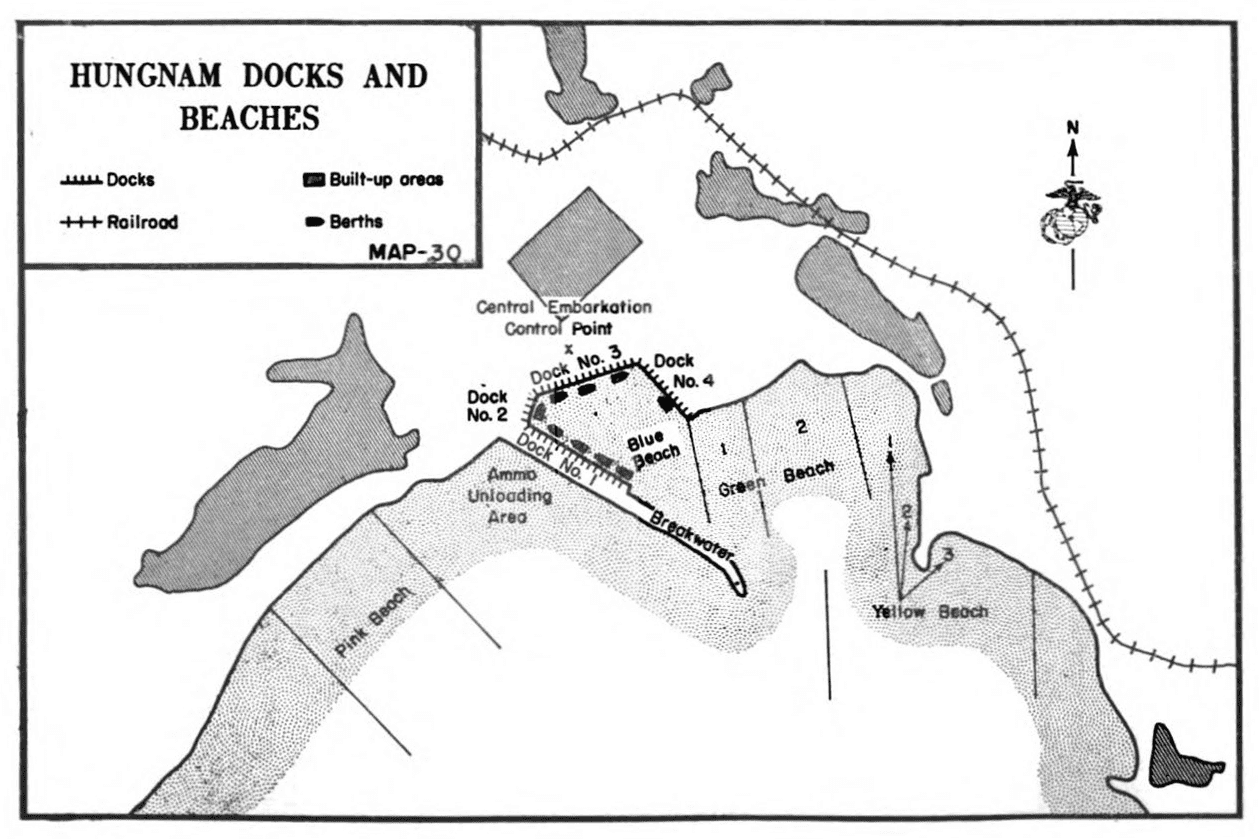
HUNGNAM DOCKS AND BEACHES
MAP-30
“With naval, air and surface units effectively isolating the beachhead, we were able to take our time and get everything out,” commented Admiral Joy on 26 December. “Admiral Doyle has turned in another brilliant performance. We never, never contemplated a Dunkirk—not even faintly.”639
Marines Arrive at New Assembly Area
While the remaining X Corps units completed outloading at Hungnam, the Marines were landing at Pusan and proceeding by motor march to their new assembly area in the vicinity of Masan. General Craig, the ADC, had gone ahead with the advance party from Hungnam and made arrangements for the reception of the Division.640
News from the front in West Korea was not encouraging as the Eighth Army planned further withdrawals, for G-2 reports indicated that the advancing Chinese were about to launch a great new offensive shortly. Despite the persistent rumors that all Korea might be evacuated by UN forces, General MacArthur insisted in his special communique of 26 December that operations “were skilfully conducted without loss of cohesion and with all units remaining intact....
In its broad implications I consider that these operations, initiated on 24 November and carried through to this [Hungnam] redeployment, have served a very significant purpose—possibly in general result the most significant and fortunate of any conducted during the course of the Korean campaign.
The might of a major military nation was suddenly and without warning thrown against this relatively small United Nations Command but without attaining a decision.
Due to intervening circumstances beyond our power to control or even detect, we did not achieve the United Nations objective.
But at a casualty cost less than that experienced in a comparable period of defensive fighting on the Pusan perimeter, we exposed before too late secret political and military decisions of enormous scope and threw off balance enemy preparations aimed at surreptitiously massing the power capable of destroying our forces with one mighty extended blow.”641
Questions as to the proper evaluation of the Eighth Army withdrawal turned into a controversy during coming months with political as well as military implications. Press representatives, military critics and soldiers of other nations, while crediting MacArthur with a great victory at Inchon, were for the most part of the opinion that the Eighth Army withdrawal of November and December was a costly reverse.642
Marine officers in Korea had no first-hand knowledge of EUSAK operations. It was obvious, however, that an Eighth Army retirement south of the 38th Parallel had made it desirable if not actually necessary for X Corps to withdraw from northeast Korea, even though General Almond held that a Hamhung-Hungnam perimeter could be defended throughout the winter.
Contributions of Marine Aviation
The close coordination of aviation with the ground forces in the Chosin campaign was due in large measure to the assignment of additional pilots to the 1st Marine Division as forward air controllers. They had been plucked from 1st Marine Aircraft Wing squadrons barely in time to join their battalions before embarking at Inchon. Increasing the number of FACs to two per battalion did much to bring air support down to the company level when needed.643
Air units frequently had to rely upon charts with place names, grid coordinates, and scales different from those in the hands of the ground troops. Here the Marine system of the man on the ground talking the pilot onto the target by reference to visual land marks paid off.
Cloudy, stormy weather was common. Three night fighter pilots were lost because of icing, disorientation, and insufficient radio aids to navigation. Two VMF-212 land-based pilots saved themselves from destruction only by landing on the Badoeng Strait with their last drops of gas.
With the approach of winter and cold weather, aircraft on the landing strips had to be run up every two hours at night to keep the oil warm enough for early morning takeoffs. Ordnance efficiency dropped. Planes skidded on icy runways. Once, after a six inch snow, 80 men and ten trucks worked all night to clear and sand a 150-foot strip down the runway at Yonpo.644
As early as mid-November it once took hours of scraping and chipping on the Badoeng Strait to clear three inches of glazed ice and snow off the decks, catapults, arresting wires, and barriers. Planes which stood the night on the flight deck had to be taken below to the hangar deck to thaw out. On another occasion VMF-214 had to cancel all flight operations because 68-knot winds, heavy seas, and freezing temperatures covered the Sicily’s flight deck and aircraft with a persistent coat of ice.
One pilot of VMF-323 had to return shortly after takeoff because water vapor froze in his oil breather tube in flight. With the back pressure throwing oil all over his windshield and billowing black vapor and smoke out of his cowl, he landed only to have the front of his Corsair burst into flames when the escaped oil dripped on the hot exhaust stacks. Quick work by the deck crews extinguished the fire.
A hazard as great as being shot down was a crash landing or bail-out at sea, where the water was cold enough to kill a man in 20 minutes. Survival clothing and equipment was so bulky that pilots could barely get into their cockpits.
Maintenance and servicing problems ashore, complicated by dirt, dust, and the scarcity of parts, kept mechanics working to the point of exhaustion. Insufficient trucks forced the ground crews to refuel and arm planes by hand, often from rusting fuel drums. Two destructive crashes, one fatal, were attributed to accumulated water in gasoline.
Aboard ship until mid-November, VMF-214 was able to keep 91 per cent of its planes operative. When suddenly deployed ashore to Wonsan, its aircraft availability dropped to 82 per cent and at Yonpo to 67 per cent. Once back at sea again in December, it jumped up to 90 per cent.
Basic difference in close air support doctrine between the Navy and Marines and Air Force were resolved by close and friendly liaison between the 1st Marine Aircraft Wing and the Fifth Air Force commands; by a Marine aviator attached to the Joint Eighth Army-Fifth Air Force Operations Center at Seoul; and by indoctrination of non-Marine units of the X Corps in the Marine-Navy style of close air support. Difficulties in inter-service communications slowed Fifth Air Force operations orders to carrier squadrons, both Navy and Marine. Messages were routed via FEAF and ComNavFe in Tokyo and arrived hours late. Ashore, even MAG-12 during the first two weeks at Wonsan received its Fifth Air Force mission orders six to 36 hours late. A direct radio teletype between 1st MAW and 5thAF headquarters alleviated the situation. And when the CG 1st MAW received full control of the air over the X Corps area on 1 December, these problems were eased.
Actual control of air support for the scattered ground units demonstrated close cooperation between the Navy and Marine Corps. This was evident from the time the Navy’s Tactical Air Control Squadron One on the USS Mount McKinley passed control to the Air Defense Section of MTACS-2 at Hamhung to the time that control returned to the ship in the Hungnam evacuation.
When the Marines had control, the ship stood by as an emergency TACC and acted as a radar reporting station for MTACS-2. When control was passed back afloat, the Air Defense Section of MTACS-2 stood by as a standby TACC aboard an LST until the last man was pulled off the beach. Furthermore, three officers from MGCIS-1 went aboard Mount McKinley to help out as Air Defense controllers. They were experienced. All through the Wonsan-Chosin campaign, the MGCIS had directed the defensive fighter patrols, circling Wonsan and Yonpo, to check all unidentified aircraft before the latter got close enough to do any damage, MGCIS-1 also steered lost planes to base in bad weather, occasionally vectored them into the GCA radar-controlled landing pattern, and even assisted MTACCS-2 in directing air support planes to FACs.645
Tactical air support in the X Corps zone was directed to the ground units by the Air Support Section of MTACS-2. From 26 October to 11 December, 3703 sorties in 1053 missions were controlled by the TACPs of Marine, Army, and ROK units. Close air support missions accounted for 599 of the total (468 for 1st Marine Division, 8 for 3d Infantry Division, 56 for 7th Infantry Division, and 67 for ROKs). The remaining 454 missions were search and attack.646
When FAC communications failed from valley to valley, aircraft became radio relays and controllers. This was highlighted by the airborne TADC, orbiting over the road from Hagaru.
Approximately half of the Marine air missions were in support of non-Marine ground units. The ROK and the U. S. Army units were not as well supplied with experienced FACs as the 1st Marine Division. In these areas four Air Force “Mosquitos” (AT-6 “Texan” training planes) were assigned to X Corps to assist in the control of air support.647
When shore-based Marine air support was about to cease with the closing of Yonpo air field, VMF-214 and VMF-212 quickly moved their operations aboard carrier; and during the final phases of the Hungnam evacuation, almost half of the Marine tactical air strength was operating from carrier bases. VMF-214 flew back aboard Sicily on 7 December without missing a mission and VMF-212, which had moved to Itami on 4 December to draw and test a new complement of carrier Corsairs, was aboard the USS Bataan eight days later. When the month ended, still another squadron, VMF-312, was polishing up its carrier landing technique for seaborne duty.648
The outcome of the Hagaru withdrawal owed much to air-dropped supplies and to casualty evacuations by General Tunner’s Combat Cargo Command (CCC). Assisting Combat Cargo in Marine support were the Wing’s R4D twin engine transports and TBM World War II type torpedo bombers, both of which were flown largely by the field-desk pilots on the Wing and Group staffs. Most of the Marines’ share of the heavy airlifting, however, was done by the four engine R5D transports of Colonel Dean C. Roberts’ VMR-152. Early in October this squadron had been temporarily shifted from the trans-Pacific airlift of the Navy’s Fleet Logistics Air Wing to support the Marines in the Wonsan campaign. In Korea its operations were controlled by the Combat Cargo Command, which committed an average of five Marine R5D’s a day into the CCC airlift. In such missions these transports supported all UN units from Pyongyang to Yonpo and points north. Marine transports not committed by the CCC for general UN support in Korea were available for Wing use. From 1 November until Christmas, VMR-152 safely carried five million pounds of supplies to the front and evacuated more than 4000 casualties.649
The Chosin Reservoir campaign opened two new chapters in Marine aviation history. The first was the use of the airborne TADC to control the air support of the division column between Hagaru and Chinhung-ni. The second was the appearance of VMF-311, the first Marine jet squadron to fly in combat. Beginning on 10 December the newly arrived squadron flew interdiction missions for four days from Yonpo. Then it moved to Pusan to operate for the remainder of the month with 5th Air Force jets streaking up the long peninsula to cover the withdrawal of the Eighth Army.650
Appreciation for the assistance given by Marine aviation to Marine ground forces was expressed in a letter of 20 December from General Smith to General Harris, the Commanding General of the 1st Marine Air Wing. The Division Commander said:
Without your support our task would have been infinitely more difficult and more costly. During the long reaches of the night and in the snow storms many a Marine prayed for the coming of day or clearing weather when he knew he would again hear the welcome roar of your planes as they dealt out destruction to the enemy. Even the presence of a night heckler was reassuring.
Never in its history has Marine Aviation given more convincing proof of its indispensable value to the ground Marines. A bond of understanding has been established that will never be broken.651
The story of air support in the Chosin Reservoir campaign would not be complete without a summary of the results of VMO-6. Marines took a proprietary interest in Major Gottschalk’s squadron, which had put into effect the helicopter techniques worked out at Quantico by the experimental squadron, HMX-1. Some of these techniques were having their first test in combat, for the development of rotary-wing aircraft in 1950 was at a pioneer stage comparable to that of fixed-wing aircraft in the first year of World War I. On 28 October, VMO-6 had a strength of 25 officers, 95 enlisted men, ten light fixed-wing aircraft (eight OY-2s, two L5Gs) and nine HO3S-1 helicopters. From that date until 15 December the squadron made 1544 flights for a total of 1624.8 hours. The principal missions were as follows:
Reconnaissance—OYs, 393; helicopters, 64; Transportation—OYs, 130; helicopters, 421; Evacuation—OYs, 29; helicopters, 191; Liaison—OYs, 35; helicopters, 90; Artillery spot—OYs, 39; helicopters, 0; Utility—OYs, 26; helicopters, 60; Rescue—OYs, 0; helicopters, 11.652
But statistics can give no idea of the most significant achievement of VMO-6 in the Reservoir campaign. For during the most critical period the only physical contact between units separated by enemy action was provided by the OYs and helicopters. The importance of this contribution can hardly be overestimated.
Losses Sustained by the Enemy
Marine losses in northeast Korea, as reported to the Secretary of the Navy, included a total of 4418 battle casualties from 26 October to 15 December 1950—604 KIA, 114 DOW, 192 MIA, and 3508 WIA. The 7313 non-battle casualties consisted largely of minor frostbite and indigestion cases who were soon restored to active duty.653 Eight Marine pilots were KIA or died of wounds, four were MIA, and three were wounded. General Smith estimated that a third of the non-battle casualties were returned to duty during the operation.654
Enemy losses for the same period were estimated at a total of 37,500—15,000 killed and 7500 wounded by Marine ground forces, plus 10,000 killed and 5000 wounded by Marine air. Not much reliance can be placed in such figures as a rule, but fortunately we have enemy testimony as to heavy losses sustained by the Chinese Communists. This evidence goes far toward explaining why they did not interfere with the Hungnam redeployment.
Contrary to expectations, Chinese military critiques have been candid in admitting failures and unsparing in self-criticism. Among captured documents are summaries of the operations of the three CCF armies encountered by the Marines in the Chosin Reservoir area. These major units, representing at least 11 and probably 12 divisions, were as follows:
20th CCF Army—58th, 59th, and 60th Divisions, with the 89th Division of the 30th Army attached;
26th CCF Army—76th, 77th, and 78th Division, with probably the 94th Division of 32d Army attached;
27th CCF Army—79th, 80th, and 81st Divisions, with the 70th Division of 24th Army attached.655
All three armies were major units of the 9th Army Group of the 3d CCF Field Army. In mid-October the leading elements of the 4th CCF Field Army had crossed the Yalu to oppose the U. S. Eighth Army. The operations of X Corps in northeast Korea being considered a threat to the left flank, the 42d Army was detached with a mission of providing flank protection, pending relief by units of the 3d CCF Field Army. Three divisions, the 124th, 125th, and 126th were represented. While the last hovered on the left flank of the 4th Field Army, the 124th was hard hit near Sudong during the first week of November by RCT-7 of the 1st Marine Division.
In order to cover the withdrawal of the remnants, the 125th Division moved south of Hagaru from the Fusen Reservoir area. Both CCF divisions then fell back to Yudam-ni, where they were relieved by units of the 20th Army, 3d Field Army. This ended the operations of the 4th Field Army in northeast Korea.
Shortly after the appearance of the 20th Army in the Yudam-ni area, the 27th Army moved into positions north of the Chosin Reservoir. Thus the enemy had available eight divisions for the attacks of 27–28 November on the Marines in the Yudam-ni area and the three 7th Infantry Division battalions east of the Chosin Reservoir. If it may be assumed that these CCF divisions averaged 7500 men each, or three-fourths of full strength, the enemy had a total of 60,000 men in assault or reserve.
The Chinese, as we know, failed to accomplish their basic mission, which prisoners agreed was the destruction of the 1st Marine Division. In every instance the efforts of the first night were the most formidable, with enemy effectiveness declining sharply after a second or third attack. The explanation seems to be that the 12 divisions were sent into northeast Korea with supplies which would have been sufficient only if the first attempts had succeeded. The following comment by the 26th Army supports this conclusion:
A shortage of transportation and escort personnel makes it impossible to accomplish the mission of supplying the troops. As a result, our soldiers frequently starve. From now on, the organization of our rear service units should be improved.656
The troops were hungry. They ate cold food, and some had only a few potatoes in two days. They were unable to maintain the physical strength for combat; the wounded personnel could not be evacuated.... The fire power of our entire army was basically inadequate. When we used our guns there were no shells and sometimes the shells were duds.
The enemy’s tactical rigidity and tendency to repeat costly errors are charged by the 20th Army to inferior communications:
Our signal communication was not up to standard. For example, it took more than two days to receive instructions from higher level units. Rapid changes of the enemy’s situation and the slow motion of our signal communication caused us to lose our opportunities in combat and made the instructions of the high level units ineffective....
We succeeded in the separation and encirclement of the enemy, but we failed to annihilate the enemy one by one. The units failed to carry out the orders of the higher echelon. For example, the failure to annihilate the enemy at Yut’an-ni [Yudam-ni] made it impossible to annihilate the enemy at Hakalwu-ri [Hagaru]. The higher level units’ refusal of the lower level units’ suggestion of rapidly starting the combat and exterminating the enemy one by one gave the enemy a chance to break out from the encirclement.
One of the most striking instances of the tactical inflexibility which stultified Chinese efforts was found at Hagaru. With only a depleted Marine Infantry battalion and service troops available to defend a perimeter four miles in circumference, the enemy needed mere daylight observation to ascertain and avoid the most strongly defended positions. Yet these were just the positions chosen for the attack, not only on the first night but also the second occasion 48 hours later.
“The [CCF] tactics were mechanical,” commented the 27th Army. “We underestimated the enemy so we distributed the strength, and consequently the higher echelons were overdispersed while the lower echelon units were overconcentrated. During one movement, the distance between the three leading divisions was very long, while the formations of the battalions, companies, and units of lower levels were too close, and the troops were unable to deploy. Furthermore, reconnaissance was not conducted strictly; we walked into the enemy fire net and suffered heavy casualties.”
Summing up the reasons why the Marines at Yudam-ni were not “exterminated promptly,” the 27th Army concludes that it was “because our troops encountered unfavorable conditions during the missions and the troops suffered too many casualties.” This would seem to be another way of saying that the Chinese failed to destroy the 1st Marine Division because they themselves were nearly destroyed in the attempt. At any rate, evidence from the enemy documents points overwhelmingly to crippling losses both from Marine fire power and non-battle casualties chargeable to lack of equipment and supplies.
The 20th Army had a hundred deaths from tetanus caused by improper care of wounds. Hundreds of other soldiers were incapacitated by typhus or ailments of malnutrition and indigestion.
More than 90 per cent of the 26th Army suffered from frostbite. The 27th Army complained of 10,000 non-combat casualties alone out of a strength of four divisions:
The troops did not have enough food, they did not have enough houses to live in, they could not stand the bitter cold, which was the reason for the excessive non-combat reduction in personnel (more than 10 thousand persons), the weapons were not used effectively. When the fighters bivouacked in snow-covered ground during combat, their feet, socks, and hands were frozen together in one ice ball; they could not unscrew the caps on the hand grenades; the fuses would not ignite; the hands were not supple; the mortar tubes shrank on account of the cold; 70 per cent of the shells failed to detonate; skin from the hands was stuck on the shells and the mortar tubes.
Testimony as to the effects of Marine fire power is also given by the 26th Army:
The coordination between the enemy infantry, tanks, artillery, and airplanes is surprisingly close. Besides using heavy weapons for the depth, the enemy carries with him automatic light firearms which, coordinated with rockets, launchers, and recoilless guns are disposed at the front line. The characteristic of their employment is to stay quietly under cover and open fire suddenly when we come to between 70 and 100 meters from them, making it difficult for our troops to deploy and thus inflicting casualties upon us.
The 20th and 27th Armies appear to have been bled white by the losses of the first week. Early in December, units of the 26th Army appeared on the east side of the MSR between Hagaru and Koto-ri, and this unit furnished most of the opposition from 6 to 11 December.
Seven divisions in all were identified by the 1st Marine Division; and since the taking of prisoners was not a matter of top priority with men fighting for existence, it is likely that other CCF units were encountered. The CCF 9th Army Group, according to a prisoner questioned on 7 December, included a total of 12 divisions. This POW gave the following statement:
Missions of the four (4) armies in 9th Group are to annihilate the 1st Division which is considered to be the best division in the U. S. After annihilating the 1st Marine Division they are to move south and take Hamhung.657
As to the reason why the Chinese took no advantage of the Hungnam redeployment, there seems little doubt that the 9th Army Group was too riddled by battle and non-battle casualties to make the effort. This is not a matter of opinion. Following the Hungnam redeployment, as the U. S. Eighth Army braced itself to meet a new CCF offensive, UN and FECOM G-2 officers were naturally concerned as to whether the remaining 9th Army Group troops in northeast Korea would be available to strengthen the CCF 4th Field Army. It was estimated that only two weeks would be required to move these troops to West Korea, where they had the capability of reinforcing the CCF attack against the Eighth Army.
Efforts to locate the 9th Army Group were unavailing for nearly three months. Then a prisoner from the 77th Division of the 26th Army was captured by U. S. Eighth Army troops on 18 March 1951. During the following week POW interrogations established that three divisions of the 26th Army were in contact with Eighth Army units northeast of Seoul.
“The only conclusion to be drawn,” comments the Marine Corps Board Study, “based on information collected by 1stMarDiv and X Corps, and that by UN and FEC, is that all corps of 9th Army Group had been rendered militarily ineffective in the Chosin Reservoir operation and required a considerable period of time for replacement, re-equipment, and reorganization.”658
Thus it appears that the Marines not only saved themselves in the Chosin Reservoir fights; they also saved U. S. Eighth Army from being assailed by reinforcements from northeast Korea in the CCF offensive which exploded on the last night of 1950.
Results of the Reservoir Campaign
There could be no doubt, after taking into account the CCF mission, that the 9th Army Group, 3d Field Army, had sustained a reverse in northeast Korea which amounted to a disaster. On the other hand, it might have been asked whether a retrograde movement such as the Marine breakout, even though aggressively and successfully executed, could be termed a victory.
This question involves issues too complex for a clearcut positive answer, but it would be hard to improve upon the analysis of results in the Marine Corps Board Study:
Although the operations of this phase constitute a withdrawal, despite the fact that CG 1stMarDiv characterized them as “an attack in a new direction,” the withdrawal was executed in the face of overwhelming odds and conducted in such a manner that, contrary to the usual withdrawal, some very important tactical results were achieved. These may be summarized as follows:
1. Extricated 1stMarDiv from a trap sprung by overwhelming enemy ground forces by skilful employment of integrated ground and air action which enabled the Division to come through with all operable equipment, with wounded properly evacuated and with tactical integrity.
2. Outfought and outlasted at least seven CCF divisions under conditions of terrain and weather chosen by the enemy and reputedly to his liking. Although frostbite took a heavy toll of the Division it hit CCF units far harder, perhaps decisively.
3. In the process of accomplishing “2” above, rendered militarily non-effective a large part of 9th CCF Army Group. Those units not contacted by 1stMarDiv were fixed in the Chosin Reservoir area for possible employment against the Division and consequently suffered from the ravages of sub-zero cold and heavy air attacks.
4. As a direct result of “3” above, enabled X Corps to evacuate Hungnam without enemy interference and, consequently, as a combat effective unit with all personnel and serviceable equipment. Pressure on X Corps by 9th CCF Army Group during the seaward evacuation of the Corps, a most difficult operation, would undoubtedly have altered the result.659
Improvisations in tactics were now and then made necessary by unusual conditions of terrain, weather or enemy action. But on the whole the Marines saved themselves in the Reservoir campaign by the application of sound military tactics. In the doing they demonstrated repeatedly that the rear makes as good a front as any other for the militarily skilled and stout-hearted, and that a unit is not beaten merely because it is surrounded by a more numerous enemy.
Inevitably the Marine campaign has been compared to that classic of all military breakouts—the march of the immortal Ten Thousand which is the subject of Xenophon’s Anabasis. Stranded in the hostile Persian Empire in the year 401 B. C., these Greek mercenaries cut their way to safety through Asiatic hordes. The following description of the tactics used by Xenophon and his lieutenant Cherisophus to overcome road blocks in mountain country will have a familiar ring to Marine veterans of the Reservoir:
The enemy, by keeping up a continuous battle and occupying in advance every narrow place, obstructed passage after passage. Accordingly, whenever the van was obstructed, Xenophon, from behind, made a dash up the hills and broke the barricade, and freed the vanguard by endeavoring to get above the obstructing enemy. Whenever the rear was the point attacked, Cherisophus, in the same way, made a detour, and by endeavoring to mount higher than the barricaders, freed the passage for the rear rank; and in this way, turn and turn about, they rescued each other, and paid unflinching attention to their mutual needs.660
Spears and arrows have been superseded by bazookas and machine guns, but the basic infantry tactics of the Reservoir breakout were essentially those which served Xenophon and the Ten Thousand more than 33 centuries ago. Organization, combat, training, spirit, and discipline enabled the Marines, like the Hellenes before them, to overcome numerical odds and fight their way over Asiatic mountain roads to the sea.
The over-all strategic effects of the Reservoir campaign, as summarized by the Marine Corps Board Study, were as follows:
1. Played a prominent part ... in enabling X Corps, a considerable segment of the total UN forces in Korea, to be withdrawn from Hungnam as a combat effective force available for employment with the Eighth Army in South Korea at a time when that Army was retreating and was in critical need of a reinforcement.
2. Were largely responsible for preventing reinforcement of CCF forces on Eighth Army front by 12 divisions during a period when such reinforcement might have meant to Eighth Army the difference between maintaining a foothold in Korea or forced evacuation therefrom, by being instrumental in rendering 9th CCF Army Group, a force of three corps of four divisions each, militarily noneffective for a minimum period of three months.
That the breakout of the 1st Marine Division had affected American political and military policy at the highest levels was the assertion of an editorial in Time. Referring to what it termed the “Great Debate,” in December 1950, as to whether American forces should be withdrawn from Korea, the news-magazine commented:
When the Marines fought their way down to Hungnam through the “unconquerable Chinese hordes,” and embarked for Pusan with their equipment, their wounded, and their prisoners, the war in Asia took on a different look. The news stories, pictures and newsreels of the Hungnam action contributed more to forming U. S. policy than all the words in the “Great Debate.” The nation—and the revitalized Eighth Army—now knows that U. S. fighting men will stay in Korea until a better place and a better opportunity is found to punish Communist aggression.661
General Douglas MacArthur as CINCUNC, in his 11th report of operations of UN forces in Korea, submitted the following to the United Nations Organization regarding the Chosin Reservoir operation:
In this epic action, the Marine Division and attached elements of the 7th Infantry Division marched and fought over 60 miles in bitter cold along a narrow, tortuous, ice-covered road against opposition of from six to eight Chinese Communist Force divisions which suffered staggering losses. Success was due in no small part to the unprecedented extent and effectiveness of air support. The basic element, however, was the high quality of soldierly courage displayed by the personnel of the ground units who maintained their integrity in the face of continuous attacks by numerically superior forces, consistently held their positions until their wounded had been evacuated, and doggedly refused to abandon supplies and equipment to the enemy.
United Nations Air Forces threw the bulk of their effort into close support of ground forces cutting their way through overwhelming numbers of Chinese Communists. The toll of the enemy taken by the United Nations aircraft contributed in large measure to the successful move of our forces from the Chosin Reservoir to the Hamhung area despite the tremendous odds against them. Air support provided by the United States Marine Air Force and Naval Aircraft in this beleaguered area, described as magnificent by the ground force commanders, represented one of the greatest concentrations of tactical air operations in history.662
Rear Admiral James H. Doyle attributed the successful evacuation at Hungnam in large measure to the Marine breakout. Writing to General Smith several months later, he asserted that he had “filled in what has been a neglected page in the story of the Hungnam redeployment. It is simply this: that the destruction of enemy forces wrought by the First Marine Division on the march down the hill was a major factor in the successful withdrawal; and that the destruction was so complete the enemy was unable to exert serious pressure at any time on the shrinking perimeter. To my mind, as I told you at Hungnam, the performance of the First Marine Division on that march constitutes one of the most glorious chapters in Marine Corps history.”663
Letters of commendation were received by the 1st Marine Division from General Cates, CMC, General Shepherd, Admiral Joy, General Collins, Chief of Staff, USA, General Almond, and many other high-ranking military leaders. But for depth of feeling, for sincerity and emotion, there was no message which appealed more to the officers and men of the Division than the concluding paragraph of this tribute from the commanding general who had guided their destinies with unswerving courage and who had come out with them, Major General Oliver P. Smith:
The performance of officers and men in this operation was magnificent. Rarely have all hands in a division participated so intimately in the combat phases of an operation. Every Marine can be justly proud of his participation. In Korea, Tokyo and Washington there is full appreciation of the remarkable feat of the division. With the knowledge of the determination, professional competence, heroism, devotion to duty, and self-sacrifice displayed by officers and men of this division, my feeling is one of humble pride. No division commander has ever been privileged to command a finer body of men.664