SPECIALIZATION OF THE NORTH PACIFIC CANOE INTO DIFFERENT MODELS
Reading edition
In the year 1806 Lewis and Clark noted that the Indians on Columbia river possessed a number of different types or models of canoes.[3] Among more recent authors, Boas,[4] Gibbs,[5] Swan,[6] Niblack,[7] and Curtis,[8] have made observations to a similar effect. It may be relied on, therefore, that in the whole area which lies between Columbia river and southern Alaska, the canoe has
WATERMAN—CANOES PL. I DIAGRAM REPRESENTING THE SIX TYPES OF CANOES ON PUGET SOUND (a, the “war canoe”; b, the “freight canoe;” c, the “trolling canoe”; d, the “shovel-nose canoe”; e, the “one-man canoe”; f, the “children’s canoe,” used by children and as a knockabout.)

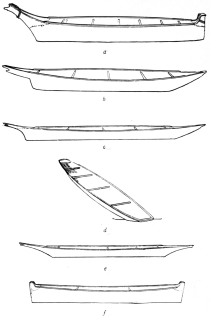
been evolved into a number of highly specialized forms. Various writers, however, classify canoes in somewhat different ways. Gibbs, and Lewis and Clark seem to imagine that the various forms are characteristic of different tribes. With Curtis and Niblack the essential thing in classification seems to be a matter of size. Boas alone has given the proper weight to differences in form.[9] On Puget sound at the present time there are six types of canoes in use, which are distinguished by the Indians not on account of their size but by differences in the shape of the hull. The variation in shape is very wide. On these waters one type of canoe is built for going to sea, and the lines of the hull are designed with the idea of enabling the craft to ride waves without shipping water. Every inch of the model is carefully calculated to keep it “dry.” No better craft for rough water, by the way, has ever been devised. The canoe rides the combers better than the white ma1’s boat. This was noted by Lewis and Clark[10] more than a hundred years ago, and similar comments are made today, even by men who follow the sea. A second type of canoe is designed for use on rivers and lakes. The bow and stern of this second model are cut off square, making the craft very convenient for poling. In spearing salmon in the streams, also, a spearsman can ride on the extreme tip of the bow and strike fish almost under his feet, while a companion paddles. This canoe is of little use in open waters. The salt-water villagers take the fish by means of nets and traps only. Each of the types in this way has its own particular uses. The series as a whole is an example of high specialization in a seafaring mode of existence.
Characteristic specimens of each of the six types used on Puget sound are illustrated in the accompanying diagram (pl. I). In order to bring out differences in outline, the drawings have been reduced to one length.
In actual practice each model of canoe is made in a large range of sizes, a matter which can hardly be presented in a diagram. Specimens of model a (pl. I) exist which are, for example, only 16 ft. long, while one other specimen of the same model exists which
WATERMAN—CANOES PL. II DIAGRAM SHOWING (a) THE SHOVEL-NOSE CANOE USED ON PUGET SOUND, AND (b) THE CANOE USED BY THE YUROK OF NORTHERN CALIFORNIA
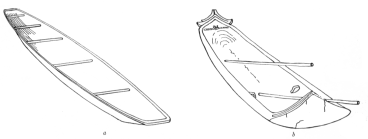
has a length of 80 ft. Model b in the diagram is usually made of fairly good size, in the neighborhood of 22 ft. long; but there is great variation in specimens. Model c is always small, and model f is never very large. We have not examined a large enough number of canoes to make it worth while to publish the measurements taken. The specimens from which the drawings were made were collected in the immediate neighborhood of Seattle and are in the Museum of the American Indian, Heye Foundation.
Fig. 1.—Diagram showing the outline of the “Alaska” canoe, used by the Kwakiutl, Tsimshian, and Haida. It is occasionally seen on Puget sound. (After a diagram in Boas, 1909.)
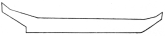
An additional type, the great “Alaska” canoe, called by the Salish tsaba´xad, is sometimes seen on the sound. Such canoes came down from the north, manned usually by Haida from the Queen Charlotte islands, or by Nootka from the west coast of Vancouver island; occasionally by people of other tribes. These canoes were not used by the Puget Sound people, and were looked on with some curiosity. Their outline is shown in fig. 1 (after Boas).