POINTS OF INTEREST IN THE VARIOUS TYPES
Reading edition
A.—The “War Canoe” (αο´τος)
The Songish about Victoria, B. C., have this model, which they call a´tqEs.[11] Its most characteristic features, both there and here, are a prominent and lofty bow and stern. These consist, on Puget sound, of separate sections hewn out of cedar and fitted carefully into their places on the hull. They are fastened there by pegs of cedar (st’Δ´stΔd, the word now applied to nails) and lashings of twisted cedar withes (sti´dΔgwΔt), and the joint is watertight without being “pitched” (see Swan, 1868, for the method of fitting). Artistically, the shape of the prow strongly suggests an anima1’s head, and gives the canoe (which is exquisite in design) an air of alertness, as though it were moving of its
WATERMAN—CANOES PL. III TWO SUQUAMISH “WAR CANOES” LASHED TOGETHER AND CARRYING A PLATFORM OF POLES This device was used in transporting house-planks and for moving large quantities of effects from one site to another. (Photographed at Suquamish, Washington, 1913.)

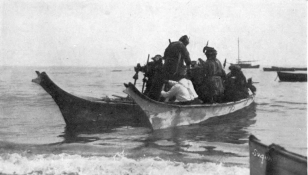
own accord. From the practical standpoint these elevated additions to the hull are designed to throw aside the seas. The naked hull without these bow and stern pieces would soon fill in rough water. The pieces seem so slender and inadequate that an observer would doubt their effectiveness for such a practical end. The answer is that in the course of generations they have been reduced to the most slender proportions which will give the necessary protection, and they are wonderfully effective in aiding the actual navigation of the canoe. Many Indians and whites who have followed the sea tell us that this type of canoe ships less water in a storm than any craft in the world. If we are looking for a catchword, we may call this the “ocean-going canoe.”
A number of other terms have been applied to this class of vessel. A popular term in the Northwest is the word “Chinook.” We find, for example, the “Chinook” wind, the “Chinook” jargon, and “Chinook” salmon. “Chinook” is also applied by Indians and whites to the type of hull just described, and appears in that sense in the works of Swan and Boas. The term, bearing in mind, of course, that it is used in a general sense and is not necessarily to be associated with the Chinook tribe proper, living at the mouth of the Columbia, is distinctive, and has the advantage of usage behind it. Locally, on Puget sound, the model goes commonly by this name. This same type of hull is found in use by all the tribes from Columbia river northward to the Quatsino, living at the northern end of Vancouver island.[12] North of this area, among the Kwakuitl and Tsimshian, Haida and Tlingit, the sea-going canoe is different, and is of the type illustrated in fig. 1. Niblack[13] and Boas[14] have noted the distinction between the sea-going canoes of the south and those of the north, and Niblack illustrates it with a somewhat misleading figure. Niblack calls this northern model the “north coast type,” while Boas styles it the “Tsimshian” model. The terms “Tsimshian” and “Chinook” might well be used as catchwords to mark the distinction between the two varieties: one found along the coast of Alaska and British Columbia, the other
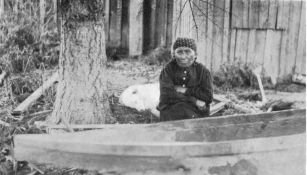
WATERMAN—CANOES PL. IV BOW OF THE HULL SHOWN IN PLATE V, VIEWED FROM THE SIDE, WITH THE MAKE1’S WIFE, MARY ADAMS (TAI´PΔS) SEATED BESIDE IT (Photograph by J. D. Leechman.)
occurring on the west coast of Vancouver island and southward as far, at least, as Columbia river.
B.—The “Freight Canoe” (sti´waL)
The freight canoe differs in several respects from the foregoing. It never reaches the great size which the first-mentioned type sometimes attains, though specimens exist which are as much as 40 ft. in length. The cutwater in this type is vertical, or nearly so. This is the point mentioned by the Indian informants as the characteristic thing. The Songish term for this craft, sti´uwaitatl, is translated by Boas as “having a square bow.” I can find no reason for this peculiarity, nor advantage in it. An extra piece of cedar is carved and fitted with dowels on the prow of this craft also, “lifting” the lines of the hull somewhat. This piece differs greatly from the pieces fitted on the ocean-going canoe. The stern is modeled out of the original log. The tip of the prow is shaped into a “notch” resembling an open mouth. This type of canoe is used for journeys with household possessions in quiet waters. In a storm it is not particularly safe.
C.—The “Trolling Canoe” (sdΔ´χωιL)
This craft has a very narrow hull, and the bow has more lift than in the preceding model.[15] Specimens of this type are usually relatively small, designed to carry only two or three men. This was the vessel used for hunting, for harpooning porpoise and otter, and in trolling for fish. The model exhibits some elegance of design. We may perhaps follow Boas in calling this craft the fishing or trolling canoe. A very large canoe of this model was called sdΔxwi´lūs. For hunting the porpoise a very swift canoe was needed, for the animal was alert, and hard to harpoon. Boas gives a complete account of the pursuit, as carried on by the Kwakiutl. The term for porpoise-hunting on Puget sound is ca´sab. The canoe intended for this purpose was called casa´bhwlL. It was of the type being discussed, but a fine, “clear” model and had to be fast.
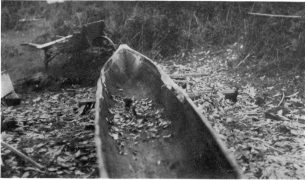
WATERMAN—CANOES PL. V INTERIOR VIEW OF THE HULL OF A SUQUAMISH “HUNTING CANOE” IN PROCESS OF MANUFACTURE Made by Jack Adams (Xa´bsus), near Suquamish, Washington, in March, 1920. (Photograph by J. D. Leechman.)
D.—The “Shovel-nose Canoe” (τL´αι)
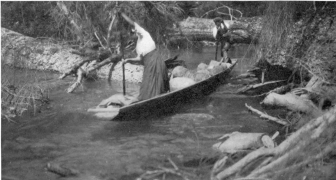
This type of canoe is called the “shovel-nose” because it is cut off square at bow and stern and the hull scoops forward like a shovel. The Songish visited by Boas have the same term, t1’lai, but the model pictured by Boas has a configuration somewhat different in certain details from the Puget Sound specimens seen. On the sound, the boat is hewn from one piece, while the Songish are said to add on the flattened end in the form of a separate plank. In spite of its shape the “shovel-nose” is in appearance anything but clumsy. It is excellently designed for a special purpose. A man may stand at the tip-end of bow or stern, and push with a pole, in shallow water. The people also who live up the rivers depend on this type of canoe for the spearing of salmon. When the fish are running in the rivers, one man paddles in the stern while a companion stands at ease out on the extreme end of the prow, with his spear poised ready for fish. His position there is ideal for striking salmon, since he lunges at fish almost directly under his feet. The bow-end of this boat is more slender than the stern. This type of boat is useful only in quiet waters. A characteristic piece of equipment is the canoe pole, he´Δqalsιd. Such a canoe is fine for sandbanks and shoals where the heavy Chinook type, with its features designed for protection against waves, is largely useless. Far up the rivers no canoes other than the shovel-nose are seen. The “salt-water” people, or “xwaldja´bc,” relate with amusement that “forest-dwellers,” or La´labιw, that is, the people living up the rivers, have only one word for canoe. “If it is a sdΔ´χωιL, or if it is a sti´waL, or even if it is a big αο´τχς, they call it a ‘shovel-nose,’ just the same.”
Some of these “fresh-water” Indians some years ago came voyaging down to Port Washington inlet, near the navy yard at Bremerton, in a shovel-nose canoe. In trying to negotiate the channel during a breeze and a change of tide, their canoe, which was not designed for such operations, filled and sank under their feet, and they lost their lives.
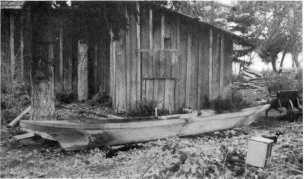
WATERMAN—CANOES PL. VI THE FINISHED HULL OF THE CANOE SHOWN IN PLATES IV AND V To the left in the photograph is the bow, which in this case lacks the “notch” found in many specimens. The “lift” of the boa1’s lines toward the prow may be plainly seen. This enables it to ride the waves. (Photograph by J. D. Leechman.)
E.—The “One-man Canoe” (di´twiL)
This is a very diminutive vessel, the smallest of all the Northwestern canoes. The term is grammatically the diminutive of sdΔ´wiL (c in the diagram, pl. I). Nevertheless, as a glance at the drawing will show, its hull differs somewhat in shape from that of its larger namesake. The di´twiL will carry only one person; but it is often very beautifully made. Specimens capsize very easily, but so long as they remain right-side up, they may be driven at high speed, and are light enough to be easily lifted and carried from place to place. They were used for fishing, and, following the introduction of firearms, for hunting ducks. Firing a shotgun over the side, however, turns the craft over. Bow and stern are finished off with very small carved pieces, which are set in place with the usual cedar pegs, and the bow carries the “notch” characteristic of the larger type. The canoe is rigged with thwarts, but the huntsman sits, not on these, but flat on the bottom of the boat. We may perhaps speak of this type as “the one-man canoe.”
F.—The “Children’s Canoe” (qe´lbιd)
The canoe pointed out under this name is a “double-ended” type. The Indians describe it as a craft with two sterns. Its ends, which are identical in shape, are finished off to resemble the stern of the big war-canoe shown in pl. I, a. This craft, while not of great length, is very heavy, since the sides are relatively thick, and it is also very wide in the beam. It was used for the commonest purposes. Children got their first knowledge of the handling of canoes by “practising” with it. While the sides are not adzed down to the thinness which characterizes the hunte1’s craft, the vessel is nevertheless well designed in its own way and is much lighter and more manageable than a white-ma1’s boat. It is worth noting that the word qe´lbιd, given as the term for this type of boat, is the general word for canoe. The term dl1’e´dwlL was also applied to this type. We may perhaps speak of this form of craft as the “children’s canoe.”
WATERMAN—CANOES PL. VII A “SHOVEL-NOSE” CANOE IN ACTION Scene on the upper waters of Quinault river, coast of Washington. (Photograph by J. H. Weir, of “The Mountaineers.”)