APPENDIX.
Reading edition
Some Statistics of the War.
Total enlistment in the United States army 2,778,304
Total enlistment in the Confederate States army 600,000
FIRST.
Number of Foreigners in the United States Army.
German 176,800
Irish 144,200
British Americans 53,500
English 45,500
Other foreigners 74,900
Total foreigners 494,900
Whites from the South 276,439
Negroes from the South 178,975
Total 455,414
Grand total 950,314
Here you will discover a force 350,414 stronger than the whole Confederate army, without enlisting a native-born citizen of the North; also that the South furnished the North 455,414 men.
SECOND.
New York troops enlisted 448,850
Pennsylvania troops enlisted 337,936
Total 786,786
Here is an army larger than the Confederate States army.
THIRD.
Illinois furnished (men) 259,092
Ohio furnished (men) 313,180
Indiana furnished (men) 196,336
Total 768,608
Here we have a second army larger than the Confederate army.
FOURTH.
The New England States furnished 363,162
The slave States furnished (whites and negroes) 455,414
Total 818,576
Here is a third army larger than the Confederate army, and the fourth army came from the excess of numbers in the three preceding ones.
But the most remarkable fact is, that there were in the United States army 950,314 men that should be called foreigners, as none belonged to the North by birth.
In connection with the number of foreigners in the United States army, I will remark that Gen. Benjamin F. Butler, of Massachusetts, in his argument before the Tewksbury Almshouse investigating committee, July 15, 1883, said: "Before you go to throwing ridicule on the foreign-born, let me tell you that you had better look into the question of who fought your battles. In the first place, look at the per cent of what birth the inmates in our soldiers' homes were; fifty-eight and one-half per cent of the soldiers in these homes are of foreign birth."
Again he said: "Some of us stayed at home and pressed soft cushions of skinned paupers while these foreigners so much sneered at were fighting our battles."
In regard to the tanning of the skins of the dead inmates of the almshouse, Butler quotes from Carlyle (page 354), and goes on to say that at Meudon the skins of the guillotined were turned into good wash leather and made into breeches for paupers. So the paupers in France were dressed in the skins of my lord and lady, "while in Massachusetts it was our aristocrats that wore slippers made from the breasts of women paupers." Matters here are reversed—it is my lord and lady who wear such slippers.
It may be of some interest to quote further from Butler. In contrasting the expenses of the soldiers' home (one of them) he said it took 278 turkeys for their Thanksgiving dinner, and their last "potpie" required 34 sheep, 15½ barrels of potatoes, and 2 barrels of flour. During the year they ate 758 head of cattle, 1,659 head of sheep, 3,714 barrels of flour, 15,744 dozen eggs, 154,932 pounds of butter, 69,289 pounds of coffee, 57,941 pounds of fish, 7,950 pounds of tea, 10,570 cans of tomatoes, 16,431 pounds of rice, 110,440 pounds of sugar, 21,325 pounds of prunes, and other articles too numerous to mention, amounting to the sum of $204,728, hereby establishing that the inmates of the soldiers' home were fed cheaper and better than the paupers of the Tewkesbury almshouse.
I refrain from naming the horrors of this institution in Massachusetts; but the men who are fond of the horrible depravity of mankind, for money, can find their taste gratified in Butler's pamphlet, illustrated by photographs of tanned skins, etc.
Civilization, even among the cultured, is sometimes a diaphanous garment to hide the infernal. "Nature still makes him; and has an infernal in her as well as a celestial."
Well might it be said by an English writer that "the men in the North could, for a moderate sum, engage substitutes to vicariously die for them, while they sipped their wines at the clubs in safety."
Percentage Killed and Wounded in Late Wars.
Allies in the Crimea 3.2 per cent
Austrians in 1866 2.6 per cent
Germans in the Franco-German war 3.1 per cent
Federals in the Confederate war 4.7 per cent
Confederates in the Confederate war 9.0 per cent
Slave Owners in the Confederate Army.
This question, as far as I am informed, has not been analyzed to separate it from the concrete mass of men that composed the Confederate army. This is desirable to establish what influence they had in deciding the Southern States to secede from the Union, and the solution of it should give the number of slave owners in the army.
The white population of these States was, in 1860, about 8,300,000. There were 346,000 whites who owned slaves. These figures represent and include men of all ages, widows, and minors: also young married women who owned the servant usually given them.
Now divide 8,300,000 by 346,000, and we have 8,300,000/346,000==24, which shows that only one person in twenty-four was a slaveholder, and we know not what number in this twenty-four were women, orphans, and old men. If allowance be made for the old men, women, and minors, there would not be over four able-bodied men to the one hundred; hence in a company of one hundred soldiers four would be slave owners. In a regiment of one thousand there would be forty, in ten thousand there would be four hundred, and in the whole Confederate army of six hundred thousand there would be only twenty-four thousand who represented slavery. The remainder (600,000-24,000) would be 576,000 who were not slave owners! This number, however, might be reduced by young men heirs apparent of slaves.
Henceforth, then, let it be known that the Confederate army was not an army of slave owners. To the people of the South it was well known that the slaves were fast becoming the property of the owners of large estates, and on many sugar and cotton plantations there were from one to two hundred negroes employed. The tendency was to consolidate labor, as it was more profitable. Therefore it was that the Confederate army was mainly composed of men as free from interests in slavery as were the men living in sight of Bunker Hill. These men were contending for an object far more dear to them than any arising from slavery. They had seen the accumulated funds of the United States treasury expended in making harbors for towns on the great Northern lakes yearly, and in digging deep-water channels for Eastern cities, and appropriations for little creeks called rivers; while the harbors of the Southern cities were neglected. Then, again, the tariff almost invariably discriminated against the South, even to the extent of nullification, almost thirty years anterior to the war; then the fugitive slave act was nullified by Northern State laws; "underground railroad" was a term used to express how negro slaves were conveyed under cover of the night to the North when enticed from their owners. They openly published that the Constitution was a "compact made with the devil;" and the hatred of the North and the West was so widespread that by a sectional party vote they elected a President antagonistic to the South. These are but a few of the acts that caused secession; and yet he who believes that secession was entertained by more than a mere majority of the people South is mistaken. Genuine love and an abiding fidelity to the Constitution were ever found in the South. Her cause for complaint also was that the people of the North and West, actuated by hatred of the people South, proclaimed that the higher law of conscience was superior to the Constitution!
Events came on apace. The Southern people were homogeneous, "to the manner born." Save only in the commercial cities were there any foreigners and but few Northerners. North Carolina did not have quite one per cent foreign; the West had about thirty-five per cent. (Census Report.)
When coercion of the South was proclaimed, it was the homogeneousness of her people that solidified both parties at once to a common defense of their homes, and these five hundred and seventy-six thousand soldiers, without interest in slavery, for four years fought for the right of their people to govern themselves in their own way. Their deeds are now a matter of history that will, by them, be recorded, contrary to the past rule, that the conquerors always write history.
Appomattox terminated the war only—it was not a court to adjudicate the right of secession—but its sequence established the fact that secession was not treason nor rebellion, and that it yet exists, restrained only by the question of expediency. Wherefore the Union will be maintained mainly by avoiding sectional and class legislation, and remembering always that in the halls of legislation the minority have some rights, and in the minority the truth will generally be found.
The charge, then, that the slaveholders, so few in number, forced secession, or that the five hundred and seventy-six thousand nonslaveholders who really constituted the Confederate army were battling to maintain slavery, is a popular error.
The cry at the North that the South was fighting to maintain slavery was proclaimed (as I have elsewhere said) to prejudice the Emperor Napoleon III. and the English Cabinet against forming an alliance with the Confederate States; but the power of public opinion and the press were such that they were obliged to remain neutral; for this constrained neutrality England was rewarded by being forced, when the war ended, to pay the United States the sum of fifteen million dollars—the Geneva award—for the ships destroyed by Admiral Raphael Semmes, Confederate States Navy; and France was rewarded by obliging Napoleon to withdraw his troops from Mexico, and leave poor Maximilian to his fate—a warning for weak men thirsting for empire.
Prison Deaths and Prisoners.
The number of Confederate prisoners in Northern prisons was 220,000, and the number of Federal prisoners in prisons South was 270,000.
Death rate in Northern prisons 12 per cent
Death rate in Southern prisons 9 per cent
See the report of Secretary Stanton, made July 9, 1866; also the report of Surgeon General Barnes, United States Army.
Some of the Brigade Losses in Particular Engagements.
Gettysburg Garnett's Brigade (Va.) Pickett's Division 65.9 per cent
Gettysburg Perry's Brigade (Fla.) Anderson's Division 65 per cent
Antietam Wofford's Brigade (Tex.) Hood's Division 64.1 per cent
Franklin Cockrell's Brigade (Mo.) French's Division 60.2 per cent
Chickamauga Benning's Brigade (Ga.) Hood's Division 56.6 per cent
There are thirteen more brigades with losses, varying in numbers, before the percentage is reduced to forty per cent.
Percentage of Loss in Some Regiments in Single Battles.
Gettysburg Twenty-First North Carolina 90 per cent
Gettysburg First Missouri 82 per cent
Gettysburg Twenty-Sixth North Carolina 88.5 per cent
Antietam Twentieth Texas 82.3 per cent
Antietam Twelfth Massachusetts 67 per cent
Antietam Twenty-First Georgia 76 per cent
Antietam One Hundred and First New York 71 per cent
And so on. There are over fifty regiments in the Confederate army before forty per cent is reached. How many there are in the Federal army I do not know. (From "The Confederate Soldier in the Civil War," and other sources.)
The Authority to Tax
is the greatest power a people can give a government, yet it is a necessary measure, but often dangerous; it can be used to impoverish a people, or enrich a comparatively few individuals, or to rob one section of a vast country to build up another. It has caused more distress than droughts or floods; it has caused more insurrections, revolutions, and wars than all other acts of man intrusted with authority. There are many modes of taxation, but the most insidious one is the quiet robbery by a tariff.
This might be demonstrated by the United States pension laws. The pensioners (and I am a Mexican war pensioner) receive as a free gift from the treasury the sum of about one hundred and fifty million dollars annually. It goes to enrich the people of the States where they reside.
If there be no pensioners living in any one State, that State contributes to support the pensioners, but receives nothing in return: so, if all the pensioners were to become citizens of any one State, that State would receive in pension money one hundred and fifty million dollars yearly, or in fifteen years the enormous sum of two billion two hundred and fifty million dollars derived by taxation of the people in the other States, less the sum that one State paid and returned to it.
Now, if all the pensioners, from any cause, should migrate to Ohio, or North Carolina, would the other forty-four States be taxed for (say) the benefit of the people of the State of North Carolina in the sum of two billion two hundred and fifty million dollars during the next fifteen years? No, never.
The presumption is that the Southern States pay, under the revenue laws, one-third of the revenue collected. If so, then the South pays the pensioners about fifty million dollars annually, and receives in return only the small sum paid the few pensioners residing within the Southern States; and thus one section of the country is taxed, under the revenue tariff laws, to enrich the other, Q. E. D.
Cost of the War.
The total cost of the war between the States was, to June 30, 1879 $10,861,929,909
Value of the slaves confiscated and emancipated 3,000,000,000
Destruction of property in the South (estimated) 600,000,000
Naval Power of the United States.
The following enumeration of the vessels in the United States service will convey some idea of the power of the North:
Seven hundred vessels were employed in blockading our coast and guarding our rivers.
During the year 1862-63 there were 533 steamers, barges, and coal boats belonging to the United States on the Mississippi river and its tributaries; and at the same time the United States Quartermaster's Department chartered 1,750 steamers and vessels to aid Gen. Grant in his operations against Vicksburg. In short, there were 2,283 vessels, exclusive of iron-clad mortar boats, operating to capture Vicksburg. The actual siege commenced May 18, and ended July 4, 1863, embracing a period of forty-seven days.
Names, Rank, and Positions of Officers on My Staff.
Abercrombie, Wiley, Lieutenant, Aid-de-Camp.
Anderson, Archer, Major, Aid-de-Camp.
Archer, C., Lieutenant, Ord. Officer.
Baker, J. A., Captain, Aid-de-Camp.
Baldwin, John M., Captain, Acting Ord. Officer.
Cain, W. H., Captain, Commissary.
Danner, Albert, Captain, Quartermaster.
Daves, Graham, Major, A. A. General.
Drane, N. M., Captain, Quartermaster.
Freeman, E. T., Lieutenant, A. A. I. General.
Haile, Calhoun, Lieutenant, Aid-de-Camp.
Harrison, William B., Major, Chief Surgeon.
Morey, John B., Major, Chief Quartermaster.
Myers, C. D., Lieutenant, Aid-de-Camp.
Overton, M., Captain, Ord. Officer.
Reynolds, F. A., Captain, A. A. General.
Robertson, N. H., Lieutenant, Artillery.
Rogers, H. J., Captain, Engineer.
Sanders, D. W., Major, Adj. General.
Shingleur, James A., Lieutenant, Maj. and A. A. G.
Shumaker, S. M., Major, Chief Artillery.
Storrs, George S., Lieutenant, Maj. and Chief Art.
Venet, John B., Captain, Engineer.
Yerger, James R., Lieutenant, Aid-de-Camp.
Thomas, Grigsby E., Sergeant, Ordnance.
Government in Louisiana, 1875-76.
The forces that were developed during the last two years of the war found a wide field for operation as the Union troops marched through the South, and induced the troops to plunder, because there was money in it, and when the war ended this force entered the wide area of reconstruction, and produced those cursed scenes witnessed all over the South, because there was money in it, and yet when the States were admitted into the Union it was natural to suppose that its power for evil was spent. Not at all; it rallied, and entered the field of politics; debased by all the license of war, which exempted them from punishment for all crimes, they sold themselves for a price, and the dual governments commenced: the one established by the property owners and respectable people, the other by the carpetbaggers, scalawags, and negroes. Here were offices by election and by appointment affording almost unlimited opportunity to plunder. They had no conscience when they could put money in their pockets.
To illustrate, I will, as briefly as I can, take the State of Louisiana. In 1875 this State had two rival courts, two opposing Legislatures. One was the radical carpetbaggers, and the other conservative. There were three governors; also United States Senators, black and white, and Gen. P. H. Sheridan was military director; and over and above all the United States intermeddling in her affairs. The rival courts were occupied in reversing the decisions of each other, the Legislatures in passing bills that were not valid for the want of a quorum, or obtaining the signature of the right governor, whether of Kellogg, Warmouth, or McEnery (the three governors).
As this threefold government presaged the probability of the radical party not receiving the electoral vote of the State in the coming election for President, something had to be done to accomplish it. Accordingly the President directed the Secretary of War to issue an order directly and secretly to Gen. P. H. Sheridan, who was in Chicago, to proceed to New Orleans, and it was suggested that he should make the journey appear as one undertaken for recreation. So he and some of his staff, and a party of ladies on pleasure bent, sailed down the turbulent Mississippi river to New Orleans, and established headquarters in the St. Charles Hotel.
Sheridan's secret orders, dated December 24, 1874, were sent to him direct from the Secretary of War, and without the knowledge of Gen. Sherman, commanding the army, or of Gen. McDowell, commanding the Department of the South, which embraced Louisiana, with his headquarters in Louisville, Ky.; but he was advised that he might stop and make known to Gen. McDowell the object of his mission if he deemed it proper to do so, but he passed by without seeing McDowell. On arriving in New Orleans he made the State of Louisiana a part of his department, and then issued his decree declaring the people of the state "banditti." This alarmed the President. It was too imperialistic. Sheridan then suggested that Congress be called on to pass an act in a few words making the people banditti. The President declined. Then the chief of the banditti advised the President to issue an order through the War Department declaring the people banditti, and to leave ALL TO HIM, and he would quell them without giving him (the President) any further trouble. In all this there is a thirst for blood and punishment by military authority. But Grant, sitting on the ragged edge of imperialism, declined to support his man-of-all-work on the banditti question. But still undaunted, Sheridan perchance recalled to mind how Cromwell entered the "Praise God Barebone" house of Parliament, and, charging the members to be guilty of dishonorable acts, drove them out of the house by an armed force, locked the door, and put the key in his pocket; or how Napoleon entered the hall of the council of live hundred in Paris, and at the point of the bayonet dissolved the convention—resolved to imitate those great men by taking a company of the United States army, and thrust the members of the conservative Legislature into the street. This he did by sending Gen. De Trobirand to close the legislative hall of a sovereign State in the Union, first ejecting the members.
However much the North was willing to punish the South, they saw in this a usurpation of United States authority which, if unrebuked, might be applied to a "truly loyal" State in the North; and now the Northern press howled, not because it had been done in Louisiana, but for fear their Legislatures might be invaded likewise, and they cried: "Have we also a Cæsar?" And all this was done to secure the vote of Louisiana to the radical party in the coming presidential election.
Pending these events Sherman and McDowell were inflamed with anger that such orders should be issued secretly, and not sent through the proper channel of communication. Such were some of the incidents of the attempt of Sheridan to punish the people of Louisiana who were "to the manner born," who owned the land, and paid nine-tenths of all the taxes, and who intellectually were his equal, and socially and in the amenities of life his superior in many respects.
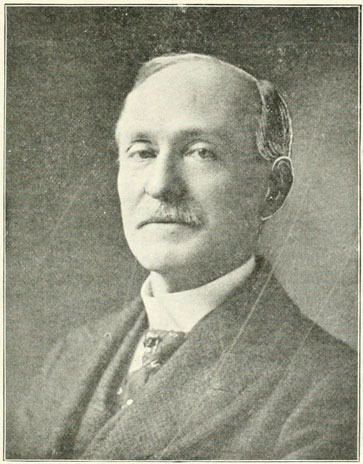
JULIUS L. BROWN.
Time passed on. Election day came, and, had these States been recorded as the people had voted, the election would have been: For Tilden, 203; for Hayes, 166. But the election machinery in most of the Southern States was in Republican hands, and thus by Chandler's orders the States of Florida, Louisiana, and South Carolina could be counted out; and if this was done, R. B. Hayes would have 185 and S. J. Tilden 184. Now "who should count the votes" became the battle ground. For two months scheme after scheme was proposed and rejected. More than once it was proposed to throw dice, and raffle off the presidency like "a good, fat turkey for Christmas," but this leaked out. One proposition after another again fell through, and at last Hayes won by trickery. Only the great desire for peace, and the marshaling of troops and concentrating naval vessels under the orders of President Grant prevented a clash of arms.
Among the first acts of President Hayes was an order removing the United States troops from New Orleans and Columbia, S. C., as the purpose for which they had been kept there had been accomplished. Those who are fond of reading low villainy can find it written in the chronicles of Louisiana.
Violation of Paroles.
In connection with the violation of paroles I will incidentally mention that Gov. Joseph E. Brown, of Georgia—after the surrender of Gen. R. E. Lee, and when Gen. J. H. Wilson was in Macon on his raid—went to Macon, and surrendered to Gen. Wilson himself and the militia in his command, and obtained his parole; thence he returned to Milledgeville. That same evening Gen. Wilson sent an officer and some troops to the residence of his excellency, took from him by force the parole that he had just given him, arrested him, took him to Macon; then sent him to Washington City, where he was imprisoned with most of the Southern Governors of the Confederate States. This gave rise to a peculiar decision on the validity of his and other paroles. See the following letter from the War Records, Serial No. 104, Page 836:
Washington, May 19, 1865.
Hon. E. M. Stanton, Secretary of War.
The inclosed makes it appear that Brown, of Georgia, surrendered the militia of that State and himself as commander in chief thereof to Gen. Wilson, and was paroled. If the call for the meeting of the Georgia Legislature was subsequent to the parole, I suppose there can be no doubt but that he stands liable to arrest for the violation of his parole; otherwise, is it not obligatory upon the government to observe their part of the contract? I would not advise authorizing him to go back to Georgia now under any circumstances; but I do not think a paroled officer is subject to arrest, so long as he observes his parole, without giving him notice first that he is absolved from further observance of it.
U. S. Grant. Lieutenant General.
The inclosure referred to is probably Wilson to Stanton, May 19, 4:20 P.M. Page 680.
The wording of the parole given the army of Gen. R. E. Lee reads:
The within named, ——, will not be disturbed by the United States authorities so long as he observes his parole and the laws in force where he may reside. (From the War Records, Vol. 46, Part 3, page 853.)
This opinion of Gen. Grant that an officer, who may be in command of an army or of a body of armed men, after the surrender of his men and their arms, can, after "notice that he is absolved from further observance of it," be arrested is a flagrant breach of faith.
Promise of protection is given to a man with arms in his hand, that if he will surrender them he shall have protection as long as he observes his parole. Is it just, right, or honorable after he has given up his arms to notify him that he is released from the observance of the parole, unless you first place him in the same condition he was before he surrendered his arms or his command? It is a deception and an outrage. In fact, I am unable to comprehend how a soldier who surrenders himself, his men, and arms on parole can be released from and absolved from observance from it from any act or acts committed prior to its date in order to arrest him. Gov. Brown was denied the rights given him by his parole, and holding him a prisoner and not permitting him to go to his home in Georgia seems to be predicated upon the fear that he might do something in violation of a parole.
The papers showed that the Governor was paroled by Gen. Wilson; then arrested the same day at his home in Milledgeville, and his parole taken from him by force. I presume that his parole was taken from him because some days previous to his surrender he had made a call for the Legislature to assemble.
Joseph M. Brown, to whom I am indebted for much information that he obtained from Union soldiers through years of correspondence relative to the Georgia campaign, is a son of Gov. Joseph E. Brown, and a gentleman of high literary attainments. His elder brother, Julius L. Brown, now a distinguished lawyer in Atlanta, refused to leave the country to be educated in Europe. By a compromise he was sent to a military school in Athens, Ga. The boys there took up arms, and formed a company to defend Athens. There Brown's first duty was to guard some Yankee prisoners. In 1864 he joined Company A in a battalion of cadets, and rendered good service in defense of Atlanta. Thence his command went to Milledgeville, where, joining with other State forces and Wheeler's cavalry, they fought Sherman's advance at every river he crossed, and otherwise retarded his march to Savannah. His battalion formed a part of the rear guard of Hardee's army on the retreat from Savannah. The last order issued by Confederate authority east of the Mississippi was to this battalion. (War Records, Serial 111, page 420.)
Cassville.
[From "Reminiscences of the War," in the New Orleans Picayune.]
The recent appearance of Hughes's "Life of Gen. Joseph E. Johnston," and the announcement of the placing in the hands of the printers of a "Life of Gen. Leonidas Polk," by his son, Dr. William Polk, were the subject of a conversation recently among a few veterans of the Army of Tennessee, and some facts were mentioned that are deemed of sufficient interest to be placed on record through the columns of your valued paper.
To those who participated in the memorable campaign from Dalton to Atlanta under Joe Johnston, the failure to give battle at Cassville is a most fertile source of discussion and regret, and this was the point of conversation on which the group of talkers lingered the longest.
The enthusiasm that swept through the army when the announcement was made that it had reached the chosen battlefield possessed anew the hearts of these veterans; the cheers that went up from each command as "Old Joe's" ringing battle order was read to the troops reverberated again in their ears; the embers of their deep emotions of elation and disgust that so rapidly succeeded each other on that eventful day burned afresh within them for a while. And naturally the oft-debated question of the amount of blame attaching to Gen. Johnston's subordinates for this failure to fight came up as of old, and the measure of it, if any, appertaining to Gen. Polk was stated as follows by one of the group, Maj. Douglas West, who, as adjutant general, attended Gen. Polk on the night of the conference when Johnston felt compelled to forego the battle and retreat across the Etowah river. He said that after Polk's Corps had taken the position assigned to it on the left of Hood's Corps and in the rear of Cassville, Gen. S. G. French, one of the division generals of the corps, sent a message to Gen. Polk that his position was enfiladed, and that he could not hold it.
Gen. Polk thereupon sent his inspector general, Col. Sevier, to ascertain about it. This officer reported back that in his opinion Gen. French was warranted in his apprehension.
Gen. Polk requested Col. Sevier to proceed to Gen. Johnston's headquarters, and place the facts before him, which this officer did.
Gen. Johnston was loath to believe in the impossibility of holding that part of the line; for, though exposed, it could be made tenable by building traverses, and retiring the troops some little to the rear. He instructed Col. Sevier to have Gen. French to build traverses. This general considered them useless, and persisted in his inability to hold his position.
Col. Sevier reporting this back to Gen. Polk, in the absence of Capt. Walter J. Morris, engineer officer of Gen. Polk's Corps (off on some duty), the General sent Maj. Douglas West to the position of Gen. French's Division to have his opinion also, and to have him talk over the situation with this general. When Maj. West reached there, there was no firing from the enemy, and he could not form an opinion in that way. However he conversed with Gen. French on the subject, and returned, reporting Gen. French as highly wrought up about the exposure of his division. Gen. Polk then sent Maj. West to Gen. Johnston to state the result of his visit to Gen. French's position, and Gen. Johnston reiterated his opinion about the feasibility of holding the position with the use of traverses.
Upon reporting back the remarks of Gen. Johnston, Maj. West found that Capt. Morris had reached Gen. Polk's headquarters, and the captain in turn was sent to French's position to make a thorough survey and report of it. He made a very thorough one, and reported the position as very exposed for the defensive, but as admirable for the offensive. Gen. Polk, since the first report from Gen. French, appeared much annoyed at this unexpected weakness in his line, which, from the pertinacity of Gen. French, was growing into an obstacle to the impending battle, for which Gen. Polk shared the enthusiasm and confidence of the troops.
That evening about sunset Gen. Hood rode up to Gen. Polk's headquarters with Maj. Gen. French, and at his suggestion Gen. Johnston was asked to meet the three lieutenant generals at Polk's headquarters for the purpose of consulting that night on the situation.
At the appointed hour Gens. Johnston, Hood, and Polk met at the latter's headquarters. Gen. Hardee was not present, he not having been found in time, after diligent search. Gen. Hood arrived at the rendezvous accompanied by Gen. French, whose division rested upon his left in the line of battle. Gen. Polk had not asked Gen. French, who was of his corps, to be present at headquarters for the occasion, and Gen. Hood's action in bringing him was altogether gratuitous. Upon arriving with French, Gen. Hood excused his action by stating that he considered the situation so vital to himself and French that he had taken the liberty to ask Gen. French to come with him to the conference. After awaiting Gen. Hardee's arrival for a good while, Gens. Johnston, Polk, and Hood retired to the rough cabin house where Polk had established his headquarters, and Gen. French and the staff officers of the different generals remained outside, beyond earshot.
It was past midnight when the meeting broke up and the generals stepped out and called their escort and attending staff.
Gen. Polk immediately instructed Maj. West to issue orders to his division generals to move as soon as guides would be furnished them. Capt. Morris was ordered to procure these immediately. Gen. Polk communicated detailed instructions, but appeared deeply absorbed. In silence everything was carried out, and the corps had taken up the march and moved some distance before Maj. West was aware that the army was in retreat. He had been by the General's side or close in the rear of him from the moment of the termination of the conference, and the General had not spoken about it. Thus they had ridden a good while. The Major, respecting the General's silent mood, had not thought proper to inquire about the destination of the column. An officer of Gen. Hardee's staff, Capt. Thomas H. Hunt, was the first to inform Maj. West that the army was retreating because Gen. Polk at the conference had insisted that he could not hold his position in the line of battle selected by Johnston. Stung by this statement, Maj. West denied it emphatically, and as his informant insisted on its correctness, Maj. West rode up to Gen. Polk, and asked him where the column was marching to. Gen. Polk said they were retreating to beyond the Etowah river. Maj. West then told him of the report that had reached him, and asked him if he was the cause of the abandonment of the intended battle at Cassville. Gen. Polk asked who had made the statement, and when told that it was a staff officer of Gen. Hardee, who also added that the impression prevailed along the column, and Maj. West asking that he be authorized to deny the report, Gen. Polk was silent for a moment, and then said to Maj. West: "To-morrow everything will be made as clear as day."
Gen. Polk never again spoke of this matter to the Major, although with him day and night during that long and terrible campaign, in which he lost his life at Pine Mountain on the 14th of July, 1864; but the impression left upon his staff officers was that the failure to give battle at Cassville was not due to any representations made by Gen. Polk, but to the objections made by Lieut. Gen. Hood, the left of whose line joined French's Division.
Gen. Polk had so little confidence in the representations of the weakness of the line at the point referred to that he did not go there in person.
But for Gen. Hood's invitation, Maj. Gen. French would not have been called to the conference, and consequently when Gen. Hood urged the untenability of his line, and supported it by bringing one of Polk's division commanders (French) to confirm him, although Polk's other division commanders (Loring and Walthall) offered no objection, and in the absence of Lieut. Gen. Hardee, Gen. Polk could only reply upon the report of his chief topographical engineer, Capt. Morris, and Maj. Gen. French, and sustain Lieut. Gen. Hood in his opinion that the line could not be held after an attack.
Gen. Polk was too noble and patriotic to care for his personal fame, and made no effort during his life to put himself properly on record for his connection with the abandonment of the line at Cassville, for he was always ready to give battle or to take any responsibilities of his position. He fought for his cause, not for his reputation.
Another of this group of veterans had been of Hardee's Corps on that occasion. He recounted that his battery had been assigned by "Old Joe" to an important post on Hardee's line, the angle at which the left flank deflected back. Vividly he described his position—the knoll upon which his guns were planted, the open fields around, that gave promise of great slaughter of the foe when he undertook to carry the point. This prospect, and the pride arising from the very danger of their post, stimulated the men in their labors of entrenching, which was necessary at this end of the line of battle, where there were none of the natural advantages the troops of Polk and Hood derived from the hills on which they were posted. But all worked with an energy that arose to enthusiasm; for confidence in "Old Joe," confidence in the "Old Reliable," and confidence in themselves inspired the men of this company as it did those of the whole corps. The redoubt was nearly completed when about two o'clock in the morning Capt. Sid Hardee, of Gen. Hardee's staff, rode up and ordered the work to cease and the battery made ready to move. This officer then stated that the intention to fight a battle there was abandoned; that Polk and Hood had insisted that they could not hold their position in the line. He added that Gen. Hardee had objected to the retreat, and had offered to change positions with either of the other corps rather than forego giving battle.
In deep disappointment and disgust Hardee's men moved off, blaming Polk and Hood for compelling the abandonment of a field which seemed to be pregnant with a glorious victory.
The impressions of that night had remained ineffaceable, and the unfought battle had been a deep source of regret during the war, and of deep interest since; so much so since that it had led to a correspondence between one of the officers of the company and Gen. Johnston.
One of Hardee's Corps.
Reply of Gen. French to "Reminiscences of the War."
Winter Park, Fla., December 12, 1893.
Editor Picayune.
A few days ago a friend sent me a copy of the Weekly Picayune of October 26 last, containing an article headed "Reminiscences of the War," that contains a number of errors, which I desire to correct so far as they relate to me, and I will refer to them in the order they are related in the paper. I quote:
1."After Polk's Corps had taken the position assigned to it on the left of Hood's Corps and in the rear of Cassville, Gen. S. G. French, one of the division generals of the corps, sent a report to Gen. Polk that his position was enfiladed and that he could not hold it."
Any line can be enfiladed if the enemy be permitted, undisturbed, to approach near enough and establish batteries on the prolongation of that line. Therefore before any person can report a line enfiladed, the guns must be near enough to sweep it with shells. To report that a point near the center of a long line of battle cannot be held before the issue is made is mere conjecture, and not justifiable, and I have no recollection of having made such a report, and deem the writer is in error in his statement. A man would not cry out, "Help me, Cassius, or I sink," before entering the water.
2. The next assertion is that Gen. Polk "sent Col. Sevier to ascertain about it, and this officer reported back that, in his opinion, Gen. French was warranted in his apprehension. Gen. Polk thereupon requested Col. Sevier to proceed to Gen. Johnston's headquarters and place the facts before him, which that officer did. Gen. Johnston was loath to believe in the impossibility of holding that part of the line, etc., ... and instructed Col. Sevier to have Gen. French build traverses. This general considered them useless, and persisted in his inability to hold the position."
In answer to this, I repeat that I have no recollection of having made to any human being the remarks here attributed to me. How, in the name of common sense, could any division officer report, much less persist, as stated? How would he know but that, if necessary during the battle, ample support would be sent him? I had one brigade and a half in reserve at that point of the line. As for traverses, I never heard them mentioned before, in reference to this line. And now, after your writer has sent Col. Sevier to me twice, he sends to me Maj. West, and it was before any firing had taken place, and he (West) could, very properly, "form no opinion unless he could witness the fire of the enemy's guns." West returned to Gen. Polk, reporting Gen. French highly wrought up about the exposure of his division, and Gen. Polk is made to send this officer likewise to hunt up Gen. Johnston, and after "reporting back the remarks of Gen. Johnston, Maj. West found that Capt. Morris had reached Gen. Polk's headquarters," and the Captain in turn "was sent to French's position to make a thorough survey and report of it." He made a very thorough one, and reported the position very exposed for the defensive, but as admirable for the offensive.
I have Capt. Morris's report, but I do not find in it where he reported the line as admirable for the offensive. I will have occasion to refer to this report after a while. I merely wish to remark that when we find Capt. Morris at Col. Polk's headquarters we have something tangible in regard to time.
3. And the article goes on to state that "Gen. Polk, since the first report from Gen. French, appeared much annoyed at this unexpected weakness in his line, which from the pertinacity of Gen. French was growing into an obstacle to the impending battle, for which Gen. Polk shared the enthusiasm and confidence of the troops."
Now, contrast this with what the writer says farther on when he tells us: "Gen. Polk had so little confidence in the representations of the weakness of his line at the point referred to that he did not go there in person."
It is not always safe to divine what is passing through a man's mind from appearances, and, having "little confidence in the representations," the deduction of "annoyance" may not be correct which is attributed to Gen. Polk. Now, inasmuch as Gen. Polk was present (when Gen. F. A. Shoupe "pointed out the fact to Gen. Johnston that his line would be enfiladed before the troops were posted, and suggested a change of position) and strongly supported Shoupe's objections," he must have been early apprised of the general condition of the line before he received the alleged report from me, which the writer explicitly affirms was sustained by Cols. Sevier, West, and Morris; hence the weakness of his line was not unexpected, and should not "have grown into an obstacle to the impending battle." Gen. Shoupe's letter will be found in Hood's book, page 105.
4. In writing about the conference I find the account thus:
"That evening about sunset Gen. Hood arrived at the rendezvous, accompanied by Gen. French, whose division rested on his left in line of battle. Gen. Polk had not asked Gen. French—who was of his corps—to be present for the occasion, and Gen. Hood's action in bringing him was altogether gratuitous. On arriving with French, Gen. Hood excused his action by stating that he considered the situation so vital to himself and French that he had taken the liberty to ask Gen. French to come with him to the conference."
This shows that Polk and Hood had decided (at a consultation in advance) to hold a conference before I went with Hood to the rendezvous, to which they invited Johnston. About my being there, I have this to say, and the facts are these: The little firing that had taken place almost ceased awhile before dark; so, taking a staff officer with me, we went to our wagon to get dinner, and while returning to my command we met Gen. Hood on his way to Gen. Johnston's. We halted, and while conversing he told me that his line was enfiladed by the batteries of the enemy in position, and that he was going to see Gen. Johnston at Gen. Polk's, and asked me to ride with him to get supper, etc. His meeting me, therefore, was purely accidental, and this place where we met was near by Polk's quarters.
So I went with him, socially, without any special object in view. He said nothing to me about a conference to be held on the situation, called by him and Gen. Polk.
Soon after supper Gens. Johnston, Polk, and Hood went to Gen. Polk's office, and Gen. Johnston asked me to go with them.
The matter presented to the meeting was: "Can we win the battle on the morrow? Can we hold our line?" Hood said he thought not, for if attacked in the morning he would not be able to hold his line, because it was enfiladed by the guns of the enemy, now in position, and that Gen. Polk's line was also enfiladed, and could not be held against a vigorous attack, or words to that effect.
Gen. Polk confirmed Hood's statement in regard to his line. Gen. Johnston maintained the contrary. Of course I took no part in the discussion. When asked, I explained how my line curved, near the end, to the left, sufficient to be enfiladed by one battery on the extreme left of the enemy's line. I have no recollection of being asked if I could hold my part of the line, but had the question been asked me, I am quite sure it would have been suppositively in the affirmative.
As the whole includes all the parts, so, the discussion being on Polk's and Hood's lines in their entirety, the parts were embraced therein, and not specifically referred to, being minor considerations.
Gen. Johnston argued for the maintenance of his plans very firmly. When a silence occurred in the discussion, I arose and asked permission to leave, stating that I wished to go to my line and fortify it. On reaching my division, I set every one to work strengthening the line and getting ready for the impending battle, that I felt sure would begin in the morning. While we were thus busily at work, and at about the hour of 11 P.M., an officer riding along my line stopped and told me that the work would be useless, and "intimated" (that is the word written in my diary) "that the army would be withdrawn or fall back to-night!" Soon after, the order came to move back on the Cartersville road. The receipt of the order was a surprise to me, notwithstanding the intimation that had been made to me.
5. Toward the conclusion of the article it reads:
"Gen. Polk had so little confidence in the representations of the weakness of the line at the point referred to that he did not go there in person. But for Hood's invitation, Gen. French would not have been called to the conference, and, consequently, when Gen. Hood urged the untenability of his line, and supported it by bringing one of Polk's division commanders—French—to confirm him, Gen. Polk could only rely upon the report of his chief engineer—Capt. Morris—and Maj. Gen. French, and sustain Lieut. Gen. Hood in his opinion that the line could not be held after an attack."
This paragraph is adroitly constructed, and apparently not intended to be clear. It first accuses Gen. Polk of having little confidence in the representations of Sevier, West, and French, as alleged to have been made to him; but when Gen. Hood brings French to the conference, his testimony is so potent as to make Polk change his opinions and sustain Hood, who urged the untenability of his (Polk's) line.
This is all wrong. Hood did not take me to the conference. I did not support or confirm Hood in his representations. I have never said I could not hold my part of the line, and it would have been presumption to do so. The commanding general would see that the line at that point was defended.
This paragraph also represents Gen. Polk as going to the conference apparently prepared to defend his line; but when he listens to Hood's arguments he changes his mind and sustains Hood; and thus, with two of his corps commanders opposed to defending their lines, Johnston deemed it better to decline the impending battle.
6. On page 110 in Hood's book you will find the beginning of a letter from Capt. W. J. Morris, Gen. Polk's chief engineer, from which I will make some quotations, abbreviating them as much as possible. He says he arrived at Cassville station about 3:30 or 4 P.M., May 19, 1864. Col. Gale was there to meet him and to tell him that Gen. Polk wanted to see him as soon as he arrived. He had half a mile to go to Polk's quarters. He met Gen. Polk at the door. He says it took him about half an hour to examine a map that Polk placed before him and make notes of the General's wishes, and fifteen minutes to ride from Polk's headquarters to the line that was reported to be enfiladed. When he left Polk's headquarters he thinks Gen. Hood was there. It took him about two hours to examine the lines, angles, elevations, and positions of the batteries of the enemy established on their line in front of Hood, and his opinion and conclusions were:
"(1) That the right of the line of Polk's command could not be held. (2) That traverses would be of no avail, etc. (3) That it was extremely hazardous for Gen. Polk to advance his line to make an attack upon the enemy while the batteries held the positions they then occupied."
"Having made the reconnoissance, he returned to Gen. Polk's headquarters just after dark. Gen. Polk immediately sent for Gen. Johnston. Gen. Hood was at Gen. Polk's."
You will thus perceive that the conference to be held was determined on between Polk and Hood, before Morris made his report to Polk, because Hood was already there, for I rode with him to the "rendezvous."
7. On the 8th of May, 1874, Gen. Hood wrote me a letter to know what I knew about the "vexed question" of retiring from Cassville. He had forgotten that he had met me in the road; that he had invited me to ride with him to see Gen. Johnston, or that I was at the conference, and said he "only learned that I was at the conference from Johnston's narrative," etc.
I answered his letter from New York, where I then was, from recollection, without reference to my diary. I have both his letter and my answer. Gen. Hood and I had talked this matter over at length at the Allegheny Springs, Va., in the summer of 1872, differing, however, about not remaining at Cassville and the defensive strength of the lines.
8. Without endeavoring to recall to mind pictures of scenes through the mist of thirty years in the past, or to revive recollections of words used in the long, long ago, I will refer to my diary, and what was written day by day therein.
After we had formed a line of battle east of Cassville, and maneuvered with Hood with a view to attacking the enemy, our troops began in the afternoon to fall back to a line of hills south of Cassville. Cockrell's Brigade, that was in reserve, had been ordered to a hill there early. The diary says: "I received orders at 4 P.M. to fall back from the line east of Cassville and form behind the division of Gen. Canty and Cockrell's Brigade, which I did. As there was an interval between Hood's line (Hindman) and Canty, I placed there, in position, Hoskins's Battery and the half of Ector's Brigade. This left Sears's Brigade and the half of Ector's in reserve, Cockrell being on Canty's left in line.
"About 5 P.M. our pickets from the extreme front were driven in toward the second line by the enemy's cavalry. Hoskins's Battery opened on them and checked the advance. About 5:30 P.M. the enemy got their batteries in position and opened fire on my line. One battery on my right enfiladed a part of my line." The diary then refers to my going to dinner, meeting Gen. Hood and riding with him over to Gen. Polk's, leaving the conference, believing we would fight, etc.
9. We are now, Mr. Editor, getting beyond the hypothetical, for we have determined certain facts pretty accurately—viz.:
The hour I received the order to fall back from east of Cassville, the time our skirmishers were driven in, and when the firing commenced; also the hour that Capt. Morris arrived.
Capt. Morris declares that he arrived between 3:30 and 4 P.M. If he be correct, I was at that time with my troops east of Cassville, and it is certain no report could have been made by me until after the enemy's artillery commenced firing. Now mark what is declared to have taken place after the alleged report was said to have been received by Gen. Polk.
It would take an officer certainly fifteen minutes to ride from Polk's headquarters to Hoskins's Battery—a mile and a half distant—examine the lines, the position of the enemy, the effects of the fire, and discuss the situation; then the same length of time to return to Gen. Polk and confer with him. Then it would require the same length of time to go in quest of Gen. Johnston, report to him and explain the situation of affairs minutely; then to return to Gen. Polk and report it to him; then to come to my line a second time, and return to Gen. Polk. These two trips to my line and one to Gen. Johnston would have occupied one hour and a half. Next Maj. West received instructions to go and examine the line, and as there was no firing, he could form no opinion, but only talk with me. Then he went back to Gen. Polk and made his report; thence he too was ordered to go in quest of Gen. Johnston, and found him somewhere, reported to him, and returned. This would have required about one hour. So the line from Polk's to my extreme right was ridden over six times, examined and discussed, and four times from Gen. Polk's to where Gen. Johnston was, consuming not less than two hours and a half. Capt. Morris was not yet at Gen. Polk's quarters when Maj. West went in quest of Gen. Johnston, but he found he had arrived when he returned from Gen. Johnston's.
Now, it is plain that, if my alleged report to Gen. Polk put all this in motion, it must have been received by him at 1:30 P.M., because we know that it terminated soon after the arrival of Capt. Morris at Polk's quarters at 4 P.M. Soon after this Capt. Morris was ordered down to examine the line, which he did, and we have his report.
The question of time may be determined in another way: If I sent a report to Gen. Polk, it was carried a mile and a half to him by courier. Next, consider Col. Sevier and Maj. West in the light of one person. That person must have traveled about thirteen miles, received seven separate sets of instructions from Gens. Polk and Johnston, made five carefully matured reports on the situation, and what was said by me and Gen. Johnston, and made at least two careful examinations of our line, noted the position of the enemy, watched the firing and noted the effect of the same, and it could not physically have been performed under two hours and a half; and yet your published article says that it was all performed during the interval between receiving my report and the departure of Morris to make his survey, which was about 4 P.M.
If I made a report, as stated, it was done after the firing commenced, and hence it must have been dark when Maj. West returned from his interview with Gen. Johnston.
The conclusion, therefore, must be that from the length of time the writer's, or relator's, memory has failed to recall events as they were thirty years ago.
There was only a small part of my line enfiladed, and that was caused by its curving to the left near the ravine, where Hoskins's Battery was.
If Hood's line was enfiladed, I did not discover it, and Capt. Morris's plan, published in the War Records (plate 62), would be faulty, for the enemy's line is nearly parallel with his. To conclude, I have shown that if all this passing to and fro of officers took place between me and Gen. Polk, and between Polk and Johnston, it must have commenced about 1:30 P.M., to have ended at 4 P.M., which could not be, for I was then east of Cassville. On the other hand, if a report was carried to Gen. Polk about my line being enfiladed, it must have been done after 5:30 P.M.; and this going to and fro, with examinations and discussions, could not have been accomplished before 8 P.M., whereas it is stated to have been done before Capt. Morris left Polk's headquarters, at 4:30 P.M., either of which is incredible.
Very respectfully,
S. G. French.
P. S.—The result of the two hours' shelling of my line in casualties was one officer and nine men wounded—none killed. Horses, three killed. A small matter to create any apprehension, as described in your article. The order placing me in command of Canty's Division has no hour date.
Your readers will perceive that it was not I who influenced Gen. Polk in this affair. In fact, I was in reserve and had no troops in line of battle except Cockrell's Brigade—and that was about the center of the line—until I was ordered to take command of Canty's Division. How absurd, then, all this rigmarole about my saying I could not hold my line, and my testimony influencing Gen. Polk.
S. G. F.
From the foregoing papers it is evident that I was left alone east of the village of Cassville. After Gen. Johnston had placed the troops of his right wing in position, an order was sent, and received by me at 4 P.M., directing me to fall back and form my troops in the rear of Cockrell's Brigade and Canty's Division. This put my division in reserve, except Cockrell's Brigade, which was on Canty's left. Thus I found myself in reserve in rear of the line of battle. This could not have been done before 4:30 P.M. Now, could I report that I could not hold my line when I had none, or only one brigade, and that in the center of a line of battle several miles in length? However, soon an order was received (without an hour date) for me to take command of Canty's Division, and to put or leave Cockrell's Brigade in Loring's Division. I was now in command of two divisions, less one brigade.
On going to the right of Canty's Division, I found a gap, a dry water gully, and its approaches unoccupied. From necessity I had to take a part of a brigade (Ector's), so as to connect with Hood's left. Then Hoskins's Battery was put in position about fifty yards in advance on an eminence in front of a gap. Soon the enemy's cavalry appeared in front of the gap, and were dispersed by the fire of Hoskins's guns. The enemy now began to establish their batteries on the ridge in front of Hood's line, especially near his right, and soon they opened fire on Hoskins's Battery. About sunset the fire slackened, when Maj. Shingleur, of my staff, and I went to our wagon in the rear to get our dinner. Up to this time I heard never a word about not holding the line. I knew nothing about horsemen or couriers or aids dashing about hunting Gens. Johnston and Polk and me on the line, and I never heard it mentioned until I read it in the newspaper sent to me one month after it was published, and thirty years after we left Cassville.
It was perhaps 2 P.M. when Gen. Johnston lost all hope that Hood, with the two corps as his command, would engage the detached forces of the enemy marching to our right, and crush them before Sherman could aid them. So no alternative was left him but to form a line of battle on selected ground, and act on the defensive. What followed after this has been already sketched.
I am sorry this article, so replete with errors, was ever published on account of Gen. Polk—a noble, kind-hearted man, ever practicing the amenities of life—for it makes him appear rather contumacious in joining Gen. Hood, and making arrangements to invite their commander to meet them at their "rendezvous" to listen to their complaints, and almost dictating what should be done after the failure of the contemplated morning attack. The writer was evidently aware that both Hood and Polk were almost disobedient in their acts at Cassville.
Thirty years had rolled by, and the incidents were almost forgotten, when this writer, to smooth the matter over, maladroitly seizes the fact that I went with Hood to Polk's headquarters, and tries to make it appear that I had influenced Gen. Polk by representations to change his opinion, and join Hood in the statement that their lines were untenable. I never saw Gen. Polk after he left the position east of Cassville until I met him at his quarters where I went to supper, and I do not remember ever sending a message or report to him that day.
He says: "Gen. Polk was too noble and patriotic to care for his personal fame, and made no effort during his life to put himself properly on record for his connection with the abandonment of the line at Cassville, for he was always ready to give battle or take any responsibilities of his position. He fought for his cause, and not for his reputation."
The writer did not even know that I was present at the council of the commanders, and heard both Hood and Polk give their opinions on their side, and Johnston on the other. Therefore, as I differed from both Hood and Polk, I could not have influenced Gen. Polk to "sustain Gen. Hood." Furthermore, in justice to myself and for the truth of history, I desire to correct the many erroneous statements made in the article published. Because a line is enfiladed it does not follow that it cannot be held. During the battle of Atlanta twice I was obliged to hold enfiladed lines nearly an entire day. Gen. Polk did not examine his line of battle after my division arrived. It is the duty of a soldier to obey an order, and not to discuss it, and any soldier who before a battle commences reports that he cannot hold a position when a whole army is drawn up should be relieved from command.
Jackson, Miss., January 15, 1894.
Gen. S. G. French, Winter Park, Fla.
My Dear General: I have read carefully your letter of the 8th instant; also the newspaper article, "Vox Populi," and find your statement in this article perfectly correct. I was the staff officer who accompanied you to Gen. Polk's headquarters.... Hood said that he would ride with you to Polk's headquarters, as he was to meet Gen. Johnston there.... We rode along leisurely, you and Hood in front, myself and one or two of Hood's staff in the rear. This was possibly an hour after dark. Arriving at Gen. Polk's, we found there, besides Gen. Polk, Gens. Johnston and Hardee. [This is an error. Neither was there when we arrived.—S. G. F.]
Of what happened at the consultation room of course I know nothing. I am sure that you came from the room between 10 and 11 o'clock, followed by Gen. Johnston, who, standing on the steps, told you when you went back to your command to have the word passed through your division that we would fight in the morning, and prepare for it....
About 1 A.M. I was waked up by some one inquiring for Gen. French's headquarters.... A courier said that he had an order for you, which we read by making a light. It was the order for us to move, with instructions to leave a few men at the breastworks to hammer and make a noise to conceal our retreat. I am sure this order fell upon us like a bombshell.
If you uttered a word about having a position that you could not hold, I never heard of it; and if you had thought so, I am sure that you would have mentioned it to me. On the other hand, I remember clearly that we discussed the situation, and both concluded that we held a very strong position, and could hold it against all odds....
Now all this Cassville affair is as clear to my mind as on the night that it happened. There is no doubt upon my mind that Gen. Hood, and he alone, was responsible for our retreat from Cassville. It is all a mistake about French and all staff officers being sent beyond earshot.... When we left Gen. Polk's headquarters you and I went alone. Hood remained. I hope you will be able to put this matter right, and let the responsibility rest where it properly belongs.
Very glad to hear from you. With best wishes, etc.
Yours very truly,
J. A. Shingleur.
Savannah, August 8, 1874.
Gen. S. G. French.
Dear General: Long absence prevented my receiving and acknowledging your very clear and satisfactory reply to my question on the subject of small arms. It is all that I could desire. I wish only to meet such of Hood's assertions as impugn the truth of my statements. If he goes on, and I understand that he intends to do so, I shall avail myself of your kind offer.
Can you not sometimes take Savannah in your way from Mississippi to New York, and vice versâ? It would be very pleasant to me to see you in my house, where there is always ample room for you and cordial welcome.
Yours truly,
J. E. Johnston.
Savannah, June 13, 1874.
Gen. S. G. French.
Dear General: You may have observed that Gen. Hood has renewed his attacks on me in his report of 1865. His last shot is in the form of a letter signed by poor old Oladowski, the ordnance officer, in which it is asserted that the army lost 19,000 small arms in the part of the campaign in which I commanded. As I have no ordnance returns, I can only refute this calumny by the testimony of the most prominent officers, and in that connection beg you to write me (for publication) about the number of muskets your division lost in the campaign, if any. Certainly the enemy took none, for you never failed to hold the ground intrusted to you. You probably have some idea of the probable losses of arms by your corps, or if it had any losses. And can you say, perhaps, if those losses could have been great enough to correspond with Col. Oladowski's statement? You will oblige me very much by giving me whatever information you can in relation to this matter.
Very truly yours,
J. E. Johnston.
Slavery Proclamation and Confiscation Act.
The act of confiscation, and the President's proclamation setting free the slaves in the Confederacy, could not abolish slavery, because it existed under the laws of the States. It altered no State law, but it did affect slavery in this way: it caused many slaves to leave their owners, and thus diminished their property and their wealth, but they could buy others under the law.
The President has no legislative power; he cannot declare martial law, for it overthrows the constitution, and his will would become the law; how can the President, an executive officer, nullify laws and condemn and punish at his pleasure?
The great latent power in the constitution is, in Art. I., Sec. 8, to provide for the common defense and general welfare. Under this section almost all the outrages of the war were committed, restrained only by international rules of war; but these were utterly ignored under the plea that this war is only a rebellion, a family affair. Under this article resides the power to imposes taxes to any amount for the common defense and public welfare.
The confiscation act of Congress was declared by the United States Supreme Court to be unconstitutional, and, in truth, it was passed as a punishment against the "rebels," without an indictment, trial, or conviction. The constitution declares that the trial of all crimes, except in cases of impeachment, shall be by jury.
As the slave owners were called the only privileged class in the United States, it is pertinent to inquire if they did not exist in all the States when the Union was formed, and if the North did not sell their title to be yet a privileged class for a mess of pottage; and then howled at the purchasers for being a privileged people!
Who demanded the continual enlargement of slavery by making it legal to steal or purchase negroes from Africa until the year 1808, to give employment to the six hundred slave ships owned in the North? for the statement is that toward the close of the slave trade there were about that number belonging to New England and New York engaged in that pious enterprise. We know the town of Newport, R. I., had one hundred and seventy ships employed in this money-making trade in the year 1750, and undoubtedly the number increased largely in after years, when made legal; so, on the whole, no doubt six hundred ships were in the trade.
The question here presents itself—and it is a proper one to ask—who first owned these slaves; how did they obtain them; how did they treat them; and to whom did they sell these human beings for money; and then, with the price of blood in their pockets, begin to preach against the sin of slavery? Ye hypocrites! who thank God "we are not slave owners, we got rid of them long ago."
It has been said by a Northern writer that "indirectly, and for the purpose of a more equal distribution of direct taxes, the framers of the constitution tolerated while they condemned slavery; but they tolerated it because they believed it would soon disappear. They even refused to allow the charter of their own liberties to be polluted by the mention of the word slave; but take heed, did not this convention give way to the clamor of the owners of slave ships to continue for twenty years the increase of slavery? They could not, consistently with honor or self-respect, transmit to future ages the evidence that some of them had trampled upon the inalienable rights of others."
"Though slavery was thus tolerated by being ignored, we should not dishonor the memory of those who organized the government to suppose that they did intend to bestow upon it the power to maintain its own authority, the right to overthrow or remove slavery or whatever might prove fatal to its permanence or destroy its usefulness."
The answer is: Yes, but not by making war and laying waste the country; burning dwellings, public buildings, towns; sinking shipping, blockades; capturing, killing, imprisoning innocent people; nor by creating enormous debts, nor yet by cruel war, but by removing the evil by compensation "for the term of service" of the slaves to their owners.
The government is under obligation to compensate parents, masters of apprentices, masters of slaves for loss of service and labor of their subjects who are enlisted in the army and navy, for the constitution recognizes slaves as "persons held to labor or service."
England compelled the abolition of slavery in her colonies, and she paid in compensation to the slave owners one hundred million dollars. Out of this, the Cape Colony, in Africa, obtained fifteen million dollars, which was about four hundred dollars per slave.
If, then, slavery was believed to be fatal to the permanence of the constitution, it could have been abolished as it was in England, or in some equitable way without the clash of arms.
Indenture.
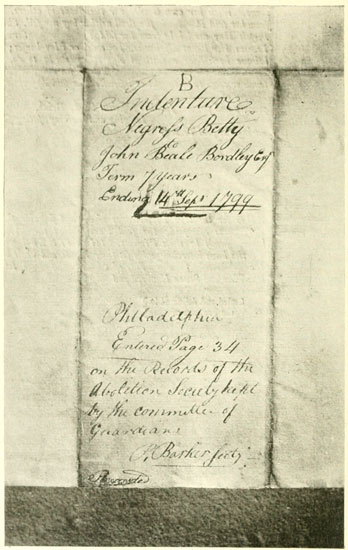
This indenture is here presented for no other purpose than to evidence the mode of manumitting slaves by the Abolition Society in the City of Brotherly Love about four years after the constitution of the United States was framed.
From this instrument of writing it appears that "Betty" was set free (so called) on the 14th of September, 1792, on condition that she should become a bond servant by contract for seven years. Her signature to the indenture (original) is made on the left-hand corner, and not covered by the photograph.
From the wording of her indenture to her master Bordley, it would appear that verily her second condition was worse than her first, and her last worse than all; for in her fifty-seventh year she was to be turned adrift in her old age, possessed of only two suits of apparel—"one of which is to be new"—to struggle with adversity. She was now, however, free to play cards and dice, go to alehouses, taverns, and playhouses, and dance and contract marriage, etc.
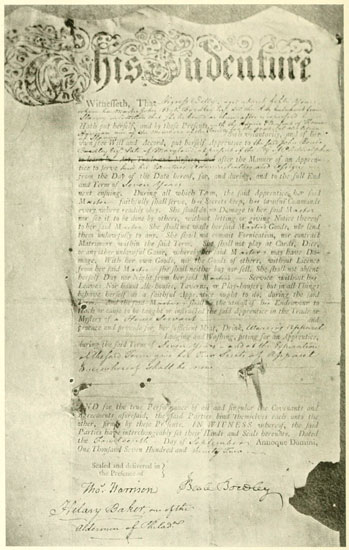
It would be interesting to know how she passed the remaining years of her life. That is buried in oblivion. Had she remained a slave—"held to a service of labor," which was her first condition—she would have had a home for life. To depend on the benevolence of the Northern people was to be in a worse condition than that of a slave, for the slave did know that he had a friend and a home for life.
How little is known, even at this day, at the North of the general relation between the owner and the slave in the latter days of slavery's existence! and I hope it will not shock the sensibility or puritanical feelings of ye scribes and Pharisees when I state that in the family graveyard near Columbus, Ga., where my wife's father and mother and some of her brothers and sisters rest, there repose the remains of their Aunt Betty, who nursed all the children of the family. She was, in name, a slave; in reality, she had all the privileges of a member of the family, and when she died the children declared she should sleep beside them in death, as she had lived with them in life and would rise with them at the resurrection.
I could tell where a slave, after her death, was carried near fifty miles to sleep in the family graveyard, with her master and mistress, who had preceded her to the sacred spot where dust returns to dust. These, and other instances I know, speak of kind feelings, and are significant of the ties that existed between the master and the slave; and this intimacy between master and slave, and almost companionship of children and servant, were more common than any harsh behavior toward them. A man who abused a slave was held in contempt, and was, I suppose, shunned by his neighbors. I had no experience with such men. Once the overseer on our place was going to punish a man for persisting in annoying another. The alleged offender sent for me, and I investigated the case. He was charged with being too gallant with another man's wife, an accusation very prevalent in high society now, when my lady can get a divorce in the morning and marry her admirer in the evening, or the husband do so, as the case may be. No punishment was given the negro in this matter, for the want of evidence; and I here state that no whipping of a negro ever occurred on the plantation.
The difference between the wage earner and the slave is, the right to change residence. The former, with his family of wife and children, is too often, for want of means, unable to avail himself of his right, and is therefore practically on a level in this respect with the bondsman, and he becomes reduced to the slavery of wages, which in this age—howling for wealth—becomes a pitiful condition, from which he seeks relief in strikes, so often in vain. He cannot succeed against the money power of the great trusts and monopolies, the power of the State and military interference of the United States forces; so in the end he is only steeped deeper in poverty. From all this the slave was free and happy, if his laughter, song, and dance indicate contentment.
I do dislike egotism, and yet to establish the fact that slaves did possess the power to change masters and homes—and you will admit that practical experience is better than any theory—I will tell you plainly what occurred to me touching this matter.
As administrator of an estate where the land and servants had to be sold, the heads of the families were given notice, months in advance, that they could visit or otherwise see the owners of the neighboring plantations and other persons with whom they would like to live, and induce them to buy the family at the sale: and when the sale was made I think all had selected homes. In this case, at the sales many were informed that they would be bid in by the heirs. I never knew a family to be separated.
I believe it was in the autumn of 1856 I wished to obtain a good cook, and went to New Orleans. Beard & May, cotton brokers, informed me that the German Vice Consul was going home, and had the best cook in the city. I called on Mr. Kock at his office, and he gave me a note to his wife, stating the object of my calling. Madame sent for the cook, and she came into the drawing room and was introduced to me, and my business made known to her. She was a fine-looking woman. She asked me the usual questions—such as "Biddy" in the intelligence office asks persons in quest of a cook—about where I lived, number in the family, if there was a church near by, nearest town, etc. Obtaining the desired information, she told her mistress she did not wish to leave the city, and she was directed to retire. Mrs. Kock said she wished the servant to be satisfied with her new home, etc.
Next Beard & May sent me to a French family. Madame came in, and sent for the cook she wished to sell. This one varied the questions, she asked even as to hot dinners on Sundays, and then she said she would not like to live on a plantation; and so the visit was fruitless. Then Beard & May told me to question the servants they held for sale, and there I found a woman about thirty years old, of fine personal appearance, who was willing to accept a position in the country, and I bought her.
A few days after, Beard & May called on me and said my cook, Maria, wanted to see me; so I went to her, and she then told me she wished I would buy her husband Jim. I expressed my displeasure that she had not told me she was married before I bought her. However, I bought Jim to satisfy her, and took them both home with me. Maria was installed in the kitchen, and proved to be a good cook. Jim had charge of the horses, etc. At the beginning of summer we went North. Jim was put to work in the field. He soon ran away, stayed in the woods by day, came home often at night, and told the overseer that he would come home when I did. When we returned in the autumn, Jim came to see me and explained that he had never worked in the field; so he worked again at the stables and ginhouses. I now learned that Maria and Jim had never been married. When spring came, I told Jim I would take him back to New Orleans, and he was willing to go. I left him with Beard & May to be sold. When we returned in the fall Jim had not been sold. In the winter I visited New Orleans. The steamer arrived during the night. In the morning as I was going on shore I saw a number of fine hacks on the levee awaiting passengers; among them the driver of a fine carriage cried out: "O Master Sam, here is your carriage; ride with me. Don't you know Jim? Mighty glad to see you, Master Sam." He drove me to the St. Charles Hotel. Soon Jim came to see me, and I told him if he did not find a home for himself before I left the city I would have him sold to some one out in the country without consulting him. The result was, Jim got the owner of the livery stable to buy him, and that was the last I saw of Jim. No one would purchase Jim because he told every one who wanted him, "If you buy me, I will run away;" and so he hired himself out for about nine months, at twenty dollars per month, as a hack driver, which supported himself free of expense to me.
And now about Maria: In the spring she got in the habit of having fits, and would foam at the mouth, and the old cook would have to come over. This continued over two weeks.
One morning I saw my neighbor Courtney riding up to my gate rather rapidly. He was excited and said: "Capt. French, I want you to buy my man Parker or sell me Maria." Parker had the main charge of some one hundred and thirty servants on Courtney's place. As I had no use for Parker, I would not entertain buying him, and replied that I would sell him Maria. When he became more composed, he told me that "Parker had become stupid, thoughtless, and could not remember what was told him, and when I called him to account he informed me that he was so much in love with Maria that his mind was all 'up-sot,' but if I would only buy Maria he would be so happy, and be the best hand on the place if she were his wife." And so Maria became Parker's wife, and never feigned having fits any more. Marriage cured them. Her fits were all "put on" to get a new home at Courtney's.
I was now quite tired and wearied with cooks, but nevertheless, being in New Orleans, I made another venture. Beard & May said they had a good cook. She was a woman of about twenty, with a jolly round face, and said she was a fine cook, and I bought her. Her name was something like Amanda, as I remember it. She was a willing, good-natured creature, but so careless that half the dishes were spoiled; so during the summer I took her to New Orleans and left her with Beard & May (early in the morning), then drove to the hotel. I had finished my breakfast and was smoking in the rotunda, when I saw Amanda approaching, accompanied by a tall, elderly gentleman, to whom I was introduced, naming him "my new master." He was from one of the parishes of the State. He asked me some questions about his new servant, and said he thought her a good cook, and honest, from what she told him. He apologized for the early call, as he had to leave on the morning steamboat. Bidding Amanda good-by, I concluded to abide with our old cook again.
I have briefly sketched these, some of my experiences with slaves, to establish the fact that bondsmen on the Mississippi did have the privilege of selecting very often the persons with whom they wished to live, as well as the place, which is by poverty denied the poor white men when in the iron grip of the rich corporations, where they are held by the relentless "slavery of wages."
A man acting for himself and in the interest of his family must have feelings of humanity for his servants. Their welfare and happiness are indissolubly linked with his, aside from his accountability for his acts to his God. Corporations have no souls, and no God to worship except Mammon. They have no ear for the misfortunes or ills of an employee, no physician for sickness, no priest for the dying, nor coffin for the dead. All these the slave has.
Truly the relentless thirst for gold over the road to wealth crushes to death like a worm the poor laborer beneath its tread. There is no provision in the charter of a trust company for care of life or soul of a laborer, and his condition is disguised in the (unknown to him) glorious privileges of independence, liberty, and freedom. What a mockery are all these human rights to a family perishing in a hut by a coal mine for want of clothing and food, with no ministering hand! And yet all the wealth in the world was obtained from the earth by the miner and farmer.
God in the beginning proclaimed the relations and the obligations between master and bond servant in Holy Writ, and he will judge them by their deeds; but God hath not, nor hath man defined the humanities inseparable between a trust company and its employee, except by injunctions and courts and bayonet rule.
Bad as it is, some may be inclined to believe that Betty, under her indenture, had more privilege and enjoyment than most of the white laborers in the employment of many monopolies.
In connection with this indenture is presented the picture of the Rev. Henry Ward Beecher selling slaves on his theatrical pulpit stage in Plymouth Church, Brooklyn, to raise money, and fire the Northern hearts against the South.
The audience is large, and their countenances express delight at this fine scene of buffoonery, which was then considered one of the "eight great personal events of the nineteenth century," and hence worthy of preservation. When passion shall have subsided, and calm judgment presides, it will perhaps be regarded as an act of charlatanry unworthy of so great a man. These great personal events are said to be:
When Jenny Lind sung in Castle Garden.
When Henry Ward Beecher sold slaves in Plymouth pulpit.
When the Prince of Wales was in America.
When Henry Clay bade farewell to the Senate.
When Grant went around the world.
When Lincoln was first inaugurated.
When Kossuth rode up Broadway.
When Mackay struck the great bonanza.
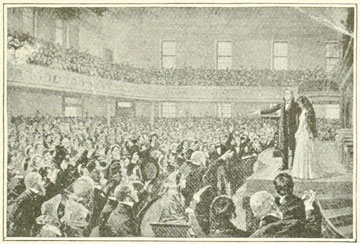
I regarded Mr. Beecher an orator, and have listened to his discourses on theology to his congregation with admiration; but his attacks on slavery were made perhaps with as little knowledge of the condition of the bondsmen as that distinguished kinswoman of his, Mrs. Harriet Beecher Stowe, has shown in her ideal novel, "Uncle Tom's Cabin." They produced a diseased state of public sentiment, and Demos, turned loose, strained the ties of love and kindred relations that bound the States by the compact, and precipitated secession and war on the South.
If slavery be considered a wrong, and no doubt it was, then, in justice to all concerned in its establishment in the United States and to the condition of the slaves in 1861 and the means resorted to for their liberation, it becomes a matter of impartial consideration, and when that day comes, the South will stand before the world vindicated, and the verdict will be both parties guilty, as will be shown hereafter.
Slavery was only made possible by bringing in ships negroes from Africa; and that was mainly done by the people of Old England, New England, and New York City. They were large ship owners. They sent their vessels for slaves, and obtained them by theft, by capturing them in the midnight glare of burning villages, or by purchase. They owned them all. They were indeed inhuman slave dealers. They sold some of them to all the thirteen colonies, and to the several States formed of them under the constitution, and they continued this slave trade legally until 1808, and illegally until 1862. (See "American Slave Trade," by J. R. Spears.)
In Old England the question of slavery was discussed calmly, with justice and common sense, and they arrived at an equitable decision—viz., that the government should compensate the owners for their property rights in persons held to labor or (in language undisguised) in slaves, and, as I have already stated, $100,000,000 was appropriated to purchase them and set them free, an act of justice to the owners.
In this land of freedom the pious people of the North (I speak plainly) sold their slaves to the planters in the South, and, with the slave money in their pockets, rejoiced that they were not like the people South, and as Pilate did (figuratively) they took water and washed their hands before the people, saying: "We are innocent of the sin of slavery now!"
Next, from causes already stated, like the crusaders to the Holy Land, the fanatical crowd came down South, and took the slaves that they once owned and sold from the purchasers, and forced the States to set them free without compensation. By this act they took over $3,000,000,000 worth of private property from the owners—the greatest robbery ever committed on earth.
In the common courts of the country it has been adjudged, I believe, that the thief is a greater criminal than the receiver of the stolen property; but when the thieves steal the same property a second time, what should the sentence of the court be? Of that crime the North stands convicted.
There is a higher power than any established by man.
"God moves in a mysterious way His wonders to perform."
In days of old he arraigned nations before his august court, and they lived or perished at his will. The day is not far distant when the South, at his command and in his own way, will arise from their down-trodden condition, to the surprise of their oppressors. Her fields will blossom as the rose, the busy hum of industry will be heard in the land, and the commercial sails of the world will ride on the waters of the Gulf of Mexico and the Caribbean Sea, plying to South America and the Orient through the canal that will connect the two great oceans. What position then will the New England States hold in the general prosperity of the States? Then it will be seen, "Vengeance is mine; I will repay, saith the Lord." And even now along the Atlantic seaboard great steamers go North mainly laden with articles made from wood, lumber, pig iron, cotton goods, fruit, and the great metropolitan hotels and the people generally depend on the fields and gardens of the South for their vegetables half the year; and so it goes on in arithmetical progression of increase.
Leaving out the negroes, the South has a homogeneous population; the solidarity of the nation will rest on her. In 1861 there was less than one foreigner to the hundred in the population of North Carolina, while in the West it ranged from thirty to sixty per cent. (See census reports.) The cities of Chicago and New York contain a population which will be found to be a conglomeration of all the peoples on the face of the earth—with their political ideas, their morality, their vices, their language, and their religion—and on no question will they agree unless purchased for a price, as a business transaction, for money, and "the love of money is the root of all evil," and the history of Rome will be repeated.
Historians estimate the number of slaves carried from Africa to the Americas and the West Indies Islands to have been from eight to twelve millions, out of which number about five hundred thousand died or were killed at sea, and their bodies were thrown overboard. And now let the sin of slavery rest on the North or the South, as it will finally be declared by the consensus of public opinion, when investigation discloses and proclaims the horrible cruelty of the Northern slave owners who brought them here, and contrast it with the amelioration of their condition and their advancement in intelligence and morality acquired by the teaching of the best men and women in the South. This opinion will be recorded.
The negro, as sold by his first owner, was a stupid animal speaking a jabbering lingo; he was now taught and trained in civilization until he was adjudged by the North, when set free, capable to perform all the duties pertaining to the high official positions to which the United States government did appoint him or his brother negroes elected him. Yes, under the teachings and training of their owners on the plantations and in the cities, while slaves, they were converted from fetichism to Christianity, and from cannibalism to gentility of living, and their beastly nature curbed by moral surroundings and force of example; and now, to humiliate the Southern people, who were disfranchised, political plans were arranged to have negro Senators elected instead of whites, and from Mississippi two negroes were occupying at different periods seats in the United States Senate chamber. Their names were Revels and Bruce. The latter I have seen riding through my plantation. From Senator he became Register of the Treasury of the United States, a position long held by my friend, Gen. W. S. Rosecrans, United States army.
Out of the three million soldiers that were in the United States army, there were not as many discharged soldiers holding office in the South in 1869 as there were ex-slaves out of the four hundred thousand negro men eligible to office. This indicates either the soldiers' unfitness for office, or that the selection of negroes was made to humiliate the people of the South.
It may be asked: Whence came Christianity among the slaves? Did it come by nature? No, nature is uniform in her laws, and developed no Christianity among the negroes in Africa, or elsewhere when left to themselves; hence it came by teaching, for on Sundays the master and mistress, nurse and children, in the carriage were always escorted to church by the young men on horseback, dressed in their clean and best attire, where all worshiped together in the Lord's house. Also, on many plantations, clergymen were maintained with ample compensation by two or three neighboring planters to preach the gospel to their people.
Whence came qualifications for business, unless taught by their owners? Reading, writing, and arithmetic do not come by birth, and the peasant and the prince alike have to study to comprehend even "the rule of three."
It is not pleasant to refer to the want of information among the common people in the North and West in regard to the real relation of the bondsmen to their owners, or to the ignorance of the masses of the nations of Europe on this question. In Europe they had a foretaste of freedom in 1848; but slavery in the United States was a sealed letter to them all. For the North there is this excuse: the almost nonintercourse between the North and the South precluded personal observation, and they were taught in the schools, in the lecture room, from the rostrum and the pulpit, by the press in every village, town, and city all over the land, to believe the fabulous accounts of the ills of slavery to be true, and that the slave owners were cruel, illiterate, uncultured, and had "plantation manners," unfit for association with the immaculate people of the North. The populace of the North learned nothing from the utter failure of the advent of John Brown in Virginia, where slaves fled from him with horror and left him to his deserved fate; on the contrary, he was by the North held up as a saint who gave his life for freedom's cause.