APPENDIX. (continued 2)
Reading edition
Far and wide the abolition and free-soil party preached a crusade against the people of the South to liberate the slaves, and Mr. Beecher's picture shows to what low means they stooped to awaken enthusiasm for their cause. It spread to Europe, and when they commenced the war the illiterate masses there joined in the crusade against the South, as they did to rescue the holy sepulcher from the hands of the infidel, on which occasion, Proctor in his "History of the Crusades" says, "the Welshman forgot his hunting, the Scot his companionship with vermin, the Dane his carouse, and the Norwegian his raw fish," in their fanatical desire to reach Jerusalem; and so again the Welshman, the Scot, the Norwegian, the Dane, the German, and the rest of Europe came over here to enlist as substitutes in the Federal army in its crusade against the institution of slavery which was founded by their ancestors.
Herod the Great, an Idumean, to secure the throne of Jerusalem to the Idumean line of Jews, murdered his wife, the beautiful Mariamne, and his two sons by her. They were handsome, had been educated in Rome, were very accomplished, and beloved by the Jewish people; but as they were, through their mother, of the Asmonean line of Jews, Herod condemned them to death to secure the succession as he desired. When the war between the States ended, the white people of the Confederacy were in the way of the line of succession of the radical party to maintain office; so they were disfranchised, and a new race was made citizens to take their place: they were the late negro slaves, the pets and "wards of the nation!"
Now, when it was told to Augustus Cæsar that Herod had murdered his two sons by Mariamne, he said that "it was better to be one of Herod's pigs than one of his sons;" and so when the white people of the South were politically murdered, many of their friends said: "It were better to be a 'ward of the nation' than a son of the Confederacy." These cruel proceedings have been condemned by all the civilized nations of Europe, and will be condemned by the impartial historians of the North when passions shall have subsided.
The enslaving of the negro race in the colonies—and which was largely confined to those called Southern, and almost entirely to them after the ending of the slave trade—placed the white people of the colonies on a higher and broader plane and released them from the daily struggle after the "almighty dollar."
The busy minds of the Northern people were constantly more and more given to trade and traffic, while those of the South turned to the enjoyment of a home life; freed from restraint and care, they practiced the amenities of social life, with honor, truth, and charity to all. Strange as it may appear, a civilization—based on slave labor, that was tolerant in religion, that encouraged freedom of thought, led their minds to the contemplation of the rights given man by his Creator when he breathed the breath of life into his body as he came into this world—resulted in prompting these men to embody their views on this question of divine right in the Mecklenburg Declaration, made in Mecklenburg County, N. C., May 20, 1775, and which was substantially expressed again, July 4, 1776, in the Declaration of Independence, read in Philadelphia.
And so it was from the thoughtful minds of these quiet slave owners came these two proclamations: that man was indued, or born, with certain "inalienable rights" derived from his Maker—namely, "life, liberty, and the pursuit of happiness." These were some of the developments of a civilization based on slavery.
To secure these rights unto themselves, after the Confederation, they framed the Constitution of the United States, but unfortunately it was established on a compromise that was left for futurity to interpret; and disagreement on this matter led to secession as a solution and last resort.
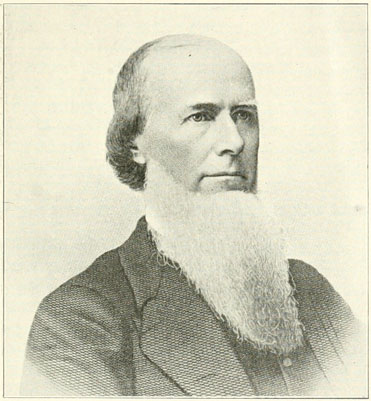
JOSEPH E. BROWN.
Passing by the particular events of the war between the States, it may not be unprofitable to inquire what was the difference in the developments of the two civilizations that followed the formation and establishment of the Constitution; the North by itself, free, and the South with her peculiar institutions. By their fruits ye must judge them.
There were seventeen Presidents anterior to President Grant, out of which number eleven were Southern born, and six the product of free soil, if we include John Adams. In jurisprudence, the South gave us a Marshall; in the forum they need no mention, as statesmen they have but few peers; among diplomats, John Laurens, of South Carolina, a member of Washington's staff, special Minister to France, stands preëminent; in the darkest hour of our struggle, at the court of Louis XIV., he saved the colonies and turned the tide of war in our favor.
In the field we have Washington, Lee, Stonewall Jackson, and Forrest. For an honest opinion of Gen. Lee and his soldiers, see Theodore Roosevelt's life of T. H. Benton: there he stands peerless. Those who desire to learn more about Col. John Laurens may read the December number of McClure's Magazine (1899).
Such are some of the fruits of a civilization that has passed away.
When I survey the past, and from it make prophecy of the future, I am as candid in saying I rejoice that slavery is no more as I am in condemning the brutal manner in which it was abolished; and nevertheless I am as sincere in my love of my whole country as I am imbued with dislike to that class of people who out of hatred precipitated that war on the Southern people out of envy because they imagined that the planters were a more favored people than they themselves were.
A Roman consul was never accorded a triumph for a victory in civil war, nor were the spoils of war his. But after this civil war, as it is termed, ended, the emblems of victory have waved in triumph in our faces, and are carefully preserved instead of being hidden away, and the universal looting has enriched the soldiers' homes with the spoils of war. Senator Charles Sumner wanted the captured flags returned.
War is not barbarous, nor is it "hell;" it is just what parties choose to make it. When confined to the enlisted troops it is seldom cruel. Hell is an expression adopted to silence argument on the cruel manner in which the United States government prosecuted the war: when this subject is mentioned we are silenced by the declaration, O well, "war is hell any way."
To cover up his own iniquities, Gen. Sherman said: "War is hell."
During the war with Mexico I was with Gen. Taylor from Corpus Christi to Buena Vista, and during that period heard of but one case of robbery, and that was at Papagallos, on the march to Monterey. There a soldier stole a chicken. Seeing a crowd of officers in the street, I rode up to ascertain the cause.
Gen. Taylor had dismounted. There was the offender; he was severely reprimanded and placed under guard. Turning to the accuser—an old woman—the General gave her some silver coin in payment for her chicken. That war was not hell.
When Richard Cœur de Lion was ill in Palestine the Islam commander, Saladin, "sent him the choicest fruits and refreshment of snow during the burning heat of summer; and at the siege of Jaffa, Saphadan, the Mohammedan chief, observing Richard dismounted, sent him two Arabian horses, on one of which he continued the conflict until nightfall. He further solicited and obtained from Richard the honor of knighthood for his son." This was not much like hell.
Again, Richard promulgated, like Gen. W. T. Sherman, regulations for the government of his troops. "A thief was to have his head shaved, to be tarred and feathered." Had Sherman issued and enforced an order like this, the sight of his troops would have frightened all the inhabitants out of Savannah.
Our Unknown Dead.
Extract from an Address of Gen. S. G. French Made to the U. C. V. Camp, No. 54, Orlando, Fla., June 8, 1893.
Comrades: The solemn ceremony of Decoration Day has been performed. The few graves, alike of the Confederate and the Union soldiers that rest in our cemetery, have been decorated with floral offerings, and the cause that so few of the Confederate dead sleep where loving kindred can care for them inclines me to say a few words in regard to the unknown dead.
From Dalton down to Atlanta, and around that city, there was one continuous conflict for one hundred days, and not a day passed without some troops being engaged, and so the dead were left throughout a hundred miles on either side, resting where they fell.
If we turn to the east again, we find that Gen. Grant crossed the Rapidan May 4, 1864, and, taking the direct line to Richmond, immediately the battle of the Wilderness followed, and he announced that he was going "to fight it out on that line if it took all summer." A few days after came the battle of Spottsylvania, and June 1 that of Cold Harbor, where the Federal troops refused to make a second attack.
In these three great and sanguinary battles the commander of the Union forces did not meet with success, and so on the first day of summer he left that line and swung around, as McClellan did, to the James river. After Cold Harbor it seems as if there was no desire for another general engagement, and the hammering away mode of war commenced on Lee. On July 18, 1864, President Lincoln called for five hundred thousand more men, and so the detrition process went on for nine months, mainly on and near the picket line, being in all nearly eleven months and a half that Lee confronted Grant's hosts of men, and over all this extent of country lay the blue and the gray side by side in death. Devastation, as in the Palatinate, had done its work.
Now when the war ended, the Federal government, with commendable zeal, very humanely collected most of its dead and had their remains removed to its beautiful cemeteries, and there keeps green the sod and fresh the flowers on their graves.
There was no Confederate government to collect and care for the remains of the Confederate dead. Along the banks of the "Father of Waters" for more than a thousand miles the inhabitants tread unawares over the unknown graves of those who battled for the South. Along the shores of the Potomac, the Rappahannock, and the James wave the golden harvests on soil enriched by their blood and moldering dust. There the grapes grow more luscious and the wine is redder. From the capes of the Chesapeake adown the stormy Atlantic, and trending around the Gulf, rest thousands of our dead; or go to the heights of Allatoona, to Lookout's lofty peak, or Kennesaw Mountain's top, and you may seek in vain where the dead rest. Time, with the relentless force of the elements, has obliterated all traces of their graves from human eye; they are known only to Him who can tell where Moses sleeps in "a vale in the land of Moab." So the forgotten are not forgot, the Hand that made the thunder's home comes down every spring and paints with bright colors the little wild flowers that grow over their resting places, and they are bright on Decoration Day. The rosy morn announces first to them that the night is gone, and when the day is past and the landscape veiled with evening's shade, high on the mountain top the last ray of the setting sun lovingly lingers longest, loath to leave the lonely place where the bright-eyed children of the Confederacy rest in death.
And wherefore did they die? They fell in defense of their homes, their families, their country, and those civil rights arising from that liberty God gave man as a heritage in the beginning. They furnished to their country much that will be noble in history, wonderful in story, tender in song, and a large share of that glory which will claim the admiration of mankind. We can today place no wreaths of immortelles on their unknown graves, yet we can rest assured that the echoes of posterity will render their deeds illustrious.
And now, as I look back on the past and recall to mind your trials and sufferings—which will be forgotten—I am sure the world will not forget that your valor merited a success which is better now than to have achieved it.