Chapter XII · ANURADHAPURA
Reading edition
Factory of cement pipes—Tiripane—Galkulum—Ruanweli Dagoba—The Abayagiria—Thuparama Dagoba—Jetawanarama Dagoba—Temple of the Tooth—Tomb and relic dagobas—Square and circle building material—Peacock Palace—Brazen Palace—Successive capitals—The Sacred Ark—Stone bulls—Pilgrims’ tents—The sacred Bo-tree.
Continuing our drive through the jungle (occasionally passing through fine forest, and sometimes crossing a bit of open plain with rice-fields), we came to Maradankadawalla, where we spent the night, and where, in addition to the usual deafening tom-toming and shrieking of shrill pipes, we were favoured with an exhibition of most 267repulsive barbaric dancing. Here, and also at Ellagamua, we were told that the tom-toming is considered equal to the best French drumming—in which case I can only say, may I never be compelled to hear either!
In 1890 a valuable industry was started at Maradankadawalla—namely, the manufacture of cement concrete pipes for road culverts and for sluices, similar to those now made in the modern city of Anuradhapura, the cost of transport being saved by establishing these factories as near as possible to new centres of work. It is encouraging to those who have so energetically promoted the work of restoration, to learn that in this district the villagers have of their own accord commenced the restoration of sixty abandoned Government tanks, each of which will become the centre of a new village and careful cultivation.
On the following morning we drove early to the Tiripane Tank, which is like a pretty natural lake, surrounded by grassy land and forest, and then on to Galkulum, altogether eleven miles. There we found graceful arches, and a most picturesque camp of temporary huts in the jungle, the breakfast house being quite a fine room. All the handsome white-humped oxen grazing near their respective large thatched waggons, and the groups of servants and drivers cooking under the shady trees, combined to make a most interesting scene.
In the afternoon (leaving the main road, which runs due north and south from one end of the isle to the other) we rode the remaining ten miles by a bridle-path, through fine jungle till we reached the far-famed pre-Christian city—the wonderful Anuradhapura.
The Government Agent’s pleasant house had been prepared for the reception of the Governor’s party, and its approach embellished by sundry fine pandals of jungle treasures, and a great display of coloured calico. Here we found ourselves in the very heart of the ruins of the once mighty capital—ruins totally unlike anything which I have seen in other countries. For my own part, the feeling they inspire is not so much admiration as wonder and bewilderment, as one wanders in every direction, walking or riding, only to come to more, and more, and more ruins,—ruins wrought by war and by ruthless treasure-seekers, but far more extensively and effectually by the silent growth of vegetation, which, fastening into every neglected crevice, has overthrown massive masonry, which, but for these insidious parasites, might have defied time.
268Two characteristics are specially striking: the incalculable multitude of tall monoliths—not rude stone monuments, but accurately hewn pillars of stone or granite, which in some cases must evidently have supported roofs, or some form of building; while a great number, capped with a beautifully sculptured crown, form the ornamental surroundings of the cyclopean dagobas or relic-shrines, which are the most prominent features of the whole place. These are gigantic masses of solid brickwork, built in the form of a half-egg or a bell, and crowned with a sort of spire called a tee, which symbolises the honorific umbrella. These huge piles are estimated to contain millions of cubic feet, and somewhere near the summit of each a secret chamber was constructed, wherein was deposited some worshipful fragment of Buddha himself, or of one of his saints, surrounded by costly offerings.
The means of access to this chamber was known only to the priests, but it is recorded in the book of the chronicles of Ceylon, the Maha-wanso, that when, about B.C. 161, King Dutugemunu had built the Ruanweli dagoba, he ascended to the summit by means of a temporary winding staircase, and thence descended into the sacred chamber, wherein he deposited the precious casket containing the relic, whatever it was, and various other treasures.
This Ruanweli or ‘Golden Dust’ dagoba is close to the house in which we lived, so it afforded the first and ever-present impression—a huge conical mass of crumbling red brickwork, partly veiled by quite large trees, which have grown up from seeds dropped into crevices all over the building, and have somehow contrived to obtain not only a footing but a living in that seemingly unnourishing soil. It is believed to have been originally 270 feet high, but is now only 189, and is crowned by an ornamental sort of spire, which I suppose must have been added at some time of restoration.
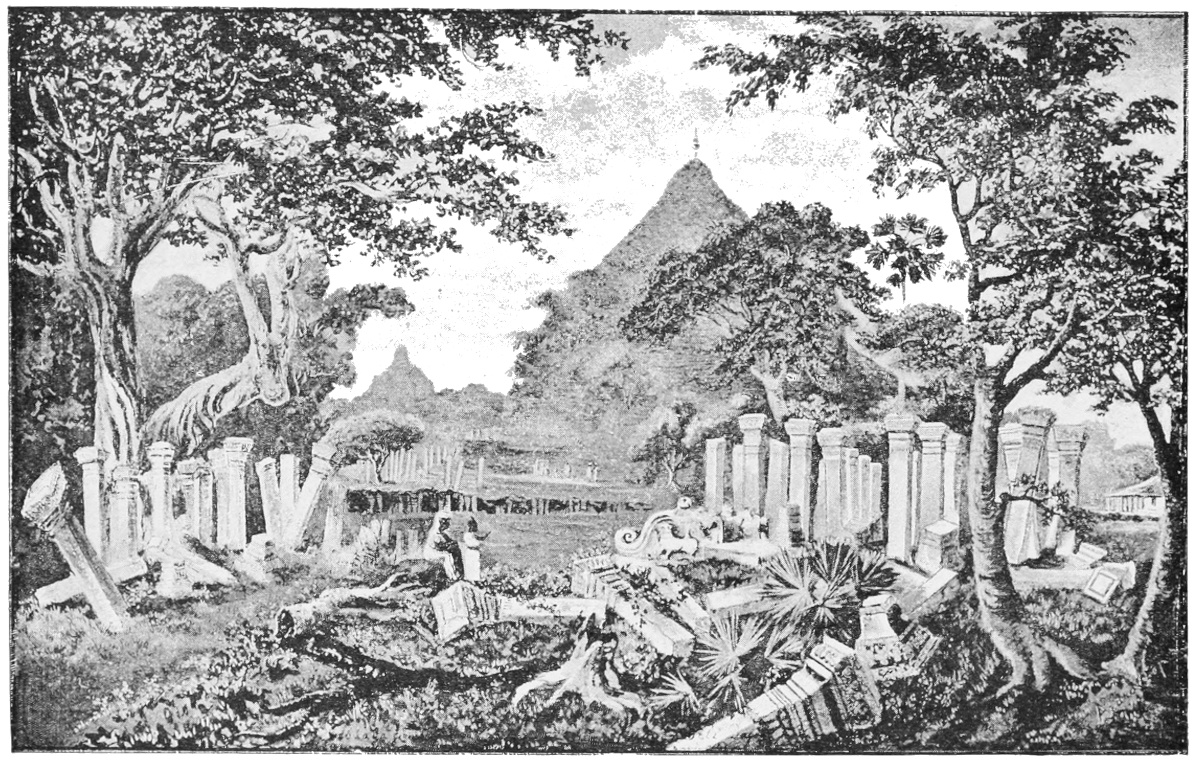
THE RUANWELI DAGOBA, ANURADHAPURA, B.C. 300. (To contain right collar-bone of Buddha. To the right is the Government Agent’s House.)
It stands in the centre of a granite pavement, forming a square platform, which measures 500 feet in every direction. It is raised on a second platform, likewise square, and round the upper square you can still trace the broken fragments of what was once a whole regiment of elephants, which, like the huge shrine itself, were all coated with the smoothest cream-coloured chunam, like polished marble. The old chronicles say that each of these elephants was originally provided with real ivory tusks: if this were so, tusked elephants must have been more abundant in Ceylon in those days than in the present century! There are also several large stone statues 269of ancient kings and saints, and a small temple, surrounded by a frieze of grotesque figures in high relief.
King Dutugemunu had previously built the Miris-wetiya dagoba, to commemorate his victory over Prince Elāla, and as he pitied his people, burdened as they had been by long wars, he refused to avail himself of his right to employ their forced labour. So he paid all his workers at a very liberal rate, and perhaps for that reason his building did not progress quite so fast as it might otherwise have done. Besides, he had many great works on hand, one of which was the erection of the Great Brazen Palace for the priests.
At all events, he did not live to complete his ‘Golden-Dust’ relic-shrine, so his devoted brother, Saidai-tissa, had a framework of wood made on the summit, and covered it with white cloth, that his dying eyes might behold it as it would appear when finished. The king was carried round the great building, and then laid down upon a carpet, that he might die gazing on this work which the priests told him was so meritorious. But in the hour of death the great king could find no comfort in any of the good deeds extolled by the priests, but only in recalling some acts of unselfish kindness known only to himself. A large slab of granite, surrounded by small pillars, marks the spot where the king lay in those last hours. A ruinous mound at a considerable distance is pointed out as his tomb.
It is said that in his last hours the king spoke somewhat bitterly of the state of absolute slavery to the priests in which he had lived all his life, an instance thereof commonly quoted being the erection of the Miris-wetiya dagoba, of which it is averred that he built it as a penance for having on one occasion so far forgotten his rule of giving the priests a share of everything, that he had eaten his curry, with the usual accompaniments of chillies and sambal (Miris-wetiya), without setting aside a portion for the priests! However, as I have just mentioned, a more plausible origin is assigned for the erection of this monument.
A Siamese prince has recently provided funds for the restoration of this dagoba (whether in memory of the king’s atonement anent the curry-stuff, or of his victory over the Malabar invaders, I cannot say). It is said that the sculptures and tracery on the three chapels connected with this dagoba, now exposed to view for the first time in the present century, are the most delicate and artistic that have as yet been disinterred. But the addition of some handsome brick 270arches, far up the sides, are criticised as being an incongruous though effectual method of arresting the process of disintegration.
The native chronicles give minute details of the building of the Ruanweli dagoba, and of the enormous labour expended on preparing a foundation capable of sustaining so ponderous a weight. It was dug to the depth of a hundred cubits, and filled with round stones, which were trampled by the largest elephants, their feet being protected by leather boots. These stones were embedded in clay, and over them was poured a layer of cement, then of sandstone, and over all were laid great plates of iron and of brass.
After the king’s death, his brother, who succeeded to the throne, surmounted the great edifice with a spire of glass as a protection against lightning. The great damage was done about the year A.D. 1214 by Maagha, a ruthless treasure-seeker, who, in his determination to reach the relic-chamber, tore down all the upper part of the structure, which accounts for its present reduced height.
I found a capital point whence to sketch this huge red ruin, veiled with green and grey foliage, with a wonderful foreground of a multitude of handsome stone pillars with elaborately sculptured square capitals—some upright, some leaning, others fallen and half overgrown with trailing vines—and overshadowed by fine trees with quaintly twisted stems.
In the distance, to the left of the Ruanweli dagoba, towered another—the Abayagiria dagoba, or Fortress of Safety, originally the greatest of all these monstrous piles, its full height having been about 405 feet (i.e., fifty feet higher than St. Paul’s) and its circumference 1,130 feet! Its height is now considerably reduced, but the square platform on which it stands still covers an area of eight acres! And around it are the ruins of various chapels and other buildings connected with a great college of priests; and among the ruins are many finely sculptured stones, a gigantic seven-headed cobra, and sundry flowers and figures. All this was the work of King Walagambahu, who thus (B.C. 89) commemorated the expulsion of the Malabar invaders and his own recovery of the throne.
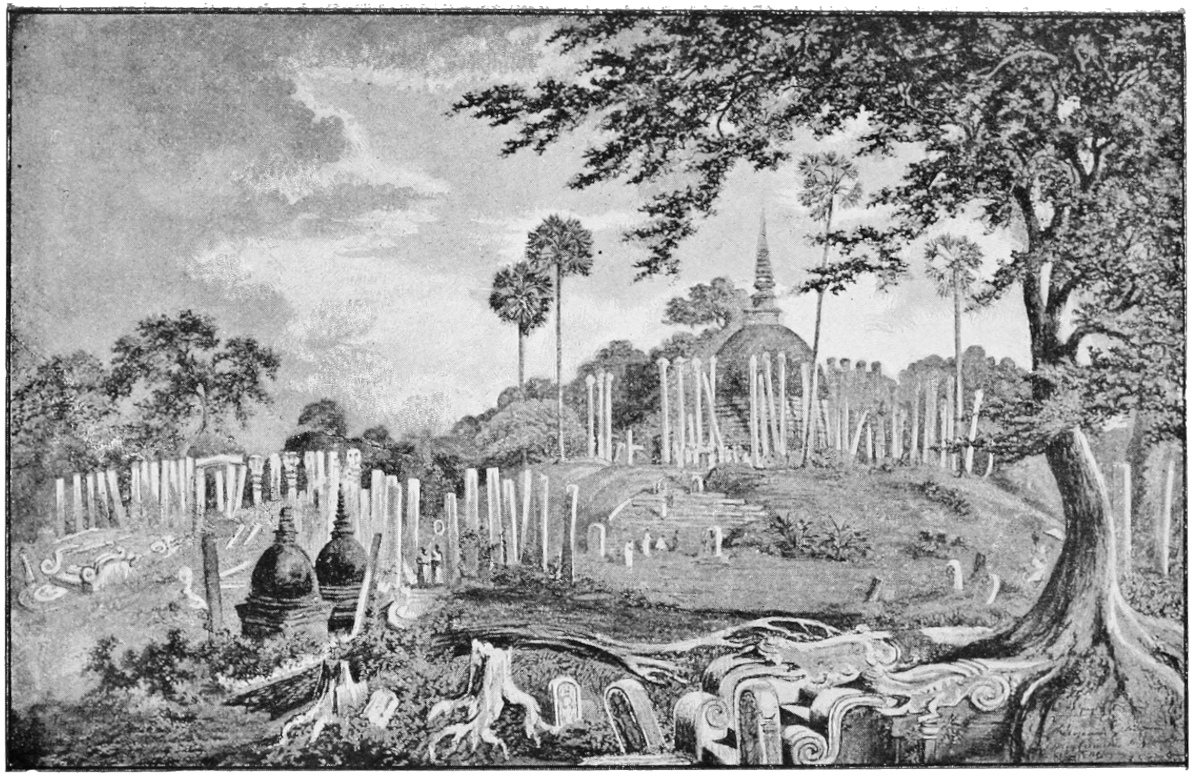
THE THUPARAMA DAGOBA, ANURADHAPURA, B.C. 300. (To the left lies the Delada Maligawa, where the Sacred Tooth rested on its arrival from India, A.D. 400.)
A few years ago the Government explorers tunnelled right into the heart of this huge ‘Fortress of Safety,’ through 200 feet of solid brickwork, because of a tradition that therein were buried very ancient books inscribed on metal plates. But on reaching the jealously guarded secret chamber, nothing whatever was found save a few beads, of no value beyond that due to their antiquity. The prisoners 271who were employed on this work of excavation, and on the restoration of the summit tower, have left rude steps along the side of the brickwork by which it is now possible to ascend to a height of 231 feet above the platform—i.e., 549 feet above sea-level—which, amid such very level surroundings, secures a wide-spread view in every direction over the wide expanse of park, land, and forest, dotted with the huge monuments of olden days, glimpses of stone pillars, and of glistening lakes and tanks, and bounded on the one side by the blue Ritigala and Matele hills, and on the other by Mihintale, the sacred mountain, so rich in ruins and in legends.
I found another fascinating spot for a very comprehensive sketch—seated beneath an overhanging tree whose roots were all entwined with a flight of beautifully sculptured steps, quaint animals, and other carved stones, which, with a couple of dark miniature dagobas to the left, formed an effective foreground for the really beautiful Thuparama dagoba, which stands on a raised mound approached by a fine flight of steps, and surrounded by 128 most elegant slim white columns with beautifully sculptured capitals. They are in three circles, the fifty-two nearest the dagobadagoba being twenty feet high: all of these are monoliths. The great building itself was cleared of jungle, restored and recoated with chunam about sixty years ago. It is crowned by a gigantic tee or spire, apparently representing seven honorific umbrellas, piled in the manner still realistically done in Burmah; and the eye is carried still higher by a group of tall palmyra palms, while a great temple-tree loaded with creamy fragrant blossom stands in relief against a background of dark foliage.
Then to the left, on lower ground, another stairway, with more quaint sculptured beasts and figures, leads up to a group of monoliths (two of which still support a third like a capstone). Here stand a group of pillars with most curiously sculptured capitals, quite unlike any others in the neighbourhood. They are described as ‘cuneiform mouldings,’ but some prosaic person has compared them to a gigantic double tooth with fangs!—that image being suggested by the fact that this is indeed the original Dalada Maligawa, or Palace of the Tooth, having been the first of the many resting-places of the famous Tooth of Buddha, of which, as also of the many palaces erected for it in the course of its wanderings in Ceylon, I have already spoken, so need only add that this building, where it was welcomed in the first instance, was erected by King Kirti Sri Megaha-warna in A.D. 311.
Fa-Hian, the Chinese traveller who visited Ceylon about A.D. 413, 272gives a wonderful account of the gorgeous ceremonials in honour of the Sacred Tooth—showing how, after great festivities, it was carried in procession to its summer home in the mountains, along a road so thickly strewn with flowers that the whole air was perfumed. Then strange miracle-plays were enacted, representing the chief events of Buddha’s life, with appropriate scenery and costumes, and introducing figures of elephants and stags so delicately coloured as to be scarcely discernible from life.
Strange, is it not, to find these curious religious plays in favour wellnigh two thousand years ago!
As I have frequently referred to my selection of scenes for ‘Comprehensive Sketches,’ I may mention that in all my travels, from the Himalayas to the remotest corners of the South Seas, I have always carried, in addition to a considerable variety of smaller sketching-blocks, one large sheet of galvanised zinc, turned over at the edges to give additional strength, and measuring 31 by 23 inches. On this (no matter how tired at night, in tent or in rest-house, where very often my large sheet of American waterproof, laid on the floor, formed my only sponging-table) I stretched a fresh sheet of drawing-paper as soon as it was possible to remove the last sketch, which was then laid with its predecessors in a flat tin box, proof against rain, white ants, and other foes.
The large zinc block was pinned up in white cloth, and strapped up in the aforesaid waterproof, which was the carpet on which I sat while sketching. I found that, from not being cramped for space, I could work much more rapidly, and produce a far more comprehensive and realistic picture, than by smaller studies of separate portions. In every case I always devoted several hours to most careful pencil-drawing, in order to secure accuracy of detail, before indulging in the joy of colour.
I think I have alluded elsewhere to the impossibility of preserving drawing-paper for water-colour painting in the damp tropics. The rapid development of mildew is so inevitable, that the artist has no alternative but just to make the best of it, and by long experience I found that the only thing to do was, just before beginning to colour, to wash over the whole paper with pure water. Then when great stars of mildew revealed themselves, I fed each hungry fungus with a good brushful of white paint. In colouring it is necessary to avoid these patches as much as possible, or work over them finely with a very dry brush. By observing these precautions I have produced 273many effective pictures on paper, which at first sight seemed absolutely hopeless, but on which now no one would suspect the presence of the once rampant mildew. At the same time, my rash attempt to ‘improve’ a sketch done in the tropics, by a wash of colour or even of water, will inevitably reveal countless troublesome stars and patches, previously invisible.
To return to the Thuparama dagoba, which is the oldest and most venerated of all these great buildings. It was built by King Dewananpia-tissa, ‘the Delight of the Gods,’ who ascended the throne B.C. 307, and having obtained possession of Buddha’s right collar-bone, proceeded to build this wonderful shrine for its reception. (I cannot refrain from reiterating how culpably careless were poor Prince Gautama’s cremators! We have seen the dagoba at Kala-wewa purporting to contain his jawbone, while another at Bintenne was erected B.C. 164 to contain a bone from his thorax.) The height of the Thuparama dagoba is about 63 feet.
The slim monolithic columns all round it are peculiarly elegant, though unmeaning except as ornaments. A similar arrangement of three rows of pillars of equally delicate workmanship, numbering respectively 20, 28, and 40, surround the Lankarama, which is a smaller but very fine dagoba, of unknown date. It is attributed to King Maha-Sen, who succeeded to the throne A.D. 275, and who having in the earlier years of his reign adopted a creed known to orthodox Buddhists as ‘the Wytulian heresy’ (supposed to have been Brahminical), had done all in his power to suppress Buddhism and destroy its monuments; but finding that the inevitable result would be to raise a general rebellion, he recanted, and became a zealous Buddhist, not only rebuilding all the monuments and priests’ houses which he had destroyed, but building new ones to outvie those of his predecessors.
The chief of these is the Jetawanarama, which, though not originally quite so large as the Abayagiria, was 316 feet high, and is still 249 feet high, with a diameter of 360 feet. Sir James Emerson Tennant calculated that even now it measures twenty millions of cubical feet, giving sufficient material to raise eight thousand houses, each with 20 feet frontage, which would form thirty streets half a mile in length, and would construct a town the size of Ipswich or Coventry, or form a wall one foot in thickness and two feet in height, reaching from London to Edinburgh!
Now this mountain of brickwork is covered to the very summit 274with large trees, of such frugal habit as apparently to live on air, for they surely can find no sustenance in the crumbling bricks!
Those slim columns with the ornamental crown, which never supported anything, are most puzzling, no one having any idea why they were erected. The only rude parallel that occurs to me, as possibly throwing light on the subject, is a custom which prevails in certain tribes in the Kassia hills on the confines of Upper India, where a cromlech is erected over the ashes of the dead, whose spirits are invoked by the living. Should the prayers thus offered be granted, a great monolith is erected close to the tomb, in acknowledgment thereof, and in due course of time these multiply, so that some favoured tombs are surrounded with a large group of such tributes of gratitude. It is just possible that this rude phase of ancestor worship may give us the clue to the more elaborate productions of a highly civilised race, whose object was equally the invocation of the dead. Whatever meaning may have once attached to them is now utterly forgotten, even by the priests.
As regards the dagobas themselves, there are two classes. First, those which were built as depositories for sacred relics (these include all the cyclopean buildings); and secondly, a multitude of small ones, which were merely hollow circular domes, built over a lower square chamber which was the receptacle for the ashes of some cremated monk or nun. Apparently the only means of access to this chamber, beneath the square platform, was by a square opening beneath the dome; but when once the dome has been erected, the living might no more enter the chamber of the dead. Within the chamber, at the four corners, forming a sort of octagon, were stone slabs bearing the name of the dead, and a short catalogue of his or her good deeds, together with a representation of Buddha’s feet, the trident, the sun and moon, and other Buddhistic emblems.
Unfortunately, at Anuradhapura most of these tomb dagobas have been destroyed by sacrilegious treasure-seekers.
Though the dagobas in this place are specially interesting as being the largest and oldest in Ceylon, the same form is reproduced in many more modern cities, and in connection with Buddhist temples all over the Isle, all[112] built on the same pattern—namely, a circular building on a square platform.
(At Chi-Chen, in Central America, there are ancient buildings, which in size, form of dome, and the ornamental tower or tee on the summit, are said to be apparently identical with those of Ceylon. It would be interesting to know whether they also have the square platform.)
It is worthy of note that the commonest type of grave all over North China, from Shanghai to Peking, simply consists of a circular earthen mound erected on a square platform of earth, the mound being generally crowned by a spire or knob. These are made in miniature for the very poor, very large for the wealthy, and cyclopean for emperors. This combination is the mystic symbolism which, to the Chinaman, represents the dual principle in nature. The square is the feminine symbol, and represents the earth. The circle suggests the male principle, and symbolises heaven. The same principle is worked out in the construction of the great Temples of Heaven and Earth at Peking.[113]
It is interesting and curious to find this ancient symbolism revered and perpetuated by the professors of a creed to which such details are certainly foreign.
The external square was repeated by an internal pillar which marked the exact centre of the dagoba: in the case of the tomb-dagoba the pillar was sometimes square, sometimes circular. It was about a foot square, and rose about four feet above ground, and on it rested the casket containing the ashes of the dead. Such caskets were generally miniature dagobas of the same bell shape.
In the construction of the gigantic relic-shrines, it appears that, in the first place, the exact centre was marked by an upright monolith accurately squared, and placed so as to have the four sides true to the points of the compass. The squares of the platform and outer wall were then marked out,—also the true circle for the dagoba,—and the whole was built up solidly; no chamber of any sort till the appointed height was reached, perhaps 15 feet from the summit. But so soon as the central square pillar was built up, another was placed on the top of it, ‘truly perpendicular, and securely fixed in position by mortice and tennon.’ Thus it was carried right up from the base to a height of from 200 to 400 feet, to the relic chamber, which was 276formed as a perfect square facing the cardinal points; and here, as in the tomb dagobas, this stone pillar projected about four feet through the floor. It was overlaid with gold, and supported a circular golden tray, on which was laid the casket containing the precious relic, which may have been only a hair from a saint’s eyebrow, or a revered toe-nail, but was probably accompanied by treasures of very much greater interest, which fully accounts for the anxiety of ruthless marauders to pillage these depositories.
Here, for example, is a list published by Mr. Wickremasinghe of the various objects enshrined in a dagoba at Hanguranketa: ‘Two gold chains and two medals, studded with valuable gems; 160 silver images, 199 bronze images, 604 precious stones, 2,000 uncut stones, and many other objects, including two boards for binding a book, of silver and gold, studded with gems; five books of the Vinaya Pitaka written on silver plates; seven books of the Abhidharma Litaka on silver plates, as also a number of other books; one book written on 900 copper plates, each three spans long, and extracts from various religious books written on 37 plates of gold, each plate weighing five English sovereigns.’
Of the cyclopean relic-dagobas,[114] there are seven within the limits of Anuradhapura itself, without reference to those at Mehintale and elsewhere in the neighbourhood. These seven are—
Supposed Present Diameter Date
original height. at base. begun.
height.
Thuparama — 62½ 59 B.C. 307
Mirisawetiya — 82½ 164 B.C. 164
Ruanweli 270 189 379 B.C. 161
Abayagiria 405 231 325 B.C. 89
Jetawanarama 316 249 360 A.D. 302
Lankarama — 32½ 44 Unknown.
Seta Chaitiya 20 Too ruinous to ascertain. B.C. 119
The latter, though generally known by this name, which means ‘the Stone Temple,’ is properly called the Lajjikavihara, having been built by King Lajji-tissa. Though small, and in very ruinous condition, it is deemed highly sacred, and its stone carving and stairways are considered very fine.
Of the other dagobas which are scattered about in the jungle, I 277may mention the Kiri Wihara (Milk Temple), which is so entirely buried beneath encroaching earth, that its existence is only known by the tradition which declares it to lie buried beneath a huge grassy mound.
All the dagobas at Anuradhapura are built of brick, and perhaps their erection here was suggested by the fact of finding building material in such abundance, in the form of beds of clay ready for the manufacture of millions of bricks—though, strange to say, the ancient chronicles relate how, to facilitate the building of the Ruanweli dagoba, one of the gods created the requisite quantity of bricks at a place sixteen miles distant; but there is no record of their having been miraculously transported to the spot.
Of course, in viewing these ruinous red mounds, it requires an effort of imagination to picture them as they appeared when so thickly coated with chunam as to resemble huge domes of polished cream-coloured marble. This chunam was still in use when the oldest European bungalows were built, and gives their pillared verandahs a delightfully cool appearance; but, as I have already mentioned, this manufacture is a lost art, though it is known that chunam was a preparation of lime made from burned oyster-shells, mixed with the water of cocoa-nuts and the glutinous juice of the fruit called paragaha.[115]
As regards the multitude of great columns, ‘moon-stones,’ and other large monoliths, some were obtained from masses of rock very near the city, which still bear the marks of the wedges by which the pillars were split off from the rock. But many were quarried from beds of mountain limestone and granitic gneiss in the neighbourhood of Mihintale, a very sacred mountain about eight miles from Anuradhapura. In these quarries you still discern the holes from which, two thousand years ago, the huge blocks and slabs were chiselled,—a stone so hard as to defy the ravages of time and-weather, for the most delicate sculptures remain as perfect as though only completed yesterday—each bead on the ornaments of the figures, each detail of flower or foliage, retaining all its original sharpness.
Of course, in exploring any scene of ancient historic interest, it is essential to have previously gathered as much information as possible regarding it, for nowhere does the eye so truly see what it brings the capacity for seeing as in visiting the ruined cities of bygone ages. This is certainly true of this labyrinth of ruinous brickwork and sculptured 278stones, so bewildering till one begins to get something like a clue to its main features.
In point of fact, most of what remains of the once mighty city of Anuradhapura, the magnificent, lies buried beneath from six to fifteen feet of soil, waiting for a whole army of excavators to come and supplement the feeble force now working for Government. And yet, although the forest now overgrows the whole plain, so that the only break in your long ride is coming to an occasional open tract, where fine old trees grow singly as in an English park, enough remains above ground to enable you to recall vivid visions of the past.
For a space of sixteen square miles the somewhat scrubby jungle, stunted by the prevalence of droughts, is but a veil for the masses of masonry and brickwork; a wilderness of granite pillars with richly carved capitals, and flights of steps, some covered with intricate carving, as perfect to-day as when, two thousand years ago, they were trodden by the unsandalled feet of reverent worshippers or busy merchants. The designs of these stairs are beautiful—on either side supported by rich scroll-patterns, and graceful figures overshadowed by the seven-headed cobra, supposed to be the emblem of vigilance; while the huge semicircular stone which forms the lowest step (commonly called ‘moon-stone’) generally represents a sacred lotus-blossom, round which circle rows of horses, elephants, bullocks, and the invariable geese held sacred by all ancient nations. These stones are peculiar to Ceylon. Strange to say, no two of these are exactly alike in arrangement of detail.
Broad roads have been cleared through the dense jungle, embracing the chief points of interest, and as you ride slowly along these or any of the innumerable pilgrim-paths which here intersect the forest, you see on every side the same wilderness of hewn stones, heaped up in dire confusion, all overturned by the insidious growth of vegetation, and at last you emerge at some huge bathing tank, all of carved stonework; or it may be on the brink of a great artificial lake, formed by an embankment of cyclopean masonry. Or else you find yourself in presence of some huge figure of Buddha, perhaps reclining in the dreamless repose of Nirvana, perhaps sitting in ceaseless contemplation of the lonely forest—a mighty image of dark stone brought from afar, at some remote time when worshippers were legion. Now, perhaps, a handful of flowers, or some ashes of burnt camphor, tell of some solitary villager who has here offered his simple prayer.
Or the object which suddenly presents itself to your amazed sight 279may be one of the gigantic dagobas of which I have already spoken—one of many similar buildings which lie scattered in various parts of Ceylon, in the silent depths of vast forests which now cover the sites where once stood busy populous cities.
It is recorded in the ancient chronicles that on great festivals these dagobas were festooned from base to summit with endless garlands of the most fragrant and lovely flowers, till the whole building resembled some huge shrub in blossom. Others were literally buried beneath heaps of jessamine. One of the relic-shrines which was thus adorned, the Jetawanarama, towered, as I have said, to a height of 316 feet.
Though no reverent hands now garland this desolate shrine, kind nature still strews it with fairest blossoms, and has covered it, right up to the summit, with trees of largest growth, all matted together with beautiful flowering creepers. These have now been in a measure cleared away so as to reveal the form of the gigantic dome, capped with a ruinous red spire four storeys high, circular, on a square base. Tall monoliths and sculptured figures at the base of this huge mass of masonry afford the eye a standard by which to estimate its height. My own feeling as I sat at work sketching it, as in duty bound, was of amazement that any human beings could have constructed an object so oppressively large, useless, and hideous.
Of vanished glories, one of the chief must have been the Monara- or Mayura-paya—i.e., the Peacock Palace of the kings, so called not only from the brilliancy of the colours with which it was painted externally, but also from the abundance of precious stones, gold, and silver employed in its decoration. It is described as having been a building three storeys high, with ranges of cool rooms underground. Whatever may still remain of it is all underground, buried beneath a grassy mound; but round it, as if keeping sentry round the royal palace, stand a circle of fine stone pillars with beautifully sculptured capitals.
But the crowning marvel of Anuradhapura was the Lowa-maha-paya, or Great Brazen Palace, a monastery built by King Dutugemunu about B.C. 164, for the accommodation of one thousand priests. It was nine storeys high, probably pyramidal, so that the top storey was much smaller than the lowest. The latter was built up from a foundation supported by sixteen hundred granite pillars, all of which, the Rajavali implies, were covered with copper. Each priest (or rather monk) had his own little dormitory, and (as no great man could possibly allow his inferior to sit higher than himself) the poor old monks of 280highest rank had to occupy the uppermost rooms, just under the roof with its glittering brazen tiles—rather warm quarters on a hot summer’s day!
A most interesting account of this palace, and its various apartments, has been preserved in the Maha-wanso, which is the book of ancient national chronicles. In one great hall were golden pillars, supported by golden statues of lions and elephants, while the walls were inlaid with flower-patterns of costly gems, and festoons of pearls. In the centre stood a magnificent ivory throne of wondrous workmanship, for the high priest, while above it was the white chatta or umbrella, the oriental type of sovereignty. On either side of this throne were set a golden image of the Sun, and a silver one of the Moon; and the whole palace was richly carpeted, and full of luxurious couches and divans.
Amongst the curious statistics of the Great Brazen Palace, we hear of a stone canoe, twenty-five cubits long, made to contain some special drink for the thousand priests—a very capacious punch-bowl! A huge hollowed stone, 63 feet long, 3-1/2 feet broad, and 2 feet 10 inches in depth, was pointed out to us among the ruins of this great monastery as having been used for this purpose; while another hollowed block of granite, 10 feet long, 2 feet deep, and 6 feet wide, lying near the Jetawanarama, was shown as that wherein the daily allowance of rice was measured out. Certainly the proportion of sack was largely in excess of the solids.
Minute details are given of the daily rations provided for all these priests by the king’s bounty, as also of the vessels of sugar, buffalo butter, and honey provided for the builders, whose work, however, did not prove enduring, for in the following reign this ‘Tower‘Tower of Babel’ had to be taken down, and it was rebuilt only seven storeys high. Two hundred years later these were reduced to five storeys, and seventy years afterwards, in A.D. 240, it must have been entirely rebuilt, as the reigning monarch changed the position of the supporting pillars.
When (A.D. 275) King Maha-Sen succeeded to the throne, full of iconoclastic zeal, he demolished this lofty ‘clergy-house,’ as well as many more buildings connected with Buddhism, and used them as quarries for the erection of new shrines for the images supposed to have been sanctioned by ‘the Wytulian heresy.’ But when he threw over his new love to return to the old, he rebuilt the Brazen Temple 281and all else that he had destroyed. Unfortunately some of the 1,600 granite monoliths had been broken; so, to make up the number, several were split. This was done by boring holes in the stone, and therein driving wooden wedges, into which water was poured to make the wood swell,—a simple but effective device, which was first adopted in England about two thousand years later.
How strange it is to think that when our ancestors sailed the stormy seas in their little skin-covered wicker boats, or paddled canoes more roughly hollowed from trees than those quaint outriggers which here excite our wonder, Ceylon was the chief centre of eastern traffic, having its own fleet of merchant ships, wherein to export (some say) its superfluous grain—certainly other products—to distant lands! Possibly its traffic may even have extended to Rome, to whose historians it was known as Taprobane, and of whose coins as many as eighteen hundred, of the reigns of Constantine and other emperors, have been found at Batticaloa.
Think, too, that while Britons wore a full-dress of only woad, and lived in wattle huts, these islanders had vast cities, with stately palaces and other great buildings, and monuments whose ruins even now vie in dimensions with the Egyptian pyramids.
Besides these massive ruins and this endless profusion of sculptured granite columns, and noble stairs which once led up to stately temples, how poor and mean all the modern temples do appear, with their wooden pillars and walls of clay, the work of pigmy descendants of giants!
Here, four hundred years before the birth of Christ, all that constituted Eastern luxury reigned supreme: great tanks watered beautiful gardens, and in the streets busy life fretted and toiled.
Even allowing largely for Oriental exaggeration we can form some idea of the greatness of the city from the native annals, which tell how, including these tanks and gardens, it covered two hundred and fifty-six square miles, the whole of which was enclosed by a strong outer wall, which was not completed till the first century after Christ. From the north gate to the south gate measured sixteen miles, and the old chronicles tell that it would take a man four hours to walk from the north to the south gate, or across the city from the rising to the setting sun.
The writer enumerates the principal streets, and it gives a strangely familiar touch to hear of Great King Street, while Moon Street reminds us of the planet-worship of the early Singhalese. 282Moon Street consisted of eleven thousand houses, many of which were large beautiful mansions two storeys high. There were lesser streets without number, bearing the name of the caste or profession of its inhabitants.
All were level and straight; the broad carriage-way was sprinkled with glittering white sand, while the footpath on either side was covered with dark sand. Thus the foot passengers were protected from the dangers of the swift riders, chariots, and carriages. Some carriages were drawn by four horses. There were elephants innumerable, rich merchants, archers, jugglers, women laden with flowers for temple offerings, and crowds of all sorts.
Not only had they cunning craftsmen of all manner of trades, but the most minute care was bestowed on such practical matters as the sanitation of their cities. Thus in Anuradhapura there was a corps of 200 men whose sole work was the daily removal of all impurity from the city, besides a multitude of sweepers: 150 men were told off to carry the dead to the cemeteries, which were well cared for by numerous officials. ‘Naked mendicants and fakirs,’ ‘castes of the heathen,’ and the aboriginal Yakkos and Nagas—i.e. the demon and snake worshippers—each had distinct settlements allotted to them in the suburbs.
Within the city there were halls for music and dancing, temples of various religions (all of which received liberal support from the earlier kings), almshouses and hospitals both for men and beasts, the latter receiving a special share of attention. One of the kings was noted for his surgical skill in treating the diseases of elephants, horses, and snakes. Another set aside rice to feed the squirrels in his garden, and a third devoted the produce of a thousand fields to provide for the care of sick animals.
At every corner of the countless streets were houses for preaching, that all the passers-by might learn the wisdom of Buddha, whose temples, then as now, were daily strewn with the choicest flowers, garlands of jessamine, and the fragrant champac-blossoms, and beautiful white and pink water-lilies (the sacred symbolical lotus). On all great festivals the streets were spanned by arches covered with gold and silver flags, while in the niches were placed statues holding lamps or golden vases full of flowers.
At a later date the records of Pollonarua are almost identical with these. Yet ere long both these cities were doomed to be forsaken. The huge tanks which watered the beautiful gardens and 283irrigated all the land were left to go to utter ruin; and for centuries all has lain hushed and still. When foreigners invaded the Isle, it was the policy of the Kandyans to keep the interior inaccessible, so there were only difficult paths through dense jungle. Consequently, although Knox had written of the wonderful ruins through which he had passed when making his escape from his long captivity in Kandy, they continued unknown till they were re-discovered by Lieutenant Skinner about 1833, when surveying for his great work of road-making.
At that time the site of the ancient city was the haunt of vast herds of elephants, sambur and fallow deer, buffalo, monkeys, and jackals. Porcupines and leopards sought shelter among the ruins, the tanks were alive with pelicans, flamingoes, and other aquatic birds, and large flocks of peafowl sought refuge in the cool shade, or sunned themselves in the green glades where once were busy streets. Of course, with the return of so many human beings, these shy creatures have retreated to more secluded hiding places.
Here and there, on the outskirts of Anuradhapura, there are great heaps of stones—huge cairns, to which, even to this day, each passer-by must, without fail, add a stone, though the people have long since utterly forgotten what event they commemorate.
Imagine such a fate as this creeping over the great capitals, where a hundred and sixty-five successive kings reigned in all the pomp and luxury of an OrientalOriental court.[116] Their history has been handed down to us in the Mahawanso, or ‘Genealogy of the Great,’—that precious manuscript to which frequent reference is so necessary to a right understanding of events in Ceylon. Its first section—which 284was compiled about the year A.D. 470 from native annals—treats of the Great Dynasty—i.e., the kings who reigned from 543 B.C. to 310 A.D., after which comes the history of those who are classed as the Sulu-wanse, or ‘lower race,’ although that list includes the great king Prakrama Bahu, by whose orders the work was completed up to his time—i.e., 1266 A.D. Finally, it was carried on to the year 1758 A.D. by command of the last King of Kandy, all compiled from authentic native documents.
Being written in Pali verse, none but the most learned priests could possibly read it, and, as a matter of fact, no one seems to have been able to do so, until in 1826 Mr. Turnour, of the Ceylon Civil Service, set himself to master this terribly difficult task, and, with marvellous patience and ingenuity, succeeded in so doing. Therein we obtain the clue to what at first seems such a mystery—how a race which produced work so wonderful as these great cities, a people so powerful, and in some respects so wise, as those old Singhalese (themselves, we must remember, conquerors from Northern India), should have been driven from province to province till all their old power and energy seems to have died out.
The mischief seems to have begun when the King of Anuradhapura first took into his pay mercenary troops from Malabar. These were the Tamils, whose descendants remain to this day. They rebelled, slew the king, and held the throne for twenty years. Driven from the Island, they returned, and again held it for forty years. Once more they were expelled, and once more fresh hordes poured in from Malabar, and landing simultaneously on all parts of the Island, again took possession of the capital, where some settled, while others returned to the mainland laden with plunder.
During all these years an ever-recurring contest was maintained between the Buddhists and their Brahmin invaders. There was the usual pulling down and building up of temples, so that by A.D. 300 the native records declare that the glory of the city was utterly destroyed, and that the royal race of children of the Sun had been exterminated. Nevertheless, it still continued to be a great powerful town, enclosed by strong walls.
The struggle with the Malabars continued till about A.D. 726, when the kings forsook Anuradhapura and made Pollonarua, farther to the south, their capital, and more beautiful than the old city. Still the Malabars pushed on, and overran every corner of the Island.
285At length, A.D. 1153, a mighty king arose, by name Prakrama Bahu, who with a strong hand delivered his country, and, driving out the invaders, established peace and security. He rebuilt the temples of Buddha, and made or restored fifteen hundred tanks, and canals without number, to irrigate and fertilise the thirsty land. Yet thirty years after the death of this great, good man, his family had become so utterly weak through their incessant quarrels, that the Malabars once more returned and seized the tempting prize.
And so the story of strife continued, till in 1505 the Portuguese came, and then followed the further complications of the struggles between Portuguese and Dutch, and later the French and English took their turn as disquieting elements.
But the consequence of all these fightings was the removal of the seat of Government from one part of the Isle to another, so that in many a now desolate jungle there still remain some ruins of ancient cities which successively claimed the honour of being the capital for the time being. The oldest of these was Tamana-nuwara, which was the capital of Wijayo, the conqueror, B.C. 543. His successor founded Oopatissa-nuwara, calling it after himself. Then Maagama and Kellania had their turns before Anuradhapura asserted its supremacy. With the exception of those eighteen years when Kaasyapa (the parricide and suicide) lived on the fortified rock of Sigiri,[117] and one year when King Kaloona removed the capital to Dondra or Dewa-nuwara, the city of the gods, and likewise committed suicide, Anuradhapura reigned supreme for 1,353 years, when it was abandoned in favour of Pollonarua: three hundred years later Anuradhapura became the capital during one stormy reign, and Roohoona, Kalu-totta, and Kaacha-ragama were each the royal home for a brief interval.
Then came the reign of the great King Prakrama, when the glory of Pollonarua was at its height, and continued the capital during the seventeen changes of sovereignty which followed in the twenty years after his death. From 1235 to the end of the century, Dambadeniya was the chief city. Then Pollonarua had another turn. After this, Kurunegalla, Gampola, Sengada-galla-nuwara, Kandy, and Cotta were successively the royal headquarters.
Now one after another of these great centres has fallen into comparative neglect, and several into total oblivion. Giant trees have overgrown both palaces and markets; beautiful parasitic plants 286have loosened the great blocks of stone, and the dark massive ruins are veiled by lovely creepers, and all the wealth of tropical scenery, through which (as they did so recently in Anuradhapura) bears and leopards roam undisturbed, while birds of all glorious hues flit through the foliage. Only at the time of certain great festivals do devout pilgrims still wend their way through the silent depths of these dark forests, to do homage at these shrines; and the stillness of night is broken by their pious ejaculations as they circle round the huge relic-shrines.
At the time of our visit to Anuradhapura, the pilgrims had assembled in vast numbers to celebrate the festival of the Midsummer New Moon, and their simple camps—yellow tents of great taliput palm-leaves, of which each pilgrim carries one section, to act as sunshade or umbrella—formed a very picturesque feature in the scene. Half-a-dozen pieces of leaf, supported by sticks, form the slight shelter which is all they need. (Many carry one of the tough fibrous sheaths which has enveloped the young flower of the areca-palm, and which serves as a simple rice-plate, while an ingeniously folded palmyra-palm leaf forms an excellent water-bucket.)
With reverent steps they trod the green forest-glades, marking the course of the main streets of the holy city, and guided by yellow-robed Buddhist priests. Many of the pilgrims carried small flags and banners, and one group carried a miniature ark containing a golden lotus-blossom, to be offered to the sacred Bo-tree.
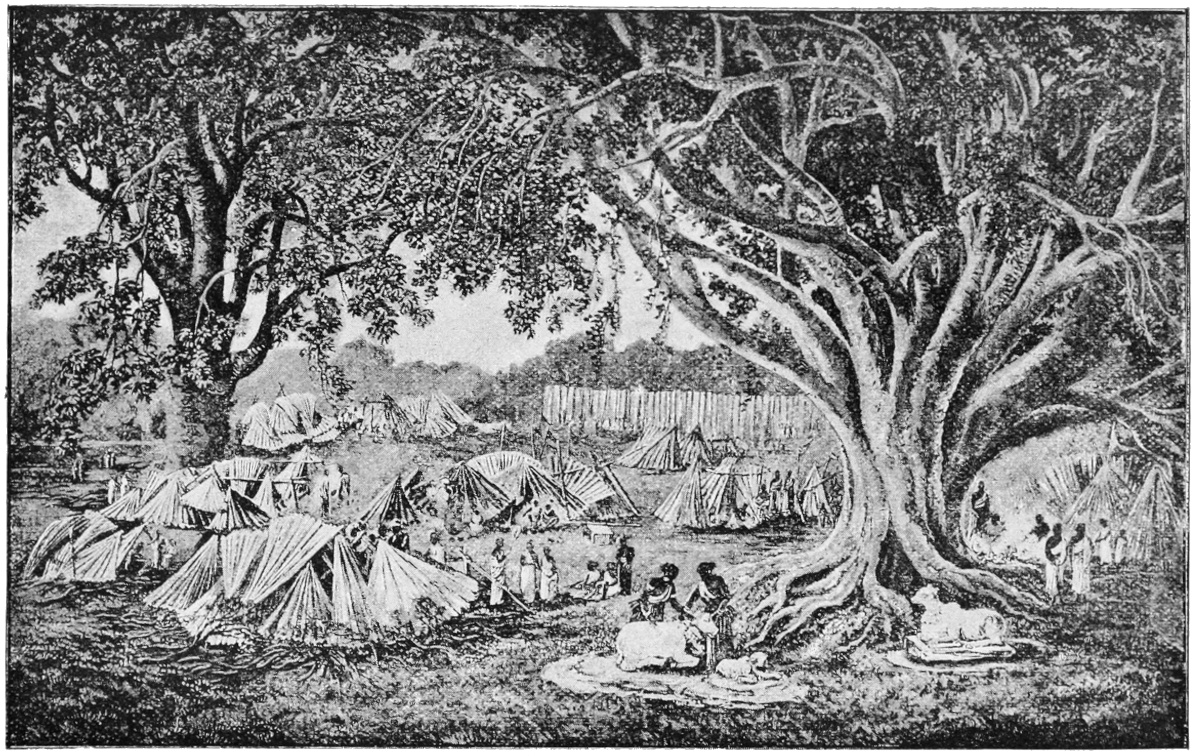
PILGRIMS’ CAMP AND THE THREE STONE BULLS. (Near the Ruins of the Brazen Temple.)
The ark, I may observe, holds the same place of honour in Ceylon as it does in many other nations. To all travellers in the Himalayas, the ark veiled with curtains, within which is concealed the idol most deeply reverenced, is a familiar object—an ark which is carried on staves through the forests, with music and dancing, and which, both in its proportions and in all the ceremonies connected with it, bears strange affinity to the sacred ark of the Israelites.[118] We find it again in the Christian Churches of Abyssinia and in the Buddhist temples of Japan; and here in Ceylon every important dewali (that is, every Malabar temple) has an ark very similar to that of the Himalayas, the sacred objects, which are so jealously concealed from the gaze of even devout worshippers, being in this case the mystic arrows of the god or deified hero there held in reverence. Once a year, at a great full moon festival, this ark is borne forth on 287its staves, and carried in sunwise circuit round the temple amid great rejoicing.
That tiny ark, containing the mystic lotus-blossom, was not the only link we noticed to the customs of far-distant lands. At the entrance to the Wata Daghè, at Pollonarua, lies a stone precisely similar to the Clach Brach at St. Oran’s Chapel in Iona, with a row of hollows, said to have been worn by the continual action of stone or crystal balls, which the passers-by turned sunwise to bring them luck. And here, in Anuradhapura, are three stone bulls, which women who have not been blessed with offspring also drag round sunwise, that they may ensure the speedy birth of an heir. One of these seems to have formerly revolved on a pivot, but now main force does all.
Certainly the most venerated objects of superstition are not often impressive to the eye, and these are three insignificant little animals, measuring respectively 3 feet 6, 2 feet 9, and 1 foot 7. They lie on the turf beneath a great tree—a curious foreground to a most picturesque pilgrim’s camp of yellow palm-leaves like gigantic fans, banked up with withered boughs; women and children busy round their camp fires, and beyond the curling blue smoke rise the pillars of the Brazen Palace.
Thousands of these primitive tents were scattered about in groups in the park-like grounds, and I had the good fortune to witness a very striking scene on the night of our arrival, when all night long, by the light of a glorious full moon, great companies, guided by bare-armed and bare-footed yellow-robed priests, circled round the Ruanweli dagoba, shouting ‘Saadhu!’ the Buddhist form of ‘All hail!’ But in making their circle they kept their left side towards the relic-shrine, which in sun-lore all the world over is the recognised form of invoking a curse instead of a blessing! But on the beautifully sculptured ‘moon-stones’ at the base of the great temple and palace-stairs, all the animals—elephants, oxen, horses, lions, sacred geese—have their right side towards the central lotus-blossom; so they are making the orthodox sunwise turn.
On returning to Britain I compared notes with my kinsman, J. F. Campbell, of Islay, and found that he also had been impressed by these various peculiarities of sunwise and anti-sunwise turns; and he noticed, moreover, that all creeping plants in the jungle coil with their left side towards the centre.
But the object of deepest reverence to the pilgrims, and of 288exceeding interest to us all, was the Peepul or sacred Bo-tree (as irreverent Britons, in their love for abbreviation, call the Maha Jaya Sri Bodingahawahanse, or great illustrious sacred Tree of Wisdom, which is really believed to be the very identical tree which was planted here in the year B.C. 288, and which consequently must now be 2,180 years old). What was shown to us as the original tree was such a wizened little old stump, that we agreed it might very well be the genuine article, and the ancestor of the generations of old Bo-trees which surround it within the sacred enclosure, to say nothing of all others in every corner of Ceylon, all of which have been propagated from seed.
Assuredly no other tree has ever occupied so important a place in history, or had its own story so minutely recorded from generation to generation. Sir James Emerson Tennant[119] quotes twenty-five extracts from various native chronicles, and other ancient sources (and these, he says, are but a few out of a multitude), stating the various honours paid to the sacred tree in different reigns, from its first arrival, nearly three hundred years before the Christian era, till that of the very last King of Kandy, who in 1739 caused it to be inscribed on a rock that he had dedicated certain lands in the Wanni to the sacred tree.
One of the passages quoted from the Mahawanso, written about 470 A.D., concludes: ‘Thus this monarch of the forest, endowed with miraculous powers, has stood for ages in the delightful Maha-mego gardens in Lanka, promoting the spiritual welfare of its inhabitants and the propagation of true religion.’
It is somewhat remarkable that in one of these quotations Fa Hian, the Chinese traveller, describes the tree as having sent forth a branch which descended to earth and there took root. Now as this is the habit of the banyan (Ficus indica), and not of the Peepul or Bo (Ficus religiosa), certain heretics have suggested that the priests may occasionally have renovated the old tree by placing a healthy seedling in some crevice, and that by mistake a seedling of the wrong sort had at that time been introduced.
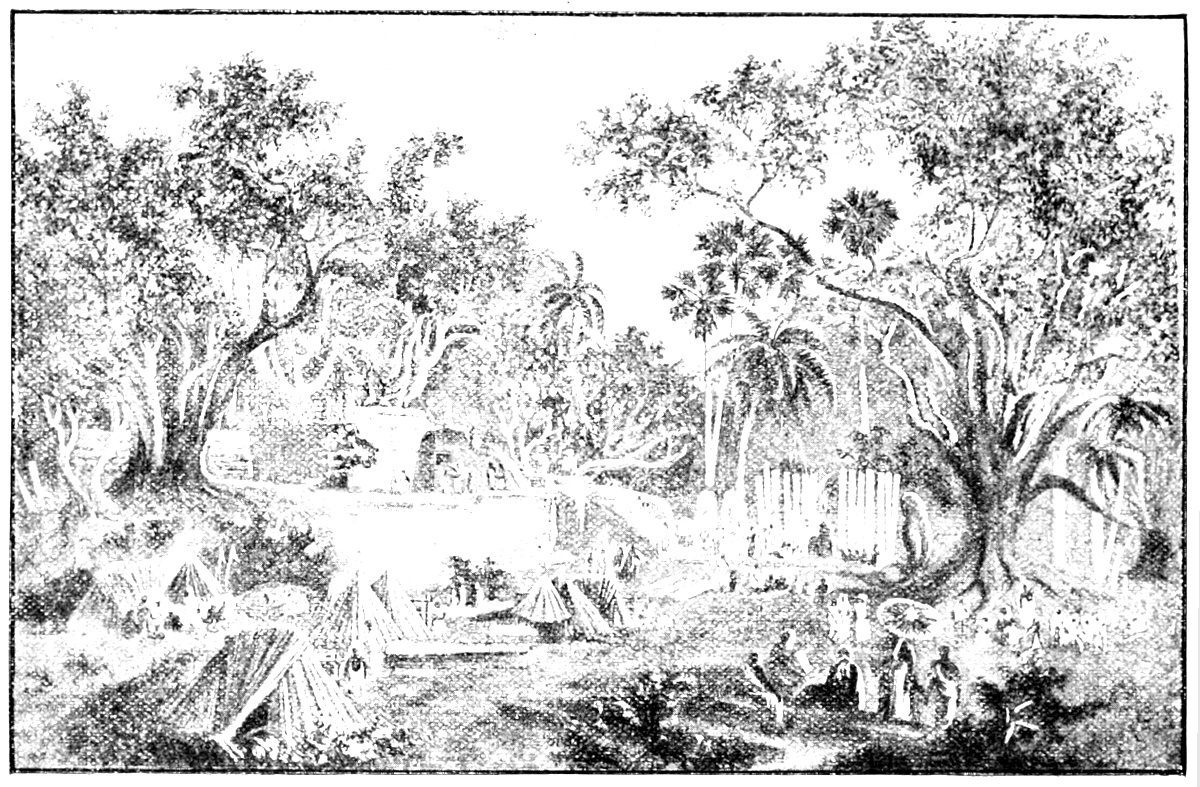
THE SACRED BO-TREE. (Rising through the Upper Terrace.)
However, the leaves of these two cousins are so essentially different that such a mistake could not really have been made, those of the banyan being thick and leathery, while those of the Bo are very thin and light. They are like very large birch-leaves, heart-shaped, with a long ribbon-like point, and are attached to the stem by such a long slender stalk that they tremble incessantly, like the 289leaves of the aspen. This, say the Buddhists, is because of their sympathetic joy that beneath their shade Gautama attained to the perfection of all knowledge—a legend which to Christian ears recalls the tradition which attributes the quivering of the aspen leaf to the memory of that dread day when the bitter Cross on Calvary was fashioned from its unwilling wood.
The story of the tree is that it was a branch of the sacred Peepul at Uruwelle (now known as Gaya or Buddha-Gaya, the capital of Behar) beneath which Buddha sat absorbed in contemplation—some say he lived beneath its shade for four years. Those who seek most closely to assimilate the ‘Light of Asia’ with the True Light of the World, say, forty days.[120] The mighty Indian King Dharm-Asoka—i.e., the righteous Asoka—having zealously embraced Buddhism, his children followed in his footsteps, his son Mahindo becoming a priest, and his daughter Sanghamitta the abbess of a Buddhist nunnery. Mahindo, the royal missionary, came to Ceylon B.C. 307, and preached so effectually that not only Dewenipiatissa, the King of Anuradhapura, but also Queen Anula, and many women of the Isle, declared themselves converts to the new creed, and desired to take the vows of devotion thereto.
Mahindo recommended that his sister Sanghamitta should come to instruct the women; so King Tissa sent an embassy to Behar inviting the royal Abbess to come to Ceylon, and praying Asoka to bestow upon him a branch or graft of the Tree of Wisdom. This the king was willing to do, but dared not risk the sin of sacrilege by cutting the tree with any instrument. He therefore approached it reverently at the head of a thousand priests; they worshipped the tree, and presented offerings of flowers to it; then having prepared a golden vase filled with perfumed earth, he took vermilion paint in 290a golden pencil, and therewith drew a line round a branch, and prayed it to sever itself from the tree, and transplant itself into the vase, which it most obligingly did forthwith, while the assembled multitudes shouted ‘Saadhu!’ to the holy tree.
Then Sanghamitta, with five hundred Buddhist nuns, started for Ceylon, in charge of the precious branch, where it was received with indescribable devotion. A whole chapter of the Mahawanso is devoted to the account of its reception, and how the king, the lord of chariots, commanded that it should be lifted by the four high-caste tribes, and by eight persons of each of the other castes, and so it was duly planted, and much worshipped.
The fact of the Peepul being held in veneration by Hindoos of all sects, as being alike sacred to Brahma and Vishnu, accounts for its having been not only spared, but honoured by the conquerors who in different centuries overran the Isle with fire and sword.[121]
In the history of successive kings, their devotion to the Bo-tree is duly recorded—how one built up the tiers of stone terraces around it; another paved the enclosure with marble; another erected stone stairs leading up to it from four sides; others made many images of Buddha in stone and in metal, and built halls to receive these and various relics. King Waahsabo, who reigned A.D. 62, kept up an illumination of a thousand lamps here and at other shrines, and also ‘caused statues to be formed of the four Buddhas, of their exact stature, and he built an edifice to contain them, near the delightful Bo-tree.’ If the exact size of the other Buddhas was at all on the scale of Gautama’s tooth and footprint, it must have been rather a large edifice!
After the destruction of Sitawacca by the Portuguese, it was prophesied that the town would be rebuilt when the Bo-tree lost one of its branches.
In A.D. 1674 a branch of the tree was stricken by lightning, and the Dutch verified the prophecy by restoring some of the old buildings.
It would be interesting to know whether the present phoenix-like birth of a modern Anuradhapura has any connection with the disaster which befell the tree on October 4, 1887. After a prolonged drought, 291which continued for eight months, the tom-tom was beaten to invite all good Buddhists to assemble on the 7th to take part in the ceremony of Kiri Utura-wanawa—i.e., the outpouring of milk, at the shrine of the sacred tree, while invoking rain. But on that very day (without waiting for the milk-offering!) there arose a mighty tempest of thunder, lightning, and rain, accompanied by a violent north wind which snapped the main stem: it fell with a crash, carrying with it part of the iron railing round the enclosure. Now a stump about four feet high is all that remains of the original tree.
A smaller branch had been broken in 1870, and was cremated with all honour, and said to have attained its Nirvana. But the fall of the ‘Great Lord’ itself was a more serious matter, and was deemed a very evil omen. Sadly and solemnly the fallen branch was sawn into logs by men attired in mourning and having handkerchiefs tied over their mouths. One log was preserved by the high priest, to be sold to pilgrims in small chips, as precious worshipful relics; the others were laid on a bullock-cart canopied with white cloth, and borne in procession to a funeral pyre erected near the Thuparama dagoba, where they were cremated with all the ceremonial observed at the funeral of a Buddhist high priest, and to a terrific accompaniment of tom-tom beating.
On the following day the ashes were collected, and a second great procession conveyed them to the neighbouring lake, the Tissa-wewa on whose waters they were to be scattered. Apparently, however, some ashes were reserved, and a small dagoba was erected to their honour, so doubtless these now receive their full share of worship.
Except to the eye of faith, the disappearance of this preternaturally old branch will make small difference, as there are so many branches, all apparently about the same age, and none exceeding two feet in diameter, growing up through the pyramidal stonework which is built round the tree in four terraces. It is impossible to guess how much trunk there may be, as it is so effectually built up out of sight. Each of these terraces forms a platform round which the pilgrims walk in procession, and feed the great company of monkeys of all sizes and ages which play in the branches.
At one festival—the Wandanawa—these branches are plastered over with gold paper, and the boughs are decorated with hundreds of brightly coloured handkerchiefs fluttering gaily in the breeze—a pretty elaboration of the decoration of sacred bushes with rag-offerings, as 292practised in so many lands, from Ireland and Scotland to the Himalayas.
At night pilgrims come bearing tiny lamps, and burn camphor to the tree as they circle round within the railing. To the priests they offer more practical gifts of rice and coin. Much good milk is also poured out in offerings to the thirsty tree.
You can well understand that the withered leaves which fall from so sacred a tree are priceless treasures, and jealously guarded. The priests spread white cloths of honour beneath the tree to collect all such, and distribute or sell them to eager pilgrims. If the supply exceeds the demand, the superfluous leaves are cremated. Of course to gather one would be accounted unpardonable sacrilege.
At night the tree is illuminated by very primitive lamps, half-cocoa-nut shells filled with oil and with floating wicks, which give a feeble flickering light. I wondered that the monkeys did not upset them, but probably they have learnt by experience to respect flame.
In the outer court, overshadowed by Bo-trees of a younger and more vigorous generation, and by cocoa and palmyra palms, are various images and finely sculptured stones, including sundry five- and seven-headed cobras. So here we stand in the very presence of the ancient tree and serpent worship—the former as real as ever, the latter obsolete except in quiet corners.[122]
Yet even here you may sometimes see ashes of burnt camphor, and bits of wax and a few flowers, on these snake sculptures, proving that they have received their share of night worship, and images of cobras made of painted clay are offered on the altar of the Bo-tree which stands on the outer side of the inner wall. So Buddhism incorporates and sanctions every conceivable variety of worship, provided that of Buddha himself is paramount. Thus the serpent worship, which could not be eradicated, was made subservient to Buddhism, by the legend of how the gigantic king of all the cobras proved his reverence for Gautama by rearing its great hood above his head, to protect him from the sun as he sat lost in meditation. Hence the hydra-headed serpent which forms the canopy of such innumerable images of Buddha.
The Rev. Samuel Langdon mentions that he has known various instances in which the priests or their attendants have kept tame cobras within the enclosure which generally surrounds each 293sacred Bo-tree, notably at the gigantic tree which overshadows the place where the kings of Kandy were cremated. These gentle pets are fed at regular hours, and it is suspected that the protection afforded them is not unmingled with some feeling of reverence.
In the same way in India, the Brahmin priests find it convenient to sanction proceedings which they cannot prevent, and are present at many ceremonies of the simplest serpent-worship.[123]
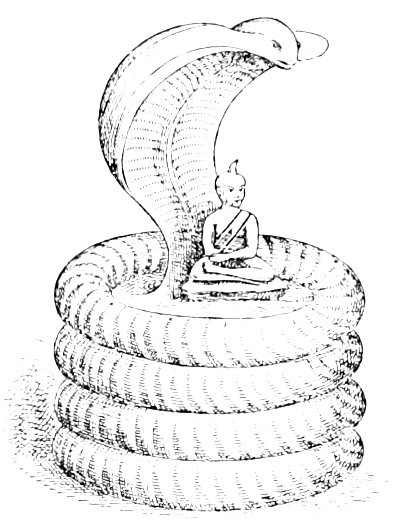
BUDDHA GUARDED BY THE COBRA, ROCK TEMPLE, ELLA PASS.
Both Tamils and Singhalese have a legend of how a cobra and the even more deadly tic polonga came together to a well in a time of great drought, and finding a little girl drawing water, each asked for a drink. This she agreed to draw, provided they would promise never to bite her. Both promised and both drank, and the cobra glided gratefully away, but the treacherous tic bit the child, who died in great agony.
So the cobra is called Nallu pambu, ‘the good snake,’ because he kept his promise, and he and the tic hate one another so cordially that the Singhalese equivalent for the old English saying about hating a thing ‘as the devil hates holy water’ is, ‘They hate one another as the tic hates the polonga.’
It has been suggested that the various proverbs and folklore referring to this enmity really owe their origin to ancient feuds between clans of the Nágas or serpent worshipping tribes who inhabited Ceylon ere its conquest by the Singhalese.
Pollonarua, the mighty medieval city which became the capital of the Isle after the downfall of Anuradhapura, is said to have been named in honour of the two serpents aforesaid—Polon and ná, the polonga and naga—in order to propitiate both.
Some years ago Mr. Layard opened a dagoba near Colombo which was supposed to have been built to commemorate the conversion of the Nága king of Kelany to the faith of Buddha. The treasure-chamber contained some fragments of bone wrapped in thin gold-leaf, 294a few pearls, gold rings and bits of brass, a brass lamp, a small pyramid made of cement and A CLAY COBRA wrapped up in cotton cloth.
I lingered long, alone with my sketching-block, amid these strangely suggestive surroundings, the stillness broken only by the ceaseless rustling of the trembling leaves, or an occasional stampede of inquisitive monkeys.
The entrance to this sacred enclosure is by a double-roofed red-tiled gateway (what a multitude of reverent pilgrims from far and near have passed through that old portal in the course of these two thousand years!). Just beyond are forty rows of roughly-hewn stone pillars, which even now stand twelve feet above the soil and are doubtless sunk to a depth of many more—a strange and unique sight. In each row there are forty of these granite monoliths, making sixteen hundred in all. Some have fallen, some are half buried among the ruins, but there they are—and these are all that now remain above ground to mark the spot where the stately Brazen Palace once stood, with all its crowds of learned priests. Of course there is not a vestige of the copper which once covered the pillars, nor of the resplendent brazen tiles.
I was told a legend—whether authentic or not I cannot say—that the final destruction of this grand building was due to fire kindled by a queen, who when sore beset by the Malabar armies, and seeing no hope of escape from beleaguering foes, resolved that at least they should not enjoy the pillage of the palace, and so caused all her most precious possessions to be brought here and heaped together, and having with her own hands set fire to this costly funeral pyre, thereon sought death.
Now the desolate ruins are forsaken alike by priests and worshippers. I wandered alone through the labyrinth of grey pillars where only a flock of shaggy, long-legged, reddish goats were nibbling the parched grass, just as I have seen British sheep finding greener pasture beneath the shadow of the mighty rock-temple of our own ancestors at Stonehenge.
295