Chapter X · THE WORSHIPFUL TOOTH
Reading edition
Blended faiths—Planet and spirit worship—Hindoo gods and Buddha—The Temple of the Tooth—Oriental library—Tooth on show—Perahara—Originally a Hindoo festival—3 and 9—Days of the week—Other teeth—Christian relics.
Few things appear to me more remarkable—and surely none would more surprise the European admirers of Buddhism—than the very strange manner in which, in most countries where it is practised, it is so amalgamated with the Hindoo mythology which Buddha sought to obliterate, that the practical result of his teaching has been to add one more god—himself—and innumerable objects of worship to those already so numerous.
In China,[86] in Siam, and in Ceylon this is specially conspicuous, but in the latter the Hindoo images are sometimes excluded from the interior of the vihara, as Buddha’s sanctuary is called. But in any case, they almost invariably occupy a dewale or house of gods in the outer enclosure, where there is also a hall for the kapuas or devil-dancers—a very singular compromise between creeds which theoretically are so antagonistic.
Thus these forms of worship are so curiously blended that the religion of the majority of the Singhalese, though nominally Buddhist, is largely coloured by Hindooism, and still more, whether avowed or only practised in secret, by demon-worship, pure and simple. The extent to which the latter prevails is extraordinary. There is not a village in the most purely Buddhist districts which has not its kattadia or devil-priest, whose office it is to propitiate the innumerable malignant demons which are supposed to be accountable for all the evils of every sort which afflict poor human beings. As a minor precaution every small child wears a charm of some sort—very often it wears nothing else!—and many grown-up folk are similarly guarded.
A people naturally superstitious find demons and spirits requiring propitiation in every tree and well, in dark river and raging pestilence, in malarious swamp or neglected burial-grounds. Planets also claim worship. The Bali, or planet-worship, is curiously blended with 197demon-worship, and astrologers are consulted on every event of life.
At the birth of every Singhalese baby its horoscope is cast by one of those, and so highly is the document esteemed, that even in the hour of death more reliance is placed upon it than on the symptoms of the patient![87] Again, the astrologer is called in to preside at baby’s ‘rice-feast,’ when some grains of rice are first placed in its mouth. He selects for the little one a name which is compounded from the name of the ruling planet of that moment. This name he tells only to the father, who whispers it low in baby’s ear—no one else must know it, and, like the Chinese ‘infantile name,’ this ‘rice-name’ is never used lest sorcerers should hear it and be able to work malignant spells.
Thenceforth at every step in life the counsel of the astrologer is sought. He must decide the auspicious moment for the first shaving of baby’s head, or in advancing years for the first shaving of the young man’s beard; for starting on a journey, for commencing to build a house. At the Singhalese festival of the New Year, which is in April, the astrologer is ready to give each individual who will pay for them directions how to secure luck for the incoming year. In case of illness he carries far more weight than the doctor. The horoscope of the sufferer is submitted to one of these gentry, who consults his astrolabe, calculates the probable influence of certain planets, and then prescribes the ceremonies or bali to be observed, which include incantations over a clay image representing the planet under which the patient was born.
The astrologers are of all castes, from the lowest tom-tom beaters to the highest agricultural aristocracy, and even include many Buddhist priests, although this practice of divination was condemned by Buddha, and is entirely borrowed from the Hindoos. The priests are, however, wise in their generation, and like to reserve so important a hold on the superstitions of their flock.
As to the Kattadias, they continue to make a very good profit on other men’s labours, for the people do not venture to sow their fields till the village priest has fixed a lucky day, when, having made their offerings at the shrine of Buddha, they tie bunches of wild flowers and cocoa-nut leaflets on sticks, placed at the corners of each field, 198to scare away evil spirits. At harvest, too, the priest must choose a lucky day for beginning work, in return for which he receives offerings of the first-fruits. Sometimes in a corner of the field you may see a small bower decorated with fragrant flowers; within this is placed a sheaf of grain, together with a palm-leaf, on which the Kattadia has inscribed mystic characters dedicating the sheaf to the guardian spirit of the field.
An exceedingly singular superstition is prevalent in districts so far apart as Tangalla in the far south and Jaffna in the far north—the former being Singhalese and the latter Tamil—namely, the use of a very peculiar patois, adopted by the villagers only during the most important periods of the paddy cultivation, while sowing, weeding, reaping, and threshing, the object being to deceive the malignant spirits, which are supposed only to understand the language in ordinary use. At the same time, they must be treated with a show of excessive politeness.
The same custom prevails amongst the numerous agricultural moormen in the eastern province. I quote the following interesting passage from an account of these villagers within twenty years ago, by Mr. Somanader and Mr. A. de Zylva, two of the local Mudaliyars:—
‘For threshing, Thursdays are considered the best days to commence, and certain charms and ceremonies are performed to keep off putams, or devils, from carrying away the fruits of their labour. The charm is called arrakku, which consisted of the following stuffs shut up in a box—viz., silver, copper, iron, coral, pearl, chanks, valampuri (a fruit), chadaimudi (a vegetable), and some arrack in a vial—and buried in the centre of the threshing-floor with margosa-leaves, &c., over which the sheaves are heaped, and the cattle turned on them for threshing.
‘In addition to these charms and ceremonies to keep off the devil from stealing the paddy, they begin to use a peculiar slang to keep the devils ignorant of what is spoken. For instance, the threshing cattle, instead of being termed madu, as usual, go by the name varikkalan, the meaning of which is ‘productive-legged’; the marakkal, or the measure, is termed ‘accountant’; the baskets are called peruvayan, or broad-mouthed, and every implement has a different name in the threshing-floor. All expressions that have meanings suggestive of decrease or other ill-omened significations are avoided, and the word ‘multiply’ is always substituted. For instance, the expression
Drive the bullocks is rendered, Multiply the varikkalan.
Sweep the corn ” Multiply the poli.
Bring the marakkal ” Multiply the ‘accountant.’
Fill the basket ” Multiply the ‘broad-mouth.’
Bring some water ” Multiply some flood.
199Go home for rice is rendered, Multiply home for white.
Call him to take this and deliver it at home } ” { Multiply him to multiply this and to multiply at home.
&c., &c., &c.
‘In threshing, cattle are driven with a song, the purport of which is to invoke the deities to give them a good produce.’
Just as it was in the early days of Christian teaching in Britain, so in Ceylon missionaries may work with comparative success against Buddhist or even Tamil worship, but it seems scarcely possible to eradicate the superstitious dread of demons, and so in the weakness of illness many so far yield to the persuasions of heathen relations as to consult astrologers or admit devil-dancers. Of course in many cases the luckless patient has no voice in the matter.
But whatever be the illness or calamity in a Singhalese or Tamil home, the devil-priests are sure to be called in, and come escorted by a company of devil-dancers with wild dishevelled hair which is never cut or combed, and wearing hideous masks to represent the devils who are supposed to have done the mischief. They dance till they are in a state of frenzy, while the Kattadia feigns to be inspired and talks oracularly. An altar is erected, on which are piled flowers and rice, and in some cases of illness a living red cock[88] is brought in, to be touched by the patient and then sacrificed, or perhaps merely dedicated to the demon, and given to his priest.
Among the old customs which still find favour with the natives, notwithstanding the teaching of grave Buddhist priests, are certain ‘devil-dances,’ much practised about the New Year. They answer to our Yule mummers; but their masquerading is of the simplest sort, as it consists in a total absence of raiment, for which paint is the sole substitute. The naked brown dancers are grotesquely painted from head to foot, generally in stripes. Sometimes they adorn themselves with the horns and tail of some wild beast, and go about in companies, dancing wildly in every village, with an accompaniment of tom-toms and other instruments of torture to the ear. Such severe exertion entails much drinking of palm toddy; and when, at sunset, the devil-dancers and their followers retire to the palm groves to spend the night leaping and dancing round their blazing bonfires, the scene is as demoniacal as can well be imagined.
200A very elaborate festival in honour of evil spirits is sometimes held in a district which has been ravaged by cholera or other infectious disease. A temporary building of boughs is erected and draped with white cloth and flowers; an altar is erected, on which offerings are laid, and priests, who have been duly purified and are fasting, sprinkle the worshippers with water tinged with saffron. Then follow incantations, dances and all manner of games, representing the capture of elephants and buffaloes, mat-weaving, &c. These continue through the night, with an accompaniment of tom-tom beating and blazing of resin to symbolise thunder and lightning. Finally, an earthenware vessel is carried to the nearest stream, where it is broken to atoms, and its fragments are thrown into the water.
The Singhalese especially dread one Yakka (i.e., devil) which is supposed to haunt running water, and to cause much sickness. All those malarial fevers which are so common in the damp jungles, more especially near rivers, are attributed to him. Therefore they strive to propitiate this water-fiend, or river-king, as they call him, by offerings of tiny double-canoes, laden with flowers, rice, and betel, shaded by a canopy of cocoa-palm leaves. After sundry ceremonies, these little barks are launched on the stream; and in times of general sickness, such offerings are so common that sometimes a small flotilla may be seen floating down from beneath the cocoa shade, or stranded on some sandbank in midstream.
In cases of small-pox the goddess Patiné must be propitiated. She is identified with the Hindoo goddess Doorga, by no means a pleasant character. In her honour the Kandians play a game commonly known to the British schoolboy as the tug of war. From among the tough twisted lianas of the forest they cut two tough, strong, crooked pieces, shaped like natural hooks. These they link together, and, having attached to each a long stout cable of rattan cane, also from the jungle, they form themselves into two companies, and, each holding on by the cable, tug with might and main till one of the hooks breaks, when the victors place the conquering hook in a palanquin, and carry it round the village with shouts of triumph.
It is very necessary for anyone interested in the various ceremonies he may chance to see in Ceylon, to bear in mind this curious blending of faiths supposed to be so entirely antagonistic one to another. Especially is this clue requisite to understand the greatest annual festival of Kandy, known as the Perahara, or Procession, which is generally assumed to be a great Buddhist ceremonial, whereas it is really all in 201honour of several Hindoo gods and goddesses, the Buddhist’s part being simply the nominal loan of a relic—in truth, the loan of an empty shrine!
But seeing that the relic in question claims to be no less a treasure than a veritable tooth of Gautama Buddha, and is the object of unbounded reverence to all the many millions (somewhere about 400,000,000) who worship him, and a relic for the possession of which bloody wars have been fought, and incredible sums of money offered, it is perhaps not to be wondered at that the priests take good care to lock it up securely, before allowing its shrine to join in the procession of relics of the Hindoo gods!
It is said that Kandy owes its very existence as the mountain capital to the fact of this precious bit of bone having in the course of its wanderings been brought here for safety in the sixteenth century; for in those days Kandy was a well-nigh inaccessible village, known as Sengada-gala Nuwara—so named from a great rock which stands in the jungle just above the Old Palace. But when such a treasure as the great dalada came to take up its abode here, its royal guardian was bound to beautify the place so honoured; and the Dalada Maligawa, the Temple of the Tooth, was year by year enriched by the offerings of the countless throng of pilgrims who braved all the toil and difficulties of the pilgrimage to this mountain fastness in order to do homage to a relic of such inestimable sanctity, and to offer their gifts of gold and silver ornaments, coins, jewels, vestments for the priests, fruit and flowers.
The latter are at all times a graceful feature in this worship, for as none care to appear empty-handed before the altar of Buddha, to whom even such simple offerings as these are acceptable, there are few in all the throng of worshippers who have not some flowers to offer—often white, pink, blue or yellow lotus, or the graceful grain-like sprays of cocoa or areca palm blossom, almost as large as the little child who often carries it. Many women and children make a living by providing baskets of flowers for sale to those who have come unprovided.[89]
(Among the very legendary acts of devotion recorded of the Ninety Kings of the Lion race—for such is the meaning of the word Singhalese—we are told of one ‘who is said to have offered six millions of blossoms in one day to this rapacious tooth. Another daily offered one hundred thousand blossoms all of one sort, and a 202different flower each day! After all, it is not incredible that the kings who built the stupendous relic-shrines at Anuradhapura, all by compulsory labour, may by the same means have collected blossoms even by the millions if they so willed.)
Externally this famous temple is not conspicuous, being within the precincts of the Old Palace, and partly concealed by the Audience Hall and the Pattipuwa, an octagonal building which is now the Oriental Library, but the whole is enclosed by a moat, with the same very ornamental stone wall which surrounds the lake; and there are always picturesque groups of people passing to and fro, whether of the laity or brethren of the yellow robe.
Though the latter are happily not so numerous as in the palmy days of Buddhism, when Ceylon supported sixty thousand priests, Kandy is very fully supplied, having two ecclesiastical colleges, the Malwatta and Asgiriya Viharas, both of the Siamese sect—the sect which incorporates so much Hindooism, but whose distinguishing characteristic to the casual observer is that of always wearing the yellow robe so as to leave one shoulder bare.[90] From an artistic point of view, I am bound to say that these stately brown beings draped in saffron colour, and sometimes escorted by an attendant bearing a yellow silk umbrella, or a large palm-leaf fan, form very harmonious bits of colour wherever one meets them.
(The symbolic honour implied by the umbrella used to be very real in Ceylon, when the Buddhist priests shared with the monarch alone the privilege of having an unfolded Talipot palm-leaf held over them, with the broad end forward. Ordinary mortals must carry the narrow stalk end foremost, and in presence of a superior must even turn that aside, so as to expose their head to the sun! Priests were further honoured by having their seats covered with white cloth. Sometimes a white or yellow canopy is borne by four men, so as to overshadow the priest. Amongst the gifts sent by the King of Cambodia in 1884 to the Buddhist College of Maligakanda, in Colombo, were a brush made of his own hair, to be used in sweeping the place where the image of Buddha is kept, and also an umbrella ornamented with precious stones. Silver umbrellas figure conspicuously within the Temple of the Tooth.)
To return thither. The architecture is not easy to describe. The chief characteristics are the low square-cut pillars, the lavish display of grotesque carving and mythological frescoes painted on the walls. 203At the lower portal we stepped over a beautifully sculptured semi-circular stone, and then passing between two wonderful stone beasts and four really splendid elephants’ tusks (of a size very rare in Ceylon), we entered the outer temple, where there are various objects of interest,—gaudily painted images of Buddha, gigantic drums and tom-toms, rich draperies, curious great honorific sunshades, &c. Thanks to an influential friend, we were shown many strange jewels and costly offerings sent to the Tooth by many Buddhist kings; but as to the Tooth itself, we were told there was no possibility of our being allowed to see it, as the dagoba containing it could only be taken from its inner shrine once a year, at the time of the great Perahara, and even then the Tooth was not visible, such a privilege as an actual sight of it being reserved for very special occasions, such as might not occur for years.
When Major Forbes-Leslie had the good fortune to witness an exhibition of the Tooth in May 1828 (when it was exhibited by order of Sir Edward Barnes), fifty-three years had elapsed since it had been openly displayed by King Kirti Sri, and of course comparatively few people had ever since beheld this object of deepest veneration.
After it was captured by the British it was, as a matter of political expediency, retained for many years in custody of the Government, and the people firmly believed that its possession conferred the right of sovereignty.
The exhibition of 1828, which was accompanied with all possible ceremonial, was freely criticised, as it was obvious to all that the Buddhist relic was being used as the political tool of a Christian Government, and it was stated that many forced worshippers were drawn to its shrine by worldly interest, rather than by any superstitious reverence for the relic.
All writers on Ceylon in the first half of the century agree in saying, that so low had Buddhism fallen in the estimation of the people, that it was in a fair way to die out altogether. Of course, therefore, the priests clung to this State protection, and were bitterly opposed to its withdrawal, when, in 1853, the relic was finally made over to their care, and all outward union of ‘Tooth and State’ ceased. Naturally they do their best, with jealous care, to foster the mystery and reverence with which it is guarded.
Now, to be at Kandy and not to see the famous Tooth was inexpressibly trying; and though kind friends strove to comfort me 204by showing me many treasures, including exceedingly valuable ancient books in the Oriental Library, I was inconsolable.
Those, however, were really of very great interest, some being quite unique manuscripts of very great antiquity, and all written, or rather scratched, with styles on long narrow strips of carefully prepared palm-leaf, generally about two and a half inches wide, and sometimes twenty inches long. Each leaf, when written, was smeared with dark oil, coloured with charred gum, which blackened the indented letters and has preserved the leaves (olas is the right word) from attacks of insects. All the leaves, forming a book, are placed between two neat wooden boards, some of which are elaborately painted, others embossed with precious metal, and even gems: the whole are pierced with two holes, and strung together by cords.
These ancient books are written in Pali and Sanskrit, classic sisters alike descended from a long-forgotten Aryan mother-tongue, and which respectively enshrine the most widespread Oriental faiths. The study of these dead tongues, especially Pali, is in Ceylon confined almost entirely to the priests, who are supposed to master them before their ordination; but it is said that, as a matter of fact, few do so—and no wonder! Pali, which is exceedingly difficult, is par excellence the sacred tongue of Buddhism, being that in which Gautama Buddha preached. Even Elu, or High Singhalese, which is the language of literature, differs so greatly from the colloquial, that it is quite a study in itself, just as, in China, mandarin Chinese differs from that of the provinces.
The great historical record of Ceylon, the Maha-wanso, to which one hears such frequent reference, is in Pali.
European students of Oriental learning are specially indebted to two Wesleyan missionaries for first unlocking these stores of long sealed-up knowledge, and their translations of Buddhist sacred books have proved precious to a multitude of less erudite writers, including some whose sole object is the exaltation of that system against which these scholars toiled so earnestly. These honoured workers were the Rev. J. Gogerly and the Rev. Richard Spence Hardy.
They were led to undertake this task owing to the fact that so soon as the priests of Buddha realised that the new preachers of Christianity were no longer satisfied with a merely nominal profession of the foreign creed in order to obtain Government employment, but insisted on a radical conversion, they roused themselves to resist their progress by violently antagonistic preaching from village to village.
205To meet these opponents on their own ground, it was necessary for the missionaries to acquire as intimate a knowledge as possible of the very voluminous sacred books. During forty-four years of mission life, Mr. Gogerly toiled at this labour of love, producing his first book on the subject in 1848, and persevering till his death in 1862. His friend Mr. Spence Hardy tells how year after year found him with some learned priest by his side poring over these strips of ancient palm-leaf, and puzzling his companion by the subtle questions he asked, and the doubts he raised relative to points which had never before been disputed.
When he first propounded his discoveries as to the real doctrines of primitive Buddhism, he was assailed by nearly every Pali scholar in the island, and his conclusions totally denied. But he calmly defended his position, and by numerous quotations from their most authoritative writings, this solitary Western student was able to lead these, the most profound expositors of Buddhism, into its deepest mysteries, and prove that they were utterly wrong in their estimate of its most essential principles.
So wrote Mr. Spence Hardy, who carried on his share of the same work till, in 1865, he returned to England, not only leaving behind him a reputation for profound scholarly learning, but having awakened the more thoughtful Buddhists to perceive their manifold departures from the very law for which they profess such reverence. His works on ‘Eastern Monachism,’ and his ‘Manual of Buddhism,’ published in 1850 and 1853, were among the first to awaken the interest of English readers in the faith of 470,000,000 of their fellow-men.
Some notion of the literary labour represented by those books may be formed from his list of authorities, consisting of 467 works, of which 237 are in Pali, 80 in Sanskrit, and 150 in Elu (i.e., written Singhalese), all of which were collected by himself in Buddhist monasteries; some of the latter are so voluminous, that one alone fills two thousand palm-leaves, each twenty-nine inches long, and inscribed with nine lines of verse. As to the sacred writings in Pali, one of the most celebrated contains 592,000 stanzas, and another (which is known to be thirteen hundred years old) contains 361,550 more, so that the study of these brittle palm-leaf pages—-dimly inscribed with such intricate characters—must indeed have proved a toilsome task, suggestive of strained and aching eyes.
Well it is for students that Buddhistic literature in Ceylon was so effectually thinned by ruthless Malabar conquerors in their various 206raids,—by none so resolutely as by Rajah Singha, who about A.D. 1590 became a convert to Brahmanism, and in his zeal for that religion, sought to destroy all Buddhist books, and delighted in collecting heaps as high as a cocoa-palm and burning them.
Besides the sacred and historical writings, the monastic libraries contain a multitude of works on astronomy, physics and mathematics; a curious detail being the extraordinary number of grammars, almost all of which are written in rhyme.
After all, fortune favoured me in my ecclesiastical sight-seeing, for on my return to Kandy in the month of February, after a pilgrimage to the Holy Footprint on the summit of Adam’s Peak, I found to my unbounded satisfaction that the authorities of the great temple had resolved to raise money for its repair by a real exhibition of the Holy Tooth, instead of merely lending its dagoba to be carried in procession. So it had been disentombed from its guarded shrine, and was actually on show! The town was swarming with pilgrims in their gayest holiday attire, assembling from every corner of the country to gaze on the precious relic, and pay their offerings into its treasury.
Within the temple the scene was striking in the extreme, both as regarded its human interest and as an artistic study of rich colouring. For crowds of most reverent worshippers, men, women, and children, almost all bringing flowers as well as more enduring gifts of jewels, money, and pieces of silk, were all pressing towards the farther end of the temple, which was now arranged as a sort of chancel, hung with rich draperies and curtains which could be drawn at will, and there, on a slightly raised platform, were grouped a phalanx of brown-shouldered yellow-robed priests of all sizes and ages, from those who might have been grey-headed had they not been so closely shaven, down to quite small boys. With them stood the great laymen associated with them in the charge of the temple and its property, all in the rich dresses of Kandyan nobles, with the large-sleeved jacket and jewelled hat. The greatest of them was dressed in the same style, but his clothes were white and gold.
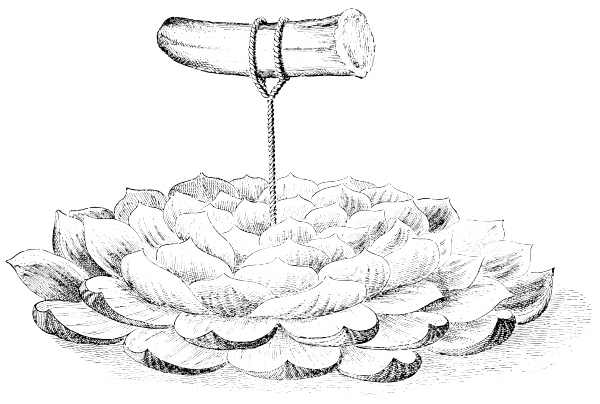
All these were grouped around a temporary altar—really a silver table supposed to represent a lake on which the golden lotus floats. Thereon stood an octagonal cupola of solid silver and gold, supported by slender pillars. In front of this were three miniature crystal dagobas or bell-shaped relic shrines, each resting on a square base, and two golden candlesticks with lighted candles. In the small 208dagobas on either side were displayed priceless jewelled objects—royal gifts.
But all eyes were riveted on the central shrine, of purest crystal, within which lay a large golden lotus-blossom, from the heart of which, upheld by a twist of gold wire, was upraised the worshipful piece of yellow ivory which, to the unquestioning eye of faith, actually passes for a human tooth!
I can only say that it is well in keeping with the gigantic footprint on the summit of Adam’s Peak, being nearly two inches long and as thick as my first finger. On previous page is an exact portrait of it, which I secured by returning in the stream of pilgrims day after day, and making a pencil sketch the next moment on a scrap of paper in the palm of my hand, to be corrected again and again till it was perfectly accurate. For to be caught attempting to make a picture of it would be the direst offence in the eyes of the priests. Not many years before, the Emperor of Siam had sent large offerings to this temple, and his ambassadors were accompanied by a Chinese artist, whose sole mission was to procure such a drawing as this that his Majesty, though debarred from making pilgrimage in person to the shrine, might at least be able to realise the exact appearance of the priceless relic. This request was refused with the utmost scorn. Only think what a valuable letter of introduction my sketch might have proved had I chanced to visit Siam!
I always found the priests and people alike interested in the progress of all my pictures, but their jealous terror lest I should draw this was extreme; and when, a few days later, I expressed a wish to sketch the general scene of the interior of the temple during the adoration of the Tooth, their fear lest I should include the relic knew no bounds. Being accompanied by several influential men, and having obtained the consent of the Dewa Nilami, who stood beside me, I was rash enough to begin work quite undisguisedly, sitting on a raised daïs in the middle of the temple, and, worst of all, produced my opera-glasses (the never-failing companions of all my wanderings, and source of endless wonder and delight to many a simple soul in remote regions of the earth).
This proved too much for the priestly mind. In a moment there was a hubbub of alarm, the curtains were drawn in front of the relic, and a procession of yellow-robed brethren headed by the high priest swept down upon me. The latter deliberately put on his old spectacles, and demanded a sight of my work. He rubbed his nose over 209it in vain. Luckily I had not there drawn the actual tooth; in fact, from where I sat I could not possibly see it, as we all strove to prove to him. But then he maintained that the magic glasses had doubtless revealed it, and he must look through them, which he accordingly did, holding them the wrong way, however, to the quiet amusement of the more enlightened bystanders. Naturally he did not see much.
Eventually he was in a measure pacified, and allowed himself to be drawn into a conversation (of course through an interpreter) concerning our mutual pilgrimages to many holy shrines, of which I had happily visited a very great number, in all parts of the island—a fact conferring on me a load of sanctity which, albeit involuntary, made me an object of envy to many of the younger priests.
They, and even the old priest, were greatly mollified by my promising to show them drawings of several of these, which I accordingly brought with me on the following day. But from that time I was conscious of a strong terror of my presence within the temple, more especially on the last day of the festival, when, the exhibition of the relic being over, I was happily included in a select party of Europeans, who by special favour were permitted to be present in the innermost shrine upstairs to witness the restoration of the Tooth to its secure prison, which really is an ornamental ‘safe,’ only about twelve feet square, an upper chamber protected by massive doors of richly wrought brass and silver, which are always locked. Over each door is suspended a large silver lotus-blossom, and the room is draped with white and gold brocade and priceless Indian shawls.
The whole was artificially lighted, and very hot, as well it might be, seeing how many eager spectators as well as guardian priests crowded into that tiny sanctuary, the atmosphere being moreover heavy with the scent of temple flowers. Many ceremonies had to be observed ere the Tooth was safely housed. First it was laid in a case resembling a richly jewelled thimble-case, but, as no human hand might touch the sacred ivory, it received the honours of the white cloth; in other words, it was tilted off its perch above the golden lotus on to a fair linen cloth, from which it was dexterously slipped into its case. (I have already mentioned that in Ceylon, as throughout the East, all favoured guests receive ‘the honours of the white cloth’; that is to say, a linen covering is thrown over the seat prepared for them, and a strip of linen—probably the spare garments 210of some of the bystanders—is laid on the ground, that they may walk over it on first entering a house.)
The tiny jewelled case was next enclosed in a golden dagoba, encrusted with gems, which was formally locked by one of the chief priests, who retained possession of the key. This was enclosed in a similar relic shrine one size larger, and locked by another priest, who retained that key. Then it was deposited within a third reliquary, and was locked by the Dewa Nilame, the great lay authority of the temple. I regret to say that he who held this office at that time was an apostate from the Christian faith, which he had professed until this honourable (some say lucrative) position devolved upon him, and, Judas-like, he found the care of the bag too much for his principles.
The several locks being, as we have seen, in the charge of three distinct persons—two priests and a layman—it follows that each must of necessity be present when the relic is displayed, for the greater safety thereof. Thus secured, the triple shrine (together with various priceless offerings, the gifts of divers kings, including many strings of the finest garnets, a tree covered with gold and silver roses, a jewelled bird and crocodile, an image of Buddha carved out of one gigantic emerald about three inches long by two deep, and chains and ornaments without number) was deposited in the Karandua, which is a large dagoba of silver-gilt, five feet in height, and about three feet six inches in diameter—beside which were placed the crystal relic-shrine in which the Tooth appears when on show, and one or two others. I have seen it stated that the inner casket is enclosed in a nest of nine golden dagobas. These may have been added, but I certainly saw only three, as described the following morning in my journal, and also in a letter now beside me.
All these relic-shrines (like the gigantic dagobas which are scattered all over the island, each containing some saintly fragment) are made in the form of a bell (consequently circular), resting on a square base. Tradition declares that the first ever built was designed to resemble a bubble floating on water. That which contains the Tooth is overshadowed by the sacred umbrella of gold or silver, symbol of sovereignty, while above it hang gold and silver lotus-blossoms and costly silk brocades.
Finally, the strong iron cage with open bars was locked and sealed with much ceremony by the three great authorities, each with his own signet. Then the metal doors of the inner sanctuary were locked by 211one of them, and the down-stairs door by some one else (I think each has two locks!), so all was once more safe, and we adjourned to the balcony of the Octagon Library, thence to witness the start of the great annual Perahara, or procession of elephants, bearing relics from the four principal Hindoo temples, and also from the Delada Maligawa, which contributes its entire stud of elephants to grace a festival of prehistoric origin, but supposed to have been instituted in very ancient days in honour of the birth of Vishnu, in his character of Krishna, the Sun-god.
Certain it is that this festival was celebrated annually for many centuries before the Buddhists recognised it in any way; and it was not till the year 1775 that it was deemed expedient to incorporate it as a Buddhist festival, and King Kirti Sri assigned the place of honour in the Hindoo procession to the Holy Tooth.
This innovation was quite a sudden thought. The king had invited certain Siamese priests to Ceylon to restore the highest order of the Buddhist priesthood—the Upasampadawa—and these hearing the noisy preparations for the Perahara, and learning that it was a festival solely in honour of Hindoo gods, took umbrage thereat, whereupon the king commanded that that very evening the shrine should be carried at the head of the procession in his own howdah, and that thus the ceremony would be in honour of Buddha as well as of the gods.
This amalgamation was no novelty—for so early as A.D. 413, when Fa Hian, the Chinese traveller, visited the kingdom of Khotan, he there saw a procession in which the image of Buddha was carried in company with those of the Hindoo gods Indra[91] and Brahma, and of the Toegri of the Moguls and the Lha of the Thibetans. These images were set in a great four-wheeled car with silken curtains, forming a pavilion eighteen feet in height. This was drawn round the city, all the streets having been swept and watered, and the houses decorated with tapestry and banners in token of rejoicing.
Again, in Central India, he witnessed a great night festival, when 212the city was illuminated, and there were theatrical representations and wrestling-matches in honour of Buddha and the other worshipful gods and heroes, whose images were placed on no less than twenty highly decorated cars. That was a Perahara on a very grand scale.
So now the supposed relic of Buddha shares the homage which previously was bestowed only on the (equally authentic) bows and arrows of the gods, whom he did his best to discredit, and his priests salve their consciences by taking no part in the procession, beyond lending the temple elephants and the shrine purporting to contain the Tooth, together with its octagonal canopy of silver-gilt.
These we saw placed with great ceremony on the back of the largest and most richly caparisoned elephant, the whole being overshadowed by a rich canopy raised on high poles, carried by six men on foot. The great elephant was escorted by two lesser elephants, one on each side of him. On these were mounted several headmen clothed in white, and bearing baskets of flowers, which from time to time they threw towards the empty shrine. Behind them sat attendants holding gold and silver umbrellas of state.
Other headmen in gorgeous dresses followed on foot, and the people bowed down in lowly reverence. Their attitude of worship is to bend the body forward at right angles from the waist, the arms being thrown forward and slightly raised and the tips of the fingers touching. All shout Saadu! which is the equivalent of All hail! the multitude of voices blending in a deep solemn wave of sound.
To us who had just witnessed the scene in the inner sanctuary, this procession was of course a supreme farce; nevertheless it was picturesque and barbaric, as we witnessed it in the moonlight, amid glare of torches, beating of tom-toms, the clanging of brass cymbals, the shriek of shrill pipes, blowing of chank-shells, and contortions of masked devil-dancers, posturing and dancing frantically to the noise of these ear-torturing instruments—truly devil music!—and escorted by a crowd of people fantastically dressed up. Were it not for the dreadful music, there is something very eerie in the silent march of such a procession, owing to the singularly noiseless tread of the elephants and the barefooted crowds.
As to the surprising get-up of the devil-dancers in their truly hideous masks, words fail to convey any idea of it, and a group of elephants in full-dress is always impressive. Like the very stout lady whom Dickens describes as affording such a magnificent expanse for the display of costly jewels, these majestic beasts do offer a large field 213for decoration, of which the Oriental mind fully avails itself in the use of gorgeous trappings and howdahs, richly embroidered cloths quite covering the huge body and head, and partly covering the trunk. On the face-cloth of the three elephants specially devoted to the Tooth is embroidered an image of Buddha enthroned. The whole is resplendent with gold, and silver, and jewels, the tusks of the principal elephants being also decorated.
After the elephants belonging to the Delada—i.e. the Tooth—followed those of the Hindoo temples, also in trios, each elephant bearing a sacred relic being escorted by two attendant elephants. Other elephants, forming a double line from the temple gate, knelt down, that the procession might pass between them, ere starting to make the round of the city.
Of course every such scene includes a multitude of details to attract the eye, which it would only be wearisome to describe,—suffice it to say that, though the Perahara of the present day is said to be a far less imposing show than it was a hundred years ago, it is still very well worth seeing. Of course, however, its chief interest lies in its antiquity.
It can be traced as far back as the second century of the Christian era, when Gajabahu returned from a campaign in Southern India, bringing with him a multitude of rescued Singhalese and Tamil captives who had been carried off from Ceylon by the Malabars in a previous invasion of the Isle. He also recovered the sacred vessels of four dewales (temples), and the refection dish of Buddha, which had been carried away about 90 B.C. To celebrate the return of these treasures, on which the heathen used to swear in the Courts of Justice,Justice, a great Perahara was held, and, except during certain times of war and anarchy, it has been held annually ever since. But it is probable that it really represents a midsummer festival of far more remote origin.
It is, however, a very movable feast, Forbes-Leslie having witnessed it in 1828 in the month of May, and the Rev. R. S. Hardy in 1834 saw it in August, in which month it was celebrated in 1888 and 1891, while June or July is more frequent. It begins on the day of the new moon in the month of æsala, but from the imperfection of native astronomy this date may vary exceedingly.
Probably the earliest record by an eyewitness which we have of thisthis festival is that given by Knox, who during his twenty years as a captive at large in Kandy, from A.D. 1659 to 1680, had ample opportunities of observing all native customs and ceremonies. He speaks 214of it as relating solely to ‘the gods that govern the earth,’ ‘the Buddou’ having no part in it. The streets were decorated with upright poles from which floated flags and pennons, and between these poles hung fringes of cocoa-palm leaves; and there were lighted lamps all along both sides of the street both by day and night. These very primitive lamps consisted of cocoa-nut shells filled with their own oil, and a wick floating in it. These were stuck on low posts—frequently banana stems—all along the road.
The procession was headed by forty or fifty elephants, with brass bells hanging on each side of them, which tinkled as they marched. Next followed men dressed up like giants, and after them a great multitude of drummers, trumpeters, and pipers: each chief brought his own company of awful musicians, and picturesque attendants bearing great palm-leaf fans and flat-topped state umbrellas. Then several companies of the women engaged in the service of the temple as washerwomen, and potters, and other trades, walking three and three in a row, holding one another by the hand. Between each company went dancers and musicians. Then followed the men of the washer caste carrying painted sticks, and those of the potter caste carrying cocoa-nut blossoms in earthen vessels. Next came three elephants, on each of which were mounted two priests, one to represent the god of one of the three chief temples, and the second holding his honorific sunshade. The central elephant marched slightly in advance of the other two, and was covered with white cloth, his rider a priest representing the Creator of Heaven and Earth, bearing a painted stick partly wrapped in silk brocade, and from which hung strings of flowers, supposed to be the wonder-working rod that was carried by the conqueror Gajabahu. Before this stick the people bowed down and worshipped, and so great was its sanctity, that a cloth was tied round the mouth of the priest lest he should breathe upon it, and so defile it.
After these gods and their attendants followed several thousands of the highest ladies in the land, walking hand in hand, three in a row, and dressed ‘in the bravest manner that their ability can afford.’
Finally came a military escort sent by the king, and in this manner they daily marched round about the city once by day and once by night, from the new moon until the full moon either in June or July, every year.
‘Two or three days before the full moon, each of these gods hath a palanquin carried after them, ... in the which there are several 215pieces of their superstitious relics, and a silver pot, which, just at the hour of full moon, they ride out into a river and dip full of water, which is carried back with them into the temple, where it is kept till the year after, and then flung away, and so the ceremony is ended for that year.
‘The greatest solemnity is performed in the city of Kandy, but, at the same time, the like festival or perahar is observed in divers other cities and towns of the land.’
An exceedingly interesting report was drawn up for Sir Robert Brownrigg, who was the Governor of Ceylon in 1817, by the Dessawe of Wellasse, in which he says that Perahara is a very ancient ceremony in commemoration of the birth of the god Vishnu, or, as it is stated in some sacred books, in remembrance of his victory over the Assureyas or enemies of the gods.
The mystic ceremonies begin as soon as the new moon is visible, either in the morning or evening, but on no account at mid-day. The Kapuralas or priests of the four principal dewales in Kandy—namely, the Maha or great temple of Vishnu, and those of Nata, Kataragama, and Pattini—have previously secured four logs of sacred wood from the stem of a young jak-tree not yet in fruit, and not more than three spans in circumference. They first clear the ground round the tree, and consecrate it by fumigating it with the smoke of burning resin, smearing it with a preparation of sandal-wood made for the purpose, and further by an offering of a lighted lamp with nine wicks (which is put at the foot of the tree), and of nine betel-leaves, and nine different kinds of flowers arranged on a chair.
This being done the wood-cutter of the Maha dewale, dressed in a clean cloth, and purified by washing and rubbing himself with lemon-juice, fells the tree at its root with an axe, and cuts the trunk transversely into four pieces of equal length, to be divided among the four dewales, the lowest piece being the property of the Nata dewale, the next of Maha dewale, the next of the Kataragama dewale, and the top piece that of the Pattini dewale. Each log is carried (under a white canopy) to its respective dewale, accompanied with beating of tom-toms.
On the day of the new moon each piece is fixed into the ground in a particular spot in each of the dewales. A roof is erected over it, and it is covered with cloth to keep it concealed, and decorated all round with white olas, fruits and flowers. Thus prepared and fixed the logs are called kap (which signifies pillars), and till the fourth day, 216from that on which these are fixed, the Kapuralas every morning and evening carry round the kap the bow and arrows of the gods to whom the temples are consecrated. Carrying the bow and arrows is called carrying the god, and this procession is confined to the precincts of the temple. On the fifth day of Perahara, the Kapurale of each temple brings forth the bow and arrow which are the visible symbol of his god, and places them in the Ranhiligay (? howdah) on the back of an elephant. The four elephants thus honoured, each escorted by two attendant elephants with umbrella-bearers, are led to the Adahana Maluwa, a consecrated place near the tombs of the ancient kings.
(Forbes says the Maluwa was a kind of sanctuary: it was encircled by stones, within which, it is said, the kings had no jurisdiction.)
Thence, after making the circuit of the Nata dewale, the procession proceeded to the Delada Maligawa, the Temple of the Tooth, to the gate of which the Buddhist priests bring forth the shrine purporting to contain the Tooth, which is also placed in the Ranhiligay on the back of an elephant, and takes its place in the evening procession. But in the nocturnal procession at the seventh hour of the night it is not permitted to appear, except on the night of the full moon.
During these five days the five temples represented take precedence by turns.
The report then goes on to tell how on the sixth day a new feature was introduced. From each temple was brought forth a randoelie or palanquin containing a golden pitcher and a sword, each dedicated to a different goddess. For the next five evenings these were carried after the bows and arrows, and in every nocturnal procession they took the lead. All the women attended as of old, and the young wives and daughters of the chiefs accompanied each randoelie by turns.
On the fifteenth night, which was that of the full moon, at the close of the procession, the shrine of the Tooth was deposited for the night in charge of the Buddhist priests at the Gedige—i.e., Asgiriya Vihara. But the priests and all the properties of the four dewales returned to their several temples, where curry and rice were offered to the gods, and doubtless enjoyed by the hungry human beings, who, thus refreshed, started again in procession with their bows and arrows, swords and golden water-vessels, and journeyed to the banks of the Maha-velli river near Peradeniya.
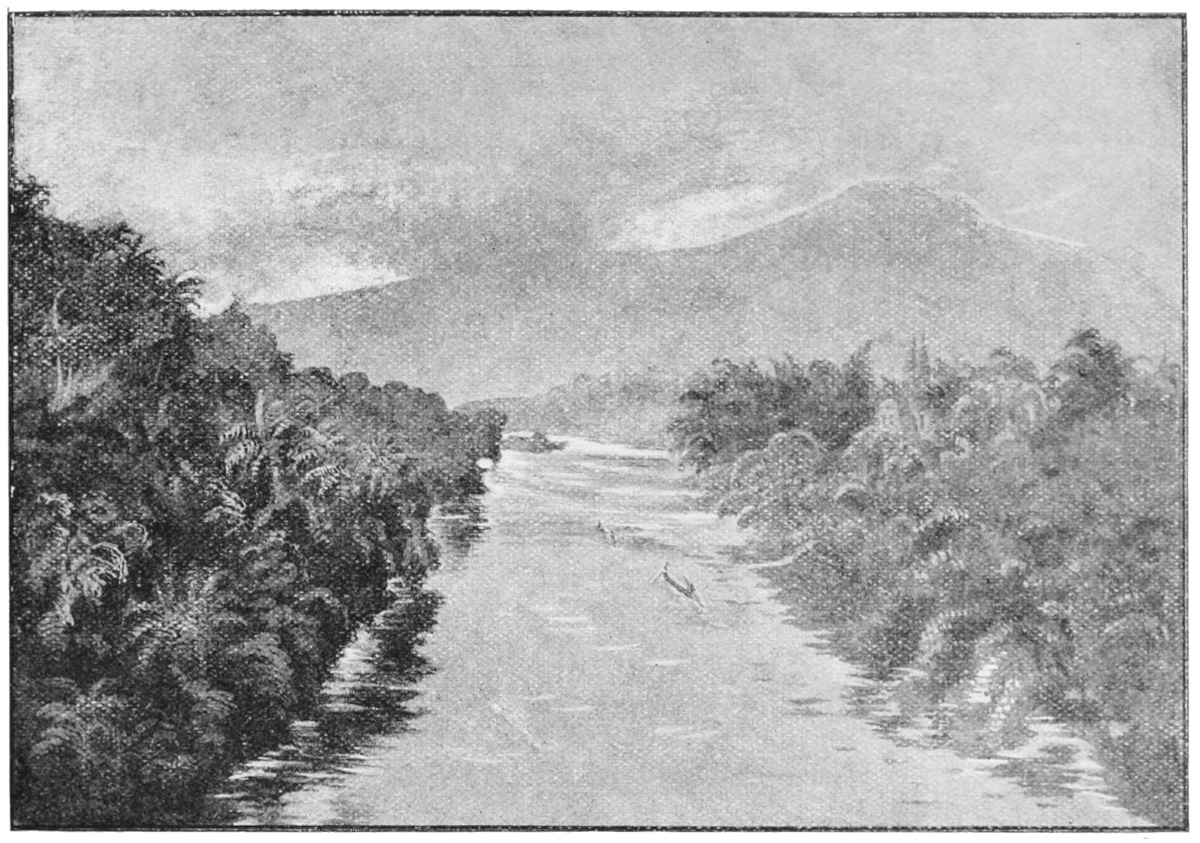
THE MAHA-VELLI-GANGA, FROM THE SATINWOOD BRIDGE. (Bamboo Foliage.)
There they found a richly decorated boat, in which embarked the four priests bearing the four swords of the goddesses, attended by 217four assistants bearing the golden water-vessels containing the water drawn just a year before. They rowed some distance up the river, and taking up a position in mid-stream, they there awaited the first streak of dawn, when suddenly the four Kapuralas struck the water with their swords, describing a magic circle in honour of the sun, and at the same instant their assistants emptied the water-vessels, and refilled them from within the circle where the swords had cut the waters.[92]
Returning to land, and having replaced the swords and water-vessels in the palanquins, they marched back to the city (being met on the road by any chiefs who had been unable to attend in the night), and went straight to the Asgiriya Vihara, where the shrine of the Tooth again joined the procession, which then returned to the Adahana Maluwa, whence it had started. It then dispersed, each party returning to its own temple. On that day four bundles of fine cloth, four pieces of sandal-wood, together with gold and silver coins, were given to the four dewales from the king’s treasury.
During the next seven days the Wali-yakon was danced in the four dewales by people belonging to the caste of tom-tom beaters. The dancers wore hideous masks, and they danced to the sound of tom-toms. The dancers of each dewale have certain distinctive characteristics; some jump and leap and turn somersaults, and twirl round till the spectators are giddy. Some wear strings of little jingling bells and bangles on neck, wrists, and arms; others beat cymbals and hollow metal rings.
Then for seven days more, people of the Balibat caste danced round heaps of boiled rice, curries, cakes, and fruits, which they subsequently consumed; and when these fourteen days of religious dancing were over, the four pillars of jak-wood which had been fixed in the four dewales were removed, and, amid much beating of tom-toms and waving of flags, were carried to the river and thrown therein.
Then once more the shrine of the Tooth, and the bows and arrows of the gods, were brought forth for a final procession; and thus, on the morning of the thirty-first day, this prolonged and noisy festival was brought to a close.
218(Surely to the people accustomed to such services there must be peculiar force in the Singhalese translation of our Lord’s saying that ‘The kingdom of heaven cometh not with observation,’—‘not with Perahara,’ says the Singhalese version.)
All the main features of this festival are still annually observed, such as the kap hitawima—i.e., the division of the young jak-tree into the four logs—and the cutting of the waters, but the various companies of women have ceased to appear in the processions. Some new features have, however, been introduced, such as the appearance of young men in the attire of dancing-girls, their arms and legs covered with little bells. Vast crowds from the surrounding country flock to Kandy to witness the various processions, especially that returning from the river after the cutting of the waters, and the scene is very striking as seen in the bright morning sun, beneath a clear, blue sky, with so many thousand picturesque people dressed either in white or in gay colours, many carrying umbrellas of all hues, forming a brilliant foreground to the richly wooded hills which embosom the city.
To students of world-wide superstitions,[93] several of these details are suggestive, such as the recurrence of the numbers 3 and 9—the women three abreast, the temple elephants likewise, each elephant bearing a relic being escorted by one on either side. Then 2193 times 3 comes in with the lamp having 9 wicks, and the offering of 9 betel-leaves and 9 kinds of flowers.
Knowing what a hold Bali or planet-worship still has over the Ceylonese, whether Buddhist or Tamils, who naturally worship the Hindoo gods, it is interesting to know that the amulet most highly valued by all is one composed of 9 precious stones,—one to represent each of the seven planets, while the moon has two extra to symbolise its changes.
The amulet as worn by the Buddhists of Ceylon and Burmah is as follows; A sapphire represents Saturn; a topaz, Jupiter; coral, Mars; a diamond, Venus; an emerald, Mercury; a moonstone, the waxing Moon; a pearl, the full Moon; a cat’s eye, the waning Moon. These are set round a central ruby, which symbolises the Sun.
In India the stones composing the amulet of the Nava Ratna, or 9 years, vary in different provinces.
A very remarkable instance of the reverence for the mystic 9 was the magnificent Brazen Temple of Anuradhapura, which was nine storeys high.
As regards planet-worship, it has been pointed out as a strange coincidence that, in the division of the week, the Singhalese should not only have retained the seven days, but should actually have named each after the same planet as owned that same day, both amongst the Chaldeans and Egyptians, and also in the Western world.
In English, four of the days were filched from the planets in honour of the Scandinavian gods Tyr, Wodan, Thor, and Freya, but across the Channel our French neighbours retain the planetary names Mardi, Mercredi, Jeudi, Vendredi.
Days of the Week in Singhalese.
Day. Planet. Planet. Day.
Irida, from Iru, the Sun, and dawasa, a day } = Sunday,
Handuda, ” Chanduya, the Moon, = Monday.
Angaharuwada, ” Angaharuwa, Mars, = Tuesday.
Badadada, ” Buda, Mercury, = Wednesday.
Brahaspatinda, ” Brahaspati, Jupiter, = Thursday.
Sicurada, ” Sikura, Venus, = Friday.
Senasarada, ” Senasura, Saturn, = Saturday.[94]
220To return to the illustrious Tooth. Its history enters so largely into that of Ceylon that it is worth a few moments’ consideration on that score, to say nothing of its exceeding sanctity in the eyes of so many millions of our fellow-creatures. Its adventures were early recorded in the Deladawanso, a work still extant, written in Elu, and translated into Pali, A.D. 1196. From this, it is said, the story was quoted in the Maha-wanso.
The original article is supposed to have been one of Buddha’s four eye-teeth, rescued from his funeral pyre when he was cremated, B.C. 543, at Kusinaga, about a hundred miles to the north of Benares. Of these four teeth, one is said to have been translated to the Heaven of Indra; the other three were secured by the king of Kalinga, the king of Gandhara, now Peshawur, and the Naga kings. The two last may perhaps be the ancestors of various other holy teeth which are treasured in various countries, but the second is supposed to be that which is now at Kandy.
Immediately after Buddha’s cremation, it was carried off to the kingdom of Kalinga, south-west of Calcutta, where its sanctity was at once recognised, and it received devout worship. Thenceforward the capital was called Danta-poora, the city of the Tooth, and a great festival was annually celebrated in its honour, almost identical with that which is still observed in the same district by the worshippers of Juggernaut. (Kalinga is supposed to be the ancient name for Orissa, and Danta-poora is the modern Puri.)
All went on peacefully, till at length one of these Buddhist kings (determined to establish uniformity of faith throughout his dominions) banished all the remaining Brahmins from the land. These fled to the court of a greater king, who dwelt in the north, to whom the kings of Kalinga owed homage. Straightway an army was despatched, with orders to conquer the Buddhist king, and carry off the relic.
It seems, however, that the invading princes were at once converted on beholding the sacred Tooth. They escorted it with all reverence to the Imperial Court, where the wrathful Emperor commanded its immediate destruction. But vain were all the efforts of the Brahmins to annihilate that precious fragment of ivory. They cast it into the fire, but it re-appeared from amid the flames safely folded within the leaves of an exquisite lotus-flower; they tried to grind it to powder on an anvil, but the most crushing blows left it safely embedded in the hard iron. Then they made elephants trample upon it, that it might sink into the earth, but once more it 221rose from its burial, enthroned in the heart of a lotus-blossom, the petals of which were of fine gold, and its heart of silver.
Still the Brahmins would not acknowledge themselves defeated. They took the wondrous tooth and cast it into the foul sewers of the city. Straightway the sewers disappeared, and in their place there appeared a clear and beautiful lake, whereon floated lilies of many hues, whose fragrance attracted clouds of murmurous bees. This time the Brahmins were silenced, and the Emperor and all his people embraced the faith of Buddha, and paid their adoration to the wonder-working and indestructible relic.
The Emperor appears to have restored the precious treasure to the safe keeping of the kings of Kalinga, for long afterwards, when the reigning king found himself sorely beset by his foes, he bade his daughter, the Princess of Kalinga, conceal this treasure in the coils of her thick long hair, and make her way to Ceylon.
This she did A.D. 311, where King Kirti Sri Megahawarna received it with all possible honour, and built for it a splendid temple at Anuradhapura. It remained in Ceylon till about A.D. 1303, being carried from place to place, as successive kings changed their royal residence; but wherever it was taken, a splendid temple was erected to its honour. Amongst the places thus distinguished were Pollonarua, Hastiselapura, Kataragama, Delgamoa, Kotmalie, Beligala, Dambadeniya, Yapahame, Kurunegala, Kotte, Sitawaka, Delgamuwa, Nilambe, Hanguranketa, Kondesahe, and lastly Kandy. At some of these places ruins of the temples still exist, and I visited several in different parts of the island.
At length the Malabar conquerors captured this bone of contention and carried it off to Southern India. Thither in 1319 the King of Ceylon, Prakrama Bahu III., went in person to negotiate its surrender, and ransomed it for a price beyond telling. Then with much pomp and ceremony he carried it back to the Isle, and all the people rejoiced greatly, and exalted it to double honours.
Thus it continued to receive the adoration of multitudes until the coming of the Portuguese, who in A.D. 1560 captured it among the spoils of the principal temple at Jaffna, where it was said to have been sent for security. They took it to Goa, and thither the King of Pegu (who, being a devout man of exceeding wealth, had annually sent embassies to do it homage) despatched an ambassador craving permission to ransom it at whatever price might be named—offering a very large sum of money in addition to great political advantages.
222Such an offer was exceedingly tempting, as it was justly urged that the heathen would only manufacture a new tooth were this idol destroyed; but the influence of the clergy was exerted so powerfully, that even the temptation of gold was withstood, and the ugly little Tooth in its golden setting was brought forth by the clergy in solemn state and placed in a mortar, where, with his own hand, the Archbishop, Don Caspar, bruised it to powder in presence of the Viceroy, and of a great assemblage of clergy and laity. The powder was then burnt in a brazier which stood ready, and the charcoal, with this minute atom of ash, was cast into the river in presence of all the multitude.
But true believers declare that the Holy Tooth was miraculously re-formed in the heart of a lotus blossom, and I suppose they consider its increase of bulk to be part of the miracle, for thousands of pilgrims have continued year by year to flock to Ceylon to adore the lump of ivory which the priests substituted for the lost treasure. (The(The marvel is, that they should not have replaced it by a human tooth. Surely such an offering would have been truly acceptable to Buddha! and they might have cast lots to know which of them might have the privilege of sacrificing one of his own!)
The Portuguese declare the tooth which they captured to have undoubtedly been that of an ape (possibly shed by Hoonooman, the Monkey-god, himself, and slyly substituted by some Brahmin!)
Certainly it does seem strange that so precious a treasure should have been sent to a place so remote as Jaffna, in the extreme north of the Isle, whose inhabitants are mostly Tamils and Brahmins. The Singhalese themselves maintain that the real tooth had been sent for safety to Saffragam. However, the tooth captured by the Portuguese had all the credit of being genuine, and the piece of ivory now held in such reverence was not heard of for many a day, and in the meantime the idea suggested by the Viceroy of Goa, that the destruction of the relic would only lead to the manufacture of another, proved literally true, for in a very short time two spurious teeth appeared in the market!
The story of their manufacture was minutely recorded by Diego De Couto, who was intimately acquainted with several witnesses of the various scenes. He tells how in A.D. 1564, Brama, King of Pegu, sent ambassadors to Don Juan, King of Cotta, asking his daughter in marriage (the astrologers having predicted at his birth 223that he was to marry a princess of Ceylon). It so happened that the King of Cotta had no daughter, but the shipload of rich gifts was irresistible, and as he had brought up in the palace a daughter of his great chamberlain, who was of the blood royal, the king agreed with his kinsman that he should pass her off as his own, and send her to be the king’s bride.
They further agreed to have a facsimile of the ape’s tooth made of a bit of stag’s horn: this was mounted in gold, enclosed in a costly shrine, and conveyed to the house of the chamberlain, who then in strictest confidence disclosed to the ambassadors and their Buddhist priests that the tooth captured by the Portuguese was a fraud, and that the true tooth was concealed in his house.
Of course they besought permission to see it, which he granted with apparent reluctance, and finally led them disguised by night to a room where the tooth lay on an altar amid incense and lights. There they spent the night prostrate in devout adoration, and afterwards offered an immense sum of money and other costly gifts (including the annual gift of a ship laden with rice), if only this inestimable tooth might be sent to the King of Pegu, together with his bride.
The wily chamberlain decided that two such treasures should go separately; so the princess was despatched first, and was received with the utmost magnificence, all the people being required to swear allegiance to her as their queen. Ere long the fact that she was really only the daughter of the chamberlain reached the ears of the king, but the damsel had found so great favour in his sight that he ignored the matter, especially as his ambassadors and the priests then took occasion to tell him about the precious tooth, and of their negotiations to obtain possession of it.
‘This,’ said De Couto, ‘excited the desire of King Brama, who reverenced that tooth above everything in life, even as we esteem the tooth of St. Apollonia (though I shall not say much of the tooth of that sainted lady) more highly than the nail which fastened our Saviour to the Cross.’Cross.’
Accordingly he at once despatched the priests and ambassadors to Colombo in a vessel laden with costly gifts, to negotiate secretly with the Singhalese king, who with the greatest solemnity and secrecy made over to them this newest fraud in its costly shrine. On its arrival on the shores of Pegu a multitude of priests and people assembled to adore it, and the King Brama despatched all his nobles 224in magnificently decorated barges to receive it with due honour, and bring it up the river in state to his royal capital of Rangoon, he himself going two days’ journey in a boat richly decorated with gilding and brocaded silks, to meet the splendid procession.
‘On coming in sight of it,’ says De Couto, ‘he bathed, sprinkled himself with perfumes, assumed his most costly dress, and on touching the raft which bore the tooth, he prostrated himself before it with all the gestures of profound adoration, and on his knees approaching the altar on which rested the shrine, he received the tooth from those who had charge of it, and raising it aloft, placed it on his head many times with adjurations of awe; then restoring it to its place, he accompanied it on its way to the city.
‘As it passed along, the river was perfumed with the odours which ascended from the barges, and when they reached the city, the priests and nobles of the king, and all the chief men, advancing into the water, took the shrine upon their shoulders and bore it to the palace, accompanied by an innumerable multitude of spectators. The grandees, taking off their costly robes, spread them on the way, in order that those who carried that abominable relic might walk upon them.
‘The tooth was at last deposited in the centre of the courtyard of the palace, under a costly tabernacle, upon which the monarch and all his grandees presented their offerings, declaring their lineage, all which was recorded by scribes nominated for that duty. Here it remained two months, till the Vihare which they set about erecting could be constructed, and on which such expenditure was lavished as to cause an insurrection in the kingdom.’
In the following year details of all these transactions reached the ears of Wikrama Bahu, King of Kandy, who was filled with jealousy that his kinsman, the King of Cotta, should have secured so much treasure. He therefore despatched an envoy to the King of Pegu to tell him the whole truth, of how the wife and the tooth he had secured were alike frauds, the genuine tooth being in the safe keeping of the Kandyan monarch himself, who now offered his own royal daughter in marriage to the King of Pegu.
Apparently he also hinted at being open to a bid for the tooth, for King Brama, after due reflection, resolved to hush up the story of the frauds, and therefore merely replied that he was duly sensible of the honour designed for him by the proffered alliance, and likewise by the offer of the tooth, and that as a mark of consideration for 225the King of Kandy he would send back by his ambassadors a shipload of presents.
Thereupon he prepared two vessels, each freighted with rice and rich cloths, one for the King of Cotta, the other for the jealous King of Kandy. On board of the former he sent all the Portuguese subjects who had been held captive in Pegu, and from the lips of one of these De Couto wrote his narrative.[95] The vessel for the King of Kandy had her cables maliciously cut, and was wrecked in Colombo harbour.
Sir James Tennant, commenting on this story, observes that ‘the Singhalese never seem to have been scrupulous about multiplying Buddha’s teeth, for Marco Polo says the great Khan Khubla sent to demand one in the year 1281, and obtained from the King of Ceylon two large back teeth, together with some of his hair.’
Long before the days of King Brama of Pegu, another Burmese monarch, Anarapta, who reigned in the eleventh century, sent a mission to Ceylon to treat for the purchase of the tooth, of which ‘a miraculous emanation’ was delivered to his ambassadors. It must have been a solid fact, for the temple in which it was lodged is still shown, attached to the palace of Amarapura.
Sir Henry Yule tells how yet another Burmese monarch, King Nauratha Men-zan, went with a large army into China to invite a tooth of Buddha to come to Burmah. The tusk, as it is called, declined to come, but a duplicate was miraculously produced, and was enshrined in the Shwé-Zeegoong Pagoda, one of the most celebrated temples in Burmah.[96]
The Burmese, however, do not seem to have been satisfied with these duplicate teeth, for when in 1815 the present piece of ivory was captured by the British, the King of Burmah, Minderagu Praio, sent two embassies to Calcutta to treat for its purchase.
The British soon afterwards received a practical lesson in the necessity of guarding this coveted object, for in the insurrection of 1818 the priests in charge of it carried it off to lend its influence to the insurgents. By a happy accident the British recaptured it, whereupon the Kandyans laid down their arms, saying, ‘As the English possessed the tooth, they had the right to govern.’
It was then committed to the care of the Government agent, who kept the key of its shrine, and the temple was guarded by sentries 226till 1847, when objections being raised to such official recognition of idolatry, the relic was returned to the care of the Buddhist priests. Shortly afterwards, however, another insurrection broke out, and but for the timely action of the Government agent in securing the Delada, it would again have been carried off to inspirit the rebels. When all danger seemed past, it was restored to the priests, who have had it in charge for the last forty years.
Of the other teeth supposed to have been rescued from Gautama Buddha’s funeral pyre, I was shown one in the Monastery of Kushan, on the sacred mount overlooking the city of Foochoow. It is kept in a dull casket within a securely locked shrine. Before it lies an elephant’s tooth—an appropriate offering.[97] It is supposed to have been brought to China in A.D. 530 by an embassy from Persia to the Chinese Emperor. The Buddhists in China are said to have several similar relics.
Fa Hian, the Chinese traveller who in the fourth century visited so very many shrines, tells of a tooth which was preserved by the priests at Ladak, and in honour of which a tower had been erected. He mentions another which was treasured by the King of Nakia in Afghanistan.
Mr. William Simpson, of the ‘Illustrated London News,’ has just sent me what he calls ‘a complete set of teeth!’ most of which are mentioned by another Chinese traveller—namely, Hiouen Thsang, who lived in the first half of the seventh century. He records that teeth of the Tatagata were to be found all over India, and as far as Balkh, where he saw a back tooth very much like the Delada at Kandy—namely, about an inch in length, and of a yellowish-white colour. He says it continually gave forth a lustre of happy augury. He saw another (which is described as a milk-tooth), answering to exactly the same description, in the north-west of Cabul, and one rather larger in Cashmere.
He was told of another enclosed in a stupa or dagoba at Nagarahara, the former capital of the Jellalabad valley.
At Bamian he found quite a collection of teeth. There was a back tooth of Gautama Buddha, and also one of a T’o-Khio Pratyeka Buddha, who lived at the beginning of the present kalpa. The latter was five inches in length, and rather less than four in circumference! A third tooth was that of a king who had turned the 227wheel of gold (Souvarna tchakra radja). This was three inches long and two in circumference.
At Nalanda, the great monastery near Buddha-gaya, he saw a tooth of Buddha an inch and a half long, and yellowish-white. He also tells of a mountain in Gandhara which was called Danta-loka, or Heaven of the Tooth.
Dr. Edkins says that in the monasteries of Northern China there are various teeth and other relics of Sakya-muni—alias Buddha. He describes a tooth which he saw at the temple called Teu-shwai-sï, which was two inches and a half thick and ten by thirteen in width![98]—a miraculous tooth indeed, and yet insignificant compared with one, likewise attributed to Buddha, which weighs about twenty pounds, and is enshrined in one of the numerous temples which cluster round Mount O-mei, a mighty mountain 10,000 feet high in Central Ssu-ch’un, the great place of pilgrimage for the Buddhists of Western China. Only think how terribly poor Buddha must have suffered before he cut such a wisdom-tooth as that!
Apparently some special virtue attaches to teeth, whatever be their origin. In his ‘River of Golden Sand,’ Captain Gill describes an object held in reverence by the people of Ch’êng-Tu, in Northern China—namely, a stone called ‘The Tooth of Heaven.’ ‘It was merely a bit of sandstone in the shape of a tooth. There was a little house built over the entrance to it, but the roof did not cover the stone itself, for they say that if the stone were covered, the God of Thunder would commit some fearful devastation on the town.’
In India a few years ago a small tope was opened by Dr. Bird, near the Kankeri caves in the Isle of Salsette, and therein was found a copper-plate recording that a canine tooth of Sakya had once been deposited there. But it had departed.
Another vanished tooth is that of St. Patrick—at least there is an allusion in the ‘Archæological Journal’ (vol. xvi., 1859, p. 150) to the Fiocail Phadraig, or Shrine of St. Patrick’s Tooth.
Apart from things held sacred, the prices obtained for kindred treasures, even in modern England, are sometimes startling. Imagine Sir Isaac Newton’s tooth having been sold in 1816 for £730! The purchaser had it set as a ring, and wore it till the day of his death. ‘Wanted. A fool and his money.’ Would not that be the right heading for an auctioneer’s advertisement of such goods?
To return to the veritable Delada at Kandy. About twenty years 228ago the Siamese sent an embassy to Ceylon, offering a sum of £50,000 for permission to remove the Tooth to their own capital. The offer was rejected with scorn. They then begged that the Tooth should be dipped in oil, which they might carry back to their king.
But the ambassadors were not even allowed to look at the precious and greatly coveted object. They appealed to the British authorities, and appointed an agent to plead their cause. At his request the priests were commanded to produce the Tooth, that he might the better explain their exact wishes. No sooner was the jealously guarded treasure revealed than he produced a small piece of rag, and observing, ‘This is all my clients want,’ he rapidly rubbed it over the holy relic as if merely illustrating their wishes, and quickly dropped the rag into a small phial of oil. Thus the oil was consecrated, and endued with sufficient virtue to consecrate tons of oil wherewith to sanctify the whole kingdom of Siam. Of course the priests were furious, and vowed that the tooth had been desecrated; but the mischief was irreparable, and the ambassadors returned to their own land with their money in hand and a holy oil that was nearly as efficacious as the possession of the Tooth itself.
The account of the Siamese ambassadors and their little phial of consecrated oil reminds me of some very similar use of relics in our own land. Thus Dr Rock[99] mentions that in olden days, ‘when any widespreading disease befell this land and took off men or beasts of the field, our bishops would send forth orders that the relics in every church should be steeped in holy water, which was afterwards to be sprinkled on the sick or given them to be drunk as a medicine.’
Hence arose the fame of the Durham water, wherein had been washed the dead body of St. Cuthbert, and the still more famous relic-water of Canterbury, wherein was mixed some well-diluted portion of the blood of the murdered Thomas à Becket (scraped up with the dust off the pavement), a relic which, being carried round the neck of ‘ye pilgrime,’ was a sure safeguard against all ill.
We of the nineteenth century would fain believe that English common-sense had driven out all such folly. Yet it is only a few years since the daily papers were discussing the curious homage paid annually by hundreds of our countrymen in ire’ire’ to the poor shrivelled hand of a certain Father Arrowsmith, which is kept in a white silk bag at Garswood, in charge of the Roman Catholic priests; and the 229sick and afflicted flock thither in hopes that they may be cured of their diseases by a touch of the holy hand. We heard of one poor woman who had travelled many miles to have this healing touch applied to a paralysed side, a curious revelation indeed of superstition in England in our own day.
As we ponder on the strange relic-worship of heathen lands, a stranger vision yet rises before us of the relics still held priceless by Christian people of the Roman and Greek Churches, and of many more, once precious objects of adoration, now lost to the faithful, such as a Tooth of Our Lord, whereby the monks of S. Medard de Soissons pretended in olden days to work miracles. Or that arm of St. Augustine, which our own Canute commissioned his ambassadors at Rome to purchase for the sum of one hundred talents of silver and one of gold!
We are inclined to smile at the superstition of the Kandyans who carried the Tooth to battle to ensure victory, but we forget that King Robert Bruce so greatly revered the arm of St. Fillan that he caused it to be carried by the Abbot of Inchaffray to grace the battle of Bannockburn, and doubtless gave the relic its full share of credit for his glorious victory.
About fifty years earlier, King Henry III. had summoned all his nobles and wise men to meet in London. Multitudes assembled, marvelling for what purpose their presence was required. The king then solemnly announced that the Grand Master of the Knights Templars had sent him a phial containing a few drops of that Most Precious Blood shed upon the Cross, and attested to be genuine by the seals of the patriarch of Jerusalem, and others! He commanded that on the following day a great procession should be formed, to conduct this inestimable relic to Westminster Abbey; and it has been recorded that though the roads between St. Paul’s and Westminster were deep and miry, the king never took his eyes off the sacred phial till he had safely deposited it in the Abbey, dedicating it to God and St. Edward. ‘Thus,’ says the old historian, ‘was all England made to shine with glory!’
Doubtless many remember the fresco in the Grand Master’s Palace at Malta, showing the Earl of Cornwall receiving a Reliquary ‘full of the Blood of Christ.’ And among the relics at Città Vecchia in Malta are a piece of the True Cross, a fragment of St. Paul’s arm, and some milk of the Blessed Virgin! Verily Christianity can ill afford to jeer at Buddhist relic worship. If, as seems probable (indeed, wellnigh 230certain), this practice was borrowed by the Christians from the followers of Buddha, the pupils have surely surpassed their teacher in their multitude of strange objects of veneration.
As to the fragments of the True Cross, treasured by all the Churches, it has been computed that, were they all collected, they might suffice to build a ship of the line! This was openly acknowledged by the priests, who rather glorified in the fact: St. Cyril, after declaring that the whole earth was filled with this sacred wood, went so far as to compare its amazingly diffusive powers to the miracle of the loaves and fishes!
The tears of our Saviour, and those of the Virgin and of St. Peter, were also bought freely by pilgrims to the Holy Land, and brought home in jewelled caskets, while the hair and toe-nails of divers saints have ever been treasured as priceless relics. Of St. Peter’s nails it was estimated that enough existed to have filled a large sack, so prolific were the sacred toes of that great apostle. Some of these are still preserved at Aix-la-Chapelle, and the faithful make pilgrimages from afar to gaze upon them!
To such an extent was the veneration for Christian relics carried, that in the days of Constantine it was solemnly decreed in Council that all altars beneath which none were found should be demolished, as a church without relics could not be consecrated; and so, even in the present day, the Church of Rome requires that some holy tooth, hair, or nail shall, on the consecration of every new church, be carried in solemn procession by the priests to the altar, and therein deposited by the Bishop (who stands mitreless to receive that precious reliquary, hoping perhaps that his own bones may some day receive similar honour). Having duly offered incense, he anoints the covering-stone with holy oil, and so seals the relic tomb, while solemn anthems rise, and prayers are duly said.
We can only account for such strange excrescences of Christianity (professedly the worship solely of One Living Lord) by the assumption that even among ourselves the widespread instinct of ancestor-worship survives to an extent we dare not admit.
How else can we account for the craving for saintly relics even in this wise nineteenth century? In Italy, not many years ago, it led to a scene that would disgrace savages—namely, a free fight over the dead body of a saintly Bishop, which resulted in the populace tearing off every fragment of his episcopal robes as most precious relics; so that at length the military had to come in and rescue 231the poor naked corpse, which the civic authorities were unable to defend.[100]
In France thousands annually wend their way to the Puy de Dôme, there to do homage to the ‘Sainte Ceinture’—the Holy Girdle supposed to have been worn by the Mother of our Lord—and which was conveyed to the mountains of Auvergne by a crusading Count of Poitou six or seven centuries ago.
Multitudes more make devout pilgrimage to a shrine near Samur, 232in the Alps of Dauphiny, to purchase holy water from a well said to have sprung from the Madonna’s tears, and which, consequently, is an infallible cure for sore eyes.
A leading article in the ‘Times,’ September 2, 1872, after speaking of the so-called miraculous apparition of Nôtre Dâme de la Salette in 1846, and reminding its readers how the case was tried in a court of law and proved to be a glaring imposture—a poor half-crazed lady having been convicted of acting the part, with the connivance of sundry other people—added, ‘Yet in spite of this, our Lady of La Salette is now greater than she ever was; a temple of enormous dimensions has risen in her honour; the pilgrims, who, till lately, did not exceed 40,000 to 60,000, are mustering this year more than the average; and the sale of the water from the Holy Well, said to have sprung from the Virgin’s tears, realised more than £12,000.’
Twenty years have elapsed since that leader was penned, and still the popularity of this Well of Tears shows no symptom of waning.
Thousands more betake them to the Holy Well at Lourdes in the Pyrenees, which was also sanctified by the miraculous appearance of the Virgin, and which also works wondrous cures on all threatened with blindness, provided they thrice pray, and thrice bathe their eyes with the healing waters. One devout pilgrim was so well satisfied with the benefit he there received, that he published a detailed account of his cure. The book rapidly passed through upwards of forty editions, and while bringing a considerable annual income to the author, has encouraged thousands of fresh pilgrims to press onwards to the same goal.
But we need not go beyond Ireland for cases in point, as every one knows who has visited Our Lady’s Well at Knock, in County Mayo, in the middle of August, when deaf, dumb, blind, paralytic, and insane persons may be cured by spending a whole night alone in the adjoining churchyard! Should anyone, however, touch or speak to them, the charm would be broken. A wall, near which the blessed Virgin was said to have appeared, had to be taken down, but the mortar was carried to the priest’s house, and has ever since been sold in fragments to give virtue to the foundation of new houses. All rain that falls on the chapel is so holy that it is carried home in bottles by the pilgrims. The first fire in a new house must be kindled by a blessed candle bought at this shrine; and if ever a turf fire goes out (which is unlucky), it must be rekindled by the same means.
233To bring these strange subjects quite up to date, I must just refer to the exhibition of the Holy Coat, which has drawn such crowds to Trèves (or, as we must now call it, Trier) in the autumn of 1891. As every one now knows, the garment which has been invested with such sacred interest is supposed to be the very coat without seam worn by our Lord on the day of His Crucifixion, and for which the soldiers cast lots.
Where it lay for the next three hundred years, even ecclesiastical legend does not state, but about A.D. 311 a seamless garment of brownish material was brought from Palestine by the Empress Helena, mother of the Emperor Constantine the Great, on that memorable pilgrimage when she was supposed to have also discovered the True Cross.
She deposited the Holy Coat in the Cathedral at Trèves, where, in the ninth century, it was concealed from the ravaging Normans in the crypt, and was not rediscovered till 1196, when it was solemnly deposited by the Archbishop within the newly consecrated high altar of the Cathedral, enclosed in a beautiful chest of wood and ivory. Thence, three hundred years later, it was brought forth for exhibition at Easter 1512, when absolution was promised to all who came to do it homage. It continued on show for twenty-three days, during which the Emperor Maximilian held a Reichstag in the town, which brought thither representatives of the kings of England, France, and Navarre, besides numerous princes, dukes, bishops, nobles, and 100,000 pilgrims of lower degree.
Such was the enthusiasm awakened, that Pope Leo X. commanded that it should thenceforth be exhibited once in seven years. The progress of the Reformation, however, rendered this impossible or undesirable. In 1640, during the Thirty Years’ War, it was carried for safety to Cologne, thence to Ehrenbreitstein, Würzburg, Bamburg, and Augsburg, where it remained till 1810, when it was restored to Trèves, and welcomed with the wildest enthusiasm.
It was brought back in a waggon all garlanded with flowers, and every town and village through which it passed held festival. As it entered Trèves itself, all business was at a standstill, altars with burning tapers lined the road, streets were decorated, paths strewn with flowers, men and women wept for joy. At that time it was computed that at least 227,000 persons came to gaze upon it. Again, in 1844, it was displayed to still larger crowds, the total number of pilgrims exceeding a million of human beings, whose adoration 234evoked such response in the sacred vestment that it commenced working miracles, upwards of a score of miraculous cures of diverse diseases being circumstantially recorded.
And now in 1891, funds being required for the restoration of the Cathedral, it was decided to exhibit the Holy Coat for fifty days, from August 18 till October 6, so as to allow ample time for a multitude of pilgrims to bring their offerings. Large barracks were erected for the accommodation of pilgrims, tanneries and storehouses were fitted up with bedding consisting of sacks of straw, almost every dwelling-house arranged to let the largest possible number of beds at the highest possible price.
The one thought of all the inhabitants seems to have been how to reap the largest pecuniary harvest from the pilgrims. It is said that, with a keen eye to business, no less than four hundred persons applied for licences to open hotels and restaurants. But, besides the provision of necessary board and lodging, there was much ingenuity in devising a strangely varied assortment of objects for sale, such as medallions, rosaries, images, cigarettes, pocket-handkerchiefs, boxes of sweetmeats, even match-boxes, all bearing the picture of the sacred tunic, which was also embossed on the bowls of clay pipes! Near the railway stations there were whole villages of refreshment booths, and for the sale of these catch-pennies. A single firm ordered 1,500 dozens of one picture of the garment.
The city was gay with countless flags; the Bishop’s flag, bearing a great red cross on a white ground, floated from the Cathedral. Day after day endless processions of picturesque pilgrims with sacred banners poured into the city, wearing the distinctive costumes of their several provinces, and marched about the livelong day chanting Ave Marias and the Litany of the Sacred Coat. Dancing, concerts, and all secular amusements, were prohibited during the fifty days. As some consolation, however, there was granted a general dispensation from all fasting during that period.
The account of the disentombment of the sacred tunic from within the high altar is even more strange than are the details of the enshrinement of Buddha’s Tooth in its various cases. The provost of the Cathedral having read the protocol of the last locking up of the relic in the previous year, three officials opened the high altar, thence breaking out large masses of stone with heavy crowbars. A box about two mètres long was then lifted out and opened, and a long document and a smaller box covered with leather were taken out; within the 235latter lay another document and a third box of metal, fastened with six seals.
The Bishop threw a red cloth over this metal box, and with the aid of the provost carried it to the treasure chamber, where the seals were carefully examined, and found to be intact, after which the box was opened, and the Bishop took thence a parcel wrapped in blue silk, within which was a wrapping of red silk, and within that of white silk, enfolding the vestment, which he then spread out on the table. No one else was privileged to touch it.
It was found to be in so tattered a condition that it could not be exhibited. Various experts were consulted, and finally a venerable nun was called in, who proposed that the fragments should be gummed together, the material being too much worn to stand the strain of needle and thread. It seems to have been previously mounted in a similar manner, as a microscopic examination proved it to be a triple garment, the brown linen lying between a coating of purple silk and one of greenish silk, all of very ancient manufacture.
The garment thus renovated was placed full length in an oaken shrine, open in front and lined with white silk, and this was suspended above the altar, beneath a great golden cross, with a background of rich crimson velvet drapery. The Cathedral was all decorated with garlands of flowers and evergreens, and a thousand citizens of Trèves declared their willingness to take it by turns to watch day and night beside the precious relic.
On the day of the unveiling, a guard of honour of Knights of Malta in scarlet uniform (all members of ancient Catholic nobility) stood with drawn swords on either side of the shrine, and as the light streamed through stained glass windows on these, and on the very large white-robed choir, and a body of upwards of a hundred clergy in richest vestments, and on a vast company of worshippers, the scene was striking in the extreme.
Thenceforth every day, and all day long, a ceaseless throng passed in a continuous stream up the great marble stairs on either side of the altar, so as to pass in front of the relic. Thousands came by special train, thousands more by steamboat, and large waggons from the country—men and women of every degree, from highest nobles and ecclesiastics to poorest peasants, but the admission of children under ten years of age was discouraged, on account of danger in so great a crowd. It was found impossible to arrange for the admission of more than 45,000 persons daily, so multitudes had to wait their 236turn from day to day. In truth, they had need of patience, for not only had the various bands to wait for many hours in the streets, but from the moment of entering the Cathedral till he passed out again each pilgrim took about three hours, progressing at a foot’s pace, only a moment’s halt for adoration or veneration being possible when he actually reached the Holy Coat. Almost all carried with them some article—a handkerchief, a crucifix, rosary, image, or photograph, which, at the moment of passing, they handed to an attendant priest, that he might therewith touch the coat, and thus sanctify it for ever.