Chapter IX · 1584-1588
Reading edition
English Catholics versus Scottish—Santa Cruz’s proposal to conquer England—Enlisting the Pope—Intrigues in Rome—Mary Stuart and Philip—Drake’s raid on Galicia—Elizabeth assumes the protectorate of the Netherlands—War at last inevitable—The preliminaries of the Armada—The Babington plot—Philip’s consent—His distrust—Discovery—Elizabeth’s fears of war—Her approaches to Spain—Santa Cruz’s fresh proposals to invade England—His great plan—The Scottish Catholics try again to share the attack upon England—Failure of Huntly’s scheme—Guise not allowed by Philip to interfere—Mendoza in favour of the Scottish plan—Philip’s claims to the English crown—The peace negotiations—Drake’s dash upon Cadiz—Parma and the Armada—Death of Santa Cruz—Medina Sidonia—The Armada—The failure and its causes—The end of the struggle to win England
When the news came of the arrest of Francis Throckmorton and his friends, and the expulsion of Mendoza, in January, 1584, Allen and Parsons were at Tournay busily discussing and arranging with Alexander Farnese, Philip’s viceroy in Flanders, the details of the proposed invasion of England in conjunction with Guise and a rising of English Catholics. At first the English priests affected to believe that the arrests would have no serious effects upon their plans. “If,” they wrote to Philip, “these men had been cast into prison in consequence of our great business, they would, as usual, have been put into the Tower of London; and we feel sure, therefore, that up to the present our adversaries have not discovered any particulars of our plans.”[255] On the contrary, they continue, what has happened should only have the effect of encouraging his Majesty to carry the matter through with greater celerity. “It is nothing short of a miracle that a business known to so many friends for two years past should have remained undiscovered so long; but it cannot remain hidden much longer, so that unless aid comes from abroad at once the Catholics in the island will be utterly ruined. We therefore cast ourselves at the feet of his Majesty, and cry unto him for the love of Jesus Christ that he will not abandon so many suffering souls, who with their hands raised to heaven are looking eagerly for his help. The time is favourable, and every day’s delay is filled with danger.”
Alas! the zealous Churchmen, who were still at this time acting in concert with the Duke of Guise, did not even yet understand the character and aims of Philip. The King, keener sighted than the priests, knew full well that the arrest of the English Catholics and the expulsion of Mendoza meant not only the failure of the loosely-knit plan of invasion with Scottish-Guisan co-operation, but a remodelling of the whole scheme for subduing England to his will. He faced the new problem cautiously and speciously, as was his wont, for he could not afford to alienate the Papacy by avowing political ends, nor dared he at first openly to fly in the face of Guise. Mendoza was summoned to Spain to confer with his master, for Mendoza was always haughtily oblivious to any but purely Spanish means and ends, and to him was confided the entire direction of the English enterprise from the Spanish embassy in Paris, to which he was appointed. But ere he arrived at his post the English Jesuits, recognising, at last, that the Scottish-Guisan plan was really frustrated, had trimmed their sails in the direction most likely to attain the ends they aimed at—namely, that which would best please their Spanish paymaster.
The Vatican, always jealous of Spanish overreaching, still clung to the inclusion of Guise and the attack upon England across the Scottish border;[256] and Beton and other Scottish Catholics naturally followed a lead which offered such prospects for the aggrandisement of their country. But Allen and Parsons were already undeceived, for they had been in close touch with Spanish feeling in Flanders; and when the former was summoned to Paris by Beton and Guise in April, 1584, in order that they might convince him that the Scottish plan was the best, they came to high words, and Allen penned a vigorous defence of his own and the Spanish view. The English Catholics, he said, would never rise and join a force coming from Scotland, owing to the hatred and jealousy between the peoples; the King of Scots’ religion being more than doubtful, moreover, will make people believe that he is trying to conquer England for himself rather than for the Church, and the very Catholics will fight against him and his foreign Catholic allies. A landing in Scotland also, said Allen, would give Elizabeth and her Government time to prepare and mass their forces on the Border, whilst a descent on the Welsh or northern English coasts would find the people ready to welcome their deliverers and secure their footing before the Queen could organise resistance.[257]
Before he surrendered his post to his successor, Mendoza, Tassis, the outgoing Spanish ambassador in Paris, also wrote a weighty memorandum to Philip enforcing the same view, whilst recommending him to send money to the King of Scots to keep him in hand;[258] and thus not many weeks passed from the failure of the combined Guisan and Jesuit plan before the English Jesuit and Spanish elements perfectly understood each other, and agreed that Spain must act alone in England. In May, 1584, Tassis wrote to Philip that Allen and Parsons were both in Paris: “Still of opinion that the enterprise should be directed against England itself, and on no account should it be attempted elsewhere.... Scotsmen here, impatient at the delay, are discussing the possibility of carrying through the business by other aid than that of your Majesty; and, although Allen and Parsons are trying to keep in with them as much as possible, they [i.e., Allen and Parsons] say that the English need no other patron than your Majesty, and they not only look to you for a remedy, but they say that even if you make the Queen of Scotland their Sovereign they hope you will not leave them hastily, or until everything is settled permanently. They also say they would be glad for your Majesty to keep some [English] ports in your hands, the better to assure matters.”[259] This was the thin end of the wedge; and, knowingly or not, the ideas of Allen and Parsons must even thus early have agreed with Philip’s humour at the time.
James Stuart, by his tergiversation, had made himself quite impossible, from Philip’s point of view, as a successor to his mother on the throne of Catholic England. Philip’s own descent from John of Gaunt was undoubted, and already had been quietly mentioned as giving him a claim to succeed to the Crown in default of other Catholic heirs. If England had to be conquered by sheer force and by Spanish arms, Philip was determined to make a complete job of it, and to suffer no more backsliding such as had happened after the death of his wife Mary; so that the suggestion of the Jesuits that the attack should be a frontal one on England itself, and that the Spaniards should retain their hold upon the country even after Mary Stuart had been substituted for Elizabeth, met a ready but cautious echo from the King himself.
Some months before this, when, in August, 1583, the Marquis of Santa Cruz, the great Alvaro de Bazan, had scattered off the Azores the mercenary French and English fleet in the service of the unfortunate Portuguese Pretender, Don Antonio, and the Spanish squadrons, flushed with victory, were ready for more fighting, the famous admiral wrote in exalted strains to the King, praying for his permission to make him King of England. “Your Majesty,” he wrote, “is now so well prepared, and with an army so victorious, that I supplicate you not to miss this chance; for believe me, sire, I have the will to make you King of England and of other realms as well, whence you might with confidence hope to subdue Flanders.” Philip was hardly ready for the step yet; for he had the hard task before him of hoodwinking the Vatican as well as parrying French opposition and Guisan interference, but he wrote to his great admiral: “These are things of which we can hardly speak just yet, for they must depend upon time and circumstances; but in any case I will order the preparations you propose to be made, biscuits to be provided, the building of galleons hastened, and men sent to Flanders to be ready.”[260]
The first necessary step was to secure the financial support of the Pope without letting him know the real object of the proposed invasion. Gregory XIII. was cautious and unambitious, though not unwilling to signalise his pontificate by some great effort against heresy, but, like most Italians, with no desire to aggrandise Spain politically. He was surrounded by Cardinals representing different interests: Medici, D’Este, Gonzaga, Rusticucci, Santorio, and others favouring the French view, which looked with hope towards the conversion of James Stuart and an arrangement with Elizabeth to recognise him as her heir, the real object being, of course, the exclusion of Spanish influence from England. Cardinal Sanzio watched the interests of the House of Guise, while the Secretary of State, Caraffa, Sirleto, Como, Dr. Allen (somewhat later), and the Spanish ambassador, the Count of Olivares, worked craftily and incessantly to forward Philip’s wishes. It will be recollected that when Father Parsons, under the name of Melino, went to Rome at the instance of Guise in the autumn of 1583, to beg the Pope’s assistance in money for the combined Anglo-Scottish project, Gregory XIII. had readily promised what was asked of him, much to Philip’s annoyance. When, therefore, Olivares, in Philip’s name in the spring of the following year, 1584, sounded the Pope upon the much vaster project of invading England with a great force direct, the Pontiff blandly replied that he would contribute what he had promised to Guise through Parsons, and at the same time recommended to Philip the Guisan plan of an invasion of Scotland as a preliminary of the conquest of England for the faith.
It was not so easy, replied Philip, to liberate the King of Scotland, nor was it safe for the Duke of Guise to stir from his house in France unless in great force. If he were to try the Scottish plan he would probably be lost, which would be an irreparable blow to the Catholic cause in France. Then Philip gently pushed James Stuart into the background. He shall be helped with money, of course, and the English Catholics shall be kept in good heart, but the affair is a great one, and will take time and much money if it is to be done with a certainty of success; above all, the Pope must “contribute very largely, and must find ways and means, through his holy zeal, to do much more than any one has yet imagined.”[261]
The stars seemed to favour the Spanish plan. Young Alençon died in June, 1584, and the next heir to the Crown of France was the Huguenot Henry of Navarre. Guise, with his high hopes and the people of Paris at his bidding, was thenceforward more easily brought into obedience to Philip; for upon Spanish forces alone could he depend to aid the French Catholics to resist the accession of a Protestant sovereign. Civil war, indeed, loomed up in France, and from it the Duke of Guise might hope to emerge a king; and in December, 1584, the Catholic league of Philip and Guise was signed at Joinville, by which the King of Spain was left a free hand in English affairs in return for his support of Guise in the rapidly approaching struggle in France. Philip was thus assured, first, that the Huguenots would be too busy to help Elizabeth in her hour of need, and, secondly, that Guise would be too full of his own ambitions in France to interfere with his in England.
The death of Gregory XIII. and the accession of Felice Peretti as Pope Sixtus V. also seemed to favour the Spanish objects. Sixtus was full of vast projects for the spread of orthodox Christianity; he was a man of great ability and boundless ambition, who had waited long for his chance and was determined to make the most of it now it had come, so that Olivares had in future a more ready listener than before to his exhortations on behalf of the Catholic King. But though Sixtus yearned to do great things for the Church, he was determined, as his predecessor had been, not to work for purely Spanish aims to the prejudice of France; and for the next two years a keen war of wits was waged between Olivares and the Pope, the Spaniard seeking to obtain the million ducats subsidy to the English enterprise without pledging his master to any definite course in England after the conquest.
In the meanwhile the long delay was driving Mary Stuart and the English Catholics to desperation. The Queen had been taken from the mild custody of Lord Shrewsbury, and was now kept a close prisoner in the hands of very different gaolers. Her one hope was in Philip and Mendoza; but as month followed month whilst her treatment became harsher and no succour came—for the vast plans of Philip could only be carried out, if at all, with infinite preliminaries—the unhappy woman became almost vehement in her prayers that the movement should be made before it was too late. In November, 1584, she wrote to Mendoza: “Let the end be what it may, and whatever becomes of me, no matter what change may be made in my condition, pray use all diligence in forwarding the execution of the great enterprise without any regard for the personal danger I may incur. I shall look upon my life as well spent if by its sacrifice I can help to relieve the multitude of oppressed children of the Holy Catholic Church.” Both she and Mendoza believed at this time that her life was in danger unless the Spanish attack was delivered in time to avert the supposed evil intention, and the ambassador, writing to Philip, added his own supplications to those of the Queen that no more time should be lost.
What Mendoza dreaded even more than Mary’s murder by the English, was the possibility of her escape by their means, as she would then owe her life to heretics, and would thereafter presumably be an untrustworthy instrument against them. “If, on the contrary, she perish, as may be feared, it cannot fail to bring scandal and reproach upon your Majesty, because as you are, after her, the nearest Catholic heir of the blood royal of England, some false suspicion might be aroused at your having abandoned the good Queen to be ruined by the heretics, in order to open the door to your Majesty’s own advantage.”[262] This idea of Philip’s claim to the English succession was industriously kept alive by Allen, Parsons, and Hugh Owen, who had been appointed a committee to advise the Duke of Parma in Flanders with regard to the English enterprise, until the breaking out of the civil war in France, and the open support given to the Dutch rebels and Huguenots by Elizabeth, changed the centre of intrigue from Flanders to Rome; and Allen and Parsons were sent thither to work in favour of the Spanish plans.
For the scheme was surely growing now into a vast expedition, ostensibly to place Mary Stuart upon the throne of England, but really to make Philip master of the country, with or without the nominal sovereignty. Deeply though France was plunged in civil war, with Guise in arms tyrannising over the King, the French interest was still strong, and, both at Rome and elsewhere, would struggle its hardest against anything like a Spanish domination of England. Nor were the Italians in love with the idea of a conquest that would make Philip supreme in Europe, and consequently all the skill, boldness, and cunning of Spanish diplomacy was concentrated in Rome to obtain by false pretences from the Church the vast sums required for the conquest of England. With the weak attempts of the French Government itself to avert the danger Philip could easily deal. The French ministers proposed to Mendoza in June, 1585, that Spain and France jointly should invade England in favour of Mary Stuart. Philip understood the object at once, and in his usual way, with much sanctimonious verbiage, asked for a multitude of pledges and particulars, as if he entertained the proposal, whilst he continued his own stealthy preliminaries in Rome for the purely Spanish enterprise, for which others might pay but he alone must direct.[263] When the leader of the French party in the Vatican, Cardinal D’Este, soon after this tried to persuade the Pope that the best and safest course for the Church would be to aid Guise to direct the English enterprise and make James Stuart King of Britain after his mother’s death, another line had to be taken by Philip. Then Olivares boldly told the Pope that D’Este, like so many of his house, was a bad Catholic, who sought to bring about the victory of heresy in France and the consequent downfall of the Guises. Let the Pope secure the triumph of Guise and the faith in France first, urged Olivares, and the English enterprise could be undertaken afterwards.
Sixtus V. was willing, nay anxious, to allow the conquest to be undertaken by Spain alone, recognising that the French Catholics could not now safely be allowed to exhaust their strength in a foreign war; but he always hoped that James’s constant assurances of Catholic sympathies might be sincere, and that Mary Stuart might be duly succeeded by her son under Catholic auspices. Guise also was constantly plied with arguments by Mendoza on Philip’s orders, directed to divert him from all ideas of England. “Warn him [Guise] against making any agreement with his enemies,” wrote Philip, on the 17th August, 1585, “and open his eyes with regard to the English enterprise. Point out to him the danger he runs if he allows himself to be cajoled into leaving his home and country before he has humbled his rivals and converted or expelled the heretics, and how much deceived he might find himself when he wished to return to France from such an attempt.... Tell the French first to put an end to the heretics in their own country, and afterwards we can deal with them elsewhere.”[264]
The sinister activity of Philip’s agents in Rome and the vapouring of the English Catholic refugees in Spanish Flanders, had in the meanwhile aroused the distrust of Elizabeth and her Government. Ever since Philip had captured Portugal and obtained thus the command of the Atlantic, the Puritan element in the English Court, led by Leicester and Walsingham, had promoted attempts, through Don Antonio and otherwise, to strike a crushing blow at the Spanish naval power in Europe. Drake’s depredations in the Pacific had been a terrible loss to Spain, both in a moral and material sense, and the English seamen were eager to return to the charge, in order to anticipate and frustrate the evil which most of them believed was being plotted against their country by the quiet, stealthy little elderly man far away in the mountains of Castile. Elizabeth and Cecil detested to face responsibility; and although the Queen was willing to accept the benefit of accomplished facts, she usually set her face against assuming an attitude of open hostility to Spain when she could avoid it. Leicester had at last, in the autumn of 1585, induced her to accept, with much misgiving, the practical protection of the rebel Dutch States, and this was naturally assumed by Philip as an act of open war. Thenceforward any means for injuring the English were considered legitimate by the King of Spain.
In the spring of 1585 a large number of English ships had been induced, on a promise of immunity from molestation, to carry cargoes of grain to the northern ports of Spain, where famine was impending. One of these ships, the Primrose, was discharging her cargo off Portugalete, near Bilbao, when, as the English sailors averred, the Lieutenant-Governor of Biscay and a force of men disguised as merchants boarded the ship and suddenly called upon the Englishmen to surrender. Though taken by surprise, the crew turned upon the intruders and threw them all overboard, though some were subsequently rescued by the English, amongst them the Lieutenant-Governor himself; whereupon the Primrose, carrying her prisoners with her, immediately set sail to England, with the news of the treachery, the official orders found upon the person of the half-drowned Lieutenant-Governor being to the effect that the ships were all to be captured to help the expedition contemplated for the invasion of England. At all events, the rest of the English ships were captured, Philip’s own pretext for the act being that it was in reprisal for the daring abduction by the Primrose of the Lieutenant-Governor.[265]
No sooner did the news reach England than the country burst into a chorus of indignation, and the sailors and Puritans, who had so long urged an active policy against Spain on the sea, found that all Englishmen were now with them.[266] It was no longer to be a timid support of the Portuguese Pretender, or a surreptitious sheltering of Dutch and Huguenot privateers, but an avowed public movement, and London and the western ports of England came openly with subscriptions, to which the Queen contributed largely, for a joint-stock fleet under Drake, to avenge the capture of English ships, and to injure Spanish shipping wherever it could be found. This was open war; and through the summer and autumn of 1585 Philip’s spies in England continued to send him alarming news of the great preparations for a naval expedition against him under the dreaded Drake. Sometimes it was said to be another attempt to place Don Antonio on the Portuguese throne, sometimes it was the Spanish silver fleet that was to be met and plundered on its way home, and so forth; but whatever it was it boded ill to Philip’s ships, with Drake in command of his foes. Retaliatory embargoes were placed once more on Spanish property in England, and the two countries thenceforward were practically at war.
The enthusiasm in England knew no bounds; and when Drake and his sea-dogs Fenner, Wynter, and Frobisher sailed out of Plymouth with twenty-one stout craft and many pinnaces well armed, on the 14th September, 1585, every one in England knew that Philip’s secret plotting was to be met by open action. Capturing the Spanish ships, they met, Drake and his company in a few days, came to anchor off the Bayona Isles in Galicia, and landed a force of men. “What want ye here,” asked the terrified townsmen, far from succour. “We come,” said Drake, “for the Englishmen ye have in your prisons, and for the English merchandise ye have stolen.” The people could only give them fair words and presents of country produce, for the English ships had not been captured there. Burning a chapel and its contents, the English force then sailed to the great harbour of Vigo, where they looted all they could lay their hands upon. Here again the people came to parley, and Frobisher, who spoke good Spanish, was the spokesman of the English. “We want our countrymen and our stolen goods restored to us,” he said; and the Spaniards were ready to promise this or anything if the valuables just seized by the English were returned. Banquets and palavers followed, but they were full of distrust, and nothing came of them; for Drake saw that his enemies were but delaying until help should arrive. So, capturing all he could catch in Vigo Bay, he sailed away on his West India voyage, intending to assail the Spanish colonial power in its three principal western centres. Philip was astounded at the boldness of the attack, the first upon Spanish soil itself, not, as he was careful to explain, because of the material damage suffered, which was small, but for the “insolence” of the thing; but withal, it took six months of frenzied effort before Alvaro de Bazan could muster a Spanish fleet fit to pursue the bold Devonshire sailor, who was devastating the West Indies.
The departure of Leicester and a strong English army to Holland, at the end of 1585, finally brought England and Spain nationally face to face in the field. We have witnessed the slow process by which Philip and Elizabeth, both haters of war, had been drawn into this position. For the former it was vital that England should be amenable to his direction in foreign policy, or the cause for which he lived was doomed, and the decadence of Spain as a dominant power in Europe was certain; and, with his patient, inflexible belief in the fated triumph of his methods, he had striven through twenty-eight years to secure his object by peaceful means. He had failed, and it was to be war after all. Not now against a Queen whose throne was unstable, but against a popular sovereign and a nation which, since he had seen it, had been born to a new sense of power, a consciousness of potential grandeur, and a determination to live its own life without interference from its neighbours. But though Philip’s plans were thus changed late in the struggle and he saw himself faced by new forces, he, at least, never doubted of the result. For him the idea of failure, in a cause that in his eyes was that of God Himself, was impossible. With a limited mental scope, which shut out all views but one, he was incapable of understanding that there were two sides to every question, or that Elizabeth was actuated in her resistance to his advances by anything else than an impious desire to do evil for evil’s sake. A small spice of imagination would have enabled him to see that she was fighting for her own and her country’s life and greatness, as surely as he was fighting for his; and perchance the knowledge might have made harmony, or at least neutrality, possible. But, given Philip’s character and Elizabeth’s circumstances, it was inevitable, after the autumn of 1585, that the antagonists should come to close grip, and that one or the other should be reduced to impotence for harm.
Philip was convinced of this at last, and with his leaden-footed deliberation he set about making success as certain as he knew how to make it. He was laborious, unsparing of himself and others, a man of great personal ability, sagacious and wise within his limitations; but his ingrained distrust of other men—part of his father’s teaching—led him to take upon himself the care of every detail in all his enterprises and deprived his officers of initiative and independence. From his cell in the Escorial, far away and difficult of access from the coast, he insisted upon pulling the wires which controlled the smallest actions of his subordinates, and we shall see how in the crowning effort of his life these fatal characteristics cast a blight over the vast enterprise, upon which depended the fate of Christendom for centuries.
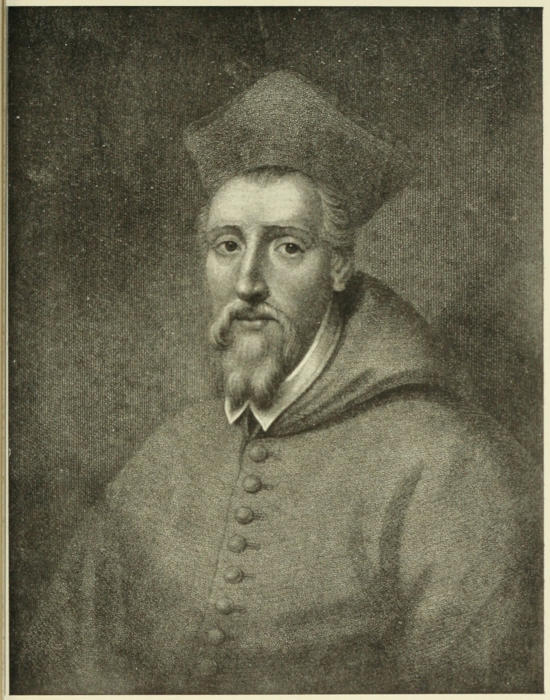
CARDINAL ALLEN
There were many difficulties to overcome before the material preparations could even be commenced. First there was Sixtus to persuade, which was not an easy task. Olivares and Allen worked hard in Rome to convince him that Philip was moved solely by religious zeal, and not by a desire for revenge or aggrandisement, in projecting the expedition. “I have plied him,” wrote Olivares, “with every argument ... but in addition to his natural tenacity and his buckler of precedents, I have been much hampered with the news of your Majesty’s preparations which pour in from all quarters.” The Guisan and Italian Cardinals, too, were for ever undoing one day what Olivares and Allen with Caraffa had effected the day before. The Scottish and Welsh Catholic clergy in Rome, too, especially Dr. Owen Lewis, Bishop of Cassano, and even many of the English secular clergy, were strongly opposed to what they feared would mean a Spanish domination of the island; and between the opposing factions and his disinclination to part with the vast sum of money demanded of him, Sixtus was not easy to bend to Philip’s will. At length, after much friction and many quarrels, Olivares was obliged to be content with the Pope’s promise of a million ducats towards the subjection of England; but no persuasion or pressure could move Sixtus to provide any part of this sum until after the Spanish army had secured a footing on the island. A more delicate matter even than this was the question of the sovereignty of England after the death of Mary Stuart. Sixtus now usually agreed—though he often wavered on the point—that James Stuart was not to be trusted; and in compliance with Philip’s argument that a successor to Mary should be chosen before she was placed upon the English throne, in order to prevent her from forcing her son as her heir afterwards, the Pope was at length brought to agree to leave the choice of the future Sovereign of England to the King of Spain, though he pleaded hard that the person chosen should be an Englishman.[267]
Whilst Olivares in Rome, with imperious boldness, was managing the Pope, Mendoza in Paris, with equal skill, was keeping Guise in hand, pointing out the great destiny that awaited him in France, and the shame of allowing a heretic King to succeed to the “most Christian” Crown. At the same time he maintained a close correspondence with Mary Stuart and the disaffected section of English Catholics who were represented as yearning for the coming of King Philip’s liberating fleet. Mary was sore and angry at what she thought an unjustifiable delay on the part of Philip, and was incessant in her prayers, through Mendoza, that she should be liberated before it was too late. Most of her intermediaries were false, and her secret correspondence was known to Walsingham and Elizabeth, but with Mary’s unhappy trustfulness she never failed to seize upon any chance, however dangerous, by which her great ambition might, perhaps, be served.
In the middle of May, 1586, Charles Paget, who was still one of Mary’s agents in Paris, came to Mendoza, bringing with him an English priest named Ballard, who had been sent by a number of Catholics, especially in Lancashire and the North, to represent to him that: “God had infused more courage than ever into them, and had convinced them that no time was so opportune as the present to shake off the oppression of the Queen and the yoke of heresy that weighs upon them, as most of the strongest heretics are now absent in Zeeland. They say that I have never deceived them, and they beg me to tell them whether your Majesty had determined to help them to take up arms when they decided to do so.”[268] Mendoza had but a general expression of sympathy to reply to this; for though the great fleet of conquest projected in Spain was already the talk of Europe, to Philip’s officers it was still supposed to be an inviolate secret. This inquiry of the English Catholics, however, was not John Ballard’s real reason for coming to see Mendoza. He handed him a letter from four English Catholics who had access to Elizabeth’s Court, in which they promised to kill the Queen either by poison or by steel if they were assured of Philip’s help after the deed was done. Mendoza ciphered the letter himself and sent it to Philip’s secretary, but as John Ballard did not broach the subject verbally Mendoza’s disinclination to give any pledges kept Ballard in Paris beating about the bush in doubt for many weeks. Parsons, who was a good hater, asserted ten years afterwards[269] that the whole scheme of Ballard and Gifford was promoted by Paget and Morgan, Mary Stuart’s correspondents in Paris, for the purpose of frustrating the purely Spanish attack upon England, to which they are represented as being bitterly hostile, and that Walsingham was informed of the plot with the same object. Paget was, and continued to be, a pensioner of Spain, and Morgan, who was entirely trusted by Mary, was also richly rewarded by Philip, at her request; but there is no reason to doubt the positive assertions of Parsons that both of them belonged to the anti-Jesuit party, to which, indeed, most English as well as the Scottish and Welsh Catholics adhered; and that by every means they endeavoured to frustrate what Allen and the Jesuits tried so hard to promote—a Spanish domination of England.
Whilst Ballard waited in Paris the reply of Mendoza, the latter received important letters from Mary Stuart, who at last had been able, by Morgan’s contrivance, to reopen correspondence with the outer world, little dreaming, poor soul, that the facilities provided were only a trap of her enemies. This was the first time she had communicated with Mendoza since his arrival in Paris a year before, and William Paget, the brother of Charles, was her messenger. He was to make certain proposals to him for Philip’s aid to “our designs”; but by far the most important part of the message came afterwards. The continued heresy of her son James had, she said, well-nigh broken her heart, and in order to secure the triumph of the Church “I will cede and make over by will to the King your master my right to the succession of the English Crown, and ask him to take me in future entirely under his protection, and also the affairs of this country. For the discharge of my own conscience I could not hope to place them in the hands of a Prince more zealous in our Catholic faith or more capable in all respects of re-establishing it in this country.... I am obliged in this matter to prefer the public welfare of the Church to the aggrandisement of my posterity.”
Thus Mary finally embraced the Jesuit view which looked forward to a Spanish sovereignty over England to the detriment of her son and Scotland, and in opposition to many of her friends and adherents in England and France.[270] To the King of Spain this renunciation of her son by Mary was of profound significance. His own English descent had never been lost sight of, but here his claim was rendered legitimate apart from his ancestry; and Mendoza, though when he received Mary’s letter he had just been couched for cataract and was temporarily blind, caused a reply to be written to the Queen warmly commending her saintly resolution. She saw, he said, how evil her son was disposed, and the French had done little enough for her, whereas Philip had always befriended her. “Moreover,” he wrote to Philip, “failing the Queen of Scots and her son, your Majesty is the direct legitimate heir to the Crown of England. Cecil, the Lord Treasurer, was in the habit of saying that the Duchy of Lancaster had been unlawfully usurped from your Majesty.”[271] No wonder that Philip replied to this in what was for him an unusually effusive strain: “She [Mary Stuart] has greatly risen in my estimation in consequence of what she says, and has much increased the devotion I have always felt for her interests, not so much because of what she says in my favour, though I am very grateful for that also, as because she postpones her love for her son, which might be expected to lead her astray, for the service of our Lord, the good of Christendom, and the salvation of England. Tell her all this from me, and assure her that if she perseveres in the good path she has chosen I hope that God will bless her by placing her in possession of her own. You will add that I shall be happy to undertake the protection of her person and interests as she requests.”[272]
This move of Mary’s made it necessary for Philip to handle the question of the succession with more caution than ever in Rome, for if once the French and Italian Churchmen thought that he meant to seize the Crown of England for himself, half Europe would have been ready to oppose him. So Olivares was ordered to “keep constantly before the eyes of his Holiness the advisability of choosing some firm Catholic, who on the exclusion of the King of Scots should take his place, and it is equally important to keep his Holiness to the point, binding him to agree to my nomination of a fit successor to the Queen of Scots in England.” The reply from Philip gave Mary new hope. She had been deeply discouraged at the repeated failures of attempts to rescue her and overthrow Elizabeth, and the long delay of any effective aid from Philip had well-nigh driven her to despair. But now, surely, a new era of success was opening to her. Rumours reached even her in her prison of the great preparations being made in the Spanish and Portuguese ports for some vast naval enterprise; whilst the open war between Elizabeth’s troops and the Spaniards in Zeeland seemed to Mary to make certain and near the hour when Philip’s arms should avenge the injuries done to him by finally crushing the heretic Queen and substituting Mary for her. Many times in the last six months, she wrote to Mendoza, she had turned a deaf ear to proposals of English Catholics for her deliverance: “But now that I hear of the good intentions of the Catholic King towards us I have written to the principal leaders of the Catholics here a full statement of my views on all points of the execution of the enterprise. To save time I have ordered them to send to you with all speed one of their number, fully instructed to treat with you, in accordance with the promises given to you in general terms, and to lay before you all the requests they wish to make to the King. I assure you, on their faithful promise given to me, that they will carry out their undertakings, even at the risk of their lives. I therefore beg you to give full credit to their messenger as if I had sent him myself. He will tell you the means they have for getting me away from here, which I will attempt to effect on my own account if I am assured of armed aid.”[273]
Almost simultaneously with this the group of English Catholics who had sent Ballard to Mendoza in May were able to supply the ambassador with the details and assurances he had requested to prove the seriousness of their intention. Their envoy on this occasion was Gilbert Gifford, brother of the Dean of Lille, and, according to Parsons, a strong opponent of the Spanish-Jesuit party. He unfolded to Mendoza the existence of a vast conspiracy in England, in which most of the Catholic nobles were implicated. The Earl of Arundel, son of the late Duke of Norfolk, and most of his kinsmen, with a score or so of other noblemen and gentry whose names Mendoza sent to Philip, were ready to rise in force whenever they were advised that the Spanish fleet was approaching. Sir William Stanley, in command of a large body of Irishmen intended for Flanders, would delay his departure if possible, revolt against the Queen, and join the invaders; the English force in Ireland under Bele would do likewise, whilst Claude Hamilton and a force of Scots would join the Catholics of the North on the signal being given. The very heretics themselves, they said, were ripe for revolution, tired of the burden of taxation; but, above all, a young man named Babington and some six confederates[274] had determined to kill Queen Elizabeth, in accordance with the suggestion previously made by them through Ballard. They only asked that Spain should support them when the deed was done. No Frenchmen should be concerned in the business, but promptitude was now vital, for every hour increased the risk of discovery; and they prayed Philip to let them know at once what he would do to rescue England.
Mendoza jumped at all these proposals, for, according to Gifford, the greatest men in England were pledged to the rising—as apart from Babington’s murder plot; even the moderate Catholics being pledged to it. Two letters went off at once from the Spaniard to the heads of the enterprise, “praising the proposal as it deserved, as it was so Christian, just, and advantageous to our holy faith and to your Majesty’s service, worthy of spirits so Catholic as theirs and of the ancient valour of Englishmen.” If they succeeded in killing the Queen, promised Mendoza without authority, they should have the assistance they required from the Netherlands, and the assurance that King Philip would succour them. “I promised them this on my faith and word, urging them to hasten the execution.” Directly they had despatched the Queen, wrote Mendoza to them, let them seize Don Antonio and the Portuguese with him and lodge him in the Tower; get Sir William Stanley to seize the Queen’s fleet, unless Lord Admiral Howard was a trustworthy party to the plot, and let them be sure to kill Cecil, Walsingham, Hunsdon, Knollys, and Beal at the same time as the Queen.
Mendoza’s hatred of Elizabeth outran his discretion, and in conveying all this to Philip he wrote: “Of all the plots they have hatched these many years past none have been apparently so serious as this. They have never before proposed to make away with the Queen, which is now the first step they intend to take. As she so richly deserves her punishment, it may be believed that God has heard the groans of the afflicted Catholics and desires to bring it upon her thus swiftly. Let Him dispose as He will; but if, for our sins, He shall ordain that it do not succeed there will be much Catholic blood shed in England. Up to the present your Majesty is pledged no further than the risk of 100,000 crowns, which have been given to the priests sent thither, and if secrecy be kept we need only watch what comes of it. If the Queen falls the country will submit without bloodshed, and the Netherlands war will be at an end.”
Philip was horrified when he received this letter, and scribbled upon its margin, in that appalling scrawl of his, scornful comments which showed that his cold, secretive nature rebelled against the rash enthusiasm of his usually discreet Mendoza. How could such a secret be kept, he asked, if all these people were chattering about it? How could the schismatics, or outwardly conforming Catholics, be trusted? They were mere heretics and no better; and how imprudent of Mendoza, his ambassador, to send to the conspirators two such compromising letters as those mentioned! Philip had heard too often in the past of such plots as this, and he had thrown away already too much money in subsidising such adventures. Nothing but conquest, he was convinced, would serve his turn now; and to that end he was bending all his energies night and day, penning the Pope closer into the corner, inflaming more than ever the French ambitions of Guise, and fomenting trouble in France; and, above all, collecting stores, arms, and ships from all his vast dominions to crush Elizabeth for good and for all in the interests of the Church and Spain.
But, withal, Philip was not a man to throw away a chance if he could gain it with a minimum of responsibility, and he blended his somewhat caustic remarks upon the lack of secrecy and caution displayed with saintly approval of the plan to murder his sister-in-law. “As the affair is so much in God’s service,” he wrote to Mendoza on the 5th September, “it certainly deserves to be supported, and we hope that our Lord will prosper it, unless our sins are an impediment thereto. It appears to be based upon a solid foundation and to have the support of many Catholics, but it is difficult to keep a secret entrusted to so many people, and it causes me anxiety that it should be so widespread, and even schismatics let into the secret.... But the importance of the matter is great, and perhaps the time has arrived when God will strike for His own cause.” Philip left in no doubt his own attitude with regard to the matter. The Spanish aid should be ready, but should not be sent until the murder of Elizabeth had been effected. Let the “principal executions” be done, he urged, without a moment’s delay. “Everything depends upon the one act which is to be the commencement. When this is done they may with one voice acclaim it, and the way will be clear, whilst if the intention is discovered before its execution each one will be destroyed separately and union will be impossible. As all hangs upon this, and the cause is God’s own, we must hope that He will prosper it.”
Gifford was sent on his way to England with the King’s message, and soon the heavy hand of Walsingham fell upon the conspirators, who had all through been living in a fool’s paradise, betrayed, as was Mary herself, by the instruments they thought so trusty and faithful. Philip had been right in his distrust; once more conspiracy subsidised by Spanish intrigue and money had failed, more disastrously this time than ever before; and the King of Spain, whilst deploring in conventional terms the dire fate of most of those upon whom he had depended for an auxiliary movement in England on the approach of his fleet, accepted the reverse with stolid philosophy. In one respect, indeed, it was to some extent a relief to him. There is no doubt that he greatly esteemed Mary Stuart for her steadfast Catholicism, and would have placed her upon the throne of England if his attempt at conquest had been successful during her life; but there was always lurking in the background the fear that after her accession she might be drawn by French intrigue or maternal solicitude to adopt her son as her heir, in which case Philip’s vast efforts and expenditure might have been in vain. But with Mary a condemned prisoner, whose head might fall at any moment, it was the present rather than the future sovereignty of England that was now to be decided, and slowly, with the aid of Parsons and Allen, the claims of Philip to the English succession were advanced tentatively even in England itself, though not, as we shall presently see, with any intention of his personally assuming the sovereignty after Elizabeth was disposed of.
The question of Mary Stuart’s complicity in Babington’s murder-project is one that does not directly concern us here, but there can be but little doubt that, even though it was not conveyed to her in so many words, she was well aware of the whole plan.[275] At least Mendoza, who should have known, believed that she was; for on the collapse of the conspiracy he wrote to Philip: “I am of opinion that the Queen of Scotland must be well acquainted with the whole affair, to judge by the contents of a letter she has written to me.... Doubtless it is God’s will to give England to your Majesty by the strong arm only, since He has allowed so much Catholic blood to be lost, as will be shed by the discovery of this business. Nothing has been said yet about my letters, but even if they were discovered and printed they are so worded that another construction could be placed upon them.” Mendoza was too sanguine in this respect. His letters were read and his conversations with the messengers repeated. There was no need on the part of Elizabeth and Walsingham to go out of their way to put harmless constructions upon his words, which, indeed, were plain enough, and a shout of execration went up all over England at an ambassador who thus connived at the murder of a sovereign and a lady.
Already the alarming reports of spies had aroused the worst fears of Elizabeth and her people. The Queen, particularly, dreaded the vengeance which seemed hanging over her. For years she had defied Philip and had beaten him in the game of diplomacy, depending for her immunity upon the continued war in the Netherlands and upon Philip’s distrust of France. But she saw that France could not help her now, whatever her extremity, for the Guises were in arms and the wretched fribble upon the throne was but a straw borne hither and thither upon the tempest, whilst the Huguenots were grimly awaiting the hour when they themselves would have to fight for freedom and for life. The war in Zeeland, moreover, was now only maintained by English help, and when the dreaded Spanish descent upon England was made Elizabeth would have to abandon the Dutch Protestants to their fate, and the last bulwark of Reform would be submerged by the flood of Spanish popery.
Once more Elizabeth played the outworn game that had served her turn so often before. Andrea de Loo and many other intermediaries hurried backwards and forwards at the instance of Burghley between London and Flanders, impressing upon the Duke of Parma the English Queen’s earnest desire to come to terms with her “good brother.” Let the Pacification of Ghent, which had been accepted in the time of Don Juan, be re-enacted and all might be settled; let a conference meet, in which mutual grievances might be arranged, and England and Spain should live happy together ever after. But Parma for a time gave stiff answers to all this, much as he knew that Flanders needed peace, for Philip kept him in the dark as to his real intentions, and he dared not act without precise instructions from the King. Other attempts were made to reopen the trade negotiations through Portuguese agents with a view to a general agreement, but Philip was irresponsive now; for after half a lifetime of hesitation he had finally made up his mind. England must be conquered by the sword wielded by his hand alone; and although he might feign to talk of peace to suit his purpose, there was in his slow-moving, inflexible mind thenceforward no peace possible with England until Elizabeth and her Government had been crushed.
Another spirited attempt was made by Elizabeth to reach Philip direct. Pedro Sarmiento de Gamboa, the famous explorer and Governor of Patagonia, had been captured at sea by one of Raleigh’s ships. Usually such men were held for heavy ransom, but Sarmiento was received by the Queen at Windsor with every witchery she knew how to exert, and was impressed with her sorrow that such unhappy relations existed—God knew from no fault of hers—between her people and the Spaniards. Would Sarmiento convey a letter to his King, accepting his liberation as a reward for his doing so? Naturally nothing would suit Sarmiento better, and Raleigh carried him with all distinction to Durham House as his honoured guest, plying him with assurances of Sir Walter’s desire to serve the King of Spain by putting a stop to all this piracy, of which the Queen herself and Lord Treasurer Burghley disapproved. Besides this, he (Raleigh) would sell a fine ship of his to Philip for 5,000 crowns, would prevent any more aid being given to Don Antonio, and would, indeed, become Philip’s humble servant in England. This was, doubtless, nothing but one of the usual mystifications to divert Philip; but the Queen herself gave a cordial verbal message to Sarmiento for the King, saying that she was really anxious to let bygones be bygones and make a durable peace. Sarmiento left London in November, 1586, and gave his message to Mendoza in Paris, but on his way to Spain was unlucky enough to be captured again, by Huguenots this time, near the Pyrenean frontier, and all Elizabeth’s and Raleigh’s influence was exerted to secure his prompt release. By all means accept Raleigh’s offer to prevent further aid being given to Don Antonio and to stop piracy, wrote Philip; but to the suggestions for direct peace negotiations he made no reply.
In the meanwhile the arsenals and harbours of Philip’s realms were ringing with preparations for the great enterprise. The peace conference so much desired by Elizabeth might meet in Flanders and talk, but no pause was made in the feverish activity in the Spanish preliminaries for war. Old Santa Cruz had waited patiently after the King’s gentle rebuff to him in 1583,[276] until the circumstances detailed in the foregoing pages had rendered war with England inevitable early in 1586, when he wrote to the King from Lisbon a letter full of fiery zeal, recalling his former offer to conquer England when his victorious fleet was ready, and deploring the shame that had fallen upon Spain since by reason of the continued insults and injuries inflicted upon it by the heretics, much to the material gain and moral prestige of the Queen of England. They had, he said, plundered a million and a half of ducats in the last five months, and had defied the King of Spain successfully at all points. Everything was now propitious, urged the admiral, for dealing a final blow at these daring heretics, and he prayed the King to arise in his wrath and smite his enemy before the occasion passed. “I am not moved to this,” he proudly added, “by a desire for fresh battles or the ambition for new victories, but by no other motive than the service of God and your Majesty.”
This time the hero’s appeal found the King ready, for all his peaceful diplomacy had failed to bring England to his side; and Santa Cruz was requested to submit to the King a plan for carrying out the enterprise he proposed. It took Santa Cruz two months, as he says, to draw up from his papers and the experience of forty years at sea a complete scheme for the irresistible descent upon England; and the estimate with which he furnished Philip stands to-day, after three centuries and a quarter, an unexampled monument of foresight, skill, and boldness. Nothing was forgotten in this prodigious estimate: naval and military requisites, arms, stores, clothing and material, down to the minutest detail, are set forth, with estimates of price and with surprising clearness; the salaries to be paid to men of every rank are given; the weight and bulk of every article, the best place where it may be obtained, the rations to be provided, and the discipline to be observed on land and sea, are all written in due order, and to such a lover of formal papers as Philip the estimate of Santa Cruz must have been a pure delight from the bureaucratic point of view.
Not so, however, with regard to the concentrated magnitude of the demands, greater than had ever been made for such an enterprise before. Santa Cruz wanted for the invasion of England 150 great ships, 40 store hulks, 320 small craft of 50 to 80 tons burden, 40 galleys and 6 galleasses, or 556 sail in all, besides 40 skiffs and 200 landing rafts. There were needed 30,000 sailors and nearly 64,000 soldiers, with 1,600 cavalry horses, all to be shipped from Spain, and this enormous multitude was to be provisioned beforehand for eight months with food and water. Deducting the ordinary cost of armaments in Spain, the extra estimated expense to be incurred by the enterprise was placed by Santa Cruz at 3,800,000 ducats.[277] The sum in money was much greater than Philip had ever had to provide in Spain for any one enterprise before, and it took him aback now. The Pope, it is true, had promised a million ducats, but not a soldo would he pay beforehand, and the Italian States might be coerced into contributing; but the bulk of this vast sum in ready money had to be wrung somehow out of already exhausted Castile, and, anxious as Philip was to make assurance doubly sure, he knew that this was impossible; so Santa Cruz’s estimates had to be modified.
The opportunity for the invasion, nevertheless, was one that could hardly be expected to recur. The cup of Elizabeth’s provocations was full to the brim, and her anxiety to open peace negotiations proved her own apprehensions. France, for almost the first time, was paralysed and could not interfere. Leicester’s ineptitude in Holland had even turned the feeling of the Dutch against their protectors, whilst many of the English troops and their leaders, such as Roland York, Sir W. Stanley, and Colonel Semple had deserted to the Spanish side and had delivered to Parma the fortresses occupied by them. The Turk, moreover, was for the time harmless, and Don Antonio was already a discredited and waning force. So, although Philip did not approve of Santa Cruz’s plan that the whole army should be embarked in Spain, he gave orders that the arsenals and dockyards should work night and day, and through Spain and Portugal, Sicily, Naples, and Lombardy there rang the echoes of warlike preparations such as they had never known before; whilst the recluse of the Escorial, shutting himself away from all other tasks, took counsel how he might effect his purpose with the means at his disposal.
It is not to be supposed that the French and Scottish faction would sit tamely by and see without an effort the whole enterprise of England fall into the hands of Spain. The conversion of James Stuart was still a fervent hope with many who dreaded to see a Spanish king supreme in Britain; and the English Jesuit faction had to fight hard against the Welsh, Scottish, French, and many English Catholics at home and abroad. James Stuart himself and the Scottish Catholic nobles were fully alive to the danger that threatened. The Scottish nobles, with the secret connivance of James, made a bold attempt to associate themselves with Philip’s invasion, and to bring Guise again into the combination. Huntly, Morton, Claude Hamilton, Crawford, and Montrose, in the summer of 1586, sent one Robert Bruce with three blank signed papers to the Duke of Guise in Paris, where the letters over the signatures were written at Guise’s dictation and addressed to Philip,[278] begging him to listen to the verbal proposals of their envoy, Bruce. Guise and Beton introduced Bruce to Mendoza, and the gist of the proposals was that Philip should send to the Scottish Catholics 150,000 crowns to raise and arm soldiers, whom they would maintain for a year, and they also asked that a foreign force of 6,000 men should be sent to Scotland to secure the triumph of the Catholics, in consideration of which they promised to place at his disposal one or more ports in the south of Scotland to serve as a shelter and a base of operations against England. Mendoza understood, as indeed did all experienced fighting-men, the immense importance of the latter suggestion; for Santa Cruz from the first had insisted upon the need of seizing harbours in the Channel in case of contrary weather; and Bruce was sped on his way to see Philip with all the support that the ambassador could give him.
But Philip had had enough of Guisan meddling, and he had no intention of allowing the supreme effort he was making to be used for the benefit of any one but himself, and least of all for that of shuffling James Stuart. As usual, he did not say no plainly, for he had no wish to alienate the Scottish Catholics, or to arouse suspicions of his motives anywhere. So, gently suggesting doubts and difficulties, he referred the question to Mendoza and Parma for report, sending Bruce back to Paris with “fair words” and a letter to Guise “praising the zeal which moves you to strive so sincerely for the promotion of our holy Catholic faith.” Mendoza was directed to keep the Scots in hand, to suggest that they should ask the Pope for the money they needed, and to flatter Guise as much as he thought necessary; all of which meant that Philip would not bind himself to Scot or Frenchman in the execution of his project, though, if on their own account and at their own risk they cared to divert his enemy, he had, of course, no objection to their doing so. But the offer of one or two safe ports in Scotland near the English border was one not lightly to be refused—its acceptance, indeed, might have changed the whole course of history—and Mendoza, an experienced soldier, wrote in October, 1586, to Parma strongly urging that the offer of the Scottish Catholics should be sympathetically entertained, in order that a diversion might thus be effected in the North simultaneously with the Spanish invasion of the South of England; though here commended that full inquiries should be first made to ascertain to what extent Huntly and his friends could carry out their pledges.
Parma, however, was almost as cautious as his uncle. He was, in fact, resentful that Philip was keeping him in the dark as to his ultimate plans, and was determined not to move a step in any direction beyond his written orders until he knew what the King was really aiming at; whether to frighten Elizabeth into peace, which Parma more than suspected, or to crush her finally by war. So to Mendoza’s almost vehement advocacy of the Scottish diversion Parma replied coolly, saying that the proposal would fail unless it formed part of the combined plan and was executed in co-operation simultaneously with the invasion. Mendoza grew more and more in love with Bruce’s proposal, which would, he said, give harbours of refuge for the Spaniards in the North Sea and divide the Queen of England’s forces; and here began the first whispers of Parma’s half-hearted loyalty,[279] which amongst the vanquished officers of the Armada afterwards swelled into a tempest of indignant recrimination.
Mendoza’s inquiries of Bruce had satisfied all his doubts, and to Philip he wrote beseechingly on the 24th December, 1586, in favour of the scheme. Some of the passages in his extremely able letter,[280] read by the knowledge of the subsequent disaster of the Armada, sound almost prophetic. “It is of advantage to the English,” he wrote, “that they should be attacked by a force which needs great sea fleets for its transport and maintenance, both on account of the immense sums of money which must be spent upon such an expedition, and the vast quantities of material and the length of time necessary for preparation, as well as the many opportunities which occur during this delay for impeding the progress of such armaments. Such expeditions, moreover, are liable to much greater disasters than land armies, for in most cases the mere death of the leader suffices to frustrate them ... and in the event of the loss of a great fleet the owner is deprived at one blow of forces, ships, and guns—things difficult to replace readily.” It is clear now, with our later knowledge, that the old warrior-diplomatist—the last of the disciples of Alba, as he calls himself—was right in his appreciations, and that Philip made a fatal mistake in not following the advice of such men, instead of indulging in his fatal itch for retaining in his own hands all executive monopoly and all ultimate profit in his plans.
But the advances of Huntly were not entirely rejected, for not only Mendoza, but Parma too, as time went on, saw their importance, and although the idea of invading England over the Scottish border was again vetoed, Bruce was sent back to Scotland after many months of impatient waiting in France and Flanders, carrying with him ten thousand crowns to freight ships in Scotland ostensibly for Dantzig, but really for Flanders, to embark there an auxiliary force to aid the Scottish Catholics in their intended rising.[281] Bruce went on his way late in the summer of 1586, with his doublet padded with gold, but when he arrived in Scotland the whole scheme was embroiled and frustrated with the usual ineptitude. It was too late in the season for the ships to be obtained. James Stuart was also consulted by the Scottish lords as to his joining the Spanish attack upon England to avenge his mother, with the result that was to be expected. Bruce and his companion, Foster, turned traitors when the plan was seen to be impracticable, and once more, and for the last time, Philip settled down to the inevitability of conquering England by himself alone, and for himself alone.
It was more important now than ever it had been that he should succeed in doing it, for Henry III. of France was without a son, and was in bad health. If Henry of Navarre, a Huguenot, became King, and France ceased to be a Catholic country and in alliance with Protestant England, the Catholic domination of Europe would be at an end, and the sun of Spain must sink rapidly. The conquest of England, indeed, must be effected, and the country made Catholic before Henry III. died, or all, it seemed, would be lost; and Philip, after thirty years of paltering, was now in a desperate hurry. There was still another reason why Philip’s zeal for the conquest of England should be further inflamed at this time. Mary Stuart was condemned to death, and in the bitterness of her heart she wrote the beautiful letter[282] to Mendoza (23rd November, 1586), in which she entrusted to Philip alone the task of avenging her and the cause for which she died, of providing for her servants, and, above all, of inheriting her rights to the succession of the Crown of England, which bequest she afterwards confirmed by a formal will. There was no longer any legal bar between Philip and the sovereignty, and no further fear of a doubtfully Catholic successor being adopted by Mary after her accession. With the fall of the head of the Queen of Scots the spirits of the English Jesuit party rose, for they knew now that James and his countrymen would not be allowed to lord over Englishmen if once Philip held the country in his grasp.
The subtle web of intrigue that had been spun for so many years past, the threads of which we have to some small extent endeavoured to unravel, had so far been favourable to Philip. He had patiently suffered numberless indignities and injuries at the hands of Elizabeth and her people; he had seen England and his own Dutch provinces drift ever further away from him; but he had never ceased to plot patiently in order to dispose affairs aptly for his vengeance when the propitious hour should strike. The Guises had been alternately flattered and frowned at, until their great ambitions in France seemed to hang upon Philip’s will, and they dared not stir without his countenance. Henry III. had been by the same means rendered equally powerless to help England or to hinder Spain. The Scottish Catholics had been subsidised and cajoled, as had James Stuart himself, into a benevolent neutrality towards Philip with blended hopes and fears of the English succession. Mary Stuart had been so handled as to lead her to make Philip by will the heir to the English Crown; and gradually all the strings which were intended to pull down the edifice of the Reformation were gathered into the hands of the gouty old monastic monarch in his granite cloister-palace on the bleak Castilian sierra. Each interest, as we have seen, had been silently and separately dealt with, and tricked into the position that best suited Philip’s ends; for he would take no risks that he could avoid, and aspired to imitate natural forces in the slow, insensible accumulation of power, which at the supreme moment might be launched by the master with irresistible effect.
When, at length, the stealthy plotting had reached fruition, and Elizabeth saw herself isolated, with Henry III. and James VI. paralysed; when the Pope and the Cardinals understood that the Church and its cherished hoards were to be instruments of Spanish political ends; when the Guises found that they and their kin were to be excluded from all share in the great prize of England; and even the English Catholics of the more patriotic and moderate sort awoke to the knowledge that their religion and their scorn of the Scots were being used to forward a conspiracy against the independence of their country; then each separate interest struggled as best it might to free itself from the toils in which the diplomacy of Philip had involved it. Allen, with his seminary, and the English Jesuits under Parsons, had gone over to the Spanish side bag and baggage, but the English Carthusians and seculars under Dr. Owen Lewis, and the large Scottish Catholic element in Rome under the Bishop of Dunblane, aided the Guisan Cardinals in combating the idea of a purely Spanish domination of England, and the contest went on bitterly and without cessation, especially after the death of Mary Stuart had made the fears more imminent.
Before that had happened, Philip had instructed Olivares to sound the Pope cautiously, and, if possible, to obtain a brief from him, declaring Philip entitled to the throne of England after the Queen of Scots, “as I cannot make war upon England for the purpose merely of placing upon the throne a young heretic like the King of Scots.” The Pope’s fears were to be lulled by the declaration that Philip had no intention of annexing England to the Crown of Spain, but of passing the sovereignty to some suitable Catholic candidate, perhaps to his daughter, the Infanta Isabel. Olivares, Allen, and Parsons knew at this time (January, 1587) that the Vatican was uneasy about the whole business, and they prayed the King to say nothing about his own claim openly until the Armada had been successful. But when, a month or two later, the news of Mary’s death came, Philip was obliged to some extent to show his hand to the Pope, and the brief was ordered to be secretly asked for as a measure of precaution. Above all, Philip urged, not a word must be said about his claims to Guise or the Frenchmen.
Unfortunately, much had already been said about them, even by Mendoza; and Guise and Catharine de Medici, and James of Scotland himself, were all trying their utmost to prove how very Catholic the latter was, and what an excellent King of England he would make. Philip ordered that his claims upon England were only to be broached with the utmost caution to the English Catholics. In May, 1587, the King wrote to Mendoza: “You must only speak of my rights to well-disposed native Englishmen in order that they may be informed of the truth, and convey it to others of their nationality, that it may thus spread and gain ground amongst them. But do not mention the matter to Frenchmen and others, who will only take it up for the purpose of frustrating it.”[283] To add to his authority in the matter, Philip urged successfully that Allen should be made a Cardinal, and he was well primed by instructions from Spain how to push the succession question with the Pope. Religion, of course, was to be the pretext. The King of Scots was a heretic, and unfit to succeed. For the good of the Church a Catholic of unquestionable orthodoxy should be chosen, and he must be powerful enough to keep England in the straight path. All this, of course, could only tend to the conclusion that Philip or his daughter alone would serve; and very gradually and cautiously this view was made familiar to Catholics, to be struggled against fiercely by all those who were not absolutely under the Jesuit and Spanish influence. Parsons was indefatigable in writing letters, addresses, and memoranda in favour of this view, and the absolute quiescence of the moderate English Catholics when at last the Armada appeared in the Channel, and their loyalty through the crisis, was largely due to the unwise forcing of the idea of a Spanish Sovereign over England by the Jesuit propaganda.
Elizabeth was no less active than the other threatened interests in her efforts to escape from the position in which she found herself. Still hoping against hope that the old policy of advance and retire might again be successful, she and Burghley strove heroically to arrange some form of peace congress with Parma through Andrea de Loo. It was not easy, for neither side was in a yielding mood in matters of procedure; but Philip said that he saw no harm in entertaining the advances, which he knew from the first he did not intend to have any result other than to lull Elizabeth into a false security, whilst his preparations advanced. The Burghley party in Elizabeth’s Court had all the Puritans against them, and, more strongly still, the blue water school of sailors, who for years past had shown by their deeds that the Spaniards were no match for them at sea. “Why wait to be attacked on our own coasts,” was their constant argument, “when we can go and crush our enemies before even they can leave port?”
The English ships had finer lines and lower bows than the Spaniards. They could sail several points nearer the wind; and the need for ocean attack and defence had developed an entirely new school of seamanship, depending upon celerity of movement, broadside armament low down, by which the hulls of the enemy might be riddled between wind and water, whereas the Spanish ships depended still largely upon bulk, needful for the carriage of cargoes from the Indies, and the old tradition descended from the Mediterranean galleys of heavy armaments fore and aft. The attack in the Spanish system consisted only in grappling with the foe and pouring soldiers on board of him, the vessel being less of a fighting entity than a conveyance to bring the fighting-men on each side into contact, as galleys had been. Under Drake the English sailors had developed an ideal entirely distinct from this, namely, to avoid grappling, and by superior handiness of the craft to cripple the hulls of the enemy, and make them unseaworthy and incapable of manœuvring. Again and again the English sailors had proved that the new methods were effective; and whenever there was a chance of meeting the Spaniards at sea, they eagerly sought it.
It was this combination of sailors and the Puritans or Liberals, led by Leicester, that sought once more to force Elizabeth’s hand in the midst of the negotiations for the peace conference with Parma early in the spring of 1587. The Portuguese spies in England continued to report to Mendoza the great preparations being made for a naval expedition, by Drake, in Plymouth and the Thames. Elizabeth and Burghley deeply distrusted a policy of daring aggression, and hesitated much to allow an attack upon Spain, though Leicester’s influence and Drake’s confidence ultimately carried the day. The secret of the destination of Drake’s fleet was well kept. The pretence was cleverly maintained to the last that it was one more attempt to aid Don Antonio—this time, it was said, to go to the Indies; and Mendoza, who reported almost daily to Philip what he heard, was hoodwinked all through. Drake arrived in Plymouth from the Thames on the 23rd March, in a hurry to get away, for fear the Queen would alter her mind and order him back. He had obtained her commission—“to prevent or withstand any enterprise against her Highness’s dominions, and especially to prevent the concentration of the King of Spain’s squadrons”—and he was authorised to “distress the ships as much as possible, both in the havens and on the high seas.” Drake knew that as soon as he left Court attempts by the moderate party would be made to spoil and hamper his plans, for his Vice-Admiral, Borough, a Queen’s officer, had been sent with him only to serve as a clog upon his actions, and Elizabeth was still full of faith in the insincere peace negotiations. Sure enough, only a few hours after he hurriedly sailed from Plymouth, a royal order came thither from London, happily too late, “to forbear to enter forcibly any of the said King’s ports or havens, or to offer any violence to his towns or ships in harbour, or to do any act of hostility on land.” Drake took very good care that these timid orders never reached him until too late to stay his hand, and went on his way as usual, in defiance of Borough’s warning.
Slowly, and with infinite difficulty, stores, arms, and material were being collected in Spain. The roads were bad, communications laborious, and Philip’s centralising methods clogged the wheels of progress. Old Santa Cruz was labouring early and late, in Lisbon, making ready such great ships as could be collected in the Tagus; whilst in the ports of Andalusia the Duke of Medina Sidonia, the great magnate of the Province, had seized for the King all the merchant ships and stores; and was actively getting ready to sail from Cadiz and join Santa Cruz in Lisbon in the early summer, and, together with other vessels expected from Italy and the Biscay ports, attempt the conquest of England. Thus matters stood in April, 1587. Santa Cruz was almost in despair, for he profoundly disliked the modification of his plans adopted by Philip, by which the bulk of the army under Parma was to cross in small boats to England when the Armada should arrive off the North Foreland to protect its passage from Dunkirk to the Thames, and the command was to be divided, Santa Cruz to be supreme at sea and Parma on land. The ships in Lisbon were still unready, and the crews and soldiers were joining in mere driblets from distant parts of Spain. The provisions, too, for all his host came in slowly, and much of the stores rotted before they could be used. The ships from the eastern ports of Spain and from Naples and Messina were lagging; for delay was inevitable when every detail had to be directed by one overworked old man far away.
Then suddenly, on the 18th April, 1587, the people of Cadiz saw in the offing a fleet of thirty white sail. “Some contingent of the Armada,” thought the Duke of Medina Sidonia, busy with his stores inside the harbour. It was nothing so welcome as that; for it was the terrible Drake himself, with his stout ships, bent upon mischief, notwithstanding Elizabeth’s timid wavering and her Admiral Borough’s warning. Looking up the harbour of Cadiz, Drake could see a forest of masts, many a tall ship, he knew, that was intended for the subjugation of his country. They were, for the most part, store ships, nearly a hundred of them altogether; and though they were crammed with provisions and material, neither their guns nor their crews were on board. Into the harbour dashed Drake, sinking the big galleon at the entrance that served as a guardship, and disdaining the fire of the protecting forts, and soon he had all the harbour at his mercy. The very name of Drake appalled the Spaniards, and without impeachment he turned adrift and set on fire some twenty-five of the principal ships. Soon the great crowd of galleons was a blazing ruin, and in the three weeks that followed Drake deliberately annihilated in the harbour of Cadiz the results of a year’s work and vast expenditure. Then, on the 1st May, 1587, he leisurely sailed away, secure in the knowledge that, come what might, no invasion of England by Spanish ships was possible for that summer.
In the Tagus, at Lisbon, there still lay the fifty great galleons, under Santa Cruz, which were to form the principal fighting force of the Armada, and as Drake stood off the mouth of the river, they looked tempting. He was more than half inclined to sail in and serve them as he had served the Cadiz ships; but he did not know whether they had their great guns on board or not. Whilst he was ascertaining this by his spies the peremptory orders came to him from the Queen that he was to provoke the King of Spain no more: the great fighting ships of Spain, with no crews or guns on board, were left unattacked, to Drake’s abiding regret, and the chance of making the invasion of England by Spain impossible altogether was missed through Elizabeth’s belief that by her usual methods she might avoid war, even at this eleventh hour. The damage done by Drake was in great part irreparable. Not only were many stores and ships destroyed in Cadiz, but for weeks afterwards the English fleet lay off the coast of Portugal, capturing great numbers of vessels loaded with pipe staves,[284] for the water and wine casks of the Armada. These could not be quickly replaced, and their loss led to the short and bad water supply in the fleet, which was one of its worst calamities. When Drake sailed away, Spain was crippled for a time; and the capture of the rich Indies galleon, San Felipe, completed the discomfiture of King Philip, who had no alternative now but to order Santa Cruz to make ready his ships in Lisbon, in a hurry, not now to invade England, but to prevent Drake from intercepting and plundering the silver fleet, whose safe arrival in Spain would alone enable Philip to proceed with his plan of invasion in the following year. The injury inflicted by Drake’s raid was a terrible one to Philip, but he plodded on, still convinced of the goodness of his methods and the ultimate certain victory of his cause.
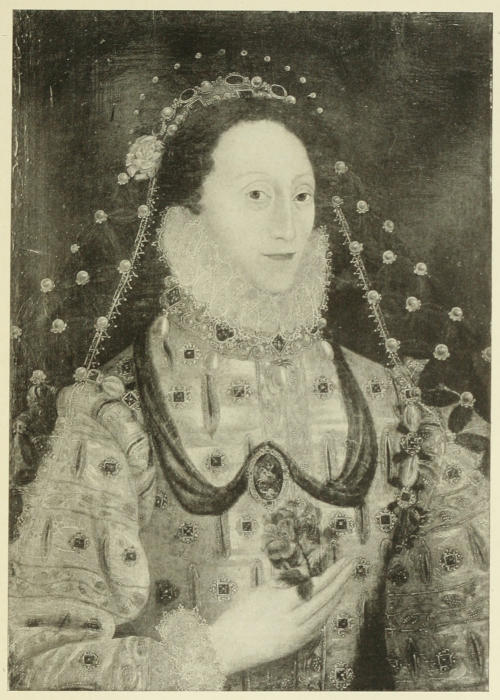
QUEEN ELIZABETH
FROM THE PAINTING BY MARC GHEERAEDTS AT THE NATIONAL PORTRAIT GALLERY
To Parma, in Flanders, the news of Drake’s attack brought anguish and discouragement beyond words, for he was less blinded by fervour than his uncle was, and was brought nearer to his practical difficulties. He was a great commander and saw plainly the weak points of Philip’s scheme for the Armada, so far as it was communicated to him. A divided command and strictly limited authority were repugnant to him, a sovereign Prince and practically supreme in Spanish Flanders; and from the first he was determined that no blame for the failure which he feared would attend the attempt should be laid at his doors in consequence of his exceeding the strict letter of the King’s written instructions. He had strained every nerve to muster and equip his troops to be ready for the expected arrival of Santa Cruz with his fleet in the summer of 1587, and now he found himself with a large force of men, and short of money, provisions, and stores for their maintenance. But he was a general of resource, and utilised his army to capture the Sluys and invest Ostend and so improve his position before the English Peace Commissioners, the Earls of Derby and Hertford, Lord Cobham, Sir James Crofts, and Drs. Dale and Herbert, went over in the autumn of 1587, in the chimerical hope of making peace with Philip. Leicester, Walsingham, and the sailors wondered aloud how her Majesty could be so blind as to believe that peace with Philip was possible now. Exhortations and prayers reached Elizabeth, from those who knew Philip’s intentions well, that she would allow another bold stroke to be dealt upon the enemy’s heart; but her parsimony and belief in her methods made her turn a deaf ear to all such urging, and England still stood unready in the face of danger so imminent and dire.
Whilst Parma was still spinning matters out with the English Peace Commissioners on fine-drawn points of etiquette and procedure, in order to give time for really illuminating instructions to reach him from Philip, and Elizabeth was living still in her fool’s paradise, the plan of the Armada was finally settled; for Philip, dead against the advice of his seamen, had determined to send out the expedition at all risks, in the autumn of 1587, as soon as Santa Cruz returned from convoying the silver fleet. The letter in which he conveyed his plan to Parma on the 4th September, 1587, is worth quoting at some length.[285] The Armada, under Santa Cruz, was to sail up the Channel, avoiding, if possible, any decisive engagement, until it had reached the Straits of Dover and had joined hands with Parma. “We calculate that by the time you have invested Ostend you will have 30,000 men ready for the main business, whilst 16,000 Spanish infantry, a part of them veterans, will go in the Armada from here, the whole force of soldiers and sailors in the fleet reaching 22,000 men. I have decided that as soon as the Marquis of Santa Cruz returns with the flotillas to Cape St. Vincent ... he shall leave them in charge of the galleys, and himself go straight to Lisbon, where he will take command of the fleet which will there await him, and, with God’s blessing, sail direct for the English Channel. On his arrival he will anchor off Margate, having given notice to you at Dunkirk of his approach. You in the meanwhile will be quite ready, and when you see the passage assured by the arrival of the fleet off Margate or at the mouth of the Thames, you will, if the weather permits, immediately cross over in the boats you will have ready. You and the Marquis will then co-operate, you being in command on land, and he at sea; and, with the help of God, will carry through the main business successfully. Until you have crossed, the Marquis is not to be diverted by anything from assuring your passage. His taking possession of Margate will cut the communications of the enemy, and prevent him to some extent from concentrating his forces. When you have landed (the Marquis giving you six thousand selected Spanish infantry as ordered),[286] I am inclined to leave to the Marquis’s discretion what he should do with the fleet, whether to stay and ensure the passage of our people from Flanders to England and intercept any foreign aid that might be sent to the English, or to go and capture some port and divert the enemy’s strength; or else he might go and seize English ships lying in various ports, to deprive them of maritime forces, upon which their strength mainly depends. You will settle this point between you, the Marquis carrying out your joint decision, whilst you will hasten to the front to conduct the enterprise on the lines laid down. I trust to God, in whose service it is done, that success may attend the enterprise, and that yours may be the hand to execute it.”
The advice of all his best soldiers and sailors had failed to move Philip on one point because he knew that it meant delay, and he was ready now to risk everything rather than wait any longer. “We are quite aware of the risk incurred by sending a heavy fleet in the winter through the Channel without a sure harbour; but the various reasons which render this course necessary are sufficient to counterbalance the objections. As it is all for His good cause, God send good weather. The most important of all things is that you should be so completely ready when the Marquis arrives at Margate that you may be able to do your part at once without delay. You will see the danger of any tardiness, the Armada having to wait there with you unready; as until your passage is effected they will have no harbour for shelter, whereas when you have crossed he will have the safe, spacious river Thames. Otherwise he will be at the mercy of the weather, and if, which God forbid, any misfortune should happen to him you will understand what a state it would put us into. All will be assured, please God, by your good understanding; but do not forget that the forces collected and the vast monetary responsibility incurred make it extremely difficult for any such expedition to be organised again, if they [the English] escape us this time; whilst the obstacles and divisions which may, and certainly will, arise next summer, force us to carry through the enterprise this year or fail altogether. I hope this will not occur, but that great success may attend us by God’s grace, since you are to be the instrument, and I have bountifully supplied you with money. I have told you how all our prestige is now at stake, and how entirely my tranquillity depends upon success being achieved, and I now once more earnestly enjoin you to justify the trust I place in you. Pray send me word that there shall be no shortcomings in this respect, as I shall be full of anxiety till I hear from you.”
Thus, like a desperate gambler, Philip at last, after all these years of waiting and planning, was ready to stake everything—fleet, army, resources, prestige, and the cause for which he had lived—with the chances of success and the warnings of experience dead against him. For years past his expert advisers had been telling him how much superior in staunchness and seaworthiness the English ships were to his, that the new naval construction and armament, by which the artillery fire was delivered low and from the broadside, gave an enormous advantage to the handy English craft, which, by reason of their finer lines and weatherly qualities, could avoid fighting at close quarters. Santa Cruz, Parma, and Mendoza had pointed out to him the rashness of taking a vast, unwieldy fleet in the late autumn, the worst period of the year, up the Channel without a harbour of refuge in case of contrary winds or tempest; again and again he had been told that his ships were still unready, his stores and arms unconcentrated, and his army but partially mustered in various provinces of Spain and Italy. All this he knew, and yet in the face of disorganisation, incapacity, and corruption in his administration, of almost insuperable material difficulties in collecting and supplying such an enormous fleet as that contemplated, the growing alarm and the opposition of all Christendom to his designs, he trusted, in the absence of all the mundane elements of success, to the special intervention of Providence in his favour. Patience and diplomacy had brought the possibility of success within his reach, but patience and diplomacy can be worked by the methods of a chess-player in a monastic cell, whilst armies and fleets must be raised, organised, and led by practical men on the spot, and this was where Philip failed. All power and initiative must be his, whilst he sat upon his office chair, annotating, checking, and dictating from morn till night, but never coming within hundreds of miles of executive action.
In obedience to Philip’s fervent exhortations Parma did his best, keeping his army of German, Italian, and Walloon mercenaries in good heart and readiness whilst the sham peace preliminaries went on. Most of the English Commissioners themselves were soon satisfied that nothing would come of their mission, for months were wasted in discussing and wrangling over such questions as the place of meeting, the sufficiency of powers, and the points to be discussed, though Croft, representing the moderate Catholic party in England, strained his loyalty to the utmost to conciliate Parma.[287] But still the Armada came not, though the winter of 1587 wore on and Parma’s painfully gathered thirty thousand men-at-arms were rapidly melting away, demoralised by short commons and dying by thousands of the plague. Not even Parma’s extremity could move Santa Cruz to take a course that he knew would end in disaster. When he returned to Lisbon from convoying the silver fleet, he told Philip flatly that it would be certain disaster to take the Armada out at such a season of the year, the ships and men, moreover, being unready. Scorn and derision were poured upon the old admiral by the nobles and soldiers, as well as by the bureaucrats who were at the King’s elbow, though the sailors who had met the English on many seas knew that Santa Cruz was right. “Once let us grapple with the heretics,” cried the vapouring men-at-arms, “and all will be well; the sailorman’s task is but to bring us face to face with the foe and we shall know how to deal with him.” Philip rarely reproached those who served him, but even his almost inexhaustible patience gave way, and his curt, cold words of reproach to Santa Cruz for his tardiness in serving him broke the old hero’s heart, and in February, 1588, there passed to his grave the one man in Spain who perchance might have rescued from otherwise inevitable catastrophe the Armada and the mighty freight of hopes it bore.
Philip was, indeed, nearly at his wits’ end, though personally he never lost faith in ultimate success. Sixtus was growing more and more sarcastic, and unwilling to pledge himself further to a policy which he now understood was making religion the stalking-horse of politics. Olivares might rail insolently at the Pontiff as a garrulous old curmudgeon, Cardinal Allen and Father Parsons, by word and pen, might, and did, urge with bland eloquence the saintliness of the enterprise and the holy aims of the Catholic King; but all Europe now was aware and apprehensive of Philip’s overwhelming schemes—not against England alone, it was feared, but against all those who questioned the political supremacy of Spain. By every courier went frantic appeals and remonstrances from Parma to Philip, as week after week passed and no Armada appeared in the Straits of Dover. The army was getting out of hand, he said, and, what with plague and discontent, would soon disappear altogether, whilst of money he had none, and even his credit was exhausted.
In December, 1587, Philip, apparently in desperation, thought that Parma, failing the coming of the Armada, might have made a dash across the Straits on his own account, and have captured England by a coup-de-main, whilst the peace preliminaries were being discussed. Parma, who was a practical soldier, was furious at such a suggestion, as well he might be. Writing to the King on the 31st January, 1588, he asks how could he be expected to do what he had the King’s strict orders to avoid doing. He had laid down clearly, he said, the necessary conditions of success; namely, that the flat boats and skiffs, too small for fighting and unfit to weather a freshet, much less a storm, should be ensured an absolutely unimpeded passage across, whilst the French should be kept busy at home, and the Dutch rebels rendered powerless for harm. “Your Majesty ordered me to undertake this business, and be fully prepared, though the time given to me was short and my resources were limited. I have done my best to perform the impossible in order to please you and carry out my duty.... Affairs have been unduly drawn out, both men and money have been delayed beyond the time indicated, and particularly the Spanish troops, who are the sinew of the whole business, and who have, after all, come in less number than agreed upon, and so dilapidated and maltreated as to look unfit for service for some time to come. The Italians and Germans have dwindled in consequence of having to march quickly in very bad weather, and they are so badly housed to keep them near the ports that many are missing; and our men are dying and falling away rapidly. I have strained every nerve to keep them near the coast to be ready for the arrival of Santa Cruz with the Armada ... and now I see that everything has turned out wrong and contrary to my hopes. Secrecy, which was of the utmost importance, has not been maintained. From Spain, Italy, and elsewhere come full details of the expedition. The King of France, as well as the League, has raised enormous forces, and they, being Frenchmen, are certainly not likely to be in our favour. Holland and Zeeland have armed as promptly as usual, and have prevented the few ships of our fleet in Antwerp from getting out, whilst the English themselves are preparing for their defence with great energy.... If the Marquis had come in good time the crossing might then have been easily effected, by God’s help, as neither the English nor the Hollanders and Zeelanders were then ready.”