EQUIPMENT FOR RAISING TURKEYS
Reading edition
CONTAINERS FOR FEED AND WATER
Click on image to view larger version.
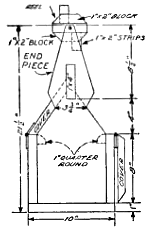
Figure 14.—Diagram of end of mash hopper for feeding young turkeys. Side view of same hopper shown in figure 13.
During the first 3 or 4 weeks after the poults hatch, two-piece crockery fountains are excellent milk containers. For water, galvanized metal containers are more convenient. When the poults are from 4 to 10 weeks old, water pails, metal troughs, or shallow tin or graniteware pans provided with wire or wooden guards are more satisfactory than fountains. A good method is to place the water or milk outside the wall of the brooder room so that the poults can drink it through a wire screen. From the age of 9 weeks until market age, a supply of running water is preferable, although ordinary water pails set inside the range house on the wire floor or nails or tubs set outside the fence, with openings in the wire for the birds' heads, are satisfactory. Changing the position of the watering devices every few days or setting them on wire-covered platforms will aid in providing sanitary conditions near the watering places where filth is likely to accumulate rapidly. A watertight barrel provided with a drip faucet and a trough also makes a good watering device. Shade should be provided to prevent the drinking water from getting hot. Suitable equipment for feeding mash and scratch feed is shown in figure 12.
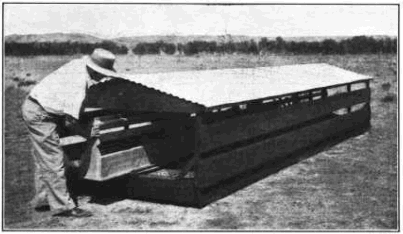
Figure 15.—A waste-proof, portable, outdoor shelter for feeder. The wire floor helps to prevent contamination from the soil and the roof provides shelter when the birds are eating.
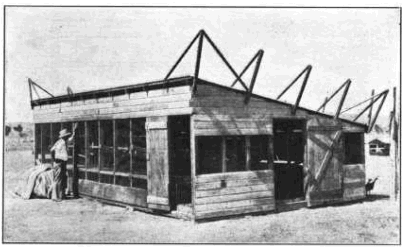
Figure 16.—Large range house for turkeys. This type is equipped with a wire-floored alleyway, as shown in figures 17 and 18. The antiflies on the roof prevent turkeys from roosting there.
Small trough feeders made of lath (fig. 12, A) may be used from the first day in the brooder and until the poults are a week old. Such feeders are made with 1 lath for the bottom, 2 for the sides, small sections for end pieces, and another lath for a guard to keep poults out of the trough. For poults from 8 days to 4 weeks old it is better to use large trough feeders made of 1/2- by 21/4-inch boards for the sides with a top guard consisting of a free-turning reel. Baling wire stretched inside the troughs (fig. 12, C) aid in preventing waste of feed and also serve as beak cleaners for the birds. To prevent waste, it is better not to fill most trough feeders more than two-thirds full. In the brooder house it is important to place feeders on a wire platform made of 1-inch mesh, 16-gage wire, and 1- by 4- or 1- by 6-inch boards. Poults 5 to 12 weeks old should have trough feeders made of 1/2- by 5-inch boards for the sides, with a free-turning reel at the top. For poults from 12 weeks old to market age the feeders should be even larger, as illustrated in figures 13 and 14.
Click on image to view larger version.
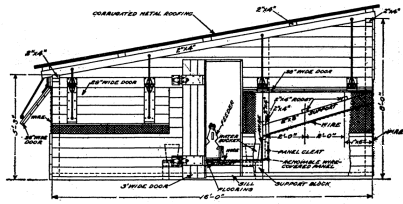
Figure 17.—End elevation of turkey range house with alleyway.
Click on image to view larger version.
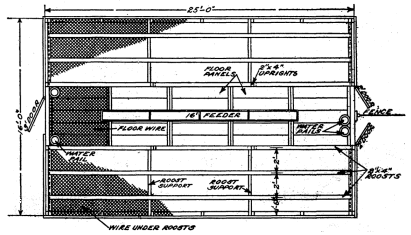
Figure 18.—Floor plan of turkey range house with alleyway.
After the age of about 12 weeks, and when feeding is done under shelter, use a flat-bottomed trough from 12 to 18 feet long or several short feeders made with a 1- by 10-inch board as a bottom, 1- by 8-inch boards as sides, and with a guard of 1- by 4-inch center piece topped with a free-turning roller or reel (fig. 14). For outside feeding a similar trough is advisable. It should be divided into two sections each 6 to 9 feet long, set on 2- by 8- or 2- by 10-inch skids covered with 1-inch hexagonal mesh, 16-gage wire or heavy gage 1-inch-mesh hardware cloth, and provided with a gable roof and side boards to protect the feed and the birds from sun, wind, and rain (fig. 15). The troughs can be removed to be used as inside feeders and for replenishing the feed. Two 9-foot feeders are sufficient for 150 to 175 birds. Inside feeding is preferred whenever possible to provide it.
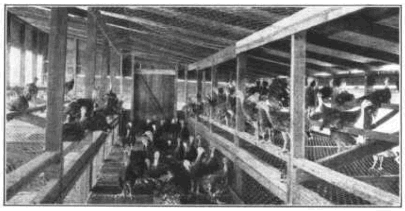
Figure 19.—Interior of 10- by 25-foot ran so house showing wire floor and wire under roosts. Figure 17 shows the wire nailed on the underside of the roost supports.
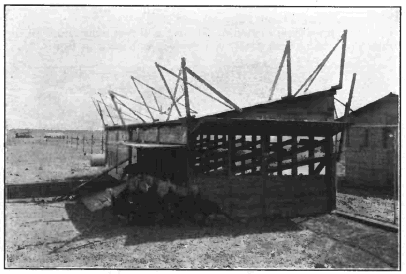
Figure 20.—This shed-roof range house will accommodate from 130 to 150 growing turkeys to market age. The plan of this house is shown in figure 21.
HOUSES AND FENCES
A verminproof, weatherproof roosting shelter for growing poults is an important piece of equipment. A square or rectangular structure with a shed or gable roof makes a satisfactory range house. A shed roof is more easily constructed. The use of wire guards called "antiflies" will keep turkeys off the roof. Allowing for a 5-foot wire-floored alleyway to hold the feeders and waterers, a house about 10 feet wide and 25 feet long (figs. 16, 17, 18, and 19) will accommodate 150 to 175 growing turkeys to market age; a similar house about 16 by 18 feet is large enough for 100 birds. Feeding and watering can be done inside. For a permanent house, a height of 5 or 51/2 feet at the caves and about 8 feet at the front (or the peak, if gable-roofed) is sufficient. If no alleyway is used, a house 9 by 26 feet containing roosts only should care for 130 to 150 turkeys to market age (figs. 20 and 21).
Click on image to view larger version.
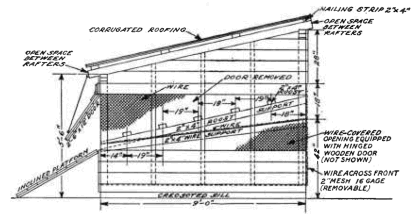
Figure 21.—End elevation of range shelter for turkeys. This type is built without an alleyway and measures 9 by 20 feet.
With the latter type of house, feeding and watering must be done outside, preferably with a covered feeder, as shown in figure 15. A cheaper portable coop, not so high and with framework of lighter material, is shown in figure 22. This coop is built on 4- by 10-inch skids and is equipped with raised wire floor and with roosts.
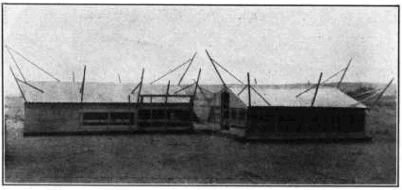
Figure 22.—Portable turkey range houses equipped with wire floors and antiflies. The house on the left is 16 by 20 feet and has a feed storage room at one end.
A permanent house should face south or in a southerly direction so that the front is not exposed to storms. Board sides on the north and west are desirable. Practically open-air conditions, combined with good protection, may be obtained by leaving wire-covered openings about 2 or 21/2 feet wide across the north, west, and east sides at about the level of the roosts. These Openings should be made closable by shiplap doors that may be partly opened in warm weather and closed during cold weather and storms. The south side may be left entirely open except for 1-inch hexagonal mesh of 16- or 18-gage wire and enough boards to give strength to the building and protect the birds from rainstorms.
As mentioned on page 29, desirable roosts may be made of 2 by 4's with edges beveled and laid flatwise but slightly titled up at about the angle of a quarter-pitch roof in the direction toward which the birds are likely to face. Roosts made of 2 by 4's or other sawed lumber may cause dents in the breastbones if they are laid perfectly flat. Smooth poles 21/2 to 5 inches in diameter also make good roosts. Material less than 21/2 inches wide is not recommended for turkeys half grown or older. Roosts should be placed preferably 20 to 24 inches apart (center to center), about 14 inches from the wall and lengthwise or the building. Those nearest the back wall of the shelter should be the highest, and each of the others should be about 6 inches lower than the one back of it. This arrangement insures an even distribution of the birds on the roosts without crowding. Allow about 1 foot of roost space per bird as they require as much space as this when approaching market age.
The space beneath the roosts should be fenced off and covered with 11/2-inch, 18-gage wire mesh to prevent the birds from getting at the droppings. This wire should be placed either on the under side of the roost supports (fig. 17) or on special wire supports (fig. 21), and it should be 6 to 12 inches below the top of the roosts. When a wire-floored alleyway is used, removable vertical panels made of 1- by 4-inch boards covered with the 11/2-inch hexagonal, 18-gage wire mesh should be placed directly under the roosts which border the alleyways in such a way as to close the opening underneath the roosts (fig. 19).
In very dry regions, it the space underneath the roosts and wire floors is entirely enclosed, the droppings may be allowed to accumulate throughout the entire growing season to save labor. In damp climates, however, the droppings should be removed frequently.
Wire floors may be used, as described, in the alleyways of roosting shelters to provide a place for inside feeding and watering and may also be used in the outside yards when close-confinement rearing is practiced. A practical method of construction is to make the floor in removable sections, each about 5 feet square. The framework should be made of 2 by 4's placed on edge, with the top edge beveled to present about three-fourths inch of surface; the center supports may be of 1 by 4's, also placed on edge, spaced 12 to 16 inches apart, and laid lengthwise of the alleyway (fig. 19). This frame should be covered with 1-inch hexagonal, 16-gage wire mesh or chain-link fabric wire. Hardware cloth in a 1-inch mesh made of 14-gage wire is perhaps more satisfactory and will last longer, but the first cost would be greater. The wire may be fastened with eight-penny nails and 1-inch staples alternated, one for each strand of wire, but fastened only to the top or sides of the 2- by 4-inch framework, not to the center supports. The sections should be set loosely in the alleyway and held 1 inch apart by nails driven into the sides of the framework. Supports made of either 2 by 4 or 2 by 6 inch material should be placed on both sides of the alleyway, directly under the outer framework of the floor panels, and blocked up so as to hold the floor frames 1 foot above the ground.
Since hen turkeys fly well, it is sometimes difficult to keep them in their runways. Clipping the large outer feathers (called primaries) of one wing will do much to prevent the turkeys from flying, but it is usually necessary to put a 3- or 4-foot guard made of 1 by 4 or 2 by 2 inch material and lightweight poultry wire around the edge of the roof of the roosting shelters, on gates, and on the fences themselves for 2 or 3 rods out from the buildings. Whenever practicable, these "antiflies" should be slanted in toward the yard (figs. 16 and 20). Clipping the wings of the toms is undesirable and is usually unnecessary when antiflies are properly constructed.
A 5-foot fence is usually high enough to confine turkeys, except near buildings and over gates, where the fence should be 8 or 9 feet high. Even a 4-foot fence has been reported as satisfactory by some growers. Steel posts and square-mesh poultry fencing of full standard weight make good turkey fences.
PROTECTION AGAINST DOGS
Dogs cause heavy losses among turkeys in many localities. Turkey houses must be well constructed to exclude dogs. Wire of 16-gage to 18-gage weight is necessary, and it must be very tightly nailed. The 16-gage weight should be used for the outside of buildings where it comes close to the ground. Confining the turkeys to their shelters all night and through the early morning hours is frequently a necessary precaution unless an attendant is present or protection is afforded by a good watchdog. Fences for confining poultry are not always entirely dog-proof. High roosts, provided by some growers, give protection at night, but in the early morning hours when the turkeys are off the roosts, an attendant should be in the vicinity. Feeding the flock inside the shelter is advantageous when turkeys must be confined during the early morning hours as this greatly increases the feeding period.
DEVICES THAT PREVENT TAIL-FEATHER PICKING
Tail-feather picking seems to begin by the birds' using each others' tail feathers to clean their beaks of mash. Although it does not ordinarily damage the birds for market, the habit ruins their appearance and decreases their salability as breeding stock. It is not always possible to prevent tail-feather picking entirely, especially in flocks raised in confinement or in small range lots, but it may be prevented partially by providing tightly stretched wire in or over the mash feeders. Baling wire stretched tightly or strips of ordinary light-weight poultry wire may be used.
Feeding the mash moist will also aid in preventing tail-feather picking. The kind of mash may also be a factor. A rather coarse mash containing considerable ground corn, some bran, and some coarsely ground oats or barley, including the hulls, seems to be more palatable than a fine mash and is not so likely to clog the beaks of the birds.