A Novel by GEORGE O. SMITH
Reading edition
[Transcriber's Note: This etext was produced from Startling Stories, February 1953. Extensive research did not uncover any evidence that the U.S. copyright on this publication was renewed.]
FOREWARD—EN SAGA
At least once in every generation there turns up a person who is embarrassing to the Custodians of History. With neither talent nor ambition, nor studious application nor admirable character, this person succeeds where the bright and the studious and the intellectually honest would have failed miserably. Stubborn, egocentric, vain—often stupid—our person blunders in where the wise and the sincere would not dare. His hide is thicker than that of the rhinoceros. He is not abashed to tell the surgeon where to ply his scalpel, or to instruct the statesman on a course of diplomacy. His little knowledge is a dangerous thing—for other people.
His success is due to the law of averages.
History holds many accounts where the brave and the brilliant have stepped in at the right time to avoid disaster. Yet there are more bums than geniuses, more cowards than heroes and more laziness than ambition in our human race, so it is not surprising that there should be occasions when a bum or a self-centered braggart should find that history has a special niche waiting for him.
I
They were parked on the dark side of Mercury, snug and comfortable in their hemisphere of force that kept out the cold and kept in the air. At one side where force met ground, a tall silvery spacecraft rose like a chimney.
They were three:
Chat Honger was tall, red-headed, and thin faced. He looked as though he were incapable of quieting down, but he was really the type of person who has an incredible amount of patience for things which cannot be performed in a hurry.
Bren Fallow was shorter than Chat Honger, darker, stouter, more round of face and more amiable. Definitely, Bren was the methodical type.
The third man was Scyth Radnor. Scyth was the kind of man who is quick to grasp a new idea and as quick to reduce it to practise. His failing was that he seldom looked deep or planned far ahead. Being quick of mind he preferred to play everything by ear because planning required study, and Scyth felt that study for the sake of study consumed too much time—time that could better be spent in the pursuit of fun and games.
Teach them the language and drop them in Greater New York and they would be lost among Manhattan's millions. Better change their clothing, though. Striped shorts, Greek sandals, a Sam Browne belt across a bare chest, and a Roman toga of iridescent changing hues is not the kind of costume seen on Fifth Avenue.
Aside from their costume they were human to the last detail. Even their speech, when translated, sounded like the human tongue. They used slang, elision, swearwords and poor grammar. They made bum jokes and puns. They sounded more like displaced earthmen than technicians from a culture that had been establishing galactic centers of population for thirty thousand years.
"You're certain?" asked Bren.
Scyth nodded. "Dead certain now. It was that last computation that sold me."
"Then I'd better shut down."
Chat Honger shook his head. "We've got a job to do. We're behind schedule now, fellows, because of this question. We've got a beacon to start here, I say let's get along with it and bedamned to the—"
"You can't," said Bren. "The first time you put down in the log that this is a middle sequence flare-star, right smack-dab in the middle of Yalt Gangrow's Diagram, the Bureau of Colonization is going to ask you if you took a look for habitable planets. Then—then what, Scyth?"
Scyth Radnor shrugged. "The answer is 'yes' we took a look and we found one, just at the right distance, the right size, and the right conditioning. To say nothing of upper atmosphere and other data made by observation. So Planet Three is about as habitable as Marandis itself."
Chat grunted. "Looked for any signs of life?"
Scyth nodded. "The phanobands are as dead as you-know-what. The machinus fields are all as dead as one might expect this far from any established route. There are a few bits and dabs of stuff on the radiomagnetic spectrum which show a recurrent pattern too fast to be anything of natural phenomena, however. I say we ought to take a look."
Chat shook his head slowly. "I didn't expect to find it inhabited. But even knowing it is habitable is—"
Bren said, "If mere habitability is all you're after we can go ahead and establish our beacon and leave Planet Three to be handled later. A beacon wouldn't ruin the planet itself, you know."
Scyth said, "We'd better take a look-see anyhow. That last computation on the radiomagnetic stuff looked too much like man-made radiation to me."
Bren Hallow smiled. "Look," he said slowly, "If this planet is inhabited, how come the Bureau of Colonization doesn't know about it. Not one case in the history of Marandis shows the discovery of an inhabited planet that—"
Chat interrupted, sourly, "that didn't stem from Marandanian origin. But how about the several cases of spacewreck? Look what we're doing. We're setting up beacons along a rift through the galaxy from Marandis to the Spiral Cluster. We found this rift after years of hard work and galactic surveying and exploring, and both of you know just how fabulous it is. Well, suppose someone found it twenty thousand years ago and got marooned?"
"So what do we do? Take a run to Planet Three and radiate machinus fields all over space? Not until we know. So, Scyth, can you ducky us up a high-sensitivity job out of one of the standard menslators?"
"I think so. D'you think it will work?"
"If there is a primitive culture of the most low-grade organization there, there will also be one or more leading characters. A man of fame or power—or infame and power—whose person will be in the active minds of a large number of hypothetical inhabitants. We should be able to get some sort of response even if the whole thing is primitive as all get-out. But let's take a look before we do anything that's likely to get us into trouble. We're late now, another few hours isn't going to hurt much more."
The discussion in the dome on Mercury's dark side abated as the trio went to work. Scyth began to tinker with his menslators; Chat began to prowl the confines like a caged animal, thinking deeply, and Bren Hallow went back to his massive equipment that was designed to create a galactic beacon.
On this Third Planet of Sol there were still captains and kings and presidents and commissars and a couple of dictators and a new invention or two, all of which professed to be gentle guardians of the public rights. Only the names had changed, some in violence and some in peace. The names of places were about the same; a few had disappeared in the heat of ideology, but by and large things and people persisted despite atoms, politics and the cussedness of human nature. Youth was still going to hell—and old age was still fuddy-duddy.
One apparent change might have been noticed by a man of the middle of the century, and even he would have expected it.
The history of this change reads like this:
A few years after Global War I, the manufacturer of a breakfast food product known as "Oatflakes" realized a rather monumental increase in the sale of his product. Conscientious investigation showed that this increase was not due to the public becoming addicted to oatmeal as a morning, noon and night diet (with a midnight snack tossed in) but entirely due to a new plaything called the "Wireless." Wireless, it was found, required as a major component about a quarter of a mile of wire wound around the cylindrical box in which the oatflakes were packed.
Some years later, when the first home-manufacture of radio sets slowed because of professional manufacture of commercial radio, the sale of Oatflakes dropped to normal. At this point the manufacturer of the food product realized that the pathway to high sales was not along the contents, but along the package. Let the public buy the stuff for the box, or the box-top. If he wants to eat the stuff on the inside, that's his business!
So in the early-middle years of the century there arose a character called Hopalong Cassidy, who portrayed an Old West chivalry and heroic strength great enough to sell boxtops by the gross ton. He tied-in sales with toy and clothing makers until business reached the Law of Diminishing Returns. After selling spurs for roller skates the brains ran out of ideas and turned to new fields.
Space travel was the coming thing, so the youth of the land turned to Tom Corbett, Space Cadet.
Tom Corbett's only trouble was the same as the difficulty encountered by one Frank Merriwell fifty years earlier. After twenty years, Tom Corbett became the oldest undergraduate in Space Academy, just as Merriwell became the oldest undergraduate at Yale. The youth of the race wanted a real spaceman, full fledged and heroic, and so they got it.
Meet Dusty Britton of The Space Patrol....
The sleek spacecraft landed and the clouds of hot dust rose almost to the spacelock, driven up by the fierce reaction blast. A hundred yards from the Patrol cruiser lay the broken spacecraft of Roger Fulton, arch-fiend, cornered at last.
The spacelock opened and Dusty Britton looked out through a wisp of the deadly radioactive dust. He was clad in the uniform of The Space Patrol: black breeches and dark blue whipcord shirt piped in gold. Calf-length black polished boots. His head was bare, and the collar of his dress shirt was open wide enough to show the fine muscles of his upper chest and shoulders. He was blondish with a wide open face of the type that is associated with laughing-at-danger. His physique was almost marvelous, slender-waisted, broad-shouldered, long-legged, and agile-armed. His arms and hands and face were tanned from the radiations of Outer Space and there were the million little wrinkles about his eyes that were natural, not because of age, but because of the price one pays for being a Spaceman. At his hip swung the secret sidearm of The Space Patrol, a raygun far more deadly than the Colt .45 in the hands of him who knew its use.
Dusty Britton took a step forward to the edge of the spacelock, took a deep breath, and then jumped down into the floating cloud of radioactive dust kicked up by the landing blast. Within seconds he was out of the cloud again and racing across the ground to the ship of Roger Fulton which had landed askew.
His crew appeared in the spacelock and looked down, not daring to drop into that horror, knowing that they were not as fast as Dusty Britton and could not make it through in time to be safe.
Across to the wrecked spacer he went, boldly breaching the ruined spacelock. Along the corridor he went warily until he came to the control room. He kicked the door open and walked in, poised lightly on the balls of his feet, lithe and ready to spring like a stalking cat.
Then Dusty Britton faced his arch-enemy, Roger Fulton. Roger Fulton wore a three-day beard, his clothing was stained and torn and his hair unkempt. Fulton watched Britton with cold, angry eyes.
"Now," said Dusty Britton harshly, "Let's have it, Roger!"
Very slowly and very carefully, Roger Fulton's hands found the buckle of his blaster-belt and unfastened it. He let it drop, putting out a leg so that belt and blaster slid easily to the floor. As it reached his toe, Roger Fulton kicked it to one side. He shook his head and sneered at Dusty Britton.
"I should draw and fight the fastest man in The Space Patrol?" sneered Roger Fulton. "I surrender. You'll never blast an unarmed man, Britton!"
Dusty tossed his head. Keeping one eye on Roger Fulton, Dusty sidled across the control room to where Barbara Crandall was tied to a chair. Her eyes were soft for Dusty as he stripped the gag from her mouth and untied her bonds with his left hand. She sat up, rubbing her wrists and working her mouth, trying to tell Dusty something important that would not come through the cramped muscles.
Dusty turned to Roger Fulton. "I've waited for this moment," he said. Quickly he unbuckled his own blaster and tossed it aside. Then he stalked forward, poised to strike, his hands opening and closing at his sides. "Man to man, Fulton. That is, if there's enough man in you to fight!"
Roger Fulton crowed, "Sucker!" and went into whirlwind action. His hand darted inside his shirt and came out with a tiny miniblast.
There came the throbbing sound of raw energy and a flash that blinded. Yellowish smoke curled out and surrounded the scene. Barbara Crandall screamed and tried to get to her feet but the hours of being tied had numbed her muscles and she fell back into her chair helplessly. The yellowish cloud billowed higher in the control room and began to thin.
Then out of the cloud walked Dusty Britton. He held his right hand by the wrist, shaking it with his left. "Stunned a bit," he smiled bravely.
"But how—?"
Dusty opened the fingers of his right hand and let a miniblast fall to the floor, its charge gone, its usefulness ended. "He tried the old hidden-gun trick," said Dusty. "But two can play that game. Roger Fulton will never menace honest spacemen again!"
The music swelled as the scene faded out; a cheer from Dusty's crew finished off one more opus of Dusty Britton and The Space Patrol.
It was a special occasion, this showing. It was Noon in New Mexico, but the showing had gone out across a worldwide instantaneous network no matter what time it was at the receiving end. In some places it was late in the morning, in some places early, others had this showing late at night. But people were watching back and forth across the face of the Earth.
The film came to end, there was the white flash, then an intermittent flicker as cross-country synchronization took hold. (This flicker was done with an eye toward the dramatic; worldwide networks could latch in without a wink of the screen anywhere in the world.) An announcer came on with the statement that everybody had been waiting for:
"And now we take you to Dusty Britton in person, from White Sands Spaceport in New Mexico!"
A flash and a thundering boom shattered the air and a sonorous voice announced: "X Minus Thirty Minutes!"
White Sands Spaceport was a broad flatland, ringed by thousands of people. In the middle stood a three-stage rocket, waiting; its distance making it look like a small model. In the foreground was a small reviewing stand, and on the stand stood Dusty Britton, resplendent in his Space Patrol uniform. He was extending a hand towards a youngster about twelve, dressed in a miniature Space Patrol uniform, complete with a miniature edition of the famous "Dusty Britton" blaster at his hip.
The lad saluted Dusty; Dusty saluted back.
Then from his shirt pocket Dusty took a small box and an engraved piece of paper.
"Junior Spaceman Harold Dawson, it is my pleasure to award you this Medal of Spaceman's Honor.
"I am informed that upon July Seventeen, at Thirteen Hundred Hours local time, you, Harold Dawson, Spaceman (Jg) full aware of the dangers that threatened, did without thought of your personal safety, wade deep into the shifting sands of Mudlark Lake and from that deadly quicksand return your smaller sister to safety. For valor and for gallantry, I present you with the Order of The Golden Heart!"
With a flourish, Dusty pinned the decoration on the proud youngster's chest. The medal glittered there, a small heart of gold surrounded by rings like those of Saturn, carved in flat relief.
Then with another exchange of salutes, Dusty Britton went down the steps and into a waiting spaceport jeep and while the crowd cheered wildly, Dusty was driven across the sands to the spacecraft.
With tolerant parents permitting their young to watch this live, in-person show no matter what time it was across the earth, it is not hard to believe that during these many minutes there were more people thinking about Dusty Britton than there had ever been people thinking about any other person at any one time in the course of history.
And so Scyth Radnor, tinkering with his menslator on Mercury, trying to tune it to some response that would deliver definitive thought, caught much more than he anticipated. In fact, it nearly overloaded the device.
"Any doubt?" he asked with a twisted smile.
"Nope," from Bren.
"I pass," added Chat.
Scyth said, "So instead of being an uninhabited planet, we have a rather high culture, complete with space travel. This Dusty Britton must be quite a hero. But how in the name of the Great Space can they have space travel without machinus fields or some knowledge of phanoband radiation?"
"Maybe their space travel is—er—"
"Now look, you're not suggesting that people with a Space Patrol are riding ships with tailburners? Rockets? What a horrible thought."
Bren shook his head. "Our forefathers lived through it."
"Not many of them," grunted Scyth.
Chat objected. "Read that history you dislike so much. You'll find that our ancestors went through hundreds of years wallowing across space to the planets in reaction-type spacecraft. Chemico-atomic rockets, if you please."
"Let's stop the argument and get along with the main problem," said Bren. "What are we going to do about them?"
"Well, we can't set up a beacon with them here. So we'll just have to take the proper measures."
"That'll be quite a project. Whole colonies and—"
"That they haven't got yet. They're at the outpost stage; the scientific expedition stage. Their moon has less than a hundred people on it, their Mars has been visited only three times, and their Venus only once previously. This project that Dusty Britton is going on is the second Venus rocket, the first one being sent as an orbital, round-trip manned-job for observational purposes. So we can set up our barytrine field without causing a lot of distress, and then we can go on preparing our space beacon."
Bren nodded and Chat said, "You're the handiest man with menslators and the like, Scyth. You're also the guy that can think fast on his feet. We elect you to go to the Earth and contact this Dusty Britton and explain to him so that he can tell his people what is going on."
Bren nodded. "Take the ship and go, Scyth. But use the driver as little as possible. We'd still like to keep this rift secret, you know. We're working for Transgalactic, not the whole damned shipping business."
Not long after, on its secondary drivers which did not radiate enough to make direction-finding much better than haphazard, the spacecraft rose from Mercury and headed toward Earth.
II
Dusty Britton entered the lower cabin of the three-stage rocket and flopped into a chair. "Quite a show," he said with a trace of scorn.
Martin Gramer, the producer of the long series of Dusty Britton pictures puffed his cigar and nodded with self-satisfaction. "Not bad," he said. "Not bad at all."
"Gramer, how the hell long is this nonsense going to go on?"
"Until you're ready to retire."
"I'm ready now."
"For good?"
"I could do something else, you know. After all, I am an—"
Martin Gramer eyed the husky young man with derision. "You say 'actor' and I'll blow a gasket," said Gramer.
"Then what the hell am I doing here?" roared Dusty.
"You're here because you have an honest-looking face and a pair of broad shoulders to go with it. You're the living embodiment of John Darling Trueheart, and you can act the part, providing some bright guy lays out the floor plan and coaches you."
Dusty growled, "Why not hire the bright guy?"
"Because he's got a face that would scare children and the physique of an underfed fieldmouse. Pull you out of that hero role you're in and you'd fall so flat on your face that folks would be calling you Old Doormat. Now snap out of it, Dusty, and be glad you've got hold of a good thing. Stop looking for something you couldn't handle."
Angrily Dusty got up out of his chair. "I suppose you think it's fun to have to go roaming around the country wearing this jazzed-up surveyor's suit with a three-pound chunk of rusty iron clanking on my hip."
"To date they've sold three and a quarter million replicas of that Dusty Britton Blaster you're so contemptuous of, and you've received ten cents for every one that crossed the counter. What's so damned bad about that?"
"I feel silly."
Gramer roared with laughter, then cut it to one short bark as he cooled down to eye Britton angrily. "What's so damned silly about being a model of honor and respect for several million kids?" he demanded.
"Did you ever think how imbecilic it sounds to be Dusty Britton of The Space Patrol, with no space to patrol, wearing a blaster that doesn't blast? And wearing a pack of medals stamped out in the model shop? What does it all add up to?"
Martin Gramer tossed the stump of his cigar at the disposal chute and faced Dusty with a hard expression. "It adds up to a lot, Dusty. It adds up to a damned good living for you. It adds up to—maybe something you're too dumb to understand, but I'll spiel it off anyway—being an ideal. Damn it, man, there's millions of kids in this world that eat, think and dream about the Space Patrol and Dusty Britton. You're an idol as well as an ideal, Dusty. Kids follow a big name man. It's a darned sight better that they follow an ideal rooted in virtue, strength, honesty and chivalry than to have them trying to emulate characters like Shotgun Hal Machin or Joseph Oregon."
"Yeah," drawled Dusty, "But do you know what it means?"
"You tell me your version, Dusty. As if I hadn't heard your gripe before."
The disgruntled actor took a deep breath, opened his mouth, but then closed it again. He let out most of the blast he was preparing and said, quietly but disgustedly, "Why waste my breath? Dusty Britton doesn't smoke. Dusty Britton drinks soda pop and milk. The only women in Dusty Britton's life are his aged mother and his younger sister. Dusty Britton's biggest gamble is when he offers to bet a Saturnstone on this or that. Hell's Eternal Fire, Gramer, do you realize that I can't even date a dame for a dance because 'Kids don't care for the mush stuff!' and my private life is not my own? I can't even swear, god-dammit!"
Gramer eyed Dusty cynically. "You seem to get along."
"Sure. I get along. When I shuck this monkey suit and dress like a human being. But you know what happens? When I turn up at some joint, do I get introduced as The Dusty Britton? Like hell I do. I'm treated like any of the rest of the dopey tourists. Herded like cattle to the rear seats, while a tomato like Gloria Bayle lushes in with her fourth husband and gets the works on the house."
"You make my heart bleed, Dusty."
"Your heart never bled anything but vouchers," snapped Dusty. He fumbled in his hip pocket and pulled out a flask.
Gramer did not say a word.
"Well, aren't you going to give me an argument?" demanded Dusty.
"No. You can't be seen."
"But someone's likely to smell bourbon on my breath."
"No one that counts. And by the time we get back—"
Dusty stopped raising the flask in midair. "Get back—?" he roared. "Get back. Look, Gramer—"
"Sit down, Dusty. Take it easy."
"Gramer, what goes on here? You're not suggesting that we take off in this fire-breathing hot water boiler, are you?"
"You've read all the advertisements."
"Yeah, but nobody with sense would take ad-writer's copy for anything but guff."
Outside, a bomb burst with an ear-splitting racket. A stentorian voice thundered, "X Minus Five Minutes!"
"Ye Gods, you're really going through with this madman's publicity scheme?"
Gramer smiled. "Sure. It's just to Venus; but you can bet your life that every kid that sees this take-off on video or here on the field will be dreaming of the fabulous adventures you'll be having. Those kids know this is for real, Dusty."
"Include me elsewhere," mumbled Dusty. He started for the spacelock.
"You can't let those kids down!" roared Gramer.
Dusty paused at the sill of the spacelock. "Gramer," he said cynically, "I'm not letting anybody down. I'm just keeping the hide of Dusty Britton in one unscarred piece."
"But the public—"
"That's what you've got press agents for, Gramer. So you can get your high-priced publicity men to run a few miles of paper explaining how I happen to have left this shooting star four minutes before take-off!"
"Dusty, you're a no-good louse."
"But a whole one. And let me tell you this, Gramer, you're less worried about the state of youthful morals than you are about losing the thread of a good, high-selling series. So I'm going to sail out of here as though I was scared to death of rockets—which I sure as hell am—and you're going to tell some bright explainist to get busy earning the dough you pay him. And when the smoke is all cleared away, I'll be safe and you'll be safe, and Dusty Britton will continue to go rolling along and the box office will continue to come rolling in. Spend a few short months in space? Not while the geegees are running at Hialeah!"
"But Dusty—"
"Space? Bah! Nothing, floating gently from vacuum to void and back again. Not for Dusty Britton!"
Dusty paused long enough to run splayed fingers through his hair and then he headed for the spacelock with a determined step.
"Wait!" roared Gramer.
Dusty paused.
"The least you could do is to go out of here not looking like Dusty Britton. Don't be an ass! I'll cover for you, but you've got to help!"
"All right but—" Outside another bomb racketed and the amplifier announced laconically, "X Minus Three Minutes!" and startled Dusty with the realization that he did not have much time. "—make it quick!"
"You—there!"
A technician coming up the ladder looked startled.
"Fifty bucks to swap clothing with Britton, here."
"Done," and the tech started to peel. He balked at Dusty's famous 'Blaster'? "That's worth another—"
"Another fifty—dammit!" agreed Gramer. "Now, wave out the door while Dusty leaves."
The roar that went up was for their beloved hero waving out of the spacelock, not the tech that came down the ramp with a rush, followed by the portly Martin Gramer. The spacelock swung closed as the spaceport jeep pulled away with Dusty and Gramer in the back.
They were a half mile away when the thunder came. No one even noticed them wending their way through the crowd, for every eye on the field was looking upwards, straining to see the spacecraft that was carrying Dusty Britton and The Space Patrol off to new adventures.
About a hundred miles off the coast of Baja California, Scyth Radnor sat in the control room of the big spacecraft. The dome was awash. Scyth sat high in the dome watching the pleasantly lazy progress of a forty foot schooner that was coming in his direction. It was a pretty sight and Scyth appreciated it even though he had been born on Marandis some thirty thousand years after the sail as a functional device had been outmoded. Sail, to Scyth, was strictly a vacation sort of thing, just as it was to Dusty Britton and a few billion other people whose lives are geared to a time-table except for vacation time.
If there was any puzzlement over this, it was because Scyth's menslator was not following the rocket, now laboring in free flight towards Venus. Dusty, according to what Scyth had been able to pick up, should have been there instead of here. But Scyth was not the burning inquisitive type. He knew that there was some explanation and that he could afford to wait until it was given instead of wasting a lot of energy trying to figure out the motives of a member of a race unknown to him.
He had better things to contemplate.
In the field of his telescope he could see a sight he approved of.
It was not Dusty Britton, lazing easily near the wheel of the schooner, keeping the helm steady with his left foot because his hands were occupied with a drink on one and a cigarette in the other. It was Barbara Crandall, lying on the cabin on a blanket. Her ankles were crossed and the arch of the upper foot was high and graceful. One thigh, slightly higher than the other, glinted from the sunshine, dark tan. Her breasts pointed at the sky, molded in dazzling white that contrasted sharply against the healthy, animal tan of her flat tummy. There were many more square feet of healthy hide showing than there were of the white shark-skin affair she wore, and Scyth approved of the view.
As he watched her, Dusty drained his drink, tossed his cigarette overboard, and called:
"Hey, Barb! Get us another quart, will you?"
Scyth did not hear it, for his menslator was by no means that competent a device. He just watched and wondered what they were saying.
Barbara called back, "Out of it already?"
"Yeah. I'd get it myself but someone's got to drive this rig."
"Don't mind." She stretched languorously and stood up, stretching high; pulling in her stomach and arching her back with her arms stretched high above her head. Scyth whistled inadvertently as her body went taut against the wisps of dazzling white that crossed her breasts and hips. She came along the cabin top, dropped into the cockpit, and disappeared into the cabin. She came out a moment later with a bottle which she opened and handed to Dusty. She took the wheel while he poured. They toasted one another. They sat side by side, their shoulders touching.
"Nice," she said quietly.
"You bet."
"Nice, quiet and peaceful."
Dusty addressed his glass and held it high. "Here's to the G. D. Space Patrol."
"What are you supposed to be doing?"
Dusty laughed. "I don't know. I'll find out when we get back. Gramer will have some flanged-up explanation right and ready for me."
"You'd better hope that the G. D. Space Patrol doesn't catch you all at sea with me."
"Phooey," he said. He pursed his lips and Barbara gave him a gentle peck that made Scyth's blood bubble slightly.
"Phooey nothing," she said. "You'd be—er—cashiered. Imagine a member of The Space Patrol consorting with a woman."
"What's good enough for pappy is good enough for me."
Barbara chuckled knowingly. "Where are we heading, if it's of any importance?"
"There's an island dead ahead. We might camp on the beach for the night. It's fine clean sand and—"
"You mean that hummock over there?"
"Hummock—humm—Good Lord!"
The hummock, dome of Scyth's spacecraft, began to rise out of the sea. Yard after yard it rose, coming upward glistening wet, the sea water running down in rivulets along its sleek flank. Ponderously and inexorably it rose with a steadiness of living rock. Yet it carried the air of feather-lightness, of an untold monster of sheer power held in easy leash. This was no rocket, straining against the formidable pull of gravity; this was a thing above material forces, its engines idling, its control in complete command. Without a second glimpse it was no spacecraft of Earth.
Up out of the sea it rose until its hundred yards towered above them. The spacelock was just above the waterline when the rising stopped and the alien spacecraft stopped, rock-steady. It was poised on its inexplicable driving forces with the same confident ease that an elevator shows when poised on its cables at the twentieth floor of a building. It stood rock-still and let the ocean waves break against its sleek, polished metal flank.
Whatever it was, Dusty did not like it.
He kicked the auxiliary engine into life, loosed the halyards and let the sails drop. He turned the helm hard as the engine roared into full throat. But the schooner defied its helm and aimed bowsprit-on to the spacelock of the spacecraft, starting through the sea like a dolphin toward the ship of space. The engine raced without bite because the ship was being hauled forward by some unknown force faster than the screw could drive it; the helm shuddered but had no effect, it tried to slue the stern sidewise but only succeeded in making the hull strain out of line. The wheel whipped out of Dusty's hand and spun to dead-ahead.
Dusty left the helm and dived into the cabin. He flipped on his radio and waited with rising panic while the tubes warmed and the meter rose to the red line that meant that it was ripe and ready for use. He grabbed the microphone, flipped the bandswitch to the Coast Guard Frequency, and yelled:
"This is Dusty Britton of the schooner Buccaneer. We are about a hundred miles off the coast of Baja California. Help! We are attacked by an alien spacecraft! Help! This is—"
He let his voice trail off because the output meter dropped abruptly to zero. Something had gone kaput.
III
Dumbly frightened at the face of the unknown, Dusty was far more frightened at being confined in the cabin of his schooner than he was of the nameless horror he would have to face above. He left the cabin in a hurry, and with mental desperation he turned deliberately to face the danger in the hope of getting it over with. He figured there would be less anguish if it came quickly.
The spacelock door was open wide and a man was standing there with a fluted-barrelled thing in his hand. On the deck were droplets of copper still hot enough to send up little wisps of smoke from the deck. The stub end of the antenna was melted down in a blob. As Dusty looked from Scyth Radnor to his ruined antenna and back again, Scyth leaned back in the spacelock and dropped his weapon. Then he made a relaxed show of sitting on the sill of the airlock with his feet dangling almost to the tips of the waves. He looked relaxed and calm and the trace of a smile was on his face; the kind of smile that would open into honest pleasure if he were greeted with the same.
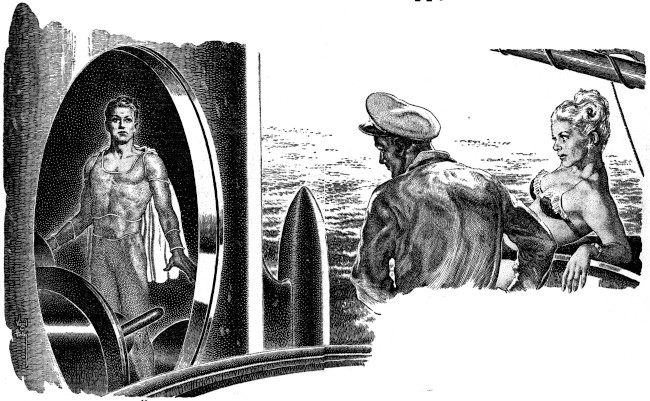
"I am sorry," he said. "I am Scyth Radnor of Marandis. Despite the fact that I was forced to ruin your antenna, I do come on a peaceful mission, Dusty Britton."
"Yeah—" mumbled Dusty stupidly. Barbara was leaning flat against the mast, white-faced under her tan.
"Believe me, Dusty. I mean no harm. I did have to prevent you from broadcasting that which would bring a bad impression of me to your people."
Scyth reached up and pressed a button in the wall of the spacelock above his head. The sill of the spacelock came out abruptly in an extensible runway, carrying Scyth forward over the deck of the Buccaneer. Scyth dropped to the deck and stood facing Dusty with a hand extended.
"What do you want?" stammered Dusty. "And how come you talk our language?"
Scyth pointed to the tiny case slung around his neck. "This is a menslator," he explained. "When used in direct conversation with a man of another tongue, it acts to translate for both parties their meaning. It isn't perfect by any means, but it does help to make people of different tongues understand one another." Scyth smiled and then said, "For a quick and amusing explanation, observe this." Scyth clicked the switch off and began to speak. His speech was utterly comprehensible to Dusty and Barbara at first, but Scyth clicked the little switch after he had said a few words. They heard Scyth like this:
"Fa d snall id, an expression meaning to consign to the region of theological punishment, which when repeated through the menslator becomes 'Go to hell!' See?"
Dusty nodded dumbly. Barbara relaxed slightly.
"Now," said Scyth, "I am from Marandis. Marandis is a planet only a few thousand light-years from the Galactic Center, which makes it nearly thirty thousand light-years from here. Marandis is the seat of the Galactic Government. Look, Dusty, I came here to explain all this to you. There is a lot to say, and there is a lot you must take on faith until you know all of it. Let's relax. Will you come aboard my ship and have a drink? It's comfortable there and—"
"No!" snapped Dusty.
"Why not?"
"Nobody, but nobody, is going to get me in any space ship," said Dusty positively.
Scyth eyed Dusty queerly. His thoughts would have been obvious to anybody but Dusty and Barbara. Scyth was trying to justify in his own mind the attitude of a High Brass in The Space Patrol (any space patrol) who would not enter a spacecraft. Scyth finally decided that Dusty's reticence was due to Dusty's suspicious nature. Dusty was unarmed and he was not getting into a spacecraft capable of carrying him across the galaxy, perhaps operated by other members of the crew. There were no other members, but the ship was big enough to have many. Scyth nodded to himself and smiled at Dusty.
"As you prefer. I only repeat that I mean no harm and I add that the salon inside is pleasant. We can all have a—"
"We've got a drink," blurted Dusty. He turned on his heel and got the quart from the seat by the helm. He stopped to get a third glass. He poured.
Scyth tasted gingerly. "Very smooth," he said. "What is it?"
"Bourbon."
"Bourbon. Tastes like an excellent liquor. Thank you. Now—" Scyth sat down on the edge of the deck with his feet hanging into the cockpit and settled himself for a session. "Dusty, we are here because we are creating a beacon for our galactic spacelanes."
"Beacon?"
Scyth nodded. "You have the insular viewpoint," he remarked. "You can stand at night and point out your destination. But you cannot even see Marandis from here, even with the finest telescope ever built. Stars lie in the way, huge gas fields and nebular clouds block fast direct passage. To chart our course safely past such stellar menaces, we establish beacons at the ends of certain free passages. For instance, Sol lies at the end of a fifteen hundred light year straightaway from the last beacon we set up. Here at Sol a slight turn in the course is made and there is another straightaway for a thousand light-years toward the Spiral Cluster. We—my friends and I—are charting the course through a rather interesting rift from Marandis to the Spiral Cluster. This rift, along which you lie, has been hidden from us for thousands of years. When it is finished it will cut hours from our travel-time."
"And maybe so. But what is a beacon and how do you establish it?"
"Dusty, when a spacecraft is running at fifteen hundred light-years per hour, a three-day-variable star winks in the sky ahead like a blinker-light." Scyth chopped his left palm rapidly with the edge of his right hand. "Wink-wink-wink it goes. And the pilot puts his spacecraft point-of-drive on the beacon and holds it there until he passes it and aims to the next. You—"
"Variable star!" blurted Dusty.
"Yes. The three-day variables are used for course markers; the longer variables are used to denote gas fields, nebular dust, and the like, and the still-longer beacons are used to denote places where various well-travelled starlanes meet, cross or merge. It is—"
"Three day variable—" breathed Dusty.
"Yes. In three days Sol will rise ten times its present brightness and fall again to less than one tenth of the present brightness. This is accomplished by creating an atomic instab—"
"My God! How can any race live under such conditions?"
"They cannot. Not unless properly prepared, well taken care of, aware and ready for it."
"Look," snapped Dusty. "Why not go out and use some other star for your damned beacon?"
Scyth shook his head. "If we were gods," he said quietly, "we could park the Galaxy on our desk, pick up a broom-straw and by fitting and trying we could locate the best course through the star-fields. But—"
"If you were gods," grunted Dusty bitterly, "you could reach in and move a few stars aside and run your damned channel on a dead line from one end to the other. So why do you use Sol?"
"Because the two straightaway lanes that meet at Sol do not meet at some other star. In one or two cases along this rift the original surveyors provided alternates in case we ran into trouble. But not on this one. No, Dusty, we cannot change our plans."
"But see here—"
"Dusty, you wouldn't stand in the way of Galactic Civilization, would you?"
"You're damn well tootin' I would if it's going to mow me down if I don't."
Scyth said soothingly, "Doubtless you have cases on your Earth where a state highway is surveyed right through someone's home. Tell me, Dusty, what happens then?"
"We buy the property at a fair price so that the family can find another home of the same value."
"So you don't stand like a barrier in the way of advancement."
"No we don't. But where are we—" Dusty eyed Scyth with a frown. "You're not going to tell me that your gang will migrate the people of Earth to another solar system, lock, stock and barrel?"
"That would be impossible, of course."
Dusty grunted. "So we gotta alternately cook and freeze just so your outfit can run a goddamned traffic pattern through our living room?"
"Well, now, it's not that bad," said Scyth placatingly.
Dusty did not hear the Marandanian. He was thinking of Los Angeles suffering under the effects of a variable star. Or, rather, he was trying to visualize such a condition. His imagination provided alternating scenes of icy blast and deadly heat, but Dusty's overall technical knowledge was far too meager to offer him even a slight glimpse of the real truth. To merely consider Sol varying about one hundred to one in brightness and warmth every three days was as far as Dusty could go. What would happen to the weather, the general climate, agriculture, and all of the rest were far beyond Dusty.
Even so, the sketchy picture provided Dusty with enough data to say, "Why, we couldn't go on living on Earth at all!"
"Right. Which is why I'm here."
"But you said—"
Scyth smiled confidently. "I'm not here to preside over the death of your part of our human race," he said. "I—"
"Our part of your human race—?" exploded Dusty.
"Of course," said Scyth in a matter-of-fact tone. "So far as we know, human life was first spawned on Marandis. About thirty thousand years ago we became galactic in scope, spreading out, colonizing, expanding, exploring. Many expeditions left home and were lost. But I'll not belabor this any more, just accept my word for the following: nowhere in this galaxy have we found intelligent life that did not spring as an offshoot of misplaced Marandanian culture."
"How can you be so damned certain?"
"The easiest way is to check the cross fertility. It has always worked, to date at least," said Scyth, inadvertently letting his eyes slide up and down the very pleasant sight of Barbara Crandall's body. Barbara knew Scyth's contemplative look and she reacted as any uninhibited woman does when some man is measuring her. The deep high breath raised her breasts and flattened her stomach even though she had no great yen toward wanton promiscuity.
"I gather, then, that you and your gang are going to do something about us?" she asked.
"Of course. We have a program for cases like this. Since you cannot live on a planet rotating about a variable star, we'll move Earth to another star of the same classification."
"But—" objected Dusty.
Scyth went on as though he had not been interrupted. "We'll set up a barytrine field around Earth which serves to do two things. A barytrine field cuts the force of gravity that holds Earth to Sol. It also produces a complete stoppage of objective and subjective time within the field. Then with machinus force-fields we'll put Earth in motion towards another star of Sol's general size. In a thousand years you'll come out of the barytrine field and resume your daily lives under the light of a brand-new sun. It's as simple as that."
Dusty eyed Scyth sourly. "Maybe I've got this wrong," he said. "Maybe you think we live a hell of a lot longer than we do. Maybe you live a thousand years and more but we—"
Scyth held up a hand. It was the hand that held the glass, which was empty. Dusty, reacting as he always did to the sight of an empty glass, filled it despite the fact that he felt that Scyth Radnor was a long way from being a friend.
The visitor from space smiled indulgently. "You miss the point, Dusty," said Scyth, nodding his thanks for the drink. "I said that the barytrine field produces a complete stasis in time. It will snap on ... a thousand years will pass ... it will snap off. To us, we will live and die and never see you again. But for you and yours, if you drop a marble before the field goes on, time will cease for you until the field goes off, and your marble will hit the floor a thousand years from now. You will feel nothing. There will be a tiny flick of light. If you are watching the sun it will probably blink and return slightly off-center because we never can be that precise. If you are watching the stars at night, they will wink out and wink on, and be in a new pattern. You will feel nothing."
"Yes, but, look here, we—"
Scyth smiled again. "Oh, you'll be repaid. We'll raise you from your present primitive level—"
"Primitive?"
Scyth nodded. "Primitive," he said. "You're as primitive to us as your savages are to you."
"But—"
"Look, Dusty, thirty thousand years ago, Marandis was still ahead of your present state of development. I can say this because your people at the present time still have no inkling as to the inconsistencies in the theory of general relativity. Someday soon you will discover that general relativity does not fit all the cases. Then you will propose the machinus theory of space-time. The machinus theory works where relativity does not. Then," glowed Scyth, "you will discover the phanoband carriers which operate in a way as to completely deny relativity in every concept. From there you find the barytrine field forces. But you're still primitive, Dusty."
Dusty eyed the Marandanian sourly.
Scyth continued, "You'd find little in common with us," he said. "You'd find that you would have to re-educate yourself before you could even understand us. Why, there are people in our culture who would take advantage of your ignorance."
Dusty nodded. His hazy knowledge of history presented him with a costume drama of Sir Walter Raleigh handing over a ten, two fives, and four ones to Chief Sitting Bull and receiving in return an engraved bill of sale for the Island of Manhattan. This negotiation was sealed with a slug of liquor out of a bottle labeled 'Bourbon, Bottled in Kentucky.' (Pocahontas, standing to one side, received a string of beads.)
Scyth went on:
"The big problem, Dusty, so far as you are concerned is the preparation of your people. We cannot be precise about the position of the new sun. We could not possibly hope to keep any semblance of your stellar geography. When the barytrine field goes on, it will produce an effect similar to reaching the splice in a reel of film. With no warning, no pain, strain, nor furor the sun will snap slightly aside to its new position. On the night-side the stars will flick instantly to a new pattern. This sort of change would cause great hysteria and fear. Unless the people are prepared for the sudden change. So, Dusty, you as a high official in your Space Patrol must carry our message to your people."
Dusty said, "But—"
"You've mentioned the possibility of payment," said Scyth smoothly. "We expect and intend to pay. But not in money, Dusty. In service and commerce and in many other ways. For instance, we know that your group—I cannot call it your 'race' because your race is ours—must stem from an early expedition and so you are a lost offshoot. As soon as we can, we will come to you with teachers and learned men to help you regain your rightful place as a part of our Galactic Culture."
Dusty looked at Scyth. In his mind churned a hundred objections to the whole thing. He did not like it at all, but he was logical enough to realize that his objections would be waved aside and the Marandanians would go on and do as they planned anyway. On the other hand, maybe if Dusty Britton were to take a large hand in this affair and carry it off successfully, Dusty Britton could become a large figure indeed.
"It will be a bit difficult," he said slowly. "People are not going to take to the idea of losing their sky and sun and a thousand years out of the middle of their lives."
"The thousand years are peanuts. Nobody will notice it. The swap in suns is only a sentimental objection. One sun is like the next and we'll see to it that they are as close as can be had. The change in stellar appearance is deplorable, I admit. But it will give you one advantage, Dusty. Like most skies, they are divided off into primitive legendary shapes with neither rhyme nor reason. A cluttered mess. With a fresh start you can make some reason to the constellations. These are the sort of arguments you must use, Dusty. As a final reminder, you must remember that this is what is going to be done. Period. It is necessary and it cannot be stopped. Therefore you and your people should accept it and make the best of it. Therefore, in what will seem like three weeks, you will be by another star, under a strange sky, a thousand years from this moment. And my people will be there waiting to help you on your climb to the pinnacle of culture.
"But now I must go. Take my words back to your leaders, Dusty. You will go down in history; make the best of it!"
As abruptly as that—Scyth Radnor arose from the deck of the Buccaneer, climbed onto his runway, and was drawn back into the big spacecraft. The spacelock closed smoothly and the huge ship rose silently out of the sea and arrowed towards the high blue sky. The only noise was the whistle of its passage through the air above.
Scyth landed beside the bubble on Mercury's dark side not long after. Chat greeted him with a question about his success and Scyth smiled. "Naturally they didn't cotton to it," he said. "No one ever would."
Chat nodded agreement. "They wouldn't stand in the path of advancement, would they?"
Scyth chuckled. "I'm getting to be something of a diplomat," he said. "Not good, but I think adequate."
"Yes?"
"Sure. First I told them about the beacon and let them ask questions about it to whet their curiosity. Then I explained what the beacon was, which horrified them completely, as it should. Then after letting them cook in their own fright for some time I let them down easy by explaining how we would help to save them. So now there's nothing to do but to finish off the job."
"Right. How long will it take for you to get the barytrine generator set up and ticking?"
"Call it a couple of weeks. I'll have to go back to Marandis for the generator. It may take me a day or two to get it, you know. We'll have to get our license revised, and we'll have to put a bond against the safety of this planet Earth, as they call it. Of course, we'll have lots of time to look for another sun where we can put their planet; we can do that after the beacon is started and they're out of danger-distance."
Bren said, "So the first thing for you to do is to hike back to Marandis and get your barytrine generator."
Chat added, "When you take off from here, be sure you go due North until you're a long way out of line. No use in advertising our position."
"Right. I'll fog-off the course as best I can."
IV
Within a few minutes after his return to Mercury, Scyth Radnor was on his way back to Marandis to make the final arrangements. He took the long way out of this part of the galaxy and wound his way in an inextricable pattern to confuse any possible competition. Until the through-route was surveyed and the first passage made from end to end, there would be no exclusive franchise; another company might be able to latch onto one open lane on this route and give them competition.
Considered as unimportant was the fact that Scyth Radnor took along with him the beefed-up menslator that had put him on the mental trail of Dusty Britton. Not that this mattered, the chances were almost perfect that no one of them would have done anything with it anyway now that their problem was settled. At least, not Chat or Bren. Scyth might have played with it in an off moment. He alone had gotten an eyeful of Barbara Crandall, and while Barbara seemed to be Dusty Britton's woman, Scyth might have wondered whether there were any more at home like her.
But Scyth was on his way to the galactic center, out of range of menslators, even the big permanent installations.
Scyth, Chat, and Bren are not to be criticized for leaving a job undone. To them, a mere explanation covered the entire program. They did not expect the natives to understand the complex ramifications of the galactic culture any more than a certain native chief could understand the danger of fishing in Bikini Lagoon some fifty years earlier.
In fact, the three of them might have been highly amused at a primitive culture that had committed the egregious error of placing such a high value on something of no intrinsic value.
But back on Earth, the wires buzzed and the headlines screamed, and a brace of Gramer's press agents were hard put to untangle the mess the Marandanians had started.
From the teletypes of Worldwide Press Service:
UNITED STATES COAST GUARD RADIO TODAY REPORTED A DISTRESS SIGNAL FROM SCHOONER BUCCANEER OFF COAST OF BAJA CALIFORNIA STOP BUCCANEER ATTACKED BY QUOTE ALIEN SPACECRAFT ENDQUOTE STOP USE WITH DISCRETION COMMA BUCCANEER OWNED BY DUSTY BRITTON OF MARTIN GRAMER STUDIOS STOP
An excerpt from the daily column of Garry Granger:
"There is something in the wind that smells like a publicity stunt. Dusty Britton, our Space Patrol type Sir Galahad supposedly took off for the Venus jaunt some three weeks ago, but has succeeded in sending a distress signal from somewhere off the coast of Southern California. Apparently The Space Patrol is about to meet up with Moby Dick, or possibly it will be "Ten Thousand Leagues Under The Sea" starring Dusty Britton. We would like to know two things: one is whether our intrepid hero actually risked his million dollar neck in a rocket or not, and the second thing is how much hanky-panky the Coast Guard is going to stand for. Some things should be kept sacred. We are not very religious here at the office; but we do believe in the Brotherhood of Man, and somehow we resent bitterly the use of distress signals as a means of getting publicity."
Excerpt from a press release from Martin Gramer Productions, Inc.:
"Now it can be admitted! Dusty Britton has combined fact with fantasy! No longer a mere actor, Dusty Britton was called from the space rocket just a few minutes before take-off time to investigate a secret report of space operations off the coast of Baja California. If Dusty Britton reported an attack, it stands to reason that the secrecy that surrounded the original report is no longer necessary and Dusty Britton's presence on earth instead of in the space rocket can be disclosed. We await more detailed information as to the real nature of—"
From a press-conference held at Arlington, Virginia:
SIGNAL FALSE! SAYS F.C.C.!
"Radar Stations report that no sign of space operations by any agency other than the Venus Rocket have been observed. Even the early warning screen operating along the coast of California and Lower California has nothing to report. The signal of distress is obviously false, and Dusty Britton will be asked to show just cause for emitting such a report."
A statement from the United States Coast Guard:
"Search and rescue squadrons of the Coast Guard were in flight above the schooner Buccaneer within an hour after the interrupted distress signal from Dusty Britton. The schooner appeared to be in excellent condition and was making its way back towards land when sighted. Radio challenges were ignored but upon flying low, Dusty Britton and an unknown woman were seen waving from the deck. There seemed to be no signs of distress, but a Coast Guard cutter is speeding to the ship and is expected to make contact in the next few hours."
Excerpt from the column of Garry Granger:
"What actor, long noted for his derring-do and his exemplary behaviour has been in unchaperoned company with a nubile young female in romantic surroundings? In our youth, heroes were only permitted to kiss their horses. We applaud the approach to reality, but then we are no longer a youth."
From the teletypes of The Worldwide Press:
"Dusty Britton today arrived in port, bearing a tale of a Galactic Civilization called Marandis. This Galactic Government it seems, intends to move the Earth to another sun because our position interferes with their program of running Galactic Highways back and forth across the trackless wastes of space. Moving Earth is a simple process, according to Dusty Britton. A mere matter of barytrine fields, machinus forces, phanoband carriers, and a general abandonment of the theory of general relativity.
"From the viewpoint of the scientists interviewed following this claim, Dusty Britton may or may not have been reading one of his own scripts. Knowing Dusty Britton of old, we are inclined to call this one: Manuscript Found In A Bottle with a deep nod at Edgar Allen Poe for the use of his title.
"Dr. Foster of the Wellmann Observatory suggested that enough of Dusty Britton's story was logical to make it sound good. A race traversing the galaxy at hundreds of light-years per hour would find variable stars helpful if used as beacons. But Dr. Foster said that Britton's story was illogically incomplete. If this outfit has the machinery necessary to move a planet, why not move the stars themselves and create a straightaway passage from one end to the other without curves in the course?"
From The Wall Street Journal:
D' B' ttn Ent' pses-Open 68 Close 43 off 25
Editorial From The Journal of Temperance:
"Elsewhere on these pages is an apology for not printing the interview between our science reporter, Miss Agatha Westlake, and Mr. Dusty Britton. The interview was not concluded because Miss Westlake believed that she could detect the fumes of alcohol on Mr. Britton. It is deplorable that the youth of this fair land have put their faith and their future ideals into the character of a man of such despicable hidden leanings. A package of cigarettes was visible on the deck of Mr. Britton's boat and nearby was a small glass of the kind only found in those dens of iniquity, the formal name of which is forbidden to these pages.
"Let us therefore seek a new champion, who will eschew these vices; who will find it more godlike to extend his gracious invitation of vacation time to his youthful admirers instead of a woman of low moral fiber. We feel—"
TIME Magazine, Science Section:
"Dr. Willy Ley, in an interview today in his retirement home in Jackson Heights pointed out that he had always been convinced that the limiting value of the speed of light was a false theory. Therefore Dr. Ley concluded that it was entirely possible that an extra-solar race could have developed interstellar travel.
"My grandson, Gregory, is aboard the Venus Rocket," said Dr. Ley in the rich German accent that seventy five years in New York have not diluted. "I hope to see the day he takes off for Alpha Centauri.
"But I do feel that there is reason to doubt the story offered by Mr. Dusty Britton. Certainly the more intelligent persons of any galactic civilization would be less likely to contact an actor than scientists or government officials? This story of phanobands, barytrine fields and menslators sounds too much like the fancies of science fiction to me."
Article in The American Weekly:
"With heat rays and weapons of unimaginable power the enemies of the Earth will swoop down to—"
From The Chicago Tribune:
"Not since the days of King George III has the threat of foreign entanglements been so great—"
From The Daily Worker:
"Without a doubt this advanced culture has developed a perfect galactic State, capable of serving all men according to their needs. We feel that a pardonable mistake has been made by their representatives in contacting a man of Dusty Britton's character, and we will wait with open arms the return of the galactic emissaries, who will bring with them the glories of—"
From Mount Palomar:
"Variable stars are of natural origin and can neither be started nor stopped. The theory that such stars are used by a galactic civilization as beacons and celestial stop-lights is utterly fantastic."
From the teletypes of Worldwide Press:
"Dusty Britton was arraigned today in Federal Court for having violated the rulings of the Federal Communications Commission and the international rulings of the Havana Conference of 1972. An indictment is expected from the grand jury, still in conference.
"Dusty Britton is charged with having caused the transmission of a false distress signal. He pleaded not guilty at his arraignment and will probably plead not guilty if his case comes to trial. A fine of ten thousand dollars or three years in jail (or both) is the maximum penalty for a conviction. Public sentiment will probably make the maximum sentence mandatory; this is an election year and the Administration is interested in demonstrating that its foremost desire is to serve the public interest."
Press Release from Cosmic Studios:
"The filming of first run of the new series, Jack Vandal, Space Rover was completed here after an extensive eighteen day program. Jack Vandal is patterned after the characters of The Saint and The Lone Ranger. Unrestricted by the laws that prevent a policeman from performing his moral duty, hated by the underworld, Jack Vandal is to become a Robin Hood of Space. The world premiere will take place at The Palace Theatre, in Greater New York."
Statement from The Office of Scientific Research & Development:
"No evidence has ever been found to corroborate Dusty Britton's statements that radiation phenomena exist which cannot be explained by the application of Maxwell's Equations, and which are not subject to the limitations imposed by the theory of general relativity."
Ruling by the Bureau of Navigation, Marandanian Sector:
"It is hereby granted that a barytrine field be established about the Planet Three of Sol, and that Planet Three shall then be transported and placed in situ near a star of appropriate dimensions. This enactment is to take place at the convenience of the Transgalactic Company with the proviso that no inconvenience take place to the culture of Planet Three. It is ruled herewith that the change in stellar hemispheres and the revision in planetary pattern is of no prime importance to a primitive culture.
"It is further ruled that the loss of approximately one thousand years of direct time in the inhabitant's life is of no importance since contact with the external culture has not taken place, and therefore this loss has no bearing on the primitive culture. At the end of this period of transmittal, investigatory contact will be made to formulate a program of enlightenment which will result in the eventual assimilation of Sol Three into the Grand Galactic Government.
Signed, Sealed, and Delivered BuNav, by Direction."
V
Barbara Crandall opened the door for a quick glance, then opened it wide. "Oh. It's you!"
Dusty nodded glumly. "Yeah. Surprised?"
Barbara shrugged. "A bit. When did they let you out?"
"This morning."
"Rough?"
"You said it. Was it rough on you?"
"A little, but it's been made up for."
"How come?" asked Dusty looking up.
She smiled quietly. "I've got legs and a figure," she chuckled. "I've been cheesecaked all over town as the Star Girl and there's talk of my getting a part in the Jack Vandal series over at Cosmic Studios."
"How so? Seems to me that we're both sort of washed up."
Barbara shook her head. "Jack Vandal is a sort of cheerful villain, you know. He takes delight in bumping off the well-protected crook who can't be touched by the law. He's hunted by the police and hated by the underworld—"
"Spare the gruesome details. They haven't changed in a couple of thousand years. How come you're not in the dog house?"
Barbara smiled. "Because the woman in that kind of opus is always a sort of shady lady herself. It wouldn't do to have an innocent virgin for the companion of a buccaneer. So with my slightly tarnished reputation I'm a natural. What happened to you?"
"The lie detector test."
Barbara blinked. "Then didn't that prove your point?"
"I thought it did. But I forgot one thing. Seems that the lie detector, no matter how good, is capable only of showing whether the character is telling a falsehood or not."
Barbara smiled confidently. "So you were telling the truth. Weren't you?"
"Sure," grunted Dusty. "Sure I was. But, quoting what's-his-name in the Bible: 'What is Truth?' One of the court psychologists pointed it out very clearly. If I firmly believe that the moon turned bright purple at ten o'clock last night, under a lie detector I'd be credited with a 'Truth' when I said so. In fact, the damned thing would say that I was telling a lie if I believed that the moon was purple and tried to cover up by saying that it hadn't changed. Follow?"
"So what was the verdict?"
"The verdict was to the effect that I was suffering under some hallucination—possibly induced by alcohol—which led me into this story. Therefore my lie-detector acquittal was valid only to prove that my call for help was, at the time, due to my personal conviction of danger. I was adjudged temporarily incompetent."
"What kind of sentence? They didn't just let you go."
"I've been two weeks in the observation ward of the federal looney locker. You see, to prove me guilty, they had to show that I had willfully and maliciously transmitted a false signal, with intent to deceive and/or for some personal reason. Willful tampering of this nature comes out as malicious mischief; malicious tampering becomes a federal offence. Maybe I've got my terms mixed up, but I think you get the idea, anyway. The end-up was this: Dusty Britton was convinced of his personal danger, his emission of a distress signal cannot be called malicious. I am no longer the top star I was once—in fact Gramer has cancelled my contract on the moral turpitude clause and the McDougall Office has black-balled me from all productions. So after a couple of weeks of observation at the spin-bin, they let me free with an admonition to leave the stuff alone. Barb, have you got a drink?"
"Sure thing. Look, Dusty, I know what you must think, but please don't ask me to corroborate your story. Not again."
Dusty nodded soberly. "I won't. The first time I thought we could convince 'em. But not any more, kid. One of us in the mud is enough. We've got to find a new attack."
Barbara handed Dusty a highball which he sipped before he said, "Barbara, we've got to do something."
"Why?"
He looked at her, stunned. "Why?" he cried.
Barbara took a sip of her own highball. "We won't lose a damned thing and you know it," she said quietly.
"A thousand years—"
"So what?" she asked simply. "Supposing that they were a bit more accurate than Scyth predicted. Suppose that they took this thousand years out of our life at a time when you weren't looking at the sun. Do you realize—" Barbara's voice lowered a bit dramatically, "—or have you been watching the night sky to see whether they have already?"
"I have," he admitted with rising excitement.
"All right," she replied complacently. "Then you surely must realize that this thousand years out of your life isn't going to change the stock market a point, or anything else."
Dusty nodded. "This I can realize. But do you think I like losing everything but my other shirt? Do you realize that as of this moment I've got only a couple of thousand bucks tucked away and about as much prospect of landing another job as a dead fly?"
"You're not really worried, are you, Dusty?"
"Why shouldn't I be?"
"Because as soon as this barytrine field goes on and off and we find ourselves around another sun, in another sky, you'll be corroborated."
He looked at her. "Of course—and I've kept my big trap shut, too."
"You've what?"
"You don't think I'd be nuts enough to go around telling people 'Well, if you don't believe me, just wait until next month!' do you?"
"Why not?"
"Because then they'd have carefully kept me on ice until after the big event."
"After which your story would be corroborated and you'd—"
"I'd have nothing," said Dusty sharply. "It's not good enough. Sure, I'd be corroborated, but then I'd be blamed for not being effectual enough to convince people in the first place. I'd be blamed for not being the guy I've been depicting on the stage. I've been Dusty Britton, The Great Hero. But when it comes down to really doing something, I'm Dusty Britton, Liar First Class. Next it is going to be Dusty Britton, Helpless Incompetent. I can't just fold my hands and tell 'em that they can wait and see, and then yelp 'I told you so!' because if there's anything that people hate it's 'I told you so!' characters."
Barbara Crandall looked at Dusty pityingly. "Dusty," she asked softly, "Just what do you hope to accomplish?"
"I hope I'll be able to—"
"No. I know what you want to do. But what I want to know is how."
"There must be some way—" his voice trailed off.
"I can't see it. Scyth has probably gone to Marandis to get his generator. Dusty, do you know where the hell is Marandis?"
"Somewhere towards the galactic center."
"I'm told that the galaxy is a hell of a big place. You've about as much chance of getting there as you have of swimming the Pacific Ocean with one arm tied behind you. Scyth is gone from here so far that it takes light thousands of years to get that far. Hell, Dusty, at this moment, the best resources of all the science of the Earth and the so-called planetary income couldn't move a housebrick from here to Venus in less than a matter of months. Alpha Centauri is actually no more than a dreamer's symbol so far as we're concerned. In fact, you and I know that Scyth's little friends are somewhere on the dark side of Mercury getting ready to make Sol a variable. We couldn't get there for months and months, and then we'd have a hell of a time locating them, even if we had whatever it might take to get there."
Barbara thought for a minute and then went on, "And if we could direct the entire Earth, and could call upon anything or anyone, we wouldn't know where to start. What is a phanoband? Why is a barytrine field? Even I know that there are a couple of dozen rather brilliant men who believe that the speed of light is not a limiting velocity, but this is only a conviction, not founded on any experimental evidence. So maybe you've got a firm inner drive to go out and prove yourself. But how in the hell are you going to make headway against a race that considers us primitive?"
"We've got to make contact."
"How? Shall we call Mercury on the phanoband communicators? And what was that intermediary step? The machinus fields? It sounds like double-talk to me."
"It was something about abandoning general relativity for the machinus theory of space-time," said Dusty, bringing into focus all the science fiction he had ever read.
"Got any theories?" asked Barbara pointedly. "Frankly, Dusty, I'd like to help, but I feel too much like a man trying to come all the way from the stone age to the atom bomb in ten days. In order to circumvent their foul plan we've got to abandon a very workable theory in favor of an unknown something called the machinus theory of space-time, and then from that we develop something called phanoband radiation, which produces factors enabling us to reduce the theory to practise and eventually we take to deep space, find Marandis, and put our case in front of some sort of bureaucratic something-or-other. Can't see it, Dusty."
"So what am I supposed to do?"
"Sit and take it. What else can you do? Darn it, Dusty, you can't fight them, and you aren't in any position to join them. We haven't got the initiation fee, we don't have the address, and we hardly talk the language."
Dusty looked at her sourly. "I'd hoped you'd help," he said unhappily. "You at least know what the score is."
"Dusty, I'd like to help. I do know what the score is. It's hopeless. You're trapped in an awkward position. And like a lot of other people, you are in a position where you can't do a damned thing about it. So you might as well save your high blood pressure and start looking around to see what you can make out of it."
Dusty finished his drink and left. In a trash-can by the alley was a Dusty Britton Blaster, complete with holster and a tin medal for sharpshooting. The school-store across the street was displaying a Jack Vandal mask and a small case containing ten candy cigarettes and a secret compartment suitable for concealing ten-thousand dollar bills lifted from lawless characters who might have used the dough to bribe juries or buy professional gunmen.
Dusty made his way along the street unrecognized.
The guard at the front gate looked at Dusty with suspicion. Dusty looked back defiantly; for a number of years the guard had practically bowed thrice as Dusty approached, Dusty hoped that the habit of deference was well established.
"Have you a pass, Mr. Britton?"
"Now see here, Sam, I don't need a pass and—"
"Mr. Britton, I've got orders to—"
"Look Sam. Let's not stall. I want in and I'm going to—"
"One minute, Mr. Britton. I'll have to call."
Dusty grunted. "I want to see Doctor Ross."
"Oh. Well, just a minute."
The guard called, and Dusty could hear the roar of Martin Gramer, "Throw the louse out!"
"Sorry, Mr. Britton. We can't let you in."
"Look, Sam, I've got trouble. You've got trouble. Do you remember your younger days, Sam? When you were the top boy at Graphic Arts?"
"Sure do. Great days, too."
"What happened, Sam?"
The smile faded from Sam's face. "I got too old."
"Sam, all I want is to gab with Dr. Ross for a minute or two. I've got a great idea. And I'll make you a promise, Sam."
"Promise?"
"Sure. I'll promise you that if you let me in right now, and this idea of mine goes through, that I'll see that you get a good bit in anything I'm in. We'll work it up from character actor until you're playing bigger and bigger bits. You can make a comeback, Sam, and I'll help you then if you help me now. How's about it?"
Sam looked through the studio gates for a moment, and the thinking could almost be seen in operation. He had darned little to lose; he could always blame Dusty's entrance on some dreamed-up excuse, and if Dusty's idea worked, he might even be able to take credit for having used some initiative.
"It's a deal, Mr. Britton. But don't forget me."
"I won't."
Dusty went inside, found the main idea-office, and talked himself into the office of Dr. Ross. These hurdles he found less difficult than the front gate; possibly due to the fact that once a man was inside the fence, everyone thought he belonged there.
Doctor Harold Ross greeted Dusty with surprise.
"Dusty! How goes it?"
"Not good. I'm a professional louse."
"How come?"
"Don't you read? Forget it. Look, Doc, you're actually the only scientist I know, so I want to ask a couple of questions."
"I'll try. But let's not lose sight of the fact that I'm not a credited scientist, as you put it. I'm a sort of cockeyed physicist whose job is to see that actors squinting through telescopes see Saturn at the right angle, and that birds looking through spectroscopes don't point at a blue triplet and call it the Sodium D Lines."
"You might be even better than a real physicist of the research kind," said Dusty.
"Thanks for them kind words, Dusty. Flattery will get you nowhere."
"I'm not trying flattery. You've been in this make-believe business for a long time. That's why you might be able to think it out."
"Go on, man. Spill your idea. What do you want me to do?"
"Let's assume that Dusty Britton's wild tale about a man named Scyth Radnor, from Marandis, is right. And that this guy came out of a spacecraft parked in the ocean, sitting on the sill of the spacelock waiting for me. He talked about the death of the general relativity theory in favor of something called the machinus theory of space-time, phanobands, menslators and all sorts of things."
"Yeah? We've been having space warps ever since the days of Jack Williamson."
Dusty grinned, perhaps for the first time in weeks. "Look," he said. "I know the patter well enough. Doc Smith invented the Bergenholm and Murray Leinster came along with the superdrive and George O. Smith developed the matter transmitter to a fare-thee-well, but all this guff is so much birdfood."
"What are you getting at, Dusty?"
"I wish I had studied a bit more science," said Dusty plaintively. "But dammit, I don't know a microfarad from a polysyllabic neutron. But I'm telling you that my so-called strange fancy is the God's Truth. Some time in the next couple of weeks the Earth is going to get itself transplanted. You can either help me now or you can come back later and tell me that you're damned sorry you tossed me out. Take it or leave it."
"All right. So maybe I'll take it. I've only a couple of weeks to lose. What do you want me to say?"
"Look, Doc, supposing that you were convinced that interstellar travel is possible; that these phanobands do exist. That this menslator is a commercial instrument. And so on. Take the first premise: faster-than-light travel is a commercial fact due to the development of a theory called the machinus theory of space-time. Can you do a bit of hypothetical theorization?"
"Sure thing. I don't mind. We'll take this on the basis of plenic syllogistics. Our first premise will be that this menslator works as your pal Scyth claims."
"It's Scyth. Not scythe."
"Then as I put it, the menslator produces the mental image that Scyth intends. He will say, for instance: 'A gostak distims the doshes,' and because he means that a professional preparer of comestibles has placed an unstated number of crustaceans under an open flame, you receive this statement of Scyth as: 'The cook broiled some lobsters.' Is that clear?"
"I can follow you," said Dusty. "This much Scyth explained."
"Good. Now let's look at our commonly accepted definition of 'Mechanus'. This means that it works. In other words we have him telling us that their culture has developed a 'workable theory of space-time' which has been taken up after the theory of general relativity displayed a number of gaping holes. So their 'mechanus theory of space-time' is a workable theory."
"And where does this lead us?" asked Dusty.
"Right back into a circle," said Dr. Ross thoughtfully. "Because if they've developed interstellar travel due to considerations brought about by the mechanus theory, that means that they have proved their theory by practise."
Dusty grunted half-humorously. "Isn't this like saying that mud is sticky because it's gooey? Or that winter is cold because of a lack of heat?"
Ross nodded. "Or that things fall because of the law of gravity."
"But aren't all these things a case of defining 'A' in terms of 'A'?"
"What isn't?" demanded Dr. Ross. "You're not looking for the Universal Truth, are you?"
"No, but—"
"Look, Dusty, the reason that we can afford to accept the fact that one and one adds up to two is simply due to the fact that one and one adds up to two in a great majority of cases."
"Wait a minute, Doc. One and one is always two."
"Not when you add a quart of alcohol to a quart of water. One and one here adds up to about one point eight."
Dusty waved a hand. "That's different."
"Not by a long shot, Dusty. There are extenuating circumstances. But this is just a proof of the fact that one and one is not always two."
"All right. But where does this leave us?"
"In the same damned circle. Granting that your observations are correct, proper, and unwarped by the addition of bourbon, Scyth and his galactic civilization have developed faster-than-light travel which has resulted in the establishment of a galactic government. But the explanation of how it is done cannot be derived from the nomenclature of the theory. Frankly, I have not the faintest idea of how to go about unravelling the word 'phanoband' unless we take it apart from its roots. Let's see, now."
Brows furrowed and lips pursed, the physicist thought for a long time and then looked apologetically at Dusty.
"I may be off the beam, Dusty, but I have a notion that your own mind put it together this way: Phan probably pertains to the roots of phantom, or unreal, or ghostly, or what is commonly referred to as the 'supernatural.' The so-called supernatural is invariably a phenomenon which cannot be explained by commonly accepted academic theory or empirical practise, mostly because the folks who work with it have neither academic nor empirical data. Incidentally, the 'o' part of this first phase is undoubtedly a conjunctive vowel stuffed into the word so that it can be uttered without losing a couple of front teeth or blowing a vocal fuse, or maybe spraying the listener like a professional German lecturer. So let's accept the concept of 'Phan' as something that you cannot explain in common terms."
"Go on, Doc. You're reducing my case to an absurdity, you know."
"I'm sorry, Dusty, but that's how I see it. Now, let's take the 'Band' part of the word. As a disciple of Maxwell, et al, I am hopelessly incapable of concocting a workable theory of radiation which has nothing to do with some basic concept of frequency. Frequency, when you sit down and start analyzing it, is a nice, stable idea that explains a hell of a lot, Dusty, and as you get into atomics you find that particle radiation can be mathematically reduced to terms of frequency. You can actually compute the equivalent frequency of a thrown baseball or a .22 rifle bullet, you know. Then we get to that high-flung miracle we call 'resonance' and God protect me from having to deliver a thirty-minute explanation of resonance."
"I won't ask you to, Doc. But aren't you getting involved in your own traps?"
"Yes, I am. And I'm sorry. But I can't help it. But you can follow my fumblings, Dusty. In the first place the radiation is not understood, which explains your accepting the mental concept as 'Phano' and because the physics of the radiation must be other than electromagnetic—which would call for the menslation into 'spectrum' the somewhat ambiguous term 'band' is assigned in your mental concept of the idea. So the literal menslation of the word is: 'Unknown mode of radiation' which—"
"But where are we getting, Doc?"
"That's what I was approaching, Dusty. This harangue boils down to the following: these people have a form or type of energy level which is completely inexplicable to terrestrial science at the present state of the art. Their terms, when menslated into our level of appreciation, come out as 'something that works' and 'something that cannot be defined' which, after all, is like trying to explain to a savage why a hunk of black rock always turns toward one direction."
"Hell!"
The doctor continued. "Sure. It's hell. Even your own term 'menslator' which I've picked up as a fine concept is only your own feeble transliteration of the definition. It does not carry any of the basic theory. So the fantastic gizmo merely aids in the conveying of an idea from one mind to another, despite the fact that the two minds place different values upon the definition of words."
"But this isn't what I'm getting at, Doc. What I want to know is: granting the possibility of faster-than-light velocities, what have we got to explain it?"
"Nothing. Nothing but your own statements that you believe that this is possible and that someone has done it. None of us have any evidence that it is possible, except you. And I am afraid that I must question your training as a scientific observer."
"But, Doc, I—"
"Let's face it, Dusty. You swing about as much weight in scientific circles as Suzy Richtmeyer, voted last year as Miss Alphatron, parked on the Caltech boo-hucky showing about three yards of shapely nylon and thirty-two well-polished teeth. She was gorgeous but ill-educated, Dusty. She wasn't afraid of getting sterile in a radiation lab. She was afraid of getting pregnant. But if you sit there and ask me how anybody could possibly make any sound and workable theory out of what you describe, I can't see it."
"Look, Doc, maybe I can't deliver much. But they were there and that's what the guy told me."
"There's only one hope, Dusty."
Dusty Britton looked at Dr. Ross; with a voice of determination he said, "Doc, if there's any hope, let me know how?"
"You've claimed that this galactic gang have some humanitarian instincts. They aren't just going to set fire to good old Sol and let us alternately fry and freeze."
"Stop kidding me."
"Maybe I'm not kidding. I'm still promulgating on your own cockeyed plenum."
"You're not giving me much—"
Dr. Ross sat back confidently. "No, dammit, I can't say that I give much credit to your cockeyed story, Dusty."
"Now see here—"
"Now you see here," snapped the physicist sternly, "I won't deny that anything is possible. But I am a firm believer in the law of least reaction, and I think that this covers the case. If this character Scyth is at all concerned about our welfare—still granting that he does exist elsewhere but in your own mind—then get this, Dusty Britton: he will be back to see how you've made out in your program of preparing people for the big change before he turns on this barytrine generator."
Dusty eyed Dr. Ross sourly. "And what is your explanation of that word?"
"Easy, and it means no more than anything else when it is what you call menslated. 'Bary' stems from the root 'heavy' as in 'barytone' referring to something of heavy voice or highly accented. 'Trine' refers to something threefold in astronomical or—er—astrological (haruumpf) meaning. My God, Dusty, the word itself pertains to something as three-times-as-heavy. You don't expect me—or any other scientist—to come up with something sensible from a bunch of half-baked definitions, do you? All you've given me so far is a workable theory, an unknown medium of radiation, and something that is three-times-heavy. Tell you what, chum. Bring me your Scyth Radnor and introduce me. I know guys who would analyze MacBeth's three witches' brew if they could get a microgram sample. But not from that gobble-gabble about the 'fillet of a fenny snake, in the cauldron boil & bake!' line out of Shakespeare." The physicist went on in an undertone, "Eye of frog and tongue of newt," until Dusty stood up and prepared to leave.
VI
Scyth Radnor was pleased with himself. The trip had gone well. He was back on Earth and the barytrine generator was running in the warm-up cycle, building its field to the magnitude necessary for synchronization to the fabric of space stress caused by the planet Earth. It had not been difficult to maneuver himself into this position of having to run the barytrine generator and in doing so turn up with a few days of vacation.
He surveyed himself in the mirror and nodded. Then he left the big spacecraft and embarked on an errand that looked very interesting indeed.
Eventually, with no adventure worth reporting, Scyth found himself standing before a door pressing on a button.
Barbara Crandall cracked the door an inch or so and peered out. "Yes?" she asked. Barbara was not expecting any visitors, and her natural reaction was to open the door only a few inches until she determined the person making the call. But the sight of this man in faultless whites caused her to open the door a full two feet.
"Miss Crandall, I—"
"I don't think I—"
Scyth chuckled again. "Barbara, may I call you Barbara?"
"Oh, now see here—"
"You don't know me?" demanded Scyth with a hurt expression.
"Should I?"
Barbara was beginning to doubt this parley as a program of good sense. As a stage personality, even though far from a universal popularity, she knew very well that a completely dull heart frequently beat lustily beneath an expensive exterior and that a clear, open, friendly face often went with a mind fit only for the company of scorpions.
He saw her doubt and decided that he had played this guessing game long enough. "Barbara Crandall, I know you don't recognize me in these clothes and in this surrounding. Our last meeting was under a rather strange circumstance. I am Scyth Radnor, the Marandanian."
"Scyth Radnor!" she exclaimed. "I—yes, it is. I'm sorry, Scyth. I did not recognize you in human clothing."
"Please," he parried, "Don't say it that way. I am as human as you are."
Barbara looked at him defensively. "And you're here to prove it?"
Scyth blinked. She was rather distractingly direct. "There is no suitable answer to that," he said. "Must I supply one?"
Barbara laughed. "Come in, Scyth. Let me offer you the hospitality of a drink."
"Pleased," he said, following her into the living room. She waved him into a chair and turned towards the kitchen.
When she came back with two highballs, Scyth was relaxed in the loveseat. Barbara noted it with inward amusement and handed him the drink without comment. Scyth sipped the drink first and then took a deep and appreciative drink.
"You do have something to offer," he said, not showing his disappointment that Barbara had seated herself in the chair instead of on the loveseat beside him.
"That," she said, "makes two items, doesn't it, Scyth?"
Scyth knew that he had lost the initiative; Barbara was way ahead of him. He tried another tack:
"I came to see how you are making out," he said.
"I'm not doing badly."
"Is the public aware of the impending event?"
"Aware, but not believing. Dusty Britton lost his shirt over this."
"He'll get it back," said Scyth. "I'm not concerned over the result. It's happened before and it will probably happen again."
"It's more than possible that Dusty will be vindicated but will then be blamed for not doing something about it," said Barbara.
"That cannot be helped. Dusty couldn't do anything about it, you know. And if Dusty loses out in the long run, we can't permit the well-being of one lonely man to stand in the way of galactic progress."
Barbara smiled confidently, but with a slightly sour twist to her pretty lips; it led Scyth to think that there was some derision in her mind. She confirmed it by saying, "Scyth, since you are going on with your program no matter what happens, and your concern about warning the people has worked no matter what happens to Dusty Britton, why do you bother coming back for a look-see?"
Scyth squirmed uncomfortably. Despite certain jokes to the contrary, it is not acceptable to confront a desirable young lady of barely speaking acquaintance and flatly state the delicate proposition. The difficulty here was that no matter how he tried, Barbara Crandall was turning the trend of conversation right back onto the old original trail.
"You're an actress," he said.
"So I'm told."
Scyth smiled. "You're popular? You are in demand here?"
"I am on my way up," she said.
"Barbara, you could be a popular actress, you know."
"Someday I shall be. But this does not come overnight, Scyth. It takes work, you know."
"I have an idea that the flavor of the foreign often helps."
"This is true."
"Then I have a suggestion. Why not come along with us back to Marandis? You have youth and beauty and ability and also the exotic flavor. It—"
"What shall I be?" she returned quietly. "The ignorant but beautiful barbarian? A clothes horse slightly incapable of holding an intelligent conversation? This seldom works, Scyth. I've studied history a bit and I recall the case of a native girl called Pocahontas who was carried from her native surroundings into the height of the civilization for the time. She was no actress—she was exhibited like a pet monkey or a rare zoölogical specimen. She died of what they called heartbreak. I think heartbreak in this case was a combination of loneliness, of facing the realization that she could never really belong to the culture, of the futility of asking to be returned to her people. In other words Pocahontas lost the will to live. So thank you, Scyth, but I have no desire to be a chattel, or a curiosity.... Or a museum-piece."