A Novel by GEORGE O. SMITH (continued 2)
Reading edition
Scyth nodded seriously. "I see your point. But I don't agree with you. In the first place you are indulging in a conversation with me. In the second place, you—"
"In the first place," said Barbara pointedly, "this conversation is being carefully kept on my level, isn't it?"
"I wouldn't say that."
"Of course not. But look, Scyth, aren't you using that menslator of yours?"
"Of course."
"Then the menslator keeps the conversation down to my level because by its very nature it cannot convey an idea to me that is beyond my understanding. Am I correct?"
"In a sense, yes. But—"
"Scyth, can you menslate a dog, for instance?"
"A dog has so little mind that—"
Barbara interrupted this with a wave of her hand. "So how long would it be before you and your people became damned sick and tired of talking down? It would be like trying to conduct an adult discussion in baby talk, wouldn't it?"
Scyth shook his head. "Not entirely," he said. "It might be that way at first. But this would not last. I don't know of your history, but I assume that your Pocahontas was a true savage. You had nothing like the menslator. Doubtless she never learned any real language and so lacked the ability to use a language of any kind, let alone learn the ramifications of the culture behind it. You would be on an entirely different plane. You have a language and a culture and you are quick to grasp a new idea. With a menslator you would learn the language well enough in a short time and while the deeper factors of the culture would always escape you, the superficial parts would eventually come easy."
For an answer, Barbara pointed to the wall. "Scyth, on that wall is a painting given to me by a character who calls himself an artist. Take a gander."
Scyth looked. The painting was a mess of squiggles and blots of color. It was iridescent here and drab there, soft lines elsewhere and sharp contrasts somewhere else.
"Interesting," said Scyth. "What is it?"
"I'm not sure. I think that this is the painting; but all it needs is a hole in one corner and it could be the palette that the guy used to make the painting."
"This is apropos of what?"
"Frankly, I think it is a mess. It is something that could be accomplished by a monkey turned loose in a paint store. But the artist calls it 'modern' and defends his stand by stating that anybody who criticises it is wayward, ignorant and unappreciative of the finer moods and things of life. So put me in your culture and turn me loose. If I criticise it will be because I am too primitive to understand these higher bits of culture. If I enjoy something, I am looked down upon because I can't really feel the true depth of the thing. It—"
Scyth held up a hand and his empty glass at the same time. Barbara laughed and went to give him a refill. It also gave him time to think, and when she came back with his highball he had the answer.
"Barbara," he said sincerely, "a lot of what you say is true. But look at it this way. You will be a celebrity. You will, to all intents and purposes, be among your own kind. That helps. So you can't follow the deeper arguments nor appreciate the complexities of society as we know them. But think of what you can see and enjoy which will be forever denied you if you refuse my offer."
"For instance?"
"Imagine the beauty of a planet under a double sun. Imagine if you can the beauty of a night sky with a ringed moon glowing soft over the landscape. Coalestis is a planet where most of the minerals and rocks combine into black stuff. Imagine the beauty of a city of polished ebony. There are the twinworlds we call Venago One and Two. The Venagos are separated only by about a hundred thousand miles and in the night sky you can look up and see the other world glowing over a quarter of the heaven, and on the dark side are the winking beauties of the cities glowing like jewels. You will see worlds where the vegetation grows lush; riotous colors to hundreds of feet tall and there are cold planets where the ice and snow are always dazzling white. You will wear sheer shimmering cloth so soft that you have no word to describe it. You will wear jewels that glow with their own internal light. Money and luxury will be yours, to travel as you see fit; to spend the rest of your life flitting from star to star, seeing the varied wonders of the universe. That is the fate of an actress in our culture, Barbara, for Lord knows we have few enough of them."
Barbara looked at Scyth seriously. A number of things occurred to her, and one of them was simple. If Scyth had returned to earth to see her, it was obvious that she measured up well against the women of Marandis. Another factor was the yearning to travel. Barbara would not have recognized the train of thought if it had been labelled and explained, but it was there none the less. This was her one chance to see the greener grass on the other side of the galaxy, the chance to realize a human dream of countless centuries.
She smiled wanly.
"You see what I mean?" asked Scyth.
"I think I do."
"Doubts?"
"Yes. I feel as though I'll be abandoning my own kind."
Scyth had been leaning forward on the loveseat. Now he came forward to cross the room. He leaned down, took her hands, and lifted her out of her chair.
"You'll come?"
"You make it very attractive."
"You can do nothing by staying, Barbara."
"But—"
Scyth freed one hand and fished in his jacket pocket. He came up with a small box, deftly flipping the cover up with his thumbnail.
Coiled inside the box was a chain of tiny-linked metal that glowed gently with a pale green light. Against the dark cloth of the box lining was a scrollwork of dark metal, the setting for a stone about a half inch in diameter. The stone itself was cut in many facets each of which glowed in a dazzle of a different color. Scyth moved the box gently and the facets changed color and sent flecks of polychrome dancing against the ceiling, the walls, the floor. Flecks of light caressed his face and sparkled into her eyes.
Barbara took a deep breath, then held it, completely entranced by the bauble for which she had no words to describe. It was sheer beauty and she knew that anything that she said would be completely inadequate.
Scyth freed his other hand and took the pendant by the chain. Holding it by both ends, he held it up to her throat.
Barbara stood immobile as Scyth put his hands to the back of her neck and fastened the clasp. Deliberately he let the tiny links slide down across her shoulders, let the chill of the cold jewel-stone thrill her as it slipped down her chest towards the hollow between her breasts.
Then, gently, Scyth took her by the shoulders and turned her to face the mirror on the door. She turned under his hands as though she had no will of her own, to look into the mirror and gasp at the rich beauty of the gem.
Scyth drew her back against him and she leaned gently with her forehead against his chin. He put his hands on her waist and she covered them with hers, squeezing them as she drew his arms close around her. She tilted her head back and turned her face to offer her lips and he found them warm and soft. His hands caressed her. Barbara turned in his arms to face him and he held her close.
VII
The snick of a key in the lock did not break through their preoccupation with one another, but the cynical voice of Dusty Britton came as the shock of a bucket of cold water:
"Very pleasant scene," he drawled. "I hope I've interrupted something."
Scyth and Barbara parted in a whirl.
Scyth felt a sinking sensation in his middle as he realized that the facts were far too clear; that the sensible course was a hasty retreat, but the only path was barred by Dusty Britton.
Barbara took the woman's course. "Don't you ever use the doorbell?" she asked icily.
Dusty smiled sourly. "I always have," he said. "Up to now. But this time I want words with the gentleman in question instead of losing him out through the back door."
"I think I should explain," said Scyth uncertainly.
Dusty chuckled. "What sort of explanation do you think I'll accept?" he asked the Marandanian.
"But I—"
"Stow it, Scyth. You couldn't explain a thing and you know it."
Barbara snorted angrily. "See here, Dusty, you can't come in here and start—"
"I'm not starting anything. I'm just seeking a conference with Scyth."
"How did you know?" asked the Marandanian uncertainly.
"By being just smart enough to find a tomcat by knowing where the tomcat is likely to prowl."
"Meaning?" demanded Barbara icily.
Dusty ignored her. To Scyth he said, "I don't know beans about barytrine fields or generators, but I guessed that you'd set it up on earth somewhere, start it cooking, and wetnurse it until it came to a boil. That would leave you on Earth with time to kill. Since time hangs heavy, you'd probably look up one of the only two people you know. The more attractive one, Scyth. So I've been haunting the front door like a private eye."
Barbara coughed. "You took that right out of The Space Patrol Fights The Overlords of Delgon."
"So I've got good writers," grinned Dusty.
"What do you intend to do?" asked Scyth nervously.
Dusty faced Scyth. Dusty topped the Marandanian by perhaps an inch or two and covered him by a good twenty pounds. He guessed that if it came to roughhouse he would probably win. He poised himself on the balls of his feet, just in case. He had no way of guessing the speed or power of the wiry-looking Scyth Radnor and so he was taking no chances.
"I became a professional bum because of you and your phanobands and your menslators and your barytrine fields," he said bluntly. "I was laughed out of everything I had. So now you're going to go with me and tell 'em all that I was right. We'll have the big domes out to take a look at your spacecraft, have 'em inspect your barytrine doodad, take a gander at whatever it is you call phanobands, and so on."
Scyth understood all too well. He was trapped, faced by a man who could take him apart bit by bit without much trouble, and if he came out of it alive, he would end up by being a bigger bum than Dusty Britton had become. Scyth had fumbled badly by taking time off for fun and games with Barbara and he knew it. The only thing to do was to clear out of here no matter what happened afterwards. For once the barytrine field snapped on, any evidence of Scyth Radnor's attempt at dalliance could not come to light for a thousand years.
His hand lifted slowly to the inside pocket of his jacket as he said, "I'll be glad to help you, Dusty. Naturally, none of us have any notion of making things tough for anybody. So—"
Scyth went into whirlwind motion. His hand came out from inside the coat carrying a fluted-barrelled weapon. As the end of the thing cleared the lapel of Scyth's jacket he was fingering the trigger and a pale emanence seared out and cut down and over in a slashing arc.
But at the whirl of action, Dusty's hand arrowed into the space between the lower two buttons of his dress shirt and came out with a snub-nosed automatic.
The pale slash of Scyth's weapon was blotted out by the flash and racket of a shot.
Scyth whirled, flinging his weapon against the wall from an outstretched hand. The thing hit with a crunching sound and Scyth continued to turn on rubbery legs, sinking and sinking and turning until he sat heavily on the floor. He sat, stunned, just long enough to fold his hands over his belly. Then he folded forward over them and rolled around sidewise as if falling out of his own lap. He half-rolled and fell a-sprawl on his face. A spread of blood stained the white carpet.
Dusty looked down at Scyth. He looked from Scyth to the snub-nosed gun in his hand and swallowed heavily. The gun dropped to the floor with a muffled thud from nerveless fingers; Dusty looked at Barbara out of far-away eyes and said, "He—er—I—"
Then he slid to the floor in a dead faint.
Barbara stifled a scream. The whole thing had been lightning-fast, but she had caught most of it. Scyth had shot first but now he was bleeding on her carpet. Dusty had shot second and was lying in a dead faint. Hysteria choked up in her but she drove it back. She wanted to laugh hysterically. She wanted to let go and slide to the floor and go to sleep while someone else came in and cleaned up the mess.
Realizing that she could only hold off the rising hysteria until someone did make a rational move, Barbara reached for and drained the highball on the bar. She augmented this slug with a muscle-sized hooker from the bottle. The liquor burned down and helped to iron out her jittery nerves.
She grabbed the ice-pitcher which was filled now with melted cubes and a slosh of water. Unceremoniously she poured the cold mess over Dusty's white face.
Dusty's eyes fluttered and his voice made spluttering noises. "Wha—?" he fumbled.
"Come off it!" snapped Barbara.
Dusty sat up weakly. He looked around for a moment as if he weren't quite sure of where he was. Then he caught sight of Scyth and it all came back to him. He scrambled to his feet and took the bottle from Barbara's hand. He took a healthy slug himself and then said, "He tried to—tried to—"
Barbara laughed hysterically. Between gales of half-mad laughter, she said, "Tried to beat the fastest man—in The Space Patrol—to the draw!"
Dusty slapped her across the face with the flat of his hand. "Shut up!" he roared. "Shut up and make sense!"
She came out of the hysteria instantly, shrinking back from Dusty with a hand against the growing redness on her face. "Dusty—don't—"
He shook his head hard. "Sorry. You needed it."
"I know. But he—? Look, Dusty, what do we do now?"
Dusty looked down at the bleeding man. "Cops," he said thickly. "I've just shot a—" He could not finish; his face was turning green again.
"Cops nothing," snapped Barbara.
"But shooting—"
"Come off it, Dusty. The cops will only delay and investigate and generally botch things up until it will be two months and a thousand years from here."
"Cops aren't that stupid."
"Cops aren't stupid at all," she snapped. "They're just smart enough to insist on knowing all the answers. So tell you what. You go to the phone and call Lieutenant Yonkers and explain carefully that you've just shot a Marandanian Marauder in my living room. Tell him you've collected one of your Great Galactics, only he's defunct. See how far you'll get!"
Dusty looked at her blankly.
"The first stop will be the bull pen," she went on hotly. "The second stop is the nut-locker. And the third stop is some unknown star a thousand years from now while the F.B.I. try to match the guy's fingerprints. Then you call on me for a witness and that gets us the front page in big black letters saying: 'Former Hero Shoots Rival In Leading Lady's Boudoir!' Start thinking right, Dusty Britton. Or," she added scathingly, "call up one of your writers."
Dusty considered. "I could slope out of here and—"
"Like hell you will!" she screamed. "You're not leaving me here with a body to explain."
"But defending your—"
Barbara's scorn was high. "Look, Dusty, ever since we were sighted off-shore in the Buccaneer I haven't had a shred of virtue and everybody knows it."
"Trouble is that we can't even run," grumbled Dusty. "This is your apartment."
Barbara looked down at Scyth. "Damned nuisance," she said.
The damned nuisance groaned. The sound was hollow and weak but it seemed to ring through the room like the cry of a wailing ghost.
Barbara cried: "He's alive—"
"—not dead!" blurted Dusty. "Get water and stuff."
Slowly they stretched Scyth out on his back, and Barbara went for her first aid kit while Dusty slid off Scyth's jacket and ripped the shirt free. The wound looked frightful, but some sponging with hot water and alcohol reduced the horror to a weeping hole that tried to breathe blood in and out. It was low on one side, somewhere near the floating ribs on the right.
"Flesh wound?" asked Dusty hopefully.
"I wouldn't know. Maybe." Barbara flipped the pages of a large book from her library, a book that had not been used much. "It says a compress."
Dusty made a pad of bandage and cotton and covered the hole. He taped it down. Scyth groaned again and Barbara cracked open an inhalant vial and put the stuff under Scyth's nose.
"Wh—wha—di' you hi' me wi'?"
Dusty never knew from where he found the moral strength to be hard-boiled. But all of a sudden the feeling that this was one hell of a mess left him; his next feeling was one of confidence and self-justification. "It's called a belly gun," he said. "But you'll be all right in a couple of months. Maybe three."
Scyth tried to struggle up but failed. He fell back and lay there glaring at them. He gasped, "Cou'le munce?"
"Sure. Stop crying. It's just a flesh wound."
"Bu' in cou'le munce—'ll be—bar'rine fiel'—gone—"
"Take it, Scyth. Sure. It's tough," said Dusty in a cold, matter-of-fact voice. "You've played and lost, but that's all right. Be a good loser. You've got a lot of company."
"Com'any?"
"Sure. There's millions of guys who've lost their future and their birthright over the flick of a hemline. We're a primitive sort of race, old man, but you'll find us both healthy and lusty. Forget Marandis and your ding-busted beacons. Maybe you can help us build a spacecraft—after we get through this barytrine business your friends cooked up for us."
"Bu' can—mus' not—Chat an' Bren—die—"
"Nonsense."
Barbara plucked at Dusty's sleeve. "He's talking about his friends. Chat and Bren. On Mercury, remember?"
"Oh, don't worry about them."
"But don't you see, Dusty? If we go into the barytrine field, and trap Scyth and his spacecraft with us, his friends will be marooned on Mercury."
Dusty nodded quickly. "Sure and that's what I'm counting on. They'll not start Sol into a variable until Scyth gets back. So—"
"Don't be blind. They won't start the variable star, but no one can stop the barytrine field. They'll still be marooned."
Dusty grinned. "You don't think a gang this advanced would be so dumb as to leave a couple of their kind marooned on a place like Mercury, do you? Well, I'll tell you how I've got it figured, Barb. Exactly eight seconds after Scyth does not land as per schedule, Chat and Bren will be calling for help on these phanoband things. That'll take care of them. But as for this guy, let's cheer up. We've got a sort of hostage. Scyth will be most happy to make a spacecraft for us as soon as he gets back on his feet. Chat and Bren will, of course, be taken care of some thousand years before we—"
Scyth groaned loudly.
"Huh?" demanded Dusty.
"S'no-so. Bren an' Chat—alone. No—no—famban—phan'ban'—phanoban' on Mer'cry. Die—"
Barbara started to say, "But your company—" but Dusty turned quickly and slapped a broad hand over her mouth.
"Shut up," he whispered in her ear swiftly. "He's got to think there is no help. He's forgotten that someone knows they're here. Play it by ear and follow my lead."
"What can you hope to do?"
"I don't know," said Dusty. "But I'm hoping that I find out." Loud enough for Scyth to hear, Dusty asked, helplessly, "But what can we do?"
"Car—ou'side. Spacer. Pocket—map."
Dusty made a dive for Scyth's jacket and found a folded road map in one of the pockets. Like any stranger in a strange land, Scyth had outlined the route in a heavy blue pencil. His travel was detailed, it took Dusty no more than a glance to place the location of Scyth's big spacecraft.
Scyth rested a moment and then went on: "Hurt—can be doc'or on Maran'is. Hurry—"
Dusty grunted. "And who's going to run this spacecraft of yours?"
"You—easy—"
Barbara looked at Dusty cynically. "It's your show, Spaceman Officer." She laughed hysterically again. "Dusty Britton Rides Again!"
Dusty slapped her across the face to shock her out of it. Then he bent down to look at Scyth. The compress was soaked with red blood, but it was not overflowing. Dusty touched it gently and looked up at Scyth's face. "Hurt?" he asked.
"Can' tell. Hur' all over."
"Gonna hurt more, Scyth. C'mon, make a break."
Dusty put his arm under the Marandanian's shoulder and slowly lifted him to a sitting position. The man groaned and the compress broke out in a new flood that ran wet for a moment and then subsided in the stickiness of clot.
Dusty lifted Scyth as gently as he could, and with Barbara opening doors, he carried Scyth to his big car.
"Why not take his?" she asked.
"Like mine better," he said with a shake of his head at the rental-agency model Scyth had come in.
Barbara found blankets from the trunk and made a soft cushion for Scyth.
"You take care of him and I'll drive," said Dusty.
Barbara shook her head. "I—you take care of him and I'll drive."
"But I know the route."
"I can read a map as well as you can."
Scyth opened his eyes wearily, but with a trace of bitter humor he managed to say, "You take care—of one another—and I'll drive!"
Then Scyth passed out cold.
Four hours' drive into the foothills, far from the lights of civilization, Dusty found the big spacecraft. It was parked in a small valley and it was colored so that only a man who knew what he was seeking and where it was would have found it.
On the way Scyth babbled about the drive and how to run the big ship. Happily, Scyth's periods of delirium were easy to separate from his periods of lucidity, for when Scyth began to babble he talked cynically about the stupidity of taking four hours to travel less than a couple of hundred miles when they could cover light-years in the matter of minutes. Then he would become quite rational and tell Dusty how to recognize the beacons as they came into sight, and where the charts were. He had to get back to Marandis, and he told Dusty the way.
Then his mind would wander a bit and Scyth would chuckle quietly over something entirely removed from spacemanship. Then would come a discussion of the levers that must be turned and the meters that must be watched; how to turn the correct knob or to push the proper pedal. He spoke of cautions, too. They must not turn on the space drive until the ship had warmed for a certain length of time (which the menslator interpreted to Dusty as a vague quantity of minutes. To be safe, Dusty would wait twice that long) and then Scyth would lapse again.
But as the drive went on, Scyth's periods of lucidity waned. His moments of babbling dropped too; and between them both came longer and longer periods of dead silence and heavy breathing.
Yet by the time Dusty drove his car underneath one tailfin, he had a fair idea of how to run the spacecraft.
VIII
Dusty carried Scyth to the salon and dropped him on a divan. He left Barbara to take care of the Marandanian while he went aloft into the control room to take over.
Once inside the room Dusty stopped short.
He was a Hottentot in a powerhouse, a savage in a Plutonium refining plant, a tone-deaf idiot standing before a four-console organ. There were meters and switches and levers and toggles, neatly mounted on gleaming black panels and clearly lettered in shining white. He stared at a pilot lamp labeled :æ:*œæ;œ*œ and wondered foolishly whether the gleam of red meant that the spaceport was still open or whether it signaled that smoking was forbidden for the time being.
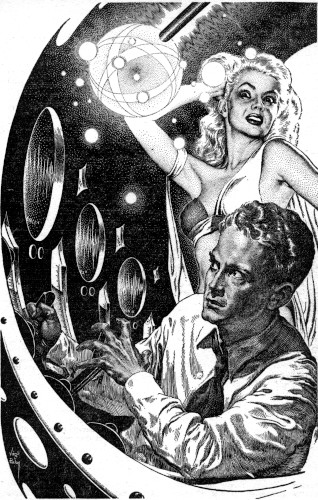
He was a Hottentot in a power house, a savage in a Plutonium refining plant.
And Dusty was supposed to drive this.
Stunned, Dusty dropped into the pilot's chair and looked around him in a completely dazed manner. Below his feet were pedals and just below the surface of the slanting panel were a pair of knee-flappers that could be pressed without losing the thrust on a foot pedal. The desk-thing was studded with large levers mounted in curve-segments all carefully marked in the calibrations of the Marandanian language. To his left was a panel filled with push-buttons from the floor to the level above his head where his long arm could reach without standing up. To his right was a similar panel. Dead ahead was a flat plate that looked like frosted glass and seemed to Dusty about as useful. It neither glowed, nor showed a spot of color other than the very logical reticule-lines which were to be used for aiming the ship. Above the plate of glass was a line of meters and another line of them below.
Dusty shivered. No matter in which way he reached he could touch buttons, or thumb levers or turn dials.
Doubtless the competent Marandanian pilot played this console like a pianist—strictly from practise. A mere matter of training; when the concert master calls for 'A' the musician automatically reaches for the right position and drops his forefinger.
This was no instrument to play by ear.
Or—was it?
"Barb!"
"Yes, Dusty?"
"Barb, find that damned menslator and bring it up here. It might—"
A moment later she came up the stairs with the small instrument in her hands. She gasped as she saw the array of controls and asked, "I thought he said it was easy?"
"To him," growled Dusty. He fitted the menslator on his shoulder by its strap and fiddled with the controls. He hit one setting that made Barbara cry out inexplicably (which irritated him) and then he found another setting that made him feel like a hundred and seventy pounds of toothache (then he forgave Barbara) and after some more fiddling with the tuning and the gain Dusty hit the right setting.
Everything became clear to him.
Directly in front of him was a meter that read "Rhenic Doubler Current" and to one side was a lever labelled "Phanoband Isolator" and some push-buttons marked "Polylateral Overload Reset" and "Primary Exchange Test." The rest, too, were very logical but equally meaningless. "Drive Pulse Synchronizer" must have some definite function because it was a large lever almost in the middle of the desk-panel and what one did with it was undoubtedly taught in the first grade of spaceman's school.
There was a large and interesting handwheel labelled "Drive Angle Trim" which Dusty gathered to be the gizmo used to equalize the drivers so the ship wouldn't yaw in flight, but he was not quite sure. There was another called the "Pre-flight Check Sequence" which probably checked the multitudinous functions of the instruments as it was turned from position to position, but what it did or what it told the pilot made no never-mind to Dusty Britton of The Space Patrol.
There was one that he recognized instantly. It said, reading from left to right "Off, Warm-up, Stand-by, Operate." It was a big four-position hand-lever and it was a good idea, excepting what did Dusty do next?
"Can Scyth help?" pleaded Dusty.
"He's out cold like a Northern Light. Lost blood and—"
"But how'm I to run this godawful thing?"
"I don't know," said Barbara doubtfully. "Try something."
"What?" he asked.
She pointed to a small button high on the front panel beside the glazed plate. It said, "SC/WBN-3 Phanoband 22".
Dusty looked at the nameplate and the menslator helped him translate the nameplate into "Space, Commercial/Non-adjustable, High-power, Emergency—Model Three. Phanoband Twenty-Two."
Dusty looked at Barbara and shrugged. This was an emergency, so Dusty put out a forefinger and pressed the button.
A pilot lamp winked from blue to red and a meter on the forepanel rose. There was a momentary whirring from far below in the big star ship and then along the bottom of the ground-glass looking window in front of him, a small circle began to grow luminous. A man's face appeared.
He was obviously in some sort of uniform; it had that air. The collar was high and the effect was uncomfortable. A pair of gold diagrams glistened on one shoulder. The man looked human enough to be the local desk-sergeant in costume dress. As soon as the little circle was completely clear he said tersely:
"Distress Call received. Identify yourself, state your position, define your danger, and estimate the time remaining in which you have a factor of safety."
Dusty blinked and then looked at Barbara. She shrugged. Dusty shrugged back and said, "Are you Marandis?"
"This is Marandis Emergency. Identify yourself, state your pos—"
"Stop talking like a robot—or are you a robot?"
"I am not! What is the meaning of this? Using a distress-call band for—"
"This is a distress call," snapped Dusty. "And part of the distress is that I can't identify myself because I don't know the language."
"You'll have—"
"The other part of the distress is that the man who knows all about this is likely to die of a bad accident if he is not given medical attention. So now you know, tell me what to do next."
"Who are you?"
"I am Dusty Britton, if that means anything."
"I don't know you."
"Of course not. I've never been to Marandis. I'm not a Marandanian, just a character of the race your play-mates term 'Backward,' and/or 'Primitive.' But you better do something fast."
"What is the name of the injured party?"
"Scyth Radnor."
"Then your identity is Exploration License K-221-Y. I know Radnor. I must get you off the distress band. Please switch to Space Communications, Band Forty-Five. I—"
"Wait," said Dusty quickly. "As a member of another solar culture you must be aware of the fact that I am not familiar with your equipment. Which knob do I twist and how far?"
The Marandanian gave Dusty instructions and waited for a second small circle to appear beside the first, with a different face in it. This face was older and not in uniform. The man said, "Please explain the nature of your difficulty. I am Gant Nerley."
As well as he could, under the circumstances, Dusty explained his predicament.
"I see," said Gant Nerley thoughtfully. "This is a rather complex problem to solve. Can you state your location?"
"Hardly."
"I suppose not. If we don't know where you are from here, the chance that a non-galactic culture would know where we are from there is indeed remote."
"Haven't you a filed plan of operations?" demanded Dusty, using a tone of voice that indicated that he thought that any culture above the level of the ape wouldn't let people go galloping all over the galaxy, tearing up stars and ruining scenery without first having filed a program and had such program approved by twenty-seven signatures.
"There is a filed plan," said Nerley defensively. "But naturally it is sealed as a matter of protection for the company."
"And no provision for emergency?"
"Only by the consent of the licensed company."
"Then you'd better call a conference at once. Scyth isn't going to last long enough for you to comb the galaxy for us."
"That's why it might be better to let the barytrine field run to completion."
Dusty's voice grew hard. "I wish you birds would stop tossing off a thousand years of our life with the flick of a finger," he said.
"What difference does it make? You'd not notice it, and—"
"Who says so?" snapped Dusty, his irritation mounting.
"Time is of importance only when its passage can be measured in reference to outside events. You have no contact with outside events. Therefore it makes no difference whether you come in contact with us now or a thousand years from now, so long as the same people of your culture are involved."
"Now see here—"
"Permit me to present an example. If the barytrine field went on at this instant, one thousand years from now my successor would pick up the thread of the conversation from the recording we are making, and take on from here. As far as you are concerned the only difference would be a sudden flick of the viewscreen and a rather abrupt change in the facial characteristics of your conferee." Gant Nerley waited a moment to let the point sink in. "Now, since you and I have very little in common, it should make little difference to you whether you spoke to me or to someone else. And as far as I am concerned, I feel the same. I have long since ceased feeling regretful that I cannot retain friendship with the hundreds of thousands of people with whom I must converse. I have almost stopped being regretful of the fact that there are so many worlds that no single lifetime would permit a visit to more than a fraction. I suggest that you try to take a more lasting attitude. You sound as though the troubles of a world you never saw were of prime importance to you."
"Look," said Dusty testily, "A lot of what you claim may be true. But we have a couple of thousand years of observational data on the planets and the nearby stars. You may take a thousand years out of our lives in the twinkle of a second, but then we spend another five hundred on top of that finding out where we are."
"You have time."
"We have not!" roared Dusty. "Move us to a new system and I'll tell you what'll happen. Before we can make a move into space we have to chart the new system completely, because we admit that our reaction motors are not efficient enough to take off without a well precharted course. We must know the orbits of the planets to a fine degree before we dare. Then, before we can make a try for the stars, we've got to spend years and years in observation before we can chart the nearest stars and observe whether or not they might have planets, our astronomy will be put back. Now—"
"Pardon me, but the information I have regarding your system is before me. Your space travel is primitive and any form of real commerce is as yet impossible. This I get from the license application for barytrine operations. Now, how can you justify your statements about interstellar travel?"
Dusty Britton, no matter what else, was a good actor any time he could sit in with a large Virginia Ham to carve. Dusty would never play Hamlet or Julius Caesar; a custard pie in the face was closer to Dusty's art than John Barrymore. This fact provided for Dusty a rather interesting background for the present argument. A student of science could not have faced Gant Nerley without paying deference to the Marandanian's obviously superior knowledge, position and experience. The learned man makes no flat-footed statements; this leads to the odd belief that most learned men are not entirely sure of themselves. It is the bird who is ignorant of all the myriad things that he does not know that can afford to stand up on his hind feet and reel off chapter and verse as though there could be no rebuttal.
So Dusty Britton, who could portray a reasonably convincing role of a wounded hero while mentally contemplating how long it would be before the first preprandial martini, plus being the flamboyant type who never lets a few facts stop his flow of words, was not abashed to let on that he knew a lot more than the Marandanian suspected. Furthermore, Dusty felt that he had Gant Nerley on the defensive, and if he could put the Marandanian off balance long enough to accomplish something, Dusty did not care if Nerley accused him of being a four-flusher at some later date.
Keeping this in mind, Dusty braced himself with little effort and tried to reduce to bafflegab what he recalled of Scyth Radnor's previous statements.
"Interstellar travel is, of course, based upon obvious errors in the theoretical mathematics of general relativity," said Dusty, as though he were reciting some of the science-double-talk usually included in Dusty Britton And The Space Patrol. "Of the many schools of thought which have their own theories on how to explain these obvious errors, the group-velocity field seems to be the most successful. But all of them are seeking some evidence to support their theories, and a couple of them, namely the gravitic and the magnetic-field proponents claim that such evidence has already supported their claim. Now, if such is the case, you know it will not be long before some practical experiment will disprove the illogic of providing a finite limit to an infinite system. Once this has been established it seems obvious that star-travel is the next step."
"Hmmm—I see. This is a situation that must be considered more carefully. May I ask, Dusty Britton, what is your position in your society?"
"I am Dusty Britton of The Space Patrol," said Dusty with the proper tone of respect. "Commander in Chief of the Junior Division."
"Indeed! A real Space Patrol!"
Dusty nodded at the viewscreen. "It may be a bit ambitious," he remarked with even more deference, carefully studied. "But we feel that there is small point in using a conservative name and then having to change it every couple of years."
"Quite a sensible attitude."
Dusty nodded again. "Fact is," he said deprecatingly, "we would probably be quite a bit more advanced in our space operations if our sister planets were not so inimical to human life. As it is, our extra-planetary operations are limited and will be limited until we can provide the necessary conversions to terrestrial conditions."
Gant Nerley nodded back. "Man is not an adaptable animal," he observed. "He does not change himself to suit his environment; he changes his environment to suit himself."
"That's what I mean."
"Then why do you object so much to this barytrine field?" asked Gant Nerley. "We can always pick you a stellar group less inimical to human life and thus advance you faster."
Dusty grunted under his breath. He had talked too much. "Buster," he said angrily, "logic like that will only get you a fat lip."
Gant Nerley blinked. "Tell me, Dusty, was Scyth Radnor hurt in some altercation over this beacon?"
By this time Dusty figured that he might as well let Gant Nerley have it cold and hard. It would show Gant that the mighty Marandanian was no more distant from the lusty chimpanzee than the terrestrian.
"No," he said flatly, "Scyth was plugged for monkeying around another man's woman."
Gant said, "Deplorable," in a tone of voice that indicated an amused disgust, but not easily identified as to whether over the act itself or the business of being caught at it. "What happened?"
"The other guy shot first," said Dusty, feeling that this was no time to point out that it was he that pulled the trigger.
"I'm not surprised. Most primitives are inclined to be both hot-headed and impulsive."
"Tell me," asked Dusty in a cooing voice, "did Scyth confine his amours to primitives, or is it the custom among Marandanians to consider your mate unattractive unless she can prove it by bedding down with an impressive list of lovers?"
"I don't understand," replied Gant Nerley stiffly.
"Against primitives I can understand Scyth carrying a weapon to his assignation, for protection against the irate cuckold. Tell me, Gant Nerley, has your emotional balance become so stable that you can take a more scholarly view of promiscuity? Or," added Dusty sharply, "do you have big black headlines about triangle slayings and love-nest scandals just like the rest of humanity?"
"Well, now, we—"
"Then don't blame us primitive souls for slugging a guy that's caught off base!" snapped Dusty. "Now, what are we going to do about Scyth?"
"Regardless of his depredations against propriety, he must be given medical attention."
"This I will go along with. How shall we start? I can always take him to one of our hospitals."
"No. No! You must not."
"Why not? We're quite competent on gunshot wounds. We're probably more used to them than you are, as primitives with impulse and hot blood."
"Please. Let's not be facetious over any man's misfortune."
"In blunt words, the life of a character caught in an awkward situation is more important than someone else losing their familiar stellar scenery and a couple of thousand years of climb up from the swamp of ignorance?"
"That is another question which I'm sure we can solve. Now—"
"Look," said Dusty firmly, "you agree to take measures for our safety and we'll agree to take measures for Scyth's. Do you understand exactly what I mean or shall I explain in very blunt words?"
"That is blackmail."
"It's worse than that. But we're primitive, and therefore lacking in refinement. As far as I am concerned, Transgalactic can keep their secret of our position locked in their sealed file. Scyth can die, and Bren and Chat can spend the rest of their lives marooned on Mercury."
"No. That wouldn't be right. You must bring Scyth back home."
"That's a fine idea! May I suggest that your ship is not as familiar as mine?" Dusty did not mention that the only control room he was familiar with was the one on the Gramer Production Lot, which was an aggregation of fantastic levers and flashing lights and futuristic three-phase busbars which had a most profound effect upon the imagination of the youth of the land but no effect upon space whatsoever.
"This can be taken care of. As a spaceman, you can understand the principles. They are simple. You can follow directions for flight."
"Yes? And which way do I go from here?"
"Not so fast. First, Dusty Britton, tell me the present condition of Scyth Radnor."
"Wait."
Dusty went below. Scyth was in a state of shock. His temperature "taken with the flat of Dusty's hand" was chill—and there was a film of perspiration wetting Scyth's body. The breathing was shallow and the face was pale. Scyth's pulse was weak and the heartbeat thin.
Dusty turned a light blanket over the Marandanian and then went back to report.
Gant Nerley said, "In the salon you will find a medicine cabinet. The instructions are simple, any intelligent being with a menslator should be able to follow them concisely. How is the bleeding?"
"Stopped. Clotted by now."
"Take care of Scyth, Dusty Britton. We'll figure out something for you."
"How about this barytrine field that's running away with itself?"
"We'll stop it. Behind you on the auxiliary panel you will see a knob and a pilot lamp, probably orange colored. Turn the knob to the left."
Dusty did, and the lamp went out.
"That's it. I see that Scyth has the usual sloppy habits of his kind. No label. According to space regulations the operator is supposed to slip a label into the frame above the auxiliary control whenever he has anything extra set up. I'll mark that oversight down on Scyth Radnor's record. Now—"
"What about Chat and Bren and that variable-star maker?"
Gant Nerley grunted. "If they're not keeping a close eye on the barytrine field detector, so they can shut off their own equipment when it fails, I'll revoke their licenses! They must be looking at the temporal field, or at least keeping watch."
"We hope."
Gant nodded thoughtfully. "Now," he said, "this being an emergency, I'll open their course-plan so that I can direct you through space. Don't turn off the viewpanel, Dusty. I'll be back in a few minutes."
IX
As soon as Gant Nerley's face disappeared from the viewpanel, Dusty turned to face Barbara. She was standing far to one side, out of range of the viewpanel, and stifling a giggle. She let it bubble through her fingers as soon as Dusty caught her eye.
"Funny as hell," he said. "Me—I'm hysterical."
Barbara sobered immediately. "Honest, Dusty. I wasn't laughing at you. I was laughing with you."
"Why?" he demanded sharply.
"Because you really fooled that bird. Dusty Britton of The Space Patrol. Yes, I can navigate a ship."
"I'm going to. Want out?"
"I wouldn't miss this for the world. Glad we've got the whole galaxy for you to make mistakes in."
"Stop making fun," he snapped. "Let's try and think of something sensible, Barb. Too bad we haven't time to take a run back to the city."
"What good would that do?"
"Well, you could show 'em that bauble you're wearing and I could try the menslator out on 'em, and maybe between us we could convince 'em that there's something more in this tale of mine than wind."
"That's an idea, but it's out."
"I know. But—"
"Dusty, you'll have to carry it to Gant Nerley yourself."
"Carry what?"
Barbara shook her head impatiently. "Think!" she cried. "Dusty, this license might be rescinded if we can show that Sol has evolved above the minimum level of acceptability."
"Yes?"
"Then go in there with your head up and let 'em know how we're built."
Dusty waved at the field of instruments on the control position. "Open my yap and let 'em know how ignorant we are? We should have a couple of scientists along."
Barbara shook her head. "No," she said slowly. "One of the marks of a real scientist is that he usually considers that he knows a lot less than he does. You're better off. You don't know enough to confuse yourself. Besides, Dusty, you're an actor."
"Um—er—Jeeks! Hang on a mo' will you? I've an idea."
Dusty loped down the stairs to his car and opened the compartment behind the front seat. It was his emergency kit; it held his Dusty Britton uniform, the complete regalia of The Space Patrol complete with Dusty Britton 'Blaster' concealed against the days when Dusty found himself trapped in public and could not appear out of character.
He changed in the car and went back to the control room.
Barbara took one look at him and nodded slowly. "You're a gaudy sight," she said. "But maybe that's what it takes."
Dusty slapped the 'Blaster' at his hip. "I look authentic enough except for this hunk of hardware," he said. "Hell, it isn't even as useful as a dress sword."
"Your revolver? Oh—still on my living room floor."
Dusty unbelted the holster. "I shouldn't have to go armed everywhere, should I?"
"I suppose not."
"All right, then. How do I look?"
Barbara smiled thinly, "Dusty, no one on earth would ever accuse you of being anything but a Hollywood actor in that get-up. But a man from halfway across the Galaxy itself might not know about these things. You might be an Admiral of the Swiss Navy. You're impressive-looking. Just don't get pompous."
"Just you remember that I'm Dusty Britton of The Space Patrol and don't giggle when I start dishing it out."
"I won't. After all, I call myself an actress, you know." She looked nervously at the viewpanel.
"Are you all right?" he demanded.
"Yes. I'm nervous but I'll be all right."
Dusty went over to her and put his hands on her shoulders. "Take a deep breath," he commanded. She did. "Now let it out slowly." She did that, too. "Now," he said softly, slipping an arm around her and leading her to the stairway, "You come down below and relax. Pull yourself together, Barb. We'll make it—somehow."
"Got any ideas?"
"Not yet. But—"
Above, the voice of Gant Nerley came back. Dusty raced aloft and apologized for having been absent. Gant was nodding with admiration at something below the level of the view panel, probably something on the desk.
Gant looked up after a moment and said, "Dusty Britton, this is really a remarkable route. Truly fantastic. So well hidden, and yet right within our grasp all of these centuries! Well, you shall see, Dusty. And doubtless you will agree."
"Okay," said Dusty, "let's get going."
"Not so fast, young man. I'm waiting for the direction-finding stations to report so that I can determine where along this prospected route you lie."
"We're about two-thirds of the way out from the center, I believe," offered Dusty.
"That's a rather inaccurate generality. You know where you are and we know where we are, but we must know where we are with respect to one another before we can make contact. Now—" Gant's voice stopped suddenly as something caught his eye above the lens of the viewpanel, and he looked over Dusty's head, apparently, so intently that Dusty himself turned to see what Gant was staring at. He saw only instruments, and realized that Gant was looking at another panel-section above the one that communicated with Dusty's panel.
"Um," said Gant. "You would appear to lie in what we call 'Sector G-18, Co-ordinate 307, Galactic Angle 215.86-plus degrees, South altitude-angle 1.017-minus degrees, Co-frame 9654.' Now, Dusty, in your terms, where lies the Galactic Center?"
Dusty laughed. The tone of his laugh was half bitter and half a note of self-disparagement. "Sorry, Gant. We frame our reference from Terra, naturally."
Dusty breathed a sigh of relief at having boned up on enough science to play his part convincingly.
"I do not quite understand what you mean," returned Gant.
"We compute stellar positions in latitude from the angle above or below the equator of Terra, which we call 'Declination' and in longitude by their rise as the planet rotates, which we call 'Right Ascension'. Therefore the so-called 'Celestial equator' is a projection of the Earth's equator upon the sky, and the colures pass from celestial pole to celestial pole, which are projections of Terra's axis. Now, since the Earth's equator is tilted with respect to the Earth's orbit, and the Earth's orbit is tilted with respect to the Galactic Equator, I'll be darned if I know how to explain in mutual terms. Oh, we assume that the galactic center is in a region of the sky we call 'Sagittarius' but that is meaningless."
"I agree. Wait a moment."
Gant turned from the window in Dusty's viewpanel and walked away from it by several yards. He worked over a complicated keyboard for some minutes and then returned.
"Dusty," he said, "I think we can handle this as follows. To your left hand near the top of the control board you will find a key-lever marked Phanobeacon. Pull it towards you."
Dusty looked, found the key, and pulled. A bright spot of light appeared on the view panel, high in the left hand corner. "That is the true position of Marandis," said Gant Nerley. "If you tried to make it at transgalactic speeds you'd plough into about forty stars and hit about nineteen gas-clouds. You'd either blow up, or spend the rest of your life running at safe velocities. However, if you take off and steer your spacecraft so as to put that beacon spot on the calibration lines G-705, F-318, you should find the next rift-beacon somewhere near to the crosshairs of the viewpanel. Got it?"
"I think so."
"Good. Now, for take-off instructions. Ready?"
"Ready."
Gant Nerley began a running patter of instructions. Those favored few who have ever seen the control room of a spacecraft can possibly grasp the implications of the problem. One does not step into the pilot's chair of a complex device such as a galactic cruiser, push a pedal and then steer any more than a Wall Street Accountant could step into the cockpit of a six-engine airliner and take off, just like that. There was the pre-flight checkoff, probably performed by the competent Marandanian Pilot in a matter of minutes, and quite possibly done with an automatic reflex action which would permit the accomplished pilot to daydream about the girl on the next planet meanwhile; only the appearance of the wrong pilot-lamp response would bring him out of his automatic response with an abrupt recognition of something awry.
But Dusty was not a pilot, and certainly not a pilot of a Marandanian Spacecraft. So the pre-flight checkoff took almost an hour. Nearly ninety-nine percent of the time Dusty was following Gant Nerley's instructions blindly: Is the pilot lamp registering power source showing red or green? Is the spacelock indicator showing closed? Turn the atmosphere control to Internal. Set the autogravity corrector to Controlled. Co-stator circuits to Regulated; antimagnetic response dial to zero; space-coordinate servo control to Stellar Display. Planetary Drive to Automatic Threshold; match the Gravitic Constant to the Power Delivery. Set the Master Control to Pre-flight Warm-up.
"Now," said Gant Nerley, "take it slow and easy. Take the 'Tee' bar gently. Find the thumb-buttons and press them both evenly; spread your knees against the paddles under the control panel slowly and press the Force pedal with your right foot. Tell me, what is your trans-atmospheric velocity?"
"It says 416."
"Too high. Press the Compensator pedal with your left foot until the TAV meter reads 312."
"Now."
"Hold it that way until the Matter Per Cubic Meter indicator drops below the red line."
"The TAV meter is dropping below 312."
"Good. Let up on the Compensator pedal and depress the Force pedal more. Keep the TAV meter at 312."
"The Matter Per Cubic Meter indicator is below the red line, Gant."
"Free the Compensator pedal. Push the Force pedal all the way home and kick it to the right. Now read the Trans-atmospheric velocity meter."
"Dropping rapidly."
"Good. And the MCPM?"
"Dropping rapidly."
"Excellent. Spread the knee-paddles wide and lock them. Have you a reading yet on the Space Velocity Meter?"
"Just getting off the peg."
"Um—it is a little early. But that's all right. It will arrive in due time. Keep an eye on the Foreign Body Indicator, Dusty. Any reading?"
"No."
"Good. Don't touch the 'Tee' bar, Dusty. That's the steering mechanism and it is in neutral. Is there any indication on the viewpanel yet?"
"Not yet."
"Haven't enough velocity yet," said Gant. "But when it appears, it will look like a star map. Now, the central cross-hair is the point of aim of your spacecraft. If the star you want lies, say, to the upper left, move the 'Tee' bar forward and to your left. That will swing the ship in that direction and you can line up the drive with the target. Also, since angular position is important when moving in three free dimensions, twisting the crossbar of the 'Tee' will cause the ship to rotate on its axis. The map will turn in the direction, apparently, but it is really the ship turning. That is—"
"I'm beginning to get a presentation now," said Dusty.
"Good. Dim and reddish, isn't it?"
"Yes."
"Fine. Now get this straight and clear: The phanobeacon is the control beacon for direction of angular curve. In other words, it takes three points to define the orientation of a plane in space. These three points are you, the star-beacon or course-marker which you will find directly, and the main terminal-beacon which is the phanobeacon. You must drive your ship in the proper plane when making a curve or making any turn. Follow?"
"Yes," replied Dusty, trying to think it out. He was far from certain about all this, wondering why it was all necessary. He went over the instructions in his mind, made no more sense out of it than the first time, and then decided to accept it without trying to figure out the reasons. After all, Gant Nerley and his folks ought to know what they were doing.
"Now," said Gant, after a moment, "In order to orient yourself, you must line up the Phanobeacon on the point of aim. Take the 'Tee' bar firmly, one hand on either side of the axle. Find the thumb-buttons on the handle. Press them all the way in and lock them home with a slight sidewise pressure towards the center. Got that? Now, lift the 'Tee' bar straight up until it is high enough to manipulate with ease. Be careful, don't move it sidewise!"
The last admonition was wasted. Dusty lifted the 'Tee' bar gingerly and not too evenly. The stars on the viewpanel danced dizzily, swiveled, and flowed across the plate. The bright phanobeacon spot moved from the plate along the bottom, danced back in view on a brief curve, and left again along a flat slant. The 'Tee' bar clicked into place and the stars stopped dancing with a snap. Dusty moved the 'Tee' bar gently and the stars flowed upward until the phanobeacon re-appeared.
"Got it," he said shakily. He moved the 'Tee' bar very gently until the phanobeacon was centered on the screen. Or, rather, almost centered. It moved in jerky little circles like the sights of a rifle in the hands of a tyro.
"Fine. You're doing well with strange equipment. Now, on the panel you will find a switch marked 'Co-ordinates.' It will be set on 'Rectangular' and you must flip it to 'Polar'."
The switch changed the cross-hair pattern of the viewpanel from the horizontal and vertical calibrations to a circular pattern with only the main center hairlines remaining. Angle-lines radiated out from the center, crossing the circles.
"Now, Dusty, inspect the radius-line marked G-705. All the way around. Do you see a winking star?"
"No."
"Um. I was hoping we could do it the easy way. The sealed course-plan is not too clear, for which I don't blame Transgalactic. All right. We'll have to do it the hard way. Move the phanobeacon down until it is almost on the lower edge of the viewpanel. Now flip the 'Co-ordinates' switch to the left, leaving it in the bottom position marked 'Polar.' You'll find that the toggle has an 'H' type pattern of motion, laid flat-wise."
The polar co-ordinates disappeared completely from the center of the viewpanel and centered around the phanobeacon spot. They made larger and larger arcs as the circles approached the top of the panel.
"Now this is going to be tricky. You must twist the 'Tee' bar slowly and let the ship rotate, but you must also move it so that the phanobeacon stays near its present off-center position. But before you do this, let me explain what you are actually doing in space. Picture a needle-shaped spacecraft with a line along the axis running out before the ship, marking the line of drive, or direction. At some distance from the line lies a spot which denotes the phanobeacon. Somewhere out beyond, there is another spot that must be sighted within the confines of an angle not greater than the angle made between the point of aim, or line of drive, and the imaginary line running from the nose of the ship to the phanobeacon. So you must cause the ship to rotate on a false axis, making the line of flight describe a cone of revolution with the phanobeacon on the axis of the cone. Now, go ahead and try."
"Okay." Dusty moved the 'Tee' bar and the stars moved in jaggledy little scallops along a greater arc. The center of the beacon held the polar lines, but they moved with the stars and with the beacon. It made Dusty dizzy and his eyes began to ache. "What am I looking for?" he asked plaintively.
"Look along the outer circles for a winking st—"
"Got it!"
"Good. Turn the 'Tee' bar to neutral," said Gant. "Return the 'Co-ordinate' switch back to the center of the 'H' pattern. Center the stellar course beacon on the point of aim."
The winking star flashed at Dusty like a flag. It danced crazily as he manipulated the 'Tee' bar with all of the thumb-handedness of the rookie pilot on his first attempt at the controls. There was so much to do, so many things to handle, so many motions to make. Dusty gripped the 'Tee' bar tightly, too tightly. When he let go with one hand to flip a switch or to make an adjustment, the grip of his other hand moved the bar. It became sweaty and sticky, then it became slippery and he gripped it even tighter, which made it worse because his fine control left him as he strove to hold the handles tighter and tighter.
In a jagged line like the trail of a rising smoke, the winking star proceeded to the center of the viewpanel. There it hung, wabbling around in tiny circles and occasionally making a brief jerky dart to one side or the other. Dusty mopped his face and the beacon star jumped; he grabbed the handle again and the star leaped across the center and wabbled on the other side of zero-zero.
"Got it," he said in a quavering voice.
"Now rotate the ship until the phanobeacon is on the vertical hairline. Then flip the switch to 'Rectangular' again."
The stars scalloped around in the viewpanel until the phanobeacon was on the vertical line. The field leaped a bit as Dusty found the 'Co-ordinates' switch and returned the calibration-presentation to the horizontal and vertical hairlines.
"Now?" he asked.
"You have a bit of time. Be certain that the star-marker lies firm and true. Be careful!"
Dusty gripped the handles and tried to steady his shaking hands. Then, because he had no more complexity of motions to make, he relaxed a bit. The dancing star-field slowed its mad vibration, which calmed Dusty's jumping nerves still more.
He leaned back in the pilot's chair slowly, his grip on the 'Tee' bar lightening and becoming more true. He looked at the beacon star and knew what Chat, Bren, and Scyth were working toward.
It lay there on the center of his panel like a winking flashlight. Lost in the star-field, which showed a myriad of points, some dim cloudy stuff, and a band of milky white, the beacon would have been nothing without that steady wink ... wink ... wink. He, himself, was lost. He had not the foggiest notion of where he was, excepting that Mother Terra must be far behind. Sol, a smallish, yellowish, completely average dwarf would show nothing to call attention to itself from the distance of a few light-years. Yes, somewhere back behind him lay Sol and his planets. But the winking beacon on Dusty's viewpanel was like a banner waved from a distant shore.
No man is alone so long as a lighthouse flashes its message of safety, or warns against danger.
Dusty took a deep breath. "Barb!" he called.
She came up the ladder. "Call me?"
"How's Scyth?" he asked.
"He's doing all right. How're you doing?"
Dusty nodded boyishly. "Look, Maw I'm flyin'," he told her with a chuckle. "Martin Gramer should see me now. This is simple like a duck's ear, and I—"
Barbara screamed and Dusty whipped his head back to look along the direction of her horrified eyes. To the viewpanel.
One of the stars, lost in the glitter of the distant background had detached itself from the immobile sky. It was moving, forward, and its glow was brightening. It came hurtling towards them like a white hot cannonball. One second it was no more than any other star, distant, aloof, and cold. Then it had exploded into a disc that expanded like a released puff of gas. It came toward them like a ball of fire hurled into their faces.
Dusty yelped and twisted on the 'Tee' bar and the stars rolled dizzily across the plate—but not until the white hot monster had flipped past in a quick wave of heat and a final flare of light which made a small section in the back of Dusty's mind recall the effect of having a foil-filled flashbulb fired during a still photography session.
Shaking, Dusty's grip on the 'Tee' bar tightened and he moved the lever in tight little jerks until the stars returned to the proper positions and the Phanobeacon was properly centered.
Gant's face showed concern. "What happened, Dusty?"
Dusty told the Marandanian, and Gant smiled knowingly. "Don't worry about it. It will happen again and again, and maybe worse. But so long as you keep the course beacon centered properly, you will pass by—and not through—those interfering stars. Now, as soon as your beacon star shows a disc, steer up to keep the beacon centered on Line H-001. Once you pass the beacon, look for another beacon on Line F-312 and bring the point-of-drive to center on the new one. Follow?"
Dusty nodded at Gant's image on the screen along the bottom of the viewpanel. Another star detached itself from the backdrop of stars and hurled itself into Dusty's teeth. The actor flinched but held his drive. The star passed in a bright flash and a quick wave of heat and was gone. Dusty licked dry lips and forced the grip of his hands to relax. Far to one side another star passed in a majestic sweep, too distant to bring them either heat or more light than the ones called 'fixed' on the viewpanel.
Dusty eyed the star-beacon suspiciously. Was it showing a disc yet? And how much time did he have to shift the drive once the disc became certain? Dusty felt a cold wave wriggle down his spine and he knew that cold beads of sweat were beginning to ooze out of his face; he was remembering the staggering speed with which the first star had come leaping at him.
Another star passed him in its characteristic wave of light and heat, and Dusty realized that what looked dangerously close on the viewpanel was in reality quite distant. It meant that so long as his ship was pointed into a clear space, there would be no danger of running into a star no matter how precarious it looked.
But the cold sweat came because the beacon star lay winking at him dead in the intersection of the crosshairs that marked the drive.
Disc? Did it show a disc? Does Sirius show more of a disc than Polaris?
Dusty's hands pulled the 'Tee' bar slightly to move the winking eye ever so subtly upward. That way he would not be aiming his spacecraft dead into the searing hot maw of a variable star. He took a shaky breath and relaxed.
Gant Nerley shook his head. "I see what you are doing, Dusty, and you must not. You'll make a wide curve and get off the beam. Or worse, you'll hit a star lying close to the course. You have no idea of how wide you'll run. Center it up, Dusty, and keep a close watch, for it will become a disc. You'll have time. Relax."
Reluctantly Dusty returned the 'Tee' bar to the central position, and the star winked through the crosshairs at him, itself no larger in diameter than the width of one line. It was not obscured by the lines because of the construction of the panel, a design that Dusty could not quite understand. Dark lines should have hidden the stars behind them, but on this gadget they did not. He looked closer and found that the stars themselves lay on top of the lines rather than under them, and he wondered how they managed that stunt. It was, of course, a matter of design. Dusty's experience had been with small telescopes, but this device was not an optical device, so the simple laws of optics did not obtain. As he watched, the winking star became a winking disc and Dusty's nerves twitched.
When had the change started? Dusty realized that he had been half-hypnotized by the wink ... wink ... wink that meant both safety and ultimate danger. The disc was expanding rapidly, and as Dusty tried to move the disc to Line H-001, the edge of the winking beacon expanded faster than the point of aim moved. He wrenched the 'Tee' bar hard and saw the crosshairs move sluggishly below the exploding circle. Then the beacon flashed past in a wave of heat far greater than any of the other stars, and he was blinded by the light for a second or more. But as the blindness died, there on Line F-312 there was a distant wink ... wink ... wink.
X
Dusty gripped the 'Tee' bar and started to turn the ship toward the new beacon. His approach to dead center was ragged—he overshot and over-corrected, but finally he made it. And then with a burst of good sense, Dusty released the 'Tee' bar very gently and leaned back in his pilot's chair. The crosshairs stayed on their winking beacon.
Gant Nerley nodded. "Turn the presentation to 'Polar' again, and keep a sharp eye out for a slow beacon along Radius Q-103. You probably made a wide curve around that other beacon and you may be a bit too close to a gas field. You'd burn up in milliseconds if you hit it at your present speed. By the way, what color is the presentation now?"
"It's getting lighter. Sort of yellowish-white, like."
"Good. But if and when it begins to blue-up a bit you'd better let up on the 'Force' pedal by a notch or more. Competent pilots can run with their screen in the violet, but you're far from being a competent pilot." He saw the look on Dusty's face and added hastily, "I mean that you've had no experience in galactic travel, Dusty Britton. You're doing magnificently so far. We'd best take no dangerous chances, though, until you have driven interstellar craft as many hours as you've driven your own interplanetary ships."
Barbara made a choked sound and then covered it by saying, "I see the slow beacon, Dusty. Out there on Circle D-212, along Radius Q-103."
It was pulsing slowly, rising to full brilliancy over a period of more than a minute and falling again, never really winking out to invisibility. It lay alone in the star-field; the gas cloud behind it must be of the same nature as any of the so-called 'dark nebulae' or dust clouds that obscure the stars behind it. But it was far to one side (Circle D-212) and it seemed reasonable to view it calmly.
"How much time have I?" he asked Gant Nerley.
"About fifteen minutes."
"Good. I want a cigarette and a drink."
It was with increased confidence that Dusty swooped around the next beacon and headed on towards the next—and the next—and then around a long curveway limned by four of the winking beacons and once more along a long field-free course towards a winker that lay dead ahead for quite some distance.
There was one quick jog between two beacons set at an angle like the flags of a slalom run on skis; a wide 'S' curve around the outside of the first, up and over, between, then out and around the second beacon in a long ogee to locate the freeway to the next beacon star. There was a quick turn that took the plane-locating phanobeacon off the screen for several minutes and then another one that put the phanobeacon almost on the crosshairs, and then another slight turn that put the phanobeacon on the lower corner of the viewpanel again. It was, according to Gant Nerley, a "most remarkable rift!" At which Dusty shrugged because he had never seen any other rift. It looked plenty complicated to Dusty, and he shuddered to think of what a really tortuous galactic passage would be like.
They passed by a vast luminous cloud that lay on the spacecraft's beam for minutes. It looked like a matter of mere miles that separated them from it. It was marked by two of the slow-winking beacons, as if that were necessary. The luminous cloud reminded them of a lake, seen from an automobile driving along a highway. They could not see the inner star that provided the energy for the luminosity of the cloud, and eventually they left the luminous cloud behind them. They zipped between the elements of a star cluster that drove at them with multiple waves of heat, and on and on they went with Dusty Britton driving his Marandanian spacecraft like a child running a motorboat, following instructions shouted by a careful, protecting parent.
This did not make of Dusty Britton a space pilot any more than turning the valve on a radiator makes one a heating engineer, or replacing a light socket makes one an electrician. But Dusty began to glory in it; his confidence grew high as his skill increased.
His touch upon the 'Tee' bar became light and sure of itself. He no longer waggled widely or jerked the bar when a deviation became noticed, Dusty corrected his course with deft touches like the driver of an automobile. He was learning, and filled with a self-confidence he had no right to feel, but did not know enough to be scared about. Dusty Britton, who had never been in a space rocket in his life, drove a galactic spacecraft across the galaxy under what can be called "Dual Flight Training."
Which was all right, so long as the trainee has enough space to make mistakes in. Dusty literally had galactic reaches and these were well marked against the pitfalls. And if Gant Nerley's face radiated confidence and his voice sounded cheerful it was due to Gant Nerley's knowledge that constant admonition, warning, and cries of horror would only cause more trouble than Dusty Britton's meandering course.
But flight is easy, whereas landing is the most difficult maneuver in the universe.
So by the time Dusty Britton was homing on the main phanobeacon of Marandis itself, Gant Nerley had his plans. Dusty Britton was not going to barrel that spacecraft down tailfins first like a screaming elevator that might come to Velocity Zero at a plus or minus a half mile from Ground Zero and maybe a plus or minus thirty seconds of Drive Turnoff; to drop like a plummet or ram the spaceport with a planet-shaking crash or burn a crater in the 'port with full drive still warping the space below the ship's tailfin.
Dusty Britton came to a full zero-zero-zero landing a million miles above Marandis. He came to a grinding halt high above the planet, looked around dazedly, and asked Gant: "What makes?"
"Keep your drive at one gravity thrust," said Gant. "Stand by for Pilot!"
The last order was delivered in a ringing voice as though it were a standard procedure.
To Dusty, familiar with the tactics used by seagoing liners upon entering port, standing by for a pilot was quite a sensible practise. If the Captain of The North America permitted a pilot to bend the big liner along Ambrose Channel, through The Narrows and into New York Harbor, Dusty Britton saw no objection to having a pilot come aboard to bend the big spacecraft down past whatever dangers might be presented by moons, meteors and cosmic junk.
And Gant Nerley, not knowing how Dusty felt about spacecraft piloting, hoped that this procedure sounded like Standard Operating Practise.
Dusty replied in ringing tone, "Standing By for Pilot!"
Gant took a deep breath.
Minutes later a small scooter hauled alongside and a Marandanian pilot came aboard and took over. He smiled at Dusty and said, "I'm Nort Wilgas, Pilot."
"Glad to have you aboard," smiled Dusty. It all sounded very familiar; The Space Patrol had borrowed liberally from the clichés of naval procedure and courtesy and he had been through these lines at least once in every picture. "I'm Dusty Britton." Then he remembered the role he was trying to play and added, "Of The Terran Space Patrol."
"Have a good passage?" asked Nort Wilgas.
"Yes. A bit tiring. After all, I've never driven a galactic spacecraft before. Frankly, I'm about flat on my face."
The Marandanian pilot looked into Dusty's face with a perplexed frown. "You know," he said, "It's just occurred to me—you drove this thing all the way on duty!"
"Yes."
"Twenty-three hours!"
Dusty suddenly felt tired. He had been too busy with the board to think of it before. He had been running on nervous energy, but now it had about run out. Dusty had been this way before; so long as there was something that had to be done he had done it, but once the need was over, he invariably came unglued and slept the clock around.
"Yes," he said. "I had to."
"Man! What stamina!"
Dusty yawned and came unglued on the divan opposite the one that Scyth Radnor occupied. Nort Wilgas nodded at him and then turned to Barbara. "You can relax too. I'll take over."
Dusty Britton was fast asleep when the spacecraft made its landing on Marandis.
XI
Dusty awoke to find the sunshine streaming in through a small porthole and lighting the cabin cheerfully. The smell of fresh air was in his lungs, a pungent, pleasant smell faintly of cinnamon or nutmeg but not quite either. He recalled that he had folded out on the divan in the salon, now he was in one of the cabins below the salon level. He wondered how he had arrived.
He stretched his muscles, the cool sheets felt pleasant against his back. Then he wondered who had undressed him and how anybody had been gentle enough to do the job without waking him. He looked around the cabin expectantly and as he looked, his door opened and a woman came in.
She was wearing white from cap to slippers and Dusty pegged her for a nurse at once. She was wholesome enough, but neither her face nor her figure would have stopped any traffic on Fifth Avenue. She carried a book with a finger slipped between pages to mark her place and in her other hand she held the Marandanian equivalent of a cigarette. A pleasant curl of smoke rose from the lighted end.
"Hello," she offered brightly. "And how do we feel this morning?"
"We feel fine," grunted Dusty. "And we'll feel better after a shower, a shave, and some of that smoke you're using. I'd also enjoy a change of clothing."
"We took the liberty of having your uniform cleaned. The shower and shaving gear is in the bath—there—and as for the cigarette, I can offer you one right now."
"Give," said Dusty with a grin. She handed him a case and snapped a lighter for him. He puffed and found that the stuff, while far from tobacco, was tasty enough. He took a deep puff and let the smoke filter out through his nose.
The nurse said, "I hope you don't resent sleeping in the—ah—"
"The raw? I do it all the time." Dusty took another puff and swung his feet overboard onto the deck. It was not deliberate, Dusty was just uninhibited and the question of wandering across a cabin dressed in nothing did not even occur to him. The nurse said, "I'll be waiting for you in the salon." She left, not precipitately, but with a certain air that removed all embarrassment.
Dusty showered and shaved and dressed in his cleaned uniform. When he got to the salon, Barbara was there already, also freshened and cleaned.
"So this," she said, "is Marandis."
The nurse nodded cheerfully. "This is Marandis. You'll have to tell me how your Terra is; I've never been anywhere near that far from home, you know."
"Sure," nodded Dusty. "But now that we're on Marandis, what do we do next?"
"Oh. I'm to escort you to a formal meeting of the Bureau where you'll meet Gant Nerley face to face."
"How's Scyth Radnor?"
"Why, he's doing very well. He's hospitalized and he'll be out and howling for the skin of the man that shot him in about a week."
"He'd better take a month off for practise, first," grinned Dusty.
"Or," chuckled the nurse, "leave other men's women alone."
"Yes," agreed Barbara.
The nurse nodded. "You're very attractive," she said with no trace of jealousy or envy. "I can see Scyth getting side-tracked along your direction. I am a little disappointed in Scyth—seems to me he could do better than a frauland for you."
"Better than a what?"
"Frauland. That bauble he gave you. You wouldn't know, of course, but it comes from Selira, a stellar colony not far from here. It's incredibly cheap."
Barbara tore the chain getting the bauble away from her. "Next time," she promised sharply, "I'll plug Scyth Radnor myself!"
The nurse shuddered a bit. Dusty merely laughed and said, "So now we know where we stand. And now knowing, I'm hungry."
"Of course. We'll all dine at the meeting."
"Oh?"
"Naturally. You're here, aren't you? Marandis is not going to send you back without a chance for you to present your case. There is a joint meeting of the Bureaus of Galactic Navigation and New Colonial Affairs. It will start with a formal breakfast during which no business will be conducted. Then, once you are all acquainted with one another, the business of the day will be discussed and a decision rendered."
She led them to the spacelock and Dusty Britton had his first glimpse of a Marandanian spaceport. There was precious little to see, which made it even more stunning to the senses.
The size of the place was completely obscured by spacecraft which stood like the trunks in a pine forest. Most of the craft were larger than Dusty's and so obscured his vision. Between those nearby (which were rather wide-set) there were others at a little distance, and beyond them there were still others, and behind those others were more and more and more until all that could be seen were the tips of the upthrust noses. The horizon was an irregular pattern of pointed shapes that was somewhat reminiscent of the Greek egg and dart moulding of ancient architecture.
Through some of the more distant lines of sight, the far spacecraft had a haze around it, as though it were miles and miles away.
There was not a building to be seen, only spacecraft.
Dusty gave up trying to penetrate the forest to the edge of the 'port and directed his attention to his nearby surroundings.
A road wound around in a zigzag manner, meeting and dividing around each ship. There was an empty landing block not far from them, and after a bit of puzzled interest—the shape of the block caught Dusty's memory—he decided that the landing block was hexagonal. So were all the rest of the landing blocks. Hexagonal pattern, like the well-known hexagon tile floor; the road was the marker-lines between the hex-shaped landing blocks. Those that were empty showed the effect of heavy masses parked on them; a bit of char now and then; a chip or a crack, probably made by a rough landing; a deep seam repaired with some sort of cement or concrete (or whatever the Marandanians had devised or discovered as a superior material) and at least one place where the edge of the block had been chipped deeply as though the pilot had missed his landing point and come down on the edge of the hexagonal block.
As they looked, a muted whir attracted their attention and they turned to see a ship lowering itself out of the sky to come down in a slowing vertical drop that ended at the edge of a curtain of nearby spacecraft. The landing ship inserted itself in the pattern behind ships until only its nose was visible. Then to one side—and apparently with no warning, a ship nosed upward, gaining speed rapidly until it disappeared in the bright blue sky above.
The nurse said, "We land a ship every thirty seconds. There's a take-off every thirty seconds, too."
"That is a lot of activity," said Dusty, swallowing the daily figure with some amazement—7,200 ships landing—a like number taking off—every hour, night and day. The traffic added up to a rather monumental figure. No wonder they required a huge spaceport.
"Marandis is the center of Galactic culture," said the nurse proudly. "And this is only the spaceport that handles affairs of the Space Administration Department. Each of the many Departments of Galactic Government has its own spaceport. The one at the Department of Space Commerce is the largest because that is the one that takes care of incoming transports carrying the necessities of living."
"Don't you do anything for yourself?"
"We have no room. Marandis is an urban planet. The only parts that are not built-up are preserves, parks and recreation-forestry. There is nothing on the entire planet that does not serve directly toward Galactic Administration, in one manner or another."
Dusty nodded. He could grasp this even though the magnitude was great. By simple proportion, if it took one complete city to administer the government for a country, it should take one planet to administer the government of a galaxy. He wondered even then how they managed to get it all in.
He smiled and made a wave at the landing ramp. He had seen everything he could see from the little platform outside of the spacelock.
At the bottom, in the zigzag road, was a lone, low-slung vehicle with a man in a simple uniform leaning indolently against the wheel. He was smoking a cigarette which he tossed onto the landing block as they came down. He fired up the thing under the nose of the car after they were inside, and as soon as the door slammed, he let the clutch out with a rap and the car jack-rabbited into motion. They took off from a standing start like a frightened deer at about five degrees lift so that by the time Dusty and Barbara had pulled their heads forward from the jerked-back angle, the car was about thirty feet in the air and arrowing forward above the road. The speed climbed rapidly until Dusty estimated something near to a hundred miles per hour.
The driver was, of course, cutting the tips of the corners between the hexagonal blocks in a die-true line of flight and naturally paying no attention to the zigzag road below them. Since the spacecraft were all standing in the center of their particular blocks, like a bunch of chessmen parked on a tile floor, there was plenty of space between the ships themselves for such passage. Even at their thirty-foot altitude, which raised them to a point on most ships where the bowed-out flanks were quite wide, there was room to spare.
And now that they were in one of the aisles, distant buildings could be seen dead ahead. It must have been ten miles from their landing block to the edge of the spaceport.
The driver barreled along this aisle with the self-assurance of any taxi-driver, hooting his horn now and then as they came to what seemed to be a major intersection of the zigzag road below. Dusty wondered worriedly what happened when two of these characters met in a draw, because the man seemed to pay no attention to any other noise but his own, which he made with great confidence, in the other guy.
Dusty was beginning to wonder about the need for any road below when his question was answered by a caravan of heavy trucks making their way along the road. They zipped over the caravan and were gone by the time Dusty realized that air-travel was not for heavy cargo.
The buildings at the end of the aisle between the spacecraft loomed larger. The driver whipped along at his thirty-foot altitude, making no attempt to climb over the buildings which were growing taller and more massive at a frightening rate. Dusty's palms went wet; the buildings had seemed minute when they turned into the aisle, but now they were tall and massive and millions and millions of windows could be seen, with magnificent arches between the buildings spanning the gaps.
The aircab whipped across an empty perimeter about the hexagonal-pattern of landing blocks, sped above a low building, and howled into the tiny space between two buildings with an arch above and a roof below, and then went into a flat climb. The car rose slowly in the canyon between the buildings that lined the street below. There were people working in those buildings, men and women that sat at their desks behind windows and paid no attention to the passage of a hundred-mile-per-hour skycab within forty feet of them.
Then the car was above the roof-level but it kept to the street-lanes. Below them were the streets, and in the valley was slow-moving traffic, ground cars and air-cars that ran at different levels to avoid intersection-collisions. Up in the higher strata were the fast-moving aircabs, each moving in its lane, and each lane for a different direction. Even with separate lanes the traffic was a turmoil; constant jockeying to gain position, to avoid trouble, to move a level higher or a level lower so that a corner could be turned without entering the intersection at the wrong level.
To make a right turn the driver jockeyed himself to the top of the altitude allowed that line of traffic, and in the block before his turn he rose above his lane, made his turn, and then entered the right-bound traffic pattern from below, mingling with the speeding aircabs. To make a left turn, the driver dropped to the floor of his lane, fell below, made his turn, and mingled with the left-bound turmoil from above their upper limit of altitude.
They raced along in the middle-altitude at high speed; cars above them, below them, to the left and right, before and behind.
"My God!" breathed Dusty, "New York at rush hour—in three dimensions."
Their driver turned and winked at them. He flicked a lighter with one hand and lit the smoke that was hanging from one corner of his mouth. "Yeah man," he drawled. "Some of them guys should ought to take lessons."
Then he turned back to his job with a shrug, lost a hundred feet of altitude in three hundred feet of run, and whizzed around a corner and fitted his aircab into a space between traffic that was just large enough to let him in without scratching paint. The other cars moved up, aside, down or sped or slowed to give him elbow room. He fought them for position, dropping on a descending run through this cross traffic until he whipped out of traffic on a spiral over the roof-top of one of the buildings.
Here the driver phlegmatically put the aircab into a tight corkscrew that dropped them onto the roof. Dusty got out slowly, testing the stiffness of his knees after the ride. He helped Barbara out next and the nurse came out on the other side at the same time.
Then they were almost roofed as the aircab took off on a flat, screaming 'U' turn that lofted him no more than ten feet, whipped across the street between levels and swooped him down on the opposite side, where he hit the other roof without a bounce and came to a fast braking stop beside a man who had flagged him.
The man got in and the aircab whiffled off the roof in a crazy climbing turn and burrowed into the fast traffic lane above. It forced its way into the mass of traffic and was lost in a matter of seconds.
"Holy Rockets!"
Barbara wiped her damp forehead with the back of a shaking hand. "Oh—for a film of this!"
Dusty grinned weakly. "Shucks, Barb. What's a fender for if you don't fend with it?"
Quietly their nurse turned from the spectacle and led them to a roof kiosk and down some steps into an elevator....
The operator cut the ropes and let them drop slightly slower than the free-fall constant of the planet Marandis, leaving their stomachs somewhere up on the hundred and ninety-first floor. He braked the elevator somewhere down below-below-below, and their innards caught up with them in such a sudden rush it buckled their knees.
Along a magnificent corridor and through massive carved doors opened for them by men in uniform, and then they were ushered into a vast ornamented room with a vaulted ceiling, tapestried walls, and a polished floor. Deep armchairs were waiting around a huge table that glistened with polished metal and blinding white cloth, the severity broken by color of dish and fruit and fluid. Soft stringed music filled the air that was also lightly scented.
As they entered, the music bridged from the stringed fugue to a magnificent orchestration and the scent changed subtly from languid sweetness to a pungent aroma that compelled the senses to pleasant attention. The soft-key lighting swirled across the vaulted ceiling and changed into a colored brilliance that made the blood leap high.
The music slid into a soft passage and a vibrant voice announced:
"Dusty Britton, Commander in Chief of The Junior Division of The Terran Space Patrol. Barbara Crandall, Thespian and Vocal Musician of Terra. In attendance, Lela Brandis, Mistress of Extra-Marandanian Medicine."
The music crashed, the scent came heavy and sharp, and the lights flashed like the licking of summer lightning and came to rest outlining them brilliantly.
Gant Nerley crossed the huge room and held out his hand to Dusty Britton.
"We need no introduction, Dusty Britton," he said in a ringing tone. "I say 'Greeting' to you with all my heart!"
Another stab of music, a touch of cinnamon-scent, and a play of lights.
Gant Nerley turned. "Stop the dramatics," he commanded. "What are we, children to be impressed by theatrical tricks?"
The music shifted back to the string ensemble, the scent smoothed out to something pleasant and pungent, and the lights faded back to their neutral medium-key. Dusty thought that if this lights-and-music stuff was strictly off the cuff, ad-lib, someone was a past master at the art of extemporaneous composition. He liked it. And if it took Marandanian children to appreciate it, you could give him ten years in school and call him the Marandanian child.
Gant Nerley was holding out an elbow to Barbara. She took it and the Marandanian led her towards the head of the table. Dusty looked around; then he offered his own elbow to the nurse—Mistress of Extra-Marandanian Medicine, Lela Brandis.