A Summer in Our Garden.
Reading edition
MRS. GERTRUDE ELLIS SKINNER, AUSTIN.
Summer in our garden begins with the arrival of the first seed catalogue in January, and closes the day before its arrival the next January. We may be short on flowers in our garden, but we are long on seed catalogues in our library. We do not believe in catalogue houses excepting seed catalogues. We find them more marvelous than the Arabian Nights, more imaginative than Baron Manchausen, and more alluring than a circus poster. We care not who steals the Mona Lisa so long as Salzer sends us pictures of his cabbages. The art gallery of the Louvre may be robbed of its masterpiece without awakening a pang in our breasts, if Dreer will only send us the pictures of those roses that bloom in the paint-shops of Philadelphia. Morgan may purchase the choicest collections of paintings in Europe and hide them from the public in his New York mansion, if May will send us pictures of watermelons, such as were never imagined by Raphael, Michael Angelo or Correggio.
While the world watches the struggle for the ownership of some great railway system, the control of some big trust, the development of some enormous enterprise, we watch for the arrival of the seed catalogue to see which artist can get the most cabbages in a field, the most melons on a cart, or make the corn look most like the big trees of Yosemite. Don't talk to us of the pleasures of bridge whist, it is not to be compared with the seed catalogue habit.
In the seed catalogue we mark all the things we are going to buy, we mark all the new things. There is the wonderberry, sweeter than the blueberry, with the fragrance of the pineapple and the lusciousness of the strawberry! We mark the Himalaya-berry—which grows thirty feet, sometimes sixty feet in a single season. Why, one catalogue told of a man who picked 3,833-1/2 pounds of berries from a single vine, beside what his children ate. Our Himalaya vine grew four inches the first season and died the first winter. We were glad it did. We did not want such a monster running over our garden. We wanted to raise other things.
But we did not lose faith in our catalogues. We believe what they say just as the small boy believes he will see a lion eat a man at the circus, because the billboard pictures him doing it.
If we ordered all the seeds we mark in the catalogue in January, we would require a township for a garden, a Rockefeller to finance it and an army to hoe it. We did not understand the purpose of a catalogue for a long time. A catalogue is a stimulus. It's like an oyster cocktail before a dinner, a Scotch high-ball before the banquet and the singing before the sermon. Salzer knows no one ever raised such a crop of cabbages as he pictures or the world would be drowned in sauer kraut. If the Himalaya-berry bore as the catalogues say it does we should all be buried in jam. You horticulturists never expect to raise such an apple as Lindsay describes; if you did, they would be more valuable than the golden apples of Hesperides.
But when we get a catalogue we just naturally dream that what we shall raise will not only be as good but will excel the pictures. Alas, of such stuff are dreams made! We could not do our gardening without catalogues, but they are not true to life as we find it in our garden. We never got a catalogue that showed the striped bug on the cucumber, the slug on the rose bush, the louse on the aster, the cut worm on the phlox, the black bug on the syringa, the thousand and one pests, including the great American hen, the queen of the barnyard, but the Goth and vandal of the garden.
But the best part of summer in our garden is the work we do in winter. Then it is that our garden is most beautiful, for we work in the garden of imagination, where drouth does not blight, nor storms devastate, where the worm never cuts nor the bugs destroy. No dog ever uproots in the garden of imagination, nor doth the hen scratch. This is the perfect garden. Our golden glow blossoms in all of its auriferous splendor, the Oriental poppy is a barbaric blaze of glory, our roses are as fair as the tints of Aurora, the larkspur vies with the azure of heaven, the gladioli are like a galaxy of butterflies and our lilies like those which put Solomon in the shade. Every flower is in its proper place to make harmony complete. There is not a jarring note of color in our garden in the winter time.
Then comes the spring in our garden, a time of faith, vigilance and hard work. Faith that the seed will grow, vigilance that it is planted deep enough and has the right conditions in which to grow. Vigilance against frost, weeds and insects. Planting, sowing, hoeing, transplanting, coaxing, hoping, expecting, working—we never do half that we planned to do in the springtime—there are not enough days, and the days we have are too short.
Then comes summer, real summer in our garden. Then flowers begin to bloom, and our friends tell us they are lovely. But we see the flaws and errors. We feel almost guilty to have our garden praised, so many glaring faults and shortcomings has it. The color scheme is wrong, there are false notes here and there. There are tall plants where short plants should be. There are spaces and breaks and again spots over-crowded. We water and hoe, train vines, prop plants, and kill the bugs, but we know the weak spots in our garden and vow that next summer we shall remedy every mistake.
Mrs. Gertrude Ellis Skinner among her gladoli.
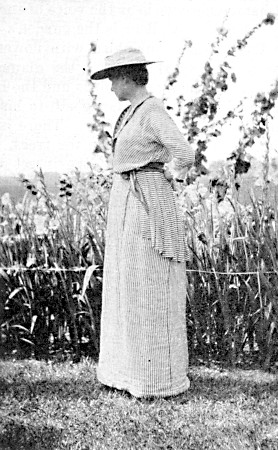
Then "summer in our garden" has an autumn. The garden is never so beautiful as when the first frost strikes it. Pillow-cases, sheets, shawls, aprons, coats and newspapers may for a brief time hold at bay the frost king, but he soon laughs at our efforts, crawls under the edges of the unsightly garments with which we protect our flowers, nips their petals, wilts their stems and blackens their leaves. We find them some morning hopelessly frozen. But the earth has ceased to give forth its aroma, the birds are winging southward, the waters of the brook run clear and cold, and the voice of the last cricket sounds lonesome in the land. We say to nature, "Work your will with our garden; the summer is over, and we are ready to plan for another season."
And what have we learned from the "summer in our garden?" That no one can be happy in his garden unless he works for the joy of the working. He who loves his work loves nature. To him his garden is a great cathedral, boundless as his wonder, a place of worship. Above him the dome ever changing in color and design, beautiful in sunshine or storm and thrice beautiful when studded with the eternal lamps of night. The walls are the trees, the vines and the shrubs, waving in the distant horizon and flinging their branches on the sky line, or close at hand where we hear the voice of the wind among the leaves.
A wondrous floor is the garden's cathedral of emerald green in the summer, sprinkled with flowers, of ermine whiteness in the winter, sparkling with the diamonds of frost. Its choir is the winds, the singing birds and the hum of insects. Its builder and maker is God. Man goeth to his garden in the springtime, and, behold, all is mystery. There is the mystery of life about him, in the flowing sap in the trees, the springing of the green grass, the awakening of the insect world, the hatching of the worm from the egg, the changing of the worm into the butterfly.
The seed the gardener holds in his hand is a mystery. He knows what it will produce, but why one phlox seed will produce a red blossom and another a white is to him a miracle. He wonders at the prodigality of nature. In her economy, what is one or ten thousand seeds! She scatters them with lavish hand from ragweed, thistle or oak. If man could make but the single seed of the ragweed, he could make a world. The distance between a pansy and a planet is no greater than between man and a pansy. The gardener sees the same infinite care bestowed upon the lowest as upon the highest form of life, and he wonders at it. He looks into the face of a flower, scans the butterfly and notes the toadstool and sees that each is wonderful.
From the time he enters his garden in the springtime until he leaves it in the autumn, he will find a place and a time to worship in his cathedral. He enters it with the seed in his hand in the spring, and as he rakes away the ripened plants in the autumn he finds something still of the mystery of life. A puff-ball is before him, and he muses on its forming. The little puff-ball stands at one end of the scale of life and he, man, at the other, "close to the realm where angels have their birth, just on the boundary of the spirit land." From the things visible in our garden we learn of the things invisible, and strong the faith of him who kneeling in adoration of the growing plant looks from nature to nature's God and finds the peace which passeth understanding.