A NARRATIVE OF ITALIAN TRAVELS IN PERSIA.
Eugene Armand Roy translation
The close of the fifteenth century is an epoch in the history of the East, and especially of Persia, of which but little is known. The blast of Timour’s invasion had swept over that historic land and left it desolate. These four Accounts of Travels by Europeans are, therefore, especially interesting in a geographical and historical point of view, and will, with the books of Barbaro and Contarini, which are in Ramusio’s collection, complete the series of Italian voyages about that period. In order clearly to understand the facts brought forward, it will be necessary to glance at the motives of policy which started the embassies, and the historical changes which influenced their results.
In Eastern Europe the Byzantine empire had, after a long and gradual decline, at length crumbled into ruins beneath the power of the Ottomans, which threatened to be as great a scourge to Europe as that of Timur (or Tamerlane) had been to Asia, while the stability and vitality of their empire offered a great contrast to the ephemeral character of Timur’s dominion. Singly, the powers of Christendom could in vain hope to withstand their terrible foe; and Venice, the Great Republic, then rich and flourishing, with a far-sighted policy, endeavoured to induce all the Christian princes to make common cause against the Ottoman Turks.
Hungary and Poland were engaged in continuous warfare with the Musulmans; but the petty jealousies, which no danger, however imminent, could lull, caused the other powers to look coldly on the proposed alliance. Venice, in her need, then cast her eyes to the East, where she found a new dynasty firmly established in the ancient kingdom of Persia, the inveterate foe of the house of Othman. That country, after the death of Timour, had been nominally subject to his descendants, though two rival Toorkoman tribes had established principalities in Azerbigan and Diarbekr. These were the Kara Koinlu, and Ak-koinlu, or the Black and White Sheep, between whom a deadly feud existed; the former were the first to rise to power, under their chief, Kara Mahomed; while his son, the famous Kara Yusuf, threw off the yoke of the descendants of Timour in 1410. Secunder, the son of Kara Yusuf, waged war with Shah Rokh; and, after his death, his brother Jehan Shah, in 1437, not only overran Irak, Fars, and Kerman, but in 1457 besieged and pillaged Herat. The Kara Koinlus kept the throne until 1486.
Kara Koinlu Rulers.
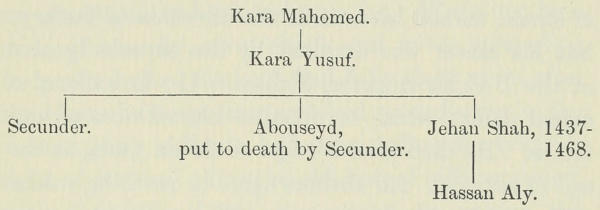
In that year the chief of the rival tribe of the Ak-koinloos, named Uzun Hassan, who had established himself at Diarbekr, succeeded in defeating Jehan Shah in a battle in which the latter fell. The Ak-koinloos were now masters of Persia, and Uzun Hassan carried his victorious arms against Sultan Abouseyd, the reigning prince of the house of Timour, who also fell before him.
Malcolm’s account of the reign of Uzun Hassan is very meagre. He was the chief of the Ak-koinlu, or Turks, of the tribe of White Sheep, and established a powerful principality at Diarbekr. He defeated and killed Jehan Shah and his son Hassan Aly, whom he had taken prisoner, with all his family. The dynasty which Uzun Hassan founded is termed Bâyenderee; the family date their rise from the reign of Timour, who made them grants of land in Armenia and Mesopotamia. Hassan, after defeating his rival, engaged in a war with Sultan Abouseyd. He owed his triumph to his skill and activity in a predatory warfare, and at last having taken his enemy prisoner, made himself master of a great part of the dominions of the house of Timour. Malcolm says: “Uzun Hassan, after making himself master of Persia, turned his arms in the direction of Turkey; but his career was arrested by the superior genius of the Turkish emperor, Mahomet II; he suffered a signal defeat, which terminated his schemes of ambition. He died after a reign of eleven years, at the age of seventy. All authors agree in ascribing valour and wisdom to this prince. We are told by an European ambassador, who resided at his court, that he was a tall thin man, of a very open countenance, and that his army amounted to fifty thousand horse, a great proportion of which were of very indifferent quality.” He adds that this ambassador was an envoy from Venice, sent by that Republic to solicit the aid of Uzun Hassan against the Ottoman. The personage alluded to by Malcolm must have been M. Josafat Barbaro, the successor of M. Caterino Zeno.
Uzun Hassan had already been in collision with the Turks, having, when ruler of Diarbekr, undertaken to defend Calo Johannes of the noble house of the Comneni, one of the last of the Christian emperors of Trebizond, against Mahomet II. This alliance had been cemented by his marriage with the beautiful princess Despina, daughter of Calo Johannes, in which manner he was connected with some of the princely families of Venice, so that the way for an embassy was easily paved. The Venetians might hope much from the ambitious and turbulent character of the Persian prince; and in this they were not disappointed, as it needed but little persuasion to induce the hitherto almost invincible soldier to take up arms against his hereditary foe. Worn out by a state of anarchy, rival chiefs and tribes struggling for power before the land had fully risen again after the blast of foreign conquest had passed over it, the ancient glory of Persia had paled before the brighter light of its rival; but the old hatred still remained, with the will, if not the power, to oppose the Turkish arms. An embassy to Uzun Hassan being determined on, the difficult task of sending an envoy still remained. The duty would be a hazardous one, as any one proceeding from Venice to Persia would have to run the gauntlet of the Turks. The sister of Queen Despina had married Nicolo Crespo, the Duke of the Archipelago, whose four daughters were in turn wedded to four of the merchant princes of Venice, one of whom was M. Caterino Zeno, a man of courage and talent. He, of all others, appeared the fittest to undertake this honourable but perilous mission, and the patriotism of Zeno induced him to overlook the dangers he would run in traversing hostile and almost unknown regions before reaching his destination. He was rewarded for his courage by arriving safely in the presence of the king, though not without meeting serious obstacles in his journey through Caramania.
Zeno was well received by the monarch; and, being supported in his arguments by his aunt, the Queen Despina, succeeded in inducing Uzun Hassan to take up arms against the Turk.
In 1472 the Persians marched into the Turkish dominions and ravaged them, but a flying column under Mustafà, the second son of Mahomet II, routed a force of Persians under one of Uzun Hassan’s generals. In the following year the Grand Turk invaded Persia with an immense army, but met with a severe check while endeavouring to cross the Euphrates near Malatia, and was forced to retreat. Uzun Hassan, however, following up his success too rashly, was routed by the Turks at Tabeada. M. Caterino Zeno was then sent as ambassador from Uzun Hassan to various Christian princes, among others to Poland and Hungary, to incite them to take up arms against the Ottoman. M. Josafat Barbaro and Ambrogio Contarini were sent from Venice to take his place at the Persian Court; but no arguments could again induce the Persian monarch to meet the Turks in the field.
The account of Zeno’s Travels in Ramusio’s collection was prepared from Zeno’s letters, as the editor was never able to get possession of a copy of Zeno’s book. For this reason the geographical details in these Travels are not so explicit as in the others, and Ramusio has in his book put Zeno’s narrative after several others, although in date he was the first. It is supplemented by a sketch of Persian history subsequent to M. Caterino’s embassy, taken from other sources. MM. Barbaro and Contarini succeeded Zeno. The account of their travels will form a separate work.
The second author in this collection is a M. Giovan Maria Angiolello, who was in the service of the Turks, and present in their campaign against the Persians. He describes, shortly, the rise of Uzun Hassan, and gives a full description of the Turkish invasion from the Turkish point of view, and the details of the march. Unghermaumet’s rebellion against his father Uzun Hassan is also mentioned by him as well as by Zeno. After the death of Uzun Hassan and his son Yakoob, Persia fell into a state of anarchy caused by the civil wars between various members of the dominant Akkoinloo family; from this the country rose at length, through the process of a revolution, almost without a parallel in the history of the world. Not only was there a change in the dynasty and form of government, but the empire was revived in a native Persian family, and an end was put to the long foreign domination. More than all, the very religion of the people was essentially altered: a fact which, by widening the gulf which separated them from their surrounding enemies, consolidated the empire and created a nationality. The family which now rose on the ruins of the Ak-koinlu power traced their descent from Ali, the son-in-law of the Prophet, through Mussa, the Seventh Imaum:—
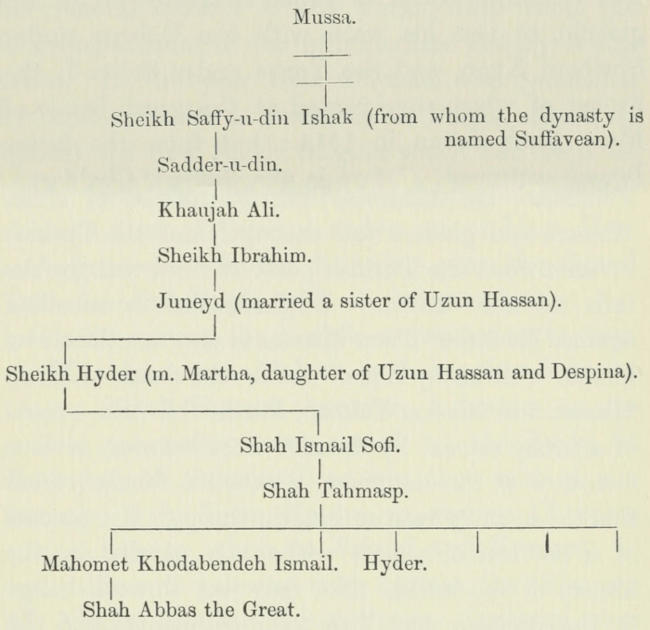
The chiefs of this family were regarded by the Persians as saints, and when Sheikh Hyder, a son-in-law of Uzun Hassan, rose in arms against Rustan, King of Persia, he was joined by great numbers. This insurrection was, however, ineffectual, and it was reserved for Sheikh Hyder’s son, afterwards Shah Ismail Sofi, to overthrow the fast decaying power of the Ak-koinlus, which was still further weakened by the struggle for the throne between two brothers named Alwung Beg and Morad Khan. The victorious career of Ismail is treated of by Angiolello, as also his wars with the Uzbegs under Sheibani Khan, and the Turks under Selim I, the former of whom were routed at the great battle of Merv Shah Jehan in 1514; but from the latter Ismail sustained a defeat in the plains of Chalderan, near Khoi, which left Tauris at the mercy of Selim. Angiolello, leaving Persian history, gives a full and animated account of Selim’s expedition against Egypt, which resulted in the conquest by the Turks of that great country and the deaths of the two last Soldans, Khafur el Ghouri and Tomant Bey.
The Third Book of Travels from Ramusio is that of an unnamed author trading from Damascus and Aleppo to Persia, where he remained upwards of eight years, from 1511 to 1520; so that he also was an eye-witness of the glory of Shah Ismail. The style of this latter is more involved; but while his historical facts correspond, his description of the towns and country is more detailed, as is but natural, from his occupation, which was more suited than that of an ambassador for gaining geographical information. He opens his narrative by describing, with a good deal of minuteness, the route from Aleppo to Tauris, finishing with an account of that city and of the historical events that took place during his stay.
There is a long gap between these two latter writers and Vincentio d’Alessandri, an envoy from Venice in 1571 to the Court of Shah Tahmasp, the son and successor of Shah Ismail Sofi, who had died in 1524. This writer is mentioned by Knolles in his General History of the Turks, from whom the following account of the intermediate history is also taken. In the year 1534 Solyman was persuaded by Ibrahim Pasha to make war on Persia, stirred up against the new Shiah religion which had been introduced by Shah Ismail Sofi. The purpose of Ibrahim was also furthered by a Persian named Ulemas, brother-in-law of the King Tahmasp, who had revolted from him,[164] fearing to be called to account for his extortion. After making preparations, Solyman sent Ibrahim and Ulemas with an army into Syria, and in the spring they advanced, without resistance, as far as Tauris. Tahmasp, the Persian monarch, was then absent, engaged in a war with Kezienbassa, Prince of the Corasine Hyrcanians; but, hearing of the taking of his capital, returned in haste for the defence of his empire. Solyman, on reports reaching him of the successes of his generals, crossed the Euphrates at Malatia, and joined them at Tauris. Tahmasp, not daring to join battle with Solyman, retreated to the mountains above Sultania, where the Turkish army, endeavouring to follow him, was greatly distressed, and forced to retreat from the inclemency of the weather. Solyman now retired to Mesopotamia, where he took Bagdad and added the provinces of Babylonia and Mesopotamia to the Turkish empire. In the following year, 1535, Solyman again entered Tauris and ransacked it; but, finding that nothing was to be done against Tahmasp, withdrew to his own dominions greatly harassed on his journey by Persian cavalry, who at last surprised and routed his army near Betilis, under the command of Delimenthes. This last reverse was the occasion of the fall of the great Pasha Ibrahim, the friend and counsellor of Solyman, by whose orders he was murdered. Ulemas was afterwards made Governor of Bosina. In 1549 the cause of Ercases Imirza, Prince of Shirvan and brother of Shah Tahmasp, was espoused by Solyman against Tahmasp; but, in a tedious war, except the capture of Van by the Turks, nothing of any importance took place, as the Persian monarch, pursuing his usual tactics, acted on the defensive, and retreated to the mountains. Discord being sown between Solyman and Ercases Imirza, the latter fled to Chaldea, where he was treacherously delivered into the hands of Tahmasp, who caused him to be murdered in prison. Bajazet, the son of Solyman, after his rebellion in 1556, fled for safety to the Court of Tahmasp, who received him with favour at first; but his mind becoming embittered against him, he caused his followers to be dispersed and slain, and Bajazet himself to be cast into prison. Solyman used all the means in his power to have Bajazet delivered into his hands, but Tahmasp would not consent; but afterwards, in consideration of a large sum of money, agreed to allow him to be made away with.[165] Bajazet accordingly was strangled, with his four sons. On the accession of Selim II, Tahmasp sent ambassadors to Constantinople to ratify a peace between them, which was concluded in the year 1568. About Vincentio d’Alessandri Knolles says, A.D. 1571:—
“Whilest these things were in doing, the Venetians, the more to entangle the Turke, thought it good to make proofe, if they might by any means stirre up Tamas, the Persian king, to take up armes against him; who, as hee was a prince of great power, so did hee exceedingly hate the Turks, as well for the difference between the Persians and them about matters of their vaine superstition, as for the manifold injuries he had oftentimes sustained. There was one Vincent Alexander, one of the secretaries for the State, who, having escaped out of prison at Constantinople, was but a little before come to Venice, a warie wise man, and of great experience, who, for his dexteritie of wit and skilfulnesse in the Turkish language, was thought of all others most fit to take in hand so great a matter. He having received letters and instructions from the Senat, and furnished with all things necessarie, travelling through Germanie, Polonia, and the forrests of Mæsia, in Turkish attire, came to Moneastron, a port towne upon the side of the Euxine or Black Sea, at the mouth of the great river Boristhenes, where he embarked himself for Trapezond, but was by a contrarie wind driven to Sinope, a citie of great trafficke; from whence he travelled, by rough and broken ways, to Cutay, keeping still upon the left hand because he would not fall upon any part of the Turk’s armie (which was then marching towards Cyprus through all those countries); neverthelesse, he fell upon a part thereof, from which he with great danger rid himselfe, beinge taken for a Turke, and by blind and troublesome wayes, through rockes and forrests, arrived at length at Erzirum, a strong citie of the Turks, then upon the frontiers of the Turk’s dominions toward the Georgians. This journey of Alexander’s was not kept so secret, but that it was vented at Constantinople by a spie, who, under the colour of friendship haunting the Venetian embassadour’s house at Pera, had got certaine knowledge of the going of Alexander in Persia. Whereupon, certaine courrours were sent out with all speed to beset the three straight passages into Persia, whereby it was supposed he must of necessitie passe, with certaine notes also of the favour of the man, of his stature, and other marks wherby he was best to be knowne. But he in so dangerous a countrie doubting all things, and fearing such a matter, leaving his companie behind him, with incredible celeritie posted from Erzirum to Tauris, and was a great way gone before the Turk’s courrours came into those quarters; who, yet hearing of him, followed after as far as they durst, but could not overtake him. Alexander, comming to Tauris, understood that the court lay at Casbin, about twelve days’ journey farther up into the country. Comming thither the 14th of August of this year, 1571, he chanced to meet with certaine English marchants, with whom he had beene before acquainted; by whose helpe he not only got to speak with Ayder Tamas, the king’s third sonne, but learned of them also the manners and fashions of the Persian court, and how to beare himselfe therein. The Persians, by reason of the intolerable heate, doe most of their business at that time of the yeare by night. Wherefore, Alexander, about midnight brought in to Aider, declared unto him the cause of his comming: and the next night admitted into the speech of his aged father, delivered his letters of credence, and in the name of the Senat, declared unto him, with what perfidious dealing Selymus, the Turkish emperor, was about to take away Cyprus from the Venetians, with what greedinesse and pride he had set upon the Christians, and that discharged of that warre, he would of all likelyhood set upon the Persians; having the selfesame quarrell unto the Persians that he had unto the Venetians, that is, an ardent and insatiable desire of soveraignetie; a sufficient cause for the greedie Turke to repute every king, the richer that he was, the more his enemie. After that, setting foorth to the full the prowesse of the Christians, the wonderfull preparation they had made, both at sea and land, he persuaded the king, with all his power, to invade the Turke, now altogether busied in the warres of Cyprus; and to recover againe such parts of his kingdom as Solyman, the father of Selymus, had taken from him. Warres, he said, were more happily managed abroad than at home; that, sithence he alone (the Christian princes all then at quiet) had withstood the Turk’s whole force and power, he needed not now to doubt of his most prosperous successe, the Christian princes now joyning with him. That he was much unmindful of his former losses and wrongs, if he thought he enjoyed an assured peace, which he should find to be nothing els but a deferring of war unto more cruell times; and that the Turke, if he should overrun Cyprus, would forthwith turne his victorious arms upon him. The end of one warre was (as he said) but the beginning of another; and that the Turkish empire could never stay in one state; and that he would observe not the Turke’s words, but his deeds; and how that the Othoman emperours, according to the oportunitie of the times, used by turnes sometimes force, sometimes deceit, as best served their purposes. That no princes had at all times, by dissembled peace and uncertaine leagues, more deluded some, untill they had oppressed others. He wished also, that at length this his cunning dealing might appeare unto the world; and that princes would thinke, that being combined together, they might more easily overcome the Turke, than being seperated, defend their owne; that in former times, sometimes will, sometimes occasion, was wanting to them to unite their forces; and that, therefore, they should now combine themselves for their common good against the common enemie; that it conserned no lesse the Persians than the Christians, to have the power of the Turke abated; and that this taking up of armes should be for the good of the Persian king, howsoever things should fall out; if well, he should then recover what he had before lost, with much more that was the Turke’s; if otherwise, yet by voluntarie entering into armes, to countenance himselfe, and to give the Turks occasion to think that he feared him not, which was (as he said) the only way to preserve their common safetie, which would be unto all the confederat princes easie enough, if they themselves made it not more difficult than the power of the enemie. The speech of the embassadour was willingly heard; whereunto the king answered, that he would consider thereupon what he had to doe; and, in the meanwhile, a faire house was appointed for the embassadour and his followers, and bountifull allowance appointed for the king’s charge. He was also many times sumptuously feasted by the noblemen whom he still requested to be mediatours unto the king, to take that honourable warre in hand. The king had at that time a sonne called Ismael, a man of great spirit, whom he then kept in durance, for that he, with too much insolencie, made roades into the frontiers of the Turke’s dominions, to the disturbance of the leagues his father had before made with the late Turkish emperor, Solyman: unto him, Alexander having accesse, was of him courteously heard, who, fretting and languishing for verie griefe of revenge upon the Turkes, wished that either the king, his father, had his mind, or he himselfe the power of a king, and said, That if ever it were his good fortune to obtaine, he would indeed shew what he then in mind thought. But of him more shall be said hereafter. Whilest this matter went more slowly forward in the Persian court than the embassadour would have had it, newes was brought unto the court of the great victorie which the Christians had much about that time obtained of the Turkes at sea; upon which occasion the embassadour solicited the king more earnestly than before, to make himselfe partaker of the victorie of the Christians by entring into confederation with them, and by taking up of armes, rather than to hold uncertain friendship with the Turkes in their miseries, by whom he had been so often wronged. This he said, was the only time for the Persian king to recover his former glorie, the like offer whereof would neither often chance, neither long stay; and that if he suffered so fit an opportunitie to slip away, he should afterwards in vaine wish for the same, when it were so late. This so wholsome counsell was well heard, but prevailed nothing to stir up the aged king, who, then troubled with rebellion in Media, or wearie of the former warres he had had with the Turke, and glad of such peace as he had then with him, answered the embassadour: That, for as much as the Christian princes had made a perpetuall league amongst themselves, he would for two yeares expect the event, and afterward, as occasion served, so to resolve upon peace or warre. This improvident resolution of the king brought afterward unprofitable and too late repentance unto the whole Persian kingdome, when, as within a few yeares after, all the calamities which the Senat had by their embassadour (as true prophets) foretold, redounded unto the great shaking thereof. For the Cyprian warre once ended, and peace concluded with the Venetians, Amurath, the sonne of Selymus, succeeding his father in the Turkish empire, invading the Persian king, tooke from him the great country of Media, now called Silvan, with a great part of Armenia the Great, and the regall citie of Tauris, as shall be here after in due place declared. At which time the Persian, who now refused to take up armes or join in league with the Christian princes, repented that he had not before hearkened unto the wholsome counsell of the Venetians; and, taught by his owne harmes, wished in vaine that the Christian princes would againe take up armes and joyne with him against the Turke.”
In the year 1576 troubles arose in the Persian kingdom consequent on the death of Tahmasp, which were taken advantage of by Sultan Murad III. Tahmasp had eleven sons; Mahomed Khodabendeh, who suffered from a weakness in his eyes; Ismael, a turbulent warrior, confined in the fortress of Cahaca, between Tauris and Casbin; Hyder, the third, with a powerful party in the State; and the others, Mahmoud, Solyman, Mustafa, Emanguli, Alichar, Ahmed, Abrahim, and Ismael the younger.
Before his death he appointed Ismael his successor, to the great discontent of Hyder, who, being in the palace, caused himself to be crowned; but Ismael’s friends being strong he was imprisoned in his palace and soon after murdered. Ismael, on ascending the throne, caused his eight younger brothers to be murdered, and greatly oppressed the country;[166] he himself, after a year’s reign, met with his fate, being murdered by his sister. The Persian chiefs raised Mahomed Khodabendeh to the throne, who, in endeavouring to avenge his brothers’ deaths, caused great discord in the kingdom, of which Murad determined to take advantage, inducing the Georgians under Levent Ogli and the people of Shirvan to revolt. After a few years, however, the incapable Mahomet was dethroned by the Persian nobles to make way for his son Abbas. This prince, perhaps the best ruler Persia had had for many centuries, began to reign in 1585, and is known to history as Shah Abbas the Great.
FOOTNOTES
TRAVELS IN PERSIA, BY CATERINO ZENO.
RAMUSIO’S PREFACE.[167]
Having undertaken to describe a journey made in Persia by M. Caterino Zeno, knight, at the time that our Republic, being at war with the Turk, desired that he should be harassed on the East by the arms of the king Ussun Cassano, who, some years before with great skill in the art of war, had made himself Master of Persia, and a great part of the neighbouring provinces; I have considered it suited to my undertaking, to treat of all the wars, which were waged in Persia, both between the members of the royal family and by the Persians against the Turks. And particularly to narrate the manner in which this Ussun Cassano, a poor nobleman, and the weakest in condition of many brothers[168] (Giausa,[169] the eldest, having become King of Persia), not possessing more than thirty soldiers besides a small castle, afterwards raised himself to such grandeur, that he had the courage to dispute the empire of all Asia with the Ottoman house, which, under Mahomet II,[170] was a terror to the East.
But the arts by which he made himself king, his valour and cunning, I shall narrate as briefly as possible, as I consider these things worthy to be reported to our nation; for, amongst all the kings of the East, who existed since the Government was taken away from the Persians, and transferred to the Greeks, there have been none who equalled the glory of Darius Hystaspes and Ussun Cassano; and if fortune had favoured him in the second battle at Tabeada in the campaign of Tokat, as it did in the first he had with the Turks on the Euphrates, there is no doubt that by these two victories he would have made himself master of all Asia and Egypt. But it is to be regretted that some Eastern kings, great in power and intellect, have not had historians to celebrate their deeds, since among the Sultans of Egypt and among the Kings of Persia, there have been men most excellent in war,[171] and worthy not only of being compared with ancient barbarian kings famous in arms,[172] but even with the great Greek and Roman commanders, in all those things which constitute able generals of armies. For the record of the deeds of such reach us Europeans, who are admirers of the virtues of men abroad and at home, in a condition so mutilated and imperfect, that from the few particulars we cannot draw up a complete history. Therefore, let no one marvel if in these my notes I do not describe things as fully in some places as I should have done, if I had had ampler information; since M. Caterino, who, as has been said, went as ambassador to Ussun Cassano, wrote several letters, from which I have drawn the pith of this short history, for the satisfaction of those who, hearing discussions about the Sufi, and of his great pomp, are desirous of being informed of the affairs of the Persian Empire. And I know well that in thus writing to a purport different from what has been written by others, many will be apt to criticise me, as it is difficult to efface early impressions from the mind; but before they do so, I beg they will rather consider my good intentions than impute to me any desire to gain a reputation for being better acquainted with the affairs of the world than other writers. But surely we ought far sooner to credit what is told us of the doings of Ussun Cassano, by one who was connected with him, and who got his information from the Queen Despina, his own aunt, than by those who, in their histories, have only availed themselves of the narrations of some Armenians, who, to take away his reputation, went about spreading the report that he was not born of royal blood, and that while he governed certain places in Armenia, by lavish expenditure, and gaining the favour of the soldiery, he seized an opportunity of casting off the sway of Giausa, and treacherously putting him to death with his son.[173] And they add, to further embellish this lie, that in this Giausa the descendants of Moleoncre, formerly a great sultan of the Parthians, became extinct. These things are all well known not to be true, since how could Ussun Cassano have made himself Lord of Persia, if he had not been of royal blood; particularly, for this reason, that there is no nation which holds noble birth and royal descent in more estimation than the Persians. And to omit the ancient example of Darius Hystaspes,[174] the son of Atossa, the daughter of Cyrus, there is the more recent one of Ismail; for, although he was not born of royal blood on his father’s side, nevertheless his mother, called Martha, was daughter of Ussun Cassano, through whom the new king was tolerated, as formerly Darius was, as the son of Atossa. We must not believe that the partizans of the ancient kings[175] (if indeed there was a party, as these authors say) would be so soon swept away; because it is impossible that a new dynasty should appear without causing great commotions and tumults, as we have seen in many kingdoms of Christendom; and, nevertheless, the reign of Ussun Cassano, as regards internal affairs, was not visited by any blast of domestic or civil war, except that raised by his son Unghermaumet; but this was caused by lust of power and not by a faction of a former reign. Therefore, read without chiding these my commentaries, in which, if I had been able to find the “Book of Travels of M. Caterino”, who first gave information of the affairs of Persia, and preceded M. Giosafat Barbaro, and M. Ambrogio Contarini as ambassador to Persia from our Republic, I should have touched upon many other particulars, which would have been most acceptable to those who take an interest in such things.
As, in spite of all my research, I have never been able to get into my hands this Book of Travels, if I should find it (and I am sure there is no one so malicious as not to shew it), I will supply what I have now missed. But, as we say, he who does all he can, does much. Since we cannot get further particulars, let us accept these, and praise the industry of the good M. Caterino, and it being evident that, not being able to find more on this subject among his writings, I cannot communicate it.
CATERINO ZENO.
FIRST BOOK.
In the year of our Lord Jesus Christ one thousand four hundred and fifty, (1450), Giausa,[176] being King of Persia, Assimbeo[177] (who, from that time, on account of his deeds, called himself Ussun Cassano,[178] which in the Persian tongue signifies “great man”), not contenting himself with being Lord of a small castle, began by little and little to usurp the states, and the jurisdictions of his other brothers less powerful than himself,[179] who, either not being of a warlike disposition or for some other reason, preferred living in ease and not opposing his ambition. Thus he without difficulty raised himself in credit and reputation. Ussun Cassano was a warlike, valiant man, and above all of great liberality, which is a rare virtue, to enable great lords to gain over the affections of the soldiery, provided it is exercised at the proper time and place, and towards the deserving (so that he who makes use of it be not esteemed of small judgment or a prodigal). By this means he was soon followed by people of war, so that he brought together five hundred good horsemen, assaulted the great and famous city of Amitto;[180] in which fortune was so favourable to him, that he took it with so much reputation that from that time he had the support of all those regions. Hence, he thought he should easily be able to make himself master of the kingdom of Persia, provided his partizans, who now favoured him so readily, continued to do so. Therefore, having made of them a large army, he took the field with the intention, if Giausa[181] opposed him, of trying the fortune of battle. Giausa, who had been half apprehensive of the designs of his brother[182] hearing of the assault and capture of Amitto,[183] did not think it politic to keep himself aloof and so allow Ussun Cassano to increase in power and also to repair the other disadvantages, which usually follow in the course of war. Therefore, having levied an army, he advanced, with almost all the forces of Persia, against Ussun Cassano. At this juncture, some Persian lords, who were friends of both, knowing what desolation would follow in Persia if they came to blows, thrust themselves between the brothers, and would have brought, with much difficulty, matters to a good understanding, if it had not been that Giausa, demanding a tribute of three hundred boy slaves from Ussun Cassano, and the latter not being willing to consent to it, proved the cause of all proposals of reconciliation being broken off. As he said, “Have I command over the sons of my vassals, that I should pay them as a tribute to Giausa; or can I forsooth dispose of them as my own? If Giausa wished to take them by force of arms from the hands of their fathers and mothers, I should never consent to it, even if I were certain of losing my life, as it is equally enjoined on the Prince to defend his people, as on the people to obey; it is not now to be thought of, that I should give them of free will.”
This answer so touched to the quick, as it were, the hearts of those people, that there was not one who would not have risked his life for Ussun Cassano. Being held in this favour he artfully drew Giausa[184] to the plains of Arsenga,[185] where, having come to an engagement, he defeated and took him, pursuing his son, who sought safety in flight beyond Tauris.
The Persian histories say, that Mahomet the Second, the lord of the Turks, who was afraid lest the greatness of Ussun Cassano should harm him in time, undertook to favour and replace Giausa in power. Wherefore, Ussun Cassano, expecting some great commotion on this side, sent Unghermaumet, his son, a valiant young man, as far as Tauris, which was the chief place of a great region; while he himself on the other side went on reducing the whole of Persia to his sway, and conquered as far as the Indian Sea, possessing a mighty empire; which empire was comprised in these limits—on the east, the river Indus and the Tartars;[186] on the west, Gorgora,[187] Trebizond, Caramania, Soria,[188] and Lesser Armenia, on this side of the Euphrates; on the south, the Arabs and the Sea of India; on the north, the Sea of Baccu.[189] This his country was for the most part inhabited by Armenian Christians, and by native Persian races, separated by a continuous rampart of mountains, inhabited by Kurds, an independent people, and partly ruled over by the Lord of Betelis,[190] who, some years later, seeing the greatness of Ussun Cassano, gave in his submission. And because at that time the Turkish arms were more than ever flourishing and illustrious under Mahomet II, Grand Turk, and made themselves felt gloriously in Asia and in Europe, Ussun Cassano, as generally happens to great Princes who live in jealousy about their states if they see another Prince of enterprise make great progress in war, fearing lest the immense power of the Ottoman house should in time destroy the Persian kingdom, made a close alliance and connection with Caloiane,[191] Emperor of Trabisonda, taking as a wife Despina, his daughter, under the condition that she might live in the Christian faith. This same Emperor had also married another of his daughters to the Lord Nicolo Crespo, Duke of the Archipelago, from whom were born four daughters, who were afterwards most honourably married to as many Venetian gentlemen, of the first nobility, and of one named Fiorenza settled in the Cornaro house, was born Madame Caterina, the Queen of Cyprus, and M. Giorgio, the Procurator; Valenza married to M. Giovanni Loredano dalla Samitara, son of the late M. Aluise, the Procurator, had no issue; of another, called Lucretia, married into the house of Priuli, was born M. Nicolò, the Procurator. Lastly, from Violante, who married M. Caterino Zeno, knight, who was afterwards ambassador in Persia, was born M. Pietro, who begot M. Caterino, who died last year, whose soul God hath taken to himself, and whose son, M. Nicolò, still lives. This same M. Caterino, knight, in the misgivings which nearly all the powers of the world had of the power of Mahomet, the Grand Turk, was despatched as ambassador from our Republic to Ussun Cassano, in order that if they were not able to raise the Sovereigns of the West to combat the common enemy, who, insatiable in his lust of power, aspired to the empire of the world, they might at least induce those of the East, by the same misgivings to become anxious and mistrustful of their affairs.
Fortune, which often opposes itself to the loftiest desires of men, caused that our Republic, being then at the zenith of its greatness, and most flourishing through many acquisitions, having in recent years waged a glorious war in Lombardy against Philippo Visconte, and having increased her dominion in that province, excited a certain jealousy in the Sovereigns of Europe, who feared lest such power and opulence should in time prove their ruin; and especially lest this Republic, being superior to the Roman in civil government, might in course of years attain the same grandeur; therefore, as if they had conspired together, when she invited each one into a league against Mahomet, they all plainly declined. On this account our ancestors, who, animated by an honourable zeal, were eager for this politic enterprise, were filled with much anxiety, seeing that envy of their greatness would occasion the ruin of Christendom. As, in the event of a Republic, which was powerful at sea and in Greece, and enriched by many large islands,[192] which were in her possession, meeting with any slight defeat, what obstacle would remain to the Turk, to prevent him attacking Italy, as was afterwards shown in the capture of Otranto.[193]
But what gave them greater disgust and anxiety of mind was, that the Turk knowing the importance of keeping this Republic friendly, sought for peace; and the senators saw that after the other Powers had been beaten by his arms, they themselves his allies, would remain an easy prey to the conquerors. Now, while they found themselves in this dilemma, four ambassadors sent by Ussun Cassano, arrived at Venice,—namely, Azimamet, Morat, Nicolo and Chefarsa, venerable men, and of great authority with the king, who, with many proffers from their master, offered to make a league and an honourable alliance against the Turk and against the Soldan, provided the Venetians would not fail with their fleet to attack both powers. These (Venetians) being delighted to have the greatest and most powerful king of the East as their confederate and ally in this war, accepted the offer, and professed to have always been good friends with the king, and assured him that this war would be more agreeable to them than ever so many others they had waged.
And thus, Azimamet remaining at Venice, the other three passed on to the Pope and to the King of Naples to excite, if possible, both of these powers to enter the league. Hence the Senate thought proper to elect an ambassador to reside at the Court of the King Ussun Cassano; as much to be ready to inflame and excite him to take up arms for the common offence and defence as to represent the grandeur and dignity of the Republic. Therefore, M. Francesco Michele was first elected, who refused; then the senators elected M. Giacomo da Mezo, who also would not accept this charge. At last, in the year 1471, M. Caterino Zeno was elected, who cheerfully undertook the journey moved only by zeal for the holy faith. He was the son of M. Dragon Zeno, who died at Damascus, having been many years before as far as Bassera,[194] to Mecca and to Persia; therefore, M. Caterino had some acquaintance with those regions, and from the knowledge that he was nephew of the Queen Despina, wife of Ussun Cassano, considered himself alone fitted to serve his country well and efficiently in this embassy. But, because this journey was unknown, long, and full of dangers, and there was no one to be found to go with M. Caterino, our Government, not wishing to desist from the enterprise, and perceiving this difficulty, provided more pay and better provisions for those attendants who would go with him, by which means they procured some valiant men, accustomed to all kinds of hardships, who, induced by the high salary, and by a desire to see the world, gladly entered his service. By this means M. Caterino was despatched on the 6th June of the same year that he was elected, with a commission to Ussun Cassano, our Government offering to arm one hundred galleys and many other large and small ships, and with them to attack the empire of the Turk from the sea, if he from the East would not fail to press them with all his forces. With these commissions M. Caterino left Venice, arrived at Rhodes in a few months, and thence having entered the country of the Caramanians, with much difficulty reached Persia. I cannot give the particulars of his journey, because, as I mentioned above, I could never, with all my research, get his book that was printed, into my hands.
M. Caterino, having arrived at the Court of Ussun Cassano,[195] was received by him with great rejoicing and honour, as the ambassador of a Republic so illustrious and powerful, his new confederate and ally; then, after having visited the king, he asked to be allowed to visit the Queen Despina. This matter, as it was not the custom to grant it to any of the Persians, was refused, it being the habit among them for the ladies not to allow themselves to be seen by any one, and they consider being seen as bad as if among us a person committed adultery.
Therefore, while they walk about the cities and the fortresses, or ride with their husbands to the war, in the following of the king, they cover their faces with nets woven of horsehair,[196] so thick that they can easily see others, but cannot be seen by them. Nevertheless, M. Caterino, by the special permission of the king, was allowed to visit her in the name of the Republic. Then, being taken into the presence of the queen, and she being informed who he was, he was welcomed and received by her with the greatest favour as a dear nephew and relation, asking him with great instance if all her nephews were alive, and in what condition they were. M. Caterino replied with great pleasure, and gave satisfactory answers to all her questions. Afterwards, when he wished to return to his lodging, she would not hear of it, but kept him in her palace, giving him separate apartments for himself and suite, and presenting him every day (a thing which is considered very honourable from the King of Persia) with the same victuals, which were put before their majesties. And then, having heard more particularly the reason of his coming, she promised him all her influence, and showing herself friendly towards our illustrious Government. And in reality this queen was instrumental, through M. Caterino, in inducing Ussun Cassano to declare war against the Turk. Nor can one deny that through the relationship M. Caterino had with Despina, he attained to such favour and intimacy with Ussun Cassano, that he even went in and out of the private apartments of the king and queen at whatever time and hour he pleased, and what is still more extraordinary, even when both their majesties were in bed; which I do not think any other Mahometan or Christian king ever granted, even to their nearest relations. This Despina was the most religious lady in the world, always remained a good Christian, and every day had mass solemnly celebrated in the Greek manner, which she attended with much devotion. Nor did her husband, although he was of a different faith and an enemy of her own, ever say one word to her about it, or persuade her to change her religion; certainly it is curious that the one bore so much with the other, and that there was so much love and affection between them. Nor did M. Caterino fail, after seeing this good Christian, to incite her to persuade her husband to wage a stubborn war with the Turks, bitter enemies of all the Christians and most particularly hostile to her and to her race, as they had slain her father,[197] and taken away his realm. Prevailed on by these arguments, the queen did so much and said so much to her husband, that he who was of himself much inclined to humble the greatness of the Ottoman power, wrote with his own hand orders to the King of Gorgora, Lord of the Georgians, to commence war with the Turks in that quarter. And Despina, while her husband was engaged in this project and was collecting troops, hurriedly dispatched M. Caterino’s chaplain, with letters written by her own hand to the most Illustrious Government and all her relations.
But the spring having passed, and there being no news of the preparations which M. Caterino said our Republic was making to attack the Ottoman, the king began to lose hope and to give less credit to him than before. On this account, having in readiness a magnificent army, he thought of leading it against some Tartar chiefs, his enemies. But our Republic, which did not fail to send messages and letters, to keep him acquainted with affairs and to confirm him in his knowledge, that the Venetians would never fail in what they had promised, on the 6th of January, twenty months after the departure of M. Caterino, elected M. Giosafat Barbaro ambassador to Persia, and sent with him several gifts to the king, which were six immense siege guns, arquebuses, and field-pieces in great number, powder, and other munitions of war; six bombardiers, one hundred arquebusiers, and other men skilled in artillery. And, on the other hand, they made a captain-general of the sea, and sent him with a great fleet to the coasts of Caramania, where, having arrived, and after waging some minor battles with the enemy, he took some castles which the Turks had occupied, giving them over to the generals of the Caramanian prince.[198] This chief, for having given a passage to M. Caterino, was unexpectedly attacked by the Turk, and deprived of his power;[199] having left several fortresses well garrisoned with men and munitions, he fled to Ussun Cassano, by whom he was graciously received, and given hopes of being reinstated, provided those fortresses, which he said still held for him, remained in his allegiance. But hope, which often disappoints the desires of men, now disappointed the Caramanian; since the captains who had charge of these strong places, corrupted by Turkish gold, although with the dishonoured name of traitors to their sovereign, gave up the fortresses in their possession, to the enemy. Having made this acquisition, Mahomet sent ambassadors from Constantinople to Persia, to excuse himself to Ussun Cassano for what he had done, and to confirm an honourable peace and friendship with him.
But very early on the day they were to have had an audience of the king, M. Caterino entered his room, and spoke to him with such convincing arguments, that, being backed up by Despina and by pity for the Caramanian monarch exiled from his home, and who, having come into his presence, supplicated, and entreated him not to abandon him in his adversity, the ambassadors were dismissed without ceremony. And having given immediate orders for war, he put his army in readiness; and he himself having arrived in great haste at the city of Betilis,[200] sent for M. Caterino, and said that he wished him to come with him to his army that he might see with what promptitude he had undertaken the war, partly for his own sake and for the safety of the kingdom of Persia, and partly incited by our Republic, and by the recent injury done to the Caramanian lord, his friend and ally, whom he could not desert, as he had thrown himself altogether into his hands.
These things M. Caterino heard with great delight, and thanked him with many words for the affection he had for our most illustrious Government, and joining one of his captains, called Amarbei Giusultan Nichenizza, went to make a muster of the king’s warriors, who, as he writes in a private letter, were one hundred thousand horse, reckoning attendants, who accompanied their masters; some of them and their horses armed after the manner of Italy, and some covered with strong, thick hides, able to save the wearer from any heavy blow. Others were clothed in fine silk with doublets quilted so thickly that they could not be pierced by arrows. Others had gilt cuirasses and coats of mail, with so many weapons of offence and defence, that it was a marvel to behold how well and skilfully they bore themselves in arms.[201] Their servants also were excellently mounted, with cuirasses of polished iron and in place of bucklers which our people use, they have round shields, with which they cover themselves, and make use of the keenest scimitars in battle; the masters made a total of forty thousand men, all brave soldiers, and their servants sixty thousand, and finer cavalry were never seen in any army: the men were tall and very muscular, and very dexterous in wielding their weapons, so that it is reported that a small troop of them would have routed ever so great a squadron of the enemy. The muster being completed, he made forced marches with the whole army towards the country of the enemy, and with him went Pirameto,[202] the Caramanian chief, and all the king’s sons who were valiant young men. And M. Caterino, who also wished to be with them, went to bid adieu to the Queen Despina; but the army marched ahead with such speed that he could not rejoin it, and therefore was much disgusted. Going on his way with a squadron of five hundred horse he was attacked in Giauas[203] by the people of the country, who caused them much loss; thus, having lost many soldiers, and having suffered several other inconveniences, he turned towards Tocat, and led them at last to the city of Carpeto,[204] where he heard, to his great comfort, that Ussun Cassano was soon to arrive. The Persian army entered Giauas in the month of September, and carried fire and sword through the country far and near, plundering and cutting people to pieces, to the great terror of the inhabitants, so that every one fled before this tempest. And passing Arsenga[205] and Tocat, he burnt the towns and villages everywhere with the same fury, and assaulted and took Carle, which belonged to the Caramanian.
Mustafà, the son of the Turk, who, with Acomat Pasha, was in Lulla, a city of Caramania, being alarmed at this, fled towards Cogno:[206] and removing his mother, sent her to Saibcacarascar,[207] four days’ journey in the interior, towards Constantinople. But the Persians coming towards Cogno, the Turk wrote letters to his son that he should retreat, and not rashly seek to come to blows with the enemy, because any little victory would raise their courage, and make them attempt anything. On account of these letters Mustafà, who knew that his father was right, retired to Cuteia,[208] where he found Daut[209] Pasha, Beglerbeg of Natolia, making great assemblies of people of war. The Grand Turk then did not think it right to linger lest his men, missing his presence, might lose spirit and allow the enemy boldly to enter the country and to capture the strongholds. On this account, having passed into Asia with his whole court, he expected soon to encounter Ussun Cassano with the Persian army. But having heard from his spies that the disturbances in those provinces arose from a captain of Ussun Cassano’s, who, with forty thousand horse, went plundering, burning, and slaughtering, and who just then was marching towards Bursia[210] to burn it (the king having remained behind with the rest of the army), the Turk despatched Mustafà with sixty thousand of the best cavalry of the army, who moved by forced marches towards the enemy, desirous of encountering them and of putting a stop to such devastation. The Persian army being warned of this, commenced a retreat, knowing themselves to be much inferior in number to the enemy; and, as they were loaded with booty and made slow progress, four thousand Turks who pursued at great speed under Armaut,[211] came up with them and at once attacked, when the Persians, beginning to fight bravely, pressed them hard, and routed them in a moment, and cut to pieces two thousand Turks with their leader Armaut. Scarcely was this action over when Mustafà arrived with the rest of his men, who, closing in one squadron, attacked the Persians fiercely; while the latter, on their side, resisted not less courageously. Both parties bore themselves bravely for many hours, and it is thought that anyhow the victory would have been on the side of the Persians, if they had not first fought with those four thousand horse, since Mustafà, who came up with fresh men, found them fatigued with that battle and with the journey, and thus remained the conqueror, although with great loss on his side.[212] The number of the slain is not given in the letters from which this history is taken; it is only mentioned that Usufcan,[213] the general of Ussun Cassano, was taken prisoner by the Turks, and that Pirameto,[214] the Caramanian Prince, fled and saved himself with a great part of the army. The whole of the succeeding winter the king and the Turk busied themselves in making fresh preparations for war, that they might in the spring again confront each other.
And Ussun Cassano, in the beginning of the summer, took the field with his army, and having captured some of the spies of the Turk, commanded their hands to be cut off and hung round their necks, and that they should be sent back to the Ottoman in this manner.
At this very time arrived letters for M. Caterino, written by M. Pietro Mocenigo, who was afterwards Doge, then Captain-General of the Sea, and M. Giosafat Barbaro[215] giving him intelligence, both of the presents which our most Illustrious Government was sending to the king, and of the arrival of the fleet on the coast of Caramania. And above all, he heard with great satisfaction of the castles which they had taken and restored to the generals of the Caramanian Prince; these letters filled Ussun Cassano with such joy and hope, that he ordered the news to be spread through the whole army, and commanded as a greater token of affection and honour towards our Republic, that at the sound of the trumpet, and Zamblacare,[216] the Venetian name should be lauded and saluted, and such was the din, that the noise might be heard at several miles’ distance.
The Turk also having made greater exertions than before, passed into Asia, and shut himself up in Amasia, a city of Cappadocia, which was the Sangiacato[217] of his son Bajazet,[218] who together with Mustafà, went with his father to this war, Gien,[219] his third son, remaining in Constantinople. And since the difficulty of leading armies into Persia consists in supplying provisions, it being the custom of the Persians to desolate the country for fifteen or twenty days’ journey on the side on which they expect an invasion; so that, whoever, in attacking Persia, does not go well provided with necessaries, either dies of hunger on the road, has to retire much to his dishonour, or else becomes a prey to the enemy. Mahomet, who had deliberated well about this with his people, after having made a good provision of victuals, divided all his army into five columns.
The first he led in person, in which, with the corps of Janissaries, were thirty thousand soldiers—the flower of the Turkish nation, so to speak.
The second, of another thirty thousand, Bajazet commanded.
Mustafà led the third, also of thirty thousand, including twelve thousand Wallachians, led by Basaraba, their captain, who came to the aid of the Turks in this war.
The fourth was under Asmurat Palæologus, a Turk, Beglerbeg of Roumania, numbering sixty thousand men, among whom were many of his Christian subjects.
The fifth was under Daut, Beglerbeg of Natolia, of forty thousand men. There were besides, the Acangi,[220] volunteer cavalry, with their chief, to the number of thirty thousand. These traversed the country thirty, forty, and fifty miles before the Turkish armies, plundered, burnt, and slaughtered whatever they found before them. They are most valiant in person, and it is their duty to bring provisions to the camp.
With this immense army the Turk started from Amasia, and having with him several large pieces of artillery, took the road to Tocat in capital order, and leaving on the left the town of Siuas[221] on the river Lais,[222] which flows from the mountains of Trebizond, entered a low plain between that city and Mount Taurus. On their way they found Nicheset,[223] a very strong Persian castle, which they did not attack, in order not to lose time on the way. Thus marching, they had on the left the city of Coiliutar,[224] situated among mountains, and surrounded with villages; descending the mountain they halted near the city Carascar,[225] famous for its mines.
The inhabitants of this place had all fled to the mountains; therefore, without halting, the army proceeded to the city of Argina,[226] situated in a wide plain. Here they found in a church a philosopher studying with many books around him, and who,[227] not ceasing to read, in spite of all the noise and uproar they made, was cut to pieces by the Acangian[228] horsemen. All the other people had fled beyond the Euphrates. Having left this, the Turks passed the country called Arsenga,[229] which is Lesser Armenia, and approached the Euphrates not far from Malatia,[230] where, on eleven dromedaries, there arrived before the sovereign the ambassadors of the Soldan of Cairo to deliver an arrow with a letter on its point, to which an answer was soon given; and they having remounted their dromedaries departed, getting over a deal of ground in one day, the dromedary being so swift as to travel without intermission further than any other animal. And St. John Chrysostom, upon Matthew, explains the difficult passage as to how the Magians could have come from the East to Judæa to worship Christ in such a short space of time, as is mentioned in the Evangelist, by supposing that they came upon dromedaries, which are said to be the fastest animals for a long journey. Leaving this place the Turkish army marched along the banks of the river towards the north-east, going up against the course of the stream, when on the other bank Ussun Cassano presented himself with the whole Persian army in array.
In this place the Euphrates, which is an immense river with very high banks, forms many sandy islands; so that it is easy to ford it from one side to the other.[231]
Ussun Cassano had a magnificent army of Lesdians who are Parthians, of Persians, Georgians, Kurds, and Tartars, and the principal captains who led them were Unghermaumet, Calul, and Ezeinel, his sons, and Pirameto, the Caramanian Prince.[232] But, although his army was so large, he nevertheless saw that of the Turk as immense, and occupying as large a space of ground, a thing which he had not at first believed, from hearsay. He marvelled at it for a time, and then all astonished, said: “Hai cabesen ne dentider,”[233] which in the Persian tongue signifies “Oh, son of a ——, what an ocean”; comparing this immense army to a sea. Then the Turk, who thought that by boldness he might anticipate and check the forces of Ussun Cassano, commanded the Beglerbeg of Roumania, Asmurat Palæologus, to cross the river with his men and gain possession of the other bank, which would be an evident defeat for Ussun Cassano and his whole army; and since Palæologus was young and bold, in order that his rashness might not cause some mistake, he joined to him Mahomet Pasha to direct him in any emergency.
He led out an immense squadron to the sound of kettle-drums and other martial instruments, with banners flying, descended into the bed of the river, and crossed from one sand-bank to another. Then Ussun Cassano, irritated by this bold proceeding, sent a powerful force of the flower of his army into the river, where the Persians having joined battle with the Turks, either party without yielding as much as an inch of water or ground, fought bravely for more than three hours continuously, while both armies stood on the banks looking on and encouraging. At last, the Turks being repulsed by the Persians with great loss, were routed and driven from the sand-banks; many were drowned in the tumult, being carried away by the stream; and the Persians falling upon them persistently, caused a renewal of the battle more fiercely and cruelly than before; since, in this retreat Palæologus, carried away by the water, was nearly drowned, and the Turks wishing to assist him made desperate head again, regardless of their lives.[234] Thus the assault was renewed so fiercely that no advantage could be discerned on either side; however, the Persians at last obtaining the victory, again broke the enemy, and beat them back with great slaughter, Asmurat[235] remaining drowned in the waters.
Mahomet Pasha, who was in array on a neighbouring sand-bank, seeing this, adroitly withdrew to the bank, where, on the arrival of the Persians pursuing the enemy, he a third time made head, and valorously sustained the Persian assault; and there would have been fiercer fighting than ever if the night had not come on and separated the combatants.
And there is an opinion that the closing in of the day robbed Ussun Cassano of a great victory; as, if Mahomet Pasha had been beaten, the Persians, to their great honour, would have made themselves masters of the other bank; and, as the Turk in the elevated country could not use his artillery or occupy an open space of ground with his cavalry, he would certainly have become a prey to the enemy; since, in the passage of arms in the river not more than five hundred Persians were killed, and from the Turkish army there were fifteen thousand missing in killed and drowned, and numberless prisoners.
On this account the Turk, harassed by a thousand conjectures, kept his army under arms all the night, fearing an attack. The next day he gave an extra donation to all the troops, liberated the slaves on the condition that they should return with the camp to Constantinople, and having arrayed the army, marched up the river, leaving it near the city of Braibret,[236] which he left on his right hand, across the mountains which separate Greater and Lesser Armenia, which road was towards the north-west in the direction of Trebizond.
The Turks being defeated at the fords of the Euphrates in the manner I have described, Ussun Cassano was incited by his sons and by the whole army to follow on, so as not to lose the fruits of so great a victory; since the Persians, who had proved the force of the enemy, despised them, and expected to come off victorious in every encounter. Therefore, the king followed the Turks on the other bank, to see what was their design; but when the Persians saw that they kept away from the Euphrates, they called on Ussun Cassano with great importunity, to cross the river, as they plainly saw the Turk was in flight. He gave way to this, although against his will (as, being a clever, practical, and veteran soldier, he remembered that noble precept of military science, “that one ought to pave the roads with gold and make bridges of silver for a flying enemy”), and acceded to the wishes of his men, to see how so much ardour and longing for battle would succeed. Thus, having chosen forty thousand of his most skilful and daring soldiers, he crossed the Euphrates, and began, with forced marches, to pursue the hostile army, having left Calul, his eldest son, on the other side of the river with all the Georgians, Tartars, and many other soldiers in charge of the baggage. By the end of August he reached the top of some mountains, from the summits of which he saw the Turkish army in the valley leading in the direction of Trebizond. Thinking, from his recent victory, that he could easily overcome them and put them to flight, he arrayed himself for battle.
The Turks, seeing the road closed to them, and knowing that they must either open it sword in hand or, to their great disgrace, be routed and cut to pieces, as happens when inspired by desperation, made a virtue of necessity, and also arrayed themselves with great ardour for the battle.[237] The Turk then having left Ustrefo with a considerable garrison in charge of his camp, set out to scale the mountain on another side, which was not occupied by the Persian troops. Ussun Cassano, seeing them leave the camp, sent Unghermaumet, his son, with a squadron of ten thousand cavalry to oppose Ustrefo, and to cut off all hope of safety from the Turk. And having made three other large divisions, he gave the right wing to Pirameto,[238] the Caramanian Prince, and the left to Ezeinel, his son, commanding in person the centre with all the infantry, which was in magnificent condition. And the battle having begun at the fourteenth hour, the action lasted eight hours continuously, the Persians resisting that great army with such valour, that their personal prowess was wonderful to see; and if Mustafà, the son of the Turk, had not attacked with a fresh squadron the right flank of the Caramanian, the victory would have remained uncertain still longer; as, when the Caramanian gave way before the fresh assault of Mustafà, everything was thrown into confusion in that quarter.[239] Thus it was, that in his retreat he disordered the flank of the line of battle of Ussun Cassano, who, on account of the confusion of his troops and the attack of the enemy in front, saw himself so pressed that he was afraid of being surrounded. Therefore, seized with no small fear on account of the uncertainty of affairs, he jumped off his horse and mounted a swift mare, which he always kept ready for such emergencies; and seeing himself pressed more and more every hour and driven in on the right wing, he turned round and fled. His son Ezeinel seeing this, threw himself with great courage into the midst of the infantry and endeavoured to make head, so that the whole army might not be routed by one charge of the enemy; but, however much this gallant young man might sustain the fury of the Turks, being at length killed by them, the Persians were routed and put to flight. Unghermaumet, who had gone to attack the camp of the Turks guarded by Ustrefo, met with great resistance, but nevertheless hoped to have taken it in time; but, seeing the rout of his father, withdrew little by little, and was in great danger of being made prisoner; since, before his retreat, the Turks had occupied all the plain. However, by making great exertions, he escaped and rejoined his father. The latter not considering himself safe in his camp, which was ten miles distant from the field of battle, crossed the Euphrates, and retired with the rest of his men to the interior of his country. This fight took place in the year 1473, in which ten thousand Persians and fourteen thousand Turks fell.
Mahomet, thus remaining conqueror, decided to follow up this good fortune, and in the course of war to make himself master of some place of the enemy’s. Therefore, having mustered his army, he marched a second time towards the city of Baibret,[240] and the Acangi[241] who preceded him were cut to pieces by the people of the country in great numbers. After this feat the inhabitants, warned by scouts, that the Turk was marching up in haste with the rest of his army, fled to the mountains, having, so to speak, given vent to their fury on their enemies. The Turks having arrived at the ford of the river Euphrates, where the first battle had taken place, crossed without any resistance, the Acangi still in advance.
Then marching towards Erseagan,[242] they found the country and towns everywhere abandoned; and four days after they reached Carascar,[243] a fortress posted on the top of a mountain; the Turks preparing to attack it, dragged some pieces of artillery up another mountain[244] which commanded the fortress, and thence bombarded it fifteen days continuously. At last a captain named Darap, a vassal of Ezeimel, the son of Ussun Cassano, who was in command, hearing of the death of his master, surrendered it. From Carascar, the army marched to Coliasar,[245] a city which, not wishing to essay its strength against so daring an enemy, also yielded. At that time news came to the Turk that Ussun Cassano was restoring his army with the design of driving, if possible, the enemy out of the country, and on this account he did not think it right to advance further, that he might not run into dangers from which he might not afterwards be able to extricate himself. Then, having faced about, he returned in great haste to Sevas, and thence to Tocat,[246] where was the ambassador of the King of Hungary, whom he had cajoled with many dissembling words in this way, saying to him that he wished first to free himself from the war with Persia, and that he would then conclude a peace with his king who was in treaty for one. All this he did with the object in this crisis not to be molested by the Hungarian arms. But after his victory he dismissed him without any conclusion of the affair, by which artifice the Hungarian king was deceived, to his great hurt and to that of all Christendom; as there is little reason to doubt that if he had availed himself of this opportunity, he would, even with very small forces, have driven the Turks from Greece, and also have terrified the whole of Asia.
And the Persian war having been concluded in the manner narrated above, the Turk returned in great triumph to Constantinople, leaving Mustafà in his Sangiacato,[247] where he soon afterwards died. And Acomat[248] Pasha went with a large army towards Laranto, a city of the Caramanian monarch, situated near Mount Taurus, where, pretending to have peaceable intentions towards the inhabitants, he gradually gained over the chiefs by inviting now this one and now that, with courtesy and familiarity, to eat with him. By using these arts for some time, so as to rid them of all suspicion of him and of the army, he fixed a certain day for his departure, before which he made a solemn feast for all these lords, who, while they were eating and drinking merrily with him, were made prisoners by some of his men told off for the purpose, and strangled in some secret places; then, having entered the mountainous country without difficulty, he took away the people and sent them to Greece, putting others in their stead to inhabit the country. While these things came to pass in the Caramanian dominions, Ussun Cassano, who had had in a short space of time, first the best fortune and then the most adverse he had ever experienced, found himself in great distress of mind on account of his recent defeat; as the reputation of being invincible, which he had acquired in so many wars, seemed to disappear at one blow. For this reason, having at his court two ambassadors—one a Pole and the other an Hungarian—he dismissed them both, that they might not witness his misery, and, by so doing, increase it.[249]
And as his greatest hope was in the Christian princes, and as he saw that they had the same interests as himself, he despatched M. Caterino with letters written to all the kings of Europe, to beg assistance of them, urging the danger that both parties ran, and that he had taken up arms against the Ottoman, principally at the instigation of our Republic and the other Christian powers.
And thus all these ambassadors, setting out in company from the king, passed into Gorgora; and M. Caterino having left the other two to continue their journey, arrived at Salvatopolo on the Greater Sea, whence he crossed to Cafa[250] in a ship of Lugi da Pozzo, a Genoese; who, having heard on the voyage that he was ambassador to Ussun Cassano, wished to take him to Constantinople to the Turks, as Cafa obeyed the latter and paid tribute. Therefore, they sent a proclamation under severe penalties, that no one should lodge, receive, or assist him in any way. However, Andrea Scaranelli, an honest citizen of our Republic, without thinking of the penalties he would incur, esteeming the favour of our Government more than life or fortune, came alongside the ship secretly by night in a boat, and having told him wherefore he was come, took him off and brought him safely to land, hiding him in his house. M. Caterino not finding any money here was in great difficulty about his affairs, when a servant of his, named Martin, persuaded him with many words to sell him by auction, and to use the money. M. Caterino, although he admired the peculiar liberality and fidelity of Martin, still pressed by the want in which he found himself, had him sold, as he proposed, by auction, making use of the money he got for the sale: a rare example of a faithful servant, and worthy of being compared with any other in ancient times, when they say there were such devoted servants, that they would offer to be killed to save the lives of their masters. Nor did our Republic fail to recognise such a service done to so worthy a citizen, as, in addition to his ransom, they gave him a pension, on which he lived: an example for others to see of what value it is to serve the State faithfully.
From Cafa M. Caterino wrote letters to the most Illustrious Government, narrating in them all the events of the two recent battles, and how Ussun Cassano had despatched him with secret commissions to all the kings of Europe, to incite them to wage war with spirit against the common enemy, as he intended in the beginning of spring to take the field with all the forces of Persia, and to try afresh the fortune of battle. These letters were most acceptable to the Government on account of their news, none of which had yet reached them from any other source. But, hearing that M. Giosafat Barbaro had not yet arrived in Persia, according to the commission he received when he accepted the embassy, they did not think it was consistent with their dignity to leave a most friendly king, and one most constant to his word, without an ambassador, now that M. Caterino had left him. For this reason, on the 10th September, in the year 1473, the Senate elected M. Ambrosio Contarini as ambassador to Persia, who set out on the 13th of February, as is narrated in his travels. This man, also going through Germany and Poland on the way to Cafa, at last crossed into Persia, where he found M. Giosafat Barbaro already arrived, but was not very well received by the king,—perhaps, because he had found in our other rulers promises and words enough, but few deeds. Our Republic had always kept inviolate all it had promised him, and was again most ready to join him in the same risks. Perhaps, also, because he found his soldiery inferior in strength to the Turkish, as it was not paid, but served the king in war when called out.[251] For this reason, he dismissed him with general words of being willing at some future time to wage war against the enemy; and, on his refusing to return, saying that that was not his commission from the Republic, compelled him by force to leave with another ambassador—the Duke of Burgundy’s; and, M. Ambrosio being indignant with this king, on account of this slight, tried with many words to lower his reputation. M. Caterino, in the meanwhile, with the aid of S. Michele Aman, after having suffered many fatigues and gone through many great dangers, went to Poland, and found the King Casimir[252] waging a desperate war with the Hungarian king. Notwithstanding this, M. Caterino announced his mission from Ussun Cassano, and entreated him, in consideration of the great danger to Christendom, if after the conquest of the mighty sovereigns of the East, Mahomet were to turn his arms towards the West, to make an alliance with this king, and to harass the enemy on his side, as he also would do on the East.
The king heard him graciously, and replied that, on account of the war with Hungary, he could not fight against the Turks with whom he was in league. M. Caterino perceiving from this answer the disposition of this monarch, and that he would not be able to get either ambassadors or a letter written to Ussun Cassano, exhorted him in a long speech to make peace with the Hungarians, saying that since he would not make war on the Turks, at least he ought not to be the reason of Hungary’s not doing her duty by Christendom in this crisis, as she had been accustomed to do in so many other wars with the very same enemy; and so efficacious were his words, that Casimir having given an audience to the Hungarian ambassadors concluded and ratified a peace in three days.
While M. Caterino was in Poland he found M. Paolo Ognibene, who was going as Nuncio from our most Illustrious Government to Ussun Cassano, and gave him letters written to the king, full of encouragement and warm words, exhorting him to persevere boldly in the war he had begun, as, then at any rate, he would be seconded by the Christian princes, when they saw him really begin to act against the Ottoman; and that he himself would not fail by importunity, and all the pains in his power, to express all his commissions to the Europeans from him. With these letters he also wrote in the same tenor to the King of Gorgora and to Melico, King of Mingrelia; and having bidden Ognibene God speed, he set out for Hungary. Being honourably received there by the King Matthias Corvinus,[253] who was the most illustrious sovereign in arms and learning, not only of the Hungarians, but also of all the kings of Christendom, he discoursed to him so powerfully about the commissions he had from Ussun Cassano, that the king, who was of himself much inclined to go to war with the Turks, promised that he would never fail a king who deserved so much from the Christian commonwealth. Then, having conversed more intimately with M. Caterino, and having recognised his valour and virtue, he dubbed him knight with many honours, as may be seen in the special grant made at Buda on the 20th April, 1474, in which are related all his works and exertions in this enterprise.
M. Caterino left Hungary and came to Venice, where, as he had been in such distant regions, and as no Venetian in the memory of man had been a longer or more memorable journey in the service of his country, he was received by all the nobility and people with great acclamations, and his relations in particular looked upon him as a god come down from heaven. The Senate having afterwards heard the commissions of Ussun Cassano and the goodwill he had towards our Republic, elected four ambassadors to the Pope and the King of Naples, and sent with them M. Caterino as ambassador of the King of Persia, who was to take precedence of the others. They were despatched by the Senate on the 22nd of August, in the year one thousand four hundred and seventy-four. These embassies, however, produced no good effect, since, at that time, on account of the bitter discords existing among our princes, it seemed that a certain fatal jealousy prevented them from taking up arms with so great and valorous a king, and one who, moreover, had just exposed himself and his kingdom to the sport of Fortune, in order to show that he had this enterprise at heart against an enemy, who evidently aspired to make himself master of the world.
And before the departure of these ambassadors they wrote to M. Giosafat Barbaro, who was in Cyprus, that he should proceed to Ussun Cassano and not render his mission useless, as he had spent so long a time between Venice and the coast of Caramania (since, having been elected in the Senate on the 5th of January, 1471, he set out after having received this letter, which was written on the last day of January, 1473). Wherefore, having laid aside all care for his life, he at last set out for his destination to serve his country, and thus after having gone through many dangers he arrived at Tauris in the presence of Ussun Cassano, as he relates in his travels, in the year one thousand four hundred and seventy-four, where he was welcomed and favourably received by that sovereign. And this same M. Giosafat writes that he found him in the height of his grandeur and reputation, as at that time the Indian ambassadors, who were accustomed every year to bring certain gifts in sign of subjection, were received with the greatest pomp. But the war which broke out between him and Unghermaumet, his valiant son, was the occasion of taking from him all his reputation and of blunting the forces of his mind, which till that time had been considered invincible; so that on account of the grief he felt for the rebellion of so gallant a son, and one so famous for his prowess in Asia and Europe, he had to give up all the duties of a king, and more particularly to cast away all thought of the enterprise against the Ottoman.
The reason of this war between father and son was, that the Kurds, people of the mountains, being envious of Ussun Cassano and the grandeur of the Persian kingdom, in order to sow the seeds of discord in the midst of peace in that realm, spread a report around that Ussun Cassano was dead, to which rumour Unghermaumet gave ear readily, as after the death of his father he aspired to the throne of Persia. Thus, having collected the army his father had given him to guard Bagadet,[254] which was formerly Babylonia, and all the country of Biarbera,[255] he immediately seized Seras,[256] a city on the confines of Persia, gaining over almost all the Kurds to his party, as they, when they heard that Unghermaumet had made himself master of Seras, came together in great numbers and traversed and plundered the country up to Tauris. Hence Ussun Cassano took the field with the “porta”, that is, the standing army, which he always kept as a guard about his person, and marched in great haste towards Seras. Unghermaumet being terrified at this, as he had already discovered the falsehood of the Kurds, and that his credulity had made him rashly endeavour, by force of arms, to complete a matter of such importance, left the territory, and by means of some chiefs, friendly both to him and to his father, tried to obtain forgiveness from him for his fault; but, hearing that Ussun Cassano was coming with a mind embittered against him, he considered that he had made a mistake, and therefore became apprehensive of being betrayed and losing his life. And his imagination coloured it so highly, that without even confronting the troops of his father, he fled, and reached the country of the Ottoman on the frontiers of the Sangiacato[257] of Bajazet, son of the Grand Turk, from whom with the consent of the latter, he obtained a safe conduct to allow him to seek an asylum under Turkish protection; and having sent his wife and sons to Amasia,[258] to give more assurance to Bajazet, he also rode in his direction, and was welcomed and greatly honoured by that prince. And since this gallant young man could not endure being thus, so to speak, deserted by fortune, desirous of trying his chance (which, as is said, often changes about from troublous to the most prosperous, provided one does not fail in duty to oneself), he passed on to Constantinople to incite, if possible, Mahomet, the Grand Turk, to give him some assistance, and was received with the greatest demonstrations of love and many promises, as Mahomet was a man of valour, and admired nobleness and bravery in illustrious men more than any of his predecessors among the Ottoman princes. Nor were his deeds less than his words, since Mahomet, wishing to take away Ussun Cassano’s fame and reputation, and to gain such a friend that for the future the Persian arms might not oppose him in his full career of conquest, thought that he would do much for his advantage by assisting Unghermaumet in this enterprise, and by these discords between father and son exhaust the force of Persia, in order that in later times, either he or his descendants might subdue that country.
Unghermaumet having obtained these Turkish auxiliaries, entered the province of Sanga, on the confines of Persia, and thence damaged the country of his father by frequent inroads; the latter, although he sent several bands of cavalry and infantry to those frontiers to repulse his son who was thus at war with him, did not seem to wish to revenge himself for so many injuries, as both in public and in private he gave out that he felt such grief on this account, and so after a little feigned to have fallen ill, and gradually retiring with those he had most faith in, either on account of benefits he had done them or otherwise, caused it to be rumoured in Persia and Turkey that he was very ill, and at last published abroad his death through the same people. Hence letters and messages were quickly sent to Unghermaumet, furnishing him with information of the death of his father and the requests of the principal nobles of the kingdom to come in haste in order that his other brothers, namely, Calul and Giacuppo,[259] might not by chance take away his kingdom, which of right belonged to him, on account of his great valour, rather than to them; and, in order to hide the deceit better, they celebrated the obsequies of the dead king with great pomp in the city.
Thus the unfortunate Unghermaumet, who was led by his fate by the hair of his head to die, not recollecting that his too great credulity had already driven him from his home and exiled him to seek assistance from his enemies who favoured him outwardly, in order to gain a better opportunity for themselves to profit by his still lower fall, gave full credence to the matter, and having given the messages brought to him in charge to some of his people set out for Persia in such haste that in a few days he reached Tauris. Here, having sought out those who had written to him of the death of his father and given him hopes of gaining the kingdom, he was conducted by them to where his father was with such secrecy, that the unhappy wretch did not discover it till he found himself face to face with him; and being then received with severe words and threats, he was put in prison, and soon afterwards murdered. This was the end of Unghermaumet who, on account of his great courage, was always called by the Persians “The Valiant”: a man without doubt most excellent in arms and worthy of his father’s kingdom, if, attracted by the lust of power, he had not been so hasty of belief; as, if he had lived longer, the kingdom of Persia would have gained greatly in glory from him, and would have risen to greater fame than it afterwards did under Ismail, his nephew; nor after his death was Persia again molested by the Turks; nor did Ussun Cassano do anything remarkable until his decease.
And M. Caterino, also, after he had completed all the missions he had undertaken by the command of Ussun Cassano and of our Republic returned to Venice so well thought of and welcomed by all the nobles as well as people, that on account of the universal favour he was held in, all turned their eyes towards him, beholding a man who, through great dangers, had compassed not only Europe, but also a great part of Asia. And, as an example of the favour he was held in, at his election to the Council of Ten, what is most singular and a great honour in our Republic, he had only seventeen adverse votes in the great Council. But what is still more extraordinary is, that when he used to walk in the street, so many persons ran together to see him, that he could hardly proceed.
And thus it is true what is said, that the path of glory is narrow and difficult, and like Hercules[260] mentioned by Xenophon, who chose rather to become famous through great trials, than live at ease without a name in the world, the good M. Caterino, to serve his country, and to gain an honourable fame, never thought of dangers and difficulties; whence one may for certain conclude that sham honours paid by the common people are but dust and ashes in comparison with those meritoriously gained by a man’s own exertions.
END OF THE FIRST BOOK.
SECOND BOOK.
Knowing well how universally people enjoy novelty in things, and above all, how acceptable an account of the deeds of illustrious kings is to those who are versed in history, I have thought fit to add to the above narration a short account of the other Persian wars which took place after the death of Ussun Cassano. From these few particulars they may see what wonderful things might be written about these kings if, in addition to civilisation in manners and valour in arms, they had a literature[261] to collect an account of their actions and hand them down to the admiration of posterity. And the kings of the East have no other thing to complain of, but that neither study nor polite literature flourished among them, as, if the love of learning were joined to that of military glory, the one would support the other, and their fame become greater than that of our kings. Since, in the same way that fine subjects draw out powers of composition, a fine writer will often enable lofty subjects to shine forth and to become models of splendour even among more illustrious ones.
Coming at length to the task I have prescribed for myself, I say that after the death of Unghermaumet, Ussun Cassano survived but a short time, and died on the eve of Epiphany in the year one thousand four hundred and seventy-eight, leaving four sons, three born from one mother, and one from Despina Caton,[262] the daughter of the Emperor of Trebizond,[263] which son on the very night of his father’s death was killed by his three brothers. Between these three the desire of reigning they each had, produced great rivalry and hatred, so that the second assassinated his elder brother,[264] and reigned alone, being named Giacuppo Chiorzeinal.[265]
Despina had already been separated from her husband, and lived on the confines of Riarbera, in the city of Cavalleria,[266] where she died, and was buried in the town in the Church of St. George,[267] where even to this day her sepulchre[268] is greatly honoured. Ussun Cassano had three daughters by her: the first, named Marta, was married to Secheaidare,[269] Ruler of Arduil,[270] a town towards the north-east, three days’ journey distant from Tauris. This chief was the head of the faction of the “Cacarineri”[271] (black sheep), which is the Sufi party, very powerful by the number of its partizans,[272] and the new doctrine, the whole of Persia being divided into two factions, one of which is called the White Cacari,[273] and the other the Black Cacari, which are like what the Guelphs and Ghibellines, the Bianchi and Neri used to be in Italy. And the other two daughters lived with their mother with great riches, and after her death still dwelt in Cavalleria; but hearing of the death of their father, and how cruelly their half-brothers had killed their full brother, fearing what might happen to them also, they collected their jewels and other valuables, and fled to Aleppo and thence to Damascus. In this place one of them was living in the year one thousand five hundred and twelve, and saw M. Caterino, son of M. Pietro, the son of the M. Caterino who had been ambassador in Persia, which young merchant was then trading in Damascus, and having recognised him as a relation, she received him with the greatest demonstrations of love, and wishing to return to Persia, as she had heard of the good fortune of Ismail, her nephew, who had possessed himself of the kingdom of Persia, she endeavoured to take him with her, promising him great things and certain rank. But M. Caterino, who was restrained by the love of his country and further by affection for his relations, thanked her for her goodwill and kindness of disposition, but remained, excusing his not going on account of the importance of his affairs, and the affection he bore to his native country.