Volume 3 / Book 6 — CHAP. XVII. The same Subject continued—Nilometer what. How divided and measured.
Reading edition

In the 7th century a revolution happened that stops our Grecian account from proceeding farther, Egypt was conquered by an ignorant and barbarous enemy, the Saracen, and Amru Ibn el Aas was governor of Egypt for Omar, the second Caliph after Mahomet. Omar was a foreigner, conqueror, bigot and a tyrant; he destroyed the Grecian Nilometer from motives of religion, the same which had before moved him to burn the library of Alexandria; and after, with the same degree of sound judgment, determined to establish his empire at Medina, in the middle of the peninsula of Arabia, a country without water, and surrounded on all sides with barren sands; but he was nevertheless desirous of feeding his famished Saracens with the wheat of Egypt, a province he had subdued; for this purpose he ordered Amru to begin a canal from the Nile to the Red Sea, to carry the wheat to the Arabian Gulf, and thence to Yambo, the port of Medina on that gulf.
The traitor Greeks, who had delivered the country to the Saracens, had probably informed him of the great plenty which constantly reigned in Egypt, and which every body had an opportunity of knowing by the cheapness of grain at the market.
Omar thought that a larger tribute was due to put the conquerors a little more upon a footing with the conquered; for Egypt, which had once 20,000 cities, had not then the tenth part of them. Having therefore a larger extent to cultivate, with the same quantity of water, it produced more grain, and at the same time having fewer people to eat it, nothing was less oppressive than that a part of the surplus of the produce should go in augmentation of the tribute. For this purpose, following the very weak lights of his own judgment, he introduced a different measure on the Nilometer, and the consequence of that measure, imposed by a conqueror, affected the people (not reflecting upon their decrease in population) so much, that they prepared to fly the country; from which it immediately would have followed, that all Egypt would have lain desolate and uncultivated, and all Arabia been starved.
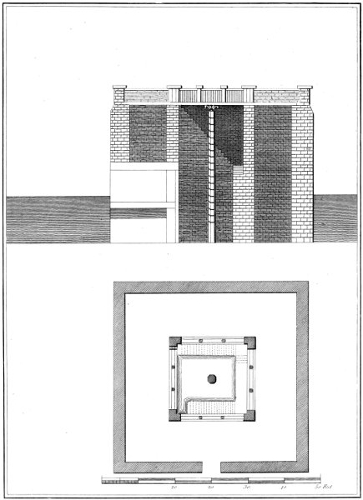
Mikeas. London Published Decr. 1st. 1789. by G. Robinson & Co.
They were perfectly acquainted with their ancient measure, and it is probable that Omar made an excessive addition by the new Nilometers which he had erected; so that faith being thereby broken between the government and people, the Egyptians set about watching the Nile upon the Nilometer with its new measure, as the only way of being informed when poverty or famine was to overtake them. This being told to Omar, he ordered the new Nilometer to be demolished; but as it had been part of the complaint to him, that their counting the divisions of the Mikeas162 was the reason why the people were kept in continual terror, he shut up the access to Christians, and that prohibition continues in Cairo to this day; and, instead of permitting ocular inspection, he ordered the daily increase to be proclaimed, but in a manner so unintelligible, that the Egyptians in general no longer understood it, nor do they understand it now; for, beginning at a given point, which was not the bottom of the Nilometer, he went on, telling the increase by subtracting from the upper division; so that as nobody knew the lower point from which he began, although they might comprehend how much it had risen since the crier proclaimed its increase, yet they never could know the height of the water that was in the Nilometer when the proclamation began, nor what the division was to which it had ascended on the pillar.
To understand this, let us premise, that, on the point of the island Rhoda, between Geeza and Cairo, near the middle of the river, but nearer to Geeza, is a round tower, and in that an apartment, in the middle of which is a very neat well, or cistern, lined with marble, to which the Nile has free access, through a large opening like an embrasure, the bottom of the well being on the same level with the bottom of the river. In the middle of this well rises a thin column, as far as I can remember, of eight faces of blue and white marble, to the foot of which, if you are permitted to descend, you are then on the same plane with the foot of the column and bottom of the river. This pillar is divided into 20 peeks, called Draa El Belledy, of 22 inches each163.
The two lowermost peeks are not divided at all, but are left absolutely without mark, to stand for the quantity of sludge the water deposits there, and which occupies the place of water. Two peeks are then divided on the right hand into 24 digits each; then, on the left, four peeks are divided each into 24 digits; then, on the right, four; and, on the left, another four: again, four on the right, which complete the number of 18 peeks from the first division marked on the pillar each of 22 inches. The whole, marked and unmarked, amounts to 36-8/12 feet English.
On the night of St John, when the Nucta has fallen, that is, when they see the rain-water from Ethiopia is so mixed with the Nile that at Cairo it is become exhalable, and falls down in dews upon the earth, which till that time it never does, they then begin to cry, having five peeks of water marked on the Mikeas, and two unmarked for the sludge; of which they take no notice in the proclamation. Their first proclamation, suppose the Nile hath risen 12 digits, is 12 from six, or it wants 12 digits to be six peeks. When it rises three more, it is nine from six, or, Tissa am Sitte, and so it goes on, subtracting the digits from the upper number, without giving you any information what that six is, or that they began to count from five, which I suppose is the assumed depth of the Nile before it begins to increase.
When the river has risen on the Mikeas eight peeks and 23 digits, they then call Wahad am erba Tush, i. e. one from 14, five peeks of water being left marked in the Mikeas, but only eight of augmentation that has risen upon the column, according to the divisions, which make in all 13 peeks and 23 digits, which wants one from being nine of augmentation, and that being added, they cry Wafaa Ullah, which obliges the country to the payment of the meery. Again, suppose 17 peeks, or cubits, and 23 digits to stand on the column, the cry is Wahad am temen Tush, i. e. one from 18, and, upon this being filled, and the divisions complete by a certain day in August, the next is Ashareen, 20, or, men Jibbel, alla Jibbel, from mountain to mountain, that is, 18 peeks marked on the pillar, and two unmarked at the foot of it, supposed to be covered with mud. All the land of Egypt is then fitted for cultivation; the great canal at Mansoura, and several others, are opened, which convey the water into the desert, and hinder any further stagnation on the fields, though there is still a great part of the water to come from Ethiopia, but which would not drain soon enough to fit the land for tillage, were the inundation suffered to go on.
Now, from these 16 peeks the Wafaa Ullah if we deduce 5, which were in the well, and marked on the column when the crier began, there will have been but 11 peeks of rise as a minimum, which still made the meery due, or 15, deducing 5 from 20, the maximum, men Jibbel, alla Jibbel, the increase that fits all Egypt for cultivation, after which is loss and danger. Therefore, suppose the 16 peeks on the medal of Hadrian to have been the minimum or fiscal term, we must infer, that the same quantity of inundation produced the Wafaa Ullah or payment of the meery, in Hadrian’s time, that it does at this day, and consequently the land of Egypt has not increased since his time, that is, in the last 1600 years.
As a summary of the whole relating to this periodical inundation of the Nile, I shall here deliver my opinion, which I think, as it is founded upon ancient history, consonant to that of intermediate times, and, invincibly established by modern observation, can never be overturned by any argument whatever. And this I shall do as shortly as possible, lest, having anticipated it in part by reflections explanatory of the narrative, it may at first sight have the appearance of repetition.
It is agreed on all hands, that Egypt, in early ages, had water enough to overflow the ground that composed it. It was then a narrow valley as it is now; having been early the seat of the arts, crowded with a multitude of people, enriched by the most flourishing and profitable trade, and its numbers supplied and recruited when needful by the immense nations to the southward of it, having grain and all the necessaries and luxuries of life (oil excepted) for the great multitude which it fed, Egypt was averse to any communication with strangers till after the foundation of Alexandria.
The first princes, after the building of Memphis, finding the land turn broader towards the Delta, whereas before it had been a narrow stripe confined between mountains; observing also that they had great command of water for fitting their land for cultivation, nay, that great part of it ran to waste without profit, which must have been the case, since it is so at this day: observing likewise, that the superabundance of water in the Nile did harm, and that the neighbouring sandy plains of Libya needed nothing but a judicious distribution of that water, to make it equal to the land of Egypt in fertility, and surpass it in the variety of natural productions, applied themselves very early to digging large lakes164, that, preserving a degree of level sufficient, all the year long watered the dry deserts of Libya like so many fruitful showers. Geometry, architecture, and all the mechanic arts of those times, were employed to accomplish those designs. These canals and vast works communicated one with another to imprison the water, and set it again at liberty at proper times.
We may be satisfied this was observed attentively all the time of the dynasties, or reigns of the Egyptian princes. After the accession of the Ptolemies, who were strangers, the multitude of inhabitants had greatly decreased. There was no occasion for works to water lands that were not peopled; so far as they were necessary for cities, gardens, and pleasure-grounds, they were always kept up. The larger and more extensive conduits, dykes, and sluices, though they were not used, were protected by their own solidity and strength from sudden ruin. Egypt, now confined within its ancient narrow valley, had water enough to keep it in culture, and make it still the granary of the inhabited world.
When the ancient race of the Ptolemies ended, a scene of war and confusion, and bad government at home, was succeeded by a worse under foreigners abroad. The number of its inhabitants was still greatly decreased, and the valley had yet a quantity of water enough to fit it for annual culture.
In the reign of the second emperor after the Roman conquest, Petronius Arbiter, a man well known for taste and learning, was governor of Egypt. He saw with regret the decay of the magnificent works of the ancient native Egyptian princes. His sagacity penetrated the usefulness and propriety of those works. He saw they had once made Egypt populous and flourishing. Like a good citizen and subject of the state he served, and from a humane and rational attachment to that which he governed, he hoped to make it again as flourishing under the new government as it had been under the old. Like a man of sense, and master of his subject, he laughed at the dastardly spirit of the modern Egyptians, anxious and trembling lest the Nile should not overflow land enough to give them bread, when they had the power in their hands to procure plenty in abundance for six times the number of the people then in Egypt. To shew them this, he repaired their ancient works, raised their banks, refitted their sluices, and by thus imprisoning, as I may say, the inundation at a proper time in the beginning, he overflowed all Egypt with 8 peeks of water, as fully, and as effectually, as to the purposes of agriculture, as before and since it hath been with 16; and did not open the sluices to allow the water to run and waste in the desert (where there was now no longer any inhabitants), till the land of the valley of Egypt had been so well watered as only to need that the inundation should retire in time to leave the farmer the ground firm enough for plowing and sowing.
Let any one read what I have already quoted from Strabo; it is just what I have here repeated, but in fewer words. Let him consider how fair an experiment this of Petronius was, that by re-establishing the works of Mæris, and putting the inundation to the same profit that Mæris did, he found the same quantity of water overflow the same quantity of ground, and consequently, that the land of Egypt had not been raised an inch from Mæris’s time to that of Petronius, above 1400 years.
Now the second part of the question comes, what difference of measure was made by the Saracens, and how does it now stand, after that period, as to the supposed rise of a foot in a hundred years? It is now above 1100 years since the165 first of the Hegira, and near 900 years since the erection of the present Mikeas, which being equal to the period between Mæris and Herodotus, and again to that between Herodotus and Julian, we should begin to be certain if any such increase in the land has ever, from Mæris to the present time, been indicated by the Nilometer.
The reader will perhaps be surprised, at what I am going to advance, That those writers, as well as their supporters who have pronounced so positively on this subject, have not furnished themselves with the data which are absolutely necessary to solve this question. Quantity is only to be ascertained by measure, yet none of them have settled that only medium of judging. The Mikeas, or pillar, is the subject to be measured, and they are not yet agreed within 20 feet of its extreme height, nor about the division of any part of it. As this accusation appears to be a strong one, I shall set down the proof for the reader’s consideration, that it may not be supposed I mean to criticise improperly, or to do any author injustice.
And first of the Mikeas. Mr Thomas Humes, a gentleman quoted by166 Dr Shaw, who had been a great many years a factor at Cairo, says, that the Mikeas is 58 feet English in height. Now, there is really no reason why such an enormous pillar should have been built, as the Nile would drown all Cairo before it was to rise to this height; accordingly, as we have seen, its height is not so much by near 22 feet. Dr Perry167 next, who has wrote largely upon the subject, says, the Mikeas, or column, is divided into 24 peeks, and each peek or cubit is 24 inches nearly. Dr Pococke168, who travelled at the same time, agrees in the division of 24 peeks, but says that these peeks are unequal. The 16 lower he supposes are 21 inches, the 4 next, 24 inches, and the uppermost, 22. So that one of these gentlemen makes the Mikeas 43 feet, which is above six feet more than the truth, and the other 48, which is above 11; besides the second error which Dr Pococke has committed, by saying the divisions are of three different dimensions, when they really are not any one of them what he conceives, nor is the Mikeas divided unequally.
As for Mr Humes, who had lived long at Cairo, I would by no means be thought to insinuate a doubt of his veracity: There may, in change of times, be occasions when Christians may be admitted to the Mikeas, and be allowed to measure exactly. This, however, must be with a long rod, divided and brought on purpose, with a high stool or scaffold, and this sort of preparation would be attended with much danger if seen in the hand of a Christian without, and much more if he was to attempt to apply it to the column within. At Cairo a man may see or hear any thing he desires, by the ordinary means of gold, which no Turk can withstand or refuse; but often one villain is paid for being your guide, and another villain, his brother, pays himself, by informing against you; the end is mischief to yourself, which, if you are a stranger, generally involves also your friends. You are asked, What did you at the Mikeas when you know it is forbidden? and your silence after that question is an acknowledgement of guilt; sentence immediately follows, whatever it may be, and execution upon it. I rather am inclined to think, that though several Christians have obtained admission to the Mikeas, very few have had the means or instruments, and fewer still the courage, to measure this column exactly; which leads me to believe, as Dr Shaw says, he procured the number of feet in a letter from Mr Humes, that the Doctor has mistaken 58 for 38, which, in a foreign hand, is very easily done; it would then be 38, instead of 58 English feet, and to that number it might approach near enough, and the difference be accounted for, from an aukward manner of measuring with a trembling hand, there being then only a little more than one foot of error.
From what I have just now mentioned, I hope it is sufficiently plain to the reader, that the length and division of the column in the Mikeas, by which the quantity of water, and consequently the increase of the soil, was to be determined, was utterly unknown to those travellers who had undertaken this mode of determining it.
I shall now inquire, whether they were better instructed in the length of that measure, which, after the Saracen conquest, was introduced into the Nilometer, of Geeza, where it has remained unaltered since the year 245? Dr Shaw introduces the consideration of this subject by an enumeration of many different peeks, seven of which he quotes from Arabian authors, as being then in use. First, the Homaræus 1-2/9 digit of the common cubit. 2. The Hasamean, or greater peek, of 24 digits. 3. The Belalæan, less than the Hasamean. 4. The black cubit less than the Belalean 2⅔ digits. 5. The Jossippæan ⅔ of a digit less than the black cubit. 6. The Chord, or Asaba, 1⅔ digit less than the black peek. 7. The Maharanius, 2⅔ digits less than the black cubit169. Now, I will appeal to any one to what all this information amounts, when I am not told the length of the common peek to which he refers the rest, as being 1½ digit, or 2 digits more or less. He himself thinks that the measuring peek is the Stambouline peek, but then, for computation’s sake, he takes a peek of his own invention, being a medium of 4 or 5 guesses, and fixes it at 25 inches, for which he has no authority but his own imagination.
I will not perplex the reader more with the different measures of these peeks, between the Hasamean and great peek of Kalkasendas, which is 18 inches, and the black peek, a model of which Dr Bernard170 has given us from an Arabic MS. at Oxford, the difference is 10 inches. The first being 18 inches equal to the Samian peek, the other 28½ inches, and from this difference we may judge, joined to the uncertainties of the height and divisions of the Mikeas, how impossible it is for us to determine the increase of 12 inches in a hundred years.
As the generality of writers have fixed upon the Constantinople, or Stambouline peek, for the measure of the Mikeas, in which choice they have erred, we will next seek what is the measure of the Stambouline peek, and whether they have in this article been better informed.
M. de Maillet, French consul at Cairo, says, that this peek is equal to 2 French feet, or very nearly 26 inches of our measure: and, to add to this another mistake, he states, that by this peek the Mikeas is measured; and, for the completing of the confusion, he adds, that the Nile must rise 48 French feet before it covers all their lands. What he means by all their lands is to very little purpose to inquire, for he would probably have been drowned in his closet in which he made these computations, long before he had seen the Nile at that height, or near it.
Without, then, wandering longer in this extraordinary confusion, which I have only stated to shew that a traveller may differ from Dr Shaw, and yet be right, and that this writer, however learned he may be, cannot, for want of information, be competent to solve this question which he so much insists upon, I shall now, with great submission to the judgment of my reader, endeavour to explain, in as few words as possible, how the real state of the matter stands, and he will then apply it as he pleases.
There was a very ingenious gentleman whom I met with at Cairo, M. Antes, a German by birth, and of the Moravian persuasion, who, both to open to himself more freely the opportunities of propagating his religious tenets, and to gratify his own mechanical turn, rather than from a view of gain, to which all his society are (as he was) perfectly indifferent, exercised the trade of watch-maker at Cairo. This very worthy and sagacious young man was often my unwearied and useful partner in many inquiries and trials, as to the manner of executing some instruments in the most compendious form for experiments proposed to be made in my travels. By his assistance, I formed a rod of brass, of half an inch square, and of a thickness which did not easily warp, and would not alter its dimensions unless with a violent heat. Upon the three faces of this brasen rod we traced, with good glasses and dividers, the measure of three different peeks, then the only three known in Cairo, the exact length of which was taken from the standard model furnished me by the Cadi. The first was the Stambouline, or Constantinople peek, exactly 23⅗ inches; the second, the Hendaizy, of 24-7/10 inches; and the third the peek El Belledy, of 22 inches, all English measure.
It was natural to suppose, that, after knowing as we do, that no alteration has been made in the Mikeas since the 245th year of the Hegira, that the peek of Constantinople, a foreign measure, was probably then not known, nor introduced into Egypt; nor, till after the conquest of Sultan Selim, in the year 1516, was it likely to be the peek with which the Mikeas was measured. It did not, as I conceive, exist in the 245th of the Hegira, though, even if it had, its dimensions may have been widely different from those fixed upon by the number of writers whose authority we have quoted, but who do not agree. It was not likely to be the Hendaizy peek either, for this, too, was a foreign measure, originally from the island of Meroë, and well known to the Egyptians in Upper Egypt, but not at all to the Saracens their present masters. The peek, El Belledy, the measure in common use, and known to all the Egyptians, was the proper cubit to be employed in an operation which concerned a whole nation, and was, therefore, the measure made use of in the division of the Mikeas, for that column, as I have said, is divided equally into peeks, or draas, called Draa El Belledy, consisting of 22 inches; and each of these peeks is again divided into 24 digits.
A very ingenious author, who treats of the particular circumstances of those times, in his MS. called Han el Mohaderat, says, that the inhabitants of Seide counted 24 peeks on their Nilometer, when there were 18 peeks marked as the rise of the water upon the Mikeas at Rhoda; and this shews perfectly two things: First, That they knew the whole secret of counting there both by the marked and unmarked part of the column; for the peek of the Mikeas being 22 inches English, it was, by consequence, four inches larger each peek than the Samian peek; so that if, to 20 peeks of Seide, you add twenty times four inches, which is 80, the difference of the two peeks, when divided by 18, gives four, which, added to the 20 peeks on the column, make 24 peeks, the number sought. Secondly, That this observation in the Han el Mohaderat sufficiently confirms what I have said both of the length of the column and length of the peek; that the former is 20 peeks in height, and that the measure, by which this is ascertained, is the peek El Belledy of 22 inches, as it appears on the brass rod, four inches longer than the Samian peek, and consequently is not the peek of Stambouline, nor any foreign measure whatever.
A traveller thinks he has attained to a great deal of precision, when, observing 18 peeks on the highest division of the column from its base, or bottom of the well, he finds it 37 feet; he divides this by 18, and the quotient is 24 inches; when he should divide it by 20, and the answer would be 22 and a fraction, the true content of the peek El Belledy, or peek of the Mikeas. This erroneous division of his he calls the peek of the Mikeas; and comparing it with what authors, less informed than himself, have said, he names the Stambouline peek, and then the black peek, when it really is his own peek, the creature of his own error or inadvertence; but, as he does not know this, it is handed down from traveller to traveller, till unfortunately it is adopted by some man of reputation, and it then becomes, as in this case, a sort of literary crime to any man, from the authority of his own eyes and hands, to dispute it.
Mr Pococke makes two very curious and sensible remarks in point of fact, but of which he does not know the reason. “The Nile, he says, in the beginning, turns red, and sometimes green; then the waters are unwholesome. He supposes that the source of the Nile beginning to flow plentifully, the waters at first bring away that green or red filth which may be about the lakes at its rise, or at the rise of these small rivers that flow into it, near its principal source; for, though there is so little water in the Nile, when at lowest, that there is hardly any current in many parts of it, yet it cannot be supposed that the water should stagnate in the bed of the Nile, so as to become green. Afterwards the water becomes very red and still more turbid, and then it begins to be wholesome171.”
The true reason of this appearance is from those immense marshes spread over the country about Narea and Caffa, where there is little level, and where the water accumulates, and is stagnant, before it overflows into the river Abiad, which rises there. The overflowing of these immense marshes carry first that discoloured water into Egypt, then follows, in Abyssinia, the overflowing of the great lake Tzana, through which the Nile passes, which, having been stagnated and without rain for six months, under a scorching sun, joins its putrid waters with the first. There are, moreover, very few rivers in Abyssinia that run after November, as they stand in prodigious pools below, in the country of the Shangalla, and afford drink for the elephant, and habitation and food for the hippopotamus. These pools likewise throw off their stagnant water into the Nile on receiving the first rains; at last the rivers, marshes, and lakes, being refreshed by showers, (the rain becoming constant) and passing through the kingdom of Sennaar, the soil of which is a red bole; This mixture, and the moving sands of the deserts, fall into the current, and precipitate all the viscous and putrid substances, which cohere and float in the river; and thence (as Pococke has well observed) the sign of the Nile being wholesome, is not when it is clear and green, but when mingled with fresh water, and after precipitation it becomes red and turbid, and stains the water of the Mediterranean.
The next remark of Mr Pococke172 is equally true. It has been observed, says he, that after the rainy season is over, the Nile fallen, and the whole country drained from inundation, it has begun again to rise; and he gives an instance of that in December 1737, when it had a sudden increase, which alarmed all Egypt, where the received opinion was that it presaged calamities. This also is said to have happened in the time of Cleopatra, when their government was subverted, their ancient race of kings extinguished in the person of that princess, and Egypt became a province to the Romans.
The reader will not expect, in these enlightened times, that I should use arguments to convince him, that this rising of the Nile had nothing to do with the extinction of the race of the Ptolemies, though popular preachers and prophets have always made use of these fortuitous events to confirm the vulgar in their prejudices.
The rains, that cease in Abyssinia about the 8th of September, leave generally a sickly season in the low country; but other rains begin towards the end of October, in the last days of the Ethiopic month Tekemt, which continue moderately about three weeks, and end the 8th of November, or the 12th of the Ethiopic month Hedar. All sickness and epidemical diseases then disappear, and the 8th of that month is the feast of St Michael, the day the king marches, and his army begins their campaign; but the effect of these second rains seldom make any, or a very short appearance in Egypt, all the canals being open. But these are the rains upon which depend their latter crops, and for which the Agows, at the source of the Nile, pray to the river, or to the genius residing in the river. We had plentiful showers both in going and coming to that province, especially in our journey out. Whenever these rains prove excessive, as in some particular years it seems they do, though but very rarely, the land-floods, and those from the marshes, falling upon the ground, already much hardened and broken into chasms, by two months intense heat of the sun, run violently into the Nile without sinking into the earth. The consequence is this temporary rising of the Nile in December, which is as unconnected with the good and bad crops of Egypt, as it is on those of Palestine or Syria.
The quantity of rain that falls in Ethiopia varies greatly from year to year, as do the months in which it falls. The quantity that fell, during 1770, in Gondar, between the vernal equinox and the 8th of September, through a funnel of one foot English in diameter, was 35.555 inches; and, in 1771, the quantity that fell in the same circumference was 41.355 inches in the same space173.
In 1770, August was the rainy month; in 1771 July. Both these years the people paid the meery, and the Wafaa Ullah was in August. When July is the rainy month, the rains generally cease for some days in the beginning of August, and then a prodigious deal falls in the latter end of that month and the first week of September. In other years, July and August are the violent rainy months, whilst June is fair. And lastly, in others, May, June, July, August and the first week of September. Now we shall suppose (which is the most common case of all) that every month from June doubles its rain. The Wafaa Ullah generally takes place about the 9th of August, the tribute being then due, and all attention to the Mikeas is abandoned at 14 real peeks, the Calish is then cut, and the water let down to the Delta.
Now these 14 peeks are not a proof how much water there is to overflow the land; for supposing nine days for its passage from Ethiopia, then the 9th of August receives at Cairo no later rains than those that have fallen the 1st of August in Ethiopia, and from that date till the 17th of September, the Nile increases one third of its whole inundation, which is never suffered to appear on the Mikeas, but is turned down to the lakes in the Delta, as I suppose it always has been; so that the quantity of water which falls in Ethiopia hath never yet been ascertained, and never can be by the Mikeas, nor can it ever be known what quantity of water comes in to Egypt, or what quantity of ground it is sufficient to overflow, unless the dykes were to be kept close till the Nile attained its extreme height,which would be about the 25th of September, long before which it would be over the banks and mounds, if they held in till then, or have swept Cairo and all the Delta into the Mediterranean, and if it should not do that, it would retire so late from the fields as to leave the ground in no condition to be sown that year.
I do not comprehend what idea other travellers have formed of the beginning of the inundation of the Nile, as they seem to admit that the banks are not overflowed; and this is certainly the case; because the cities and villages are built there as securely as on the highest part of Egypt, and even when the Nile has risen to its greatest height they still are obliged to water those spots with machines. In another part of the work it is explained how the calishes carry the water upon the lands, approaching always to the banks as the river rises in proportion, and these calishes being derived from the Nile at right angles with the stream, and carrying the water by the inclination of the ground, in a direction different from the course of the river, the water is perfectly stagnated at the foot of the hills, till accumulated as the stream rises, it moves in a contrary direction backwards again, and approaches its banks. But when the inundation is so great that the back-water comes in contact with the current of the Nile, by known laws it must partake the same motion with it, and so all Egypt become one torrent.
Dr Shaw, indeed174, says, that there seems to be a descent from the banks to the foot of the mountains, but this he considers as an optic fallacy; I wish he had told us upon what principle of optics; but if it was really so, how comes it that the banks are every year dry, when the foot of the mountains is at same time under inundation; or, in other words, what is the reason of that undisputed fact, that the foot of the mountains is laid under water in the beginning of the rivers rising, while the ground which they cultivate by labour near the banks, cannot supply itself from the river by machines, till near the height of the inundation? these facts will not be contraverted by any traveller, who has ever been in Upper Egypt; but if this had been admitted as truth instead of an optic fallacy, this question would have immediately followed. If the land of Egypt at the foot of the mountains, is the lowest, the first overflowed, and the longest covered with water, and often the only part overflowed at all, whence can it arise that it is not upon a level with the banks of the river if it is true that the land of Egypt receives additional height every year by the mud from Abyssinia deposited by the stream? and this question would not have been so easily answered.
The Nile for these thirty years has but once so failed as to occasion dearth, but never in that period so as to produce famine in Egypt. The redundance of the water sweeping every thing before it, has thrice been the cause, not of dearth, but of famine and emigration; but carelessness, I believe, hath been, the occasion of both, and very often the malice of the Arabs; for there are in Egypt, from Siout downwards, great remains of ancient works, vast lakes, canals, and large conduits for water, destined by the ancients to keep this river under controul, serving as reservoirs to supply a scanty year, and as drains, or outlets, to prevent the over abundance of water in wet years, by spreading it in the thirsty sands of Libya to the great advantage of the Arabs, rather than letting it run to waste in the Mediterranean. The mouths of these immense drains being out of repair, in a scanty year, contribute by their evacuation to make it still scantier by not retaining water, and if after a dearth they are well secured, or raised too high, and a wet season follows, they then occasion a destructive inundation.
I hope I have now satisfied the reader, that Egypt was never an arm of the sea, or formed by sediments brought down in the Nile, but that it was created with other parts of the globe at the same time, and for the same purposes; and we are warranted to say this, till we receive from the hand of Providence a work of such imperfection, that its destruction can be calculated from the very means by which it was first formed, and which were the apparent sources of its beauty and pre-eminence. Egypt, like other countries, will perish by the fiat of Him that made it, but when, or in what manner, lies hid where it ought to be, inaccessible to the useless, vain inquiries, and idle speculations of man.