PETER KALM’s TRAVELS. (continued 4)
Johann Reinhold Forster translation
No manufactures of note have as yet been established here; at present they get all manufactured goods, such as woollen and linen cloth, &c. from England, and especially from London.
The river Hudson is very convenient for the commerce of this city; as it is navigable for near a hundred and fifty English miles up the country, and falls into the bay not far from the town, on its western side. During eight months of the year this river is full of yachts, and other greater and lesser vessels, either going to New York or returning from thence, laden either with inland or foreign goods.
I cannot make a just estimate of the ships that annually come to this town or sail from it. But I have found by the Pensylvania gazettes that from the first of December in 1729, to the fifth of December in the next year, 211 ships entered the port of New York, and 222 cleared it; and since that time there has been a great increase of trade here.
The country people come to market in New York, twice a week much in the same manner, as they do at Philadelphia; with this difference, that the markets are here kept in several places.
The governor of the province of New York, resides here, and has a palace in the fort. Among those who have been entrusted with this post, William Burnet deserves to be had in perpetual remembrance. He was one of the sons of Dr. Thomas Burnet (so celebrated on account of his learning) and seemed to have inherited the knowledge of his father. But his great assiduity in promoting the welfare of this province, is what makes the principal merit of his character. The people of New York therefore still reckon him the best governor they ever had, and think that they cannot praise his services too much. The many astronomical observations which he made in these parts, are inserted in several English works. In the year 1727, at the accession of king George the II. to the throne of Great Britain, he was appointed governor of New England. In consequence of this he left New York, and went to Boston, where he died universally lamented, on the 7th. of September 1729.
An assembly of deputies from all the particular districts of the province of New York, is held at New York once or twice every year. It may be looked upon as a parliament or dyet in miniature. Every thing relating to the good of the province is here debated. The governor calls the assembly, and dissolves it at pleasure: this is a power which he ought only to make use of, either when no farther debates are necessary, or when the members are not so unanimous in the service of their king and country as is their duty: it frequently however happens, that, led aside by caprice or by interested views, he exerts it to the prejudice of the province. The colony has sometimes had a governor, whose quarrels with the inhabitants, have induced their representatives, or the members of the assembly, through a spirit of revenge, to oppose indifferently every thing he proposed, whether it was beneficial to the country or not. In such cases the governor has made use of his power; dissolving the assembly, and calling another soon after, which however he again dissolved upon the least mark of their ill humour. By this means he so much tired them, by the many expences which they were forced to bear in so short a time, that they were at last glad to unite with him, in his endeavours for the good of the province. But there have likewise been governors who have called assemblies and dissolved them soon after, merely because the representatives did not act according to their whims, or would not give their assent to proposals which were perhaps dangerous or hurtful to the common welfare.
The king appoints the governor according to his royal pleasure; but the inhabitants of the province make up his excellency’s salary. Therefore a man entrusted with this place has greater or lesser revenues, according as he knows how to gain the confidence of the inhabitants. There are examples of governors in this, and other provinces of North America, who by their dissensions with the inhabitants of their respective governments, have lost their whole salary, his Majesty having no power to make them pay it. If a governor had no other resource in these circumstances, he would be obliged either to resign his office, or to be content with an income too small for his dignity; or else to conform himself in every thing to the inclinations of the inhabitants: but there are several stated profits, which in some measure make up for this. 1. No one is allowed to keep a public house without the governor’s leave; which is only to be obtained by the payment of a certain fee, according to the circumstances of the person. Some governors therefore, when the inhabitants refused to pay them a salary, have hit upon the expedient of doubling the number of inns in their province. 2. Few people who intend to be married, unless they be very poor, will have their banns published from the pulpit; but instead of this they get licences from the governor, which impower any minister to marry them. Now for such a licence the governor receives about half a guinea, and this collected throughout the whole province, amounts to a considerable sum. 3. The governor signs all passports, and especially of such as go to sea; and this gives him another means of supplying his expences. There are several other advantages allowed to him, but as they are very trifling, I shall omit them.
At the above assembly the old laws are reviewed and amended, and new ones are made: and the regulation and circulation of coin, together with all other affairs of that kind are there determined. For it is to be observed that each English colony in North America is independent of the other, and that each has its proper laws and coin, and may be looked upon in several lights, as a state by itself. From hence it happens, that in time of war, things go on very slowly and irregularly here: for not only the sense of one province is sometimes directly opposite to that of another; but frequently the views of the governor, and those of the assembly of the same province, are quite different: so that it is easy to see, that, while the people are quarrelling about the best and cheapest manner of carrying on the war, an enemy has it in his power to take one place after another. It has commonly happened that whilst some provinces have been suffering from their enemies, the neighbouring ones were quiet and inactive, and as if it did not in the least concern them. They have frequently taken up two or three years in considering whether they should give assistance to an oppressed sister colony, and sometimes they have expresly declared themselves against it. There are instances of provinces who were not only neuter in these circumstances, but who even carried on a great trade with the power which at that very time was attacking and laying waste some other provinces.
It is however of great advantage to the crown of England, that the North American colonies are near a country, under the government of the French, like Canada. There is reason to believe that the king never was earnest in his attempts to expel the French from their possessions there; though it might have been done with little difficulty. For the English colonies in this part of the world have encreased so much in their number of inhabitants, and in their riches, that they almost vie with Old England. Now in order to keep up the authority and trade of their mother country, and to answer several other puposes, they are forbid to establish new manufactures, which would turn to the disadvantage of the British commerce: they are not allowed to dig for any gold or silver, unless they send them to England immediately: they have not the liberty of trading to any parts that do not belong to the British dominions, excepting some settled places, and foreign traders are not allowed to send their ships to them. These and some other restrictions, occasion the inhabitants of the English colonies to grow less tender for their mother country. This coldness is kept up by the many foreigners such as Germans, Dutch and French settled here, and living among the English, who commonly have no particular attachment to Old England; add to this likewise that many people can never be contented with their possessions, though they be ever so great, and will always be desirous of getting more, and of enjoying the pleasure which arises from changing; and their over great liberty, and their luxury often lead them to licentiousness.
I have been told by Englishmen, and not only by such as were born in America, but even by such as came from Europe, that the English colonies in North-America, in the space of thirty or fifty years, would be able to form a state by themselves, entirely independent on Old England. But as the whole country which lies along the sea shore, is unguarded, and on the land side is harrassed by the French, in times of war these dangerous neighbours are sufficient to prevent the connection of the colonies with their mother country from being quite broken off. The English government has therefore sufficient reason to consider the French in North-America, as the best means of keeping the colonies in their due submission. But, I am almost gone too far from my purpose; I will therefore finish my observations on New York.
The declination of the magnetic needle, in this town was observed by Philip Wells, the chief engineer of the province of New York, in the year 1686, to be eight deg. and forty-five min. to the westward. But in 1723, it was only seven deg. and twenty min. according to the observations of governor Burnet.
From hence we may conclude that in thirty-eight years the magnet approaches about one deg. and twenty five min. nearer to the true north; or, which is the same thing, about two min. annually. Mr. Alexander, a man of great knowledge in astronomy and in mathematics, assured me from several observations, that in the year 1750, on the eighteenth of September the deviation was to be reckoned six deg. and twenty two min.
There are two printers in the town, and every week some English gazettes are published, which contain news from all parts of the world.
The winter is much more severe here, than in Pensylvania; it being nearly as cold as in some of the provinces of Sweden: its continuance however is much shorter than with us: their spring is very early and their autumn very late, and the heat in summer is excessive. For this reason, the melons sown in the fields are ripe at the beginning of August; whereas we can hardly bring them so soon to maturity under glasses and on hot beds. The cold of the winter, I cannot justly determine, as the meteorological observations which were communicated to me, were all calculated after thermometers, which were so placed in the houses, that the air could not freely come at them. The snow lies for some months together upon the ground; and sledges are made use of here as in Sweden, but they are rather too bulky. The river Hudson is about an English mile and a half broad at its mouth: the difference between the highest flood and the lowest ebb is between six and seven feet, and the water is very brackish: yet the ice stands in it not only one but even several months: it has sometimes a thickness of more than two feet.
The inhabitants are sometimes greatly troubled with Musquitoes. They either follow the hay which is made near the town, in the low meadows which are quite penetrated with salt water; or they accompany the cattle at night when it is brought home. I have myself experienced, and have observed in others, how much these little animalcules can disfigure a person’s face during a single night; for the skin is sometimes so covered over with little blisters from their stings, that people are ashamed to appear in public. The water melons which are cultivated near the town grow very large: they are extremely delicious, and are better than in other parts of North America; though they are planted in the open fields and never in a hot-bed. I saw a water melon at Governor Clinton’s in September 1750, which weighed forty seven English pounds, and at a merchant’s in town another of forty two pounds weight: however they were reckoned the biggest ever seen in this country.
In the year 1710, five kings, or Sachems of the Iroquois went from hence to England, in order to engage Queen Anne to make an alliance with them against the French. Their names, dress, reception at court, speeches to the Queen, opinion of England and of the European manners, and several other particulars about them are sufficiently known from other writings; it would therefore be here unnecessary to enlarge about them. The kings or Sachems of the Indians, have commonly no greater authority over their subjects than constables in a meeting of the inhabitants of a parish, and hardly so much. On my travels through the country of these Indians, I had never any occasion to go and wait upon the Sachems; for they always came into my habitation without being asked: these visits they commonly paid in order to get a glass or two of brandy, which they value above any thing they know. One of the five Sachems mentioned above, died in England; the others returned safe.
The first colonists in New York were Dutchmen: when the town and its territories were taken by the English, and left them by the next peace in exchange for Surinam, the old inhabitants were allowed either to remain at New York, and to enjoy all the privileges and immunities which they were possessed of before, or to leave the place with all their goods: most of them chose the former; and therefore the inhabitants both of the town and of the province belonging to it, are yet for the greatest part Dutchmen; who still, especially the old people, speak their mother tongue.
They begin however by degrees to change their manners and opinions; chiefly indeed in the town and in its neighbourhood: for most of the young people now speak principally English, and go only to the English church; and would even take it amiss, if they were called Dutchmen and not Englishmen.
Though the province of New York has been inhabited by Europeans, much longer than Pensylvania, yet it is not by far so populous as that colony. This cannot be ascribed to any particular discouragement arising from the nature of the soil; for that is pretty good: but I was told of a very different reason, which I will mention here. In the reign of Queen Anne about the year 1709, many Germans came hither, who got a tract of land from the government on which they might settle. After they had lived there for some time, and had built houses and churches, and made corn-fields and meadows, their liberties and privileges were infringed, and under several pretences they were repeatedly deprived of parts of their land. This at last rouzed the Germans; they returned violence for violence, and beat those who thus robbed them of their possessions. But these proceedings were looked upon in a very bad light by the government: the most active people among the Germans being taken up, they were very roughly treated, and punished with the utmost rigour of the law. This however so far exasperated the rest, that the greater part of them left their houses and fields, and went to settle in Pensylvania: there they were exceedingly well received, got a considerable tract of land, and were indulged in great privileges which were given them forever. The Germans not satisfied with being themselves removed from New York, wrote to their relations and friends and advised them, if ever they intended to come to America, not to go to New York, where the government had shewn itself so unequitable. This advice had such influence, that the Germans, who afterwards went in great numbers to North America, constantly avoided New York and always went to Pensylvania. It sometimes happened that they were forced to go on board such ships as were bound to New York; but they were scarce got on shore, when they hastened on to Pensylvania in sight of all the inhabitants of New York.
But the want of people in this province may likewise be accounted for in a different manner. As the Dutch, who first cultivated this country, obtained the liberty of staying here by the treaty with England, and of enjoying all their privileges and advantages without the least limitation, each of them took a very large piece of ground for himself, and many of the more powerful heads of families made themselves the possessors and masters of a country of as great an extent as would be sufficient to form a middling and even a great parish. Most of them being very rich, their envy of the English led them not to sell them any land, but at an excessive rate; a practice which is still punctually observed among their descendants. The English therefore as well as people of different nations, have little encouragement to settle here. On the other hand they have sufficient opportunity in the other provinces, to purchase land at a more moderate price, and with more security to themselves. It is not then to be wondered, that so many parts of New York are still uncultivated, and have entirely the appearance of desarts. This instance may teach us how much a small mistake in a government will injure population.
November the 3d. About noon we set out from New York on our return, and continuing our journey, we arrived at Philadelphia on the fifth of November.
In the neighbourhood of this capital (of Pensylvania) the people had a month ago made their cyder, which they were obliged to do, because their apples were so ripe as to drop from the trees. But on our journey through New York we observed the people still employed in pressing out the cyder. This is a plain proof that in Pensylvania the apples are sooner ripe than in New York; but whether this be owing to the nature of the soil, or a greater heat of the summer in Philadelphia, or to some other cause I know not. However there is not the least advantage in making cyder so early: for long experience had taught the husbandmen that it is worse for being made early in the year; the great heat in the beginning of autumn being said to hinder the fermentation of the juice.
Pa:273. Pl:2.
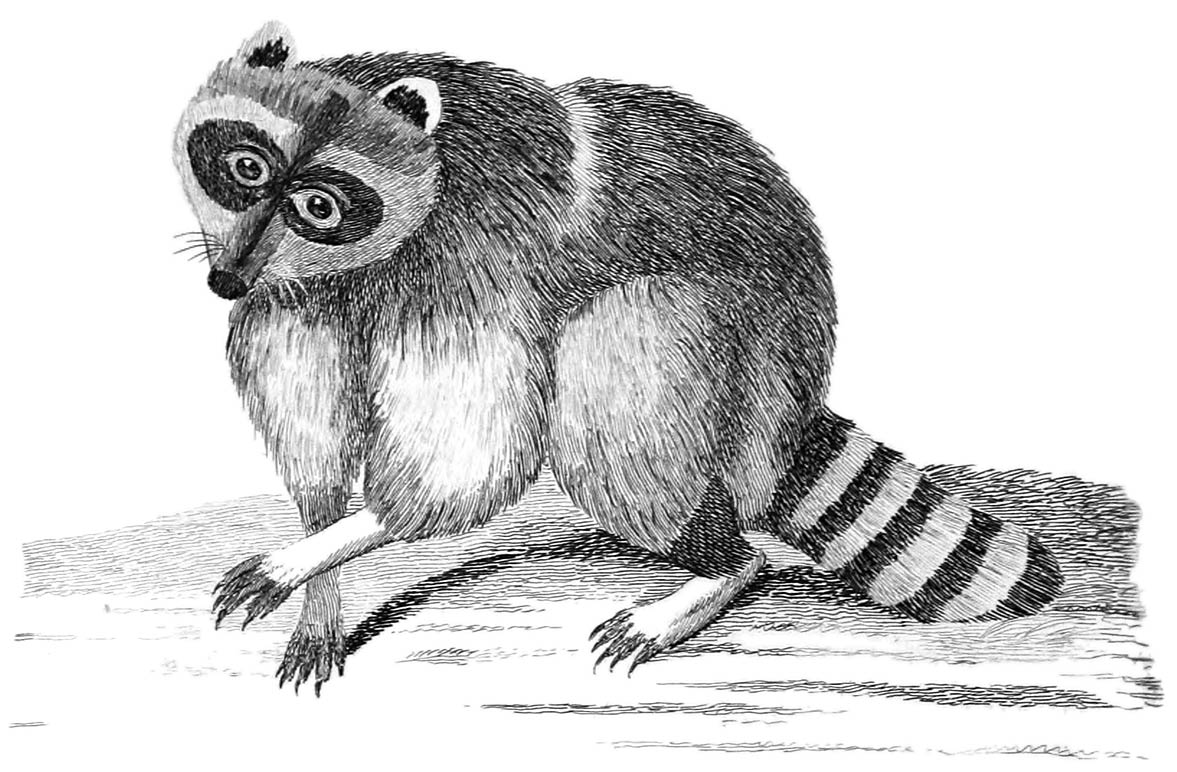
Racoon.
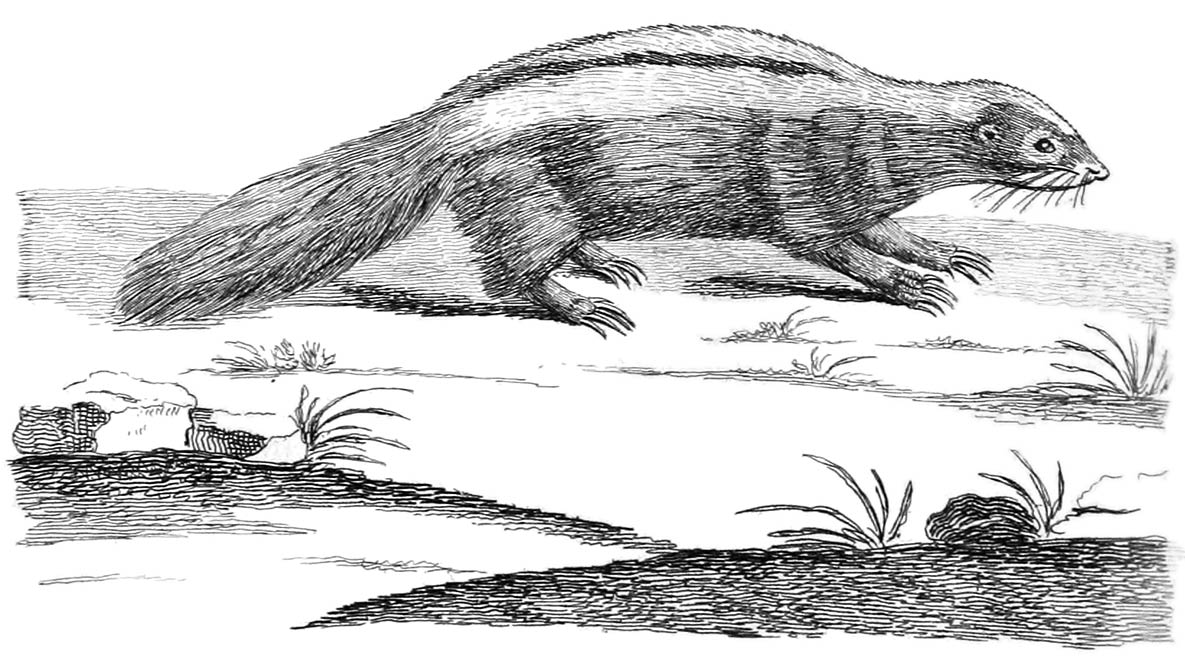
American Pole-Cat.
This animal has a particular quality by which it is principally known; when it is pursued by men or dogs it runs at first as fast as it can, or climbs upon a tree; but if it is so beset by its pursuers, as to have no other way of making its escape, it squirts its urine upon them. This according to some it does by wetting its tail with the urine whence by a sudden motion it scatters it abroad; but others believe, that it could send its urine equally far without the help of its tail; I find the former of these accounts to be the most likely. For, some credible people assured me, that they have had their faces wetted with it all over; though they stood above eighteen feet off from the animal. The urine has so horrid a stench that nothing can equal it: it is something like that of the Cranesbill or Linnæus’s Geranium robertianum, but infinitely stronger. If you come near a polecat when it spreads its stench, you cannot breathe for a while, and it seems as if you were stifled; and in case the urine comes into the eyes, a person is likely to be blinded. Many dogs that in a chace pursue the polecat very eagerly, run away as fast as they can when they are wetted: however, if they be of the true breed, they will not give over the pursuit till they have caught and killed the polecat; but they are obliged now and then to rub their noses in the ground in order to relieve themselves.
Clothes which have been wetted by this animal retain the smell for more than a month; unless they be covered with fresh soil, and suffered to remain under it for twenty four hours together; when it will in a great measure be removed. Those likewise who have got any of this urine upon their face and hands, rub them with loose earth; and some even hold their hands in the ground for an hour; as washing will not help them so soon. A certain man of rank who had by accident been wetted by the polecat, stunk so ill, that on going into a house, the people either ran away, or on his opening the door, rudely denied him entrance. Dogs that have hunted a polecat are so offensive for some days afterwards, that they cannot be borne in the house. At Philadelphia I once saw a great number of people on a market day throwing at a dog that was so unfortunate as to have been engaged with a polecat just before, and to carry about him the tokens of its displeasure. Persons when travelling through a forest are often troubled with the stink which this creature makes; and sometimes the air is so much infected that it is necessary to hold ones nose. If the wind blows from the place where the polecat has been, or if it be quite calm, as at night, the smell is more strong and disagreeable.
In the winter of 1749, a polecat tempted by a dead lamb, came one night near the farm house where I then slept. Being immediately pursued by some dogs, it had recourse to its usual expedient in order to get rid of them. The attempt succeeded, the dogs not choosing to continue the pursuit: the stink was so extremely great that, though I was at some distance it affected me in the same manner as if I had been stifled; and it was so disagreeable to the cattle that it made them roar very loudly: however, by degrees it vanished. Towards the end of the same year one of these animals got into our cellar, but no stench was observed, for it only vents that when it is pursued. The cook however found for several days together that some of the meat which was kept there was eaten; and suspecting that it was done by the cat she shut up all avenues, in order to prevent their getting at it. But the next night being awoke by a noise in the cellar, she went down, and though it was quite dark, saw an animal with two shining eyes, which seemed to be all on fire; she however resolutely killed it, but not before the polecat had filled the cellar with a most dreadful stench. The maid was sick of it for several days; and all the bread, flesh, and other provisions kept in the cellar were so penetrated with it, that we could not make the least use of them, and were forced to throw them all away.
From an accident that happened at New York to one of my acquaintances, I conclude that the polecat either is not always very shy, or that it sleeps very hard at night. This man coming home out of a wood in a summer evening, thought that he saw a plant standing before him; stooping to pluck it, he was to his cost convinced of his mistake, by being all on a sudden covered with the urine of a polecat, whose tail as it stood upright, the good man had taken for a plant: the creature had taken its revenge so effectually that he was much at a loss how to get rid of the stench.
However though these animals play such disagreeable tricks, yet the English, the Swedes, the French, and the Indians in these parts tame them. They follow their masters like domestic animals, and never make use of their urine, except they be very much beaten or terrified. When the Indians kill such a polecat, they always eat its flesh, but when they pull off its skin, they take care to cut away the bladder, that the flesh may not get a taste from it. I have spoken with both Englishmen and Frenchmen, who assured me that they had eaten of it, and found it very good meat, and not much unlike the flesh of a pig. The skin which is pretty coarse, and has long hair, is not made use of by the Europeans; but the Indians prepare it with the hair on, and make tobacco pouches of it, which they carry before them.
November the 6th. In the evening I went out of town to Mr. Bartram, I found a man with him, who lived in Carolina and I obtained several particulars about that province from him; a few of which I will here mention.
Tar, pitch and rice are the chief products of Carolina. The soil is very sandy, and therefore many pines and firs grow in it, from which they make tar: the firs which are taken for this purpose are commonly such as are dried up of themselves; the people here in general not knowing how to prepare the firs by taking the bark off on one, or on several sides, as they do in Ostrobothnia. In some parts of Carolina they likewise make use of the branches. The manner of burning or boiling, as the man describes it to me, is entirely the same as in Finland. The pitch is thus made: they dig a hole into the ground and smear the inside well with clay, into which they pour the tar, and make a fire round it, which is kept up till the tar has got the consistence of pitch. They make two kinds of tar in the North American colonies: one is the common tar, which I have above described, and which is made of the stems, branches, and roots of such firs, as were already considerably dried out before; which is the most common way in this country. The other way in peeling the bark from the firs on one side, and afterwards letting them stand another year; during which the resin comes out between the cracks of the item. The tree is then felled and burnt for tar; and the tar thus made is called green tar, not that there is that difference of colour in it, for in this respect they are both pretty much alike; but the latter is called so from being made of green and fresh trees; whereas common tar is made of dead trees: the burning is done in the same manner as in Finland. They use only black firs; for the white firs will not serve this purpose, though they are excellent for boards, masts, &c. green tar is dearer than common tar. It is already a pretty general complaint that the fir woods are almost wholly destroyed by this practice.
Rice is planted in great quantity in Carolina: it succeeds best in marshy and swampy grounds, which may be laid under water, and likewise ripens there the soonest. Where these cannot be had, they must choose a dry soil; but the rice produced here will be much inferior to the other: the land on which it is cultivated must never be manured. In Carolina they sow it in the middle of April, and it is ripe in September: it is planted in rows like pease, and commonly fifteen inches space is left between the rows; as soon as the plants are come up, the field is laid under water. This not only greatly forwards the growth of the rice, but likewise kills all weeds, so as to render weeding unnecessary. The straw of rice is said to be excellent food for cattle, who eat it very greedily. Rice requires a hot climate, and therefore it will not succeed well in Virginia, the summer there being too short, and the winter too cold; and much less will it grow in Pensylvania. They are as yet ignorant in Carolina of the art of making arrack from rice: it is chiefly South Carolina that produces the greatest quantity of rice; and on the other hand they make the most tar in North Carolina.
November the 7th. The stranger from Carolina whom I have mentioned before, had met with many oyster shells at the bottom of a well, seventy English miles distant from the sea, and four from a river: they lay in a depth of fourteen English feet from the surface of the earth: the water in the well was brackish; but that in the river was fresh. The same man, had at the building of a saw-mill, a mile and a half from a river, found, first sand, and then clay filled with oyster shells. Under these he found several bills of sea birds as he called them, which were already quite petrified: they were probably Glossopetræ.
There are two species of foxes in the English colonies, the one grey, and the other red: but in the sequel I shall shew that there are others which sometimes appear in Canada. The grey foxes are here constantly, and are very common in Pensylvania and in the southern provinces: in the northern ones they are pretty scarce, and the French in Canada, call them Virginian Foxes on that account: in size they do not quite come up to our foxes. They do no harm to lambs; but they prey upon all sorts of poultry, whenever they can come at them. They do not however seem to be looked upon as animals that cause a great deal of damage; for there is no reward given for killing them: their skin is greatly sought for by hatters, who employ the hair in their work. People have their clothes lined with it sometimes: the grease is used against all sorts of rheumatic pains. These foxes are said to be less nimble than the red ones: they are sometimes tamed; though they be not suffered to run about but are tied up. Mr. Catesby has drawn and described this sort of foxes in his Natural history of Carolina, by the name of the grey American fox, vol. 2. p. 78. tab. 78. A skin of it was sold in Philadelphia for two shillings and six-pence in Pensylvanian currency.
They have two varieties of Wolves here, which however seem to be of the same species. For some of them are yellowish, or almost pale grey, and others are black or dark brown. All the old Swedes related, that during their childhood, and still more at the arrival of their fathers, there were excessive numbers of wolves in the country, and that their howling and yelping might be heard all night. They likewise frequently tore in pieces, sheep, hogs, and other young and small cattle. About that time or soon after, when the Swedes and the English were quite settled here, the Indians were attacked by the small pox: this disease they got from the Europeans, for they knew nothing of it before: it killed many hundreds of them, and most of the Indians of the country, then called New Sweden died of it. The wolves then came, attracted by the stench of so many corpses, in such great numbers that they devoured them all, and even attacked the poor sick Indians in their huts, so that the few healthy ones had enough to do, to drive them away. But since that time they have disappeared, so that they are now seldom seen, and it is very rarely that they commit any disorders. This is attributed to the greater cultivation of the country, and to their being killed in great numbers. But further up the country, where it is not yet so much inhabited, they are still very abundant. On the coasts of Pensylvania and New Jersey, the sheep stay all night in the fields, without the people’s fearing the wolves: however to prevent their multiplying too much, there is a reward of twenty shillings in Pensylvania and of thirty in New Jersey, for delivering in a dead wolf, and the person that brings it may keep the skin. But for a young wolf the reward is only ten shillings of the Pensylvanian currency. There are examples of these wolves being made as tame as dogs.
The wild Oxen have their abode principally in the woods of Carolina, which are far up in the country. The inhabitants frequently hunt them, and salt their flesh like common beef, which is eaten by servants and the lower class of people. But the hide is of little use, having too large pores to be made use of for shoes. However the poorer people in Carolina, spread these hides on the ground instead of beds.
The Viscum filamentosum, or Fibrous misletoe, is found in abundance in Carolina; the inhabitants make use of it as straw in their beds, and to adorn their houses; the cattle are very fond of it: it is likewise employed in packing goods.
The Spartium scoparium grew in Mr. Bartram’s garden from English seeds; he said that he had several bushes of it, but that the frost in the cold winters here had killed most of them: they however grow spontaneously in Sweden.
Mr. Bartram had same Truffles, or Linnæus’s Lycoperdon Tuber, which he had got out of a sandy soil in New Jersey, where they are abundant. These he shewed to his friend from Carolina, and asked him whether they were the Tuckahoo of the Indians. But the stranger denied it, and added that though these truffles were likewise very common in Carolina, yet he had never seen them used any other way but in milk, against the dysentery; and he gave us the following description of the Tuckahoo. It grows in several swamps and marches, and is commonly plentiful. The hogs greedily dig up its roots with their noses in such places; and the Indians in Carolina likewise gather them in their rambles in the woods, dry them in the sun shine, grind them and bake bread of them. Whilst the root is fresh it is harsh and acrid, but being dried it loses the greatest part of its acrimony. To judge by these qualities the Tuckahoo may very likely be the Arum Virginianum. Compare with this account, what shall be related in the sequel of the Tahim and Tuckah.
After dinner I again returned to town.
November the 8th. Several English and Swedish oeconomists kept bee-hives, which afforded their possessors profit: for bees succeed very well here: the wax was for the most part sold to tradesmen: but the honey they made use of in their own families, in different ways. The people were unanimous, that the common bees were not in North America before the arrival of the Europeans; but that they were first brought over by the English who settled here. The Indians likewise generally declare, that their fathers had never seen any bees either in the woods or any where else, before the Europeans had been several years settled here. This is further confirmed by the name which the Indians give them: for having no particular name for them in their language, they call them English flies, because the English first brought them over: but at present they fly plentifully about the woods of North America. However it has been observed that the bees always when they swarm, spread to the southward, and never to the northward. It seems as if they do not find the latter countries so good for their constitution: therefore they cannot stay in Canada, and all that have been carried over thither, died in winter. It seemed to me as if the bees in America were somewhat smaller than ours in Sweden. They have not yet been found in the woods on the other side of the Blue Mountains, which confirms the opinion of their being brought to America of late. A man told Mr. Bartram, that on his travels in the woods of North America, he had found another sort of bees, which, instead of separating their wax and honey, mixed it both together in a great bag. But this account wants both clearing up and confirming.
Aged people had experienced that with the fish, which I have just mentioned of the birds: in their youth, the bays, rivers, and brooks, had such quantities of fish that at one draught in the morning, they caught as many as a horse was able to carry home. But at present things are greatly altered; and they often work in vain all the night long, with all their fishing tackle. The causes of this decrease of fish, are partly the same with those of the diminution of the number of birds; being of late caught by a greater variety of contrivances, and in different manners than before. The numerous mills on the rivers and brooks likewise contribute to it in part: for it has been observed here, that the fish go up the river in order to spawn in a shallow water; but when they meet with works that prevent their proceeding, they turn back, and never come again. Of this I was assured by a man of fortune at Boston: his father was used to catch a number of herrings throughout the winter and almost always in summer, in a river, upon his country seat: but he having built a mill with a dyke in this water, they were lost. In this manner they complained here and every where of the decrease of fish. Old people asserted the same in regard to oysters at New York; for though they are still taken in considerable quantity, and are as big and as delicious as can be wished, yet all the oyster-catchers own, that the number diminishes greatly every year: the most natural cause of it, is probably the immoderate catching of them at all times of the year.
Mr. Franklin told me that in that part of New England, where his father lived, two rivers fell into the sea, in one of which, they caught great numbers of herring, and in the other not one. Yet the places where these rivers discharged themselves into the sea, were not far asunder. They had observed that when the herrings came in spring to deposit their spawn, they always swam up the river where they used to catch them, but never came into the other. This circumstance led Mr. Franklin’s father who was settled between the two rivers, to try whether it was not possible to make the herrings likewise live in the other river. For that purpose he put out his nets, as they were coming up for spawning, and he caught some. He took the spawn out of them, and carefully carried it across the land into the other river. It was hatched, and the consequence was, that every year afterwards they caught more herrings in that river; and this is still the case. This leads one to believe that the fish always like to spawn in the same place where they were hatched, and from whence they first put out to sea; being as it were accustomed to it.
The following is another peculiar observation. It has never formerly been known that codfish were to be caught at cape Hinlopen: they were always caught at the mouth of the Delaware: but at present they are numerous in the former place. From hence it may be concluded that fish likewise change their places of abode, of their own accord.
A captain of a ship who had been in Greenland, asserted from his own experience, that on passing the seventieth deg. of north lat. the summer heat was there much greater, than it is below that degree. From hence he concluded, that the summer heat at the pole itself, must be still more excessive, since the sun shines there for such a long space of time, without ever setting. The same account with similar consequences drawn from thence, Mr. Franklin had heard of the ship captains in Boston, who had sailed to the most northern parts of this hemisphere. But still more astonishing is the account he got from captain Henry Atkins, who still lives at Boston. He had for some time been upon the fishery along the coasts of New England. But not catching as much as he wished, he sailed north, as far as Greenland. At last he went so far, that he discovered people, who had never seen Europeans before (and what is more astonishing) who had no idea of the use of fire, which they had never employed; and if they had known it, they could have made no use of their knowledge, as there were no trees in the country. But they eat the birds and fish which they caught quite raw. Captain Atkins got some very scarce skins in exchange for some trifles.
It is already known from several accounts of voyages, that to the northward neither trees nor bushes, nor any ligneous plants are to be met with, fit for burning. But is it not probable that the inhabitants of so desolate a country, like other northern nations which we know, burn the train oil of fishes, and the fat of animals in lamps, in order to boil their meat, to warm their subterraneous caves in winter, and to light them in the darkest season of the year? else their darkness would be insupportable.
Mr. Franklin gave me a piece of a stone, which on account of its indestructibility in the fire, is made use of in New England for making melting furnaces and forges.
It consists of a mixture of Lapis Ollaris or Serpentine stone, and of Asbest. The greatest part of it is a grey Serpentine stone, which is fat and smooth to the touch, and is easily cut and worked. Here and there are some glittering speckles of that sort of asbest, whose fibres come from a center like rays, or Star Asbest. This stone is not found in strata or solid rocks, but here and there scattered on the fields.
This stone was chiefly employed in the following manner. First, the people took spots out of their cloaths with it. But for this purpose the whole stone is not equally useful, for it includes in its clear particles some dark ones which consist wholly of serpentine stone, and may easily be cut with a knife; some of the loose stone is scraped off like a powder, and strewed upon a greasy spot, in silk or any other fluff; this imbibes the grease, and after rubbing off the powder the spot disappears: and as this stone is likewise very durable in the fire, the country people make their hearths with it, especially the place where the fire lies, and where the heat is the greatest, for the stone stands the strongest fire. If the people can get a sufficient quantity of this stone, they lay the steps before the houses with it, instead of bricks, which are generally used for that purpose.
The walls round the court yards, gardens, burying places, and those for the sloping cellar doors towards the street, which are all commonly built of brick, are covered with a coping of this stone; for it holds excellently against all the effects of the sun, air, rain and storm, and does not decay but secures the bricks. On account of this quality, people commonly get the door posts in which their hinges are fastened made of this stone: and in several publick buildings, such as the house of assembly for the province, the whole lower wall is built of it, and in other houses the corners are laid out with it.
The Salt which is used in the English North American colonies is brought from the West Indies. The Indians have in some places salt springs from which they get salt by boiling. I shall in the sequel have occasion to describe some of them. Mr. Franklin was of opinion that the people in Pensylvania could easier make good salt of sea water, than in New England, where sometimes salt is made of the sea water on their coast; though their situation is more northerly. Lead-ore has been discovered in Pensylvania, but as it is not to be met with in quantity, no body ever attempted to use it. Loadstones of considerable goodness have likewise been found; and I myself possess several pretty pieces of them.
Iron is dug in such great quantities in Pensylvania and in the other American provinces of the English, that they could provide with that commodity not only England, but almost all Europe, and perhaps the greater part of the globe. The ore is here commonly infinitely easier got in the mines, than our Swedish ore. For in many places with a pick ax, a crow-foot and a wooden club, it is got with the same ease with which a hole can be made in a hard soil: in many places the people know nothing of boring, blasting and firing; and the ore is likewise very fusible. Of this iron they get such quantities, that not only the numerous inhabitants of the colonies themselves have enough of it, but great quantities, are sent to the West Indies, and they have lately began even to trade to Europe with it. This iron is reckoned better for ship building than our Swedish iron, or any other, because salt water does not corrode it so much. Some people believed that without reckoning the freight, they could sell their iron in England at a lower rate than any other nation; especially when the country becomes better peopled and labour cheaper.
In several houses of the town, a number of little Ants run about, living underground and in holes in the wall. The length of their bodies is one geometrical line. Their colour is either black or dark red: they have the custom of carrying off sweet things, if they can come at them, in common with the ants of other countries. Mr. Franklin was much inclined to believe that these little insects could by some means communicate their thoughts or desires to each other, and he confirmed his opinion by some examples. When an ant finds some sugar, it runs immediately under ground to its hole, where having stayed a little while, a whole army comes out, unites and marches to the place where the sugar is, and carries it off by pieces: or if an ant meets with a dead fly, which it cannot carry alone, it immediately hastens home, and soon after some more come out, creep to the fly and carry it away. Some time ago Mr. Franklin put a little earthen pot with treacle into a closet. A number of ants got into the pot, and devoured the treacle very quietly. But as he observed it he shook them out, and tied the pot with a thin string to a nail which he had fastened in the ceiling; so that the pot hung down by the string. A single ant by chance remained in the pot: this ant eat till it was satisfied; but when it wanted to get off, it was under great concern to find its way out: it ran about the bottom of the pot, but in vain: at last it found after many attempts the way to get to the ceiling by the string. After it was come there, it ran to the wall, and from thence to the ground. It had hardly been away for half an hour, when a great swarm of ants came out, got up to the ceiling, and crept along the string into the pot, and began to eat again: this they continued till the treacle was all eaten: in the mean time one swarm running down the string, and the other up.
November the 12th. A man of fortune who has long been in this province asserted, that, by twenty years experience, he had found a confirmation of what other people have observed with regard to the weather, viz. that the weather in winter was commonly foretold by that on the first of November, old stile, or twelfth new stile; if that whole day be fair, the next winter will bring but little rain and snow along with it: but if the first half of the day be clear, and the other cloudy, the beginning of winter would accordingly be fair, but its end and spring would turn out rigorous and disagreeable: of the same kind were the other presages. I have likewise in other places heard of similar signs of the weather; but as a mature judgment greatly lessens the confidence in them, so the meteorological observations have sufficiently shewn, how infinitely often these prophecies have failed.
Pensylvania abounds in springs, and you commonly meet with a spring of clear water on one or the other, and sometimes on several sides of a mountain. The people near such springs, use them for every purpose of a fine spring water. They also conduct the water into a little stone building near the house, where they can confine it, and bring fresh supplies at pleasure. In summer they place their milk, bottles of wine and other liquors in this building, where they keep cool and fresh. In many country houses, the kitchen or buttery was so situated, that a rivulet ran under it, and had the water near at hand.
Not only people of fortune, but even others that had some possessions, commonly had fish ponds in the country near their houses. They always took care that fresh water might run into their ponds, which is very salutary for the fish: for that purpose the ponds were placed near a spring on a hill.
November the 13th. I saw in several parts of this province a ready method of getting plenty of grass to grow in the meadows. Here must be remembered what I have before mentioned about the springs, which are sometimes found on the sides of hills and sometimes in vallies. The meadows lie commonly in the vallies between the hills: if they are too swampy and wet, the water is carried off by several ditches. But the summer in Pensylvania is very hot; and the sun often burns the grass so much, that it dries up entirely. The husbandmen therefore have been very attentive to prevent this in their meadows: to that purpose they look for all the springs in the neighbourhood of a meadow; and as the rivulets flowed before by the shortest way into the vallies, they raise the water as much as possible and necessary, to the higher part of the meadow, and make several narrow channels from the brook, down into the plain, so that it is entirely watered by it. When there are some deeper places, they frequently lay wooden gutters across them, through which the water flows to the other side; and from thence it is again by very narrow channels carried to all the places where it seems necessary. To raise the water the higher, and in order to spread it more, there are high dykes built near the springs, between which the water rises till it is so high as to run down where the people want it. Industry and ingenuity went further: when a brook runs in a wood, with a direction not towards the meadow, and it has been found by levelling, and taking an exact survey of the land between the meadow and the rivulet, that the latter can be conducted towards the former; a dyke is made, which hems the course of the brook, and the water is led round the meadow over many hills, sometimes for the space of an English mile and further, partly across vallies in wooden pipes, till at last it is brought where it is wanted, and where it can be spread as above-mentioned. One that has not seen it himself, cannot believe how great a quantity of grass there is in such meadows, especially near the little channels; whilst others, which have not been thus managed look wretchedly. The meadows commonly lie in the vallies, and one or more of their sides have a declivity. The water can therefore easily be brought to run down in them. These meadows which are so carefully watered, are commonly mowed three times every summer. But it is likewise to be observed, that summer continues seven months here. The inhabitants seldom fail to employ a brook or spring in this manner, if it is not too far from the meadows to be led to them.
The leaves were at present fallen from all the trees; both from oaks, and from all those which have deciduous leaves, and they covered the ground in the woods six inches deep. The great quantity of leaves which drop annually, would necessarily seem to encrease the upper black mould greatly. However, it is not above three or four inches thick in the woods, and under it lays a brick coloured clay, mixed with a sand of the same colour. It is remarkable, that a soil which in all probability has not been stirred, should be covered with so little black mould: but I shall speak of this in the sequel.
November the 14th. The Squirrels which run about plentifully in the woods are of different species; I here intend to describe the most common sorts, more accurately.
The grey Squirrels are very plentiful in Pensylvania and in the other provinces of North America. Their shape corresponds with that of our Swedish squirrel; but they differ from them, by keeping their grey colour all the year long, and in size being something bigger. The woods in all these provinces, and chiefly in Pensylvania, consist of trees with deciduous leaves, and in such these squirrels like to live. Ray in his Synopsis Quadrupedum, p. 215, and Catesby in his Natural History of Carolina, Vol. 2. p. 74, tab. 74, call it the Virginian greater grey Squirrel; and the latter has added a figure after life. The Swedes call it grao Ickorn, which is the same as the English grey Squirrel. Their nests are commonly in hollow trees, and are made of moss, straw, and other soft things: their food is chiefly nuts; as hazel nuts, chinquapins, chesnuts, walnuts, hiccory nuts, and the acorns of the different sorts of oak which grow here; but maize is what they are most greedy of. The ground in the woods is in autumn covered with acorns, and all kinds of nuts which drop from the numerous trees: of these the squirrels gather great stores for winter, which they lay up in holes dug by them for that purpose: they likewise carry a great quantity of them into their nests.
As soon as winter comes, the snow and cold confines them to their holes for several days, especially when the weather is very rough. During this time they consume the little store, which they have brought to their nests: as soon therefore as the weather grows milder, they creep out, and dig out part of the store which they have laid up in the ground: of this they eat some on the spot, and carry the rest into their nests on the trees. We frequently observed that in winter, at the eve of a great frost, when there had been some temperate weather, the squirrels, a day or two before the frost, ran about the woods in greater numbers than common, partly in order to eat their fill, and partly to store their nests with a new provision for the ensuing great cold, during which they did not venture to come out, but stay snug in their nests: therefore seeing them run in the woods in greater numbers than ordinary, was a safe prognostic of an ensuing cold.
The hogs which are here droven into the woods, whilst there is yet no snow in them, often do considerable damage to the poor squirrels, by rooting up their store-holes, and robbing their winter provisions. Both the Indians, and the European Americans, take great pains to find out these store-holes, whether in trees or in the ground, as all the nuts they contain are choice, and not only quite ripe, but likewise not pierced by worms. The nuts and acorns which the Dormice, or Mus Cricetus, Linn. store up in autumn, are all in the same condition. The Swedes relate, that in the long winter, which happened here in the year 1741, there fell such a quantity of snow, that the squirrels could not get to their store, and many of them were starved to death.
The damage which these animals do in the maize fields, I have already described: they do the more harm, as they do not eat all the corn, but only the inner and sweet part, and as it were take off the husks. In spring towards the end of April, when the oaks were in full flower, I once observed a number of squirrels on them, sometimes five, six, or more in a tree, who bit off the flower stalks a little below the flowers, and dropt them on the ground: whether they eat any thing off them, or made use of them for some other purpose I know not: but the ground was quite covered with oak flowers, to which part of the stalk adhered. For this reason the oaks do not bear so much fruit by far, to feed hogs and other animals, as they would otherwise do.
Of all the wild animals in this country, the squirrels are some of the easiest to tame, especially when they are taken young for that purpose. I have seen them tamed so far, that they would follow the boys into the woods and run about every where, and when tired would sit on their shoulders. Sometimes they only ran a little way into the wood, and then returned home again to the little hole that had been fitted up for them. When they eat, they sit almost upright, hold their food between their forefeet and their tail bent upwards. When the tame ones got more than they could eat at a time, they carried the remainder to their habitations, and hid it amongst the wool which they lay upon. Such tame squirrels shewed no fear of strangers, and would suffer themselves to be touched by every body, without offering to bite. They sometimes would leap upon stranger’s cloaths and lie still on them, in order to sleep. In the farm houses where they were kept, they played with cats and dogs: they likewise eat bread.
The wild grey squirrels likewise hold up their tails when sitting. As soon as they perceive a man, they continually wag their tails and begin to gnash with their teeth, and make a great noise, which they do not readily give over. Those who go a shooting birds and other animals, are therefore very angry at them, as this noise discovers them, and alarms the game. Though a grey squirrel does not seem to be very shy, yet it is very difficult to kill; for when it perceives a man, it climbs upon a tree, and commonly chuses the highest about it. It then tries to hide itself behind the trunk, so that the shooter may not see it, and though he goes ever so fast round the tree, yet the squirrel changes its place as quickly, if not quicker: if two boughs bend towards each other, the squirrel lies in the middle of them, and presses itself so close, that it is hardly visible. You may then shake the tree, throw sticks and stones to the place where it lies, or shoot at it, yet it will never stir. If three branches join, it takes refuge between them, and lies as close to them as possible, and then it is sufficiently safe. Sometimes it escapes on a tree where there are old nests of squirrels, or of large birds: it slips into such, and cannot be got out, either by shooting, throwing, or any thing else; for the grey squirrels seldom leap from one tree to another, except extreme danger compels them. They commonly run directly up the trees and down the same way, with their head straight forward. Several of them which I shot in the woods, had great numbers of fleas.
I have already mentioned that these squirrels are among the animals, which at present are more plentiful than they formerly were, and that the infinitely greater cultivation of maize, which is their favourite food, is the cause of their multiplication. However it is peculiar, that in some years a greater number of squirrels come down from the higher countries into Pensylvania, and other English colonies. They commonly come in autumn, and are then very busy in the woods gathering nuts and acorns, which they carry into hollow trees or their store-holes, in order to be sufficiently provided with food for winter. They are so diligent in storing up of provisions, that though the nuts have been extremely plentiful that year, yet it is difficult to get a considerable quantity of them. The people here pretended from their own experience to know, that when the squirrels came down in such numbers from the higher parts of the country, the winter ensuing was uncommonly rigorous and cold, and for that reason they always look upon their coming down, as a sure sign of such a winter. Yet this does not always prove true, as I experienced in the autumn of the year 1749: at that time a great number of squirrels came down into the colonies, yet the winter was very mild and no colder than common. But it appeared that their migration was occasioned by the scarcity of nuts and acorns, which happened that year in the higher parts of the country, and obliged them to come hither for their food. Therefore they generally return the next year to the place from which they came.
Some people reckon squirrel flesh a great dainty, but the generality make no account of it. The skin is good for little, yet small straps are sometimes made of it, as it is very tough: others use it as a furr lining, for want of a better. Ladies shoes are likewise sometimes made of it.
But these little animals do considerable damage to the maize, not only whilst it is upon the stalk, as I have before observed, but even when it is brought home into the barns: for if they can come at it without any obstacle, they can in a few nights bring a whole bushel away into their lurking holes. The government in most of the North American colonies, has therefore been obliged to offer a certain premium, to be paid out of the common treasury, for the head of a squirrel. It seems inconceivable what a sum of money has been paid for grey and black squirrel’s heads, in the province of Pensylvania only, from the first of January 1749, to the first of January 1750; for when the deputies from the several districts of the province met, in order to deliberate upon the affairs of the province, each of them complained that their treasuries were exhausted by paying so much for squirrels: for at that time the law had appointed a reward of three-pence for each squirrel’s head. So far extended the vengeance taken upon these little creatures, i.e. upon the grey and black squirrels. It was found, by calling up accounts, that in that one year eight thousand pounds of Pensylvania currency, had been expended in paying these rewards: this I was assured of by a man who had looked over the accounts himself.
Many people, especially young men, left all other employment, and went into the woods to shoot squirrels: but the government having experienced how much three-pence per head took out of the treasury, settled half that sum upon each squirrel’s head.
Flying Squirrels are a peculiar kind, which seem to be the same with those which inhabit Finland, and which Dr. Linnæus in his Fauna Svecica, No. 38. calls Sciurus volans. The American flying squirrel at the utmost is only a variety of that which we have in Finland. Catesby in his Natural History of Carolina, Vol. 2, p. 76, 77, has described it, and tab. 76, 77, drawn it after life. He likewise calls it Sciurus volans. Edwards in his Natural History of Birds represents it, t. 191. They are met with in the woods, but not very frequently. They are scarce ever seen in the day time, unless they are forced out by men who have discovered their nests: for they sleep in the day time, but as soon as it grows dark, they come out and run about almost all night. They live in hollow trees, and by cutting one down, seven or more flying squirrels are frequently found in it. By the additional skin with which Providence has provided them on both sides, they can fly from one tree to another. They expand their skins like wings, and contract them again as soon as they can get hold of the opposite tree. Some people say that they fly in a horizontal line; but others asserted that they first went a little downwards, and then rose up again, when they approached the tree to which they would fly: they cannot fly further than four or five fathoms. Among all the squirrels in this country, these are the most easily tamed. The boys carry them to school, or wherever they go, without their ever attempting to escape: if even they put their squirrel aside, it leaps upon them again immediately, creeps either into their bosom, or their sleeve, or any fold of the clothes, and lies down to sleep: its food is the same with that of the grey squirrel.
Pa:322.Pl:1.
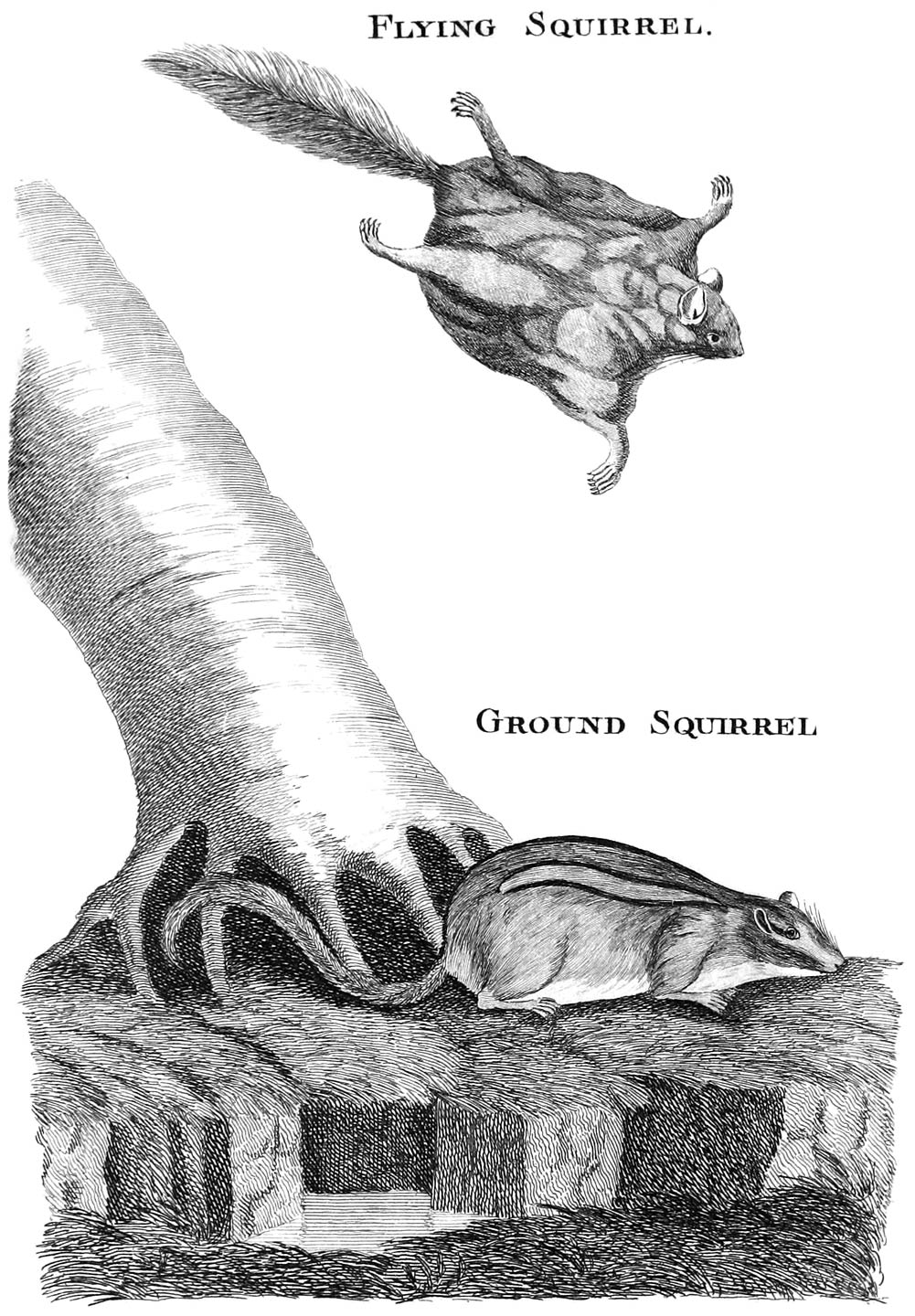
Flying Squirrel. Ground Squirrel
As a Swede was making a mill-dyke, pretty late in autumn, he employed for that purpose the soil of a neighbouring hill, and met with a hole on a subterraneous walk belonging to these squirrels; he followed it for some time, and discovered a walk on one side like a branch, parting from the chief stem: it was near two feet long, and at its end was a quantity of choice acorns of the white oak, which the little careful animal had stored up for winter. Soon after he found another walk on the side like the former, but containing a fine store of maize: the next had hiccory nuts, and the last and most hidden one contained some excellent chesnuts, which might have filled two hats.
In winter these squirrels are seldom seen, for during that season they live in their subterraneous holes upon the provisions, which they have stored up there. However on a very fine and clear day they sometimes come out. They frequently dig through the ground, into cellars in which the country people lay up their apples, which they partly eat, and partly spoil, so that the master has little or nothing left. They handle the maize stores full as roughly as the apples. But the cats are their great enemies, who devour them and bring them home to their young ones: their flesh is not eaten by men, and their skin is not made use of.
Of all the squirrels in the country, these are the most difficult to be tamed; for, though they be caught very young, yet it is dangerous to touch them with naked hands, as they bite very sharp when one is not aware of them. Many boys, who had lost a deal of time in trying to tame these squirrels, owned that they knew of no art to make them quite tame; at least they are never so far tamed as the other species. In order to do any thing towards taming them they must be caught when they are very small. Some people kept them in that state in a cage, because they looked very pretty.
I shall take an other opportunity of speaking of the black and ferruginous squirrels, which likewise inhabit this country.
November the 15th. In the morning I returned to Philadelphia. Mr. Cock told me to day, and on some other occasions afterwards, an accident which happened to him, and which seemed greatly to confirm a peculiar sign of an imminent hurricane. He sailed to the West Indies in a small yacht, and had an old man on board, who had for a considerable time sailed in this sea. The old man sounding the depth, called to the mate to tell Mr. Cock to launch the boats immediately, and to put a sufficient number of men into them, in order to tow the yacht during the calm, that they might reach the island before them, as soon as possible, as within twenty-four hours there would be a strong hurricane. Mr. Cock asked him what reasons he had to think so, the old man replied, that on sounding, he saw the lead in the water at a distance of many fathoms more than he had seen it before; that therefore the water was become clear all of a sudden, which he looked upon as a certain sign of an impending hurricane in the sea. Mr. Cock likewise saw the excessive clearness of the water. He therefore gave immediate orders for launching the boat, and towing the yacht, so that they arrived before night in a safe harbour. But before they had quite reached it the waves began to rise more and more, and the water was as it were boiling, though no wind was perceptible. In the ensuing night the hurricane came on, and raged with such violence, that not only many ships were lost, and the roofs were torn off from the houses, but even Mr. Cock’s yacht and other ships, though they were in safe harbours, were by the wind, and the violence of the sea, washed so far on shore, that several weeks elapsed, before they could be got off.
An old Dutch skipper said, that he had once caught a dogfish in the bay of New York, which being cut open, had a quantity of eels in his stomach.
November the 18th. Mr. Bartram shewed me an earthen pot, which had been found in a place, where the Indians formerly lived. He, who first dug it out, kept grease and fat in it to smear his shoes, boots and all forts of leather with: Mr. Bartram bought the pot of that man; it was yet entire and not damaged: I could perceive no glaze or colour upon it, but on the outside it was very much ornamented and upon the whole well made. Mr. Bartram shewed me several pieces of broken earthen vessels which the Indians formerly made use of. It plainly appeared in all these that they were not made of mere clay; but that different materials had been mixed with it, according to the nature of the places where they were made. Those Indians, for example, who lived near the sea shore, pounded the shells of snails and muscles, and mixed them with the clay. Others who lived further up in the country, where mountain crystals could be found, pounded them and mixed them with their clay; but how they proceeded in making the vessels, is entirely unknown: it was plain, that they did not burn them much, for they were so soft that they might be cut in pieces with a knife: the workmanship however seems to have been very good; for at present they find whole vessels or pieces in the ground, which are not damaged at all, though they have lain in the ground above a century. Before the Europeans settled in North America, the Indians had no other vessels to boil their meat in, than these earthen pots of their own making: but since their arrival, they have always bought pots, kettles, and other necessary vessels of the Europeans, and take no longer the pains of making some, by which means this art is entirely lost among them. Such vessels of their own construction are therefore a great rarity even among the Indians. I have seen such old pots and pieces of them, consisting of a kind of Serpentine stone, or Linnæus’s Talcum, Syst. nat. 3. p. 52.
Mr. Bartram likewise shewed me little pieces of a black slate, which is plentifully found in some parts of the river Skullkill. There are pieces to be found, which are four feet and above square: the colour and configuration is the same as in the Table slate (Schistus tabularis, Linn.) Syst. nat. 3. p. 37. except that this is a little thicker. The inhabitants of the country thereabouts (in the neighbourhood of the Skullkill) cover their roofs with it; Mr. Bartram assured me, that he had seen a whole roof composed of four such slates. The rays of the sun, heat, cold, and rain do not act upon the stone.
Mr. Bartram further related, that in several parts of the country, caves or holes were to be met with, going deep into the mountains: he had been in several of them and had often found a number of Stalactites, Linnæus’s Stalactites stillatitius, Syst. nat. 3. p. 183. of different dimensions at the top; they differed in colour, but the greatest curiosity was, that in some of the caves Mr. Bartram had found Stalactites, whose outward side was as it were wreathed from top to bottom; he had sent some pieces of it to London, and had none at present.
November the 20th. This morning I set out in company of a friend, on a journey to Raccoon in New Jersey, where many Swedes live, who have their own church. We had three miles to go before we came to the ferry which was to bring us over the Delaware. The country here was very low in some places: the plains on the banks of the river, were overflowed at every high water or flowing of the tide, and at the ebbing they were left dry again. However the inhabitants of the country hereabouts, made use of this plain: for that purpose they had in several places thrown up walls or dykes of earth towards the river, to prevent its overflowing the plains, which they made use of as meadows. On them the Water-beeches (Platanus occidentalis, Linn.) were planted in great numbers on both sides the road, quite close together: these in summer afford a pleasant shade, on account of the abundance and size of their leaves, and make the road extremely delightful, as it resembles a fine shady walk. The Delaware has nearly the same breadth here, which it has near Philadelphia. Near the place where the ferry is to be met with, several pretty houses were built on both sides, where travellers might get all kinds of refreshment. On our journey from Pensylvania to New Jersey, we were brought over the Delaware in a ferry belonging to, and kept in repair by the Pensylvania-men; but on our return we were obliged to take the ferry belonging to the New Jersey side. As soon as we had crossed the river, we were in a different province, for the Delaware makes the division between Pensylvania and New Jersey, so that every thing to the west of it belongs to the former, and all to the east, to the latter province. Both these provinces have in most things different laws, and their peculiar coin.
We now pursued our journey further, and soon observed that the country on this side appeared very different from that on the other; for in Pensylvania the ground consists of more clay and black mould, and is very fertile; but in New Jersey it is more sandy and very poor, so that the horses went very deep in sand in several parts of the road. Near the place where we were brought over, and a little way along the shore was a thick firwood: the trees were not very high, but in their greatest vigour; between them appeared now and then a low bush of oak. But after travelling about three English miles, the firwood ended, and we saw no more trees of this kind till we came to the church in Raccoon. In all the parts of Pensylvania where I have been, I have found few firwoods; on the other hand, they are abundant in New Jersey, and especially in the lower part of that province. We afterwards found all the day long no other trees, than such as have deciduous leaves; most of these were oaks of different sorts, and of considerable height, but they stood every where far enough asunder, to admit a chaise to pass through the wood without any inconvenience, there being seldom any shrubs or underwood between the trees, to obstruct the way. The leaves were all fallen, and covered the ground more than a hand’s breadth: this had an appearance of encreasing the upper black soil greatly. In several places flowed a small rivulet. The country was commonly plain, but sometimes formed a few hills with an easy declivity, though no high mountains appeared, and in a few places we found some small stones not bigger than a fist. Single farm houses were scattered in the country, and in one place only was a small village: the country was yet more covered with forests than cultivated, and we were for the greatest part always in a wood.
This day and the next we passed several Kills, or small rivulets which flowed out of the country into the Delaware with no great descent nor rapidity. When the tide came up in the Delaware, it likewise rose in some of these rivulets a good way; formerly they must have spread to a considerable breadth by the flowing of the tide, but at present there were meadows on their banks, formed, by throwing up strong dykes as close as possible to the water, to keep it from overflowing. Such dykes were made along all rivers here to confine their water; therefore when the tide was highest, the water in the rivers was much higher than the meadows: in the dykes were gates through which the water can be drawn from, or led into the meadows; they were sometimes placed on the outward side of the wall, so that the water in the meadows forced it open, but the river water shut it.
In the evening we came into the house of a Swede called Peter Rambo, and we staid the night at his house.
The pines which we had seen to day, and which I have mentioned before, were of that kind which has double leaves and oblong cones covered with aculeated scales. The English to distinguish it call it the Jersey Pine: commonly there were only two spines or leaves in one fascicle, as in our common Swedish pines, but sometimes three; the cones had long spines, so that they were difficult to be touched. These pines look at a distance wholly like the Swedish ones, so that if the cones were not regarded, they might easily be taken for the same species. Of these pines they make a great quantity of tar, of which I shall speak in the sequel; but as most of them are but small, they are good for nothing else; for if they be employed as posts, or poles in the ground, they are in a short time rendered useless by rotting: as soon as they are cut down the worms are very greedy of them; they soon eat through the wood, and only a few weeks after it is cut down; however it is made use of as fuel where no other wood is to be got, in several places they make charcoal of it, as I intend to mention in the sequel. There is another thing which deserves notice, in regard to these trees, and which several people, besides myself, have experienced. In the great heat of the summer, the cattle like to stand in the shade of these trees, preferably to that of the oak, hiccory, walnut, water-beech and other trees of this kind, whose foliage is very thick; and when the cattle find the latter with the former, they always choose to stand under the firs and pines, though the other trees with annually deciduous leaves could afford a better shade: and if there be but a single pine in a wood, as many cattle from the herd as can stand under it, throng to it. Some people would infer from hence, that the resinous exhalations of these trees, were beneficial to the cattle, and which made them more inclined to be near firs and pines, than any other trees.
The Spoon tree, which never grows to a great height, we saw this day in several places. The Swedes here have called it thus, because the Indians who formerly lived in these provinces, used to make their spoons and trowels of the wood of this tree. In my cabinet of natural curiosities, I have a spoon made of this wood by an Indian, who has killed many stags and other animals on the very spot where Philadelphia afterwards was built; for in his time that spot was yet covered with trees and shrubs. The English call this tree a Laurel, because its leaves resemble those of the Laurocerasus. Dr. Linnæus, conformable to the peculiar friendship and goodness which he has always honoured me with, has been pleased to call this tree, Kalmia foliis ovatis, corymbis terminalibus, or Kalmia latifolia. It succeeds best on the side of hills, especially on the north side, where a brook passes by; therefore on meeting with some steep places (on hills) towards a brook, or with a steep side of a hill towards a marsh, you are sure to find the Kalmia. But it frequently stands mixed among beech trees. The higher the Kalmias stand on the north side of a mountain, the less they grow: I have seen them not only in Pensylvania and New Jersey, but even in New York, but there they are more scarce: I never found them beyond the forty-second deg. of north lat. though I took ever so great care to look for them: they have the quality of preserving their fine green leaves throughout winter, so that when all other trees have lost their ornaments, and stand quite naked, these chear the woods with their green foliage. About the month of May they begin to flower in these parts, and then their beauty rivals that of most of the known trees in nature: the flowers are innumerable, and sit in great bunches. Before they open, they have a fine red colour, but as they are expanded, the sun bleaches them, so that some are quite white; many preserve the colour of roses. Their shape is singular, for they resemble a crater of the ancients: their scent however is none of the most agreeable. In some places it was customary to adorn the churches on christmas day or new-years day with the fine branches of this tree, which are then thick covered with leaves.
But these trees are known for another remarkable quality; their leaves are poison to some animals, and food for others: experience has taught the people that when sheep eat of these leaves, they either die immediately, or fall very sick, and recover with great difficulty. The young and more tender sheep are killed by a small portion, but the elder ones can bear a stronger dose. Yet this food will likewise prove mortal to them, if they take too much of it: the same noxious effect it shews in regard to calves which eat too much of the leaves: they either die, or do not recover easily. I can remember, that in the autumn of the year 1748, some calves eat of the leaves, but fell very sick, swelled, foamed at the mouth, and could hardly stand, however they were cured by giving them gunpowder and other medicines: the sheep are most exposed to be tempted by these leaves in winter; for after having been kept in stables, for some months they are greedy of all greens especially if the snow still lies upon the fields, and therefore the green but poisonous leaves of the Kalmia, are to them very tempting. Horses, oxen and cows which have eaten them, have likewise been very ill after the meal, and though none of them ever died of eating these leaves, yet most people believed, that if they took too great a portion of them, death would certainly be the result. For it has been observed that when these animals only eat small quantities, yet they suffer great pains. On the other hand the leaves of the Kalmia are the food of stags, when the snow covers the ground, and hides all other provisions from them. Therefore, if they be shot in winter, their bowels are found filled with these leaves; and it is very extraordinary, that if those bowels are given to dogs, they become quite stupid and as it were drunk, and often fall so sick, that they seem to be at the point of death, but the people, who have eaten the venison, have not felt the least indisposition. The leaves of the Kalmia are likewise the winter food of those birds, which the Swedes in North America call Hazel-hens, and which stay here all winter, for when they are killed, their crop is found quite filled with them.
The wood of the Kalmia is very hard, and some people on that account, make the axis of their pullies of it. Weavers shuttles are chiefly made of it, and the weavers are of opinion, that no wood in this country is better for this purpose, for it is compact, may be made very smooth, and does not easily crack, or burst. The joiners and turners here, employ it in making all kinds of work, which requires the best wood; they chiefly use the root because it is quite yellow; the wood has a very suitable hardness and fineness, and from the center, spread as it were small rays, which are at some distance from each other. When the leaves of the Kalmia are thrown into the fire, they make a crackling like salt. The chimney sweepers make brooms in winter of the branches with the leaves on them, since they cannot get others in that season. In the summer of the year 1750, a certain kind of worms, devoured the leaves of almost all the trees in Pensylvania; yet they did not venture to attack the leaves of the Kalmia. Some people asserted, that when a fire happened in the woods, it never went further, as soon as it came to the Kalmias, or Spoon trees.
November the 21st. The Swedes and all the other inhabitants of the country plant great quantities of maize, both for themselves and for their cattle. It was asserted that it is the best food for hogs, because it makes them very fat, and gives their flesh an agreeable flavour, preferable to all other meat. I have given in two dissertations upon this kind of corn to the Swedish Royal Academy of Sciences, which stand in their Memoirs, one in the Volume for the year 1751, in the last quarter, and the other in the first quarter of the Volume for the year 1752, and thither I refer my readers.
The wheels of the carts which are here made use of, are composed of two different kinds of wood. The felloes were made of what is called the Spanish oak, and the spokes of the white oak.
The Sassafras tree grows every where in this place. I have already observed several particulars in regard to it, and intend to add a few more here. On throwing some of the wood into the fire, it causes a crackling as salt does. The wood is made use of for posts belonging to the enclosures, for it is said to last a long time in the ground: but it is likewise said, that there is hardly any kind of wood, which is more attacked by worms than this, when it is exposed to the air without cover, and that in a short time it is quite worm-eaten through and through. The Swedes related, that the Indians who formerly inhabited these parts, made bowls of it. On cutting some part of the sassafras tree, or its shoots, and holding it to the nose, it has a strong but pleasant smell. Some people peel the root, and boil the peel with the beer which they are brewing, because they believe it wholesome for the same reason. The peel is put into brandy, either whilst it is distilling, or after it is made.
An old Swede remembered that his mother cured many people of the dropsy, by a decoction of the root of sassafras in water drank every morning: but she used, at the same time to cup the patient on the feet. The old man assured me, he had often seen people cured by this means, who had been brought to his mother wrapped up in sheets.
When a part of a wood is destined for cultivation, the sassafras trees are commonly left upon it, because they have a very thick foliage, and afford a cool shade to the cattle, during the great heats. Several of the Swedes, wash and scour the vessels in which they intend to keep cyder, beer or brandy, with water in which the sassafras root or its peel has been boiled; which they think renders all those liquors more wholesome. Some people get their bed-posts made of sassafras wood, in order to expel the bugs; for its strong scent it is said prevents those vermin from settling in them. For two or three years together this has the desired effect; or about as long as the wood keeps its strong aromatic smell; but after that time it has been observed to lose it effect. A joiner shewed me a bed, which he had made for himself, the posts of which were of sassafras wood, but as it was ten or twelve years old, there were so many bugs in it, that it seemed likely, they would not let him sleep peaceably. Some Englishmen related, that some years ago it had been customary in London, to drink a kind of tea of the flowers of sassafras, because it was looked upon as very salutary; but upon recollecting that the same potion was much used against the venereal disease, it was soon left off, lest those that used it, should be looked upon as infected with that disease. In Pensylvania some people put chips of sassafras into their chests, where they keep all sorts of woollen stuffs, in order to expel the moths (or Larvæ, or caterpillars of moths or tinies) which commonly settle in them in summer. The root keeps its smell for a long while: I have seen one which had lain five or six years in the drawer of a table, and still preserved the strength of its scent.
A Swede named Rambo, related that the Indians formerly dyed all sorts of leather red with the bark of the chesnut oak.
Some old people remembered that in the year 1697, there had been so rigorous a winter, that the ice in the river Delaware was two feet thick.
November the 22d. Aoke Helm was one of the most considerable Swedes in this place, and his father came over into this country along with the Swedish governor Prince; he was upwards of seventy years of age. This old man told us, that in his youth there was grass in the woods, which grew very close, and was every where two feet high; but, that it was so much lessened at present, that the cattle hardly find food enough, and that therefore four cows now give no more milk than one at that time; but the causes of this alteration are easy to find. In the younger years of old Helm, the country was little inhabited, and hardly the tenth part of the cattle kept which is at present; a cow had therefore as much food at that time, as ten now have. Further, most kinds of grass here are annual, and do not for several years together shoot up from the same root, as our Swedish grasses: they must sow themselves every year, because the last year’s plant dies away every autumn. The great numbers of cattle hinder this sowing, as the grass is eaten before it can produce flowers and fruit. We need not therefore wonder that the grass is so thin on fields, hills, and pastures in these provinces. This is likewise the reason why travellers in New Jersey, Pensylvania, and Maryland, find many difficulties, especially in winter, to get forwards with their own horses, for the grass in these provinces is not very abundant, because the cattle eat it before it can bring seeds: but more to the north, as in Canada, are a sufficient quantity of perennial grasses; so wisely has the Creator regulated every thing. The cold parts of the earth, naturally bring forth a more durable grass, because the inhabitants want more hay to feed their cattle with, on account of the length of the winter. The southern provinces again have less perennial grass, as the cattle may be in the fields all the winter. However careful œconomists have got seeds of perennial grasses from England, and other European states, and sowed it in their meadows, where they seem to thrive exceedingly well.
The Persimon (Diospyros Virginiana) was pretty common here: I have already mentioned it before, but I intend now to add some more particulars. Some of its fruits began to ripen and to become fit for eating about this time, for they always ripen very late in autumn, and then the people eat them like other fruit: they are very sweet and glutinous, yet have a little astringency; I frequently used to eat a great quantity of them, without feeling the least inconvenience. From the persimon several Englishmen and Swedes brew a very palatable liquor in the following manner. As soon as the fruit is ripe, a sufficient quantity is gathered, which is very easy, as each tree is well stocked with them. These persimon apples are put into a dough of wheat or other flour, formed into cakes, and put into an oven, in which they continue till they are quite baked, and sufficiently dry, when they are taken out again: then, in order to brew the liquor, a pot full of water is put on the fire and some of the cakes are put in: these become soft by degrees as the water grows warm, and crumble in pieces at last; the pot is then taken from the fire, and the water in it well stirred about, that the cakes may mix with it: this is then poured into another vessel, and they continue to steep and break as many cakes as are necessary for a brewing: the malt is then infused, and they proceed as usual with the brewing. Beer thus prepared is reckoned much preferable to other beer. They likewise make brandy of this fruit in the following manner: having collected a sufficient quantity of persimons in autumn, they are altogether put into a vessel, where they lie for a week till they are quite soft. Then they pour water on them, and in that state they are left to ferment of themselves, without promoting the fermentation by any addition. The brandy is then made in the common way, and is said to be very good, especially if grapes (in particular of the sweet sort) which are wild in the woods, be mixed with the persimon fruit. Some persimons are ripe at the end of September, but most of them later, and some not before November and December, when the cold first overcomes their acrimony. The wood of this tree is very good for joiner’s instruments, such as planes, handles to chisels, &c. but if after being cut down, it lies exposed to sunshine and rain, it is the first wood which rots, and in a year’s time there is nothing left but what is useless. When the persimon trees get once into a field, they are not easily got out of it again, as they spread so much. I was told, that if you cut off a branch and put it into the ground, it strikes root, but in very strong winters, these trees often die by frost, and they, together with the peach trees, bear cold the least of any.