Volume 2 — APPENDIX.
Reading edition
LIST OF THE NEW SPECIES OF MAMMALS DISCOVERED BY THE LATE M. MOUHOT IN CAMBODIA AND SIAM.
By Dr. Albert Günther.
a. Monkeys.
1. Hylobates pileatus.
MAMMALS.
Male.—Black: back of the head, back of the body, and front hind legs greyish; forehead and circumference of the black spot on the crown paler grey: hands and tuft of long hair round the organ of generation white.
The three specimens in this state are all nearly of the same size, and appear to be adult. They only vary slightly in the size of the coronal spot, and in the extent of the white colour on the hands.
Female.—White: back brownish white, slightly waved; a large ovate spot on the crown, and a very large ovate blotch on the chest, black.
These specimens are all of one size, and appear to be adult; three have the teats well developed. They vary in the size of the black chest-spot, and in the colour of the whiskers, thus:—
a, b. White: spot on the chest moderate, reaching only half-way down the abdomen: whiskers on side of face white.
c. Brownish: spot on chest larger, reaching further down the abdomen: sides of the face black: a few black hairs on the throat.
d. Brownish: side of the face, under the chin, and the whole of the throat, chest, and belly black: teats well developed.
Young.—Uniform dirty white, without any black spot on chest or head.
All those varieties were found by M. Mouhot on a small island near Cambodia. (Described by Dr. J. E. Gray, Proc. Zool. Soc., 1861, p. 135.)
b. Carnivores.
2. Herpestes rutilus.
Grizzled chestnut-brown, variegated with black and white rings on the hairs: the head and limbs darker chestnut, with scarcely any hair, and very narrow white rings: lips and throat, and under part of the body, uniform duller brown; the nape with longer hairs, forming a broad short crest.
Cambodia. (Gray, Proc. Zool. Soc., 1861, p. 136.)
c. Squirrels.
3. Sciurus Mouhotii.
Grizzled grey brown, with pale rings: lips, chin, throat, and under side of body and inside of limbs white: the upper part of the sides with a longitudinal black streak, edged above and below with a narrow white line: tail blackish, whitish washed, hairs elongate, brown, with two broad black rings and a white tip: ears simple, rounded.
The species differs from most of the squirrels of the size, in the three streaks being on the upper part of the back, and in the dark colour between the two colours of the upper and under surface.
Cambodia. (Named by Dr. J. E. Gray, after M. Mouhot, and described in Proc. Zool. Soc., 1861, p. 137.)
4. Sciurus splendens.
All the specimens are bright red bay.
Var. 1.—All over dark, and very intense red bay, with a white spot on each side of the base of the tail.
Var. 2.—Top of the head and tail, like var. 1, dark and very intense red bay: side of the back, under sides of the body, and tip of the tail paler red bay, without any white spot at the base of the tail.
Var. 3.—Uniform pale bay, like the side of var. 2: tail and middle of the back rather darker and brighter: tail without pale tip or white basal spot.
Var. 4.—Crown, middle of the back, and tail dark intense red bay: throat, chest, and under side paler red bay, like var. 2, 3: cheeks, shoulders, and thighs, and outsides of the fore and hind legs brown, grizzled, with yellow rings on the hairs: side of the body rather greyish red.
Cambodia. (Gray, Proc. Zool. Soc., 1861, p. 137.)
5. Sciurus siamensis.
Bright red-brown, grizzled, with elongate black tips to the longer hairs, each of which is marked with a broad subterminal yellow band. These black hairs are more abundant and have broad pale rings on the rump, outside of the thighs, and especially on the lower part of the tail, where they nearly hide the general red colour. The terminal half of the tail bright chestnut-brown, without any black hairs or pale rings. The throat, breast, belly, lower part of sides, inner side and edge of the legs, uniform bright red-brown: ears rounded: whiskers black: feet covered with short close-pressed hairs.
(Gray, Proc. Zool. Soc., 1859, p. 478.)
d. Ruminants.
6. Tragulus affinis.
Similar to T. javanicus in colour, but rather smaller and much paler, and the side of the neck similar in colour to the side of the body: the belly is white, with a brown streak on each side of the central line: the head is smaller. It is larger than T. kanchil; very much paler; and the neck is not blacker and grizzled. A specimen of the species has been in the British Museum, as above named, for many years: it is said to have come from Singapore; but that probably was only the port of transit. It may be only a small pale local variety of T. kanchil.
Six specimens, adult, all exactly similar, and one young, have been collected by M. Mouhot. (Gray, Proc. Zool. Soc., 1861, p. 138.)
7. Cervulus cambojensis.
There are the forehead covered with hair and the horns of a Muntjack in the collection sent by M. Mouhot from Cambodia: it is very much larger than any specimen of that genus in the British Museum collection, and is probably a distinct species.
The horns are thick, nearly straight, with a short, thick recurved branch on the outer part of the front side, near the base, and one of them has a somewhat similar callosity on the hinder side on the same level. Hair of forehead very rigid, close pressed, dark brown, with narrow yellow rings. (Gray, Proc. Zool. Soc., 1861, p. 138.)
LIST OF THE NEW SPECIES OF REPTILES DISCOVERED BY THE LATE M. MOUHOT IN SIAM AND CAMBODIA.
By Dr. Albert Günther.
a. Tortoises.
1. Geoclemys macrocephala.
REPTILES.
The shell oblong, rather depressed, entirely three-keeled, olive-brown: the keels subcontinued, nearly parallel; the middle one higher and more distinct behind; the lateral ones, near the upper edge of the shields, continued, ending abruptly on the hinder edge of the third lateral discal shield: the hinder lateral and central shield only marked with a slight convexity: the margin entire, yellow edged: the under side yellow, with black triangular spots: the sternum flat, very indistinctly keeled on the side.
Animal black olive, head large; crown flat, covered with a single smooth plate, purplish-brown, with two streaks from middle of the nose; the upper edging the crown, the other the upper part of the beak, and with two streaks from the hinder edge of the orbit; the lower short and interrupted, extended on the temple; the upper broader and continued over the ear, along the side of the neck; two close streaks under the nostrils to the middle of the upper jaw, and two broad streaks dilated behind, down the front of the lower jaw, and continued on the edge of the lower jaw behind: the nape and hinder part of the side of the lower jaw covered with large flat scales: the rest of the neck and legs covered with minute granular scales: the front of the forelegs covered with broad band-like scales: the toes of the fore and hind feet rather short and thick, covered above with broad band-like scales. (Gray, Proc. Zool. Soc., 1859, p. 479, pl. 21.)
2. Cyclemys Mouhotii.
Shell oblong, pale yellow; back flattened above, with a dark-edged keel on each side: the vertebral plates continuously keeled, and rather tubercular in front: the margin strongly dentated: nuchal shield distinct. (Gray, Ann. and Mag. Nat. Hist., 1862, x. p. 157; Günth., Rept. Brit. Ind., pl. 4, fig. D.)
3. Trionyx ornatus.
Back of the young animal, in spirits, brown, with large, unequal-sized, irregularly disposed black circular spots: head olive, with symmetrical small black spots on the chin, forehead, and nose: throat and sides of neck with large, unequal-sized, irregular-shaped, and nearly symmetrically disposed yellow spots: legs olive, yellow spotted in front: sternum and under side of margin yellow: sternal callosities not developed.
A single specimen has been found by M. Mouhot in Cambodia, which is now in the British Museum. (Described by Dr. J. E. Gray, Proc. Zool. Soc., 1861, p. 41, pl. 5.)
b. Lizards.
1. Draco tæniopterus.
Tympanum not scaly: nostrils above the face-ridge directed upwards: a low longitudinal fold on the neck: scales on the back of equal size, obscurely keeled: gular sac covered with large smooth scales, uniformly coloured: wings dark-greenish olive, with five arched black bands, not extending to the margin of the wing, some being forked at the base. (Günth., Proc. Zool. Soc., 1861, April 23, and Ind. Rept., p. 126, pl. 13, fig. E.)
2. Acanthosaura coronata.
The upper orbital edge serrated, without elongate spine posteriorly; a short spine on each side of the neck; a yellowish-olive band edged with black across the crown, from one orbital edge to the other; an oblique, short, yellowish band, broadly edged with brown, from below the orbit to the angle of the mouth.
This and the following species belong to the genus Acanthosaura, as defined by Gray (Catal. Liz. p. 240). The tympanum is distinct; a short spine between it and the dorsal crest, which is rather low; no femoral or præanal pores: a short spine behind the orbital edge, and separated from it by a deep notch: back and sides covered with small smooth scales, slightly turned towards the dorsal line, and intermixed with scattered larger ones which are keeled: belly and legs with larger keeled scales: tail slightly compressed at the base, the rest being round, and without crest; all its scales are keeled; those on the lower side being oblong, and provided with more prominent keels: throat without cross-fold, and without distinct longitudinal pouch: a slight oblique fold before the shoulder. (Günth., Proc. Zool. Soc., 1861, April 23, and Ind. Rept., p. 149, pl. 14, fig. E.)
3. Acanthosaura capra.
The upper orbital edge not serrated, terminating posteriorly in a long moveable horn: no spine above the tympanum or on the side of the neck: nuchal crest high, not continuous with the dorsal crest, which is rather elevated anteriorly: crown and cheek without markings.
The tympanum is distinct: no femoral or præanal pores: back and sides covered with small smooth scales, which become gradually larger and more distinctly keeled towards the belly: no large scales intermixed with the small ones; only a few appear to be a little larger than the rest: tail slightly compressed at the base, surrounded by rings of oblong, keeled scales: throat expansible; a very slight fold before the shoulder. (Günth., Ind. Rept., p. 148, pl. 14, fig. F.)
4. Physignathus mentager.
Dorsal crest not interrupted above the shoulder; interrupted above the hip: caudal crest as high as that on the back: no large scales on the side of the neck: sides of the throat with large convex or tubercular scales.
A high crest, composed of sabre-shaped shields, extends from the nape of the neck to the second fifth of the length of the tail, being interrupted above the hip: scales on the back and the sides of equal size, very small, with an obscure keel obliquely directed upwards; those on the belly smooth, on the lower side of the tail rather elongate; strongly keeled: tympanum distinct: throat with a cross-fold: orbital edges and sides of the neck without spines: tail transversely banded with black.
One stuffed specimen is 30 inches long, the tail taking 21. (Günth., Proc. Zool. Soc., 1861, April 23, and Ind. Rept., p. 153, pl. 15.)
5. Tropidophorus microlepis.
Snout rather narrow and produced: scales on the back strongly keeled, the keels not terminating in elevated spines: back of the tail with two series of moderately elevated spines, the series not being continuous with those on the back of the trunk: scales of the throat smooth, or very indistinctly keeled: tail with a series of plates below, which are much larger and broader than the scales of the belly: three large præanal scales: a single anterior frontal shield (internasal). (Günth., Proc. Zool. Soc., 1861, April 23, and Ind. Rept., p. 76, pl. 10, fig. A.)
c. Snakes.
Simotes tæniatus.
Scales in nineteen rows. Brownish-olive, with a brown longitudinal dorsal band enclosing an olive-coloured line running along the vertebral series of scales; another brownish band along the side of the body; belly whitish, chequered with black.
One loreal shield, one anterior and two posterior oculars; eight upper labials, the third, fourth, and fifth of which enter the orbit; 155 ventral plates; anal entire; 44 pairs of subcaudals. Head with the markings characteristic of the genus: each half of the dorsal band occupies one series of scales and two halves; the lateral band runs along the fourth outer series, touching the third and fifth. (Günth., Proc. Zool. Soc., 1861, April 23, and Ind. Rept., p. 216, pl. 20, fig. A.)
d. Newts.
Plethodon persimilis.
Black, white-speckled, the specks closer and more abundant on the sides; the hind-toes elongate, unequal. Tail compressed.
This is the first species of Newts which has been discovered in Continental India; it is exceedingly like the Pl. glutinosus from North America, but the hind toes are rather longer and more slender. (Gray, Proc. Zool. Soc., 1859, p. 230, c. tab.)
LIST OF THE NEW SPECIES OF FRESH-WATER FISHES DISCOVERED BY THE LATE M. MOUHOT IN SIAM AND CAMBODIA.
By Dr. Albert Günther.
1. Toxotes microlepis.
D. 5/13. A. 3/17. L. lat. 42. L. transv. 6/14.
FRESH-WATER FISHES.
In the general habit and in all the generic characters the present species completely agrees with T. jaculator; the snout, however, is much shorter, its length being scarcely more than the diameter of the eye, and considerably less than the width between the orbits. The diameter of the eye is one-fourth of the length of the head. The length of the base of the anal equals exactly that of the dorsal. One of the largest scales covers two-thirds of the eye.
The colour may prove to be subject to as much variation as in the other species. The specimens described are yellowish, with greenish back and yellowish caudal. There is a series of four black blotches on each side: the anterior is the smallest, and situated on the upper extremity of the præoperculum; the third is the largest, and placed opposite the dorsal spines; a narrow blackish band round the base of the caudal; a round black spot on the posterior angle of the dorsal; the anal and the ventrals are black.
(Günth., Fishes, ii. p. 68.)
2. Eleotris siamensis.
D. 6 | 10. A. 9. L. lat. 90.
Twenty-two longitudinal series of scales between the origin of the posterior dorsal and the anal, forty transverse ones between the anterior dorsal and the snout. The height of the body is contained six times and two-thirds in the total length, the length of the head four times. Head broad, depressed, with the snout obtuse; the lower jaw is prominent, and the maxillary extends to behind the vertical from the centre of the eye. Teeth in villiform bands. The diameter of the eye is one-seventh of the length of the head, one-half of that of the snout, and of the width of the interorbital space. A small barbel on each side of the upper jaw; the head is covered with small scales; there are about ten between the posterior angle of the orbits; the snout is naked. Dorsal and anal fins much lower than the body: one-half of the caudal is covered with thin scales; its length is contained five times and a half in the total. Brown: the lower parts whitish, minutely punctulated with brown: two oblique dark stripes on the cheek, radiating from the eye. Dorsal fins variegated with blackish, the other fins uniform blackish; a black ocellus, edged with whitish, on the upper part of the root of the caudal fin.
Lines.
Total length60
Height of the body9
Length of the head15
Diameter of the eye2
Length of the caudal fin11
(Günth., Fish., iii. p. 129.)
3. Osphromenus siamensis.
D. 7/8. A. 11/33-12/35. L. lat. 42. L. transv. 12/16.
When we take the origin of the dorsal fin as the highest point of the upper profile, and the base of the last anal spine as the lowest of the abdomen, the depth between these two points is one-half of the total length (the caudal not included). The length of the head is three times and two-thirds in the same length. The snout is broader than long, equal to the diameter of the eye, which is one-fourth of the length of the head. The interorbital space is convex, wider than the orbit. Mouth very small, rather protractile; præorbital, with its extremity truncated and serrated: angle of the præoperculum serrated; there are two or three series of scales between the eye and the angle of the præoperculum. The dorsal fin commences nearer to the root of the caudal than to the end of the snout; it has six strong spines, which increase in length posteriorly, the last being longer than one-half the length of the head. Caudal emarginate; the anal is nearly entirely scaly, and terminates immediately before the caudal. The longest ventral ray extends beyond the extremity of the caudal, and has three or four rudimentary rays in its axil.
The colour is greenish on the back, silvery on the sides and on the belly. A black spot on the middle of the body in the vertical from the origin of the dorsal, below the lateral line; a second on the middle of the root of the caudal. The soft dorsal and caudal with brown dots; anal yellowish, with lighter spots, and sometimes with brownish dots.
This description is taken from specimens which are from three to four inches long.
(Günth., Fishes, iii. p. 385.)
4. Osphromenus microlepis.
D. 3/10. A. 10/39. L. lat. 60. L. transv. 12/22.
The height of the body is one-half of the total length (without caudal), the length of the head two-sevenths; the profile of the nape is convex, that of the head rather concave. The snout is somewhat depressed, broader than long, with the lower jaw prominent; the interorbital space is convex, nearly twice as wide as the orbit, the diameter of which is one-fifth of the length of the head, and less than that of the snout. Præorbital triangular, with the lower margin serrated; there are five series of scales between the orbit and the angle of the præoperculum. The entire lower margin of the præoperculum and a part of the sub- and inter-operculum are serrated. The dorsal fin commences on the middle of the distance between the snout and the root of the caudal; its spines are moderately strong, the length of the third being more than one-half of that of the head. Caudal emarginate; more than one-half of the anal fin is scaly; it terminates immediately before the caudal. The longest ventral ray extends beyond the extremity of the caudal, and has three rudimentary rays in its axil. Immaculate: back greenish, sides and belly silvery; the soft dorsal and caudal with brownish dots.
Total length six inches.
(Günth., Fishes, iii., p. 385.)
5. Catopra siamensis.
D. 13/15. A. 3/9. L. lat. 27. L. transv. 5½/13.
The height of the body is contained twice and a third in the total length, the length of the head thrice and a third; head as high as long. Snout rather shorter than the eye, the diameter of which is one-fourth of the length of the head, and equal to the width of the interorbital space. The lower jaw is scarcely longer than the upper, and the maxillary extends slightly beyond the anterior margin of the orbit. Two nostrils remote from each other, both very small. Præorbital and angle of the præoperculum slightly serrated; opercles, throat, and isthmus, entirely scaly. The dorsal fin commences above the end of the operculum, and terminates close by the caudal; its spines are very strong, and can be received in a groove; the fifth, sixth, and seventh are the longest, not quite half as long as the head; the last spine is shorter than the penultimate; the soft dorsal is elevated and scaly at the base. The second anal spine is exceedingly strong, rather stronger and longer than the third, and not quite half as long as the head; the soft anal is similar to the soft dorsal. Caudal fin rounded, slightly produced, one-fourth of the total length; its basal half is scaly. Pectoral rather narrow, as long as the head without snout. The ventral is inserted immediately behind the base of the pectoral; it has a strong spine, and extends to the vent.
Scales minutely ciliated: the upper part of the lateral line terminates below the last dorsal rays, the lower commences above the third anal spine.
Gill-membranes united below the throat, not attached to the isthmus, scaly. Four gills, a slit behind the fourth; pseudobranchiæ none.
The jaws, vomer, palatines, and upper and lower pharyngeals are armed with bands of small villiform teeth. Very remarkable are two large, ovate, dentigerous plates, one at the roof, the other at the bottom of the mouth, in front of the pharyngeals; these plates are slightly concave in the middle, pavimentated with molar-like teeth, and have evidently the same function as the pharyngeal dentigerous plates of the true Pharyngognathi.
Total length 52 lines.
(Günth., Proc. Zool. Soc., 1862, June 24.)
6. Ophiocephalus siamensis.
D. 42. A. 27. L. lat. 65. L. transv. 5/11.
Large teeth in the lower jaw, on the vomer and the palatine bones. The height of the body is contained six times and four-fifths in the total length; the length of the head three times and two-fifths; the length of the caudal six times. The width of the interorbital space is more than the extent of the snout, and two-ninths of the length of the head. Cleft of the mouth wide the maxillary not extending to the vertical from the posterior margin of the eye (in old specimens it probably reaches to below that margin). There are eleven series of scales between the eye and the angle of the præoperculum; scales on the upper surface of the head of moderate size. The pectoral extends to the origin of the anal fin, and its length is less than one-half of that of the head: the ventral is not much shorter than the pectoral; greenish-olive, with darker streaks along the series of scales; a light longitudinal band from the eye to the middle of the caudal fin; two series of alternate darker blotches, one above the light band, the other below; side of the head with three oblique brown bands; dorsal and anal fins with oblique blackish stripes; caudal with blackish spots: the lower side of the head blackish, with white spots. (Günth., Fishes, iii., p. 476.)
7. Mastacembelus argus.
D. 32/60. A. 3/56.
Præoperculum with two or three spines. The maxillary does not extend to the vertical from the anterior margin of the eye. Vertical fins continuous: brownish-black, with white bands and round white spots: a band from the occiput, along the middle of the back, passing into the white margin of the vertical fins: a second band above the eye, interrupted and lost on the side of the back: a third from the angle of the mouth, passing into a series of spots, which is continued to the caudal: another series of spots along the side of the belly; the soft dorsal with a series of six spots: pectoral black at the base and near the margin. (Günth., Fishes, iii. p. 542.)
8. Cynoglossus xiphoideus.
D. 120. A. 98. V. 4. L. lat. 135.
Three lateral lines on the left side, the upper and lower separated from the middle by twenty or twenty-one longitudinal series of scales: a single line on the right side. Two nostrils: one between the posterior parts of the eyes, the other in front of the lower eye. Eyes separated by a concave space, the width of which is more than that of the orbit; the upper eye considerably in advance of the lower: lips not fringed. The length of the snout is contained twice and a third in that of the head, the angle of the mouth being behind the vertical from the posterior margin of the eye, and nearer to the gill-opening than to the end of the snout. The rostral hook terminates below the front margin of the eye. The height of the body is contained four times and two-thirds in the total length, the length of the head five times and a half. The height of the dorsal and anal fins is two-sevenths of that of the body. Uniform brownish-grey. (Günth., Fish., iv. p. 495.)
ON AN APPARENTLY UNDESCRIBED SPIDER FROM COCHIN CHINA.
By Dr. Albert Günther.
Cyphagogus Mouhotii.
UNDESCRIBED SPIDER.
Cephalothorax subovate, covered with fine, short, dense hairs, with a transverse groove between cephalic and thoracic portion, and with a deep impression in the middle of the upper surface of the latter.
Eyes eight, unequal in size, disposed thus ·.::.·; the four middle occupy a slight protuberance in front of the cephalothorax, whilst the lateral are the smallest, and situated on the side of its anterior part.
Falces articulated vertically, rather compressed, with a non-denticulated claw of moderate size at their extremity; the claw is received in a sheath at the lower end of the falces, the edges of the sheath being provided with some horny spines of unequal size. Maxillæ flat; the outer margins of both together form a card-like figure; their lower extremity is hairy; sternal lip between the maxillæ, elongate elliptical. Sternum ovate, covered with rather coarse hairs. Palpi of moderate length: the terminal joint is rather longer than the two preceding together, and armed with a minute non-pectinated claw.
Legs rather robust, tapering, very unequal in length, the two anterior being nearly equally long, but much longer than the two posterior: the fourth is longer than the third: each is armed with a pair of minute claws.
Abdomen club-shaped, anteriorly produced into a very long, thin, cylindrical process, which is twice bent, so that its basal half is leaning backwards on the back of the abdomen, whilst its terminal half is directed upwards and forwards, terminating in a slight cuneiform swelling: this singular appendage is covered with a leathery, fine hairy skin, like the lower parts of the abdomen. The cephalothorax being united with the abdomen at no great distance from the spinners, the anterior portion of the abdomen, with its appendage, is situated vertically above the thorax. The abdomen is nearly smooth above, and covered with very fine hairs below; it terminates in an obtuse point directed upwards.
Six spinners in a quadrangular group immediately before the vent: the anterior and posterior pair are of moderate size: the third pair is very short, and situated between the posterior spinners.
Two branchial opercula: tracheal opercula absent.
Dimensions.
Lines.
Length ofcephalothorax4
„ abdomen to the first bend of the appendage12
„ appendage from its first bend10
„ falces1⅓
„ palpus4⅓
„ terminal joint of palpus1⅔
„ first leg16
„ second leg16 /3
„ third leg9
„ fourth leg10½
Colour brownish yellow: extremities of the legs and of abdominal appendage and sternum blackish brown: upper parts of the abdomen yellow: two black bands round the femur of the first leg.
A single female specimen of this spider was obtained by the late M. Mouhot in the Lao Mountains of Cochin China. Its form is so extraordinary that we have not hesitated to refer it to a new genus, Cyphagogus.
DESCRIPTION BY M. LE COMTE DE CASTELNAU OF A NEW AND GIGANTIC CARABIDEOUS INSECT DISCOVERED BY M. MOUHOT IN LAOS.
(Communicated by the Count to the ‘Revue et Magasin de Zoologie.’ 1862. No. 8. Paris.)
GIGANTIC CARABUS.
Among the magnificent insects that M. Mouhot collected during the few months of his stay in Laos, the first place is claimed by the beautiful Carabus which forms the subject of this paper, and which I have named Mouhotia gloriosa after my unfortunate countryman.
This splendid insect is black, with a large border of flame-colour at the sides of the thorax and of the elytra; this is covered with longitudinal striæ, formed by a double row of punctures. The thorax is hollowed behind, smooth on the top, with the lateral border a brilliant coppery-red; it presents a small longitudinal stria in the middle of its disk, and the anterior angles are very prominent.
It much resembles Pasimachus and Emydopterus, but is distinguished from them; firstly, by the maxillary palpi, of which the last joint is broad, flat, angular on the inner side, and rounded at the end, this joint being a little longer than the one before it; secondly, by the labrum, which is wide, short, and indented on the exterior side; and thirdly, by the labial palpi, which have their last joint in the same form as the maxillary, but longer and hatchet-shaped. The mandibles are very strong, moderately arched, striated transversely, and with a strong tooth on the inner side; the jaws are also striated and obtuse at the ends. The head is similar to that of Pasimachus, the thorax is heart-shaped, the elytra oval, with angles towards the joints not strongly marked, convex, and a little serrated behind; the claws are powerful, with a strong tooth on the outer side of the middle of the tibiæ of the centre pair.
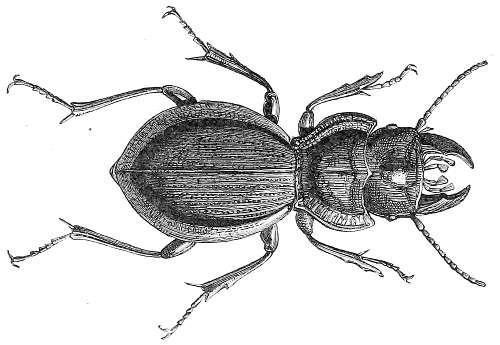
This insect is one of the most magnificent Carabidæ known, and is nearly two inches in length. The collection in the British Museum contains a fine specimen of it.
DESCRIPTIONS OF TWO NEW SPECIES OF LAND-SHELLS DISCOVERED BY M. MOUHOT IN THE INTERIOR OF CAMBODIA.
Helix cambojiensis.
LAND-SHELLS.
Shell sinistral, deeply umbilicated, conoidly globose, rather inflated; upper portion of the whorls of a rich-toned transparent chestnut colour, edged at the satural margin with purple black; lower portion of the whorls white, turning to a delicate straw-colour by the overlying of a shining, transparent, horny epidermis, encircled below the periphery and around the umbilicus with two very decided, broad, rich purple black bands; whorls six, corrugately puckered throughout at the satural margin, the first four whorls very densely granosely wrinkle-striated in the direction of the lines of growth, the striæ gradually disappearing on the fifth whorl; aperture lunar-orbicular; lips simple, reflected partly round the umbilicus.
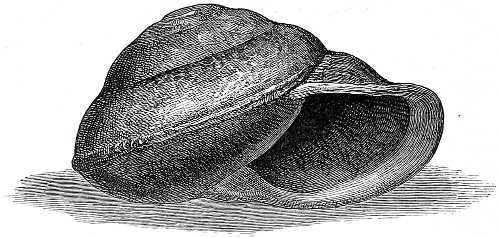
Out of two thousand species of Helix at present known, the only one of the same type as H. Mouhoti is the large H. Brookei, collected by Mr. Arthur Adams, in company with Sir Edward Belcher, on the mountains of Borneo, during the voyage of the ‘Samarang,’ and described by Mr. Arthur Adams in the ‘Zoology’ of that expedition. H. Mouhoti, of which Mr. Stevens has received a few specimens in various stages of growth, is even larger and more inflated than H. Brookei. In adult specimens the last whorl measures 6½ inches in circumference, 3 inches in diameter, and the shell is about 2 inches high. It differs from H. Brookei in being conspicuously, but not broadly, umbilicated, and in the mature lip not being in the least degree reflected at the margin. The lip itself (not the margin) is reflected at its junction with the body-whorl, partly round the umbilicus, as in the Nanina form of the genus. But the most striking feature of the species is the colouring. In H. Brookei the lower half of the whorls is of a uniform dark chestnut-colour; in H. Mouhoti it is pure white, turned to a bright straw colour by the overlying of a shining horny epidermis, encircled immediately below the periphery by a broad, rich, purple-black band, somewhat like the bands of the large Philippine Bulimus Reevei, but even broader and more defined on the white ground. The region of the umbilicus is also deeply and as definitely stained with the same purple-black colour. As in H. Brookei, all the specimens of H. Mouhoti are sinistral, or what is more commonly called reversed.
Bulimus cambojiensis.
This shell is either sinistral or dextral, cylindrically ovate, thick, stout and pupoid in the spire, bluish-white, tinged with a watery fawn-colour, and clouded throughout with oblique zigzag flames of the same colour, darker, but very undefined and washy; whorls seven, smooth, rather bulbous, faintly impressed concavely below the suture; aperture ovate, of rather moderate dimensions, overlaid in a very conspicuous manner across the body-whorl, and over a very thickly reflected lip, with a callous, opaque, milk-white deposit, which in the interior is stained with a beautifully iridescent violet-rose. This fine species, of which Mr. Stevens has received several specimens, measuring nearly 3 inches in length by 1½ inch in width, is a most characteristic example of a type of the Malayan province of the genus, represented by the old Bulimus citrinus of Brugnière; and it has been named after its well-authenticated place of habitation, because the species is, in all probability, confined to that locality. The islands adjacent to Cambodia have been pretty well ransacked; and we have nothing like it in species either from them or from the contiguous mainland of Siam on the west, or Cochin China on the east. This particular type of the genus appears, however, abundantly at the Moluccas, in B. citrinus; and at Mindanao, the southernmost of the Philippine Islands, in B. maculiferus. Like these two species, B. cambojiensis occurs with the shell convoluted either to the right or to the left. The shell is both larger and stouter than that of B. citrinus, differently painted, and especially characterized by its mouth of iridescent violet-rose, or what is now fashionably termed “Solferino” colour.
These descriptions are from the pen of Lovell Reeve, Esq., F.L.S., &c., and were communicated by him to ‘The Annals and Magazine of Natural History.’ See vol. vi. p. 203.
The annexed plate contains representations of several other new and interesting species of land shells discovered by M. Mouhot, and named by Dr. Pfeiffer, but which have yet to be described.
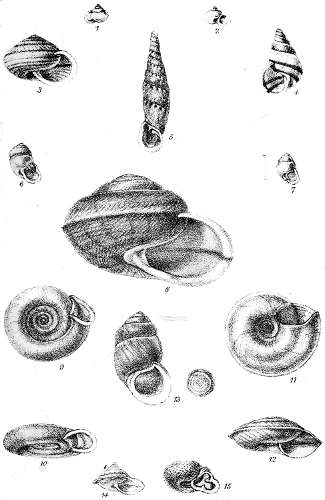
New Land Shells discovered by M. Mouhot.
G. B. Sowerby lith. W. West imp.
1. 2. Alycæus Mouhoti, Pfr.
3. Helix deliciosa, Pfr.
4. Bulisnus Römeri, Pfr.
5. Clausilia Mouhoti, Pfr.
6. Streplaxis pellucens, Pfr.
7. Pupina Mouhoti, Pfr.
8. Helix illustris, Pfr.
9. 10. Helix Laomontana, Pfr.
11. 12. Helix beligna, Pfr.
13. Hybocistis Mouhoti, Pfr.
14. Trochatella Mouhoti, Pfr.
15. Helix horrida, Pfr.
ATMOSPHERICAL OBSERVATIONS.
ATMOSPHERICAL OBSERVATIONS.
January.—The month of January at Bangkok is generally the coolest in the whole year. The thermometer generally ranges from 58° to 60° Fahr. in the morning. The wind is sometimes N. or N.E., and at others S.S.W. or S. The rainy season ends in the latter part of October; the water has fallen in the rivers, which have not overflowed since the middle of December; therefore at this time of the year one can walk along the banks, which are pleasant. The paths are visible and in a good state for travellers, and there is less danger, even in the interior of the country, of being attacked by jungle fever. There is often fog in the morning, but yet it is not unhealthy. The weather has been fine all the month, excepting one or two rainy days towards the middle.
February.—During this month the wind frequently blows from the N.E. or E., though sometimes from S.S.W. The weather is fresh, agreeable, and healthy. It is the month which the Buddhist pilgrims choose to visit Phrabat, where they imagine they can trace the prints of Buddha’s feet. It is the best time for crossing the jungles and the plains, for the banks are all raised high above the water and the earth is perfectly dry. If the wind blows from the S. for a few days, as it sometimes does, the heat becomes overwhelming for the time. There are also occasionally, as in January, two or three rainy days towards the middle of the month.
March.—This month is hotter and drier than the two preceding ones; there is less freshness. The wind blows generally from the E.N.E., S., or S.S.W., and often with great violence during the day: the Siamese call it Som Won (wind of the shuttlecock), of which game they are very fond, and one hears everywhere their noise mingled with cries of admiration from the people. Violent storms, accompanied by rain and thunder, generally mark the equinox; after that the weather becomes hot and dry. The thermometer sometimes rises as high as 93 in the middle of the day, but the nights are still pleasant.
April.—April is the hottest month of the year. The first part is generally dry, with E. or S. winds, but changes about the middle to N.E. and S.W. In the latter part of the month the excessive heat is tempered by some refreshing rains. Although the sun is very powerful during the day, the nights at Bangkok are cool. This month is not so healthy for Europeans as the three which precede it, and dysentery makes great ravages.
May.—This month is considered one of the most rainy of the year, though sometimes July and September are more so. The rain rarely lasts all day, and there are sometimes intervals of two or three fine days. In this month the people prepare their ground and sow their rice.
June.—During the whole of this month the wind blows constantly either from the S., W., or S.W. The jungles at this season are fatal to travellers, especially to Europeans, who would do wisely to avoid them and to pass this the rainy season at Bangkok, which is one of the healthiest of the tropical towns.
July.—In July sweet and refreshing breezes blow from the W. and S., but more rain falls than in June. There are sometimes very hot days, when the thermometer rises very high, but still in Siam this month is considered tolerably healthy.
August.—The same as July.
September.—This is a month of almost incessant rain, and it is very rare to have two or three consecutive fine days.
October.—Everything is inundated, some of the streets of Bangkok are transformed into canals, and the rivers everywhere overflow their banks. The first part of this month is as rainy as the preceding one.
November.—The Siamese now complain of the cold, but the Europeans rejoice in it, for the N.E. wind begins to blow. There are still some rainy days at the beginning of the month, and some hot ones. These transitions of temperature give rise to colds and catarrhs. At the end of the month the wind changes to the S.W.
December.—This is the best month to commence travelling on the rivers. Occasionally there is thunder and rain, but altogether it is considered a healthy month.
METEOROLOGICAL REGISTER.
Meteorological Register kept during the month of October 1861, and up to the sixth day after M. Mouhot was attacked by fever.
Louang Prabang (Laos).
Dates.Fahr. 8 A.M.Reaumur.Fahr. 3 P.M.Reaumur.Fahr. 8 P.M.Reaumur.
1731884..80..
272..85..78..
373188122⅓7620
475..802275¼20
573188124¾75¼20¼
675½2079207520
773197720½74..
87218½8323¼72¼18½
9731979207419
107419½83237419
11721883½23¼7419
127218¼79½21½7218
137015½78217017½
146314½7921½6515
15601372186015
16601383½23½7017
176414½83½227015
186414½8623½7018
196917852471½17½
207015½89257419½
21731990267419
2271188623½7118
23731987257018
246816½8825....
TALE.
Translated from the Chinese by M. Henri Mouhot.
CHINESE TALES.
In a Chinese village lived two cousins, both orphans: the eldest, who was called Moû, was cunning and egotistical; the other, on the contrary, was goodness and simplicity itself; he was called A-lo-Sine. The time for ploughing the fields arrived: A-lo-Sine possessed a buffalo, while Moû had only a dog. An idea struck him, and he went to his cousin and said, “I bring you my dog; give me your buffalo: my dog will plough your field, which is not very large, and you will see that you will have very fine rice.”
A-lo-Sine consented, and worked so well with the dog that his rice was first-rate, while the field ploughed by the buffalo produced hardly anything.
Moû, then, full of spite, went by night into his cousin’s field, and set fire to it: A-lo-Sine saw the flames, and, unable to repress his despair, uttered piercing cries, and rolled in the field.
Some apes, who were marauding in a neighbouring field, witnessed this spectacle, and said to each other, “That must be a god, since the fire does not hurt him.” They accordingly drew near him, took him by the feet and arms, and carried him to the top of a mountain, where they laid him down, plunged in a deep sleep. The monkeys then piled up rice and delicious fruits, and bowls of gold and silver of extraordinary beauty and value, and then left him to return to the fields.
At last he awoke, and thought no more of his misfortune, seeing around him so many treasures: he gathered them all up, and returned to his hut, full of joy.
Moû, seeing him so happy, followed him, and, at the sight of the gold, “Heavens!” cried he; “my cousin as rich as a prince: give me something.”
“No,” replied A-lo-Sine, “I will not; for you are wicked, and you set fire to my field.”
Moû then went to his own field, and set fire to that also, and imitated all that his cousin had done: he wept, cried, and, like him, threw himself into the flames. Five monkeys, one of them a young one, who were feasting close by, drew near him, curious to see what he was about. “He is a god,” said they, also; “the flames have spared him. Let us carry him away.” No sooner said than done. Each monkey seized one an arm, the other a leg, and they set off.
They reached a neighbouring wood; but there the little monkey began to cry out, “I want to help to carry him also.” “But there is nothing of him to hold by,” said the mother. The little monkey, however, continued to cry, and at last seized Moû’s long tress of hair, and put himself at the head of the procession.
But this hurt Moû, and he tried to disengage his hair. The young monkey began to cry again. “Ah, you are angry; stay there, then,” said all the others, and they threw him into a prickly bush.
Moû had great trouble in extricating himself from his disagreeable position; and it was nearly evening when he reached home, all covered with blood.
“Well, cousin, have you also some gold and silver?” said A-lo-Sine, on seeing him. “Ah! I am thoroughly punished for the harm I did you,” replied Moû. “I bring back nothing but needles: call the women to take them out of me.”
TALE.
Translated from the Chinese by M. Henri Mouhot.
There lived formerly in a Chinese village an old couple who had no children; and one day the husband put himself in a violent passion with his wife for never having had any, and even beat her. The poor old woman rushed out of the house, crying, and ran a long way. A priest of Buddha met her accidentally, and asked her what had happened to her. “My husband was angry to-day, and beat me, because we had no children,” replied she. “Listen,” said the priest; “I will make you happy! Dig in this earth and knead it” (it was clay). The woman obeyed, and the priest then sat down, and with his fingers moulded nine little figures. “The first,” said he, “will have long ears and very quick hearing; the second, a piercing sight; the third, a skin so hard that he will not feel any blow; the fourth will stand fire without hurt; the fifth will have an enormous head, as hard as iron; the sixth, legs long enough to cross the deepest stream; the seventh, feet as large as those of an elephant, for walking in mire; the eighth, an immense stomach; and the ninth, a nose as long as a pipe, from which jets of water will issue at command. Now,” continued the priest, “go home, and every year eat one of these children.” The old woman bowed several times, professing her gratitude and happiness; then she returned home; but in her joy, instead of contenting herself with one child, she eat up all nine at once. Her stomach, which had begun to swell at once, grew every month bigger and bigger, and became frightful. The husband was beside himself with joy, and was very kind to his wife.
At last the day of delivery arrived: the father received the first child, and ran to wash him in the stream; but there came a second. “Another!” cried the father, and ran again to the river. Returning, he found a third, then a fourth. He opened his eyes and cried, “Really this is quite enough: what can we give them to eat?” But the whole nine made their appearance on the same day.
All were prodigies: they grew rapidly; never cried; eat enormously, and began to run about in two months. But the old man did not know what to call them all; and one day he complained to his wife that he could not distinguish them one from another, got in another passion, and struck her again. The old woman ran away, crying, again, and went to find the priest who had helped her before. “Why do you cry now?” said he. “My husband has so many children now that he does not know what names to give them.” “You are very foolish,” replied he, “not to be able to distinguish them by the gifts they possess. Call one ‘Quick-ear,’ another ‘Hard-head,’ and so on for the others.”
The old man had calmed down when his wife returned; but debts accumulated as the children grew up. At last they became strong and fearless.
One day a creditor came and asked for money. “I have none,” replied the old man. He persisted in this reply, and at last turned the creditor out of the house. A few days after, this man collected several of his friends, and went again to the old man, declaring he would seize one of the children, and whip him. “Quick-ear” had heard all, and “Piercing-eye” had mounted to the top of a tree and seen all that was going on. They decided that “Hard-skin” would be the best to go, and the creditor succeeded in binding him and taking him away. But every cane broke on his back, without hurting him: at last they took an immense cudgel, but this broke in the same way; and seeing that it was lost time to beat him, they let him go home.
But a few days after, the creditor came back, determined to kill one of the children with boiling water. “Quick-ear” heard the project, and “Invulnerable” was left at home, and consequently carried off. They threw him into a boiler full of water; and in about an hour, when they opened it, the child raised his head. “What, not yet dead!” cried the creditor, in a fury, and he made up a larger fire, but “Invulnerable” was still alive. They made it still hotter, but the next day their wood was exhausted, and they let him go free, saying that Buddha protected him. “This is very sad,” said the creditor; “I cannot get my money; I cannot get my money: I will write a letter to Heaven, to beg that fire may be sent down to burn the house of my debtor.” He did so accordingly; but “Quick-ear,” who heard the plot, warned “Fountain-nose,” who thereupon took care to water the roof. The thunderbolt fell, but glided from the roof to the ground. All the children joined their strength, and lifted it, chained it up, and placed it in the house.
“Is it possible,” cried the creditor, “that they are not all dead? I must throw one of them into the sea.” This time it was “Stilt-bird’s” turn. The boat in which they placed him had not gone far from the shore when a storm arose and upset it, and all the men were drowned, with the exception of “Stilt-bird,” who escaped, thanks to his long legs. However, his brothers feared for him, and sent “Big-head” to the shore, where he found him fishing, and having already caught so many fish that he did not know where to put them. Luckily “Big-head” had his hat, which they filled, and returned home with an immense load. “Large-feet” went to cut wood to fry it with; but “Great-stomach” eat it all up before his brothers had hardly had time to begin. “Weeping-eyes” began to cry, and an inundation ensued, in which many of the neighbours perished.
Meanwhile, all the children were out searching for food, and the mother was left at home alone. She, seeing the thunderbolt chained in a corner, unfastened it. Immediately it rose in the air, then, falling again, struck the poor woman, and killed her.
FABLE.
Translated from the Chinese by M. Henri Mouhot.
CHINESE FABLES.
Firmness and presence of mind often make heroes of cowards, and rescue them from great dangers, while rashness is generally fatal.
In the midst of a thick and virgin forest, where everything seemed to slumber, an elephant began to utter doleful howlings, and a tiger replied by others still more dreadful, which froze all the other animals with terror. Monkeys, stags, and all the inhabitants of the neighbourhood, ran groaning to seek refuge at the tops of the trees, or in the depth of the woods, or in their dens. The elephant himself ran with all his speed, when on his way he met a hare, who stopped him, and said, “Why do you run thus, without aim and without reason?” “What! did you not hear the frightful roaring of the tiger? Would you advise me to stay here and be devoured?” “Stay here, and have no fear; I will answer for it that no harm happens to you,” said the hare; “only sit down, that I may jump on your back.” The elephant goodnaturedly approached and extended his four legs; then the hare jumped up, having first put into his mouth a piece of betel.
“Now, get up again,” said he, “and you will see that all will go well.” He then proceeded to give the elephant further counsel, and afterwards let out along his back a long stream of saliva, reddened by betel. Soon the tiger came up. “What are you coming to seek here?” said the hare, as the tiger stopped to look at them. “Do you not see that this elephant is not too much for me alone; and do you think I will share with you?” The tiger drew aside, behind a tree, to watch what passed. The hare then seized hold of the elephant’s ear, made him roar, and seemed perfectly master of his prey, and busy at his work. “Heavens! how strong he is!” said the tiger; but still he drew near. “Wait a minute, and I will come to you,” cried the hare, looking as though preparing to spring, and the tiger, struck with terror, turned and ran away. A chimpanzee, seeing him running away in such terror, burst out laughing. “What! you laugh at my misfortune?” cried the tiger. “I have just escaped from death, and you do not pity me.” “How so? I should like to see the beast who frightened you; take me to him.”
“What! to be devoured? no.”
“Do not be afraid; I will get on your back, and will not leave you: we will fasten our tails together, if you like; and thus united we shall run no risk!” The tiger was persuaded by these words, and they both returned to the elephant. The hare seemed still busy at his work: he had chewed a new piece of betel, and had made another stream, red as blood, on the elephant’s back. “You dare to come back!” cried he, in an angry tone, to the tiger. “You knew I had only just enough here for myself, and yet you want to carry away my prey from me; you deserve to be punished.”
At these words the elephant uttered a piercing cry; the hare made an enormous bound on his back; and the tiger, struck with terror, rushed precipitately away at full speed, saying to the chimpanzee, “Now, you see; you laughed at my fears, and we both narrowly escaped death.” But the chimpanzee did not hear; for in the tiger’s precipitate retreat he had fallen off his back, struck himself against a bamboo, and died, cursing his rashness with his last sigh.
THE HARE AND THE SNAIL. FABLE.
Translated from the Chinese by M. Henri Mouhot.
Formerly, according to the Siamese, hares had thick ears; but a certain day one of these animals, having more legs than memory, met a snail dragging himself painfully along the ground, and in a moment of pride sought to humiliate him. “Why, little one, where are you going at this pace?” said he. “To the beautiful rice-fields of the next village.” “But, my poor fellow, you will be a long time reaching them. Why did not Nature furnish you with legs like mine? Confess you envy me. How long, now, do you think it would take me to get there?”
“Perhaps longer than it would take me, though you pity me so much,” replied the snail, coldly.
“You jest, do you not?”
“No.”
“Well, will you bet about it?”
“Willingly.”
“What will you bet?”
“Whatever you like.”
“Well, then, if you win you shall nibble my ears; for you cannot eat me; and if you lose I will eat you: will that suit you?”
“Perfectly.”
“Then set off; for I will give you a start.”
While the hare began to browse the snail set off at his slow pace, and went to his brother, who was a little way off, and to him he communicated a pass-word, which he in turn told to another, and so on along the whole line which the betters had to travel, so that it quickly reached the end.
Soon the hare, having satisfied his hunger, and feeling strong, set off, and flew over the ground, calling to the snail, whom he believed to be close by. “Ohé!” answered he, from a long way off. “Oh, he is already far on the way,” cried the hare, who set off again like an arrow. In a few minutes he stopped and called again: “Ohé,” answered a voice still farther on. “Really, he goes very quickly,” thought the hare, and he set off again. A quarter of an hour after, he stopped, quite out of breath. “Now,” said he, “I may rest; I must be far in advance; but I will call and see.” “Ohé! snail.” “Ohé!” replied a voice a long way on. “Oh! I must be quick; I shall lose my bet,” murmured the hare. He ran, and ran, and at last stopped, quite exhausted, only a few yards from the fields. “Snail,” cried he, faintly: “what! you are returning from the place? Unfortunate that I am, I have lost my bet;” and he made vain efforts to get up and escape, but, alas! his strength failed him, and the snail pitilessly gnawed his ears.
Since that day the hare always avoids damp places, for fear of meeting one of the creatures who punished him for his pride.
TALE.
Translated from the Chinese by M. Henri Mouhot.
CHINESE TALE.
There lived formerly in a small town in China a singular couple, of a description still met with, for the Chinese progress very slowly. The husband was noted for his folly, and the wife for her cunning. “Always remember,” she used constantly to say to her husband when he went out, “that all people with long noses, in the form of an eagle’s beak, and bending downwards, are good-for-nothings, beggars, cheats, and, worse still, bad paymasters, coiners of false money, false-swearers, and will go to hell; while people with small turned-up noses are good, and will go straight to heaven. Therefore, that you may not lose, sell only to these last; for, I repeat to you, the others are bad.”
Every day the husband went out, and passed from street to street, examining the passers-by, but never addressing any but those who had their heads raised to look at something, so that he very seldom sold anything.
One day, when he was observing noses as usual, he saw a man reading a placard which was placed very high. “That man will go straight to heaven,” thought he; “his nose is so much turned up. Will you buy some clothes, good man?” said he. “Clothes! you see I have some.” “But you appear to me the most honest man I ever saw” (“I never saw such a nose,” he added to himself); “and I should like to sell you a whole suit; my wife makes them herself.” “Well, what is the price?” “Of my wife?” “No; of the clothes.” “Two kóóu” (about ten francs). “But why do you come into this retired place to sell your clothes, when there are so many people elsewhere?” “Oh! I went to those places; but all the people had long, bent, and eagle-shaped noses, you see! and I only sell to snub-nosed people.” “I do not understand you; why will you not sell to people with long noses?” “My wife, who is a very clever woman, told me that all people with long, eagle-shaped noses are knaves.” “Really, your wife is very sharp, and I understand you now. Well, my friend, I will buy your clothes; but as I have no money with me, I will pay you to-morrow. You have only to come to my house; I live near here. You will see a hurdle covered with eggs, a flag at the end of a mast, and a little plantation of betel.” “Very well; that will do.”
The merchant went home to his wife, and told her he had sold to a man with a snub nose. “Where is the money?” said she. “I have not got it yet, but I shall be sure to have it to-morrow. I am to go where I see a hurdle covered with eggs, a flag on a mast, and a little betel plantation.” The next day the wife said, “Go for your money.” He went, but could not find the house; and after long searching he came home again. “Have you the money?” said the wife. “No, I could not find the house.” “Well, I will go myself to look for it. If I am not back in an hour, you will know that I am drowned.” After an hour, as his wife did not return, the man took the sieve with which he usually sifted his rice, and set off to the river, which he began to try to empty with it. A passer-by asked him what he was doing. “I am emptying the river,” replied he; “for my wife is drowned, and she had on her best yellow bonnet.” “Nonsense!” said the other; “I just met her walking with a man who had a snub nose.”
THE DAMIER, OR CAPE PIGEON.
Procellaria Capensis.
THE CAPE PIGEON.
During a long voyage, when for months you have seen nothing but water and sky, the smallest novelty which appears and promises variety for the eye and the mind, though only for a few minutes, is joyfully welcome. Sometimes it may be a stormy petrel, flying like a swallow, skimming through the air in a hundred different directions, and seeming to play in that element; sometimes a ring-tail, which, with its piercing cry like that of a hawk, appears a messenger from the sun to bid the bold navigator welcome to the tropics, hovers for a few minutes over the ship, and then flies off with a jerk and disappears.
Sometimes are to be seen numerous blowers, who pass and repass the ship with bounds; or perhaps a whale, which almost stupefies you with the noise he makes as he displaces the water in rising to the surface to breathe: at another time it is some hungry shark, who, following in the wake of the ship, lets himself be caught by the bait thrown out to him, and which, when hoisted with great difficulty on deck, lashes it with his tail and looks formidable even after death; and this is a good take for the sailors, who divide the spoil and feast on it.
But of all the creatures dear and familiar to sailors, none rejoices him more than the faithful companion who, more than 3000 miles before he doubles the Cape of Good Hope or Cape Horn, appears to his sight, swims in the water, grazes a thousand times the hull or the rigging, pleases his eye by its parti-coloured plumage, and announces to him calm and tempest.
This bird, called by the French “Damier,” by the English the Cape Pigeon, and “Peintada” by the Portuguese, is the Cape Petrel, or Procellaria capensis of naturalists.
Gifted with great powers of flight, though less than other petrels, from morn till night, and often even a part of the latter when the moon is full, it is seen in the wake or alongside of the ship, describing in its flight, in which scarcely any movement is apparent, a thousand evolutions, sometimes touching the great waves which seem ready to overwhelm it, the moment after reappearing far above them, always wheeling about and careless of the storm.
The sight of this flight and of all these evolutions is most pleasing, and one involuntarily thinks of a graceful skater flying over the ice at his utmost speed, and seeking to attract admiration.
The whole life of this bird is perpetual movement, a constant chase after a scarce and insignificant prey. Unlike the swallow, who has his hours of pleasure and of amorous warbling, and nights of sleep in his warm nest, the Cape pigeon, pressed by hunger and by his ravenous appetite, only rests for a few minutes at a time at rare intervals during the day, in order to recruit his strength, and at night, rocked by the stormy wave, must find but little sleep.
Neither does the Cape pigeon know the delight of a peaceful retreat in a favourite spot sheltered by thick foliage or long reeds; and while most birds confine themselves to a limited district, where they are almost certain to be found at the same season, and to which they invariably return at the disappearance of the frosts which have chased them away for a time, this one, a sailor by nature, has for its domain an immense empire, namely the greatest part of the Atlantic, Pacific, and Indian oceans, and has to brave night and day, at one time an icy wind, and at another the rays of a burning sun.
But in a state of liberty nothing living is often unhappy, and the foreseeing Providence, who knows how to satisfy the wants of his creatures, also knows how to create joys for them, where we see nothing but trouble and misery. In like manner the industrious workman and the hardy traveller experience, perhaps, of all men the most lively joys; to them repose would be the greatest suffering.
Although inseparable companions of the sailor, it is not certainly for the pleasure of his society, nor for that afforded by the sight of the ship, that the petrels follow it, but for the certainty of finding in the scraps thrown overboard, as well as in the number of shells in the wake of the ship, food more abundant than he would discover elsewhere in the water. Nothing can equal their voracity but the quickness and vivacity with which they catch sight of the smallest prey and seize it even amidst a stormy sea. From a great distance, and long before the albatross, and the other descriptions of petrels which are often to be seen with the Cape pigeons, have remarked it, they see and pounce on it, and have generally swallowed it before the jealous rivals who follow them have been able to overtake them. The sense of smell does not here come in aid of that of sight, for they often pounce on a piece of wood or something of that description which falls from a vessel, and only abandon it when convinced by the touch that it is not fit for food. Their greediness is such that they will often let themselves be taken in dozens with hooks; no sooner are they on deck than they disgorge a thick liquid the colour of linseed oil.
When these birds rest on the sea and let themselves be tossed about by the waves, their appearance, dimensions, form, and colour of plumage strongly resemble our domestic pigeons, and hence the English seamen, struck with the similarity, have given them the name of Cape pigeons. Their size varies; the largest measuring more than 18 inches English from the beak to the tip of the tail, and rather more than a foot in circumference.
They are generally seen in great numbers only in stormy weather and in rather high latitudes. In the winter season—that is, during our June, July, and August—they follow the ships constantly between 23° S. lat. and 31° and 103° E. long.
Is it not a wonderful thing and worthy of admiration that the instinct with which this bold little navigator is endowed guides him safely through this vast space, where there is nothing to serve him as a landmark, enables him to rejoin his comrades if accidentally separated from them, and teaches him every year when the warm season returns to recognise and find the island or the solitary rock where he was born, and where in his turn he will bring up his young ones; while man, with his maps, his books, his nautical instruments, and in spite of all his long experience, has such difficulty in finding his way across the ocean? And yet we think that our intelligence raises us above the animals. This is what confounds and overwhelms the scholar when he seeks to fathom the great mysteries of creation.
THE ALBATROSS.
THE ALBATROSS
A wise and bountiful Providence has taken care to people the most distant and desert parts of the globe, whether covered with eternal snow or impenetrable forests. In the waters of the ocean are, as well as in our fields and woods, creatures which rejoice the eyes of man and provide for his wants. Of all these creatures none are more charming and pleasing than the birds; endowed either with melodious voices or brilliant plumage, or with some other charm or quality, such as vivacity, quickness and grace of movement, and power of flight; all have attractions for us; and even in our museums, in spite of their faded plumage and often altered forms, they are still objects of admiration, not only to the learned naturalist, but to men who care little for other beautiful sights.
But if leaving the cabinet we visit Nature herself, penetrate into the heart of the forests, climb the rocks, or visit the shores and the ocean, then our admiration grows stronger and more deep.
Of all birds there is none which exercises a greater influence over the mind of man, or causes greater astonishment, than the albatross, so celebrated by voyagers from the earliest times. The albatross! The word recalls to the navigator a thousand souvenirs; as the name of some bloody battle in which he has taken part, or of some general who has led him to victory, awakens those of the soldier. It recalls to the memory of the sailor the principal incidents of an existence passed between calm and tempest; he feels himself transported in thought to the time when the first albatross was signalled, and passengers and sailors turned their gaze eagerly towards the spot where, like a proud man of war, cradled by the rolling waves, advanced the powerful sailer against whom the storm rages in vain, and who, far from avoiding, seems to court it.
To this first souvenir succeed many others; there is the dead calm, which in the tropics has often detained his vessel inactive for weeks, as though chained under the burning sky, where the eye seeks in vain for a cloud, and the only sound that meets the ear is the heavy flapping of the sails against the masts as the ship rocks; a calm often more to be feared and more dangerous than the most terrible tempest, for it renders the crew inactive, impatient, and bad-tempered. But the first sight of the albatross indicates a coming change and wind to be expected. There is also the memory of painful and too sudden transitions from equatorial heat to the cold of high latitudes; that also of hours of dreadful anxiety when the storm broke out in all its violence, of the contest between winds and waves, and of the albatross hovering over the latter, as though chosen an umpire between these two formidable antagonists. The albatross inhabits the southern hemisphere of the Atlantic Ocean from the 25° or 26° of latitude, also both Pacifics, but is rarely seen farther north, and has never been known beyond the tropics; it is in the seas which bathe the three southern capes that they are seen in the greatest numbers.
It often happens, however, when the winter is mild and the weather fine, that very few are seen until you reach the 40°. They lay their eggs on some deserted southern shore; the female lays only one, and feeds her little one for nine months without leaving it, so much need has it of its mother’s help.
There is much difficulty in the classification of the palmipeds, which exhibit a great number of varieties.
The beak of the albatross is long and very strong; the upper jaw furrowed at the side and much curved; the lower one sharp, smooth, and truncated at the end; the nostrils, formed by two tubes opening outwards, are lateral and placed in a groove. The tarsi are short, but very thick, and ending in three front toes much palmated; the wings are long and narrow.
There are probably four distinct species of albatrosses.
1st. The wandering albatross, Diomedea exulans, which measures ten feet with the wings spread; it has a white head, the wings and belly being spotted with white, grey, and chestnut brown; the beak is the colour of horn. This species varies much in size, and still more in colour and plumage, which is more or less mixed with grey or brown, and sometimes even entirely white; this depends doubtless on the season, the sex, and the age.
2nd. The epauletted albatross, Diomedea epomophera, which is smaller than the common albatross. His head, neck, body, back, and rump are snowy white, while the feathers of his wings are perfectly black, with the exception of a large white lozenge-shaped spot on each; the beak is yellowish. Some naturalists believe these to be only the young of the ordinary kind.
3rd. The yellow-beaked albatross, Diomedea chlororhyncos. This species I have myself taken with a hook; his head, belly, and neck are brilliantly white, his back and the plumage of the wings a deep brown grey, the beak yellow, and the feet bluish grey; the rump is white, and as well as the underpart of the tail is bordered by a wide black line.
4th. The sooty albatross, Diomedea spadicea of Forster, which is the size of the common albatross, and of a uniform deep chestnut-colour.
CAMBODIAN VOCABULARY.
A.
Abandon (to)Lẽng, chol.
Abhor (to)Sââp.
Approach (to)Dâl.
AbstinenceTam.
Abstain (to)
Accept (to)Iotuol.
Accompany (to)Iam.
Accomplish (to)Ihúruéch hoì.
Accustom oneself (to)Ihlap.
Accuse (to)Shõdéng.
AcidEhu.
Admire (to)Ehhugã̆l.
Adore (to)Ihoui bãngeom.
AdulteryBap phit propon Ki.
Afflict (to)Lruey chot chaw chot.
AgeAcõ̆schhnam.
Announce (to)Srăp, pram.
Appease (to)On.
AppetiteComléan Klileán.
AfterẼcroí.
AridSngnot, comynot.
ArmCrùóng predăp.
ArmyIăp.
Arrive (to)Dâl.
AssemblyChumnam.
Assemble (to)Chumnam Kenéa.
AudacityIhean.
Audacious
AugustMahu.
AlsoDẽl.
AltarBalang, as-prĕn.
AgileChuery.
AirAcos.
Add (to)Thêm.
AloesJadam.
AlumSaĕpchu.
Amuse oneself (to)Ling.
AncientChus.
AssSatliá.
AngelFirĕuda.
AngleChrung.
AnimalSăt.
AvariceComnaut.
AdvocateSma Kedey.
Abortive (to be)Relutcõn.
ArmPhlu.
AimVong.
AshesPhe.
Ask (to)Som.
AboveLù ê lù.
AndNon.
Awake (to)Dăs.
ArrowPrúeup.
AgreeableTotuol.
AppearanceCŏmnăp.
According toTam.
AlwaysRuéy (iún ruey reáp darăpton muc).
AngerConhong.
AmongstErang.
AcrossTotùng.
AlreadyHoi.
B.
BitterLoving.
BeforeMum.
Bathe (to)Ngut tin.
BreathDâng hina.
BoldTahéan.
BroomBombãs.
BambooResey.
BananaChá.
BanquetCar si.
BeardPuk mŏt.
BoatIui.
Build (to)Sâhy, thú phtĕn.
Beat (to)Véag.
BeautifulSââ.
BenedictionPrăe pór.
BeastSat.
BlueKhín.
BeefCũ.
BushelIhang-Iao.
BoxHêp.
BottleSăr phdŏe.
ButtonLeu.
BranchMie.
BrickOt.
Break (to)Rei.
Burn (to)Dot.
BuffaloCrebey.
BlackKhnaun.
BoneCheóng.
BreadNam.
BasketConchir.
BladeLompeng.
BookSombot.
BedDomnéc.
ButPê.
BadBap, chomngú.
BreastDâ̆.
Beg (to)Som teau.
BetterCheang, lus.
Bite (to)Kham.
Be born (to)Cót.
BeeKhmum.
Bark (to)Sru.
Buy (to)Iink.
BusinessDomnor.
BowEhme.
BatatasEomlong.
BridgeSpreau.
BehindCroi, ê croi.
BackHhnang.
Be (to)Non-mêan, Chèn.
BigPhom.
Broil (to)Hang.
BirdSat liar.
BloodChheàm.
Blow (to)Phlõm.
Betray (to)Kebâ̆t.
BarkSombok.
Brother (elder)Bâng.
Brother (younger)Phŏôn.
C.
Come (to)Moc Dâ̆l.
CottageCatôm.
CorpseKhmoch.
CageIrung.
CaseHêp.
Calk (to)Bàt.
Calm oneself (to)On.
CambodiaSroch Khmêr.
CambodianKhmêr.
CountryNeal.
CanalPreê.
CombSuét.
CaskThâng.
CardamomCrevanh.
CauseHet dòm.
Cold (a)Câã̆c.
CupChan.
Conduce (to)Tôm.
ClothSouipăt.
CoughCâã̆c.
CommotionRevàl.
Cut (to)Cat.
Conquer (to)Chhnĕa.
ConqueredChănh.
ClothingAo.
CarriageRetê̆.
CentipedeKaêp.
CircleVong.
CoffinMochhus.
ChainChervăi.
ChoirSach.
Change (to)Prê.
CoalKhîung.
ChastitySel.
CatChhma.
ChiefMechàs, héay.
ChineseSwẽ chèn.
CholeraRŏmbâl.
ClearThla.
ClockCondong.
Cocoa-nutDong.
Combat (to)Chebang.
CommencementDòm.
Count (to)Răp.
Consent (to)Prom.
Console (to)Tŭo Săo.
ClayDeyót.
CrowdFông, cânbân.
CrowKhoêi.
CordKhse.
CoastKhaeng.
CottonCrebas.
ColourSombar.
CutCap, cat.
CrownMocõ̆t.
Call (to)Han.
CleanSaat.
Cry (to)Tô̆ui.
Carry (to)Chun, Rĕc sêng.
Clean (to)Nos leáng.
CloudSapô̆c.
Chew (to)Bièm.
ColdRengia.
CricketChungret.
ClockNovea.
CustomChebăp, Tomlăp.
Create (to)Bângeat.
CrySâmléng.
Cry (to)Srêc.
Cook (to)Dam.
CopperSpó̆n.
CymbalLông, Khmõ̆.
CrabPomgeong.
Church (temple)Preă-Vihear.
Carry away (to)Roc ton.
Coat (to)Leap.
ChildComing.
D.
Descend (to)Chô.
Desire (to)Sângvat, Châng.
Destroy (to)Pombat.
DebtBomnàl.
DivinerAchar.
DaybreakPrealum, Preahean.
DelicateTon.
DifferentTitey.
DifficultCra.
DiscipleCŏn Só̆s.
DearthÂmnât.
Dispute (to)Chhlô̆ prokêe.
DoubtMoutûl.
DysenteryChomngú mual.
Do (to)Thu.
DungAch.
Dress (to)Prăeae.
DampSom.
DrunkSreving.
DayThugay.
Deliver (to)Preeol.
DoctorCruthnam, pet.
Despise (to)Măcngeáy.
Deride (to)Sôch, châm-ôn.
Die (to)Slăp.
DwarfTua.
DuringCompung.
DustEhuli.
Dare (to)Héan.
Dote (to)Trũl.
DoveRùs.
Dig (to)Hal.
DrumSeôr.
Delay (to)Ângvéng.
Dye (to)Cherlâ̆c.
DarknessTângcap.
Draw (to)Téanh.
Deceive (to)Bŏn chhăt.
DearThlay.
DewÂnsóm.
DeafCâ.
DreamSâp.
DogChkê.
DoorShóĕ.
Drink (to)Elinear.
DuckIea.
Dream (to)Zâ̆l Sãp.
E.
Exchange (to)Dôr.
Efface (to)Lap.
EqualSmó.
ElephantTamrey.
Endure (to)Â̆t, ôn.
Engage (to)Pobuol.
EnemySatron-Khmang.
Enter (to)Chôl.
Envy (to)Chernêu.
Envy
ExampleKébuon.
Exhort (to)Boutun méan.
EndChông.
EveningLŏngéach.
EasyNgeáy.
EndLong-âs.
EyePhnée.
EggPong-sut.
EarErechiéc.
EqualMytrey.
Eat (to)Si, pisa, chhăn, soi.
EvenSmó, dock.
EverywhereSâ̆p ăulú.
EagleAntri.
EarthDey, Preă thorni.
F.
FaceMŭc.
FeebleComsoi.
FamilyCrua.
FamineÂmnâ̆t.
FatigueNuèy.
FaultTus.
FemaleNhi.
FerociousSahan.
FirePhlâng.
FeverCran.
FigureMuc.
FlowerPhŏm.
FaithChommia.
ForestPrey.
FreshRehoi.
FrontThngos.
FruitPhle.
Float (to)Ândẽt.
Freeze (to)Câc.
FatThop.
FrogOng Kêp.
FoodAhur Sâbiẽng.
FriendKeló.
FormerlyPidom.
FirewoodOs.
FingerDay.
FastBuos.
Fast (to)Si buos.
FreeNeaĕ Cheá.
FarChhngai.
FalsehoodCâhâc.
FrightfulNoiai.
Forget (to)Chŭs bât côrna.
FlyRug.
FishingBap.
Fish (to)Stuch trey, Dóc non.
FatherA puc.
FewEech.
FearKhlach.
FullPeuh.
FeatherSlap, mems.
FootChung.
FishEyey.
FowlMón.
Fill (to)Bampenh.
FoolLengong.
Follow (to)Tam, dòr tam.
FirebrandRengûc.
Fall (to)Duol-thleăc.
Find (to)Roi ban.
FaceMac.
FleshSach.
FieldPrê.
FigurativelyChó̆t.
Fear (to)Khlàch.
Fly (to)Luèch.
Fly (to) (like a bird)Hòr.
G.
GoldMeas.
GunpowderDémsón.
Go (to)Tou.
GreedyLuphu.
GoodLââ, chiá, písa.
Grind (to)Boh.
GirdleCrevat.
GarlicKetym Sá.
GrasshopperChungret.
Go out (to)Chenh.
GreenKhién, baí tong.
Glass (a)Péng Kên, Kên.
Go to bed (to)Dec.
Grow (to)Sbec.
GodPrĕa.
Give (to)Oi, chun.
GriefChhu.
GirlConsrey.
GunComphlûng.
Gain (to)Ban chonménch.
Guard (to)Reăesa.
GloveTeăc.
GenerousChôt tuléay.
GingerKhnhey.
GluttonLuphu.
GumChor.
Govern (to)Tac tîng.
GovernorChanfai sroc̆.
GraveÂnisãng.
GrainCrò̆p.
GreatThôm Kepô̆s.
GraftCrechâc.
Guide (to)Nóm.
GrassSmau.
GardenChomca, chebar.
GladnessNgeay.
H.
HungerComléan.
Hungry (to be)Khléan.
HelmChangcôt.
HailPrŭl.
HabitTomlá̆p.
HatchetPuthae.
Hate (to)Sâ̆âp.
HaricotSondêe.
HarmoniousPirô̆.
HighKepô̆s.
HourMong, Teune.
HideousAcrâ̆c, asron.
Honour (to)Ró̆p an.
Horror (to have an) ofKepum.
HalfChomhieng conmat, pheac condat.
HardRùng.
HellMorok.
Hear (to)Lú.
HousePhtêa.
HusbandPhodey.
HoneyTác khmum.
HostPhnhién.
HumbleSuphéap réap téap.
HereNê̆ ênê̆.
HeavyThngô̆n.
HundredweightHap.
HolyArahán.
HisRônthuc.
Hold (to)Can.
HolePrŏhong.
HeatCadau.
HorseSê.
HairSôc.
HeartBêdông.
How muchPonman.
HowDoehmedéch?
HornSneng.
Hang (to)Phiuor.
Hair (of animals)Merues.
Heap (to)Bomol.
Have (to)Mean.
HappinessBoran-Lays.
Hide (to)Puvu.
HeVeá Cá̂̆t.
HeavenMie.
HimChâng.
I.
IgnorantKhlan.
IslandCâ̆.
ImageComnur.
ImbecileChicuat.
IndiaPon, suey.
Impost SrŏcKeling créas.
Indicate (to)Bânghanh.
Inundate (to)Lich.
Inscribe (to)Cat.
InsipidSap.
InstantMŏ pŏnlú.
Instruct (to)Predan, Pourieu.
Insult (to)Promat pikhèat.
IntelligencePraehuha.
IntentionChò̂t.
Interdict (to)Khò̆t.
Interest (of money)Lar prăe.
Interpret (to)Prêpasa.
Interrogate (to)Suor, donding.
Introduce (to)Boŭchôlnòm.
Invite (to)Anchùnh.
IllChhu.
IllnessChumgŭ.
IfBó.
In order thatOi.
IdleKhchìl.
IdlenessComchil.
InKenong.
IncenseComnhau.
IsCòt.
Inhabit (to)Non, công.
J.
Join (to)Phehăp.
JoyÂmnâr.
JoyousAr, sabai, sremŏc sŏc sabai.
JudgeChmrom.
Judge (to)Cat săch Kedey.
JustTiéng Trâng.
Jump (to)Sut.
K.
Kiss (to)Thŏp, ap.
KingLuong, sdăch.
Know (to)Déng, chê.
Kill (to)Sâmlûp.
KnifeCombit.
Kneel (to)Lut cháng cong.
KneeCháng cong.
L.
LabourPhehuor.
LakeTouli Sap.
Leave (to)Lêng, chol.
LaymanCrehŏs.
LampChiêng Kién.
LanguagePasa.
LanguageÂndut.
Language (of a country)Pasa.
LargeTuléay.
Lick (to)Lit.
LightSral.
LeperChomugu, Khlong.
LeprousComlong, Khlong.
LetterÂcâr, sombăt.
LeavenTambê.
LipPepir.
LibertyLâmpey.
LinePoutŏt.
Line (fishing)Sontŭch.
LimpidThla.
LionSóng.
LawCrót, viney.
LongVéng.
Let (to)Chuol.
LeanSiom.
Lead (to)Dóc, nóm.
Lie (to)Câ̆hâ̆c cŏmphŭs.
LeafSló̆r.
LeftChhnéng.
Lose (to)Bâng, bât.
LittleEoch.
LadderChóndór.
Light (to)Och.
LeadSomnar.
LowIéap.
LikeSuró.
Lend (to)Khchey.
LawsuitKedey.
Lower (to)Lontéep.
Learn (to)Lù, rién.
Look at (to)Múl.
Laugh (to)Soch.
LearnedMéac, prach.
LordÂmmechûs, mechăs.
LikeSmó, doch.
Love (to)Srelant.
LifeAios.
Live (to)Rô̆s.
M.
MalayChuréa.
MaleChnmul.
Malediction.Bŏndasa.
MisfortuneÂndarai, piér, lombac.
MandarinMaman.
MangoSoai.
MannerIĕang.
MarshBóng, trepang.
Marry (to)Souipĕa apea pipéa.
MarkSâmcól.
MorningPrû̆c.
MedicineThnamsangcon.
Meditate (to)Niŭ, rompúng chon chieng.
Mingle (to)Leay.
MemberThnac thang.
MercuryBârât.
MotherMedai, mê.
MeritBŏn.
MarvellousChôm lû.
Measure (to)Vàl.
MidnightAtréat.
MirrorConchâe.
ModelKebuon.
MonthKhe.
MonasteryVât.
MountainPhnom.
Mount (to)Lòng.
MusquitoMus.
MuttonChiêm.
MurmurKhsâp, Khsién.
MusicPhlêng.
MatCòntil.
MadChimat.
ManMenus.
MilkTiù dâ̆.
MoonKhê (prĕa-Chăn).
MiserComnaut.
MuchChrón.
MouthMôt.
MudPhoc.
MillsBôs, tomboa.
MoneySrae.
MoreLus, Cheang.
MeatSăch.
N.
NetUon.
NarrowChang-ièt.
NailDêc ail.
NeckKho.
NowÊlounê̆.
NoonHmgay trâng.
NotCom.
NineThmey.
NoseChermo.
NestSomboi.
NameEhhnaô, neàm.
NoEi.
NourishAnchein.
NewCrá̆p.
NakedSrat.
NightYap.
NailCreehâi.
NearChut.
NeedleMòchul.
Native PriestMeăc, nìng prĕa sâng.
O.
Obey (to)Sdăp, doi Toudap.
Observe (to)Mal.
Obtain (to)Ban.
Offend (to)Ehú tuc̆.
Offer (to)Chun.
OnionKetym.
OunceEomlong.
OppositeEo-tung.
OrangeCroch.
Order (to)Bângcáp.
Open (to)Bòc.
OneMuey.
Old manChăs.
Old
OtherSitey-tiĕt, e tiét.
OilPreńg.
OarCheo.
OftenChrondâng, chron créa.
OwlEitui.
OfSi âmpi.
OverflowCompô̆i.
OathSâmbât.
P.
PrideComnoi.
PagodaG. vihéar.
PairCû.
PalaceVang, Preă-montir.
Palm-treeDóm tenot.
PeacockCanghoc.
PaperCredas.
ParadiseSthan suor, phimean.
Pardon (to)Ât tus.
PriestSâng Kreach.
PorringerChan.
Perceive (to)Khūuh.
Pray (to)Phéavĕanea, sot thor.
PrayerEhór pheavinia.
PrisonErung.
PriceTomlay.
ProfitChomniuh.
ProfoundChron.
Promise (to)Sãmŏt.
PromptRanăs.
Prostrate oneself (to)Crap.
Punish (to)Toctus.
Partake (to)Chec.
Pass (to)Huvs.
PoorPibac.
Pay (to)Sâng.
Paint (to)Cuor.
PelicanEung.
Pierce (to)Ehlu, thleay.
PeopleReas.
PerhapsProman.
Pound (to)Bô̆c.
PipeKhsier.
PricklyHór, măt.
PlaceDăc, tuò.
Pity (to)Anót, anot.
Please (to)Săp.
PleasureÂmnâr sôc sabai.
PlankCadar.
Plant (to)Dam.
PoisonEhnam pal.
PepperMŏreih.
PolishedReling.
PorkChrue.
Pursue (to)Ehuli.
PomegranateTetum.
PupilCrôm Sôs.
PincersEăngeap.
PowerAmnach.
Preach (to)Eisna.
Prepare (to)Riép.
Plane (to)Chhus.
PerspirationRhú̂s.
Perspire (to)Bêe nhús.
PerforatedThlu, dăch.
Preserve (to)Eue reaisa.
Pine-appleMonós.
Perceive (to)Klrúuh.
Print (to)Bâ̆ pum.
Play (to)Líng.
PlaceTach.
Pound (weight)Neal.
Put (to)Dăc, tuo.
PieceComnap.
Q.
QueenKhsatrey.
Question (to)Dondeng.
Quit (to)Léng, léa.
QuickChhăp.
R.
ReasonSack Kedey.
Row (to)Cheo.
RankChuor.
Raze (to)Côr.
RatCondor.
RayReăcsemey.
RecentlyÂmbauh.
Receive (to)Totuol.
RecompenseRongvoú.
RentViéch.
Rule (to)Soi réach.
Regret (to)Sdai.
ReligionSassena.
Repent (to)Chhu chá̆t.
Reply (to)Chhlói.
Respect (to)Cat Khlach.
Remain (to)Non.
Restore (to)San̂g viuh.
Rouse (to)Dàs.
Revolt (to)Kebâ̆t.
RichCââ̆c.
RichesSombat tròp.
RiverPrêe, stùng.
RiceIron. Ângeâ. Bai.
RoastThang.
RedCrehâm.
RouteThlon.
RoofTambâl.
RainPhliéng.
RunRã̆t.
Rain (to)Phliéng.
RottenLaoy.
RiverTouli.
RipeEam.
ReadSot.
RainbowAnthua.
RingAnchién.
RelationBang phoon, sach uheat.
S.
Spit (to)Sdâ Pruvs.
Strengthen (to)Chuol.
SpiderLing peáng.
Sit down (to)Ângmi.
SharpSruéch.
Sharpen (to)Sâmbiéng.
SmellEum Keloń.
ShadowMolâp.
StormPhiu.
StrawChambońg.
Speak (to)Sredey—Nieáy.
Sweep (to)Bas.
StickIâmbâng.
Shine (to)Phlú.
SealIra.
Slander (to)Chombon.
SoulPrea lúng.
SmellingAmnach, p. bâzmey.
Set out (to)Eau.
StoneEhmâ.
SweetSaân.
StraightEran̂g.
SquirrelComprŏc.
StillEtiér.
Swell (to)Hŏm.
Send (to)Pró, phnô.
ShoulderSma.
SwordSâmsér.
StuffSompat.
StarPheai.
Study (to)Rień.
Split (to)Su.
Son CouPros.
StrongKhlang.
Strike (to)Meay.
Son-in-lawCôu prusa.
SwallowTrechiéc cam.
ShameKhmas.
Swear (to)Sebât.
Shine (to)Phlu.
Slander (to)Sredey dám.
SeaSremăt.
SparrowChap.
Show (to)Bânghanh.
SoftSom.
Swim (to)Hêl.
SnowAp.
Sing (to)Chrieng.
Seek (to)Roc.
ScissorsContray.
Sew (to)Dér.
ShortKeley.
See (to)Sâmléng.
ShoreMót compong.
StreamStûng.
SandKhsach.
SabreDan.
SacrificeBuchéa.
Seize (to)Toc, chap.
SeasonCâughê.
SalaryChhnuol.
Sob (to)Tuéuh.
SatietyChâet.
SauceSômlâ.
SavouryPisa.
SealEra.
Seal (to)Prelâc âmbêl.
SawAnar.
Saw (to)Ar.
ScribeSmién.
SculptorChhleăc.
Shake (to)Ângruom.
Succour (to)Chuey.
SecretarySmień.
Sow (to)Prô, sap.
SerpentPôs.
SieveChuey.
SexÂngiochéat.
SilentSngiém.
SilkPré.
SoldierPôl, tahéan.
SunEhngay.
Sound (to)Phsâm.
SulphurEeá.
Suffer (to)Spoń thor.
Soil (to)Chhú, ât.
SuspicionMontúl.
StatueRup.
StimulateÂutóng.
SuccessionMârdâ̆c.
SugarSeâr.
Suffice (to)Lemon.
Supplicate (to)Ângvâr.
Support (to)Â̆t.
Suspend (to)Phiuor.
Stoop (to)Pontēep Khluon Êng.
SoonChhăp.
Silent (to be)Non sugiém.
Steep (to)Trom.
Sell (to)Lô̆c.
StomachKhial.
Smooth (to)Smó, reling.
SaySredey.
Small poxOt.
Shed (to)Chăk.
SaucepanChhang, keteă.
T.
Take (to)Yoi.
TailCŏntui.
Think (to)Niŭ, rompûng chŏuchúng.
ThusHêt nê.
ThenEŭp.
To-dayEhngay nê̆.
ThinSiom.
TradeEhneúh prô.
ThunderRoutèa.
Taste (to)Shlõ̆c.
Tear (to)Reliĕr.
To-morrowSõă.
ToothEhmeúh.
Teach (to)Predan.
TogetherKenéa.
ThickCrăs.
ThornSoŭla.
TinSomnăr Pahang.
Trust (to)Dêc.
Take care (to)Réacsa.
TipsyChăêt, srevońg.
TobaccoEhnăm chõ̆c.
TableTang.
TryProńg.
TaxPõ̆n, suey.
TestimonyBŏntál.
TempestPhin.
TemplePreă viheár.
TimeCal, pileá, vileá.
ThibetPreă, sumér.
TigerKhla.
TheeÊng, preă, sedêng.
ThunderPhiôr, roŭteă.
TorchChôulô.
TorrentStung.
TortoiseÂndoc.
Touch (to)Pó̆l.
TowerPreă-sat.
Turn (to)Vil.
Translate (to)Prê.
TrafficChomnuénh.
Transcribe (to)Châmlâng.
Tremble (to)Nhór.
TrumpetErê.
ThroneCõ̆l.
Too muchPic.
TroopFông, cân-bân.
TileKebúońg.
TurbulentRepus.
TownPŏnteéy.
TruePrã̆cã̆t; Arã̆ng.
ThingRebâs.
Travel (to)Dór.
ToadKing cok.
TwinCŏn Phlô.
ThereÊnŏ, nŏ.
TearEŭć Phneé.
U.
Undergo (to)Mãrdã̆c.
UproarVôr.
UlcerBõ̆s.
UniverseLu key.
Unite (to)Phsã̆m.
UrineTuc uõ̆um.
UsageTomlóp.
Use (to)Pro.
UsefulPreioch.
Utility
Understand (to)Yŏl.
UselessÂt preíoch.
UprightChhor.
Untie (to)Srai.
UnderCrom, ê crom.
UngratefulSmŏr.
UglyAirâc.
V.
VeryNăs.
VagueRelõ̆c.
VesselSâmpon, capol.
Vaunt (to)Uot.
VaseChan.
VeinSesay.
VenomPŭs.
VirtueCousâl, bŏn.
VictoryChhneă.
VirginPrommâ̆châ̆rey.
VillagePhum.
ViolentKhlang.
VioletSâmbôr soag.
ViolinChăpey.
Visit (to)Suor.
VowBâmmâ̆n.
Vow (to)Bân bâmmâ̆n.
VeilSounoiéa.
Veil (to)Bang.
VoiceSâmleńg.
Vomit (to)Cunot.
VoraciousLupha.
ViceBap, tus.
VegetablePoule pongea.
W.
WhenCalna.
WhoNana.
WhatOy? Sat ay?
Wake (to)Phuheăc.
WisdomSamphi.
WindingChhăp.
WorkCar.
Work (to)Thú car.
Watch (to)Retrit tetrut.
WindKhiâl.
WormChŏulin dûngeon.
Well (a)Andońg.
WordPeac.
WhyDebâtay.
WeTúng.
WorkChĕang.
Water (to)Sroch.
Wait (to)Ohâm.
Wash (to)Pongeon.
Water-closetLeáng.
WhenCăl, calêna, compung.
WickedBap, Chomugú.
Walk (to)Dór.
WorldLong.
WordPeác.
WallComphin̂g.
WaterTŭć.
Write (to)Sâ̆cer.
WifePropôn.
Wake (to)Dăs.
WaveTouli.
WagerPhnŏl.
WarSó̆c.
WineSra.
Wish (to)Châng.
WarmCadan.
Warm (to)Prap.
WhiteSâ.
WoundRebuos.
WoodSrey.
WhereÊna.
WomanSrey.
WidowerPomaí.
Y.
YesChŭs, bât, côrna.
YearChhnam.
YellowLúóng.
YoungComing.
YesterdayMŏsãl.
Z.
ZealChhú chaăl.
ZincSămnăr pang Krey.
NAMES OF THE NUMBERS.
1Muey.
2Pir.
3Bey.
4Buon.
5Prăm.
6Prămmuey.
7Prämpil.
8Prămbey.
9Prambuon.
10Dâ̆p.
11Mõtó̆n Dâ̆p.
12Pirtó̆n dâ̆p.
13Beytó̆n dâ̆p.
14Buontó̆n dá̆p.
15Prămtó̆n dá̆p.
16Prămmueytó̆n dá̆p.
17Prămpiltó̆n dá̆p.
18Prămbeytó̆n dâ̆p.
19Prămbuontó̆n dâ̆p.
20Mŏphey, or Bien Phey.
21Mŏphey muey, or Phey muey.
22Mŏphey pir, or Phey pir.
23Mŏphey bey, or Phey bey. &c.
30Sumsá̆p.
40Sêsó̆p.
50Hosá̆p.
60Hocsá̆p.
70Chêtsá̆p.
80Pêtsó̆p.
90Cansá̆p.
100Mŏ roi.
200Pir roi.
300Bey roi.
400Buon roi.
500Prăm roi.
600Prămmuey roi. &c.
1,000Mŏ pŏn.
2,000Pir pó̆n. &c.
10,000Mŏ mŭn.
100,000Mŏ sên.
1,000,000Mŏ cõt.
10,000,000Mŏ béan.
100,000,000Mŏ a Kho.
1,000,000,000Mŏ puni.
CARDINAL POINTS.
NorthÊ chûng, Tùs udãr.
SouthÊ thbong, Tus ê bor.
EastÊ cát, Tus ê cát.
WestÊ lich, Tus ê chém.
SEASONS.
Rainy SeasonCânghê or redon phliéng.
Hot or Dry SeasonCânghê or redon cadan.
WinterCânghê or redon rengèa.
THE DAYS OF THE WEEK.
SundayAtú̆t.
MondayChan.
TuesdayÂng Kéar.
WednesdayPût.
ThursdayPrĕa-hó̆s.
FridaySŏc.
SaturdaySan.
THE NAMES OF THE MONTHS.
1. MarchChêt.
2. AprilPisac.
3. MayChis.
4. JuneAsat.
5. JulySrap.
6. AugustPhetrebot.
7. SeptemberAsôch.
8. OctoberCârdó̆c.
9. NovemberMéac Khsér.
10. DecemberBõ̆s.
11. JanuaryMéac thõ̆m.
12. FebruaryPhâ̆l cun.
CYCLE OF TWELVE YEARS.
1. PigCôr.
2. RatChût.
3. OxChhlom.
4. TigerKhal.
5. HareThâ.
6. DragonRung.
7. SerpentMéa Sanh.
8. HorseMéa mê.
9. GoatMéa mê.
10. MonkeyVoê.
11. CockRoca.
12. DogChô.
PRONUNCIATION OF THE CAMBODIAN VOWELS.
a, ă, ã; é, ê; i; o, ó; u, ú.
CAMBODIAN VOWELS.
a. This is pronounced like the English word, “Palm.”
ă. This is pronounced short; as, “Mat.”
ã. This is something between the a and the o; it is pronounced like a very open o.
é. This is pronounced like our close e; as, “Men.”
ê. This is pronounced like our open e; as, “He.”
i. This is pronounced also like our e.
o. This is pronounced like our o; as, “Go.”
ó. This is pronounced like eu in “Liqueur.”
u. Like ou, in “You.”
ú. This is pronounced like u.
DIPHTHONGS.
Ai, ei, oi, ôi, ói. This is pronounced with a single emission of sound.
Ay, ey, oy, óy, ui, úi. This is pronounced with two emissions of sound, as, a-ï, e-ï, o-ï, u-ï, ú-ï.
Cha, ché, chi, cho, chu. This is pronounced as Tia, tié, tii, tio, tiu; with a single emission of sound.
Chha, chhé, chhi, chho, chhu. This is pronounced as Thcha, thché (etc.), with a strong aspiration.
Kha, khe, khi, kho, khu. This is pronounced as Ka, ke, ki (etc.), with a strong aspiration.
Nha, nhe, nhi, nho, nhu. This is pronounced as Nia, Nie (etc.), with a single emission of sound.
Pha, phe, phi, pho, phu. This is pronounced as pa, pe, pi (etc.), with an aspiration.
Nga, nge, ngi, ngo, ngu. This is pronounced hard.
Tha, thé, thi, tho, thu. Hard, and with an aspiration.
THE LORD’S PRAYER IN CAMBODIAN.
O’ Preă dâ công lu mic, apuc Túng Khnhŏm oi: Túng Khnhŏm ângvâr Preă-âng, som oi ûs neăc phâng têng núng cot sesór preă néam Preă-âng: som oi preă-nocor Preă-âng ban Túng Khnhŏm. Som ai rebal méan non dey thú tam preă hartey Preă-âng dock lú mic. Ahar Túng Khnhŏm sâ̆p thngay som ai Túng Khnhŏm ban thngai nê: hoï som pros bap Túng Khnhŏm dock iung Khnhŏm â̆t tus neăc êna mian tus núng Túng Khnhŏm: hoï som pum ai Túng Khnhŏm doi comnach: tê aî Túng Khnhŏm ban ruéch âmpi ândâ̆rai teăng puâng. Amén!
LETTERS FROM M. MOUHOT.
To Samuel Stevens, Esq.
[To be communicated to the Royal Geographical Society.]
Brelum, among the Savage Stiêns, lat. N. 11° 46′ 30″, long. W. 103° 3′, merid. of Paris, 15th October, 1859.
Dear Mr. Stevens,
I profit by a favourable opportunity which has just presented itself to write you a few hasty lines to let you know that I am alive. For the last two months I have been living with the savage Stiêns amidst their immense forests, the latitude being precisely as I have stated above, and here I have passed the season most favourable for collecting insects and land shells. In spite of the letter given to me by the King of Cambodia, ordering all the chiefs of the Srok Khmer, or Cambodian villages, to furnish me with the means of transport on my journey, I experienced much difficulty, as frequently neither buffaloes nor carts were to be found in the hamlets through which I passed. My journey took me a month to accomplish, which is about three times as long as it would have taken me on foot.
On the 21st July, after having descended the great arm of the Mekon from Pinhalú, a village about nine miles from the capital, and in lat. 11° 46′ 30″ N. and long. 103° 3 W. merid. of Paris, as far as Penom Peuh, a commercial town filled with Chinese, and situated at the conflux of two streams, I ascended the great Cambodian River, the water of which is still low, as all through the country the rainy season is two months later than usual. The Mekon is studded with islands, of which many are eight or nine miles long and more than a mile broad; such is the large and beautiful island of Ko-Sutin, where I arrived after five days’ journey. I estimate the width of the river to be about three miles. Pelicans are found on its waters, often in flocks of more than fifty, and storks, sea swallows, and other aquatic birds, abound in the shallow parts of the river. The general aspect of this mighty river is, however, rather sombre than gay, although doubtless there is something imposing in the rapidity of its waters, which run like a torrent. Few boats are to be seen on it, and its banks are almost barren (the forests being more than a mile distant), and, being constantly undermined by the water, fall down at the least shock, and this is generally all that you can see or hear. The Menam is much more gay and animated.
The rapids and cataracts commence about thirty or forty leagues north of Ko-Sutin, on the confines of Laos, and it is there necessary to leave the large boats and take to canoes, which as well as the luggage are often obliged to be carried on men’s backs.
The current of the Mekon is so strong that at certain times of the year you can go little more than a league a day, and the rowers often seek for fire in the evening at the very place where they cooked their rice in the morning. I ascended it in a small boat with three rowers, but at every bend of the river we had the greatest trouble to make any progress, and were frequently obliged to hold on by the rushes to prevent our being carried away by the current. Eight days after leaving Pinhalú I reached Pemptiélan, a large Cambodian village, where I found it necessary to take to land travelling.
There still remained 150 miles to travel in carts, all in an easterly direction. I was well received by the mandarin at the head of affairs in this part of the country, and was able to set out again in two days.
The first day our conveyances upset, and I feared that we should be unable to proceed; there were continually dreadful bogs, quagmires, and marshes, in which the carts sank up to the axletrees and the buffaloes to their bellies. Fortunately on the following day the road improved, but for three weeks all that was visible was a few scattered rice-fields round the villages, and we had to make our way through a marshy plain, covered with thick and dark woods, which reminded one of the enchanted forest of Tasso, and it is easy to understand that the imagination of a pagan race peoples these gloomy solitudes with evil spirits. Twenty times in an hour the men who accompanied us were obliged to raise the large branches and cut down the trunks which obstructed our passage, and sometimes we had to make a new path for ourselves.
The Cambodians were all much surprised at seeing us journeying towards the Stiêns at the worst time of the year, for in that country the rainy season had commenced, and even those who live nearest dare not venture there; and had I not brought with me from Siam my two young servants, I could not for any money have found a single individual to accompany me. Even they felt great repugnance to proceed—for in Siam, Cambodia bears a terrible reputation for unhealthiness, and unhappily both for them and for myself they were attacked with fever in the forests, since which, instead of receiving any help from them, I have had two patients to nurse.
Passing through a village peopled by a barbarous race of Annamites, I ran great risk of being taken prisoner by them, and being sent to finish my researches in a dungeon. Last year the carriages belonging to a French missionary were completely rifled, and the men sent with ropes round their necks to Cochin China. I loaded all my guns, and gave one to each of my men: our firm appearance, no doubt, frightened them, for we were not attacked.
In spite of the heat, the fatigue, and privations inseparable from such a journey, I arrived among the Stiêns in perfectly good health as far as I was concerned, and here I found a settlement of Catholic missionaries from Cochin China. It would have been impossible to go further, for I could neither find means of transport nor provisions, for at this time of the year the poor savages have consumed all their rice, and have nothing to live upon but herbs, a little maize, and what they can catch in the chase. I therefore accepted the hospitality offered to me with much kindness by a good priest. In a few weeks the rainy season will be over, the nights will become cold, and for several months insects will be found, and after that will come the turn of the birds, with which I shall exclusively occupy myself.
My departure from here will depend upon circumstances; perhaps I shall myself be the bearer of this letter to Pinhalú, perhaps I may be detained here some months by the bad state of the roads and the impossibility of procuring vehicles during the rice-harvest.
If you ask who are this strange people, living retired on the table-lands and mountains of Cambodia, which they appear never to have quitted, and differing entirely in manners, language, and features from the Annamites, Cambodians, and Laotians, my answer is that I believe them to be the aborigines of the country, and that they have been driven into these districts by the repeated inroads of the Thibetians, from whom they evidently descend, as is proved by the resemblance of features, religion, and character.
The whole country from the eastern side of the mountains of Cochin China as far as 103° long., and from 11° lat. to Laos, is inhabited by savage tribes, all known under one name, which signifies “inhabitants of the heights.” They have no attachment to the soil, and frequently change their abode; most of the villages are in a state of continual hostility with each other, but they do not attack in troops, but seek to surprise each other, and the prisoners are sold as slaves to the Laotians.
Their only weapon is the cross-bow, which they use with extraordinary skill, but rarely at a distance of more than twenty paces. Poisoned arrows are used only for hunting the larger animals, such as elephants, rhinoceros, buffaloes, and wild oxen, and with these the smallest scratch causes death, if the poison is fresh: the strongest animal does not go more than fifty paces before it falls; they then cut out the wounded part, half roast it without skinning or cutting it up, after which they summon the whole village by sound of trumpet to partake of it. The most perfect equality and fraternity reign in these little communities, and the Communists would here find their theories reduced to practice and producing nothing but misery.
The strongest European would find it difficult to bend the bow which the Stiên, weak and frail as he appears, bends without effort, doubtless by long practice.
They are not unacquainted with agriculture, but grow rice and plant gourds, melons, bananas, and other fruit-trees; their rice-fields are kept with the greatest care, but nearly all the hard work is done by the women. They seldom go out in the rainy season on account of the leeches, which abound in the woods to such a degree as to render them almost unapproachable; they remain in their fields, where they construct small huts of bamboo, but as soon as the harvest is over and the dry season returns they are continually out fishing or hunting. They never go out without their baskets on their backs, and carrying their bows and a large knife-blade in a bamboo handle. They forge nearly all their instruments from ore which they procure from Annam and Cambodia. Although they know how to make earthen vessels, they generally cook their rice and herbs in bamboo. Their only clothing is a strip of cloth passed between the thighs and rolled round the waist. The women weave these scarfs, which are long and rather pretty, and which when well made often sell for as much as an ox. They are fond of ornaments, and always have their feet, arms, and fingers covered with rings made of thick brass wire; they wear necklaces of glass beads, and their ears are pierced with an enormous hole, through which they hang the bone of an animal, or a piece of ivory sometimes more than three inches in circumference. They wear their hair long in the Annamite fashion, and knot it up with a comb made of bamboo; some pass through it a kind of arrow made of brass wire, and ornamented by a pheasant’s crest.
Their features are handsome and sometimes regular, and many wear thick mustachios and imperials.
Quite alone and independent amidst their forests, they scarcely recognise any authority but that of the chief of the village, whose dignity is generally hereditary. For the last year or two the King of Cambodia has occasionally sent the mandarin who lives nearest the Stiêns to their first villages, in order to distribute marks of honour to their chiefs, hoping little by little to subdue them, and to get from them slaves and ivory, and already he receives a small tribute every year. His emissaries, however, scarcely dare pass the limits of the kingdom, so fearful are they of the arrows of the savages and of the fevers which reign in their forests.