Volume 2 — APPENDIX. (continued 3)
Reading edition
Dr. Hodgkin stated that, besides the two letters, portions of which had been read, and the drawings and charts, M. Mouhot had likewise sent an elaborate description of the ruins which he found at Ongcor and in its vicinity. The plans on the table would give some idea of the magnitude of these ruins. A great part of the manuscript which accompanied them described their structure and workmanship. They were constructed chiefly of granite, and many of the stones were not only of very large size, but were elaborately carved. The workmanship of some of them was described as exquisite, and the designs not so deficient in artistic taste as one might suppose. Many of them represented imaginary animals, such as serpents with many heads; others, beasts of burden—horses, elephants, and bullocks. These temples were situated in a district which was now completely imbedded in a forest very difficult of access, and were so much in ruins that trees were growing on the roofs, and many of the galleries were in a state of great decay. The base and a large portion of the elevation were constructed of a ferruginous rock, but for the upper part blocks of granite were used—so exquisitely cut as to require no mortar to fill the interstices, and carved with relievos relating to mythological subjects indicative of Buddhism. M. Mouhot had copied some of the inscriptions, which from their antiquity the natives who accompanied him were unable to read. The characters so nearly resembled the Siamese that Dr. H. had no doubt that a skilful archæologist would have very little difficulty in deciphering them. He believed that the remains in question would be found equal in value to those which had recently been explored in Central America; and he felt convinced that when the descriptions were published, M. Mouhot would be thought deserving of great respect.
Mr. Crawfurd said it was about forty years since he visited the country, but his recollection of it continued vivid to this day. Most people knew very little about Cambodia; its very name was only familiar to us in that of its product, gamboge, which word was nothing else than a corruption of Cambodia. It was one of five or six states lying between India and China, whose inhabitants had lived under a second or third-rate civilisation at all times—never equal, whether physically, morally, or intellectually, to the Chinese, or even the Hindoos. At the present time Cambodia was a poor little state, having been encroached upon by the Siamese to the north, and by Cochin China to the south. M. Mouhot had given us an account of a country that no European had ever visited before. With respect to that gentleman’s belief that certain wild tribes whom he described had descended from Thibet, he (Mr. Crawfurd) believed that his ethnology was at fault. For his part, he believed these wild people to be no other than natives of the country—mere mountaineers, who had escaped from the bondage, and hence from the civilisation, of the plain. Such people existed in Hindoostan, in Siam, in the Burmese empire, in Cochin China, and in China itself—in fact, they were of no distinct origin, but simply the natives in a rude, savage, uncivilised state.
With respect to the French, he did not know on what grounds they had gone to Cambodia. They had obtained possession of one spot which was eminently fitted for a settlement. The finest river in all India, as far as European shipping was concerned, was the river at Saigon, which he had himself ascended about 14 miles, and found it navigable even for an old “seventy-four.” He believed it was the intention of the French to attempt the conquest of the whole of Cochin China. If they effected it, and occupied it, they would find it a monstrous difficulty. It would prove another Algeria, with the additional disadvantage of being 15,000 miles off instead of 500, and within the torrid instead of the temperate zone. The climate was very hot, the country was covered with forests, the malaria and the heat rendered it unsuitable for the European constitution. If they made an advance upon the Cochin Chinese capital, they would find the enterprise one of great difficulty. From Saigon to the northern confines of Cochin China the distance is 1500 miles, and the capital itself could not be less than 700 or 800 miles from Saigon, situated on a small river navigable only for large boats, with a narrow mouth, and two considerable fortresses, one on each side, at its mouth. When they arrived, they would find one of the largest and most regular fortifications in the East. He believed it was the most regular, after Fort William in Bengal, and a great deal larger than Fort William. It was constructed by the French, and now they will have considerable difficulty in conquering their own work. The French had a perfect right to be in Cochin China, and their being there would do no harm, but rather good, however questionable the benefit to themselves; for their presence amounted to the substitution of a friendly and civilised power for a rude and inhospitable one.
The drawings on the table were exceedingly curious and interesting; they were admirably done, and exhibited representations of some remarkable monuments, evidently of Buddhist origin. They reminded him very much, though inferior in quality and beauty, of the monuments of the island of Java. He never heard of volcanoes when he was in Cambodia, but he had no doubt M. Mouhot’s information was correct, though it appeared he did not describe them from his own personal experience. He would add a word upon the alphabets which were on the table. The Cambodians had invented a written phonetic character, which they used at the present time; therefore there could be no difficulty in understanding a Cambodian manuscript. But there were several of those now exhibited which were of more or less antiquity. One of them seemed to be the alphabet which was used by the Cambodians in their religious rites. The figure of Buddha showed that the Cambodians were worshippers of Buddha.
To M. Charles Mouhot.
Montbéliard,[15] 13th June, 1862.
LETTER TO M. CHARLES MOUHOT.
The members of the “Société d’Émulation” at Montbéliard desire to express the deep regret which they have experienced at the premature death of their fellow-townsman M. Henri Mouhot. After a three years’ journey in Cambodia and Siam, during which he devoted himself to researches which have been highly appreciated by the Geographical and Zoological Societies of London, he fell a victim at the early age of thirty-five to his love of science. His work remained unfinished, but it was gloriously commenced, and his name will not perish. The regret experienced by his friends is the greater from their conviction that had he lived he would have been still more an honour to his native town, and that the name of Mouhot would have ranked side by side with those illustrious ones which have already rendered Montbéliard famous in the department of Natural Science.
THE END.
LONDON: PRINTED BY WILLIAM CLOWES AND SONS, STAMFORD STREET, AND CHARING CROSS.
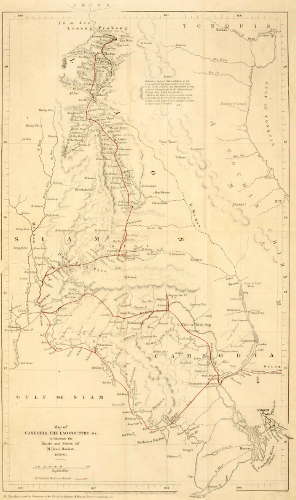
Map of CAMBODIA, THE LAO COUNTRY &c. to illustrate the Route and Notes of M. Henri Mouhot. 1859-61.
Pubd for the Journal of the Royal Geographical Socy. by J. Murray, Albemarle Strt. London, 1862.
NB. This Map is used by Permission of the R. G. Socy. to illustrate M. Mouhot’s Travels in Cambodia, &c.