CHAP. VI.
Reading edition
Language.—Literature, and the fine Arts.—Sciences.—Mechanics, and Medicine.
Opinion of the Chinese Language being hieroglyphical erroneous.—Doctor Hager's mistakes.—Etymological Comparisons fallacious.—Examples of—Nature of the Chinese written Character.—Difficulty and Ambiguity of.—Curious Mistake of an eminent Antiquarian.—Mode of acquiring the Character.—Oral Language.—Mantchoo Tartar Alphabet.—Chinese Literature.—Astronomy.—Chronology.—Cycle of sixty Years.—Geography.—Arithmetic.—Chemical Arts.—Cannon and Gunpowder.—Distillation.—Potteries.—Silk Manufactures.—Ivory.—Bamboo.—Paper.—Ink.—Printing.—Mechanics.—Music.—Painting.—Sculpture.—Architecture.—Hotel of the English Embassador in Pekin.—The Great Wall.—The Grand Canal.—Bridges.—Cemeteries.—Natural Philosophy.—Medicine.—Chinese Pharmacopoeia.—Quacks.—Contagious Fevers.—Small pox.—Opthalmia.—Venereal Disease.—Midwifery.—Surgery.—Doctor Gregory's Opinion of their Medical Knowledge.—Sir William Jones's Opinion of their general Character.
If no traces remained, nor any authorities could be produced, of the antiquity of the Chinese nation, except the written character of their language, this alone would be sufficient to decide that point in its favour. There is so much originality in this language, and such a great and essential difference between it and that of any other nation not immediately derived from the Chinese, that not the most distant degree of affinity can be discovered, either with regard to the form of the character, the system on which it is constructed, or the idiom, with any other known language upon the face of the globe. Authors, however, and some of high reputation, have been led to suppose that, in the Chinese character, they could trace some relation to those hieroglyphical or sacred inscriptions found among the remains of the ancient Egyptians; others have considered it to be a modification of hieroglyphic writing, and that each character was the symbol or comprehensive form of the idea it was meant to express, or, in other words, an abstract delineation of the object intended to be represented. To strengthen such an opinion, they have ingeniously selected a few instances where, by adding to one part, and curtailing another, changing a straight line into a curved one, or a square into a circle, something might be made out that approached to the picture, or the object of the idea conveyed by the character as, for example, the character 田, representing a cultivated piece of ground, they supposed to be the picture of an inclosure, turned up in ridges; yet it so happens that, in this country, there are no inclosures; the character, 口 a mouth, has been considered by them as a very close resemblance of that object; 上 and 下 above and below, distinctly marked these points of position; the character 人, signifying man, is, according to their opinion, obviously an abbreviated representation of the human figure; yet the very same character, with an additional line across, thus 大, which by the way approaches nearer to the human figure, having now arms as well as legs, signifies the abstract quality great; and with a second line thus 天 the material or visible heaven, between either of which and man it would be no easy task to find out the analogy; and still less so to trace an affinity between any of them, and 犬 which signifies a dog.
It is true certain ancient characters are still extant, in which a rude representation of the image is employed; as for instance, a circle for the sun, and a crescent for the moon, but these appear to have been used only as abbreviations, in the same manner as these objects are still characterized in our almanacks, and in our astronomical calculations. Thus also the kingdom of China is designed by a square, with a vertical line drawn through the middle, in conformity perhaps with their ideas of the earth being a square, and China placed in its center; so far these may be considered as symbols of the objects intended to be represented. So, also, the numerals one, two, three, being designed by 一 二 三, would naturally suggest themselves as being fully as convenient for the purpose, and perhaps more so than any other; and where the first series of numerals ended, which according to the universal custom of counting by the fingers was at ten, the very act of placing the index of the right hand on the little finger of the left would suggest the form of the vertical cross 十 as the symbol or representation of the number ten.
I cannot avoid taking notice in this place of a publication of Doctor Hager, which he calls an "Explanation of the Elementary Characters of the Chinese." In this work he has advanced a most extraordinary argument to prove an analogy between the ancient Romans and the Chinese, from the resemblance which he has fancied to exist between the numeral characters and the numeral sounds made use of by those two nations. The Romans, he observes, expressed their numerals one, two, three, by a corresponding number of vertical strokes I. II. III. which the Chinese place horizontally 一 二 三. The Romans designed the number ten by an oblique cross X, and the Chinese by a vertical one 十. This resemblance in the forming of their numerals, so simple and natural that almost all nations have adopted it, is surely too slight a coincidence for concluding, that the people who use them must necessarily, at some period or other, have had communication together. The Doctor however seems to think so, and proceeds to observe, that the three principal Roman cyphers, I. V. X. or one, five and ten, are denoted in the Chinese language by the same sounds that they express in the Roman alphabet. This remark, although ingenious, is not correct. One and five, it is true, are expressed in the Chinese language by the y and ou of the French, which it may be presumed, were the sounds that the letters I. and V. obtained in the ancient Roman alphabet; but with regard to the ten, or X, which, he says, the Chinese pronounce xe, he is entirely mistaken, the Chinese word for ten in Pekin being shee, and in Canton shap. This error the Doctor appears to have been led into by consulting some vocabulary in the Chinese and Portuguese languages; in the latter of which the letter X is pronounced like our sh. But admitting, in its fullest extent, the resemblance of some of the numerals used by the two nations, in the shape of the character, and of others in the sound, it certainly cannot be assumed to prove any thing beyond a mere accidental coincidence.
The earliest accounts of China, after the doubling of the Cape of Good Hope, being written by Portuguese missionaries, and the Chinese proper names still remaining to be spelt in the letters of that alphabet, have led several etymologists into great errors, not only with regard to the letter X, but more particularly in the m final, and the h incipient, the former being pronounced ng, and the latter with a strong aspirate, as sh. Thus the name of the second Emperor of the present dynasty is almost universally written in Europe Cam-hi, whereas it is as universally pronounced in China Caung-shee.
The learned Doctor seems to be still less happy in his next conjecture, where he observes that, as the Romans expressed their five by simply dividing the X, or ten, so also the ancient character signifying five with the Chinese was X or ten between two lines thus indicating, as it were, that the number ten was divided in two; the Doctor seems to have forgotten that he has here placed his cross in the Roman form, and not as the Chinese write it; and it is certainly a strange way of cutting a thing in two, by enclosing it between two lines; but the learned seldom baulk at an absurdity, when a system is to be established. The Chinese character for five is 五.

Of all deductions, those drawn from etymological comparisons are, perhaps, the most fallacious. Were these allowed to have any weight, the Chinese spoken language is of such a nature, that it would be no difficult task to point out its relationship to that of every nation upon earth. Being entirely monosyllabic, and each word ending in a vowel or a liquid, and being, at the same time, deprived of the sounds of several letters in our alphabet, it becomes necessarily incapable of supplying any great number of distinct syllables. Three hundred are, in fact, nearly as many as an European tongue can articulate, or ear distinguish. It follows, of course, that the same sound must have a great variety of significations. The syllable ching, for example, is actually expressed by fifty-one different characters, each having a different, unconnected, and opposite meaning; but it would be the height of absurdity to attempt to prove the coincidence of any other language with the Chinese, because it might happen to possess a word something like the sound of ching, which might also bear a signification not very different from one of those fifty-one that it held in the Chinese.
The Greek abounds with Chinese words. κυον, a dog, is in Chinese both keou and keun, expressive of the same animal; ἐυ, good, is not very different from the Chinese hau, which signifies the same quality; and the article τὸ is not far remote from ta, he, or that. Both Greeks and Romans might recognise their first personal pronoun έγω or ego in go, or as it is sometimes written ngo. The Italian affirmative si is sufficiently near the Chinese shee, or zee, expressing assent. The French étang, and the Chinese tang, a pond or lake, are nearly the same, and their two negatives pas and poo are not very remote. Lex, loi, le, law, compared with leu, lee, laws and institutes, are examples of analogy that would be decisive to the etymological inquirer. The English word mien, the countenance, and the Chinese mien, expressing the same idea, are nothing different, and we might be supposed to have taken our goose from their goo. To sing is chaung, which comes very near our chaunt. The Chinese call a cat miau, and so does the Hottentot. The Malay word to know is tau, and the Chinese monosyllable for the same verb is also tau, though in conversation they generally use the compound tchee-tau, each of which separately have nearly the same meaning. The Sumatrans have mau for mother, the Chinese say moo. On grounds equally slight with these have many attempts been made to form conclusions from etymological comparisons. If I mistake not, the very ingenious Mr. Bryant makes the word gate a derivative from the Indian word ghaut, a pass between mountains. Surely this is going a great deal too far for our little monosyllable. Might we not with as great a degree of propriety fetch our shallow or shoal from China, where sha-loo signifies a flat sand, occasionally covered with the tide? A noted antiquarian has been led into some comical mistakes in his attempt to establish a resemblance between the Chinese and the Irish languages, frequently by his having considered the letters of the continental alphabets, in which the Chinese vocabulary he consulted was written, to be pronounced in the same manner as his own[14].
Whatever degree of affinity may be discovered between the sounds of the Chinese language and those of other nations, their written character has no analogy whatsoever, but is entirely peculiar to itself. Neither the Egyptian inscriptions, nor the nail-headed characters, or monograms, found on the Babylonian bricks, have any nearer resemblance to the Chinese than the Hebrew letters have to the Sanscrit; the only analogy that can be said to exist between them is, that of their being composed of points and lines. Nor are any marks or traces of alphabetic writing discoverable in the composition of the Chinese character; and, if at any time, hieroglyphics have been employed to convey ideas, they have long given way to a collection of arbitrary signs settled by convention, and constructed on a system, as regular and constant as the formation of sounds in any of the European languages arises out of the alphabets of those languages.
The history of the world affords abundant evidence that, in the dawn of civilization, most nations endeavoured to fix and to perpetuate ideas by painting the figures of the objects that produced them. The Egyptian priesthood recorded the mysteries of their religion in graphic emblems of this kind; and the Mexicans, on the first arrival of the Spaniards, informed their prince Montezuma of what was passing by painting their ideas on a roll of cloth. There is no way so natural as this of expressing, and conveying to the understanding of others, the images that pass in the mind, without the help of speech. In the course of the present voyage, an officer of artillery and myself were dispatched to make observations on the small island of Collao, near the coast of Cochin-China. In order to make the natives comprehend our desire to procure some poultry, we drew on paper the figure of a hen, and were immediately supplied to the extent of our wants. One of the inhabitants taking up the idea drew close behind the hen the figure of an egg, and a nod of the head obtained us as many as we had occasion for. The Bosjesmen Hottentots, the most wild and savage race perhaps of human beings, are in the constant habit of drawing, on the sides of caverns, the representations of the different animals peculiar to the country. When I visited some of those caverns I considered such drawings as the employment of idle hours; but, on since reflecting that in almost all such caverns are also to be seen the figures of Dutch boors (who hunt these miserable creatures like wild beasts) in a variety of attitudes, some with guns in their hands, and others in the act of firing upon their countrymen; waggons sometimes proceeding and at others standing still, the oxen unyoked, and the boors sleeping; and these representations generally followed by a number of lines scored like so many tallies; I am inclined to think they have adopted this method of informing their companions of the number of their enemies, and the magnitude of the danger. The animals represented were generally such as were to be met with in the district where the drawings appeared; this, to a people who subsist by the chace and by plunder, might serve as another piece of important information.
The Chinese history, although it takes notice of the time when they had no other method of keeping their records, except, like the Peruvians, by knotting cords, makes no mention of any hieroglyphical characters being used by them. If such were actually the case, the remains of symbolical writing would now be most discoverable in the radical, or elementary characters, of which we shall presently have occasion to speak, and especially in those which were employed to express some of the most remarkable objects in nature. Out of the two hundred and twelve, or thereabout, which constitute the number of the radical signs, the following are a few of the most simple, in none of which, in my opinion, does there appear to be the least resemblance between the picture and the object.
人 gin, man
口 koo, a mouth
土 tee, earth
子 tsé, a son
艸 tsau, a plant
山 shan, a mountain
心 sin, a heart
手 shoo, a hand
方 fang, space, or a square of ground
月 yué, the moon
日 jee, the sun
木 moo, a tree
水 swee, water
火 ho, fire
石 shee, a stone.
The rest of the elementary characters are, if possible, still more unlike the objects they represent. There seems, therefore, to be no grounds for concluding that the Chinese ever made use of hieroglyphics or, more properly speaking, that their present character sprung out of hieroglyphics. They have a tradition, which is universally believed, that their prince Fo-shee was the inventor of the system upon which their written character is formed, and which, without any material alteration, there is every reason to suppose has continued in use to this day. To Fo-shee, however, they ascribe the invention of almost every thing they know, which has led Mr. Baillie ingeniously to conjecture that Fo-shee must have been some foreigner who first civilized China; as arts and sciences do not spring up and bear fruit in the life of one man. Many changes in the form of characters may have taken place from time to time, but the principle on which they are constructed seems to have maintained its ground. The redundancies of particular characters have been removed for the sake of convenience; and the learned in their epistolary writing have adopted a sort of running hand, in which the form is so very materially altered, by rounding off the angles, connecting some parts and wholly omitting others, as to make it appear to a superficial observer a totally different language. But I may venture to observe, that it has not only not undergone any material alteration for more than two thousand years, but that it has never borrowed a character, or a syllable, from any other language that now exists. As a proof of this, it may be mentioned, that every new article that has found its way into China since its discovery to Europeans has acquired a Chinese name, and entirely sunk that which it bore by the nation who introduced it. The proper names even of countries, nations, and individuals are changed, and assume new ones in their language. Thus Europe is called See-yang, the western country; Japan Tung-yang, the eastern country; India Siau-see-yang, the little western country. The English are dignified by the name of Hung-mou, or Red-heads, and the French, Spanish, Portuguese, and others, who visit China, have each a name in the language of the country totally distinct from that they bear in Europe. This inflexibility in retaining the words of their own poor language has frequently made me think, that Doctor Johnson had the Chinese in his mind when, in that inimitable piece of fine writing which prefaces his dictionary, he made this remark: "The language most likely to continue long without alteration, would be that of a nation raised a little, and but a little, above barbarity, secluded from strangers, and totally employed in procuring the conveniences of life."
The invention of the Chinese character, although an effort of genius, required far less powers of the mind than the discovery of an alphabet; a discovery so sublime that, according to the opinion of some, nothing less than a divine origin ought to be ascribed to it. It may, however, be considered as the nearest approximation to an universal character that has hitherto been attempted by the learned and ingenious of any nation; each character conveying at once to the eye, not only simple, but the most combined ideas. The plan of our countryman, Bishop Wilkins, for establishing an universal character is, in all respects, so similar to that upon which the Chinese language is constructed, that a reference to the former will be found to convey a very competent idea of the nature of the latter. The universal character of our countryman is, however, more systematic, and more philosophical, than the plan of the Chinese character.
Certain signs expressing simple objects or ideas may be considered as the roots or primitives of this language. These are few in number, not exceeding two hundred and twelve, one of which, or its abbreviation, will be found to compose a part of every character in the language; and may, therefore, be considered as the key to the character into which it enters. The eye soon becomes accustomed to fix upon the particular key, or root, of the most complicated characters, in some of which are not fewer than sixty or seventy distinct lines and points. The right line, the curved line, and a point are the rudiments of all the characters. These, variously combined with one another, have been extended from time to time, as occasion might require, to nearly eighty thousand different characters.
To explain the manner in which their dictionaries are arranged will serve to convey a correct notion of the nature of this extraordinary language. All the two hundred and twelve roots or keys are drawn fair and distinct on the head of the page, beginning with the most simple, or that which contains the fewest number of lines or points, and proceeding to the most complicated; and on the margins of the page are marked the numeral characters one, two, three, &c. which signify, that the root or key at the top will be found to be combined on that page with one, two, three, &c. lines or points. Suppose, for example, a learner should meet with an unknown character, in which he perceives that the simple sign expressing water is the key or root, and that it contains, besides this root, six additional points and lines. He immediately turns over his dictionary to the place where the character water stands on the top of the page, and proceeding with his eye directed to the margin, until the numeral character six occurs, he will soon perceive the one in question; for all the characters in the language, belonging to the root water, and composed of six other lines and points, will follow successively in this place. The name or sound of the character is placed immediately after it, expressed in such others as are supposed to be most familiar; and, in the method made use of for conveying this information, the Chinese have discovered some faint and very imperfect idea of alphabetic writing, by splitting the monosyllabic sound into a dissyllable, and again compressing the dissyllable into a simple sound. One instance will serve to explain this method. Suppose the name of the character under consideration to be ping. If no single character be thought sufficiently simple to express the sound ping, immediately after it will be placed two well-known characters pe and ing; but, as every character in the language has a monosyllabic sound, it will readily be concluded, that pe and ing, when compressed into one syllable, must be pronounced ping. After these, the meaning or explanation follows, in the clearest and most easy characters that can be employed.
When, indeed, a considerable progress has been made in the language, the general meaning of many of the characters may be pretty nearly guessed at by the eye alone, as they will mostly be found to have some reference, either immediate or remote, though very often in a figurative sense, to the signification of the key or root; in the same manner as in the classification of objects in natural history, every species may be referred to its proper genus. The signs, for instance, expressing the hand and the heart, are two roots, and all the works of art, the different trades and manufactures, arrange themselves under the first, and all the passions, affections, and sentiments of the mind under the latter. The root of an unit or one comprehends all the characters expressive of unity, concord, harmony, and the like. Thus, if I observe a character compounded of the two simple roots, one and heart, I have no difficulty in concluding that its signification is unanimity, but, if the sign of a negative should also appear in the same character, the meaning will be reversed to discord or dissention, literally not one heart. Many proper names of persons have the character signifying man for their key or root, and all foreign names have the character mouth or voice annexed, which shews at once that the character is a proper name employed only to express sound without any particular meaning.
Nor are these keys or roots, although sometimes placed on the right of the character, sometimes on the left, now at the top, and then at the bottom, so very difficult to be discovered to a person who knows but a little of the language, as Doctor Hager has imagined. This is by far the easiest part of the language. The abbreviations in the compound characters, and the figurative sense in which they are sometimes used, constitute the difficulty, by the obscurity in which they are involved, and the ambiguity to which they are liable.
The Doctor is equally unfortunate in the discovery which he thinks he has made of a want of order in classing the elements according to the number of lines they contain. The instances he gives of such anomaly are in the two characters of 母 moo, mother; and 田 tien, cultivated ground: the first of which he is surprised to find among the elementary characters of four lines, and the latter (which he asserts to be still more simple) among those of five. The Chinese, however, are not quite so much out of order as the Doctor seems to be out of his province in attempting a critique on a language, of which he really possesses a very superficial knowledge. The first character 母 moo is composed of and the second 田 tien of ; the one of four and the other of five lines according to the arrangement of Chinese dictionaries, and their elementary treatises.

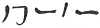
Among the roots or primitives that most frequently occur are those expressing the hand, heart, mouth, and the five elements, earth, air, fire, wood, and water. Man is also a very common root.
The composition of characters is capable of exercising a very considerable degree of ingenuity, and the analysis of them is extremely entertaining to a foreigner. As in a proposition of Euclid it is necessary to go through the whole demonstration before the figure to which it refers can be properly understood, so, in the Chinese character, the sense of the several component parts must first be known in order to comprehend the meaning of the compound. To endeavour to recollect them without this knowledge would be a laborious and almost impossible effort of the mind. Indeed, after this knowledge is acquired, the sense is sometimes so hid in metaphor, and in allusions to particular customs or ways of thinking, that when all the component parts of a character are well understood, the meaning may yet remain in obscurity. It may not be difficult to conceive, for instance, that in a figurative language, the union of the sun and moon might be employed to express any extraordinary degree of light or brilliancy; but it would not so readily occur, that the character foo or happiness, or supreme felicity, should be designed by the union of the characters expressing a spirit or demon, the number one or unity, a mouth, and a piece of cultivated ground, thus 福. This character in the Chinese language is meant to convey the same idea as the word comfort does in our own. The character implying the middle of any thing, annexed to that of heart, was not inaptly employed to express a very dear friend, nor that with the heart surmounted by a negative, to imply indifference, no heart; but it is not so easy to assign any reason why the character ping, signifying rank or order, should be expressed by the character mouth, repeated thrice, and placed like the three balls of a pawnbroker, thus 品, or why four of these mouths arranged as under, with the character ta, great, in the center, should imply an instrument, or piece of mechanism. 器. Nor would it readily occur why the character 男 nan, masculine, should be made up of tien, a field, and lee, strength, unless from the idea that the male sex possesses strength, and only can inherit land. But that a smoothness or volubility of speech 唫 should be designed by koo, mouth, and kin, gold, we can more easily conceive, as we apply the epithet silver tongue pretty nearly on the same occasion.
If the Chinese had rigidly adhered to the ingenious and philosophical mechanism they originally employed in the construction of their characters, it would be the most interesting of all languages. But such is far from being the case. New characters are daily constructed, in which convenience, rather than perspicuity, has been consulted.
It will follow from what has been said, that every compounded character is not only a word, but also a definition, comprehending in visible marks its full explanation; but no character, however compounded, can have more than a monosyllabic sound, though each part when alone has a distinct sound, as well as sense. Thus, "Happiness," though compounded of four distinct characters, shee, a demon; ye, one; koo, a mouth, and tien, a piece of cultivated ground, has only the simple monosyllabic sound foo, which is unlike that of any one of its compounds.
The sounds and various inflexions incidental to languages in general, are not necessary to be attended to in the study of the Chinese characters. They speak equally strong to a person who is deaf and dumb, as the most copious language could do to one in the full enjoyment of all his senses. It is a language addressed entirely to the eye, and not to the ear. Just as a piece of music laid before several persons of different nations of Europe would be played by each in the same key, the same measure, and the same air, so would the Chinese characters be equally understood by the natives of Japan, Tunquin, and Cochin-China; yet each would give them different names or sounds, that would be wholly unintelligible to one another. When, on the present voyage, we stopped at Pulo Condore, the inhabitants, being Cochin-Chinese, had no difficulty in corresponding, by writing, with our Chinese interpreters, though they could not interchange one intelligible word.
Although, with the assistance of a good dictionary and a tolerable memory, a knowledge of such of the Chinese characters, as most frequently occur, may be obtained by a foreigner; yet the ambiguity to which they are liable, on account of the frequent figurative expressions and substitution of metaphor for the literal meaning, renders their best compositions extremely obscure. Another, and not the least, difficulty to a learner of this language arises from the abridgment of the characters for the sake of convenience, by which the eye is deprived of the chain that originally connected the component parts. In short, it is a language where much is to be made out that is not expressed, and particularly so in what is called fine writing; and a thorough knowledge of it can only be acquired from a familiar acquaintance with the manners, customs, habits, and opinions of the people. Those missionaries even, who have resided in the country the best part of their lives, and accepted employments about the palace, are frequently at a loss in translating and composing the official papers that are necessary to be made out on the occasion of an European embassy.
It is, however, a matter of surprize that, after all that has been published in Europe by the Jesuits of the grandeur, the magnificence, the learning, and the philosophy of the Chinese, so very few persons should have taken the trouble to make themselves acquainted with the language of this extraordinary nation. So little was a professor of Chinese, at Rome, versed in the language he professed to know, that he is said[16] to have mistaken some characters found on a bust of Isis for Chinese, which bust and the characters were afterwards proved to be the work of a modern artist of Turin, made after his own fancy. In Great Britain we have known still less of the Chinese language and Chinese literature than on the continent. It is not many years ago, that one of the small copper coins of China, stamped in the reign, and with the name, of the late Tchien-lung (or as he is usually called in the southern dialect of China Kien-long) was picked up in a bog in Ireland, and being considered as a great curiosity, was carried to an indefatigable antiquary, whose researches have been of considerable use in investigating the ancient history and language of that island. Not knowing the Chinese character, nor their coin, it was natural enough for him to compare them with some language with which he was acquainted; and the conclusion he drew was, that the four following characters on the face were ancient Syriac; and that the reverse (which are Mantchoo letters) appeared to be astronomical, or talismanic characters, of which he could give no explanation.
Face.
Tchien-lung. Pao-tung.(Emperor's name.) Current value.
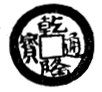
Reverse.
po tchin.House, or dynasty, of Tchin.

The Mantchoo Tartar characters of another coin he supposed to signify p u r, which is construed into sors, or lot; and it is concluded, that these coins must either have been imported into Ireland by the Phœnicians, or manufactured in the country; in which case, the Irish must have had an oriental alphabet. "In either case," it is observed, "these medals contribute more to authenticate the ancient history of Ireland than all the volumes that have been written on the subject."
I have noticed this circumstance, which is taken from the Collectanea Hibernica, in order to shew how little is known of the Chinese character and language among the learned, when so good a scholar and eminent antiquary committed so great a mistake.
The youth of China generally begin to study the language when they are about six years of age. Their first employment is to learn by name a certain number of easy characters, without any regard to the signification, or without understanding the meaning of one of them, consequently, without adding to the mind one single idea, for five or six years, except that of labour and difficulty. For the name of a character, it may be recollected, has no reference whatsoever to its meaning. Thus fifty-one different characters, of as many distinct significations, have the same name of ching; and if ten or a dozen characters, bearing the sound of ching, should occur in the same page, the learner, in this stage of his education, is not instructed in the several meanings; his object is to acquire the sound, but to neglect the sense. I have been told, that a regular-bred scholar is required to get by heart a very large volume of the works of Confucius so perfectly, that he may be able to turn to any passage or sentence from hearing the sound of the characters only, without his having one single idea of their signification. The next step is to form the characters, commencing by tracing, or going over, a certain number that are faintly drawn in red ink. As soon as they are able to cover these with tolerable accuracy, without deviating from the lines of the original, they then endeavour to imitate them on fresh paper. These operations employ at least four years more of their life. Thus, a young man of fourteen or sixteen years of age, although he may be able to write a great number of characters, for each of which he can also give a name, yet, at the same time, he can affix no distinct idea to any one of them. The contrary method would appear advisable of teaching them first the signification of the simple roots, and the analysis of the compound characters, and afterwards the sounds, or, perhaps, to let the one accompany the other.
Objections of a similar nature to those now mentioned against the mode of Chinese education, have, it is true, been frequently stated with regard to the plan of educating youths in the public grammar schools of our own country; that some of the most precious years of their lives, when the faculties were in growing vigour, and the plastic mind most susceptible of receiving and retaining impressions, are wasted in poring over the metaphysics of a Latin Grammar, which they cannot possibly comprehend; and in learning by heart a number of declinations, conjugations, and syntax rules, which serve only to puzzle and disgust, instead of affording instruction or amusement: that the grammar, or philosophical part of a language, is useful only for the niceties and perfection of that language, and not a subject for boys. In all instances, perhaps, where the language to be learned is made the common colloquial language of the pupil, the objections stated against the use of the grammar may have some weight. But as this is not the case with regard to the Greek and Latin languages in Europe, nor to the written character in China, which differs widely from the colloquial, long experience may, perhaps, in both cases, have led to the adoption of the most eligible method[17].
But a youth of Europe has a very material advantage over one of China, during the time in which he is said to be poring over his Latin Grammar. He is in the daily habit of acquiring new ideas, from his knowledge of other languages. His mother-tongue supplies him with books, which he is able to comprehend, and from which he derives both entertainment and instruction. Without enumerating the great variety of these that daily engage his attention, I deem it sufficient to observe, that his Robinson Crusoe (the best book, with few exceptions, that can be put into a boy's hand) shews the numberless difficulties to which he is liable in the world, when the anxious cares of his parents have ceased to watch over him; it is there pointed out to him that, arduous as many undertakings may appear to be, few are insurmountable; that the body and the mind of man are furnished with resources which, by patience, diligence, prudence, and reflexion, will enable him to overcome the greatest difficulties, and escape the most imminent dangers. His Tom Jones, however exceptionable in those parts where human failings are represented under an amiable and alluring dress, leaves, upon the whole, a lively impression in favour of generosity and virtue, and seldom fails to excite an indignant glow against perfidy, selfishness, and brutality. The young Chinese has no such relief from his dry study of acquiring the names and representations of things that to him have as yet no meaning. He knows not a word of any language but his own.
The last step in the education of a Chinese is to analyse the characters, by the help of the dictionary, in the manner already mentioned, so that he now first begins to comprehend the use of the written character. Extracts from the works of their famous philosopher Cong-foo-tse (the Confucius of the missionaries) are generally put into his hands; beginning with those that treat on moral subjects, in which are set forth, in short sentences, the praises of virtue, and the odiousness of vice, with rules of conduct to be observed in the world. The eternal mean, in the style and manner of the maxims of Seneca, next follows; and the art of government, with an abridgment of the laws, completes him for taking his first degree, which generally happens when he has attained his twentieth year; but in order to be qualified for any high employment, he must study at least ten years longer.
From this view of the written character, and the mode of education, it will readily occur, that little progress is likely to be made in any of the speculative sciences; and more especially as their assistance is not necessary to obtain the most elevated situations in the government. The examinations to be passed for the attainment of office are principally confined to the knowledge of the language; and as far as this goes, they are rigid to the utmost degree. The candidates are put into separate apartments, having previously been searched, in order to ascertain that they have no writing of any kind about them. They are allowed nothing but pencils, ink, and paper, and within a given time they are each to produce a theme on the subject that shall be proposed to them. The excellence of the composition, which is submitted to the examining officers, or men of letters, depends chiefly on the following points.
That every character be neatly and accurately made.
That each character be well chosen, and not in vulgar use.
That the same character do not occur twice in the same composition.
The subject and the manner of treating it are of the least consideration, but those on morality, or history, are generally preferred. If the following story, as communicated by one of the missionaries, and related, I believe, by the Abbé Grozier, be true, there requires no further illustration of the state of literature in China. "A candidate for preferment having inadvertently made use of an abbreviation in writing the character ma (which signifies a horse) had not only the mortification of seeing his composition, very good in every other respect, rejected solely on that account; but, at the same time, was severely rallied by the censor, who, among other things, asked him how he could possibly expect his horse to walk without having all his legs!"
The construction of the colloquial, or spoken language, is extremely simple. It admits of no inflexion of termination, either in the verb, or in the noun, each word being the same invariable monosyllable in number, in gender, in case, mood, and tense; and, as most of these monosyllables begin with a consonant and end with a vowel, except a few that terminate in l, n, or ng, the number of such sounds, or simple syllables, is very limited. To an European they do not exceed three hundred and fifty. But a Chinese, by early habit, has acquired greater power over the organs of speech, and can so modulate his voice as to give to the same monosyllable five or six distinct tones of sound; so that he can utter at least twelve or thirteen hundred radical words, which, with the compounds, are found to be fully sufficient for expressing all his wants.
On this curious subject I am enabled to speak with great accuracy, through the kindness of Sir George Staunton, to whom, indeed, I am indebted for more information in this work than I am allowed to acknowledge. From the best manuscript Chinese dictionary in his possession, he has obligingly taken the trouble to draw out the following abstract of all the simple sounds, or words, in the Chinese language, together with their inflexions or accentuations, by which they are extended as far as any tongue can possibly articulate, or the nicest ear discriminate. The first column shews all the initial letters, or their powers in the language; the second, the number of terminations, or the remaining part of the monosyllable beside the initial; and the third, expresses the number of monosyllabic sounds that may be given to each by inflexion, or modulation of voice, and by making use of aspirates.
Initials. Power.Number of terminations to each.Number of inflexions or accentuations.
1Ch. as in Child.20131 including aspirates.
2F.1030 no aspirates.
3G.1132 no aspirates.
4between H. & S.36114 all strong aspirates.
5Y.1661 no aspirates.
6J as in French Jour1434 no aspirates.
7K.37206 including aspirates.
8L.2566 no aspirates.
9M.2258 no aspirates.
10N.2356 no aspirates.
11O.12 no aspirates.
12P.21104 including aspirates.
13S.2986 no aspirates.
14T.17105 including aspirates.
15Ts.28147 including aspirates.
16between V. and W.1339 no aspirates.
17Sh.1960 no aspirates.
173421331
So that in the whole colloquial language of China, an European may make out 342 simple monosyllabic sounds, which by the help of aspirates, inflexions of voice, or accentuations, are capable of being increased by a Chinese to 1331 words. And as the written language is said to contain 80,000 characters, and each character has a name, it will follow, that, on an average, 60 characters, of so many different significations, must necessarily be called by the same monosyllabic name. Hence, a composition if read would be totally unintelligible to the ear, and must be seen to be understood. The monosyllabic sound assigned to each charter is applied to so many different meanings, that in its unconnected state it may be said to have no meaning at all.
In the business of common life, the nice inflexions or modulations, that are required to make out these thirteen hundred words, may amply be expressed in about fifteen thousand characters, so that each monosyllabic sound will, in this case, on an average, admit of about twelve distinct significations. This recurrence of the same words must necessarily cause great ambiguity in conversation, and it frequently indeed leads to ridiculous mistakes, especially by foreigners. Thus, a sober missionary, intending to pass the night at a peasant's house, asked as he thought for a mat, but was very much surprised on seeing his host presenting him with a young girl; these two objects, so very different from one another, being signified by two words whose pronunciations are not distinguishable, and consequently one or the other requires to be used with an adjunct.
It was a source of daily amusement to our conductors, to hear the equivoques we made in attempting to speak their language. A Chinese, when the sense is doubtful, will draw the character, or the root of it, in the air with his finger or fan, by which he makes himself at once understood.
But as some of these monosyllabic words, as I have observed of ching, have not less than fifty distinct significations, which the nicest tones and inflexions, even of a Chinese voice, are not able to discriminate, such words are generally converted into compounds, by adding a second syllable, bearing some relative sense to the first, by which the meaning is at once determined. Among the significations, for instance, of the monosyllable foo is that of father, to which, for the sake of distinction, as foo has many significations beside that of father, they add the syllable chin, implying kindred; thus, a Chinese in speaking of his parents invariably says foo-chin for father, and moo-chin for mother; but, in writing, the character of chin would be considered as an unnecessary expletive, that of foo being very differently made from any other called by the same name.
The grammar of this language may briefly be explained. The noun, as observed, is indeclinable; the particles te or tié, mark the genitive, and always follow the noun; eu the dative, which it precedes, and tung or tsung the ablative, before which they are also placed. As for example,
Nom. gai love.
Gen. gai-te of love.
Dat. eu-gai to love.
Acc. gai love.
Abl. tung or tsung gai, from or by love. And the same in the plural.
Give me your book, Keu go ne-te shoo. Dear to men, Quei eu jin. Come you with him, Ne-lai tung ta.
The adjective is also formed from the genitive of the noun as pai, whiteness; pai-tié white; je heat; je-tié hot; lee, reason; lee-tié, rational; hau goodness; hau tié, good. But when the adjective precedes the noun, as it generally does, the particle tié is omitted as,
hau jin, a good man. pai-ma, a white horse. je-swee, hot water.
The plural of nouns is expressed by prefixing some word signifying plurality, as to-jin, many men; to-to jin, a multitude of men; chung jin, all men; and sometimes by a repetition of the word as jin-jin, men.
Adjectives are compared by placing the particle keng before the comparative, as
yeou, soft; keng yeou, softer. hau, good; keng hau, better. My book is newer than yours, Go-te shoo keng sin ne-te.
The superlative is marked by various particles, sometimes preceding, and sometimes following, the adjective, and it is also formed by repeating the positive, as
hau, hau tié, very good. whang-whang-tié, very yellow.
The personal pronouns are,
ngo (nasal) or go, ne, ta, go-men, ne-men, ta-men. I, thou, he, we, ye, they.
And they become possessives, in the same manner as nouns are changed into adjectives, by the addition of te or tié, as
go-te, ne-te, ta-te, go-men-te, ne-men-te, ta-men-te. mine, thine, his, ours, yours, theirs.
The verb has likewise neither conjugation nor inflection; and the tenses, or times of action or passion, are limited to three; the present, the past, and the future. The present is signified simply by the verb, as go lai, I come; the past, is expressed by the particle leo, as go lai leo, I did come, or I have come; and the future is formed by placing the particle yau before the verb, as go yau lai, I will come; or, when something very determined is meant to be expressed, the compound yuen-y precedes the verb, as go yuen-y-lai, I am determined to come. It may be observed, however, that although these, and other particles signifying the time and mode of action, are necessary in common speech, yet, in fine writing, they are entirely omitted, which is another cause of the obscurity and difficulty that occur to strangers in the study of the Chinese character.
The two negatives mo and poo, are of great use in the spoken language. The first is generally used with the verb yeu to have, and always implies a want or deficiency, as, mo yeu nai, there is no milk; mo yeu tcha, you can have no tea, I have no tea, there is no tea, &c. Poo is generally used to express qualities of an opposite nature, as, hau, good, poo hau, bad; je, hot; poo je, cold; ta, great; poo ta, little. The usual salutation between friends is hau-poo-hau, well, or not well?
The limits I have prescribed for the present work will not allow me to enter into a more detailed account of this singular language. What has been said may serve to convey a general idea of the written character, and the simple construction of the spoken language. I shall now endeavour, in a few words, to explain the nature and construction of the Mantchoo Tartar character, which, if the present family continue on the throne for a century longer, will, in all probability, supplant the Chinese, or will at least become the court language. In the enunciation it is full, sonorous, and far from being disagreeable, more like the Greek than any of the oriental languages; and it abounds with all those letters which the Chinese have rejected, particularly with the letters B and R. It is alphabetic, or, more properly speaking, syllabic, and the different parts of speech are susceptible of expressing number, case, gender, time, modes of action, passion, and other accidents, similar to those of European languages. This is effected either by change of termination, preposition, or interposition. The character is extremely beautiful, and it is written, like the Chinese, in perpendicular columns, but beginning on the left side of the paper instead of the right, as is the case in writing the former language.
The elements of the language are comprized in twelve classes of simple sounds or monosyllables, from the different combinations of which all the words of the Mantchoo language are formed.
These classes are distinguished by the terminations.
The first class ends in a, e, i, o, u, pronounced exactly as the Italian.
The second, in ai, ei, iei, oi, ui.
The third, in ar, er, ir, or, ur, air, &c.
The fourth, in an, en, in, &c.
The fifth, in ang, eng, ing, &c.
The sixth, in ak, ek, ik, &c.
The seventh, in as, es, is, &c.
The eighth, in at, et, it, &c.
The ninth, in ap, ep, ip, &c.
The tenth, in au, eu, iu, ou.
The eleventh, in al, el, il, &c.
The twelfth, in am, em, im, &c.
The initials are, A. E. F. H. I. K. L. M. N. O. P. R. S. T. U. Y.
To give some idea of the character, I subjoin the written elements.
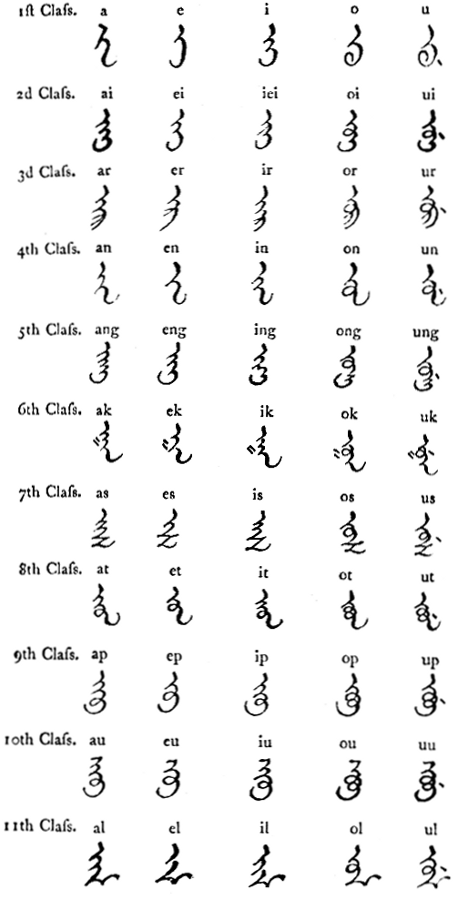
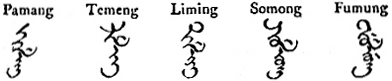
The initial characters are represented by respective marks, which being joined to these elementary terminations, generally at the upper extremity, give all the monosyllabic sounds, and the junction of these according to their various combinations all the words in the Mantchoo language. One example will be sufficient to shew the nature of such composition; thus the initials P. T. L. S. F. set before the 12th class of radicals, will stand as follows:

And if each of these syllables be respectively added to the 5th class, they will stand thus:
Of the state of their literature, and progress in science, I have little to observe. The nature of the language will almost itself determine these points. With respect to any branch of polite literature, or speculative science, little improvement seems to have been made in the last two thousand years. Indeed, there are no works in the whole empire, modern or ancient, that are so much esteemed, so much studied, and I may perhaps add, so little comprehended, as the five classical books collected and commented upon by their great philosopher Cong-foo-tse, who lived about 450 years before the Christian æra; and these certainly are very extraordinary productions for the time in which they were written. These works and a few writings of their favourite master, according to the annals of the country, escaped the general destruction of books, when the barbarous She-whang-te ordered all the monuments of learning to be burnt, except such as treated of medicine and agriculture, about 200 years before Christ, for the absurd purpose, as they state, that he might be considered by posterity as the first civilized Emperor which had governed China, and that the records of its history might, by this mean artifice, appear to commence with his reign.
Admitting such an event to have happened which, however, may be considered as doubtful, the supposition involves in it this necessary consequence, that the stock of learning at that time must have been very confined. It is scarcely possible, otherwise, how one person, near the end of his reign, could have contrived to assemble together all the works of art and literature, dispersed through so large a tract of country and so enlightened as it was then supposed to be. There were, besides, other independent sovereigns in the country, over whom he had little or no controul, so that it is very probable the commonwealth of letters suffered no great loss by the burning of the Chinese books. When the Caliph Omar commanded the Alexandrian library to be destroyed, which the pride and the learning of the Ptolemy family had collected from every part of the world, literature sustained an irreparable loss; but, although the tyrant had the power to consign to eternal oblivion the works of science, yet he had no power over the principles upon which these works were constructed. These principles had spread themselves wide over the world. The expedition of Alexander carried the learning of the Egyptians and the Greeks into various countries of Asia, where they continued to flourish. And when the tyranny and oppression of the seventh Ptolemy (Physcon) forced the Alexandrians to abandon a city that was perpetually streaming with the blood of its citizens, they found an asylum in the Grecian states and in different parts of Asia. And as this sanguinary tyrant, in the midst of his cruelties, pretended and indeed shewed a fondness for literature, the arts and the sciences flourished even in his reign: the migrations, therefore, at this time, from the capital of Egypt, were of the greatest importance and use to those nations among whom the refugees settled. Unluckily for China, the wild mountainous forests towards the south, and the wide sandy deserts to the north, that render any communication extremely difficult between this empire and the rest of Asia, together with their dislike for foreigners, seem, at this time, to have checked the progress of those arts and sciences which had long flourished in Europe and in Africa. Their history, at least, is silent as to any communication with India, till a century nearly after the commencement of the Christian æra, when the religion of Budha found its way from Thibet into China.
Whether the burning of the works of the learned in China did or did not happen, appears, as already observed, to admit of some doubt; but the antiquity, and the authenticity, of the five king, or classics, seem to be sufficiently established. And considering the early periods in which they were written, they certainly demonstrate a very superior degree of civilization. It has been observed that, in this country, the arts, the sciences, and literature, are not progressive; and the five king would lead one to conclude, that they have rather even been retrograde than stationary. The names of these works are:
1. Shoo-king. A collection of records and annals of various princes, commencing more than 2000 years before Christ.
2. Shee-king. Odes, sonnets, and maxims; most of them so abundant in metaphor, and so obscure, that much of the sense is to be made out by the translator.
3. Ye-king. The perfect and the broken lines of Fo-shee; the most ancient relict in China, and perhaps the first attempt at written language: now perfectly incomprehensible.
4. Chung-choo. Spring and autumn. The history of some of the kings of Loo: the work principally of Cong-foo-tse.
5. Lee-kee. Ceremonies and moral duties. A compilation of Cong-foo-tse.
The lines of Fo-shee puzzled even the great philosopher of the country, who declared himself dissatisfied with all the explanations of the commentators. The learned and ingenious Leibnitz fancied he discovered in them a system of binary arithmetic, by which all the operations and results of numbers might be performed, with the help of two figures only, the cypher or zero 0, and an unit 1, the former being considered as the constant multiple of the latter, as 10 is of the unit. Thus 1 would stand for 1, 10 for two, 11 for three, 100 for four, and so on. It is unnecessary to observe, with how many inconveniences such a system would be attended when reduced to practice. This discovery of the binary series, which the mathematician, in all probability, considered only as a philosophical plaything, was communicated to Father Bouvet the Jesuit who, happening at that time to be engaged in decyphering the lines of Fo-shee, caught the idea and in an extacy of joy proclaimed to the world that Leibnitz had solved the Fo-sheean riddle.
The missionaries of the Romish church are so accustomed to the mysteries with which their religion abounds, that every thing they meet with, and do not understand, among a strange people, is also resolved into a mystery. Thus, the following figure, which the Chinese, in allusion to the regular lines described on the back-shell of some of the tortoises, metaphorically call the mystic tortoise, has been supposed by some of these gentlemen to contain the most sublime doctrines of Chinese philosophy; that they embrace a summary of all that is perfect and imperfect, represent the numbers of heaven and earth, and such like jargon, which, it obviously appears, is no less unintelligible to themselves than to their readers.
These famous lines, supposed to be found on the back of a tortoise, are the following:
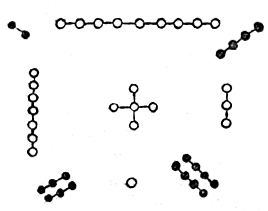
Who does not perceive, at a single glance, in this figure the common schoolboy's trick of the magic square, or placing the nine digits so that they shall make the sum of fifteen every way, thus,

and what are the perfect and imperfect numbers, but the odd and even digits distinguished by open and close points? In like manner, I am inclined to believe, the several ways of placing these open and close points that occur in Chinese books are literally nothing more than the different combinations of the nine numerical figures, for which they are substituted.
Most of the other king have been translated, wholly or in part, and published in France. It may be observed, however, that all the Chinese writings, translated by the missionaries, have undergone so great a change in their European dress, that they ought rather to be looked upon as originals than translations. It is true, a literal translation would be nonsense, but there is a great difference between giving the meaning of an author, and writing a commentary upon him. Sir William Jones observes that the only method of doing justice to the poetical compositions of the Asiatics, is to give first a verbal and then a metrical version. The most barren subject, under his elegant pen, becomes replete with beauties. The following stanza, from one of the odes of the Shee-king, is an instance of this remark. It is calculated to have been written about the age of Homer; and it consists of fifteen characters.
123456 The peach-tree, how fair, how graceful, its leaves, how blooming, 7891011 how pleasant; such is a bride, when she enters her bridegroom's 12131415 house, and attends to her whole family.
This is a fair translation, as no more expletives are inserted than such as were necessary to make up the sense, and it is thus paraphrased by Sir William Jones.
"Gay child of Spring, the garden's queen, Yon peach-tree charms the roving fight; Its fragrant leaves how richly green! Its blossoms, how divinely bright! "So softly smiles the blooming bride, By love and conscious virtue led, O'er her new mansion to preside, And placid joys around her spread."
The late Emperor Kien-Long was considered among the best poets of modern times, and the most celebrated of his compositions is an ode in praise of Tea, which has been painted on all the teapots in the empire. The following is a verbal translation, with such auxiliaries only as were necessary to make the sense complete.
"On a slow fire set a tripod, whose colour and texture shew its long use; fill it with clear snow water, boil it as long as would be necessary to turn fish white, and crayfish red; throw it upon the delicate leaves of choice tea, in a cup of yooé (a particular sort of porcelain). Let it remain as long as the vapour rises in a cloud, and leaves only a thin mist floating on the surface. At your ease, drink this precious liquor, which will chase away the five causes of trouble. We can taste and feel, but not describe, the state of repose produced by a liquor thus prepared."
He wrote, likewise, a long descriptive poem on the city and country of Moukden, in Mantchoo Tartary, which has been translated by some of the missionaries, and appears to possess much more merit than his ode on tea, of which, however, it is difficult to judge without a thorough knowledge of the language, as the ode may owe its chief beauties and its fame more to the choice of the characters than to the sounds, literal sense, or versification. To an European the Chinese language appears to have few elegancies: it wants all the little auxiliaries that add grace and energy to those of Europe. In the Chinese the beauty of an expression depends entirely on the choice of the character, and not on any selection or arrangement of the monosyllabic sounds. A character uniting a happy association of ideas has the same effect upon the eye of the Chinese, as a general theorem expressed in symbols has on a mathematician; but in both cases a man must be learned to feel the beauties of the concise expression. Even in speaking the language has few expletives. "English good, Chinese better,"—"to-day go, to-morrow come,"—"sea no bound, Kiang no bottom;"—"well, not well;"—are modes of expression in which an European will not find much elegance.
In addition to the defects of the language, there is another reason why poetry is not likely ever to become a favourite pursuit, or to be cultivated with success, among the Chinese. The state of society we have seen to be such as entirely to exclude the passion of love. A man, in this country, marries only from necessity, or for the sake of obtaining an heir to his property, who may sacrifice to his manes, or because the maxims of the government have made it disgraceful to remain in a state of celibacy. The fine sentiments that arise from the mutual endearment of two persons enamoured of each other can therefore have no place in the heart of a Chinese: and it is to the effusions of a heart thus circumstanced, that poetry owes some of its greatest charms. Nor can they be considered as a nation of warriors; and war, next to love, has ever been the favourite theme of the muses.
The language is much better adapted to the concise style of ethics, than the sublime flights of poetry. The moral precepts of Cong-foo-tse display an excellent mind in the writer, and would do honour to any age and nation. The following will serve as a specimen of his subjects, style, and manner.
"There is one clear rule of conduct: to act with sincerity; and to conform with all one's soul, and with all one's strength, to this universal rule—do not any thing to another, that you would not wish another should do to you."
How conformable is this sentiment as well as the words in which it is expressed, to that of the great Author of our religion; a religion whose "ways are ways of pleasantness, and all whose paths are peace."
"Five things ought to be well observed in the world: Justice between the prince and the subject; affection between father and son; fidelity between man and wife; subordination among brothers; concord among friends."
"There are three radical virtues: prudence to discern; universal benevolence to embrace (all mankind); courage to sustain."
"What passes in a man's mind is unknown to others: if you are wise, take great care of what none but yourself can see."
"Examples are better for the people than precepts."
"A wise man is his own most severe censor: he is his own accuser, his own evidence, and his own judge."
"A nation may accomplish more by bravery than by fire and water. I never knew a people perish, who had courage for their support."
"An upright man will not pursue a crooked path; he follows the straight road, and walks therein secure."
Having taken this short view of their language and literature, I shall now proceed to shew the present state of the arts and sciences, as far as the communications I had not only with the missionaries, but also with some of the most learned Chinese, will allow me to pronounce on these points. The observations I have to make must of course be very general; minute particulars will not be expected in a work of this nature. There is no branch of science which the Chinese affect to value so much, and understand so little, as astronomy. The necessity indeed of being able to mark, with some degree of precision, the returns of the seasons and certain periods, in so large a community, must have directed an early attention of the government to this subject; and accordingly we find, that an astronomical board has formed one of the state establishments from the earliest periods of their history. Yet so little progress have they made in this science, that the only part of its functions, which can be called astronomical, has long been committed to the care of foreigners, whom they affect to hold in contempt and to consider as barbarians. The principal object of this board is to frame and to publish a national calendar, and to point out to the government the suitable times and seasons for its important undertakings. Even when the marriage of a prince or princess of the blood is about to take place, the commissioners of astronomy must appoint a fortunate day for the celebration of the nuptials, which is announced in form in the Pekin Gazette.
In this important almanack, as in the Greek and Roman calendars, are inserted all the supposed lucky and unlucky days in the year, predictions of the weather, days proper for taking medicine, commencing journies, taking home a wife, laying the foundation of a house, and other matters of moment, for entering upon which particular times are assigned. To the superintendency of the Chinese members of this august tribunal is committed the astrological part, a committee of whom is selected annually for the execution of this important task. Whether the men of letters, as they call themselves, really believe in the absurdities of judicial astrology, or whether they may think it necessary to encourage the observance of popular superstitions, on political considerations, I will not take upon me to decide. If, however, they should happen to possess any such superior knowledge, great credit is due to them for acting the farce with such apparent earnestness, and with so much solemnity. The duration of the same system has certainly been long enough for them to have discovered, that the multitude are more effectually governed by opinion than by power.
The phenomena of the heavenly bodies, to an enlightened and intelligent mind, furnish the most grand and sublime spectacle in nature; to the ignorant and superstitious, the most awful. The common people of all countries, and in all ages, have considered the occasional privation of the light of the two great luminaries of heaven as the forerunners of some extraordinary event, whilst the more intelligent part of the community have turned these superstitious notions to their advantage. Thales is said to have been able to calculate the returns of eclipses six hundred years before the birth of Christ; of course, he was well acquainted with the causes by which they were produced; yet his countrymen were always filled with superstition and terror on the event of an eclipse. Plutarch has observed that Pericles learned from Anaxagoras to overcome the terrors which the various phenomena of the heavens inspired into those who knew not their causes; and he mentions a striking proof which he gave of this knowledge, on his expedition against Peloponnesus, when there happened an eclipse of the sun. The sudden darkness, being considered as an omen unfavourable to the object of the expedition, occasioned a general consternation. Pericles, observing the pilot of his own galley to be frightened and confused, took his cloak and placed it before his eyes, asking him at the same time if he found any thing alarming, or of evil presage, in what he then did? and upon his answering in the negative: "Where then is the difference," said Pericles, "between this covering and the other, except that something of greater extent than my cloak deprives us of the light of the sun?" Nor can it be doubted that Alexander when, on a like occasion, previous to the battle of Arbêla, he commanded a sacrifice to be made to the sun, the moon, and the earth, as being the three powers to which eclipses were owing, did it merely to appease the superstitious notions of his army. To suppose him ignorant of their causes, would be paying an ill compliment to his great master. Thus it might have been with regard to the Chinese government, which, whether through ignorance or policy, still continues to observe with the greatest solemnity the same ceremonies, or nearly so, on the event of an eclipse, which were in use among the Egyptians, Greeks, and Romans, near two thousand years ago. When the moon was darkened by an eclipse, their drums and clarions and trumpets were sounded, under the notion that, by their shrill and loud noise, they might assist in relieving the labouring goddess.
"A vast eclipse darkens the neighbouring planet, Sound there, sound all our instruments of war; Clarions and trumpets, silver, brass, and iron, And beat a thousand drums to help her labour."
The brazen gong is violently beat by the Chinese on the same occasion; and that such an event may not pass unobserved, and the luminary thereby be deprived of the usual assistance of music, to frighten away or to charm the dragon, which they suppose to have seized upon it, the great officers of state in every city and principal town are instructed to give public notice of the time it will happen, according to the calculations of the national almanack. A rude projection of a lunar eclipse, that happened whilst we were at Tong-choo, was stuck up in the corners of the streets; all the officers were in mourning, and all business was suspended for that day. When the Dutch Embassadors were in Pekin, the sun was eclipsed on the 21st of January 1795, which happened to be the first day of their new year: a day observed through the whole empire with the greatest festivity and rejoicing; and almost the only day on which the bulk of the people refrain from their respective occupations. The Embassador and his suite were summoned to court at the usual hour of three in the morning. On arriving at the palace they were told that, in consequence of an eclipse of the sun, which was about to happen on that day and which was a most unfortunate event, portending an unhappy year to their country, the Emperor would not be visible for three days, during which time the whole court would go into mourning; that the amusements, feasts, and entertainments usual on this particular day would be suspended from one end of the empire to the other.
Before an eclipse happens, the members of the mathematical board and other learned men in office assemble near the palace, each having in his hand a sketch of the obscuration, in order to witness the truth of the astronomer's calculation. But if these people were not all interested in making the calculation to agree with the time and other circumstances of the eclipse, the astronomers would run no great hazard of being detected in an error, provided it was not a very glaring one, as they have no instruments for measuring time with any tolerable degree of accuracy. The moment the eclipse begins, they all fall down on their knees, and bow their heads nine times to the ground, during which is struck up a horrible crash of gongs, kettle-drums, trumpets, and other noisy instruments, intended to scare the devouring dragon.
From the observance of such extravagant ceremonies it would not be fair to infer their total ignorance of the principles of astronomy; but that such is really the case, the latter part of their history furnishes abundant testimony. In the thirteenth century, when Gengis-Khan the Mongul Tartar first entered China, and his successor Kublai-Khan effected the conquest of the country, the greatest disorder and confusion prevailed in their chronology. They were neither able to regulate the reckoning of time, nor to settle the limits of the different provinces, nor even to ascertain the divisions of lands as allotted to the several districts. Kublai, according to their own annals, held out encouragement for learned men to frequent his court from every part of the world, and through the means of the missionaries, both of the Christian and Mahomedan faith, but principally the latter, and perhaps still more through the descendants of the Greeks, who anciently settled in Bactriana, many important improvements were then introduced into China. He caused a regular survey to be taken of the whole empire. He adjusted their chronology, and corrected the errors of their astronomical observations; he imported various mathematical and astronomical instruments from Balk and Samarcand; such as were then in use among the Chinese being of a rude construction, and unfit to make observations of the heavenly bodies with any tolerable degree of accuracy; and he repaired the grand communication by water that connects the northern with the southern extremities of the empire, a work, in the contemplation of which the mind is not more strongly impressed with the grandeur and magnitude of the object, than with the pleasing sense of its important utility.
In some of the early accounts of China, published in Europe, we find the description of certain instruments, said to have been discovered on a mountain near the city of Nankin, and afterwards placed by the Chinese partly in that capital and partly in Pekin. On a more accurate examination of those instruments it appeared, that they had all been constructed for some particular place lying under the 37th parallel of latitude; from whence it followed, that all the observations made with them at Pekin, which is in 39° 55'. north, as well as all those made at Nankin in 32° 4'. north, must have been entirely false: and the very act of placing them so distant from the parallel for which they were constructed, is in itself a sufficient proof of the ignorance of the Chinese in matters of this kind. Mr. Pauw has given the most probable conjecture respecting those instruments. He supposes them to have been made at Balk, in Bactriana, by some of those Greeks who obtained the government of that province under the successors of Alexander, and that they had passed into China during the period of the Mongul government.
The death of Kublai-Khan was speedily followed by the total expulsion of the Tartars from China; and most probably, at the same time, of all those learned men they had been the means of introducing into the country; for when the empire was again subdued by the Mantchoo Tartars, whose race now fills the throne, Sun-chee, the first Emperor of the present dynasty, observes in an edict published by him in 1650, that since the expulsion of the Monguls, the Chinese had not been able to make a correct almanack; and that error had been accumulating on error in their astronomical observations and chronology. At this time, some Mahomedans were again found to superintend the construction of the calendar; but the office devolving, at length, upon a Chinese, the unfortunate almanack-maker happened to insert a false intercalation, assigning thirteen months to the year 1670, when it should have contained no more than twelve. This mistake was an event too fortunate to be overlooked by some Catholic missionaries who, at that time, happened to be in the capital. They saw the advantages to be derived from convincing the Tartars of the ignorance of the Chinese in a matter of the last importance to the government, and they had little doubt of success, where prejudice was already operating in their favour. In short, the Europeans succeeded; the almanacks of that year were declared defective, were called in, a new edition printed off, and the poor almanack-maker is said to have been strangled.
Four German Jesuits were then appointed to fill the vacant places in the tribunal of mathematics; and, being men of learning, they proved of no small use at court. After these the Portuguese succeeded to the appointments of regulating the calendar, three of whom, as already observed, are now entrusted with this important office. Fortunately for these gentlemen, the Chinese have no means of detecting any little inaccuracies that may happen in their calculations. I saw, and conversed with, numbers of their learned men at the palace of Yuen-min-yuen, but I can safely say, that not a single Chinese, nor a Tartar, who shewed themselves there, were possessed of the slightest knowledge of astronomy, nor one who could explain any of the various phenomena of the heavenly bodies. Astronomy with them consists entirely in a certain jargon of judicial astrology; and they remain firmly attached to the belief of the doctrines of their great philosopher, delivered more than two thousand years ago, which teach them that "the heaven is round, the earth a square fixed in the middle; the other four elements placed at its four sides: water to the north; fire to the south; wood to the east; and metal to the west:" and they believe the stars to be stuck, like so many nails, at equal distances from the earth, in the blue vault of heaven.
As to the numerous eclipses taken notice of in the records of the country, they are mere registers, noted down whenever they happened, and not predictions or the result of calculations. It does not appear, indeed, that the Chinese were, at any time, able to predict an eclipse, notwithstanding all that has been said in their favour on this subject. The reputed Chinese tables, published by Father Couplet, have been detected to be those of Tycho Brahe; and Cassini found the chronology of their eclipses, published by Martinus, to be erroneous, and their returns impossible. It could not indeed be otherwise; the defectiveness of the calendar must necessarily falsify all their records as to time.
Had the missionaries been disposed to confer a real service on the Chinese, instead of misleading the world by their strange and wonderful accounts of this people; instead of bestowing so much time in translating into Chinese a set of logarithm tables for the use of Kaung-shee, the second Emperor of the present dynasty, of which they pretend he was so fond that he always carried them about with him suspended to his girdle, they should rather have taught them the use, and the convenience, of the Arabic numbers, of whose combinations and results their own language is not capable, and have instructed a few of their youth in the principles of arithmetic and the mathematics. For such an omission, however, human nature can readily find an excuse. It would be too great an instance of self-denial, to relinquish the advantages and the credit which their superior skill had gained them over a vast empire, by making the individuals of that empire participate in their knowledge.
When we reflect, for a moment, how many perplexities and difficulties were occasioned by the irregular coincidences of the solar and lunar periods, in the calendars of Europe, from the time of Julius Cæsar to the altering of the style by Pope Gregory, we may readily conceive how great must be the errors in the chronology of a country, where the inhabitants are entirely ignorant even of the first principles of astronomy, and where they depended on the adventitious aid of foreigners, to enable them to carry into execution one of the most important concerns of the government.
Every thing of their own invention and discovery carries with it such strong marks of originality, as cannot easily be mistaken. The language declares itself to be most unquestionably the production of the country; so does the mariner's compass; and they have a cycle, or period, to assist their chronology, of which I think none will dispute with them the invention. In their records it is carried back to the time of the Emperor Whang-tee, the third from Fo-shee. This cycle, consisting of sixty years, has no reference to the periods of the motions or coincidences of the sun and moon, as one of the same period among the Hindus, but is used merely as our century, to distinguish time into eras or ages. Instead of denominating any given year the first, second, or third year of such a cycle, they have assumed two sets of characters, one set consisting of ten, and the other of twelve; the first are called the ten roots, and the second the twelve branches. The combination of a root and a branch gives a name for the year; and the different permutations, of which they are capable, supply them with sixty distinct titles, making the complete cycle of sixty years. The nature of this period may be rendered familiar to such as are not conversant with the combination of numbers, by assuming the numerals from 1 to 10 for the ten roots, and the letters of the alphabet from a to m, for the twelve branches, and by placing them in a circle, in the following manner, where the cycle begins with the letter a.
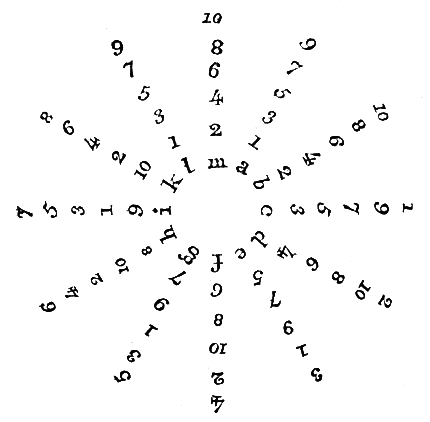
Supposing these letters and figures to be Chinese characters, the first year of any cycle would be called 1a, the second 2b, the third 3c, and so on to 10k, the tenth year; the eleventh would be 1l, the twelfth 2m, the thirteenth 3a, and the sixtieth 10m, when the whole revolution would be completed. This cycle, though always used in the records of their history, never appears in the date of public acts. These only specify the time of the reign under which they are given, as the 1st. 2d. or 3d. day of the 1st. 2d. or 3d. moon, of the 1st. 2d. or 3d. year of the reign of such or such an Emperor.
Little progress as they appear to have made in the science of astronomy, their knowledge of geography, which supposes indeed an acquaintance with the former, is equally limited. Their own empire was considered to occupy the middle space of the square surface of the earth, the rest of which was made up of islands. When the Jesuits first entered China, they found the charts, even of their own country, rude and incorrect sketches, without any scale or proportion, wherein a ridge of mountains covered a whole province, and a river swept away half of another. At present they have neat and accurate maps of the country, copied after the original survey of the whole empire, undertaken and completed by the Jesuits, after several years of indefatigable labour.
Although the Chinese language be unfavourable for numerical combinations it is admirably adapted for the concise operations of algebra, and the terse demonstrations of geometry, to neither of which, however, has it ever been made subservient, both the one and the other being totally unknown in the country. Their arithmetic is mechanical. To find the aggregate of numbers, a machine is in universal use, from the man of letters, to the meanest shopman behind his counter. By this machine, which is called a Swan-pan, arithmetical operations are rendered palpable. It consists of a frame of wood, divided into two compartments by a bar running down the middle: through this bar, at right angles, are inserted a number of parallel wires, and on each wire, in one compartment, are five moveable balls, and in the other two. These wires may be considered as the ascending and descending powers of a numeration table, proceeding in a tenfold proportion; so that if a ball upon any of the wires, in the larger compartment, be placed against the middle bar, and called unity or one, a ball on the wire next above it will represent ten, and one on the next one hundred; so, also, a ball on the wire next below that expressing unity will be one-tenth, the next lower one hundredth, and the third one thousandth, part of an unit; and the balls on the corresponding wires in the smaller compartment will be five, fifty, five hundred, five-tenths, five hundredths, five thousandths; the value or power of each of these, in the smaller division, being always five times as much as of those in the larger. In the following figure, suppose X be assumed as the line of units, the lines to the right will be integers decimally increasing, and those to the left fractional parts decimally decreasing; and the Swan-pan in the present position of the balls, will represent the number 573916 0705/10000.
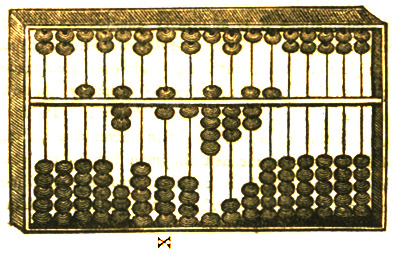
This is clearly a system of decimal arithmetic, which, for the ease, simplicity, and convenience of its operations, it were to be wished was generally adopted in Europe, instead of the endless ways in which the integer is differently divided in different countries, and in the different provinces of the same country. The Swan-pan would be no bad instrument for teaching to a blind person the operations of arithmetic. Yet, paradoxical as it may seem, these operations, as performed by the Chinese, like their written characters, require more the exercise of the eye than of the mind. The simple addition or subtraction of the little balls to, or from, the middle bar, shews at once by their disposition on the board the result of any required combination. The invention of it I think may fairly be attributed to the Chinese; though it has been compared, how justly I cannot pretend to say, to the Roman abacus.
It has been observed, and perhaps with a great deal of truth, that the arts which supply the luxuries, the conveniences, and the necessaries of life, have derived but little advantage in the first instance from the labours and speculations of philosophers; that the ingenuity of artists, the accidental or progressive discoveries of common workmen, in any particular branch of business, have frequently afforded data, from which, by the reasonings and investigations of philosophers, hints have sometimes been struck out for arriving at the same ends by a shorter way; that the learned are therefore more properly to be considered as improvers than inventors. Of this mortifying truth, the Chinese afford many strong examples in their arts and manufactures, and particularly in some of those operations that have a reference to chemistry, which cannot here be said to exist as a science, although several branches are in common practice as chemical arts. Without possessing any theory concerning the affinities of bodies, or attractions of cohesion or aggregation, they clarify the muddy waters of their rivers, for immediate use, by stirring them round with a piece of alum in a hollow bamboo; a simple operation which, experience has taught them, will cause the clayey particles to fall to the bottom: and having ascertained the fact, they have given themselves no further trouble to explain the phenomenon.
In like manner, they are well acquainted with the effect of steam upon certain bodies that are immersed in it; that its heat is much greater than that of boiling water. Yet, although for ages they have been in the constant practice of confining it in close vessels, something like Papin's digester, for the purpose of softening horn, from which their thin, transparent, and capacious lanterns are made, they seem not to have discovered its extraordinary force when thus pent up; at least, they have never thought of applying that power to purposes which animal strength has not been adequate to effect. They extract from the three kingdoms of nature the most brilliant colours, which they have also acquired the art of preparing and mixing, so as to produce every intermediate tint; and, in their richest and most lively hues, they communicate these colours to silks, cottons, and paper; yet they have no theory on colours.
The process of smelting iron from the ore is well known to them; and their cast ware of this metal is remarkably thin and light. They have also an imperfect knowledge of converting it into steel, but their manufactures of this article are not to be mentioned with those of Europe, I will not say of England, because it stands unrivalled in this and indeed almost every other branch of the arts. Though their cast-iron wares appear light and neat, and are annealed in heated ovens, to take off somewhat of their brittleness, yet their process of rendering cast iron malleable is imperfect, and all their manufactures of wrought iron are consequently of a very inferior kind, not only in workmanship but also in the quality of the metal. In most of the other metals their manufactures are above mediocrity. Their trinkets of silver fillagree are extremely neat, and their articles of tootanague are highly finished.
With the use of cannon they pretend to have been long acquainted. When Gengis-Khan entered China, in the thirteenth century, artillery and bombs and mines are said to have been employed on both sides; yet when the city of Macao, in the year 1621, made a present to the Emperor of three pieces of artillery, it was found necessary to send along with them three men to instruct the Chinese how to use them. The introduction of matchlocks, I am inclined to think, is of no very ancient date; they wear no marks of originality about them, like other articles of Chinese invention; on the contrary, they are exact models of the old Portugueze matchlock; and differ in nothing from those which still continue to be carried, as an article of commerce, by this nation to Cochin-China. There can be no doubt, however, of the use of gunpowder being known to the Chinese long before the Christian era.
In a very ancient treatise on the military art, there is a detailed account of the manner how to annoy an enemy's camp, by springing a mine with gunpowder; but this treatise makes no mention of cannon. Fire-works, made generally of gunpowder, filings of zinc, camphor, and other ingredients, are described in various old tracts. It is easily conceived, that the deflagration of nitre was likely to be first noticed in those countries where it is the spontaneous and abundant production of the earth, which is the case on the elevated desarts of Tartary and Thibet, and on the low and extensive plains of India and China. The gunpowder, however, made by the Chinese is extremely bad. They have no particular manufactory, but each individual makes his own. It is in fact one part of the soldier's employment to prepare his own gunpowder. The usual proportions, according to Van-ta-gin's information are,
50 pounds of nitre, 25 —— sulphur, 25 —— charcoal.
They know not the art of granulating the paste, as in Europe, but use it in a coarse powder, which sometimes cakes together into a solid mass; and from the impurity of the nitre, (no means appearing to be employed for extracting the common salt it usually contains) the least exposure to the air, by attracting the moisture, makes it unfit for service. This may be one reason for their objection to firelocks.
It has been remarked, that the three great discoveries of the magnetic needle, of gunpowder, and of printing, in Europe, followed close upon the return of the famous traveller Marco Polo. It was the boast indeed of Caung-shee to the Jesuits, when they instructed him in some of the sciences of Europe, that the latter country was neither acquainted with the mariner's compass, nor with the art of printing, nor with gunpowder, till they had been in common use in China near two thousand years. As to gunpowder, it is pretty obvious, that our countryman Roger Bacon was well acquainted with the ingredients that enter into its composition. In more than one part of his works he observes, that with saltpetre and other articles may be made a fire that will inflame to a great distance; and in one place he states, that with sulphur, saltpetre, and something else, which he disguises under two or three barbarous words, a composition may be made, by which the effects of thunder and of lightning may be imitated. Bacon died in the year 1292, and Marco Polo returned to Europe in 1295; so that he could not possibly have received any hint to lead towards the discovery through the channel of the Venetian traveller[18].
If the Chinese had, at any period of their history, been acquainted with the art of casting large cannon, and of making use of them in their wars, it is scarcely probable they would ever have lost it. Yet it is very certain the two Jesuits, Schaal and Verbiest, took great pains to instruct them in the method of casting cannon; in which, however, they have not made any progress or improvement. I observed, near one of the gates of Pekin, a few rude, ill-shapen, and disproportionate pieces, lying unmounted on the ground, and these, with some of the same kind on the frontiers of Canton, and a few pieces, apparently twelve pounders, at Hang-tcheu-foo, which had wooden pent-houses erected over each, were the only cannon that we noticed in the whole country. Whether the specimens, exhibited in the annexed plate, which were drawn by the late Captain Parish of the Royal Artillery, be originally of Chinese invention, or borrowed from some other nation, I cannot take upon me to decide; but such are the pieces which are sometimes found, scattered about the gates of some of their cities.