FIRECRACKERS BY ERICK POMEROY TEMPLE OF THE EMPRESS OF HEAVEN, CHINA
Reading edition
This is the thirteenth day of the fifth moon of the thirty-third year of Kwang-su, very early in the morning—that is, "very early" for me, because I ordered my "boy" last evening to call me at eight o'clock this morning and not a minute before. Here, in the rambling old temple where we live, we have learned to go to bed with the sun on the fourteenth and on the last day of each Chinese moon, because we know that the wailing pipes of the early morning celebrations before the gods on the first and fifteenth of the moon will be certain to wake us at a truly heathenish hour. But when an extra, unannounced, unexpected festival day is ushered in with cymbals, pipes, and firecrackers, then we just have to lose our morning sleep and try not to lose our tempers. This morning is one of those dawns of misery. Even as I write the temple bells, the drums, and those peculiar jig-time horns are setting up a discordant hubbub in the courtyards, while at intervals a big cracker sends me springing into the air with a start that fearfully tries my nerves. At first this morning I endeavored to sleep, but I soon gave that up to don my kimono and sally forth to find out the cause of this gratuitous Fourth of July. Out on the terrace in front of the inner gates of the temple, to which the rays of the rising sun had not yet bent down, there was gathered a small group of men and boys watching such a display of firecrackers as would have attracted a whole City Hall Park full of people at home. Yet their interest was apparently much like their numbers—very small. They just gazed at the exploding end of the red string of noise without any comments and without any more evident interest than they took in seeing that the small boys picked up all of the unexploded crackers that were blown out of the danger circle by their more powerful brothers. My appearance in a kimono and straw sandals seemed to furnish them with more excitement than the rope of crackers which hung from the firecrackers pole hard by. Such a din! Can you imagine a string of firecrackers, large and small woven together, of over one hundred thousand?
But I am getting ahead of my story. By way of introduction I meant only to tell you that I have for some time been planning to write a letter to your good editor in the hope that he might be willing to pass on to you of the fast-disappearing American "firecracker age" my story of how this country, the native land of the "whip-guns," manufactures and uses these crackers which we think of as belonging only to our Fourth of July.
The desire and determination to write this letter had their birth one day in a city of North China when I was walking along the street where many of the firecracker-makers live—since dubbed "Firecracker Row" on my private chart of the city—and when I suddenly realized how much I should have liked as a boy, when I was "shooting off crackers," to see these places and to know their ways of manufacture. It is difficult not to be interrupted nor to interrupt these lines. Now there are two little pigtailed heads stretched up just over my window-sill, peeping in and asking if I do not wish to buy the tiger-lilies they have gathered on the hillside. So first I will try to tell you how the crackers are made and then how they are used out here, in the hope that you may find as much interest in reading the story as I have found in gathering the information and pictures for it.
Several times I went into the city to visit Firecracker Row, and on one occasion took a series of photographs to show more clearly than words will do the important steps in the process of manufacture. The first step consists in cutting the rough brown paper into pieces long enough to make a hollow tube of several layers in thickness, and wide enough to give the tube a length just twice that of the finished cracker. From the top of his pile the workman takes a pack of these slips, lays them out with one end arranged just like steps, and then slides down the stairs, as it were, with a brush of paste, so as to make the outer ends of the slips stick fast when rolled against the tube. Then he bends the other—the dry—end around an iron nail, and places the nail under a board, which rolls it along the slip until all the paper has curled around it. Once the cracker skeleton is thus formed, he gives it an extra roll or two down the bench for good measure, slides it off the nail into a basket, and has another started before you realize what he is about. Then one of the small apprentices in the shop arranges the skeletons together in a six-sided bundle, like those on the drying board in Cut II, in each of which he puts just five hundred and seven. Why that particular number, I could not find out.
Once dry, the skeletons receive their covering garment of red paper, which makes them so truly "little redskins"—this from the hands of one of the workers without the aid of any machine whatever. He just rolls one of the narrow slips around the tube with his fingers and hurries the growing agitator into another basket to await the time for stuffing in the material that will make him such a lively fellow. Once more, however, they all have to be packed up into the six-sided bundles, this time with two stout strings tied around them a third of the way from the top and bottom, leaving the middle free. The worker takes his big knife and chops right down through the whole bundle to make the clean ends for the tops of the shorter tubes.
These shorter tubes next have a thin paper covering pasted over both tops and bottoms before the bottoms are closed by tapping them with a nail that is just a little larger than the hole in the tube, so that it crowds down some of the paper from the sides. With the bundles right side up, the workman then makes holes in the paper cover over the top, scatters on this the powder dust, and distributes it fairly evenly among the five hundred and seven hungry ones by means of a light brush. When the dust has been tamped a little, the powder finds its way to the middle of the tube in the same manner, the fuse is inserted by another workman, the top layer of dust added, and the whole supply of bottled fun packed in by another tamping with a nail and mallet. Completed and still crowded together in the bundles, the little redskins, with the fuses sticking out of their caps, seem to wear a festive, promising look that clearly says: "You give us a light, and we'll do the rest. And what a high old time it will be!"
When asked how many of these bundles one man could make in a day, the good-natured master of the shop said that one man is counted on to make twenty bundles up to the point where the powder is put in, when the crackers are passed along to others to finish and weave into strings. What a "string" means here in this land, where the diminutive "packs" we used to buy for a nickel would be scored, may be gathered from a glance at those which the maker is holding up in Cut I and at those on the drying-boards in the view shown in Cut II.
Once the crackers have been fully prepared for stringing, either they are put together in such strings as you see in the pictures or they have bigger fellows—four or five times the size of the little ones—plaited in at regular intervals. Then they are wrapped neatly with red or white paper in long packages bearing on the face a red slip with the shop's name printed on it in gilt characters. Some of these packets would have seemed monstrous—needlessly extravagant—in those days when I used to make one or two nickel packs last the better part of a Fourth of July morning by firing them one by one in a hole in the tie-post or under a tin can. To give these longer strings sufficient strength to hang from a pole, as is the usual way of firing them, the workmen weave in with the fuses a light piece of hemp twine. But even this is not an adequate protection against a break in those monster strings that come out on special occasions. The one that started this letter to you was fifteen feet long when I arrived on the scene to investigate the disturbance and had already lost one-half its numbers (I have seen strings from thirty to fifty feet long). To keep such a string from breaking, the Chinese fasten it at intervals to a rope which runs through the pulley at the top of the pole, and then draw the line up until the bottom clears the ground. As the explosions tear away the lowest crackers, the rope is let down and, at the same time, held out away from the bottom of the pole to make a graceful curve of the last few feet of the string. When such long strings have eaten themselves up, you can imagine the amount of fragments around the base of the pole. There are literally basketfuls of them to be first wetted down to guard against fire and then swept up or allowed to blow away when the winds so will.
Thus far you have heard only of little and big crackers. However, there are many distinguishing names among the Chinese for the several varieties and sizes, which I am going to give you before passing on to the story of the special uses of crackers in the Chinese life. First come the ordinary pien p'ao, or "whip-guns," the small ones which derive their name from the similarity which their explosion bears to the snapping of a whip. Sometimes they are called simply "whips," in the same way that the Chinese speak of many things by shortened or changed names. To make these names seem more real to you I have had my Chinese teacher write out for me on separate slips the characters which represent them. More diminutive than the ordinary crackers are the "small whips," about an inch long, that are made especially for the small children to use without danger. For one American cent you could buy about one hundred of these. Then above the whip-guns the next class is the "bursting bamboos," which are said to have taken their name from the fact that in early times bamboo was used as the tubes for these crackers. If such were the case, a line of them must have "made the splinters fly." Even still more powerful are the "hemp thunderers," or, to take a little liberty with the translation, the "hemp sons of thunder," whose name also indicates their construction and their magnitude. Bearing a close similarity in power to our cannon crackers, these have been known at times to break the second-story paper windows in a small compound. They play an important part in the worshiping, or propitiating of the gods in our courtyard, inasmuch as it is considered good form to set them off at intervals while the whip-guns—which my teacher assures me "do not require any watching"—are keeping up their unbroken stream of praise and prayer. They may be considered as good lusty "Amens" throughout the service.
Slightly different in form are the "double noises," which are nothing more or less than our "boosters" that go off first on the ground and again up in the air. To intersperse these throughout the explosions of the whips during any special demonstration is also considered good form. Then allied to these we find another booster, which when it explodes on the ground drives ten others up into the air to become the "flying in heaven ten sounds" with the Chinese. These are only "for play," and that chiefly in the homes from the thirteenth to the seventeenth days of the first moon of the year. With the "lamp flower exploders," that is, our flower-pot, the list of the most common forms of crackers and fire-works becomes exhausted, although the Chinese have several other less usual species, together with many alternative names for both these and the ones I have mentioned.
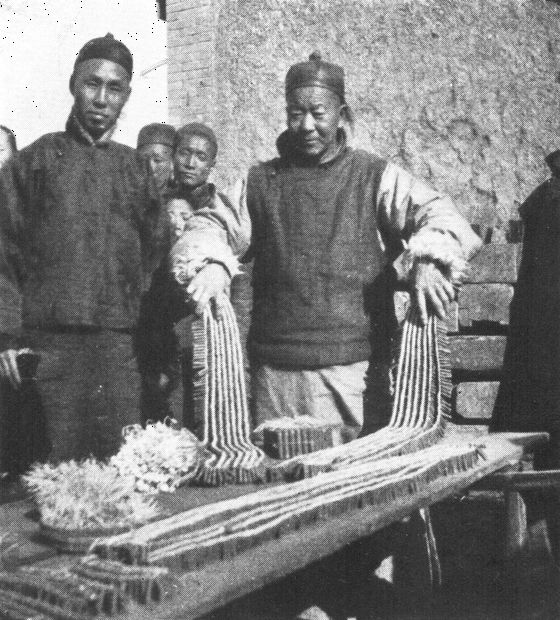
Strings of firecrackers
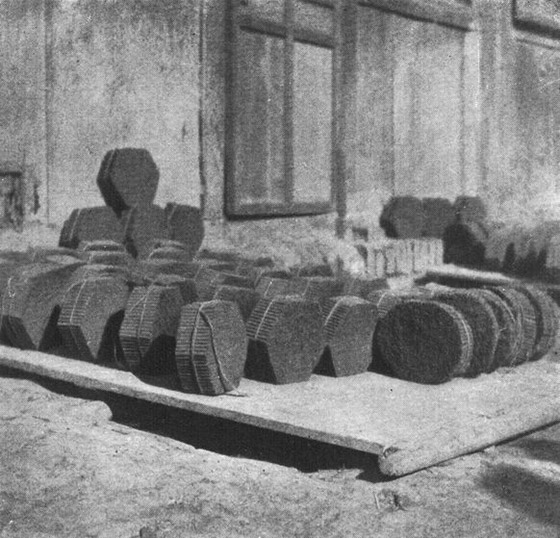
Hexagonal bundles of firecrackers drying in the sun
The time when the Chinese receive most crackers is at the New Year season, when, among the well-to-do families of Tientsin and Peking, it is customary to give a boy the equivalent of our fifty cents for his purchases. In Peking the shops issue special red notes, like our old "shinplasters" in value, for this one use at the New Year. In giving the cracker money to the boys, the parents often make smaller presents to the girls, who are wont to buy paper flowers with their pennies, in proof of which the Chinese have a proverb which runs, "Girls like flowers; boys like crackers."
But this juvenile use of the whip-guns consumes only an infinitesimal part of the whole supply of the year. At many festivals and on many occasions the head of the house, the manager of the shop, or the officers of the gild require great quantities of these propitious harbingers. Greatest of all occasions is the passing of the year, when the people keep up the successor to the ancient custom of setting off the "bamboo guns" in order to drive away the evil spirits of the past twelvemonth and to usher in all that is good for the coming one. All night long the crackers have been popping in the town below, and an early gathering in the temple is held to add the final touch before the new day shall break.
When morning came, I wandered leisurely to my office through the business section of the town to watch the fun at the big shops. Never shall I forget the picture of that street with its dozen or more great red strings of crackers hanging in front of the bigger hongs and seemingly waiting for some word to start the fusillade. Fortunately this came and the storm broke as I waited. For sheer noise, vivacity, and demonstrative liveliness I never have seen the equal of those snarling, bursting lines that poured out their wrath with incessant fervor upon the evil spirits below and shot up their welcome to the good ones above. Then, although this display on New Year's Day seemed grand enough to last a long time, there came more explosions as the shops took down their doors and began their routine business on the fifth or sixth of the moon. Furthermore, custom demands in certain parts that throughout the first ten days of the year there shall be occasional snappings of the whips, to be followed on the fifteenth, at the Feast of Lanterns, by a still greater demonstration.
When a new shop is opened, it is customary for all the front boards to be left up until just before the opening ceremony takes place; then one or two boards are taken down, the manager and his assistants come out to light a string of crackers, and, as the whips are snapping, the remaining boards come down to the sound of this propitious music of the land. Very often there are several strings hung from poles or tripods, and one is lighted after the other in such a way as to maintain a long, unbroken stream of noise.
In most parts of the empire it is also customary for an official, when he receives the seals of office from his predecessor, to have a string of crackers let off at the proper moment. And I must confess to having yielded myself to the pressure of my Chinese assistants in having purchased a few for use at the time we opened our new office at this place. Likewise, when a military official is leaving a post, he is usually accorded a send-off with crackers which have been subscribed for by his men.
And thus, from what has gone before, you may catch some idea of the persistency with which the little redskins have poked their noses into almost all the important celebrations of the Chinese life.