Part 2 — A GEOGRAPHY CITY "COME ALIVE" BY LINDAMIRA HARBESON
Reading edition
During the Great War, when the armies of Europe were trying to beat their way into Constantinople, this city, which once had been to us merely a black dot in our geographies, suddenly became very real. We used to know it as a point somewhere in the lower right-hand corner of the map, where Europe is separated from Asia by several annoying little bodies of water that were so hard for us to remember. But when I tell you that I ate a bag of peanuts while going in a ferry-boat to Constantinople from Scutari, the little Asiatic village just opposite, you will understand the width of the Bosporus better, perhaps, than your geography can tell you.
The photograph presents a good general view of the city as seen from the Galata side; and shows clearly Santa Sophia and the Golden Horn which divides in two parts this ancient and famous metropolis of the Ottoman Empire. From the roof of the American College buildings, which are on a hill in Scutari, we can look directly across toward the mouth of the Golden Horn.
Stamboul is the old part of the city, where many different peoples have dwelt—first Greeks, then Romans, now Turks, and you can still see by a bit of a house or an old wall how these people lived. Galata is where English, French, Italians, and Germans carry on their business in Turkey, and where the big boats unload their cargoes. Between Galata and Stamboul is one of the most famous and most crowded bridges in the world. Pera is where most of the Europeans live.
Constantinople is indeed like the fairy city in the Arabian Nights to which the poor brothers are whisked away on a carpet—a dream city on the edge of the water—a city of lavender-blue domes, and minarets that seem to reach to the sky. We are just aware of the little houses straggling up the hill or dipping their feet in the water. The maze of houses and the mosques are veiled in a light blue haze, just as if the city, like the women, had to wear the yachmak, or head-covering. Off beyond is the glistening Sea of Marmora, and near by, the dazzling blue waters of the Bosporus dotted with little black boats. The city stretches on farther up the shore, and just beyond are the wooded hills. At the foot of one of them, on the very edge of the water, is the long low white marble palace of the sultan—Dolmah Bagtché it is called, which means "walled-in garden."
Everybody who is young must love Constantinople. It is so full of color and soft musical sounds that one is sure something unexpected and wonderful will happen any moment. Nowhere in the world, perhaps, can be seen so many different types of people as on Galata Bridge. Let us pay ten paras—a little over one cent—and go on the bridge; we shall see and hear more than a dollar's worth. There go modern Turkish gentlemen dressed like our fathers, but wearing fezzes instead of hats. A fez is made of soft red felt and has no brim; from the top hangs a black silk tassel. Here come old-fashioned Turkish gentlemen with bent shoulders and flowing beards. They wear soft padded overcoats of many colors, and each is sure to have on a ring set with a beautiful stone that he keeps turned toward the inside of his hand. There are some priests with white scarfs round their fezzes; here are others with green ones, because they have been to Mecca, where every pious Turk wants to go before he dies. There are whirling dervishes in brown overcoats, and tall brown hats shaped like chicken croquettes. Have you ever heard of dervishes? They are priests who perform a peculiar ceremony in their religious houses. They take off their brown overcoats and dance in green or white costumes that have full pleated skirts. They spin round and round on their tiptoes, accompanied by strange music, while the chiefs of the order sit cross-legged on the floor and watch them.
Then there may pass a Tartar pilgrim all in white from the interior of Asiatic Turkey, or a Persian in gray with a Persian-lamb fez, or a fierce Kurd. The last is a soldier, and wears a brown hood with a long end knotted round his head. Since the Balkan War, when many Kurds were in Constantinople on their way to the army, the little Turkish girls have worn the same sort of hood of soft colors and fabrics. On the bridge, too, may be seen the shrouded Turkish ladies, who move silently along like black ghosts. They wear the tcharchaf—the modern Turkish dress which includes a veil over the face; old-fashioned women of the poorer class still wear the soft white yachmak that covers the head but not the face. And then, too, there are the hamals—wild peasants from the interior—who do the fetching and carrying. They wear little caps and bright sashes, and have on their backs a kind of saddle on which they put anything from a bag of flour to a piano. They walk faster than the rest and sing "Dustur, dustur," which means "Get out of the road." If we are very lucky, we shall see a string of camels with their noses in the air, and on their humps lovely faded blue and red saddle-bags. They are usually led by a donkey, and with them is a camel-driver of most fetching appearance. The camels are so big and shaggy and out of place that we pinch ourselves to see if we are really awake.
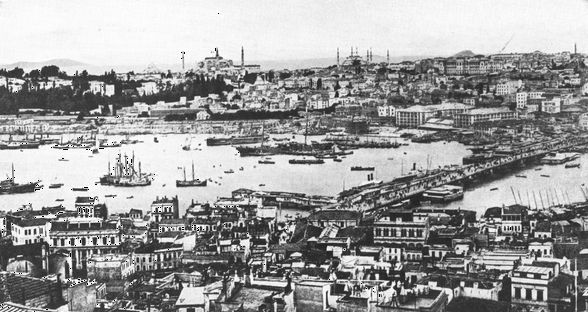
View of Constantinople from the Galata side
Now let us go wandering about the old city. The narrow, silent streets are paved with cobblestones, and lined with houses that have never been painted, but have been colored by the sun, the rain, and the wind. Some of them are overgrown with wistaria vines that cross from one side of the street to the other and frame the big shut front door.
One fine day I lifted the knocker on one of these doors when calling on a Turkish family I knew. The door was opened silently, and I found myself in a tiny garden full of flowers. No matter how small his house, the Turk always has a bit of a garden. If he is rich, he has it on a hill from which he can see the Bosporus. The garden I visited opened from a bricked hall. We went up the stairs and were greeted by the ladies of the family more courteously and gracefully than I ever have been greeted anywhere else. I wish I could describe for you the Turkish salutation. It is as hard to acquire as a foreign accent. As she bows, a lady makes a downward sweep with her arm, then raises her hand, palm upward, to her heart and lips. This means, "I am at your service; my heart is yours; the words that I speak are in your favor."
I was taken into a room all windows. The Turk loves windows as he loves gardens—windows that look over the water. All around the room were bright-colored sedias,—low hard couches,—which are, however, very comfortable to sit or lie upon. In the middle of the room on a brass tray was a big brazier containing live coals, on which the daughter of the house soon made Turkish coffee. Besides gardens and windows, the Turk loves coffee—his own peculiar kind that you must taste some day along with the other goodies. This is the way it was made for me: Into a brass coffee-maker, which looks like a pitcher with a long handle, were put one sugar lump and one coffee-cupful of water. When this had boiled, one teaspoonful of finely powdered Turkish coffee, taken from a china egg on the tray, was put into the water. This mixture was allowed to come to a boil three times and then poured, the pitcher being held a foot from the cup so that there would be foam on the coffee. I tried to drink it in the really Turkish way, holding the saucer with the cup to my lips. If you try it, you will see how hard it is to do this easily!
A little sister showed us her drawing-book, in which she had begun at the back and worked toward the front. The Turkish children recite their lessons all together in the old-fashioned schools, and if you could hear them, you would think that you had gone into Wonderland with Alice where "things wouldn't come straight." The little girls go to school in groups, and with them is always an old servant who carries all their books on what looks for all the world like a small clothes-tree. The boys go and come in two long lines, attended by their teacher. They carry their own books and wear long trousers and fezzes exactly like those of their fathers. Some of the tiny girls carry their own little tables and drawing-boards. In the gipsy village in Scutari the children learn their lessons by songs in the street. They stand in a circle with a big girl in the middle, and they grow noisier and noisier the more interested they become. These little girls wear shelvars, which look like little trousers gathered in at the ankle. I tried to take a picture of a little girl in an orange-colored pair and of a boy in a wrapper and fez, but they were frightened and ran away crying.
Now I must tell you about the Turkish shops—the really Turkish ones. Most of them are about the size of a spider's parlor and have no front wall, so you see the wares can be temptingly displayed to the passer-by. You see in one of our pictures a shop where all kinds of blankets and scarfs are sold. The scarfs are especially useful: if you are a man, you can wind one around your fez or your waist; if you are a lady, you can wear it indoors as a shawl, sash, or scarf; or, if it is the right kind, a little girl can wear it to school on her head. You don't know which one to choose when they are tossed down in front of you—a riotous mingling of reds, browns, oranges, golds, and yellows. Another fascinating shop is a bead-shop. Most of them are together on the bead street. There you may see displayed all kinds of strings of beads—long and short, large and small beads, red, yellow, and blue, of amber, meerschaum, and olive-wood. The Turkish gentlemen carry the short strings, and, when they chat, they play with the beads, unconsciously, but always in the same way. They move them forward with the thumb and first finger, two at a time, one from each side of the string. When all have been moved, they turn the string about and move the beads in the opposite direction.
Then there is the rug-shop. The Turkish rug-merchant offers you tea or coffee and cigarettes, as he hopes you will spend much money. And while you drink, he throws down before you rugs, rugs, rugs, soft, rich, alluring, from Baluchistan, Kurdistan, Persia.
But you, I am sure, would prefer a candy-shop. Even if you have tasted our Turkish paste, you have only a remote idea of how succulent a goody the real loukoumi is. Then there is halva, full of nuts and all sorts of other good things which you can never guess. It is sticky, and, when you bite it, it nearly pulls your teeth out. Then there are courabiés and smits, both of which are cakes which you must buy on a ferry-boat to get the real flavor. A man comes in, carrying a basket in one hand and waving a sheet of paper in the other. The courabiés are stuck to this paper and you pull them off yourself. The smits are on a stick which protrudes from the top of the basket. For you must know that a smit is shaped like a doughnut. (Only the hole has grown larger without affecting the size of the eatable part. This part is not sweet and is covered with aniseed.)
It would make your mouth water if I should tell you of all the delectable dishes you might have in the cafés all over the city. The Turk loves to eat, he loves to sit, and he loves to stare at his garden, at his beloved Bosporus, or at space. They never say in Turkey, "Where do you live?" but always, "Where do you sit?" In spring and autumn the hills about Constantinople are dotted with spots of color. They are the Turkish men and women sitting on the grass. And what a wonderful view they look at! There they sit for hours and hours, usually silent, occasionally chatting, sometimes grunting "Uh, uh, uh, uh," in descending tones.
The chief other thing a Turk does in times of peace is to pray. From the gallery of a minaret the muezzin calls him to prayer five times a day. Do you know what a minaret is? It is the tower of the Turkish church, or mosque. Mosques built by royalty may have two minarets, others only one. These minarets are slender, very tall, with a gracefully pointed top that draws the eye right up to the sky. There is a Turkish proverb that says, "Never steal a minaret unless you have a place to hide it in." Two thirds of the way up, there is a carved gallery, very light and beautiful, where the priest stands and chants down through the air the call to prayer, which in English prose is this: "There is no God but Allah; Mohammed is His Prophet; let us go and pray; let us go save our souls; God is great; there is no god but God." A pious Turk either goes to the mosque, or prays wherever he may happen to be. I once saw a soldier praying on a ferry-boat. Inside the mosques the cooing of many pigeons adds to the rhythmic murmur of the prayers. There are pigeons inside and outside of all the mosques; one, of which a picture is here shown, is called the Pigeon Mosque.
The most famous mosque of all is Santa Sophia, once a Christian church as you can tell by its name, built by the Byzantine Greeks about 300 A. D. It is yellow, weathered by time, is very big and on top of a hill. Inside, it is a dark golden-brown, and the pigeons flying around under the roof seem to be far, far above you. The rugs on the floor are all on a slant because the church was built originally with the altar toward the east; later the Moslems made it face toward Mecca, southeast of Constantinople. No Turk ever walks on those rugs with his shoes on,—he leaves them at the door or carries them in his hand,—and before he comes in to pray, he washes his feet and hands at the fountain outside, no matter how cold the water or the weather. Fountains are everywhere in Constantinople, made of white marble and exquisitely carved.
Constantinople has been famous in history ever since the legend that Leander died in swimming the Hellespont, the old name of the Dardanelles. Nations have quarreled over it, because it is one of the most wonderfully situated cities in the world, and Constantine the Great made it the capital of his huge empire. You will study all that in Roman history if you have not studied it already, and will read also of its capture by the Turks, under Mohammed the Conqueror, nearly five hundred years ago.
The history of the Ottoman Empire makes the most exciting fairy tale seem colorless. Perhaps you do not know that, when Henry the Eighth of England and Francis the First of France were forming a mutual-admiration society of their two kingdoms on the Field of the Cloth of Gold, there was another king, as great as either of them, in the southeast of Europe, carving great pieces out of other countries for his empire. This sultan, Suleiman the Magnificent, was a great lawgiver. His reign was the height of Turkey's power. Soon after its close the rest of Europe became interested in Turkey, especially Russia and England. Recently, German influence has been stronger than any other at the Turkish court. That is why Turkey fought on the side of Germany, and why England and France determined to storm the forts and brave the mines in the water entrances to Constantinople and so open up a way to the Mediterranean for their great ally, Russia.