Front matter (continued 3)
Reading edition
I wanted the council to be a formal affair, and so I had Omar sound the call by striking on a hollow log. The older men took their places first, squatting in a semi-circle; then the younger men squatted behind them. The women and children loitered on the outskirts at a respectful distance. All of them were chewing betel-nut.
From the house, I watched the council assemble, but I did not go out until Omar came for me. Then, with Omar and Munshee walking beside me, I left the house, dressed in native costume—Chinese trousers, sârong and jacket. The chattering ceased as I approached, and all eyes were centered on me. Every one was visibly impressed by the fact that I was wearing the clothes of a native, and that they were of the finest quality, and entitled me to much consideration.
The importance of staging such an expedition—all the "magic," the talk, the council and the costume—was not to be underrated. As I have explained before, the natives are extremely impressionable; if they like a man and believe in him, they will do anything he asks, and if they do not believe in him, they will run wild at the moment when he needs them most. The orang-outang hunt was the most important and difficult thing of its kind I had ever attempted; it required the greatest technical proficiency, because there were numerous chances of failure through little miscalculations. Elephant driving is, after all, largely a matter of simple strategy combined with endurance; and capturing leopards is about on a par with setting mouse-traps when compared with getting full-grown orang-outangs into cages.
I squatted before the council and talked long and earnestly about the work that lay before us. I told the villagers that I had left important business in Singapore at the request of their headmen, to come and help them; that I had hesitated about making the trip and had been persuaded only by the promises of Omar and Mahommed Munshee that every assistance would be given me. I explained that I had the permission of the Resident-General and that he had offered me men, but that I had refused, because I knew I could depend on the men of this kampong—they knew everything that was to be known about the jungle, and the whole world knew that they were brave and cool-headed. I impressed upon them that such work was not to be taken as play, and that it was a dangerous enterprise. The natives nodded sagely. "You must be guided by what I say and do," I told them, "for I have made plans. If you do as I tell you to do, we shall be successful."
Then I called upon the men who had been sent out to locate the orang-outangs. They had found them about two hours' distance from the village; they described the location and told how it could be reached. A general discussion followed. I gave each man a chance to express his ideas. They all wanted to talk—preferably all at the same time—and the council dragged on for hours. With the assistance of Omar, I kept the debate orderly, and we listened to all sorts of opinions.
For the most part, they felt that it would be necessary to kill the animals. That, of course, was the last thing in the world that I wanted. It would mean that the expedition was wasted effort: there are few live orang-outangs in zoölogical gardens, but many stuffed ones in museums. I did not agree with the idea that we should have to kill the animals but I did not entirely disagree. We compromised by reaching the decision that, if they must be killed, I should do the work and no man should try to kill them without my consent. The natives had seen what one bullet from my rifle would do to a tree, and they were convinced that an orang-outang would stand a poor chance.
The council broke up and work began. I had Omar set some of his men to making strong nets of twisted rattan. He drew plans for the two cages and had other men gather the limbs of trees for them. The cages were just large enough to hold the animals and small enough to keep them from getting any leverage on the bars. After the skeletons of the cages were built, they were bound tightly with rattan ropes so that, even if the bars were broken, the orang-outangs would be in a network.
The strength of a full-grown orang-outang is enormous. I have seen one bend a one-inch steel bar as though it were made of rubber. If he can brace himself properly, with plenty of room to exert his entire strength, he can bend almost anything; but between bending a bar and breaking a rope by pulling, there is a great deal of difference. A rattan rope will hold him, though a simple menagerie cage may not give him any more trouble than a paper hoop.
The strength of the orang-outang, or "wild man," as the name means in Malay, is largely in his arms. The arms of a mias—the breed that we were after—measure ten feet or more from tip to tip. The mias type, which is next in size to the gorilla, is somewhat larger than the ordinary breed. It is distinguished by a darker color and by folds of skin at each side of the face. Its body, from shoulders to hips, is about the size of a man's. It has short, undeveloped legs, long fingers and thumbs that are mere stubs.
An orang-outang never travels on the ground when he can swing from tree to tree, since there are very few open spaces in the jungle, he seldom reaches the ground except when he goes down to get something. He can swing incredible distances, hurtling through the air and catching branches with perfect accuracy.
Orang-outangs usually live in colonies numbering from forty to sixty, and the largest and most powerful is chief. They make their homes on platforms by breaking off limbs and putting them criss-cross. In mating season the male and female live together, but the couples separate after the young are born. The mother takes care of them and the father goes off about his business.
As they do in the case of most dangerous animals, the native collectors hunt orang-outangs by killing the mother and taking the young. The weapon they most often use, except when they have guns, is the blow-pipe, which, in the hands of an expert, is not to be despised. It is a long, slender tube, measuring from six to eight feet, made from a single joint of a rare bamboo. The tube is allowed to dry and harden and is wrapped tightly with rattan. The darts, which are about the size of a steel knitting-needle, are made from the midribs of palm-leaves, and at one end there is a small conical butt, which fits tightly into the bore of the pipe. A small nick is made in the shaft of the dart just below the point, and the end is coated with a deadly poison made from the sap of the upas-tree and another species of the genus Ipo. When the dart strikes, the end breaks off and remains in the wound; the poison acts rapidly, first paralyzing, then killing the victim. In warfare, also, the natives poison kris and spear, and the wound is invariably fatal.
Fighting a full-grown orang-outang with weapons so primitive is extremely hazardous work, and the natives avoid it except when a beast becomes a menace to the village. An orang-outang in battle is ferocious. If it is treed and afraid to come down, it goes into a paroxysm of fury. It will bite its arms, tearing the flesh away and inflicting frightful wounds. If there are two of the animals, they bite and hug each other. An orang-outang that has been struck by an arrow can follow the natives in the trees or on the ground while the poison is taking effect. The only refuge from the frenzied creature is the smoke of a fire, and, when it is sufficiently enraged, even that will not stop it. The best chance lies in keeping it so harried that it does not know whom to attack; once it decides on a particular native, the native is as good as dead. When the poison begins to work, after an animal has been wounded, the natives end the fight with knives. The possibility of an orang-outang attack is a danger that all the men must be prepared to face, and the duty of engaging in an orang-outang hunt is no less important than that of making war. It was but normal, therefore, that, as soon as I had convinced the villagers of my trustworthiness, I should have their hearty support.
After putting the men to work on the nets and cages, I selected a crew of twenty-five to accompany me while I went out to get the lay of the land. I warned the men against doing anything that might frighten the animals unnecessarily and explained that we should do no hunting for smaller game until we had attended to the two big orang-outangs. With the guides leading, we started into the dense jungle, and, after several hours of slow, tortuous traveling, we came to the tree where the animals lived. I could see, far up, the platform they had built.
Fortunately the orang-outangs were not there, and we were able to inspect the location at our leisure. I stationed the men at one side, telling them to wait for us, and then Omar and Munshee and I circled the tree. The surrounding jungle was as thick as any I have ever seen; the trees were so close that their branches mingled and they were woven together with creepers, vines and rattan. It was not possible to go forward a step without cutting the way. The tree in which the orang-outangs lived was the largest in the vicinity. Nearly an hour passed before I decided upon the course we would pursue. Squatting with Omar and Munshee, I explained how we would cut away the trees, so as to leave in isolation the one in which the animals had their platform; then, how we would cut that tree and tumble them into the net.
We went back to the place where the men were waiting, and I put them to work at cutting the mass of creepers that bound the trees together. The jungle was so dense that it would have been impossible to fell the trees without first cutting the network woven between them; for it would have held the trees upright even though they were cut at the base. Without tearing the creepers to the ground, we cut back as far as sixty feet on all sides. I estimated that the trees beyond would be well out of swinging distance for the orangs. At the point where I planned to have the big tree drop, I had an additional thirty feet cut. Then, when the creepers were all simply hanging, we began work on the trees.
First-rate native jungle men use their parangs with astounding rapidity and accuracy. I doubt if there are any finer woodsmen in the world. Their greatest fault is that they like to stop working in order to talk. Omar, Munshee and I, knowing this weakness for conversation, circled through the jungle constantly, urging our men on. Partly as a result of this watchfulness, perhaps, I have never seen natives do a piece of work more neatly and rapidly. It was vitally important, of course, that we finish before the big fellows came swinging back home.
The trees were cut so that they remained standing. We were trying to achieve something like a flimsy structure built of cards or dominoes, which one push will send toppling. At a signal, every tree in the circle I had mapped out was to fall, those at the center, first, and the others in order, until the one in which the orang-outangs had their platform was isolated. It was a nice problem in jungle-craft to cut the trees so that they would bear the weight of animals swinging in the branches, and yet be so weak that they would all fall—and in the proper directions—when we started them by pulling on the ropes. I allowed myself to be guided entirely by the judgment of the natives; they appreciated my confidence and took care to see that the work was done accurately.
The hacking of the parangs and the conversation attracted hundreds of jungle animals, including many of the smaller orang-outangs. We did not molest them, and they grew bolder, until we had a large, chattering, screaming audience watching us work.
Long before the two big brutes came back to their home, we were on our way to Omar's kampong, with the first stage of the work completed. The jungle as we left it did not appear greatly different from the way it looked when we arrived. I knew that the orang-outangs would realize that some one had been there, and yet I was fairly certain that the absence of human beings would reassure them. And, too, they would have several days to accustom themselves to whatever changes they noticed.
At the kampong, I called the men together again, this time for an informal council. I told them that I had considered carefully everything they had said the day before, and that, after inspecting the location, I had come to the conclusion that we could easily capture the animals. It would be simply a matter of rapid work and of each man's thoroughly understanding his job. Drawing a circle on the ground and planting a stick in the middle, I explained what we were to do and how we were to do it. Then I told them how we had cut the creepers and prepared the trees.
During the next four days we avoided the location as much as possible. Crews of men, bearing bundles of dry grass and bushes, approached within five hundred feet, dropped their bundles and returned to the village. The grass and bushes were to be used for the fire I planned to build at the base of the tree, once the orang-outangs were isolated there. We took care never to go near when the big fellows were at home, and the other jungle creatures grew less and less perturbed each time we appeared.
I remained at the kampong, supervising the making of the nets and cages. The entire population helped us, and I put some of the people to work at making smaller cages and rigging snares for other animals. Finally, when the nets and cages were ready and the material for the fire gathered and in place, I began drilling the men in their parts. Thirty men were detailed to the work of pulling down the trees in the circle; ten men to clearing the space where the big tree was to fall; and ten men to handling each side of the big net. It was upon the last-named crew that the success of the attack rested, for any mistake or delay in manipulating the net would mean that the animals would escape—even probably with disastrous results. Omar and Munshee helped me select the men from the number of those who had previously demonstrated their courage and resourcefulness in the face of danger. I had a long pole put up near the village, and we rehearsed the capture innumerable times: the pole would fall, and the men would cast the net and secure it over the bunch of grass tied to the top to represent the orang-outangs. We repeated that performance for several days, and I always stood by with my rifle in my hands as if I were ready to put an explosive bullet into the bundle of grass, if it tried to escape.
When they had played the part so many times that there seemed to be no chance of a blunder, we had a full rehearsal. As the pole fell, this time, the other men closed in, beating with the clubs, pounding tom-toms and yelling. I wanted them to make just as much noise as possible when the orangs came down; for noise paralyzes animals with fright and makes them easier to handle.
On the eighth night at Omar's village, I called all the men together and announced that we would start next morning before daybreak. Once again I made them promise that they would not kill the beasts without my permission, and I, in turn, promised them that I would shoot if there was the least danger. Long before daybreak the village was astir. All those who were to take no part in the hunt were ordered to stay behind, and they stood silently watching us while the men shouldered the nets and ropes and filed into the jungle blackness.
By the time it was light, each man was at his post, waiting for me to fire my pistol as a signal. We could see the two orang-outangs sleeping on their platform.
The men who were to give the trees the final cut and send them toppling over stole forward silently. Ali was beside me, carrying my rifle; Omar and Munshee were stationed near, one at each side. I waited, scarcely daring to breathe, for them to signal that their men were ready. Ali was intently watching the orangs, to warn me if they stirred.
Omar moved first; then Munshee. I gave a quick glance around and fired my pistol. Instantly the tumult started; the men yelled and beat upon tomtoms and trees. The orang-outangs leaped up bewildered and scrambled about their platform. Through the noise I could hear the men at work with their parangs; then came the crashing of trees. The jungle seemed to fold up, and the big tree stood alone. The orangs screamed and hugged each other. Men rushed forward with the bundles of dry grass and started the fire; others came with wet leaves to make a smudge. One of the orangs started, as if to come down, and I reached for my rifle; but when the smoke struck him, he went back to the platform, screaming and tearing the tree. Then, as the smoke, became more dense, the two animals climbed higher and sat on the topmost limb, arms and legs wrapped around each other, completely terrified.
The natives danced and yelled. Through the clouds of smoke that drifted over us, I could see their black bodies flashing, arms waving, and lips, stained crimson with betel-nut, wide open. The din was terrific. For several minutes I just stood there, unable to move.
The orang-outangs, high up in the tree, were huddled together, swaying back and forth. Omar came with the message that the space was cleared for the tree to fall; I ordered the net carried to position and sent the two headmen to place the natives at their posts.
Dense clouds of smoke rolled up from the smudges, enveloping the tree completely and hiding the orang-outangs, who perched aloft, screaming and coughing. I could get occasional glimpses of them, as they sat there, hugging each other.
The big rattan nets were in place, with the men holding them ready to cast when the tree came down. Other men, armed with sharp-pointed poles, stood behind, to pin the beasts down if the nets did not fall in the proper position. They were so excited that I spent several minutes in casually walking about, talking with them and calming them. Ali trudged a few feet behind me, carrying my express rifle.
We cleared away the litter of tree trunks and creepers from the spot where the big tree was to fall, so that there might be nothing underfoot to interfere with rapid work; then I gave the signal for the tom-toms. The racket began again and the crew of men detailed to cutting the tree ran through the smoke barrier, waving their parangs and shouting. I stood outside, near the net, watching the orangs and keeping the men at their stations. Omar was with me, and Munshee was with the men who were doing the cutting. We could hear the big knives hacking into the tree.
A messenger from Munshee came with the word that the tree was ready to drop. I gave a hasty glance around me, told the men to be on the alert and sent him back with instructions to let the tree fall. Once again through the din of tom-toms and shouts we could hear chopping; the tree swayed for a moment, the orang-outangs screamed with terror and the men with the nets crouched, ready to spring. Slowly the tree toppled and came down, gathering speed as it fell, exactly in the spot we had marked. When it struck, the entire jungle seemed to be in upheaval.
The orang-outangs abruptly stopped their outcry. As they hit the ground, they were paralyzed with fright. A net went sailing over them. In an instant they came to their senses and began fighting. With long, black, powerful arms they lashed at the rattan; they leaped and struggled, biting the ropes and tearing great gashes in their bodies. They screamed and chattered furiously. One of them reached out and grabbed a native by the throat, whipping him through the air and breaking his neck. The native struck the ground several yards away, blood pouring from his nose and mouth.
I yelled to the men to cast the second net and secure it to the trees. The orangs kept up a constant battle, lashing and heaving under the ropes that pressed them to the ground. Their arms and legs became entangled in the meshes of the nets, and they wasted their strength in wrenching and squirming, while we fastened them down. The natives, crazy with excitement, pressed in, tumbling over one another.
Our material had been put to the greatest test and would hold the animals, I knew, for they could not again equal the struggle of the first few minutes. So, because I wanted them to have room to become thoroughly tangled in the nets, I ordered the ropes slackened a trifle.
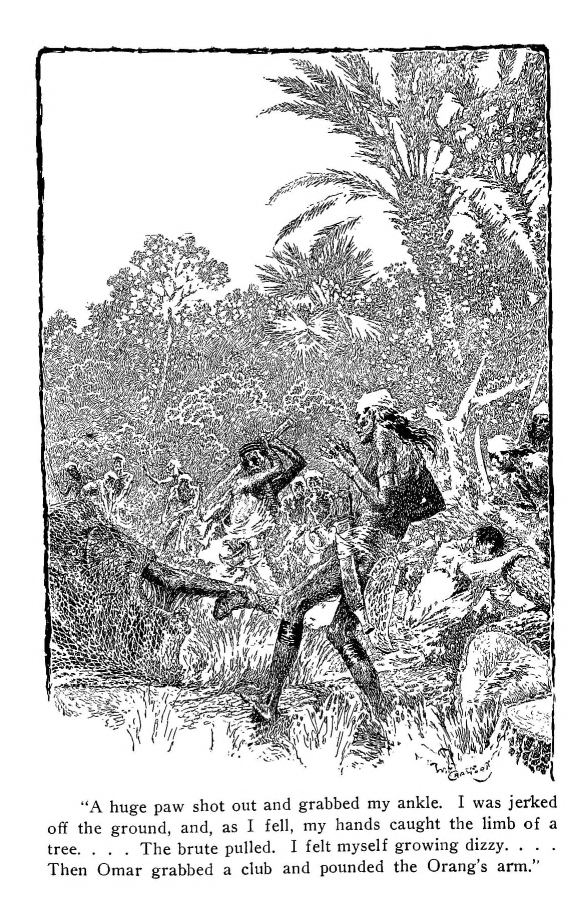
Just then, while I was standing near the nets, superintending the work of making them fast, a huge paw shot out and grabbed my ankle. I was jerked off the ground and, as I fell, my hands caught the limb of a tree. I clung to it with all my strength, feeling my fingers weaken and slip while the brute pulled. The joints at my hip and knee pained me for an instant; then my leg became numb. The men stood terrified and I could not yell at them! I felt myself growing dizzy and I simply wondered why some one did not do something. Then Omar grabbed a club and pounded the orang's arm; the pulling stopped, and I realized that I was being dragged away from the nets. For several minutes I was too groggy to know what was happening, but the idea that the natives might kill the orang-outangs while I was disabled made me sit up. They were standing there, looking first at me and then at the animals, wondering what to do. I told them I was all right and I began feeling my leg. It was not broken, but it had been so badly wrenched that I could not stand on it.
"A huge paw shot out and grabbed my ankle. I was jerked off the ground, and, as I fell, my hands caught the limb of a tree.... The brute pulled. I felt myself growing dizzy.... Then Omar grabbed a club and pounded the Orang's arm."
While I sat on the ground directing the work, the men gathered the outside meshes of the nets and ran a rope through them. Then, as the other ropes were loosened, they pulled the noose close, and the two brutes were in a sack. For the first time, I had an opportunity to examine our catch; they were the two biggest orang-outangs ever captured in Borneo.
Gradually they exhausted themselves and gave up the struggle. They peered out through the meshes, snarling at the men who came near them and sometimes shooting out a long arm with the fingers opening and closing. The natives squatted about in a circle, watching the animals and laughing.
When the men had rested, I had them build two litters of boughs—one for the dead man and the other for me. Then we strung the net on three long poles, to be carried by twelve men, and started back to the village. Messengers went on ahead to tell the people of the kampong of our success. I headed the procession; then came the orang-outangs with natives dancing around them and beating tomtoms; then the dead man. It was necessary to stop often to change the crews that were carrying the litters and animals—they weighed over five hundred pounds—and the entire population of Omar's kampong came out to meet us in the jungle before we had covered half the distance. My coolie boy, who had remained at the village, was ahead of them all. He was one of the fastest rickshaw men I have ever seen, and his old training came in handy that day. He wanted to carry me in his arms back to the village, but I told him to run back and put some water on to boil for me.
I left Omar and Munshee in charge of the orangs and had my men hurry ahead with me, for my leg was paining me intensely and I could feel the fever coming on. I had many things to do before I could afford to be sick, and I did not want to lose any time. For one thing, I realized that it would be impossible to get the animals into separate cages and that it would be necessary to build a larger cage before we could take them from the nets. It would be too dangerous to leave them in the nets overnight, for they might chew their way out.
At the village I found that my boy had laid out my medicine kit. I soaked my leg in hot water and massaged it; then we painted it with iodine and bandaged it tight. By the time the procession arrived, I was ready to give Omar and Munshee orders about the new cage.
While the women prepared the feast of chicken, rice and sugar-cakes, the men went into the jungle again and cut logs eight feet long and from six to eight inches in diameter. These they drove two feet into the ground, placing them not more than three inches apart, so as to form a cage eight feet long and three feet wide. Then they bound them together tightly with rattan ropes, and made and lashed down a strong roof of logs. One end of the cage was left open for the animals to enter.
Propped up on my litter, I directed the work; then I was carried while I made a careful inspection of it. When the cage was ready, the orang-outangs were brought up to the open end, the poles were drawn out and the slip-knot of the outer net was loosened. By using poles and working at a respectful distance, the men forced into the cage the single net containing the animals; then they drove the end-bars into the ground and lashed them. Finally, by working between the bars, they loosened the slip-knot of the net and left the orang-outangs free to untangle themselves.
By the time the job was finished, I was exhausted by the fever, and my leg was paining me unbearably. I thanked the men for their good work and was carried back to Omar's house. The people were disappointed that I could not take part in the great celebration they were preparing, and deputations arrived at the house to ask if they could do anything for me. In a hundred different ways they showed their concern for me and their kindness, and I know that they would have dispensed gladly with their merrymaking if I had intimated that the noise might keep me awake. Sleep was, of course, out of the question, but not because of the noise; my leg was puffed and swollen, and the fever was growing worse. Outside, I could hear the people celebrating. The ceremonies began with the funeral of the man that had been killed and they lasted until daybreak.
In the morning I sent for Munshee and told him that it would be necessary for me to go down the river to Sintang, where Dr. Van Erman lived. He selected four of his fastest boatmen and sent them off to the doctor with the message that I was coming. Their orders were that they might stop at Nanaoh-Pinoh to eat, but that they were not to rest until the message was delivered. Just as soon as they were out of the way, Munshee turned to preparing a boat for me; an awning made of palm-leaves was put over the center and a bed arranged.
I left Omar in charge of the orang-outangs, with Ali to assist him. Ali objected to being left behind, but I explained to him that he could be of greatest service to me by staying. He was to see that the orang-outangs were fed and watered and to have the natives trap other animals for me. I instructed Omar to build a shed over the cage and to place a fence around it, so that none of the natives could venture too close.
When my boat was ready, all the people of the kampong were on hand to bid me good-by and wish me a speedy recovery. Munshee steered and six men paddled. Another boat followed with my supplies. I went down the river, thinking that I had never found a kinder, more hospitable people than these, who are known throughout the world as savages and head-hunters.
My fever grew worse and worse and I became delirious. I did not know until later that Munshee urged the men on, hour after hour, until we overtook the messenger boat. The last thing that I remember of the trip was that everything became a blur. The men who were paddling, the river with its green banks, Munshee, the awning over my head and the coolie boy all whirled around and grew indistinct. I was unconscious when we reached Sintang.
Two days later I awoke in Dr. Van Erman's house and was unable for some time to realize where I was and why I was there. The doctor came in and talked with me for a few minutes. He said that I would be well in two weeks and that my leg was not badly damaged. Then I drifted off to sleep again.
The next day I felt stronger, and the doctor repeated some of the tales the natives were telling about the capture of the orang-outangs and the death of the crocodile. The stories had improved with age, and so I told him what had actually happened.
"Mahommed Munshee has been waiting here for you to get well," said the doctor. "I think he'd like to see you—if you don't mind."
Munshee came in, beaming with delight. Taking my hand and pressing it to his forehead, he told me that only one chosen by "God and Prophet" could recover from the fever and the sickness caused by the paw of an orang-outang. All of the villagers, he said, had been making offerings to the different deities for my recovery, and the people would be happy to hear that Tûan was well again. I told him that I would return with him to Omar's kampong within two weeks, and he left, promising to come for me.
The days at Dr. Van Erman's house passed quickly and pleasantly. I found him a thoroughly fine man, as well as a fine doctor, and I enjoyed his companionship. Under his care I rapidly threw off the fever, and my leg healed so that I could get about with little difficulty. The ankle had been dislocated by the grip of the orang-outang's paw, and the tendons badly strained.
By the time Mahommed Munshee came for me, I was quite ready to go up the river. I had seen enough of the country to know that the jungles were full of animals, and I wanted to capture as many as possible before starting back for Singapore. Munshee said that the orang-outangs were in good health and that Omar's men, working with Ali, had made many captures. Dr. Van Erman cashed a draft for me, so that I should have silver money to distribute to the natives who had helped me, and I started up the river, promising to stop on my way down so that the doctor could see the animals.
At Munshee's request, I stopped overnight in his village. The people gave me a royal welcome and we had a fine celebration. The news of my coming went ahead of us, and Omar and Ali came down the river, meeting us two hours' distance below the kampong. They gave me an enthusiastic reception and I was touched by their affection. We rowed on up the river and, when we reached Omar's village, I found that the people had been busy for days, preparing the festivities in honor of my return.
After greeting the people, I went directly to the cage of the orang-outangs. They showed little fight, and I was encouraged to find that they were not too despondent. I did not want to risk transporting them until they had become thoroughly accustomed to captivity—or at least as much accustomed to it as is possible for orang-outangs. For homesickness grips them just as it grips human beings, and they become pitiable objects. If they refuse to eat, it is scarcely worth while to spend time and money in transporting them, for seasickness and the excitement of traveling will kill them. I had been lucky enough to find my captives eating quietly and taking life calmly.
The celebration lasted until dawn, but I excused myself early and went to bed. Omar explained to his people that I would become ill again unless I rested, and they escorted me to the house with all the ceremonious attention that they would have shown to royalty. I did not appreciate at the time quite how near I was to being a royal person in their eyes; but I found out later that Ali, during my absence, had been absolutely shameless in the tales he told about me. I habitually dined with sultans and rajas; I was an exorcist, renowned the world over; I feared no hantu (ghost) and, in addition, to all that, I was a master of hobatan (magic), who, by using his powers, could capture elephants as if they were monkeys. But, apart from Ali's stories, the people liked me because I had engineered the capture of the beasts that had been terrorizing them. And I liked them better than any other people I had met in all my travels.
Before beginning the work of capturing other animals, I turned my attention to preparing the transportation cages. These were three feet wide, three feet high and five and a half feet long—just large enough to hold the orangs, without giving them any chance to wrench at the bars. They sat clutching each other while we placed the transportation cages at each end of the big cage. Occasionally they snarled at us and reached out between the bars. Natives armed with sharpened poles held them back. Then, by poking and prodding, we separated them and ran bars through the center of the big cage. These operations excited the beasts so greatly that we left off work for the day. The next morning we went to the cage again and cut away the end-bars so that the animals could enter their transportation cages. These gave them more room, and I stationed an extra guard over them with instructions to call me immediately if they began to tear at the bars. Ali spent practically all of his time there, talking to them and feeding them. Gradually they became accustomed to him, and, although they were far from accepting him as a friend, they did know him and realize that he was not there to hurt or annoy them. All others, except the headmen and myself, were kept away from the cages.
Food was always placed in the transportation cages, and, since the animals were deprived of each other's company, they became accustomed to spending their time in them. That, of course, was exactly what I wanted, and the prospects looked more encouraging each day.
We spent the next two weeks in trapping and snaring, and I kept the men of the kampong busy all the time, either at collecting the animals or at building cages for them. I was fortunate enough to get one proboscis monkey. It is a rare, long-nosed species, difficult to capture. My standing orders from zoölogical gardens all over the world always included one of these creatures, but this was the only one I ever caught. We found him hopelessly tangled in a net we had put up near a watering place. He was a fine specimen, two feet high, with long arms, legs and tail, and a nose that measured two inches.
Netting animals in the way in which we caught this monkey is one of the easiest and best modes of collecting. The size of the net and of the meshes will depend entirely upon what one hopes to capture. Our nets varied from eight feet square to fifteen feet long by ten feet wide. The meshes measured from two to four inches. The net is placed at a spot where animals are sure to pass; it is suspended across the trail and held in place by light bamboo poles. Leaves and grass are scattered over it until it cannot be distinguished from the ground. When an animal steps into it, the net falls and he begins to struggle instead of quietly, working his way out. Within a minute he has himself so tangled in the meshes that it is sometimes necessary to cut the net to get him out. One great advantage connected with this method of trapping is that the animal is never injured; he simply wears himself out and then, exhausted, stays in the net until some one comes along to release him. A cat animal, for example, comes running into a net; its feet catch and it goes tumbling, rolling over and over, roaring and pawing. In a few seconds it becomes so tangled that it cannot move an inch. Its cries bring the men who have been posted as lookouts, and they carry it back to the kampong on poles.
Contrary to the general idea, cat animals, such as tigers and leopards, are the easiest to catch in traps as well as nets. The work is as simple as baiting a rat-trap and it requires little sagacity. A box-trap with a spring-door will make a catch time after time, with no more trouble than transferring the animal to a transportation cage and rebaiting the trap with a chicken or a small goat. It is wise to allow a fairly long runway between door and bait so that the captive will not be injured when the door springs shut. After recovering from the surprise of finding itself trapped, the animal eats the bait, which supplies it with food until the natives come along on their regular tours of inspection. It is just routine work, involving but little excitement.
Among the animals we captured while working from Omar's kampong were three gibbons, or wahwahs. These are also known as flying gibbons, because they make such long leaps from tree to tree. They are a tailless breed of monkey, rather rare and extremely difficult to catch. Once captured, they become affectionate pets and they command a good price for that reason. They have soft, downy, light brown, silver-gray or yellow hair, black faces and large, round, expressive eyes.
The work of trapping and snaring went along steadily during the ten days I spent with Omar. By; the time the orang-outangs were ready to travel, we had three gibbons, four baby orang-outangs, one proboscis-monkey, ten black monkeys, eighteen long-tailed monkeys, twenty-two pig-tailed monkeys, three pythons, which averaged eight feet in length, two sambur deer, one sun-bear, three wildcats, four civet-cats, four porcupines, one ant-eater and two armadillos.
We slipped the bars over the open ends of the cages in which the big fellows were to travel, and lashed them securely with rattan ropes. Since the boats at the kampong were too small, I had two large rafts made of bamboo and I placed all the cages on them.
When everything was ready, we boarded the boats and rafts and started down the river. The people lined the banks, shouting and wishing us a safe journey; others followed us in boats. At each village, the natives swarmed out to see the animals and wish us luck. I can still hear them calling: "Tûan, bîla bâlik? Salâm-at jalân! (Sir, when will you come back? Safe journey!)"
We stopped at Mahommed Munshee's village, and then at Sintang. I found that Dr. Van Erman had gone down to Pontianak. Another swarm of natives met us when we arrived there, and I had to station my men around the rafts to keep them from coming aboard.
Leaving Ali in charge of the animals, I went ashore and found that a steamer was sailing for Singapore the next morning. I made arrangements for shipping, and then went to the Resident's house to pay my respects. Dr. Van Erman was there and, after luncheon, I took the Resident and the doctor out to see my catch. The Resident was profuse in his congratulations and he confirmed my belief that the orang-outangs were the largest ever captured in Borneo.
Omar and Munshee assisted in the work of loading the crates on the steamer, because they felt that their obligation to me did not end until we had the animals clear of Borneo. I felt, of course, that I was under obligation to them for all the fine work they and their people had done for me, and I wanted them to accept some money for their services. They refused at first but finally they gave in. From their point of view, they had made sufficient profit, merely in prestige, both with their own people and with the Resident. I made them my agents in their districts and took them with me to the offices of the steamship company while I arranged to have any animals they brought to Pontianak shipped to me at Singapore. When we sailed the next day, they were in their boats alongside, waving and yelling.
There was great excitement in Singapore when the story of the orang-outangs got about. Hordes of people came to see them unloaded. I called upon the police to keep the crowd back, for I was afraid the excitement might be too much for the beasts.
At my animal house, I put them in a quiet spot and left Ali in charge with strict orders against letting too many people come to see them. Then I went to the cable office and sent to the Antwerp Zoölogical Gardens news of the capture.
There was no question in my mind as to what the answer to my cablegram would be, and, before it arrived, I made all the arrangements for shipping. Antwerp offered $10,000 each for the animals delivered. I knew that I could get offers of $25,000 or more in the United States, but that the orangs would not be able to stand the voyage. I sent another message to Antwerp, saying that I was sailing and requesting that arrangements be made for shipping by rail from Marseilles.
A few days later, the cages were swung aboard and we started eastward. Ali accompanied me to care for the animals.
From the moment the steamer headed out to sea, the orang-outangs began to fail. They became deathly seasick, especially the female, and refused food. Ali and I were with them constantly, tempting their appetites with choice bits of food and doing everything possible to make them comfortable. The male grew better but the female lost strength rapidly. Finally she slumped down to the floor of the cage, unable to sit up; she paid no attention to us when we reached into the cage and touched her.
One morning she curled up on the floor, buried her face in her arms and died. Through her death I lost a great deal of money, but I could not help feeling relieved. She had been so abjectly miserable and she had seemed so human in her suffering! I have often wondered if the male had any idea that she was dead. He ceased to improve in health and he became morose. Many days of anxiety followed; every minute I expected the message that the poor fellow was dying.
The ship's carpenter built a vat, and we "pickled" the body of the female in salt water. I knew that some natural history museum would be glad to have such a specimen for mounting. We steamed into the harbor at Marseilles with the male still alive, and I thought that there was an even chance of getting him to Antwerp if the people there had followed my instructions and arranged transportation. An agent met me at the dock. Everything was prepared for us, and we lost no time in getting the beast to the train.
When we reached Antwerp, I felt like standing on the platform and whooping. My job was finished.
The men from the Gardens took charge and rushed the orang-outang out to the cage that had been built to receive him. We ran the transportation cage up to the door and cut away the bars. The orang-outang came out slowly, like a tired and sick old man. He was not interested in his new surroundings and he pushed away the food that we put before him. Veterinarians could do nothing for him. Ten days later he died.
Ali and I remained in Antwerp for several weeks. It was Ali's first trip to Europe, and not a very enjoyable one. He was bewildered and puzzled; he could not understand such a country. Only once did he venture out of the hotel without me, and then he did not go out of sight. He slept in my room on the floor—he would have nothing to do with a bed—and he would touch no food that was not vouched for by me.
When we boarded the boat that was to take us back to the Far East, Ali's face brightened. He had had a wonderful experience, but he said: "Oh, tûan, I am happy to go home: I would not live here."
VI "KILLING A MAN-EATER"
Before describing my experience with a man-eating tiger, I want to tell something of their habits and the usual methods of hunting them.
There are three classes of tiger, the game killer, the cattle killer and the man-eater.
The game killer confines himself to heavy jungle amongst the hills, where he keeps to the feeding-grounds and resorts of game; he is a great killer of deer and wild pigs; he shuns the haunts of man and wanders in the jungle at all hours.
They are lighter and more active than the cattle killer. Doubtless the reason is that they have to travel farther for their food.
The terror inspired throughout a district by a man-eating tiger is extreme and the natives are only safe in numbers. The rapidity and certainty of its movements form the chief element of the terror it causes; it is generally an old tiger or tigress, or one that has been wounded or otherwise hurt, and has been unable to procure its food in its usual way.
Cattle-killing tigers frequent jungle close to villages and seize a victim amongst cattle where they graze, or pick up a stray animal about the villages at night.
The largest tigers are found amongst the habitual cattle killers. When a tiger becomes old and fat he usually settles down in some locality where beef and water are plentiful, and here he lives on amicable terms with the villages, killing a cow or bullock about once in four or five days.
A full grown, large tiger would have no chance in a fair fight with a bull-bison; the latter's brawny throat, with its hide one and a half inches thick, would afford him a difficult hold, even could he attain it, and no wrench could dislocate the bison's powerful neck, while the tiger would be crushed out of all recognition if once caught between the ground and the bison's massive forehead or forelegs.
I have never witnessed a tiger actually seize its prey, but it has been described to me by natives who have seen them many times while tending cattle. The general method is for the tiger to slink up under cover of bushes or long grass ahead of the cattle and to make a rush at the first cow or bullock that comes within five or six yards. The tiger does not "spring" upon his prey in the manner usually represented, but clutching the bullock's forequarters with his paws, one being generally over the shoulder, he seizes the throat in his jaws from underneath and turns it upwards and over, sometimes, springing to the far side in doing so to throw the bullock over and give the wrench which dislocates its neck.
The popular belief that a tiger can kill his prey by a stroke is erroneous. I have never seen anything to support this belief nor is it held by natives. I have seen several cattle severely lacerated which had escaped from tigers, where had a heavy blow accompanied the strokes of the paws, bones must have been broken.
There is no foundation for the belief in tigers sucking the blood of their victims; the jugular vein is seldom if ever injured; it is by the fracturing of the vertibræ, not by blood-letting, that the tiger's prey is deprived of life. In eating, the tiger invariably commences at the hindquarters and the exact spot where the first mouthful will be taken can be told with certainty.
The flesh of one or both thighs, and sometimes the flanks, or about fifty or sixty pounds of meat is eaten the first night.
Tigers seldom lie up far from their kill if the cover be thick and quiet; they eat whenever inclined either by day or night till the carcass is finished; this is usually on the third day; but of course, this depends upon the size of the animal killed. After or during a meal the tiger drinks largely, often walking belly deep into the water.
Tigers' power of enduring hunger and thirst is very great. Once we surrounded with nets a tiger, tigress and a leopard. We shot the leopard the first day, but the enclosed thicket was so dense that we could not get the tigers to show, but on the fifth day we wounded them both. After this, as nothing would make them break cover, I sent for elephants and killed them still full of vigor on the tenth day. The circle in which they were enclosed was about seventy yards in diameter, and the heat of the fires kept up night and day was considerable, yet they existed without a drop of water for ten days, suffering from wounds half the time. A tiger can go much longer than this without serious inconvenience. One of the most powerful elements in the tiger's attack is his voice. If the attack be commenced very near, the startling, coughing roar is almost paralyzing to the coolest, but if the tiger has to come on from any distance, he rarely does more than grunt, and the hunter's attention is concentrated on the beast itself, so the demonstration passes unnoticed.
The power of the tiger's voice at close quarters may be understood by anyone who has had an opportunity of seeing a newly caged tiger; it is almost impossible to watch the charge against the bars without flinching, if standing within a yard or so of them, but if seen at twenty yards distance it is nothing.
The tigress does not breed oftener than once in two years. They do not breed at any fixed season. Cubs have been taken in March, May and October.
A tigress feeds her cubs when very young with half-digested flesh which she disgorges on her return from hunting or kill. Carrying meat to any distance would be an unnatural proceeding, and the half-digested flesh is probably better adapted to the requirements of young cubs.
When only six weeks old the cubs move from place to place with their mother, but are left at home while she hunts, though she leads them to feast if near when she kills.
Watching for the return from a kill, or at a pool where they are known to drink, is a method of hunting chiefly practiced by natives. Poison pitfalls and traps are generally brought into play when dealing with a man-eater. There is perhaps no method of shooting tigers so seldom successful as watching for their return to feed on animals they have killed. For my part, I confess to a great liking for the silent and solitary watch, which kind of shooting requires the utmost vigilance and patience.
In a shady, green-screened platform in some fine tree, watching at the cool of evening, when jungle sounds alone break the stillness and birds and animals seldom seen at other times steal forth and can be watched at leisure, an intense excitement is kept alive by the possibility of the tiger's appearance at any moment. Those without experience at this game do well to pause, but one who knows the beast he has to deal with may kill many dangerous animals on foot without accident or even serious adventure. Almost every accident that occurs is directly traceable to ignorance or carelessness; the hunter is a tyro or over-venturesome, or due precautions are not observed when following a wounded beast on foot and moving about where he does not think the animal can possibly be, he is seized.
Tiger shooting on foot can never, of course, be safe sport; risks must be run, but if properly conducted, dangerous game shooting on foot is not the mad amusement usually supposed.
It makes all the difference in the world whether the animal to be attacked is wounded or not, and whether any tiger should be attacked on foot or left alone depends greatly on the nature of the jungle in which he is found.
In the grass plains and thick undergrowth in parts of the Malay Peninsula I have seen tigers that could only be shot at from the elevation of an elephant's back. None but the utterly ignorant would think of following a wounded tiger in the long grass or close cover where it has every advantage, and the hunter may be seized before he has time to use his rifle. In such cover the tiger rarely makes any demonstration, seeking only to avoid observation, but when almost stumbled upon he attacks like lightning.
Under no temptation should a hunter's last shot be fired at a retreating beast.
The really best time for tiger hunting in the Malay Peninsula is in the height of the hot season, July and August, when the water supply is at its lowest ebb. The tigers being very impatient of thirst, seek the lowest valley where much of the game he preys upon has gathered and where the village cattle are regularly watered.
It is quite useless to devote much time in hunting the hill or game killing tiger that preys upon game alone; they are so scattered over a large tract of jungle and so active and wary that it is only by accident that they are ever brought to bay.
The average size of a full-grown tiger is from eight and a half to nine feet from nose to tip of tail and weight from two hundred and seventy-five to three hundred and twenty-five pounds.
One day an old friend, Tungku S'leman, a petty rajah from Kelantan, then under the Siamese Protectorate but now under the British, called on me and invited me to go back with him to his district to trap or kill tigers, and he assured me I would be able to get some fine tiger cubs. I was in fact very anxious to secure a few good specimens of young tigers, but as his district was far inland, near the boundary line of a small state called "Rawang," I did not think it worth my while to go, for it would involve a lot of time, and knowing the Malays and their ways so well, it might mean that I would have to beat about the country on a wild goose chase. A Malay will always exaggerate, no matter on what subject, and, as stated elsewhere in my articles, they finally believe what they are telling. They will never do today what can be put off until tomorrow—"Nou-tee Bess-so" (wait tomorrow) is one of the principal words in their vocabulary.
As the Tung-ku's district was difficult to reach, the Kelantan river branching miles from the nearest point, and elephants being the only means of travel, I told him that if I decided to go back with him he would have to furnish the elephants and all the men I might need. I also pointed out to him the difficulty in transporting animals and cages to the coast, and that the cost in time to me would probably be greater than the trip and animals were worth. It was my policy not to show any interest.
I could see that the Tungku was anxious to have me return with him to his district, as it was tiger infested, and his people were leaving on that account. He agreed to do everything in his power as to men, elephants and transportation to the coast. I told him I was very busy but that I would think it over, and to come back in a few days when I would give him a definite answer.
As nearly all my animals had been shipped from my house in Orchard Road, I decided to take the trip with Tungku S'leman and go in for not only tigers but whatever it was possible to get. I was keen on securing a good specimen of rhinoceros, and tapir, so made my preparations for a lengthy stay in his district, and for getting whatever animals I could, large or small. When on the following day the Tungku came to see me and I told him I would go back with him, he seemed a happy man. I advised him to send his chief follower on ahead so that he could have the elephants meet us at the end of our trip down the Kelantan river, to take us inland, as that would save a lot of time and unnecessary waiting for them to come down for us. He assured me the elephants were there as they would remain until he returned. So the following week we started up the coast in a small vessel, and arriving at Koto Bharn, we went up by boat to the capital, Kelantan, and the next day after paying my respects to the Sultan, we started up the Kelantan river to where the river turned further south. Here at a kampong we found the four elephants of Tungku S'leman. We stopped four days at this kampong, getting everything packed that would not be used or wanted until we reached the Tungku's village, which meant a four days' journey through jungle.
Taking six men, including the headman, I started on a tour of inspection of that district for the best location to set up our traps, dig pits, and spread nets for smaller game, as the headman informed me that deer, wild pigs and tapir were numerous, but very shy. On our return to the kampong, I had a trap made and set up for the catching of tigers and leopards, and explained how the nets were to be made of rattan, both large and small mesh, and how to set them amongst the trees. I was particular to impress upon the headman that he was to remove all signs of the jungle being disturbed and if possible have a goat tied to the windward while setting up the large trap.
I did the same at the two other kampongs before we reached Tungku S'lamen's village, where I was received with interest by the natives, as I was one of the very few white people they had ever seen, and as the runners had hurried on ahead as we were getting close to his village, they were all out to see Man Gagah (Sir Elephant). After resting for a few days and hearing whatever news there was regarding the man-eater that was terrorizing the district, I thought it best to try and round him up by elephants.
As they are cowardly, as well as cunning, they are most difficult to stalk, and as their movements are so uncertain it is very difficult to locate them, it was essential that the men who were to work with me could be depended upon at the right moment. I assured them that in numbers they were safe from the tiger, and that by showing a bold front the tiger would be more afraid of them than they of it. The last time it had been reported had been about ten days before, and nothing could be done for the time being, so I started the men making traps, snares and nets. These I intended to set up within a certain area, while with others I started out on a tour of inspection with the elephants to visit all the water holes and drinking pools in the surrounding district. There I intended to have pits dug and to mark the best places for setting the nets; the traps I intended to set up later, depending more on the nets, as I had already had traps set up in the kampongs on our way to the Tungku's village. I spent a whole week in working out different areas for snaring by nets.
I had nets made of twisted rattan in sizes of twenty by fifteen feet with meshes six inches, other nets ten by eight and five by five feet with meshes according to what the net was best adapted for.
The older men who could not follow the hunt, I had put to work making transporting or rough string cages and crates, for monkeys as well as tigers.
My plan was to work each section or area and catch by either net or pit whatever we could. Everything was in readiness to start at daybreak the following morning, when a native came running into the kampong, crying as he ran, "Re-mow, Sa-tan" (Devil Tiger). The man was about to collapse with fright and exhaustion from running. I calmed him so he could tell his story, which was that while he, his wife and daughter were gathering some faggots not one hundred yards from his hut, the tiger suddenly sprang from the thicket and striking his daughter down, carried her off in the jungle. After leaving his wife in the hut, he ran to the Tungku's kampong to inform the Tungku what had happened.
As it was too late in the afternoon to do anything I told Tungku S'lamen to send out the alarm for all the available men; the alarm is sounded by the striking of a hollow log, which can be heard for miles in the stillness of the jungle, and all natives hearing the booming sound know its meaning. I advised Tungku to send five or six men back with the messenger and for them to stay with him until we came the next morning. The hunt was on, and all preparations were made at once for our early start, as the men began to flock in from the outlying kampong. They were to stay at the Tungku's kampong that night to be ready to start at daybreak after eating their breakfast. There was intense excitement throughout the whole night, very little sleep for anyone, for, as I told the men, they would not return until we had killed the tiger. A few of the natives, especially the headmen, had flintlock, muzzle-loading rifles. To these I handed out extra powder and slugs; they were really good marksmen and men who could be depended on at the right moment.
We started at daybreak. The men having eaten, everyone was anxious and eager to be off, now that the hunt was to be conducted not alone by a white man, but in numbers. There were fifty natives; the Tungku and two of his headmen with their flintlock rifles rode on the first elephant, while Ali and myself followed behind on the second, the third with stores bringing up the rear, for I had no idea when we would get back. Although the Tungku assured me the elephants were well broken, I did not place any reliance on them. Riding on an elephant and jogging along peacefully is one thing, and tiger hunting on the back of one is quite another. As I have mentioned elsewhere, they are excessively timid both in their wild and domestic state, and to become a well-trained, tiger-hunting elephant, one so broken must have plenty of courage and experience. It is simply madness to attempt to use an elephant that has never been broken and tried out, as they will always bolt. Then again, if one never had a gun fired from its back, the effect is rather startling to his riders. It is a terrible thing to be bolted with while on an elephant's back in the jungle. I intended to take no chances while mounted as far as shooting was concerned, depending on cornering the tiger, if possible, and if the ground were favorable, start on foot.
Besides my 50-110 express, I had a Holland double-barrel 450 and a Fox No. 12 smooth bore shotgun. Ali had his spears, but was to use either the express or double-barrel Holland if we came up with the tiger. The other men carrying spears, parangs and tom-toms made up the party. Arriving at the place where the girl had been seized, two men who were experienced trackers took up the trail, which was quite fresh and plain and could be easily followed. Presently we came upon the remains of the poor victim. Very little was left—only the head and upper part of her body. We stopped only long enough to bury the remains. The tracks were not over an hour old, and as the jungle was sparse, it would give no cover to the tiger. After crossing a small stream, his track led toward a rocky hill less than two miles distant, coming suddenly into a clearing with tall grass.
I shouted to the men to spread out, keep quiet, and move slowly within a few feet of each other. As the grass was still heavy with dew, we could see where the tiger had passed through to the right into the thicker jungle. We had perhaps traveled about one hour, the tracks becoming difficult to follow on account of heavy undergrowth, when we were startled by the screaming and chattering of monkeys. We knew then the tiger was not far ahead, and at the same time the elephant that the Tungku was on, spreading his ears and raising his trunk, uttered a shrill, brassy trumpet, expressing his fear. I called to the Tungku to take the elephant back, as he would be worse than useless. He was quickly turned about and driven behind, the Tungku coming up with me, the two headmen joining the men on foot. The elephant I was on showed no sign of uneasiness; the mahout or driver spoke sharply to him, calling back to me that he could handle him as that was not the first time he had been used in smelling tiger. Still I was loath to risk firing a gun from his back.
We followed the trail of the chattering monkeys, when suddenly they ceased, as we came to a very heavy patch with thick undergrowth, excellent cover for the tiger, into which he had evidently gone. The patch itself was not more than seventy yards in diameter. I called to the men to stretch but and surround the place, and make as much noise as possible, keeping close together.
As soon as the patch was surrounded, I told the Tungku to send the two elephants, the one he had been on and the other one carrying stores, back to his kampong for more men, and the men as they came on were to cut and load up the elephants with all the dry wood they could; also each man was to carry some wood and as many of the long nets as had been made. These I intended to spread out at the back and as much around the sides as possible, making doubly sure he should not escape. I told the Tungku we would not leave the spot until the tiger had been killed. I had a platform built with "kaj-ongs" forming the roof. This was very soon finished, and late in the afternoon the elephants returned with more foodstuffs, wood and forty men. Each man had gathered a good bundle of dried wood, which wood I had passed around, as I intended to form a circle of fire and keep the tiger within the circle. I then had the fires started and they were kept up the whole night, but in the morning the fires that were in front of the platform were allowed to die out, and after the men had taken turns eating, I ordered them to close in about twenty-five feet, throwing the fire before them. In this way I kept narrowing the circle every few hours while we on the platform kept a keen lookout.
On the second day one of the headmen on the left side of the circle fired a shot at what he said was the tiger. Instantly there was a great commotion and the men started shouting and making a great noise. We were keenly on the alert, as the platform faced the only spot of the circle that was open and free from fire, and hoped the tiger would break cover. Suddenly Ali, touching me, quietly said, as he raised his gun to his shoulder, "Tuem-block-on-po-ko" (behind the tree). Telling him to cover the left side, I covered the right side of the tree the tiger was crouching behind, and told Ali to shoot as close to the tree as he could without hitting it. He fired, and almost instantly I let go at a streak of yellow and black; it disappeared at once. The yelling by this time was enough to drown the grunt or roar of the tiger; there was no way at the time to know if we had succeeded in hitting it, so completing the fire circle in front of the platform, we lay down to sleep as best we could. What little wind there was, was in our direction, and kept us pretty free from being eaten alive by mosquitoes.
On the morning of the fourth day the tiger had not broken cover and as the circle had now narrowed to about fifty yards, the heat was intense, for the fires were kept going day and night. Still the tiger would not break cover. I was determined to go into the circle then with the elephant, as the nets were well put up at the back, outside of the fire, and that allowed more men to strengthen the sides. I was taking no chances of escape. I had two headmen get up on the elephant I had come on, and told the driver to back a short distance, as I wanted the headmen to shoot off their guns from the elephant's back, in order to watch the effect on the elephant. I told them to each fire his gun off on opposite sides but not at the same instant. Well, he never moved, and when those muzzle-loading flintlocks go off they certainly kick and make a startling noise. After that test I was satisfied to take the chance and told the Tungku that Ali and myself were going in after the tiger, and that he and his two headmen must keep a sharp lookout from the platform and have their guns trained on the opening. The mahout was a plucky fellow and felt very proud, assuring me he could handle his elephant.
I passed the word for all the men to be on the lookout and allow the fire on the right side to die out, to keep together, and those of the headmen who had guns should shoot if the tiger tried to break through. As soon as the fires had died down, I told the driver to go ahead and keep to the right side. When on an elephant in fair ground, the object should be to get the tiger to charge instead of letting him sneak away, for the hunt is then ended in a short and exciting encounter, but if once let away it may be hours before he is found again, if he ever is at all.
Coming opposite the tree where we had shot at the tiger, and under a patch of heavy undergrowth, against a large boulder, we both saw it. Seeing the elephant it gave a coughing roar, and as it did I let go, catching it fair in the eye. Ali had his spear poised ready to throw, but the man-eater slumped down and to make sure I put another explosive bullet in its side as it lay. I called to the Tungku we had got it. I will not try, for I could not adequately describe the scene which followed when the men knew their foe had been killed; shouting, yelling, dancing, they went wild. Runners started off at once racing back to the kampong to tell the news and have the women make ready a feast. The return to the kampong was like a royal procession. The Tungku and I on the elephant led the way, the men carrying the dead tiger, singing and laughing, calling the dead animal all manner of names. There was great feasting that night; it was made hideous with the singing and beating of tom-toms, and, although dead tired from lack of rest, sleep was impossible. In the morning the Tungku did a most astonishing thing; nothing of the kind had ever been known to the oldest subject; he set free five of his debt slaves.
On examination I found that the first time we fired at her, while behind the trees, as she leapt back from the shot Ali had fired, I had caught her in the flank, smashing the hind leg, and with all her suffering, thirst and heat, she never betrayed her cover or uttered a sound.
She measured eight and three-quarters feet from tip of nose to tip of tail and weighed about two hundred and ninety pounds. She was in milk, but though we searched, we never found her cubs.
VII UP A TREE IN THE JUNGLE
For fully a week after the killing of the man-eating tiger, I devoted all my time seeing to the making of rough transportation cages, crates of all sizes, and small nets. One morning I told the Tungku of a plan I had to get some large nets made in a hurry. "Te-dor, bully tûan" (Cannot be done, sir), said he, shaking his head. I then explained to him how I intended to work it. Clapping his hands to his sides he went into a fit of laughter, and was as pleased as a child, saying: "By tûan by (Good, sir, good)." I have stated before that getting work out of a Malay was an art that can only be attained by close intercourse and complete confidence on the part of the native and by making work seem play or a game. To stage the affair in the best light I had the Tungku give orders for a general assembly of the men of the kampong, saying that the Tûan had a game he wanted the men to enter into, and when they were all assembled, I told them I was going to offer prizes to the men picked out and worked as crews, that made the best and most nets in four days,—one day for the cutting and washing the rattan, one day for the splitting and twisting the rattan into rope, and two days for net-making, the net-making to start on the third day at six o'clock in the morning until four o'clock in the afternoon and no work to be done on the nets until the next morning, when they started again at six o'clock and worked until four. The nets were to be made ten by eight with six-inch mesh, there would be four men to a crew, and three crews would go in for the prizes. Those who wanted to enter were to step forward and the Tungku would pick them out—no old men or boys. They were to start the next morning, the prizes were five dollars (Mexican) to each man of the crew that made the best and most nets, three dollars each to the next crew and two dollars each to the last. As soon as the Tungku had picked them out, each crew should choose the space they wanted to work in and set their poles and stakes for the twisting of the rattan and the making of the nets. This I told them to do as it saved them a lot of time, trouble and confusion, for then each crew would know the space it was to work in so as not to interfere and get in one another's way. The race was not to begin until the next morning at six o'clock, when they were to line up at the Tungku's house and at the word "go" start for the jungle and cut rattan.
Believe me, I started something! If there is one thing a Malay loves, it is a game or race of any kind, pitting themselves against one another; anything that has a flavor of sport that can be gambled on.
Every man was eager, and the Tungku, looking them over, picked out the men, and as each man was chosen, the men, women and children howled with delight, clapping hands, passing all manner of jokes and banter. When the men were picked out the Tungku formed them in crews; they were a pretty proud lot. Again warning them that they could not start making the nets until the second day, and that after they started in the morning to cut the rattan, if they were caught taking help from any of their friends, they would be thrown out of the race, he told them to get busy and lay out their poles and stakes. The Tungku shaking his head and laughing, said: "Tûan bow-gar poro-day sea-opper pe-care, e-to (Sir, you are very clever, who would think of that)."
In the meantime the men and their friends got to work staking out and putting up cross-sections and poles for the twisting of rattan and the making of the nets. Everyone in the kampong was laughing and talking over it. It was going to be great sport and plenty of fun; each had their favorites and were already making wagers on them. This was not work! This was play, sport, a game, rivalry, having an audience, for the whole kampong and those from the outlying districts would be there; men, women and children cheering and edging them on, not alone for the prizes but the prestige it would give to be known as the best and fastest net-makers in the whole of Kelantan. The tiger hunt was off, and the net-making and round-up was on.
At daybreak the following morning, the whole kampong gathered at the Tungku's, and, after eating the breakfast of rice and dried fish, started off for the jungle to cut, collect and wash the rattan.
One who has never seen rattan in its natural state would be quite deceived by its appearance; it is not the smooth, shining, pointed cane one sees in the market; it grows as a vine, sometimes one hundred feet and over, up and down trees or along the ground, twisting in and out; it is covered by an outer shell or skin, and at each joint a circle of thorns an inch in length. The outer skin and thorns are scraped away, washed and cut in lengths of sixteen feet, one hundred lengths to a bundle, and the rattan is ready for the market. They grow in various thickness. The Malacca cane is the thickest grown.
Everybody went down to the stream where they would strip the thorns and peel off the outer skin, wash, split and cut in lengths; the crews kept cutting like mad. I do not believe there ever was so much rattan cut, stripped, washed and cut in lengths in the state of Kelantan, or in any other state, in one day as those twelve men did.
On the morning of the third day, the whole district was in holiday attire and all on edge to see and encourage their friends to be the first. The rattan was all laid out in two piles in cut lengths of twelve and ten feet and seventy-two pegs or bamboo stakes were driven into the ground. I myself had measured off the ground and stakes for length and width of nets. Twenty each, stakes for top and bottom, and sixteen stakes each for width.
The first day was pretty nearly a tie, although one crew had started on another net and had got one-quarter of it finished when a halt was called for the day. Nine nets on the following day, the crew that had one-quarter of a net finished the day before finishing four nets by four o'clock; the other two were practically tied, and as such I gave them credit; they had three and a half nets finished, and each of the crew received second prize money, three dollars each. There was great satisfaction, although the first crew with their five dollars each were strutting around and talking big. After finishing the half-made nets, I had twenty-one ten by eight rattan nets. Great work in four days; had I gone any other way about getting them, it would have taken twice as long. Even with the money prizes, they cost me on an average of only two dollars (Mexican) or one dollar each.
The third day after the net-making contest, taking fifteen men and loading their nets, large and small, on an elephant, we started off for a half day's journey from the kampong to set up the nets on the ground and in the trees, also to dig pits at the water-holes. We had been moving on slowly, the first elephant carrying the nets, breaking a trail for about three hours, when we heard the screaming and chattering of monkeys. The natives first thought the cry was "re-mow" (tiger); the men on the first elephant halted just at reaching a break in the jungle; they called back, all excited: "Tûan, Bar-be. Ari-men kombing, be-prong (Sir, a fight between a pig and a leopard)." By the time I arrived alongside the other elephant at the clearing, both elephants were becoming restive, but were being calmed down by their drivers.
I came upon a sight I shall never forget, a full-grown leopard and a Baba-rusa (wild boar) in a deadly combat. I was fascinated by the sight; no noise would have disturbed them, for what with the snarling, screaming, grunting of the two, and the screaming of the monkeys, it was difficult for me to even make the men I was talking to hear. The fight must have been going on for some time before we got there. The pig's jaws dripped with blood and foam, his beady red eyes following each move of the leopard, his flanks and back covered with blood from the clawing and biting it had suffered, but still strong, nimble and full of fight; the leopard's side and neck gashed open and blood streaming from the wounds. One can hardly credit the quickness of a wild boar; they are lightning fast on their feet; their big head and thick hide are a match for any tiger in a fair fight, let alone a leopard, and although a leopard is very quick, the boar with its wicked tusks matched him in all his moves and springs. It made no difference which way the leopard would spring, it was always met by a ripping of the tusks. It was an ideal place for an encounter of this kind; a clear, open space, neither having an advantage, the ground baked hard. It gave a firm foothold to the boar as it allowed it to turn and meet the rushes and springs of the leopard, and as the leopard would spring the boar would dart forward, throwing up its head at the same time, the tusks ripping whatever they came in contact with. The object of the leopard was to get a firm hold on the back of the boar, while the boar, unmindful of biting and clawing, was bent on getting the leopard down and disemboweling him. The men became as excited as the monkeys in the trees, and it was difficult to distinguish which were making the more noise or were the more excited. I am positive we looked upon the fight ten minutes, and I cannot judge how long they were at it before we came upon them; they were both becoming weaker from the loss of blood.
As we watched them with bated breath, the leopard kept circling around, crouching for a spring, while the boar, never taking its small red eyes from the leopard, with head lowered, was watching and ready to meet the next move. Almost too quick for the eye to follow, the leopard sprang at the boar like lightning, the boar jumped forward and aside and, in a flash, turned and as the leopard the ground, before it could recover, was upon it, striking it with its head and throwing it on its side. Standing on its adversary, with its front feet holding it down and unmindful of the snarling, biting and clawing, with a squealing grunt, the boar lowered his head and with one ripping thrust disemboweled the leopard.
It was done quicker than the eye could follow. The leopard lay where it was; it attempted to rise, but the boar, jumping and stamping upon it, it fell back, gave one or two spasmodic efforts to rise and turned over dead. The boar still standing over it, squealing, its head rolling from side to side, its hind feet sagged and, giving a squealing grunt, fell over the leopard, dead. It was truly a battle royal. I was thrilled. I could not move. It was the most thrilling sight I think I ever witnessed. My admiration for the boar was great; had he not died, and had been able to move off, I would have made no attempt to either stop or kill him. It was a magnificent fight, with the boar on his feet last.
We buried the dead fighters and went on our way. Coming to a small stream, I decided to make camp. We built platforms in trees for sleeping and as a cache for stores, cutting down the surrounding trees and leaving a small clearing. The next day I had the men cut saplings and rattan to make rough transportation cages. I wanted everything handy so a cage could be made in a few moments. The natives could not at first understand why I went to all the trouble of having all the wood ready for cages and nothing to put in them. Their idea was to get the animals first and then cage them. I pointed out that an animal in a net was sure to injure itself in its struggle to escape and the sooner it was in a cage and free from the nets, the safer it would be, for if they were injured in any way, they were useless. We stayed four days at this camp, arranging the nets and digging a few pits after caching stores in the trees. Before starting on the first drive I explained to the Tungku what I considered the most difficult problem of the expedition, namely a clear road to the river and to the coast, as all cages would have to be drawn to the river on runners or sleds, and the jungle paths would have to be cleared of fallen trees and undergrowth. I told him he had better send four or five men to clear and widen the path to the next kampong and the headman there to do the same on to the next, and so on to the river, the headman at the river to gather bamboo and logs for making of rafts. For the drive itself and the work pertaining to it, fifty men would answer. We would be away from the kampong about one week and at the farthest one half day's journey. Should occasion arise, I would send back for bullocks to bring in the cages. Everything being arranged to my satisfaction as to the transportation, we started off the next morning and arrived at the clearing where the leopard and boar had battled, and started the drive at that point. The Tungku and I rode on, the elephant in the center, twenty-five men on each side and an elephant at each end, headmen with their muzzle loaders on the elephants.
At the striking of a tom-tom we all started to move toward the camp. The men were told to make as much noise as they wished and believe me it was a noisy crowd. They went at it heart and soul, not only on account of the incentive of clearing out of their district a lot of destructive animals, but the killing of the man-eating tiger and the net-making contest, the way I had gone about things in general had inspired them all with the utmost confidence. They believed that no possible harm could come to them while with me, and my slightest wish was carried out. The drive itself is not dangerous as you are fairly safe in numbers.
With the men shouting, and cutting the undergrowth, and the two elephants at each end breaking through, there was enough noise to startle and drive any animal before it. Our work in extracting whatever we caught and the putting together of cages, would not allow those animals caught in nets much chance to bite through or injure themselves as we could handle the most violent ones first.
In handling and taking from the nets the smaller animals a thick bamboo was used hollowed throughout, about five or six feet long, with a length of stout rattan, the end doubled together and run through the bamboo, leaving a loop at one end which could be slipped over the head of the animal through the mesh, and drawn taut against the end of the bamboo and held by two natives. Although they would wiggle and twist and squirm, they were helpless, and as the net would be unfurled, another loop held by two other natives would then be slipped over its head and as the other loop was allowed to come free from the bamboo, they would take the animal which was now clear of the net and drop it in the rough cage. With the bars fastened and the animal safe, it was ready to be sent on to the nearest kampong.
This method of course could only be used with the smaller animals. The larger cat animals that were caught in the nets, two leopards and one clouded tiger were so entangled that we put nets and all in the rough cages and then from between the bars, cut enough of the mesh in the net for the animals to free themselves. The larger deer gave us a lot of trouble on account of getting their horns and feet entangled through the meshes and most had to be killed. These we fed to the cat animals, after we had taken our fill. One tapir and calf we got in nets, the other two in pits. The wild boars gave us the most trouble. Whereas the tapirs were timid, the boars were very vicious and could only be put in cages by the same method I used with leopards. With the tigers and leopards caught in set traps, a transportation cage is set close to one end of the trap with two bars raised. A chicken or bait of some kind is placed within the cage, then a couple of bars of the trap are loosened and drawn out. If the animal refuses to enter the cage he is prodded with poles until he does, the bars are then slipped into their place and the animal is secured. There is really no danger or excitement in trapping and caging of tigers, or any animal caught in a trap of that kind.
In all I stayed with the Tungku nine weeks and the round-up of animals caught by net and pit, included ninety-two different varieties, not including three tigers, two spotted and one black leopard—forty-three cages and sixteen crates. This only includes those specimens in good condition. I do not count the animals that were killed off on account of not being fit to show for zoölogical purposes.
It was my good fortune during my stay with the Tungku to witness a bull fight. Under a covered shed on a raised platform the Sultan with his Court and guests sat, while the natives, five and six deep, either sat on the ground or stood forming a circle of about seventy yards in which the bulls fight.
The bulls belonged to a local breed. They are small in size, but sturdy, well built, very quick in movements, have a small hump on their necks, and short sharp horns. They are trained for fighting from early youth and out in the ring about the age of three, but are at their best at four or five years old. Bulls of as nearly as possible the same size and weight are generally matched to fight, and when once the bulls have been let go, the fight continues till one turns tail and leaves the field.