Front matter (continued 2)
Reading edition
Dawn came, and we found that we had driven them a mile and a half. It had been exhausting work. I posted guards to watch the herd, and we slept until late in the afternoon. Our bodies were covered with welts from insect bites and the sting of nettles and were torn and scratched by the sharp vines; and I was throbbing with the fever. When darkness came again, it seemed to me that the enterprise was all a wild nightmare.
Early the next day the stampede hit us without warning. A small elephant, straying from the herd, saw some of the men on the right; he ran back, trumpeting the danger. Then the bellowing herd came down upon us.
Ali shoved my rifle into my hands and I jumped behind a tree. The Siamese priest stumbled and fell. Before I could shoot, a big bull elephant stepped on him and tore him in two, throwing the upper portion of his body over my head. I was spattered with blood. Elephants, bellowing furiously, rushed past us; men screamed and scrambled for places of safety. The immense animals loomed up in the darkness for a second and then disappeared. In their excitement some collided with trees.
There was no need to shoot; it would have been like holding up a fan to fend off a cyclone. I hugged my tree, keeping my gun in position. I was discouraged; our efforts had been wasted and the herd was scattered. That would be a fine story to take back to the Sultan.
When the elephants had passed, I called to the men. We lighted torches and searched for the injured. Three had been killed and twelve hurt, and I was thankful there weren't more casualties. We buried the dead. Ali brought up my medical kit and helped me dress the wounds.
After a few hours' sleep, I found that I wasn't quite so discouraged, and so I called the men together and lectured them on the necessity of being careful. They showed no signs of mutiny, and so we started off again in search of the herd. It was not difficult to find them, for they cut a swath in the jungle to the point where they stopped, five miles from the scene of the stampede.
Again I posted guides in the trees and spread out the drivers. Every man was alert, and, when night ended, we were considerably nearer the trap. In the minds of the elephants there seemed to be no connection between the noise that was driving them and the men they had seen the night before, and they went ahead peaceably.
Leaving scouts to watch the herd, I gathered the men together and praised them. Success rekindled the enthusiasm that had been damped by the stampede, and, when we threw ourselves down to snatch a few hours' sleep, we were convinced that the drive would proceed without trouble. The scouts reported that the herd was slightly depleted, but, even so, it was the largest herd that any of us had ever seen, much less driven.
At nightfall, each day, the men were again in position, waiting for my signal; and, three nights later, we approached the stockade. The men went wild with delight. And above the uproar, I could hear the calls of the guides in the trees, telling us our distance from the trap.
The big beasts jammed in the runway between the wings, heaving and struggling, and forcing those ahead of them into the trap. The walls of the wings groaned as they threw their bodies against the posts. The elephants bellowed, and the natives kept up a continual pandemonium. I mounted the platform and looked down; I could see nothing but a tossing flood of black that poured slowly from the runway into the trap.
When the last elephant was inside, the ropes that held the gate were cut. The gate crashed down; bars were run through the sockets; the elephants were trapped.
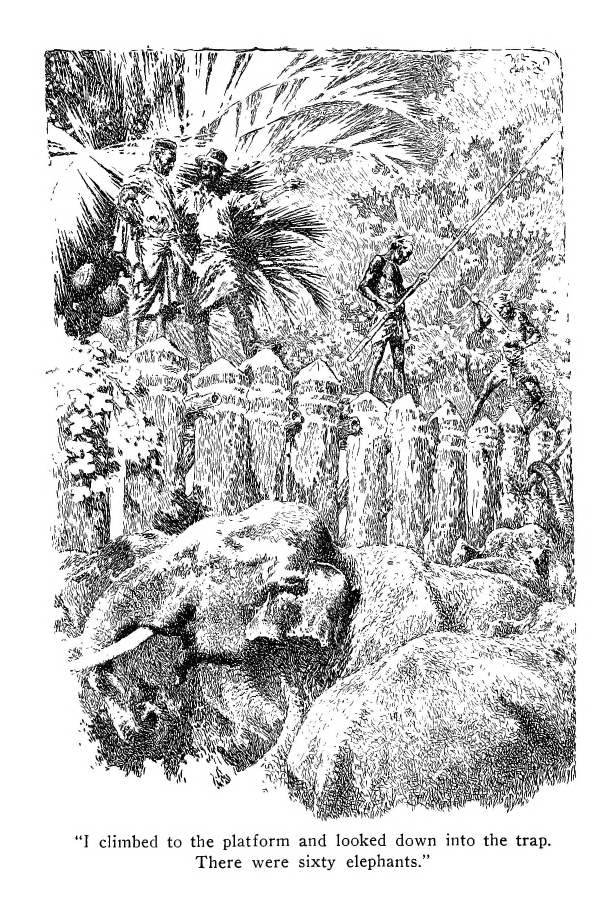
On my platform I shouted as loudly as any of the Malays. Torches were lighted and the men began dancing. I slipped to the ground and warned them against climbing up on the walls of the stockade, for I was fearful that the sight of men might enrage the elephants. If the beasts suddenly took it into their heads to charge the wall in a body, some of the posts might give way. I could hear them milling around inside the trap, bellowing and tearing up the jungle in an effort to find a way out. Through the remainder of the night the natives danced, ate and drank. Then, when dawn was beginning to light up the sky, I climbed to the platform again and looked down into the trap. There were sixty elephants!
The men, armed with long, spiked poles, mounted to the running platform on the top of the posts, and the celebration was renewed. I stood there, breathless, wondering how many of them, in their excitement, would fall off the platform into the trap. But none did fall, and they fended off the charges of the elephants by sticking them in the heads and bodies with their spikes.
Omar immediately sent a messenger to the Sultan with the good news, and the word passed from village to village. Natives poured in to inspect the catch, and the messenger returned with the news that the Sultan was on his way. It was a historic occasion in Trengganu. The Sultan had never been in the interior of his own country before, and never had there been such an elephant hunt in the state. Omar busied himself with the details of the royal reception while I cared for the catch.
"I climbed to the platform and looked down into the trap. There were sixty elephants."
We cut holes in the rattan webbing between the posts and enticed the small elephants to come out. There were several babies in the lot, and they soon became playful and affectionate. Baby elephants are just three feet high at birth and weigh about two hundred pounds. They grow an inch each month. We made pets of them and amused ourselves with weaning them. We did this by taking a pail of warm milk and dipping the babies' trunks into it, then doubling the trunks up and putting them into their owners' mouths, and finally squirting milk in with a squirt gun. The babies soon learned to imitate this procedure. They were mischievous little animals, full of fun and inquisitiveness. Hour after hour, I played with them and laughed until I ached.
The Sultan arrived with his retinue, and we gave him a ceremonial greeting. Deputations from all the villages were present, and Omar requisitioned food for a great feast. The Sultan had little to say about the elephants until I took him up on the platform where he could count them for himself. For a minute he looked at them, wide-eyed; then he repeated, "Sir, you spoke the truth."
"I always speak the truth," I replied, and I could see by his expression that he believed me. He was convinced that I was honest. I knew that I had his protection for any expeditions I might undertake in Trengganu. His friendship had been difficult to win, but it was worth the trouble—quite aside from the value of the elephants. Trengganu was virgin country, filled with animals that my customers wanted to buy, and I had the exclusive privilege—so far as foreigners were concerned—of hunting there. And, since the Sultan received a bonus on the animals captured, he provided me with labor.
The Sultan remained several days and we spent much of our time in talking over the problems of government. These conversations ended by my becoming a sort of foreign adviser in all dealings with European countries. Later, before Trengganu was made a British protectorate, he awarded me some valuable tin concessions. The new arrangement under the British government was made satisfactorily; he received a suitable pension and he passed happily into a purely honorary position in his state, relieved of all the complexities of political administration. When I last saw him, he was living in indolent comfort, surrounded by his wives—and his two-story brick palace was at last completed.
It took more than a week after the departure of the Sultan of Trengganu for the natives to get their fill of celebration. While they feasted and danced, I made my plans for the stocks in which the sixty elephants were to be broken.
The breaking of elephants, especially so large a herd, is a long, tedious job. I was thankful that I had Prince Omar with me to keep the natives working. The hunter, who kills and skins his animals, has a simple life compared with the collector, who must not only take the animals alive and uninjured, but convey them through miles of jungle country to a port. Months of hard labor were before us, and the success of the expedition was by no means assured, even though we had our elephants safe in the stockade. It was to be a great test in managing the natives.
There is only one thing that a Malay values, and that is his kris—his knife. To lose this cherished possession means to lose honor. There is a saying to the effect that money will buy everything but a lucky kris. Their disregard of money makes all dealings with Malays extremely difficult, and their dislike for work has completely blocked more than one project. To my mind, the Malays are the laziest people in the world.
When work is an exciting or amusing game, such as the hunt, they will go on for days without signs of fatigue. They seem to keep alive by some fanatic energy. But when work is just plain labor, they will say "Wait," or "I must think." Or a Malay may say candidly: "Sir, I have just had plenty to eat. I am content." Many times I have had a Malay tell me, when I asked him to do some work, that he had enough rice and fish for the day and that he might die during the night. It is an unanswerable argument. Tomorrow's food can be found when tomorrow comes.
The Malay's food is simple and his clothes are few. With no more effort than dropping a few seeds and covering them with earth, he can grow most of the food he needs, aside from his rice and fish. One catch of fish will supply his family for weeks and give him a surplus to sell to the Chinese traders. With the money he can buy some cloth and a little powder. Six or seven good-sized chickens cost one Mexican dollar; eggs cost one Mexican cent; yams, one or two cents each; pineapples, two or three cents. Why worry about the tomorrow that may never come? Why should a Malay gentleman, who believes in Allah and whose stomach is full, do the labor that can be done by heathen, pig-eating Chinese?
"Will you row me across the river?" I asked a Malay one day.
"Tûan, I have eaten and I have had plenty," he responded. "You may take my boat and row yourself across the river. Tomorrow, if Allah grants me life and if I need the boat, I will swim over for it."
That Malay trait of living for the moment has led many a European to murder, and more than once it made me feel like running âmok. It is maddening. Getting work out of Malays is a fine art, a science to be learned only after years of patient arguing and cajoling. And yet, with all their laziness, they are lovable people. In most cases they are brave and willing to do anything for a person they like.
Under the circumstances, sick with fever and worn out by the drive through the jungle, I was entitled to some doubt as to what the next few months would bring. The Sultan had left strict orders that I was to be provided with all the labor I needed, and Omar was there to assist me. However, I waited with anxiety to see what the attitude of the natives would be after they had finished celebrating, and I was encouraged to find that I had earned the name Tûan Gâjah—Sir Elephant. They were deeply impressed by the power of the white man who had engineered a great drive of sixty elephants and who owned the exceedingly marvelous gun that his man, Ali, displayed with such proud ostentation.
Inasmuch as they were receiving no money for their work, they had some right to object, but I humored them with promises of celebrations and games. The white man's camp became a popular place in Trengganu. Wonderful tales of what was done there spread through the country, and the men who had been to the camp could command an audience in their home compounds when they returned. The elephant drive was a historic event in the country, and henceforth we had little trouble with labor.
The work of breaking wild elephants must be carried on with painstaking exactness, for one elephant can create havoc in a few seconds if the men lose control. The first task is the building of the stocks where the elephants are to be held while they become accustomed to men; then comes the work of driving into the ground, about four feet apart, two rows of heavy stakes, leading from the trap to the stocks. Also, next the trap, a small enclosure, four or five feet wide by fifteen long, is built at the end of the passageway formed by the stakes. The piles of the trap are removed from the entrance to this enclosure and bars are substituted. Since the elephants were given practically no food during the time they were kept in the trap, they were half starved when the breaking commenced. In their weakened condition they were much less dangerous to handle, and, too, they could then be fed in such a way as to impress upon them the fact that good behavior brings good treatment.
The young elephants required no breaking, and so they were lured from the trap with food. They roamed about the camp, playing and watching operations.
As soon as the tuskers were taken from the trap, they were killed for their ivory. The tusks were worth almost as much as I could get for the live animals, and tusks are far easier to handle than animals that have to be broken and fed. Also, as the animal dealers say, the elephant might "eat and die." I did the killing with my express rifle. The explosive bullets produced instant death. Another way of killing an elephant is to strangle him by running two ropes around his neck and having elephants pull him in opposite directions.
As soon as all the equipment for breaking was ready, I instructed the natives in their work. With a select crew of men, I rehearsed all the details of what we were going to do and how we were going to do it. Finally, I ordered food placed in the enclosure and the bars drawn. The nearest elephant saw the food, sniffed, flapped his ears and walked in. Breaking commenced.
As soon as the elephant enters the small enclosure, the bars behind him are slipped. He eats the food so eagerly that he does not realize quite what is happening and the men put the knee- and foot-hobbles on him. These allow him about one quarter of his normal step. Rattan ropes are fastened to his feet and drawn out through the bars; his trunk is secured so that he can do no damage with it.
There is a great deal of misunderstanding about what an elephant can do with his trunk. It is a sensitive organ and he never uses it for heavy labor, but he can strike a terrific blow with it. I have seen many a man's ribs and arms broken when he neglected to take the proper precautions. In approaching a dangerous elephant, a man should come up sideways, with the nearer arm folded to protect the ribs. Then, if the elephant strikes, he should try to catch the blow on the upper part of the arm, where there is the most flesh to protect the bone. Such a blow never knocks a man flat; it sends him spinning like a top until he tumbles over.
The elephant uses both his trunk and his lungs in calling, and he has a large variety of sounds and combinations of sound with which to express himself. When rushing an enemy, he trumpets shrilly; when enraged by wounds, he grumbles hoarsely from his throat; he expresses fear by a shrill, brassy trumpet and a roar; and pleasure by a continued low squeaking through the trunk. When apprehensive of danger or when attempting to intimidate an enemy, he raps the end of his trunk smartly on the ground and trumpets. The peculiar noise sounds like that produced by the rolling up of a sheet of tin.
In a moment of danger, the elephant coils his trunk to protect it from injury. When he is engaged in heavy work, such as piling lumber, he may use his trunk to balance the load he is carrying on his tusks, but never to bear part of the burden. If an unharnessed elephant must pull a rope, he holds it in his mouth, taking good care to keep his trunk out of the way. It has happened many times that an elephant-keeper—not a trainer, for a trainer knows better—has used a hook a little too freely on an elephant's trunk. If he doesn't get killed, he picks himself up several yards from where he was standing. A trainer is invariably pleased at such an occurrence, because it shows that the keeper was abusing the elephant and has merely received his deserts. The elephant is a good, faithful animal, and he does not attack his keeper without excuse, except when he is in what is called the "must" period, which I shall describe later.
When the elephant is secured by hobbles, foot-ropes and trunk-ropes, the bars leading from the enclosure are removed. The foot-ropes have been fastened to the stakes and are loosened as the elephant walks out. The men holding the ropes attached to the fore feet wind them around the two stakes ahead, and those holding the ropes attached to the hind feet wind them about the first stakes. In this way the animal is drawn forward, step by step, toward the stocks, while natives prod him from behind with poles. If he tries to bolt, he simply falls over. It is a difficult, trying job, because the elephant is still vicious.
The stocks are built in covered stalls, so that each elephant is separate from the others. Two large uprights are driven into the ground in the shape of a V; the elephant's head is drawn between them, and they are pulled together at the top so that he is held securely behind the ears. At the corners are uprights, with poles to fence him in, running between them. These poles, located a trifle below his belly, support two cross-bars, one just behind his fore legs, and the other in front of his back legs. In this position it is impossible for the elephant to lie down or to move; he can wiggle his legs and wave his trunk, but that is all.
The elephant remains in the stocks for about two weeks. During that time he is fed and petted by a keeper appointed for that particular job. The keeper crawls over his back and rubs him behind the ears and gives him water, fruit and bamboo shoots. The elephant learns not to be afraid when a man is near him, and he gradually becomes more docile. During these two weeks he is fed very lightly because he must be kept in a weakened condition.
After two or three weeks, according to the disposition of the elephant, ropes are again attached to his feet, and he is led out of the stocks. This time he wears only the knee-hobbles, which allow him more play. Eight or ten men hold each of the ropes; his keeper sits on his head with a prod; another crew hold the rope attached to his trunk; and six or eight men follow with rattan whips. The men with the whips beat him continually. At first, in the excitement, he does not mind the whipping; then he finds the pain unbearable. The men on the trunk-ropes lead him about from right to left, while the men on the foot-ropes stand ready to trip him if he tries to bolt. At last he gives a bellow of pain and the whipping stops.
This one bellow marks a surprising change in the animal. His spirit is broken and he acknowledges that man is his master. The fact that he is instantly fed and petted helps him to make up his mind, of course, and to forget about the old, wild ways of the jungle. Thereafter, a keeper who does not deliberately make him angry can handle him easily. His schooling is brief and he learns readily to turn, kneel, back and pull. In return he is given plenty of food and is tied to a tree instead of being put in the stocks.
It occasionally happened that an elephant refused to bellow. In that case, I had the men lead him out to be shot, for I knew I should be wasting time in trying to break him.
The opinion is generally held by those who have had the best opportunities of observing the elephant, that the popular estimate of its intelligence is a greatly exaggerated one; that instead of being the exceptionally wise animal it is believed to be, its sagacity is of a very mediocre description. Of the truth of this opinion no one who has lived amongst elephants can entertain a doubt.
The elephant's size and staid appearance, its gentleness, and the ease with which it performs various services with its trunk, have probably given rise to the exalted idea of its intellect. Amongst those not intimately acquainted with it, and it being but little known outside of its native countries, what is known of it justly make it a general favorite and leads to tales of intelligence being not only accepted without investigation, but welcomed with pleasure.
One of the strongest features in the domesticated elephant's character, is its obedience. It is also readily taught, but its reasoning faculties are far below those of a dog, and possibly other animals, and in matters beyond the range of its daily experience, it evinces no special discernment; while quick at comprehending anything taught to it, it is decidedly wanting in originality.
Let us consider whether the elephant displays more intelligence in its wild state than other animals. Though possessed of a proboscis, which is capable of guarding it against such dangers, it readily falls into a pit dug for catching it, only covered with a few sticks and leaves. Its fellows make no effort to assist the fallen one, as they might easily do by kicking in the earth around the pit, but they flee in terror.
It commonly happens that a young elephant falls into a pit near which the mother will remain until the hunter comes, without doing anything to assist it, not even feeding it by throwing in a few branches. This, no doubt, is more difficult of belief to most people than if they were told that the mother supplied it with grass, brought water in her trunk, or filled up the pit with trees and effected the young one's release.
Whole herds of elephants are driven into ill concealed enclosures which no other wild animal could be got to enter, and single ones are caught by their legs being tied together by men under cover of a couple of tame elephants. Elephants which happen to effect their escape are caught again without trouble. Even experience does not bring wisdom.
These facts are certainly against the conclusion that the elephant is an extraordinarily shrewd animal, much less one possessed of the power of reasoning in the abstract, with which he is commonly credited. I do not think I traduce the elephant, when I say it is in many things a stupid animal, and I can assert with confidence that all the stories I have heard of it, except those relating to feats of strength or docility performed under its trainer's or keeper's direction, are beyond its intellectual power and are but pleasant fiction.
It often happens that persons who do not understand elephants give them credit for performing actions which are suggested to them, and in which they are directed by their trainer or by the mahout on their necks. I think that all who have had to deal with elephants, will agree in saying that their good qualities cannot be exaggerated and that their vices are few, and only occur in exceptional animals. The not uncommon idea that elephants are treacherous and retentive of injury, is a groundless one.
Elephants do not push with their foreheads or the region above their eyes, but with the base of the trunk or snout, about one foot below the eyes. Elephants are poor sighted, and are so intent on being off when thoroughly started, that I have been almost brushed against without being discovered.
The rapidly advancing line of huge heads and cocked ears bobbing up and down as the elephants come rushing on, leveling everything before them, is a trying sight, and at first one requires some nerve—and the reflection they are escaping, not charging—to stand still.
If circumstances ever occur to make a run unavoidable, the pursued hunter should always take down hill and choose the steepest place at hand, as the elephants fear to trust themselves on a rapid descent at any great pace; uphill, or on the level, man would be immediately overtaken. When elephants are close at hand, standing in indecision, no one should shout to turn them; a charge by one or more of them is sure to be made if they are suddenly started at this time.
Eight months passed at breaking elephants. I was sick with fever and dysentery and I was glad when we could break camp. Riding on the head of an elephant, I led my catch through the jungle to port. Once again I paid my respects to the Sultan, who told me that I might hunt in Trengganu whenever I pleased. A year before, I should have been wildly delighted at the prospect of having Trengganu open to me under his protection, but now, with my health broken, I did not care much if I never saw the country again.
I arranged for the keeping of the animals until they could be brought by boat to Singapore, and then I caught the first coast steamer south, taking four elephants with me. At Singapore I found that the story of the big capture had been the talk of the city for months. In fact, several days after I arrived, I went to call on my former enemy, Mahommed Ariff, and he took off his turban and bowed. We had many dealings after that, and he always treated me with the greatest respect and honesty.
When I was leading one of the smaller elephants through the street on my way to the animal house I had rented in Orchard Road, I was approached by an Arab.
"Tûan mau jûal? (Sir, do you wish to sell?)" he asked.
"Of course," I answered. I was sick and tired and I did not want to be bothered.
He persisted. "Tûan, how much?"
"All of them or just one?"
"That one," he answered, pointing to the elephant I was leading.
I thought he was asking just out of curiosity, and so I set a price that I thought would silence him—$3,000 Mexican.
"Tûan, truly will you sell it for that?"
"Yes."
He followed me to the animal house, and I wondered what he had on his mind. As a matter of fact, I would have sold the elephant for $450, because it was young and small. At the animal house, he again asked me if I would sell for $3,000; then he undid several of the shirts he was wearing and pulled forth an old wallet. He gave me $500 to bind the bargain and called a friend of his to act as witness. When he left to get the rest of the money, I went to the stall where I had placed the animal and examined it.
It didn't take me long to discover why the Arati was willing to pay $3,000. The little elephant had twenty toes instead of the usual eighteen. Twenty-toed elephants are held in veneration throughout India, and are keenly sought by all the rajas and maharajas for the prosperity they are supposed to bring. They are guarded more carefully and quartered even more sumptuously than the white elephants of Siam, and the price they will bring is determined almost entirely by the amount the rajas can gather together. My little twenty-toed elephant was a faultless specimen. He was about five years old and stood four and a half feet high. His head was perfectly shaped; his back was straight and absolutely even with the top of his head.
I was naturally disgusted to think that I had let such a bargain slip out of my hands, and, when the Arab returned, I blamed him for cheating me when I was sick with the fever. I abused him and his ancestors and gave a great show of indignation. He begged me to take the money and give him the elephant; I refused the money and told him to take the elephant out of my sight.
"I have put a curse on him," I said. "He will be dead within twenty-four hours."
At this he burst into tears, begging me to remove the curse. He said that he was a poor man and that the elephant's death would ruin him. Finally we reached a compromise. He would pay me an extra $500, and I would arrange transportation to India for the elephant. Then, if the sale proved profitable, he was to return to Singapore and pay me an additional $500. He swore by Allah and the Prophet that he would keep his word. So I removed the curse and took his money and he departed happily. A month later he returned and paid me the $500. He had sold the elephant to the Maharaja of Mysore for 10,000 rupees. The Arab later bought four large elephants from me.
During my nineteen years in the Malay Archipelago I captured hundreds of elephants, but none of the herds was so large as my first catch. And, though I always looked carefully at the elephant's feet before I sold him, never again did I bag one with twenty toes.
Of all the animals I have handled in my experience as a collector, I prefer elephants. They are interesting and amusing beasts, and, once broken, they become hard-working and affectionate. They never show any inclination to go back to the jungle, even when used for the purposes of running wild elephants. In Siam all the driving of herds into the traps is done on female elephants, and their presence calms the herd. I have seen the tame elephants press in upon a wild elephant, holding him while he docilely allowed himself to be hobbled.
The hunts in Siam are for tuskers, and the females are for the most part allowed to run free again to breed. The tuskers are used in the teak forests for handling logs. The females bear young about every three years until they reach an age of from seventy to seventy-five years. The period of carrying varies from eighteen months in the case of a female baby to twenty-one months in the case of a male. A baby elephant, as I have already written, weighs approximately two hundred pounds at birth and stands thirty-six inches high. It suckles from six to nine months. The breasts of the female are located just back of the fore legs, and the baby runs its trunk up along its mother's side while nursing. Its next food is fruit and the tenderest bamboo shoots. It is very fond of sugar. It grows at the rate of one inch a month up to its third year and attains its full growth, but not maturity, at about twenty-five. The age of an elephant is told largely by the ears; an old animal has ragged ears and sunken cheeks. The height of an elephant is almost exactly twice the distance around its foot.
A herd of elephants is invariably led by the females, perhaps because they are the more alert to catch the least sign of danger. If the herd is put to flight, the males take the lead, breaking through the jungle and making a trail for the females and young. An elephant never goes around things; he either pushes them to one side or goes straight through. He is very sure-footed and, on anything that looks doubtful, he will never step without first putting out a foot and trying it. For that reason, it requires some skill to build a pit-trap that will not attract attention. A pit-trap is practically useless, however, because the elephant is invariably injured in the fall; it allows the capture of the baby, in the case of females, but at the cost of the good, full-grown animal. Wild elephants, grazing in a herd, travel rapidly if they are frightened, but usually they saunter along, sleeping during the day and feeding at night. Their food consists chiefly of grasses, bamboo shoots, cocoanuts and the bark of some trees. Lone elephants and outcasts from the herd are dangerous animals and should be killed.
There comes a period, known as "must," when even the most reliable elephant becomes a dangerous animal. Like the Malay he "sees red" and runs amok. A good elephant keeper can detect the madness several days before it reaches the dangerous stage, and by securing the animal with hobbles, can prevent trouble. In the cheeks of the elephant are two small holes, called "errors," and from these holes oozes a slight secretion. One of the keeper's duties each day is to examine the holes and run a piece of straw into them. If there is an odor of musk about the straw when he pulls it out, it is an indication that the "must" period is coming. Sometimes the keeper fails to make this test, and the elephant runs amok, killing people and leaving a trail of wreckage behind him.
On one of my visits to Sydney with a consignment of animals for the Zoölogical Gardens, I found the entire crew of elephant keepers busy with the task of trying to control an animal that was in "must." His keeper had failed to make the test, and the elephant had suddenly gone mad. Fortunately he was in his stall at the time. When I arrived, he had wrecked the stall, and the keepers were afraid that he might get loose. Another stall had been arranged, but they could figure out no way of changing him to it. The men were thoroughly frightened and absolutely refused to risk hobbling him. The director of the Gardens offered me £100 if I would do it, and, since I had Ali and several of my own men with me, I agreed to try.
With elephant hooks strapped to our wrists, we entered the stall. The elephant stood looking at us, apparently wondering which one he should knock down first. I told Ali to get behind him while I approached from the front.
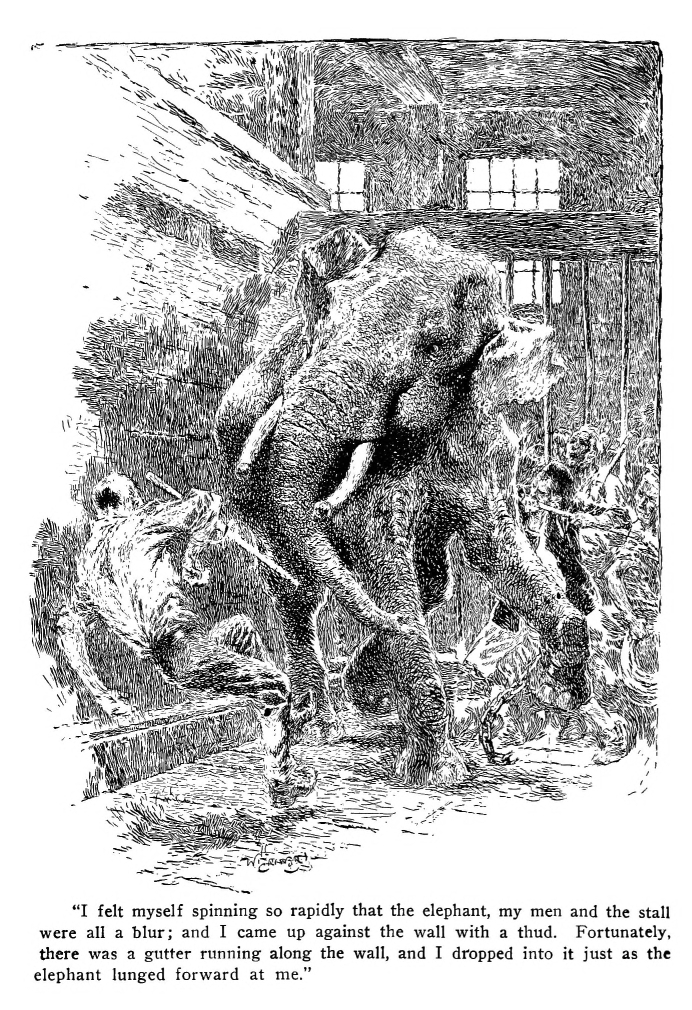
I went up to him sideways, speaking to him and offering him food. He waited quietly until I was near enough; then, before I could duck, he hit me with his trunk. I felt myself spinning so rapidly that the elephant, my men and the stall were all a blur; and I came up against the wall with a thud. Fortunately, there was a gutter running along the wall, and I dropped into it just as the elephant lunged forward at me. His big head hit the wall and the floor but couldn't get at me. He would not risk his trunk, because he realized that I would jab him with the hook.
"I felt myself spinning so rapidly that the elephant, my men and the stall were all a blur; and I came up against the wall with a thud. Fortunately, there was a gutter running along the wall, and I dropped into it just as the elephant lunged forward at me."
Ali and the other men were at his tail, jabbing him and pulling. When he turned for them, I jumped up and began running my hook into his side. It became a game of jabbing and dodging and worrying him to first one side and then the other. I took care to thrust my hook always in the same spot, tearing a raw wound in his side, while the other men caught him on the legs and on the trunk. We had to work fast to keep away from the big trunk as it cut through the air, and his feet, when he kicked. Each of us was sent sprawling several times before the fight was over.
At last I could see that the elephant was paying more attention to the wound I was making than to anything else we were doing; he favored the hurt side and tried to shield it. Then, with a bellow, he knelt down and dropped on his side to cover the wound.
While I kept him down, Ali arranged the hobbles; then we petted him and allowed him to stand. He got to his feet doubtfully, as if he weren't sure that we were not playing a trick on him—urging him to stand up so that we could jab him again. The wound I had torn in his side was large enough for two fists, and it must have pained him terribly. He was worn out by the fight and he hobbled off to his new stall, much subdued. Several days later he came out of the "must" period, which rarely lasts for more than a week, and became again the docile elephant that took children on his back for a ride.
I went to see him several times before I returned to Singapore, and, when I entered the stall, he edged away from me, protecting his side. Years later, I went to Sydney and entered his stall. He didn't recognize me until I put my hand on the scar; then he muttered deep down in his throat and lay down. I petted him and fed him sugar, and he seemed to harbor no resentment against me, but he did remember me in connection with a strenuous and unpleasant afternoon.
IV SHIPPING WILD ANIMALS
Elephants are easily trained and, when they once get the idea of what is expected of them, they will do it over and over with little variation. A trick or a certain kind of work immediately becomes a habit with them. In fact, they can form habits more rapidly than any other animals I have ever seen.
In Burma there are large lumber mills, and elephants are used for rolling the logs into position for the saws. Pushing with their heads, they run the logs up two inclined skids to the platform. Two elephants do the pushing and a third elephant acts as boss. The boss need not be an especially intelligent animal; he is simply taught that the log must go up the skids in a certain way and that the two pushers must be kept even. In his trunk he carries a few links of anchor chain, which he uses as a whip. If one elephant falls behind, the boss gives him a rap with the chain. When the log is on the platform, the pushers turn and plod back for another. The boss elephant is quite unimpressed by his authority, and the others show no resentment when he swings the chain on them.
When the whistle blows, the elephants know that it is time to stop work and eat. It makes no difference if they have a log within a fraction of an inch of the platform; the boss drops his anchor chain and gets out of the way, and the pushers step to one side, letting the log crash down again. Then, without the least expression of interest, they turn for the stalls. Because they obey signals so mechanically, the engineer steps out, when feeding-time comes, and looks up and down the runway to see if an elephant crew has a log on the skids. If so, he waits until it reaches the platform before he pulls the whistle-cord.
The great weight and bulk of elephants sometimes make difficult the problem of handling and especially of shipping them. They are usually hoisted over the side of the ship in slings, but that method takes much time and labor, not to speak of very strong tackle. I did not evolve a new one, however, until the refusal of the captain of one of the British India Steam Navigation Company's boats to take a consignment of elephants for me put my ingenuity to the test.
I was under contract to send fifteen large elephants to Madras, and I had arranged with the company's agent at Singapore for three shipments of five each. The animals were the remainder of the Trengganu herd and I was anxious to see them shipped, for I was still sick with the fever. The doctors had told me that the best thing I could do was to leave the country and recuperate, and delay in disposing of the animals meant a great sacrifice of either money or health.
The first five elephants, together with attendants and food were waiting back of the sheds at Tanjong-Pâgar, the docks at Singapore, to be put aboard. At the last moment the chief officer came with the message that the captain refused to take them.
I went to the captain's cabin and found a stout, red-faced and apparently good-natured Englishman. He was just out of his bath, wearing pajamas and idling about in his cabin until the ship was ready to get under way. I thought it a good time to approach him, and I took care to be quite calm and cool about it, although I was raging inside.
I showed him my receipt and the bill of lading given me by the agent. He replied that the agent was not captain of the ship; he didn't care what agreement the agent had made. So long as he was captain, he'd run his ship to suit himself, and all agents could go to the devil, for all he cared. And, moreover, he'd not carry elephants—not for any one. I explained my position and told him that it would mean a great financial loss to me if I failed on my contract to deliver the elephants.
"Look here, Mayer," he said, "I've handled elephants at Calcutta and I've always had a lot of trouble with them. If I load these elephants, it means that I have to rig up extra gear, and I won't do it."
"Captain," I replied, "I'll load those elephants without using a foot of rope. I'll put them anywhere you say, and you won't have to rig up a bit of gear. And I'll unload them at Madras the same way. Will you say the word?"
"I don't think you can do it," he answered, "but I'm enough of a sportsman to give you a chance."
That was all I wanted. I got out before he could ask me how I was going to work, for I couldn't have told him.
The elephants were to go in the bow and they had to be taken there through a seven-foot passage from amidships. The smallest of the elephants measured fully seven feet and the largest more than eight. I decided that we might as well try the largest first, and I asked that the electric bulbs be removed from the ceiling.
After some coaxing and prodding, we got the first elephant up the gangplank. The others followed obediently. Then I asked the chief officer to clear the cabins along the passage, for I was afraid that some one might open a door and frighten the elephant. A frightened, stampeded, eight-foot elephant in a seven-foot passage would give Singapore enough excitement to last for a year. The chief officer sent the people from the cabins and locked the doors.
The elephant balked at sight of the passage. I was at his head, talking to him and coaxing him, and two attendants were behind, prodding. We made him kneel and then urged him forward. At last we got him into the passage. It was a tight fit. His sides scraped the walls. I gasped at the thought of what would happen if he suddenly became afraid. He would try to stand up, of course, and then wedged in, he would begin to kick and lunge his way out; and the other four, who were close behind him, would do the same. "And then, good-by, steamship," I said to myself. Slowly we made our way forward, with the five elephants hobbling along on their knees. I stayed close to the head of the first, talking to him and petting him. Finally we came to the end of the passage, and I drew the first deep breath in fifteen minutes. I took the venture simply as a matter of course, and I didn't say anything that gave the captain an idea of what my emotions had been in that passage; but Ali looked at me and I looked at Ali, and there was no need of words.
I washed and went to the captain's cabin for breakfast, while the men secured the elephants in their quarters.
The captain said, "Mayer, that was the quickest and slickest thing I've ever seen, but what am I going to do with those animals at Madras?"
I knew that there were no docks at Madras and that all freight was unloaded into lighters, but I answered, "My men will attend to them."
When the ship reached Madras, the attendants opened the doors and simply backed the elephants overboard. They hit the water with a great splash and a roar and came up blowing like whales. They were swimming, of course, for elephants swim better than any other land animals I have ever seen. The attendants approached them in rowboats, and, jumping on their backs, rode them to shore. By the time they reached land, they had completely recovered from the excitement of falling overboard.
The captain returned to Singapore, enthusiastic over this new way of handling elephants, and I had the pleasure of shipping my last consignment to Madras on his ship. He advised me never to take an agent's word for what the captain of a ship will or will not do, and after that experience, I always saw the captain first and the agent second.
In collecting and trapping of wild animals one must not think that all animals so caught are fit for zoölogical or show purposes. Such is not the case; often after trailing animals for days and after having trapped them, I found them old, scarred, mangey, with broken tails and in numerous ways unfit, and although I rarely killed, except in self-preservation, I would kill off all such as were not fit.
All animals I sold and shipped were at the time of embarkment, healthy, sound and in good condition. As I never carried with my outfit any preparation for the curing of skins, I usually allowed the natives to have them, although I often presented good specimens to the Raffles Museum at Singapore that were mounted and catalogued as donations from myself. In one exhibit a group of eight orang-outangs, from babies to full grown, and a baby elephant were well mounted and always came in for the particular notice of visitors.
I was having a busy week at my animal house in Singapore, getting a lot of animals recaged and ready for shipment to Melbourne, for Mr. La Souef, Director of the Melbourne Zoölogical Society, who was then on a visit to Singapore with his wife, when one day a messenger came from the Sultan of Johore, inviting Mr. and Mrs. La Souef and myself to call the following day.
As Singapore is an island of fourteen by sixteen miles, and separated from the main land by the Straits of Johore, the extreme southern point of Asia, or the Malay Peninsula, it really meant but a few hours, sixteen miles by rail to Kranji and by ferry across the Straits about a mile to Johore.
Back of the jail at Johore were built eight large, strong iron cages, in which were kept all tigers, leopards and smaller cat animals that were caught throughout the state of Johore and were sent to the Sultan for him to present as gifts or sell as he saw fit. I eventually had first call on all animals so caught.
On the following day, arriving at Johore, we were met my Dato Muntre, the prime minister, and introduced to Sultan Ibriam, who was at that time a young man and with whom I was very well acquainted. After showing Mr. and Mrs. La Souef through his palace and grounds, we came to the cages back of the jail, which contained three tigers, two black and one spotted leopard. The Sultan, pointing to one cage which contained a beautiful specimen of tiger, young, beautifully striped, and a bright golden yellow, said he wished to present that tiger to the Melbourne Society as a gift, and, turning to me said, "Tûan Mayer, you can get him whenever you wish," he knowing I was Mr. La Souef's agent.
Mr. La Souef was delighted and thanked the Sultan in his and the Society's name, promising to put his gift in a prominent place in the Melbourne Garden.
On our return to Singapore, I had quite an argument with Mr. La Souef regarding the flimsy, unsuitable cages he was having made to suit himself, and every time I ventured to point out the inadvisability of certain cages being built under his directions, he would invariably say, "Mr. Mayer, you may be right. I also am right, and I have handled animals longer than you." As the animals were his and he insisted on having his way, I simply carried out his instructions. His idea was to build large, roomy cages from the cheapest of wood (siraih), having a space between the floor and the cross section holding the iron bars, to clean out the cages and to hand in food.
I never would think of shipping an animal in such a cage. First it is too large and roomy, giving the animal too much play to break the cage, and as it was weakened by having a space between the floor and the cross piece, unless made of heavy and strong wood. I always caged for shipping animals in small narrow cages or boxes; heavy wood; sides of wood, but bars at each end and no space. When wood or water was to be given them, the food was cut up small enough to be poured between the bars, and a drinking pan nailed to the floor of the cage. When cleaning out the cage on board the steamer, both front and rear covers were taken off and the cage flushed with water, at the same time giving the animal a bath. The bath in some instances, and according to the animal, would be dispensed with, but never with cat animals.
I returned to Johore the following day with a transporting cage, and with Ali and the assistance of a few of the prisoners from the jail, soon had the tiger safely boxed and on his way in a bullock cart to my animal house in Orchard Road, there to be recaged in the cage Mr. La Souef was having built under his directions, by my Chinese carpenter who built all my cages. Taking me aside he said: "Tûan, etn, Orang bon-yer, gee-har sat-tu Jam remow pe-char" (Sir, that man is very foolish, the tiger will break his cage in an hour). I said, "Never mind, make the cage as he wants it, that is his look out."
Well, the cage was made, the tiger moved into it, and a few days later we loaded his shipment on board the steamer, ours being the last thing to be put on board. As the steamer was to sail at midnight, we had no trouble in placing the cages on deck, and, as space was limited, I suggested to Mr. La Souef to let me arrange the placing of cages and animals. But no, he would see to that, and told the captain that he would like to have them placed as he wished. They were on the forward deck, in a circle about the hatch, with the smaller animals and deer facing the cages on deck, on the hatch itself. Can you imagine placing deer is crates facing tigers in none too strong boxes?
I bade Mr. La Souef and his wife bon voyage, and wished him success in landing his shipment. Mr. La Souef was a personal friend of the owner of the steamship company, the McAllister line, who was a patron and also a director of the Melbourne Zoölogical Society. As Mr. La Souef had taken the trip with his wife as guests of the owner, Captain Edwards of the vessel used diplomacy, said nothing, and allowed Mr. La Souef to have his way; but before going ashore, I said to Captain Edwards, "watch out, there is going to be trouble before you get to Melbourne." "Never fear," he replied, "Mayer, I'll kill or dump the whole lot over the side if anything starts, friend of the boss or not! I have my other passengers to look to." I said good-bye to him hoping to see him on his return trip, when I would hear the news, if any.
The shipment consisted of the following, not counting the tiger, the gift of the Sultan of Johore: Two small orang-outangs, twenty monkeys, one sun bear, one honey bear, two civet cats, one binturong, four crown gora pheasants, one black leopard, one clouded leopard, spotted and looking like an ocelot, one female tiger, two samber deer, two mouse deer, in all fourteen cages and three crates.
At five o'clock the following morning, I was awakened by a hammering at the gate and the calling of "Tûan! Tûan!" Looking out, I saw a native boatman. "What do you want?" I called.
"Tûan, etu re-mow, pe-char sanken, mon lorrie" (Sir, the tiger has broken his cage and wants to run away).
"What tiger? Where," I asked.
He said, the tiger from the steamer.
"Well, what do you want me to do? The steamer left last night. I am through with it."
"Te-dar Tûan" (No, Sir), he said, handing me a letter, "the tiger is in my lighter and is tied to one of the buoys in the harbor." He begged me to get the tiger, as no one was near or on the lighter.
The letter, which was from Mr. La Souef, written before the steamer sailed, stated that the tiger presented by the Sultan of Johore had broken his cage and was in danger of getting clear away, as the captain had had a sling put about the broken cage after the ship's carpenter had nailed a few boards to cover the hole the tiger had made and partly strengthened it, hung the cage over the side of the ship, telling Mr. La Souef that if he did not get some kind of a boat or lighter to put the cage in, he would drop tiger, cage and all into the water, and as this happened at about half-past eleven at night, things did not look very bright for Mr. La Souef. He begged and prayed the captain to let the carpenter or himself get nails and boards, but the captain was firm. They finally got the head stevedore of the dock to let him put the cage in a lighter, which they did, and then towed the lighter out in the harbor, everyone leaving it as soon as it was tied to a buoy, and Mr. La Souef then told them to notify me, which they did. There I was, with instructions to get the tiger, recage it and ship by next steamer, eighteen days later.
I asked the boatman where the lighter was. Taking Ali and four natives with ropes, boards, nails, etc., we went down to the docks, and there out in the harbor tied to buoy was the lighter with a fleet of small boats surrounding it at a good distance. I called a sampan and told the owner of the lighter to follow. As we neared the lighter, we could hear the growling and the tearing of wood, and getting alongside and cautiously climbing up, I looked in.
There was the cage with the tiger's head through a hole that it was trying to make larger. Fortunately the cage had been strengthened by the ship's carpenter, otherwise he would have broken out and escaped before I could have been notified. By that time the docks were lined with people. The story had spread that there was a lighter in the harbor, filled with wild animals that had broken out of their cages and were fighting and killing one another and those that could escape would jump into the harbor and make for the shore. Then some one called Police Headquarters and four European officers came down to the dock with repeaters.
Ali and I dropped into the lighter, calling to the natives to pass the boards, nails and hammers, and assuming that there was no danger, we took each an end of a board and carrying it to the top of the cage passed it over until it covered the hole the tiger had his head out of. As Ali and I held the board my men nailed it and then another, so soon we had him fairly well secured; that is, he was in the cage again, snarling, biting and scratching. Calling to the owner of the lighter to come aboard with his men and row his lighter to the docks, we went to work and nailed board after board against and over all weak spots. There was no need to tell the boatmen to hurry; they never rowed faster. Arriving at the docks, and after telling the inspector just what had happened, we got the cage on a bullock cart and soon had the tiger safe at my animal house. Three weeks later I shipped him aboard in a good strong cage, in charge of the captain, but as the steamer was steaming up the Yarra river into Melbourne, the tiger died. An autopsy showed he died of a fractured skull, and later I got the full particulars.
It seemed that when the tiger first attempted to break out of his cage on board the steamer and the carpenter was ordered to get some boards and cover the hole he had been tearing, as the head showed against the opening the carpenter struck it with his hammer. The deer and smaller animals became terrified, and in their endeavor to escape, the deer's legs got through the slats in the crates; they broke their legs and had to be killed. This I was told later by Captain Edwards, who said it all happened within a few minutes, Mr. La Souef running about like a madman, begging this and that, getting in the way of everybody, but no one paying any attention to him, and what with the excitement among the passengers, the roaring of the tigers, barking of the bears, chatter of monkeys and crying of the smaller cats, and the frantic efforts of the deer to break through the crates, he was only adding to the confusion and disorder, until Captain Edwards ordered the water hose brought into play to quiet the animals. He told the carpenter to get some boards and nail up the opening the tiger had made, then having a sling put about the cage with the tiger snarling and biting and tearing at the opening it had started, but now covered by the planks, swung it over the side of the ship and there it hung. The captain then had the cages taken off the hatch and placed against the side of the steamer, telling Mr. La Souef that if he did not keep quiet he would have the whole shipment put over the side and dumped into the harbor.
That was the story Captain Edwards told me on his return trip to Singapore, and he laughed heartily over the way he said Mr. La Souef was hopping about in his pajamas.
My bill against the Society for services, paying for the lighter the tiger was put into from the steamer, labor, recaging, feeding for twenty-one days, and enough food for eighteen to twenty-one days' voyage to Melbourne seemed to Mr. La Souef an overcharge and my bill of £50 all out of proportion; as the tiger was a gift from the Sultan of Johore and not purchased. I insisted and drew on him for that amount, at the same time resigning as agent for his society, telling him that although he was an older man, he had still to learn the art of caging, recaging and shipping animals, not receiving them, and that had he not insisted on having things done his own way with cheap material, and had left it to me, what happened could not have happened, as barely one-third of his shipment landed alive.
By the time I had disposed of the last of my elephants, I was so sick with the fever that I could not leave my bed. I was dangerously ill and I began to realize that I should be lucky if I escaped with my life.
Mr. Lambert, who had been my friend ever since I landed at Singapore to enter the animal business, engaged passage for me on a steamer bound for Europe and took charge of the affairs of my animal house in Orchard Road. When it was time to go to the steamer, my Chinese coolie boy carried me. He is the only Chinese I have ever seen cry; the tears rolled down his cheeks as he carried me up the gangplank and to my cabin, for he thought that he should never see me again. I rather thought so myself, but I figured that if they didn't drop me into the Red Sea, which is the last resting-place of so many people who have stayed too long in the tropics, I should recover and live to return.
Ali and the coolie waited faithfully for me during the next year, while I traveled in Europe and America, recuperating and gathering new commissions for animals. And, when I came back, they were on the dock to welcome me.
Though my health was much improved by the voyage I did not feel able to resume the active business of collecting, and so I concentrated my efforts upon my animal house and made it the largest place of its kind. I had a monopoly of the business. Mahommed Ariff, who had a large number of native collectors working for him, did much of his dealing through me, and I had no difficulty in disposing of all the animals brought in from the jungles by our various agents. My largest market was Australia, where I could sell the animals f.o.b. Singapore without any of the risk of transportation. Also, I made shipments to Hagenbeck, of Germany, and Cross, of Liverpool. Because of the high import duty, I sent comparatively few of my animals to the United States.
John Anderson, who was European adviser to the King of Siam and who had been created a Siamese nobleman, sent for me and offered me a commission that kept me busy for the next five years. The King of Siam was in the habit of making presents of wild animals to foreign rulers, and it became my work to select the animals and supervise all details of shipment. I was sent to interview the Minister of the Interior, H. H. Prince Damerong, who gave me a permit to travel wherever I pleased in Siam and to force labor. In Siam, I directed many hunts, especially for tuskers to be used in the teak forests. The driving was done entirely during the daytime, and on elephants, instead of on foot, as in Treagganu. The fever had left me in bad condition, and so I did not take an active part in the work.
On my trips between Bangkok and Singapore, I stopped off many times at Trengganu to renew my acquaintance with the Sultan and to talk with the native hunters, who were sending a steady stream of animals to me at Singapore. I was known to the natives throughout the Peninsula as Túan Gâjah—Sir Elephant—and I was amused to find that the story of the big elephant hunt had grown to incredible proportions. The herd of sixty elephants became larger each time the story was told.
After one exciting incident in the work of shipping animals for the King of Siam, I was allowed full authority. We were sending a pair of beautifully matched leopards to the Emperor of Austria, and they had reached Singapore in two large, poorly constructed cages. Mr. Anderson was there, and we disagreed on the advisability of recaging them. I thought that the cages looked weak and I wished to have my Chinese carpenter build two that would be smaller and stronger. Mr. Anderson, however, was impatient to start the leopards on their voyage, and, since he was boss, we loaded the cages on bullock-carts and headed for the docks. In unloading one of the bullock-carts, the natives allowed the case to slide to the ground too heavily; the cage broke, and out went Mr. Leopard like a flash of lightning, heading straight for the Chinese quarter. The Chinese saw him coming, and a panic started. They tumbled over one another in getting out of the way, and two of them were scratched. The leopard was quite as frightened as any of the Chinese. The natives in charge of the bullock-cart came running for me, and I went to the Chinese quarter to find the leopard. He had taken refuge in a house, and I finally discovered him hiding under the stairs, his eyes shining in the darkness. Since it was impossible to get rid of the mob of Chinese and recaging under the circumstances would have been too dangerous, we had to shoot the animal. We took the other leopard back to Orchard Road and built a new cage.
In 1902, just before the rainy season, I was resting in Singapore after six months of hard work. Just as I had almost decided to go to Europe, I happened to see in an old copy of the New York Clipper an advertisement of a steam merry-go-round. That gave me an idea; there had never been a merry-go-round in the Malay Peninsula, and I was confident enough of my judgment of Malay nature to gamble that it would be a success. Mr. Lambert didn't agree with me. "Forget about it," he advised. "Take the steamer and have a good vacation." But I went to the Hongkong and Shanghai Bank and cabled $2,000 in gold to the factory at North Tonawanda, New York, with instructions to ship me the merry-go-round on the first boat, via London. It arrived nine weeks later, and it cost me £110 in freight. The rain was beating down steadily in Singapore, and so I transshipped it to Penang.
A few days later, I was in Penang, driving around in a rickshaw, looking for a good location, while the merry-go-round, still in crates, was coming ashore in sampans. Opposite the Hotel de la Paix I found a good open space, and I routed out of bed the Chinese merchant who owned it. I told him that I should like to rent the lot for a show and that, if he would come to terms with me, I would let him and his family ride free of charge. Now a Chinese likes a show better than anything else on earth, and so we were not long in closing a bargain. I was to pay him a rental of $1 Mexican a day and to have an option of two months on the lot. I had no paper on which to write out the agreement, and so, since I didn't want him to change his mind, I paid him $30 for one month, writing the receipt in my pith helmet. He signed in my hat; then we pasted a stamp in it and canceled the stamp by writing the date across it.
While Ali and my coolie boy were getting the merry-go-round unloaded, I collected a gang of laborers and an engineer. All that day we worked at uncrating the merry-go-round and putting it together. The natives stood around, watching us and speculating as to what this strange new thing could possibly be. The merry-go-round ran on wheels on a track and the horses were connected with eccentrics, which worked them up and down; a good loud organ was connected by a belt with one of the wheels. The merry-go-round carried fifty-six people.
I began business on the Chinese New Year's Day. The merry-go-round was the sensation of Penang. The crowds flocked to see it, and the natives lined up for several hundred yards, each with his dime in his hand, waiting for his turn. We were so busy that I could not even go to the hotel for a meal; the brassy organ of the merry-go-round shrieked from early in the morning until late at night. In two days, I took in $1,500 Mexican.
On the third day the merchant from whom I had rented the lot announced that he was going to build a fence around it and charge two cents for the privilege of standing and watching the merry-go-round. I told him that I wouldn't allow it; that all of Penang could come and see my show free. I was too busy taking in dimes to think about fences. He went away angry and disappointed. Four days later a lawyer representing him came to see me. He said that the rent had been raised to $10 a day, and that a dispossess order would be executed unless I paid it. I told the lawyer to wait and I went back to the hotel, to get my pith helmet.
The merchant had forgotten about the receipt. When the lawyer saw it, he told me that the merchant was unpopular with all the Malays and Chinese in Penang because he cheated them, and that they would be delighted if I sued for breach of contract. The result was that, for $1 a day, I got the use of the lot as long as I wanted it.
Within six weeks I had made up the entire cost of the merry-go-round and I was on velvet. The dimes were still rolling in as fast as I could collect them. Finally, when the novelty of my show had worn off and business began to slacken, I shipped to Rangoon, Burma, to collect dimes there. After the merry-go-round had been running two weeks, I was approached by a man who wished to buy me out. I had had all the fun I wanted, and so I sold it to him for 10,000 rupees—$4,500 in gold. He was a government official and consequently did not wish to appear in the transaction. The bill of sale was made out in his wife's name, and a man was hired to run the merry-go-round for him. I stayed for a week to get the enterprise started; then I went up to the lumber mills to see if the lumbermen needed elephants. When I returned to Singapore, I had a commission for six large elephants.
It was a better vacation than I could have had in Europe. I had made many friends and attended to some animal business and I had £700 clear profit in my pockets.
At my animal house I found a letter from Mr. La Soeuf, the director of the Perth Zoölogical Gardens, saying that he was anxious to get a rhinoceros and asking what I could do for him. I did not want to go into the jungle again immediately, for I was afraid of a return of the fever, but I replied that I would see what could be done and I sent out word to all my native agents. Both Mr. La Souef and his father, who was director of the gardens at Melbourne, were great friends of mine, and their gardens had been my best market for animals. Quite naturally, I wanted to do everything I could to help them, and so, when word came from an agent in Trengganu that some rhinoceroses had been located there, I packed up my kit and started out.
At Trengganu, the Sultan welcomed me, and I spent several days with him, telling him what was happening in the world and discussing his problems. The problems were largely financial. He owed some money, and, knowing that he had something in the treasury, I asked why he did not pay his debts.
He thought for a time and then replied: "Well, I'll tell you. If I pay those people, they will forget about the Sultan of Trengganu. If I don't pay them, they'll never forget me."
The conversation turned to the subject of prisoners. On my way to the palace I had passed the cages where the prisoners were kept. Many of them were starving to death, for, unless their friends or family cared for them, they got no food.
"Why don't you feed them?" I asked.
"Why should I?" he replied. "If I feed them, my whole country will want to go to jail."
Finally, after he had satisfied his craving for sociability, he gave me my official permit to go into the interior and to force labor. I started out for the upper end of his state, bordering on Lower Siam. At the mouth of the River Stu, I found my agent; we gathered a crew of ten men and went up the river as far as we could. When the weeds became so thick that we could not force the boats through, we took to the jungle and began cutting our way to the mud-puddle where the rhinoceroses came to wallow.
We took great precautions in approaching the puddle, for once a rhinoceros gets the scent of a hunter, he is off through the jungle as fast as he can go. The hunter, who spots his animal and shoots, has an easy time of it; but the collector, who must capture, has a more difficult Job. He must work and build his trap at the very spot frequented by the animal and he must do so without exciting suspicion. A rhinoceros seldom charges when he sees a man, and his charge is not dangerous, for he is short-sighted and cannot gauge his direction accurately. Most often he runs, and it is almost impossible, even when the collector can find him again, to chase or lure him back to the trap.
No animals were at the puddle when we arrived, and I had a good opportunity to examine the location. Then we withdrew and I told the men how we should go about making the capture. We made camp, building platforms between the trees for living-quarters, and I detailed some of the men to the work on a rattan net, which measured twenty by fifteen feet, with meshes ten inches square. I felt that we had a good chance of getting a rhinoceros in a net-trap and should save ourselves much time and labor if we could do so. When the net was ready, we put it in position at a likely-looking approach—half on the ground, where the animal would step into it, and half suspended, so that he would catch it with his head and bring it down about him.
Then we turned our attention to malting pits. As I have explained before, a heavy animal was sure to injure himself in falling into a square pit such as the natives generally dug, and, of course, an injured animal would have been of no use to me. Hence the four pits that we dug around the puddle were made wedge-shaped, instead of square. They were six feet wide, at the top and tapered to three feet at the bottom; they were eight feet deep and ten feet long, with the approach tapering down so there would be the least possible chance that the beast would injure himself when he fell.
Over the tops of the pits we built platforms of bamboo poles, and covered them with mud and leaves, taking care to leave no traces of our work. To the building of each pit we gave a whole day of hard labor and we were constantly on the alert for fear one of the rhinoceroses might surprise us. Lookouts were already stationed to catch the sounds of the beasts as they broke through the jungle, coming to their bath.
One morning a native came running with the news that a rhinoceros was trapped. We gathered our tools and hurried off to the puddle. There, grunting and fighting, lay a two-ton rhinoceros, firmly wedged in and helpless. When he saw us, he became furious, squirming in the slime of the pit, pounding with his feet and grunting.
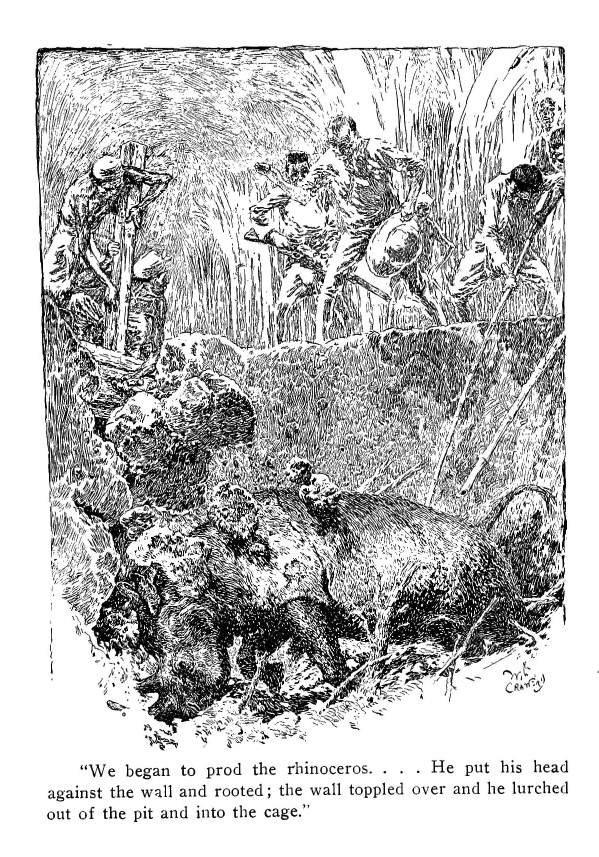
I divided my crew, putting half at building a cage of heavy timbers and the others at digging away the ground in front of the beast. By the time the cage was put together and bound securely with rattan, we had an incline running down to the pit, with two feet of earth walling the rhinoceros in. Then we placed skids on the incline and let the cage slide down. A native, who had been sent back to the nearest kampong, or native village, to recruit men and water-buffaloes, had soon returned with a score of other natives, driving six water-buffaloes before them. Then I went through the usual business of holding a meeting and explaining carefully, in the greatest detail, exactly what we were about to do and how we were to do it; what each man was to do and when and how. When they understood perfectly, we set about digging away the wall that separated the rhinoceros from the open end of the cage. With a little more than one foot of earth remaining, we began to prod him. The immense beast pounded his feet on the bottom of the pit, grunting and moving forward as rapidly as he could get foothold. He put his head against the wall and rooted; the wall toppled over, and he lurched out of the pit and into the cage. The natives slipped the end-bar into place.
"We began to prod the rhinoceros.... He put his head against the wall and rooted; the wall toppled over and he lurched out of the pit and into the cage."
The capture was finished—but not the work. A rhinoceros cannot be broken and driven through the jungle like an elephant; he must be hauled every foot of the way. With the six water-buffaloes straining and every native giving a hand, we pulled the cage up the incline and mounted it on the runners. It took a week of steady cutting to clear the way, so that we could drag the cage to the Trengganu River. There we built a heavy raft and floated the cage down to port. Another two weeks passed before we could ship the beast to Singapore, for transshipment to Perth.
I received for the animal £200, which was about one quarter of its value. But it was as much as the Perth Zoölogical Gardens could afford to pay, and I was glad to be able to put so fine a specimen into the hands of Mr. La Souef.
One day when I was busy in my animal house, Ali came to me with the message that three natives from Pontianak, Borneo, were outside. They had something important to tell me, Ali said. When they came in, I found that I knew one of them; he was an animal trader from whom I had bought some birds and monkeys. The other two were head-men from the interior of Borneo.
The headmen had gone to the trader with the story of two large orang-outangs that were terrorizing their villages, and the trader was bringing them to me for advice. We sat down in the shade and discussed the situation. The orang-outangs had run off with a young girl and had recently killed one of the men. The natives had tried repeatedly to kill them, but without success, and now they were afraid to venture into the jungle.
For several years I had had a standing order from the Antwerp Zoölogical Gardens for a good specimen of orang-outang, and I had planned to go, just as soon as my health permitted, into Borneo, to see what I could find. Orang-outangs command unlimited prices because they are so hard to capture and, once captured, so difficult to deliver. On account of homesickness and sensitiveness to climatic changes, they die quickly in captivity. A caged orang-outang loses his spirit immediately; he sits brooding over his capture and often refuses all food. On one occasion I shipped eighteen small and medium-sized orang-outangs to San Francisco, hoping to land two or three alive, but they all died before reaching port. If I had been able to deliver a good specimen in the United States, I could have sold it for $5,000.
But here were two full-grown beasts, already located, and waiting for me to try my hand at capturing them. I was greatly interested in the story the two headmen had to tell, and I spent the entire afternoon in listening to them and asking them all manner of questions. They described the country where the orang-outangs made their home, and promised as many men as I needed.
I impressed them with the fact that I was not anxious to make the trip, and I made them promise, as a first consideration, that they would use all their power to prevent the natives from killing the animals if I captured them. I feared that the resentment of the natives against the orang-outangs might lead them to kill the animals for revenge, even after I had them safely caged. They agreed to do as I requested and once again begged me to return with them. I told them to come back the next day and talk with me again. I had already made up my mind, but it is always well to let a native think that one has not quite decided.
When I went to see the Dutch Consul-General and explained the situation, he issued passports for me, and, accompanied by the two headmen, the trader, Ali and my coolie boy, I took the next steamer to Pontianak. At Pontianak, I presented my credentials to the Dutch Resident. He was pleased to hear that I was going after the orang-outangs and he offered to let me have as many native officials as I wished to take along. I thanked him and declined his offer, explaining that I really did not know as yet just what I should need, or how long I should be up-country. As a matter of fact, I did not want his native officials because I knew; that the jungle people have no love for them, and I wanted to have my expedition entirely clear of everything that looked official.
We stayed there for several days, getting supplies together. The trader remained with the party at my request, because he was known by both the coast and the jungle people. From a Chinese he rented a houseboat that I could keep as long as I had need of it. The Borneo houseboats are twenty to twenty-five feet long and five feet wide; they have a bamboo shed, which makes a fairly comfortable room, and are rowed or paddled by six men. With a mattress spread on the floor and mosquito-netting hung about, I could take the trip up the river easily. Omar, one of the headmen, stayed with me in my boat, while Mahommed Munshee, the other headman, went ahead with some of the stores.
On the way up the river we came to the station of Dr. Van Erman, the Dutch medical officer who was in charge of the outlying districts. He insisted that I stay with him for two days at least, and I was glad to do so, for he was the last white man I should see before we tackled the orang-outangs. I was anxious to have the benefit of his knowledge of the natives and the country, and also I found it reassuring, under the circumstances, to have the friendship of a medical man. Later, I became his enforced guest and I have always been thankful for his care.
We arrived at Nanaoh-Pinoh, which was Mahommed Munshee's village, two days late. I stayed at Munshee's house while the men prepared boats for the trip up the Melarir River to the spot where the orang-outangs were.
V THE SEA TRAGEDY OF THE JUNGLE FOLK
It seemed to me, as I waited in Mahommed Munshee's village, that it might be a good plan to establish a reputation among the natives as a worker of wonders. Fame as a magician is easily acquired among these people and is of inestimable value in handling them. For the task that lay before us, I needed all their courage and confidence, and I had a feeling that they were accepting me with some doubt. That would never do, for, unless I had them under perfect control when the hunt reached its most exciting point, all our efforts might be wasted. They showed proper awe of the express rifle that Ali exhibited so proudly, and they took fitting note of my stores, but still they regarded me simply as a white man who might, or might not, be able to do the things he said he was going to do. They were respectful and hospitable, but the more I saw of them, the more I realized the importance of doing some spectacular thing that would distinguish me in their minds and send tales of my magic traveling through the wilderness of jungle. It is astounding, by the way, how rapidly news travels in the jungle. Many times, in breaking through virgin country, I have found that the news of my coming had preceded me and that the natives knew all about me and were waiting for me. The only explanation I could ever get was simply, "Tûan, we heard."
A good opportunity to impress the natives presented itself one day when I was preparing to take a plunge in the river. Munshee stopped me, saying: "Take care, sir. There are crocodiles in the river." He told me that many natives had lost their lives recently and that men had had their arms snapped off while they were paddling boats.
I took his advice and went to the house where my supplies were stored. Presently I returned with a stick of dynamite and a fuse. Gathering the natives around me, I explained to them that they were to line the banks of the river and prepare to come out in their boats when I gave the signal. They were entirely mystified, for they had never heard of dynamite.
Going up-stream, I prepared the charge and then drifted down, dropping it over. Wide-eyed and puzzled, they watched the smoking fuse disappear into the water. Then came a muffled explosion, which made them jump; the water trembled, shaking the boats and frightening them; fish came to the surface. I signaled and the scramble to gather the fish began.
Ali was standing near me, ready to put the rifle into my hands, and I strained my eyes, looking for crocodiles. Suddenly a woman pointed to the opposite bank and screamed, "Buâia (crocodile)!"
I yelled to Munshee to take his men down-stream and keep them quiet and on the alert; then I directed my boat above the spot where the woman had pointed. I dropped another stick of dynamite overboard. A few seconds later, the belly of a crocodile appeared on the surface, its feet and tail moved feebly. It was stunned by the explosion—mâbok (drunk), as the natives say.
I took my gun and put two bullets into its belly. Before it could sink, Ali grabbed its tail; then we made for the shore. The natives gathered about, wildly excited, and Mahommed Munshee was the proudest man in the village. He had vouched for my abilities and I had proved my possession of the powers that he claimed for me. It was hobat-an (magic).
The crocodile measured fifteen feet, four inches, and was twenty-five years old. The natives could tell its age by counting the pebbles in its pouch.
I decided to stop at Munshee's a few days longer, to have the men gather rattan to make the nets, and also to talk with the natives about orang-outangs and plan all the details of the capture. Omar, the other headman, went on up to his village, taking with him as much of our store of provisions as he could carry. I was willing enough to have him spread the crocodile story among the natives and I knew that the tale would not suffer in the telling.
Omar was to determine, if possible, the exact location of the orang-outangs and to make arrangements, such as engaging recruits for the hunt, in advance of my arrival. I planned to have a general council of all the men who were to take part in the work. Such a council would have a double advantage: in the first place, it would give me the benefit of their experience, and secondly, it would make them feel that I depended upon them.
It took us four days to gather as much rattan as we could carry in our boats; then, with thirty men, we started up the river. I found at each village that Omar had done more than justice to the crocodile story and that he had taken with him a select crew of men. As in Trengganu, the natives felt that this was to be the great sporting event of the year, and they were anxious to take part. Their keen interest in the adventure made it possible for us to choose the strongest and best of them, together with a few older men, who knew the jungle.
Our boatmen swung on their paddles steadily, pushing the boats against the current. Solid banks of foliage lined the sides of the stream, and, in places, the branches touched overhead, making a thick canopy that shaded us. In the sun, the heat was blistering.
When we arrived at Omar's kampong, the entire population was on the banks to welcome us. Omar came forward and announced that he had recruited seventy men—Malays and Dyaks—for the hunt and that he would vouch for all of them. That made a crew of a hundred, counting the thirty who came with me, and we examined one another curiously. I was the first white man that most of them had seen.
Leaving instructions that the council was to be called for the next morning, I went to the house that Omar had prepared for me. Ali and the Chinese boy accompanied me with my personal equipment, and I sat talking with Omar while I waited for my bed to be prepared, so that I could get my afternoon nap. The men loitered outside the house apparently waiting for something. I knew what they wanted—more magic. At last a deputation came with the request. Would the white man perform magic such as he had performed at the village of Mahommed Munshee?
Crocodiles were less plentiful so far up the river, and I was rather afraid that they might be disappointed if I did not at least equal the former exhibition. The story, as I have remarked before, had grown wonderfully in traveling up-country. But they were determined to see the "drunken fish," and I decided that, before beginning work, I should do well to give them some sort of amusement.
With the two headmen—they were delighted to show such familiarity with this new sport—assisting me, I stationed the natives on the banks with their boats and then I went up-stream with the dynamite. There was breathless silence as they saw me strike a match and touch it to the fuse. When the explosion came, they gave a shout and darted out in their boats to gather in the fish. After the excitement had subsided, and all the fish had been compared for size and weight, I dropped another stick. The men enjoyed the sport immensely, and we made a hilarious afternoon of it. The most sober person in the village was my coolie boy, who, as he went quietly about his business of arranging my living quarters, muttered, "Sĕmûa gîla (All crazy)."
Ali, who had become a good shot, showed the villagers my express rifle, and demonstrated what an explosive bullet could do to the trunks of trees. The men were fascinated by that power of destruction, and they passed their fingers reverently over the barrel and listened to Ali's stories while he cleaned it. Ali had traveled all over the Far East with me and he gave marvelous interpretations of what he had seen. He could hold an audience of natives spellbound for hours and, incidentally, he was an excellent publicity man for me. In his whole-hearted, childish, Malay fashion, he accepted me as the greatest man in the world and he was never contented unless others did so too. He was in great measure responsible for the success of my expeditions, for he removed many an obstacle—sometimes without my knowledge—and worked constantly to keep up the enthusiasm of the men.