"Trapped by Malays" (continued 7)
Reading edition
“That’s right, sir.”
“But we shall show where we are.”
“Of course; but we can’t help that, sir,” cried Peter excitedly. “Here they come. They’ll overtake the little ’un directly. You’ve got bullet cartridges, sir, for I tried one. But I don’t know whether this double gun will carry so far; so you had better wait.”
“One barrel’s rifled, Pete, and it will,” said Archie, drawing himself into a kneeling position and resting the barrels upon a horizontal bough.
“Look sharp, sir! Oh, murder—there goes another spear! I couldn’t hardly see, but it must have gone close to that woman who is handling the bamboo. Oh, do fire, sir!”
There was the sharp report of one barrel, and then, as the smoke rose, Archie fired again, and opened the breech and rapidly inserted the cartridges that Peter handed to him; while, as if startled by the reports, the rowers in the far boat laid on their oars, and those astern started up, and the lads could dimly see their spears bristling in the gathering gloom.
“Give them another, sir—only one—and reload. You missed first time. You must bring down a couple now.”
Archie fired again, and this time one of the Malays seemed to spring out of the boat and drift behind.
“That’s good, sir. Here’s your cartridge. Now then! Give them two now. They are coming straight for us where the smoke shows. Quick, sir!”
Bang, bang went the double gun, the reports almost simultaneous, for in his excitement Archie had no thought of reserving one shot; and as he hastily reloaded he could see in the rapidly dimming light that the rowers were changing the course of their naga, as if to get out of the line of fire, and were beginning to make for the opposite shore; while the big Malay in the small sampan had ceased his efforts to pole his boat more swiftly along, and was using the bamboo to steer the little vessel, which, gathering force from the man’s efforts combined with the swift stream, plunged right in through the hanging boughs behind which the two lads crouched. There was a heavy crash, mingled with the breaking of twigs, and the two lads were driven headlong into the bottom of their boat.
Archie struggled up at once, holding his double gun on high to keep it out of the water, with which he was drenched; and the first thing he could make out through the wide opening torn in their shelter was the naga and its occupants gliding rapidly by, the rowers pulling as if for dear life, and the spearmen crouching down in the bottom, half-hidden by the awning. Then they were gone.
Meanwhile Peter was struggling to free himself from the encumbrance of the big Malay, who had been shot from his own vessel right upon him; and the next thing that met Archie’s eyes, as he gazed through the crushed-down leafage driven before the lesser boat, was Peter’s bayonet-armed hand with the weapon raised dagger-wise, and beyond the Malay, who was holding out his hands, the native boat with the Malay woman, pole in hand, panting hard as if from exertion. Then his eye caught the figure of the other woman, kneeling in the stern.
“Pete, look out! Quick! We must climb into this boat. She’s cut us down. Quick—before it’s too dark to see!”
“Here, I don’t understand, sir. This fellow knocked me down, and—”
“Understand! Can’t you see we are sinking? It’s deep water here.”
Before he could finish he dimly made out that the big Malay had struggled clear and seemed to be much higher as he dragged at Peter, hoisted him right up, and jerked him behind; while at the same time the panting woman was holding out the pole she used, at which Archie grasped, just in time, as he felt the water was gradually bearing him away.
The next minute he was being dragged over the side of the sampan by the two Malays, and as they lowered him so that he lay upon his back, Peter’s head suddenly appeared between the two strangers, with the eager question:
“Have you stuck to your gun, sir?”
“Yes; all right, Pete. What a horrible accident! Where’s our boat?”
“Rotten old cocoa-nut shell,” cried Peter savagely. “There’s the last on her just going down;” and he pointed to a spot a few yards away, where, dividing the pendent branches of their shelter, was the attap roof of their sampan. “And do you know what that means, sir?”
“Utter wreck, Pete,” said Archie, breathing hard from excitement.
“Yes, sir; and my four boxes of cartridges with all them blue pills gone to the bottom to feed the crocs.”
“But what about the other boat?”
“Why, we are in it, sir. Can’t you see?” said Peter sourly.
“No, no—I mean the enemy’s.”
“Oh! Out of sight, sir. Gone down the river just as if you were peppering them still.”
“Eh? What?” cried Archie, as he became aware of the fact that some one else had spoken, and that a bough of one of the trees that overshadowed them was being pressed aside; and, half-stunned in his astonishment, the young officer grasped the words that seemed to be coming in the confusion of some strange dream:
“Archie! Don’t you know me? I’m Minnie Heath.”
Chapter Forty Three.
The Enemy’s Work.
Archie Maine and Minnie Heath sat in the darkness, hand clasped in hand, the poor girl sobbing bitterly, nearly overcome with emotion, after, in a low, excited voice, asking questions about her aunt and uncle and Sir Charles. After learning that all were alive and safe, she burst out in so wildly hysterical a fit that there was a low, deep growl from the darkness at the far end of the boat.
“Silence, Pete!” whispered Archie sternly.
“’Twarn’t me, sir. It’s this ’ere Malay chap. I think he means that you oughtn’t to make so much noise at that end. I wanted to say something of the kind, but I didn’t want to be rude to the young lady.”
Minnie was silent directly; and close to the spot where Peter had been speaking a curious rustling noise arose, which Archie could not understand, till almost at once the edge of the moon appeared above the night mist and lit up the interior of the shelter, and then it was plain that the big Malay fisherman was busy at work cutting down branches and laying them across the boat, in which a pile of leafage was beginning to appear.
“What does he mean by this?” whispered Archie. “I suppose he means the branches to disguise the boat.”
“I don’t know,” said Minnie. “I suppose so. I don’t think we need ask. He and Dula have saved me, and have been most kind.”
“But can you talk now?”
“Yes, yes; I will not break down again if I can help it.”
“I’ll wait,” said Archie.
“No, no; go on talking, pray,” half-sobbed the girl. “It keeps me from thinking. What were you going to say?”
“I was going to ask you how you knew that we were in hiding here.”
“Knew! Oh no! It was like this. Dula and Pahan were bringing me down in their boat, believing that they could reach the bungalow in the darkness and hide me there. Of course you did not see in the dusk that I am wearing Dula’s baju and sarong.”
“No; it was all too dark and confused. But I did think you were a native woman.”
“That is good,” said Minnie. “Dula brought me down to the creek where the boat was lying, and Pahan meant to pretend after dark, if we met any of the Malays, that he was taking in fruit for the Rajah’s men. But we were seen too soon. One of the Rajah’s boats came in sight, and the chief with it called to us to stop. Then Dula said I must lie under the attap mats, as they were going to pretend that they did not hear the call. They began poling the boat along as hard as ever they could, hoping, as the stream was with us, that we could escape; but—” The poor girl broke down with a sob.
“Don’t talk about it, Minnie—dear sister,” said Archie quickly. “Sit quiet and try to believe that you are safe. Pete and I will die sooner than harm shall befall you now.”
“Yes, yes, I know,” said the poor girl, stifling her rising sobs; “but I must talk. Don’t stop me. It helps me to grow calm again after the horrible excitement of that race for life. Oh,” she shuddered, “it was terrible! For they kept gaining upon us, till they got near enough to begin throwing spears, two of which passed through the attaps; and I crouched down, praying that the darkness that was so near would come down and hide me so that Pahan could run the boat in somewhere amongst the bushes. At last, when it seemed all over, and I was feeling that I must bid good-bye to life and jump into the river before I saw these dear people speared to death, my poor heart gave one great throb in answer to the sound of your rifle, while Dula uttered a cry of joy, knowing the shots at the Malays could only come from friends, and helped her husband to force the sampan right in amongst the trees where we saw the smoke rising; and then— Oh Archie! oh Archie!” She broke down, and as she clung to her old companion, the lad made what sounded like a dreary attempt at a mocking laugh, as he exclaimed:
“Upon my word, Minnie, it was too bad! Here were we trying to save you, and you dashed in, sank our boat, sent all my cartridges to the bottom, and nearly drowned us into the bargain.”
“Don’t—don’t try to make a laughing matter of it, Archie! I can’t bear it now.”
“Of course you can’t. Forgive me for being such a fool. I say, your what’s his name—Pahan—he’s getting quite a stack of green stuff aboard, and— Hang it all! Look at the moon!”
“Yes; I am looking,” sighed Minnie. “I’ve watched it many a time since I have been in hiding, and I never thought to look upon it peacefully again. Oh Archie! go on talking to me. Tell me more about Sir Charles, and what you have all been going through at the station.”
“Can’t. It would take a month.”
“Oh! do tell me something.”
“Breaking our hearts about you, then—everybody in the place. Even poor old Mother Smithers sat down and cried like a child; didn’t she, Pete?”
“Gugg!” said the lad, out of the darkness. “Can you get at your knife, Mr Archie? Mine’s turned into a screw-driver, and I want to help this nig— Malay gentleman to cut sticks.”
“Here you are, Pete,” said Archie, after a hard struggle to get his hand into the pocket of his overall, and a harder struggle still to get it back with the knife.
“Thankye—gugg—sir! Blest if I don’t believe I’m going to have a cold!” And the cutting and rustling of thick, leafy branches went on.
“Now, Minnie, tell me, what do they mean to do?”
“Yes,” said the girl quickly. “Dula told me—she can say a few words in English, and I know a few Malay sentences as well, so that we managed to understand one another—she said her husband thought he could get the boat down to the foot of our garden in the darkness, and then we could all carry baskets of fruit, and so pass through the Malays to a spot where we could make a dash for the Residency, where we should be safe, if some of the soldiers didn’t shoot us down.”
“Ah,” said Archie slowly, “you needn’t be afraid of that, Minnie.”
“What’s the matter?” cried the girl sharply.
“Oh, nothing. I am only very wet.”
“You are trying to hide something, Archie,” said Minnie earnestly. “You called me sister a few minutes ago.”
“Well,” he said sharply, “that’s what you are to me.”
“Then is it brotherly to keep something back?”
“Oh, all right, then,” said the lad. “It was only because I didn’t want to give you more troubles to think about.”
“What is it, then? I know: Sir Charles is wounded, or perhaps—”
“No, no. He’s been knocked about, like the rest of us. I was keeping it back that our men haven’t got a cartridge among them left to fire. Pegg and I were at the bungalow last night to smuggle out your uncle’s double gun and the cartridges, and we had got in here to wait till night came again before we landed and tried to make our way back to the Residency.”
“Say, Mister Archie, sir,” grumbled Peter, as Minnie sat pressing her old companion’s hand in token of her gratitude for what he had said.
“What is it, Pete?”
“I can’t understand what this chap says, but he made me shut up your knife, and has put away his own, so I think he means we have got as much green stuff as we can carry.”
“Yes, that’s it, Pete. Well, what?”
“Only this, sir. You see the moon there?”
“Of course I do.”
“Well, is it a heclipse or an echo, or anything of that kind, over yonder?”
“Where? What do you mean?”
“This ’ere way, sir. You are looking t’other.”
“Nonsense!”
“You are looking the wrong way, sir. Hold them branches back. Yes; it’s getting wuss, sir. Blest if they ain’t burning the Residency down!”
Chapter Forty Four.
The Fisherman’s Plan.
Peter’s conclusion was only a guess, but it soon became evident that a fire was raging somewhere in the direction of the station. But this did not seem to trouble the two Malays, who shifted the position of the boat by pushing it clear of the trees, to one of which they secured the sampan so that it swung in the stream, while they rearranged the greenery that had been collected, and worked hard in the bright moonlight so as to give it some semblance of a market-boat carrying down supplies from higher up the river.
This done to the satisfaction of the owner, whom Peter had been working hard to help, the lad uttered an apologetic cough.
“Look here, Pete,” said Archie impatiently; “if you are going to say that we had better remain in hiding on account of the moonlight and the glare of that fire, you had better be silent, for we must trust to these people to do what they think best.”
“I warn’t a-going to say nothing of the sort, Mister Archie, sir,” protested the lad.
“Then what were you going to say? I know that that cough or grunt of yours means that you are going to object to something.”
“No, sir; it’s not a object to anything unless you say I can’t have it. I was only going to ask if Miss Minnie didn’t say something about having fruit aboard this ’ere craft.”
“Yes, yes!” cried Minnie excitedly.
“Well, miss,” said Peter, with a sigh of relief, “if you won’t think it rude of me, I should just like to say that Mister Archie here ain’t had a mossel of nothing to eat since the day before yesterday, and PP ain’t much better.”
“Oh Dula!” exclaimed Minnie; and she uttered a few words in the Malay tongue that sent the woman rustling past the cut boughs beneath the attap awning, to return directly and gladden the eyes of Peter with a basket containing a heap of bananas and a couple of native-made cakes.
“Ah!” sighed Peter. “Don’t they look lovely in the moonlight! Tlat!” he added, with a hearty smack of his lips.—“No, thank you, sir. No water, please,” he continued, after a busy interval. “I never feel sure what you might be swallowing when you have a dip out of the river. It’s all very well when the sun shines hot, but when it’s the moon it don’t make you thirsty—least it don’t me.”
It must have been a couple of hours later, during which the occupants of the boat had been watching the rising and falling of the fire as they swung slowly to and fro at the end of the rope, when Minnie, who had been speaking in a whisper to the boatman and his wife, turned to her companions and said:
“Pahan thinks that we may risk floating down the river now. The excitement of the fire will be pretty well over when we get abreast of the bungalow, and we have a long journey yet; and then if he makes the boat fast, as he says he can, at the foot of the garden, he thinks no one will notice it. But we shall have to lie hidden, and, if necessary, covered up with the boughs.”
The covering over with boughs fell to the share of the two lads, the shelter of the attap mats and her Malay dress seeming likely to be sufficient for Minnie’s protection if they neared any Malay boat, that most dreaded being the naga whose occupants had been put to flight—though even if that were encountered, the sampan was now so transformed that it was not likely to be recognised; and once more the little party were in motion, floating down towards the station, the Malay poling the boat and keeping as near as possible to the farther shore.
Chapter Forty Five.
“Close up!”
“Don’t you think we might make a bigger peep-hole, Mister Archie?” whispered Peter.
“No,” was the abrupt reply.
“All right, sir; you know best; only it is precious smothery. I’m as hot as hot.”
“Can’t help it, Pete. We must bear it, and above all now that we are getting so near.”
“Yes, we are near; aren’t we, sir?”
“Very near, Pete.”
“Can you make out anything more about what is burning?”
“Yes—the Residency.”
“That’s bad, sir. Thought we was to retreat to there when things got too hot at the orspittle.”
Archie had been raising the boughs that concealed them as they drew nearer the upper landing-place, dropping very slowly along, their progress being checked by the manipulation of the boat’s grapnel under Pahan’s clever management, for he controlled the rate at which they were carried downward on the swift stream by using the rough little anchor as a drag.
As far as could be made out in the moonlight, the river was quite clear of boats, and, to their surprise, they glided on into utter silence, while not a moving figure could be made out.
Archie had, in a whisper, given such information to his companion as he could, and attributing the position to their still being at a considerable distance from the scene of the conflict, he had crushed down in his own breast the feeling of dread that the worst had occurred. He had just come to this conclusion when Peter made a horrible suggestion.
“Mister Archie,” he whispered, “ain’t it all very quiet?”
“Yes. Perhaps the enemy is waiting for broad daylight, to make another attack.”
“More fools they, sir, when they might catch our poor chaps quite done up in the darkness and without a shot to fire. But you don’t think, sir, as we are too late, and the niggers have made a rush, carried all before them, and ended up by finishing our lads off?”
“No, I don’t,” said Archie shortly; “and now don’t talk. What’s the use of making the worst of things?”
“Quite right, sir. There, I’ve done; but I’d give anything to get to work again. Just tell me this, sir: how much farther have we got to go?”
“A very little way,” whispered Archie, as he raised his head a little and peered through the boughs, to see that the fire was burning low and that they were now gliding into comparative darkness, evidently caused by the river mist keeping down the smoke, which hung low and partially obscured the light of the moon.
And now the big Malay was evidently busily using his pole, and thrusting hard to force the boat into the position he had marked. Then, as far as the listeners could make out, he had hauled up the little grapnel so that it hung over the side, worked hurriedly with his pole again, and then laid it leaning against a pile of boughs so that the two lads could hear the water dripping where they lay.
Then the grapnel was lowered again, and the boat swung round; and as Archie raised his head once more, it was to find that they were close up to their old position whence they had made their successful capture of the cartridges. And now it seemed as if they had suddenly glided from silence into the noise and turmoil of the fight, for from the shore came the shouts and yells of the Malays, who were evidently engaged in a savage attack upon the defenders of some portion of the station, and Archie, in his excitement, uttered a low:
“Thank Heaven!”
“What did you say that for, sir?” whispered Peter excitedly.
“That horrible silence, Pete, made me afraid that you were right.”
“Ah, yes, sir; and that all our poor lads were wiped out. It’s all right, sir, only that we ain’t got no cartridges. But what are you going to do, sir? We can’t go on lying here.”
“No, Pete, of course not,” whispered Archie, though there was no need, for the noise and tumult would have drowned his words even had they been spoken aloud.
He raised the boughs, but nothing was to be seen, for the bungalow was hidden by the smoke and mist now being borne by the faint breeze of the coming daylight in their direction. But he could make out enough to determine that an attack must have just commenced upon the mess-room and its surroundings, while, in spite of the stillness in that direction, the lad could gather that the defenders must be still holding their own.
A sudden sharp rustling and movement of the boat made Archie turn sharply.
“Don’t say nothing, sir,” panted his companion, whose voice sounded as if he had been running hard. “I couldn’t bear it no longer, sir. I was being smothered. Can’t you hear, sir? They ain’t cheering, but our chaps is at work with the bay’net.”
“Yes, yes, I hear,” said Archie hoarsely.
“Well, sir, we are close inshore, and with a sharp run we could get in and help.”
“But it would be madness, Pete, to try and land with Miss Minnie now.”
“Who wants to land with Miss Minnie, sir?” cried the lad fiercely. “She’s safe here. You tell her to lie low, and say that what’s his name is to pull up his anchor and run her a bit lower down, or across the river out of danger till all’s safe again.”
“Impossible, Pete. We are almost unarmed, and it would be like forsaking the poor girl at a time like this.”
“What you talking about, sir? Here’s two of us, and there’s our poor chaps dropping before these niggers’ spears. Come on, sir! I must speak, for I feel it’s our duty to be there.”
“Yes, Pete,” replied the subaltern in a voice that he hardly knew as his own; and rising clear of the bushes, he made his way to where he could dimly make out the figure of Minnie kneeling beneath the attap roof.
“Minnie,” he whispered, “our men are fighting to defend the station, and our place is there. Tell the Malay to get the boat across to a spot where you will be safe. Don’t ask me to stay. I can’t.” Turning from the girl as she made a snatch at his hand, “Now, Pete,” he said, and grasping the gun, he sprang over the side into the shallow water, and then, as he dragged himself out by the help of the nearest bush, a quick panting from the gloom around told him that Peter was by his side. Then old discipline asserted itself. “Forward! Double!” he cried; and falling into step, the two lads ran almost blindly in the direction of the shouting and yells, which acted as their guides to the quarter where the conflict was going on.
Those next minutes were to the lads like a brief period of blind confusion, and at one time they were hurrying between trees where the smoke was thickest, rising from places where firing was going on and the mist hung low but seemed to be lightened here and there by the flickering of fire, whose pungent odour of burning wood assailed their nostrils. Then Archie was conscious of finding himself rushing through a crowd, at whom he struck right and left with the barrels of his gun, and of hearing a piercing yell somewhere to his right, followed by a grim, stem voice growling:
“You’ve got it, then!”
And at last, with a bound, the two lads stumbled, nearly fell, and then leaped together over a rough breast-work, and fell heavily amongst the dimly seen defenders who were left.
“Friends—friends!” yelled Peter, and then, “Mister Archie, sir, where are you? Ah! That’s done it!” For no reply came in answer from his panting companion, who was being partly held up by one of those whom he had joined, and who gasped out a cheer.
“That’s right! Hooray it is!” cried Peter. “Here, give us a rifle. I’ve got a bayonet.” And Archie heard the click, click of the keen weapon being fixed.
This brought back his failing powers, and the next minute, finding himself in the little line of defenders who were dimly seen in the smoke that was floating from the levelled Residency, he raised the gun he still clung to, tired twice into the bearers of so many bristling spears, and began to load again, asking himself the question, “Are the cartridges wet?”
The little, hurriedly thrust-in rolls answered for themselves with two more sharp reports, and these four shots resulted in checking the enemy’s advance and in raising a wildly exultant, though feeble, cheer from the defenders along the little line; for, trifling as was the addition to the failing force, the shots seemed to give as much encouragement to the enfeebled men as dismay to their enemy.
“Fire, sir—fire, Mister Archie! Don’t stop to aim, sir!” panted Peter. “I’ve got a lot more ready. Fire till the barrels are too hot to hold!” And, trembling with excitement the while, Archie fired as fast as he could drag the cartridges from the pockets where they lay.
And as he fired again and again the Malay attacking party hung back, dropped a little more to the rear, and began turning their spears into missiles, which began to whistle past the defenders, who were finding their voices more and more, and cheered hoarsely.
“Here y’are, sir! Old England for ever!” cried Peter. “I’ve got about a couple of dozen handy. Ketch hold.”
“Who’s that firing?” came in a familiar voice from Archie’s right. “You, Maine! Great heavens! I thought— Here, distribute some of your cartridges to the men.”
“No use, sir. This is a shot-gun,” panted Archie hoarsely; and he fired again twice, snatched at a fresh supply from Peter, and was in the act of closing the breech again, when the Major exclaimed:
“Stand fast, my lads! It has given you a rest. Bayonets!”
There was another cheer at this, and the men stood fast as ever—a dwindling party, hard beset, of the defenders of the mess-room veranda, their breast-work for the most part consisting of the bodies of the slain.
“Steady, my lads! Close up!” cried the Major.—“That you, Sir Charles? Good! I didn’t know you could use a bayonet like that.”
There was a tremendous yell from the front now, and it became plain that the enemy had recovered from the check given by the recrudescence of the long-stopped firing, little though it was, and were now coming forward in greater force.
“Close up, my lads!” he said again. “God save the Queen!”
The cheer that burst forth was only faint, but it was true as the British steel with which the men stood ready to deliver their final thrusts.
“The last two, Mister Archie!” panted Peter in a low tone. “Let ’em have ’em, sir, and then be ready. I’ve got another rifle and bay’net. Fire, and chuck the Doctor’s gun at them and hooroar! We will die game!”
“Close up!” roared the Major desperately, as he stood sword in hand, ready to give point. “Stand fast, and let the black-hearted cowards spit themselves upon your bayonets.—What’s that?” he cried.
“A fresh body of ’em, sir, coming round to right and left.”
“That you with your bad news, Sergeant?” cried the Major half-laughingly. “Good-bye, my lad! Good man! Brave soldier! But we’ve done our best, and they’ll say it was bravely done at home.—Form square! Rally!” he roared, as he now raised his sword on high.—“Well done, subaltern—and you too, boy,” he added, as right and left, with lowered rifles, Archie and Peter helped to close him in.
Yell, yell, yell, came in a savage roar, as, like a dark wave flashed with scarlet and amber yellow, two lines of spear—armed Malays in admirable military order charged round the two angles of the mess-room right and left; and as the tiny square stood firm, it was to see the new-comers dash wildly past and tear away right before them in a fierce charge upon the advancing enemy, whose attack that had meant the extinction of the brave defenders was now turned into a repetition of the sham-fight’s rout, as they scattered in wild retreat across the parade-ground and made for the jungle.
The defenders stood, with presented blood-stained bayonets, in bewildered silence for a time, and too much astounded to cheer as they watched the smart, bright military charge of the new enemy, for it seemed impossible to believe that these were others than a fresh party who were making some terrible mistake.
They watched then as the fresh, bright line with glittering spears tore on, driving the enemy before them, till the latter began to plunge in amongst the jungle trees, or made for one or other of the paths, when all at once a wild, shrill cry rang out, and, as if by magic, the new, well-drilled force stopped short as though in obedience to the loud, familiar sound of a British bugle. This was answered by two more, one from the path nearest to the river, the other away from the direction of the village campong; and in response to these three calls came as many crashing volleys, while as the smoke arose it was to display a motley crowd of the enemy returning in wild excitement, driven back by the check, to be met in their retreat by the spears of their new foes.
What followed was a short and desperate encounter, in which the retiring foe turned wildly again to reach the shelter of the jungle, but only to meet the quick, scattering fire of the advancing detachments, which, as if from some carefully planned manoeuvre, but which Peter called chance, were now advancing in the nick of time.
The fight was over, for, hemmed in now, Rajah Suleiman’s despairing force threw down their arms in appeal for mercy, crushed, beaten, half-destroyed.
Chapter Forty Six.
“Hoo-Ray!”
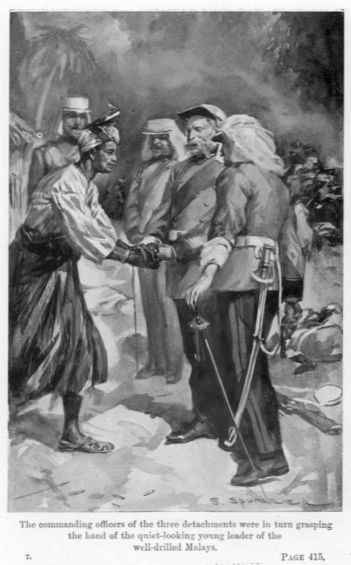
In the midst of the wild bursts of cheering given out again and again by the rescued men, wounded (who were many) and sound (who were very few), to those who had succoured them in their direful time of need—shouts that were echoed and re-echoed by the wearied and weather-worn comrades warmly shaking hands and almost ready to embrace old friends—there were other meetings and heart-stirring incidents. Not the least interesting was that in which the commanding officers of the three detachments were in turn grasping the hand of the quiet-looking young leader of the well-drilled Malays who had come up from the rear and literally flung back Rajah Suleiman’s savage warriors on to the bayonets of the returning force.
“I don’t know how to thank you enough, sir,” said Captain Down.
“Nor I, sir,” said Lieutenant Durham.
“You, Ripsy,” cried Captain Down again—“you understand these things better than we do. Did you ever witness a better advance and charge? You saw it, didn’t you?”
“Yes, sir,” said the old Sergeant, “just as we were all out of breath and were struggling out of the jungle path.”
“Well, say something to the Prince, man.”
“No speaker, sir,” said the Sergeant-Major gruffly; “but I should have been a proud man if I had had the drilling of such a body of men.”
“Oh, gentlemen, gentlemen,” said the young chief, “it is all imitation, and the teaching of an old non-com, whom I have had with me ever since I came back from England. Only too glad to have come in time. But I should like to say a few words to Major Knowle and Sir Charles Dallas before we retire to my boats.”
“Oh, we will talk about that by-and-by,” cried Captain Down. “I see they have been playing havoc here while we have been tricked and deluded into following no end of false and lying guides who professed to lead us to the place where Suleiman and his men were retiring before us. Come along. Good heavens! I had no idea that the Major had been pressed like this. The Residency gone, too! And look, Durham—it was time we came!”
The officers and the young Rajah quickened their steps across the parade-ground, dotted now with fallen Malays, wounded and dead in the final mêlée; and Captain Down uttered a groan as he ran to grasp the hand of his chief, who took a step or two forward by the help of his blunted and rusted sword, while the relics of the defenders stood round, cheering hoarsely and feebly, and trying to cheer again, but breaking down in the effort and lapsing into silence, each man craning forward eagerly to listen to what was said.
“We had no messages, sir, from headquarters, or we should have been back long before. All we could gather was that the Rajah was fleeing before us; and Durham was told the same. Here—the Sergeant too. He was led on and on by people who showed him the tracks of Suleiman’s elephants, and—”
“No more—no more,” said the Major hoarsely. “I knew you’d have come, and that there must be some good reason. I thank Heaven that it was no worse, for in my despair I was ready to agree with my true comrade here, Sir Charles Dallas, that each detachment had been led into some trap, and my brave lads slaughtered to a man. As you see, we have had pretty well to fight to the death, and I’m too weak and ready for the Doctor’s hands to grasp everything. I want to know, though,” he added feebly, “how it is that this brave little native force came to us at the last pinch and turned our defeat into a victory.”
“What! don’t you know, sir?” cried Captain Down excitedly.—“Here, Rajah Hamet, speak for yourself.”
“Rajah Hamet!” cried the Major and Sir Charles in a breath; and the young man took a step forward as the group of officers drew back to give him place.
“Oh, don’t say anything, Major,” said the young man, smiling. “I have always been your friend, but, somehow, your caution and the malignant lies and jealousy of an old enemy made you distrust me. But there, I remember a Latin saying at my English school. It was, to speak no evil of the dead.”
“The dead!” said Sir Charles, who looked startled.
“Yes, sir, of the dead—the man who plotted to rob me of my country, and make you believe in him and mistrust me.”
“But you said dead,” cried Sir Charles, who spoke with difficulty, as he supported a wounded arm with a bleeding and roughly bandaged hand.
“Yes, sir. Rajah Suleiman died bravely in his final charge.”
“Are you sure of that?” said Sir Charles excitedly.
“Yes, sir; I saw him fall. But one word, Sir Charles: I should like to hear from your own lips that you believe in me now.”
“Believe in you, Prince! You have proved that my suspicions have all been wrong. I ask your forgiveness, sir; and let me be the first to hail you as the new Rajah of Suleiman’s dominions, combined with your own.”
“You mean this, Sir Charles?” cried the young man, who for the moment lost his calm, Eastern composure.
“Mean it, sir? I repeat it in the name of Her Majesty the Queen, whose representative I am.—Yes, what is it, Major?—Quick, some one—the Doctor! He is fainting.”
“No, no,” said the Major feebly; “only a little overcome. Water, from the Doctor’s well. Don’t fetch him. He has too many brave fellows to attend to yonder. Ah! thanks, Rajah. You carry a water-bottle, then, as we do.”
“I was never more glad to follow a good old English custom than now.”
“Ah!” cried the Major, after a hearty draught. “That’s like new life. I had half-forgotten. Everything’s been swimming round me. Now tell me, some one—you, Sergeant—did not Mr Maine come suddenly upon us, as if from the dead, to help us at the last?”
“Yes, sir; and young Pegg as well,” said the wounded Sergeant, saluting, as he supported himself upon the rifle and broken bayonet he held. “But—”
“Ah!” cried the Major excitedly. “Don’t say that—”
“No, sir, I hope it’s not that,” said the Sergeant huskily; “but they were both amongst the missing as I tried to call the roll.”
“Wrong, Sergeant!” cried a husky voice, and all turned and saw a grim-looking private sitting with his bandaged head resting upon one hand.
“What do you know, then, Joe Smithers?”
“Only here they come,” growled the poor fellow, as he flung up his disengaged hand and cried, “Hoo—”
He meant to say “Hooray,” but his feeble voice was drowned in a fresh burst of cheers, as from the direction of the Doctor’s bungalow Minnie Heath appeared, nominally led by Archie and Peter Pegg, but partly supporting them as they tottered on either side.
At that moment a wild cry of joy rang out, and Joe Smithers’s wife, who had dropped a great brass lotah of clear, cold water which she had been to fetch from the Doctor’s well, hurried in to announce that the commanding officer was down, and had brought the Doctor with his wife to attend to their brave old friend.
Poor Archie and Peter had to snatch at the nearest hands, as, with a cry of joy, Minnie sprang to her aunt; while, after an interval devoted to embrace and welcome, the Doctor turned to Archie and began to examine his hurts.
“Quiet, sir!” he cried, as he passed a hand hastily across his screwed-up eyes. “I’ve no time for all this nonsense with all these wounded on my hands. I’ve kissed her, boy, and said I was glad; and her aunt and Sir Charles here will do all the rest. Now, Archie, my lad, no nonsense; lean on me. Do you think I’ve been wounded too? I haven’t a scratch. I say you shall have first turn, and—I say, wasn’t I right when I prescribed that day? Do you feel anything like a boy now?”
“Oh, I say, Doctor, don’t!”
“What!” cried the Doctor, purposely misunderstanding him. “What! going to play the woman? Bah! I’m going to hurt you far more than that.”
The End.
| Chapter 1 | | Chapter 2 | | Chapter 3 | | Chapter 4 | | Chapter 5 | | Chapter 6 | | Chapter 7 | | Chapter 8 | | Chapter 9 | | Chapter 10 | | Chapter 11 | | Chapter 12 | | Chapter 13 | | Chapter 14 | | Chapter 15 | | Chapter 16 | | Chapter 17 | | Chapter 18 | | Chapter 19 | | Chapter 20 | | Chapter 21 | | Chapter 22 | | Chapter 23 | | Chapter 24 | | Chapter 25 | | Chapter 26 | | Chapter 27 | | Chapter 28 | | Chapter 29 | | Chapter 30 | | Chapter 31 | | Chapter 32 | | Chapter 33 | | Chapter 34 | | Chapter 35 | | Chapter 36 | | Chapter 37 | | Chapter 38 | | Chapter 39 | | Chapter 40 | | Chapter 41 | | Chapter 42 | | Chapter 43 | | Chapter 44 | | Chapter 45 | | Chapter 46 |