"Trapped by Malays" (continued 6)
Reading edition
“Yes, certainly, sir,” replied the Resident; “but I am afraid—”
“I wouldn’t say so, sir,” said the Major, with a bitter laugh.
“You know what I mean,” said Sir Charles sternly. “I fully expect that we shall have another body of Malays, to join in the attack, from down the river—I mean, the Rajah Hamet’s men.”
“Well,” said the Major, “our little citadel will hold us all, and when the last cartridges are fired we can make such a breast-work of bayonets as I don’t think, in spite of their spears, these Malay scoundrels will pass.”
“We shall do our best, I am sure,” said the Resident quietly. “But what do you make of this explosion?”
“Ruin,” said the Major bitterly.
“No, no; I mean, what could have caused it? You have all your rules—no fire is ever allowed to approach.”
“Ah yes, to be sure,” said the Major sharply, “what could have caused it?” and he looked round from one to the other. “I have been so wrapped up in the consequences that it has never occurred to me to think of the cause. We could have no enemy within the camp.”
“Look here,” said Archie to the Doctor; “one of these fellows is coming to say that the more they throw on earth the more the wood blazes up.—What is it?” he continued, to the shovel-bearing private, who now joined them, his streaming and blackened face showing plainly in the bright light.
“We’ve just come upon a wounded man, sir.”
“Why didn’t you bring him in?” said Archie sharply.
“I don’t mean only wounded, sir. He’s all black and burnt. Seems as if the blow-up had sent him ever so far away, and he’s lying yonder amongst the stripped trees.”
“Eh? What’s that?” said the Major excitedly. “Not one of my lads?”
“No, sir. As far as I can make out by what’s left of his clothes, he’s one of the enemy.”
“One of the enemy!” cried the Major. “Why, we are coming to the truth, then. No one of the enemy could have been there—unless—”
“Look here,” said the Doctor in his busy way, “you said wounded man, my lad?”
“Yes, sir; he’s alive, for he moved when we touched him, and groaned. But he’s got it badly.”
“Well,” said the Doctor sharply, “a wounded man, whether he’s one of ourselves or an enemy, is all one to me;” and he walked with the rest, after a glance or two in the direction of the silent forest, from which the attack had come, towards the still blazing fire, where a little group of the spade party was standing round a dark object lying at some distance on the other side of the ruins of the magazine.
The party drew back a little to make way for their officers, and Archie shuddered as he caught sight of the horribly blackened object before them.
“A litter here,” said the Doctor shortly. “I will have him up into hospital, but I’m afraid it’s a hopeless case.”
As the Doctor rose from one knee, something bright caught Archie’s eye and somehow brought to mind the gold bracelet he had seen the French Count wear. Then thought after thought flashed through his mind, as he heard a deep, muttering groan, and the man who had brought the tidings whispered to his young officer:
“That’s the same as he did before, sir—just cried ‘Lo-lo-lo!’ or something like that.”
“Why, Doctor,” said Archie excitedly, “did you hear the rest—‘De l’eau’? He was asking for water.”
“Yes—for the love of Heaven! what does this mean? He can’t be a Malay.”
“No,” said Archie excitedly. “It’s impossible to recognise him for certain now, but I feel sure it’s the Rajah’s French friend.”
“What!” said the Major excitedly. “What could he have been doing here?”
“What could he have been doing here, sir, that night when Captain Down and I were startled by hearing some one outside the veranda—some one who must have been listening to you and Sir Charles when you were talking together?”
“Here, I don’t understand,” said the Major petulantly. “What could the Rajah’s friend have been doing here listening to our talk?”
“Playing the spy, sir, in his master’s interest.”
“Pooh!” said the Major angrily. “This is no French friend of the Rajah’s. He’s a Malay. That’s a piece of a silk sarong clinging to his waist, with a kris stuck in it.”
“Yes, sir,” said Archie; “but those are European trousers he’s wearing underneath, and—yes!” cried the lad, as he bent nearer and shrinkingly touched the blackened wrist, just as a fresh flight of flame rose from the ruined magazine—“I am certain that’s the gold bracelet the Rajah’s friend used to wear. It’s got a French motto on it, which you could see if you took it to the light. But I know it by the shape, and I thought that it was a silly bit of effeminate foppishness on the part of a man.”
“Yes,” said Sir Charles; “I remember thinking so too. Why, the scoundrel must have been in the pay of the Rajah, and played the spy here to pretty good purpose. I don’t think you need search for the cause of the magazine being exploded.”
Further conversation was ended by the report of a musket, which served as the signal for several more, all fired from beyond the parade-ground, and doing no harm, though the whiz and phit of the bullets passed close by, and could be heard striking against the nearest buildings.
“Cover,” said the Major sharply. “Never mind the fire now. It will do them as much harm as it does us, for we shall be able to see its glint reflected in their eyes at the edge of the jungle. Quick, every one—cover!”
“Wait a minute, four of you,” said the Doctor. “I want my patient carried in.”
“Your what!” said the Major fiercely. “The renegade who has dealt us this cowardly blow?”
“I never ask questions about a man’s character,” said the Doctor gruffly. “If he wants a surgeon’s help, that’s character enough for me. If I save his life, and you like to prove all this is true, and court-martial him and shoot him afterwards, as a spy, that’s not my business, and I shall not interfere.—But look sharp, my lads. These big musket-balls are coming unpleasantly near, and they make very bad wounds. I can’t afford to get one in me, for I am afraid you will want your surgeon for some time to come.”
It was a horrible task, but the four men who raised the injured man to bear him in could not forbear a chuckle at the Doctor’s remark.
But the order to take cover was none too soon, for the musket-bullets were flying faster, fortunately without aim; and as shelter was reached it became evident that the scare caused by the explosion had died out, for by the light of the burning ruins the flash of a spear-head could be seen every now and then at the jungle-edge, and as the enemy once more gathered as if for a rush, their threatening yells grew plain.
“Well, young Maine,” said the Major slowly, as he passed his hand over his grizzled moustache just as Archie was going round from post to post, “this seems rather hard for you.”
“For me, sir?” said the lad, gazing at his commanding officer wonderingly.
“Yes, because you are such a young fellow. There, go on. Don’t let the men waste a cartridge, for they must be made to last until one or the other of our detachments comes in—I hope well supplied, for if they’ve been using what they have, they will be in just as bad state as we are.”
“Oh, they’ll be coming in soon, sir,” said Archie cheerily.
“I don’t know. I hope so, my lad, for everybody’s sake; but it’s tough work getting through the jungle—and there, look at that! These fellows have plenty of pluck, or they wouldn’t expose themselves as they do. I expect to find that we have very little more ball-cartridge. Well, it will be bayonet against spear, and if it were only equal sides I should back our lads. As it is, Maine, we must hope, and pray for our lads to come in with a run. Have you any idea what time it is, my lad?”
“No, sir. But it can’t be near morning yet.”
“I suppose not. There, let’s go and see how the Doctor’s getting on with his new patient. You are right, my lad; I am sure now. You young fellows jump at a thing directly. We old fellows want a good deal of thought over anything before we will accept it as a fact.”
“Are you looking for anything, sir?” asked Archie, as the Major walked close to the window and stood looking out.
“Yes, my lad; I was looking for morning, and I can’t see it yet.—Why, what—” The Major went heavily against the side of the window, as a result of a violent thrust from Archie, who swung out his sword and struck up the shaft of a spear with one cut, sending the spear to stick into the upper framework of the window, his next stroke being delivered with the pommel of his sword crash into the temple of a Malay who had crept up in the darkness and made two thrusts at the gallant old soldier, who said dryly, as one of his men made a thrust with his bayonet and rendered the treacherous enemy hors de combat.
“That was very soldierly and smart, Maine. They’re as treacherous as the great striped cats of their jungle. Well, I suppose I ought to thank you for saving my life, but we soldiers don’t talk about this sort of thing.”
Chapter Thirty Six.
A strange Confession.
The Doctor was busy with his patients in the heat of the day, loosening one poor fellow’s bandage, and tightening another that an irritable sufferer had worked loose; while Mrs Smithers was thoroughly proving her ability at using basin and sponge over the brows of some poor, fevered fellow whose pillow-less head rolled slowly from side to side. Archie was taking the mess-room on his way to visit the chamber where Peter Pegg was stationed, and from whose window an occasional shot rang out from time to time, with the result of the gaudily robed Malay in a smart, cavalry-like cap, who had drawn the shot, being seen no more.
“How am I, Mister Archie, sir? Oh, it’s rather hot here, sir,” said Mrs Smithers; and then, in response to a second: ‘Yes, old lady, or, I should say, Madame la Duchesse’—“Now, please, sir, don’t you get calling me names too. I don’t mind from the Doctor, but it teases when it comes from a young gent like you. No, sir, I ain’t cross, only a bit worried by the flies. They are terrible, and it’s all due to its being so hot.”
“Yes, Mrs Smithers,” said Archie meaningly. “It is hot, and no mistake. But how beautiful and tidy you have got everything!”
“Well, it is a bit better, sir. I have been collecting all the mats I could find for the poor boys. Do you hear any news, sir, of reinforcements coming up?”
“Not yet, old lady.”
“I do wish they’d come, sir; and oh, Mr Archie, can’t I do anything for you?”
“Me? No! I am not wounded.”
“No, sir; but, oh dear, what a state you are in! Some clean things would be a blessing to you.”
“Oh, wait a bit. One’s got something else to think about now. Where’s the Doctor?”
“He was here just this minute, sir; and he’s sure not to be long, for I never see such a man for watching everybody who’s in hospital. There, I thought so! Here he is, with the mess water-can and a clean glass. He might have asked me to fetch some water if he wanted it. But he always will interfere with what’s in my department.”
“Hullo, Maine, my lad, you here! You are just in time. I’ve been fetching a can of this clear, sparkling water for my poor fellows. Look sharp, for I can see several eyes looking at it hungrily—I mean thirstily,” he added quickly.
He filled the glass after the fashion of Dickens’s butler, trying to froth it up with a heading of sparkling beads.
“May I drink this, Doctor?” said Archie.
“Drink it? Of course! You are one of my patients still.”
“Thanks. But ladies first.—Here, Mrs Smithers; you look tired and hot. I will have the next glass.”
“No, sir, please,” said the woman firmly. “You want it worse than I do.”
“Don’t waste time,” said the Doctor sternly. “Drink the water, my lad.”
The deliciously cool draught trickled down Archie’s throat till the bottom of the glass became top.
“De-licious,” he said.
The Doctor took the glass, filled it, emptied it, smacked his lips, and then refilled and handed it to Mrs Smithers.
“Your turn, nurse,” he said. “Then take the can and go all round, and finish off by taking a glass up to the Frenchman.”
“Ah, I was looking round, sir, for him,” said Archie.
“Yes, I am getting too full here, my lad. I have had him carried up to that room where Pegg’s on duty.”
“Oh, I’m going there, sir, and I shall see him.”
“One moment, Duchess; half a glass, please. I feel like a volcanic cinder.—As you say, my lad—de-licious,” he continued, as he handed back the glass. “I am proud of that water, and so you ought to be.”
“I am, Doctor.”
“That’s all due to me, sir. When we first came—you know the Major’s way—‘Nonsense,’ he said. ‘There will be three hundred idle men here with nothing to do, and they can fetch as much water as we want for the day’s supply from the river.’ And I said, ‘No. In a hot country like this I want my men to have good, pure, sparkling well water, and not to be forced to drink croc and campong drainage soup. I want a thoroughly good well dug by an engineering company.’ I got it, too, just when he was red-hot over his idea for a magazine. And now, sir, there’s my well, always full of that delicious spring water that will do the men more good than any medicine I can exhibit; and where’s his magazine? You tell me that.”
“If he were here, Doctor, he’d tell you that he’d rather have the magazine intact than the well.”
“Never mind. I’ve got the water.”
“Yes, Doctor. But how’s Mrs Morley?”
“Ah, poor dear soul!” replied the Doctor, and his eyes looked moist. “Worked to death, thank goodness!”
“Thank goodness?” said Archie wonderingly.
“Yes, my lad. It keeps her from thinking and fretting about Minnie. I’ll tell her you asked after her, my boy. It will please her, for she doesn’t know what a reckless young scamp you are, and she always talks of you as if you were her own boy. Going?”
“Yes, Doctor.”
“All right and square, my boy? No shot or spear holes in you?”
“No, sir; I’m as sound as sound.”
“That’s right. If you do get into any trouble, you know where I am; and though I don’t want you, you will be welcome to our mess—and a nice mess we are in, eh, Archie?—Come, look sharp, you British soldiers, and clear away all this scum.”
“Only too glad, sir,” said Archie, and he hurried away to have a few words with the sentry who commanded the landing-place, and who was so intent at the window, watching the edge of the jungle, that he did not hear his visitor till he spoke.
“Got company, Mister Archie, sir? Yes; that French chap. Doctor said if he was not brought up here where he’d be quiet he would go off sudden like. Not very cheerful company, for he’s awful bad, and when he does talk it’s all in his parly-voo, kesky say, pally wag bang lingo that don’t mean nothing as I can make out.”
“Ah, poor fellow! I suppose he’s very bad.”
“Oh, that’s right, sir! Poor fellow, and we are all very sorry for him and much obliged because he was kind enough to come and blow all our cartridges to Jericho, or elsewhere, as they say on the soldiers’ letters. You stop here a little while, sir, and you will hear him begin to jabber. Talk about that mahout’s pa-ta-ta-ma-ta-ja-ja-ja—this chap goes twice as fast.”
“Well, Pete, I can’t stop talking to you. I only wanted to take you in my round. Are you all right?”
“Right as a trivet, sir; only I am getting awful short of ammunition. I don’t want to keep on potting these ’ere fellows, but somehow I took to rifle-shooting. There’s some fun in hitting a mark at a distance, and that’s the only thing I ever got a kind word for from old Tipsy. He said I could shoot.”
“Yes, you are a very good marksman, Pete; and that’s why you are stationed here.”
“Yes, I suppose so, sir. But ’tain’t my fault that I’m a good marksman, as you call it. It come quite easy like. I suppose it’s good for us, but it’s very bad for these ’ere Malay chaps, and it does make me feel a bit squirmy when one of them gives me a chance, and then it’s oracle, phit, and down he goes, and me loading again. I don’t want to shoot them. But then if I don’t keep on knocking them over they’ll knock us over, and I’ve got such a kind of liking for PP that I’d sooner shoot one of them than that they should shoot me. Still, there is something a bit queer about it.”
“You are doing your duty, Pete, fighting for your country.”
“I say, sir, that ain’t quite right, is it? Seems to me that I’m fighting for these ’ere people’s country.”
“We needn’t go into that, Pete. You are doing your duty—fighting for your comrades in defence of this station and the women and children.”
“There he goes again, sir. Just you listen. It makes me wish I could understand what he’s saying.”
Archie turned sharply, for from the part of the room where the Frenchman was lying upon one of the mats Mrs Smithers had placed for him, with another rolled-up to form his pillow, came the quick, excited utterance of the terribly injured man.
He was delirious, and evidently in his wanderings was going over something that had impressed him strongly, and almost at his first utterances in his own tongue he attracted the subaltern to his side.
Archie was no good French scholar, but that tongue had formed part of his studies at a public school, and he had been somewhat of a favourite with the French master, who had encouraged his pupils in acquiring French conversation by making them his companions in his country walks.
The sufferer’s first utterance was an expression of anger at somebody whom he was addressing, calling him an imbécile; and then Archie pretty clearly gathered his meaning. He was telling the man to be careful, and to give him something so that he could do it himself.
“No,” he said, “you don’t understand. I wish I could tell you in your own tongue. There, your hands are trembling; you are afraid. You hate these people, but not with the great hate I feel towards them, who am their natural enemy. There, give me the two bags. Yes, it is bad powder; not such as, if I had known, I might have brought from my own country. What is it? You hear some one coming? Lie down. No one can see us here, shut in behind these trees. You are afraid they will shoot? Bah! Let them! They could not aim at us in this darkness. Be brave, as I am. Recollect what I told you before we started to creep here: if we fire, it will destroy all their ammunition. They will be defenceless, and it will be easy for your prince to slay and capture all these wretched British usurpers of your prince’s country. And I shall be the Rajah’s great friend and counsellor, and make him great, so that he will become a glorious prince and reign over a happy, contented people. There, you are not afraid now. Your hand trembles, though. Well, help me to pour out what is in this bag in a heap over that pile of boxes. Do not tremble so. Nothing can hurt us now. That is good. Now stand there, behind those bushes, and tell me if you hear any of the enemy coming. That is good, and there is the good work done. Quick! Now the other bag. My faith, how you tremble! Now my hand—hold it tight and lead me through the darkness back to the way we came—in silence, so that the enemy shall not hear. No, no—too fast! Do you not understand? You must lead me so that I can pour the powder from the bag as I walk backwards and lay the train.”
The Frenchman ceased his utterance, and though Archie missed some of his words, the scene that must have taken place in the darkness of the jungle surrounding the magazine seemed to start out vividly and picture itself before the listener’s eyes. Then the sufferer began to speak again, in a low, quick, excited way.
“Ah! Idiot! Clumsy! I could have done better without you. Do you not understand? You have trampled over the careful train I have laid, and I must scatter more, or the plan will fail. Stay here till I come back to you.—Curses! He has gone. What matter? I can finish now. That is well. There is plenty, and it cannot fail. Now the matches.—Stop. Is the way clear? I shall have time—and—yes, I can find my way as I did before. I was mad to bring that shivering idiot. He has been in my way all through. But no; he did carry the bag, and the task that brings ruin and destruction upon these English is nearly done. Now—the matches. Ah! Confusion! The box must have been wet. Now another; then quick! The moment the fire begins to run. Confusion! Is it that the matches are wet? No. I am all in water, and the touch from my fingers prevents the match from striking. Now—ah, that is better. But hark! Could the sentry have seen that? No. I am trembling like that coward Malay. Courage, my friend. It is such a little thing to do. But I must hasten, before the powder spoils upon the damp ground, where everything drips with the heavy dew. Courage, my friend—courage! It is such a little thing, and for the glory of my beautiful France, and for my great revenge against these English and their officers, while my prince will rule in peace, and—yes, my faith! I shall rule him now. Crack! That match burns, and—hiss—the train begins to run, and so must I. Ah! My faith! I am going wrong. These trees catch my feet with their frightful tangle, and the light dazzles my eyes. My faith! My faith! I am lost!”
So vivid seemed the picture that the listener’s brow grew moist, and he turned shuddering away, to see that Peter was watching him curiously; and both lads started now as a wild cry of horror and despair arose from the rough pallet on which the sufferer lay struggling feebly.
“I’d say as you would, Mister Archie, sir: ‘Poor beggar!’ for he must be feeling very bad with his burns; but he don’t deserve it. It was his own doing. Could you make out what he was talking about?”
“A great deal of it, Pete.”
“What was he saying of, sir?”
“Poor wretch! He’s quite off his head. He seemed to be talking about how he tried to blow up the magazine.”
“Said he was sorry for it, perhaps, sir?”
“No, Pete; I didn’t catch that.”
“Ah, well, he would be, sir, because he didn’t get away fast enough. A chap who would do a thing like that wouldn’t feel sorry for it if he hadn’t got caught.—I say, pst! Look here, Mister Archie.”
“What is it?”
“I was only just in time to catch sight of them. Think of it! I only turned my head to talk to you, but two of them took advantage and crept right close up behind that bush. Can you see ’em?”
“No.”
“Well, I can, sir, or think I can, because I saw them for a moment as they dashed in. You stand back from the window, sir. There’s only shelter for one, and that’s me.”
“Are you going to fire?”
“Don’t quite know, sir. Depends on them. They must have seen you when you stood looking out before that Frenchman began to talk. I could send a shot right through the bush, and it might hit one of them; but then it mightn’t, and I should have wasted a cartridge. I think I’ll wait till they come out to shoot or chuck a spear, and then I can be sure. What do you say?”
“That will be quite right, Pete; and I will go on now. Why, Joe Smithers ought to be able to spot any one hiding behind that bush. I’ll go round by where he’s posted and see.”
“Ought to be able to see for hisself,” grumbled Peter; and as Archie turned to reach the door, unaware of the fact that he was exposing himself a little, Peter raised his rifle to his shoulder and fired a snap shot, just as simultaneously Archie started at the brushing by his cheek of a spear which came through the window with a low trajectory and stuck with a soft thud into something at the far end of the room.
“Missed him!” said Peter in an angry, impatient way. “No, I ain’t. It was only chance it, though. Ah! Would you?” For another spear flashed through the window, making one of the young men duck down, while the other started aside.
Then their eyes met in a curious look of horror, and for a few minutes neither spoke.
“Think of that, now, Mister Archie!” said Peter, as his trembling fingers were playing about the breech of his rifle.
“Horrible!” said Archie, as he recalled the confession to which he had listened.
“Yes, sir; ’orrid, ain’t it? And that was a chance shot, too, though he meant it for you. I say, sir, he won’t blow up no more magazines;” and Peter made a great smudge across his moist forehead with his powder-blackened hand. For the second spear had found its billet in the chest of the Frenchman, whose sufferings were at an end.
Chapter Thirty Seven.
The Doctor’s Cartridges.
The position of the beleaguered occupants of the Residency grew worse and worse. There had been three different brief despatches from the detachments, but the information conveyed was very small. In each case the commander announced that he was in full pursuit of the Rajah, who had thrown off the mask and taken to the jungle; and after reading the despatches over to the Resident the Major had uttered a grunt and said:
“One would think there were three Rajahs instead of one.”
He had sent replies by native runners, urging upon his subordinates the necessity for an immediate return, so as to strengthen the position of the Residency, and stating that, from news that had come in, it was evident that Rajah Hamet had also thrown off the mask and was waiting, undoubtedly to make an attack in conjunction with Rajah Suleiman.
“We shall be hard pressed,” he said emphatically, “and I must call upon you to rally at once. Sir Charles is sending a despatch to Singapore, telling of the uneasy state of the native princes, and the sore straits in which we find ourselves; but it will be some time before a messenger can reach the Governor, and Suleiman’s men are pressing me hard. As you well know, it must be many days before a gunboat can reach us here.”
No reply reached headquarters, for, however wanting in generalship Suleiman might have been, he took care that no messengers should pass his people in either direction, and, in fact, the Major’s appeal to his officers never reached their hands, and the cunning Malays kept up the appearance of being in full retreat, leading the detachments farther and farther into the intricate mazes of the jungle.
Meanwhile it was not only the ammunition that was running out but the provisions. But there was an ample supply in the various stores of the settlement, and these under ordinary circumstances would have been largely supplemented at the little market held by the people of the neighbouring campongs. But after the attack by Suleiman’s men not a single native made his appearance, and, as was afterwards proved, no Malay, save at the risk of losing his life, dared to approach the military quarters.
“It seems so hard,” said the Resident, “that after Dr Morley and I had gone over the matter as we did respecting provisioning the place, we should not have made other arrangements for warehousing our permanent supplies. I felt that, with a strong military force for the protection of the storehouses, nothing more could be done.”
“No; nobody blames you, Sir Charles, for no foresight could have seen that the place would be denuded of troops, and that the enemy would close us in so completely that no man could approach a ware or store house without risking having a spear in his back.”
“Ah,” said the Doctor, “it’s lucky for us all that I beat you, Major, and got my well dug.”
“Yes, Morley,” said the Major sharply; “and no one’s more glad than I am. But you needn’t tell us all about it quite so often.”
The Doctor chuckled, for in spite of the terrible demands that were made upon him he was generally in pretty good spirits.
“Well, I won’t say any more about it, but you military men, who get all the honour and glory, might let your poor doctor have a little bit of praise.”
“Well, what’s to be done? We must have a couple or more sacks of that Indian meal from the store to-day. We cannot sit here and starve. And at the same time more of the necessaries of life, or what we have in time come to consider necessaries, must be obtained for the women and children.”
“Yes,” said the Doctor. “My hands are full with dealing with the wounded. I can’t have the poor, starving women coming into hospital to be treated for exhaustion, and the children upon my hands dying like flies.”
“No,” said the Major; “we must call for volunteers, Sir Charles, to cut our way through the enemy to the store.”
“No, no,” said the Doctor; “I forbid that.”
“Why?” said the Major angrily.
“Because it means half-a-dozen or a dozen more wounded men to crowd my hospital.”
“Hah!” ejaculated the Major. “And I can’t spare one.”
“Then look here,” said the Doctor; “call for your volunteers—or for one volunteer at a time. You see, with their cunning and subtlety they know beforehand that we must be ready to do anything to get at the stores, and consequently they keep the strictest watch, with spearmen ready to let fly at any poor wretch who approaches either of the buildings.”
“Yes, yes, we know that, Doctor,” said the Resident peevishly.
“Then why don’t you meet cunning with cunning?” replied the Doctor. “Surely the Major can pick up some clever, sharp fellow who will crawl in the darkness past the enemy’s pickets and bring back something, if it’s only one sack of meal.”
“That would be better than nothing, Doctor.—We’ll try; eh, Major?”
“Of course; of course.”
The little council of war was being held in the hottest part of the day, when the attacking enemy seemed to have drawn off for a while amongst the trees, and most of the beleaguered were grouped around in the shadow of veranda and tree to listen to the discussion.
“Well,” said the Resident, “I can’t ask either of my native servants who have been true to us to risk his life for us. We should never see them again, for the enemy would be sure to make an extra effort to spear them.”
“Quite out of the question, Sir Charles,” said the Doctor.—“Now, Major, we must look to you again.—What’s that, Mrs Smithers?”
“I was only going to say, sir, that my Joe is a big, strong fellow, and he’ll volunteer to try and get a sack of flour to-night.”
“Eh? What’s that?” cried the private.
“You heard what was said, Joe. What do you mean by shaking your head like that?”
“Oh, I’m not the right man,” he said. “I can carry my rifle, but I’m an out-and-out bad one at carrying sacks.”
“Nonsense, Joe,” said his wife. “You can do anything that a British soldier can.”
“Nay, missus,” said Smithers; “’tain’t in my way at all. If it was my officers wanted a stone jar of rack or a dozen of bottled ale, I might manage ’em, but I’m nowhere with sacks.”
“Never mind, then,” said Mrs Smithers tartly; “I’ll go myself.”
“Nay, you won’t,” said Joe, shaking his head more hard than ever.—“I’ll go, gen’lemen. She wants to be a widow, but I look to you, Doctor, not to let her be if I come to quarters with a sack of meal pinned on to my back with a spear.”
That night Joe Smithers managed to crawl right round the outskirts of the settlement, got into the store from the other side, and returned by the same circuitous way with a sack of meal and such instructions to his messmates that two more men started at once and foraged with a like success. But that was only a temporary alleviation of the troubles of the beleaguered, and twice over, when off duty, Archie summoned Peter to accompany him to the lower part of the river, where they succeeded, at great risk, in wading off to a boat, fishing for three parts of the night, and returning after very fair success.
Then came a day when the enemy had been more energetic than ever, and three more of the Major’s little force were carried into hospital suffering badly from spear-wounds, and this just at a time when, in a whisper, the announcement had gone round that there were very few cartridges left.
The Doctor had just finished tending his men with the help of Mrs Morley, for Joe Smithers’s wife had broken down from being brought face to face with her well-scolded husband, who was carried in by two comrades and laid at her feet.
“Oh Joe,” she cried, “how could you?”
“I didn’t, missus. It was one of them ugly, flat-nosed chaps, who managed to put a spear into me; but I give him the bayonet in return. But ain’t you going to tie me up?”
“Oh, yes, yes, Joe dear!” she cried, hurrying to fetch her lotah and sponge; while the Doctor came up from the other side, frowning severely, and then making a dash to catch the unhappy woman and save her from falling, for poor Mrs Smithers, the strong and never-tiring, had fainted dead away for the first time in her life. The consequence was that the Doctor’s wife stood by his side till the last dressing had been applied, and then sat in the veranda to discuss with him a glass of his favourite water and talk in a whisper about the perils of their position.
“Yes,” said the Doctor; “it’s a very bad lookout, my dear. I have seen some bad times, but this is the worst of all, and you have no business here.”
“Why not, dear?” she said softly.
“Because our poor fellows are doing the best they can to protect us, but at any moment one of these savage beasts might make a dash and send his lim-bing flying and hit you.”
“Isn’t it just as risky for you, dear?” said Mrs Morley quietly.
“Oh, but I am a doctor, and doctors don’t count.”
“Nor doctors’ wives,” said Mrs Morley quietly. “I shall stay. Now, tell me, isn’t it very strange that neither of the detachments have made their way back?”
“No, my dear. They are right out in the jungle, and that explains everything. Perhaps they are being lured farther and farther on by the Rajah; or perhaps,” he added to himself, “the poor fellows have been surrounded and speared.—Oh,” he added aloud, “we may hear a bugle at any moment, and see the lads come in with a dash. Don’t you bother your head about military matters, but help me to bring the wounded round.”
“I will, dear,” said the poor woman quietly; “but tell me this—”
“Is it military?” said the Doctor.
“No, no, no, no. I was only going to say, have any of the men seen anything of that big fellow, Dula’s husband?”
“No,” said the Doctor. “He and his wife disappeared during the attack, didn’t they?”
“Yes,” said Mrs Morley. “I’m afraid they lost their lives.”
“Humph! Maybe,” said the Doctor. “It is quite enough for them to be seen here with us to bring upon them the enemy’s spears. But don’t, please, my dear—don’t! I’ve never said a word, but you know that I have felt it as cruelly as you, and I would have done anything to have gone up the river with those two people to try to bring back our poor child.”
“Yes, yes, I know; and I have tried, dear, to keep my sorrow to myself.—Hush, hush! Here’s Archie Maine. Not a word before him.”
Mrs Morley held out her hand to the young man as he came up, and the Doctor nodded shortly as he saw the lad’s contracted, anxious face.
“Anything fresh, boy?” said the Doctor.
“No; only the old bad news: we are coming down to the last cartridge for the rifles, and we officers have only too few for our revolvers.”
“Well,” said the Doctor, “you know what the Major said. There are the bayonets.”
“Last cartridges,” said Mrs Morley thoughtfully.
“Yes, my dear. It’s no use to hide anything from you. The poor fellows’ pouches are pretty well empty.”
“Oh, by the way,” said Archie quickly, “those three poor fellows who were just brought in—what about their pouches?”
“Oh, the bearers pretty well fought for them,” said the Doctor bitterly, “and divided the spoil. Two men got one apiece, the other a couple.”
“But, Henry dear,” said the Doctor’s wife, laying her hand upon his arm, “what about your double rifle at home?”
“Double gun, my dear, and one barrel rifled. I haven’t done much sporting with that lately. I was to have a tiger-shoot. But what do you mean? Do you want me to begin potting at the enemy?”
“No, dear; I was thinking about the cartridges.”
“Yes, Doctor,” cried Archie excitedly. “You must have a lot of cartridges.”
“I had four boxes, my lad—two of shot, large and small, and two of ball-cartridges for the tigers. But I haven’t the least idea where they are.”
“But I know, dear—on the store-room floor. I put them there to be dry.”
“Good girl! But they’re no use for our men’s rifles.”
“The powder would be, Doctor,” said Archie; “and you might let us have the rifle for one of the men.”
“Yes, of course,” said the Doctor bitterly. “But how are you going to get them here?”
“Yes,” said Archie thoughtfully; “how are we going to get them here?”
“Why, my lad,” said the Doctor, “to reach the bungalow you would have to go through a little forest of spears, and if our lads managed to cut you out it would be only another patient for me to heal—if I could,” he added softly—“and the one we could least spare.”
“Poor boy!” said Mrs Morley as Archie went slowly away. “I wish I hadn’t mentioned the cartridges. Surely he won’t dream of trying to get them?”
“Oh no; it’s an impossibility. He would never be so mad.”
“I don’t know,” said Mrs Morley. “After what has been done by the men in volunteering to fetch in food, he will be offering to make some such dreadful venture.”
“Then he sha’n’t,” said the Doctor fiercely, “for I will make it my duty to put the Major on his guard.”
Chapter Thirty Eight.
After Last Post.
Meanwhile Archie, faint with heat and weariness, had made his way slowly to Peter, who was at his old post, doing double and quadruple duty as the sentry who commanded the approach to the landing-place; and as Archie entered the room he looked up eagerly.
“I was thinking about you, Mister Archie, sir.”
“And I was thinking about you, Pete.”
“Thank you, sir. Have a drink, sir,” he continued eagerly, pointing to a brass lotah and a cocoa-nut shell. “It’s nice and fresh, sir. Mother Smithers only brought it up about two hours ago, because she said this was the hottest place in the station; and it’s splendid stuff, sir. It’s kept me awake many’s the time, when I’ve felt as I must snooze.”
Archie took the cup mechanically, filled it, and handed it to his man.
“After you, sir, please.”
Archie raised the cup and drank.
“Don’t it put you in mind, sir, of the stone jar and the helephant-shed?”
“Yes, Pete. Ah, it’s rather warm, but very refreshing;” and he refilled the cup and held it to the man.
“No news, I suppose, sir?”
“Yes, Pete. More bad, of course; three more men down.”
“Three, sir! Well, I suppose we have all got to get a taste of them spears, just have our dose, and—good luck to him!—the Doctor will set us up again.”
Archie was silent for a few moments.
“One of the men is poor Joe Smithers,” he said at last.
“Joe Smithers!” cried Peter, letting his rifle fall into the hollow of his arm. “Joe Smithers!”
“I didn’t know you cared for him so much, Pete,” said Archie, as he saw the big tears gathering in the lad’s eyes.
“Oh, I liked him as a comrade, sir. He’s a good chap, and fought as well as the best of them. But it makes me feel ready to snivel, sir, about old Mother Clean-shirts. Why, it will about break her heart. Why, she was here a couple of hours ago to bring me that drinking-water, and looked as chirpy as ever.—Poor old girl!” continued Peter, as Archie told him what had passed. “It’s a bad, bad job, sir; but we soldiers has to chance it, for where there’s a lot of bad there’s always a lot of good. And look at that now! Who’s Joe Smithers as he should have such a stroke of luck and have a nurse like that?”
There was silence for a few minutes, and the two lads sat gazing out of the window.
“Extra quiet this afternoon, ain’t they, sir?” said Peter. “Think it means that they are making up some fresh dodge to wake us up?”
“I don’t know, Pete,” said Archie sadly. “You ought to be able to bring that fellow down,” he added, pointing.
“Yes, I could cripple him, easy, sir, though it is rather a long shot.”
“Then why don’t you fire?”
“Only got two cartridges left, sir,” replied the lad, looking at the speaker wistfully.
“Cartridges!” said Archie, starting. “That’s what I came to talk to you about.”
“Go it, then, sir, please, for there’s nothing I should like better to hear.—Hooray!” ejaculated Peter softly, as Archie related what had occurred. “Talk about corn in Egypt, sir! Well, we must have them.”
“The Major won’t let us go, Pete.”
“No, sir, I suppose not. Says it’s too risky.”
The lad was silent for a few minutes, and then went on:
“Yes, ’tis a bit risky, sir, for the niggers are as thick as thieves all down that way; but you and me always did like a lark with a bit of spice in it—when we was boys; and that ain’t much more than a month or two ago, sir. I should just like to get them cartridges; shouldn’t you?”
“Yes, Pete, dearly; and it might be the saving of a good many lives.”
“To be sure it would, sir.”
“But it would be like acting in defiance of orders if we were to attempt such a thing.”
“Well, if you look at it like that, sir, I suppose it would. And the Major would never forgive us—if we didn’t get them.”
“No,” said Archie, “But if we did.”
“Yes, Pete, if we did he’d shut his eyes to our breach of orders.”
“Well, sir, we always did like a bit of spice, as I said just now—just a bit of risk over a lark; and this is only like a serious lark to do a lot of good as well as giving us a bit of fun. I’m game, sir, if you are.”
Archie was silent for a few moments, and then he said slowly:
“It’s for the benefit of all, Pete. With a couple of hundred cartridges, even if half of them are small shot—”
“We could kick up such a row, sir, as would make the niggers think we had no end of supplies. Let’s get them, sir.”
“How, Pete?”
“Oh, that means you are on, sir. How? Well, that wants a considering-cap and a little bit of thinkum-thinkum. How? Don’t quite see it yet, sir; but if you sets your mind on a thing, and comes to me—it always did end in our seeing how to do it, and that’s how it’s going to be now.” Peter began to whistle softly and then sing in a whisper about—
“Some talks of Alex-ander, And some of Hercules, Of Hector and Lysander, And such brave chaps as these.
“Here, I have got it, sir.”
“Yes—how?” cried Archie.
“A boat, sir.”
“Bother! I have been thinking of boats and sampans and nagas and gunboats, and all the rest of them. How are we to do it with a boat?”
“Don’t be waxy with me, Mister Archie, sir. You are in such a hurry with a chap. I said boat.”
“I know you did,” said Archie gruffly.
“And then you chopped me off short, sir, when I was going to say—and chance it.”
“That’s what you are always saying.”
“That’s true, sir; but you can’t say but what it sometimes turns up trumps.”
“Well, go on. What boat?”
“Any boat, sir. Anybody’s boat. Why not smuggle the one we had when we went fishing?”
“We can’t do that again. There’s a fresh rumour that Rajah Hamet is bringing his men up there; and we may have an attack from the lower river at any time.”
“Oh, that settles it, then,” said Peter. “We must have them cartridges before those fresh reinforcements come. All right, then, sir. We must creep round right away outside the camp, and get to the water-side half a mile beyond the spot where I was on duty and hailed you that night. There’s sure to be boats up there.”
“Very likely. What then? But if there are they will be anchored right out in the river. How are we to get one?”
“Swim,” said Peter laconically.
“And the crocs?”
“Chance it,” said Peter.
“Ugh!” ejaculated Archie.
“’Tain’t tempting, sir, but I’m game. Look here, Mister Archie,” continued the lad; “they say British soldiers are odd fish—and so they are—but bad as we want cartridges, ain’t four hundred of them, all new, and waiting to be used, at a time when every lad’s pouch is empty, a big enough bait to make any British soldier bite? Come on, sir; chance it!”
“I will, Pete; and if one of those hideous reptiles takes me down—well, I shall have died for my country.”
“I won’t, sir,” said Peter fiercely, “but I’ll die for him. I mean, I will disagree with him this ’ere way. Of course I should leave my rifle at home, but I should go that journey with a naked bayonet in my belt, and it will go rather hard before he settles me if I don’t find time to put it into his fatigue-jacket here and there.”
“Yes, Pete; and, as you say, we will chance it. But when we have got the boat, what then?”
“Lie quietly in the bottom, sir, and let it float down till we are off the foot of the Doctor’s garden, and then one of us will hold it ready and drop down the anchor-stone or the grapnel, and there we are.”
“But suppose some of the Malays are already in the house.”
“No, we won’t, sir. We are not going to suppose anything of the kind. We are going to chance it, sir.”
“That’s right, Pete. When shall we start?”
“What do you say, sir?”
“I say to-night, directly after Last Post.”
“Last Post it is, sir.”
Peter had not lost the memory of differences of position, but he was thinking of two men binding themselves upon a perilous compact that might mean death to both, as he slowly stole forward a very dirty hand.
The young officer to whom it was extended on his part did not see in his companion a private, but the brave, tried comrade, as he caught Peter’s powder-grimed hand in a warm grasp.
And Archie’s hand was just as grubby.
Chapter Thirty Nine.
A dark Exploit.
“It seems so stupid, Pete, going all this way round in the black darkness to get at the bungalow, when ten minutes at the outside would have taken us there.”
“That’s right, Mister Archie. What was it—five hundred yards?”
“Somewhere about; but if we had tried to walk there, how far should we have got before we had spears through us?”
“About five-and-twenty, sir, or thirty; and then we shouldn’t have got the cartridges. But, I say, this is about the darkest dark night I ever remember. Glad I ain’t on sentry-go. Can you make out where we are?”
“Yes. Can’t you?”
“No, sir; we come such a long way round. But as far as I can make out, we are somewhere at the back of them big trees where they fed the helephants on Sham-Fight Day.”
“Yes, I think that’s right,” whispered Archie, as they knelt together whispering. “But let’s get on; we must hit the river somewhere.”
“Hope so, sir. It will be softer than hitting your head against trees. I did get a poke just now when I went down, and it has made my nose bleed wonderful.”
“How tiresome! Let’s get to the river, and the cold water will soon stop it.”
“All right, sir.”
They had been creeping along for the most part on all fours for the past hour since starting, so as to avoid friends and enemies, for they had been expecting at any moment to hear a challenge from one of their own outposts or receive a thrust from a Malay spear. But so far success had attended them, and Peter had just caught hold of his officer’s arm to whisper that he could smell the river, but he said instead:
“’Ware hawk, Mister Archie!”
And the next moment there was a rush of feet, a rough-and-tumble scuffle, the sound of blows, and Archie was down on his knees, panting and trying hard to get his breath silently so that he should not be heard.
“It’s all over,” he thought, “unless I can do it myself. Poor old Pete! I wonder where he is.”
He crouched a little lower as he heard the rustling of bushes a short distance away, and he did not stir till the sounds died out, when, guessing more than knowing where the river was, he made a slight movement, and felt himself seized by the throat.
“You stir, and—”
“That you, Pete?”
“Mister Archie! My! You have done me good! Let’s lie down, put our heads together, and whisper. There were three of them, I think, and one may have stopped back.”
“It was our fellows, wasn’t it?”
“Yes, sir; and I know who one of them was. Didn’t you get a crack on the back?”
“Yes. Drove me forward on my face. I think it was done with a rifle-butt.”
“That was it, sir. You know who it was—Scotch Mac. He always says ‘Hech’ when he hits out.”
“Yes, of course.”
“Well, wait a bit, sir. Some day I’ll pay him back. I’ll make him say ‘Hech’ out louder. Hurt you much, sir?”
“Only made my arm feel a bit numb. Stop a minute and listen. What’s that?”
“A splash!”
“Some one rowing?”
“Croc, perhaps, sir, with his tail.”
“Then we are close to the river.”
“Splendid, Mister Archie! Then it’s going to be easy, after all.”
At the end of a few cautiously taken paces the two lads found their progress arrested by bushes, and they stopped short, trying hard to pierce the gloom; but it seemed darker than ever.
“Can you tell where we are, Pete?” whispered Archie, with his lips close to his companion’s ear.
“No, sir; but take care, or we shall step right off the bank into the water somewhere. Think I might strike a match, sir, and chuck it before us?”
“No. If you do we shall be having a spear this time instead of a rifle-butt.”
“Right, sir; but I don’t see how we are going to find a boat unless we wade in and chance it.”
“Let’s get on, and creep through the bushes. It may seem a little lighter close to the water’s edge.”
Hand-in-hand they pressed on, the bushes brushing their faces but yielding easily for a few minutes, and then, as if moved by one impulse, they checked an ejaculation and stood staring straight before them, for all at once a bush they had reached sent forth a little scintillation of light, and as Peter struck out with one hand, he started a fresh sparkle of tiny little lights, as a flight of fire-flies flashed out for a moment, and left the surroundings blacker than ever.
“That’s done it, sir,” whispered Peter. “I saw two quite plain.”
“I saw quite fifty, Pete,” whispered back Archie.
“Boats, sir! Stuff—fire-flies!”
“Do you mean to say that you saw boats?”
“That’s right, sir. Just a glimpse—tied up, not half-a-dozen yards out in the river. Come on, sir; I’ll lead; only keep hold of hands and be ready to step down into the water. These bushes hang quite over, you know how. Ready, sir?”
“Yes.”
“Then come on.”
Two or three cautious steps were taken, which disturbed the occupants of one of the clumps of low growth, which sparkled vividly as the nocturnal insects were disturbed, and then the two adventurers were standing breathing hard, hip-deep in the cool water which was flowing by them.
“Hear anything, Pete?”
“Only the ripple-pipple of the water, sir. You see the boats this time?”
“Yes, for a moment, quite plainly, away to your left.”
“We can reach them easy, sir; but it will get deeper. You must be ready to swim. Say the word, sir, and I will lead.”
“No, no; I’ll go first.”
“That’s wasting time, sir.”
“Right. Go on.”
The words had hardly passed the subaltern’s lips when he felt a sudden snatch and a wallow in the water as if Peter had stepped out of his depth; but the lad recovered himself directly and stood firm, panting.
“All right, sir,” he whispered. “Bay’nets!”
In his excitement Archie had forgotten the crocodiles, and he now tore the sharp, triangular blade from his belt, his imagination turning the ripple and plap of water against the nearest boat into the movement of an advancing reptile.
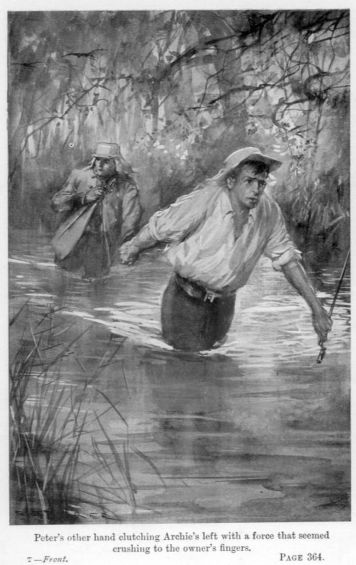
But all the time, short as it was, Peter, with extended arm, was moving sideways in the direction where the boats had been seen, with the bayonet-holding hand stretched out in the direction of his goal, the other clutching Archie’s left with a force that seemed crushing to the owner’s fingers.
Step after step was taken sideways, with the water each minute growing deeper, and as they passed quite clear of the bushes they had left, the water pressed more and more strongly against their breasts, so that they could hardly keep their feet; while as the darkness above the flowing stream seemed to be growing more transparent, Archie turned his head to gaze back in the direction of the overhanging bushes, in the full expectation of feeling a thrust from a spear, when he felt another sudden snatch and tightened his grasp of his comrade’s hand, for Peter had reached deeper water and was borne off his feet, dragging Archie sideways.
Then there came a sharp sound as of metal against wood, a splashing or wallowing that suggested the rush of one of the loathsome reptiles, and Peter gasped out in a gurgling way, as if he had been under water:
“All right, sir. I’ve got hold. Let yourself float down, and make a snatch at the side.”
How it was done Peter did not know, and did not want to. It was enough for him in the darkness that he could feel that his companion had hold of the side of the boat, which had careened over so that the surface of the rippling river was within a few inches of the edge; and there they clung, listening with straining ears, trying to make out whether they had been heard.
“It’s all right, sir,” said Peter softly, as they now rested with their arms over touching the bottom of the boat.
“I don’t know,” said Archie. “I think the stern’s covered in. Is anybody on board?”
“Like enough, sir; but chance it;” and raising himself with a sudden movement which made a loud wallowing and sent a shudder of horror through his companion, Peter drew himself over the rough gunwale, rolled into the bottom of the boat, in company with a gush of water, and then, bayonet in hand, crept over the thwarts and under the attap-covered stern.
“All right, sir,” whispered the lad; and he crept to the far side of the boat, trimming it so that it made Archie’s task of joining him easier to achieve. “Ready, sir?”
“Yes. What about the moorings?”
“I was going to cut the rope, sir,” whispered Peter, “but I won’t. Perhaps it’s a grapnel, and we shall want it again.”
Creeping right to the bows, he began to haul on a roughly made fibre line, which came in readily as the water rippled more loudly against the stem, and the line became more and more perpendicular, till something struck against the frail woodwork of the bows, and, panting with his exertion, Peter drew a little, clumsily made anchor into the big sampan.
“That’s done it,” he whispered. “Hear anything, sir?”
“No; but we are floating down.”
“Lovely, sir. Now then, we shall have to look out, for we mustn’t pass the Doctor’s garden.”
Crack—creak—scrape!
The two lads dropped at full length into the water that was washing about the bottom of the boat, and lay motionless till they had scraped past a boat that seemed similar to the one they had boarded. But it was evidently unoccupied, and they raised themselves up into a sitting position again, and strained their eyes to gaze in the direction of the shore they had left, where all was perfectly still. Then Archie felt his companion’s hand touch his arm.
“Talk about a lark, Mister Archie!” whispered Peter.
“A lark?”
“Yes, sir. I forgot all about the crocs. They must have been asleep.”
Plash—wallow! came from just ahead, as there was a slight jar as if something had been encountered, and a tiny shower of water flew over them.
“Doesn’t seem like it, Pete,” said Archie softly.
“No, sir; and the brute needn’t have done that. I was quite wet enough before. I suppose you are a bit damp?”
“Don’t, Pete—don’t!” whispered Archie. “This is no time for trying to be funny.”
“All right, sir. I thought it was, for I’m in precious low spirits. Think we can manage to stop opposite the Doctor’s garden?”
“We must, Pete; but I can make out nothing. I suppose we are a long way above the landing-place.”
“Oh yes, sir; and perhaps it’s all for the best as we can’t see, for if we could, whoever’s ashore would see us; and that would mean spears, for none of our chaps would be about here.”
“Look here, Pete, we must both watch; but you get right in the bows with the grapnel in your hand, ready to drop it over silently when I say Now!”
“Right, sir; but we must have ever so far to go yet, eh?”
“I am not sure, Pete.”
“No, sir; but you will have to chance it.”
Archie uttered an angry ejaculation, and then clutched sharply at the side of the boat, which shivered from end to end and nearly capsized as it glided up the slanting rope of a larger vessel with which it had come violently in contact. But it righted itself quickly, and scraped along the side, with the lads crouching lower as they listened to the angry, muttering of voices and the scuffling of people moving. But the next minute the river had borne them clear, and the muttering died away.
“That must have been a naga, Pete, from the size of it, and having men on board.”
“Suppose so, sir. I thought it meant a swim for us. But, I say, it must have spoilt somebody’s beauty snooze. But look there, sir! That must mean gardens.”
“What, Pete?”
“Can’t you see them glow-worm things sparkling?”
“Yes.”
“Well, sir, ain’t you going to say Now?”
“No, Pete. We cannot have passed the big landing-place yet. If we have, only just. Yes, that must be it, and this must be the spot. Oh! if we could only see a spark of light from the Residency we should know where we are.”
“Yes, sir; but it’s no use to look out for lights. Still, we must be getting somewhere near, sir, and I’m ready when you are. I must leave it to you, for you know more about boating on the river than I do. It only seems to me that it can’t be long before we shall be opposite the Doctor’s beautiful garden and the little steps at the bottom, where you used to land.”
“Yes, Pete, I must guess, for I can see nothing.”
“Nor me neither, sir; but don’t be huffy because I say what I am going to say.”
“No. Speak out.”
“Then just wait, sir, till you think we are as near as we shall get, and then chance it.”
Archie made no reply as he reached over the side, and, unconscious of the fact that the stream had turned the boat completely round so that she was dropping down now bow foremost instead of stern, he suddenly uttered the word “Now!” and his command was followed by a faint splash and the rattle of the rope passing over the bows, till there was a check, and then they were conscious that the sampan was swinging round again, and Archie uttered a low, groan-like sigh.
“What’s the matter, sir? Didn’t I do it right?”
“Right, my lad? Yes, you were right enough, but I was all wrong. The boat has been gliding along stem first, and I have been confused and looking at the farther shore, seeing nothing but the faint twinkle of the fire-flies.”
“Yes, sir; that’s right enough.”
“No, no; it’s wrong enough, my lad. I’m quite lost. I don’t know where we are. You will have to haul up the grapnel again.”
“But what for, sir? She’s swung round now right enough, head to stream—and look—look!” he whispered. “I can see trees quite plain. We must be close inshore.”
“Close inshore; Pete!”
“Yes, sir. Can’t that be the Doctor’s garden?”
“Hist!” whispered Archie; and there was a sound as if his companion had given his mouth a pat, for from pretty close at hand there was the low babble of voices.
“Hear that, sir?” whispered Peter again. “Our chaps?”
“No—Malays.”
Chapter Forty.
“What About Victuals?”
For a few minutes it seemed as if the success that had attended them was to be completely dashed, though it had become evident that, by a wonderful stroke of good fortune, they had dropped the grapnel of the boat so that they were swinging nearly opposite to the part of the river-bank which had been their goal. For then Fate, which had been filling their breasts with hope, seemed to have withdrawn from them behind a darker cloud than ever.
The voices were so near that they dared not whisper or stir, only wait in the full expectation of being seen and welcomed with a shower of spears; but by degrees the talking ceased, and the silence was so profound that it became evident that the enemy, whatever had been their object in coming there, had silently crept away.
“Do you really think they have gone, sir?” whispered Peter.
“I feel sure of it,” was the reply.
“Then don’t you think we could get out the poles and work the boat closer in?”
“I’m afraid to try, Pete. The stream seems running so strong that we might be swept away.”
“Oh, I don’t know, sir, close inshore like this. I think we might manage it. Hadn’t we better try?”
“Well, yes,” replied Archie, after a little hesitation. “We must use the poles when we go away, unless we try going down-stream.”
“Oh, that wouldn’t do, sir. It would be running right into Rajah Hamet’s nest, even if we didn’t meet Suleiman’s men; and if we didn’t do neither we should have to carry the boxes through them who are surrounding the Residency.”
“We must get them somehow,” cried Archie impatiently.
“Yes, sir. But we ain’t getting them like this.”
For answer Archie seized one of the poles that lay along under the thwarts of the sampan, passed it over the side, and, to his great delight, found that close in to the bank the eddy was so strong that there would be no difficulty in working against the current. This discovery made, the grapnel was pulled up and the sampan thrust in close under the bank at the bottom of the Doctor’s garden.
“Nothing like trying, sir,” said Peter; and landing, he carried the grapnel in to the full extent of the rope and pressed its flukes down into the earth.
This was not done without noise, and the two lads stood listening for a few minutes before proceeding farther. Once satisfied that there were no fresh occupants in the bungalow, Archie led the way in, and the rest of their task proved delightfully easy.
He knew enough of the interior of the Doctor’s home to make for the store-room at once. Everything was open, just as it had been left in haste, and in spite of the darkness they easily found the little, square boxes of cartridges lying exactly as Mrs Morley had described; and each securing two, they were about to hurry down to the boat, when Archie remembered the gun, which, he knew, was hanging over a cabinet in the Doctor’s study.
Placing his two boxes on the floor, he made for the Doctor’s room, took the gun from the hooks where it hung, and hurrying back to the room where he had left the boxes, he found himself alone, for Peter had hastened off with his portion of the load.
There was nothing for it but to wait; but at last his ears were gladdened by the sound of his companion’s hurried footsteps, and together the remainder of the objects of their search were borne down to the boat, which was cast loose, the poles were seized, and they began to stem the current.
The work proved easier than they had anticipated so long as they kept close inshore; but this, they felt, was incurring the greatest peril, for an occasional voice warned them of the presence of enemies close at hand; and after one narrow escape, consequent upon their being hailed by some one in the Malay tongue, they pushed off in despair, to make for the farther bank of the river.
This portion of their journey was not achieved without losing ground, for out beyond the middle there were times when, in spite of the length of the long bamboo poles, they could not touch bottom. But once more close inshore, they began to make better progress, and as they paused for a few minutes’ rest in the thick darkness in a place closely overhung by trees, the question arose as to how long it would be before daybreak, for both felt that the night must be pretty well spent.
“What do you say, Pete?” said Archie.
“Don’t want to say nothing, sir,” was the reply.
“Why?”
“Don’t want to put you out of heart.”
Archie was silent for a few moments.
“You mean that it must be nearly morning now. Speak out.”
“Something of the kind, sir; and I was thinking that it seems too bad to have to make a mess of it at the end.”
“Ah! You think that though we may get across and land with our load on our side of the river, we should have daylight upon us before we could get anything like back to the Residency?”
“Wish I was as clever as you are, Mister Archie,” said Peter in a low, grumbling tone, as he thrust with all his might at the end of his pole.
“What do you mean?”
“You saying just exactly what I was thinking about, sir. How you come to see it all I don’t know.”
“Oh, never mind that, Pete. It’s very horrible, and when we are missing in the morning there will be no end of an upset, and they will think that we have deserted.”
“Haw, haw!” grunted Peter, with another thrust of his pole which hindered the straight course of the sampan. “Them thinking you had deserted, sir? Likely! You ain’t me.”
“Well, Pete, let’s get as high as we can past the place where we got the boat, and then the moment we think that daylight’s coming let’s get across, tie the boat up somewhere under the trees, and lie in hiding till night.”
“Won’t do,” said Peter shortly. “Boat belongs to somebody as ain’t our friends, and when they find it gone they will come hunting along the water-side till they find it, and like as not tell the enemy where we are.”
“You are right, Pete. Then we will find a snug place, and lie in waiting till it’s dark again; and we shall know by then pretty well where we are, and take our measures for a fresh start.”
“That’s right, sir. Glad I was able to do some good—and, I say, it’s getting close to morning.”
“How do you know?”
“By them things as we have heard howling out in the jungle over and over again.”
“I’ve heard nothing,” said Archie.
“I have, sir; and they’re getting quiet now. I heard a tiger once, and crocs over and over again, but I wouldn’t say anything.”
“I had too much else to think of, Pete,” said Archie, as he toiled hard at his pole, causing an eddy more than once, as if some river-dweller had been disturbed.
It was not long after when the notes of the birds began to proclaim the coming day, and the surroundings began to appear so plainly that at the first favourable opportunity the boat was run in beneath the shelter of the overhanging trees and made fast; while, as the day broadened and they peered out across the river, Archie found they were so high up that no object on the farther bank was familiar; and he said so.
“Well, sir, I must leave that to you,” said Peter. “I ain’t done much boating, and have never been so high as this before. Well, from what you say, I suppose we shall be safe till night, and then we are going to get across and land them cartridges somehow or another where they are wanted. We’ve got a lot of hours to wait, though, first.”
“Yes,” said Archie, with a weary sigh.
“Well, then, sir, what about victuals?”
Chapter Forty One.
“If the Powder ain’t damp.”
Morning came with a rush, the rays of the sun seeming to do battle with the mist that floated over the surface of the river. The golden arrows of light cut and broke up the one dense, grey, heavy cloud into portions which floated slowly along, separating more and more, the dull grey growing rapidly silvery, then golden, and the gold becoming suffused with soft light. So beautiful was the scene that, while Archie gazed thoughtfully at its beauty, even commonplace, powder-besmirched Peter sat with his lips apart, staring hard, and then, forgetting himself and their risky position, with its need for concealment, he clapped his hands softly.
“Just look at it, Mister Archie!” he said. “Blest if the place don’t look just like the inside of one of them big hyster-shells that they get the pearls out of!”
“Hush!” said Archie softly.
“Mum!” said Peter. “I forgot; but don’t it look as if the river was boiling hot and the steam rising, and the fire that hots it was shining up through the cloud? I say, nobody could hear me say that,” he whispered.
“I hope not; but for aught we know boats may be floating down, hidden by that mist.”
“Mist—of course, sir! But it do look like steam, and it makes me think of rations and hot coffee. I say, if one feels like this just at daybreak, how’s it going to be by night? Here goes to tighten my belt.”
Peter suited the action to his words, and moved the tongue of his buckle up two holes.
After this the lad sat peering through a dense, green curtain of the beautiful tropic leafage, till by degrees all the mist had floated away with the stream, leaving the water glittering and sparkling in the bright sunshine, and giving the watchers a clear view of the flowing river and the jungle that bowed its pendent branches so that they kissed the water, while farther on tall, rigid palms shot up and displayed their feathery tufts of great leaves, to sway gently in the hot sunshine.
“Let’s see, Mister Archie; don’t seem to be many paths where helephants and things come down to drink. I don’t believe if we were landed there we could get through those woods. I wonder what makes them call them jungles. I suppose it means because the trees are all junged up together so that you can’t get through. If they called it tangle there’d be some sense in it. But that ain’t the worst.”
“What is, then, Pete?” replied Archie, speaking so that his companion in misfortune should not think him surly and distant.
“Why, we have got to carry them four little chesties and the gun right through it in the dark. Well, we’ve got ’em, sir, and that’s what we come for.”
“Yes, Pete; and it will be a relief to get them to the Residency.”
“Yes, sir; and we have got to do it; and that means we shall, somehow.”
The lad ceased speaking, and bent down to shift the four square, solid-looking boxes a little, and as he did so he uttered a low grunt.
“I say, sir, it’s been so dark that we couldn’t tell what we were doing, but lookye here. These ’ere two bottom ones are standing right in the water. It’s to be hoped they are tin-lined, or else what about the cartridges? What do you say to laying them two bamboo poles right across the boat for the day, and standing the boxes on them?”
“Good idea, Pete!” And the two lads busied themselves in placing the boxes so that the moisture would drip away, with the possibility of their getting dry in the sunshine, which was already beginning to fill their shelter with semi-horizontal rays.
“Here, I say, sir, if we had known what a ramshackle old wreck this ’ere sampan is we should have stepped along pretty gingerly while we were poling—at least I should, for it looks to me as if you could shove your foot through anywhere. Look at the sides! Why, they are half-rotten!”
“Yes, Pete; it’s a wonder that the boat did not go to pieces when we ran up against that other one in the night.”
“That it is, sir. Why, if I’d known I believe I should have liked to travel outside, hanging on, with my legs in the water.”
“As a bait to tempt crocodiles, Pete?”
“Oh, I say, don’t, sir! You give one the shivers.”
As the lad spoke he peered over the side of the boat and half drew his bayonet from his belt.
“Might be one of those beauties under the bottom now, sir,” he said half-apologetically. “Nice morning, though, ain’t it? Talking about hanging one’s legs over the side, we might lay them up a bit to dry;” and he set the example of stretching his own out on the seat-like thwart, and sitting silently for a while gazing through one of the openings across the river.
Then, as if being silent wearied him, his tongue began to go again.
“Suppose you can’t make out exactly where we are, sir, can you?”
“No, Pete; the river winds about so.”
“Of course, sir. Well, no wonder—it ain’t got anything else to do. Got your watch, sir?”
“Yes;” and Archie drew it out from his pocket.
“What time is it, sir?”
“One,” said Archie dryly.
“Can’t be, sir. Why, that means afternoon, and the sun’s only just up.”
“It means that it was one o’clock when we waded into the river, and the water got in, Pete.”
“Stopped! I’m blest! If you had thought of it, sir, you’d better have left it at home. ‘Home, home, sweet home!’” hummed the lad. “But this ain’t home, and I’m precious hungry; but I’d a deal rather be here, after all, than in the old whitewashed barracks where we were stationed last, with nothing but drill, drill, drill, till one felt as if they had drilled a hole right through you. Feel anything of your head now, sir?”
“Yes, Pete; but not much.”
“That’s the same with my hurt, sir; but one can’t expect what we got to get well directly. Wish we’d got something to do, if it was only to clean one’s buckles and lay on a bit of pipeclay. Is my face dirty, sir?”
“Horribly, Pete. Is mine?”
Pete showed his teeth in a broad grin.
“Well, it would be all the better for a wash, sir, before you went in to mess. We might have a bit of a sluice. But I suppose it would be risky to try and get closer in to the bank?”
“You couldn’t, Pete. It would be impossible to force the sampan through this tangle. Why do you want to move? We are in a capital place.”
“I was thinking of getting some soft mud out of the bank to use instead of soap. It’s wonderful cleansing, sir. I know what I should like to do.”
“Not talk, Pete, for you are doing that now?”
“Yes, sir, I know,” said the poor fellow sadly. “I feel as though if I didn’t go on saying things and thinking of doing something, I should go half-dotty.”
“Nonsense, Pete! See how beautiful it is all round.”
“Yes, sir, lovely! But who’s going to enjoy it when your inside keeps on saying, ‘Soup and ’tater—soup and ’tater—soup and ’tater,’ and there ain’t none? Plenty of croc soup, of course. But, I say, Mister Archie, sir, think it would be safe to bathe?”
“No; but I think you must be half-dotty, as you call it, to propose such a thing.”
“Right, sir. Of course! It does look very pretty about here, but one can’t help feeling that one of them pretty, smiling creatures may be lying in there, just where the leaves touch the water, and watching us all the time. Here, I should like to murder some of them. What do you say to fixing bayonets on the end of them bamboo poles, and then pitching leaves or bits of dead wood into the water as a bait for them reptiles, and having a bit of sport to pass away the time?”
“I don’t feel much disposed for sport, Pete.”
“Course you don’t, sir; but, you see, we’ve got hours and hours to sit here till it’s dark. One feels as if one must do something. Here, I know! Capital! I’ve got no tackle but green leaves. I’ll clean that gun.”
“No cleaning-rod, Pete.”
“Must be, sir.”
“Of course; but it will be hanging up somewhere in the Doctor’s bungalow.”
“Might cut a young, thin bamboo, sir,” said Pete, looking sharply round, and feeling in his pocket for his knife.
“I can see no bamboos,” said Archie—“nothing but crooked boughs.”
“Well, anyhow, sir, we might rub the specks of rust off with leaves. Would you like to have first turn?”
“No, Pete. I feel as if I could do nothing but sit still and rest and think.”
“What about, sir?”
“What they are saying about us at the Residency. I suppose they will give us the credit of not deserting.”
“Course they will, sir. They will be saying that we are lying speared somewhere not far from headquarters. My word, sir, won’t Mrs Morley take on about losing you, sir! And, oh dear! nobody won’t miss me—except old Tipsy. Haw, haw, haw! He’d like to have me to bully-rag when he gets back to headquarters again.”
“Will nobody else miss you, Pete?”
“No, sir—I d’know, though. Yes—old Mother Smithers, next time she has a chance to have a turn at the wash-tub. It will be, ‘Now, Pete, fresh water, please.’ Wish she’d got some of what’s in this precious boat! Talk about a leaky sieve! Why, it’s coming in everywhere. We shall have to begin baling soon, Mister Archie. To be sure; that will be next job after I’ve rubbed up the gun, and— This ’ere ain’t a fruit-tree, is it, sir?”
“Absurd!”
“Suppose it is, sir. I was thinking of cocoa-nuts and getting one down to bale with. I shall have to use my cap. It’s wonderful how it’s stuck on. I ketched it slipping off twice, though, when we were creeping through the wood.”
Peter reached for the gun, and began to rub the barrels with such leaves as he could pick; but after trying to polish for some time, he shook his head in despair.
“Only making it worse, sir.—I say, Mister Archie, you are not going to sleep, are you?”
Archie, who was resting one hand on the side of the boat and bending down sideways, rose quickly.
“Hist!” he whispered. “Listen.”
Peter sat motionless for some little time, and then, looking full in his companion’s eyes, shook his head slowly. Then a look of intelligence came into his face, and he nodded two or three times quickly, leaned forward, and placing his lips close to his companion’s ear, he whispered:
“Poles! Boat coming up-stream.”
The two lads sat thinking of their own slow advance as they had punted upwards in the darkness, and fully understood the effort that was being made to force the advancing boat against the running water.
Then the same thought must have animated both, for after peering through the leaves by which they were surrounded, each lay back upon the thwart he occupied and cautiously began drawing one of the thick boughs that touched the water closer in so as to increase the shelter; but no sooner had Archie begun to disturb the water at the side of the boat than there was a violent disturbance, and something dashed out into the open river.
“Croc,” whispered Peter, “or some large fish. Wish I had him on my bayonet, sir. I could eat him raw.”
“Hist!” whispered Archie, for the sound of splashing poles was giving place to the regular beat of oars; and crouching low, wondering whether their shelter would be pierced by the keen eyes of the enemy, they lay waiting, listening to the steady plash and the muttering of voices, which grew louder, and, looking bright in painted gold, with the rowers’ silken bajus gleaming gold and yellow in the sunshine, a large dragon-boat glided by, so close to the lads’ hiding-place that the rowers’ blades on their side nearly swept against the leaves, and they could see the gleam of the eyes and glint of spears, for the boat was crowded with armed men, and beneath the palm shelter in the stern they could note the gaily plaided silken sarongs of the principal leaders of the party of Malays.
Feeling that they must be seen, the lads hardly dared to breathe till the gilded stern of the naga had passed; and even then it seemed as if the steersman was looking back straight through the hanging leaves so that he must detect the boat.
At last both were breathing freely, for the plash of oars was growing more distant, and Peter, who had found it horribly painful to remain silent so long, hazarded a few words.
“Felt as if my heart was in my mouth, sir. But do you know what I was thinking all the time?”
“That they must see us, Pete?”
“Of course, sir; but something else.”
“Speak lower, man!”
“All right, sir; they can’t hear. But can’t you guess?”
Archie shook his head.
“Well, I’ll tell you, sir. Here’s a double gun; there’s four boxes of cartridges. Why haven’t you got it loaded and ready to blow a couple of the enemy overboard, and then click, click, shove in two more cartridges, as I should hand to you, ready for two more shots? That would be enough to send them to the right-about, for they wouldn’t know but what there might be half a company of us hiding here.”
“How are we to get at the cartridges, Pete?” said Archie, brightening up, for his companion’s words sent a thrill of hope through his breast, and their position seemed not half so defenceless as before.
“I’ve got my knife, sir.”
“What! to cut through the lid?”
“No, sir. It’s screwed down. I think I could turn the screws with the big blade.”
Taking one of the boxes on his knee, he brought the blade to bear, but dared not put forth all his force, and for some time he could not get even one of the fastenings to move, for the water had made the wood swell.
“It’s no use, Pete.”
“Oh, ain’t it, sir? They are in precious tight, but we have got lots of time; and look—the top of this box is steaming, and it’s drying fast. I shall do it if I don’t break my knife.”
Click!
“There, now, if half-an-inch of the blade ain’t gone! And I thought it was a bit of the best stuff in our company. Well, there’s a bit left to work with, and I must try and cut through.”
“No, no!” cried Archie eagerly. “Try if the broken blade will not go into the ends of the screws.”
“What! and use it as a screw-driver, sir?” cried Peter joyously. “Why, it will be quite easy now. Call mine a head! Why, it’s as thick as a bowl. Here, take it coolly, sir! Here’s one coming out as easy as easy.—There’s one! Don’t shout ‘Hooray!’ sir, for sound runs along over the water like a skate on ice. Why, my knife is like a real tool. Couldn’t have broke off better, sir, and in half-an-hour we shall be all right if—”
“If what, Pete?”
“The powder ain’t damp.”
Chapter Forty Two.
“Don’t you know me?”
To the great satisfaction of both, the upper layers of the cartridges proved to be quite dry, and, at Peter’s suggestion, they made sure of having a couple of dozen handy by bestowing them in various pockets.
“All right for present use, sir,” said Peter; and placing in a few leaves to refill the box, he lightly screwed down the lid again.
“It’s a pity to do that,” said Archie.
“Think so, sir? We have got to get those boxes down to the Residency, and it might happen that we should be obliged to hide them somewhere. Anyhow, what we’ve got out will be handy. Now then, I want it to get dark. What do you say to one of us taking an hour’s snooze?”
“By all means, Pete. It will help us to get through the long watching before night. There, I could not sleep now. You lie down while I keep watch.”
“Oh no, sir; you first.”
“Don’t argue, Pete. I say, lie down,” said Archie sternly.
“Right, sir. But you will play fair? Rouse me up in an hour, and let me relieve guard.”
“I will, Pete. We both want rest, and we shall do our work the better afterwards.”
Peter promptly prepared the only dry place he could find, which was in the stern of the boat, by dragging down a portion of the bamboo and palm-leaf awning and laying the pieces across so as to form a little platform, where he stretched himself out, and before a minute had elapsed he was breathing so heavily that his companion began to peer up and down the river and think of the possibility of the sleeper being heard. But nothing was in sight downward, and he now found that by changing the position of the boat a little he could command a long reach upward—quite a mile.
The guessed-at hour grew into what must have been two, and amidst the annoyance of flies, and troubled by the intense heat, Archie sat watching and thinking, and wondering whether it would be possible as soon as it was dark to thread their way among the bushes of the opposite shore and carry their burden to the help of their friends.
“It’s all what Pete calls chancing it,” he said to himself; “but we may succeed—and we will.”
At last, just as he was thinking that it might be wise to awaken Pete for an exchange of places, he suddenly caught sight of a large boat in the extreme distance, gliding round a slight curve, and after watching it increase in size as it came rapidly down, he laid a hand on Peter’s arm, and the lad started up, fully awake.
“Relieve guard, sir? Right! Give us the gun,” said the lad quietly; and then, following Archie’s pointing finger, he realised the new peril, and withdrawing his hand, he drew out his bayonet and replaced it ready for instant use.
A glance showed the pair that they could do nothing more to add to their concealment, and with the boat rapidly nearing, they sat and watched, Archie with the cocked piece lying across his knees ready for their defence in case of need.
During the first part of the time their impression had been that it was the dragon-boat they had seen going up, but as it drew nearer they made out that it was manned by Malays, evidently of the poorer classes, but well-armed and in all probability followers of some minor chief.
To the lads’ great satisfaction, it seemed that they were hugging the farther shore, and they passed by travelling slowly, without even looking in their direction, and glided out of sight.
“Lucky for some of them, Mister Archie,” said Peter, as he stretched out his hand for the gun and crept forward. “There you are, sir. I feel like a new man. Have a good sleep, sir. It helps the time along beautifully. How did you guess an hour, sir?”
“Never mind about the time, Pete. You guess another as nearly as you can; but wake me, of course, if there is any danger.”
“You trust me, sir,” was the reply; and Archie lay down, feeling that the position would be restful, but certain that he should not be able to sleep.
Five minutes had not elapsed, however, before he was sleeping heavily, but ready to awaken at a touch and sit up, to stare about him wildly.
“Why, Pete,” he said angrily, “I have had more than an hour.”
“Well, just a little, sir. Feel all the better for it, don’t you?”
“Why, you scoundrel,” cried Archie as he readied for the gun, “it’s close upon evening—close upon night! How dare you disobey my orders? Why didn’t you wake me up?”
“Hadn’t the heart, sir,” said the lad quietly.
“But I said—”
“Yes, I know you did; and I was going to wake you up half-a-dozen times, but I knowed how weak you were, and that you would want every bit of strength for what we have got to do to-night; and I didn’t want you to break down.”
“Am I your officer, sir, or am I not?” said Archie fiercely.
“Yes, sir, of course; and I know I ought to obey the word of command. But you don’t want me to do impossibilities, now, do you, sir?”
“What do you mean?”
“Why, sir, you don’t want me to carry you and the cartridge-boxes too?”
“No; I should carry my share, of course.”
“Yes, sir; but I should be having Paddy’s load. You would be carrying the boxes, but I should be carrying you and the boxes too.”
“Pete—” began Archie fiercely; but he was checked by the lad’s action, for with one hand he pointed up the long reach, and with the other he placed the gun across the subaltern’s knees.
“A boat!” said Archie.
“Two on ’em, sir;” and they sat gazing up through the gathering gloom of their shelter at what the last faint rays of the setting sun showed to be a large sampan coming down the river, urged by a couple of Malays who were steadily using their poles, while some distance behind a boat about double the size was following them, propelled by oars.
“It will be all right, sir,” said Peter. “By the time they come by here it will be getting dark. Look at that farther one. The attaps looked red just now, but they are turning brown already.”
“Yes; and look there. Why, Pete—am I right? It seemed as if one of the Malays in the front of the far boat stood up and threw a spear.”
“Right you are, sir, and no mistake. There goes another. Can you see how many there are in the first boat?”
“Three, I think; and one’s a woman.”
“I thought two of them,” said Peter; “and there’s eight or ten or a dozen in the other. Well, sir, the far-off one must be enemies, and the little boat must be friends. I know which side we ought to take, and we can now.”
“What do you mean? Fire?”