Part 1 — III
Reading edition
CLUB LIFE AMONG OUTCASTS
I
One of the first noticeable features of low life is its gregariousness. To be alone, except in a few cases where a certain morbidity and peculiar fondness for isolation prevail, is almost the worst punishment that can befall the outcast. There is a variety of causes for this, but I think the main one is the desire to feel that although he is forbidden the privileges and rights of a polite society, he can nevertheless identify himself with just as definite and exclusive a community as the one he has been turned out of.
His specialty in crime and rowdyism determines the particular form and direction of his social life. If he is a tramp he wants to know his partners, and the same instinct prevails in all other fields of outlawry. In time, and as he comes to see that his world is a large one,—so large, in fact, that he can never understand it all,—he chooses as he can those particular "pals" with whom he can get on the easiest. Out of this choice there develops what I call the outcast's club. He himself calls it a gang, and his club-house a "hang-out." It is of such clubs that I want to write in this chapter. I do not pretend to know all of them. Far from it! And some of those that I know are too vile for description; but the various kinds that I can describe, I have chosen those which are the most representative.
II
Low life as I know it in America is composed of three distinct classes, and they are called, in outcasts' slang, the "Kids," the "Natives," and the "Old Bucks." The Kids, as their name suggests, are boys and girls, the Natives are the middle-aged outcasts, and the Old Bucks are the superannuated. Each of these classes has clubs corresponding in character and purpose to the age of the members.
The clubs of the Kids are composed mainly of mischievous children and instinctively criminal children. As a rule, they are organized by boys alone, but I have known girls also to take part in their proceedings. The lads are usually between ten and fifteen years old. Sometimes they live at home with their parents, if they have any, and sometimes in lodging-houses. They get their living, such as it is, by rag-picking, selling newspapers, blacking boots, and doing odd errands fitted to their strength. None of them, not even the criminally inclined, are able to steal enough to support themselves.
To illustrate, I shall take two clubs which I knew, one in Chicago, and one in Cincinnati. The Chicago club belonged exclusively to a set of lads on the North Side who called themselves the "Wildcats." The most of them were homeless little fellows who lived in that district as newsboys and boot-blacks. They numbered about twenty, and although they had no officially elected leader, a little fellow called Fraxy was nevertheless a recognized "president," and was supposed to know more about the city and certain tricks than the rest, and I think it was he who started the club. He was an attractive lad, capable of exercising considerable influence over his companions, and I can easily understand how he persuaded them to form the club. For personality counts for as much in low life as it does in "high life," and little Fraxy had a remarkably magnetic one. He drew boys to him wherever he went, and before going to Chicago had organized a similar club in Toledo, Ohio.
The club-house of the Wildcats was a little cave which they had dug in a cabbage-field on the outskirts of the city. Here they gathered nearly every night in the week to smoke cigarettes, read dime novels or hear them read, tell tales, crack jokes, and plan their mischievous raids on the neighboring districts. The cave contained a brickwork stove, some benches, some old pots and cans, one or two obscene pictures, and an old shoe-box, in which were stored from time to time various things to eat.
The youngest boy was ten and the oldest fourteen, and as I remember them they were not especially bad boys. I have often sat with them and listened to their stories and jokes, and although they could swear, and a few could drink like drunkards, the most of them had hearts still kind. But they were intensely mischievous. The more nuisances they could commit the happier they were; and the odd part of it all was that their misdemeanors never brought them the slightest profit, and were remarkable for nothing but their wantonness. I remember particularly one night when they stoned an old church simply because Fraxy had suggested it as sport. They left their cave about nine o'clock and went to a stone-pile near at hand, where they filled their pockets full of rocks. Then they started off pell-mell for the church, the windows of which they "peppered 'n' salted" till they looked like "'skeeter-nettin's," as Fraxy said. The moment they had finished they scampered into town and brought up at various lodging-houses.
They never thieved or begged while I knew them, and not one of them had what could be called a criminal habit. They were simply full of boyishness, and having no homes, no parents, no friends, no refined instincts, it is no wonder that they worked off their animal spirits in pranks of this sort. Sometimes they used to take their girl friends out to the cave, too, and enlist them for a while in the same mischievous work that I have described; but they always treated them kindly, and spoke of them as their "dear little kidsy-widsies." The girls helped to make the cave more homelike, and the lads appreciated every decoration and knickknack given them.
Every city has clubs like this. They are a natural consequence of slum life, and to better them it is first necessary to better the slums themselves. Sunday-school lessons will not accomplish this; reading-rooms will not accomplish it; gymnasiums will not accomplish it; and nothing that I know of will accomplish it except personal contact with some man or boy who is willing to live among them and show them, as he alone can, a better life. There are many young men in the world who have remarkable ability, I believe, for just such work, if they would only go into it. By this I do not necessarily mean joining some organization or "settlement"; I mean that the would-be helper shall live his own individual life among these people, learn to understand their whims and passions, and try to be of use to them as a personal friend. If he is especially adapted to dealing with boys, he has only to take up his residence in any slum in any city, and he will find plenty to do. But whatever he does, he must not let them think that he is among them as a reformer.
III
The club in Cincinnati was of a different kind. It is true that it consisted of young boys, and that some of them were boot-blacks and newsboys, but in other respects they were different. Their club name was the "Sneakers," and their hang-out was an old deserted house-boat, which lay stranded on the river-bank about a mile or so out of town. Some of them had homes, but the majority lived in lodging-houses or on the boat. When I first knew them they had been organized about three months, and a few of them had already been caught and sent to the reform school. Their business was stealing, pure and simple. Old metals were the things they looked for chiefly, because they were the handiest to get at. They had had no training in picking pockets or "sly work" of any particular sort, but they did know some untenanted houses, and these they entered and cut away the lead pipes to sell to dealers in such wares. Sometimes they also broke into engine-houses, and, if possible, unscrewed the brass-work on the engines, and I have even known them to take the wheels off wagons to get the tires. Their boat was their storehouse until the excitement over the theft had subsided, and then they persuaded some tramp or town "tough" to dispose of their goods. They never made very much profit, but enough to keep up interest in further crimes.
I became acquainted with them through an old vagabond in Cincinnati who helped them now and then. He took me out to see them one night, and I had a good opportunity to learn what their club was made of. Most of the lads were over fourteen years of age, and two had already been twice in reform schools in different States. These two were the leaders, and mainly, I think, on account of certain tough airs which they "put on." They talked criminal slang, and had an all-wise tone that was greatly liked by the other boys. They were all saturated with criminal ideas, and their faces gave evidence of crooked characteristics. How they came to club together is probably best explained by the older vagabond. I asked him how he accounted for such an organization, and he replied:
"Got it in 'em, I guess. It's the only reason I know. Some kids always is that way. The divil's born in 'em."
I think that is true, and I still consider it the best explanation of the Sneakers. They were criminals by instinct, and such boys, just as mischievous boys, drift together and combine plots and schemes. I know of other boys of the same type who, instead of stealing, burn barns and outhouses. Young as they are, their moral obliquity is so definitely developed that they do such things passionately. They like to see the blaze, and yet when asked wherein the fun lies, they cannot tell.
How to reform such boys is a question which, I think, has never been settled satisfactorily. For one, I do not believe that they can ever be helped by any clubs organized for their improvement. They have no interest in such things, and none can be awakened strong enough to kill their interest in criminal practices. They are mentally maimed, and practically belong in an insane asylum. In saying this I do not wish to be understood as paying tribute to the "fad" of some philanthropic circles, which regard the criminal as either diseased or delinquent—as born lacking in mental and moral aptitudes, or perverted through no fault of his own. Without any attempt to tone down the reproach of criminality, or to account for the facts by heredity or environment, it still remains true that in thousands of cases there is as direct evidence of insanity in a boy's crimes and misdemeanors as in a man's, and I firmly believe that a more scientific century will institute medical treatment of juvenile crime, and found reform schools where the cure of insanity will be as much an object as moral instruction and character-building.
IV
Club life among the Natives,—the older outcasts,—although in many respects quite different from that of the Kids, is in some ways strikingly similar. There are, for instance, young rowdies and roughs whose main pleasures are mischief and petty misdemeanors, just as among the young boys in Chicago. But in place of breaking church windows and turning over horse-blocks, they join what are called "scrappin' gangs," and spend most of their time in fighting hostile clubs of the same order. They are not clever enough as yet to become successful criminals; they are too brutal and impolite to do profitable begging, and as rowdyism is about the only thing they can take part in, their associations become pugilistic clubs.
How these originated is an open question even among the rowdies themselves. My own explanation of their origin is this: Every community, if it is at all complex and varied, has different sets of outcasts and ne'er-do-wells, just as it has varieties of respectable people. In time these different sets appropriate, often quite accidentally, territories of their own. One set, for example, will live mainly on the east side of a city, and another set on the west side. After some residence in their distinct quarters, local prejudices and habits are formed, and, what is more to the point, a local patriotism grows. The east-sider thinks his hang-outs and dives are the best, and the west-sider thinks the same of his. Out of this conceit there comes invariably a class hatred, which grows, and finally develops into the "scrappin' gangs," the purpose of which is to defend the pride of each separate district. In New York I know of over half a dozen of these pugnacious organizations, and they fight for as many different territories. I have seen in one club young and old of both sexes joined together to defend their "kentry," as they called the street or series of streets in which they lived. The majority of the real fighters, however, are powerful fellows between the ages of eighteen and twenty-two. Sometimes they live at home, and a few pretend to do some work, but most of them are loafers, who spend their time in drinking, gambling, and petty thieving. They usually sleep in old tenements and cheap lodging-houses, and in the daytime they are either in the streets or at some dive supported mainly by their patronage.
I knew such a place in the city of New York, on the East Side, and not far from the Brooklyn Bridge. It was kept by an Irishman, and he had no customers other than those belonging to a "scrappin' gang" called the "Rappers." There were two rooms—one fronting on the street, and used as a bar-room; the other, in the rear, was the gambling-and "practisin'"-room. Here they came every night, played cards, drank stale beer, and exercised themselves in fisticuffing and "scrappin'." I visited them one night, and saw some of their movements, as they called the various triangles and circles which they formed as strategic guards when attacking the hostile gangs of the West Side. One of them they nicknamed the "V gag," and prided themselves on its efficiency. It was simply a triangle which they formed to charge the better into the ranks of their enemies, and it reminded me strongly of football tactics.
That same night they were to scuffle with a West-Side gang called the "Ducks," as one of their members had been insulted by one of the Duck gang. Battle was to be joined in a certain alley not far from Eighth Avenue, and they started out, their pockets full of stones, in companies of two and three, to meet later in the alley. I accompanied the leader, a fellow called the "slugger," and reached the alley about eleven o'clock. He wanted me to give my assistance, but I told him that I could play war correspondent much better, and so was excused from action. And it was action indeed. They had hardly reached the battle-ground before the Ducks were upon them, and rocks flew and fists punched in a most terrific manner. Noses bled, coats were torn, hats were lost, and black eyes became the fashion. This went on for about fifteen minutes, and the battle was over. The Rappers were defeated fairly and squarely, but, as the slugger said, when we were all at the hang-out again, "we mought 'a' licked 'em ef we'd 'a' had 'em over here."
Such is the "scrappin' gang." Every large city supports one or two, and London has a score of them. They make some of its districts uninhabitable for respectable persons, and woe to the man who tries to interfere with them. As their members die or grow old, younger fellows come forward, often enough out of the very boys' clubs I have described, and take the place of the departed heroes. This is what rowdies call life.
Like the famous Studenten-Corps in Germany, they need some sort of rough excitement, and the bloodier it is the happier they are. They have so much heart in them that no ordinary exercise relieves it, and they institute these foolish fighting clubs. It is possible that some sweet-natured philanthropist might go among them and accomplish wonders. In London the Salvation Army has done some splendid work with these same rowdies, and I know personally several who are to-day respectable working-men. But as for organizing polite clubs among them on any large scale, I think it impossible.
V
Among the other Natives, club life, as a rule, centers around the saloon, where they gather to exchange news bulletins and meet their cronies. There are varieties of these saloons, corresponding to the varieties of outcasts, and in Chicago there are over twenty, each one of which is supported by a different clique and species; but these are not exactly clubs. The saloons are meeting-places more than anything else, or a sort of post-office. In the main they are very much like any other saloon, except that their clientèle comes principally from the outcasts' world; and about all the life they afford is a boisterous joviality, which seldom takes definite shape. It is proper to say right here that criminal outcasts, as a rule, never form clubs so marked in individuality as the "scrappin' gang." The thief, the burglar, the pickpocket, and other "professionals," although gregarious and friendly enough, do not organize simply for the sake of sociability. When they combine it is more for the sake of business than anything else, and whatever social life they seem to need is furnished them at the saloon or some private hang-out. This is also true to a great extent of all the Natives who have passed their thirtieth year. At that age they are usually so sobered, and have seen so much of the world, that they cannot get much pleasure out of the clubs that the younger men enjoy. The "scrappin' gang" no more appeals to them as a pastime or a source of happiness than it does to an old rounder. They feel happier in simply sitting on a bench in a saloon and talking over old times or planning new adventures. Whatever excitement remains for them in life is found mainly in carousals. Of these I have seen a goodly number, but I must confess that after all they are only too similar to carousals in high life, the only noticeable difference being their greater frequency. They occur just about four times as often as anywhere else, because the outcast, and especially the criminal, is intensely emotional; he can never live very long without some kind of excitement, and the older he grows the more alluring become his drinking-bouts. When his opportunities in this direction are shut off by jail-walls, he improvises something else, which often takes organized form; but it must be remembered that such organizations are purely makeshifts, and that the members would rather sit in some low concert-hall or saloon and have an old-time drinking-bout, if circumstances were only favorable.
VI
The most interesting of these impromptu clubs is the one called in the vernacular the "Kangaroo Court." It is found almost entirely in county jails, in which petty offenders and persons awaiting trial are confined. During the day the prisoners are allowed the freedom of a large hall, and at night they lodge in cells, the locks of which are sometimes fastened and sometimes not. The hall contains tables, benches, daily papers, and, in some instances, stoves and kitchen utensils. The prisoners walk about, jump, and play various games. After a while these games become tiresome, and the "Kangaroo Court" is formed. It consists of all the prisoners, and the officers are elected by them. The positions they fill are the "judgeship," the "searchership," the "spankership," and general "juryship." To illustrate the duties of these various officials, I shall give a personal experience in a county jail in New York State. It was my first encounter with the "Kangaroo Court."
I had been arrested for sleeping in an empty box-car. The watchman found me and lodged me in the station-house, where I spent a most gloomy night wondering what my punishment would be. Early in the morning I was brought before the "squire." He asked me what my name might be, and I replied that "it might be Billy Rice."
"What are you doing around here, Billy?" he queried further.
"Looking for work, your Honor."
"Thirty days," he thundered at me, and I was led away to the jail proper.
I had three companions at the time, and after we had passed the sheriff and his clerk, who had noted down all the facts, imaginary and otherwise, that we had cared to give him about our family histories, we were ushered pell-mell into the large hall. Surrounded in a twinkling by the other prisoners, we were asked to explain our general principles and misdemeanors. This over, and a few salutations exchanged, a tall and lanky rogue cried out in a loud voice:
"The Kangru will now k'lect."
There were about twenty present, and they soon planted themselves about us in a most solemn manner. Some rested on their haunches, others lounged against the walls, and still others sat quietly on the flagstones. As soon as entire quiet had been reached, the tall fellow, who, by the way, was the judge, instructed a half-grown companion, whom he nicknamed the "searcher," to bring his charges against the newcomers. He approached us solemnly and in a most conventional manner, and said:
"Priz'ners, you is charged with havin' boodle in yer pockets. Wha' does you plead—guilty or not guilty?"
I was the first in line, and pleaded not guilty.
"Are you willin' to be searched?" asked the judge.
"I am, your Honor," I replied.
Then the searcher inspected all my pockets, the lining of my coat, the leather band inside my hat, my shoes and socks, and finding nothing in the shape of money, declared that I was guiltless.
"You are discharged," said the judge, and the jury-men ratified the decision with a grunt.
A young fellow, a vagrant by profession, was the next case. He pleaded not guilty, and allowed himself to be searched. But unfortunately he had forgotten a solitary cent which was in his vest pocket. It was quickly confiscated, and he was remanded for trial on the charge of contempt of the "Kangru." The next victim pleaded guilty to the possession of thirty-six cents, and was relieved of half. The last man, the guiltiest of all, although he pleaded innocence, was found out, and his three dollars were taken away from him instanter; he, too, was charged with contempt of court. His case came up soon after the preliminaries were over, and he was sentenced by the judge to walk the length of the corridor one hundred and three times each day of his confinement, besides washing all the dishes used at dinner for a week.
After all the trials were over, the confiscated money was handed to the genuine turnkey, with instructions that it be invested in tobacco. Later in the day the tobacco was brought into the jail and equally divided among all the prisoners.
The next day I, with the other late arrivals, was initiated as a member of the "Kangaroo Court." It was a very simple proceeding. I had to promise that I would always do my share of the necessary cleaning and washing, and also be honest and fair in judging the cases which might come up for trial.
Since then I have had opportunities of studying other "Kangaroo Courts," which have all been very much like the one I have described. They are both socialistic and autocratic, and at times they are very funny. But wherever they are they command the respect of jail-birds, and if a prisoner insults the court he is punished very severely. Moreover, it avails him nothing to complain to the authorities. He has too many against him, and the best thing he can do is to become one of them as soon as possible.
Other clubs of this same impromptu character are simple makeshifts, which last sometimes a week, and sometimes but a day, if a more substantial amusement can be found to take their place. One, of which I was a member, existed for six hours only. It was organized to pass the time until a train came along to carry the men into a neighboring city. They selected a king and some princes, and called the club the "Royal Plush." Every half-hour a new king was chosen, in order to give as many members as possible the privileges which these offices carried with them. They were not especially valuable, but nevertheless novel enough to be entertaining. The king, for instance, had the right to order any one to fill his pipe or bring him a drink of water, while the princes were permitted to call the commoners all sorts of names as long as their official dignity lasted. So far as I know, they have never met since that afternoon camp on the prairies of Nebraska; and if they are comfortably seated in some favorite saloon, I can safely say that not one of them would care to exchange places with any half-hour king.
A little experience I had some time ago in New York will show how well posted the Natives are regarding these favorite saloons. I was calling on an old friend at a saloon in Third Avenue at the time. After I had told him of my plan to visit certain Western cities, and had mentioned some of them, he said:
"Well, you wan' ter drop in at the Half in State Street when you strike Chi [Chicago]; 'n' doan' forget Red's place in Denver, 'n' Dutch Mary's in Omaha. They'll treat you square. Jes left Mary's place 'bout a week ago, 'n' never had a better time. Happy all the while, 'n' one day nearly tasted meself, felt so good. There's nothin' like knowin' such places, you know. 'F you get into a strange town, takes you a ter'ble while to find yer fun 'less yer posted. But you'll be all right at Red's 'n' Mary's, dead sure."
So the stranger is helped along in low life, and the Natives take just as much pride in passing him on to other friends and other clubs as does the high-life club-man. It gives them a feeling of importance, which is one of their main gratifications.
VII
A GATHERING OF "OLD BUCKS."
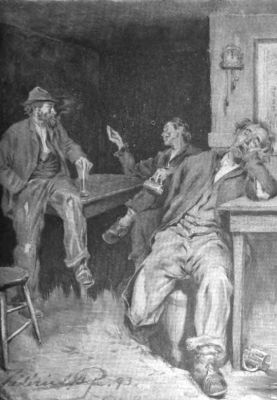
Of the Old Bucks,—the superannuated outcasts,—and their club life, there is very little to say. Walk into any low dive in any city where they congregate, and you can see the whole affair. They sit there on the benches in tattered clothes, and rest their chins on crooked sticks or in their hands, and glare at one another with bloodshot eyes. Between drinks they discuss old times, old pals, old winnings, and then wonder what the new times amount to. And now and then, when in the mood, they throw a little crude thought on politics into the air. I have heard them discuss home rule, free trade, the Eastern question, and at the same time crack a joke on a hungry mosquito. A bit of wit, nasty or otherwise, will double them up in an instant, and then they cough and scramble to get their equilibrium again.
MIDNIGHT.
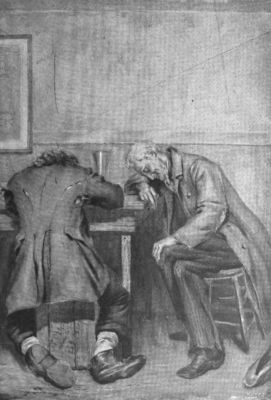
Late at night, when they can sit no longer on the whittled benches, and the bartender orders them home, they crawl away to musty lodging-houses and lie down in miserable bunks. The next morning they are on hand again at the same saloon, with the same old jokes and the same old laughs. They keep track of their younger pals if they can, and do their best to hold together their close relationships, and as one of their number tumbles down and dies, they remember his good points, and call for another beer. The Natives help them along now and then, and even the boys give them a dime on special occasions. But as they never need very much, and as low life is often the only one they know, they find it not very difficult to pick their way on to the end. If you pity them they are likely to laugh at you, and I have even known them to ask a city missionary if he would not take a drink with them.
To think of enticing such men into decent clubs is absurd; the only respectable place they ever enter is a reading-room—and then not to read. No, indeed! Watch them in Cooper Union. Half the time their newspapers are upside down and they are dozing. One eye is always on the alert, and the minute they think you are watching they grip the newspaper afresh, fairly pawing the print with their greasy fingers in their eagerness to carry out the rôle they have assumed. One day, in such a place, I scraped acquaintance with one of them, and, as if to show that it was the literary attraction which brought him there, he suddenly asked me in a most confidential tone what I thought of Tennyson. Of course I thought a good deal of him, and said so, but I had hardly finished before the old fellow querulously remarked:
"Don' cher think the best thing he ever did was that air 'Charge of the Seventeen Hundred'?"
VIII
I have already said that, so far as the older outcasts are concerned, there is but little chance of helping them by respectable clubs; they are too fixed in their ways, and the best method of handling them is to destroy their own clubs and punish the members. The "scrappin' gang," for example, should be treated with severe law, whenever and wherever it shows its bloody hand, and if such a course were adopted and followed it would accomplish more good than any other conceivable method. The same treatment must be applied to the associations of other Natives, for the more widely they are separated and thus prevented from concourse the better will it be. It is their gregariousness which makes it so difficult to treat with them successfully, and until they can be dealt with separately, man for man, and in a prison-cell if necessary, not much can be accomplished. The evils in low life are contagious, and to be treated scientifically they must be quarantined and prevented from spreading. Break up its gangs. Begin at their beginnings. For let two outcasts have even but a little influence over a weak human being, and there are three outcasts; give them a few more similar chances, and there will be a gang.
I would not have any word of mine lessen the growing interest in man's fellow-man, or discourage by so much as a pen-stroke the brotherly influences on the "fallen brother" which are embodied in neighborhood guilds and college settlements of the present, but I am deeply convinced that there is a work these organizations cannot, must not, do. That work must be done by law and government. Vice must be punished, and the vicious sequestrated. Public spirit and citizenship duly appreciated and exercised must precede philanthropy in the slums. Government, municipal and State, must be a John the Baptist, preparing the way and making the paths straight, ere the embodied love of man and love of God can walk safely and effectively therein.