Part 2 — II
Reading edition
WITH THE RUSSIAN GORIOUNS
I
It was not my intention, in going to Russia, to tramp there. I planned merely to see St. Petersburg and Moscow, work for a while on Count Tolstoi's farm at Yasnaya Polyana, and then, after a short trip in the south, return to Berlin. I did all these things according to expectation, but I also made a tramp trip. It happened in this way: I had no more than reached the Russian capital when the tramp was forced upon me. As I jumped into the cab with my friend, who had come to the train to meet me, he pointed out about twenty tattered and sorry-looking peasants, marching by us under police escort.
"There go some Goriouns," he exclaimed—"look quick!"
I had only to follow the men with my eyes to know that they were Russian tramps.
"What are the police doing with them?" I asked.
"Oh, they probably have no passports and are to be sent back to their villages."
"Are there many tramps in Russia?"
My friend laughed. "Thousands of them. You can hardly go into a village without meeting them. They are one of the greatest problems Russia has to deal with."
I soon saw also that I could not even approach a church without being accosted by them. They stood on the steps and at the doorway of every one I visited, and invariably begged of me, saying, "Radi Krista" ("For Christ's sake"). Even at Yasnaya Polyana, fifteen miles from the nearest town, and several minutes' walk from a highway, the Goriouns put in an appearance. I was there ten days, and at least one called every morning. They all seemed to know about Count Tolstoi's gospel, and came to his home, sure, at least, of something to eat. On the highway, at some distance from the house, I saw bands of ten and twenty marching by every day, and they often camped at a bridge which I crossed on my walks.
This continual meeting the tramp and hearing about him naturally made me curious, and I wondered whether it would be possible to make a journey among them. I knew enough Russian at least to make myself understood, and could understand much that was said to me. The great question, however, was whether, as a foreigner, I should be allowed to make such a trip. I talked with Count Tolstoi one day about the matter, telling him some of my experiences in other countries, and asking his advice.
"Why not?" he said, in his jovial, pleasant way. "Of course you will have hard work in understanding their dialects, and you can hardly expect to be taken for one of them, but otherwise you ought to get on easily enough. From your pass and other papers the police will see that you are nothing dangerous, and if anything should happen, all you have to do is to send to St. Petersburg. I should like to make such a trip myself, if I were younger. I'm too old now. Once I went on a long pilgrimage and saw a good deal of the life, but of course you will see much more if you go directly into the tramp class. If you decide to make the trip, I wish you would find out how they look upon the authorities, and whether they really believe in what they call their religion. It ought to be very interesting to talk with them on these topics, and perhaps you will be able to gather some useful material—only you will not be permitted to print it here in Russia"; and he smiled.
I finally decided to make a trial trip, and was fortunate in finding a Moscow student who was willing to accompany me for a few days. He had tramped perforce in some of the southern provinces, and being much interested in the tramp class in the Vitebsk government, consented to go with me if I would begin my investigations there. I was fortunate also in having brought a tramp outfit with me. It had already seen service in England, Germany, and Italy, and I had taken it along for work in the fields at Yasnaya Polyana. It was a little better than the usual Gorioun dress, but I should really have been ashamed to put on anything shabbier. My friend the student was clad in a patched university uniform, which all of his class have to wear in Russia, and he looked like pictures I have seen of ragged Union soldiers in Libby Prison. We both had a little money in our pockets, and it was not our intention to beg for anything more than bread and milk, and not even for these things unless it was necessary to make good our pose. We reasoned that the peasants of whom we should have to ask for them needed them much more than we did, and I am glad to say that neither of us on this trip, nor I on others, which were sometimes made alone, asked for much that we did not pay for.
Our credentials for the journey consisted of our passports, some university papers, and an open letter which I had received in St. Petersburg from Prince Chilkoff, the Minister of Ways and Communication. It was addressed to the director of the Siberian Railway, but I kept it by me for the sake of identification, and it helped me through many a predicament, although the officials to whom it was presented could never get it through their heads how I, an Amerikanski tramp, could be in the possession of such an almighty document. There were times, I fear, when they were tempted to arrest me as an impostor, but they never did—a good fortune which I can only explain on account of the singularity of the situation. The Russian "system" was evidently not prepared for so weird a creature, and I was allowed to pass as an anomaly.
With the Moscow student I tramped for three days in the Vitebsk government, between the towns of Polotsk and Dünaburg, as dreary a stretch of country as is to be found anywhere in our West. It was warm August weather, and the sun came down on us in all its Russian fierceness. There were times when I simply had to get under a tree to keep from sun-stroke. At night we slept out of doors, or in haystacks and barns. The peasants always offered us the hospitality of their cabins, as they do to all tramps, but we could not bring ourselves to put up with the vermin we should have found there. In winter, on the other hand, the Gorioun is glad enough to curl up over their stoves, and I suppose that we also should have been, had the weather been cold. As it was, most of the vagabonds we met slept outside, as we did, and we always had plenty of company. On this trip we met two hundred, traveling in bands and families. They invariably wanted to know where I came from, which is the first question they ask, after the greeting, "Strassvuitye," and I told them the truth on each occasion. "America—America," they would say in their simple way. "What government is that in?" meaning what Russian province. I could not make them understand that it was not in Russia at all, which to them is the entire world, but they called me "the far-away brother," and I was probably considered a new species in their class. I never had the feeling that they accepted me as one of their own,—it would have been strange if they had,—but they, at any rate, dubbed me "brother," and this was as much as I could ask. They always wanted to share their simple fare with me, and I soon saw that there was but little danger in associating with them.
II
There are two types of tramps in Russia, and they may be classified as the authorized and the unauthorized. The first are the so-called religious mendicants, who are protected by the church and tolerated by the police; the second are the common vagabonds. It is these last who constitute, from the Russian point of view, the tramp problem. The religious beggars are considered an inevitable church class, and are taken care of almost as conscientiously as the priests. The common tramps, on the other hand, are looked upon as a very unnecessary burden, and ever since the conversion of Russia to Christianity, laws have been passed and institutions founded for their suppression and reform. It is estimated that in European Russia alone they number over nine hundred thousand, and in Siberia their class represents an even greater proportion of the population.
Their national name among themselves is "Goriouns"—mourners, or victims of grief. The word is an invention of their own, but is supposed to come from the Russian word gore, meaning sadness. In Russian proper they are called brodiagi. If you ask them why they do not work,—and the great majority are perfectly able to do so,—they reply in the forlornest voice mortal ever heard: "Master, I am a Gorioun—a victim of sorrow." They seem to have accepted the philosophy that a certain number of human beings are foreordained to a life of misery and sadness, and they pose as members of this class. On many of their passports I saw such expressions as "Burned out," "Has lost all his relatives," "Has no home," "Will die soon," "Is possessed of the pitiful spirit," and others of a like nature, which they bribe officials to write, or themselves forge. I could have had similar explanations put on my own passport. There are tramps who make a regular business of this kind of imposture, and it is another evidence of how difficult it is to make even a passport tell the truth. In Germany the same trick is practised by tramps, and in both countries the beggar can buy false passes which the police cannot detect. I saw several in Russia which looked exactly like the genuine thing, and, had I wished to appear to be a Russian, could have bought one any day for ten rubles.
In looks and dress the Gorioun acts out to a nicety the story which his papers are supposed to substantiate. Never have I seen such sad faces as these men and women have when begging. At heart they are capable of considerable fun and boisterousness, but they affect a look of despondency, which many of them retain even when off duty. In other respects they resemble very closely the ordinary peasant, or muzhik. They all have an immense shock of hair, parted in the middle and chopped off roughly at the edges. The face is generally covered with a huge beard, which gives them a backwoodsman look not always indicative of their character. In America, for instance, they would be taken by tramps for "Hoosiers," but, in their way, they are just as clever and sharp as the hobo who would laugh at them. Indeed, I know of no hobo who can equal them in facial trickery and disguise, and wherever this is the necessary qualification for successful begging they are past masters. Their clothes are invariably rough and patched, and if by some chance they get a good suit it is pawned or sold immediately. The usual peasant shirt or blouse takes the place of a coat, and the trousers are tucked into the boots also in peasant fashion. A tea-pot hangs at the belt, and a bundle, containing all their possessions, is slung over the shoulder. Thus they tramp about the country from village to village, year in and year out, and are always distinguishable from the fact that on meeting a Gospodinn (gentleman), or any one else of whom they can beg, off come their greasy caps, down go their great shocky heads, and they say, "Radi Krista."
SLEEPING IN A BARN.
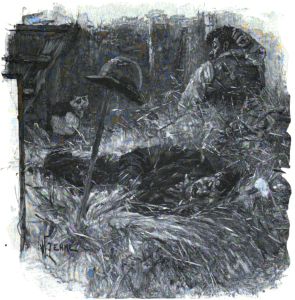
When tramping on the highway, they average about fifteen miles a day, but a great many never make over five. One old man on the Kursk road, between Tula and Orel, told me that he was satisfied if he covered three versts a day,—a verst is two thirds of a mile,—and he expected that it would take him the entire autumn and part of the winter to reach Odessa, whither he was bound. In this respect the Goriouns are like all other vagabonds; they love rest, and if they find a good place, stick to it as long as possible. In the country they make their homes with the peasants, sleeping in summer in sheds and haystacks, and in winter in the peasants' cabins. Plagues though they are, the peasant always gives them shelter, and it very seldom happens that they die of cold or starvation in districts thickly populated. I could have stopped for days in every village I passed through, and the peasants would even have protected me from the police if it had been in their power. Their own life is so hard that it comes natural to take pity on the tramp, and they all have the feeling that favors thus shown prepare a place for them in the heaven of their imagination. Indeed, the Gorioun plays on this feeling in begging of them. I often heard him say, in asking for alms: "It will help you out above"; and his humble friends seemed pleased to be thus assured.
Men predominate in the Gorioun class, but in no other country that I have visited are there so many women and families "on tramp." They are all mixed up together, men, women, and children, and no great effort is made to keep even the families intact. I was told by tramps that in the peasants' cabins there is very little separation even between the peasants and the vagabonds, and on cold nights they all curl up in a heap on the tops of the great piles of masonry which serve them as stoves. In large cities they live in lodging-houses and night-shelters. In St. Petersburg these places are found mainly in what is called the "Siennaia," about five blocks behind the Kazan cathedral. There are entire alleyways and courts in this district given up to the Goriouns, and in one house alone, Dom Viazemski, over ten thousand lodge every night. They have the right to return to their planks at any time during the day, and speak of them as their homes—their dom. The cost of a "spot" on the benches is thirty-five copecks (about twenty cents) a week, in advance.
The life that goes on here is pretty much the same as in lodging-houses everywhere, but there are a few peculiar features to be noticed. In the first place, there is a chief, or ataman, of the Goriouns of each room, and he is given the rights and privileges of a bully. He is the strongest and most daring of all, and his companions allow him to play "the almighty act," as the hobo would say, in their confabs and councils. Any tramp who refuses to knuckle down to him is considered either a spy or a rival candidate, in which latter case he must fight it out with fists, and sometimes with knives. If he is successful he takes the ataman place, and holds it until some one else dislodges him. In case he is taken for a spy he is shunned by all concerned, and I was told that every year several men are killed on this suspicion. When an actual raid by the police is planned, the ataman generally gets wind of it beforehand, and all lights are put out before the police arrive. They can then accomplish very little, and while I was in St. Petersburg several of their attempted raids ended unsuccessfully.
Another queer custom is the way each man takes care of his boots. In every country the Schuhwerk, as the Germans say, is prized, perhaps, more than any other part of the wardrobe, but the reason in St. Petersburg is unique. Thanks to his boots, the Gorioun can be enrolled as a torch-bearer or mourner at funerals, and this is one of his most lucrative employments. The agencies which manage funerals recruit from the tramp class so many mourners for each interment; about thirteen thousand are employed in this way every year. The agencies furnish the suitable clothes and pocket-handkerchiefs—everything, in fact, but the shoes, which the tramp must be able to show on his feet, or he will not be hired. When a funeral is "on," the tramps gather at the Nikolski market, and are selected by an employee of the agency. Those chosen are conducted to the house of the deceased, and there, under a porch, in a shed, or even in the court, ten, twenty, or thirty of them, according to the elaborateness of the funeral, undress themselves entirely, even in the dead of winter, and put on the mourner's garb. Their own clothing is rolled up in a bundle and taken to the cemetery in a basket, where, after the ceremony, it must be put on again. The promised wage for this service is forty copecks a man, but with tips and drinks it usually amounts to a ruble. The St. Petersburg street-gamins have a way of crying out, "Nachel li?" ("Hast thou found it?") to the Goriouns as they file along—an allusion to their daylight torches. Some very funny scenes take place when the boys get too saucy; for the men forget, in their anger, the solemnity of the situation, and, dropping their torches, run after the boys, much to the consternation of the agency and the family concerned.
The funeral over and the money in their pockets, they return to the lodging-house for an uproarious night spent in drinking vodka. When the last drop is gone, they fall over on their planks senseless, and to see them in this condition makes one fancy he is looking on in a morgue. They lie there as if dead, and the stench in the room could not be worse if they were actually in a state of decay. One would think, under such circumstances, there must be a heavy percentage of sickness and mortality among them, but I think this is not true. I saw a number of crippled and deformed beggars, but otherwise they seemed a fairly healthy lot, and never anywhere have I seen such herculean bodies. Many of them looked as if they could lift an ox, and in one of the few squabbles that I witnessed, they knocked one another about in a way that would have done honor to professional pugilists. However, these knock-down fights are not frequent. For a people so degraded they are phenomenally sweet-tempered; in England and America, tramps with their strength would be measuring it on all occasions.
In the lodging-houses, as in the peasants' cabins, men and women are mixed up together, and there seems to be no effort at all to keep them separated. They say that they are married, or "belong to the family," and the Starosta (proprietor) allows them to keep together. Their children—and each couple has its full share—are used for begging purposes; indeed, they are the winning card of the Russian tramp. If they are deformed or crippled, so much the better.
The food of these tramps is probably the simplest bill of fare known among European vagabonds. On the road they seldom have more than black bread and milk, and even in towns they are satisfied with the addition of a dish of potatoes. Meat they know very little about, and it almost never occurs to them to spend their money for a good steak; they prefer to buy vodka. Of course there are exceptions to this rule; in every country there are beggars who keep up with the latest styles and indulge in a gourmet's dishes, but they are not common in Russia.
There is another trait of the Goriouns to record—their clannishness. In almost every government of the empire they are organized as compactly as a trade-union, and even in St. Petersburg, strict as the police are, they have their peculiar artel. It was impossible for me to become a member of these corporations. I should have had to knuckle down very submissively to some ataman, or bully, and this I was not willing to do. It would also have been necessary to learn the different dialects, and I had all I could do to make use of my small Russian vocabulary. Each artel has its own peculiar lingo, and it is almost as hard to learn as Russian itself. Even the native inhabitants know very little about such dialects, and the students who traveled with me had as much difficulty as I did in understanding them. Fortunately, however, the tramps can also speak Russian, and we generally conversed with them in this language. I give here what I learned about their various artels, but it is in no sense an exhaustive report. There are many of which I heard nothing, and it would take a book to describe them all.
In Moscow one of the most notorious clans is the so-called "Gouslitzki," or "Old Believers," who came originally from the district of Bogorodsk. They are mixed up with the regular working population of the town and have no particular sign by which a stranger could distinguish them, but their business is entirely criminal. They counterfeit money, forge passports and baptismal certificates, beg and steal, and the police have to keep a continual watch over them. Ostensibly their business is manufacturing trinkets, colored images, and toys, but these are merely subterfuges to gain them the privilege of standing on the sidewalks as hawkers. In their lodging-houses—and there are several supported by them alone—they live under the direction of a head man whom they must obey, and a certain percentage of their day's earnings has to be contributed to a common fund. From time to time this fund is divided equally among all the members of the organization, but it is almost immediately given back as "renewed stock." The Gouslitzki are unlike most of their class in being very parsimonious, and they have the reputation of drinking very little—some not at all. They speak two languages, Russian and a dialect which is practically their mother-tongue. They have been settled in Moscow for generations, and the police find it impossible to drive them out.
The "Chouvaliki," another well-known gang, are mainly peasants, but they come also from the Moscow government, being settled in the districts of Veresisk and Mozhaisk. It would be very peculiar in America to see a band of farmers starting off on begging and marauding trips, but this happens in Russia, and the Chouvaliki are of this class. In the census of Russia they are put down as peasants, and they do pretend to work a part of the year, but they are known from Moscow to the Don as the begging Chouvaliki. They go on the road twice a year, and exploit by preference the governments of Tamboff, Voronesh, and so on down to the Don. The Russians call them brigands, and tell frightful stories about their robberies, but the Goriouns spoke of them merely as beggars, and I fancy this is what they are. On returning from their trips, which last sometimes several weeks, they spend in one orgy all the money they have taken in.
It is in White Russia, and above all in the government of Vitebsk, farther north, that the tramps form these beggars' organizations. During my journey through the Vitebsk government I heard of them right and left, and it is this district that contributes largely to the criminal population of St. Petersburg. The rich Ukraine is also a notorious haunt. At Kharkoff, for instance, I got into a regular nest of them, called "Tchortoff Gniezda" (Nest of Devils). They live there in dirty little cabins and underground caves, a close community with its ataman and common funds. They start out in the morning on their begging trips, and return at night for debauches, those who have been most successful inviting their rakli, or pals, to celebrate with them. There is a careful division, or douban, of all the spoils taken in during the day, and each one receives his share, minus the contribution to the common tribe.
In Kazan, the Tatar town on the Volga, there is an artel of beggars whose origin goes back to the taking of Kazan by Ivan IV, and they are known all over Russia as the "Kazanskia Sieroty" (the Kazan Orphans). Although Mussulmans, they beg "in the name of Christ" ("Radi Krista"). They will beg even from other beggars if they do not belong to their organization, and consider everybody their prey who is not an "Orphan." They can only be compared to the tramps who exploit the governments of Samara and Saratoff, and those coming from fifteen villages of the districts of Saransk and Insarsk, in the government of Penza. These last, although officially peasants, are all organized into narrow begging corporations, and call themselves "Kalousni," which comes from their dialect word kalit, meaning "to reap," or, as they would say, "to beg." In Moscow, on the other hand, the generic dialect term for beggars is "Zvonary," which comes from zvonit, also meaning "to beg."
The Kalousni, or "Reapers," start out on their begging trips in their wagons immediately after harvest. All of them who can move, excepting the very oldest and youngest, depart for "the work," as it is called. Those who have no blind or deformed children of their own rent them in neighboring villages. The village of Akchenas is the center of this trade, and peasants send their deformed children there to be marketed off. In the Galitzin village, in the government of Penza, amounting to three hundred cabins, five hundred of the inhabitants are peasant beggars; in Akchenas, one hundred and twenty cabins, there are only four persons who are not "Reapers"; in Germakoff, another hamlet of the district, there is not an inhabitant who does not go kalit (begging). The return of these bands to their homes is celebrated by fêtes and orgies. The main one is on November 8, St. Michael's day, when they spend every copeck they have collected. The next trip takes place in winter, and they return to their villages by Lent. The third return is just before Pentecost.
Although I did not tramp in Siberia, I traveled there and heard much of the local tramps. They are not so definitely organized as in European Russia,—many travel entirely alone,—but I saw and heard of several categories. On the highway between Ekaterinburg and Tiumen the traveler is accosted by beggars known as the "Kossoulinski." They live exclusively by begging, and in summer sleep out of doors along the route between the towns mentioned. At Ekaterinburg there are also unnamed gangs of young men and little boys and girls who are continually begging of the inhabitants. They are generally the children of deported convicts, or those of peasants who were driven by famine out of neighboring districts.
If I could have got into the wooded parts of Siberia I might also have made the acquaintance of that queer product of Siberian prison life, the runaway convict tramp. Early in the spring he makes a dash for liberty, sometimes being shot down in the attempt, and then again succeeding. He runs to the woods and lives there until autumn, when, if there is no hope of getting back to European Russia, he gives himself up and returns to prison again. In the spring, "when the birds call him," as one of his songs pathetically relates, he makes another dash for the trees. Only at night does he venture into the villages, and then merely for a moment to snatch the food left for him on the window-sills by the generous-hearted peasants. He grabs the bread, or whatever it is that they have set out, and then scampers back to the woods like a wolf.
III
Religious beggars in Russia are a class by themselves. In giving alms to them the average Russian thinks that he is making so much more likely his welcome in heaven, and they, of course, stand by him in the conceit. If you give them a ruble they will swear that you are going to heaven, and even twenty copecks make one's chance pretty good.
The most easily distinguished type is what is called the religious lay mendicant. He is always standing around the churches in St. Petersburg and Moscow, and everybody who has visited these cities will recall him. He is generally an old peasant, begging for some village church, and the police or church authorities give him the necessary passes and stamped documents. He stands at a church door or near some shrine, bareheaded and with a little plate in his hand, covered with cloth on which is embroidered the cross. This is a passe-partout wherever he goes, and serves as an excuse for entering restaurants, railway-stations, and other public places. As a Russian gentleman said to me: "You can't drive a man out with the cross in his hand," and he is consequently allowed to go pretty much where he pleases. Unfortunately, however, it is not very difficult to imitate him, and there are a number of Goriouns in Russia, posing as religious lay mendicants. They counterfeit the necessary papers, buy the plate and cross, and then beg with all their might. Occasionally they are discovered and severely punished, but the winnings from this kind of begging are so tempting—sometimes as much as ten rubles, or five dollars a day—that they are willing to run the risk. There are also monk beggars who proceed in the same way as those of the lay order, except that they wear monk costumes. It is consequently not easy for the common tramp to imitate them, but it has been done.
Authorized and permitted though these monks are, there is but little need for them to beg, for their convents are almost without exception rich. The more they have, however, the more they want, and so the monks are sent out to beg of poor and rich alike. An amusing story is told of how one of these convents was relieved of some of its superfluous wealth. During the Crimean War Nicholas I borrowed ten million rubles from the Laura monastery at Kieff, and gave in exchange his note like any other mortal. Alexander II, after coming to the throne, made a tour of the provinces and visited Kieff, where, according to custom, the first thing he did was to call at the Laura. He was received by the metropolitan and clergy in great array, and during the ceremony the note of Nicholas was presented to him, of course for payment, on a beautiful plate. He took the bit of paper, read it carefully, and then, holding it high in the air, said in a very solemn voice: "Behold the most touching proof of the patriotism of Russia's clergy when she has need of them! I cannot better thank you than by giving you, as a glorious memento, this autograph of my august father." And that ended the matter for all time.
The pilgrims are another type of religious beggar. They also are mainly old peasants, who have made a vow to go afoot to some distant shrine, often a thousand miles away. They take with them only money enough to buy candles to place at the altars where they worship en route, and trust to the mercy of the people they meet for food and shelter. No peasant would refuse them hospitality, and they are taken in whenever they appear. Money is never offered them, because it is known that they will not accept it. All they want is food enough to keep body and soul together, and this they feel free to ask for.
These pilgrimages are very frequent in Russia, and are always the result of a vow, made sometimes many years before. Each famous monastery, like the Soloviecki, near the White Sea, the Troitzke, near Moscow, the Laura, at Kieff, and many others, has its days of "grand pardon," which attract pilgrims from the farthest points of the empire. They travel invariably on foot, and occasionally in bands, but the typical pilgrim goes alone. His destination is sometimes even Jerusalem. This is often the case among devoted monks, who make this the last act of a life consecrated to the church. The peasants feed and shelter the pilgrim, and he is one of their main objects of veneration.
There is one more class of authorized beggars in Russia—the nuns. These women, with long robes and pointed bonnets, generally travel in couples. They beg on what is called the "contract system." An arrangement is made with a convent by which they are allowed to exploit certain districts, and they agree in return to give the convent a certain percentage of their winnings; all over this amount belongs to them personally. They are taxed according to their ability, the percentage varying from one to three rubles a day. When they are young and pretty, which they sometimes are, they do very well. As a Russian who has often given to them said to me: "You can't give copper to a pretty woman," and they know wonderfully well how to make their attractions tell. They are acquainted with all the "good places," and learn quickly to discern the generous giver. There is no doubt, however, that much is given them without any thought of the church or religion, and it is an open secret in Russia that there is a great deal of corruption among them. I myself saw them in a state of intoxication several times, and their conduct was not at all in keeping with their religious calling.
IV
Something remains to be said about the causes of vagabondage in Russia and what is being done to suppress it. The religious mendicants must be left out of the discussion, for they are not supposed to be a part of the problem. It is the Gorioun class that the Russians are particularly anxious to be rid of, and it is they who correspond to the tramp class in more Western countries.
The love of liquor is the main cause of their degradation. Two thirds could be made respectable men and women if they were free of their passion for drink, and until they are, I see no hope of bettering them. They will even steal from the churches, religious as they are, if impelled by thirst for vodka, and it is simply impossible for an employer to have anything to do with them. In St. Petersburg a large number of them are discharged mechanics and day-laborers, who know perfectly well how to earn their living, but have lost position after position on account of their loose habits. The minute they get a week's wage, they go off and spend it for drink, and then there is no place for them.
Besides this strictly individual cause, there are certain economic facts which help to explain the situation. The lowering of railroad fares has started a regular hegira of peasants toward the towns, where they imagine that they are to make their fortunes. We think in America that a great deal might be done to change the lot of outcasts if they could be led back to the country and settled on farms, but Russia teaches us plainly enough that this alone will not suffice. There must be something besides country air and surroundings to offset the attractions and temptations of city life. In Russia it has been found that after the peasant has once experienced these attractions he is never happy on the farm.
Over seven thousand peasant tramps are sent away from St. Petersburg every year, but a still larger number find their way back. There is a case on record where a man was sent away one hundred and seven times and returned after each expulsion. When one takes into consideration that the majority of all those thus sent away receive new clothes before leaving, it is easy to see what an expense they are to the town, and the most of them sell their new clothes at the first opportunity. This is one of the weakest points in all the Russian methods with tramps. The police return vagabonds to their villages, expecting them thus to be kept away from city temptations, but the trouble is that they cannot hold them there. They run back to the towns the first chance they get, and then there has to be another expensive expulsion. Lately some of the governors of inland districts have petitioned the police to stop doing this, explaining that tramps thus returned corrupt their village companions.
Besides returning a beggar to his village, there are also light punishments. If he is arrested for the first time in St. Petersburg, he is brought before a commission, by which he is questioned and then handed over to a more special committee, before which he must submit to another cross-questioning. If he can prove that he has been driven to beg by poverty alone, he is recommended to the care of the poor authorities of his district. If he has been arrested several times before, he is taken immediately to a justice, by whom he is condemned to a punishment, varying, according to circumstances, from a month's to three months' hard labor in prison. These are only such beggars as have been caught in the act, so to speak, and have papers certifying to their identity. Those who are found without passports are taken in hand by the police alone. If nothing very bad is found against them, they are allowed to go free, if some one will stand sponsor for them; in this case they must send to their home authorities for a passport, and if it is received they can remain in the town for a period of three months. It is possible with good conduct to have this term of probation prolonged to nine months, but after that, unless very good reasons are given, the man must return to his village.
There are also reformatory and charitable institutions which seek a regeneration of the tramp on philanthropic grounds. Recently a number of workhouses have been put up in the largest towns, and great hopes are placed in these very praiseworthy undertakings. The present empress has taken them all under her personal protection, and there is every likelihood that they will be well supported. The effort is thus made to offer every tramp a chance to work; they are to serve as a test-house where the Gorioun can show what he really is. He is not compelled to make use of them, but if it should be discovered that he knew about them and still begged, he would be punished very severely.
Both men and women are received, and they can earn their daily bread by working for it. Lodging must be found elsewhere, but children can be left during the day in a crèche belonging to the institution. Father John of Kronstadt is credited with having founded the first of these workhouses, but it is only lately that they have become popular. If well managed they ought to do good, for the great question in Russia, as well as everywhere else, is to find out who the really deserving are, and the workhouses can be of great assistance in developing the facts. How much they will aid in lessening the professional vagabondage of the country remains to be seen. If the police—and everybody knows what powers the Russian police have—are unable to accomplish this, it is hardly likely that the workhouses can do much more. Indeed, I fear that nothing can root out entirely this class in Russia. It is too old and settled to give up the struggle without a long resistance, and there are traditions dear to all Russians which will forever aid the Gorioun in his business. A Russian prince with whom I talked about the possibility of getting rid of the tramp class said to me: "It is simply out of the question. We are all beggars, every mother's son of us. The aristocrat begs a smile of the czar, and others ask for honors, positions, decorations, subsidies, and pensions, and it is these beggars who are the most persistent of all. Russia is the land of na tchai ["for tea," like pour boire in French, and Trinkgeld in German], and no laws or imperial ukase will ever make it any different."