GENERAL CHARLES KING (continued 3)
Reading edition
Two minutes more and the adjutant, Strong, came running from the platform. "Don't unsaddle," he shouted. "Bring those horses back and get some more! Send the escort up here at once!"
The officers at the lookout had not even unslung their pistol belts, and Willett now was seen to set down his binocular and start away. The general called to him and he half turned and hurriedly answered: "Back just as quick as I can get my Colt, sir." He was unfastening his blouse at the throat as he went, and even at the distance men could see how hot and flushed he looked, while the others seemed so hard, "tried out" and fit for anything. Presently the half dozen horsemen, who had been with their chief to the Picacho, came trotting forth from the corral, followed by two or three led horses. Strong mounted the first to reach him and sent another to his quarters for Lieutenant Willett. Then Captain Bonner came strolling back as though quite unconcerned. "May as well get the men under arms," said he to his alert first sergeant, and away went every man of Company "C" on a run for the barracks.
"Needn't wait for Willett," the general was heard calling to Strong, who, with a little party, sat in saddle eagerly awaiting orders. So down the slope they went, just as the doctor and Mrs. Archer, apprised in some way of the excitement, came forth and saw the dust cloud in their wake, and the snorting troop horse pawing the sand in front of Strong's. Old Bucketts, the quartermaster, came limping up the line, his florid features a deeper red, and all he could tell in answer to question was, "They see something beyond the Point. Who's that horse for, orderly?"
"Loot'nt Willett, sir—said he'd be out in a minute."
But the minutes proved long, and Bucketts went in to help, if need be, and to get information, if possible. Willett had kicked off his fine uniform trousers and ununiform Oxfords, and was cursing the striker who had hidden his scouting rig. "Why the devil didn't you go as you were?" asked Bucketts unsympathetically. "They're raising the dust far as the ford already. What's up, anyhow?"
"Can't tell! Don't know! Nobody knows! They send scouts out—couriers out—messengers out, and spend hours wishing somebody'd come with news, and then when somebody's seen coming get rattled and send half the garrison out to meet——"
But suddenly catching sight of the disapprobation on his caller's face, Willett broke off short. No wonder Buckett's looked astonished at such language from a staff officer. Nor was that veteran questioner long in sizing up the cause. It added nothing to his respect for Willett, and not a little to his concern. He knew by this time, as did almost every man except the post commander, how and where Willett spent the night and morning—knew that he had left the store only an hour or so previous, as though to follow and find the bookkeeper—knew that Case had been drinking, and saw now that Willett had been following suit. Without a word on that head, or another question as to the causes of the excitement, he stumped about the premises, busying himself in hunting for the missing items, and presently found them hanging under a calico curtain that Willett had already nearly torn down in unsuccessful, unseeing search. "Here you are," he said, tossing the garments on the bed. "Here's your pistol, Colt's 44; every chamber loaded and ready for business. You'll use a different belt when you've been a month in Arizona—and you'll shed top boots for 'Patchie moccasins. Let me help you, Willett. You're a bit blown. Here, douse your head in that——" and as he spoke Bucketts half filled a bowl and went limping out to the olla for more and cooler water, leaving Willett fussing at his riding breeches and damning Strong's striker for being away among the gaping, staring, empty-headed gang at the bluff at the moment he was most needed.
As Bucketts was lifting the vessel from the cool depths of the hanging reservoir, he heard his name faintly called, and there, at the side door of the doctor's quarters, pale and suffering, barefooted and mantled with a sheet, his arm and shoulder bandaged, stood Harris.
"Tell Willett to come out," he said. "I must see him before he goes."
"You go back to bed. I'll tell him," but Harris stood his ground despite the fact that the attendant had laid a hand upon his unbound shoulder, and was begging him to return. Bucketts set the pitcher inside the door. "Here's cooler water, Willett," he said, "and here's Harris at the door—says he must see you before you start."
Then, without waiting for answer, the quartermaster hurried along the path to the front in search of the doctor; saw him far over back of the hospital, heading for the platform; saw Mrs. Archer, on her own veranda by this time, in eager talk with Mrs. Stannard, and Lilian drooping at the corner pillar; hurried back to get his stick and to further rebuke Harris, when, afar down to the south-east came the sound of a shot, half-muffled by distance, and, gazing from the rear end of the little gallery, he saw, a mile or more away across the stream and skirting the willows, two horsemen coming at top speed; saw, emerging from the willows at the near side of the ford, a man who walked heavily through the yielding sand, holding his hand to his face. He, too, had heard the shot and was making, 'cross lots, for home. It was Case, the bookkeeper, disturbed, perhaps, said Bucketts, in his siesta among the willows and doing his best to gain shelter. Before Case could get a fourth of the way across the barren flat, tacking perceptibly among the cactus and grease wood, the riders burst in sight again and went lashing away to the store—two ranchmen or prospectors, said Bucketts, and they've been having the time of their life getting in. 'Tonio said the Tontos were all about them, and here was additional proof. The last Bucketts saw of Case he was lurching on toward the store, but, just then, buttoning his riding jacket and girding on his revolver belt, out came Willett.
"Well, what is it?" was his brief, almost sullen question. And then came his classmate's answer—one that Bucketts long remembered.
"You are going up the valley, I take it, and there is an alarm of some kind. Now, Willett, remember this: no matter what you have seen or suspect, the Apache-Mohaves had no part in the devil's work at Bennett's. I have 'Tonio's word for it, and will bring proofs."
"Damn 'Tonio's word! He's a renegade and a deserter himself! He's playing a deep, double game, and you yourself suspected it three days ago. Now he's proved it. I've no time to talk." And impatiently he turned away and sprang for his horse. A moment more and he was in saddle, had set spurs to his excited mount, and then, full gallop, went tearing to the edge of the mesa, lifted his hat in salutation to the general, and dove down the slope, across the lower bench, away through an upper ford of the sluggish winter stream, and out upon the sandy flats beyond.
"Rides well," said the general, looking after him.
"Rides very well," said the surgeon, looking after Strong. "Can you see anything yet, sir?"
"Could see two horses ten minutes ago, with some running figures far up the valley. Can't make 'em out at all. Strong'll fetch 'em—Strong and Willett. Good stock there, doctor!"
"Tiptop, where Strong is concerned," said the doctor grimly. The events of the earlier afternoon had tended to add to his disapprobation of the other. "There's something up at the store, sir, I think," he added, with a swift change of subject. "I saw men running that way just now. Here comes Bucketts!"
And Bucketts came, hobbling sturdily. "It's two ranchmen, I think, and there was a shot down toward the south-east ten minutes ago."
The general looked back. Down in front of the log barracks Bonner's company, in fatigue dress, had formed ranks, and the sergeants were distributing ammunition. Across the parade, the verandas of the Mess and office buildings were deserted, but one or two men stood staring toward the invisible plant of the trader. Close at hand, near the hospital and again lining the edge of the mesa, a score of yards farther to the left, a number of soldiers of the other company were eagerly watching developments. Even with the naked eye, two miles or more up the valley, Strong's little detachment, black dots of skirmishers, could occasionally be sighted pushing on northward, while, at heavy gallop, heading for the front, Willett was still in plain view; but, at the moment, nothing could be seen of the objects that were the original cause of the excitement.
From the Picacho, it seems, both Strong and Bonner had made out through their glasses two tiny black dots in the direction of Bennett's ruined ranch, coming slowly toward the post, but still five or six miles away. From the platform, forty minutes later, two horsemen had distinctly been seen moving swiftly about, close to the willows that lined, in places, the rocky stream bed. More than this, the general was sure he had caught sight of three or four figures afoot, skipping actively about when moving at all. What he and his advisers believed was that Sergeant Woodrow and his comrades were, for some reason, trying to make their way back to Almy and had found Apaches barring the way. Therefore had Strong and his little party been sent forth to meet, to aid, to bring them in. Therefore had Willett, of his own motion this time, and without the delegated authority he bore when following Harris, set forth at speed to overtake them, forgetful, in the eagerness of the moment and the possible over-excitement of his faculties, that he had promised Archer to be back just as soon as he'd got his Colt—that calibre 44 Colt now belted at his hip, with every chamber loaded.
And now as the eager watchers at the platform trained their glasses on the distant field, Bucketts, taking up the handsome binocular left by the aide-de-camp, had time to notice its fine silver mounting and the engraved "H. Willett, U.S.A.," in exactly the same script as that which adorned the revolver. Then, as he adjusted it to his eyes, it occurred to him to tell the doctor of Harris's coming to the side door, and of his most earnest language and manner, whereat the general turned sharply:
"What's that? Harris said no Apache-Mohaves?"
"No Apache-Mohaves in the affair at Bennett's Ranch, sir, on 'Tonio's authority, and Willett scoffed at both statement and 'Tonio."
"By heaven," said Archer, "'Tonio was right in saying we were cut off, isolated here, and if he hadn't slipped away in that mysterious fashion I'd rather take his word than—than Willett's impressions. Where has Willett been—all morning—anyhow? He never came near me!"
Everybody within earshot knew, and nobody answered. Archer looked queerly about him. Bonner and Briggs gazed fixedly through their glasses. Bucketts was absorbed in the adjustment of his. The doctor said he must go over and give Harris a rebuke for getting up, and started forthwith, and Archer, without further question, turned again to his survey. He was of the old army—and knew the signs.
For a moment every living object up the valley seemed to be shut from view. Bonner, by way of changing the subject, had so far "white-lied" as to exclaim "There they are again!—er—no," but the ruse was unnecessary; Archer understood. Almost at the moment, however, came a sound from the open windows of the matron's room, adjoining the hospital, against which all present would willingly have closed their ears—the prolonged, heart-breaking, moaning cry of a woman robbed of all she held dearest—poor Mrs. Bennett waking once more to her direful sorrows, and filling the air with her hopeless wail. For a moment it dominated all other sound. "For heaven's sake, doctor," cried Archer to the assistant, "can't you and Bentley devise something to still that poor creature? Has she lost her mind, too?"
"Sounds like it, sir. There's only one thing that will bring it back—that's those babies."
"If anybody can get 'em it will be Stannard," answered the general prayerfully. "This, whatever it is, up the valley may be news from him and of them! God grant it!"
"Look!" cried Bonner at the instant. "I see Willett! See him?—galloping up that—— Why, hell and blazes—I beg your pardon, general—he's 'way out beyond Strong's people! See 'em—down there by the willows? Where in—— Gad! d'ye see that? Why, his horse jumped and shied as if he'd—— Look! He's running away! He's gone!"
Gone he had. Not once again, before the going down of the sun, now just tangent to the western heights, did they catch sight of Willett or Willett's horse. One after another the watchers again found Strong within the field of vision and followed him down to and across the stream, and others of the mounted party were seen, some wearily following their officer, others moving about a point among the willows where last had been seen the two strangers whose odd movements led to the going forth of the searching party. But it was half an hour later, and light was growing dim in the valley, while the eastward crests of the Mogollon were all ablaze, when a single rider was made out coming homeward at speed. It was dusk at Almy when his panting horse struggled painfully up the slope and, dismounting, a weary rider saluted the post commander and handed him a note. By this time Mrs. Archer, Mrs. Stannard and Lilian, too, were on the platform, and the mother's arm stole instinctively about the daughter's slender waist, while every eye was on the general as he quickly opened, then slowly read aloud the pencilled words:
"We have the couriers safe. They are from up the Verde, badly scared and worn out. Say they have been chased by Indians ever since three o'clock, were almost out of ammunition. Lieutenant Willett, venturing too far on the east side, while we were to the west of the stream, must have encountered some of them. We heard firing, and followed. Found his horse dead among the rocks and Willett lying near, stunned, but certainly not shot. Could see nothing of his assailants. Ambulance needed. Respectfully,
"Strong."
Mrs. Archer's arm wound still closer about her daughter's trembling form. Lilian said no word, but her face was white, her soft lips were quivering. Mrs. Stannard sympathetically closed in on the other side, as the general gave brief directions, and presently, between the two, the girl walked slowly away, only the general following with his eyes. Bentley went back once again to quietly tell the news to Harris, but was ready when the ambulance stopped at his door. Lilian had been persuaded to go and lie down, said Mrs. Archer, when her grave-faced husband came home at dark. "That is best," was all he said, but he turned and took his fond wife's face between his hands and kissed it thrice, then went forth again to meet the coming couriers. It seems their orders were to deliver their despatch in person to the commander of Camp Almy, and, sending them on for refreshments, he read by the light of a lantern the message from the commander of the District of the Verde. Young warriors by the hundred were out, said the agent at the reservation, even the Apache-Mohaves. Mail messengers, ranch people and others had been murdered close to Camp Sandy. Friendly Indians report soldiers killed in Dead Man's Cañon in revenge for death of Comes Flying, accidentally shot. Captain Tanner and Lieutenant Ray are out from Camps Sandy and Cameron, with strong commands, and will try to communicate with Almy. "Nothing has been heard of Lieutenant Harris and his scouts," said the despatch, "but rumors are rife as to Indian depredations near you. It is feared that in your advanced position you may be surrounded, and communication cut off, but no fears are entertained as to your ability to take care of yourself. If you still have cavalry scouting in the Tonto basin, warn them of conditions and report when possible."
"So much for so much," said the general. "Now for Willett," and a mile farther out he met the ambulance coming in, Willett and the doctor aboard, the former with a broken collar-bone and a bad headache. Moreover, Willett was in vicious mood.
"General Archer," said he, "the shot that killed my horse was meant for me, and the Indian who fired the shot was Harris's paragon, 'Tonio."
CHAPTER XIII.
That was a stirring night at Almy. The general, contrary to habit, was very grave and quiet, saying little, drinking nothing, even the customary toddy being declined. The doctor, also contrary to habit, was drinking a little and thinking a lot, but saying nothing. An abstemious man, as a rule, and a temperate man at all times, he seemed inclined to sample his Monongahela more than once before midnight, when, having gotten his patients to sleep, he tried to do likewise. "They are on an even keel again," said Bonner, referring to the two casuals, "and I am not sorry to see it." Evidently there had been comparison of notes between Strong and Bonner, and an agreement of some kind, for both held that Willett had exceeded his authority, as well as his discretion, in conducting a single-handed charge on an outnumbering enemy, secretly hidden behind rocks and ridges. Strong's men said that Lieutenant Willett, spurring hard, had called across the stream for them to follow him, and three of those nearest the bank plunged through the shallows and were barely three hundred yards behind him when, from their right front among the rocks at the foot of a bluff, the shot was fired that wounded the lieutenant's horse, which veered at once and ran away down among the willows. No, they hadn't charged. They turned, too. For all they knew, there might have been a thousand Apaches in hiding there, and when the lieutenant turned they turned. It was not until Lieutenant Strong and the rest of the men came up with them that they pushed ahead and found the officer and his horse lying among the rocks by the stream. Willett had been hurled out of saddle when the frenzied beast went suddenly down, and there he lay, stunned and bleeding, while the poor brute was quivering in the agonies of death.
"Did you see anything of 'Tonio?" Strong was asked, as a matter of course.
"Not so much as a shred of his breechclout," said Strong, "nor of any other Indian nearer than a mile away, and they were running for the rocks. It was too dark to do any trailing." But for the shot that killed Willett's horse, and the tremendous tales of the courier scouts, Strong would have been inclined to say there were not a dozen Indians in the north valley. "If there were more," said he, "and if they were really hostile, even though afoot as they were, was it likely that two couriers on worn-out horses could have escaped them? No," said Strong. "There is something about it we don't understand, neither does Willett, for all he's so positive."
But Strong admitted that two things puzzled him. The horse was certainly shot, and Willett's Colt, the handsome revolver that he set such store by, was certainly gone. Willett, when he came to, had asked for it. He swore that he had drawn it from the holster, and was riding at "raise pistol" when the shot was fired—that he clutched it as his maddened horse tore blindly down the slope, and then, among the rocks, stumbled, staggered and fell. Now revolver, holster, "thimble belt" of cartridges—all were gone.
The couriers were made to tell their tale while the doctor and his assistants were getting Willett to bed, and Willett, from several conditions, was not easy to soothe and quiet. He had not been sparing of the spiritus frumenti that went with other medical supplies in the ambulance. Archer and the surgeon saw it, and said nothing. That was natural, possibly, under the circumstances, and could be controlled later. Archer cross-questioned the couriers at some length. They had not followed the Verde Valley southward. They had "lit out" along the Mesa road, toward Baker's Butte, until they found the trail by way of Hardscrabble and Granite Creek. They had succeeded in evading Apaches until the third day out, and after leaving the East Fork they saw smokes that made them wary, and once down in the Wild Rye Valley, and in sight of the old Picacho, they came upon recent Indian signs in the sand—moccasin tracks going down stream bed toward the post. Then they "chassayed," as they said, out into the open, midway to the foothills, so as to keep out of rifle range of both, and then Indians came a-running at them from the foothills, trying to head them off and take them alive, they supposed, and they had dismounted and fought and driven them back, and, oh, they must have killed three or four of 'em! and in fact had had to fight for their lives most of the afternoon. Archer listened, incredulous, puzzled. Frontiersmen's and fishermen's tales have much in common. These were men who had been employed three years, they said, by the agent at the upper reservation and had been detailed for courier duty with Colonel Pelham, commanding the district of the Verde. One was American, the other Mexican. Their story might be straight, but, with all the valor to which they laid claim, it seemed strange to Archer and his officers that two men could break their way through an encircling horde of hostiles such as they described, and hold a hundred fierce Apaches four long hours at bay.
Harris was awake, and in highly nervous condition, and begging that he might be allowed to see and question these couriers, but both doctors, regular and contract, said no, not this night. And so, toward midnight, the couriers were permitted to go to bed. The doubled sentries were cautioned to observe the utmost vigilance. The lights were extinguished at the store, by way of telling everybody that neither game nor glass was to be had before the morrow. The general was urged by his devoted adherents, Bonner, Bucketts and Strong, to get such sleep as was possible, and the post was committed to the charge of Lieutenant Briggs, officer of the day. The lights were still burning low at the hospital and in the doctor's quarters and Strong's, as, with a look about the moonlit valley and a word to his sergeant, Bonner rejoined his comrades at the quartermaster's veranda.
"Odd," said he, with a tilt of his head toward the quarters next beyond, "of all our little fighting force, so far the only casualties are with our two casuals."
That was at one o'clock in the morning. At three, by which time all but the guard were presumably in bed, Mrs. Archer, lying anxious and wakeful, listening for the sound of sigh or sob from Lilian's little room and praying that sorrow might be averted from that beloved child, felt sure at last that she heard a footstep, and, stealing softly across the narrow hallway, found Lilian kneeling at the curtained window and gazing out upon the brilliant night. There was no reproach in the mother's murmured words. Well she knew what it portended that her daughter should be at this hour sleepless and striving, perhaps, to see the light from the window where her young hero lay prostrate and suffering. Not one word had they yet exchanged about him, but many a woman, even with mother love brimming over in her heart, would have upbraided, and many another would have "nagged." What other word have we for that feminine method, the resort of so very many, the remedy of so very few? But Mrs. Archer simply circled a loving arm about the slender form. "We're all on guard to-night, aren't we, daughter?" she murmured, fondly kissing the tear-wet cheek. "It was so long before your father dropped to sleep. Have you—heard anything?"
Burying her face in the dear refuge of years, with her arms thrown instantly about her mother's neck, Lilian's sole answer was a shake of the bonny head. It was as much as saying, "You know that isn't the matter; yet, thank you for trying to think so—thank you for not asking me what is."
"Well, I did," murmured Mrs. Archer, slowly rising to her feet, and drawing Lilian with her. "I'm sure I heard low voices down there on the flat toward the ford. The sentries are more than usually watchful and taking note of everything. You know it was right out there Number Five heard the crying in the willows only last night." And all the time she was quietly leading her child back to the little white bed.
Then suddenly Lilian stopped and lifted her head. "I hear now," said she. "It's coming!" Across the hall stealthily they sped, and together were presently peering from the southward window in Mrs. Archer's room. Two dim figures could be seen crossing the flat from the direction of the ford, coming straight for the low point of the mesa whereon stood the quarters of the commanding officer. Then they began breasting the slope, but exchanging no word. As they reached the top Mrs. Archer caught Lilian's hand. "It's an Indian—a runner, I believe. See, that's the corporal of the guard with him! It's a despatch of some kind!"
And so it proved. Five minutes later, Briggs, officer of the day, was heard coming down the line; his sword clicked at the steps; his foot was on the veranda, but before he could knock, Mrs. Archer met him at the door.
"We saw them coming," said she. "Is it a despatch—for the general?"
"From Captain Turner," said he gravely. "I read it, hoping not to have to disturb the general, but—there's been a fight and some are wounded. Turner needs instructions."
The army-bred woman needed no further word. She knew at once what had to be done. "Wake father, Lilian, dear," she gently called from the foot of the stairs. "Will you come in, Mr. Briggs? I can light up in a moment."
"There's light in abundance out here, thank you, Mrs. Archer. Besides, I have our runner." And, turning back, he pointed to the steps where, still watched by Corporal Hicks, the dusky messenger squatted wearily. All Apaches looked alike to Hicks. His attitude was plainly indicative of a conviction that treachery of some kind was afoot, and this particular envoy had designs on his commander or that commander's wife. They could hear the veteran bustling about upstairs, hurriedly donning his uniform. Then came Strong, with his quick, bounding step, for Briggs had called him before disturbing the "Old Man." A moment later, by the clear light of the unclouded moon, Archer was hurriedly reading Turner's brief despatch.
Bivouac on Toronto Creek, November 24th, 187—.
Post Adjutant, Camp Almy.
We have had two more brushes with Tonto Apaches, resulting in the breaking up of two rancherias and the scattering of the band, leaving several dead in each affair, also a few wounded bucks and squaws that I had to leave, as we had no means of sending them to the post or caring for them in any way. Sergeant Payne, Corporal Smith, G, and Troopers Schreiter and Wenzel, wounded, are doing as well as can be expected, but must remain at this point under a small guard while we follow the renegades. The scouts report many signs toward the Black Mesa, and we shall strike wherever we find the hostiles, but I shall have but twenty-five men with me now, and barely forty rounds per man. Instructions sent by bearer may reach me among the foothills toward Diamond Butte. Otherwise, we shall return by the way we came. Trooper Hanson, died of wounds in the affair previously reported, was buried here.
Respectfully,
Turner, Commanding.
"Then the other runner failed to get in," said Archer gravely. "There was a fight before this. Turner's found a raft of Indians. This despatch is two days old now. Have we nobody who can talk with this Indian?"
"Nobody, I fear, sir," answered Strong, bending over the scout and examining the brass identification tag worn by each of those regularly employed and mustered. "He's a Hualpai. No. 21. Even Harris doesn't know that tongue, sir."
"If anybody here does, it's one of those two that got in from Verde last evening," said Archer reflectively. "Turner evidently had no idea the hostiles were all about us, and he thinks the previous despatch must have reached us. Corporal, go find the couriers and fetch them here. Be seated, gentlemen," he continued, in his courtly way, then turning from everybody, stepped out on the sandy level between his quarters and the office building, and began pacing slowly up and down.
What was to be done? No word had come from Stannard. Stirring, yet disquieting news they now had from Turner, whose wounded lay in need of medical attention a long day's march through stony wilds, with jealous and savage eyes watching every trail. Here at Almy he had two companies of sturdy foot, capable of covering ground almost as fast as the cavalry, but wearing out shoe leather much faster. Twenty of these fellows could fight their way through to the Tonto, but might have just as many more wounded to care for, and be unable to transport them. Moreover, with so many hostiles on every side, was he justified in stripping the post of its defenders? It was no pleasant situation. It was more than perplexing. Presently he turned and, using such signs as he thought might be comprehensible, asked the impassive runner if he knew where the first fight took place, and the Hualpai, as would almost any Indian partially gathering the drift of a question, began a rambling reply, pointing as he spoke, with shifting finger, all over the range to the south-east.
"Bella, dear, have we anything that this incomprehensible creature could eat?" asked Archer. "It may help matters." And presently the lady of the house appeared at the hall door again, with a tray in her hands. Briggs ceremoniously took it, and set huge slices of bread and jam before the gaunt mountaineer, who found his feet in an instant; received a slice on the palm of his outspread hand; lifted it cautiously, his yellow teeth showing hungrily; smelled it suspiciously, thrust forth his tongue, and slowly tasted the strange mixture on the surface; then, with confidence established, finished it in four gulps, and, like a greyhound, looked eagerly for more. Briggs laughed and pointed to the tray on the steps, but the Hualpai shook his head and drew back shyly.
"You'll have to give it piece by piece, Briggs," said Strong. "His squaw would scoop the whole trayload into her skirt or blanket, but not a Hualpai brave."
Approached in accordance with Hualpai views of table etiquette, the Indian ate greedily, and was still eating when the corporal came and, with him, the sleepy and dishevelled courier, the American. And now in the radiant moonlight the strange war council was resumed.
"Ask him, if you can, where the first fight came off, and who was sent with the despatch," demanded the general of the new-comer, upon whom the Hualpai looked in recognition, but with neither light nor welcome in his piercing eyes. Question and answer in halting, uncanny speech progressed fitfully a moment. Then came the report:
"He says there was a fight the first day out; another when they struck Tonto Creek, and two soldiers were killed."
"And as to the first runner?"
"He says 'Patchie Mohave brought it all way safe. This buck met him going back. He said he gave it to 'scout capitan' out by Picacho."
"'Out by Picacho!''Scout capitan!' Who on earth does he mean?" asked Archer, with a sudden fear at heart.
Once again, stumbling question, much gesticulation, many words in strange gutturals—and a name. Then the final report:
"He means Apache-Mohave—'Tonio!"
CHAPTER XIV.
Three anxious, watchful days went by, with anxious, watchful nights intervening, with no further tidings of 'Tonio or Stannard or Turner, of friend or foe from the outside world, and with only one attempt on part of the invisibly, yet perceptibly, surrounded garrison to communicate with the field columns. "Hualpai 21," the only designation he would own to (the real name, in the absence of some tribesman to speak for him, one could rarely learn from an Indian), was given his fill of food and rest, then, with a despatch to Turner, was sent forth Monday night south-eastward, the way he came, and bidden if he reached the rugged height known as El Caporal, some twelve miles to the south-east, and deemed it safe to do so, to send at sunrise three quick mirror flashes toward the flagstaff, repeating twice or thrice to be sure of its attracting attention. Hualpai 21 took with him one of those cheap little disks of looking-glass, cased in pewter, at that time found at every frontier store. He took also the injunction to give his despatch to Captain Turner or one of his men, but to no Indian whomsoever—'Tonio in particular. It was the last attempt of the week.
For, from dawn until the sun was an hour high, the watchers watched in vain. Three signal glasses, telescope and binocular, were trained upon the heights and no one of them caught the faintest spark of reflected light. The nearest approach to a signal was seen by a corporal of the guard and sentry Number Six an hour after midnight, when, in quick succession, two faint, firefly flashes, unrepeated, were visible afar out due east of the Picacho, and they could have been caused in only two ways—somebody experimenting with a mirror and the moonbeams, the moon being then about three hours high and three-quarters full, or else, as they were ruddier than moonshine, somebody taking two quick shots, probably at somebody else. The corporal counted seconds up to twenty and more, and even in that breathless silence, heard not a sound to warrant the belief.
Yet a few hours later that sun-blistered morning, the bookkeeper Case "blew in for a bottle," as he expressed it; remarked with engaging frankness that he believed he had still a day or so in which to taper, and would be home and on deck if the Apaches didn't get him meantime; and, being delicately invited to state where he had spent the night, replied as frankly as before, "Down at José Sanchez's," meaning thereby the down-stream resort two miles distant, where prospectors, packers and occasionally men from the post, in peace times, at least, went for unlimited mescal and monte. Since the death of Comes Flying, the disappearance of 'Patchie Sanchez (the runner, half-brother to Sanchez, the gambler), and the general outbreak among the Indians, it had been shunned as utterly unsafe, and reported abandoned. When cautioned by Watts against returning thither, Mr. Case replied that now that the Indians spurned it, for not even 'Tonio would set foot anywhere about the ranch, the ghost of the brother was seen there every night. He had seen it and it was an honest ghost, and a convivial spirit, which was why last night's bottle had lasted no longer. Moreover, Case said that when he was drinking he was only at home in half-bred society and couldn't live up to the high tone of the post. When told of Mr. Willett's further mishap, Case sobered for a moment in manner, and said Mr. Willett was unwise taking so many chances, and Mr. Willett would be in big luck if he got away from Almy without further puncture. Somebody else had been shot at last night. He and the ghost had heard it.
This at the moment was regarded as semi-maudlin talk, but at morning office hour Watts was sent for, was told what the guard had seen, and asked what Case had really said, rumor being, as a rule, inaccurate. Then Archer rebuked Watts for letting Case go in his intoxicated condition, and it was decided to send a little party in search, in hopes of fetching him in and finding out more about the alleged shooting. The party found Case without any trouble. He sat singing to himself and swinging his legs from the table in the abandoned rookery, the half-emptied bottle on one side and a "monkey" of spring water on the other, scornful alike of danger or demands, but indomitably courteous. The party took a drink with him as promptly invited, but found him implacably bent on holding the position. Not until argument and whiskey both were exhausted would he listen to reason and the suggestion to return to the post. That being the only means to more whiskey, he started affably enough, but before going half a mile declared he had left or lent his revolver. "There's only one revolver at Camp Almy just like it," said he, with drunken dignity, and then, with sudden gravity, "an' that one—isn't at Camp Almy."
The infantry sergeant in command of the little party tried to wheedle Case out of his whim, but it was useless. Back he would go, and they, half supporting, had to go with him. From the drawer of the battered old table he drew the missing weapon to light, and it stood revealed—one of the famous Colt's 44, made soon after the Civil War to replace the percussion-capped "Navy" carried by most officers of the army until late in the '60's. In the hands of the cavalry at the moment, and for experimental purposes, were nickel-plated Smith and Wesson's of the same calibre, and nearly the same length of barrel, also one or two other patterns of the remodelled Colt. But, as Case said, this was a special make and model, differing slightly from any that Sergeant Joyce had ever yet seen; but not until later did the sergeant or his comrades attach any significance to Case's statement, "there's only one at Almy just like it."
His weapon recovered, his mental balance slightly restored, and with the further inspiration of replenished flask ahead, Case made the difficult essay to tramp the two sandy miles back to the store and the still more difficult task of there accounting for himself and explaining his enigmatical sayings. Strong, as directed, strove to keep him to the point, but the one more drink Case declared indispensable on his final arrival at dusk sent flitting the last filaments of reason, and the poor fellow maundered off to sleep on his little cot in the darkened room, where he was bolted in and left for the night.
"Only one pistol like it at the post, and that—isn't at the post," Strong found himself repeating again and again that night, as, after Mrs. Archer and Mrs. Stannard had read their patient into a doze and taken their departure, the adjutant stood for a moment by Willet's bedside. "And now Willett has lost his, and presumably the Tontos, or perhaps the Apache-Mohaves, have got it!"
They had wandered away in the darkness together, those two brave and tender-hearted army women, each with a keen anxiety of her own, each striving to be helpful to the other. Three invalids were there now at Almy to whom they were giving many hours of care and nursing. Poor Mrs. Bennett gained little in mental or bodily health. The fearful scenes of that long night of horror and rapine still seemed vividly before her in her few hours of fitful slumber, and were this state of things to continue long, said the doctor, insanity would be a merciful refuge. An hour or so each day these ministering angels gave to the young officers. Harris, severely shot, was mending fast, his perfect physical condition lending itself admirably to his restoration. Willett, but slightly injured, should be sitting up, with his shoulder in a frame and his arm in a sling, but he was mending only slowly, and had not a little fever. Harris, accustomed to self-denial, seemed to require no physical comforts. Willett, something of a Sybarite, craved iced drinks and cooling applications that gave more trouble, said Strong, than twenty Harrises. Willett had even gone so far as to suggest that the ladies must be tired of reading aloud, possibly Miss Lilian might relieve one or other, and possibly, hope whispered, both. Harris, who would have welcomed that presence and possibility as he would no other, had ventured nothing beyond the expression of a hope that Miss Archer was quite well.
As for Miss Archer herself, what man can say just what thoughts, emotions, hopes and fears were rioting in that gentle and innocent, yet troubled heart. A very unheroic little heroine is this of ours. It was a time when she might well be thinking of the perils by which they and their defenders were encompassed round about, of the bereaved and broken-hearted woman crying to heaven for her murdered husband and her stolen children, of the scouts and couriers shot down from ambush in their efforts to reach them in their isolation or to creep through with messages to the columns afield, of the wounded lying with but scant attention and puny guard, weary marches away, of the comrades killed or died of wounds in fierce grapple with the warriors of the desert and the mountains—even of this young soldier within their gates, sore stricken in daring rescue of a helpless woman, he to whose coolness and command of self—and others—had saved her from the rattler's fang. Very possibly she did think of it—and often—and tried to think of them still oftener, but all the time, it must be owned, in her heart of hearts she was hearing again the soft, caressing tone of that deep, rich voice—"the words of love then spoken;" she saw again the lustrous eyes that shone and burned into hers despite their drooping lids, the graceful, gallant form of that picture of the knight and gentleman whose swift wooing had made such wondrous way. Lilian Archer was but a child in spite of years and schooling. She spent her earliest years within the shadow of the flag and the sound of the drum. She had seen nothing of garrison life from that morning in '61, when she had just passed her sixth birthday, when they were bundled aboard a wheezing river stern wheeler and floated for many a day and many and many a long mile down a muddy, twisting stream—her father so grave and anxious, and some of the officers with him so urgent and appealing. She could not understand why her mother should so often sit with tear-brimming eyes and clasp her to her bosom with the boy brother she so loved—and teased. Father's home was in a proud old border state, and they went there for a week or two, after that sorrowful day in St. Louis when three of father's old friends and comrades came for one last conference and then—a last good-by—two of them refusing his hand. They had resigned and followed their state. They had striven to take him with them to swell the ranks of the proud young army of the South. They had loved him well and he them, but there was something floating overhead, from the white staff at the stern, he held still dearer. One officer, who was most urgent in his pleadings, was her bonny "Uncle Barney," mother's own brother, and when he left, without kiss for her or handclasp for the sad-faced soldier in the worn uniform of blue, mother's heart seemed almost breaking. Father took them to his father's old home, and left them there while he went to drilling militiamen north of the Ohio, and was presently made a colonel of volunteers. But the people who lived about them were all for the South, and they could not forgive mother for his taking sides against them; so, throughout the long bitter struggle, while he was at the front or suffering in Southern prison, as happened once, and from Northern suspicion, as happened much more than once, they lived in lodgings in a quiet little country town, where brother and she went hand in hand to school and saw little of the outer world and nothing of the war. Then at last came peace, and in '66 the reorganization of the army, and father—in a general's uniform on a major's pay. Then in '69 General Grant appointed brother a cadet, and all were so proud and hopeful when he left them for the Point. He was the image of Uncle Barney, who was killed leading his splendid brigade in one of the earliest battles in Virginia, and, like Uncle Barney, brother was high-spirited and impatient. Mathematics and demerit set him back in '70 and dropped him out entirely in '71, when father was weeks away across the deserts of Arizona, and they were in lodgings at San Francisco, and poor mother was nearly distraught with grief and anxiety. Brother never came back to them. He went straight, it seems, to the Brooklyn Navy-Yard; enlisted in the Marines, and, within five months thereafter, jumped from the deck of the "Yantic" in a swift tideway at Amoy, striving to aid a drowning shipmate, and was never seen again. That was the saddest Christmas they ever knew. Father had to return to his post, and all that year of '72 they wore deep mourning and went nowhere. During the spring of '73 mother was rallying a little, and loving army friends from the Presidio and Angel Islands, who used to come to see them so often, now sought to have Lilian visit them; but wisely Mrs. Archer kept her at her studies and her music and away from possible fascination of the garrison, and except, therefore, for two dances given by the artillery, and one charming, rose-bowered afternoon reception at Angel Island, Lilian had seen nothing of army life and next to nothing of army beaux, until in all the ardor and innocence of sweet, winsome, wholesome girlhood—buoyant, beautiful and in exuberant health and spirits, she was suddenly landed here at this out of the way station in uttermost Arizona, and brought face to face with love and destiny.
For two days she had been hoping that mother would suggest that she, too, might come when they went for the afternoon visits to their wounded. But, though mother had twice taken her to sit a few minutes by the side of poor, frenzied Mrs. Bennett, there came no intimation that she might follow to the bedside of Lieutenant Willett, whose voice the child was longing to hear again, whose face she craved to see. No woman of heroic mould, perhaps, was Mrs. Archer. Hers was one of those fond, clinging natures, capable of any sacrifice for the husband or child she loved. She had turned her back on the home and the people so dear to her when unhesitatingly she followed the soldier husband she rapturously loved, and now, though she yearned to take her daughter to her heart and kiss away the wistful, pathetic, pleading look in the fond eyes that never before had appealed to her in vain, something told her it were best to let her fight it out, even to suffer, alone, than admit, even to her, the possibility of a growing love for this brilliant and dangerous young gallant, as to whom she had unwittingly heard such damning accusation. It had not taken Mrs. Archer long to learn that Case, nerved by drink, had appeared at Harris's bedside that Sunday afternoon, asking to speak with him alone, only to be speedily followed by Willett, and by the altercation she had overheard. Under the circumstances, as known to her, Mrs. Archer was thankful that, since he could not leave the post, Lieutenant Willett could not even leave his room. Not with her knowledge and consent should her gentle Lilian be again brought within the sphere of his influence.
But Love that laughs at locksmiths was yet to find his way, and that right soon.
CHAPTER XV.
Harris was up and fuming for action. With his wound unhealed and his arm utterly useless, he was insistent that he should be permitted to mount and ride. "What could you do?" asked Bentley. "The post is surrounded. Every trail and both roads are watched day and night. Your horse is all that's left you. 'Tonio is gone. 'Tonio has turned traitor!"
"That," said Harris, "I will not believe for an instant."
They brought General Archer to see him, and the grave-faced old soldier bent kindly over the impatient and incredulous junior. "It is even as Bentley tells you, lad," said he. "Only one messenger has been able to come or go through their lines since the demoralized pair that got in from Verde, and they can't be hired to try again. We are hemmed in and helpless until our cavalry return. Willett will tell you he saw 'Tonio fire the shot that killed his horse and was meant to kill him. 'Tonio has intercepted messengers between Turner and me, and killed, I believe, at least one messenger. You must be patient or you will throw yourself into a fever and set you back a month. We've simply got to act on the defensive, guard the post and the women until relief comes. By this time, of course, General Crook himself is somewhere in the field, and any moment may bring him; then our Apache friends, hereabouts, will have to hunt their holes."
"General Archer," said Harris, commanding himself with evident effort and striving to speak with his accustomed deliberation, "I have not seen Willett, but, if I had, I should refuse to believe that 'Tonio fired at him. The Apache-Mohaves may be with the hostiles at last, but not 'Tonio. There is some reason for his absence that we cannot fathom. They may have killed him for his loyalty to us, but loyal he is at heart, no matter how much appearances are against him."
"We'll hope so," said Archer, "but for the present, do as Bentley bids you and stay quiet," and the commander rose to go.
But Harris, too, was on his feet, steadying himself with one hand on the back of his chair. "You will pardon me, will you not, sir, if I ask a question? You say you have been unable to communicate with Stannard or Turner. Stannard is, probably, too far away, but if Turner's wounded are over on Tonto Creek, he can be reached. Have you tried signalling?"
"Signalling? We've got some flags and torches somewhere, but I believe that——"
"I don't mean that, sir. No one with Turner would understand if we had. I mean smoke signals—Indian."
"No," said Archer slowly. "No one but Indians could say what they meant, even if any one here knew their confounded code. Do you?"
"I know enough at least to call 'Tonio; and unless he is dead or spirited away, he'll answer. Then we can get word to Turner."
Archer turned back. He was almost at the door. "Do you mean he would answer—that he would come in here?"
"If I may give my word that no one shall touch or harm him, he'll come—if alive and able."
For a moment the general was silent. It was a grave question. In his eyes and those of his officers, 'Tonio stood attainted practically with treason. He had deserted in face of the enemy, joined forces with the enemy, shot as an enemy, conspired and acted as an enemy. He deserved to be hunted and shot down without trial, without mercy. Yet here was this young soldier, who had known him best and longest, full of boundless faith in him, demanding safe conduct for him on the honor of an officer and gentleman. If Archer gave his word it would be flying in the face of his entire command—what there was left of it, at least—and Archer's word was a thing not to be lightly given. "I must think of this awhile," said he. "It is a big proposition. You think you can reach him?"
"By night or day, sir, either; but it would have to be from the top of Squadron Peak."
It was then late on Friday afternoon, the fifth day of what might he called the siege. Not a signal had come from without, not a sign from either command, not a symptom of surrounding Indian; yet a little party sent to search the rookery down stream, where Case declared he'd been entertaining the ghost of 'Patchie Sanchez, came back reporting that fresh moccasin and mule tracks were plainly visible about the premises and at the neighboring ford, also that the mule tracks led away back of the Picacho, as everybody persisted in calling the peak—in spite of the fact that from the north it presented no sharp point to the skies, but rather a bold and rounded poll. Squadron Peak was more "sonorous and appropriate," said the trooper who so named it, but now that troopers were scarce at Almy, there were none to do it that reverence.
Old Sanchez—José—the former proprietor, had disappeared entirely, he and his brace of henchmen, after somewhere digging a treasure pit in the sand and therein "caching" their store of mescal, aguardiente, and certain other illicit valuables. It was conjectured that he had fled to the Verde Valley and taken refuge at McDowell until the storm blew over. But Craney was more than curious as to Case's guest, the ghost, and by Friday Case was sober and solemn and sick enough to be cross-questioned without show of resentment. Craney went so far as to ask Case wouldn't he like a little whiskey to steady his nerves—a cocktail to aid his appetite and stir his stomach? "Like it," said Case, "you bet I would—which is why I won't take it. Three days' liquor, two days' taper, one day suffer, then the water wagon for a spell. Thank you all the same, Mr. Craney. What can I do for you without the drink?"
But when Craney mentioned Sanchez, the ghost and the drinking bout by night at the rookery, Case said he must have been nigher to jimjams than he'd got in a year. "I never saw any ghost," said he, and Craney had to give it up, and report his failure to the commanding officer.
"Ever try threatening him with discharge?" asked Bucketts, by way of being helpful.
"Ever try? I don't have to try! The one time I started in on that lay he never let me finish; said all right, he'd go just as soon as he'd balanced the books. Then, by gad, it was all I could do to get him to stay. He is the most independent damn man I ever met. Says he knows he's a drunkard and nuisance one week out of four, and don't wonder I want to discharge him. Discharge him? I couldn't get along without him! Any time he wants a better job and plenty of society all he's got to do is go to Prescott. Discharge him! All I'm afraid of is he'll discharge himself!"
So Bucketts dropped the subject and he and Strong went to report non-success to Archer just as the sun was going down and the peak, in lone grandeur, loomed up dazzling above the black drapery about its base, and Bonner, pacing up and down with his much-honored chief, saw the gloom deepen in his deep-set eyes. Only Lilian seemed able to win a smile from him, as she came and took him by the arm and led him away to dinner.
Darkness settled down apace. The moon rose late and the stars were holding high carnival in consequence, for the skies were gorgeous in their deck of gold. Mrs. Stannard was dining with the Archers en famille, as she did now almost every evening, for the Archers would so have it, and Archer had been talking of Harris's proposition, and his determined stand for 'Tonio. Mrs. Archer shook her pretty head in negation. She could not see how any one who distrusted her general could himself be loyal. She had said the same of Secretary Stanton during the war, for one of that iron master's most masterly convictions was that every soldier, Southern born—even such as Thomas—must of necessity be a Southern sympathizer. 'Tonio must needs be a traitor since he avoided sight of, or speech with, her soldier who could do no wrong. And if Mrs. Archer believed in 'Tonio, on her husband's account, what must have been Lilian's conviction? she who had both father and lover—father and the husband soon to be, for of that Mrs. Archer had now no earthly doubt—the two men beyond all others combined who were dearest to Lilian on earth, both of them inimical to 'Tonio, one of them wellnigh his victim. It was Mrs. Stannard who listened in silence. She had longer known the Apache-Mohave, and as between 'Tonio and Willett it might well be a story with two sides.
They had finished their coffee and were just coming forth upon the veranda into the exquisite evening air, and, as bidden by her father, Lilian had just begun to tune her guitar, when across the parade among the men seated along the low front of the barracks there was sudden start, sudden rush, and, from up the line of officers' quarters not many doors away, came agonized cry for help. Archer sprang to his feet and started, but Mrs. Archer, in a paroxysm of fear, thinking only of Indians and treachery, seized him by the arm, clung to and held him. Mrs. Stannard sprang within the hall and back with Archer's revolver which, without a word, she thrust into his hand. Then all three together started, for while fifty men came tearing headlong across the sandy level, making straight for the adjutant's quarters, Lilian, their little Lilian—the silent, sad-eyed, anxious child of the days and days gone by—heading everybody, was flying like a white-winged bird, straight along the line, and when the father reached her she had thrown herself upon a heap of burning, smouldering bedding, thrashing it with a wet blanket snatched from the olla, and then, with her own fair, white hands, was beating out the few sparks that remained about the sleeve and shoulder of a soaked and dishevelled gown, and brushing others from the hair and face of an unheroic, swathed and dripping figure—Harold Willett in the midst of the wreck of his cot, while Blitz, the striker, aided by Wettstein and the doctor's man, were stamping and swearing and tearing things to bits in the effort to down other incipient blazes. Between them they had dragged Willett from the midst of the flames and drenched him with a cataract from the olla. The rush of the men from the barracks made short work of the fire, but when Mrs. Archer and Mrs. Stannard, with throbbing hearts, bent over the scorched and smoking ruin on the south porch, a tousled brown head, with ghastly face, was clasped in Lilian's arms, pillowed on Lilian's fair, white bosom. Willett had fainted from fright, pain and reaction, and the unheroic, untried, unfearing girl had blistered her own fair hands, her own soft, rounded, clasping arms, yet saw and felt nothing but dread for his suffering and joy for his safety. Even the mother for a moment could not take her rescued darling from that fond, fearless, impassioned embrace. All in that desperate instant the veil of virgin shame had burned away. In the fierce heat and shock and peril the latent love force had burst its bonds, the budding lily had blossomed into womanhood.
And upon that picture, pallid, weak and suffering, another neighbor, another pain-stricken young soldier gazed in silence, then turned unobtrusively away. There was no one to help him back to the reclining chair from which he had been startled at the almost frenzied shriek of alarm. There was no further talk—no thought of signals that night; Archer had had enough of fire. They bore the reviving officer, presently, to a vacant room in Stannard's quarters, and Lilian was led to her own. There were bandages about both hands and arms when next morning she appeared upon the gallery. They hid the red ravages on the fair, white skin, but what was there to veil the radiant light that shone in her eyes, the burning blushes that mantled her soft and rounded cheeks? Archer took her to his heart and kissed her and turned to his duty with a sigh. Mrs. Archer clung to and hovered about her, silent, for what was there to say? Mrs. Stannard came over, all smiles and sunshine, to announce that "He" had passed a comfortable night, and "His" first waking thoughts and words were for her, as indeed they should have been, and, so far as audible words were concerned, they possibly were. What else could Mrs. Stannard have said when she saw that winsome, yet appealing little face?
And in such wise was our Lilian wooed; in such wise was she won. Contrary to Bentley's wishes, Willett had essayed to smoke, and so set his bed afire. Contrary to all convention, the love of the maiden had been the first to manifest itself to public eye, but Willett manfully rose to the occasion. In the midst of anxiety, uncertainty and danger there beamed one ray, at least, of radiant, unshadowed, buoyant hope and bliss and shy delight. Lilian Archer envied no girl on the face of the globe, no white-robed seraph in heaven; and for her sake others, too, strove hard to hope, to help, to shower good wishes and congratulation.
"But to think of my little girl in love," said Archer, with brimming eyes. "Why, you—you won't be nineteen!"
"And mother was but seventeen when she married you," softly laughed Lilian, snuggling to his side.
"And Mr. Willett so far from his captaincy," sighed her mother.
"Much nearer than father was to even a first lieutenancy when you married him," was the joyous answer. "He was only a second lieutenant by brevet."
"Well," said Mrs. Archer, "it seems different—somehow."
And so it seemed to us. "All too brief a wooing," said poor Archer. "God send her longer wedded bliss!"
CHAPTER XVI.
Moreover, as some one said in speaking of the sudden engagement, "It came about on a Friday evening, didn't it?" And then, too, when people were talking it over a few weeks later, as Mrs. Archer said, "it seemed different." Soldier folk sometimes have superstitions as surely as the sailor man is never without his, and a start on a voyage of love life, clearing port of a Friday evening, had its inauspicious side. But for the mishap that suddenly enveloped the happy man in flames at a moment when he was sprawled on his back with his whole right side, as it were, in a sling, Mr. Harold Willett might indeed have returned to duty and department headquarters with no other encumbrance than a mortgaged pay account, and it was not fair to Lilian to speak of her engagement as "announced" that Friday evening; but in her wondrous happiness she could find no fault with anything about it. It was all just perfect, just heavenly (where they neither give nor are given in marriage, which possibly accounts, as said our cynic, for so much that is heavenly about it). As an engagement, in fact, it did not exist until four days later, after other and equally important things had occurred, and we have merely taken Lilian's point of view, and left them out of that chapter and all consideration, as she did, so far as we are concerned, in order to have it all over and done with. But of course there had to be time for Willett to recover from the effects of the shock, to be clothed in his right mind and something less fragmentary than the relics of a robe de nuit, and a day in which to realize what had taken place. (I shrewdly suspect that our good friend Mrs. Stannard saw to it that Mr. Willett was informed of what Lilian had done and suffered on his account, if she did not dilate on what Lilian had betrayed.) And then came his very properly worded plea to be allowed to see her and thank her; and when there was equally proper demur on Mrs. Archer's part, Willett made his avowal in what even the mother held to be manly and convincing fashion, for, now that she knew that her darling's heart was gone—that it was too late to avert the inevitable—mother-like, she strove to see with her darling's eyes all that was good in him, and there was so very much that was good-looking. She never even hinted to her husband, much less to Lilian, that she had heard the paragon most vehemently accused of most unmanly and unbecoming conduct (for what was Mr. Case, after all, but an irresponsible inebriate?), and she saw that her daughter's happiness was wrapped up in this brilliant and most presentable young soldier. Willett certainly gave many a promise of eminence in his career and profession, so she set herself at once to work to talk the general into complaisance, and he, who loved her with all his heart, and believed her the best, the bravest, fondest, truest wife in all the army (as indeed she might have been without being the wisest), and who could deny Lilian nothing from the time she turned his best silken sash into a swing for herself and Wauwataycha Two Bears, her tiny Sioux playmate, till now that she had set her heart on one Harold Willett for a husband, broke down and surrendered as ordered. But there was that in the old soldier's face as he took Willett's hand that made the junior wince more than did the grip, which was mild enough. "She will be just such another wife as is her blessed mother," said Archer. "Be good and true to her, Willett."
"I will, so help me God!" said Willett solemnly, and then, at least, he meant it.
There had been an awkward little conference, an impromptu affair, at the mess the morning after the alarm of fire. Willett stock had been running down before that episode, and went "plumb out of sight" for several hours. It was held by Bonner, Bucketts, Briggs and Strong a most womanish thing on his part to have raised such a row and then "wilted." It was Bentley, the most disgusted man at the post, who now came to the rescue. "He was dumped on the porch like a sack of potatoes," said he, "and probably suffered exquisite pain, let alone the burns and the shock." Then, bunglingly, as bachelors will, and bachelors two of them were, they began to talk of the revelation that met their eyes and what it portended. No one, as yet, had told "the Old Man" of Willett's night at the store, and now no man would do it. Bygones were bygones. Willett would be up in a week or so, the better, perhaps, for enforced rest and abstinence, and now, of course, there could and would be no more of—of that sort of thing, and all his better traits would shine by contrast with his probably temporary lapse into frivolity. Even then, however, they wondered what Harris would think, and speculated as to what he would say. Bucketts had not guessed amiss when he said there was no love lost between the classmates. Bucketts, and all, had seen how much both the young men had been attracted by Lilian's grace and beauty, and the sweet, girlish freshness that proved such a charm. Bucketts, and all, had been in, as usual, to see Harris, and found him, as he said, a trifle set back by the excitement, and therefore rather more grave and quiet even than usual, but they said no word of Lilian and—possibilities. He knew. Strong had seen him when he came, and looked, and stood inert one moment there, unable to be of use, and had turned slowly back to his room under Bentley's roof. Everybody knew it could not be more than a day or two before the affair would be announced as an engagement, and while every man felt that Willett had won a prize far beyond his deserts, there was not one that felt like tendering congratulation.
But, as we said, there were other and important matters to claim the attention of the garrison, and just an hour before sunset that evening came the first. Case's week was up, and, sharp on time at noon on Saturday, Case came forth from his room, tubbed, trimmed and shaved, went silently to his desk and then turned to Mr. Craney to ask what had become of the mail.
"Nary mail," said Craney. "Not a cuss got in or out for over a week."
"Didn't Sanchez bring—anything from Prescott?"
"Nothing but his ghost has even been heard of. You told of that."
"I? Do you mean he hasn't been here—hasn't told you what's happened?" And Case's eyes were looking wild again.
"What has happened, Case? By gad, if you know, out with it, for no mother's son of us here has heard a thing for a week, and Sanchez has never set foot on the post."
"Then send for Mr. Strong, quick," said Case, sinking into a chair, the sweat of weakness and distress of mind showing instantly on his brow, rare symptom in Arizona. And then, while somebody ran up to the post to summon the adjutant, Case, pressing his hands to his head, began striding up and down the low-ceilinged, half-darkened room. "Wait," he said, as Craney and Watts, excited and anxious, would have pressed him to begin. "Wait. Give me just three fingers," and the whiskey was handed forthwith. He downed it in two gulps, and presently the color began to come back to his cheeks, and then Strong came hurrying in. "Is Mr. Harris still here?—and that other specimen—Mr. Willett?" Case demanded on the instant. "That's well, anyhow! And the cavalry still out? That's bad. We want 'em here, here, I tell you, and quick, too! Gentlemen, this is no cock-and-bull story. There's enough Apaches back of us here in the Mazatzal to head off everybody from Prescott or McDowell. They've killed three parties—a dozen soldiers, perhaps—already, and they've cut off Prescott and Date Creek and Sandy, and murdered every courier that tried to get through. They headed off and killed the runners sent to find General Crook and give him the news, but worse than all, they've been down here begging the Sierra Blancas, and the bands of Deltchay and Eskiminzin—nearly eight hundred they'd make—to come up here and get between Turner and the post, eat him up in the cañons—he's had a lot killed and wounded already—and then turn on us. How do I know it?" he demanded, in the midst of his excited harangue. "Sanchez told me—'Patchie Sanchez, the runner, last night. No—night before, or some night. Right here, I thought; right here where you all heard! He said they'd ordered him ironed in Prescott for telling the truth, and he said the sergeant had orders to flog him with a bull-whip, and he killed the man that tried to flog him. You mean you didn't hear this? You didn't know it? You didn't see him?—that I've been dreaming as well as drunk? By God, drunk or dreaming, it's so! and that's why José Sanchez and the others lit out for McDowell! They were afraid to stay. 'Patchie says Deltchay and Skim are coming, sure, whether the Sierra Blancas join or not. All the cavalry are up on the Black Mesa 'cept Turner's troop, and now's their turn. Call me drunk, crazy, mad, anything you like, but tell the general what I say! Tell him to get ready to fight like hell!"
"Keep watch now all around, especially east and southeast." Page 175
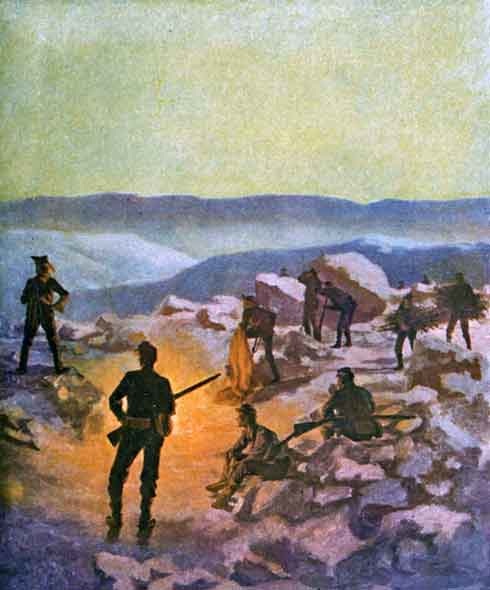
And so it would seem Case, the bookkeeper, had "inside information," and so it happened that, within an hour after sunset, once again the gray-haired commander and the wounded subaltern were in conference, and Case's strange story was told in full. "There's more than enough in it to demand our warning Turner," said Harris. "Can you get me up to Squadron Peak—to-night?"
Just at tattoo the old-fashioned, yellow ambulance, drawn by a brace of mules, backed up at Bentley's quarters, and Harris was carefully lifted aboard. The general, with Strong and Bonner, stood at hand to say godspeed. "Promise him safe conduct," said the commander, as they drove away, and Harris touched his hat in acknowledgment. Briggs, with twenty stout foot soldiers, awaited them at the abandoned ranch. The doctor and two attendants accompanied him. The road for nearly four miles lay along the sandy flats, then went boring westward into the foothills, while a little worn branch turned off to the peak. Two-thirds of the way to the top the mules were able to pull the jolting vehicle, and from thence half a dozen brawny arms bore the young soldier on a stretcher to the summit. It was then after eleven, and the moon still behind the Mogollon, lowering black against the silvering skies full forty miles to the eastward. Already there was sufficient light to guide them, and a sergeant led on to a point where, surrounded by knee-high rocks, was a little blackened space where in bygone days many a signal fire had blazed, and here the men tossed the tinder, the pine cones and dead branches they had gathered on the climb. A match was applied. All crouched or stooped among the rocks, as the flames presently leaped on high, and gave ear to the quiet orders of the young soldier, practically in command. "Keep watch now, all round, especially east and south-east. It may be ten minutes before you get an answer, and there may come a dozen. More fuel may be needed," whereat half a dozen dark forms silently backed away down the slope, and all men waited and watched. Harris, with one arm and shoulder still bandaged, and obviously weak, sat grasping at the corner a folded blanket and busily coaching Briggs, who listened, absorbed. Ten, twelve, fourteen the minutes rolled by. The silvery sheen spread higher over the eastward sky. The crest of the distant Mesa was just fringing with dazzling white, when two voices at once exclaimed: "There you are, sir!" And afar over to the south-east, the direction of Tonto Creek, a little ruddy spark appeared through the gloom, and a moment later still another was made out, farther to the left. In twenty minutes three were in sight. "Anywhere from fifteen to twenty miles away," said Harris, as he studied them with the signal glass, "and," he continued, "I looked for one much nearer."
"There you have it, sir!" And almost opposite them, it seemed, and lower, straight away to the east, so near they could almost mark the waving of the flame, a fourth blaze burst into view.
"That's more like it!" said Harris. "Now the blanket. Give me a boost, corporal," and with that, supported by the strong arm of one of the soldiers, he stepped upon the nearest rock, the blanket in his left hand. Briggs grabbed the opposite corner with his right, and the next moment a woollen curtain swung flat between the fires.
"Now, Briggs, up!" and the hidden red eye was suddenly unmasked and glared out over the east. "Down!" and all toward the opposite fire was darkness again. Twice more was it raised and lowered. Then a five seconds' pause. Then twice again. "Thirty-two," said Harris. "'Tonio's old signal. Now watch for the answers!" From those at a distance there came no sign. The flare at each was steady. From the nearmost, almost instantly, came the desired response. It suddenly disappeared, and Harris, at second intervals, counted low, "One, two, three." Then came the red glow again, just a moment. Then darkness only for two seconds. Then light again. "It is 'Tonio," said he, "and that's his call to me. Now, Briggs, again! Slowly this time!"
And very slowly was the blanket raised and lowered twice. Then came two or three quicker movements. Then the blaze spoke untrammelled, and all eyes were on 'Tonio's torch, and they who had heard ill of him—had doubted him—found themselves oddly drawn to him across the intervening miles of darkness. Twice, thrice slowly his light, too, was curtained. Then for a moment it burned clearer; then seemed suddenly to sputter out. Within a few seconds, far more swiftly than it rose, the signal fire vanished from sight, and Harris stepped quietly down. "That's all," said he, yet the doctor, at least, could read the suppressed exultation in his tone. Then, seeing inquiry and disappointment, both, in the eager eyes about him, the young officer added, "He understands. He's coming, or sending, in."
"Did you promise him safe conduct?" asked Bentley.
"He did not ask it," was the answer.
Two hours later, once more safe at the post, the doctor had stowed his weary patient in bed, renewed the dressing and bandages, and was bidding him try to sleep, but Harris smiled. "You'll need me to translate," said he. "The general's message to Turner is being written now. Let us finish this while we're about it."
Sure enough. Toward half-past one the sentries on Numbers Six and Seven set up a shout for the corporal of the guard, and an Indian girl, trembling a bit, was led to the office, and half the garrison knew that word was in from 'Tonio. The general took his messenger kindly by the hand. Food and chocolate were in readiness at the Mess, but she shook her head. "Capitan Chiquito," she insisted, and then was conducted up the line, and, shrinking not a little, was led into the doctor's quarters. There, at sight of Harris, she instantly stepped to his bedside, knelt, and taking his weary hand, placed it on her head. He whom 'Tonio held in reverence, his followers could but blindly obey.
To his question in her own tongue, "Where is 'Tonio?" she answered, "Toward the moon, now two hands high. When it is straight above Pancha can reach him again." "Is 'Tonio well?" "'Tonio is well, but—others brought Pancha. They say they are afraid that soldiers shoot. They await Pancha's returning."
Evidently, despite the kindness in every face, the girl still feared the white man and wished to be gone. "He has sent her, general," said Harris. "Whatever you wish to send now to Turner will go through, if 'Tonio is not killed in the attempt."
And so, with unexpected burden of food and gifts and with a brief despatch to Turner, bidding him hasten with his entire force, the dusky, fleet-footed daughter of the mountain was led back to the stream, went bounding lightly across from stone to stone, and disappeared among the shadows toward the east.
"And now," said Harris, "Deltchay and Skiminzin may come as soon as they like. Turner will get here in time, and then—you may judge as to 'Tonio."
And this was Saturday night or rather Sunday morning, not yet one full week since Willett was brought in swearing he saw 'Tonio take deliberate aim at him, although only the horse was shot, and as matters stood in the gross and scope of garrison understanding, the weight of presumptive evidence was against the Apache, and there was more to come.
CHAPTER XVII.
As was to be expected, Lieutenant Harris was somewhat worse when time came for inspection Sunday morning, but Bentley said complete rest would soon restore him. The other interesting invalid, Lieutenant Willett, was correspondingly better, and was to sit up awhile later in the day. Inspection was held under arms and in fighting kit instead of full dress—the two companies looking like a pair of scanty platoons, so heavy was the drain for guard duty. From earliest dawn lookouts had been stationed on top of the adjutant's office at the south, and the hospital at the north edge of the parade, Bucketts having built for them a little wooden platform, with bench, shelf and sunshade, and there, with signal-service glasses, they scoured the barren wilds in every direction for sign of coming friend or foe.
It was eleven o'clock when Bentley came forth with Mrs. Stannard from his morning visit to Willett. "Oh, he's doing as well as an overfed, under-trained animal has any right to," said he, in response to the inquiry in her soft blue eyes. "I still think some men have too much luck in this world of ours. Here's Willett, who doesn't begin to deserve it, getting everything that is good, and Harris, who deserves all the good that the army affords, gets all the hard knocks and setbacks. Here's Willett swearing that 'Tonio's a renegade, hostile, spy and a traitor, and Harris convinced that he is stanch and loyal—that Willett must be mistaken in saying he shot at him, and though everything I know of the Apaches or ever heard, and every bit of evidence is overwhelmingly in favor of Willett's statement, just from what I've seen of these two men I'm deciding with Harris."
"You don't—feel confidence in Mr. Willett's—judgment?" she asked.
For a moment he hesitated, then turned and squarely faced her. "I don't feel confidence in Mr. Willett. There, Mrs. Stannard! There are not ten women in the army to whom I'd trust myself to speak of this—or five women out of it—but I am not happy over the way things are going."
"Don't you think he'll—learn to appreciate her?"
"He shouldn't have to learn! He should see it all at a glance, and thank God for the unmerited blessing."
"Perhaps he does," said she, ever gentle, helpful, hopeful. "It is lovely the way he speaks to her—and I'm quite eager to see them this afternoon."
What woman would not be? What man would not have been at his best at such a time, under such circumstances? The realization that he had won the fervent love of that fresh, pure, exquisite young heart was enough to thrill even a nature so utterly selfish as Willett's. It is the shallowest soul that most readily thrills, and what could be sweeter than the shy, yet rapturous love in the downcast eyes of Lilian Archer, when, as he had implored her mother, she was led that afternoon to the darkened room in which he sat, and, like knight of old, he took and bent over and kissed her trembling little hand. "I would kneel, too," he murmured, even as her mother stood beside her, with swimming eyes, and as he looked up into the blushing face his own eyes were filled with unfeigned homage, admiration, even love, his deep voice with emotion that was sweet to woman's ear. "Heaven never made a lovelier lover than Hal Willett," once said a famous belle and beauty. "That's why so many of us like to listen."
But these earnest, honest, inexperienced two—the whole-hearted army wife who had lived well-nigh quarter of a century in the undivided sunshine of an honest soldier's love, and this sweet, simple-hearted army girl who had never dreamed of or thought to know any love to compare with this—listened, spellbound, to Willett's almost eloquent avowal, and the last doubt or fear that Mrs. Archer entertained vanished like the morning mists before the sunshine.
"I declare," she said to Mrs. Stannard, "I'm almost as much in love as Lilian," and indeed it seemed so, and might well be so, for never was queen's courtier so exquisite in deference, homage, tact, as, in that blissful week of honeymooning, was Hal Willett to the mother of his dainty love. As for Lilian, the arid, breezeless day was soft with scented zephyrs; the unpeopled air was athrill with the melody of countless song birds; the unsightly desert flowered with exquisite millions of buds and blossoms that craved the caress of her dainty hand, the pressure of her pretty foot. The sunburned square of the lonely little garrison, environed with swarthy foemen, cut off from the world, was alive with heroic knights in glittering armor and ladies in lace and loveliness, and all were her loyal, devoted subjects, revelling in her happiness, rejoicing in her smiles, serving her in homage and on bended knee, their thrice-blessed, beautiful, beloved queen. God never made a more radiantly happy girl than was our fairy Lilian that wonderful week. God be thanked it was so utterly blissful, since it had to be so brief!
All day long the watchmen clung to their glaring stations, and Sunday went by without either alarm or excursion. All Sunday—Monday night, they scanned the dark depths of eastward basin, the lone reaches of the valley, the tumbling heights to the west. It was nine in the morning of the second day since the signalling from Squadron Peak when the cry went up from the roof of the office, "Signal smoke south-east!" and every glass at Almy was brought to bear within the minute, and half the garrison lined the lower edge of the mesa, and all men were listening for further tidings, when from the hospital came the stirring shout: "Smoke answer, west!" And there, plainly visible, and not five miles away among the pine-bearded foothills, in little puffs, singly and distinct, thick wreaths of gray-white smoke were sailing straight aloft. The waiting Apache of the Mazatzal was signalling the coming brother from the dark clefts of the Sierra Ancha. One hour later, just as ten was striking on the spiral of the office clock, two sudden shots were heard on the flats to the north-west, and the little herd of horses and mules, not two dozen in all, grazing under cover of the rifles of Sentries 3 and 4, came limping, lumbering in, fast as hoppled feet would permit and without sign of a herdsman. Number Three, a veteran of the war days, let drive with his fifty calibre Springfield, the gun of the day, and sent up a yell for "The Guard!"
"Join your companies, men," said the general, in his placid way, whereat most of them went with a rush. "The north side first, Bonner," he added, as the captain came hurrying to his chief. "They've sneaked up on the herd guard, I fancy. Send the picked shots out to the pits."
Out on the flats to the west of the Verde road, full five hundred yards away from rock, tree or shelter, other than mere clump of cactus, pumpkin size, or bunch of dirty weed, there was lying a little heap of dingy white and brown, with a cow pony kicking at empty air in a shallow ditch—what was left of the half-breed herd guard and his mount. With most of the cavalry gone, the quartermaster had supplied their place with such mounted men as he could make available, and in broad daylight, within long rifle-shot of the sentry lines, the Apaches had squirmed out, snake-like, on their bellies, unseen, unsuspected; had picked off one of two watchers and stampeded the other. The skirmish line stumbled over the survivor, quaking among the willows in the stream bed, and kicked him out into the open to help bear home his murdered brother; then pushed out as far as the first ridge in hopes of a shot, and were rewarded with nothing better than a glimpse of vanishing breech-clouts. Falling slowly back, toward noon, Bonner posted two men in each of a dozen rifle-pits, some fifty yards outside the sentry lines, as a rule, and wherever view of the approaches could be had. Two of these were on little knolls to the south of the store, and here were Craney & Co. in full force, every man armed with a Henry rifle and a war-model Colt, "Mr. Case-Keeper Book," as Sergeant Clancy jovially hailed him, quite as formidable as his fellows, and every whit as cool. Craney held that he and his men had a right to be counted in among those told off to hold the fort, and Bonner smilingly assented.
"You two seem to hit it off pretty well together," said he to Case and Clancy. "I reckon we'll Cossack you over yonder," and he pointed to a scooped-out little hummock nearest the stream, commanding much of the southward road and the trail along the willows, now facetiously termed the "Ghost Walk." It was an unusual assignment, or distribution, but it seemed to strike the fancy of both. In times of peril and at the fore-posts men think less of rank and more of repute. Clancy was known far and wide as a fearless Apache fighter, with a Gaines's Mill-Gettysburg record behind him. Case had never before been heard of afield, but his one exploit in the card room stamped him unerringly, said these frontier experts, as "a man of nerve." Clancy held out his big red hand. "Are ye with me?" said he. "Yours truly," said Case. "Then come on, Pitkeeper," said Clancy, "and we'll leave Book and Case behind."
The general came jogging down at the moment, bestriding one of Bucketts's general utility beasts, watching the posting of the post defenders, and he screwed his eyelids down to a slit as he glared from under the brim of his then unorthodox slouch hat, and squinted after the combination of soldier and civilian stalking away to the assigned station. "What have you there, Bonner?" he asked, as he reined in.
"'Erin go unum, E pluribus bragh,' sir, as Derby would have it." "The Celt and the Casekeeper," he added to himself. "Clancy and Case going gunning together as amicably as if they had never squabbled over a sutler's bill."
"Queer lot—that man Case!" said the commanding officer reflectively. "His face bothers me sometimes, as though I must have seen or known him before, yet he tells me that he did not come to Vancouver until after I had left that department. Is he all straight again?"
"Straight as the new toadsticker, general, and"—with a rueful look at that slender appendage—"a damned sight more useful. His ghost-herding spree was no end important. I've an idea Case can handle a gun as well as"—another sotto voce now—"he can play a worthless hand."
"Well," said Archer, as he glanced about him, "I don't believe, as a rule, in putting any but soldiers on post, but," as he considered the slender rank of infantry standing patiently at ease, barely a dozen all told, and then smiled at Craney and his belligerent force, only four in number, but each man a walking arsenal with two weapons and five shots to the soldiers' one, "there are no non-combatants in Indian warfare. Every man, woman and child may have to fight."
Yet Archer felt no measure whatever of apprehension. One hundred good men and true, at least, were left to guard the post, and many of them battle-tried veterans. Not since the war days had the Apaches mustered in sufficient force and daring to attack a garrison. Still, Archer knew that if they only realized their strength in point of numbers, their skill in creeping close to their prey, their swiftness of foot, and the ease with which they could escape, all they needed was dash, determination and a leader, to enable them to creep upon the post in the darkness, and in one terrific moment swoop upon the officers' quarters, massacre every soul, and be off across the stream before the men in the barracks could rush to the rescue. They had talked it over at officers' mess—the general and Bonner and Bucketts and all, and figured out just how fifty white desperadoes could plan and accomplish the feat. It would be no trick at all to come up the valley in the screen of the willows, creep to the west bank, divide into six different squads, one for each set of quarters, crawl to the post of the drowsy sentry, shoot him full of arrows before he could cry out or load, then, all together, charge up the slope and into the flimsy houses, pistols in hand and knives in their teeth, and simply butcher the occupants as they lay in their beds. Doors, even if closed or bolted, which rarely happened, could be smashed in an instant—matches would light their way. It would be all over in much less time than it takes to tell it, and it might well happen but for two things—the Apache's dread of the dark and his fear of a possible hand-to-hand fight.
Yet if Deltchay and Eskiminzin, with all their warriors were to reëforce these about them, with five hundred braves to the garrison's one hundred, even that dread might be overcome.
And by Monday's sundown it was known that numbers of Apaches had crossed the valley ten miles away to the south—the telescope had told that—and not a word or sign had been vouchsafed by Turner, and Tuesday brought no better news. Then 'Tonio, said many a man, had played them false.
Just at four o'clock Archer had arranged the dispositions for the night. Mrs. Stannard, with Mrs. Archer and Lilian, were to occupy the ground floor, north-west, room of his quarters—the one least exposed to flying bullets in case of attack. Mrs. Bennett and the matron were moved into a little room in the hospital. The soldiers' wives and children were to assemble in the barracks in case of alarm. The men in the outlying posts and pits were to be doubled at dusk—Bonner's company attending to that, while Briggs and his fellows were to sleep on their arms within the post. It now lacked but a few minutes of sunset. No further demonstration had occurred. Not an Indian had been seen within a radius of six miles, when, all on a sudden, there came a shot—then two, almost together, then a quick crackle and sputter of small-arms afar down the stream. "By Jove!" cried Bonner, from a perch by the lookout at the office. "They've opened on Case and Clancy!"
"They've opened on Case and Clancy." Page 188
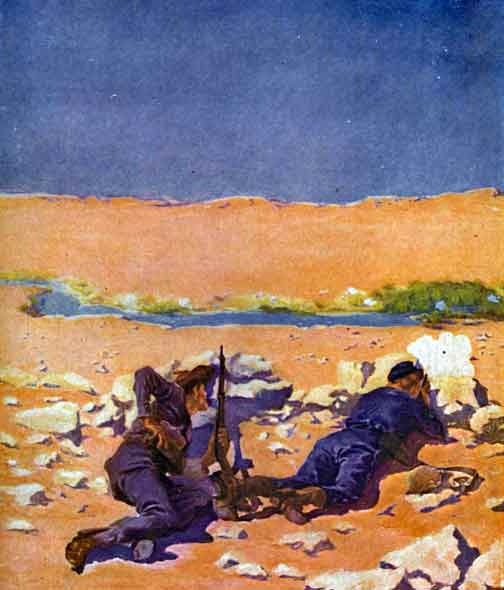
And that was but the opening, for within a minute, from on every side, from far out among the rocks to the west, from the sandhills across the stream, from little heaps of brush and weed and cactus in the flats, from the distant screen of the willows in the stream bed, little puffs of white sulphur smoke jutted into the slanting sunshine, and the pulseless air of declining day was suddenly set to stir and throb by the crackle of encircling musketry. And then was seen the wisdom of the veteran's defence. Few of the hostiles, as yet, had other than old-fashioned muzzle-loading rifles, and few that they owned were effective over six hundred yards. By stationing his better shots in rifle pits well forward from the buildings on every side, Archer easily held the foe at a distance so long as they dare not "rush" his outposts. Only on the east side were there pits less than three hundred yards from the mesa, but here there was a dismal flat beyond the creek, affording a minimum of cover, and hardly a bullet whistled in from any direction so as to reach the quarters. Once in a while a little puff of dust flew up from the sandy slope without, but even that was enough to demand that the women folk should keep under shelter, and at the moment the firing began Lilian and her mother were seated by Willett's reclining chair, and then Mrs. Stannard joined them, and, the windows being shaded, they never saw, among the first to reach the general at the mesa edge, Harris, the wounded officer, revolver in his unfettered hand.