GENERAL CHARLES KING (continued 2)
Reading edition
Possibly a realization of this had already come over him, as angering yet unswerving, he once again overtook the eager leaders among his scouts,—lean, wiry fellows, ever gliding swiftly on in that tireless Apache running walk. Once there again, he kept his broncho at the trot to hold his own, and a broncho trot, after a mile or two of warming up, becomes something besides monotonous. Away to the far front, the north-east, flickered the tiny blazes; guiding lights, as Willett would have it; bale fires, as Harris began to believe—fires set by confederates to blind the eye of the pursuit, or lure pursuers to a trap. Away to the far front, seven miles now, and deep in a nook of the foothills, lay the site of Bennett's ruined ranch, and thither, at top speed of his scouts, was the young leader pressing. Not even a dull glow in the heavens above, or a spark on the earth beneath, could the sharp-eyed scouts discover to tell of its lonely fate. Only the dago's horrified words, only the confirmative symptoms of these farther fires, had these fly-by-night rescuers to warrant their mission. The story had its probable side. Peaceable as had been the Apache-Mohaves, the fact that a clash had occurred between them and some of the agent's forces,—a clash in which Comes Flying had been killed,—might readily turn the scale and send them on the war-path. If so, the first and nearest whites were apt to be the victims. If so, Bennett and his beloved wife and boys might well have been murdered in their beds—or spared for a harsher fate. In any event, the first duty—the obvious one—for Harris and his scouts was to reach the spot with all speed; ascertain, if possible, the fate of the ranch folk, then act as their discoveries might direct. All this Harris was turning over in mind as he hurried ahead. The road, though little worn, was distinct, and now that they were out of the bottom and skirting the stony bed of a little mountain stream, quite firm and dry. Six miles an hour, easily, his swarthy, half-naked fellows were making without ever "turning a hair." His own lean broncho, long trained to such work, scrambled along in that odd, short-legged trot, and Harris himself, trained to perfection, hard and dry, all sinewy strength, rode easily along—he could have done almost as well afoot—at the head of his men, keeping them to their pace, yet never overdriving.
But with Willett the case was different. For him there had been no hard and dry scouting. It had been wet work in the Columbia country. It had been "hunt-your-hole business" in the lava beds, where the hat that showed above the rocks was sure to get punctured. Then the month of feasting in that most lavish of cities, "'Frisco, the Golden," and the fortnight's voyage by sea, with further symposiums, and finally some hours of frontier hospitality at Prescott and at Almy, all had combined to spoil his condition, and before he had ridden forty minutes Hal Willett found himself blown and shaken. He lagged behind to regain breath, then galloped forward to lose it. He knew that Harris had left him in anger and indignation not unjustifiable. He knew he had not full warrant for his authority. He knew Harris was entitled to unhampered command, and that he had hampered. Yet, now, believing that Harris was pushing swiftly ahead as much to "shake" him as to reach the scene, he again dug spurs to his laboring troop horse, and came sputtering over the loose stones to the young leader's side.
"Harris," he puffed, "this is no way to work your men. They'll be blown when you get there, and of no earthly use."
"You don't know them," answered Harris, with exasperating calm, and without so much as a symptom of slowing up.
"But—I know how it affects—me,—and I'm no novice at scouting."
"You are to—this sort of thing, anyhow," was the uncompromising answer, and then with a cool, comprehensive glance that seemed to take in the entire man, he added, "You're out of training, Willett—the one thing a man has to watch out for in Apache work. Better let me leave a couple of men with you, and come on easily. You won't be very far behind us."
And then, as bad luck would have it, 'Tonio came cantering up from the rear, his big, lop-eared mule protesting to the last, and 'Tonio bore a little folded paper.
He was not versed in cavalry etiquette, this chieftain of the frontier, nor had he learned to read writing as he did men. The two officers at the moment were side by side, Willett on the right, his charger plunging and sweating with back set ears and distended nostrils; Harris on the left, his broncho jogging steadily, sturdily on, showing no symptom of weariness. "To Gran Capitan—Willett" were the general's words, it seems, when he sent 'Tonio on his way with the note, but in 'Tonio's eyes Harris was "Gran Capitan," even though hailed at times as "Capitan Chiquito," and to Harris's left 'Tonio urged his mount and silently held forth the missive.
There was never any question thereafter that it was meant for the other. Archer had his reasons. Willett was there as the aid, the representative, of the department commander, charged with an important duty. Willett had come to him, volunteered to go with the scouts, and he had bidden him God speed. Willett was the senior in rank as first lieutenant, promotions in the "Lost and Strayed" having been livelier than in the "Light Dragoons." Moreover, Willett had shown proper deference to him, the post commander, whereas, Harris, said he, in his first impulsive, self-excusing mood, even though warranted in going, had gone without a word. Sensitive and proud, the veteran of many fights and many sorrows, ruefully bethinking himself of Harris's abstinence and his own conviviality, saw fit to imagine Harris guilty of an intentional slight.
Like noble old Newcombe, the gentlest and humblest-minded of men, "he was furious if anybody took a liberty with him," and in his sudden rousing and wrath this was what he thought Harris had done. It was to humble him rather than to exalt Willett that he ignored the one and hailed the other. "To Gran Capitan Willett," he said, and 'Tonio handed the missive to the one "gran capitan" he knew and served and loved.
And Harris, never noting the pencil scrawl upon the back, proceeded to tear it open, when Willett stretched forth his hand:
"I think you will find that is for me, Harris—an answer to what I wrote," and his words had the distinct ring of authority. Harris flushed, even in the moonlight; turned it over, read the unsteady characters, "Lieutenant Willett, A.D.C.," surrendered it without a word, and a second time drove ahead, while Willett reined up to read.
It was ten minutes before Willett again overtook the pale-faced young officer at the front. Harris's mouth looked like a rigid gash, and his battered felt was pulled down over a deep-lined forehead, as with stern eyes he turned his head, but never his shoulder, in answer to his classmate's imperative call.
"Rein in now, and listen to this, Harris. If you must have it, it's—by order."
And Harris slowly checked his horse; silently inclined an ear.
"Lieutenant Willett, it says," began the senior, with the sweat rolling into his eyes, "Your despatch received. The fires you mention indicate further hostile parties, 'Tonio insists not Mohaves. If not, must be Tontos. Therefore, move with caution. Stannard just saddling. Use your discretion as to waiting for him.
"Archer, Commanding Post."
Then Willett turned. He had begun to refold, but ceased, and held it forth. "Read it yourself, if you like." Harris's gauntlet came up in protest. He bit his lip hard, but said no word. The scouts were but white specks in the distance now. There was sudden cry, low, like that of the night-bird, and 'Tonio dug his moccasined heels in his lop-eared charger's ribs and drove out to the front, then turned in saddle, looked back at his chief and pointed. Both officers instantly followed.
The trail led over a low spur, and the scouts had halted and were squatting at the crest. Straightway before them, possibly four miles, a dull red glow lay in the midst of the moonlight, with occasional tongues of lurid flame lazily lapping at some smouldering upright. The fire had spent its force; gorged itself on its prey and was sinking to sleep.
"Come on then!" said Harris, speaking for the first time impetuously. "If you can't stand the pace let us shove ahead!"
"And run slap into ambush? No. My orders are to move with caution. We've got to feel our way now. Hold your hand, Harris—and your men."
Barely fifty minutes had they been in coming these six miles from Almy. Barely fifty minutes thereafter, and with less than three miles more to their credit, halted for cautious reconnaissance, with the ruined ranch still a long mile away, there came sound of feeble hail from a patch of willows down by the brookside, and presently, in fearful plight, they dragged forth Bennett's colored man-of-all-work, unharmed, but half dead with terror. Yes, Indians had suddenly come in the early evening. First warning was from the Maricopa boy who came running from the spring, saying they had killed his brother. Bennett grabbed his gun and ran out to see, telling him, Rusty, to take a rifle and hurry with Mrs. Bennett and the children and hide in the willows down the creek. They heard firing and yelling, and 'twas all Rusty could do, he said, to keep Mrs. Bennett from running back to her husband, and the children from screaming aloud, but he made them go with him still farther down the valley, down to that patch yonder, and there they lay in hiding while the Indians burned the ranch, and seemed hunting everywhere for them, and at last things quieted down, but Mrs. Bennett was wild and crazy and crying to go back and find her husband, dead or alive, and he had to hold her. Just a few minutes ago, not fifteen minutes before, she broke away, and he found it was no use trying. She started to run back, telling him to save her boys. She kissed them both and went, and it wasn't five minutes after that before he heard her scream awfully, and the boys began to cry again, and then—then he saw two Indians coming running, and he knew they'd got her and were coming for the children, so what could he do but run and save himself?
"Lead on where you left them!" ordered Harris instantly, never waiting for Willett to speak. Ten minutes brought them to the farther shelter, a dense little willow copse, empty and deserted. "Come on to the ranch," was the next order, but there Willett interposed.
"Carefully now. Let your scouts open out and feel the way," he ordered, and Harris would not hear. Harris had thrown himself from his horse to lead the search. He never stopped to remount. He ran like a deer up the stony creek bed until he regained the road, his scouts following pell-mell, and in ten minutes more they found him bending over the lifeless body of brave, sturdy Jack Bennett, weltering in his blood at the side of the spring house, and with no sign of the hapless, helpless wife and mother anywhere.
"By God, Hal Willett!" cried Harris, as he sprang to his feet, all dignity and deliberation thrown to the winds. "You may 'proceed with caution' all you damned please. 'Tonio and I go after that poor woman and her children. We'd have saved them here if it hadn't been for you!"
CHAPTER VII.
The dawn was breaking in sickly pallor over the jagged scarp of the Mesa, bounding the chaotic labyrinth of bowlders, crag and cañon beneath. Far up the rugged valley, jutting from the faded fringe of pine, juniper and scrub oak that bearded the Mogollon, a solitary butte stood like sentry against the cloudless sky, its lofty crown of rock just faintly signalling the still distant coming of the heralds of the god of day. Here in the gloomy depths of the basin, and at the banks of the murmuring stream, all was still silence and despond. The smouldering ruins of Bennett's cosey home lay a mass of dull red coal, with smoke wreaths sailing idly aloft from charred beam or roof-tree. The mangled body of the stout frontiersman had been gathered into a trooper's blanket and lay there near the pathetic ruin of the house he had so hopefully builded, so bravely defended, for the wife and little ones. Half a dozen Indian scouts, silent and dejected, were squatting inert about the little garden, irrigated from the main acequia, where the heavy-headed poppies, many of them, were still nodding on their stalks, while others lay crushed and trampled. A little distance away down the stream a little troop of cavalry, in most business-like uniform, had dismounted and was watering some fifty thirsty horses, while its stocky commander, his hands thrust deep in the pockets of his riding breeches, his slouch hat pulled down to his brows, his booted foot kicking viciously at a clump of cactus, was listening impatiently to the words of the young aide-de-camp, who seemed far less at ease than when he trod the boards of the general's quarters some six hours earlier in the night.
"Do I understand you then," and Stannard spoke with a certain asperity, "that Mr. Harris, with just two or three scouts, has gone out hunting on his own hook?—that even 'Tonio isn't with him?"
"He claimed the right to go, and I told him to take half a dozen—half a score of the scouts, if need be, and leave the other half with me, only I drew the line at 'Tonio. I needed him here. He is the only Indian in the lot who understands enough English to catch my meaning and to translate. I could let Harris go, or 'Tonio, separately, but not both together. That left me powerless. Oh, yes, he objected. He said 'Tonio had always been his right bower—always had worked with him and for him. But 'Tonio, not Harris, is the chief of scouts, the man they look to and obey. Now he and most of his followers are here to do your bidding. If Harris had been allowed his way, I'd have been probably alone."
Stannard sniffed. "Which way'd he go?" he bluntly asked.
"I'm not sure. We were going to trail the moment it was light enough to see. One thing is certain, they did not start in the direction of the signals, though they may have veered off that way. 'Tonio is the only one who claims to know anything. 'Tonio says 'Apache Tonto' was the murderer, not Apache-Mohave, and 'Tonio's in the sulks. Look at him!"
Stannard glanced an instant toward the gaunt figure of the Apache, standing dejectedly apart from all others and gazing fixedly toward the dawn. The light was stronger now. The red was in the orient sky. The distant butte was all aglow with the radiance of the rising yet invisible sun. Stannard seemed more concerned in the whereabouts of Mr. Harris than in the worries of Mr. Willett. Again he returned to his questions.
"Well, did Harris give any inkling of his purpose—whether he meant to follow the trail till he found captives and captors, or only till he found where it probably led to? I've got to act, and lose no time. Sergeant, tell the men to hurry with their coffee," he called, to the brown-eyed, dark-featured soldier who was coming forward at the moment. A salute was the only answer, as the sergeant turned about in his tracks and signalled to the boy trumpeter, holding his own and the captain's horse. Another moment and Stannard was in saddle.
"Harris didn't say," was the guarded answer. "You know, I suppose, that he left the post without consulting the general, and he took it much amiss that, in compliance with the general's orders, I exercised certain authority after reaching him. Now you are here to take entire charge, I turn over the whole business to you. There's what's left of the scouts; there's what's left of the ranch; and there," with a glance at the blanket-shrouded form, "is what's left of the Bennetts. I'll jog back to the post by and by."
"Oh, then you're not going on with us?" said Stannard, relieved in mind, he hardly knew why.
"No, sir, I only rode out here to investigate and report. We, of course, hoped to save something."
"Pity you hadn't spared yourself and not spoiled the pie," thought Stannard as he looked about him over the scene of desolation. The men were snapping their tin mugs and the refilled canteens to the saddle rings. The captain rode over to 'Tonio, a kindly light in his blue-gray eyes. He whipped off the right gauntlet and held forth his hand.
"No Apache-Mohave!" said he stoutly. "Apache Tonto. Si! Now catch 'em Teniente Harris." Poor lingo that "pidgin" Indian of the desert and the long ago, but it served its purpose. 'Tonio grasped the proffered hand, a grateful gleam in his black eyes; warned with the other hand the captain's charger from certain tracks he had been jealously guarding; then pointed eagerly, here, there, in half a dozen places, where footprints were still unmarred in the powdery dust. "Si—si—Apache Tonto!" and the long, skinny finger darted, close to the ground, from one print to the other. "No Apache-Mohave! No!"
"Then come! Mount!" called Stannard. "Leave a corporal and four men here as guard until the ambulance gets out from the post," he added, to the first sergeant. "Mount the troop, soon's you're ready. I'm going ahead with 'Tonio and the scouts. Ugashi, 'Tonio! Good-by, Mr. Willett. Take one of the men, if you need an orderly," he shouted back, over a flannel-shirted shoulder, innocent of badge or strap of any kind. In point of dress or equipment there was absolutely no difference between the captain of cavalry and his fifty men.
A moment later, spreading out over the low ground like so many hounds throwing off for a scent, 'Tonio and his scouts were trotting away toward a dip in the rugged heights to the north-east, for thither, the moment it was light enough even faintly to see, the keen eyes of the Apaches had trailed the fugitives, and now with bounding feet they followed the sign, Tonio foremost, his mount discarded. Afoot, like his fellows, and bending low, pointing every now and then to half turned pebble, to broken twig or bruised weed, he drove ever eagerly forward, the stolid bearing of the Indian giving way with each successive minute to unusual, though repressed excitement. Thrice he signalled to Stannard and pointed to the crushed and beaten sand—to toe or heel or sole marks to which the Caucasian would have attached but faint importance had not the aborigine proclaimed rejoicefully "Apache-Mohave!" whereat Stannard shook his head and set his teeth and felt his choler rising.
"Thought you swore Apache Tonto awhile ago," said Stannard wrathfully. "Now you're saying Apache Mohave!"
"Si! Si! Apache Tonto—kill—shoot. Apache-Mohave good Indian. Look, see, carry," and with hands and arms in eager gesture he strove to illustrate.
Could he mean that they who killed Bennett were hostile Tontos, and that these who bore the poor widowed creature were of the Mohave blood? If so, why should 'Tonio seem really to rejoice? Had he not strenuously denied that his people took any part in the outrage? Was he not now insisting that they were active in bearing her away—probably to captivity and a fate too horrible? Stannard, riding close at his heels, his men still following in loose skirmish order until they should reach the ravine, studied him with varying emotion. Harris had certainly betrayed a fear that 'Tonio was but half-hearted in the matter of scouting after Apache-Mohaves. Now the suspected scout was trailing for all he was worth, with the pertinacity of the bloodhound.
Broad daylight again, and the sun peering down from the crest of the great Mesa, and the morning growing hot, and some new hands already pulling eagerly at the canteens, despite their older comrades' warning. And still the advance went relentlessly on. They were climbing a rugged, stony ravine now, with bare shoulders of bluff overhanging in places, and presently, from a projecting ledge, Stannard was able to look back over the rude landscape of the lowlands. There to the west, stretching north and south, was the long, pine-crested bulwark of the Mazatzal, the deep, ragged rift of Dead Man's Cañon toward the upper end. Winding away southward, in the midst of the broad valley, the stream shone like burnished silver in the shallow reaches, or sparkled over rocky beds. Far to the south-west, the dull, dun-colored roofs and walls of the post could barely be discerned, even with the powerful binocular, against the brown barren of the low "bench" whereon it lay. Only the white lance of the flagstaff, and the glint of tin about the chimneys, betrayed its position. From north to far south-east ran the palisade-like crest of the Black Mesa, while the Sierra Ancha bound the basin firmly at the southward side. Deep in the ravines of the foothills, where little torrents frothed and tumbled in the spring tide, scant, thread-like rivulets came trickling now to join the gentle flood of the lower Tonto and the East Fork of the Verde, and, at one or two points along the Mesa, signal smokes were still puffing into the breathless air. Below them, possibly six miles away, yet looking almost within long rifle-shot, the square outline of the abandoned corral, the blackened ruin of the ranch, with the adjacent patches, irrigated, tilled, carefully tended—all Bennett's hard and hopeful toil gone for nothing—told their incontrovertible tale of savage hate and treachery. It was a sorry ending this, a wretched reward for the years of saving, self-denial and steadfast labor of him who had lived so long at amity among these children of the mountain and desert, giving them often of his food and raiment, asking only the right to build up a little lodge in this waste land of the world, where he need owe no man anything, yet have home and comfort and competence for those he loved, and a welcome for the wayfarer who should seek shelter at his door. It was the old, old story of many a pioneer and settler, worn so threadbare at the campfires of the cavalry that rough troopers wondered why it was that white men dared so much to win so little. Yet, through just such hardships, loneliness and peril our West was won, and they who own it now have little thought for those who gave it them.
Stannard sighed as he closed his signal glass and turned again to the duty in hand. "What's the trouble?" he bluntly asked his faithful sergeant; lieutenants at the moment he had none.
"Check, sir. All rock and half a dozen gullies. Scouts are trying three of them. Don't seem to know which way they went from here. Even a mule shoe makes no print."
The troop, following its leader's example, without sound or signal had dismounted, and stood in long column of files adown the ravine. 'Tonio and his fellow-scouts had disappeared somewhere in the stony labyrinth ahead. Up this way, before the dawn, the dusky band must have led or driven their captives, two of Bennett's mules having been pressed into service. Up this way, not an hour behind them, must have followed Harris and his handful of allies, four Indians in all. Up this way, swift and unerring thus far, 'Tonio, backed by half a dozen half-naked young braves, had guided the cavalry, and never before, so said old Farrier Haney, who had 'listed in the troop at Prescott, and had served here with the previous regiment in '69—never before had he known 'Tonio so excited, so vehement. Beyond all question, 'Tonio's heart was in the chase to-day.
Scrambling down the adjacent slope every man for himself. Page 81
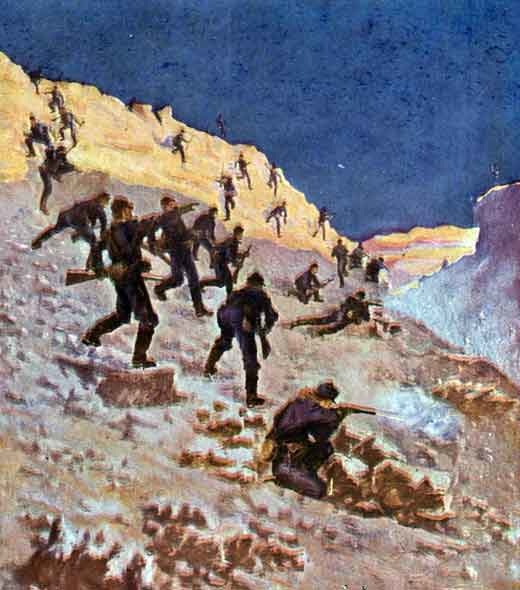
But this delay was most vexatious. Every moment lost to the pursuit was more than a minute gained by the pursued. Lighter by far and trained to mountain climbing, the Apache covers ground with agility almost goatlike. It was long after seven, said Stannard's watch, and not a glimpse had they caught of Indian other than their own. It was just half past the hour, and Stannard with an impatient snap of the watch-case was about thrusting it back in his pocket, when, far to the front, reëchoing, resounding among the rocks, two shots sounded in quick succession, followed in sudden sputter by half a dozen more. "Turn your horses over to Number Four, men!" shouted Stannard. "Sergeant Schreiber, remain in charge. The rest of you come on."
Scrambling up a rocky hillside, he led on to the divide before him—the crest between two steep ravines—his men coming pell-mell and panting after, every now and then dislodging a stone and sending it clattering to the depths below. Two hundred yards ahead, at a sharp, angular point, one of the Yuma scouts stood frantically waving his hand, and thither Stannard turned his ponderous way. No lightweight he, and the pace and climb began to tell. Eager young soldiers were at his heels, but grim old Stauffer, the first sergeant, growled his orders not to crowd; hearing which their captain half turned with something like a grin: "Tumble ahead if you want to," was all he said, and tumble they did, for the firing was sharp and fierce and close at hand, augmented on a sudden as 'Tonio's little party reached the scene and swelled the clamor with their Springfields. Another moment and, springing from rock to rock, spreading out to the right and left as they came in view of a little fastness along the face of a cliff, the troopers went scrambling down the adjacent slope and, every man for himself, opened on what could be seen of the foe. Some men, possibly, never knew what they were firing at, but the big-barrelled Sharp's carbine made a glorious chorus to the sputtering fire of the scouts. Five hundred yards away, bending double, dodging from bowlder to bowlder, several swarthy Indians could be seen in full flight, apparently. Then old 'Tonio threw up a hand from across the stony chasm, signalled to his friends to cease, sprang over a low barrier of rock, disappeared one moment from view, then a few yards farther signalled "Come on." And on they went and came presently upon an excited, jabbering group at a little cleft in the hillside. A mule lay kicking in death agony down the slope. Another lay dead among the bowlders. An Apache warrior, face downward in a pool of blood, was sprawled in front of the cleft, and presently, from the cavelike entrance, came Lieutenant Harris and 'Tonio, bearing between them the form of an unconscious woman, and Stannard, as he came panting to the spot, ordering everybody to fall back and give her air, and somebody to bring a canteen, slapped Harris a hearty whack on the shoulder, whereat that silent young officer suddenly wilted and dropped like a log, and not until then was it seen he was shot—that his sleeve and shirt were dripping with blood.
And just about that hour, less than thirty miles away, based on Lieutenant Willett's verbal report, the commanding officer of Camp Almy was writing a despatch to go by swift courier to department head-quarters—a report which closed with these words:
"The presence at this juncture of Lieutenant Willett, aide-de-camp to the department commander, was of great value and importance, and I trust that his decision to remain may meet approval. On the other hand, it is with regret that I am constrained to express my disapproval of the action of Lieutenant Harris, commanding scouts, who left the post with his men immediately after the alarm and without conference with me; was only overtaken by Lieutenant Willett after going several miles, and, when informed of my instructions, practically refused to be guided by them. Persuading a few of the scouts to follow him, he left the detachment, in spite of Lieutenant Willett's remonstrance, and started in pursuit of the marauders. As these must largely outnumber him, it is not only impossible that he should rescue the captives, but more than probable he has paid for his rashness with his life."
CHAPTER VIII.
"The Gray Fox" had but just received his promotion to the star, jumping every colonel in the army. He had been doing mighty work among the recalcitrant Apaches at a time when other commanders were having hard luck in their respective fields—one, indeed, forfeiting his own honored and valued life through heeding the sophistries of the Peace Commissioners rather than the appeals of officers and men who long had known the Modocs. For long years the warriors of the Arizona deserts and mountains had bidden defiance to the methods of department commanders who fought them from their desks at Drum Barracks, or the Occidental, but George Crook came from years of successful campaigning after other tribes, and in person led his troopers to the scene of action. One after another the heads of noted chiefs were bowed, or laid, at his feet. The pioneers, the settlers, the ranchmen and miners took heart and hope again, and the marauders to the mountains. Then came "our friends the enemy," from the far East, with petition and prayer. Suspension of hostilities, on part of the troops at least, was ordered, while most excellently pious emissaries arrived inviting the warriors to come in, to be reasoned with, taught the error of their ways and persuaded to promise to be good. The astute Apache had no objection to such proceedings. He was certainly willing to have the soldier quit fighting, just as willing to come and hear exhortation and prayer, when coupled with presents and plenty to eat; most Indians would be. So the new general stepped aside, as ordered, and left the elders a fair field. "The Gray Fox" went hunting bear and deer, and while the Apache chieftains went down to the Gila to reap what they could from the lavish hands of the good and the gentle, their young men swooped on the stage roads and scattered ranches, and made hay after their own fashion while shone the sun of peace and promise. So happened it along the Verde and Salado that the Apache came down like the wolf on the fold, and so Harris had come up from the Southern Sierra, and 'Tonio had sworn that, all signs to the contrary notwithstanding, his people were not, as the agent declared, the pillagers and pirates. "Apache-Mohave? No! No!!"
"The Gray Fox" had ventured to give his views to the War Department, which in turn had ventured to express itself to the Secretary of the Interior. But let us lose no time in following further. The Eastern press, and such of the Eastern public as had any leisure to devote to the subject, persisted in looking upon Indian affairs from the viewpoint and remoteness of Boston, where once upon a time Miles Standish and our Puritan forbears handled such matters in a manner anything but Puritanical. Nothing was left to the military arm of the Government but temporary submission, so, as has been said, "the Gray Fox" went off on a hunt for bear, mountain lions, and such big game as was reported to be awaiting him toward the Grand Cañon to the north. An adjutant-general of the old school was left in charge of the desk and the department, and all on a sudden found that while Peace and its commissioners held their sway far to the south, grim-visaged War had burst upon the northward valleys, and chaos had come again.
The couriers bearing Archer's report to Prescott found others, similarly burdened, from the upper reservation, from Camp Sandy, and even from points to the west and south of department head-quarters, all telling of death and depredation. So, while the chief of staff ruefully digested these tidings at the office, the couriers proceeded to have a time in town, to the end that, when replies and instructions were in readiness to be sent out, only two of the six were in shape to take them, and Archer's runner—one of the frontier scouts, half Mexican, half Apache—was one of the two.
Now, the chief of staff had been nearly three years in Arizona, had served in similar capacity to predecessors of "the Gray Fox," and naturally thought he understood the Apache, and the situation, far better than did his new commander, and the fact that he had allowed this conviction to be known had led to a degree of official friction between himself and the one aide-de-camp left that was fast verging on the personal. Bright, almost invariably the companion of the general in his journeyings, was even now with him, lost in the mountains ninety miles in one direction; Willett, the newly appointed aide-de-camp, was with the commander of Camp Almy, ninety miles away in another, while black-bearded Wickham stood alone at Prescott. Wickham had not been consulted when Willett was sent with confidential instructions to Almy. Wickham would have disapproved, and the chief of staff knew it. Wickham had to be shown Archer's despatch, though the adjutant-general would gladly have concealed it, and now, in chagrin at the outcome of affairs at Almy, and in consternation at the ebullition all around him, the adjutant-general was quite at a loss what to do. Wickham, if asked, would have said at once, "Send for General Crook," but that would be confession that he, the experienced, did not know how to handle the situation. So again he took no counsel with Wickham, but issued instructions in the name of the department commander and ordered them carried out forthwith.
Then it transpired that only two couriers were fit to go. Thereupon, the commanding officer of the one cavalry troop at the post was ordered to detail three non-commissioned officers, with a brace of troopers apiece, as bearers of despatches to Date Creek, Wickenberg, Sandy and the reservation, while Sanchez, the Mexican-Apache Mercury, was ordered to hasten back to Almy by way of the Mazatzal. It was then but ten a.m., and to the annoyance of the adjutant-general, Sanchez shook his black mane and said something that sounded like hasta la noche—he wouldn't start till night. Asked why, the interpreter said he feared Apache Tontos, and being assured by the adjutant-general that no Tonto could be west of the Verde, intimated his conviction of the officer's misinformation by the only sign he knew as bearing on the matter—that of the forked tongue, which called for no interpreter, as it concisely said, You lie. Sanchez meant neither insult nor insolence, but the adjutant-general regarded it as both, ordered another sergeant and two men got ready at once to ride to Almy, and bade the interpreter take Sanchez to the post guard-house and turn him over for discipline to the officer of the day. The sergeant started forty minutes later, with his two men at his back, and just thirty-five minutes behind Sanchez, who left the station on the spur of the moment, and the interpreter with a cleft weasand. It is a mistake for one man to attempt the incarceration of an armed half-blood of the Indian race. Sanchez started in the lead, afoot, and, in spite of his fear of Tontos, kept it all the way to the Mazatzal, where, as was later learned, he abandoned the paths of rectitude and the trail to Almy, and joining a party of twenty young renegades, complacently watched the coming of that sergeant and detachment from behind the sheltering bowlders of Dead Man's Cañon, and thus it happened that the orders Archer had been expecting three long days and nights were destined never to get to him.
It was this situation he had been puzzling over when at ten p.m. the officer of the day came in to say that new signal fires in the east were now being answered by others in the west, away over in the Mazatzal, and the general went forth to the northern edge of the "bench" to have a good look at them, wishing very much he had Stannard or Turner or "Capitan Chiquito"—little Harris—to help him guess their meaning.
But Stannard, with his sturdy troop, was still far afield, scouting the fastnesses of the Mogollon in hopes still of overtaking the marauding band that had ruined Bennett's ranch, murdered its owner, and borne away into the wilds two helpless little settlers for whom a half-crazed, heart-broken woman at Almy was wailing night and day. Turner, following another route and clew, was exploring the Sierra Ancha south of Tonto Creek, and Lieutenant Harris, in fever and torment, was occupying an airy room in the post surgeon's quarters, the object of Bentley's ceaseless care, and of deep solicitude on part of the entire garrison.
Borne in the arms of Stannard's men, poor young Mrs. Bennett, raving, had been carried back to the ruins, and thence by ambulance to the post. There now she lay with her reason almost gone, nursed by the hospital steward's wife, and visited frequently by three gentle women, whose hearts were wrung at sight of her grief. Mrs. Stannard sometimes spent hours in the effort to soothe and comfort her. Mrs. Archer was hardly less assiduous, but was beginning now to have anxieties of her own. Lilian, her beloved daughter, fancy free, as the mother had reason to know, up to the time of their coming to this far-away, out-of-the-way station, seemed dangerously near the point of losing her heart to that very attractive and presentable fellow, Willett, the aide-de-camp, and Mrs. Archer did not half like it.
When the news was brought in to Almy that Mrs. Bennett had been recaptured, and that Lieutenant Harris was wounded in the fight which scattered her abductors, Willett was the first to mount and away to meet them. It was his orderly who came galloping back for the ambulance, and Willett who, before the arrival of the surgeon, had caused to be rigged up a capital litter on which, later, by easy stages his suffering classmate was borne to the post. Harris was indeed sorely hurt, so sorely that the faintest jar was agony. Harris was weak and pallid from suffering when lifted to his couch in the doctor's quarters, bearing it all with closed eyes and clinching teeth, suppressing every sound. The general was there to bear a hand and speak a word of cheer, all the time wishing it were possible to overtake the courier, by that time nearly twenty-four hours on his way to Prescott, that he might amend the wording of that report. He was for sending a "supplementary" that very evening, but who was there to send? Sanchez was the only available post courier. The scouts were away with the cavalry. Both troops were now afield. Barely a dozen horses were left at the post, and every able-bodied, ambitious cavalryman was with his comrades on the trail. They who remained were the extra duty men, or the weaklings. Moreover, when Archer spoke of it to Willett, the latter very diplomatically argued against it. Wait a day and something worth sending would surely turn up. Two such captains as Stannard and Turner could not fail to accomplish something. They could be counted on to find the hostiles and punish them wherever found. Moreover, as yet, there were only evil tidings to send, for so the wounding of Harris would be regarded, and the recapture of poor Mrs. Bennett without her children would hardly compensate. There was still another thing to be considered, but even Willett balked at saying this. He had said enough to induce Archer to hold his hand another day at least, so why use more ammunition until he had to?
Two days, therefore, had gone by without news from the field column or further message to Prescott. Then it was easy to persuade Archer that it was best to wait the return of Sanchez, and, for Willett, those two days, especially the long, exquisite evenings, had been full of sweet and thrilling interest. "I should be more with Harris, I suppose you are thinking," he had said to Lilian Archer, "and there I would be, but—I cannot rid myself of the feeling that he would rather be alone. He always was peculiar, and I seem to worry rather than to help him."
"But you were classmates," said she, "and I thought——"
"Classmates, yes," he answered, "but never much together. Even classmates, you know, are not always intimates."
"Still I should think that now—here——" she began again, her hand straying listlessly over the strings of her guitar, her slender fingers trying inaudible chords.
He glanced over his shoulder to where Mrs. Archer and Mrs. Stannard, fast becoming warm friends, were in chat near the open doorway. Then his handsome head was lowered, and with it the deep, melodious voice.
"Can you not think that here, and now, I might have greater need of every moment? Any hour may bring my marching orders."
She drew back, just a little. This was only the evening after his return with the wounded. "You always welcome field orders," she ventured.
"I always have—hitherto."
The voice of Mrs. Archer was uplifted at this juncture, just a bit. "Lilian, dear, you and Mr. Willett would be wise to pull your chairs this way. I've never liked that corner since 'Tonio's discovery. Where is 'Tonio, Mr. Willett?"
"I wish I knew, Mrs. Archer," said Willett, rising and holding forth a hand to aid Miss Archer to her feet—something she did not need, yet took. "He was with Stannard when I left. He was with him when they rescued Mrs. Bennett. He was said to be all distress when he saw that Harris was hit—and then he disappeared. Stannard's last despatch said he had not rejoined."
It was another beautiful, moonlit evening, and the post was very still. The men of Archer's two infantry companies were clustered about their log barracks or wandering away by twos and threes to the trader's store on the flats. The general was pacing the parade in earnest and murmured talk with the post adjutant. Bentley, the surgeon, was busy with his charges, having left Harris in a fitful, feverish doze. Not since the night of the calamity at Bennett's had the sentries reported sign of signal fire in the hills, but this night, before the last filament of gold had died at the top of the peak, Number Four had caught a glimpse of a tiny blaze afar over to the east, and instantly passed the word. Only half an hour it was observed, and then, away toward the south-east, an answering gleam burned for a moment against the black background of the Sierras. Then both went out as suddenly as they started.
The general was dining at the moment, and, believing that the fires would not so soon be extinguished, the officer of the day had not at once reported them. He was at Archer's door as the veteran came forth, haranguing Willett, again his guest at dinner, but with anxious eyes turned at once to hear the report. "No matter what time it happens," he said, "hereafter, when signals are seen, let the guard notify me at once." And the officer retired musing over this bit of evidence that the commanding officer was growing a trifle irritable.
It was soon after guard mount next day that two runners from Sandy had come in, weary and hungry. "'Patchie sign—todas partes," said the leader, after delivering his despatch. But he, too, was half Apache and had squirmed through without mishap. For two hours after reading Archer kept the contents to himself. The adjutant-general wished to consult him at Prescott. Ninety miles north-west by buckboard, through a country infested by hostile Indians! It was a trip he little cared to take and leave his wife and daughter here! At noon he had had to tell them, and tell Willett, who was teaching Lilian a fandango he had heard on the Colorado. Mother and daughter looked anxiously at each other and said nothing. It was decided he should wait until night before arranging when to start. Surely this night should bring news of some kind.
And surely enough, at ten came the summons that took him, field-glass in hand, to the northward edge of the little mesa again. Somewhere in the direction of Diamond Butte, almost due east, one fire was brightly blazing. Over in the Mazatzal to the westward there were two, and even as they stood and studied them, Archer dropped his glasses at an exclamation of surprise from one of his officers, and there, gaunt and weary, yet erect and fearless, stood 'Tonio. Like a wraith he seemed to have blown in among them, and now patiently awaited the attention of the commander; yet, when accosted, all he would say in answer to question, for they knew not his native tongue, was "Capitan Chiquito!"
So they led him to the doctor's quarters, and Bentley tiptoed in to see what Harris was doing. He was awake, in pain and fever, but clear-headed. "Of course I'm able to see 'Tonio," said he. "I need to see him." Whereupon shufflings were heard in the hallway without, and presently in the dim lamplight 'Tonio knelt by the young chief's side, took the clutching white hand and laid it one instant on his head. To no other of their number had 'Tonio ever tendered such homage. Rising to his feet, he looked about him, his glittering eyes fixed one moment in mute appeal; another moment, and gloomily, they studied Willett's handsome face. Then he spoke, Harris half haltingly explaining. It began languidly on the latter's part. It quickly changed to excitement, then to vehement life. 'Tonio was telling of some sharp encounter wherein women and children had been slain, whereby the mountain tribes were all aroused, and then he had gone on to declare what Indian vengeance would demand. Impassioned, 'Tonio threw himself at the first pause on his knees by the side of the cot whereon lay his beloved Capitan, and it was to him he spoke. It was he who translated:
"No one," said 'Tonio, "should venture beyond sentry post either day or night. Even now the rocks and woods about the station were full of foemen. Get ready to fight them and to take care of the women and children. They mean revenge! They mean attack! Renegade Apaches!" said he, "all renegade! Apache-Mohave, no!"
CHAPTER IX.
The night was still young. The conference at the surgeon's house was brief, for Bentley, fearing for his patient, hustled all but 'Tonio out into the open air just as soon as the Indian signalled "I have spoken," which meant he would tell no more. Brief as it was, the interview had sent the wounded officer's pulse uphill by twenty beats, and Bentley knew what that meant. Still it had to be. 'Tonio brought tidings of ominous import, and the public safety demanded that his warning should be made known, and who was there to translate but Harris? "If it were only Chinook, now," said Willett, "I could have tackled it, but, except a few signs, Apache is beyond me."
So while the doctor was giving sedatives to his patient, and the doctor's servant giving food to 'Tonio, Archer gathered his few remaining officers about him in the moonlight and discussed the situation. From 'Tonio's description, the affray that had aroused the Apaches far and wide had occurred three days earlier, just at dawn, among the rocky fastnesses of the Mogollon, perhaps "two sleeps" to the north-east, the very direction in which Stannard was scouting. But it wasn't Stannard's command. 'Tonio said the soldiers were from up the Verde, and the scouts were Hualpais, and then Archer understood. Between the Hualpais, finest and northernmost of the Arizona tribesmen, and the Tonto Apache there had long been feud. It was evident from 'Tonio's description that a rancheria of the latter had been surprised—"jumped" in the vernacular—just about dawn; that the Hualpais, rushing in, rejoicing in abundant breechloaders and cartridges, had shot right and left, scattering the fugitives and slaying the stay-behinds, who, crippled by wounds or cumbered by squaws and pappooses, could not get away. The soldiers, though only a hundred yards or so behind, were slow climbers as compared with the scouts, and though the few officers and men did what they could to stop the wretched killing, a few women and children were found among the dead, and the word was going the length of the Sierra, far to the south-east, and would never stop till it reached Sonora and Chihuahua, that the white chief had ordered his soldiers to kill, so they might as well die fighting.
"If they were to concentrate now, first on Stannard, and then on Turner," said Archer—"ambuscade them in a cañon, say—I'm afraid we'd see few of their fellows again."
"Or if they only knew their strength," spoke up the only captain left at the post, "and were to concentrate, say, five hundred fighting men upon us here, it's little the rest of the world would ever see of us."
Archer turned half-angrily upon the speaker. "You never yet, Captain Bonner, have heard of Apaches attacking a garrisoned post, even though the garrison was smaller than ours, and I believe you never will. The question I have to settle is how to send warning to our two field columns."
For a moment there was none to offer suggestion. There were present only seven officers, all told, Bentley being still with his young patient. Anxious eyes were watching the little group, their white coats gleaming in the moonlight. Over at the barracks a score of soldiers, slipping from their bunks, clustered at the wide-open doors and windows. Over at the hospital two or three convalescents, with the steward and the nurse, sat gazing from the shaded piazza. Over at the commander's quarters Mrs. Archer, Mrs. Stannard and Lilian, sitting closer for comfort, murmured occasional words, but their eyes seldom quit their anxious scrutiny. To Mrs. Stannard it was no novel experience. To Mrs. Archer and her daughter, despite their longer years in the army, it was thrillingly new. In the utter silence on the line and throughout the garrison the rhythmic tramp of feet, muffled by distance, could not fail to catch their straining ears, and far over across the parade, behind the barracks, betrayed by the glint of the moonlight on sloping steel, a shadowy little detachment went striding away toward the nearest sentry post.
"They are doubling the guard," said Mrs. Stannard. Then the group at the flagstaff broke up. Three officers went with the commander toward the office, others toward the company quarters. One came swiftly, purposely, toward the waiting trio. Lilian knew it was Willett even before they could recognize his walk and carriage. Mrs. Archer rose to meet him. All they yet knew was that 'Tonio was in with tidings of some kind—Doyle had told them that.
"Tell us what you can," was all she said.
"The time-honored tale of Indian uprising," said Willett airily. "Something I've heard every six weeks, I should say, since they gave me a sword."
"But they've doubled the guard."
"Only changed it, I fancy. The general wants some few cavalrymen for a scout in the Mazatzal."
Mrs. Stannard knew better, but held her peace. The object at least was laudable, if not the lie. All three had risen now and were standing at the edge of the veranda, Mrs. Archer's gentle, anxious eyes following the soldierly form just vanishing within the shadows at the office, Lilian's gaze fixed upon the handsome features of the young soldier before her.
"'Tonio brought news, did he not?" asked Mrs. Stannard.
"'Tonio had to tell something, you know, to cover his mysterious movements. 'Tonio's story may be cock and bull for all we know. It is just such a yarn as I have heard told many a time and oft in the Columbia basin. Most Indians are born liars, and 'Tonio has everything to gain and nothing to lose in telling a believable whopper now. 'Tonio says his people are persecuted saints, and all others perjured sinners."
And just then, through the silence of the night, there rose upon the air, distant yet distinct, the prolonged, anguished, heart-broken wail of a woman in dire distress—a Rachel mourning for her children, and refusing to be comforted. There was instant scraping of chairs on the hospital porch, and one or two shadows vanished within the dimly lighted doorway. "Oh, poor Mrs. Bennett!" cried Mrs. Archer. "I'm going over a little while. Come, Lilian."
"Let me go with you," said Mrs. Stannard, ever sympathetic with young hearts and hopes. But Lilian had been well trained and—went, the two wives and mothers walking arm in arm in front, the other two, the girl of eighteen, the youth of twenty-five, gradually dropping behind. The elders entered the building, following the wife of the hospital steward; the juniors paced slowly onward to the edge of the low bluff overlooking the moonlit valley, with the shining stream murmuring over its shallows in the middle distance. Lilian's white hand still rested on the strong arm that drew it so closely to the soldier's side, and both were for the moment silent. He seemed strangely quiet and thoughtful, and she stood beside him now with downcast eyes and fluttering heart, for, as she would have followed her mother, he had bent his head and, almost in whisper, said:
"Come—one minute. It may be my last chance."
And the girl in her had yielded, as what girl would not?
Presently he began to speak, and now his head was bowing low; his eyes, though she saw them not, were drinking in the lily-like beauty of the sweet, downcast face. One quick look she flashed at him as he began, then the long lashes swept her cheek.
"I could not tell your mother the whole truth, just then," he began. "I've got to tell you something of it now. Until to-night I never knew what it was to—to shrink from news of action. Now—I know."
She wanted to hear "why," even when her own heart was telling her. She wanted him to say, yet coquetted with her own desire. "Is—it serious news?" she faltered.
"So serious that Stannard, or Turner, or both, may be in grave danger, and there's no one to go and warn them but—me!"
"You?" and up came the troubled, beautiful eyes.
"Yes. Ask yourself who else there is. The scouts are gone. Sanchez has not returned. There's but a baker's dozen of troopers and troop horses left at the post. The general needs to send a little party to explore the Mazatzal. 'Tonio can't be trusted. Harris has—practically—put himself out of it. Don't you know me well enough to know—I've got to go?"
She was only just eighteen. She had lived her innocent life at that fond mother's side. She had read of knightly deeds in many an hour, and her heroes were such as Ivanhoe and William Wallace, Bayard and Philip Sidney, the Black Prince and Henry of the snow-white plume. Four days agone her heart had first stood still, then thrilled with girlish admiration when they told her how Harris had met his serious wound, and, for just that day, that soldierly young trooper was the centre of her stage. Then Willett returned, with a different version, and other things to murmur to her listening ears. Then Willett had been at leisure two—three—long days, and, save that mournful tragedy at the ranch, casting its spell over the entire post, sufficient in itself to strike terror to a girlish soul, to inspire it to seek strength and protection of the stronger arm, what else was there to occupy the heart of a young maid here at sun-baked, mud-colored, monotonous old Almy? The one thing that would transform a desert into paradise had blossomed in her fair, innocent, girlish bosom, and he who had marked the symptoms many a time knew that the pretty bird was fluttering to his hand. The one precaution needful was—no sudden shock—no word or deed to bring rude awakening.
But even now she stood, trembling a bit, trying not to believe that he must leave the post—must leave her, and on so dangerous a mission. She was silent because she knew not what to say, yet knew that what he had said almost turned her cold with dread. He saw the hesitancy, and struck again:
"Must go—to-night."
"Oh, Mr. Willett!" And now the little face, uplifted suddenly, was piteous as he could wish. It fell again for shame at her self-betrayal, for sheer helplessness and dismay, for the sudden realization of what the long days now would be without him, for what life might be if he never came back. With all her pride and strength and maidenly reserve she was struggling hard to fight back the sob that was rising to her throat, the tears that came welling to her eyes, but he would have the tribute of both, and murmured again:
"Lilian, little girl, don't you know why I cannot bear to go—just yet?"
And then, shaking from head to foot, she bowed her face upon her hands, and Willett's arms were around her in the instant, and after one little struggle, she nestled in a moment, sobbing, on his heart. She did not even see the sentry coming slowly up the path, and when girl or woman is blind to all about her but just one man, her love is overwhelming.
It was he who whispered word of warning, as his lips pressed their kisses on her soft and wavy hair. It was he who calmly hailed the guardian of the night, asking if further sign had been seen, adding, "Runners may well be coming in to-night, just as did 'Tonio." It was he who promptly, cordially answered Mrs. Archer, calling Lilian from the angle of the hospital, kneeling instantly as though to fasten a loosened bootlace. And then, as he presently led his silent captive back toward the parade, talked laughingly of the sentry's broken English, imitating so well the accent of the Rhineland.
"No word of this just yet," he murmured, ere they reached the general's door, and saw that veteran hospitably awaiting them. "It is so sudden, so sweet a surprise. Come what may now, I shall not go until I have seen you again. What, general? Sangaree? I'd like it above all things!"
Two horsemen came trotting across the parade, threw themselves from saddle, and one stepped swiftly to the group, his hand at the hat brim in salute.
"Well, sergeant, you have been prompt!" the general was saying. "You have your letter for Captain Turner?—and Woodrow is to follow Captain Stannard? Good again! Do most of your trailing by night. The Apaches are cowards in the dark, and you can't miss the trail. God be with you, my men! Your names go to General Crook in my first report!"
Another moment and they were away, and two more had taken their place—two who waited while Mrs. Stannard pencilled a few hurried words to her "Luce," while Lilian, with a world of rapture, thanksgiving and rejoicing in her heart, was striving to regain self-control, and avoid her mother's eye, a thing she never before had done, nor would she now be doing but for that splendid, knightly, heroic, self-poised, soldierly fellow, standing so commandingly, gracefully there, conferring one minute with her soldier father, and the next—helping Mrs. Archer to more small talk and sangaree.
CHAPTER X.
The night had gone by without alarm. No further signals were seen. No runners came in. Poor Mrs. Bennett, under the influence of some soothing medicine, had fallen asleep. The doctor, coming in late from a visit to the hospital, found Harris still wakeful, but not so feverish, and 'Tonio, worn and wearied, stretched on a Navajo blanket, seemed sleeping soundly on the side piazza, just without the door. The general and Willett had sat and smoked, with an occasional toddy, until after the midnight call of the sentries, the former still expectant of the return of Sanchez; the latter pondering in mind certain theories of Wickham as to the Apache situation, to which at first he had paid little heed. If Wickham were right, then Sanchez might never have reached Prescott. If so, the general need never have to amend that report.
And that the matter troubled Archer more than a little Willett was not too pleased to see. Moreover, it was evident that not only Bentley, the surgeon, but Strong, the young adjutant, Bucketts, the veteran cavalry subaltern doing duty as post quartermaster, and the three company officers of Archer's regiment stationed at Almy—all were determined to consider Harris decidedly in the light of the hero of the recent episode. It was a matter Willett would not discuss with them, nor, when they somewhat pointedly referred to Harris and his part in the affair, was it Willett's policy to say aught in deprecation. As "the representative of the commanding general" temporarily at the post, and observing the condition of affairs, it was his proper function to give all men his ear and none his tongue, to hear everything and say nothing. But the adjutant knew, and had not been able to keep entirely to himself, the fact that Sanchez was the bearer of a report adverse to Lieutenant Harris—that no modification thereof had been prepared—even after Harris was brought in dangerously wounded, the result of his daring effort to rescue an unfortunate woman from a fearful fate. The adjutant had gone so far as to hint to that much-loved lieutenant-colonel of infantry, Brevet Brigadier-General Archer, that he should be glad to write at his dictation a report setting Harris right, as surely as the other had set him wrong, and for the first time Strong found his commanding officer petulant and testy. It was exactly what Archer himself thought it his duty to do, yet he was annoyed that any one else should think so. Moreover, he had taken counsel with Willett, and Willett had said that he would be the last man to deny a classmate and comrade any honor justly his due, nor would he stand in the way of General Archer's writing anything he saw fit, but, as the officer present on the spot and cognizant of all the circumstances connected with Harris's going, he had yet a report to make to the department commander.
"Frankly, general," said he, "I do not wish to say what I know unless I have to—and your changing your report might make it necessary."
This had occurred the night before 'Tonio's coming, and now, in the silence of midnight, as the two sat smoking on the veranda, while Lilian lay in her little white room listening in wordless rapture, in sweet unrest, to the murmurous sound of the deep voice that had enthralled her senses, while Mrs. Archer, wife and mother, slept the sleep of the just and the wearied, the old general turned again to that subject that weighed so heavily on his heart and soul.
"By heaven, Willett," he said, "here it is midnight and no Sanchez. If he isn't in by mail-time to-morrow I'll have to send a party—or else a courier—to Prescott."
"Does the mail usually reach you Sunday, sir?"
"Hasn't failed once since my coming! They send it by way of McDowell, over on the Verde. If Sanchez isn't here, or the mail either, I'll know that 'Tonio was right, that we're hemmed in, and that they have killed our messengers. And they are expecting to hear from me at head-quarters, and probably wondering at my silence. Another thing to be explained."
"Another?" said Willett.
"Another. Of course I must straighten out that matter about Harris. I own I sent it under wrong im—impressions. I thought at first he had ignored my authority, but that was unjust. The more I think of it, the more I blame myself."
"Then—how you must blame me!"
"Well—no! You doubtless feel that he did ignore you and your authority, though I own it wasn't my intention that you should assume command over him. You are both young and you perhaps judge more sharply than I, but I've learned to know the fallibility of human judgment. I've suffered too much from it myself, and the fact stares me in the face that Harris knew just what ought to be done, and went and did it. He rescued that poor creature at the risk of his life, and he—deserves the credit of it."
Willett was silent a moment. He seemed reluctant to speak. Finally and slowly he said:
"General Archer, it is an ungracious thing to pull down another man's reputation, especially when, as in this case, Harris and I are classmates and I, at least, am his friend. And, therefore, I still prefer to say nothing. I was in hopes that Captain Stannard and his fellows might be back by this time, with the Bennett boys for one thing, and with—the truth for another."
"What truth?" demanded Archer.
"The real truth—as I look upon it—the real credit of that rescue, you will find, sir, belongs to Stannard and his troop, with such little aid as they may have received from those who advised and guided them—the scouts. But for Stannard the hostiles would have gotten away, not only with Mrs. Bennett, but with Harris. Harris made a hare-brained attempt to rescue her single-handed. He only succeeded in running his own neck into a noose. Your wisdom, and God's mercy, sent Stannard just in the nick of time, and there's the whole situation in a nut shell."
For a moment Archer was silent. Who does not like to hear praise of his wisdom, especially when self-inclined to doubt it?
"But the doctor tells me Harris had the Indians on the run before ever Stannard was sighted—that he and his handful of scouts alone attacked, defeated and drove them, that his scouts were chasing them and were mistaken themselves for hostiles, and were fired at by Stannard's men at long range."
"Yes," said Willett, with calm deliberation. "That is just the story I should expect Harris to tell."
And sore at heart, and far from satisfied, the general suggested a nightcap, and Willett presently left him, though not, as it subsequently transpired, for the adjutant's quarters and for bed. It was late the following day before his next appearance near the Archers.
Sunday morning had come, as peaceful and serene as any that ever broke on New England village, and Sunday noon, hot and still, and many an hour since early sun up anxious eyes had scanned the old McDowell trail, visible in places many a mile before it disappeared among the foothills of the Mazatzal, but not a whiff of dust rewarded the eager watchers.
Archer's binocular hung at the south-west pillar of the porch, and another swung at the northward veranda of the old log hospital. The road to Dead Man's Cañon wound along the west bank of the stream, sometimes fording it for a short cut, and that road, the one by which Sanchez should have come, was watched wellnigh as closely as the other. Nothing up to luncheon time had been seen or heard of human being moving without the limits of the post; nothing by Lilian Archer of her gallant of the night before.
In times of such anxiety men gather and compare notes. The guard had been strengthened during the night, and its members sat long in the moonlight, chatting in low tone. The officer of the day, making the rounds toward two o'clock, noted that the lights were still burning at the store, and, sauntering thither, found a game going on in the common room—Dago seeking solace from his sorrows in limited monte with three or four employés and packers, while in the officers' room was still another, with only one officer present and participating. To Captain Bonner's surprise Lieutenant Willett, aide-de-camp, was "sitting in" with Bill Craney, the trader, Craney's brother-in-law and partner, Mr. Watts, Craney's bookkeeper, Mr. Case, a man of fair education and infirm character who had never, it was said, succeeded in holding any other position as long as six months. Here, as Craney admitted, he hadn't enough to occupy him three weeks out of the four, and, so long as he could tend to that much, he was welcome to "tank up" when he pleased. That clerk had been a gentleman, he said, and behaved himself like one now, even when he was drunk. The officers treated him with much consideration, but to no liquor. Willett, knowing nothing of his past, had been doing the opposite, and Mr. Case's monthly spree was apparently starting four days ahead of time. Moreover, Mr. Case seemed inspired by some further agent, for though unobtrusive, almost, as ever, he was possessed with a strange, feverish impulse to pit himself against Willett, and almost to ignore all others in the game. A fifth player was a stranded prospector whom Craney knew, and presumably vouched for. Luck must have been going Willett's way in violation of the adage, at the time of Bonner's entrance, for the table in front of him was stacked high with chips, and four men of the five were apparently getting excited.
Bonner seldom played anything stronger than casino and cribbage, nor did he often waste an hour, night or day, in the card room. This night, however, he was wakeful, and had seen that which even made him a trifle nervous. He had visited every sentry post, finding his men alert and vigilant. 'Tonio's words had already been communicated to the guard, and self-preservation alone prompted every man to keep a sharp lookout. Bonner had noted as he stepped out on the side porch of his quarters, where hung the big earthen olla in its swathing bands, that 'Tonio lay, apparently sound asleep, at the side door of the doctor's quarters, and Bonner found himself pondering over the undoubted devotion of this silent, lonely son of the desert to the young soldier lying wounded within. Bonner left him as he found him. 'Tonio had not stirred. Barely twenty minutes thereafter, as he finished examination of the two sentries on the north front, and came down along the bank at the rear of the officers' quarters, he found Number Five, a Civil War veteran and, therefore, not easily excited, kneeling at the edge, with his rifle at "ready," gazing steadily toward a clump of willows at the stream bed, some five hundred feet away, listening so intently that the officer halted, rather than mortify him by coming on his post unchallenged. The brilliant moonlight made surrounding objects almost as light as day, and Bonner could see nothing unusual or unfamiliar along the sandy flat to the east. So, finally, he struck his scabbard against a rock by way of attracting Number Five's attention, and instantly the challenge came.
"What was the matter, Five?" asked Bonner, after being advanced and recognized, and the answer threw little light upon the subject.
"I wish I knew, sir, but there was some one—crying—down there in the bush—not five minutes ago."
"Crying! You're crazy, Kerrigan!"
"That's what I said, sir, when first I heard it, but—whist now!"
Both men bent their ears—the veteran sentry, the veteran company commander. Both had spent years in service, in the South in the war days, in the West ever since, and neither was easily alarmed.
As sure as they stood there somebody was sobbing—a low, heart-breaking, half-stifled sound, down there somewhere among the willows, that for two hundred yards, at least, lined the stream. "Come with me," said the captain instantly, and together the two went plunging down the sandy slope and out over the flats beneath, and into the shadows at the brink, and up and down the low bank between the fords, and not a living being could they find.
"What first caught your ear?" asked Bonner, as together, finally, they came plodding back.
"Sure, I heard the captain come out on his side porch for a drink at the olla, sir, and saw him step over and look at the doctor's place before starting for the guard-house, and I knew he'd be around this way and was thinking to meet him up yonder where Number Four is, when I heard Six down here whistling to me, and when I went Six said as how the dogs way over at the store was barking a lot, and he said had I seen or heard anything in the willows—he's that young fellow that 'listed back at Wickenburg after the stage holdup—and while we was talkin' he grabbed me and said, 'Listen! There's Indians out on the bluff! I heard 'em singing.' I told him he was scared, but when I came back along the bank I could have sworn I saw something go flashing into the willows from this side, an' then came the cryin', and then you, sir."
Bonner turned straightway to his own quarters, to the side porch at the doctor's—and 'Tonio was gone. Peering within the open doorway, he saw the attendant nodding in his chair by the little table where dimly burned the nightlamp, close to the cot where Harris lay in feverish slumber. Next, the captain started for the post of Number Six, near the south-east corner of the rectangle, and there was the corporal and the relief, just marching away with "the young feller that 'listed in Wickenburg." A new sentry, another old soldier, had taken his place. There was nothing to do but tell him to keep a sharp lookout and report anything strange he saw or heard, particularly to be on lookout for 'Tonio. Then he pushed on after the relief, and then, catching sight of the lights at the trader's, strode briskly over there and stopped a few minutes, asking himself should he tell Willett what had been heard, and incidentally to watch the game. Willett, however, was engrossed. His eyes were dilated and his cheeks were flushed, albeit his demeanor was almost affectedly cool and nonchalant, and Bonner had not been there five minutes before a queer thing happened. Willett, playing in remarkable luck, had raised heavily before the draw. Case, with unsteady hand, had shoved forward an equal stack. The prospector and Craney shook their heads and dropped out. Only three were playing when Willett, dealing, helped the cards according to their demands, and for himself "stood pat." It was too much for the brother-in-law, but the bookkeeper, who had been playing mainly against Willett, and apparently foolishly, now just as foolishly bet his little stack, for without a second's hesitation Willett raised him seventy-five dollars. It was a play calculated to drive out a small-salaried clerk. It was neither a generous nor a gentleman's play. It was, moreover, the highest play yet seen at Almy, where men were of only moderate means. Even Craney looked troubled, and Watts and the prospector exchanged murmured remonstrance. Then all were amazed when Case drew forth a flat wallet from an inner pocket, tossed it on the table, and simply said, "See—and raise you."
Now there was audible word of warning. Watts looked as though he wished to interpose, but was checked instantly by Case himself. "Been saving that for—funer'l expenses," said he doggedly, "but I'm backin' this hand for double what's in that."
Craney lifted the wallet, shook it, and three fifty-dollar bills fluttered out upon the table. Willett looked steadily at Case one moment before he spoke:
"Isn't this a trifle high for a gentleman's game?" said he.
"That's what they said at Vancouver, two years ago, when you bluffed out that young banker's son."
Willett half rose from his chair. "I thought I'd seen your face before," said he.
"What I want to know," said the bookkeeper instantly, all deference to rank or station vanished from tone and manner, "is, do you see my raise now?"
There was a moment's silence, during which no man present seemed to breathe. Then slowly Willett spoke:
"No, a straight isn't worth it." Whereupon there was a moment of embarrassed silence as the stakes were swept across the blanket-covered table, then a guffaw of rejoiceful mirth from the prospector. Case, as though carelessly, threw down his cards, face upwards, and there was not so much as a single pair.
"The drinks are on me, oh, yes," said he, "but the joke's on the lieutenant."
Yet when Bonner left, five minutes later and the game again was going on, there was no mirth in it. Nor was there mirth when the sun came peeping over the eastward range this cloudless Sabbath morning, shaming the bleary night lights at the store—the bleary eyes at the table. Bonner found them at it still an hour after reveille, and ventured to lay a hand on Willett's shoulder. "Can I speak with you a moment?" he said.
Willett rose unsteadily, but with dignity unshaken by change of fortune. He had lost as heavily, by this time, as earlier he had won.
"May I be pardoned for suggesting that you would be wise to get out of this and—a few hours' sleep? The general is up and worried. 'Tonio is gone!"
CHAPTER XI.
The fact that the post was cut off from the rest of the world, that neither runner from the field columns, courier from Prescott, nor mail rider from McDowell had succeeded in getting in, while 'Tonio, head trailer, had easily succeeded in getting out, was a combination calculated to promote serious reflection on part of the garrison this ideal Sunday morning. Perhaps it did, but so far as talk was concerned a very different fact ruled as first favorite. It was known all over the barracks by breakfast time that Case, the bookkeeper, had bluffed out the young swell from the Columbia who had come down to teach them how to play poker and fight Apaches. "Willett stock" among the rank and file had not been too high at the start, had been sinking fast since the affair at Bennett's Ranch, and was a drug in the market when the command, as was then the custom of the little army, turned out for inspection under arms, while Willett was turning in for a needed nap. Strong, his official host, knew instinctively where Willett must be, when he tumbled up to receive the reports at morning roll call and found the spare bed untouched. He said nothing, of course, even at guard mounting, when, together, he and Captain Bonner walked over to the office, where sat the post commander anxiously awaiting them. It seems that even after Bonner's friendly hint the game had not ceased at once. Willett had played on another hour in hopes that luck would change, but by seven Craney called a halt, said that he and Watts must quit, and intimated that Willett ought to. Case, though well along in liquor, still kept his head and lead, and would have played, but by this time Willett was writing I.O.U.'s. The prospector's cash was gone. The hitherto modest, retiring, silent man of the desk and ledgers had won heavily from the officer, yet only a trifle from his employers, and Craney suggested a recess until night. "Then we'll meet again—and settle," said Willett, half extending his hand.
"You bet we'll settle," said Case, the bookkeeper, wholly ignoring it, and even then the fact was noted and thereafter remembered.
"I think I won't go up to the post just now," said Willett to Craney. "Perhaps you have——"
"Certainly, Mr. Willett. Come right in here," said the trader hospitably, leading the way into a darkened room. "Take a good nap; sleep as long as you want to. I'll send you in a tub if you like." The tub was gratefully accepted, and then they left him. At noon when the general asked Strong if Willett "wasn't feeling well," Strong said Willett had been up late and was probably still asleep. Bonner, it was known, had not turned in again after two o'clock, and the discovery that 'Tonio was missing. He was dozing on the porch in his easy-chair when first call sounded for reveille, and Lilian, like gentle-hearted Amelia, lay dreaming of her wearied knight as having kept vigil with the sentries to the break of day that she and those she loved might sleep in security, and now, of course, he must indeed be wearied.
Therefore there came a surprise to her, and to the fond and watchful mother, when toward four o'clock in the afternoon Mrs. Stannard dropped in to chat with them awhile, and to tell about Harris, by whose bedside she had been sitting and reading for nearly two hours. Mrs. Archer welcomed the news. The doctor had promised to let her know as soon as he considered it wise for her to go, and the general was so anxious and disturbed on Mr. Harris's account. It so happened that the general, with a small escort, had ridden over to search the valley with glasses from the peak, and then the first thing Mrs. Stannard said was, "I thought that Mr. Willett might have been glad to go with the general."
"And did he not?" asked Mrs. Archer, after one quick glance at Lilian's averted eyes.
"Why, no," and now Mrs. Stannard hesitated; "I saw, at least I think I saw, him coming up from the river a little while ago. He may have been following 'Tonio's trail, you know. It was easy enough in the sand, they said, but once it reached the rocks along the stream-bed they lost it." Then wisely Mrs. Stannard changed the subject.
But if she and they knew not where and how Willett had spent the night and hours of the day, they and Harris, by this time, were the only ones at Almy in such ignorance. Moreover, Almy was having a lot of fun out of it. No one had ever heard of Case's playing before in all the time he had silently, unobtrusively, gone about his daily doings at the post. Three weeks out of four he sat over the books and accounts, or some writing of his own, saying nothing to anybody unless addressed, then answering civilly, but in few words. The other week, just as quietly and unobtrusively, he was apt to be busy with his bottle, sometimes in the solitude of his little room, sometimes wandering by night down along the stream, sometimes stealing out to the herds, petting and crooning to the horses, sometimes slyly tendering the herd guard a drink, and always accompanied by a pack of the hounds, for by them he was held in reverence and esteem. He never accosted anybody, never even complained when a godless brace of soldier roughs robbed him of his bottle as he lay half-dozing to the lullaby of the babbling stream. He simply meandered a mile and got another.
From this plane of inoffensive obscurity Case had sprung in one night to fame and, almost, to fortune. A single field had turned the chance of war, and the placid Sunday found him the most talked of man at the post. Rumor had it that he had quit five hundred dollars ahead of the game, and the most conservative estimate could not reduce it more than half. For the first time Camp Almy awoke to the conclusion that an experienced gambler was in their midst—one who had spared the soldier and his scanty pay that he might feed fat, eventually, on the officer. Rumor had it that Case's trunk contained a roulette wheel and faro "layout." In fine, long before orderly call at noon, in the whimsical humor of the garrison, he was no longer Case, the bookkeeper, but "Book, the Case Keeper," and every frontiersman, civil or military, in those days knew what that meant.
And even as they exalted Case, who toward afternoon had disappeared from public gaze, refusing to be lionized, so would they have abased Willett, who likewise had concealed himself, on the plea of needed sleep, yet had done but little sleeping. Willett was haunted by a memory, and not pleasantly. The fact that he had lost over a month's pay troubled him less by far than that he had lost repute. He had suffered much in pocket, but more in prestige. He had been a successful player in the Columbia country, too much so for the good of scores of comrades, but especially himself. He could have found it in his heart to throttle that guffawing clown, whose rude bellow of rejoicing over Case's brilliant bluff and his own defeat, had brought even the dago and his fellows in staring wonderment to the open door. He would have pledged another month's pay could he have throttled the story he knew now would be going the rounds. He was even more humiliated—far more—than they knew. They all would have shouted had they seen the hand he laid down, but he had striven to carry it off jocosely, to say he had only been bluffing, and was very properly caught at his own game. Oh, he had shown a game, sportsman-like front, and had striven to pass it all off as a matter that worried him not in the least, but Craney, clear-headed, believed otherwise, and Case, muddle-headed as he was by noon, knew better, and had his reasons for knowing—reasons as potent as were those that moved him wholly to ignore Willett's half-proffered hand.
Case had nothing in particular to do all day, and could sleep if so minded. Willett, not knowing what moment he might be called upon to take active part in stirring service, should sleep, and so prepare himself, yet could not. Case's personality, and Case's one reference to Vancouver, two years previous, haunted and vexed him sorely. Where and under what circumstances had he seen the man? Only for three weeks had he been at the fine old post referred to, while a big court-martial was there in session, and he, with other subalterns, had come as witnesses. There had been dinners and dancing and fun and flirtation, both at the post and in Portland. There had been card-playing in which he was easy winner, and not a little of his winnings had gone for wine. There had been foolish things said in pink little ears, and even written in silly missives that now he would have been glad to recall, but—but no harm to him as yet had come from them. There had even been a girl whom he had never seen before nor since that visit, nor wanted to see again, nor hear from, yet from her he had heard, and more than once—piteous, imploring little letters they were. But, heavens! he was busy hunting Indians when they began to come, and then they had ceased to find him, rather to his relief, but none of these episodes or epistles in any way included Case, yet somewhere he had seen him, somewhere he had heard his voice, and somewhere Case had marked his method of play. Case said Vancouver, but though two or three steep games had there or thereabouts occurred—games in which his soldier comrades had withdrawn as too big for them—he, with his luck and brilliancy, had dared to pursue to the end and came out envied as a winner. And still this did not seem to point to Case.
Not two hours' sleep did Willett get that Sunday morning. He was awake, hot, feverish, and athirst at noon, craving ice, which could be seen in the mountains only a day's march away, but had never yet been made to last through the homeward journey. Craney brought him a cool and dripping canteen and some acetic acid, the best he could do, and had proffered bottled beer, cooled in the big olla and retailed at fifty cents, but Willett sought information rather than sleep, and indirectly inquired as to Case's antecedents. Inferentially, he wished Craney to understand that he believed Case to be a professional, and Craney blamable for permitting him to play. Craney saw the move and checkmated at once. "Case has had dozens of chances to play—dozens of 'em—since I brought him here from Prescott, and never before has he sat into anything bigger'n a dollar limit. He never would play in the other room. He came out as quartermaster's clerk, nearly two years ago. With whom? Why, Major Ballard brought him out and had to turn him loose for drinking. No, Ballard was never at Vancouver. Then my bookkeeper got shot in a pay-day row and left the books in a muddle. I had to hire Case to come and balance them—best accountant and bookkeeper I ever had—square to the marrow, though he wants one week off a month, and is absolutely stalwart t'other three, but he will not talk of his past. Ballard told me he came with tiptop letters from officers of rank in San Francisco, who said he was incorruptible, even when he drank, whereas my clerk, who had been a model of sobriety, robbed right and left. Case has gone off now, somewhere down among the willows, I reckon. He'll be drunk for three days, sobering three days, and straight the seventh. If you hadn't started him last night he'd be sober now. And if you hadn't come into it that family game would have stopped at one, with nobody the worse nor wiser. You said you had no use for a dollar limit game."
There was no comfort, therefore, in Craney's visit. Willett took another cool bath, dressed about two, and being shown the path Case generally followed, sauntered away, quite as though he had nothing on his mind, and was presently lost beyond that same willowy screen. He at that time, at least, was not thinking of 'Tonio and the lost trail.
At five the general, with Strong and Bonner, could be made out four miles away, riding back from the peak. "I'll go a moment and inquire for Mr. Harris," said Mrs. Archer, "and ask the doctor when we may visit him." So, leaving Lilian with Mrs. Stannard, and intending to be gone but a few minutes, the gentle, anxious-hearted woman, sunshade in hand, went forth from the shelter of the low veranda into the slanting, unclouded rays, and presently tapped lightly at the doctor's open door. There was no answer, yet from somewhere within came sound of masculine voices. Entering the dark hall, she tapped again at the entrance to the doctor's sitting-room, or den. A Navajo blanket hung like a portière across the open space, for door there was none, and, as no one came in answer to her modest signal, she ventured to push the curtain a bit to one side and peer within. The room was but dimly lighted, all windows but one on the north side being heavily draped. The doctor's reclining chair and reading table, the latter littered with books, pamphlets and pipes, were visible through a reminiscent haze of not too fragrant tobacco smoke, for the old predominated over the new. A rude sideboard stood over against her, between the northward windows, and thereon was stationed a demi-john of goodly proportions, with outlying pickets in the way of glasses. Bentley himself, though one of the old school, was an abstemious man, and therefore enabled to have at all times a supply of reliable stimulant for such of his callers as were of opposite faith. That some of that ilk had recently favored him was presumptively evident, no more by the sideboard display than by the sound of voices from an inner room, where two or three were uplifted in discussion, and neither was the doctor's.
Now, Mrs. Archer much wished to see young Harris, to assure him of their deep interest in his welfare, of their desire to be of service to him, and their reason for not earlier intruding. Gentle and unselfish though she was, there was distinct sense of chagrin that Mrs. Stannard, or any woman, should have anticipated her coming. The doctor had promised to say just how soon he could approve her seeing his patient, and it was the doctor's fault she had come no sooner. Not until days thereafter did she know that Harris had asked for Mrs. Stannard. Not for even a Christmas home-going would Mrs. Stannard have let her know it—but Mrs. Stannard was a rare, rare woman.
But if the doctor thought it unwise that his patient should receive the visits of ministering angels such as she and they, what, said Mrs. Archer to her stupefied self, could Dr. Bentley mean by permitting the visits of such disturbers as these whose angering words came distinctly to her ears? She stood, half-dazed, unable for a moment to determine what to do—whether to enter at once—enter, and in the name of her husband, the commanding officer, enter emphatic protest against such exciting language at such a time, in such a presence—or whether to retire at once and hear no more of it. One voice, at the moment low and guarded, was that of a stranger—she had never heard it before. The other, however, she knew instantly as that of Harold Willett. No wonder she stood amazed, never doubting they were addressed to Harris, at the first words—Willett's words—to reach her ears!
"You are in no condition now to talk to a gentleman, and I refuse to listen. You came here to lie about me—to undermine me, and I know it, and the quicker you go——"
"I came here to speak God's truth and you know it!" came the instant answer, and in instant relief she knew it was not the voice of Harris. "As to undermining—by God, it's to block your undermining another and a better man I've come! If that isn't enough for you—to block your doing here—what you did to that poor girl at Portland——"
But a rush and a scuffle, the sound of a blow, broke in upon the words, just as the attendant, affrighted, came running out, just as Dr. Bentley, astounded and indignant, came hurrying in. Mrs. Archer, in bewilderment, fell back into the sunshine, only presently to see Willett, flushed and furious, hasten forth from the rear door and turn straightway to the adjutant's quarters adjoining—only to be overtaken in a moment by the attendant, panting: "The doctor said would Mrs. Archer please come back one minute, he'd like to speak with her." And Mrs. Archer turned again and went.
CHAPTER XII.
Ten minutes later, when the general and his little escort came dustily into the garrison, his first question on dismounting was for Willett, and it was Lilian who had to answer that she believed he was at Mr. Strong's. So thither, with but brief, though kindly, word with Mrs. Stannard, and as brief an expression of his satisfaction that Mrs. Archer had gone to see Harris, the veteran took his way. The horses were led to stables. The other officers, hastening homeward, bowing in hurried, perfunctory fashion to the ladies, turned again at sound of his voice, and all three together entered the adjutant's house, an orderly remaining at the door. Lilian looked anxiously after them and Mrs. Stannard inquiringly. "They have seen something, I know," said the girl, "and something father is puzzled about. He would not have come and gone without a kiss." Already Mrs. Stannard had noted his fond custom, had marked its omission now when, ever since luncheon, he had been away, and she, too, divined that he was preoccupied, even perplexed. But once already she had too quickly spoken her thoughts, and there must be no more of that. In three minutes the little party came forth again, Willett with them now, and, field-glasses in hand, away they strode to the northward edge of the plateau and went speedily along toward a point at the back of the hospital where there stood a little platform, railed about with untrimmed pine, a rustic lookout much affected by the men in the long evenings, but seldom visited when the sun was up. It took no time at all for half the remaining garrison to turn out and, at respectful distance, stand curiously watching them, and little more for the other half to come flocking out of doors. "Seen somethin' from way up on the Picacho," explained the orderly, as he jogged by with the heated horses, "an' came back akiting!"