TOM MOORE
Reading edition
Cover
Here's a health to thee, Tom Moore!--BYRON
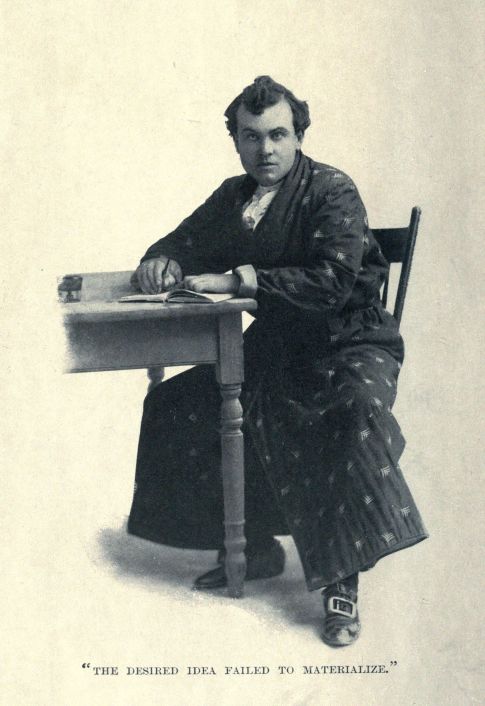
THE DESIRED IDEA FAILED TO MATERIALIZE.
TOM MOORE
An Unhistorical Romance, Founded on Certain Happenings in the Life of Ireland's Greatest Poet
By THEODORE BURT SAYRE
Author of "Two Summer Girls and I" "The Son of Carleycroft," Etc.
ILLUSTRATED
THE MUSSON CO., LIMITED TORONTO
Copyright, 1902 By Frederick A. Stokes Company
Published in September 1902
FOURTH EDITION
To ANDREW MACK
With the author's grateful acknowledgment and appreciation of the convincing art and rare personal charm of the actor who has done so much to make "Tom Moore" a success upon the stage
Preface
In this book the author has endeavored to give to the reading public an intimate presentation of one of the more famous of the literary giants who made the beginning of the last century the most brilliant period in the history of English Letters since the days of the Elizabethan authors.
Of Tom Moore's rank and attainments as a poet of the finest gifts very little need be said. Posterity has placed the seal of everlasting approval upon the best of his work and in the main is admirably ignorant of his few less worthy productions. So it need not be feared that the memory of the author of "Lalla Rookh," "The Last Rose of Summer," "Love's Young Dream," and, lastly, the most tender and touching of all love songs, "Believe Me, if All Those Endearing Young Charms," will ever be less brightly preserved, less tenderly treasured, than it has been in the years that have intervened since his death.
"Moore has a peculiarity of talent, or rather talents--poetry, music, voice, all his own; and an expression in each, which never was, nor will be, possessed by another.... There is nothing Moore may not do, if he will but seriously set about it.... To me some of his Irish Melodies are worth all the epics that ever were composed," wrote the hapless Lord Byron, who was one of the gifted Irishman's most intimate and faithful friends.
"The poet of all circles and the idol of his own."
No other words could so fitly describe the position of Moore in the esteem of the public. His ballads are sung by peer and peasant, in drawing-room and below stairs, and long ago the world at large began to rival the affection and admiration with which the life work and memory of the sweetest singer of them all has been cherished by the little green island which so proudly proclaims itself as the birthplace of this, its favorite son. But of the brilliant poet's early struggles, failures, successes and ambitions little is known. From his own writings and those of Lord Byron, Sir Walter Scott, Leigh Hunt and Captain Trelawney, it has been gleaned that there never was a more faithful friend, a more patient or devoted lover, a truer husband and fonder father than Thomas Moore. His married life was as sweet and tender as one of his own poems. Much is known of the happy years that followed his wedding, but till now no attempt has been made to picture the days of love and doubt that preceded the union which was destined to prove so splendid an example of true connubial content. In regard to historical accuracy, it is admitted that a certain amount of license has been used. For the sake of gaining continuity, events spread over a space of years have been brought within the compass of months, but aside from this concentration of action, if it may be so described, the happenings are in the main not incorrect.
While it is true that Moore was never actually ejected from society by the Prince of Wales, he did forfeit for a time the favor of that royal gentleman until the authorship of certain offensive verses was generously acknowledged by Lord Byron. The incident wherein Moore sells his life-work to McDermot is pure fiction, but in truth he did succeed in obtaining from Longmans an advance of £3,000 for "Lalla Rookh" before it was even planned, an event which in this chronicle is supposed to occur subsequent to his rescue from McDermot by Lord Brooking. Since the advance really obtained was three times the amount he is made to demand of the Scotch publisher the possibility of this particular part of the occurrence is not to be questioned.
For certain definite and easily comprehended reasons the real degree of Moore's poverty when he arrived in London and previous to his talent's recognition by the Regent, who did accept the dedication and thus insure the success of his first volume of verses, has been exaggerated, but in regard to his possession of the Laureateship of England the story deals with fact. Nevertheless the correctness of this bestowal of favor by the Prince of Wales was publicly denied in the columns of an influential New York newspaper at the time of the play's first presentation in the metropolis. For the enlightenment of those who may have been led into error by this misstatement, at the time overlooked by the author, they are referred to letter No. 63, from Moore to his mother, dated Friday, May 20th, 1803, in the first volume of the "Memoirs, Journal, and Correspondence of Thomas Moore," edited by Lord John Russell, in which the poet gives his exact reasons for having recently relinquished the post in question.
It is also true that the first notable success of Bessie Dyke as an actress was scored at Kilkenny, Ireland, instead of London. As her elder sister, Mary, has no part in this story, she has been omitted altogether, though her long and successful career upon the American stage is a part of the national theatrical history.
So far as the characters herein set forth are concerned but little explanation is required. Those historical have been sketched in accordance with the accounts of their peculiarities furnished by the literature of the times. Several of the most important people are entirely imaginary, or have been constructed by combining a number of single individuals into one personage.
In reply to the anticipated charge that the author cannot prove that the incidents described in the progress of Moore's wooing ever happened, he makes bold to answer that it is equally as impossible to prove that they did not.
With this explanation, necessary or unnecessary, as the future will no doubt prove, the book "Tom Moore" is confided to the mercy of the public which has so generously welcomed the play.
CONTENTS
BOOK ONE
ONE AFTERNOON IN IRELAND
CHAPTER
Tom Moore goes Angling
Certain Happenings in Mistress Dyke's School
Tom Moore entertains Teacher and Pupils
The Blackmailing of Tom Moore
Tom Moore gives Mistress Dyke an Inkling
Two Gentlemen of Wealth and Breeding
Tom Moore obliges a Friend and gets in Trouble
BOOK TWO
ONE AFTERNOON IN ENGLAND
Introduces Montgomery Julien Ethelbert Spinks
Tom Moore receives Calls from Mrs. Malone and Mr. Dyke
In which the Landlady is played a Trick
Tom Moore receives Visits from Two Cobblers and a Clerk
In which the Poet warbles to Mrs. Malone
Tom Moore has a Bitter Disappointment and an Unexpected Visitor
Sir Percival Lovelace is favored by Fortune
BOOK THREE
TWO EVENINGS IN HIGH SOCIETY
Sets Forth Certain Explanations
Tom Moore separates a Young Lady from her Skirt
Honors are Easy
Tom Moore moves in Distinguished Company
Mr. Sheridan, Mr. Brummell, and Mr. Moore Hold Council of War
Tom Moore makes a Bad Bargain
The Poet falls from Favor
BOOK FOUR
A NIGHT OF ADVENTURE
Tom Moore receives a Proposal of Marriage
The Poet has Callers and gives a Dinner-Party
Tom Moore hears of a Political Appointment
Sir Incognito receives a Warm Welcome
Tom Moore's Servant proves a Friend in Need
The Poet regains Royal Favor
The Play, founded by Mr. Sayre on the same incidents as the novel, was produced by Messrs. Rich and Harris, with great success at the Herald Square Theatre, New York, on the evening of the Thirty-first of August, 1901, with the following cast:
TOM MOORE, Ireland's favorite poet . . . . . . . . . ANDREW MACK PRINCE OF WALES, Regent of England . . . . . . . . . MYRON CALICE SIR PERCIVAL LOVELACE, Boon Companion to the Prince GEORGE F. NASH LORD MOIRA, Moore's friend and patron . . . . . . . THEODORE BABCOCK ROBIN DYKE, an Irish minor poet . . . . . . . . . . GEORGE W. DEYO SHERIDAN, the famous wit . . . . . . . . . . . . . . GILES SHINE BEAU BRUMMELL, a leader of society . . . . . . . . . HARRY P. STONE TERENCE FARRELL, a young Irishman . . . . . . . . . FRANK MAYNE BUSTER, Moore's servant . . . . . . . . . . . . . . EDWARD J. HERON MCDERMOTT, a publisher . . . . . . . . . . . . . . . RICHARD J. DILLON SERVANT . . . . . . . . . . . . . . . . . . . . . . JOHN NAPIER
MICKEY } { JOHNNY COOKE WILLIE } { WILLIE COOKE PATSEY } { AUGUSTUS WILKES DICKY } { GEORGIE CADIEUX JOHNNY } { JOHNNY WILKES TOMMY } School { HAROLD GRAU LIZZIE } Children { VIVIAN MARTIN NELLIE } { ETHEL CLIFTON MAGGIE } { MARY McMANUS KATIE } { SYLVIA CASHIN BRIDGET } { ISABEL BARRCACOLE MARY } { LORETTA RUGE
BESSIE DYKE, an Irish girl . . . . . . . . . . JOSEPHINE LOVETT WINNIE FARRELL, an heiress . . . . . . . . . . SUSIE WILKERSON MRS. FITZ-HERBERT, the Prince's favorite . . . JANE PEYTON MRS. MALONE, Moore's landlady . . . . . . . . MAGGIE FIELDING Courtiers, Ladies, Footmen, Servants, etc.
Book One
"The time I've lost in wooing,
In watching and pursuing
The light, that lies
In woman's eyes,
Has been my heart's undoing"
TOM MOORE
Chapter One
TOM MOORE GOES ANGLING
Mr. Thomas Moore was certainly in a very cheerful mood. This was evidenced by the merry tune with which he was delighting himself, and a jealous-minded thrush, with head cocked on one side, waited with ill-concealed impatience for his rival to afford him the opportunity of entering into competition. As this was not forthcoming, the bird took wing with an angry flirt of the tail and mental objurgation levelled at the unconscious head of the dapper young Irishman, who lilted gayly as he wandered along the path worn in the sward of the meadow by the school children on their way to and from the institution of learning presided over by Mistress Elizabeth Dyke.
"The time I've lost in wooing,
In watching and pursuing
The light, that lies
In woman's eyes,
Has been my heart's undoing."
Moore paused in his ditty and sat down on a convenient stone, while he wiped his brow with a ragged silk handkerchief which, though of unmistakably ancient origin, was immaculately clean.
"Faith," he murmured, "there's no fiction in that last stanza. It's broken-hearted I am, or as near it as an Irishman can be without too much exertion."
He sighed almost unhappily, and drawing a knife from his breeches pocket proceeded to manufacture a whistle from the bark on the end of the long willow wand he had cut a few moments before to serve as a fishing-rod.
This last was accomplished after some little effort accompanied by much pursing of lips and knitting of brows.
His labors completed, Moore regarded the whistle with the critical approval of an expert, and putting it to his mouth blew a shrill blast. As the result was eminently satisfactory, he bestowed the toy in the crown of his beaver and, crossing his legs comfortably, proceeded to take his ease.
His appearance was decidedly attractive. While quite a little below middle size, his wiry figure was so well proportioned that in the absence of other men nearer the ordinary standard of height, he would have passed as a fine figure of a lad. He carried himself with easy grace, but affected none of the mincing, studied mannerisms of the dandy of the period. He had a round, jolly face, a pleasing though slightly satirical mouth, an impudent nose, and a pair of fine eyes, so brightly good-humored and laughingly intelligent, that no one could have looked into their clear depths without realizing that this was no ordinary youth. And yet at the period in his career from which dates the beginning of this chronicle Tom Moore's fortunes were at a decidedly low ebb. Disgusted and angry at the ill success which attended his attempts to sell his verses to the magazines and papers of Dublin, for at this time it was the exception, not the rule, when a poem from his pen was printed and paid for, Moore gathered together his few traps, kissed his mother and sisters good-bye, shook the hand of his father, then barrackmaster of an English regiment resident in Ireland, and hied himself to the sylvan beauties of the little town of Dalky. Here he secured lodgings for little more than a trifle and began the revision of his translation of the Odes of Anacreon, a task he had undertaken with great enthusiasm a year previous. Thus it was that he chanced to be wandering through the fields on fishing bent this bright and beautiful morning in the year of our Lord 179-.
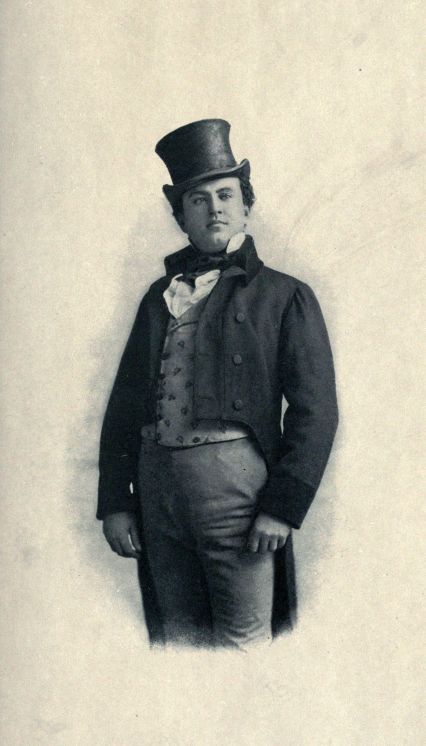
Tom Moore
A small boy, barefooted and shock-headed, came across the meadow in the direction of the schoolhouse visible in the distance on the crest of a long, slowly rising hill. He carried a bundle of books and an old slate tightly clutched under one arm, while from the hand left disengaged swung a long switch with which he smartly decapitated the various weeds which had achieved altitude sufficient to make them worthy of his attention.
Noticing Moore for the first time, the boy's face brightened and lost its crafty look of prematurely developed cunning and anxiety, as he approached with a perceptible quickening of his gait.
"Is it you, Mr. Moore?" he said, a rich brogue flavoring his utterance.
"Unless I am greatly mistaken, Micky, you have guessed my identity," admitted the young man, making a playful slap with his rod at the new-comer's bare shins, which the lad evaded with an agility that bespoke practice, at the same time skilfully parrying with his switch.
"Goin' fishin'?"
"Shooting, my boy. Don't you perceive my fowling-piece?" replied Moore, waving his fish-pole in the air.
"Sure," said Micky, grinning broadly, "you will have your joke."
"None of the editors will, so, if I did n't, who would?" responded Moore, with a smile not altogether untinged by bitterness. "Where are you going, Micky?"
"To school, sir, bad cess to it."
"Such enthusiasm in the pursuit of education is worthy of the highest commendation, my lad."
"Is it?" said Micky doubtfully. "What's that, Mr. Moore?"
"Commendation?"
"Yis."
"Well, if I said you were a good boy, what would that be?"
"Father would say it was a d--n lie."
Moore chuckled.
"Well, we will let it go at that. You seem to be in a great hurry, Micky."
"So do you, sir."
"Humph!" said Moore. "I perceive you are blessed with an observing mind. Have you observed the whereabouts of a trout brook that is located somewhere in this neighborhood?"
"Yis," replied Micky, himself an enthusiastic fisherman. "I have that. Don't ye know the place, Mr. Moore?"
"Not I, my lad, but, since Providence has sent you along to show me the way, I 'll speedily be possessed of that knowledge."
Micky looked doubtfully in the direction of the schoolhouse. It was almost time for the afternoon session, but the day was too beautiful to be spent in the dull depths of the school without regret.
"I 'd show you the way, sir, gladly, but it 'll make me late."
"Are you afraid of Mistress Dyke?" queried Moore, noticing the boy's hesitation.
"Yis, sir."
"So am I, my lad."
Micky looked surprised. That this dashing young blade in whose person were apparently embodied all the manly virtues, at least from the lad's point of view, should stand in dread of such a soft-eyed, red-cheeked little bundle of femininity as his schoolmistress was a matter beyond his juvenile comprehension.
"And why, sir?" asked the boy curiously.
"She 's very pretty," replied Moore. "When you are older you will understand what it is to be in awe of a trim little miss with the blue sky in her eyes and a ripple of red merriment for a mouth. In the meantime you shall show me the way to the brook."
"But she 'll lick me," objected Micky, numerous ferulings keenly in mind.
"Not she, my laddybuck. To-day I 'm coming to visit the school. Tell her that and she 'll not whack you at all."
"Won't she?"
"No, she will be so pleased, she will more than likely kiss you."
"Then why don't you go and tell her yourself? You would like the kiss, would n't you?"
"Micky," said Moore solemnly, "you have discovered my secret. I would. Ah me! my lad, how little we appreciate such dispensations of Providence when we are favored with them. Now you, you raparee--you would much rather she did n't practise osculation upon you."
Micky nodded. He did not understand what his companion meant, but he was quite convinced that the assertion made by him was absolutely correct.
What a beautiful thing is faith!
"A pretty teacher beats the devil, Micky, and you have the prettiest in Ireland. I wish I could be taught by such a preceptress. I 'd need instruction both day and night, and that last is no lie, even at this day, if the lesson were to be in love," he added, a twinkle in his eyes, though his face was perfectly sober.
"Sure," said Micky, "she don't think you nade lessons. I heard her tell Squire Farrell's daughter blarney ran off your tongue like water off a duck's back."
"What is that?" said Moore. "I 'll have to investigate this matter thoroughly."
At this moment the metallic clang of an old fashioned hand-bell sounded faintly down the hillside mellowed into comparative melodiousness by the intervening distance.
"Ah," said Moore, "your absence has been reported to Mistress Dyke, and she has tolled the bell."
It seemed as though the young Irishman's execrable pun decided the ragged urchin that the way of the transgressor might be hard, for, without further hesitation, he took to his heels and fled in the direction of the schoolhouse.
After a moment's thought Moore followed him, beating time with the willow fishing-rod to the song which half unconsciously issued from his lips as he turned his steps in the direction of the headquarters of Mistress Bessie Dyke.
Tom Moore was going angling, but not for trout.
Chapter Two
CERTAIN HAPPENINGS IN MISTRESS DYKE'S SCHOOL
Over her desk, waiting for developments, leaned Mistress Dyke. A moment passed, then the tousled head of the tardy Micky appeared above the level of the bench behind which he had secured shelter after carefully crawling on hands and knees from the door, having by extreme good fortune, made the hazardous journey undetected. Only the fatally unwelcome interest displayed in this performance by the red-headed boy on the front row prevented the success of Micky's strategy. As it was, the blue eyes of Bessie met his with a glance of reproof as he slid noiselessly into his place.
"Micky."
The boy rose reluctantly to his feet.
Bessie looked at him severely. To his youthful mind she appeared very stern indeed; but, if the truth were known, to the ordinary adult eye she presented no fiercer exterior than that ordinarily produced by a slight feeling of irritation upon the aspect of a kitten of tender age. Smiles always lurked in Bessie's big blue eyes, and little waves of mirth were ever ready to ripple out from the corners of her mouth at the slightest provocation, so it can readily be understood that it was no easy task for her to sternly interrogate the freckle-faced youth who, beneath her disapproving gaze, shifted uneasily from one bare foot to the other.
Mistress Dyke ruled by love, and if she did not love by rule, it is merely another instance where exception can be taken to the old saw which so boldly and incorrectly states that a good maxim must of necessity be reversible.
"Why are you late, Micky?" demanded Bessie.
"Sure, mistress, I dunno," was the hopeless response.
"You don't know, Micky? How foolish!"
"Yis 'm," assented Micky. "I was foolish to be late."
Bessie smiled and then tried to deceive the school into the belief that it was only the beginning of a yawn by patting her mouth with a dimpled palm. The school knew better and anxiety grew less.
"But there must be some reason for it," she persisted.
"I know," said a little lad with long yellow curls, which were made doubly brilliant by the red flannel shirt that enveloped him, materially assisted by diminutive trousers, with a patch of goodly proportions upon the bosom. "I saw him goin' fishin' wid Mr. Moore."
"Tattle-tale! Tattle-tale," came in reprimanding chorus from the other pupils. Dicky, quite unabashed by this disapproval, made a gesture of defiance and returned to his place. Unfortunately the copper-tipped brogan of one Willy Donohue, who chanced to be sitting immediately in the rear of the youthful informer, was deftly inserted beneath Dicky as he started to seat himself.
The result of this was that the cherubic Richard arose, with an exclamation of pain and surprise, much more quickly than he sat down.
"Dicky, you may remain after school. I want no tell-tales here," said Bessie.
"Teacher, Willy Donohue put his foot in me seat," expostulated Dicky, on whom the lesson was quite thrown away.
"Willy shall stay after school, also."
"Ah-h-h!" remarked Dicky, mollified at the prospect of his unkind fate being shared by an old-time enemy.
"I wish you wuz big enough to lick," growled Willy, under his breath. "Your own mother would n't know you after the flakin' I 'd give you. I 'd snatch you baldheaded, baby."
Dicky turned his head far enough over his shoulder to prevent Mistress Dyke from observing the protrusion of his tongue, and was so unlucky as to be hit fairly in the eye with a paper pellet, amply moistened, propelled with all the force the vigorous lungs of the prettiest girl in school, aided by a tube of paper torn from the back of her geography, could impart to it.
"Teacher, Milly O'Connor hit me in the eye wid a spit ball," snivelled Dicky, who, being of tender years, did not share in the general masculine scholastic worship of the youthful belle, who was admired and fought over by the larger boys, on whom she bestowed her favors quite impartially.
"Oh dear!" sighed Bessie. "Was there ever such a lot of children? Milly, rise."
Milly stood up without any visible sign of contrition or embarrassment. She was a pretty, dark-curled lassie of ten, dressed neatly and becomingly, which made her doubly prominent in her present surroundings, for most of the children were of such poverty-stricken parentage that the virtue possessed by their wearing apparel consisted almost entirely in sheltering and hiding rather than ornamenting their small persons.
"What shall I do to punish you?" asked Bessie, wearily.
"You might ferule her, teacher," suggested Dicky, good-humoredly coming to the rescue.
"Dicky, mind your own business," said Bessie severely, "or I 'll ferule you. Now I shall punish you both. Milly, kiss Dicky immediately."
"I don't want to kiss a tattle-tale," said Milly, who placed fully the proper valuation on her caresses.
"Exactly," said Bessie. "This is a punishment, not a reward of merit."
"Not for Dicky," corrected Milly. "He will like it, teacher."
But here the little lady was in grievous error, for when she, resignedly obedient, approached the small rascal, he promptly burst into tears and, dropping on the floor, hid his head under the bench. This was more than Bessie had bargained for, and she was about to motion Milly to return to her seat when Patsy, a youth with carroty red locks already mentioned, rose from his place on the front bench, burning with the noble flame of self-sacrifice.
"She can kiss me instead, teacher," he announced heroically, "and you can let Dicky off this time."
Bessie laughed outright in spite of herself, but Milly, regarding Patsy's suggestion as nothing short of positive insult, turned her back on the admiring gaze of the gallant youth.
"I think we will excuse you, Patsy. Dicky is punished sufficiently, and I fancy Milly will behave herself in the future."
Patsy sat down with a gulp of regret, not comforted by Milly's whisper:
"I 'd do anything rather than kiss that red-headed monkey."
Micky, to whom she had imparted this welcome information, nodded approval.
"Wait till I catch him after school," he murmured hostilely. "I 'll dust his jacket for him."
Meanwhile Bessie had rescued Dicky from his grief and apprehension, and, when the curly-headed youth had had his nose blown and resumed his seat, school assumed its wonted quiet until the sight of a tiny mouse nibbling a bit of cracker under an unoccupied bench drew forth a scream of terror from Milly, who considered herself entitled by age to the enjoyment of all the follies peculiar to her sex.
"A mouse!" she shrieked. "Oh, teacher, teacher, save me!"
And she immediately sought a position of safety upon the seat.
Pandemonium broke loose. The other little girls not to be outdone became equally as frightened, and followed Milly in her ascent, an example which was most shamefully emulated by Bessie herself, with her desk as the base of operations.
Patsy plunged headlong in the direction of the small disturber bent on demolishing it with his geography. The other boys were equally prompt in following the chase, with the exception of Micky, who, realizing this was an excellent opportunity for administering a rebuke to his latest rival's amatory ambition, stepped quickly behind his enemy and kicked him in the place handiest at the time with an enthusiasm worthy of a better cause. Patsy, justly aggrieved, abandoned the pursuit, and, rising to his feet, smote Micky in the neck with a force that jarred him mentally as well as physically. Retaliation followed in a swinging blow on Patsy's snub nose, and a clinch ensued which continued in spite of Bessie's desperate remonstrances until Tom Moore put his head in the window, realized the necessity for prompt action, ran to the door, entered, and, seizing the combatants by their collars, tore them apart by main strength.
Chapter Three
TOM MOORE ENTERTAINS TEACHER AND PUPILS
Moore held the boys at arm's length, thus frustrating their desperate attempts to continue the battle, and glancing up at Bessie, who was still perched on the desk, favored her with a look of mingled astonishment and admiration.
"What a nice quiet time you have been having! Quite like a baby Donnybrook," he remarked cheerfully. "Are you trying to fly, Bessie, that you are up so high?"
"Oh, Tom, you came just in time."
"That is a habit of mine," replied Moore, and then, turning his attention to his prisoners, he continued:
"Now, my bully gladiators, what is the cause of this gentle argument?"
"Misther Moore, he said I looked like a monkey the other day," answered Micky, harking back to an insult that had long rankled in his memory.
"He kicked me, he did," said Patsy, "and I gave him a oner in the neck for it, I did."
"Red-head!" ejaculated Micky in tones of scorn. "He wanted Milly to kiss him, the puckorn!"
"Which is Milly?" inquired Moore, scanning the other scholars interrogatively.
"I am," answered that young lady, delightfully free from embarrassment.
"I don't blame you at all, Patsy," observed the poet regarding the youthful belle with approval. "Are you desperately fond of her?"
"To be sure," responded Patsy, valiantly. "I 'm going to marry her."
"As though I 'd marry that," remarked Milly, in accents by no means admiring.
"Never mind that, Miss Milly! An honest man's love is not to be scorned even when it's in short breeches," said Moore, reprovingly. "So it is jealousy that is at the bottom of this quarrel? Faith, I 'll settle it right here. Neither of you lads shall have Milly. I 'll marry her myself."
"All right," said Milly, cocking her eye at Bessie, "if teacher has no objection, I haven't."
"What an idea!" ejaculated the schoolmistress, descending from her desk. "Tom, how can you talk such nonsense?"
"Don't mind her, Milly. It's only jealousy," said Moore. "Boys, this fight is postponed till after hours." Then he added, in a whisper, "I 'll referee it myself. Go to your seats."
"Each of you boys will remain in an hour after school is dismissed," said Bessie, severely.
Moore stepped quickly to the desk where she had seated herself preparatory to continuing the session.
"Oh murder, no!" he expostulated in an undertone. "How can I talk to you, Bessie, if they are here?"
"Do you wish to talk to me, Mr. Moore?" asked the guileless maiden, as though surprised.
"I am dying to, Bessie," said he.
"On second thoughts, boys," she announced, "since Mr. Moore has interceded for you, you need not stay in, but there is to be no more fighting after school. I don't like quarrelling."
"Then you have made up your mind to be an old maid, have you?" murmured Moore.
Bessie tossed her head disdainfully.
"Are you sure the mouse is gone?" she asked, evading the question.
"I think I see it there," exclaimed Moore. "Look out, Bessie!"
"Oh!" cried the girl, relapsing into fright and seizing hold of her companion for safety's sake. "Don't let the horrid thing come near me!"
Moore chuckled and released himself from her appealing grasp.
"Please be more respectful, Mistress Dyke," he said reprovingly. "I 'll not have you seizing hold of me like this. It is entirely too familiar treatment for a young unmarried man to submit to at such short notice and unchaperoned. Have you no bringing up at all? What do you suppose my mother would say if she thought I permitted you to take such liberties?"
"Oh, never mind your mother," said Bessie pettishly, deciding that she was in no particular danger at the present moment.
"That is nice advice to give a young lad," commented Moore, drawing a rose from his button-hole. "See, Bessie, I have brought you a posey, the last blossom on the bush. Some day, if I have the time, I shall write a poem on the subject."
"Thank you, Tom."
As she spoke, Bessie put the flower in a glass of water on the desk that already held a bunch of clover plucked for her by the grimy fingers of one of her pupils.
Dicky stood up and raised his hand.
"Please, teacher," he lisped, "is Mr. Moore going to sing for us?"
"Sure as life," said Moore, his vanity tickled.
A murmur of approval came from the children. The young Irishman had amused them with his fine voice more than once, extracting in return from their evident enjoyment quite as much pleasure as his music afforded them.
"What shall it be, teacher?" he asked, turning to Bessie.
"Oh, anything but one of those odes from Anacreon, Tom. They are simply terrible."
"But you read them all."
"I blush to admit it," answered the girl, frowning at his lack of tact in recalling such an indiscreet proceeding.
"Ah, Bessie," he murmured tenderly, "I'd admit anything for the sake of seeing the roses steal in and out of your dear cheeks. Why, it is like watching the sunset sweeping over the clouds in the west on a summer evening."
"Sing, Thomas Moore," commanded the girl, but a softer look came into her eyes as she settled comfortably back in her chair to listen.
"I 'd like to pass my life singing to you, Bessie."
"That's all very well, Tom, but the notes from your throat are not taken at the bank."
"Well," retorted he, cheerily, "to get even, it is not many bank-notes I take."
Moore, after fetching a high stool from a distant corner of the room, perched himself upon it and began to sing, the school-room echoing with the clear ringing voice that was destined in after years to be the delight of the most fashionable circle in Europe. He had selected an old ballad setting forth the emotions felt by a world-worn traveller as he threaded the streets of his native village after years of wandering abroad, and, as the chorus was composed of the various song-game rhymes sung by the children in their play, it was quite familiar to the pupils of Mistress Dyke, who joined in heartily.
"Ready," cried Moore, beckoning the children from their places. "Now, all together.
"'I came to see Miss Jenny O'Jones,
Jenny O'Jones, Jenny O'Jones,
I came to see Miss Jenny O'Jones,
And how is she to-day?'"
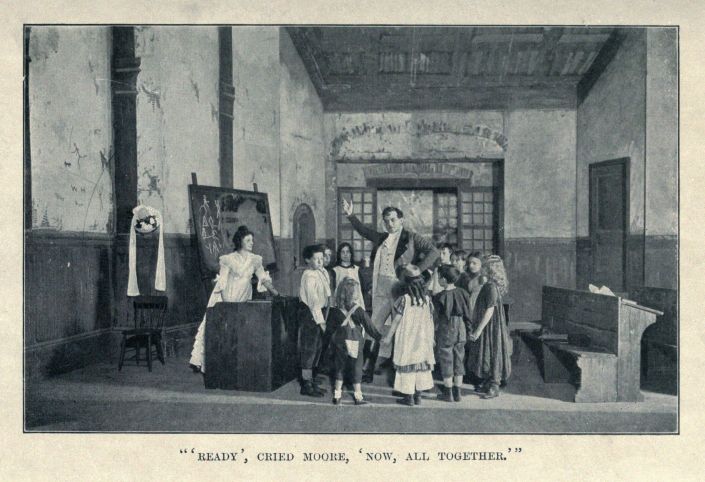
"'Ready,' cried Moore, 'Now, all together.'"
Hand in hand the children, their shrill voices raised tunefully under the leadership of Moore, marched gayly forward and back, the poet prancing as joyously as any of them, as he beat time with a ruler.
"Second verse," he said, and, enjoying every note, sang it through to the huge delight of his audience, who, when the chorus was reached a second time, danced around him in a circle, their pleasure proving so infectious that Bessie herself deserted her desk to take part in the wind-up, which was both uproarious and prolonged.
"That will do you," said Moore, mopping his face with his handkerchief. "Faith, it is great fun we have been having, Bessie."
"So it appears," she replied, rapping on the desk for order.
"You have a fine lot of pupils, Bessie. I 'd like to be father of them all."
"Mr. Moore!" exclaimed the girl, horrified at such a wish.
"I mean I 'd like to have a family as smart as they look," explained Moore, helping himself to a chair.
"That would not require much effort," replied the girl, coldly.
"But it would take time," suggested the graceless young joker. Then he continued, as Bessie gave him a freezing glance, "I mean, never having been married, I don't know, so I will have to take your word for it."
"You deserve to be punished for your impudence, Tom Moore."
"Since I 'm a bachelor, that is easy brought about, Bessie."
"Who would marry such a rogue as you?"
"I 'm not going to betray the ladies' confidence in my honor by giving you a list of their names," replied Moore, virtuously. Then he added softly:
"I know something--I mean some one--I deserve, whom I am afraid I won't get."
"Sooner or later we all get our deserts," said Bessie, wisely.
"I want her for more than dessert," he answered. "For three meals of love a day and a light lunch in the evening."
"It is time to dismiss school."
"I am not sorry for that; send the darlings home."
"And another thing, Tom Moore, you must never come here again during school hours. It is impossible to control the children when you are around."
Moore laughed.
"You had them nicely controlled when I arrived, didn't you?" said he. "Oh, well, I'll come later and stay longer. Dismiss them."
Bessie rang the bell, and school broke up for the day immediately.
Chapter Four
THE BLACKMAILING OF TOM MOORE
After bidding good-bye to the visitor most of the children crowded noisily out of the door, rejoicing at their resumption of freedom, but Patsy, he of the red hair, seated himself deliberately on the front bench and immediately became deeply interested in his arithmetic, his presence for the moment being completely overlooked by Moore, whose attention was attracted by the attempt of a ragged little miss to make an unnoticed exit.
"Little girl," said Moore, gently, "why are you going without saying good-bye to me? What have I done to deserve such treatment from a young lady?"
The child thus reproached, a tiny blonde-haired maiden, dressed in a faded and ragged frock, looked timidly at her questioner, and flushed to her temples.
"I thought you would n't want to say good-bye to me, sir," she answered, shyly.
"And why not, alanna?"
"'Cause I 'm poor," she whispered.
A tender look came into Moore's eyes and he crossed to the side of the child, his generous heart full of pity for the little one's embarrassment.
"I 'm poor, too," he said, patting her yellow curls. "Where do you live, my dear?"
"Down by the Mill, sir, with my auntie."
"And is this the best dress she can give you?" he asked, trying the texture of the little gown and finding it threadbare and thin.
The child looked down at her feet, for the moment abashed, then raising her eyes to the young man's face, read only sympathy and tenderness there, and, thus encouraged, answered bravely:
"It is better than hers."
"Then we can't complain, dear, can we? Of course not, but is n't it very thin?"
"Yes, sir, but I would n't mind if it was a bit more stylish."
Moore looked at Bessie, smiling at this characteristic manifestation of femininity.
"The size of her!" he said. "With a woman's vanity already."
Then, turning to the child again, he continued:
"Well, we poor people must stick together. I 'll call on your aunt to-morrow."
"Will you?" cried the girl in delight. "And you 'll sing to us?"
"That I will," said Moore, heartily. "Now run along like a good girl, and mind me, dear, never be ashamed of your honest poverty. Remember that the best man of us all slept in a manger."
"Yes, sir," responded the child, happily, "I 'll not forget."
As she started for the door Moore called her back and put a shilling in her little pink palm.
"What will you do with it?" he asked, chucking her under the chin.
"Buy a ribbon, sir."
"A ribbon?" echoed Moore in imitation of her jubilant tone.
"For me auntie."
"Bless your generous little heart," said Moore, drawing another coin from his pocket. "There is the like of it for yourself. Buy one for each of you. Now off you go. Good-bye."
The child ran lightly to the door, but, as she reached the steps, turned, as though struck by a sudden thought, and beckoned to Moore.
"You may kiss me, sir," she announced with as much dignity as though she were bestowing upon her benefactor some priceless gift, as indeed she was, for certainly she possessed nothing more valuable. Then, after he had availed himself of her offer, she courtesied with childish grace and trotted gayly off, her two precious shillings tightly clutched in her hand. Believing himself to be alone with Bessie, Moore hastened toward her with outstretched arms, but was suddenly made aware of the presence of a third party by Patsy, who discreetly cleared his throat as he sat immersed in his book.
Moore turned to Bessie.
"What is that lad doing there?" he whispered. "Does n't he know school is over?"
"How should I know?" she answered, though a glint of fun in her eyes showed she was not without her suspicion as to the reason of Patsy's presence.
"You might ask him what he wants," she suggested encouragingly.
"I will," said Moore, approaching the interrupter of his wooing with a disapproving expression upon his face.
"Look here, my son, don't you know school is dismissed?"
"Yis, sir," replied Patsy, loudly.
"And yet you are still here?"
"Yis, sir."
"Bad luck to you, can't you say anything but 'Yis, sir'?"
"No, sir," responded Patsy, not at all intimidated by Moore's glowering looks.
"That is better," said Moore. "You are going home now?"
"No, sir."
"There you go again! Faith, I wish you would say 'Yes' and stick to it. What are you doing here at this unseasonable hour?"
"I wish to study me lessons," replied Patsy, enthusiastically.
Fairly dashed, Moore returned to Bessie.
"I never saw a lad so fond of his books before," said he.
"It is a new thing for Patsy," said Bessie with a laugh. "There is no bigger dunce in school."
"Is that so?" asked Moore. "Faith, I'm beginning to understand."
Patsy looked sharply over his book at the young poet.
"Can't you study at home, my lad?"
"No, sir."
"Will you never say 'Yes, sir,' again?"
"No, sir."
"Now look here, my young friend, if you say 'Yes, sir,' or 'No, sir,' again I 'll beat the life out of you."
"All right, sir," responded Patsy, plunging his face still deeper into his book.
Moore regarded his small tormentor with a look of dismay.
"You will strain your eyes with so much study, Patsy," he said, warningly. "That is what you will do,--and go blind and have to be led around by a stick, leaning on a small dog."
A suppressed giggle from Bessie drew his attention to his mistake.
"It 's the other way round I mean. Are n't you afraid of that sad fate, my bucko?"
Patsy shook his head and continued his energetic investigation of his arithmetic, while Moore sought counsel from the schoolmistress, who was keenly enjoying her admirer's discomfiture.
"What will I say to the little tinker, Bessie?" he asked, ruefully.
"How should I know, Tom? I am his teacher and will have to help him if he wishes it."
"What is it troubles you?" demanded Moore, looking down on Patsy's red head.
"A sum, sir," replied Patsy.
"Show it to me."
The boy designated an example with his finger.
"'If a man sold forty eggs at one ha'penny an egg,'" read Moore from the book, "'how many eggs--'?"
Shutting up the arithmetic, he put his hand in his pocket and jingled its contents merrily.
"Is the answer to this problem sixpence?" he asked.
"Oh, no, sir," replied Patsy ingenuously.
"What is, then?" demanded Moore, baffled.
"Two shillings," announced the graceless youth.
"I 'll give you one," said Moore, suggesting a compromise, but Patsy was not to be so lowered in his price.
"Two is the answer," he replied in a determined tone.
Moore yielded without further protest and produced the money.
"There you are, you murdering blackmailer," said he. "Now get out before I warm your jacket."
Patsy seized his books, and, dodging a cuff aimed at him by his victim, ran out of the schoolhouse with a derisive yell.
"Bessie," said Moore, solemnly, "that little spalpeen will surely come to some bad end."
"And be hanged?" asked the girl, taking a handful of goose-quills from her desk preparatory to sharpening them into pens with an old knife drawn from the same storehouse.
"Or get married, my sweet girl, though they say death is better than torture," replied Moore, approaching the schoolmistress. "Do you know it cost me two shillings to get a talk with you?"
Bessie smiled and finished a pen with exquisite care.
"Talk is cheap," she observed, carelessly.
"Whoever said that never called at your school, Bessie Dyke," said Moore, perching himself upon her desk. "Turn your face a bit the other way, if you please."
As he spoke he took the girl's round chin in his hands and moved her head until only a side view of her pretty face could be obtained from his post of vantage.
"Do you like my profile so much, Tom?" she asked, submitting docilely to his direction.
"It's not that, Bessie," answered Moore, "it's because I can't stand two such eyes at once. Now there is but one of them looking at me. And such an eye! My heart's jumping under my jacket like a tethered bullfrog with the glance of it. Ah, Bessie, there is only one in the wide world like it."
"And where is that?" asked the girl, a shade of jealousy perceptible in her inquiry.
"Just around the bend of your nose, mavourneen," laughed Moore. "Filled with melted moonshine are both of them. Sure, one soft look from those eyes would make a cocked hat out of starlight."
"Would it?" murmured Bessie, charmed in spite of herself. "Do you really mean all you say?"
"Mean it? It's poor justice my words do your beauty, Bessie dear. You have the sauciest, darlingest, scornfullest nose, and such a mouth! Why, to look at it makes my lips pucker."
"A lemon would do the same," observed Bessie, foiling Moore's attempt to snatch a kiss by sitting back in her chair. "You need not think I believe all your nonsense, Thomas Moore."
"Don't you believe what I have just said, Bessie?"
"Not I. You need n't flatter yourself."
"Why needn't I? Will you do it for me?"
"I have something better to do," replied Bessie, paring another quill with much vigor.
"That is what I call a cutting remark," said Moore, looking at the knife.
Bessie sighed, and temporarily abandoned her labors.
"Tom Moore," she said solemnly, "why will you make such awful puns?"
"Practice makes perfect, my dear. If I keep on, some day I may make a good one."
"I wonder if there ever was a good pun?"
"Keep on wondering. You look like an angel pondering over the fit of her wings."
"Tom, that is sacrilegious."
"You 're wrong, Bessie, it's only poetry."
Bessie frowned. Like all good women, she did not like to hear religion spoken of lightly, so she rebuked the erring Thomas with a glance.
"You are pretty even when you frown, Bessie," remarked the unregenerate versifier.
Bessie attempted to look doubtful as to the truth of this last statement.
"Why should n't you believe me? Has n't your mirror showed you day after day what I am telling you?"
As he spoke Moore took her hand in his, not noticing that one slender finger was wound round by a bandage. Bessie gave a little cry of pain.
"What is the matter?"
"You hurt me," she answered, exhibiting her finger.
"I 'm more than sorry, Bessie, but what ails your pinkie?"
"I burned my hand."
"Shall I burn the other for you?" asked Moore, extending his in invitation.
"How could you?" she demanded, suspecting a trap.
"Why," said Moore, "with a kiss half as warm as my heart."
Bessie giggled, then tried to resume her dignity, but Moore had no intention of letting such an advantage pass unutilized, and, seizing her uninjured hand, planted a hearty smack in its warm palm.
"Mr. Moore!"
"Mistress Dyke!"
"I shan't allow you to stay here if you cannot behave in a sensible manner," she threatened.
"I'm not sensible?"
"Not now."
"Then, if I am not sensible, I am unconscious, and, if I am unconscious, I am not responsible for what I do."
Moore with this justification made a sudden attempt to embrace Bessie, who, always prepared for such lawlessness, evaded his outstretched arms and retaliated by pricking him with her knife, a proceeding which resulted in the instant removal of the poet's person from her desk, accompanied by an ejaculation that sounded suspiciously like profanity.
"What did you say, Tom?" asked Bessie with a gurgle of satisfaction. For once she had the better of her resourceful admirer.
"You will have to guess that, Bessie," he remarked. "Do you think that is a nice way to treat a young man?"
"Oh, it was only a joke," said Bessie, quite unrepentant.
"Your jokes are too pointed," said Moore. "After this please refrain from any that are sharp enough to go clean through doe-skin breeches and I 'll thank you."
The door opened suddenly and Dicky, still resplendent in red shirt and golden curls, appeared, carrying a book. He halted on the threshold and looked inquiringly at his teacher.
"Egad, it's the cherub!" exclaimed Moore.
Taking courage, Dicky toddled in, book in hand, and approached Moore, who gazed wonderingly down at him.
"Well, my lad, what do you want?"
"Please, sir," piped Dicky, "I wants help wid me lessons," and he held up his book. Bessie stuffed her handkerchief into her mouth to smother her laughter, while a look of understanding came into Moore's eyes.
"Oh, you want help, do you?" said the latter.
"Yis, sir, wid me aris'metic," announced Dicky, laboring earnestly to bring forth the big word and catching some of the edges with his teeth in spite of the exertion. "It's a sum, sir."
"A sum indeed?" echoed Moore.
"Yis, sir, and the answer is one shillin', sir."
Moore looked over at Bessie, who almost choked and had to seek relief in coughing. Then he regarded the recently arrived blackmailer with a glance that he vainly endeavored to make severe, but Dicky perceived the twist of mirth at the sides of his victim's mouth, and took heart accordingly.
"A shilling, my young Jack Sheppard?" said Moore, feeling in his pocket. "I 'll give you a six-pence."
"Patsy said it was a shillin'," insisted Dicky, stamping his feet by way of emphasis.
Moore yielded in shameful defeat.
"There you are, you highwayman, and you tell Patsy I 'll flake him when I catch him again," he said, handing out the desired coin. "You see that door? Well, get through it as quickly as you can, or I may do you bodily injury."
Dicky fled wildly across the school-room with Moore galloping at his heels, then the door shut with a bang, and the pair were alone again.
Chapter Five
TOM MOORE GIVES MISTRESS DYKE AN INKLING
Moore regarded Bessie with a glance of reproving indignation, which was quite lost upon the young lady.
"I 'm in a den of thieves, I am," he remarked, sternly. "Bessie, I half believe you put those lads up to that same game. What share do you get? Half, I 'll wager."
"When do you go back to Dublin, Tom?" asked the girl, waving aside his insinuation with a flirt of her handkerchief.
"I don't know," responded Moore. "I should be there now."
"Should you, Tom? What is keeping you, then?"
Simple child! She, of course, had not the slightest suspicion that she was in any way concerned in the poet's prolonged tarrying at Dalky. Innocence is a truly beautiful thing, and that it is not more popular is much to be regretted.
"Keeping me?" repeated Moore. "Nothing but my heart, mavourneen."
"Indeed? Who has it in their possession, if it is no longer in yours?"
"You, Bessie," answered Moore, earnestly. "And pray do not return it. After being in your keeping, no other woman would satisfy it, and I 'd have no peace at all. Ah, alanna, when I left Dublin, weary and discouraged at my failure to sell my poetry, and came to this quiet country place in search of rest, it is little I dreamed I would run across such a girl as you. You have put new thoughts in my head, Bessie. My soul is not the same at all."
Touched by the tenderness of his tone, the girl grew sober in her turn.
"And you must go, Tom?" she asked, regretfully.
"I have my fortune to make, Bessie. Why, mavourneen, I have n't a penny of my own."
"And no pennies of anybody else's?"
Moore smiled broadly.
"How could I have?" said he. "I never went to school here. I don't know the system like your pupils."
Bessie laughed and looked so tempting in her mirth that Moore made another attempt to kiss her, with no better success than had rewarded his previous efforts.
"Poverty is a common complaint," she observed, shaking her head at the disappointed youth.
"I had rather be poor than a miser," said Moore, sitting down on a stool.
"A miser? Am I one?"
"Yes, with your kisses. Faith, they are spoiling to be picked."
"I am the best judge of when and by whom they shall be picked, good sir," replied Bessie, pensively nibbling on the end of a brown curl.
"It is hard to be poor, Bessie," sighed Moore, resting his feet on a rung of the stool, his elbows on his knees, and his chin in his hand, this being a favorite attitude of the poet's.
"If you would marry Winnie Farrell you would have slews of money," suggested Bessie, leaning on the back of the bench with affected carelessness of demeanor, but there was a gleam in her eye, hidden 'neath drooping lids and long lashes, that seemed indicative of no little interest in the forthcoming answer.
Moore looked inquiringly at his fair companion.
"Winnie Farrell is it?" he said, laughing at the idea. "Not for me, Bessie. I have picked out another lassie."
"But I 'm told you often call at Squire Farrell's," persisted the girl, not wholly reassured.
"To be sure I do, Bessie," replied Moore frankly. "And no wonder. The Farrells are pleasant people. Winnie is nice to chat with, and I like her brother. He is the cleverest lad in the country."
Bessie shook her head doubtfully, and a sunbeam that, slanting in the window, had comfortably nested in a coil of her bonny brown hair was rudely thrown forth to find no better resting-place than the floor, for the girl moved nearer to Moore as she spoke.
"He is too clever for his own good, I fear," she said. "The fewer dealings you have with Terence the better it will be for you."
Before Moore could reply the door opened, and Patsy, Micky, and Willy Donohue filed in, each clutching an arithmetic.
"Look, Tom," said Bessie, pointing out the new-comers.
Moore regarded the little party with wide-open eyes.
"Egad, Bessie," said he, "it's a committee. What do you lads want now?"
"Please, sir," said Patsy, acting as spokesman, "these two boys wants help wid their lessons. They each has a sum, sir, and their answer is sixpence apiece."
"Come here, then," said Moore, sweetly, "and I 'll hand it to you."
The boys, made confident by past successes, came forward without hesitation as their victim put both hands in his pockets.
"It is a long worm that has no turning," remarked Moore, seizing Patsy by the collar with one hand, while with the other he picked up the ruler from the desk. "This is where Thomas Moore worms--I mean turns. There is sixpence where you won't lose it, my lad."
The dust flew from Patsy's breeches, while from his mouth proceeded vigorous objections to his present treatment.
"Now run, you divil, or I will repeat the dose," cried Moore, throwing the ruler at Micky's bare shins as that youthful conspirator sought safety in headlong flight with Willy before him and Patsy close at his heels. A moment later they appeared outside the window and retaliated with derisive gestures for their recent defeat until Moore ran towards the door as though about to give chase, when the lads, squealing with fright, fled across the fields, disappearing in the distant trees.
"How do you like teaching?" asked Bessie, mischievously, as Moore returned.
"Fine," he said. "Fine, and it's I that pays the fines, little limbs of Satan."
"Remember, you are speaking of my pupils, Mr. Moore," she said threateningly.
"All right," said Moore, "little limbs of Bessie Dyke!"
"Tom!"
"I did n't mean it that way, my dear. Far be it from me to make such indelicate remarks intentionally."
"I am not so sure," said Bessie, suspiciously.
"I did n't think what I was saying, Bessie."
"Do you always say what you think?"
"Do you want me to be arrested?" demanded Moore. "I conceal my thoughts almost as often as you do, mavourneen."
"You can omit that 'Mavourneen,'" said Bessie, refusing to be so soon cajoled into good humor. "I 'm not to be blarneyed so easily."
"Oh," said Moore, "it's a terrible thing to be haunted by a girl's face."
"Is it?" asked Bessie, mollified.
"I should think so," responded Moore. "I can't work for thinking of one."
"Is her name 'Laziness'?"
"You 'll get no more information on the subject from me. Do you know, Bessie, I have half made up my mind not to go back to Dublin at all?"
"No? Where else would you go, Tom?"
"To London," announced Moore, dramatically. "To London, Bessie, and once there I 'll take Dame Fortune by the throat and strangle the hussy till she gives me what I deserve."
"Ah," cried Bessie, "that would be splendid, Tom!"
"I 'd go to-morrow only I dare n't leave you, darlin', for fear you will be stolen from me in my absence."
"What do you mean?" asked Bessie, looking at him in surprise.
"As though you did not know, Bessie!" answered Moore, rising to his feet. "I mean this Sir Percival Lovelace, who is seen so often in your company of late. Lord Brooking's friend. Don't I know what he is after when I see a great gentleman like him, the odor of Court still in his ruffles, walking and talking with a pretty bit of a school-teacher like you?"
Bessie flushed a little, but her tone was sad instead of angry when she answered:
"Tom, have you no faith in me?"
"Well, it is precious little I have in Sir Percival," he replied, turning away angrily, "and the less you have the better it will be for you."
Bessie's eyes twinkled maliciously. Here was her chance to pay her lover back for some of the plaguements he had practised upon her.
"You don't like Sir Percival?" said she, calmly.
"Not I," said Moore. "I see through his fine manners easy enough."
"He says I would make a good actress," continued Bessie, as though flattered by the idea.
Moore bit his lip in anger, but spoke calmly enough when he answered:
"He did n't say you would make a good wife?"
It was Bessie's turn to lose her temper.
"Oh, Tom," she snapped crossly. "I shall be angry."
Moore sat down on the bench previously ornamented by Patsy's youthful form.
"I'd rather you would be angry than sorry," he said, moodily.
There was a short silence. For a moment Bessie hesitated between anger and apology, then her real regard for Moore triumphed and she decided not to torment him further.
"Tom," she said softly.
Moore showed no sign of having heard her.
"Tom," she said as sweetly as a deliciously modulated voice could sound the word.
Still no reply. She stepped lightly towards him.
"Tom, dear, don't be sulky," she said, laying one hand upon his sturdy shoulder. "Why I care more for your little finger than I ever could for Sir Percival."
"Will you tell him so?" asked Moore, taking her hand as he rose.
This was asking entirely too much and Bessie raised her head very haughtily, indignant that her condescension in making so confidential a statement had led to such an extravagant request.
"Indeed, I will not," she declared, defiantly, returning as she spoke to her chair behind the desk at the front of the schoolroom. Moore followed her and they stood face to face, the desk between them.
"Very well," he said determinedly, "if you won't, I will."
"If you dare, Thomas Moore," cried Bessie, shaking one pink forefinger at the poet, admonishingly. "If you dare!"
"Faith, I dare do anything," he replied, and, seizing her hand, plunged the lifted finger up to the second joint in the contents of the inkstand, thus effectually ending the argument.
"Oh!" cried Bessie, holding her hand, so the jetty fluid would not fall upon her gown or apron. "You horrid, horrid thing, see what you have done!"
Moore laughed heartily at her discomfiture, and in so doing recovered his usual cheerful spirits.
"Oh, the ink will wash off," he chuckled. "That is more than the mark you have left on my heart will do, for that is indelible."
Bessie stamped her tiny foot in her rage and made as though she would wipe her hand on Moore's coat, which caused the triumphant young man to seek sudden shelter behind the benches.
"I can't wash it off, Tom Moore."
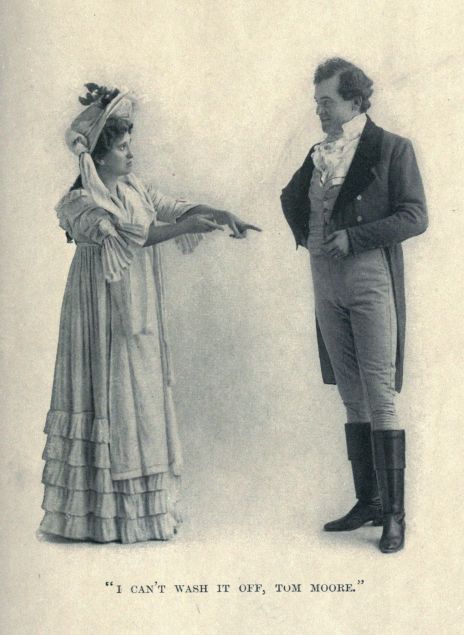
"I can't wash it off, Tom Moore."
"Have you never been taught to perform your ablutions, Bessie?"
"Stupid! My other hand is burned and water will make it smart."
"I wonder if water would make me smart."
"I 'd like to," said the girl.
"I 've always tried wine when I thought I needed intellectual stimulation."
"I should think you would be drinking all the time," said Bessie, spitefully.
"Not all the time," corrected Moore. "Part of it I spend earning the price. There, now, don't worry, I 'll scrub your little fist for you if you will let me. Will you?"
Bessie's anger cooled as rapidly as it had warmed.
"If you will be very gentle, you may."
"Trust me for that," said Moore, going to the bucket that stood in the corner with a basin covering it. "It's empty, Bessie. There is not as much water here as would make a foot-bath for a flea."
"You can fetch it from the well," said Bessie.
"Will you come with me?"
"You can go alone, Tom Moore."
"I can, but I don't want to, Bessie."
"You would be almost there now if you had n't stopped to talk."
"Won't you come, Bessie?"
"I suppose I will have to do it to please you," said the girl, yielding with a little sigh.
"Won't it please you, too?" said Moore, stopping her.
"But, Tom--"
"Won't it?" he insisted.
"Yes,--yes,--yes!" she replied, with increasing emphasis on each reiteration.
Moore let her pass, and she paused at the door, looking over her plump shoulder.
"What a child you are, Tom Moore!"
"Child," he repeated. "Child? Maybe I am, Bessie, but when you are called 'Mama' it won't be by me, though I think I 'll not be far off."
"Oh!" she cried, and slammed the door.
Chapter Six
TWO GENTLEMEN OF WEALTH AND BREEDING
It is doubtful if a search prosecuted through the entire extent of the United Kingdoms over which the Prince of Wales ruled as Regent would have brought forth a more debonair or contented individual than Sir Percival Lovelace, gentleman, libertine, and chosen comrade of His Royal Highness. In the eyes of this gallant, morals were a mark of ancient barbarism that gentle breeding and a long line of ancestors should be expected to remove or render forgotten. As these views coincided almost exactly with those cherished by the First Gentleman of Europe, it is not to be wondered that the Prince found in the baronet an agreeable and, more than that, an amusing companion. But even London may pall upon one and, not being hampered by the restrictions limiting the peregrinations of royalty, which were often the cause for much princely profanity at Carlton House, Sir Percival sought change and diversion in a jaunt through Scotland and Wales, finally ending in a tour of Ireland, where, much to his surprise, he stumbled upon certain persons destined to furnish him with more or less food for thought for the next year or two. His companion on his travels was none other than Lord Brooking, nephew of Lord Moira, already known as one of England's most capable statesmen. The young gentleman first mentioned was quite popular in the Regent's set, but more widely known in the circles from whence the various arts drew encouragement and patronage. But, in spite of his leanings toward the more cultured pursuits scantily patronized by the profligate society immediately surrounding the Regent, Lord Brooking was much more popular with that noble gentleman than many whose daily and nightly labor was the effort to curry favor with England's ruler. Lord Brooking was no ordinary personage. There was small flavor of the roué in his character, though it cannot be denied that, following the general current of fashion, he had not hesitated to play his part in the masque of dissipation offered as entertainment to the middle and lower classes by the aristocracy whom they were expected to envy and admire. But in his heart he felt only regret for his own participation in such unworthy extravagance, and, in most instances, a profound contempt for those who found diversion and contentment in such existence. There were two conspicuous exceptions to his lordship's general condemnation. The first was Richard Brinsley Sheridan, poet, dramatist, and statesman, now in his decadence, who still sought and furnished entertainment in society, a garrulous, drunken, and witty old gentleman, with a heart as young and a thirst as dictatorial as when Fame first brought him well-merited reward. The only enemies owned by this lightsome veteran were those foolish enough to expect eventual settlement of bills or loans that they were so unwise as to allow him to add to his long list of personal indebtedness. It is almost unnecessary to mention that disappointment was the subsequent conclusion of all such hopes of his deluded creditors, for Mr. Sheridan was consistent in one thing to the last--entire lack of financial responsibility.
The other exception was Sir Percival, who was so gay, so generous, so witty that Brooking, blinded by the glitter of a sparklingly brilliant personality, neither saw nor felt the hideous moral imperfections that this winning gentleman hid beneath his splendid exterior. The several peccadilloes really beyond all extenuation or apology of which the baronet had been guilty had never been brought to the attention of his younger friend and so at the time of which this tale is a chronicle it would have been difficult to find two closer cronies than this pair of young noblemen, who were strolling leisurely in the direction of the schoolhouse.
Sir Percival looked at Brooking quizzically.
"You do not approve, lad," he said with a little laugh. "You 're too good a fellow, I am afraid."
"I wish I could be as timid about you," replied Brooking, pleasantly.
"Can't you, dear boy? No? Pray, why not?"
"Do you really wish to know?" asked Brooking, hesitating a little.
Sir Percival treated himself daintily to a pinch of snuff and brushed the dust from his coat with an embroidered handkerchief.
"I think you wish to tell me," he answered, smiling. "It amounts to the same thing between friends, doesn't it?"
"I think we may as well understand each other now," said Brooking, in a serious tone.
"I quite agree with you," remarked Sir Percival, inwardly wondering what this introduction would lead to.
"I have been postponing this conversation from day to day for the last week."
"Indeed? And why?"
"It is rather a delicate subject."
"I would prefer one that is indelicate, if it is not inconvenient," suggested Sir Percival.
"For once in your life, Lovelace, be serious."
"Even that I will not deny you. Proceed."
"We have been pals since boyhood. As little lads we blacked each other's eyes."
"We did," admitted Sir Percival, laughing gently, "and bled each other's noses, too."
"We licked the same stick of candy."
"Gad, yes. My favorite was peppermint. I remember it as well as though it were but yesterday."
"We grew up to manhood together," continued Brooking, half sadly. "A pretty couple of rakes we were, too."
"We are still, dear lad," corrected Sir Percival. "Two very pretty little libertines, upon my honor."
"In London, where we were well known as an unworthy couple, I have no fault to find with you."
"No?" said the baronet in surprise. "To tell the truth, that statement causes me some little astonishment."
"We sailed under our true colors there--"
"But," interrupted Sir Percival, "the same flag is still flying, old man."
"Ah," said his lordship, "while that is true, it must be remembered that they do not understand its meaning down here. I haven't much to brag of in the way of morals, more is the pity, but no woman has ever wept of shame from my wrong doing, nor will a woman ever do so."
Sir Percival gave his companion a smile of interrogation.
"And I?" he asked.
"I am not so sure about you," responded Lord Brooking, deliberately, "but in London, where you are known, the folly of a girl in trusting you would be so inexcusable that indiscretion upon your part might be readily condoned; but here in this peaceful, simple old town it is very different."
"Come to the point, Brooking. You are almost tiresomely wordy to-day."
"It amounts to this, Percy. I have done some things I 'm heartily ashamed of and I intend in the future to be a better fellow."
"Very commendable, indeed," observed the baronet, a trifle bored, "Does my approval encourage you?"
"What do you intend to do with Bessie Dyke?" demanded the younger man, halting as he spoke.
Sir Percival paused and pensively cut down a weed or two with his walking stick.
"Hum," he said slowly. "As I thought."
"Do you mean honestly by the girl?"
"Your last words are quite correct," said the baronet, coolly. "Buy the girl--I mean to do that, Brooking."
"You frankly avow that is your object?" began Brooking, genuinely shocked.
"Tut--tut!" interrupted his companion, good humoredly. "She is a pretty creature, is n't she? Clever, too, in her own innocent, foolish, little way. For her smiles and bread-and-buttery love--a welcome change, by the way, from the London brand of petulant passion--I 'll give her a carriage, horses, fine dresses, a necklace or two, and lastly my own charming self for--er--for probably as long a time as several months."
"And then, what will become of her?"
"Really, I don't know," answered Sir Percival. "Can't imagine, and I shan't bore myself by wondering. Perhaps she will marry some clodhopper like this Tom Moore. No doubt he would think her doubly valuable when I have finished with her."
"You are not in earnest," stammered Brooking, incredulously.
"Quite in earnest, my dear old chap. Ah, you think that I will not succeed? Pshaw, Brooking! Not here, perhaps, in this deliciously moral atmosphere, but elsewhere, yes. And I intend that she shall be elsewhere. Brooking, I shall fetch this rural beauty to London."
"She will not go," asserted his lordship.
"No?" returned the baronet. "Who, think you, will prevent her?"
"Tom Moore, or I am much mistaken," answered Brooking, confidently.
"Tut!" said Sir Percival, incredulously. "You do not give my tact sufficient consideration. I 'll wager the objections Mr. Moore may see fit to make will prove of no avail in influencing the lady. In fact, if I do say it myself, my plans are clever enough to discount the efforts of a dozen bogtrotters, let alone one and he a rhymester. To begin with I have read and gone in raptures over old Robin Dyke's verses. Egad, I have pronounced them beautiful, and really they are not half bad, Brooking. If they were not so crammed with anarchy they would sell in London. The old boy is a socialist, you know. Yes, i' faith, he bastes the Prince and Castlereagh soundly," and this ardent royalist chuckled gleefully at the memory.
"Then you have broached the subject to Mr. Dyke?" asked Lord Brooking, as they continued their stroll in the direction of the schoolhouse. Sir Percival nodded his head.
"Yes, Brooking, the old scribbler is half persuaded already. I have promised him my support and patronage in London if he comes."
"And the girl?"
"I am tempting Bessie with the promise of a place at Old Drury, where, as you know, I am not without influence. Stab me! with her eyes and rosy red cheeks she would need neither paint nor powder to make her an ornament to the boards. Like most clever women, she has ambitions of a histrionic nature. She will come to London, Brooking, and once there!--once there--she is mine, dear lad, she is mine."
Brooking's anger and disgust refused to be longer pent up beneath his calm, almost indifferent, demeanor.
"What a low scoundrel you are!" he ejaculated, much to Sir Percival's surprise. The baronet for a moment regarded him quizzically, as though suspicious that this uncomplimentary description of his character was intended as a humorous remark, but seeing severity in his lordship's face, he smiled pleasantly and refused to take offence.
"Don't be so serious, old cock," he drawled. "Earnestness is so tiresome. Ah, life at its best bores me. My friends bore me. Even you, Brooking, bore me at times. Toss me, if I know anything that does not bore me sooner or later."
"Sir Percival," said the younger gentleman, "if I whispered one half that you have said to me in Tom Moore's ear he would choke the life out of you and sink your body in the pond."
"And spoil the drinking water? Well, such treatment as you describe would not bore me at all events. 'T would be exciting, even unpleasant, 't is true, but interesting in the extreme, and anything which is not tedious is worthy of all consideration."
Brooking laughed, amused in spite of his disapproval.
"You are incorrigible," he said.
"Permit me to explain my view of the matter," continued Sir Percival, amiably.
"By all means, Percy."
"This piquant country damsel pleases me rarely. She is a sweet little thing whose view of life is about as comprehensive as that of a day-old kitten. She shall be educated, Brooking, and I will serve as tutor. You saw me stoop and pluck a primrose from beside the road as we walked this way, did you not? Here it is in my button-hole. This girl is a primrose, Brooking; I 'll wear her till she is faded,--then, like this wilted blossom, I will toss her aside. And why? Because there are other primroses as fair and sweet, unplucked and unfaded, that grow beside my path farther on, and I like fresh flowers and new faces."
This very pretty gentleman helped himself to snuff, and then beamed benevolently upon his companion. Brooking saw the baronet was in sober earnest in spite of his pleasant manner and humorous tone. A new comprehension of his friend's real character dawned upon his mind, and for the first time in the long years of their acquaintance and fellowship he was able to strip from the libertine the exterior of the winning and courtly gentleman that had hitherto served to conceal his imperfections. In that one moment vanished the affection and admiration the younger man had felt for the elder, leaving only the colder and less exacting friendship existing between men of the same circle in society, who find much to interest and amuse in each other's company, but nothing to love or respect.
There was a slight pause before his lordship spoke, but when he did so there was a new ring to his voice.
"If you harm this little girl, I 'll never take your hand in mine again. You hear, Percy? Do as you have said, and we are strangers forever."
"And why?" demanded his companion.
"Because I 'll not own friendship with so filthy a rogue as you will have proved yourself to be."
"Hum!" murmured Sir Percival, thoughtfully. "Then you will probably constitute yourself her protector?"
"If necessary, yes."
"And will no doubt seek to balk me by telling her what a villain you think me, lad?"
"You know better than that," replied Brooking, a reproachful tone perceptible in his voice.
"So I do," assented the baronet. "What do you say to making it a game? One hundred guineas I win."
The instinct of the gamester, without which no buck of the times was considered completely a gentleman in society's interpretation of the word, stirred in the blood of his lordship.
"Done," said he.
"Good lad," commented Sir Percival. "My cards are wealth and fame, London and Drury Lane."
"Mine are the girl's honesty and Tom Moore."
"Tom Moore?" repeated the other, inquiringly.
"Yes," answered Brooking, "for if Bessie Dyke does go to London with you as her patron, I 'll bring Tom Moore there and be his."
"Just as you like," said Sir Percival.
Reaching the door of the schoolhouse a moment later, the two bloods knocked vigorously and stood on the stone threshold, waiting patiently for a response from the interior. As this was not forthcoming, after another moment's delay, Sir Percival opened the door and led the way into the schoolroom.
Chapter Seven
TOM MOORE OBLIGES A FRIEND AND GETS IN TROUBLE
"Can it be Mistress Bessie has departed for the day?" said Sir Percival, surveying the deserted room with no little disappointment.
"I think not," replied his lordship, imitating his companion's look of investigation. "As I thought, Sir Percival! There is her hat."
As he spoke, Brooking pointed to a dainty affair composed of some complicated combination of white straw and blue ribbons, from which peered inquisitively forth a bunch of pink posies. This charming creation hung pendant by the strings from a nail in the wall behind the desk, making plain that the school-mistress intended to return.
"True, Brooking," said Sir Percival, and taking it down he pressed one of the ribbons to his lips. "Almost as sweet and pretty as its owner. Egad, how tuned in harmony with her own charm are the belongings of a dainty and tasteful woman. Like the scientists of the Museum who from a bone construct a skeleton, so could I from this little hat draw the portrait of the lady whom it might become."
"You are dangerously near sentimentality," said Brooking, as though warning the baronet of peril unperceived.
Sir Percival laughed.
"I sometimes forget that I am no longer a lad of two-and-twenty, though Heaven knows I lack not reminders. Impossible as it seems, it is nevertheless true that I found a gray hair this morning. A silver messenger from approaching Age. I plucked the rascally thing out and breathed more freely when I was rid of it."
A knock sounded on the door by which the pair had entered, and Sir Percival, peeking slyly through a convenient window, gave an exclamation of dismay.
"Pluck me, Brooking, if it is not old Robin Dyke himself. Devil take the old bore!"
Brooking pointed to the other exit.
"Perhaps we can escape this way."
Sir Percival, followed by his lordship, tiptoed across the room, but before they reached the other doorway, Mr. Dyke, weary of waiting, entered briskly, and their plan of evasion was abandoned as hastily as it had been adopted.
"Why, if it is not Mr. Dyke," cried Sir Percival, cheerily, quite as though he were overjoyed at the meeting. "Good-day to you, sir. I hope it finds you sound in health."
Dyke flushed with pleasure at the heartiness of the great gentleman's greeting. He was a pleasant-faced old man, simple and good-hearted, too prone to trust in the honor of others, but erring only by giving them credit for benevolence and honesty equal to his own. He was quite a portly old person, with a face strongly lined in spite of its placid expression. His hair, worn rather long as became a poet, was a wavy, shimmery gray, and he walked with a rambling sort of gait that suggested vaguely a compromise between a stride and a toddle. Sir Percival's quick eye caught sight of a suggestive roll of manuscript sticking out of the new-comer's pocket.
"Ah!" exclaimed the baronet, tapping the paper with his cane. "I see a paper peeking from your coat, Mr. Dyke. Another poem, I 'll be bound. Come now, sir, out with it. I swear, we will hear it, eh, Brooking?"
"I 'm afraid we will," murmured his lordship beneath his breath, but he bowed in pleasant assent in reply to the old gentleman's inquiring look.
"What?" continued Sir Percival. "Too modest, eh? Then I will read it myself," and, with a gesture gracefully apologetic for the liberty, he drew the roll from Dyke's pocket.
"Really, Sir Percival," stammered the old man, in pleased embarrassment. "My poor effort--"
"Your poor effort," repeated Sir Percival, scanning the first page through his eyeglass, as he spoke. "If this be his poor effort, Brooking, what would his best be?"
"God knows!" murmured Brooking to himself, "I hate to think of it."
Sir Percival's quick ear caught his lordship's muttered remark, so, as the flustered poet crossed to the window in hope of obtaining a glimpse of the absent schoolmistress, the baronet turned to Brooking with a laugh.
"Perhaps God knows," he whispered, "or perhaps it is better known in the other place. Look at it, Brooking."
"Must I?" replied the younger man, reluctantly.
"Of course you must," asserted Sir Percival. Then more loudly he continued:
"Genius in every line, and more between them. My dear Dyke, we must have you in England."
"You think so, Sir Percival?" said the old gentleman, greatly flattered.
"I am sure of it," answered the other as though convinced, returning the poem to its author. "But once you are there, no seditious political versifying like this. Why, sir, the Prince would foam at the mouth if he saw this. Love lyrics, sir, for the ladies. That must be your game, dear man."
Mr. Dyke hardly knew which to regard as the greater compliment, the implication that he had but to exert himself to write poetry that would be pleasing to the fair sex of London, or the assertion that the satire of his latest production was sufficient to cause annoyance even to Royalty itself. Still not quite decided in regard to the matter, he blew his nose resoundingly and modestly replied:
"I would restrain my opinions, since I cannot change them."
Sir Percival winked wickedly at Brooking to draw the latter's attention to his next remark.
"Have you thought over my proposal, Mr. Dyke?"
"I have given it much deliberation," answered that worthy, in a tone that but ill concealed the delight occasioned him by the mere suggestion of such an idea.
"Well, Mr. Dyke?"
"I feel most favorably inclined, I must confess," replied the old gentleman.
"Ah!" said Sir Percival, in an undertone to Lord Brooking, "d' ye hear that, lad? He must confess."
"I wish you had to, Percy. It would save me trouble."
"Then it is decided?" said Sir Percival, looking triumphantly at his friend.
Dyke hesitated.
"No," he said, "not exactly decided. It now rests with my daughter. If she agrees with me, I will be pleased to do as you have suggested."
"Then Bessie shall say 'Yes,'" responded the baronet.
Chancing to look out the window at this moment, Sir Percival caught a glimpse of a familiar figure passing on a path running near the schoolhouse.
"What, what?" he laughed. "There goes young Farrell. Who is the petticoat in tow?"
"That is his sister Winnie," replied Mr. Dyke, peering through his glasses. "A nice girl, Sir Percival, with a proper admiration for literature."
"Too dumpy, by far," responded that gentleman, surveying the lady with anything but approval. "By the way, I 've something to say to Terence. Brooking, while I run after them, you may tell Mr. Dyke your opinion of his poetry."
And hastening to the door, the baronet gave chase to the couple, already at quite a distance.
At this moment Farrell chanced to look around and, beholding the approaching macaroni, halted his companion and stood waiting, his sister feeling quite giddy with the thought of meeting so great a beau as Sir Percival.
"I 've a word or two to say that may interest you, Terence, if you can spare me a moment," began the baronet.
"My time is quite at your disposal, Sir Percival," replied Farrell. "Permit me to present you to my sister."
Sir Percival bowed with graceful formality.
"La, Mistress Farrell," he sighed, prettily, "your father is indeed fortunate. With such a son and such a daughter his old age should be crowned with happiness and content."
"Father finds much to criticise," said the girl. "I fear he takes no such flattering view of his children as you insinuate he should."
"Criticise?" repeated Sir Percival in a tone of astonishment. "What can he wish for?"
"Much, if one may judge from his complaints," answered Winnie, not a little puffed up by the baronet's condescension and approval. "I 'll not keep you from your business with my prattle, sir. Terence, I will go on to Mrs. McCloud's and stop for you at the school-house on my way back."
"You are most amiable, Mistress Farrell," said Sir Percival, gratefully.
The girl courtesied in what she hoped was a good imitation of the London manner, and continued on her way, leaving the two gentlemen to stroll toward the schoolhouse.
"Well, Sir Percival," said Farrell knowingly, "what is afoot?"
As he spoke he gave the baronet a searching look, which drew forth a pleasant smile by way of answer.
"You never lose time in getting to the point."
"Except when it's a sword," replied Farrell. "Then I can be devilish slow."
Sir Percival's face wore a pensive look as he regarded his friend.
"For a country squire you present a wonderfully fashionable appearance," he remarked, his eye travelling approvingly from the bell-crowned beaver on the youth's well-shaped head to the carefully tied stock and thence to the immaculately polished boots which ornamented feet both small and neatly turned. "Your costume would not be out of place on Pall Mall, Terence."
With characteristic cunning the courtier had detected young Farrell's weak point. The youthful Irishman's fondest wish was that he might some day be acknowledged as a beau in no less a place than London itself; a city which dictated fashion to the rest of the kingdom, drawing its own inspiration from the finicky fancy of George Brummell, now at the height of his power as dictator of society.
Farrell flushed with pleasure at Sir Percival's commendation.
"I' faith," he answered, "even in Ireland we are not entirely lacking in taste."
"No, not entirely," observed the baronet. "And the cards, Terence? Does Fortune smile upon you these days?"
"Not so frequently as my pocket demands, sir. To tell the truth, I 've played in most villainous luck this last week."
"Then possibly you would regard the opportunity to earn one hundred pounds with favoring eye?"
"Would I? Try me, Sir Percival," answered Farrell eagerly.
"Very well, Terence," replied the baronet, "but whether you accept or refuse my proposition you bind yourself as an honorable man to repeat to no one what I shall suggest?"
"Of course," answered Farrell. "You may confide in me, Sir Percival."
"I have work for that infernally clever brain of yours. One hundred pounds if you will devise a scheme that parts Bessie Dyke from this Tom Moore who annoys me."
It cannot be said that Farrell was astonished at the words of Sir Percival. Nevertheless, that such a great and clever man should consider it advisable to obtain assistance in outwitting so comparatively rustic an individual as Tom Moore, was, in the youth's eyes, rather a damaging admission of weakness. At least so he regarded it, for the moment not realizing that to a gentleman of large fortune it was far more satisfactory to busy another's brain than to greatly exert his own, even though the result of the latter might be more pleasing in the end.
"One hundred pounds," repeated Sir Percival, languidly.
"But Tom Moore is my friend."
"Ah!" said the baronet, "in that case one hundred and one pounds."
Farrell laughed a little.
"Very well, Sir Percival," said he, "I will undertake to earn the sum you mention. I must admit the airs and graces with which Moore sees fit to conduct himself are extremely offensive to me. His manner is one of extreme condescension, and more than once I have felt myself to be upon the verge of resenting it."
"Then," said the baronet, "it is agreed?"
Farrell nodded pleasantly.
"How will you do it?"
"Easily, Sir Percival. You leave the affair to me and I 'll fix it so Bessie Dyke will never look at Tom Moore again."
"If you succeed, I 'll make it one hundred and fifty."
"Ah," said Farrell, lifting the latch of the school-house door, "I like dealing with you, Sir Percival."
At almost the same moment Bessie Dyke entered at the opposite side. Sir Percival bowed in his most courtly manner.
"Here is the missing damsel at last," he said.
Moore pushed the half-closed door open and stepped in, bucket in hand.
"There is more to follow," he announced, setting his burden in an out-of-the-way corner as he spoke.
"More?" echoed Sir Percival, questioningly.
"Yes, Tom Moore."
"A villainous pun, upon my honor."
"A pun upon your honor might well be such," said Moore, coming forward.
Sir Percival allowed an expression of surprise to pass over his handsome face.
"Egad," he said, gently, as though in veiled wonderment. "Wit, and from such a source."
"A sauce of wit makes game more savory," returned Moore, not at all irritated at the baronet's accent of superiority. "And I know your game," he added in an undertone.
"Indeed?"
"In deed and in thought, too," answered Moore, cheerfully. "You will not succeed, my good sir."
"Will you prevent me, Mr. Moore?"
"I fancy so, Sir Percival."
The baronet raised his voice, so that the conversation, hitherto inaudible to the others, who were clustered at the side of the room, could be easily heard. He did this intending to overwhelm this youth, whom he despised both as a rustic and as an Irishman, with the apt and stinging wit that had made him famous even in London drawing-rooms accustomed to the sparkling sallies and epigrams of Sheridan and Rogers. He regarded the conversational defeat of Moore as an easy task, and proceeded to attempt it with a confidence born of many hard-fought victories won in the brilliantly flippant circle surrounding the Prince of Wales, a society that could only be described as pyrotechnically witty.
"I understand that you write poetry, Mr. Moore."
"But you would not understand the poetry I write."
"But I might buy some of it. I am not over particular as to merit, you see."
"I am very particular, you see, to whom I sell."
"Why?" demanded Sir Percival, taking snuff with a graceful flourish.
"Because I write for the masses and classes, not for the asses," replied Moore, as pleasantly as though paying a delicate compliment to the nobleman.
Sir Percival recognized that the first point had been scored by his hitherto despised rival, and rallied gamely, as became a gentleman of blood and breeding.
"That last accounts for your unpopularity with your fellow-countrymen," he suggested.
"Oh, they are not the asses I alluded to, Sir Percival."
"Perhaps you intended that for me, then?"
"Does a fellow feeling make you wondrous kind?" asked Moore, innocently.
"Hum. Rather clever, Moore," said Sir Percival, planning a particularly nasty retort, which he was prevented from delivering by Bessie's approach.
"How is my little schoolmistress to-day?" he said, winningly, to the girl.
Moore, loath to relinquish his victory, decided to continue the battle of wits, and thus brought about his undoing in the moment of his triumph.
"Your little schoolmistress?" he repeated. "Have you become a scholar, Sir Percival?"
"To be taught by Mistress Dyke, I would become anything."
"Except honest," suggested Moore.
"Sir!" exclaimed his rival, angrily.
"Why, sir, if you are honest already, there is surely no need of change."
"He had you there, Percy," said Lord Brooking, joining the group.
"On the contrary, Brooking, Mistress Dyke has me here," replied Sir Percival, his anger cooled.
"We all have our troubles," observed Moore, plaintively, "even Mistress Dyke."
This was the baronet's opportunity, and he made good use of it.
"Egad," he drawled, "have you been reading your own poetry, Mr. Moore?"
Bessie laughed merrily as Moore tasted the bitterness of defeat and allowed himself to be led away to the organ by Lord Brooking.
"A song, Mr. Moore. I 've heard such reports of your singing that I am more than eager to listen to one of your ballads. Mr. Dyke and our friend Farrell join me in the request."
"But, my lord," objected Moore, casting an inquiring glance towards where Sir Percival was talking glibly to the little schoolmistress, "I--er--really I 'm not in voice to-day."
"Nonsense!" said his lordship. "We will not be denied, Mr. Moore."
"Then since I 'm not Saint Peter, I 'll have to yield. What shall it be?"
A short discussion followed at the organ, and when this had been settled by Dyke and Farrell choosing "The Shamrock," Moore, calmly paying no attention to such a detail as that, proceeded to sing his latest poem, written only that morning in honor of Sir Percival.
Nothing could have been more to the point, for at this very moment the baronet was urging the girl to ratify her parent's decision in regard to the proposed move to London, painting for her in vivid words what a Successful career at Drury Lane Theatre would mean, at the same time dwelling upon her father's opportunity for advancement as poet and scholar.
"Oh! weep for the hour,
When to Eveleen's bower
The Lord of the Valley with false vows came;
The moon hid her light
From the heavens that night,
And wept behind her clouds o'er the maiden's shame.
"The clouds passed soon
From the chaste cold moon,
And heaven smiled again with her vestal flame;
But none will see the day
When the clouds shall pass away,
Which that dark hour left upon Eveleen's fame.
"The white snow lay
On the narrow pathway
When the Lord of the Valley crost over the moor;
And many a deep print
On the white snow's tint
Showed the track of his footsteps to Eveleen's door.
"The next sun's ray
Soon melted away
Every trace on the path where the false Lord came;
But there's a light above
Which alone can remove
That stain upon the snow of fair Eveleen's fame."
Moore's voice died away melodiously in the last plaintive note.
"A very pretty song, Mr. Moore. It tells a beautiful story and points a splendid moral," said Lord Brooking.
"Yes, my lord," answered Moore, glancing toward Bessie. "It shows the folly of a poor girl in believing aught told her by a nobleman. It is as true nowadays as it was then."
"Oh, Tom," said the girl, tremulously. "It is beautiful. Is it not, Sir Percival?"
"Oh, very, very," replied the baronet. "Extremely so. I congratulate you, Mr. Moore."
"Have you reason to do so, Sir Percival?" asked Moore.
His question was answered immediately, for Bessie turned toward the gentleman addressed.
"I thank you, Sir Percival," she said, "but I fear London is not for such as father and me."
As Moore gave a sigh of relief and turned away, satisfied that he had foiled the baronet in his attempt to entice Bessie from Ireland, Farrell touched him on the arm and led him to one side.
"Will you meet me here, Tom, in half an hour?" he asked.
"Is it important, Terry?" demanded Moore, who intended to devote the rest of the afternoon to courting Bessie.
"It may mean money enough to start you in London."
"The devil!" exclaimed the poet. "I 'll meet you then, for to London I am bound to go, sooner or later."