TOM MOORE (continued 3)
Reading edition
Having knocked for admittance, Mr. Slink was duly announced and ushered in by Buster, whose manner to one better versed in the youth's peculiarities would have seemed suspiciously courteous.
"Good-day to you, Mr. Slink," said Moore, pleasantly. "Is your health salubrious?"
"Quite werry, sir," replied the cobbler, approaching his patron with his usual mincing step.
"And have you the boots, Mr. Slink?"
"I have, sir," replied the cobbler, exhibiting a paper-wrapped bundle, nestling beneath his arm. "Here they are, sir, but the money, sir? You promised cash, sir. That is to say, sir, I intimidated as delicatesome as I could that I must have the coin, sir, before I could let you have them, sir."
"So I have been informed by my man," replied Moore. "Really, my good sir, such suspicions are unworthy of you. Believe me, it is with regret I perceive the taint of cynicism in an otherwise charming character."
"Yes, sir," answered Mr. Slink. "Yes, sir. Them is just my own sentiments, but I have a large family, and one that I may say, proudly and truthfully, sir, is on the steady increase."
"My sympathy to you in your misfortune," said Moore, hastily. "Ah, England owes much of her advancement to her noble citizens. It is such men as you make possible the Orphan Asylums, for without the young and deserving what would become of such worthy institutions?"
"Sir, you take the werry words out o' my mouth. Scarcely a day passes but I says much the same thing to Matilda. You see, she being a mother and a woman--"
"The natural implication, believe me, Mr. Slink," interrupted Moore.
"Oh, quite, sir. One usually follows on the other. Matilda is apt to become downcast when she compares population with pocket-book, for as one goes up the other goes down, so I made her a solemn promise after the sixth that business should be placed on a strictly cash basis in the future."
"Ah," observed Moore, interestedly, "and did that encourage the good woman?"
"I think it must have, for our next blessing was twins, boy and girl, sir."
"Cause and effect is a most diverting study," observed Moore. "Now that you have explained the reason for your insisting upon immediate material compensation for your labor, I cease to regard such a stipulation as insulting."
"Yes, sir," replied the gratified cobbler.
"But, Mr. Slink, have you thought of the result that might ensue if too much encouragement be provided for so lofty an ambition as that which stirs your wife's existence? Twins can be endured, but, sir, think of triplets!"
"Well, sir, I holds that there is luck in odd numbers," answered Mr. Slink, quite unimpressed by the poet's argument and its obvious conclusions, "so, if you 'll let me, I shall be delighted to enleather your pedals, if I may make bold to so term your feet."
"Just as you say, Mr. Slink; but, of course, before I part with my money I naturally desire to be certain that the boots fit me."
"All right," said the cobbler, undoing his parcel. "Sit you down, Mr. Moore, and I 'll exhibit my wares."
Moore took the stool brought to him by Buster, and the cobbler, kneeling down, proceeded with sundry pulls and pushes to inclose his foot in the new shoe.
"Easy, easy!" said Moore, clutching the bottom of the stool, to keep from being shoved off it. "You are not pushing a cart, even if you are driving a bargain, Mr. Slink."
"There you are," exclaimed the cobbler, sitting on his heels as he wiped the perspiration from his wrinkled brow. "There you are. A beautiful fit, or may I be unworthy of Matilda."
"Your merit, Mr. Slink, has already been proved if your previous statements are authentic," said Moore. "Statistics bear me out, my friend. I am quite convinced you are a splendidly matched pair."
"Well, sir, this other boot is just as good a match for the one you have on."
"Try it, Mr. Slink, try it. There is nothing like doing things thoroughly. I know Matilda and you agree with me there."
Slink obediently started to fit the other shoe, finding some little difficulty in doing so, for Moore contrived to make the operation a very difficult one, and for a purpose, as will be seen later.
"You are an artist, Mr. Slink," said Moore, approvingly. "Look at the boot, Buster. Did you ever see better?"
"Never 'as 'ow Hi remembers. Oh, Mr. Slink his a tiptopper when it comes to shoes heven if Mr. Smirk hallows 'as 'ow 'ee 's a bloomink bungler," replied Buster, winking at his master. "But, hof corse, Mr. Smirk, being a bachelor, 'ee hain't as careful as 'ee might be. 'Ee says 'ee 'as no wife to beat 'im as hothers 'ee says 'ee knows hof in the same business 'as."
"If that baldheaded leather-spoiler means me, all I have to say is that no decent woman would consider matrimonially no such rum-soaked old ravellings as that same Smirk," replied Mr. Slink, puffing at his work. "He has no pride in his handiwork. His shoes lack all soul, spirituously speaking."
"Pride," repeated Moore, with a grimace of discomfort. "That shoe will have to be pried before I can wear it. Oh! It is tight, Mr. Slink, cursedly tight, Mr. Slink. Were you yourself quite sober when you made it?"
"Yes, sir, I was. I always am sober, sir."
"Then it is the wind that tints your proboscis that strawberry pink, is it?" said Moore. "Suppose you have a gentle breeze with me. I 've a new lot of sherry just sent me by Admiral Nelson. You must try it, Mr. Slink. Just a little puff of wind? A squall more or less won't affect the color of your nose."
"I 'll be delighted, sir," replied the cobbler, getting on his feet. "As I always says to Matilda--
"A little wine now and then
Is cheery for the soberest men."
"Ah," said Moore, "I see you are a student of the poets?"
"That verse is of my own decomposition," answered Mr. Slink proudly.
"I believe you," said Moore, suavely. "Your health, Mr. Slink, the health of Mrs. Slink, and all the little Slinkers!"
The cobbler emptied his glass and smacked his lips.
"We forgot to drink your own health, Mr. Moore. We must repair that oversight instanterly, if I may make so bold."
"I 'm flattered," replied Moore. "Buster, fill the glasses again."
"Splendid wine," remarked Mr. Slink, rather thickly for, if the truth be known, he had treated himself twice at the ale-house across the street before mounting to the attic, and this unwonted indulgence in addition to the hospitality of the poet made an aggregate amount of intoxicants quite a little more than he could comfortably contain.
"You 're a judge of liquor, Mr. Moore, a gentleman and a scholar in the bargain. I 've always told Matilda so, I assure you."
"I am delighted to hear you say so, Mr. Slink. Now if you will take this shoe that is tight back to the shop and have it stretched, I 'll pay you for the pair if the one that pinches suits as well as this I have on, when I try it on again."
"Just so, sir," replied the cobbler, cheerfully, meanwhile getting down on his knees to remove the unsatisfactory boot. "I 'll not be long, sir. You can rely on my return, sir, within the hour."
"That will be soon enough," said Moore. "Here is your paper, Mr. Slink."
"Thank you, sir," said the now thoroughly exhilarated shoemaker, wrapping up the boot, as Moore resumed the well-worn slippers he had temporarily discarded for the test of Mr. Slink's handiwork.
"Good day, Mr. Slink."
"Good day, Mr. Moore."
"Oh, my best respects to Mrs. Slink."
"Matilda will be delighted, sir," replied the cobbler, moving out into the hall with a step decidedly uncertain.
Moore gave vent to a sigh of satisfaction as the sound of feet died away upon the stairs below.
"But, sir," said Buster, inquiringly, as he shut the door, "wot use his one boot?"
Moore regarded his youthful retainer with a look of mild astonishment.
"Don't you understand, Buster?"
"Not Hi, sir."
"Well then, I 'll not tell you. Demonstration is far more valuable than explanation. So just watch me, my lad. A study of Thomas Moore when hard up is a liberal education for the young and unsophisticated. You shall be educated, Buster."
"Yes, sir. Wot his it, Lord Castlereagh?"
"Gr-r-r-g-h!" remarked the bulldog, warningly, at the same time sniffing suspiciously at the crack of the door.
"Is-s-s Mister-r-r M-M-M-oore in?" demanded a husky voice, enthusiastically and persistently hyphenated by a decided stutter.
"Hit's the hother shoemaker, sir," whispered Buster, recognizing the thick utterance of the newcomer. "The one who spits on his words, sir, before 'ee lets loose hof 'em."
"Faith," said Moore, "it is a good thing the hall is dark. They must have met on the stairs. It's a wonder we escaped bloodshed, Buster."
"I s-say, is-s-s Mr. M-M-Moore at h-home?" repeated the shoemaker, with a hiccup that was plainly perceptible within the attic.
"Phew!" exclaimed Buster in an undertone, recoiling from the keyhole. "Hole Smirk his loaded hup to 'is hears. You won't need to waste hany of the Hadmiral's sherry hon 'im, sir. 'Ee 's fragrant, sir, that's wot 'ee his, hand it hain't no bloomin' new mown 'ay wot flavors 'im, Hi tells yer."
"Admit the gentleman," said Moore, opening the windows to their widest extent. "A friend in need is a friend indeed."
"A friend in soak his more like it," murmured the boy, opening the door obediently.
The big, bald-headed, redfaced man who had egged Bekowsky on to disaster earlier in the afternoon staggered in with an oath and a hiccup so entangled on his lips that neither he nor his hosts made any effort to translate his greeting.
"Good-day, Mr. Smirk," observed Moore, pleasantly. "You are looking well, sir."
"T-t-t-hat is-s n-no ex-c-cuse f'r keeping me w-w-waiting a month in the h-h-hall," replied the intoxicated tradesman, thickly, endeavoring to look offended.
"We thought you were a publisher, my friend, and we always make them wait a little while before we admit them," said Moore. "It has a most beneficial effect upon their opinion of me as a writer. Independence is frequently accepted as indicative of personal affluence, as you doubtless know."
Mr. Smirk looked a trifle dazed, and then, abandoning his effort at comprehension, proceeded to get to his business without further delay.
"H-h-have you the m-money for the b-boots, Mr. M-M-Moore?" he inquired, holding his parcel behind him as though fearful that he might be robbed.
"Ah, sir," replied Moore, suavely, "money fits any hand, but my foot does n't fit every shoe. I 'll try them on if you are not too tired."
"Y-yes, s-sir," replied Smirk, with difficulty unwrapping his package.
"Your words are as slow as my rent," said Moore, sitting down.
The cobbler dropped heavily on his knees, and losing his balance, fell forward on Moore's lap almost knocking him off the stool.
"It is n't time to lie down yet," said the poet, restoring the tradesman to his equilibrium. "You forgot your prayers, sir."
Smirk succeeded in getting one of the boots on without much difficulty, but the other stuck fast in spite of the earnest endeavors of its maker.
"Is it a straight jacket you have there, Mr. Smirk?" demanded Moore. "Don't trouble to answer me. It will take too long. You will have to have that stretched, sir."
"Y-yes, s-sir," replied the cobbler, "that will f-f-fix it fine."
"Take it along, Mr. Smirk, and have it attended to immediately," directed the poet. "When I try it on again, if it's all right, I 'll pay you for the pair. How long will it take you?"
"I 'll be b-back in l-less than an hour, Mr. M-M-Moore, and see you have your money r-ready."
"Ready money is a nice thing," assented Moore. "Good day, Mr. Smirk."
"G-g-good d-day," began the shoemaker.
"Finish it outside," suggested Moore.
"I w-w-will, s-sir," replied Smirk, and as he proceeded slowly and unsteadily downstairs, the whisky-burdened tones of the cobbler died away in a murmur and then ceased entirely.
"Observe me, Buster," said Moore, boots in hand. "These boots are made of one style. From Mr. Smirk I have procured one for my right foot; from Mr. Slink one for my left. The two together make a pair, which is the object I set out to accomplish."
"'Ooray!" shouted Buster. "Hi sees. Hi sees."
"A trifle late, Buster, a trifle late," said Moore, pulling on his recently acquired spoils.
"But, sir," said the boy, apprehensively, "they will both be back in a little while."
"Well, I 'll take pains not to be here then."
"But they 'll watch hand ketch you sooner hor later."
"That is all the good it will do them," replied Moore, cheerfully, regarding his feet with no little amount of approval.
"Hi knows, sir, but you never breaks your word, sir, hand you promised to pay--"
"When did I say I 'd pay, Buster?"
"When you tried on the other boot, sir."
"Well, that is a simple matter, lad. I won't try the other boot on."
"Won't yer?"
"Not I, and they will have a nice easy time making me against my will."
"Hi sees, Mr. Moore," cried the boy, delighted at the discovery of a means of discomfiting the cobbler without breaking a promise.
Moore sighed.
"Ah, Buster," he said sadly, "when luck comes we will pay all these men. Till then they will have to give us credit, and if they won't give it, we will take it, but for every penny I owe them now, I 'll pay them two when I can afford to settle. I can do without wine, but without boots I 'd not earn the coin to pay any of my debts. I don't like such trickery, heaven knows, but I must get on. I must get on."
"Hif they were n't crazy fools, they 'd be glad to trust us," assented Buster. "We 'll pay 'em when McDermot brings hout our book hof poems."
"That reminds me," said Moore, "it must be almost time for me to hear from that same gentleman."
"Yessir. Say, does Hi get a hautograph copy?"
"You do, Buster," replied Moore, smiling. "No one deserves it more than you, I am sure."
"A hautograph copy," repeated Buster, delightedly. "My, but that will be fine. Hand I wants yer to write your name hin the front of it?"
"Don't you know what an autograph copy is, Buster?" asked Moore, his eyes twinkling.
"That Hi does," said the boy, confidently. "Hit's one with gilt hedges hall around it. Hi knows."
Chapter Twelve
IN WHICH THE POET WARBLES TO MRS. MALONE
Rat-tat-tat!
"Are you dressed, Mister Moore?" asked Mrs. Malone, her ear against the crack of the door.
Moore winked at Buster and motioned him to admit the landlady, who entered with her accustomed independence of carriage, apparently expecting and prepared for contention.
"Ah, ha," said she, triumphantly. "You didn't thrick me this time, Tom Moore."
"On the contrary, I have been patiently waiting for your coming, Mrs. Malone," replied the poet, politely.
The landlady looked incredulous.
"Where is the rint?" she inquired, belligerently.
"Here in my dressing gown," answered Moore, exhibiting a long tear in the garment mentioned. "A big rip it is, too. Have you your needle handy?"
"I wants no fooling, Misther Thomas Moore," declared Mrs. Malone, drawing her bushy brows low in a ferocious frown.
"Were you ever in love, Mrs. Malone?"
"Thot is none of your business."
"You forget your husband was my first instructor," said Moore, reproachfully.
"Well, I 'll be your last teacher, and I 'll give you instructions in how to get up and get out wid your pile o' kit, bag and baggage, unless I gets me rint."
"You are Irish, Mrs. Malone."
"Niver mind thot, sorr."
"Sure, I don't mind, if you don't," replied Moore, "and if Ireland don't object there will be no discussion on that point at all."
"Whot are yez going to do? Thot's whot I wants to know, Mr. Moore? Is it rint or run, me fine bucko?"
"Won't you sit down, Mrs. Malone?"
"I 'll not sit down, I 'll stand up."
"Well, will you stand up till you get the rent, Mrs. Malone?"
"I 'll sit down," replied the landlady, suiting the action to the words so vigorously that the attic rattled.
"Do you know, Mrs. Malone, I 've written you a song?"
"I wants no song. I have no notes in me voice."
"Faith," said Moore, with a chuckle, "we are alike then, for I 've none in my pocket."
"I wants me rint."
"Be easy, Mrs. Malone," said Moore, in a conciliatory tone and forthwith broke into song:
"Oh, the days are gone when beauty bright
My heart's chain wove--"
"Where is the rint?" interrupted the irate landlady, but Moore continued his singing, at the same time helping himself to a seat on the table beside her.
"When all my dreams by day or night
Were love, still love--"
"The rint is no dream," exclaimed Mrs. Malone, "and by gorry, I 'll have it, me canary-bird."
"New hopes may bloom,
And days may come
Of milder, calmer beam--"
"Not till I have ivery penny due me," asserted Mrs. Malone, turning a deaf ear to the pathos and sentiment with which the poet's beautiful voice was investing the simple words of the song.
"But there's nothing half so sweet in life
As Love's young dream--"
"I 'll prefer the rint a t'ousand times," observed Mrs. Malone, quite unaffected.
"No, there's nothing half so sweet in life
As Love's young dream."
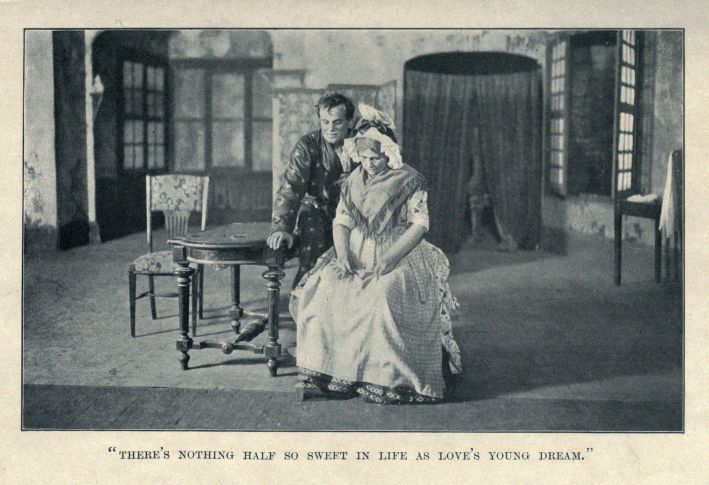
"There's nothing half so sweet in life as Love's young dream."
As the words of the song died away in a sigh of sentimental melody, Moore leaned forward and touched the old woman on the shoulder, hoping that he had struck some responsive chord of memory in her recollections of long-departed youth, but he was doomed to disappointment, for she smote the table with one calloused fist and called upon the saints to witness and sustain her resolve to accept nothing but the whole amount of the money due her.
Nothing daunted, Moore slipped off the table and standing behind his determined creditor began another verse, throwing even more feeling into his voice as he proceeded:
"No,--that hallowed form is ne'er forgot
Which first love traced--"
"I 'll have that rint, Tom Moore, song or no song," interrupted Mrs. Malone, but her tone was not quite so quarrelsome as before, and Moore from this drew encouragement that lent double sympathy to his music as he continued:
"Still it lingering haunts the greenest spot
On memory's waste--"
"I wants me rint," remarked Mrs. Malone, but her voice had lost its assertive defiance.
"'T was odor fled
As soon as shed--"
"I 'll have me rint, Tom Moore," said the landlady plaintively.
"'Twas morning's wingéd dream;
'Twas a light that ne'er can shine again,
On life's dull stream--"
An audible sniff came from beneath the frill of Mrs. Malone's cap and she cleared her throat noisily. Moore leaned over her and tenderly and slowly breathed forth the last words of his song, the mournful cadences stealing from his lips sweet and low and laden with tears, supremely touching in their plaintive harmony, for he sang as though it was to the hopeless love that filled his heart's innermost recess that he now gave utterance.
"No, there 's nothing half so sweet in life
As Love's young dream."
The last words died away, and for a moment the old attic was silent. Then Mrs. Malone rose from her seat with a stifled sob, and, wiping her eyes, started toward the door.
"And the rent, Mrs. Malone?" asked Moore, timidly.
"You--you rapscallion," she said, brokenly, "to make an old woman like me cry. Ah, bless you, Tom Moore, for it's the old days you 've brought back to me."
"But the rent?"
"May your voice never grow less, Tom Moore. You--You--!"
"Well, Mrs. Malone?"
"You have me rint Satherday or there 'll be throuble."
And, blowing her nose vigorously, the relenting landlady left the attic to its inhabitants.
"'O-o-ray! 'O-o-ray!" shouted Buster in a hoarse whisper, seizing Lord Castlereagh by the front paws and dancing around in a circle in his delight. "Till Saturday, till Saturday! 'O-oray! 'O-oray!"
"Buster, from now on, we can never complain of these apartments as expensive," said Moore, fanning himself by the window.
"No, sir? Why not?" asked Buster.
"Because I got them for a song," replied the poet. "A cursed bad joke, Buster, even if I did make it myself."
Chapter Thirteen
TOM MOORE HAS A BITTER DISAPPOINTMENT AND AN UNEXPECTED VISITOR
Mrs. Malone opened the door suddenly, accompanying this action with a vigorous gesture intended to represent an apology for the liberty she took in omitting the knock. By this it can be easily seen that under Buster's tuition the manners of the landlady were improving.
"A gentleman to see you, Misther Moore."
"Show the gentleman in, Mrs. Malone," said the poet, adding in an undertone to Buster, "This must be a reception we are giving. We have joined society without knowing it, lad."
"This way, sorr," announced Mrs. Malone, with an elephantine duck, this being the best imitation nature permitted her to give of a courtesy.
Immediately a little, square-shaped man with an expressionless face from which protruded two beady eyes in much the same manner that raisins brighten and decorate the exterior surface of a plum-pudding, entered, striding as pompously as though his height were considerably over six feet instead of but a trifle under five. His face was clean shaven and consistently grave and solemn down to the lower lip, where his chin made a sudden and undignified attempt to obtain complete concealment in the folds of his neckcloth. However, all in all, he was a neat little man, though far from a beauty.
"Er--er--ahem," he began with a little cough, meanwhile looking back and forth from Moore to Buster as Mrs. Malone waddled out of the attic, "which is Mr. Thomas Moore?"
"I am, sir," replied the poet, taking no notice of the new-comer's intentional rudeness. "What do you wish with me?"
"I--er--er--ahem--come from Mr. McDermot, the publisher. My name is Gannon."
"Indeed?" cried Moore. "Won't you have a chair, Mr. Gannon?"
"I will, thank you," replied the clerk, for such he was, seating himself with much dignity, a performance given a humorous tinge by the unsuccessful attempt he made to cross his fat little legs. "I have called at Mr. McDermot's request to see you about your poems."
"You are more than welcome, I am sure," replied Moore.
"Mr. McDermot has read the manuscript volume you submitted, and takes great pleasure in saying he has never read anything better; great pleasure."
Moore gave a sigh of relief and grew quite light-headed with delight. Here was real appreciation. Genius was about to be recognized at last. Ugly, ill-tempered, little Gannon became in the poet's eyes suddenly invested with the beautiful characteristics and perfect exterior of a cherub, a little over-grown and shapeless, perhaps, but nevertheless cherubic. He wondered how he could for the moment have so greatly disliked this herald of prosperity.
"Mr. Gannon, you are thirsty, I know," stammered Moore. "You must be after such a walk. I insist that you drink with me, sir. What shall it be?"
"Since you insist I 'll try a little port," said the clerk, obligingly.
"Unfortunately," replied the poet, "that is one thing I have n't in my possession. I'm like a loaded ship, sir, just out of port. But I 'll give you something better."
"Will you?"
"I 've the finest drink in the world in that cupboard, sir. One that will make life seem like a dream of blue sky and roses to you."
"Er--er--ahem,--I am a married man," observed Mr. Gannon, doubtfully.
"This will enable you to forget that," said Moore in a reassuring tone.
"I hope not," replied Gannon, suddenly waxing confidential. "The only cloud in my domestic horizon was caused by just such a slip of memory. What a recollection women have for such lapses."
"For theirs or for yours, Mr. Gannon?"
"For mine, Mr. Moore, for mine," hastily replied the clerk. "Ah, women--er--er--ahem--are angels, sir, angels."
"No doubt," said Moore, pleasantly, as he poured out the whisky, "of one kind or another. This, sir, is the dew of heaven. You 'll never beat this for tipple, Mr. Gannon. When I place this before you I show you the greatest compliment in my power. Believe me, it is most precious, dear sir, for it is the essence of Ireland. Each drop a tinted diamond. Your health, Mr. Gannon."
"Thank you, Mr. Moore, thank you," replied the clerk in a flattered tone, raising his glass to his mouth. But the first swallow of the fiery liquid sent him into such a paroxysm of coughing that Moore felt compelled to slap him on the back hastily.
"That's the way to drink such whisky," said the poet, approvingly. "It makes it last longer."
"Er--er--ahem," replied the clerk, taking advantage of Moore's own imbibing to empty the contents of his glass over his shoulder unperceived by his host. Buster, being at this particular moment just behind the little clerk, received the whisky full in the face, and feeling compelled on his master's account to resist the belligerent impulse which demanded he should obtain immediate satisfaction from the cause of his discomfiture, he sought with a smothered oath the seclusion of the stairs, an exile into which he was immediately followed by the bulldog.
"What ails the lad?" asked Moore in astonishment. "I wonder if he is n't well?"
"Ahem--er--Mr. Moore," began the clerk in a businesslike tone, "permit me to deliver to you the message of my employer. I really am pressed for time, sir."
"Go ahead," said Moore, seating himself on the opposite side of the table near which his guest was sitting. "You may command me, Mr. Gannon."
"Mr.--er--er--McDermot--ahem--wishes me to inform you that your poetry is delightful. The language is beautiful."
"Yes?" said Moore, interrogatively, now in the seventh heaven of delight. "Really, Mr. Gannon?"
"Each metaphor he declares is as delicate as it is charming."
"Yes?"
"Your rhymes are perfect, Mr. Moore."
"Yes?"
"In fact Mr. McDermot wishes me to assure you that the highest praise can be lavished on your work, Mr. Moore, the highest praise."
"He is too kind, Mr. Gannon, he is too kind," cried the poet, rising in his excitement.
"He was delighted with your book, but--"
Mr. Gannon paused, and looked solemn.
"But what?" asked Moore, eagerly.
"He cannot publish it."
Moore stood looking stupidly at the little clerk for a moment quite dazed.
"Can't publish it?" he repeated slowly. "Can't publish it! Why not, sir?"
"Your work is most worthy," answered Mr. Gannon, "but who are you?"
"I don't--quite--know," faltered Moore, stunned by the sudden casting down of his so recently raised hopes.
"Ahem--er--er--nor does any one else," continued the clerk, pitilessly. "Mr. McDermot bade me say that to obtain success at the present time a book must be dedicated to some great figure of fashion."
"But I know none, sir," replied the disconsolate poet, sinking limply back on his stool. "I know none, sir."
"Just so,--er--er--ahem,--Mr. Moore," said Mr. Gannon, gravely. "You know none; none knows you, so here is your poetry."
As he spoke, he drew a bundle of manuscript from his coat-tail pocket and tossed it contemptuously upon the table.
"Good day, sir, good day, er--er--ahem,--Mr. Moore."
And swelling out his chest with the importance properly attached to the person of the bearer of bad news, little Mr. Gannon sauntered leisurely out of the attic.
For a moment Moore sat motionless and dumb, striving to comprehend that the sudden downfall of his hopes was real. So quickly had he found himself robbed of the triumph which seemed almost in his grasp that the events of the last few moments were temporarily blurred and blotted in his mind as the fanciful weavings of a slumbering brain often are when consciousness is rudely restored to the sleeper and memory seeks to recall the dream.
"Done again," he murmured, softly. "Done again."
Suddenly a great sob shook his frame, but he manfully choked back the others which would have followed it.
"My courage is gone at last," he whispered, as though he were not alone. "I 'm beaten--I 'm beaten. Oh, it is bitter. All my bright hopes were conjured up but to fade. A glimpse of Paradise shown to me, and then this attic again. Ah, Bessie, Bessie, my heart is broken this day."
For a second he seemed as though about to break down completely, but, controlling himself with a great effort, he dashed the tears from his eyes with the back of his hand. Then as he turned, his eye fell upon the manuscript lying on the table where it had been thrown by the careless hand of Mr. Gannon.
"You are there, are you?" he cried, seizing it roughly. "You tempted me from beautiful Ireland--you lured me here to this heartless, cruel London, with a thousand sweet promises of hope and love and fame. You 've tricked me. You brought me here to starve--to die--to fail. Then, damn you, I 'm through with you forever."
He hurled the written book to the floor and groped his way to the window, blinded with the tears he would not shed. The golden and salmon hued glory of the sunset, painting the spires and house tops with a thousand shades of flame, fell full upon his hopeless head, and conscious of the horrible mockery of such a halo at a time when only darkness and despair seemed to surround his existence, the poor fellow buried his face in his arms on the window-sill and sobbed like a beaten child.
After a while, when the final bitterness of his grief and disappointment had passed he left the window. As he crossed the room his eye fell upon the rejected poems, which lay on the floor bathed in the crimson and yellow riot of a sunbeam. He stood for a moment as though transfixed, then as his heart filled with a sudden revulsion of feeling he knelt and clasped the manuscript to his breast with a little cry.
"No, no," he murmured brokenly, "I did n't mean it, I did n't mean it, for such as you are you 're all I have."
When Buster opened the door a few moments later he found his master sitting in his favorite arm-chair in front of the fireplace in which flickered a tiny fire, lighted for the sake of its cheering influence as the chill of fall was still at least a month away.
"Well, sir?" asked the lad, hopefully. "Did he take 'em?"
"No, Buster, he came to bring them back," replied Moore, quite calmly. Buster made a remark as expressive as it was profane, which is saying much.
"Well, blow 'is hugly face!" he cried, in righteous indignation. "Hall that fuss hand then 'ands 'em back?"
"He did, Buster."
"Oh, Hi wishes Hi 'ad a knowed it. Babble's tumble wouldn't 'ave been a circumstance to the 'eader that little pot-bellied cove would 'ave tooken. Hi say, Mr. Moore, will you call me 'Pride' after this?"
"Why?" asked Moore, more cheerfully.
"Because 'as 'ow Hi goes before a fall hand returns hafter it. Dabble will swear to that, sir. Aw, don't let a measly publishing cove cast you down, sir. W'y hall we 'as got to do is to cut McDermot dead when we meets 'im on Pall Mall. That 'll ruin 'im socially."
"You are a plucky little devil, Buster."
"Yessir," replied the boy, sagely. "You see, Hi hain't got no gal to worry me, sir."
"Ah, my lad," said Moore, nodding his head with a sigh, "that makes a world of difference after all."
"There is some one hat the door, sir," said Buster. "Shall Hi tell 'im you're hout?"
"No, lad, I 'll be glad of company. Bid him enter."
Buster obediently opened the door and a tall gentleman, magnificently dressed, stepped over the threshold.
"Is this the residence of Mr. Thomas Moore?" he asked, removing his hat politely.
At the sound of the new-comer's voice Moore started to his feet.
"It is, sir," he answered, advancing a step or two.
"Oh, how are you, Mr. Moore? You remember me?"
"Lord Brooking; Sir Percival's friend," said Moore coldly. "I 've not forgotten you."
And he paid no attention to his lordship's outstretched hand.
Brooking seemed a trifle disconcerted at the coolness of his reception, but, recovering himself, he continued winningly:
"You wrong me, sir. My intimacy with the gentleman you named has declined to a mere acquaintance."
"You are to be congratulated, Lord Brooking," replied Moore more cordially. "Won't you sit down?"
Then, as the young nobleman was relieved of his cloak and hat by Buster, the poet went on:
"I believed your lordship to be abroad."
"It is my custom to pass six months yearly upon the Continent," answered Brooking, settling back at his ease in the old arm-chair to which his host had waved him. "To this, doubtless, your impression is due. As it is, I only returned from there two days ago, so you see, Mr. Moore, you are one of the first of my friends to receive a call from me."
"I am honored," replied Moore, politely, sitting down on the other side of the fireplace.
"No doubt you are wondering what has brought me to see you?"
"I can't deny a slight curiosity, my lord," admitted Moore, smiling back at the young nobleman, whose charming manner was winning his confidence in spite of his previous suspicions.
"Then I 'll proceed to enlighten you without further delay, Mr. Moore."
"If your lordship will be so good."
"In Ireland a year ago Sir Percival offered little Mistress Dyke a position at Drury Lane Theatre."
"He did, curse him!"
"Knowing the gentleman as I do, I promised my better self that, if the young lady did come to London as the protégée of Lovelace, I would fetch you here as mine, so, if the time came when she would require a strong arm and a loving heart to defend her happiness, she need not go far to find it. That very day I left Ireland and have since been abroad. Two days ago I returned from Paris and found to my surprise that Mistress Dyke is acting at Drury Lane. Surely, you did not allow this willingly?"
"Not I, sir. I had nothing to say about it."
"You mean she preferred Lovelace's advice to yours, Mr. Moore?"
"We quarrelled, sir, and from that day--it was the one on which you left the old country, my lord--she has had no good word for me. Circumstances placed me in an unfavorable light, and, believing me faithless, she turned a deaf ear to my warnings. Her father was daft to come to London, and in her anger she consented to make the venture."
"And you followed her here, Mr. Moore?"
"Yes, sir, I made a pretence of studying law in the Middle Temple, but it was wretched work which I soon abandoned. Since then I 've been scribbling for a living and not achieving much success at it, though I have done my best."
"I see," said Brooking, reflectively.
"Did Bessie give you my address?"
"Not she," replied his lordship. "I 've not had the pleasure of renewing my acquaintance with Mistress Dyke."
"She and her father go everywhere," said Moore, proudly. "Thanks to Sir Percival's influence, they have been received by society with open arms. The old gentleman's poems sell, and Bessie is more than ordinarily successful at Drury Lane."
"I am not surprised at the young lady's success," observed the young nobleman. "That of her father in the world of letters would have seemed to me problematical had I not your assurance of his prosperity."
"Then if Bessie did not tell you where I lived, how did you find me out?"
"I lunched to-day at Mrs. FitzHerbert's. There I saw a poem with your name and address attached."
Moore gave Buster a grateful glance which more than repaid that young gentleman for his enterprise.
"By the way, Mr. Moore, the verses I spoke of were charming. Mrs. FitzHerbert read them aloud to the assembled company, who received them with every mark of pleasure and appreciation. Mr. Sheridan was particularly complimentary in his comments, while no less harsh a critic than Mr. Brummell condescended to express himself as delighted. Have you other poems, Mr. Moore?"
"What is that, Lord Brooking?"
"Have you other poems?"
Moore's laugh was not untinged with bitterness as he opened the drawer in the table, lifting from it with both hands a confused pile of manuscripts which he dropped carelessly in front of his guest.
"A few, sir," he remarked grimly.
"But why are they not published?" demanded Lord Brooking, scanning various poems through his eyeglasses. "They seem of uniform excellence."
"They are refused because I have no patron in the world of fashion to accept the dedication. McDermot, the great publisher, told me so himself."
"Indeed?" remarked his lordship, meditatively. "Hum!"
"Ah, if your lordship would permit me?" began Moore, eagerly.
"I 'll do better than that," interrupted Brooking. "I 'll bring your work to the attention of the Prince himself."
"The Prince?" cried Moore, dazzled at the mere idea.
"Yes, Mr. Moore, the Prince. Wales, in spite of his many faults, is a curst good fellow, and quite a judge of poetry. He shall read specimens of your skill. Fortunately Mrs. FitzHerbert, who still enjoys his Highness's favor, is mightily at odds with Sir Percival. Moreover, she was greatly pleased with the Rose poem you favored her with. I 'll get her to exert her influence with Wales. Egad, Mr. Moore, we 'll do our best for you."
"How can I thank you?" faltered Moore, hope welling up in his heart once more.
Brooking rose from his chair.
"You can repay me easily," he answered, placing his hand upon his protégé's shoulder. "Marry sweet Mistress Bessie and then keep her from Sir Percival. The happiness your wedded life should bring you both will amply reward me for any effort I may make in your behalf. If the Prince permits me to dedicate your book to him the publishers will fight for the privilege of printing it and your fortune is made, Tom Moore."
"But we have quarrelled," said Moore, hopelessly.
"Capital!" cried his lordship. "No woman tiffs with a man to whom she is indifferent. It is the sex's sweet perversity. Then, again, Tom Moore famous, for you 'll never be more than 'Tom' if success is yours--the public loves a familiar diminutive, sir--will be a different Moore from Thomas Moore unknown."
"Ah, sir, you put new courage in my heart," said Moore, catching the young nobleman's infectious enthusiasm.
"I 'll put money in your purse, which is even better, lad," replied Brooking, plunging his hand in his pocket, from which he drew it forth filled with coins of various denominations. "Write me a sonnet to send to my lady love."
"I 'll do it gladly," said Moore, seating himself at the table and with feverish haste drawing towards him pen and paper. "Is the lady blonde or brunette?"
Lord Brooking hesitated for a moment.
"Curst if I know," thought he, "since I have never laid eyes on her."
Then he continued, addressing Moore:
"Brunette, dark hair and blue eyes, and a devilishly sweet and mischievous mouth."
"Very well, sir," replied Moore, dipping his pen in the ink.
"One second, Mr. Moore. Here are five sovereigns in advance."
His lordship dropped the coins upon the table as Moore looked up at him, gratitude dumbing his tongue for the moment.
"Finish the verses at your leisure," continued Brooking. "I am in no hurry for them."
"God bless you, sir," stammered Moore, finding speech at last. "You have brought new life and hope to me this day. I 'll never forget your generosity."
"Tut, tut," said his lordship, hastily. "Never mind thanking me. If all goes well you are to get married and be happy if you wish to please me."
"I promise I 'll do my best," replied the poet, smiling more cheerfully than in days.
"My hat and cloak, boy," said Brooking. "I 'll off to Carlton House, where I am expected by Wales even now."
"I can hardly believe I am the same man, my lord," said Moore. "You have changed me completely, sir."
"You 'll hear from me soon, Tom," said Brooking, hat in hand, as he crossed to the door. "Be of good cheer, my lad, for if Wales will have none of it, I 'll accept the dedication, and I flatter myself that will be enough to insure publication for you. Good-bye for the present."
"Good-bye, my lord," answered Moore, closing the door behind his benefactor with almost reverential care.
"Mr. Moore," said Buster.
"Yes, my lad."
"Was that Lord Brooking?"
"Yes, Buster. Why do you ask?"
"Coz Hi thought as 'ow he was a bloomin' hangel," said Buster.
"Ah, lad, I 'm not sure that you are not right," answered Moore, and there was no laughter in his voice.
Chapter Fourteen
SIR PERCIVAL LOVELACE IS FAVORED BY FORTUNE
Moore lost no time before setting out to make a little payment on account to all of his creditors residing in the neighborhood, so Buster, left to his own devices, extended a broomstick towards Lord Castlereagh in a manner tempting in the extreme. Being of a congenial and obliging disposition, the bulldog secured a firm grip and then endeavored to wrest it from his master's grasp. A rough and tumble tug-of-war ensued, the finish being an aerial performance by Lord Castlereagh, who made a flying trip around Buster as that worthy youth, exerting his muscle to the utmost, swung stick, dog and all in a circle clear of the floor. Having exhausted himself without accomplishing the release of the stick from the bulldog's jaws, Buster had a brilliant inspiration and outraged precedent by washing his face and hands, it being his custom to perform ablutions only on arising in the morning unless detected and otherwise admonished by his master. Before he had finished drying himself a warning growl from his four-legged playfellow gave notice that some one was approaching.
Buster opened the door in answer to a loud knock and found himself confronted by two elegantly attired gentlemen, who willingly entered the room in response to his hospitable greeting.
"Hullo," said Sir Percival, coolly eying Buster through his glass with an amused smile. "Who are you?"
Buster was distinctly pleased with the baronet. Sir Percival's stalwart form was clad in the latest fashion, which set off his handsome person to great advantage, but in spite of his distinguished appearance, his manner in addressing the boy was so genuinely affable and good-natured that it placed them in sympathy at once. Where Buster liked he was prone to admire eventually; when he both liked and admired at first sight he became like clay in the potter's hands.
"Who am Hi, sir?" repeated he, "Why Hi 'me the Reverend Doctor Buster of Hall Souls's Chapel."
"Indeed?" observed Sir Percival. "Delighted to make your acquaintance, Doctor."
"We want none of your slack," growled the baronet's companion.
"Tut!" said Sir Percival, "let the boy have his joke. Is Mr. Moore at home?"
"No, sir," replied Buster, giving a hard look at Farrell, for Sir Percival's companion was none other. "'Ee 's never 'ome at such times, sir."
"What times?" demanded Farrell, gruffly.
"Times wen 'ee is hout," replied the boy, delighted at having entrapped the object of his dislike, for he was as much displeased with the young man as he was favorably impressed with his more amiable companion. Sir Percival laughed gently at his companion's discomfiture.
"I am an old friend of Mr. Moore," he said to Buster. "May I wait till he returns?"
"Yessir," replied Buster. "You can make yourself comfortibble in my habsence. I ham about to give his lordship a breather."
"His lordship?" echoed Sir Percival. "May I ask whom you so designate?"
"Certingly. Come 'ere, Pupsy."
The bulldog gambolled across the room to the boy, and standing up on his hind legs playfully attempted to bite off one of his trouser buttons.
"Sich manners, hand hin front o' comp'ny too," said Buster, chidingly. "Down, sir. Hallow me to hintroduce Lord Castlereagh, the champeen fighter of the neighborhood. Say 'ow-dy-do, Pupsy."
Lord Castlereagh obediently threw up his great head and barked cheerfully in welcome. This done, he sat down on his haunches and extended his paw, which the baronet shook heartily.
"Who named the dog?" demanded Sir Percival, helping himself to a seat on the stool nearest him.
"I hasked Mr. Moore to suggest a suitable cognomy, hand that's wot 'ee chose. 'Ee hallows has 'ow hit was wonderously happropriate, sir."
"I quite agree with your master," replied the baronet. "You said you were going out. Pray do not let me detain you."
"Hall right, sir," said Buster, taking his cap from its nail behind the door. "Mr. Moore will return from 'is drive in 'Yde Park in 'arf an hour. Hi won't be very long. Come hon, Pupsy."
Opening the door he hurried along the hall and down the stairs with Lord Castlereagh yelping delightedly in headlong pursuit as Sir Percival rose from his seat and strolled carelessly around the attic, humming softly to himself as he prosecuted his investigation. Meanwhile Farrell, seated in Moore's arm-chair, preserved a gloomy silence.
"So," said the baronet, disdainfully, "this is the abode of genius? Upon my word, as bare and unattractive a kennel as I have ever explored."
"You dragged me here against my will, Sir Percival," responded Farrell, uneasily. "When you have satisfied your curiosity let us go. I have no wish to encounter Moore."
"Tut," said Sir Percival, reprovingly, "there is no necessity for our haste, we saw the worthy gentleman leave here, Terence. Walking at the rate at which he started he must be half way to Pall Mall by this time."
"If he does not turn back," objected Farrell. "You can't be sure how long he intended to continue in that direction, Sir Percival."
"That can hardly be considered as a disadvantage," responded the baronet, airily, "since it adds a pleasant tinge of risk to our adventure which otherwise could not be termed hazardous, though what difference discovery would make I really fail to see."
"That is all very well for you," said Farrell, crossly, "but I want no more such beatings as he gave me in Ireland. I was in bed a week."
"You were suitably recompensed for your discomfort, Terence. Thanks to you, Bessie and her father accepted my proposition to come to London, turning a deaf ear to the impassioned explanations of the worthy but misguided Thomas."
"Oh, I 'm smart enough to accomplish the wishes of other people," replied Farrell, bitterly, "but I cannot seem to materially advance my own fortunes."
"Yet, I see little reason for your dissatisfaction. Finding myself in need of such a clever brain in London I brought you here ostensibly to read law. You have the benefit of my popularity in the social world. Surely for a young and unknown Irishman to be comparatively intimate with the Prince's own set is an honor? You don't know when you are well off, my young misanthrope."
"That is as it may be," said Farrell, not at all impressed by his patron's eulogy of the advantage afforded him by his present situation.
"But," said Sir Percival knowingly, "think what an education for a young and ambitious beau a close and personal study of George Brummell must of necessity be. By the way he spoke very highly of you at Sam Rogers's house only yesternight."
"Did he?" asked Farrell, eagerly. "May I ask you to repeat his words, Sir Percival?"
"To be sure, my boy," said the elder man, genially. "Let me see. If I recollect correctly, his exact words were, 'Young Farrell possesses great sartorial possibilities now in a state of gradual but progressive development, his innate refinement of taste being at the present time slightly obscured and handicapped by a provincial anarchism of selection due to youth's inevitable cheerfulness in the choice of color, and rather crude harmonizing of shade.' There is a tribute for you, Terence."
Farrell flushed with pleasure. Secretly ambitious to outshine even the great leader of fashion himself, he found his aspirations seriously interfered with by the limited income allowed him by his patron. It must not be thought, however, that Sir Percival was niggardly in his treatment of Farrell. In truth he was far more generous than ninety-nine men out of a hundred would have been under the same circumstances, but it could hardly be expected that the allowance given even by a free-handed patron to a clever protégé would suffice to dethrone such an all-powerful monarch of society as at this time was George Brummell, familiarly known in the circle he graced as the Beau. Nevertheless the handsome face and tasteful costumes of the young Irishman had begun to attract some little attention in London society, a circumstance that filled his heart with more than ordinary satisfaction, for Farrell was clear-headed enough to see that the vogue of Brummell, who was almost as renowned for wit and impertinent frankness as for dress, even in his association with Royalty itself, must sooner or later come to an end when by some characteristically insolent jest he should lose the favor of the Prince of Wales, now his close friend and patron. Some years later this very disaster apprehended by Farrell occurred, and when the impoverished and heartbroken Brummell was starving in a mean garret in Calais, it was the brilliant young Irishman, his pretensions now supported by the vast wealth of the ugly old widow whom he had meanwhile married, who reigned as first fop and dandy of the United Kingdom, until the summer Sunday morning came on which he went bravely to his death for slapping the face of Sir Dudley Brilbanke, who had made a slighting remark on beaus in general and Brummell in particular, which the successor to the unfortunate man then in exile felt bound to resent.
In the meantime Sir Percival had been poking about on the table which was still littered with the manuscripts thrown upon it during Moore's interview with Lord Brooking.
"To Bessie!" murmured the baronet in an amused tone. "Our rhymer wastes a vast number of sheets in that young lady's name,--'The Meeting of the Waters,' 'She is Far from the Land,' 'Oft in the Stilly Night,' 'Love's Young Dream.' Will these ever see print, I wonder?"
"On that I 'll stake my life, Sir Percival," responded Farrell. "Though I dislike Tom Moore with all my heart, I know he is a genius in his line. If he will only keep his courage in the face of disappointment there is no man who will achieve more success in the writing of verses, I feel certain."
"Dear me," said Sir Percival, taking snuff, "if such is really the truth, I 'll have to interest myself in his affairs again. Hullo, what is this?"
As he spoke, the baronet drew from the heap of manuscripts the verses satirizing the Prince of Wales written and left in Moore's keeping by Mr. Dyke, which the poet had accidentally taken from the drawer when he flung his armful of rejected poems on the table before Lord Brooking.
Sir Percival scanned the verses, his dubious expression changing to one of great delight as he read on, until as he finished he laughed aloud.
"What is it pleases you, Sir Percival?"
"Egad, Terence, I 've happened on a treasure. A satire on the Prince. Gad, he cooks Wales to a cinder. Listen, Terence.
"'THE BRAIN OF ROYALTY.
"It is of scraps and fragments built,
Borrowed alike from Fools and Wits,--
His mind is like a patchwork quilt
Made up of motley, cast-off bits.
Poor Prince! And how else could it be,
His notions all at random caught,
His mind a mental fricassee
Made up of odds and ends of thought.'
"And so on for several more verses. The Regent has n't had such a toasting in many a day. I swear I 'll have this published immediately."
"Ah," said Farrell, "and why, sir?"
"'T will ruin Moore," replied the baronet, regarding the other in surprise.
Farrell surveyed the attic with a contemptuous stare before answering.
"Surely, Sir Percival, this shabby hole is not indicative of either success or affluence," said he slowly. "One does not dig into the earth to crush a worm under foot."
"You speak in riddles, Terence," observed Sir Percival, pleasantly puzzled.
"I 'll make my meaning plain, sir. Tom Moore does not annoy you now. Wait till he succeeds, if he ever does so, before you publish that poem. The time to spoil his career is when he has accomplished something and is about to climb higher. He is starving here."
"Stab me, if you are not right, Terence," exclaimed the baronet, approvingly. "I will keep this bit of humor in reserve, and you shall be witness that I found it fresh from Moore's pen upon his table."
"Willingly," said Farrell. "Meanwhile, continue your pursuit of Mistress Dyke. Are you making progress there?"
"As yet I 've gained no ground at all so far as I can see," replied Sir Percival in a discontented tone. "True, I have apparently won her trust and friendship, but that is because my behavior has been above criticism. No young curate could be more circumspect and exemplary than I have been. To tell the truth, Terence, I am cursed weary of being respectable."
"I can understand how irksome such restraint must be to you, Sir Percival," said Farrell, carelessly, "but you must play your own hand. I have helped you all I can in the securing of cards. My trick in the school-house ruined Moore in the girl's estimation, thus clearing the way for your approach."
"Quite so," observed Sir Percival, cordially, "and since he is powerless to thwart me I can take my own time about the chase."
"Speaking of time, Sir Percival," said Farrell, rising to his feet, "we can't linger here much longer. Come, let us go."
"Tut, Terence," said the baronet, disapprovingly, "how nervous you are."
At this moment Moore opened the door and, striding into the room, gave an exclamation of surprise as he recognized his visitors.
"Mr. Moore, as I live," said Sir Percival, gently. "Sir, we have been waiting for you."
"What do you want here, Sir Percival?" demanded Moore, gruffly, glaring at Farrell, who was manifestly ill at ease.
"I thought I 'd look you up for old times' sake," replied the baronet, a sneer breaking through his smile for once. "Mr. Farrell came at my request."
Moore stepped to the door and opened it.
"Then he will leave at mine," he said, sharply. "Get along, Terence, before I do you an injury."
Farrell did not hesitate. Waving his hat in farewell to Sir Percival, he walked quickly out of the attic and started downstairs as Moore slammed the door loudly after him.
Sir Percival laughed good naturedly, and rose to his feet as Moore returned from the doorway.
"I called, Mr. Moore, to say that it has reached my ears that you are in want. Is this true?"
"I would want a long time before I would ask you for anything but your absence," replied Moore, hotly.
"If you desire to return to Ireland, I will be pleased to pay your way," continued the baronet, suavely.
"If you will go to the devil I will be pleased to assist in your departure, Sir Percival. Hurry, or I may do it now."
"You are not polite, sir."
"My politeness would be wasted upon such as you," answered Moore.
"That is a point that might be argued," observed Sir Percival in his most genial manner. "Am I to regard your answer as final, Mr. Moore?"
"Quite final. Now be so kind as to go."
"If you desire it, with pleasure."
Moore opened the door that Sir Percival might pass out and found himself face to face with Bessie Dyke, who had paused on the threshold preparatory to knocking.
"You, Bessie?" he stammered, for the moment completely confused.
Bessie was not at all embarrassed until, on entering, her eye fell on Sir Percival. Then she blushed slightly, but after a momentary hesitation turned to Moore and said:
"I thought my father was here, or I should not have ventured up."
"He was here a while ago and I expect him to return any moment," answered Moore, eagerly taking his cue from Bessie.
"A note came to the house for him marked 'Immediate,'" continued the girl, ribbing adroitly, "so I thought best to follow him here."
"Won't you wait for him?" asked Moore, pushing forward the arm-chair.
"I fancy," said Sir Percival, "I fancy Mistress Dyke will not care to remain here since her father is absent."
"Why not?" demanded Moore, angrily.
"This is scarcely the place nor the company for a lady to remain in," replied the baronet.
"When you go, Sir Percival," said Moore, more calmly, "the only objectionable feature will be removed."
Sir Percival did not deign to reply to this rudeness, but, stepping towards the girl, extended his arm in mute invitation. Mistress Dyke, however, had plans of her own, and was not to be thus led away.
"I thank you, Sir Percival," said she, "but I shall wait for my father."
Sir Percival raised his eyebrows disapprovingly, but was too wise to insist further, so took his departure with a courtly bow to the girl, and a sneering smile for Moore, who, quite unruffled, lighted an extra pair of candles in honor of his visitor.
As the sound of the baronet's steps died away in the hall Bessie gave a sigh of relief and sank down in the chair. Moore hesitated, then taking courage came to her side.
"Ah, Bessie," he said, softly. "I 've been starving for a sight of you. It is like the old times to see you again."
"But," said the girl in a chilly tone, "the old times are passed and done with. Nothing is as it was."
"You are wrong, Bessie," said Moore, gently. "My heart is the same."
Bessie rose from the chair and drew her shawl closer about her shoulders.
"Then it belongs to Winnie Farrell," she said in a determined tone.
Moore winced as though he had received a blow. Nevertheless his voice was clear and unfaltering as he answered:
"Winnie Farrell is married to the man of her choice. Surely there is no need to throw her name in my face when I tell you that I love you?"
"You told Winnie the same thing," said Bessie, coldly.
Moore gave an exclamation of pain.
"I 've explained that misunderstanding a score of times," he said, bitterly. "They tricked me that you might think me unworthy of your trust and so be persuaded to come to London. Like a fool I walked into the trap and you believed me faithless. On my honor, you wronged me, dearest. I 've loved but you Bessie; you are all in all to me, mavourneen. Won't you--can't you--believe me?"
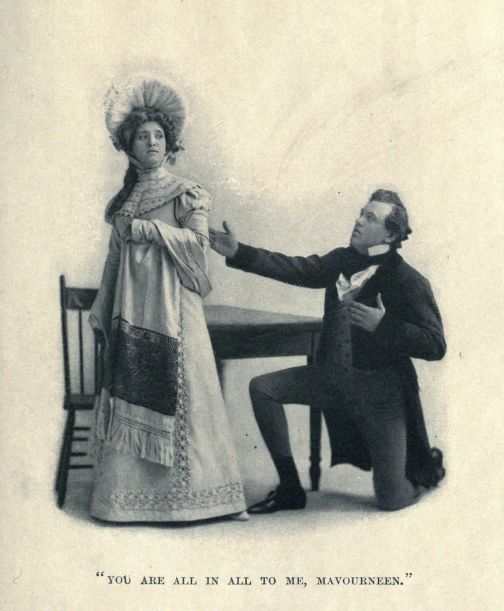
"You are all in all to me, mavourneen."
Bessie's lips trembled as she averted her face, but her voice showed no signs of relenting as she answered:
"Whether you love me or not matters very little to me, Mr. Moore."
"The applause at Drury Lane has changed you, Bessie. You are like all the others; one glimpse of the footlights and the rest of the world may go hang."
"Nonsense!" said the girl. "I don't care a snap of my fingers for the theatre. I was never intended to be an actress."
"I know," assented the poet, "you were meant to be Mrs. Moore, darling."
"I think you are quite mistaken, sir."
"How cold you are to me," cried Moore in despair. "Is it because--? No, I can't believe that. Bessie, you don't care for Sir Percival?"
"Really, Mr. Moore, I cannot discuss my private affairs with you," said Bessie in a voice so cold and proud that Moore abandoned all hope of moving her.
"Then," he asked defiantly, "why have you come here?"
Bessie turned to him with a little sobbing sigh of relief. She had played her part well and kept up the artifice to the last moment required by the object which she had intended to accomplish, but the task had been more difficult than she had expected.
"Why?" she cried, her voice thrilling with love and happiness. "To tell you that you need battle with poverty no longer, Tom Moore. You have won, Tom, you have won. Fame, fortune--all that you have dreamed of and fought for so long--so patiently and courageously--shall be yours. I bring you a message from the Prince of Wales."
"From the Prince?" gasped Moore.
"Yes, Tom. He accepts the dedication of your book. Lord Brooking sent me to tell you the news."
"You mean it, Bessie?" cried the half-frantic poet, as the door was sent slamming back by the entrance of Lord Brooking with Buster and the bulldog close at his heels.
"Lord Brooking, is it true?"
"The Prince declares himself honored by the dedication," replied his lordship triumphantly. "McDermot publishes your book in a week."
Moore gave a choking sob of joy as he groped his way toward his benefactor.
"At last!" he whispered, "at last!" and buried his face on his lordship's sturdy shoulder, his eyes full of glad tears.
"There, there, Tom," said the young nobleman. "It is quite true. Your luck has finally changed. There shall be no more striving and starving for you, my good lad. Your fortune is made."
"Ah," cried Moore, turning to where Bessie stood, her hands tightly clasped and her face radiant with gladness as she watched her lover's realization of the truth. "You hear, Bessie? It's success, girl, it's fortune and renown. Aye, fortune, Bessie. Now you will marry me?"
The girl turned white with anger and shame. Moore had made a fatal choice of the words with which he re-declared his love, never thinking his meaning could be misunderstood.
"Tom," said Lord Brooking, warningly, but Bessie interrupted him before he could put things right.
"How dare you?" she cried, her cheeks suddenly flaming as she faced the luckless poet.
"Bessie?" cried Moore appealingly, seeing his error too late.
"How dare you?" she repeated, her voice quivering as she stamped her foot in her anger. "Fortune! You hurl the word in my face as though I were to be bought by wealth. Do you think because prosperity has come I must of necessity change my answer? You believe you could bribe me to say 'Yes' with your success. Oh, how could you, Tom Moore?"
"No, no, Bessie," cried the poet, "you know I did not think that."
"Hush, sir," she answered, moving towards the door with downcast eyes.
"I beg of you to listen to me, Bessie. You know--you must know--I could not think what you fear?"
"Let me go, sir. Lord Brooking, I appeal to you."
His lordship touched Moore on the shoulder as the poet sought to prevent the departure of the enraged girl.
"Some other time, Tom. Words can do no good now," he said, softly.
Moore withdrew his hand from Bessie's arm and she opened the door as he stepped back.
"Have you nothing to say to me?" he murmured, hoarsely, as she turned on the threshold.
"Yes," she answered. "I hate you, I hate you," and closed the door.
For a moment Moore stood staring at the spot where she had paused; then he turned with an oath.
"You heard that, Lord Brooking?" he cried bitterly. "You saw that? That ends it all. I 'm through with the old dream forever. I 'll go back to Ireland. Back to the green fields and rippling brooks. I 'm through with London. I 've starved here. It has broken my heart and I hate it. In Ireland I will be with my friends--my own people. There I will forget her. I will learn to hate her. Aye, to hate her."
And he threw himself heavily into his arm-chair.
Lord Brooking stepped quickly forward.
"You are right, Moore," said he. "Tear her from your heart."
"Yes," cried the poet, desperately.
"There are other women much more fair than she. Go back to Ireland and forget her."
"I will, sir."
"Leave her to Sir Percival Lovelace!"
Moore started to his feet with a cry of protest.
"No, I 'm damned if I do, Lord Brooking."
"Ah," said his lordship, greatly relieved. "I thought you would change your mind."
Book Three
"Oh! what was love made for, if it's not the same
Thro' joy and thro' torment, thro' glory and shame?
I know not, I ask not, if guilt's in that heart,
I but know that I love thee, whatever thou art."
Chapter Fifteen
SETS FORTH CERTAIN EXPLANATIONS
Lord Brooking spoke truly when he declared that the dedication of Moore's volume of poems accepted by the Prince would bring fame and prosperity to the young Irishman, who had toiled with such enthusiasm and unwavering diligence in paraphrasing and adapting the Odes of Anacreon. Arrayed and ornamented by his brilliant fancy, owing as much to their translator as to Anacreon himself, they were given to the world and received with such choruses of commendation from both the public and the critics that the reputation of Thomas Moore was firmly established by his first book. Society delighted itself by showing favor to the author it had hitherto neglected. Moore became a stranger to privation and occupied the best suite in the dwelling presided over by Mrs. Malone, who now was numbered in the ranks of his greatest admirers. In fact the old woman seemed to take a personal pride in the social success of her lodger, and followed with an enthusiasm worthy of a better cause his course in the upper world as traced by the papers in their reports of the diversions of the aristocracy. Moore remained quite unchanged by his sudden good fortune. Never even in his darkest hour had he doubted that he deserved success, and, now that it had come, he accepted it as his just earnings and valued it as nothing more, though jubilant that his merits had at last been recognized. His reception by the world of society was more than flattering. Where he was invited first because he was the poetic lion of the season he was asked again on account of his own charming personality. Moore the poet opened the door of the drawing-room for Moore the society man, who was forthwith made an honored and much-sought guest. He sang his own songs in a melting baritone that struck a responsive chord in the hearts of young and old alike. His ballads were the most popular of the day. Romantic swains and sentimental maidens warbled them on every possible occasion; but none equalled in feeling and grace the manner in which they were rendered by the hitherto unknown youth who had penned them. The grand dames were often rivals in their attempts to secure the poet's presence at their musicales and receptions. The young bucks sought him as guest at their late suppers, while the publishers bid against one another for the privilege of printing his next book, as, in spite of his gadding about from function to function, Moore contrived to find time to continue his literary labors. Lord Moira, thanks to the glowing representations of his nephew, made much of the poet, and through his influence Moore became acquainted with certain of the great gentlemen of the time who had but few moments to waste on social amenities, and were therefore far more exclusive than the better-known figures in the gay world drawing its guiding inspiration from Carlton House. Though Moore did not lose his head as a result of the flattery and admiration now showered upon him, it would have been strange indeed if he had not secretly exulted over the triumph he had won. His almost juvenile delight was frankly acknowledged by him in the long and loving letters he wrote to the members of his own family, who in distant Dublin gloried in the London victory of the firstborn. It was no odd or unusual thing for the poet to be seen at three or four fashionable gatherings in one evening. His presentation to the Prince of Wales, whose condescension had made certain the success of the Odes, followed soon after the publication of the book, and prince and poet were equally charmed, each with the other. Moore seized upon this meeting as an opportunity to tender to his Highness the thanks previously conveyed for him by Lord Brooking. To his great delight, Wales graciously declared that he considered himself honored by the dedication of the volume, and expressed a hope that they might have the opportunity of enjoying each other's society on many occasions in the near future. Moore came away that evening belonging wholly to the Regent, for, when that noble gentleman willed it so, no one could be more charming, and as his Highness was distinctly taken with the clever and modest young poet, he saw fit to be more than usually condescending and agreeable. He had chatted genially with Moore on literary topics of present interest, complimented him on the grace and rippling beauty of his translation of the Odes, and warmly applauded the young Irishman's singing of several of his own ballads. Taking all things into consideration, Moore had every reason except one to be content with his present lot. That the single disturbing element in his existence was the misunderstanding with Bessie Dyke need scarcely be asserted. They met frequently in society, for, thanks to the influence of Sir Percival, the doors which Moore had pried apart by mighty effort with his pen, had opened in easy welcome to the beautiful young actress, who, though coldly pleasant in her demeanor, made no attempt to conceal her desire to avoid Moore when the opportunity offered. As he, hurt and hopeless, made but little effort to force his company upon her, they might have been comparative strangers for all the evidence of mutual interest they gave at the various social gatherings when they chanced to meet, so, though several months had elapsed since Moore emerged from obscurity, no progress had been made in his love affair.
Sir Percival Lovelace had contemplated his rival's sudden rise to fame with interest, not unmixed with cynical amusement, his humorous sensibilities being rarely tickled at his own discomfiture, for this pleasant gentleman was philosopher enough to extract cause for merriment from his own disappointments and miscalculations. But the real reason for the toleration exhibited by the baronet was the confidence he felt that he had in his possession a weapon which, when he chose to wield it, would not fail to utterly destroy Moore in the estimation and good graces of the Regent, for Sir Percival felt certain that the loss of royal favor would result in the social ruin of his rival. As he thought he had ascertained by various means that there was comparatively little likelihood of the differences between Bessie and her lover being patched up, Sir Percival had held back the blow which he intended should completely demolish the prosperity of the poet, deciding to allow Moore to climb even higher on the ladder of fortune before knocking it from beneath his feet, that a greater fall might follow. But meanwhile the baronet had not been idle in other directions. Like many other gentlemen of the quill, Robin Dyke imagined that he was possessed of much ability in affairs of finance, and as numerous opportunities were ever at hand for indulgence in such hazards as are afforded by stock speculation to the unwary, he succeeded in quickly and secretly losing all the money he made over and above the funds necessary to maintain the modest little home tenanted by himself and daughter. After much mental debating he mentioned his indiscretion to his patron, who, scenting immediately a chance to secure a much-desired hold upon the foolish old gentleman, at his own suggestion loaned Dyke three hundred pounds, taking notes at ninety days' sight in exchange for the sum, stipulating that the matter should be kept from Bessie. Dyke, naturally reluctant to admit the previous ill-success of his investments to his daughter, readily consented to accept this condition, and without more ado proceeded to send good money after bad by repeating his financial mistakes. This time he hesitated very little before acquainting Sir Percival with his lack of success, and found no difficulty in securing a further loan of another three hundred pounds, the investment of which resulted in even more brilliant disaster than before. Sanguine ever of ultimate success which should retrieve the losses already incurred, the worthy but foolish old rhymer increased his indebtedness to Sir Percival until he owed him in all one thousand pounds without Bessie having even a suspicion of the true state of affairs. Time passed and the notes matured, but Dyke, having no means of settling, frankly announced the fact to his patron and received reassuring smiles in return, a reply which fully contented him. The baronet affected to be quite indifferent as to the length of the period he might have to wait for his money, and told Dyke to take his own time in repaying him. This the old gentleman proceeded to do and thus made possible the events to be described in succeeding chapters.
Chapter Sixteen
TOM MOORE SEPARATES A YOUNG LADY FROM HER SKIRT
It was at the splendid mansion of Lady Donegal that Moore first met Mr. Sheridan. Introduced to the famous wit by no less a person than George Brummell himself, Moore found not unworthily bestowed the reverence he had felt from his boyhood for the brilliant but erratic Irishman whose previous success in the fashionable world of London had served to render less difficult the progress of his younger countryman when once begun, and on this evening was laid the foundation of the friendship destined to endure until the melancholy end of the elder genius. Mr. Walter Scott, as yet famed only for his verse romances, for this was some years before the fiery genius of Lord Byron, now a fat youth at Eton, drove the genial Scotchman from the lyric field into the world of prose where he has reigned supreme even to this day, was another notable with whom Moore became immediately and delightfully intimate. The sturdy intellect of Scott, who infused his vigorous personality into all that flowed so readily from his pen, was delighted and amazed at the grace and beauty of the Irishman's more delicate imagery, while the refined and subtler fancy of the younger poet was filled with wonder by the other's stirring, rakehelly border ballads. Scott was the sturdy, gnarled, and defiant oak in the literary forest; Moore the tender, clinging ivy, enfolding and beautifying all that he touched and lingered on. No wonder, then, that their admiration should be reciprocal. The intimate crony of these brilliant men, the hostess herself was a woman of refined taste and much personal charm. In her Moore found a true and admiring friend, and whenever he, for business or pleasure, was compelled to absent himself from London, a delightful correspondence was kept up, as pleasing to the great lady of fashion as to the poet, for Moore, ever a favorite among men, was not less popular with the opposite sex, no matter what their rank in the world might be.
While he had good reason to treasure the friendship of Lady Donegal for the sake of the brilliant acquaintances whom he met at her mansion for the first time, even a more tender and pleasing opportunity for gratitude was to be afforded him, for here it was that transpired the series of incidents which resulted finally in his reconciliation with Bessie Dyke.
On the night in question Moore arrived in company with Sheridan and Brummell, the two Irishmen having spied the Beau in a cab driving to the reception at Lady Donegal's as they were making their way toward the same destination on foot. They hailed the vehicle, and when the driver had pulled up in obedience to a signal somewhat unwillingly given by Brummell, climbed in with hardly as much as a beg your leave, making themselves quite comfortable in spite of the remonstrances of the crowded and berumpled dandy, the three thus reaching her ladyship's great mansion together.
Moore paid his respects to his hostess, then, after a brief session in the card-room with Mr. Sheridan, which resulted in the enrichment of the elder Celt to the extent of two guineas, made his way to a room usually little frequented by the less intimate company, intending to give definite shape in black and white to a new song as yet unwritten, the garbled and uncompleted verses of which had been running and jumping in his head all day.
Much to his surprise, Moore found the writing desk in use, the young lady who was busy scribbling being no other than Bessie Dyke. His first impulse was to make a quiet exit, trusting to his noiselessness to effect escape undiscovered, but reflecting that, as hitherto he had not had so excellent an opportunity for an uninterrupted conversation, he would be foolish to allow such a chance for attempting to right himself in her estimation to go unutilized, he thought better of it, and so remained, announcing his presence by a polite little cough, highly suggestive of a timidity but slightly feigned.
Bessie looked up from her writing, then continued her occupation until she had completed her task.
"Am I interrupting you, Mistress Dyke?"
"Does it look as though you were, Mr. Moore?" she asked, tartly.
"Not exactly," he admitted, not at all encouraged by her manner; "but appearances are deceiving, you know."
"I usually accept them as conclusive," said she, folding the sheet of paper which she had just finished.
"I know you do," said Moore, plaintively. "It is a bad habit to get into."
"No doubt you speak as an authority on the subject, Mr. Moore?"
"On bad habits? It is a bad habit I have of speaking, you mean, Mistress Dyke?"
Bessie nodded and turned toward him, resting one chubby elbow upon the desk.
"How London has changed you," sighed Moore, regretfully, shaking his head as he spoke.
"And you?" said the girl in a critical tone. "Surely Mr. Thomas Moore, the friend of the Prince, is very different from an unknown Irish rhymer?"
"Rhymer?" repeated he. "I see you have been talking with Sir Percival."
"To be sure," said Bessie. "So pleasant and witty a gentleman is worthy of attention."
Moore sighed, and drawing a chair nearer to the desk sat down and crossed his legs comfortably.
"See here, Bessie," he said in his most persuasive tones, "why should we quarrel in this foolish fashion?"
The girl laughed in rather an embarrassed way and shifted a little on the chair.
"If there is some other fashion in which you would prefer to quarrel, perhaps it will be as acceptable as this," she replied, lightly.
"Will you never be serious?" demanded the poet.
"Why should I be serious, sir?"
"To please me, if for no other reason."
"Ah, but why should I wish to please you, Mr. Moore?"
"It is a woman's duty to make herself agreeable."
"Not to every impudent young versifier who thinks to do her honor with his attention," replied Bessie, smiling mischievously as she rebuked an unruly ringlet with one dimpled hand.
"But I have no such idea," protested Moore, quite baffled by her behavior.
"No? Surely a young man who proposes marriage to two different girls in one afternoon must think very well of himself?"
Moore groaned, and gave the girl an appealing glance that failed to accomplish anything.
"Ah, Bessie, you have no heart!"
"Have you, Mr. Moore?"
"You have had it these two years, Bessie," he replied, fervidly.
"You are quite mistaken, sir," quoth she, in tones of conviction. "I would have no use for such a thing, so would not accept it. You are thinking of some other girl, Mr. Moore."
"I am thinking of you, Bessie."
"Then you are wasting your time, Mr. Moore, and I 'll thank you to say 'Mistress Dyke' in the future when you address me."
"I 'd like to say 'Mrs. Moore,'" replied the poet.
"What did you say, sir?" she demanded shortly, an angry flash in her eyes.
"I said I 'd know more some day."
"That is certainly to be hoped," said Bessie. "One should be sanguine, no matter how futile such cheerfulness may appear at the present time."
So far Moore had succeeded but poorly in breaking down the girl's reserve, and though painfully conscious of his failure, was nevertheless quite resolved that the interview should not end with their present attitudes unaltered.
That she herself was not averse to listening to his arguments this evening was already fully proved, for she had made no effort to conclude their conversation, and in fact seemed waiting with no little interest for the next attempt he might make to restore himself to his old-time place in her regard.
"Mistress Dyke," began Moore, hopefully, favoring the girl with a look as languishing as love could make it, "do you know what your mouth reminds me of as you sit there?"
"Cherries?" suggested the girl promptly. "I believe that is the usual comparison made by lame-witted poets."
"No, indeed. Cherries conceal pits, and, as you no doubt remember, Joseph fell into one. Now I am no Joseph."
"No," said Bessie. "You are more like Charles Surface, I fancy."
"Never mind mixing the Drama with this conversation," replied Moore, chidingly. "Forget for a moment that you are an actress and remember you are a woman, though no doubt it amounts to the same thing."
"Well, what does my mouth remind you of, Mr. Moore?" asked the girl, her curiosity getting the better of her.
"Of better things, Mistress Dyke."
"Indeed? What may they be, sir?"
"Kisses," replied the poet lightly. "Ah, Bessie, it is glad that I am that your mouth is no smaller."
"And why so?" she asked, suspiciously.
"The smaller a woman's mouth, the greater the temptation."
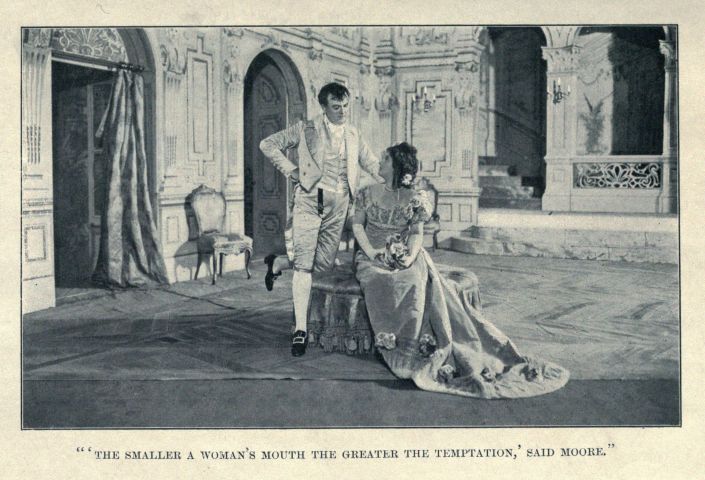
"'The smaller a woman's mouth, the greater the temptation,' said Moore."
"Is that what you call me?"
"Your mouth, my dear. Alluring is no name for it. Temptation? Aye, that it is. Twin ribbons of rosy temptation, or I 'm no Irishman."
"We won't dwell upon that subject," announced Bessie.
"If I were a honey-bee, I 'd live and die there," said Moore, sincerely.
"Where?" asked the girl.
"On the subject, if I were a honey-bee."
"The subject is closed," she answered, compressing her lips in anything but an amiable expression.
"I don't like it so well that way."
"How you like it does not interest me at all, sir."
"Now I wish to speak to you seriously," said Moore with becoming gravity. "Please give me your attention."
"I am listening, sir," she answered, a trifle uneasily.
"Very well, then. Don't you think women should try to make men better?"
"Yes."
"And to reduce their temptations?"
"Yes."
"Then, for instance, if you had a loaf of bread you did not need and knew a man was starving for it, would n't you rather give it to him than have him steal it and be responsible for the sin?"
"Yes," said Bessie, "I would, undoubtedly."
"Ah," exclaimed Moore, happily, "then if I tell you I am starving for a kiss and feel afraid I may steal it, you will give me one to put me out of temptation?"
"On the contrary, I shall request you to cease talking nonsense, and suggest that you had better sit down."
"I will, if it pleases you," replied Moore, smiling sweetly at the girl, as he resumed the chair from which he had risen in his eagerness a moment before.
"Oh," said Bessie, in a sarcastic tone, "you think you are very clever, don't you?"
"Why should I deny it? A good opinion is like charity, and should begin at home."
"Does any one else think you are clever, Mr. Moore?"
"I don't know," answered the poet cheerfully; "but if they do not, it only makes my opinion more valuable on account of its rarity."
Bessie was compelled to smile by this ingenious argument, and sought refuge behind her fan; but Moore, seeing he had scored, followed up his success resolutely.
"As you say," he continued, "I am clever."
"But," said Bessie indignantly, "I did not say that."
"You forget," replied Moore, loftily, "that a man's opinion of what a woman thinks is based largely on what she does not say."
"You surprise me, Mr. Moore. Pray explain your last assertion."
"Well, then, for example, I linger by your side and you do not say 'Go away,' so my opinion is that you wish me to remain."
"Oh," exclaimed Bessie, shocked at the mere idea of such a thing.
"You do not say 'I hate you,' so my opinion is that you l--"
"Mr. Moore," cried Bessie, sternly, and the poet diplomatically allowed her interruption to finish his remark.
"Men are so foolish," observed the girl, knitting her brows in sad contemplation of masculine idiocy. "Really it is quite saddening when one considers their stupidity."
"And yet," said Moore, "if we were not such fools you wise little ladies would find it much more difficult to work your wills."
"I am not so sure of that," said Bessie, with a sniff of superiority. "Men are great nuisances at best."
"Had you rather I went away?" asked Moore, in his most honeyed accents. "Shall I go?"
"You must suit your own inclination, sir," replied Bessie, too clever to be so entrapped.
"And you?" he returned. "Can't you say 'I wish you to stay'?"
"No, Mr. Moore."
"And why not, Mistress Dyke?"
"Girls do not say such things to men."
Moore sighed regretfully.
"I wish they did," said he. "Don't you like me at all any more?"
"Not very much," replied Bessie, with seeming frankness.
"Won't you smile at me?"
"No," said Bessie, determinedly, "I will not."
As she spoke she turned away from the poet, but he was not to be so easily defeated.
"Bessie," he whispered tenderly. "Smile at me, dearest, smile just once."
"No," she answered firmly, "I will not. I don't have to smile if I don't wish to, do I?"
But, alas for her determination, as she replied her eyes met those of Moore; the twinkling merriment which she read in her lover's gaze was too much for her gravity, and so, in spite of her effort to keep a sober face, she smiled back at him, and if it was not the love-light that shone beneath her long lashes, it was a something so entirely like it that a wiser man than the young Irishman would have been pardonable for making such a mistake.
"Oh," he said, lovingly triumphant, "what do you think about it now?"
"Well," said Bessie, in quick equivocation, "I wanted to smile then. You are very ridiculous, Mr. Moore."
"You make me so, Bessie."
"What did I tell you about that name?" she demanded, rising to her feet.
"I forgot, Bessie," he replied defiantly.
"If that is the case you shall have the opportunity to recall it to mind," said she, sternly, at the same time moving towards the door. But her foot caught in her skirt and as she recovered her balance with a little cry there was an ominous sound of ripping plainly heard.
"There," cried Bessie in a rage, "I 've stepped on a ruffle. It is all your fault, Tom Moore."
"Of course it is," replied the poet. "It always is, as we both know."
Bessie, meanwhile, had investigated the extent of the damage she had sustained. The lace ruffle on her underskirt had been torn off for at least two feet. The thing was utterly ruined, and, gritting her teeth as she realized this, Bessie tried to tear off the loose piece. This, however, proved to be beyond her strength, so, abandoning the attempt with an exclamation of rage, she stamped her foot in anger.
"Let me help you," said Moore politely. "No doubt, I can break the plaguey thing, Mistress Dyke."
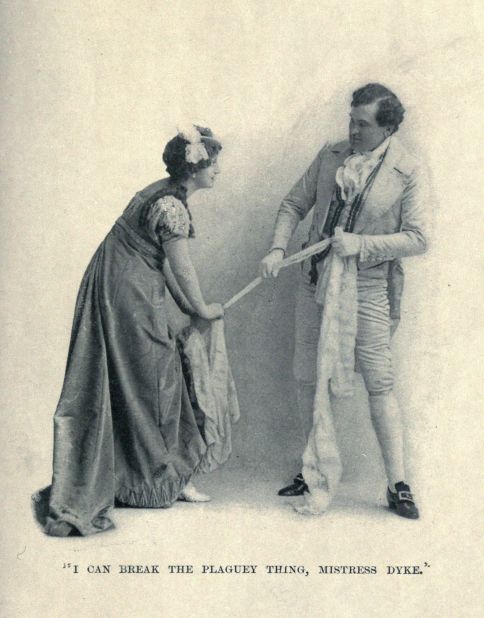
"I can break the plaguey thing, Mistress Dyke.
"You are the cause of all the trouble," said Bessie, crossly.
"All the more reason, then, for letting me help you repair the damage. You can't dance with that trailing in front of you."
Moore took the end of the ruffle which Bessie held out to him, and, securing a firm grip upon it, marched across the room, thus ripping off the entire bottom of the skirt.
"Thank you," said Bessie, more graciously, extending her hand for the torn piece.
Moore shook his head and held the ruffle behind him.
"Give it to me, sir," exclaimed the girl indignantly.
"It is the foam on the wave of loveliness," declared the poet, waving his prize as though it were a pennant, but carefully keeping it out of Bessie's reach.
"You cannot have it, sir," she said, sternly.
"Women are enveloped in mystery," he continued, quite unrebuked, "yards of it. If there is anything I love, it is mystery, so I 'll keep this for myself."
"Why?"
"For a souvenir. Think of the memories associated with it, Bessie."
"What good will it be to you?" she asked, rather more pleasantly.
"It would be a great success as a necktie," Moore went on, draping it beneath his chin. "Thusly, for instance, or I might wear it on my arm, or next my heart."
"Give me that ruffle," cried Bessie, snatching at it as she spoke, and by good luck catching it.
"Let go," commanded Moore. "If you don't I 'll kiss your hands for you."
"Oh, no, you won't."
But he did.
"Please," pleaded the girl, not letting go.
"I don't intend to keep it, Bessie, on my word of honor."
Confident that she had secured her object, the girl released the ruffle and stepped back.
"Thank you, Mr. Moore," said she, waiting expectantly.
"Oh, not at all, Mistress Dyke. What are you waiting for?"
"For that."
"But you do not get this, Mistress Dyke."
"But you promised, sir."
"I did not say I would give it to you," explained Moore, genially. "I merely promised that I would not keep it. Well, I won't. I happen to have your card in my pocket--it's a wonder it is n't the mitten you have presented me with so often--and this card I shall pin on the ruffle, which I shall then hang on this candelabra, where it will remain until found by some one, and what they will think of you then is beyond my power to imagine."
Moore suited the action to the word as he spoke, and the bundle of frills was securely perched on the candle-rack protruding from the wall a good seven feet from the floor before Bessie fully realized how completely she had been outwitted.
Then she lost her temper entirely.
"You cheat," she cried furiously. "Oh, I should have known better than to trust you."
"Certainly you should," replied the poet, politely agreeing with the irate damsel. "I was surprised myself at the simplicity of your behavior."
"However," she continued, "I shall never believe you again."
"Never?"
"Never, Mr. Moore, and I am very angry with you."
"Really?" asked he. "Why, whoever would have suspected it, Bessie?"
"Luckily I can get it without your assistance," she went on. "You are not half so smart as you imagine."
"Of course not," observed Moore, watching her as she stood on tiptoe and vainly endeavored to reach the cause of all the trouble. "Take care, Bessie, or you 'll tear something else."
The girl was baffled only for the moment, for directly beneath the candelabra stood the desk at which she had been writing a few moments before. As the top, which when open formed the writing table, was let down, it was an easy thing for her to step up on it from the seat of a chair, and then from there to the top of the desk. This was what Bessie did as quickly as was possible, for she was considerably handicapped in her climbing by her long train.
"There is nothing like independence," remarked the poet, observing her with a broad smile, as she performed this manoeuvre and stood in triumph on the desk. "Like marriage, it usually begins with a declaration and ends with a fight. It did in America."
"You imagine you are witty," said Bessie, in icy tones, picking the ruffle from its perch on the candelabra.
Moore stepped quickly forward and shut up the desk. This done he removed the chair by which she had mounted and had her completely at his mercy.
"And you," he said pleasantly, "imagine you are independent."
Bessie turned carefully and discovered her plight with a little exclamation of dismay.
"Put that chair back and open this desk immediately," she commanded sternly.
"The chair is doing very well where it is," replied Moore, calmly sitting down upon it.
Bessie bit her lip in anger.
"It is not customary for a gentleman to sit while a lady remains standing."
"Nor is it usual," answered Moore, "for a lady to climb up on a desk."
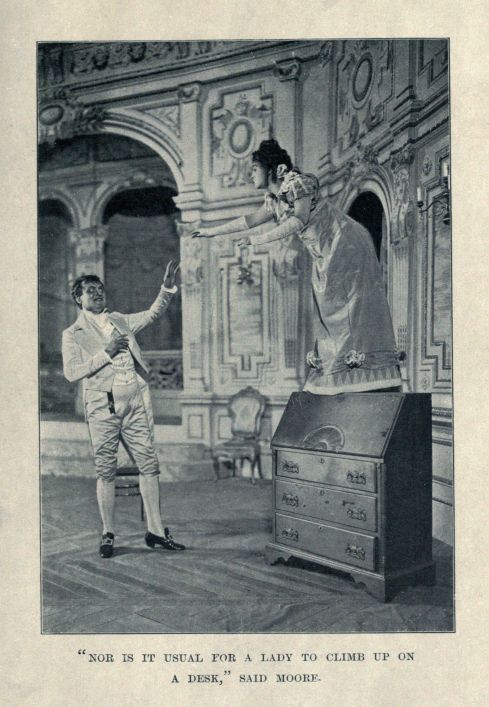
"Nor is it usual for a lady to climb up on a desk," said Moore.
"You think you know a lot about women, don't you?"
"I am always willing to learn more," responded the victorious poet, blithely.
"Oh, dear," sighed the girl, "I don't dare jump with these high-heeled slippers on."
"I observe that your tastes are elevated, even in shoes. Give me the ruffle and I 'll help you down."
"No, sir, you shall not have it."
"Hurry, I think I hear some one coming," exclaimed Moore in an alarmed tone.
"Do help me down."
"The ruffle first."
"Oh, there you are," she cried, abandoning herself to utter defeat as she tossed him the bribe he demanded.
Once safely on the floor, Bessie ran lightly to the entrance leading to the adjoining room and peeped out to see who was approaching. Much to her astonishment she discovered no one near, then, turning, read in Moore's laughing eyes how cleverly she had been tricked.
"There is no one coming," she said severely.