Chapter XVI · THE FRENCH CONQUEST
Diana White translation
Up to the last moment England endeavoured to put her hand upon the commerce of Timbuctoo. Failing in her efforts from Tripoli and the Niger’s mouth, she attempted to secure a footing by way of Morocco, and was installed towards 1890 at Cape Juby. It was then too late. Our columns and posts had been slowly advancing by the Senegal route advocated by Colbert, and in 1893 Colonel Archinard took Jenne, the last halting-place but one. The following year we were at Timbuctoo, and Cape Juby was evacuated.
Whatever may have been said at the time, the occupation of Timbuctoo was not only necessary, but had to be effected with the least possible delay. No one can complain now that we have not made known the history of these people and their country. The prosperity of the Sudan is so closely connected with that of its principal market, that if the general anarchy had been prolonged in Timbuctoo all the sacrifices of human life and money we had made on her threshold would have remained sterile. The sooner an end was put to the ruinous dominion of the Touaregs the better would it be. What would have become of the town if the French occupation had been prevented? We can easily picture the scene: the Touaregs would assemble and unite with Kountas, Foulbes, and Moors, as they did thirty years ago against the Toucouleurs at the instigation of El Backay. The routes from Morocco, Tuat, and Tripoli would have left the Sudan (that enormous country which we occupy with such modest means) open to foreign intrigues, to the introduction of arms and ammunition, and to fanatics led by some inspired marabut, to a second El Hadj Omar returned from Mecca, or to some Mahdi come from Tuat. The result of long years of struggle and effort would be destroyed in a few months, our patient work of regeneration and pacification would be hopelessly compromised, and the flames of revolt which would break out in Timbuctoo would rapidly spread to Algeria. The seat of so many perils, the key to all the routes of the Sahara and Sudan, must be in our hands as soon as possible.
These dangers were dissipated by the promptitude of our march on Timbuctoo. All homage to Colonel Archinard, who knew so well the country and people with whom he had to deal. By his alacrity the colony was spared fresh convulsions and the capital great sacrifices. No sooner was Jenne taken, than, with remarkable intuition, he traced the plan of the succeeding campaign. A forced march was to be made on Timbuctoo to prevent any concentration of the nomads, one column traversing the countries on the left bank of the Niger, another advancing by means of the river as the gunboats cleared the passage. Such were the tactics pursued at the end of 1894. Colonel Bonnier conducted one of the columns, Colonel Jouffre the second, while Lieutenant Boiteux commanded the flotilla. Unfortunately Colonel Archinard was not there to conduct the campaign; had he been, the unfortunate episodes which marred its execution would probably have been averted.
I am now going to show the taking of Timbuctoo in a new light, as it appeared to the inhabitants. They related it to me as the old Sudanese chroniclers, whose art is unhappily lost, might have done.
From the beginning of November 1894 vague rumours were afloat in Timbuctoo, reports of a mustering of troops at Segu. The country being quiet on their side, the inhabitants conjectured it to be some expedition preparing for the north. Three weeks passed without any news, and then suddenly events took shape. A merchant, who arrived from the south, announced that the gunboats had reached Sarafara and were preparing to start for Kabara. They had taken on board, as pilots, two of the leading merchants of Timbuctoo, who were in exile at Sarafara, having been ruined by the Touaregs. The next day news came of the arrival of the flotilla at Koriouma.
A body of Tenguaragif Touaregs were in Timbuctoo, and they summoned Hamdia, the chief of the town, and ordered him to have the tabala (war drum) sounded, and to command the people to take up arms. The excitement was great, the population being divided between fear of the French and terror of the Touaregs; some of the notables remonstrated with Hamdia, and the Kountas alone showed any courage. However, all those who had not hidden themselves in time had to set out in company with the veiled men. This small army, of which the Touaregs formed the cavalry, was armed with lances and javelins, and a few rifles belonging chiefly to the Kountas.
As this army was marching to Kabara on the morning of December 5th, the flotilla had left Koriouma, and was ascending the Pool to Dai. There Commandant Boiteux and some Laptots (black sailors) disembarked in a lighter to reconnoitre the route to Kabara, and gather sufficient information to acquaint the two columns with the situation when they should arrive. But an incident occurred which upset their intended plans, and hastened the capture of Timbuctoo in an unforeseen manner.
The approach of the lighter having been signalled at Kabara, the Touaregs and Timbuctooans assembled on the banks, silent and immovable. When the lighter appeared in sight a cloud of lances and javelins greeted it, the Kountas discharged their guns, and a general uproar took place. Only one shot carried, wounding a laptot; the rest had time to escape the javelins by crouching at the bottom of the boat. They replied with a volley which wounded several, killed one, and put all to flight, the Touaregs to the desert, and the Timbuctooans back to their city.
A few hours later the gunboats and lighters anchored in the harbour of Kabara.
At Timbuctoo the authorities held council during the night. ‘What is to be done’? asked Hamdia, the chief.
‘Listen to my words and thought,’ replied the kadi. ‘You must write a letter to the commander, and say, “It is not we who are responsible for what has happened at Kabara but the Touaregs, whom we fear. We, the people of Timbuctoo, are not opposed to your arrival here, for you hold the countries from which we draw our commerce and alimentation. We place ourselves in your hands.” This is my advice.’
‘I am afraid to do that,’ replied Hamdia. ‘The Touaregs insulted me this morning by saying that we had written to the white men asking them to come. They know that some of our people are on their side.’
‘The Touaregs do us nothing but harm: why listen to them?’ replied the kadi. ‘We had better send a letter to Kabara.’
‘But the road is guarded. Our messengers would be taken and killed.’
‘You can get to Kabara by other than the main route.’
‘So be it,’ said Hamdia finally. ‘Let us do as you say.’
The kadi drew up the letter, and wrote to the commander as follows:—
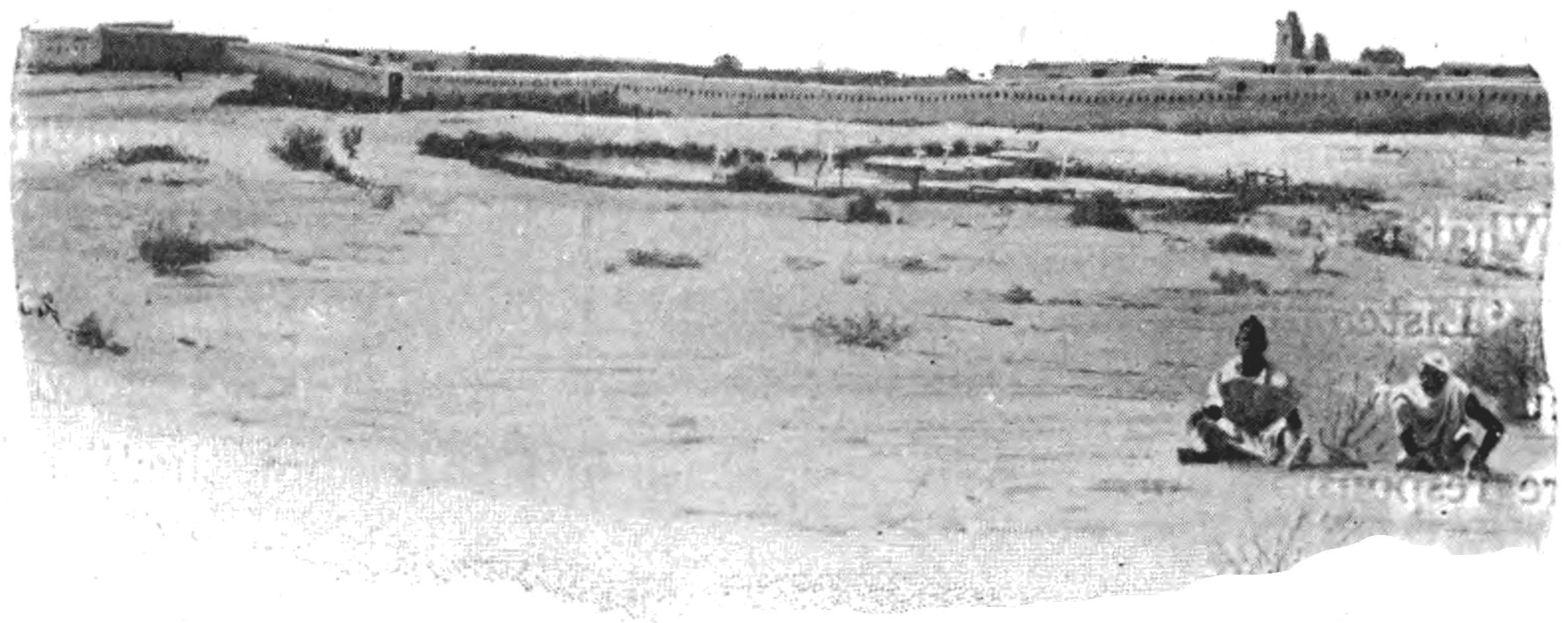
GENERAL VIEW OF FORT BONNIER
‘We would have you to know that what took place this morning was done without our sanction. We only took part under compulsion from the Touaregs, and we fled as soon as we could. Our united resolution was this. When, a month ago, we learnt of the arrival of your troops at Segu, some Arab merchants counselled us to write to our former master, the Sultan of Morocco, and ask him what we were to do if the white men came. The messengers set out for Fez with a caravan. The route is long, and they have not yet returned. We are women. We do not fight.’
Two messengers, who were bribed with a hundred yards of white linen to go to Kabara, immediately set out. Before sunrise they returned. One of the Timbuctooans, who accompanied the gunboats, had read and translated the kadi’s letter to the white man’s interpreter, and then written the following answer in the commandant’s name:—
‘I know that all the mounted men and those armed with lances were Touaregs, but those who had guns were natives of Timbuctoo. Why did you attack us before you knew what we wished? It is not thus you should receive people with whose intentions you are not acquainted. Ours were for your good. But what is past is past; to-morrow send some of your chiefs for a palaver.’
Early in the morning of the next day the Touaregs returned to Timbuctoo. They were questioned by one of the notables, Alpha Saidou, the chief of the Ghingaraber quarter.
‘We pay you taxes, therefore you ought to defend us. Here are the white men. What do you intend doing?’
‘Do as you like,’ they replied. ‘The Tenguaragifs are not the only masters here. Other tribes share the tax with us, and our people ought not to be the only ones to be slaughtered. Besides, we have just learned that a column is coming from the west, the Gundam quarter, where our flocks and wives are. We want to protect them, and we are going.’
The Touaregs having left the town, the chiefs and notables assembled in the mosque of Sidi Yaia after the sunset prayer. They decided to accede to the commandant’s wish, and two delegates were chosen. The letter which accredited them repeated that they were merchants and not combatants, and that if the commandant would wait for the sultan’s answer all would be well; but if not, he was at liberty to do just what he pleased; he would not be opposed by the people. However, the delegates came back; one, a Tripolitan chosen by the Arab merchants, would not do. The commandant, would not treat with a stranger, but only with the natives. He was replaced by an influential marabut, Mohaman Kouti, the other delegate being Alpha Saidou. From that time negotiations opened very amicably with Kabara, the delegates frankly explaining the situation and announcing the exodus of the Touaregs. The commandant received them courteously, told them that two armies were following him up, and demanded that a treaty of peace should be signed by the chief and authorities of the town placing the country under the protectorate of France. But no one in Timbuctoo dared give his signature. The town was dismayed, every one feared the return of the Touaregs, knowing that in that case his signature would cost him his head.
According to a local legend, the Niger has an exceptionally high and early rise in those years when some remarkable event, generally sinister, is to take place, such as war, epidemic, or famine. For thirty years no one remembered to have seen so much water in the pool that winds from Kabara to Timbuctoo. M. Boiteux decided to hasten the negotiations, and arrived at Timbuctoo, by means of the pool of Kabara, with two lighters armed with revolving guns, borrowed from the gunboats.
And thus it was that Timbuctoo, a town nearly eight hundred miles from the sea—a town of the Sahara, moreover,—was taken by sailors, thus equalling the feat of Jourdan’s Hussars, who took possession of the Dutch fleet among the ice of the Zuyder Zee.
It was December 15th. The evening before, the two delegates had been sent back to Timbuctoo to prepare it for the events which were to follow. During the night, the lighters, manned by eighteen men, had crossed the sands without hindrance, and were before Timbuctoo by the morning. On hearing this, some forty of the besieged, Foulbes and Kountas mostly, took up arms; but the authorities compelled them to put them down, threatening to stir up the mob against them if they did not. The chiefs then proceeded to the banks of the pool, taking with them gifts of welcome. ‘Are you bringing me the treaty of peace I demanded?’ asked Commandant Boiteux. ‘No,’ the chief replied, ‘for we only heard of your arrival last night.’ ‘Then I cannot accept your gifts,’ said M. Boiteux, ‘and I have nothing further to say to you. You know my wish; I made it known to your two envoys.’
As the deputation retired one of the guns was landed and planted on a neighbouring dune, which was rapidly transformed into a redoubt; the other was left on board the lighter, to cover any eventual retreat.
The presence of the little troop, and, above all, the two cannon (whose terrible power was known to them), reassured the authorities as to the return of the Touaregs, and gave them courage for a final resolution. They assembled their notables and marabuts at the mosque, and, the three o’clock prayer having been recited, Kouati, the most influential marabut, stood up and said, ‘What have you all to say?’
‘But what have you to say?’ the assembly replied.
‘I? Oh, I am not one of the authorities.’
‘Certainly. But you are a marabut, you have the word of God. Speak! speak!’
‘This is my thought,’ Kouati then said. ‘All those who will not make peace will be responsible in the Judgment Day for the souls of those who get killed.’
‘We will do as you counsel us.’
‘I am not the only marabut in Timbuctoo,’ Kouati objected.
‘Question my brethren.’
‘What Mohaman Kouati says is true,’ opined the brethren.
‘It is well,’ concluded Kouati. ‘I am going to make peace with the French.’
And then he went to the lighters with Alpha Saidou, who had accompanied him to Kabara, and said to the commandant, ‘We ask for peace. We will accept it, and do all you wish. Henceforth we are with you.’
‘Your decision gives me much pleasure,’ M. Boiteux assured them. ‘We do not like making war, we prefer peace. It was the Toucouleurs who first fired at Jenne; had it not been for that, we should not have fired a shot. In future, you have nothing to fear. Sign the treaty by which you recognise the French as masters of the town, and I, on my side, will sign one which will place you under our protection.’
The next morning, the two treaties having been exchanged in the presence of the chiefs and marabuts, they implored the commandant to enter and occupy the town, explaining their fear of reprisals from the Touaregs, and assuring him that henceforth he could in all things count upon them. They loyally informed him that the besieged had taken up arms, and they undertook to keep them under surveillance, and to acquaint him with all that went on inside and outside the city.
M. Boiteux requested them to show him the highest point of the city, and there he selected a large house. One of the guns was hoisted on to the terrace, and the surrounding walls were temporarily put into a state of defence. This improvised fortlet was at the north of the town, where a real fort, occupied by a squadron of Spahis, now stands. At the south of the town another house was transformed in the same manner, and the second gun was placed there, while the handful of Europeans and Laptots were stationed in between, and some fifty men, armed with guns furnished by the town, were posted as sentinels.
In the meantime the Touaregs had plotted with, and been joined by, some Kountas. On December 21st they attacked the flotilla reserve station at Kabara. It was on this occasion the sad episode occurred which cost Midshipman Aube his life. At the moment he was dying at Our’ Oumaira, the sentinels at Timbuctoo, having heard rifle-shots, had given the alarm. The only two horses in the town were brought out, Commandant Boiteux mounted one, another European the other, and, accompanied by the little garrison and the fifty natives, they set off in all haste to Kabara. They routed the Touaregs, who fled, leaving fifteen of their number dead.
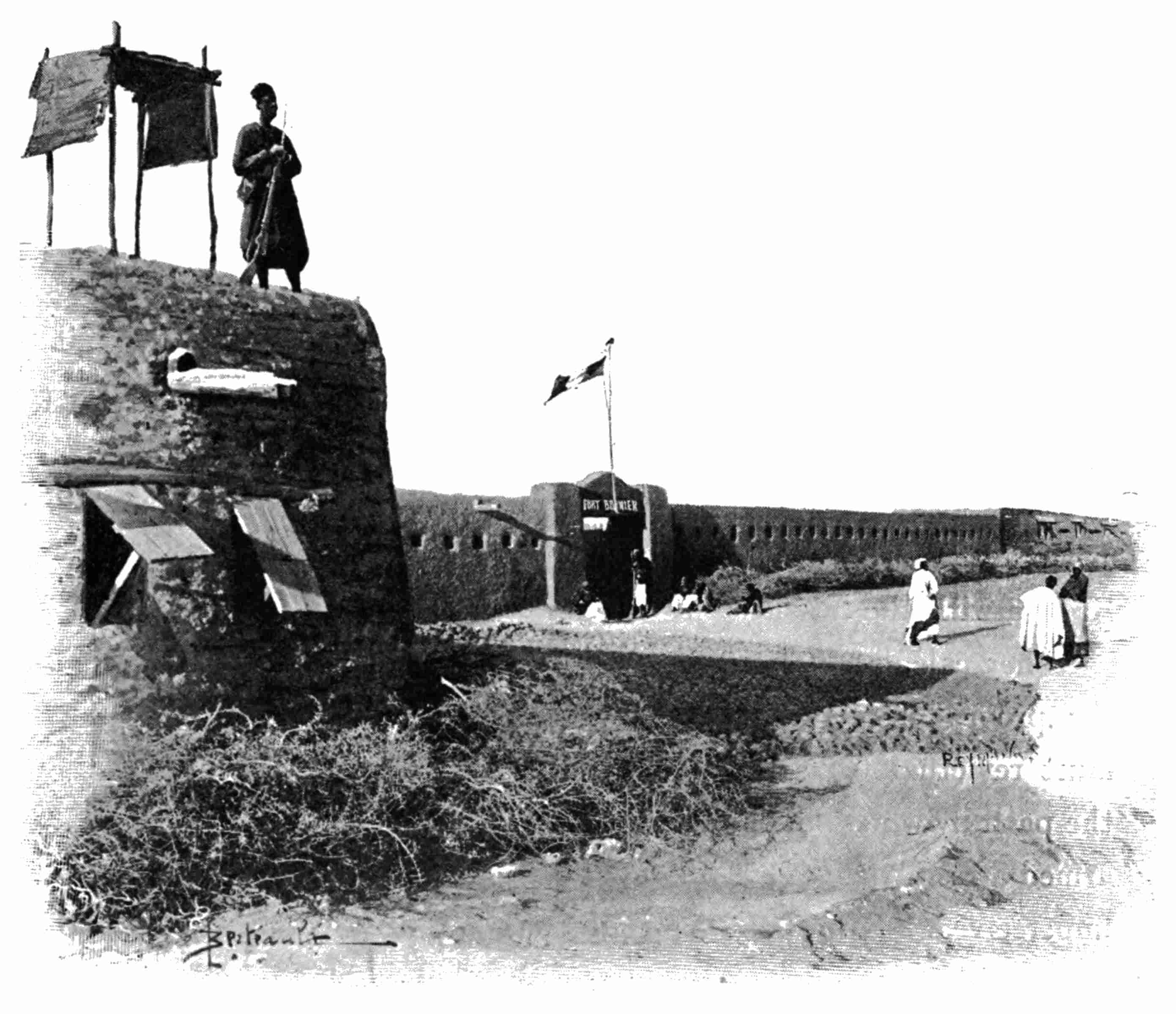
ENTRANCE TO FORT BONNIER
The enemy mustered again in the night, and were seen in the day-time passing the town. Being greeted with shot, they dispersed, some to block the road to Kabara on the south, while others installed themselves to the north of the city. The next night they sent a letter to the kadi couched in the following terms: ‘People of Timbuctoo, are you for us, or for the white men?’ The messenger was sent back with no other answer than having seen the letter torn in pieces and spat upon. At the same time, an inhabitant of the city arrived who had been made prisoner by the Touaregs, and had escaped under cover of the darkness. He told the Timbuctooans that at a council of the Touaregs, N’-Gouna, chief of the Tenguaragifs, had proposed marching on Timbuctoo, but had been opposed by the chiefs of the Kalintassars.
The commandant was immediately warned, and the alarm given to the inhabitants, who feared an attack in the dark, according to the usual custom of the veiled men. Every one was armed; even the strangers of Mossi, who had been recently exploited by the Touaregs, seized their bows and arrows. They were posted east and west, while the two fortlets guarded north and south.
As day broke they could see bands passing from east to west, but not daring to approach when they saw the muster. The divisions among the Touaregs increased; the Kalintassars, who had not wished to attack Timbuctoo, returned to their homes, and only the Tenguaragifs remained, and they seized the road to Kabara with the intention of starving the town.
They calculated well. About January 6th the garrison found the provisions were running short. Whatever happened, they must revictual from Kabara. The commandant resolved to use the path by which he had come; so, in the night, the two lighters, armed afresh with the revolving guns and a few men, glided out unperceived. However, they could not get back before daylight, and the Touaregs, having discovered them, assembled in a mass on the shores where the banks of the pool narrowed. As they were preparing to fling their javelins, the guns were unmasked, and a charge of grape-shot saluted them. The Touaregs had not noticed the departure of the lighters, and thinking that reinforcements had arrived, they fled to the interior westward of the town, and the road to Timbuctoo was free.
Four days later, January 10th, the first column, under command of Colonel Bonnier, entered the town, and thus ended the extraordinary adventure of the marines in Timbuctoo.
I have transcribed, word for word, the naïve account given me by those ebony and bronze men who were either the chief actors or chief spectators in this action. My one care has been to simplify their narrative and avoid any embellishments, yet I doubt if, in modern times, there has been any event as improbable. The gravity of heroic drama is mingled with the fun of an operetta, buffoonery wrestles with the sublime. Not even the unhealthy imagination of Edgar Poe ever conceived anything more fantastic.
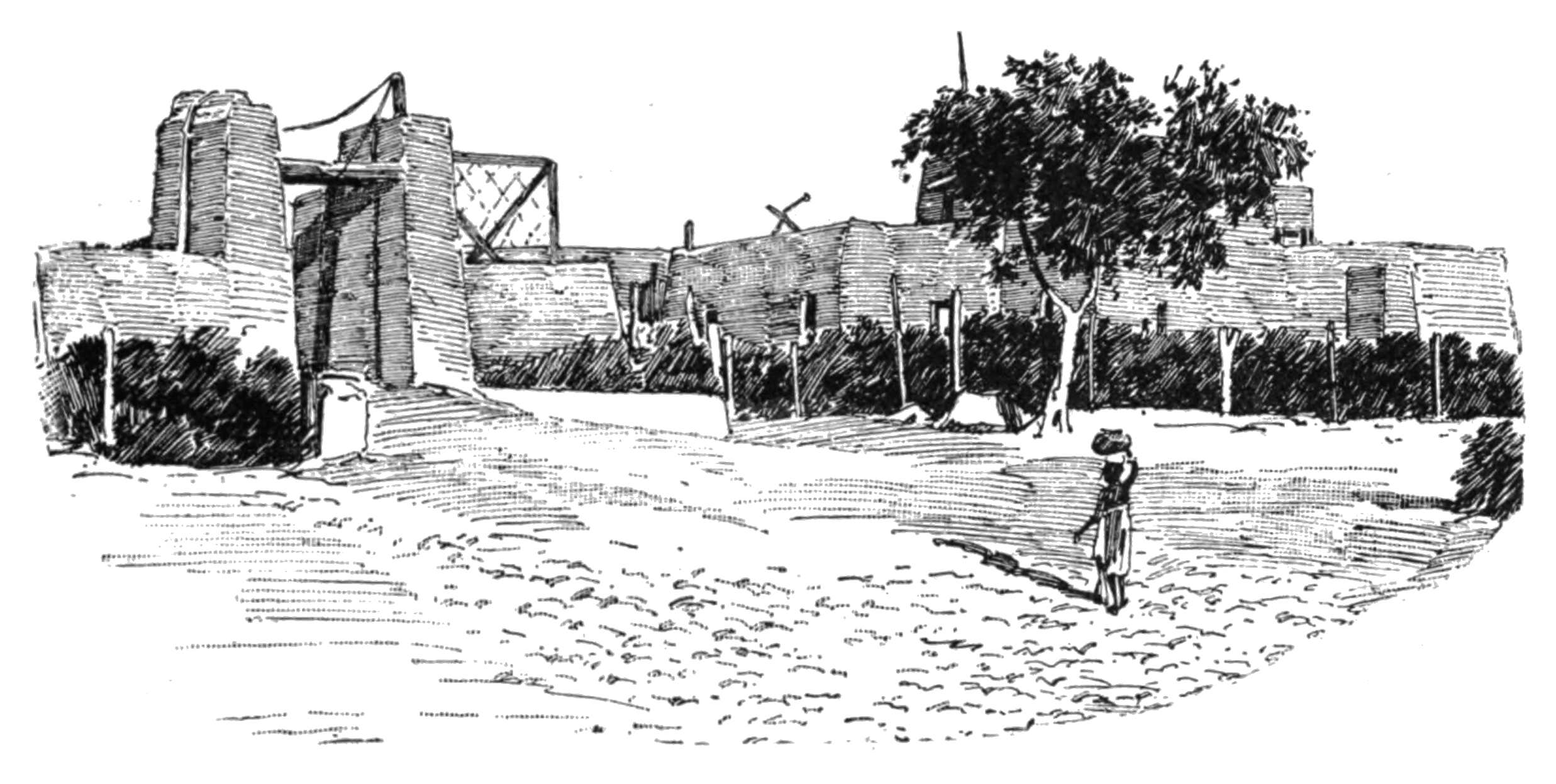
FORT PHILIPPE
It is so preposterous on the face of it. Nineteen men, seven of whom are Europeans and the remainder Senegalese negroes, set out to bring to terms a town of 8000 inhabitants, and are asked to take possession of it. And this town is no African Lauderneau: it is Timbuctoo the Great, known as a mysterious, fanatical, inaccessible city. Events follow in crescendo. The population sides with its masters of to-day against those of yesterday. One day they are ‘women,’ the next they are heroes ready to die in defence of their conquerors, and, what is more, they prove it! These Touaregs, whom formerly they had not dared to look in the face, they now fight in the open country. And, more astonishing still, they beat them! This dishevelled epopee, this mingling of cavalry and artillery with naval combats and pictures of siege, does not last for one or several days, it is prolonged for a month. In fact, one is surprised not to see the green-eyed Pallas Athene, or the white-armed Venus, appearing in the plain of Timbuctoo to protect the combatants and inflame them with warlike ardour, while Apollo of the silver bow brings the others to confusion with his arrows. But no, this is no fable; it has all been lived in our notoriously prosaic nineteenth century. Why should such a glorious and amusing quip be followed by so sinister an epilogue?
The actors are the first column and those same Touaregs whom just now we left to the west of Timbuctoo. The story has been written by M. Raille, one of the garrison officers in Timbuctoo, who collected the facts from the survivors.
The morning after their entry into Timbuctoo, Colonel Bonnier, without further delay, ordered the fifth company and a platoon of the eleventh to set out and reconnoitre, that they might rid the neighbourhood of the nomads infesting it, and avenge, if possible, the massacre of Midshipman Aube.
At five o’clock in the morning, leaving the rest of the troops under the command of Captain Philippe, the colonel started with the little column. He was accompanied by Commander Hugueny, Captains Regad, Livrelli, Tassard, Sensaric, and Nigote, Lieutenants Garnier and Bouverst, Sub-lieutenant Sarda, Doctor Colonel Gallas, the veterinary Lenoir, and interpreter Acklouck.
It was the 14th of January 1894. At two o’clock in the afternoon Colonel Bonnier learnt that the Touaregs were distant only a mile or two in front of the column. They continued marching until eight in the evening, and then they saw some flocks and a few armed men. After giving chase to the stragglers, they encamped at a place called Taconbao, which had just been evacuated by the Touaregs. Every one was satisfied and cheerful.
They encamped, as nearly as possible, in the form of a square, the men of the fifth company occupying the north, and those of the eleventh company the south side. Every one slept rolled up in his blanket with his arms piled near. On the other two sides the captured flocks were picketed. The prisoners were installed in the middle of the camp, while the staff formed a group in the middle of the square towards the east side, where the colonel’s quarters were.
Until midnight the officers of the staff were awake, and laughing and joking, having spent the evening gaily. At last every one slept. It was a magnificent night, and the brilliant light of the moon illuminated everything, until she set towards four o’clock in the morning. At half-past four only the sentinels, of whom there were six, were awake. The colonel himself gave the orders to have them placed at a short distance from the camp. Suddenly, in the midst of the silence and darkness, two reports of firearms resounded through the camp, and the cry ‘To arms!’ was repeated everywhere. Immediately every one was up, hurriedly seeking his arms. Alas! it was too late!
The Touaregs, some of whom had been seen straggling round the camp the evening before, had assembled during the night. Their cavalry, accompanied by running footmen and favoured by the darkness, flung themselves on to the French camp in a furious and irresistible charge. In the twinkling of an eye they had capsized the piled weapons and swarmed into the camp before any one had had time to defend himself.
It was night indeed, and the frightful scene which ensued cannot be depicted. It was a furious onslaught, an indescribable tumult. Above everything sounded the warcries of the enemy, who were striking and killing on all sides with lances, assegais, sabres, poignards, tomahawks, etc. A few rifle-shots mingled with the clamour of distress, and that was all.
Our tirailleurs succumbed to this human avalanche. In a few minutes it was all over.
Three Europeans, an officer and two non-commissioned officers (Captain Nigote, Sergeant-Major Baretti,and Sergeant Lalire) and a handful of men succeeded in forcing a passage and reaching some bushes near the encampment. Captain Nigote collected the fugitives in the midst of these unprecedented perils and difficulties, and conducted them to the convoy which had been left behind. There they were able to reform.
Eighty-two of our men and two guides were missing. Nine officers, including the colonel, three non-commissioned officers (of whom two were Europeans), eight corporals, and sixty native tirailleurs, had fallen before the enemy.
As far as the survivors could judge in the darkness and tumult, they had been attacked by about two hundred horsemen and between two and three hundred foot-soldiers.
Twenty-five days afterwards, the second column, commanded by Colonel Jouffre, arrived at Taconbao and collected the skeletons of the thirteen Europeans, bringing them back to Timbuctoo. They were buried behind an enclosure of dead thorns at the foot of the fort which was being built to the south of the town. The last solemn honours were rendered them before the whole garrison and the assembled population, and modest mounds of sun-dried bricks and simple black crosses were placed over the graves of these unfortunate heroes. Then Colonel Jouffre turned his thoughts to vengeance. He soon ascertained that the Tenguaragifs had settled between the Lakes Faguibine and Fati, not far from Gundam. They were surprised by night in their encampments, and our tirailleurs and Spahis slew a great number of them. According to a saying of their own country, they paid the ransom of blood.
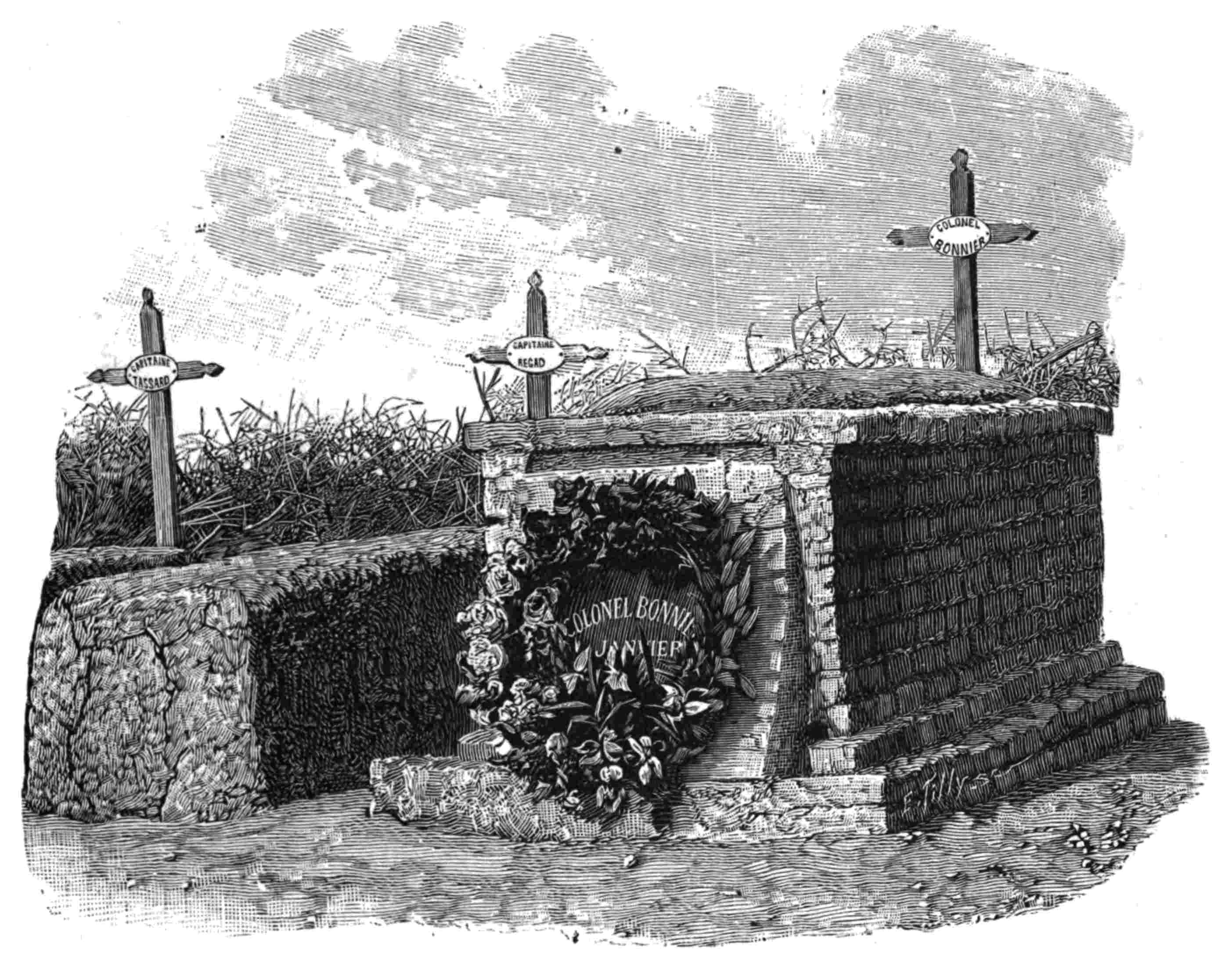
COLONEL BONNIER’S TOMB AT TIMBUCTOO
Since we have avenged our dead, as the customs of the desert require, and since we possess the country and the markets from which the Touaregs draw their supplies, their different tribes have offered their submission. I will not affirm that this submission is complete and definite. It will still be necessary from time to time to show them that their nefarious dominion is at an end, and that they have found their master.
Timbuctoo remained unwaveringly faithful through all these vicissitudes, true to the word given on the first day, ‘We are for you henceforth,’ and it is easy to see that this allegiance will never be withdrawn.
After waiting for it a year, the town received the sultan’s reply. The sovereign of Fez wrote as follows:—
‘Praise be unto the one God.
‘May blessings and salutations be upon our Lord Mahomet, upon his family, and upon his companions.
‘Greeting to the chief of the town and the notables. May God accord you His favours, accompanied by His blessings and His mercy.
‘I have paid great attention to the help and protection you ask of me. I am greatly distressed. I should have responded to your appeal and given you good support, but the great distance between us compels me to be cautious. Your neighbours must come to your assistance.
‘I will march upon the French and drive them away from you, but you must first send me proofs of your dependency on my high government and my kingdom. If you possess writings emanating from your ancestors (those generous ones who are already in the Land of the Blessed), manifest and serious documents, send them to me. With their help I will deliver you from everything by the power and grace of the Most High God, who suffices unto the afflicted and who comforts those who suffer, for He is All-powerful.
‘Salutation. ‘Moulay El Hassan.’
And so faded their last and fondest illusions. As soon as received, his majesty’s letter was put into the hands of the commandant of Timbuctoo, who delicately placed it in the archives.
Two large forts have replaced the improvised fortifications, and their guns command every side of the town. Under their protection the inhabitants are reviving. The long nightmare of the Touaregs is being slowly dispelled, they are beginning to repair and rebuild their houses, to leave the doors ajar, and to resume their beautifully embroidered robes.
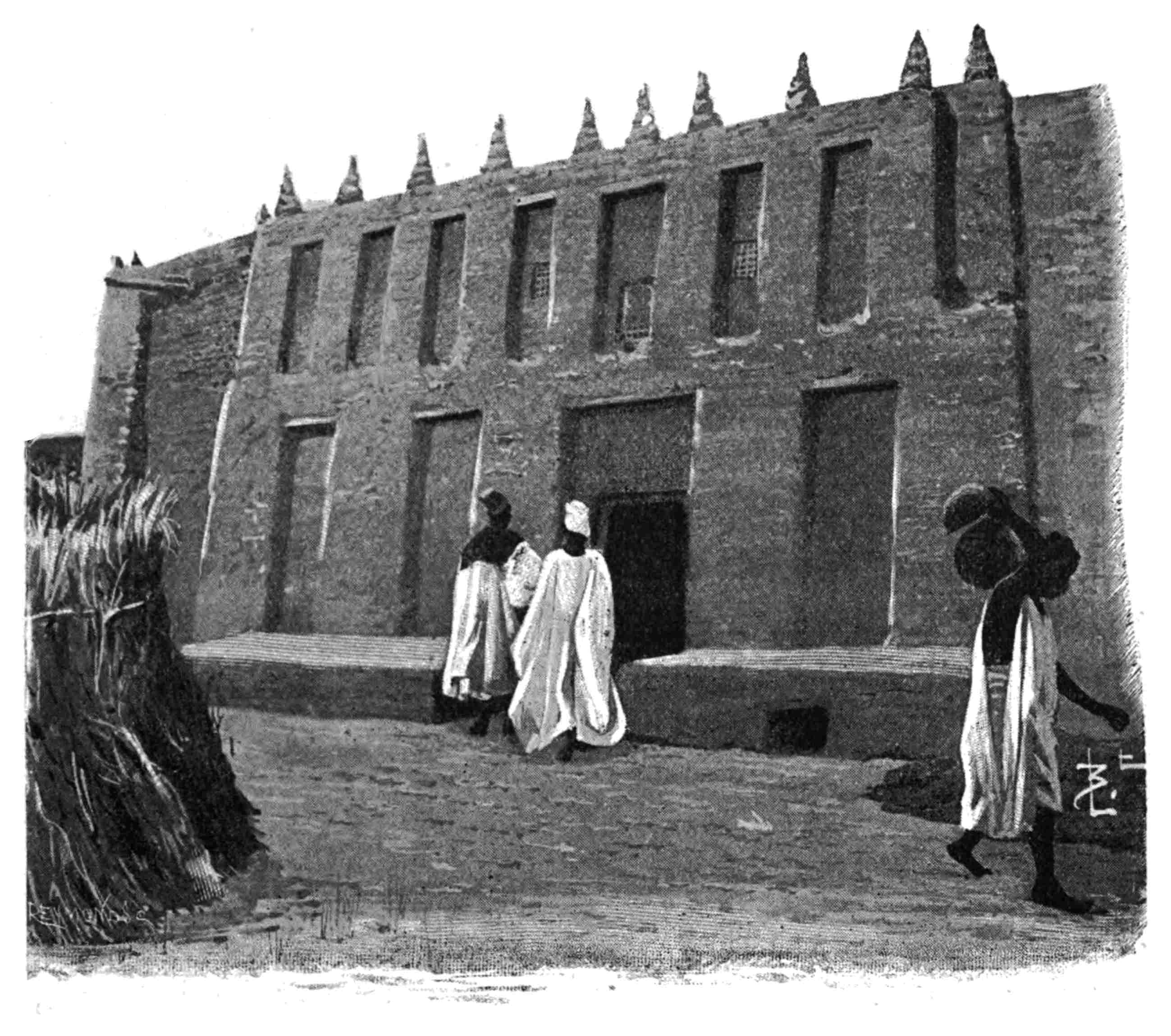
A HOUSE: TYPICAL OF TIMBUCTOO RESTORED
The town begins to show signs of European occupation. A great, herculean negro plays the part of policeman, and promenades the streets with a sabre at his side. An enterprising merchant, Gaston Mery, has recently established a counting-house, and he carries on an excellent business in the large and comfortable house he has built there. Cardinal Lavigerie’s White Fathers have arrived, led by Father Hacquard (a man well known in Algeria), and, thanks to them, the town is already endowed with a church (Our Lady of Timbuctoo) and a school.
Such are the first days of the new era upon which Timbuctoo has entered, and from which she will emerge more famous than ever; for she possesses one thing which can never be destroyed, and which ensures her perpetual greatness—her unique geographical position on the threshold of the Sudan between the eastern and western Niger, two arms which embrace the whole of western Africa.
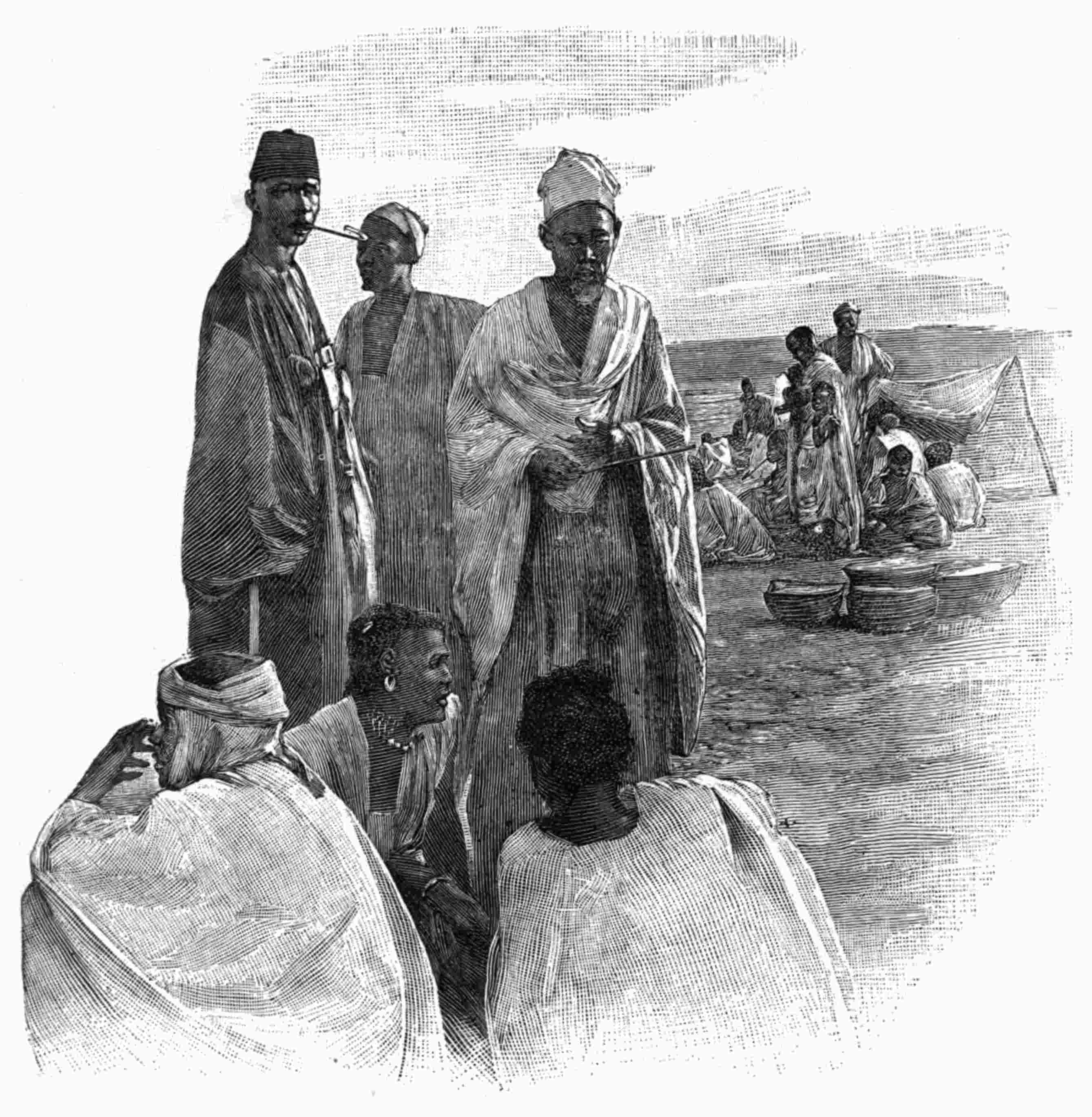
THE POLICEMAN AT TIMBUCTOO
I see Timbuctoo throwing aside her rags in the distant future, and raising the form bent by misfortunes. The sandy pool of Kabara will have been cleared and deepened, and the Niger will have brought its abundant waters to the gates of the town. It will be an easy task then to carry an arm to north and east, and the town will be embraced by a girdle of cultivation. Her gardens, her wealth of verdure, and her palm-trees will be restored to her, and, threaded by shady walks, she will become a pleasant and active cosmopolitan city, a point of union between the black and white worlds.
The Sahara will be conquered; an iron chain will be put about its sands, the links of which will be railways; freights will circulate between Algiers and Timbuctoo with the speed of lightning; and the fleets of the Mediterranean will unite with those of the Niger. Touaregs, Kountas, and all unproductive nomads will be thrown back upon the desert, their first home, where they will form an efficient police force, which will protect the routes of the Sahara.
I picture the city become a centre of European civilisation and science, as it was formerly of Mussulman culture. The reputation of her scholars will again spread from Lake Chad to the mountains of Kong and the shores of the Atlantic, and Timbuctoo will once more be the wealthy and cultured Queen of the Sudan which her distant view now so deceitfully promises her to be.