Front matter (continued 5)
Reading edition
CHAPTER XXXIV
FOLLOWING A MYSTERIOUS TRAIL
Nita had not appeared during the lieutenant's former brief visit to the plantation, and when, on his departure, Anstice sought her to charge her with having already learned that Coacoochee still lived, the happy girl made no denial of her knowledge. At the same time she would not reveal the source of her information, though when Anstice declared her belief that Nita had seen the young chief himself, the latter denied that such was the case. "He is wounded," she added, "and could not come. Besides," she continued proudly, "he is now head chief of the Seminole nation, and has much to think of. But he remembered me, and sent me a message."
"Remembered you, indeed!" cried Anstice. "I should think he ought to; but I am sorry to hear that he is wounded, for he is a splendid fellow. Isn't it wonderful, though, that Lieutenant Douglass went through that same awful battle, and came out without injury. I can't understand it."
"In a battle where Coacoochee commands, no friend of Ralph Boyd can be struck, save by accident," replied Nita, simply.
"Do you believe that? If I thought it were true, I should love your Indian hero almost as much as you do, dear. I wonder, though, if that can be the secret of Irwin's escape?"
So the two girls talked and became drawn more closely to each other with their exchange of innocent confidences.
On the following day, Nita rode Ko-ee as usual, though not in the direction of the magnolia spring; but on the one after, she haunted its banks for hours. She went to it in the morning, reluctantly returning to the house for lunch and to have Ko-ee fed at noon, and made her way back to the place appointed for meeting her brother, as soon afterwards as she could frame a decent excuse for so doing.
She was in the gayest of spirits as she rode away, and she laughingly called back to Anstice, "To-morrow, dear, I am going to spend the whole day with you."
"Isn't it a pleasure to see her so happy?" asked Anstice of her brother, as they watched the girl ride away. "And did you ever see such a change in so short a time? A few days ago she was listless and apparently indifferent whether she lived or not. Now she is full of life, and interested in everything. Then, I did not consider her even good-looking; while at this minute, she seems to me one of the most beautiful girls I ever saw."
"Yes," replied Boyd, "I have noticed the change; but I wish, Anstice, you would persuade her to give up these lonely rambles; though she has promised me not to go beyond the limits of the plantation, I can't help feeling uneasy. If I weren't so awfully busy, I would ride with her myself, since she insists on riding."
"No you wouldn't, brother," laughed Anstice. "I couldn't afford to have the jealousy of the savage lover aroused in that way. Besides, it is absurd to regard Nita as though she were a daughter of civilization, needing to have every step carefully guarded. In spite of her sweetness, and the readiness with which she has fallen into our ways, she is still so much of an Indian as to be more at home in the trackless forest, than in the chaco of the Iste-hatke, as she is pleased to term the house of the white man. So let her alone, brother; for, if she is to be the wife of an Indian, the more she retains of her Indian habits, the better it will be for her."
Thus Nita was allowed to go her own way. And when, at sunset, she had not returned, but little uneasiness was felt in the great house on her account, though Anstice did sit with her gaze fixed on the long avenue up which she expected each moment to see the truant appear.
A few minutes later her uneasiness was exchanged for alarm, as one of the stable boys came running to the house to report that Ko-ee, the pony, had shortly before appeared at the stables, riderless and alone, though still saddled and bridled, and that Miss Nita was nowhere to be seen.
Filled with dismay at this report, Ralph Boyd and his sister hastened to the stables, and there were greeted by the further news that four of the best horses belonging to the plantation were missing. This had only been discovered when one of the stable boys went to the field into which all the horses not in use were turned during the daytime, to drive them up for the night.
By this time a group of excited negroes was collected, and it seemed as though it had only needed the starting of disquieting reports to cause others to come pouring in. It now appeared that saddles and bridles had been stolen, that provisions had disappeared, that a boat was missing from the river bank, that unaccountable noises had been heard, and mysterious forms had been seen at night, in various parts of the plantation.
When Boyd sternly demanded why he had not been informed of these things before, the negroes replied that they had not dared offend their Indian friends, whom they believed to be at the bottom of all the trouble.
"If Indians are prowling about here, the sooner we locate them and discover their intentions, the better," announced the proprietor, "and if Miss Nita has come to any grief from which we can extricate her, the sooner we do that, the better also."
With this, he armed himself and a dozen or so of the more trusted negroes, provided a dozen more with torches, for the night had not grown very dark, let loose all the dogs of the place, wondering at the time why they had not given an alarm long before, and thus accompanied made a thorough examination of all Nita's known haunts within the limits of the plantation. Midnight had passed ere the fruitless search was ended, and the young man returned wearily to the great house.
"It is my honest conviction," he declared to Anstice, as she hovered about him with things to eat and to drink, "that Nita has met some band of Indians and gone off with them. I shouldn't be surprised to learn that Coacoochee had sent for her, or even come for her himself."
"I don't believe any such thing," said Anstice, decidedly. "She would never have gone off without bidding us good-bye. Nor do I believe that Coacoochee would take, or allow to be taken, one pin's worth of property belonging to you. Whatever has happened to Nita, and I am afraid it is something dreadful, she has not left us in this state of suspense of her own free will."
"Well," replied the other, "I am too tired to discuss the question further to-night, and perhaps daylight will aid us in solving it."
Soon after sunrise the next morning, according to his promise of returning on the third day, Lieutenant Douglass, heading an escort of troopers, and accompanied by one of the most experienced scouts in Florida, reached the plantation. While at breakfast he gathered all the known details of what had happened on the previous evening. Then he asked which of Nita's usual haunts she would have been most likely to visit the afternoon before.
"The magnolia spring," replied Anstice, without hesitation. "She was going in that direction when last seen."
"Let us take a look at the magnolia spring, then, and see if Redmond, my scout, can discover any signs of her having been there."
So they four, the Boyds, Douglass, and the scout, visited the bubbling spring beside which Nita was known to have passed so much of her time. Within two minutes the scout pointed out a place in a thicket but a short distance from the spring, where a struggle had taken place, and from which a plainly marked trail led through the undergrowth toward the river.
"There were only two men," he said, "and they warn't Injuns, for no redskin ever left such a trail as that. Besides, Injuns don't wear boots, which them as was here yesterday did. It's my belief that them men has made off with the girl. Leastways, one of 'em carried something heavy; but they've been mighty careful not to let her make any footprints."
The trail was followed to a place on the riverbank where a boat had been concealed, and from signs undistinguishable to untrained eyes, the scout described the craft so minutely, that Ralph Boyd knew it to be the one missing from his own little fleet.
"But what have white men got to do with this business?" the latter asked, in perplexity, and unwilling to drop his Indian theory.
"Dunno, cap'n," replied the scout; "but you can take my word for it, that white men have been, and Injuns hasn't. Yes, they have too!" he cried, as at that instant his eye lighted on another, almost illegible print, near where the boat had grounded. "Here's a moccasin track, and it ain't that of any woman either. What I want now is to have a look on the other side."
In compliance with this desire, a boat was procured, and the whole party crossed the river. Then a short search located the point where the other boat had landed. It also disclosed a most puzzling trail, for here were the prints of four pairs of booted feet instead of two, while no trace of moccasins was to be found. The trail led from the water's edge to a grove in which four horses had been tied to trees, and from there it bore away to the southwest.
"They're headed for the Tampa road," remarked the scout; "and I reckon Tampa's where they're bound for."
"Then we'll have a chance to find out something more about them," said Douglass; "for I must be a long way toward Tampa before another nightfall."
"By Jove, old man! I'm going with you," declared Ralph Boyd; "I want to know something more of this affair myself."
"If you go, Ralph, I shall go too," announced Anstice, firmly. "I'm not going to be left here alone again. Besides, I am as anxious to find out what has become of poor Nita as you are, and I have always wanted to visit Tampa."
As Douglass assured his friends that nothing would afford him greater pleasure than to have them accompany him, and joined with Anstice in her plea, Ralph Boyd reluctantly gave consent for his sister to form one of the party. Thus, before they regained their own side of the river, all details of the proposed trip were arranged.
While Anstice was making her preparations for departure, her brother summoned the entire working force of the plantation, and telling them that he had reason to believe the recent thefts to have been committed by white men, asked if any of them could remember having seen any strange white man about the place within a week.
All denied having done so, save one of the old field hands, who hesitatingly admitted that he had seen the ghost of a white man, on the night of the "Norther."
"Where did you see it?" demanded Boyd.
"At de do' ob de chickun house."
"What were you doing there?"
"Jes' projeckin' roun'."
"How do you know it was a ghost, and not a live man?"
"Kase I seen him by de light ob de moon, an kase I uster know him when he war alive."
"Whose ghost do you think it was?"
"Marse Troup Jeffers, de ole oberseer."
"The very man I ought to have thought of at first!" exclaimed the proprietor, turning to Douglass. "He is not only so familiar with the place that he knows where to lay his hands on such things as he needs, and is friendly with the dogs, but he is so bitter against me for turning him off, that he has already attempted to take my life, as well as that of Anstice. He is now a slave-trader, and, in company with other ruffians like himself, disguised as Indians, he very nearly succeeded in running off all the hands on the plantation. He has already made several attempts to capture Nita, for the purpose of selling her into slavery, and now I fear he has succeeded. I swear, Douglass, if I ever get within striking distance of that scoundrel again, his death or mine will follow inside of two seconds. Now, let us hasten to pick up the trail, and may God help Nita Pacheco, if she has fallen into the clutches of that human devil."
The plantation being left in charge of old Primus, the travellers set forth, and, a number of boats having been provided, they were speedily ferried across the river, towing their swimming horses behind them. On the farther side they resaddled and mounted, Anstice riding Nita's fleet-footed Ko-ee.
By hard riding they struck the Tampa road before noon, and Redmond immediately pointed out the trail of four shod horses, which he affirmed had been ridden at full speed, late the evening before. Soon afterward, the scout discovered the place where the outlaws had camped. He declared that they had reached it long after dark, and had left it before sunrise that morning.
"Mighty little hope of our overtaking them this side of Tampa, then," growled Douglass.
For two days longer did the pursuing party follow that trail. They found two other camping-places; but study the signs as they would, they could discover nothing to indicate the presence of a woman, nor of any save booted white men. "Which is what beats me more than anything ever I run up against," remarked the puzzled scout.
On the third day, by nightfall of which they expected to reach Fort Brooke on Tampa Bay, the plainly marked trail came to a sudden ending, amid a confusion of signs that Redmond quickly interpreted.
"They were jumped here by a war-party of Reds," he said, "were captured without making a show of fight, and have been toted off to the northward. Would you mind, sir, if I followed this new trail a few miles, not to exceed five? I might learn something of importance from it."
"No," replied Douglass. "We can afford to rest the horses here for an hour or two, and I will go with you."
"So will I, if you have no objection," said Boyd.
The three went on foot swiftly and in silence for about three miles, then the guide suddenly stopped and held up his hand for caution. Creeping noiselessly to his side, the others peered in the direction he was pointing, and there beheld a scene of horror that neither of them forgot so long as he lived.
CHAPTER XXXV
FATE OF THE SLAVE-CATCHERS
For some time, Boyd, Douglass, and the scout had been aware of an odor, pungent and sickening; but neither of the two former had been able to determine its character. Now, as they gazed into an opening in the pine forest, beside a small pond, its hideous cause was instantly apparent. Although there was no sign of human life, there was ample evidence that human beings, engaged in the perpetration of an awful tragedy, had occupied the place but a few hours before. Chiefest of this evidence were the charred remains of two human bodies, fastened and supported by chains to the blackened trunks of two young pine trees. At the foot of each tree a heap of ashes, and a few embers that still smouldered, told their story in language so plain that even the civilian and the soldier had no need of the scout's interpretation to enable them to comprehend instantly what had taken place.
For a few minutes they remained in hiding while he cautiously circled about the recent encampment to discover if any of the Indians still lurked in its vicinity. At length he reappeared on the opposite side of the opening, and entering it disturbed a number of buzzards that were only awaiting the cooling of the embers to begin their horrid feast. These rose on heavy wings, and lighting on neighboring branches, watched the intruders with dull eyes.
"The Injuns have gone," said the scout as he met his companions in the middle of the opening, "and taken the four horses with them. It was a small war-party, all on foot and without women or children; but what beats me is that there ain't no tracks of white men along with theirs. Here are two accounted for, but what has become of the other two? They might have rid horseback, it's true; but then, it ain't Injun way to let prisoners ride when they are afoot themselves."
"Is there any way of finding out who these poor devils were?" asked Douglass, indicating the pitiful remnants of humanity before them.
"No, sir, I can't say as there is," replied the scout, doubtfully. "All I know for certain is that they was human, most likely men, and more than likely white men. They must have done something to make the Reds uncommon mad, too; for even Injuns don't burn prisoners without some special reason, and never, in my experience of 'em, have I run across a case where they did it in such a hurry. Generally when they've laid out to have a burning, they save it till they get back to their village, so as to let all hands share in the festivities. No, sir; this case is peculiar, and you can bet there was some mighty good reason for it."
As it would have been useless to follow the Indian trail any further, the scouting party turned back from this point.
"If I could only be sure that one of those wretches was Jeffers," said Boyd to Douglass as they made their way among the solemn pines, "I should feel that he had met with his just deserts. Certainly no man ever earned a punishment of that kind more thoroughly than he. As the matter stands, I fear it will be long before this mystery is cleared, if, indeed, it ever is. Under the circumstances, don't you think it will be just as well not to tell Anstice what we have seen?"
"Certainly," replied Douglass, "and I will instruct Redmond not to mention our discovery to any one. Of course, I shall be obliged to report it to the general, but beyond that it need not be known."
So Anstice was only told that the scouts had followed the Indian trail as far as they deemed advisable, without discovering a living being, and she rode on toward Tampa, happily unconscious of the hideous forest tragedy that had been enacted so near her. Although she was still anxious concerning Nita, she was not without hope that the girl had fallen into friendly hands, who would ultimately restore her to Coacoochee.
At Tampa, which presented at that time a scene of the most interesting activity, the Boyds formed many friends. A large military force was stationed here in Fort Brooke, a post charmingly located on a point of land projecting into the bay, and shaded by rows of live-oaks, vast in size, and draped in the cool green-gray of Spanish moss. Beneath these were the officers' quarters, and long lines of snowy tents. One of the married officers, whose wife had gone North, tendered the Boyds the use of his rudely but comfortably furnished cottage until they should find an opportunity for returning safely to their own home. They gladly accepted this offer, and their cottage quickly became a centre of all the gayety and fun of the fort.
Just back of the post was a large encampment of Indians, who had surrendered or been made prisoners at different points, and were now collected for shipment to New Orleans, on their way to the distant west.
Although Anstice, in her pity for these unfortunates about to be torn from the land of their birth, often visited them, and made friends with the mothers through the children, she did not realize their sorrow so keenly as she would had any of her own friends or acquaintances been among them.
On the day before that fixed for their embarkation, Colonel Worth, of the 8th Infantry, came in from a long and finally successful scout after Halec Tustenugge's band of Indians. Although the leader of this band, together with a few of his warriors, succeeded in eluding capture, a large number, including many women and children, had been brought in. These it was decided to start for New Orleans in the morning with the captives already on hand.
The colonel who had just concluded this arduous campaign was a fine specimen of the American soldier, as honest as he was brave; and a cordial friendship already existed between him and the Boyds. As was natural, therefore, the morning following his arrival at Fort Brooke saw him seated at their cheerful breakfast table, where, of course, the conversation turned upon the existing war.
"There is just one man in Florida to-day, with whom I wish I had a personal acquaintance," remarked the colonel. "He alone could put a stop to this infernal business of hiding and sneaking and destroying cornfields, and running down women and children, if he only would. His name is Coacoochee."
"Yes, I know him well, and believe what you say of him is true," responded Boyd.
"You know him! Then you are just the man to aid me in meeting him. I am to be sent into his country in a few days, and am extremely anxious to have a talk with him. Will you go with me, and exert your influence to induce him to come in?"
"I am afraid my influence would prove of small avail, colonel. You see, Coacoochee has been already caught by chaff and made to suffer dearly for his credulity."
"Yes, I know, and it was one of the most outrageous—But I have no business criticising my superior officers, so I can only say that—"
Just here came an interruption in shape of a lieutenant, who wished the colonel's instructions concerning an awkward situation. "You see, sir," he began, "we had just got the prisoners, whom you brought in yesterday, nicely started for the boats, when one of them, and a mighty good-looking one for a squaw, darted out from among the rest and ran like a deer towards the woods. Two of the guards started after her, and several men ran so as to head her off. At this, and seeing no other chance of escape, she sprang to a small tree and climbed it like a kitten. Once up, she drew a knife from some part of her clothing and declared in excellent English that she would kill any man who dared come after her and then kill herself. I have been talking to her and trying to persuade her of her foolishness. She only answers that she will never be taken from Florida, and will do exactly what she threatens, in case we attempt her capture. She is terribly in earnest about it, and I am afraid means just what she says. Now all the boats have left, save one that is only waiting for her, and I am in a quandary. I dare not order any man to go up after her. I can't have her shot. I can't shake her down, nor can I persuade her to come down, and the transports will have sailed long before she is weary or starved into submission."
"It certainly is a most embarrassing situation," laughed the colonel, rising from the table as he spoke, "and one that would seem to demand my official presence. Will you come with us, Boyd?"
"Can't I go too, colonel?" broke in Anstice. "Perhaps I can persuade the poor thing to come down after all you men have failed."
"Certainly, Miss Anstice; we shall be delighted to have both your company and assistance."
They found the situation to be precisely as described, except that, by this time, quite a crowd of soldiers, all laughing and shouting at the Indian girl, were collected about the tree. These were silenced by the coming of their officers, and drew aside to make way for them.
"This is a decidedly novel experience," began the colonel, as he caught sight of a slender figure perched up in the tree, and staring down with great, frightened eyes.
At that moment, Anstice Boyd, who had just caught a glimpse of the girl's face, sprang forward with a little scream of recognition.
"It is Nita! my own darling Nita!" she cried. "Colonel, order these horrid men to go away at once, and you and the others please go away, too. She is my friend, and will come to me as soon as you are all out of sight. I will be responsible for her, and shall take her directly to the house, where you can see her after awhile, if you choose."
Two minutes later the men had disappeared, and the poor, brave girl, who had determined to die rather than leave the land in which her lover still fought for liberty, was sobbing as though her heart would break in Anstice Boyd's arms. The latter soothed and petted her as though she had been a little lost child, and finally led her away to her own temporary home. Here she clad her in one of the two extra gowns she had managed to bring from the plantation, and so transformed her in appearance, that when, an hour later, the colonel called to inquire after his captive, he was more amazed than ever in his eventful career, to find her a very beautiful, shy, and stylishly dressed young lady, to whom it was necessary that he be formally presented.
He had, in the meantime, learned her history from Boyd; and, when made aware of the tender ties existing between her and the redoubtable young war-chief of the Seminoles, had exclaimed:
"Ralph Boyd, your coming here with your sister was a special leading of Divine Providence, as was the act of that brave girl in refusing to embark for New Orleans this morning. Now, with her aid, we will end this bloody war."
Proceeding to headquarters, he briefly explained the situation to General Armistead, who had just succeeded General Taylor in command of the army in Florida, and obtained his permission for the transports to depart, leaving Nita Pacheco behind.
Upon meeting Nita in Anstice Boyd's tiny sitting-room, the colonel chided her gently for not making herself known to him at the time of her capture with the others of Halec Tustenugge's village.
To this she replied that she and her people had suffered so much at the hands of white men, and been so often deceived, that they no longer dared trust them.
"That is so sadly true, my dear girl, that it seems incredible that a Seminole should ever trust one of us again. Still, I am going to ask you to do that very thing. I am going to ask you to trust me, and believe in the truth of every word I say to you as you would in that of Coacoochee himself. If I deceive you in one word or in any particular, may that God who is ruler of us all repay me a thousand fold for my infamy."
Here followed a long conversation, in which the colonel outlined his plan for obtaining an interview with Coacoochee, through the influence of Nita, who he proposed should accompany his forthcoming expedition to the southern interior. At its conclusion, Nita gave him a searching look that seemed to read his very soul. Then, placing a small hand in his, she said:
"I will go with you, I will do what I can, and I will trust you."
"Spoken like a brave girl, and one well worthy the bravest lover in all Florida!" cried the colonel. "Now can I see the end of this war. Boyd, I of course count on you to go with us?"
"And me?" interposed Anstice. "Don't you count on me too, colonel? Because if you don't, neither of these people shall stir a single step with your old expedition."
"My dear young lady," rejoined the colonel, gallantly, "the entire fate of the proposed expedition rests with you, and I made so certain that you would accompany us, that I have selected as my adjutant Lieutenant Irwin—"
"That will do, sir. Not another word," interrupted the blushing girl. "If you get into the habit of talking such nonsense I, for one, will never believe a word you say. I don't care, though, so long as it is settled that I am to go. Now I want you both to listen while I tell you what Nita has just told me of all that has happened to her since she disappeared so mysteriously from the plantation. Nita dear, I am sure you don't want to hear it, so run up to my room, and have a good rest. I will come just as soon as I have got rid of these men."
CHAPTER XXXVI
PEACE IS AGAIN PROPOSED
After Nita had left the room, Anstice began her story as follows:
"On the afternoon before that cold 'Norther' we had about a month ago, Nita was sitting, as she often did, by the magnolia spring. You must remember the place, colonel. There she received a most unexpected visit from her brother Louis, whom she had not seen for years. He had been sent by Coacoochee to carry the news of the battle of Okeechobee to the northern bands, and also to bring a message to Nita. After they had talked for awhile, he had to go on his way, but promised to be back in two days' time and take any message or token she might wish to send to her lover."
"That's who it was then!" broke in Ralph Boyd. "Well, I am glad to have that part of the mystery cleared up."
"Yes," continued Anstice; "and of course, Nita was awfully excited. When the second day came, she spent nearly the whole of it at the spring. Finally, late in the afternoon, as before, she heard a voice calling to her by name, very softly. Thinking, of course, that it was Louis, who feared, for some reason, to advance into the open, she followed the direction of the voice unhesitatingly. Then the first thing she knew, a cloth was flung over her head, she was seized in a pair of strong arms, and borne struggling away.
"When, to save her from suffocating, the cloth was removed, she found herself in a boat, with two white men and her brother Louis. The poor fellow's head was cut and bleeding, as though from a cruel blow, and he lay bound in the bottom of the boat. One of the white men was rowing, and the other sat watching them, with a pistol in his hand."
"Did she recognize the white men?" inquired Ralph Boyd.
"Yes, she says they were the very two who stole her mother, and afterwards stole the wife of Osceola."
"The scoundrels!" cried Colonel Worth. "In that case they were the prime instigators of this war, and ought to have been hanged long ago."
"Yes," answered Boyd, "and one of them stole my sister, colonel, and turned her adrift in the forest, where but for Coacoochee she must have perished. The same gentleman also shot me in the back at the battle of Withlacoochee, and supposed he had killed me."
"Hanging would be altogether too good for the brute," declared the colonel, excitedly. "He deserves to be burned at the stake."
"That is what the Indians thought," replied Boyd, significantly. "But go on, sister. Did Nita find out the name of the other man?"
"Yes, she learned while with them that it was Ruffin,—Ross Ruffin."
"I have heard of him, too, as being as great a scoundrel as Jeffers himself, only more of a coward," muttered Boyd.
"They made both Nita and Louis put on boots before leaving the boat," continued the narrator, "and that accounts for our finding what we supposed were the footprints of four white men. When they reached the place where the horses were waiting, both the captives had their wrists bound together, and a rope was passed from each to the saddle of one of the white men. So they rode for two days, and Nita says it was simply awful."
"I should imagine it might have been," said the colonel.
"Just at dusk of the second day, a lot of ambushed Indians surprised and captured them all without firing a shot. Nita says, in spite of her fright, she thinks that was one of the happiest moments of her life. The Indians knew Louis, and, of course, released him and her at once, tying up the white men instead. That night they camped some miles from the road, and when Louis told who the prisoners were, and of the many outrages they had committed, especially the stealing of poor Chen-o-wah, the Indians declared they should live no longer, and began at once to make preparations for killing them. Nita says she isn't certain how they were killed, as she made Louis take her a long way off, where she could neither see nor hear what was going on; but she thinks they were burned to death."
"And I know it," said Ralph Boyd, grimly. "Douglass and I saw their charred remains the next day, and not knowing who they were, I expended a certain amount of sympathy on them, that I now feel to have been wholly wasted."
"Oh brother! and you never told me! I'm glad you didn't, though, for it is too horrible to even think of. Well, when Nita got to the Indian village, they treated her just as nicely as they knew how, and promised to join Coacoochee, of course taking her with them, as soon as their crops were planted. Then you came along, colonel, and captured poor Nita with the others, and brought her in here, and the rest you know. Oh, I forgot! Nita is feeling very badly about her brother Louis, who was captured with her and brought here. She says he was taken off in one of the first boats this morning, and she is afraid she will never see him again."
"He must have given an assumed name," remarked the colonel, thoughtfully. "Under the circumstances, though, I am very glad that he did, and that he is well out of the country. I am afraid if it had been known a few hours sooner that Major Dade's guide was in the prisoners' camp, he would never have left it alive. In that case my course with Coacoochee, which now appears so plain, would have been beset with serious, if not insurmountable, difficulties. As it is, I congratulate you, Miss Anstice, on having Nita Pacheco for a friend, and look forward to the happiest result arising from that friendship. Within a week we shall be ready to start for the country of Coacoochee, and I can assure you that I have never anticipated any expedition with greater pleasure than I do this one."
The first of March, that loveliest month of the entire Floridian year, found Colonel Worth's command camped in Fort Gardiner hammock, on the western bank of the Kissimmee River. Here, they were more than one hundred miles beyond the nearest white settlers, and in a country so abounding with game of all kinds, including deer and turkey, besides fish and turtles in wonderful abundance, that the troops were fed on these, until they begged for a return to bacon and hardtack as a pleasing change of diet. The heavily timbered bottom lands were in their fullest glory of spring green, fragrant with a wealth of yellow jasmine, and the glowing swamp azalea, as well as vocal with the notes of innumerable song birds. It was one of the most charming bits of the beautiful land that the Seminole loved so well and fought so fiercely to retain. It was a typical home of the Indian, and one from which the soldiers of the United States had thus far been unable to drive him.
In the camp a large double tent, pitched next that of the commander, was set apart for the use of the Boyds and Nita. Here Anstice held regal court; for she was not only the first white woman to penetrate that wild region, but the first who had ever accompanied a command of the Florida army on one of its "swamp campaigns." In her efforts at entertaining the officers who flocked about her, Anstice was ably seconded by Nita, who, though demure and shy, was not lacking in quick wit and a cheery mirth that had been wonderfully developed during this expedition into the haunts of her lover.
From its outset she had refused to wear the garb of civilization, and appeared always dressed in the simple costume of an Indian maiden such as the young Seminole war-chief might recognize at a glance, and now he might be expected at any moment.
The day on which he had promised to come in had arrived, and already was Ralph Boyd gone forth to meet him. Oh, how slowly the time passed, and yet again, how swiftly! Finally, unable to conceal her agitation, Nita returned to the innermost recess of the tent, while Anstice entertained several officers with gay talk and laughter outside.
Friendly Indians, sent out long before with a white flag, on which were painted two clasped hands, in token of friendship, and with numerous presents, had found Coacoochee, and informed him of Colonel Worth's desire for a talk; upon which the fierce young chief had laughed them to scorn.
"Tell the white chief," he said, "to come alone to the camp of Coacoochee if he wishes to talk."
"Thy friend Ralph Boyd is in the camp of the soldiers, and sends word that the white chief is to be trusted."
"Tell my friend that I am through with trusting white chiefs. I have had a sadder experience with them than he."
"Nita Pacheco is in the camp of the soldiers, and, being restrained from coming to thee, bids thee come to her. She also sends word that the white chief is to be trusted even as she is to be trusted."
For a long time Coacoochee sat silent, while the little smoke clouds from his calumet floated in blue spirals above his head; then he spoke again, saying:
"Tell the white chief that in five days Coacoochee will come to him. Tell Ralph Boyd that on the fifth day from now, two hours before the sleeping of the sun, if he comes alone, I will meet him at the palmetto hammock, one mile this side of the soldiers' camp. If he comes not, then shall I return to my own people, and the white chief shall never meet me save in battle. Tell Nita Pacheco that at her bidding only, of all the world, do I trust myself again within the power of the Iste-hatke. Now go, and bear to her this token from Coacoochee."
With this the young chief detached from his turban a superb cluster of egret plumes fastened with a golden clasp, and handed it to the messenger. This token had been promptly delivered to Nita, together with her lover's message, and now she awaited his coming.
Ralph Boyd, riding out alone to meet his Indian friend, felt almost depressed at the utter loneliness of his surroundings, in which no signs of human presence or animal life were to be discovered. He wondered curiously, as he rode, whether that fair country would ever be filled with the homes and tilled acres of civilization. As he approached the cluster of cabbage palms named as the place of meeting, he scanned it closely, but without detecting aught save an unbroken solitude.
Even as he pondered on how long he should wait for Coacoochee to fulfil his engagement, he was startled by a low laugh, and the young chief, with outstretched hand, stood by his side.
Springing from his saddle, the Englishman grasped the hand of his friend, and after a warm greeting confessed his amazement that any human being could have approached him so closely without warning.
"I remembered the magic by which your warriors were made to appear and disappear on that former occasion long ago," he said, "and have watched so keenly this time that I did not believe even you could come within many yards of me without detection. Even now I know not from where you came."
For answer Coacoochee uttered his own signal, the cry of a hawk. Instantly, to Boyd's infinite amazement, the two were surrounded by a cordon of warriors, all armed with rifles, and the furthest not more than three rods away.
Coacoochee smiled at the blank expression on his friend's face, and said: "From the camp of the soldiers to this place have my braves kept pace with thee; for, while I trust Ralph Boyd, I was not yet prepared to fully trust the war-chief of the Iste-hatke nor place myself entirely in his power. Now am I satisfied, and will go with you."
Thus saying, Coacoochee waved his hand, and the Indians, who had stood motionless about them, disappeared within the shadows of the hammock. At the same moment there came from it seven mounted warriors, one of whom led a superb horse fully equipped for the road. The young chief vaulted lightly into the saddle of this steed, and Boyd mounting at the same time, the two friends, followed by their picturesque escort, dashed away toward the camp by the Kissimmee.
A few minutes later a blare of trumpets and a roll of drums heralded their arrival, and Colonel Worth, escorted by a group of officers in full uniform, stepped forward to greet the distinguished guest, from whose coming so much was hoped. As the two war-chiefs of different races, and yet both natives of one country, held each other's hand, and gazed into each other's face, each was impressed with the belief that he had met an honest man, a worthy foe, and one who might become a stanch friend.
After the formalities of the occasion had been exchanged, and just as Coacoochee's eyes were beginning to rove restlessly down the camp, Anstice Boyd stepped to his side, gave him the greeting of an old friend, and leading him to her own tent, bade him enter alone.
Thus there was no witness to the meeting of the forest lovers; but when, a few minutes later, they came from the tent together, there was a happiness in their faces that had not been there since that long-ago evening of betrothal in the village of Philip Emathla.
CHAPTER XXXVII
COACOOCHEE IS AGAIN MADE PRISONER
Although the Seminoles had generally been victorious in their battles with the whites, they were struggling against a power so infinitely greater than theirs that the four years of war already elapsed had made very serious inroads upon both their strength and their resources. Their entire force was in the field, and they had no reserves from which to draw fresh warriors. They must raise their own food supplies even while they fought. They could not manufacture powder nor arms, and could only gain infrequent supplies of these by successful battles or forays. The fresh, well-armed, and well-fed troops, operating against them, outnumbered them ten to one. Their entire country was dotted with stockaded posts, called by courtesy "forts," garrisoned by troops who were continually driving the Indians from hammock to hammock, destroying their fields, and burning their villages.
One line of these posts extended across the Territory, from Fort Brooke on Tampa Bay to St. Augustine, cutting off the northern bands from those who had sought refuge amid the vast swamps of the south. Another line extended down the west coast, and up the Caloosahatchie to Lake Okeechobee; while a third line commanded the Atlantic coast from St. Augustine to the mouth of the Miami River, where it empties into far-distant Biscayne Bay. Of this last chain the principal posts were Fort Pierce, on the Indian River opposite the inlet, Fort Jupiter at the mouth of the Locohatchie, Fort Lauderdale on New River, and Fort Dallas on Biscayne Bay. The last named was most important of all, because of its size, its strength, nearly all of its buildings being so solidly constructed of stone that some of them are in a good state of preservation to this day, and on account of its situation, which commanded the Everglades and the system of waterways connecting them with the coast.
Under these circumstances, it is no wonder that the Indians were weary of the hopeless struggle against such overwhelming odds, and that Colonel Worth found Coacoochee willing to talk peace.
The two war-chiefs seemed drawn to each other, and to understand each other from the first. During the four days that Coacoochee remained in the camp of the soldiers, they held many informal talks concerning the subject of greatest importance to them both. For a long time, Coacoochee argued stoutly against the removal of his people to a distant country, and pleaded hard for a reservation in their own land.
To this Colonel Worth replied that more than half the tribe were already removed, and could never be brought back. Also that, with the great tide of white immigration setting steadily southward, no reservation in Florida, worth the having, could be secured to the Indians for more than a few years; at the end of which time the existing troubles would rise again with exaggerated violence.
These arguments finally prevailed, and with a heavy heart the young chief admitted the necessity of leaving the land of his birth. He, however, made one stipulation.
"There are among us," he said, "those of a darker skin than ours, but who are yet our brothers. Many of them were born to freedom in the land of the Iste-chatte. They have fought with us for our liberty, and have died by our side. They are with us as one people, and where we go they must also go. If Coacoochee surrenders, and exerts his influence for the removal of his people, it is only on condition that those of the Iste-lustee now dwelling with the Seminoles shall go with them, and that no one of them shall ever be claimed by a white man as his slave. Are the words of Coacoochee good in the ears of the white war-chief?"
"They are good," replied Colonel Worth, "and, were I in full command, your condition should be granted unhesitatingly. But there is another war-chief more powerful than I, who must be consulted. I believe he will gladly accept your terms. He is now at Fort Brooke. Will you go with me and see him? If you will, no matter whether you come to an agreement or not, I pledge my sacred word, as a man and a soldier, that you shall return to your own people, free and without harm."
For some minutes Coacoochee meditated this proposition in silence. Then he said slowly:
"Micco-hatke [white chief], in the hope of ending this war, and saving the lives of my people, I will do what I have said I never would do. I will trust myself again within the walls of a white man's fort. I will go with you to talk with this great white chief. First, I must return to my warriors, and tell them where I am going, that there may be no fighting while I am gone. I give you these ten sticks. With the rising of each sun throw one away. When all are gone, Coacoochee will come again, and go with his white brother to the place of the great white chief."
So the Wildcat left the camp of the soldiers as free as he had entered it, journeyed far among the scattered bands of his people, and in ten days returned, prepared to accompany his white friends to the place from which they had set forth in search of him.
At Tampa, General Armistead expressed himself as greatly impressed with the manliness and evident sincerity of the young chief. He readily consented to the condition imposed, and bade him bring in his people at once, that they might be embarked for emigration.
To this Coacoochee replied that, while he had become convinced of the necessity for removal to the west, it would take time to convince his followers, especially as the soldiers had so driven them that they were scattered in small bands all over the country. They would not be gathered together until at their great annual festival or green corn dance, which would be held in June. Before that time he doubted if he should be able to accomplish very much.
Understanding this state of affairs perfectly, General Armistead still desired Coacoochee to go and collect his people as speedily as possible, designating Fort Pierce on the Indian River as the place at which they should assemble.
So the young war-chief having renewed his confidence in the words of the white man, departed cheerfully, and filled with a new hope for the future. He had received every mark of friendship and distinction from officers and soldiers, and had been given no cause to doubt for a moment the sincerity of these expressions.
As Colonel Worth was about to leave for Palatka, and the Boyds were taking advantage of his escort to return to their own home, Coacoochee decided to accompany them as far as the plantation on the St. John's, where Nita was still to be left until his return from the great enterprise he had now undertaken.
About this return much was said; for it would mean the beginning of the young chief's long journey to the west, and of course on that journey, from which there was to be no return, Nita Pacheco was to accompany him. Anstice had set her heart on having what she termed the "royal wedding" take place at the plantation, and had so nearly gained Coacoochee's consent to being married according to the way of the Iste-hatke, that she already considered her pet scheme as good as adopted.
The only officer accompanying the colonel to Palatka was Lieutenant Douglass; and, on the evening of their arrival at the plantation, as he and Anstice sat together on the verandah, while Coacoochee was strolling with Nita beneath the oaks, and Ralph Boyd was entertaining Colonel Worth inside the house, he startled the English girl by asking:
"Wouldn't it be just as easy, Miss Boyd, to have two weddings as one when Coacoochee returns?"
"Why, yes. I suppose so. If there was any one else who wanted to get married just at that time."
"Well, there is. I do, for one."
"And who is the other, pray?"
"Can't you guess, Anstice? Don't you know? Won't you—?"
Here the young officer caught one of the girl's hands in both of his, and though he was obliged to release it a moment later, as the other men appeared on the verandah, the mere fact that she had not snatched it away filled him with unspeakable joy. It was a sufficient answer to his question, and he knew as well as though told in words, that he had won something better and sweeter far than rank, or honors, or position, or whatever else besides love the world holds most dear.
During the weeks that followed this happy evening at the plantation, while Colonel Worth, with Irwin Douglass as his hard-worked adjutant was always in the field, giving the Indians to understand that the vigilance of the troops was in no way to be relaxed, by the prospects of peace, Coacoochee, in the far south, was using every effort to redeem his pledged word, and persuade his people to come in for removal. He often visited Fort Pierce, the appointed rendezvous, which was commanded by Major Chase, the same who as a captain had destroyed the swamp stronghold of Osceola. This officer had long been conducting similar operations in the south, despatching small bodies of troops in all directions from his post, on the soldierly tasks of destroying fields, capturing women and children, and burning the rude roofs that had sheltered them. Upon receipt of orders to stay his hand, and hold his troops in check, that Coacoochee might be given an opportunity to collect his scattered warriors, Major Chase became impatient at the loss of his favorite occupation. So he sent word to the general commanding, that Coacoochee was so dilatory in fulfilling his promises, that it was believed he meditated treachery.
At this, General Armistead, who was on the point of being relieved of his command, and ordered to Washington, consummated his official career in Florida by an act calculated to bring a blush of shame to the cheek of every American soldier. It was nothing more nor less than an issue of instructions to Major Chase to seize Coacoochee, together with any who might accompany him, the very next time the young chief visited Fort Pierce, and hold them as prisoners of war.
Upon the retirement of this general, the man appointed to succeed him to the command in Florida, was Colonel Worth, then at Palatka, on the St. John's, which was headquarters of his regiment. The distance between that point and the Boyds' plantation was so short, that the colonel, together with his adjutant, was in the habit of frequently visiting it and sharing its bountiful hospitality. Here were often held discussions of the war, and of the efforts then being made by Coacoochee toward securing peace. During these conversations, the colonel was apt to sigh for an extension of his powers, that he might be enabled to put some of his pet theories into practice. In these aspirations the plantation household heartily sympathized.
It was only natural, then, that, on receiving his unexpected appointment as commander-in-chief, the honest soldier should hasten to impart the glad intelligence to his friends and bid them share his satisfaction.
Thus it came about that, a few evenings later, Ralph Boyd gave a dinner in celebration of the event, at which, among other guests present, were "General" Worth, as he must now be called, and Lieutenant Douglass.
The occasion was one of unrestrained happiness, for all believed that the tedious war must now come to a speedy close. Frequent blushes were brought to the cheeks of both Anstice and Nita, by sly allusions to the rapid approach of a certain double wedding that now appeared among the probabilities of the immediate future.
When the festivities were at their height, and all were in the gayest of spirits, there came a clatter of horses' hoofs, and a rattle of arms, from outside. The next moment a travel-stained courier entered, saluted, and handed the general a despatch marked "urgent."
The commander tore it open, glanced with paling cheeks at its contents, and sprang to his feet, exclaiming:
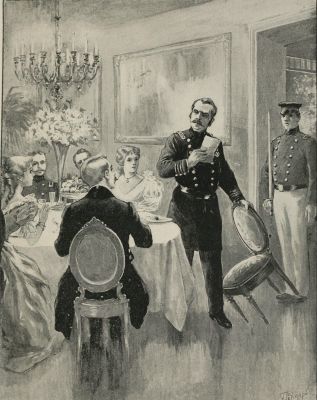
"ALL IS LOST AND THE WAR IS ABOUT TO BREAK FORTH WITH GREATER FURY THAN EVER."
"My God, gentlemen! all is lost, and the war is about to break forth with greater fury than ever! In violation of our plighted word, Coacoochee and fifteen of his followers have been treacherously seized at Fort Pierce, sent in irons to Tampa, and despatched in cruel haste to the west. A transport even now bears them toward New Orleans. In this emergency there is, to my mind, but one thing to be done. Coacoochee must be brought back. Without his aid to end it, this wretched war will continue indefinitely. Lieutenant Douglass, within fifteen minutes I shall want you to start on an overland ride to New Orleans. Intercept Coacoochee and bring him back to Tampa. For so doing you shall have my written authority. Boyd, pen and paper, if you please, and quickly."
Less than a quarter of an hour later, Douglass, splendidly mounted, armed with all requisite authority, and followed by but two troopers, dashed away down the long avenue, fairly started on his momentous mission.
As Anstice bade him farewell, she whispered in his ear: "Remember, Irwin, a double wedding, or none."
CHAPTER XXXVIII
DOUGLASS FULFILS HIS MISSION
In spite of the undisguised treachery by which Coacoochee had been made a prisoner and hurried from the country, the act was hailed with joy by unthinking people all over the Territory. These cared not how their enemy was got rid of, so long as they were at liberty to seize his lands and enslave the negroes among his followers. There were many others who were making too good a thing out of the war to care to have it end. From these classes, therefore, arose a mighty clamor, when it became known that General Worth was determined to bring back the young war-chief; and for a time there was no man in the country so bitterly abused and reviled as he.
To the fearless soldier, strong in the rectitude of his convictions, and planning far ahead of the present, this storm of words, prompted by ignorance, malice, and selfish interests, was but as the idle whispering of a passing breeze. He cared not for it; and if he had, his attention was too immediately and fully occupied by matters of pressing importance to permit him to notice it.
As the general had foreseen, the outrage perpetrated upon their most beloved chieftain caused the Seminole warriors to spring to their arms with redoubled fury. Even as a smouldering brush-heap is fanned into leaping flames by a sudden fitful gust, so the spirit of revenge, burning deep in Indian hearts, was now allowed to blaze forth without restraint. Small war-parties sallied forth from every swamp and hammock, burning and killing in all directions. Nimbly eluding pursuit, these could neither be destroyed nor captured; and through their fierce acts of vengeance, the citizens of Florida were given bitter cause to regret the taking away of Coacoochee. Such chiefs as remained, bound themselves by a solemn covenant to hold no further intercourse with the treacherous white man, but to fight him to the bitter end, and to put to death any messenger, red, black, or white, whom he might send to them under pretence of desiring peace.
It was now summer, the season of heat, rain, fevers, and sickness. Heretofore, during the summer months, the Indians had rested quietly in their villages, and cultivated the crops that should furnish food for the campaign of the succeeding winter. Heretofore, at this season, the soldiers had been withdrawn from the deadly interior, and allowed to recuperate in the health-giving sea-breezes of the coast.
Now all this was changed. While sympathizing with the wronged and outraged Indians, General Worth's loyalty to his government was too strong to permit his feelings to interfere in the slightest with the full performance of his duty. The time for an active summer campaign had arrived, and the new commander was the very man to conduct such a one with the utmost vigor. The Indians who had taken to the war-path quickly found, to their sorrow, that the whites had done the same thing.
From every post in Florida detachments of troops scoured the neighboring territory, carrying desolation and dismay into every part of the country known, or supposed, to be occupied by the enemy. No hammock was so dense, and no swamp so trackless, that the white soldier did not penetrate it. During the month of June thirty-two cornfields of from five to twenty acres each were despoiled of their growing crops, and as many Indian villages were destroyed. Even the watery fastnesses of the widespread Everglades were invaded by a boat expedition from Fort Dallas, which destroyed crops and orchards on many a fertile island that the Indians had fondly believed no white man would ever discover. During this same month of June, more than three thousand men, stricken by fevers and kindred disease encountered in the swamps, were enrolled on the sick list of General Worth's little army.
By the end of the month nearly every Indian in Florida had been driven into the impenetrable recesses of the Big Cypress, a vast swamp bordering on the southwest coast, and most of the troops were recalled to their respective posts.
Now, if Douglass had been successful in his mission, it was time for Coacoochee to be expected at Tampa, and the commander moved his headquarters from Palatka to Fort Brooke, that he might be on hand to receive the exiled chief. With him went the Boyds; for they had become too deeply interested in this game of war to remain at a distance from its most important moves. Of course, Nita accompanied them, alternately hopeful and despairing, longing for news from her lover, and yet fearing to receive it. Their old cottage being again placed at their disposal, the Boyds were at once as comfortably established as though they had never left it.
On the third of July, a strange sail was reported beating slowly up the bay, and that same evening Lieutenant Irwin Douglass, in speckless uniform, walked into the Boyds' cottage, as quietly as though he had left it but an hour before. As he entered, Anstice was the first to discover him, and sprang to his side.
"Irwin Douglass!" she cried. "Have you brought Coacoochee back with you? Tell me quick!"
Close behind her stood Nita, silent and motionless, but with shining eyes that gained the coveted information from the young officer's face long before he could give it in words.
"Didn't you say it must be a double wedding or none?" he asked, laughingly.
"Yes. Tell us quick!"
"Well, I didn't know of any one besides yourself who wished to get married, except Nita."
"You horrid man! Why don't you tell us?"
"And as I didn't suppose she would accept any other Indian—"
"You brought Coacoochee back with you?"
"I didn't say so."
"But you have! You know you have; for you would never have dared come here if you hadn't."
"Well then, I have, and he is aboard the transport out there in the bay, alive, hearty, and filled with happiness at once more breathing his native air."
"Irwin Douglass, you are a dear fellow, and I love you! which is more than I ever admitted before, except to Coacoochee," cried Anstice, throwing her arms about Nita and hugging her in her excitement. "But why didn't you bring him ashore? Didn't you suppose we wanted to see him? And didn't you know that poor Nita was wearing her heart out with suspense?"
"I feared so, but I couldn't help it. You see, when a man in the military business runs up against orders, he finds them mighty stubborn facts, and not lightly to be turned aside. So as I had orders to leave our friend under guard aboard ship, until he had been visited by the commanding general, I thought it better to obey them."
"Never mind, dear," said Anstice, turning consolingly to Nita. "We will have him ashore to-morrow, and his coming will be a fitting celebration of the Fourth of July that the Americans make so much fuss over."
On the morrow, the general, accompanied by his staff, together with Douglass and Boyd, visited Coacoochee on board the transport. As these gained the deck, they beheld the distinguished prisoner thin and haggard, with manacles on both wrists and ankles, but still standing straight and undaunted, with eyes gazing beyond them and fixed on the dear land that he had thought never to see again.
Stepping directly to him, General Worth grasped his hand, saying:
"Coacoochee, I take you by the hand as a warrior and a brave man, who has fought long and with a strong heart for his country. You were not captured and sent away by my orders, but by the orders of the great chief who was then in command. Now I am in command, and by my order have you been brought back to your own land that you may give it the peace you promised me. For nearly five years has there been war between the white man and the red man. Now that war must end, and you are the man who must end it. You will not be allowed to go free until your whole band has come in, ready for removal to the west. You may send a talk to them by three, or even five, of your young men. You shall state the number of days required for your people to come in. If they are all here within the limit of time fixed, you shall be set at liberty, and allowed to go on shore to them. If they are not here by the last day appointed, then shall its setting sun see you, and those with you, hanging from the yards of this vessel with the irons still on your hands and feet. I do not tell you this to frighten you. You are too brave a man for that. I say it because I mean it, and shall do as I say. This war must end, and you must end it."
For some minutes there was a dead silence, as the company reflected on the terrible words they had just heard, and Coacoochee's breast heaved with emotion he struggled to control. At length he said:
"Micco-hatke, you are a great chief, and I believe you are an honest man. Other white men have lied to me and cheated me. They could not overcome Coacoochee in battle, so they captured him by their lying words. With you it is not so. I will trust you. Let my young men go. If in thirty days the warriors of Coacoochee have not obeyed his voice and come to him, then let him die. He will not care longer to live."
After a conversation with his companions, to whom all this had been interpreted, Coacoochee selected five of them, and with the earnest words of one placing his life and honor in their hands, charged them with a message to his people.
Then the irons were stricken from the limbs of those five, and they were allowed to pass over the side of the ship into a waiting boat. Coacoochee shook hands with each one, and to the last he said: "If thou meet with her whom I love, tell her—No, tell her naught. Already does she know the words that the heart of Coacoochee would utter. Give her this, and bid her wear it until I once more stand beside her or have gone from her life forever."
With this he handed the messenger a silken kerchief of creamy white, that, in honor of the occasion, had been knotted about his head.
Among those who thronged the shore to witness the return of the boats, none watched them with such straining eyes and eager impatience as Nita Pacheco. She stood with Anstice, a little apart from the rest, clad in the forest costume that she knew would be most pleasing to her lover.
General Worth had told no one of his plans, and so the girl did not doubt for a moment that Coacoochee would be allowed to come ashore that day. She was the first to make certain that one of the boats contained a number of Indians; and from that moment her eyes did not leave it.
As it drew near to the shore, the happy light gradually faded from her face, and in its place there came a look of puzzled anxiety. "He is not there," she finally said to Anstice, in a tone that betrayed the keenness of her disappointment. "Let us go; there is nothing now to stay for."
"No," objected Anstice, "there must be a message from him. Let us wait and learn what has happened."
Boyd and Douglass came directly to where the girls awaited them; but ere either of them could enter into explanations, Nita darted away toward the warriors, who had just landed. With these she engaged in rapid conversation for the next five minutes, during which she learned of all that had passed aboard the ship, and of her lover's imminent peril.
When the girl rejoined her friends, her jetty hair was bound with the kerchief of creamy silk. She walked with a resolute step, and her eyes flashed with determination. Speaking to Anstice alone, without regard to those who stood near her, she said:
"The Micco-hatke will kill him if every member of his band is not here, ready to emigrate, within thirty days. The Seminole chiefs have sworn to receive no proposals for peace. They will even shoot the messengers of Coacoochee before they can be heard; but they will not kill a woman. It is for me, therefore, to go with those who bear the talk of Coacoochee. If, at the end of the allotted time, every member of the band is not here, then I, too, shall be far away; but, as the sun sinks into the sea on that day, the spirit of Nita Pacheco will be forever joined with that of him to whom she plighted her troth. Come, let us go and make ready."
No persuasions nor suggestions of danger or hardship could alter the girl's determination, or cause her to waver from her fixed purpose. So she was allowed to have her way, and at daylight of the following morning she set forth, in company with the five warriors, on her perilous and fateful mission. They were amply provided with horses, provisions, and everything that could add to the success of their undertaking, and, as they rode away from the fort, every soul in it, from the general down, wished them a heart-felt "God speed."
CHAPTER XXXIX
THE BRAVEST GIRL IN FLORIDA
During the month that followed Nita's departure there was in Fort Brooke but one all-absorbing topic of conversation and speculation. Would the brave girl succeed in saving the life of her lover? or must he die like a dog, without ever again treading the soil of his native land? Except for being kept a prisoner, the young war-chief was treated with distinguished consideration, and every want that he made known was gratified, so far as was consistent with safety. At the same time, he was still manacled, and his irons, together with those of his comrades, were carefully examined by a blacksmith, under supervision of an officer, every morning and evening. The guard on the transport was doubled, and at night a chain of sentinels was posted along such portions of the shore as lay adjacent to the ship. No boats were allowed to approach or leave the floating prison between sunset and sunrise, and no other precaution that human ingenuity could devise for the safe-keeping of the captives was neglected.
Ralph Boyd, often accompanied by some officer from the post, made daily visits to cheer Coacoochee with his belief that all was going well, and to carry him the very latest news. On the occasion of his first visit he took Anstice, who claimed the privilege of telling the young chief what his sweetheart had undertaken in his behalf. As the stern warrior listened to the simple recital, his face became very tender, and a tear, hastily brushed away, glistened for an instant on his cheek. Then he said: "Now do I know that all will go well," and from that moment he was cheerfully confident of the final result.
No word was received from the messengers for a week, at the end of which time one of them returned, bringing with him ten warriors and a number of women and children. The messenger reported that, but for Nita, their mission, so far at least as this particular band was concerned, would have been fruitless. Upon their approach, the warriors had sternly ordered them away, covering them with their rifles, and threatening to shoot if they dared speak of peace. Upon that, Nita, who had until then remained in the background, boldly advanced to the very muzzles of the brown rifles, resolutely pushed them aside, and then pleaded so effectively with the warriors who held them that, ere she finished, their hearts were softened, and they announced themselves as not only ready to surrender, but willing to follow their young chief wherever he might lead them.
Coacoochee had given General Worth a bundle of small sticks which, by their number, represented the entire strength of his band. Upon the arrival at the fort of these forerunners, the general counted them, and returned to Coacoochee an equal number of his sticks. From day to day after this, other small parties of Coacoochee's followers straggled in, and for every new arrival a stick was sent to the young chief, who gloated over his increasing pile as a miser over his hoard, or a politician over the incoming votes that promise to save him from defeat.
In the meantime Nita, with an incredible exhibition of endurance, was scouring the distant country lying about the headwaters of the St. John's and Kissimmee. Here in little groups, the widely scattered members of Coacoochee's once numerous and formidable band had sought refuge amid the vast swamps and overflowed lands, which constitute that portion of Florida. Here, from swamp to swamp, from one tiny wooded island to another, or from hammock to hammock, the dauntless girl followed them. Sometimes she was accompanied by a small escort; but more often she was alone. There were days on which she had food, but many others on which she went hungry. The howl of the wolf became her familiar lullaby, while the scaly alligator and venomous water-moccasin regarded her invasion of their haunts with angry eyes. She travelled on horseback, by canoe, and on foot, scorched by noontide suns, and drenched by heavy night-dews that fell like rain, but always the image of Coacoochee was in her heart, as she bore his talk from band to band of his scattered followers.
As fast as they could be persuaded to go, she sent them to the far-away fort by the salt waters of the west, and bade them hasten or they would be too late. She, too, knew the number of Coacoochee's warriors, and kept a close count of those who had gone, as well as of those who still remained to be persuaded. With jealous care she noted the passage of each day, and murmured that they should fly the more swiftly as the fatal date drew near.
At length the last hiding-place was found, and the last sullen group of eight warriors, with their women and children, was persuaded to go in with her who was beloved of their young chief. By hard riding they could reach the fort on the twenty-ninth day, leaving but one to spare for safety. The brave girl, who had borne up so wonderfully during this month of suspense, was filled with joy at the success of her mission. At the same time, she was so utterly wearied that she often slept, even as she rode, and but for the quick support of willing hands, would have fallen from her saddle. But she would not pause. There would be plenty of time for resting afterwards. Now, they must push on.
On the evening of the last day but one of the month, the fort was only a score of miles away. They would keep on and reach it that night. So said Nita Pacheco. But there were enemies on whom she had not counted. Halec Tustenugge, with the fourteen Miccosouky warriors who had escaped with him from their ravaged village, roamed that part of the country and infested that particular road like ravening beasts. They had sworn never to surrender themselves, nor allow others to do so if they could prevent them. Now they confronted the little party from the eastern swamps, and bade them turn back or suffer the consequences.
There was a moment of hesitation and consultation. Then Nita Pacheco sprang to the front.
"Are the warriors trained by Coacoochee to be told what they shall do, and what they shall not do, by a pack of Miccosouky dogs?" she cried. "No! It cannot be! Let them get out of our way, or we will trample them in the dust! Yo-ho-ee yo-ho-ee-chee!"
As this war-cry of the Wildcat rang out on the evening air, and Nita's horse sprang from under the stinging lash, in the direction of those who blocked the road, the warriors of Coacoochee, echoing madly the cry of their leader, plied whip and spur in an effort to charge by her side. The Miccosoukies, though numbering nearly two to one, were on foot, while Nita's followers were mounted. The former fired one point blank volley, and then fled precipitately from before the on-rushing horses.
The battle had been fought and won, and the enemy dispersed in less than a single minute; but it was the victors who suffered the heaviest loss. One warrior killed outright, two more wounded, one horse so severely wounded that he had to be killed; and, what no one noticed at first, not even Nita herself, a stream of blood spurting from an arm of the girl who had led the charge.
So delayed was the little party by this fierce interruption, that the sun had climbed high above the eastern horizon, on the last day of the thirty allotted to Coacoochee, ere the last of his followers, travel worn, staggering from wounds and weariness, but filled with pride at the feat they had just accomplished, and fully conscious of their own importance, filed slowly into Fort Brooke.
For days their coming had been eagerly awaited. For hours they had been watched for with feverish anxiety. Now the tale of sticks in General Worth's possession was complete, for Nita had insisted upon the living warriors bringing in him who was dead, that he might be counted with them.
The soldiers of the garrison uttered cheer upon cheer at sight of these last comers. The friends who had preceded them thronged about them with eager questions and congratulations; and the news that Coacoochee was saved, repeated from lip to lip, spread like wildfire throughout the post.
Ralph and Anstice Boyd, seated at a late breakfast, heard the glad shouting, and ran to the porch of their cottage to discover its cause. They were just in time to greet Nita as she rode up, and to catch her as she slipped wearily from her saddle.
Her clothing was torn and stained, and her unbound hair streamed wildly about her head. Her eyes were bright and shining, but her cheeks were hollow, and glowed with spots of dull red. Coacoochee's silken kerchief that had confined her hair, was now bound tightly about her arm, and its whiteness was changed to the crimson of blood.
"He still lives? I am in time?" she whispered huskily as Anstice met her with a mingled cry of joy and terror.
"Yes, you dear, splendid, brave girl. He still lives, and you are in plenty of time. But, oh Nita! if you have killed yourself, what will it all amount to? Ralph, you must carry her in. She isn't able to walk."
Very tenderly they bore her into the house, and laid her on the tiny bed in her own room. Then Boyd hastened to find the surgeon, while Anstice bathed the girl's face with cool water, and talked lovingly to her. Ere an hour was past, the deadly fever of the swamps, that she had defied so long and so bravely, held her in its fierce clutches, and the girl, who by her own exertions had brought the war to a close, lay with staring eyes, but unconscious of her surroundings.
To Irwin Douglass was assigned the congenial task of notifying Coacoochee that he was free, and bringing him ashore. He hastened to execute it, and, on reaching the ship, at once ordered the hated irons to be struck from the limbs of the captive leader. As they fell clanging to the deck, the whole appearance of the young chief changed. He again lifted his head proudly, his form expanded, and he paced the deck with the stride of a free man.
His first query was for Nita, and when told of her triumphant return, leading the last remnant of his band, he smiled proudly, and said that she was indeed fitted to be the wife of a warrior. At that time Douglass did not know of the girl's wound, nor of the illness that was even then developing its true character. Consequently, Coacoochee was allowed to go ashore filled with happy anticipations of meeting her whom he loved and to whom he owed so much.
He arrayed himself in a striking costume for the occasion, and one that well became his rank. From his turban drooped three black ostrich plumes. His frock was of scarlet and yellow, exquisitely made. Across his breast glittered many medals. In his silken sash was thrust the silver-hilted hunting-knife, by aid of which he had escaped from the fortress prison of St. Augustine. His leggings were of scarlet cloth, elaborately fringed, and on his feet he wore beaded moccasins.
A great throng of people, including every Indian at the post, was assembled to greet him; and as the boat neared land, these raised a mighty shout of welcome. As he leaped ashore and trod again his native sands, the throng drew back. Then with outstretched arms, and his form extended to its fullest height, Coacoochee gave utterance to the ringing war-cry that had so often carried dismay to his foes, and thrilled his warriors to desperate deeds.
"Yo-ho-ee yo-ho-ee-chee yo-ho-ee!"
It was answered by a sound of hearty cheers from the assembled troops. Then the throng parted to make way for him, and up the living lane the young war-chief walked proudly to headquarters, where he exchanged greetings with General Worth as one with whom he was in every respect an equal. This formality concluded, he turned to the crowd of Indians who had followed him, and addressed them briefly, but in ringing tones:
"Warriors: Coacoochee stands before you a free man. He sent for you, and you have come. By that coming you have saved his life, and for it, he thanks you. The Great Spirit has spoken in our councils, and said: 'Let there be no more war between my children.' The hatchet is buried so that there may be friendship between the Iste-chatte and his white brother. I have given my word for you that you will not try to escape. For that I am free. See to it that the word of Coacoochee is kept strong and true. I have spoken. By our council fire I will say more. Now, away to your camp."
As the throng melted away in obedience to this command, Coacoochee turned to Lieutenant Douglass, and asked to be taken to Nita.
At the cottage in which she lay, he was met by the Boyds, from whom he learned what she had undergone on his behalf; of her wound incurred in fighting his battle, and of her present dangerous illness. He insisted on seeing her; and, on being led to where she lay tossing and moaning in the delirium of fever, the proud warrior knelt by her side, and, hiding his face, wept like a little child.
CHAPTER XL
A DOUBLE WEDDING AND THE SETTING SUN
For days Nita Pacheco hovered between life and death. During this time, almost hourly bulletins of her condition were demanded, not only from the Indian encampment, but from the garrison, every man of which had been won to admiration of the gentle girl by her recent heroism. As for Coacoochee, he was as one who is bereft of reason. He would sit for hours on the porch of the Boyd cottage, heedless of any who might speak to him, motionless and unconscious of his surroundings. Then he would spring on his waiting horse and dash away to scour madly through miles of forest, before his return, which was generally made late at night or with the dawning of a new day. When food was offered him, he took it and ate mechanically; when it was withheld, he seemed unconscious of hunger.
The mental condition of the young chief so alarmed his friends that, one morning when he returned from a night spent in the forest, in a cheerful frame of mind, gentle and perfectly rational, they were greatly relieved, and welcomed him as one who had come back from a long journey.
"Take me to her," he said. "She is watching for me. From this moment she will get well. I have seen Allala, and she has said it."
They had not noted any sign of a change for the better in the sick girl, and so it was with misgivings as to the result that they complied with his request.
Nita lay as they had left her; but, upon the entrance of her lover into the room, her eyes unclosed. She smiled at him, and feebly held his hand for a single moment. From that hour her improvement was steady and rapid, and from that time forth Coacoochee was again the leader of his people, the firm ally of the whites, and unwearying in his efforts to persuade those of the Seminoles who still remained out, to come in and submit to removal.
During the two following months he spent his time as Nita had done, in visiting distant bands of Indians and explaining to them the folly of a further resistance. He possessed two great advantages over all others who had labored in the same direction. He had fought by their side, no one more bravely, and they trusted him. He had also crossed the salt waters and returned again in safety, so that, of his own experience, he could refute the assertion made by their prophet, that every Indian taken to sea by the whites was thrown overboard and drowned.
In this service the young chief often found himself in desperate situations, and he made frequent hair-breadth escapes from death at the hands of those Indians who were either jealous of his power or distrustful for his honesty of purpose. In spite of discouragements and dangers, he persisted, and as the result of his convincing talks beside the red council fires of many a wild swamp retreat, band after band under well-known leaders and renowned fighters came into Fort Brooke, until only a scanty remnant still defied pursuit amid the impenetrable labyrinths of the Big Cypress.
The Indian encampment at Tampa occupied a space two miles square, and the task of guarding this large area was so great that, early in October, General Worth concluded to embark those already collected before they should become dissatisfied or rebellious and without waiting for more to come in. Accordingly the transports were made ready and the day for departure was fixed.
Now ensued most active preparations. For three days and nights the monotonous sound of the great wooden pestles cracking corn for the journey was heard from all parts of the camp. Vast quantities of fat pine knots were collected by the women, for they had heard that the country in which they were to live was destitute of wood. The entire area of the camp was illuminated at night by huge fires, so that there might be no cessation of the work.
The crowning event of all, or, as the general termed it, "the peace contract that ended the Seminole War," was the double wedding that took place in the open air, under the great live-oaks in front of headquarters, on the evening before the day of sailing. The scene was as remarkable as it was picturesque. On one side were gathered the hundreds of forest dwellers who acknowledged one of the bridegrooms as their leader. Among these were proud chiefs, conspicuous in feathers and gaudy finery, stern warriors who had never known defeat in battle, plump matrons wearing many rows of beads and silver ornaments, slender maidens, and chubby children.
On the other side were ranks of troops as motionless as though on parade, and groups of officers in glittering uniforms. A superb military band rendered its choicest selections of music, and the simple ceremony was performed by the post chaplain.
Nita, fully recovered from her illness, and having emerged from it more lovely than ever, like gold that is purified by fire, was clad in the fawnskin dress of a forest maid, though about her neck lay a chain of great pearls, presented by the commander and his officers in token of their devoted admiration of her who had ended the war.
Beside her stood the young war-chief who had fought so bravely, and accepted defeat so manfully, and with whose fate hers had been so closely entwined during all the long years of fighting.
These two were married first, and after them came the beautiful English girl, whose heart had passed into keeping of the dashing American trooper, standing so proudly beside her.
Ralph Boyd, after giving away both brides, declared that he could now appreciate the feelings of a parent bereft of his children.
The moment the double ceremony was concluded, the band played its most brilliant march, the troops raised a mighty cheer, there came a salvo of artillery from a light battery stationed on the parade-ground, and the assembled Indians gazed on the whole affair with curious interest. All that evening there was music and feasting and dancing; but on the morrow came the sorrowful partings, and, for hundreds of those about to become exiles forever, the heart-breaking departure from their native land.
As Coacoochee and Nita stood together on the after-deck of the steamer that was bearing them down the bay, straining their eyes for a last glimpse of the stately pines that they loved so dearly, she murmured in his ear:
"Without your brave presence, my warrior, I could not bear it." And he answered: "Without you, Ista-chee, I would never have come."
Across the blue Mexican Gulf they steamed, and for one hundred miles up the tawny flood of the great river to New Orleans. There the followers of Coacoochee were so impressed by the numbers and evident strength of the white man, that they were filled with pride at having successfully resisted his soldiers so long as they had.
At New Orleans the exiles were transferred to one of the great river packets, that, with its glowing furnaces, and the hoarse coughing of its high-pressure exhaust, seemed to them by far the most wonderful creation of the all-powerful Iste-hatke.
Being embarked in this mighty Pith-lo-loot-ka (boat of fire), no stop was made until they came within a few miles of Baton Rouge, where, by special request of Coacoochee, the packet was swung in toward the eastern bank. Guided by one familiar with that country, the entire body of Indians followed Coacoochee to the land. He bore a great basket, very heavy, and covered with palmetto leaves. None save himself knew what it contained.
A few rods from the shore the guide halted, and pointed to a lowly mound that was evidently a grave. Standing silently beside this, and waiting until all his people were gathered about him, the young chief said, with a voice that trembled, but so clearly that all might hear:
"Under this grass lies a great chief of the Seminole nation; one whom you knew and loved. He was an old man when the soldiers tore him from his home. His heart broke with its weight of sorrow, and he died on his way to that new land to which we are now going. He lies cold in this strange earth; but I have brought that which will warm him. With this soil from the land of his fathers, I now cover the grave of Philip Emathla." Thus saying, Coacoochee emptied the contents of his basket over the mound at his feet.
At mention of Philip Emathla's name, a great cry of grief and loving reverence went up from the dusky throng, and they pressed tumultuously forward. They struggled to see, to feel, and even to taste the earth that now covered his grave. It was only coarse gray sand; but it was sand from Florida, from the dear land they would never more see. Through the magic of its shining particles they could hear again the whispering pines, the rustling palms, and the singing birds of Florida. They could see its shadowy woodlands and white beaches. Its myriad lakes and tortuous waterways lay outspread before them. The fragrance of its jasmine and palmetto was wafted to them. Its glinting clouds of white-winged ibis circled before their eyes. The countless details mirrored indelibly on their hearts rose before them in all their alluring beauty. The warriors stood stern and silent; but the women tore their hair, with piteous cries.
After a while Coacoochee succeeded in restoring quiet, and, with many a backward, lingering glance at the lonely grave of Philip Emathla, the company was re-embarked, and the steamer continued on its way up the mighty river. Turning from it into the Arkansas, they continued up the muddy volume of that great tributary, across the whole State to which it gives a name, and on into that territory that the United States Government had recently set apart for the occupation of its Indian wards. Here, at Fort Gibson, the journey by water ended, though they had still to traverse the country of their old-time neighbors and enemies, the Creeks, ere they could reach the narrow tract reserved for them, in which they were to make their new homes.
At Fort Gibson a joyful surprise awaited Nita and Coacoochee; for Louis Pacheco, long since established in the west, and previously notified of their coming, had travelled that far to meet them. For them he had brought saddle-horses, while for the others a long train of wagons had been provided.
It was late on the day after their arrival before all was in readiness for the last stage of their journey; but they were now so anxious to press forward that Coacoochee gave the order for a start. Then, vaulting into his own saddle, and with Nita and Louis riding beside him, the young war-chief dashed away in the direction of the setting sun. As they gained a crest of the rolling prairie, he waved his rifle toward the infinite glories of the western sky, and, turning his face to those who followed him, thrilled their hearts with the ringing war-cry that had so often led the Seminole to victory:
"Yo-ho-ee yo-ho-ee yo-ho-ee-chee!"