Front matter (continued 2)
Reading edition
It must not be supposed that Ralph Boyd had been standing in the middle of the road all this time. He was in the saddle even before the sound of the Indian war-cries informed him of the direction they had taken and where they were. Directly afterwards he put spurs to his horse, and during the latter part of his soliloquy was galloping rapidly back over the road he had just come.
Although Boyd knew Salano to be a bitter and unscrupulous enemy, he had no hesitation in returning to St. Augustine on his account, or for fear of the others with whose cruel sport he had so summarily interfered. He did not believe they would dare publish what they had done, or care to acknowledge that they had been driven off and compelled to forego their intentions by a single man.
To satisfy himself on this point, he made a few inquiries on reaching the city, and finding that nothing was known of the recent adventure, he went to the colonel commanding the small garrison stationed in the city and informed him of the presence near it of an armed band of seven Indian warriors. He also expressed his fear that they intended mischief to some of the plantations along the St. John's.
The colonel listened attentively to all that he had to say and thanked him for the information. Darkness had fallen by this time, and it was too late to do anything that night, but the officer promised to send out a scouting party of twenty troopers at daylight. In the meantime he begged that Boyd would remain as his guest over night, and in the morning consent to guide the troops to the place where he had seen the Indians, which the latter readily agreed to do. He did this the more willingly because he had learned that the scouting party was to be commanded by Irwin Douglass, a young lieutenant with whom he had formed a pleasant acquaintance, and who had already visited him at the plantation.
When, after an early and hurried cup of coffee with the colonel and Douglass the following morning, Boyd joined the soldiers, to whom for a short distance he was to act as guide, he was amazed to find that Fontaine Salano had applied for and received permission to accompany them. He wondered at this as the troop clattered noisily with jingling sabres and bit-chains out of the quiet old town. Was Salano's hatred of the young Indian whom he had so cruelly wronged so bitter that he was determined to seize every opportunity for killing him? Boyd could think of no other reason why the man, naturally so indolent, should undertake this forced march with all the discomforts that must necessarily attend it.
The spring morning was just cool enough to be exhilarating. The fresh air was laden with the perfume of orange groves, and from their green coverts innumerable birds poured forth their choicest melody. The cavalry horses, in high spirits from long idleness, pranced gaily along the narrow streets and were with difficulty reined to a decorous trot.
Once free from the town and out in the broad plain of sand and chaparral that lay beyond, the pace was quickened, and for several miles the troop swung cheerily along at a hand gallop, with polished weapons and accoutrements flashing brightly in the rays of the newly risen sun.
A halt was called at the place where Boyd had encountered the Indians, and scouts were sent in search of signs. These easily found the camp from which Coacoochee had started on his visit to town the morning before, and finally discovered a fresh trail leading to the west or toward the St. John's.
It was not easy for the troops, inexperienced in Indian warfare, to follow this on horseback, and they soon lost it completely. This did not greatly disturb Lieutenant Douglass; for, being satisfied that the plantations along the river were the objective points of those whom he was pursuing, he determined to push on toward them without losing any time in attempting to rediscover the trail.
That evening they reached the great river and encamped near it without having discovered any further Indian sign, or finding that the few widely scattered settlers had been given any cause to suspect the presence of an enemy.
During that night, however, two startling incidents occurred. The first of these was the complete and mysterious disappearance of one of the sentinels who guarded the camp. He had been stationed not far from the edge of the forest, but within easy hail of his sleeping comrades. The sergeant had given him particular cautions regarding the dangers of his post, and warned him to be keenly alert to every sound, even the slightest. He had answered with a laugh, that his ears were too long to permit anything human to get within a rod of him without giving him warning, and he declared his intention of firing in the direction of any suspicious sound.
So they left him, and an hour later the corporal of the guard, visiting the post, found it vacant. In the darkness it was useless to hunt for the missing sentry, and so, without giving a general alarm, the corporal detailed another sentinel to the place of the missing man, and remained with him on the post until morning. They neither saw nor heard anything to arouse their suspicions, but as soon as daylight revealed surrounding objects, they could readily note signs of a struggle at one end of the beat paced by their unfortunate predecessor.
There were no traces of blood, nor in the trail of moccasined feet leading away from the spot could any imprint of the heavy cavalry boots worn by the missing soldier be found. The trail led to a small creek that emptied into the river just above the camp, but there it ended. Both banks of this creek were carefully examined for a mile up and down, but they revealed no sign to denote that they had ever been trodden by human feet.
There was nothing more to be done. The man was reported as missing, and a riderless horse was led by one of the troopers on that day's march,—but this mysterious disappearance and unknown fate of their comrade served to open the eyes of the soldiers to the dreadful possibilities of Indian warfare.
CHAPTER X
FONTAINE SALANO'S TREACHERY AND ITS REWARD
Another mysterious happening of that first night out was well calculated to exercise a depressing effect on the men and to transform the contempt they had hitherto felt for Indians into a profound respect not unmixed with fear. Fontaine Salano slept rolled in his blanket not far from the lieutenant in command of the party, and within the full light of a camp-fire. Toward morning, however, this fire had burned so low that it shed but little light, and the place where Salano lay was buried in shadow.
When he awoke at the first peep of dawn, he was puzzled by the appearance of a number of strange objects that rose from the ground close by his head. He examined them curiously, but his curiosity was in an instant changed to horror when he discovered them to be seven blood-stained Indian arrows thrust into the ground, three on each side of where his head had lain and one at the upper end of his couch. This one bore impaled on its shaft the bloody heart of a recently killed deer, the significance of which was so plain that no one could fail to understand it.
The mere fact that the Indians had thus been able to penetrate undetected to the very centre of a guarded camp invested them in the eyes of the men with supernatural powers. The effect on Salano was precisely what Coacoochee had intended it should be. To feel that he had been completely within the power of one who had sworn to have his life and had only been spared as a cat spares a mouse, that she may prolong its torture for her own pleasure, filled the wretch with a terror pitiful to behold.
He begged Lieutenant Douglass to return at once to St. Augustine or at least to send him back under escort. The officer politely regretted his inability to comply with either of these requests, saying that it would be contrary to his duty to retire from that part of the country until satisfied that the Indians had left it, and that he dared not weaken his little force by detailing any men for escort duty.
The man displayed such abject cowardice that finally, more out of disgust than pity, Ralph Boyd offered to accompany him back to the city, and to his surprise, Salano accepted the offer eagerly. As they were both volunteers, Douglass had no authority for detaining them, though he protested against the undertaking, and tried to persuade them of its dangers. Ralph Boyd only laughed, and even Salano intimated a belief that the Indians would devote themselves to watching the movements of the scouting party, so that to remain with them would be to remain in the vicinity of greatest danger.
The lieutenant said that he should remove his command only a short distance, to a better and more secure camping-ground that he knew of not very far from Boyd's plantation, over which he promised to keep especial watch. He intended to remain at that place until he learned something definite regarding the movements of the Indians, and there Boyd promised to rejoin him on the following day.
Camp was broken, and the clear bugle notes of "boots and saddles" were ringing on the still morning air as Boyd and Salano rode away from the camp on the return trail to St. Augustine. They rode in silence; for one entertained too great a contempt for the other to care to talk with him, and Salano was perfecting a plan for obtaining one portion of the revenge upon which his mind was intent.
They had not proceeded thus more than two miles, when they came to a narrow gully through which they were obliged to ride in single file, and here Salano, with an exaggerated show of politeness, dropped behind, allowing Boyd to take the lead.
The latter rode unsuspectingly ahead for a few rods, and then, not hearing the sound of the other's horse behind him, turned to see if he were not coming.
The sight that met his eyes was so unexpected and terrible that for an instant it rendered him incapable of thought or action. Salano, dismounted from his horse, was slowly raising a rifle and taking deliberate aim at him. He could see the cruelly triumphant expression on the swarthy face. In that instant of time he also saw a flashing figure with uplifted arm leap from the underbrush behind Salano. Then all became a blank.
When next Ralph Boyd was able to take an interest in the affairs of this world, he was lying in the shade of a tree, two horses were cropping the grass near him, and a strange, wild-looking figure was dashing water in his face.
"What does this mean? What has happened?" Boyd inquired faintly.
"Wal, cap'n," answered the stranger, in unmistakable English, pausing in his occupation and drawing a long breath. "I'm almighty glad you ain't dead. The Injun said you warn't, but I wouldn't be sure of it myself till this very minute. As to what's happened, I'm a leetle mixed myself, but it's something like this: Some red villians was about to do for me when you come along and stopped 'em. Then a white villian was about to do for you, when one of the red villians stopped him, or at any rate he stopped the worst of it; then the red villian did for the white villian, and did it almighty thorough too."
At this juncture Boyd again closed his eyes and seemed about to lapse once more into unconsciousness, whereupon the stranger began again to dash water vigorously in his face.
There was a stinging sensation and a loud buzzing in the young man's head. Salano's murderous aim had been slightly disconcerted, at the moment of firing, by a fierce yell in his very ear. At the instant of pulling the trigger Coacoochee's terrible knife had been buried to the hilt in his body. The would-be murderer sank dead without a groan, while his intended victim escaped with a scalp wound which, though not dangerous, was sufficient to deprive him of his senses for some time.
When he had sufficiently recovered his strength to be able to sit up, and after he had listened to these details of his own narrow escape, he looked curiously at his companion and asked him who he was. It is no wonder that he did not recognize the strange figure; for though the man wore a pair of army trousers, he had Indian moccasins on his feet, was bare-headed, and naked to the waist. Half his face as well as half of his body was painted red and the other half black.
In this manner did the Seminoles prepare their bodies for death, and to those who understood its meaning, this combination of the two colors had a very grim significance. Fortunately for the man's peace of mind, he had not understood why this form of decoration was applied to him, though his fears that his life was in danger had been very fully aroused.
In answer to Ralph Boyd's questions, he told his story as follows: "I'm not surprised that you don't recognize me, cap'n; for I'm not quite sure that I'd recognize myself. Still, whatever I may be to-day, yesterday I was private Hugh Belcher of Company B, Second Regiment United States Dragoons."
"What!" exclaimed Boyd, "are you the sentry who disappeared last night?"
"That's who I am, sir," replied the other, "much as my present appearance would seem to point again its being true. How the Reds crept upon me without me hearing a sound of their coming is more than I can tell, for I've always bragged that my ears were as sharp as the next man's. However, they did it, and the first I knew of their presence was when a blanket was flung over my head and I was tripped up. I don't know how many of 'em had me, but there was enough, anyway, to hold me fast, and tie me and get a gag into my mouth, so that I couldn't make a sound. Then they pulled off my boots, put moccasins on my feet, and made me go along with them.
"After awhile we came to this place, and here, as soon as it got light, they stripped me and painted me and tied me to a tree, and was just getting ready to give me a thrashing with a lot of switches they'd cut, though Lord knows I hadn't done nothing to rile 'em, when all of a sudden you and Mr. Salano hove in sight.
"I was faced that way and see Mr. Salano when he dropped off his horse and drawed a bead on you. I'd a hollered, but the gag was still in my mouth, so I couldn't. When the head Injun see what was taking place though, he gave one spring out of the brush, and landed on Mr. Salano's back like a wildcat. At the same time he let loose a yell fit to raise the dead. The gun went off just as he yelled, and you tumbled out of the saddle like you was killed.
"When the head Injun saw that, he run up to you first and dragged you to this place. Then he run back to Mr. Salano and stooped over him like he was feeling of his heart to see if he was dead. When he riz up again, he fetched another yell and called out something in his own lingo about Ul-we. Then the rest crowded around him, and he talked to them for about a minute.
"After that they come back and cut me loose, and the head Injun, pointing to you, said in English, 'You are free. Care for him. He is not dead. Tell him Coacoochee's heart is no longer heavy. He will go to his own people. If the soldiers want him, let them seek him in the swamps of the Okeefenokee.' Then, without another word, they all disappeared, and I set to work to bring you to."
Thus was the death of Ul-we, the tall one, atoned for in heart's blood, and thus was the stripe on Coacoochee's back washed out with the blood of him who had so wantonly inflicted it. Thus, also, did Coacoochee save the life of his friend and punish the would-be assassin who had so planned his cowardly revenge upon Ralph Boyd that the act would be credited to the Indians.
With the accomplishment of this deed of just retribution, Coacoochee and his warriors disappeared from that part of the country, nor were they again seen there for many months.
CHAPTER XI
THE SEMINOLE MUST GO
The Seminoles must be removed. The clamor of the land-speculator, the slave-hunter, and a host of others interested in driving the Indian from his home had at length been listened to at Washington, and the fiat had gone forth. The Seminoles must be removed to the distant west—peaceably if possible, but forcibly if they will not go otherwise.
A new treaty had been made by which the Indians agreed to remove to the new home selected for them, provided a delegation of chiefs appointed to visit the western land reported favorably concerning it. These went, saw the place, and upon their return reported it to be a cold country where Seminoles would be very unhappy.
Upon hearing this, the Indians said that they would prefer to remain where they were. Thereupon the United States Government said through its commissioners that it made no difference whether they wanted to go or not; they must go.
In the meantime, outrages of every kind were perpetrated upon the Indians. The whipping of those discovered off the reservation, that was begun with Coacoochee, was continued. Several Indians were thus whipped to death by the white brutes into whose cowardly hands they fell. The system of withholding annuities and supplies was continued, and the helpless Indians were recklessly plundered right and left.
General Andrew Jackson, who was now President, had no love for Indians. He had in former years wronged them too cruelly for that, while teaching them lessons of the white man's power. He therefore appointed General Wiley Thompson of Georgia, as the Seminole agent, and ordered him to compel their removal to the far west without further delay. He also sent troops to Florida, and these began to gather at Fort Brooke and Tampa Bay under command of General Clinch.
It was evident that the Seminoles must either submit to leave the sunny land of their birth, their homes, and the graves of their fathers, or they must fight in its defence, and for their rights as free men. If they consented to go west to the land that those chiefs who had seen it described as cold and unproductive, they would find already established there their old and powerful enemies, the Creeks, who were eagerly awaiting their coming, with a view to seizing their negro allies and selling them into slavery. It was evident that a fight for his very existence was to be forced upon the Seminole in either case, and it only remained for him to choose whether he would fight in his own land, of which he knew every swamp, hammock, and glade, and of which his enemy was ignorant, or whether he should go to a distant country, of which he knew nothing, and fight against an enemy already well acquainted with it.
This was the alternative presented to the warriors of Philip Emathla's village assembled about their council fire on a summer's evening a few weeks after that with which this history opens.
On Coacoochee, now sitting in the place of honor at the right hand of the chief his father and earnestly regarding the speaker who laid this state of affairs before them, the weeks just passed had borne with the weight of so many years. During their short space he had passed from youth to manhood. Having directed the search for himself that followed the death of Salano, toward the Okeefenokee, while his village lay in exactly the opposite direction, he had escaped all intercourse with the whites from that time to the present. But from that experience he had returned so much wiser and graver that his advice was now sought by warriors much older than he, while by those of his own age and younger he was regarded as a leader. Thus, though still a youth in years, and though he still reverenced and obeyed his father, he was to all intents the chief of Philip Emathla's powerful band.
It was in this capacity that the speaker, to hear whom this council was gathered, evidently regarded him, and it was to Coacoochee that his remarks were especially directed.
This speaker was a member of a band of Seminoles known as the Baton Rouge or Red Sticks, who occupied a territory at some distance from that of King Philip. His father, whom he had never known, was a white man, but his mother was the daughter of a native chieftain, and though he spoke English fluently, he had passed all of his twenty-eight years among the Seminoles, and they were his people. Although not a chief, nor yet regarded as a prominent leader, he was possessed of such force of character and such a commanding presence that he had acquired a great influence over all the Indians with whom he was thrown in contact. His name was Ah-ha-se-ho-la (black drink), generally pronounced Osceola by the whites, who also called him by his father's name of Powell.
This dauntless warrior was bitterly opposed to the emigration of his tribe, and was anxious to declare war against the whites rather than submit to it. He believed that the Seminoles, roaming over a vast extent of territory abounding in natural hiding-places, might defend themselves against any army of white soldiers that should undertake to subdue them for at least three years. Could the conflict be sustained for that length of time without the whites gaining any decided advantages, he declared they would then give up the struggle and allow the Indians to retain their present lands unmolested.
Osceola was now visiting the different bands of the tribe, preaching this crusade of resistance to tyranny. As he stood before Philip Emathla and his warriors, with his noble figure and fine face fully displayed in the bright firelight, they were thrilled by his eloquence. With bated breath they listened to his summing up of their grievances, and when he declared that he would rather die fighting for this land than live in any other, they greeted his words with a murmur of approving assent.
Never had Coacoochee been so powerfully affected. The sting of the white man's whip across his shoulders was still felt, and he was choked with the sense of outrage and injustice inflicted upon his people. His fingers clutched nervously at the hilt of his knife and he longed for the time to come when he might fight madly for all that a man holds most dear.
As his gaze wandered for a moment from the face of the speaker, it fell on a group just visible within the circle of firelight. There sat the beautiful girl to whom he had so recently plighted his troth, and beside her Chen-o-wah, the daughter of a Creek chief and his quadroon squaw. She was the wife of Osceola, and the one being in all the world whom the fierce forest warrior loved.
For a moment Coacoochee's determination wavered as he reflected what these and others equally helpless would suffer in a time of war. There came a memory of the manner in which Nita's mother and brother had been consigned to slavery by the white man. No word had come from them, but he could imagine their fate. Might not the same fate overtake her most dear to him and hundreds of others with her? Would it not be better for them to incur the dangers and sufferings of war rather than those of slavery? Yes, a thousand times yes.
And then, perhaps the whites were not so very powerful, after all. Their soldiers, so far as he had seen them, were but few in number, and moved slowly from place to place. He and his warriors could travel twenty miles to their five. Besides, there were the vast watery fastnesses of the Everglades and the Big Cypress in the far south, to which the Indians could always retreat and into which no white man would ever dare follow them. Yes, his voice should be raised for war, no matter how long it might last, nor how bloody it might be, and the sooner it could be begun, the better. But he must listen, for Philip Emathla was about to speak.
CHAPTER XII
CHEN-O-WAH IS STOLEN BY THE SLAVE-CATCHERS
The aged chieftain rose slowly and for a moment gazed lovingly and in silence at those gathered about him; then he said: "My children, we have listened to the words of Ah-ha-se-ho-la, and we know them to be true. But he has spoken with the voice of a young man. He sees with young eyes. My eyes are old, but they can look back over many seasons that a young man cannot see. They can also look forward further than his, and see many things. I have seen the great council of the white man, and his warriors. I have seen his villages. His lodges are more numerous than the trees of the forest, and his numbers are those of the leaves of countless trees. To fight with him would be like fighting the waves of the great salt waters that reach to the sky. If we should kill one, ten would spring up to take his place. For a hundred who may fall, a thousand will stand. He is strong, and we are weak. Let us then live at peace with him while we may. Let us meet him in council and tell him how little it is that we ask. There is a land beyond Okeechobee, the great sweet water, that the white man can never want, but where the red man could dwell in peace and plenty. Let him leave this to us, and we will ask no more.
"If he will not do this, then let us fight. Never will Philip Emathla consent to go to the strange and distant land of the setting sun. If it is a better land than this, as the white man tells us, why does he not go there himself and leave us alone? It is a cold country. My people would die there. It is better to die here and die fighting.
"The white chief at Fort King calls us together for one more talk with him. Philip is old. He cannot travel so far, but Coacoochee shall go in his place. He will speak wisely, and if peace can be had, he will find it. If there is no peace, if the Seminole must fight, then who will fight harder or more bravely than Coacoochee? At his name the white man will tremble, and his squaws will hide their faces in fear. The enemies of Coacoochee will fall before him as ripe fruit falls before the breath of Hu-la-lah (the wind). He will kill till he is weary of killing. His footsteps will be marked with blood. Rivers of blood shall flow where he passes. I am old and feeble, but Coacoochee is young and strong. From this day shall he be a war-chief of the Seminoles. Philip Emathla has spoken."
At this announcement there came a great shout of rejoicing, and as the council broke up, the warriors crowded about Coacoochee to tell him how proud they would be to have him lead them in battle.
After the tumult had somewhat subsided, Osceola, who had not hitherto spoken directly to Coacoochee, stepped up to him. The two young men grasped each other's hands, and gazed earnestly in each other's face. Finally Osceola, apparently satisfied with what he saw, broke the silence, and said:
"We are brothers?"
"We are brothers," answered the young war-chief, and thus was made a compact between the two that was only to be broken by death.
The following morning, Coacoochee, with a small escort of warriors, set forth, in company with Osceola and Chen-o-wah, to travel to the village of Micanopy, head chief of the Seminoles, there to hold another council before going to Fort King for a talk with the agent.
In Micanopy's village they found assembled a large number of Seminole warriors, and many of the sub-chiefs of the tribe. This council was a grave and momentous affair. It was to decide the fate of a nation, and its deliberations were prolonged over two days. Micanopy, the head chief, was old, corpulent, and fond of his ease. He loved his land and hated the thought of war. He was greatly disinclined to remove to the west, but it was not until urged and almost compelled by the younger men, especially Coacoochee and Osceola, that he finally declared positively that he would not do so.
His utterance decided the majority of the council. They would fight before submitting to removal, but on one pretext and another they would gain all possible time in which to prepare for war.
It was also announced at this council that any Seminole who should openly advocate removal, and should make preparations for emigrating, should be put to death.
In all the council there was but one dissenting voice. It was that of a sub-chief named Charlo, who had been raised to the head of a small band by the agent, in place of an able warrior who was an uncompromising enemy of the whites. This petty chief spoke in favor of removal, and ridiculed the suggestion that the tribe could hold out for any length of time against the overwhelming power of the white man. He was listened to with impatience, and many dark glances were cast at him as he resumed his seat.
Three days later some fourteen chiefs, accompanied by a large number of their people, were encamped near Fort King, and active preparations were going forward for the great talk that was to be held that afternoon.
On the morning of that day, a thick-set, evil-looking man, whom the reader would at once recognize as his old acquaintance Mr. Troup Jeffers the slave-trader, sat in the agent's office engaged in earnest conversation with General Wiley Thompson.
"Thar ain't no doubt about it, gineral," he was saying. "She's easy enough identified, and I'll take my affidavy right here that she's the gal Jess who run away from old Miss Cooke's place two year ago. You've got a list of all them niggers and their description, as well as the order from Washington for their capture and deliverin' up. You know you have, and when I tell you what this gal looks like, you see if she don't answer the description exactly."
"Yes, sir, I've no doubt," answered the agent, wearily, for of the many trials of his difficult position, the importunities of the slave-hunters who besieged him at all hours were the greatest. "I don't doubt what you say, and I'll give you an order for the girl which you can present to the chiefs. If they give her up, well and good; but if they won't, why they won't, that's all, and matters are too critical just now for us to attempt to force them."
"All right, gineral," replied Mr. Jeffers, with a triumphant glitter in his cruel little eyes. "The order is all I want, and I'll get the gal without putting you or anybody else to a mite of trouble."
Thus saying, the trader took the slip of paper handed him by the agent, and left the office.
Like a vulture scenting the carnage from afar, the slave-trader hearing that the Seminoles and their negro allies were about to be removed, had hastened to the scene of action, determined in some way to secure a share of the peculiar property in which he dealt, before it should be placed beyond his reach.
In the Indian camp he had seen several good-looking young women in whose veins he was convinced flowed negro blood, and he decided that his purpose would be served by securing one or more of these. Going to the agent with the trumped-up story of having thus discovered a runaway slave girl, he obtained the coveted order for her restoration to her lawful owner. Armed with this, he proceeded to carry out his wicked design.
His plan was very simple, and to put it into operation, he repaired to the store of the post trader. It was located in a grove of live oaks, some distance beyond the stockade, and was hidden from view of those in or near the fort. To it, groups of Indians, men, women, and children, found their way at all times for the purchase of such supplies as they needed and could afford.
Rogers, the storekeeper, whose conscience from a long dealing with and cheating of Indians was as calloused and hardened as that of Mr. Jeffers himself, was not above turning what he called an honest penny by any means that came in his way. Therefore when the slave-trader explained his business, showed the agent's order, and offered Rogers ten dollars to assist him in recapturing his alleged property, the latter readily consented to do so.
Troup Jeffers was almost certain that one or more of the young women whom he had noticed in the Indian camp would visit the store at some time during the day, and so he waited patiently the advent of a victim.
At length, late in the afternoon, when most of the Indians were attracted to the scene of the council, then in session, a squaw was seen to approach the store. She was one of those whom Mr. Jeffers had selected as suitable for the slave market, and the instant he observed her he exclaimed to the storekeeper:
"Here comes the very gal I'm after—old Miss Cooke's Jess. I'll just step into the back room, and if you can persuade her to come in there to look at something or other, we'll have her as slick as a whistle."
"All right," responded Rogers, who a minute later was waiting on his customer with infinitely more politeness than he usually vouchsafed to an Indian.
She desired to purchase some coffee and sugar with which to surprise and please her husband when he returned to his lodge after the council should be ended, and the storekeeper easily persuaded her to enter the other room, where he said his best goods were kept.
As the unsuspecting woman bent over a sugar barrel, she was seized from behind, and her head was enveloped in a shawl, by which her cries were completely stifled.
A few minutes later, bound and helpless, she was lifted into a light wagon and driven rapidly away.
Half an hour afterwards, a boy who worked for the storekeeper remarked to his employer:
"I should think you would be afraid of Powell."
"What for?" asked Rogers.
"Why, for letting that man carry off his wife," was the reply.
Thus did the storekeeper receive his first intimation that the alleged runaway slave girl was Chen-o-wah, the adored wife of Osceola.
CHAPTER XIII
"WILEY THOMPSON, WHERE IS MY WIFE?"
While the wife of Osceola was thus being kidnapped and consigned to slavery, he, ignorant of the blow in store for him, was participating in a far different scene. Just outside the gateway of the fort, in an open space of level sward, the great council upon which so much depended was assembled. At one side of a long table sat General Clinch, commanding the army in Florida, with the officers of his staff standing behind him. Beside him sat General Wiley Thompson, the agent, red-faced and pompous, Lieutenant Harris, the United States disbursing agent, who was to conduct the Indians to their western homes, and several commissioners. All the officers were in full uniform, and presented a brave appearance. Behind them were two companies of infantry, resting at ease on their loaded muskets, but ready to spring into action at a moment's notice. Just inside the gateway of the fort the guns of its light battery were charged to the muzzle with grape and canister, ready for instant service. This was one side of the picture.
On the opposite side of the table from the whites sat or stood a group of Indian chiefs, sullen, determined, and watchful. Too many times already had the white man cheated them. They would take care that he should not do so again. They had learned by bitter experience how lightly he regarded such treaties as conflicted with his interests. They knew the value of his false promises and fair words.
A little in front of the others sat Micanopy, head chief of the tribe, and close behind him, so that they could whisper in his ear, stood Coacoochee and Osceola. Grouped about them were Otee the Jumper, Tiger Tail, Allapatta Tustenugge, the Fighting Alligator, Arpeika, or Sam Jones, Black Dirt, Ya ha Hadjo, the Mad Wolf, Coa Hadjo, Halatoochee, Abram, the negro chief, Passac Micco, and many others. Behind them stood one hundred warriors, tall, clean-built fellows, lithe and sinewy, their bare legs as hard and smooth as those of bronze statues. Concealed in a hammock, but a short distance away, was another body of warriors held in reserve by Coacoochee, who had thought it best not to display the full strength of his force at once.
The old men, women, and children had been left in camp not far from the trader's store. Here everything was prepared for instant flight in case the council should terminate in an outbreak.
The proceedings were opened by General Thompson, who stated that he had thus called the Indians together that they might decide upon a day when they would fulfil their promise contained in the treaty of Payne's Landing, and set forth for their new home in the west. He had prepared a paper setting forth the conditions of removal, which he now wished all the chiefs to sign.
Then Otee the Jumper, who was one of the most fluent speakers of the tribe, arose and calmly but firmly stated that his people did not consider themselves as bound by that treaty to remove from their country, and had decided in solemn council not to do so.
At this point the Seminole speaker was rudely interrupted by General Thompson, who, flushed and furious, sprang to his feet and demanded by what right the Indians interpreted the treaty differently from the whites by whom it was drawn up. He accused them of treachery and double-dealing, and ended by declaring that it made no difference whether they were willing to remove or not, for they would be made to go, alive or dead, and he for one did not care which.
This speech drew forth angry replies from the chiefs, and to these the agent retorted with such bitterness that General Clinch was finally obliged to interpose his authority to calm both sides. He told the Indians how useless it would be for them to struggle against the power of the United States, and how greatly he would prefer that they should remove peaceably rather than oblige him to remove them by force.
At this the Indians smiled grimly and exchanged contemptuous glances. They knew that there were only seven hundred soldiers in all Florida, and the idea of compelling them to do anything they did not choose, with a little army like that, was too absurd. It almost made them laugh, but their native dignity prevented such a breach of decorum.
General Clinch talked long and earnestly and was listened to with respect and close attention. The agent regarded his arguments as so unanswerable that at their conclusion he called on the chiefs by name to step forward and sign the paper he had prepared.
"Micanopy, you are head chief. Come up and sign first at the head of the list."
"No, Micanopy will never sign."
"Then Coacoochee may sign first. He comes, I believe, as representative of the wise and brave King Philip."
"No, Coacoochee will not sign either for his father or himself."
"Jumper, then; and when he signs, I will make him head chief."
"No."
"Alligator?"
"No."
"Sam Jones?"
"No."
"Abram?"
"By golly. No."
At these repeated refusals to comply with his request, and the evident contempt with which his offers of promotion were regarded, the fat agent became so angry as to entirely lose his self-control.
"If you will not sign," he shouted, "you are no longer fit to hold your positions. I therefore declare that Micanopy, Coacoochee, Jumper, Alligator, Sam Jones, and Abram, shall cease from this minute to be chiefs of the Seminole nation, and their names shall be struck from the roll of chiefs."
At this an angry murmur ran through the ranks of the Indians, who considered that a grievous insult had thus been offered them. Those chiefs who had been sitting sprang to their feet and fell back a few paces. The warriors behind them moved up closer, and Coacoochee, slipping unnoticed through the throng, hurried back to the hammock to direct the flight of the women and children, and bring up his reserve force of warriors.
In the meantime an Indian who had come from the camp was talking with low, hurried words to Osceola, who listened to him like one in a dream or who does not fully comprehend what he hears.
Suddenly he sprang forward, his face livid with passion, and crying in a loud voice, "I will sign! I, Osceola the Baton Rouge, will sign this paper of the white man."
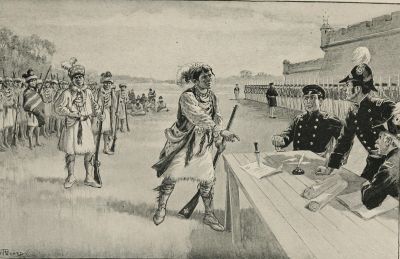
IT SUNK DEEP INTO THE WOOD OF THE TABLE AND STOOD QUIVERING AS THOUGH WITH RAGE.
Then stepping up to the table, while both whites and Indians watched him with breathless interest, the fierce warrior plucked the scalping-knife from his girdle and drove it with furious energy through the outspread paper. It sunk deep into the wood of the table, and stood quivering as though with rage.
"There is my signature, General Wiley Thompson," he cried in a voice that trembled with the intensity of his emotion. "There is the signature of Osceola, and I would that it were inscribed on your cowardly heart. Where is my wife? What have you done with her? Give her back to me, I say, and as safe as when I left her in yonder grove. If you do not, I swear by the white man's God, and by the Great Spirit of my people, that not only your own vile life, but that of every white man who comes within reach of Osceola's vengeance, shall be forfeited. As you have shown no mercy, so shall you receive none. The word shall be unknown to the Seminole tongue. You taunt me with being a half-blood. I am one; but I am yet a man, and not a slave. With my white blood I defy you, and with my Indian blood I despise you. Wiley Thompson, where is my wife?"
CHAPTER XIV
OSCEOLA SIGNS THE TREATY
The group of white men on the opposite side of the table had left their seats before Osceola stepped toward it. General Clinch exchanged a few words with the agent and gave an order to the officer in command of the troops. These were moved forward a few paces, though, blinded by the intensity of his feelings, the half-breed failed to notice their change of position.
Now, in obedience to a signal from the agent, they sprang forward with fixed bayonets, and in an instant Osceola, cut off from his friends, was hedged in by a wall of glittering steel. At the same moment a sharp rattle of drums was heard within the fort, and the light battery, dashing out from the gateway in a cloud of dust, was wheeled into position with its murderous muzzles trained full on the startled Indians.
With one forward movement the pitiless storm of death would have swept through their crowded ranks. They knew this and stepped backward instead.
Within two minutes after the council was so summarily dissolved, not an Indian was to be seen. Within five minutes Osceola, heavily ironed, was thrust into the strongest cell of the guard-house and the door locked behind him. By this time, also, the troops had retired, and General Thompson was inquiring in every direction what the crazy half-breed meant by demanding a wife from him. He knew nothing about the fellow's wife. Did not even know he had a wife, and was inclined to think that Osceola was drunk, or else had trumped up this demand for the purpose of exciting the Indians to resistance.
Finally, however, through Rogers, the trader, he discovered the real facts of the case. Then he realized the awkward position in which his careless giving of an order for the recovery of a runaway slave had placed not only himself, but all the whites in that part of the country.
He visited the prisoner in his cell, and tried to quiet him by explaining that it was all a mistake, and by assuring him that every effort should be made to recover Chen-o-wah and bring her back; but all to no purpose.
Osceola replied that his wife alone had been seized of all those who visited the trader's store. Moreover, she had been seized upon a written order from himself, for the paper had been read aloud in the presence of several persons. No, there was no mistake, and as for the agent's promise to restore Chen-o-wah to him, he would believe it when he saw her, but not before.
For six days the forest warrior who had been struck this deadly blow paced hopelessly up and down his narrow cell, dragging his clanking chains behind him. During this time he hardly touched food nor would he speak to a human being. No one save himself knew the bitterness of his heart, or the terrible thoughts that seethed in his mind during those six days. He appeared like one consumed by an inward fire, and it even seemed as though his haughty spirit was about to escape from the imprisoned body.
At length he sent for General Thompson, and expressed a willingness to sign the paper that should commit him to emigration. "My spirit is broken," he said; "your irons have entered my soul. I can hold out no longer. By these chains I am disgraced in the eyes of my people, and my influence over them is gone. It is better that I should go away and die in a strange land. Bring me your paper; I will sign it."
But that was not sufficient. The paper must be signed in the presence of other Seminoles, that they might be witnesses to the act, and spread the great news abroad throughout the nation. Even to this humiliation Osceola consented, and a messenger was despatched to bring in the first band of Indians he should meet. This messenger was given a token by Osceola, and thus provided, he had no difficulty in persuading Coacoochee and some forty warriors, thirty of whom belonged to the captive's own band, to again visit the fort.
Although they came to the fort, Coacoochee's caution would not allow them to pass within its gates, and so the ceremony of signing was of necessity performed outside.
General Clinch and his staff had returned to Tampa, but there still remained enough of officers at Fort King to escort the agent and lend an imposing effect to the ceremony.
Osceola was led to the place of signing, under guard and with the irons still upon his ankles. He approached the table with downcast eyes, apparently unmindful of the presence of either friends or foes. As he took the pen preparatory to signing, the agent asked:
"Powell, do you acknowledge in the presence of these witnesses, that you are about to sign this paper of your own free will, without fear or compulsion?"
The half-breed regarded his questioner with a curious expression for a moment, and then answered:
"I have no fear. No one could compel me. I sign because it pleases me to do so."
Thus saying, he affixed his signature to the hated paper, with a steady hand. Immediately afterwards his irons were struck off, and he was once more a free man.
The agent now asked Coacoochee if he would not also sign, but that wily young Indian refused to do so at that time. "When I have spoken with Ah-ha-se-ho-la, and learned his reasons for signing, perhaps I may also touch the white man's talking stick," he said.
When Osceola had retired with his friends to their camp, General Thompson turned to one of his companions, and rubbing his hands complacently, remarked:
"That is a capital stroke of business. I have been all along regretting the unfortunate affair of that fellow's wife. Now, though, I begin to think it was one of the best things that could have happened for us. It has brought him to terms as I don't believe anything else would, and though he is not a chief, his influence is the most powerful in the tribe."
"You may be right," replied Lieutenant Smith, the young army officer to whom this remark was addressed, "but it was an outrageous thing, all the same, to steal the poor chap's wife. It makes me feel ashamed to be mixed up in this wretched business, and if I were not dependent on my profession for a living, and so forced to obey the orders of my superiors who have sent me here, I'd have nothing more to do with it. The idea of stealing a man's wife and selling her into slavery! I don't wonder it drove him so nearly crazy that he was willing to sign or do anything else. Under the circumstances I wouldn't give a fig for his signature."
"Nonsense!" replied the agent; "you don't know these people as I do. He is only an Indian in spite of his mixture of white blood, and they don't feel about such things as we do. I'll guarantee that in less than a month he will have forgotten all about this wife and will have taken another or maybe two of them, in her place."
At this same time Coacoochee and Osceola were walking apart from the other Indians and talking earnestly.
"Was there no way for my brother to save his life but by signing the white man's paper?" inquired the former.
At this Osceola broke into a hard and bitter laugh. "Does my brother regard me so meanly as to think that to save my life alone, or to save a thousand lives such as mine, I would have signed?" he asked. "No. It was not to save life that Osceola put pen to paper, but to take it. It was that he might be revenged on those who have wronged him far deeper than by killing him, that he did it. When his vengeance is accomplished, then will he gladly die; but he will never go to the western land."
"Listen," he continued, noting the other's look of bewilderment at these words: "once the Indian fought with bows and arrows, while the white man fought with guns. Did he continue to do this when he found that his weapons were no match for those of the white man? No; he threw away his bows and arrows, and got guns in their place. Once Osceola was honest, his tongue was straight, he would not tell a lie. Are the white men so? No, their tongues are crooked; they say one thing and mean another; they have cheated the Indian and lied to him from the first day that they set foot on his land. They have laughed at his honesty and said, 'The Indian is a fool who knows no better.' Now Ah-ha-se-ho-la is fighting them with their own weapons. For them his tongue is no longer straight. It is as crooked as their own. Does my brother now understand why I signed?"
This style of reasoning was new to Coacoochee, and he pondered over it for a minute before replying. "It is true," he thought, "that the white man gains many advantages over the Indian by cheating and lying to him. If they do those things, why should not the Indian do them as well? In the present instance how could Osceola have gained his liberty by any other means? Yes, it must be right to fight the white man with his own weapons."
So Coacoochee acknowledged that Osceola was justified in the course he had pursued, and congratulated him on his escape from the white man's prison. He was also rejoiced to learn that his friend was to remain and aid them in the coming war rather than to leave them and go to the far-off western land.
Thus answered Coacoochee. At the same time deep down in his heart the young war-chief hoped that he might never find it necessary to fight any enemy with so dangerous a weapon as a crooked tongue.
Now the two young men laid their plans for the future. They agreed that as much time as possible should be gained before open hostilities were declared, in order that the Indians might make all possible preparations for war. With this end in view, Osceola was to remain near the fort, and while still expressing a willingness to emigrate whenever the others of his tribe should come in, was to procure such supplies as he could, especially ammunition, that might be stored for the coming struggle.
Coacoochee was to visit the scattered bands and induce them to provide safe hiding-places for their women and children, that the warriors might be free to fight.
While confined in the fort, Osceola had learned that the chief Charlo, who styled himself "Charlo Emathla," was disposing of his cattle preparatory to emigrating, and now the young men agreed that in his case it was necessary to show both whites and Indians the earnestness of their purpose by carrying out the decisions of the chiefs and putting him to death.
This, Osceola undertook to do, and Coacoochee was glad to be relieved of the unpleasant duty.
Thus matters being arranged, the friends separated; and while Coacoochee with his ten warriors took their departure, Osceola with his thirty followers remained near the fort, to carry out his plan for averting war as long as possible, and to watch for the revenge against those who had robbed him of his wife, that had now become the object of his most intense desire.
Thus matters stood for several months. At the end of that time, the agent becoming suspicious of the Indians on account of their purchasing such quantities of powder, peremptorily forbade the further sale of ammunition to them. Thereupon Osceola sent out runners to carry the news to every Seminole band from the Okeefenokee to the Everglades, and from the Atlantic to the Gulf, that the time for action had arrived, and that the first blow of the war was about to be struck.
CHAPTER XV
LOUIS PACHECO BIDES HIS TIME
Tampa Bay was filled with transports waiting to carry the Seminoles to New Orleans on their way to the Indian Territory. On shore, the soldiers' encampment beneath the grand old live-oaks of Fort Brooke swarmed with troops, newly arrived from the north, and hoping that the Indians would at least make a show of resistance. Of course, no one wanted a prolonged war; but a brisk campaign with plenty of fighting, that would last through the winter, would be a most pleasing diversion from the ordinary monotony of military life. It was not supposed, however, that the Seminoles would fight. Major Francis Dade was so certain of this, that he volunteered to march across the Indian country with only a corporal's guard at his back.
Among those who prayed most earnestly for a taste of fighting, in which they might prove the metal of which they were made, were several lieutenants recently emancipated from West Point and ordered to duty on this far southern frontier.
A few days before Christmas, 1835, a jovial party of three young officers was assembled in the hospitable house of a planter, a few miles from Fort Brooke. They were to dine there, and at the dinner table the sole topic of conversation was the impending war. The Indians had been given until the end of December to make their preparations for emigration, and to assemble at the appointed places of rendezvous. On the first day of January, 1836, their reservation was to be thrown open to the throngs of speculators already on hand, and with difficulty restrained from rushing in and seizing the coveted lands without waiting for the Indians to vacate them.
General Clinch had decided to send Major Dade, not, indeed, with a corporal's guard, but with two companies of troops, to reinforce the garrison at Fort King. From that post, which was well within the reservation, he was to move against the Indians and compel them to move promptly on January 1, if they showed a disinclination to do so of their own accord.
Several of the young officers assembled about the planter's dinner table were to accompany this expedition, and their anticipations of the pleasures of the campaign were only equalled by the regrets of those who were to be left behind.
Some one suggested that there might be some fighting before the troops returned, and that their march might be attended with a certain amount of danger.
"Danger?" cried Lieutenant Mudge, the gayest spirit of the party, and the most popular man at the post. "Let us hope there will be some danger. What would a soldier's life be without it? A weary round of drill. Hurrah, then, for danger! say I. Louis, fill the glasses. Now, gentlemen, I give you the toast of 'A short campaign and a merry one, with plenty of hard fighting, plenty of danger, and speedy promotion to all good fellows.'"
The toast was hailed with acclamation and drunk with a cheer; while after it the calls for Louis grew louder, more frequent, and more peremptory than ever. It was "Here, Louis!" "Here, you nigger!" "Step lively now!" from all sides, and the bewildering orders were so promptly obeyed by the deft-handed, intelligent-appearing young mulatto, who answered to the name of Louis, that he was unanimously declared to be a treasure. Those of the officers who were to remain at Fort Brooke, envied the planter such a capital servant, and those who were to accompany the expedition to Fort King, wished they might take him with them to wait on their mess.
"Well, I don't know but that can be arranged," remarked the planter, thoughtfully. "Major Dade was asking me to-day where he could obtain a reliable guide, and Louis, who overheard him, has since told me that he is intimately acquainted with the country between here and Fort King. Isn't that so, boy?"
"Yes, sir," replied the mulatto; "I was born and brought up in this country, and I know every foot of the way from here to Fort King like I know the do-yard of my ole mammy's cabin."
This answer was delivered so quietly, and with such an apparent air of indifference, that no one looking at the man would have suspected the wild tumult of thought seething within his breast at that moment. For months he had waited, planned, hoped, and endured, for such an opportunity as this. At last it had come. He was almost unnerved by conflicting emotions, and to conceal them, he flew about the table more actively than ever, anticipating every want of his master's guests, and waiting on them with an assiduity that went far to confirm the good impression already formed of him.
Once, Lieutenant Mudge, happening to glance up at an instant when Louis was intently regarding him, was startled by a fleeting expression that swept across the man's face. For a second his eyes glared like those of a famished tiger, and his lips seemed to be slightly drawn back from the clinched white teeth. Although the devilish look vanished as quickly as it came, leaving only the respectful expression of a well-trained servant in its place, it gave the young soldier a shock, and filled him with a vague uneasiness that he found hard to shake off. He spoke of it afterwards to his host, but the latter only laughed and said:
"Nonsense, my dear boy! It must have been the champagne. I have had that nigger for nearly a year now, and a more honest, faithful, intelligent, and thoroughly reliable servant I never owned. If Dade will pay a fair price for him, I will let him go for a few months, and thus you will secure a reliable guide and a capital table servant, both in one."
In answer to some further inquiries concerning Louis, he said: "I'd no idea he was born in this part of the country or knew anything about it, but as he says he does, it must be so, for I have never known him to tell a lie. He knows it would not be safe to lie to me. I got him from a trader in Charleston last spring, and only brought him down here a couple of months ago, when I came to look after this plantation. But you can depend on Louis. He don't dare deceive me, for he knows if he did I'd kill him. I make it a rule to have none but thoroughly honest servants about me, and they all know it."
The reader has doubtless surmised ere this that the servant whom his master praised so highly was no other than Louis Pacheco, friend of Coacoochee, the free dweller beside the Tomoka, whom the slave-catchers had kidnapped and carried off.
Inheriting the refinement of his Spanish father, well educated, and accomplished, Louis would have killed himself rather than submit to the degradation of the lot imposed upon him, but for one thing—the same spirit that actuated Osceola during his imprisonment restrained Louis from any act against his own life. He lived that he might obtain revenge. So bitter was his hatred of the whole white race, that at times he could scarcely restrain its open expression.
He managed, however, to control himself and devoted his entire energies to winning the confidence, not only of the man who had bought him, but of all the other whites with whom he was thrown in contact. Thus did he prepare the more readily to carry out his plans when the time came. He saw his aged mother die from overwork in the cotton-fields, without betraying the added bitterness of his feelings, and was even laughingly chided by his master for not displaying greater filial affection. He planned a negro insurrection, but could not carry it out. Then he conceived the project of inducing a great number of negroes to run away with him, and join his friends the Seminoles, but this scheme also came to naught. He was planning to escape alone and make his way to Florida, where he hoped to find some trace of the dearly loved sister from whom he had been so cruelly separated, when chance favored him, and his master brought him to the very place where he most desired to be.
In Tampa, he quickly learned of the condition of affairs between the Indians and whites, and he looked eagerly about for some means of aiding his friends in their approaching struggle.
The proposed expedition of Major Dade, for the relief and reinforcement of Fort King, was kept a secret so far as possible, for fear lest it should delay the coming in of numbers of Indians, who were supposed to be on their way to the several designated points of assembly. It was, however, freely discussed in the presence of Louis Pacheco, for he was supposed to be so well content with his present position, and to have so little knowledge of Indian affairs, that it could make no difference whether he knew of it or not.
So Louis listened, and treasured all the stray bits of information thus obtained, and put them together until he was possessed of a very clear idea of the existing state of affairs, and of what the whites intended doing.
Through the field hands of the plantation he opened communication with the free negroes who dwelt among the Indians. Thus he soon learned that his friend Coacoochee was now a war-chief and an influential leader among the Seminoles.
Now the hour of his triumph, the time of his revenge, had surely come. If he could only obtain the position of guide to Major Dade's little army, what would be easier than to deliver them into the hands of Coacoochee? What a bitter blow that would be to the whites, and how it would strengthen the Seminole cause! How far it would go toward repaying him for the death of his mother, the loss of his beautiful sister, his own weary slavery, and the destruction of their happy home on the Tomoka! Yes, it must be done.
The day after that of the dinner party his master concluded arrangements with Major Dade, by which Louis was engaged as guide to the expedition and steward of the officers' mess. So the slave was ordered to hold himself in readiness to start on Christmas Day.
CHAPTER XVI
OSCEOLA'S REVENGE
In the meantime, Osceola had carried out his part of the arrangement with Coacoochee in regard to the traitor, Charlo Emathla. Although warned of the fate in store for him in case he persisted in disregarding the wishes of his people and the commands of the other chiefs, this Indian, dazzled by sight of the white man's gold, flattered by his praise, and assured of his protection, persisted in his course.
Osceola waited until certain that he had accepted a considerable sum of money from the agent, and then prepared an ambush beside a trail along which the doomed man must return to his camp. It was completely successful; the victim fell at the first fire, and covering his face with his hands, received the fatal blow without a word. Tied up in his handkerchief was a quantity of gold and silver. This, Osceola declared was the price of red men's blood, and, sternly forbidding his followers to touch it, he flung it broadcast in every direction.
When news of this summary punishment of a renegade was received at Fort King, it created a serious feeling of anxiety and alarm for the future. This was shared by all except the agent, who declared, in his pompous manner, that he knew the Indians too well to fear them. They might murder one of their own kind here and there, but they would never muster up courage to attack a white man. Oh no! the rascals were too well aware of the consequences of such an act.
Another report that reached the fort about the same time increased the uneasiness of its inmates. It was of six Indians who had been brutally and wantonly set upon by a party of white land-grabbers. The Indians were in camp, quietly engaged in cooking their supper, when the whites rode up, made them prisoners, took away their rifles, and examined their packs, appropriating to their own use whatever they fancied, and destroying the rest. Then they tied the Indians to trees and began whipping them.
While they were thus engaged, four other Indians appeared on the scene and opened an ineffective fire upon the aggressors. The whites answered with a volley from their rifles that killed one Indian and wounded another. Both parties then withdrew from the field, the whites carrying with them the rifles and baggage that they had stolen.
This outrage was termed an Indian encroachment, and a company of militia was at once ordered out to chastise the Indians and protect citizens.
By such acts as these the land-grabbers hoped to hasten the movements of the Seminoles and compel them to evacuate the coveted territory the more rapidly.
It was with gloomy forebodings that the little garrison of Fort King, who, from long experience, had gained some knowledge of the Indian character, heard of these and similar brutalities. They knew that such things would drive the savage warriors to acts of retaliation, and precipitate the crisis that now appeared so imminent. Their fears were heightened by the fact that early in December the Indians ceased visiting the fort, and it was reported that all their villages in that part of the country were abandoned.
So the month dragged slowly away. Christmas Day was passed quietly and without the usual festivities of the season. The anxiety of the garrison would have been still further increased had they known that on that very day Osceola and a band of picked warriors took up a position in a dense hammock from which they could watch every movement in and about the fort.
Osceola's object was the killing of the agent, whom he believed to be directly implicated in the abduction of Chen-o-wah. So determined was he to accomplish this, that he had decided if no better opportunity offered to venture an attack against the fort itself, desperate as he knew this measure to be.
Coacoochee at this time was gathering the warriors of the tribe and preparing them for battle in the depths of the great Wahoo Swamp, the hidden mysteries of which no white man had ever explored. It lay a day's journey from Fort King, and to it were hastening many chiefs with their followers.
On the morning of Christmas Day a negro runner, well-nigh exhausted with the speed at which he had travelled, reached the swamp encampment and asked to be led at once to Coacoochee, the war-chief. The moment he had delivered his message the young warrior, trembling with excitement, sought the other chiefs and made known to them the wonderful news he had just received.
"This very day," he said, "the white soldiers have left Tampa to march through the Seminole country. At the end of four days they hope to reach Fort King. They are guided by one whom I thought dead, but who sends word that he is alive. He is my friend and may be trusted. He will bring them by this road. Shall we allow them to pass by us and join their friends? Or shall we meet them in battle and prove to them that our words were not empty boastings, when we said the Seminole would fight for his land? The white man laughs at us and whips us as though we were dogs. He takes from us that which pleases him, and gives us nothing but blows in return. The Indian and the wolf together are marks for his rifle. Let us show him that we are men and warriors. Let us strike a blow that he will never forget. It may be that when he finds the Seminole ready to fight, he will let us alone to dwell peaceably in our own land. Are the words of Coacoochee good in the ears of the tribe? Are his warriors glad when they hear them?"
A long discussion followed; but when it was ended, the counsel of the young war-chief had been accepted.
Then through the dim forest aisles echoed the hollow booming of the kasi-lalki, or great war-drum. Fleet runners were despatched in all directions, some to hasten the incoming bands, and some to watch the movements of the advancing troops. One was sent to bear the great news to Osceola, and bid him hasten if he would take part in the first battle of the war.
When this messenger reached those secreted in the hammock near Fort King, and delivered his tidings, Osceola bade him return and tell Coacoochee that if at the end of one more day his purpose had not been accomplished, he would abandon it for the present and hasten to join him.
On the following afternoon two figures were seen by the eager watchers to leave the fort and stroll toward the trader's store a mile away. Osceola's keen eye was the first to recognize them, and he knew that the hour of his vengeance had arrived.
The two who strolled thus carelessly, apparently unconscious of danger, were the agent, General Wiley Thompson, and his friend, Lieutenant Constantine Smith. They were smoking their after-dinner cigars and talking earnestly. Their subject was the rights and wrongs of the Indian. As they reached the crest of a slight eminence, these words, uttered in Wiley Thompson's most emphatic tone, reached the ears of Osceola, who, with flashing eyes and compressed lips, peered at the speaker from a thicket not ten yards away.
"I tell you, sir, the Indian is no better than any other savage beast, and deserves no better treatment at our hands."
They were the last words he ever spoke; for at that instant there burst from the thicket a blinding flash and the crashing report of thirty rifles, discharged simultaneously. Both men were instantly killed, and with yells of triumph the Indians rushed from their hiding-place, each intent upon procuring a scalp or some other trophy of the first event of the contest so long anticipated and now so sadly begun.
But Osceola's vengeance did not rest here. There were others within reach who had aided in the stealing of his wife, and he bade his warriors follow him to the store of the trader. A few minutes later Rogers and his two clerks had been added to the list of victims. After helping themselves to all the goods they could carry, the Indians set fire to the store and started toward the Wahoo Swamp, where they hoped to join Coacoochee in time to participate in the battle of which he had sent them notice.
The little garrison of fifty men at Fort King heard the firing and the war-cries, and saw the smoke from the blazing store rise above the hammock. They knew only too well what these things meant; but supposing the Indians to be in force and about to attack the post, they dared not venture beyond its limits. They waited anxiously for the coming of the promised reinforcements from Tampa, but weary days passed, and no word came from them.
CHAPTER XVII
ON THE VERGE OF THE WAHOO SWAMP
On the afternoon of Christmas Day, Major Dade's little command of two companies of troops, numbering one hundred and ten souls, marched gaily out from Fort Brooke on Tampa Bay and started for Fort King, one hundred miles away, near where the city of Ocala now stands. Both officers and men were in the highest spirits, and regarded their present expedition as a pleasant relief from the monotony of garrison life. It was not at all likely they would be called upon to do any fighting; for, although the Indians had been acting suspiciously for some time, nobody believed they would dare come into open conflict with the whites. And what if they did! Was not one white man equal to five Indians at any time? To be sure, the soldiers were unfamiliar with the country, but then they had a guide who knew every foot of it.
Louis Pacheco was one of the most popular members of the expedition. He was not only a good guide, but he was polite, obliging, and attentive to the wants of the officers. He certainly was a treasure, and they were fortunate to have secured his services. So the lieutenants said to one another.
For two days the command moved steadily forward, its one piece of light artillery and its one baggage wagon bumping heavily over the log-like roots of the saw-palmetto, and threatening to break down with each mile, but never doing so. They experienced no difficulty in crossing the dark, forest-shaded Withlacoochee; for Louis led them to the best ford on the whole river, and the officers agreed that they were making much better progress than could have been expected.
On the third night they had skirted the great Wahoo Swamp and were camped near its northern end. As this place was known to be a favorite Indian resort, the sentinels of that night were cautioned to be unusually vigilant. The corporal of the guard was instructed to inspect every post at least once an hour, and oftener than that towards morning, when an attack was supposed to be most imminent. As the officer of the day was equally on the alert, and visited the sentries many times during the night, the camp was deemed securely guarded.
All that day Louis, the guide, had been unusually silent. More than once he was observed to direct long, penetrating glances toward the dense forest growth of the great swamp, as though it held some peculiar fascination for him. It seemed as though he were conscious of the keen eyes, that, peering from its dark depths, watched so exultingly the march of the troops. It seemed as though he must see the lithe figures that, gliding silently from thicket to thicket, or from one mossy covert to another, so easily kept pace with the slow-moving column.
In waiting on the officers' mess that evening, Louis was so absent-minded that he made innumerable blunders, and drew forth more than one angry rebuke from those whom he served.
At last one of these remarked that, if the nigger was not more attentive to his duties, he would be apt to make an acquaintance with the whipping-post before long.
Then there flashed into the man's face for an instant the same look that Lieutenant Mudge had detected once before, and from that moment his demeanor changed. He was no longer absent-minded. He was no longer undecided. The time of his irresolution was passed.
That night he slept apart from any other occupant of the camp, beyond the line of tents and on the side nearest the swamp hammock. For hours after rolling himself in his blanket the man lay open-eyed and thinking. This was either the last night of his life or the last of his slavery, he knew not which. On the morrow he would be either dead or free. On the morrow, if he lived, he would learn the fate of the dear sister from whom he had heard no word since that terrible night on the Tomoka. On the morrow would be struck a blow for liberty that should be felt throughout the length and breadth of the land, and on the morrow his score against the white man would be wiped out. The account would be settled.
Louis had expected the attack to be made that day, and from each hammock or clump of timber they passed, had dreaded, and hoped to hear, the shrill war-whoop mingled with the crack of rifles. Now, he thought it might be made during the night or just at dawn. At all events, it must be made, if made at all, before the following sunset, for at that hour the command expected to reach Fort King.
As he lay thinking of these things, the querulous cry of a hawk suddenly broke the stillness of the night. It came from the swamp. Again it sounded, and this time with a slight difference of tone. The weary sentinels wondered for a moment at the strangeness of such a cry at that hour, and then dismissed it from their minds.
Not so with Louis Pacheco. The second cry had confirmed the suspicion aroused by the first. It was long since he had heard the signal of Coacoochee; but he recognized and answered it. The gentle, quavering cry of a little screech owl, though coming from the camp, alarmed no one. It went straight to the ears of Coacoochee, however, as he lay hidden in the saw-palmettoes, only a few rods beyond the tents, and he was content to wait patiently, knowing that his friend had heard and understood his signal.
All the old forest instincts, long suppressed and almost forgotten, were instantly aroused in Louis. No Indian could have crept more cautiously or silently toward the line of sentries than he, and none could have slipped past them more deftly. A few minutes later the owl's note was sounded at the edge of the hammock and immediately answered from a spot but a short distance away. Then there came a rustle beside the motionless figure and a whispered:
"Louis, my brother?"
"Coacoochee, is it you?"
For a few minutes they whispered only of their own affairs, and Louis learned of Nita's escape from the slave-catchers, of her flight to Philip Emathla's village, and of her betrothal to Coacoochee, all in a breath. He longed to fly to her at that very moment; but a weary journey lay between them, and before he could undertake it a stern and terrible duty remained to be performed. He must return to the camp of soldiers and remain with them to the bitter end. Otherwise the plan for their destruction might yet miscarry.
Coacoochee told him the reason why the attack had not already been made was that the Indians had awaited the arrival of Osceola and Micanopy. The latter had come in that evening, and it was decided to wait no longer, but to begin the fight at daylight.
Louis opposed this plan, saying that Major Dade expected an attack to be made at daylight, if made at all, and would be particularly on guard at that time. He also seemed to feel that if he were attacked, it would be from that swamp. Therefore, the mulatto advised that the attack be made at a point some miles beyond the swamp, where nothing of the kind would be anticipated.
Coacoochee acknowledged the soundness of this advice, and agreeing to follow it, the two separated, one to lead his warriors to the appointed place and prepare them for battle, the other to work his way with infinite caution back into the camp of sleeping soldiers. Fortunately for him the night was intensely dark, and though at one time a sentry passed so close that he could have touched him, by lying flat and almost holding his breath he escaped discovery.
He had barely reached his sleeping-place and rolled himself again in his blanket, when an officer came along, and stumbling over his prostrate form, exclaimed:
"Hello, Louis! Is that you?"
Upon receiving an affirmative answer, he continued: "Well, I must confess that it is a great relief to find you. I missed you, and have been searching for you. I really began to think you had deserted and left us to find our own way out of this wilderness. Where have you been?"
"The major's horse got loose, sir, and came very near stepping on me," replied Louis. "And I just took him over to the cart, where I tied him up again. Sorry to have caused you any anxiety, sir."
"Oh, that's all right," answered the officer. "I'm glad your excuse is such a good one, for these are times when we can't be too careful, you know."
With this he walked away to visit the line of sentries, while Louis, bathed in a profuse perspiration in spite of the chill of the night, shuddered as he realized the narrowness of his escape.
CHAPTER XVIII
COACOOCHEE'S FIRST BATTLE
The next morning's sun ushered in one of the fairest of Floridian days; the air was clear, cool, and bracing. It was filled with the aromatic odors of pines and vibrant with the songs of birds. All was life and activity in the camp of soldiers, who were preparing for an early start on the long day's march that they hoped would bring them to their destination that same evening.
"We are past all the bad places now, boys," cried Major Dade, cheerily, as he rode to the head of the column. "This swamp is our last danger point, and beyond this there is nothing to apprehend. The cowardly redskins have let a good chance slip by, and it will be long before they will be given another."
Then the bugles sounded merrily, and with light hearts the command resumed its march. But the Indians had moved earlier than they.
At daylight that morning one hundred and eighty warriors glided like shadows out from the dark recesses of the swamp, and, following the lead of Coacoochee, advanced some four miles beyond it. Where they finally halted in the open pine woods there was a thick growth of scrub or saw-palmetto.
A pond bounded the road on the east at this point, and the entire body of Indians took positions on the opposite or western side. Each warrior selected his own tree or clump of palmetto, and sank out of sight behind it. Three minutes after their arrival nothing was to be seen nor heard save the solemn pines and the sighing of the wind through their branches.
There was so little to arouse suspicion that a small herd of deer fleeing before the advancing troops and coming down the wind dashed in among the Indians before discovering their presence. Even then the hidden warriors made no sign, and the terrified animals pursued their flight unmolested.
Besides Coacoochee, the chiefs in command of the Seminole force were Micanopy, Jumper, and Alligator. It had been determined that Micanopy, as head chief, should fire the first shot of the contest, and as the old man was timid and undecided, Coacoochee stood beside him to strengthen his courage.
At length about nine o'clock the troops appeared in view. They marched easily in open order, the bright sunlight glinted bravely on their polished weapons, and many were the shouts of light-hearted merriment that rose from their ranks. Louis, the guide, was not to be seen, as on some trifling pretext he had dropped behind the column.
The advanced guard reached the pond and passed it unmolested. It was not until the main body was directly abreast the Indian centre that the wild war-whoop of Otee the Jumper rang through the forest. The next instant Micanopy's trembling fingers, guided by Coacoochee's unflinching hand, pulled the trigger of the first rifle. With its flash a great sheet of flame leaped from the roadside, and half of Major Dade's command lay dead, without having known from where or by whom the fatal blow was struck.
The survivors, confused and demoralized by the suddenness and unexpectedness of this attack from an unseen foe, still made a brave effort to rally and return the pitiless fire that seemed to leap from every tree of the forest. Their one field-piece, a six-pounder, was brought up and discharged several times, but its gunners presented an attractive target to the hidden riflemen, and it was speedily silenced.
A small company of soldiers managed to fell a few trees in the form of a triangular barricade. Behind this they took shelter, and from it maintained a stout fire for some hours; but early in the afternoon their last gun was silenced, and only the shadows of death brooded over the terrible scene.
During the fight the Indians had kept up an incessant yelling, but now they appeared stunned at the completeness of their success and contemplated their victory in silence.
With Louis Pacheco, who had joined the Indians immediately after the first fire, Coacoochee walked slowly and thoughtfully over the battle-field. He sternly forbade his warriors to mutilate or rob the dead, and speedily withdrew them to their encampment in the great swamp, from which they had emerged with such mingled hopes and apprehensions that morning.
Soon after their departure a band of fifty negroes, who had been summoned from a distance to take part in the battle, rode up to the scene of slaughter. Disappointed at having arrived too late to participate in it, they made an eager search among the heaps of slain, for any who should still show signs of life. If such were discovered, they were immediately put to death, while even the dead bodies were mutilated and stripped. After thus gratifying their bloodthirsty instincts, these, too, laden with scalps and plunder of every description, followed their Indian allies to the swamp, and on the blood-soaked field an awful stillness succeeded the wild tumult of battle.
As darkness shrouded the pitiful scene, two human figures, the only living survivors of "Dade's Massacre," slowly disengaged themselves from the dead bodies by which they were surrounded. They were wounded, and faint from the loss of blood, but they dragged themselves painfully away and were lost in the night shadows of the forest. Five days later they reached Fort Brooke and there gave the first notice of the terrible blow by which the despised Seminole had defied the power of the United States.
The Indian loss in this battle was three killed and five wounded.
That same night, Osceola and his warriors, laden with trophies and plunder, reached the encampment in the Wahoo Swamp. They had much to tell as well as much to hear, and the whole night was devoted to feasting, dancing, drinking, and every species of savage rejoicing over their successes.
Coacoochee, though filled with a sense of exultation, took no part in these excesses. He preferred talking with Louis and several of the graver chiefs regarding the future conduct of the war, and the chances for its speedy termination. All were agreed that there would be no further fighting for some time, and as both the young men were most anxious to visit Philip Emathla's village, they determined to do so at once.
At daylight, therefore, they left the swamp and started on their journey. By noon they were threading an open forest many miles from their point of departure. They were proceeding in silence, with Louis following Coacoochee, and stepping exactly in his tracks. This precaution was taken as a matter of habit, rather than from any idea that there was an enemy within many miles of them.
Suddenly Coacoochee stopped, held up his hand in warning, and listened intently, with his head inclined slightly forward. "Does my brother hear anything?" he asked.
No; Louis heard nothing save the sound of wind among the tree-tops. His ears were not so sharp as those of Coacoochee, nor, for the matter of that, was any other pair in the whole Seminole nation. So marvellously keen was the young war-chief's sense of hearing, that his companions deemed it unsafe to utter a word not intended for his ears within sight of where he stood. They believed him to be able to hear ordinary conversation as far as he could see. Although this was undoubtedly an exaggeration, his powers in this respect were certainly remarkable, and excited astonishment in all who were acquainted with them.
Now, after standing and listening for a moment with bent head, he threw himself to the ground, and placing one ear in direct contact with the earth, covered the other with his hand. He also closed his eyes, the better to concentrate all his powers into the one effort of hearing.
He lay thus for several minutes, and then slowly regained his feet. There was now an anxious expression on his face. Louis could no longer restrain his curiosity. "What is it, Coacoochee? What do you think you hear?"
The asking of this question would have at once betrayed Louis to be of other than Indian blood; for no Seminole would have exhibited the slightest curiosity until the other was ready to disclose his secret of his own accord.
So Coacoochee smiled slightly at his comrade's impatience as he answered:
"I hear more white men coming from that way"—here he pointed to the north; "they are many. Some of them are soldiers, and some are not. They travel slowly, for they have much baggage. They fear no danger and are careless. They have no cannon, but they have many horses. They know nothing of yesterday's battle. Let us go and look at them, where my brother will see that Coacoochee has heard truly."
Louis gazed at his companion, in amazement. "How is it possible for you to hear these things when I can hear nothing at all?" he asked. "I am not deaf. My ears are as good as those of most men, but they detect no sound. You must be making game of me. Is it not so?"
For answer Coacoochee persuaded him to lay his ear to the ground and listen as he had done a moment before.
When Louis rose, he said: "I do indeed hear something in the ground, but it is only a confused murmur. I cannot tell what it is or where it comes from."
Coacoochee smiled, and said: "My brother's ears are good. He has heard more than would most men; but Coacoochee's are better. No sound is withheld from them. He can hear the grass grow and the flowers unfold. The murmur that my brother hears is the sound of an army marching. They are white men because they tread so heavily. Some of them are soldiers because they blow bugles and because they keep step in their marching. More of them are not, for they walk as they please, and many of them ride on horses. They have much baggage, for I hear the sound of many wagons. They fear no danger and are careless, for they run races with their horses and fire pistols. They have not learned of yesterday's battle, or they would be sorrowful and quiet. Now they laugh and are merry."
Half an hour later, as Coacoochee and Louis occupied positions among the spreading, moss-enveloped limbs of a large tree, the eyesight of the latter confirmed all that his comrade's marvellous hearing had already told them.
From their perch they could overlook a broad savanna, across which slowly moved a small army of white men. They counted nearly one thousand, two hundred of whom were regular troops; the rest were ununiformed militia, many of them mounted and exhibiting but little discipline. These rode hither and thither, as they pleased, ran races, fired their pistols at stray birds, and shouted loudly. They were a cruel, rough set, and the heart of Coacoochee grew heavy with the thought of such a powerful and merciless invasion of the Seminole country.
CHAPTER XIX
RALPH BOYD AND THE SLAVE-CATCHER
The army so unexpectedly discovered by Coacoochee was under the immediate command of General Clinch, and was largely composed of Florida volunteers. Most of these were land-hunters, slave-hunters, or other reckless adventurers, who had taken advantage of this opportunity for gaining a safe entrance into the Indian country and examining its best lands before it should be thrown open to general occupation. The majority of them had no idea that the Indians would dare resist this occupation by the whites, or that they would be called upon to do any fighting. At the same time they expressed a cheerful willingness to kill any number of redskins, and loudly declared their belief in the policy of extermination.