Chapter VIII · MOSTAR AND THE VALE OF NARENTA.
Reading edition
Amulets against Blight—A Hymn in the Wilderness—We arrive at Mostar—Our Consul—Anglo-Turkish Account of Origin of the Insurrection in the Herzegovina—The real Facts—The ‘Giumruk’—The Begs and Agas and their Serfs—The Demands of the Men of Nevešinje—Massacre of Sick Rayahs by Native Mahometans begins the War—Plan of Dervish Pashà’s Campaign—Interview with the Governor-General, Dervish Pashà—Roman Characteristics of Mostar and her Roman Antiquities—Trajan’s Bridge—Ali Pashà, his Death’s-heads and Tragical End—The Grapes of Mostar—Start with Caravan for Dalmatian Frontier—A Ride in the Dark—Buna and the Vizier’s Villa—Bosnian Saddles—A Karst Landscape—Tassorić: Christian Crosses and interesting Graveyard—Outbreak of Revolt in Lower Narenta Valley—The Armed Watch against the Begs—A Burnt Village—On Christian Soil once more—Metcović—Voyage Down the Narenta Piccola—Ruins of a Roman City—The Illyrian Narbonne—Metamorphosis of Sclavonic God into Christian Saint—The old Pagania—The Narentines and Venetians—Narentine Characteristics—A Scotch Type—Subterranean Bellowings near Fort Opus: the Haunts of a Minotaur!—Adverse Winds—Tremendous Scene at Mouth of Narenta—La Fortuna è rotta!—Our Boat swept back by the Hurricane—A Celestial Cannonade—Sheltered by a Family-Community—Dalmatian Fellowship with the English—Stagno—A romantic Damsel—Gravosa, the Port of Ragusa.
About two hours and a half from Mostar the pass opened, and our way lay across a broader part of the Narenta valley, overlooked by the mountains at a more respectful distance. Here, passing a cottage, we noticed the poles of the fence that surrounded the adjoining maize-field adorned with an array of equine skulls. I cannot doubt that these were set up for the same reason as induced the ancients to set up the skulls of cattle among their corn-fields—namely, as an amulet against blight.[286] The superstition survived in mediæval Italy, and Boccaccio tells an amusing story of a lady who, by turning the two asses’ skulls on her garden fence in a certain direction, telegraphed to her lover that her husband was out.
At a solitary hut called Potoci, about two hours distant from Mostar, we took leave of our Kiradjì, who would not trust his beast any further, since any horse that showed itself in the neighbourhood of the Herzegovinian capital was sure to be requisitioned. Opposite the hovel at Potoci was a small stone building, which, on enquiry, we found to be a church. It laid no more claim to architectural elegance than a barn, and, with its loop-holed windows, and even these hermetically boarded up, and a door carefully barred, seemed at present more fitted for withstanding a siege than for the celebration of divine service. Perchance, in these troubled times, the congregation preferred to seek the high places of nature for their worship. Indeed, whilst passing through the more precipitous gorge of the Narenta, we had caught the solemn cadence of a Christian hymn, chanted, may be, by some shepherd on the mountain side; but whoever poured forth the ‘plaintive anthem’ was hidden by distance and intervening rocks from our view; nor were the tones the less impressive that their rudeness was thus softened, and that the singer was ‘but an invisible thing, a voice, a mystery.’
The minarets of Mostar now rose before us, the city lying on the Narenta at a point where the mountains on each side again jut forward and overhang the river. To the south of this the valley expands once more, so that Mostar owes much of its importance to the fact that it is the key to the communication between the upper and lower valleys of the Narenta; or, to take a simile from the insect world, this city lies on the narrow duct—the wasp’s waist—between the thorax and abdomen of the river-system. We now made our way to the chief inn, quite an imposing stone edifice, rejoicing in the title of the Casino, and kept by an Italian Dalmatian on what he is pleased to suppose European principles. Our room, at all events, possessed the first beds[287] that we had seen since we quitted Serajevo, and is further adorned with a picture of the Imperatore e Rè. Here we were presently visited by our Consul, Mr. Holmes, who is lodging under the same roof, but had been out when we arrived, engaged in relieving the tedium of diplomacy by practising a still more gentle craft on the banks of the Narenta, which is a fine trout-stream.
From Mr. Holmes we learnt the official Turkish account of the Herzegovinian insurrection—or rather the official account as served up to suit English palates; for, as was discovered by the consular body on afterwards comparing notes, the wily Governor-General gave a different version of the story to each of the European Consuls!
According to our version the whole affair was concocted by about forty agitators, and these not even Herzegovinians for the most part, but Montenegrines and Dalmatians. Certainly, even the Vali allowed, the tax-farming was a grievance—and who more laudably desirous of removing it than he (the Pashà) himself?—but that, so far as the present rising was concerned, it had not even this ground of justification. That the misguided beings who answered to the summons of the professional agitators were what are called Pandours, somewhat corresponding to the Austrian Grenzers, who, in return for frontier defence, are freed from ordinary taxes, and who, so far from being ruined by the tax-farmers, are actually in receipt of a small sum annually from the Government. Well, yes, there certainly have been some complaints of misgovernment, and the Pashà, always desirous that the meanest of his (the Sultan’s) subjects should share in the fullest measure the beneficence of his lieutenant’s rule, had sent two Commissioners, the Mutasarìf of Mostar and a respectable Christian of Serajevo, Constant Effendi, to inquire into the alleged grievances. But what did these Commissioners report? Just complaints they could hear absolutely none. Thread-bare grievances, often as much as ten years old, were raked up for their benefit, and even these were retailed, not by the alleged victims or their families, but by self-constituted grief-mongers! True, it might be objected that if the insurrection was altogether devoid of just cause, how was its spread to be accounted for? but, really, the explanation was very simple. These frontier agitators, not meeting with sympathy from the loyal Christian subjects of the Sultan, supplied its want by intimidation. That in many cases the Turkish authorities had received messages from Christian villages saying ‘We do not wish to join the insurrection, but we fear that we shall be forced to join.’ And forced to join they were. If a village refused to throw in its lot with the rebels, they first burnt one house or one maize-plot, and then another, till the unhappy villagers, forced to choose between ruin and rebellion, consented to join their ranks. As to the way in which the insurgents were conducting the war, it was almost too horrible to be repeated. That they would often shut up whole families of Moslems in their houses, to which they then set fire. That, (to take a single instance,) at Ljubinje they spitted two children and roasted them alive before their parents’ eyes. And while relating these and other atrocities to our Consul, the tender-hearted Pashà burst into tears. The tears were, I believe, exclusively reserved for our representative—a distinguished mark of confidence.
Dervish Pashà has a well-earned reputation for finesse, but this account of the outbreak can hardly claim even the qualified merit of being ben trovato! The authentic history, as elicited by the Consular Commission of the great Powers,[288] shows very few features in common with this official Turkish explanation. To begin with, however credible may seem the statement that the Turkish governors of the Herzegovina are in the habit of paying Christians to defend their frontier, and whatever sums the Pandours may have been in the habit of receiving from a government on the verge of bankruptcy, these considerations are beside the point, for the focus of the whole movement has been the village of Nevešinje, not on the frontier at all, but, on the contrary, in the heart of the country, only a few miles from Mostar itself.
As in Bosnia, the main cause of the insurrection was the oppression of the tithe-farmers. The case of the Herzegovinian rayahs differs, however, in many respects from that of their Bosnian brothers. This is due to the difference in the physical conditions of the two countries. In Bosnia there are many tracts, like the Possávina, of marvellous fertility, where the most extortionate government cannot so entirely consume the fatness of the land as not to leave the rayah considerable gleanings. Far otherwise is the case in the Herzegovina. The greater part of this country may be briefly described as a limestone desert, and it is the terrible poverty of the soil which makes the position of its Christian tiller so unendurable.
Here, too, the chief product of the earth is not maize, but tobacco and grapes, and the peculiar character of these crops enables the government to extort a double impost on each. For the tobacco as it stands on the ground, and for the grapes when carried off as must, the tithe-farmers exacts his eighth in his usual arbitrary fashion.[289] But now follows a supplementary extortion. On what remains to the rayah, after paying these eighths, he has to pay giumruk, or excise. This, like the former tax, is let out to ‘publicans’ as villanous as the other tithe-farmers, whom they rival in their extortions. They swoop down on an unfortunate village with their gang of retainers and Zaptiehs, and live at free quarters on the villagers. Their business is to find out the quantity of tobacco still growing on the stalk, and the remnant of the wine drawn from the must which has escaped the collector of ‘the eighth;’ and their exactions and insolence are among the grievances on which the insurgents in their appeal to the foreign Consuls lay most stress.[290] These men hold an inquisition on every hearth, and the right which they exercise of intruding themselves into the inmost privacy of the rayah gives them inconceivable opportunities for outrage.
Another of the special evils of the Herzegovina is also in a great measure due to the physical aspect of the country. This is eminently a peak-land. The mountains here are higher than in Bosnia, and the strongholds of the old feudal nobility consequently more impregnable. In Bosnia the native Agas and Begs have been to a certain extent brought under the central government. But in the Herzegovina their authority retains much more of its old vitality. Here the wretched rayah has not only to satisfy the Kaïmakàms and Mutasarìfs, who represent the needs of the Osmanlì ruler, but is at the mercy of a haughty aristocratic caste, who eye their Christian serfs with the contempt of a feudal lord for a villain, and the abhorrence of a fanatical Moslem for a Giaour.
Suffering from this double disability, social and religious, the Christian ‘kmet,’ or tiller of the soil, is worse off than many a serf in our darkest ages, and lies as completely at the mercy of the Mahometan owner of the soil as if he were a slave. Legally, indeed, the Aga who owns all the land is bound to enter into a written agreement with his ‘kmet’ as to the dues and labours to be paid him; but as a matter of fact this petty potentate haughtily refuses to enter into any such compact; and since the Turkish government knows well enough that its tenure of the Herzegovina is not worth twenty-four hours’ purchase if it were seriously to act counter to the native Sclavonic Mahometans, the Beg or Aga can break the law with impunity. He is thus allowed to treat his ‘kmet’ as a mere chattel; ‘he uses a stick and strikes the “kmet” without pity, in a manner that no one else would use a beast.’ Any land that the rayah may acquire, any house he may have built, any patch of garden that his industry may have cleared among the rocks, the Aga seizes at his pleasure. The ordinary dues, as paid by the kmet to the landowner, as specified in the appeal of the Herzegovinian rayahs, are heavy enough. He has to pay, according to the custom of the various districts, a third or a fourth part of the produce of the ground, about Mostar and the Plain of Popovo as much as half;[291] to present him with one animal yearly, and a certain quantity of butter and cheese; to carry for him so many loads of wood; and if the Aga is building a house, to carry the materials for it; to work for him gratuitously whenever he pleases, and sometimes the Aga requisitions one of the kmet’s children, who must serve him for nothing; to make a separate plantation of tobacco, cultivate it, and finally warehouse the produce in his master’s store; and to plough and sow so many acres of land, the harvest of which he must also carry to his master’s barn. Finally, to lodge the Aga in his own house when required, and to provide for his horses and dogs.
The insurrection in the Herzegovina has been directed more against the Mahometan landowners and the tax-farmers than against the immediate representatives of the Sultan. It is mainly an agrarian war.
Add to the extortion of the tax-farmers and landlords, the forced labour which the government officials exact as well as the Agas, the impossibility of obtaining justice in the Medjliss, the atrocious conduct of the brigand-police or Zaptiehs, and, of course, the wolfish propensities of the shepherd of the herd—the Fanariote bishop of Mostar—and we have more than enough to account for the outbreak of the insurrection without going in quest of foreign agitators.
This is not to deny that the insurrection was aided and abetted by Sclavonic agitators from beyond the border. The solidarity between the various members of the South-Sclavonic race has, as we heard from the most well-informed sources, reached a pitch which demands an attention that it has not received from the statesmen of this country. It was inevitable that the Sclaves beyond the Turkish border should sympathize with their oppressed brothers in their struggle for liberty, and should aid them with supplies and recruits. Thus there are many representatives of all the South-Sclavonic peoples from Bohemia to Montenegro fighting in the insurgent ranks,[292] and one of their principal leaders, Ljubibratić,[293] comes from Free Serbia. But that the insurrection was brought about by foreign agitators is strongly disproved by the fact that the outbreak took the Serbian Revolutionary Society—the Omladina itself—by surprise.
But, it will be asked, have the Sclavonic committees and societies, partly literary partly political, established for years at different towns along the Dalmatian and Croatian frontiers, effected nothing? It stands to reason that they have played their part in preparing the rayah for the present outbreak. To their influence, no doubt, is due the fact that among the Christians of several parts of the Herzegovina, including the districts where the revolt first broke out, a defence organization had already been set on foot. The rayahs of every village, who in case of extreme oppression were ready to take arms, had divided themselves into groups of twenty or thirty called Čotas, under a leader whose title was Načenik. When, however, we come to enquire what induced the rayahs to put a halter round their necks by listening to the advice of their free brothers beyond the border, and organizing such measures of protection; when we come to enquire what at last induced them to take up arms—then there is only one ever-recurring answer—it was simply and solely the tyranny of the agents of the Turkish government and the Mahometan landlords.
Nothing shows a more hopelessly wrong conception of the whole character of the rayah mind, than to suppose that the dull, unlettered peasants of Bosnia and Herzegovina took up arms as the champions of Panslavism or the ‘Cosmopolitan Revolution.’ Jacques Bonhomme, of whatever nationality, is an emphatically practical being, and a grande idée is entirely beyond his comprehension. Poor Herzegovinian Hodge did not exchange his spade for a musket to secure Provincial Autonomy; he simply wanted to obtain a fair share of what he earned with the sweat of his brow, to gain security for life and limb and the honour of his wife and children, to be allowed at least to live. How far, since the date of the first outbreak, foreign auxiliaries and emissaries may have succeeded in infusing the refinements of la haute politique into this raw material, is beyond my province to enquire. All that I wish to point out is that this insurrection—so pregnant in its consequences—was in its origin Agrarian rather than Political. It was largely an affair of tenant-right.
The outbreak of the insurrection was certainly favoured by a variety of accidental circumstances. The visit of the Emperor of Austria to Dalmatia in the spring could not fail to raise hopes of Austrian intervention, and Christians of both sects did their best to lay petitions before his Apostolic Majesty. The dispute between Turkey and Montenegro with reference to the Podgorica affair, induced the malcontents of the Herzegovina to look with confidence for allies among their brothers of the Black Mountain. Another favourable circumstance was the discontent of the Franciscan fraternities, due to the recent infringement of some of their privileges and the delay of the Sultan in confirming their firmans, which made the leaders of the Roman Catholic communion willing to throw in their cause for the nonce with the Greek heretics. One of the most curious features of the present insurrection has been the way in which the two Christian sects have fought side by side.[294]
The scene of the first outbreak was the district of Nevešinje; and the history of the oppression there may serve to explain the causes of discontent among the rayah population of Herzegovina generally. The village of Nevešinje, which gives its name to the surrounding district, is about twelve miles distant from Mostar, as the crow flies, and lies on the south-eastern flank of the mountain range that rises above this city to the east. It is built on the skirts of an extensive plain, raised 1,800 feet above sea level, and once the bed of a large lake, known as the Nevešinsko Polje, and overlooked on every side by a wilderness of bare limestone mountains scattered with fragments of rock. In a rock-fastness like this, little harvest could be expected in the best of seasons, but in 1874 the harvest proved a failure altogether. Yet, what there was might not be gathered in till the tax-gatherer had claimed his eighth, and as he did not make his appearance, it was allowed to rot on the ground, till the starving peasantry could endure no longer and cut a portion of it for their needs. Months passed, and it was not till January 1875 (I am following the consular report) that the tax-farmers at last made their appearance, resolved to exact the uttermost farthing. The Publicans on this occasion consisted of one Christian and two members of the renegade Mahometan aristocracy of the Herzegovina, who here vie with the Fanariote Greeks for this shameful office. These gentry, as is their wont, rated the harvest at far higher than its real value, and when the peasants refused to comply with their exorbitant demands, let loose their bloodhounds, the Zaptiehs, and robbed, beat, and imprisoned whom they would. The Knezes or village elders tried to complain to the Kaïmakàm, but being insulted and threatened with imprisonment, fled to Montenegro. The rest of the villagers, unable to obtain any redress, and hourly subjected to the violence of the Zaptiehs, took refuge, with their cattle, in the neighbouring mountains. Only one old man was left in the village, and him the Zaptiehs bound and sent to Mostar. Events of a similar character were occurring in the neighbouring districts.
But meanwhile the news of these events began to be noised abroad. Unpleasant rumours of sacked villages had reached the ears of the consular body, and the Nevešinjans had even attempted to tell the story of their wrongs to the Emperor of Austria, then engaged in his Dalmatian journey. The Vali of Bosnia began to perceive that it was high time for him to interfere, or the agitation might reach such dimensions as to place him himself in a difficult position. The oppressed rayahs of Nevešinje and the surrounding districts had appealed to the commiseration of civilized Europe, and something must be done to satisfy the great Powers and their representatives, and at the same time to allay the agitation among the rayahs.
The Vali accordingly appointed the precious Commission, already spoken of, to confer with the Christians on their grievances; and at the same time gave the refugees in Montenegro a safe-conduct to their homes. By these means the Vali secured the double object of revenging himself on the Christian refugees, and throwing dust into the eyes of the consular body. The refugees, on attempting to return, were, in spite of their safe-conduct, fired on by Turkish troops; and when at last some of them succeeded in finding their way to Nevešinje, the Turkish authorities permitted Mussulmans of the village to murder several without moving a finger to punish the assassins! The results of the Commission were so falsified as to make it appear that the whole agitation among the rayahs was fictitious, and the outrages committed during the last three months by tax-farmers and Zaptiehs, the sack of whole villages, the assassination of men, the violation of women, were, forsooth, reduced to ‘antiquated grievances raked up by self-constituted grief-mongers.’
This might do all very well, so the Vali thought, for the consular body; but he was well aware that other tactics were necessary in order to allay the dangerous spirit aroused among the rayah population. The shooting of the refugees was due, he explained, to a ‘misunderstanding.’ The Christians were to be convinced of the reality of the Commission. The Turkish government even consented to place among its members the envoy of the Prince of Montenegro. The real information received by the Commission was very different from that which the Vali vouchsafed to our Consul. The grievances of the Herzegovinians generally, as against the government, are well set forth in the seven demands which the people of Nevešinje laid before the Commission. They form an interesting commentary on the Turkish rule in the Herzegovina, and savour neither of Panslavism nor of disloyalty to the Sultan.
The demands of the men of Nevešinje were as follows:—
1. That Christian girls and women should no longer be molested by the Turks.
2. That their churches should no longer be desecrated, and that free exercise of their religion should be accorded them.
3. That they should have equal rights with the Turks before the law.
4. That they should be protected from the violence of the Zaptiehs.
5. That the tithe-farmers should take no more than they were legally entitled to, and that they should take it at the proper time.
6. That every house should pay in all only one ducat a year.
7. That no forced labour, either personal or by horses, should be demanded by the government; but that labour, when needed, should be paid for, as was the case all over the world.
The last two demands were added on Dervish Pashà himself appearing at Nevešinje; the Pashà promised that he would do all in his power to satisfy their demands, but that they must first lay down their arms. This, the Christians, who as yet had committed no overt act of hostility, expressed themselves ready to do, if the Pashà would first find means to protect them from the armed Mahometan fanatics by whom they saw themselves surrounded. This the Vali either could not or would not do, and on his departure the Christians, alarmed by the hostile attitude of the native Mahometans, fled once more to the mountains.
The weakness of the government now became deplorably evident. The native Mussulmans, headed by a Beg, a great landowner of the neighbourhood, who was also one of the tithe-farmers, broke into the government store and armed themselves with breech-loaders; and on the 1st of July the civil war in the Herzegovina was begun, not by the Christians, but by Mussulman fanatics, who butchered all the Christians they could find in Nevešinje—a few sick rayahs, who, unable to support the hardships of mountain-life, had returned to their homes.
The Christian refugees now descended from the mountains to retaliate on the perpetrators of the massacre; whereupon the government, instead of interfering in an impartial spirit to stop the disturbances and punish the malefactors, dispatched two battalions of Turkish troops to aid the Mahometan assassins, and attack the Christians indiscriminately. It was now that the rayahs of the neighbouring districts, who had been suffering from the same outrages, answered the urgent appeal of the men of Nevešinje, and a great part of the Christian population, from the Roman Catholic districts of the right bank of the Narenta to the orthodox Greek clans of the Montenegrine border, flew to arms.
Since then a guerilla warfare has been carried on among the mountains with uncertain results, but with great atrocity on both sides. In such matters religion counts for little, human nature for everything; and there seems no good reason a priori for doubting the worst instances of Christian atrocity that we heard of. But granting that the Christians were guilty, as our Consul asseverated, of the terrible auto da fè of Ljubinje, the blame must be laid at the door, not of the poor wretches who perpetrated these enormities, but of the tyrants who have brutalized them for centuries; just as the worst horrors of the French Revolution were but a counter-stroke to the accumulated misdeeds of the despotism that had preceded it. It is also true that the rayahs have in some instances forced Christian villages to join their cause by burning the crops and houses of the recalcitrants; but if desperate men, standing at bay against overwhelming numbers, have been forced to seek recruits by this means, it is that long-continued tyranny has enslaved the very spirit of many Christians. As with the miserable provincials of the Roman empire, who saw themselves annually pillaged by barbarian invaders, it was not that injuries were wanting which should have urged freemen to take up arms, but that the sense of injury itself—the last relic of self-respect—had been deadened within them:—
Jam nulli flebile damnum! Sed cursus sollemnis erat, campusque furori Expositus; sensumque malis detraxerat usus.[295]
Aug. 29th.—Dervish Pashà, the Vali, or Governor-General, of Bosnia, who has lately taken command of the troops in Herzegovina in person, returned here last night from Stolac, where he has been superintending operations against the insurgents. Our Consul, who visited him this morning, found him, outwardly at all events, well satisfied with the results of his campaign. He is certainly the most likely man to succeed against the insurgents, for not only is he by repute one of the best generals that Turkey possesses, but he is also well acquainted with the topography of the Herzegovina, and already, as far back as 1851, distinguished himself in the guerilla warfare in this country on the occasion of the last struggle of the native Mahometan aristocracy against the Sultan. His plan of operations in the present campaign has been to occupy the valleys with large bodies of regular troops, then, to draw the mountains with light-armed detachments, and so to drive the game. But to occupy the valleys and passes efficiently a body of troops is required out of all proportion to the number of the insurgents; and so, although Bosnia has been drained of troops for this purpose, and 6,000 regulars have already been landed at the port of Klek without hindrance from the Austrian government, the Vali still complains that his force is insufficient, and that the insurgents are perpetually escaping out of the toils prepared for them and doubling on their pursuers. He is, however, so well contented with the result of his operations that he was about to start for Tašlidzje and Novipazar in Rascia, where the insurrection seemed to be attaining dangerous dimensions, and where the commander was altogether incompetent.[296] To-day he sends three divisions of regulars to Stolac, Ljubinje, and Nevešinje.
The truth of the matter with regard to the insurrection here seems to be that neither party have gained any substantial advantage. The insurgents have burnt several block-houses along the Montenegrine frontier, and seized some stores. On the other hand, the Turkish garrisons have generally succeeded in making their escape, and the insurgents have never succeeded in capturing any considerable town, the Mahometan element being strong among the urban population here as in Bosnia. News, however, of a substantial success for the Turks arrives from Bosnia. The Vali has just received a telegram to say that the insurgents in the neighbourhood of Gradisca have been beaten across the Save, and that the rebellion in the Possávina has been virtually got under.
This morning our Consul kindly secured us an interview with the Vali, and deputed his Cavass to guide us to his Excellency’s Konak. We approached the official residence through a yard in which there were cannons and other warlike material, and making our way up a flight of rickety wooden steps, and thence along a carpeted corridor, were finally ushered by a gorgeous official into the hall of state—an airy chamber, about which the swallows were darting to and fro—in the extreme corner of which sat the Pashà, who graciously rose to receive us and shook hands. We were next treated to the usual coffee, while his Excellency conversed with us by means of a French interpreter. Our conversation was naturally of a personal and not a political character, so that I may confine myself to recording the amusement evinced by the Vali on our praising the scenery of the Narenta Valley. The beauty of mountain scenery was an aspect of the outside world which had evidently never even suggested itself to his mind, and it tickled his fancy immensely. Our conversation was every now and then interrupted by the appearance of couriers with despatches. The Pashà glanced at them rapidly, and signified his will about them to an attendant secretary; but we were much struck with the nice distinctions of rank observed, the officers who bore the despatches advancing so many paces from the door according to their official position, and the officers in attendance on the Pashà being seated, with due reference to their social espacement, at unequal distances from the arm-chair which served as his Excellency’s throne. The Pashà, in spite of his gracious smiles, looked worn and preoccupied, so that we hastened to cut short our interview, his Excellency rising and shaking hands again in the most polite way at our departure.
Dervish Pashà is a little man of a shrewd countenance, and though affable in his demeanour, not without a lurking cunning in his small grey eyes beneath his affected cheerfulness. It is indeed a melancholy stoicism that supports Turks like himself of ability and education. The fact is, that whatever his private opinion as to the issue of the present contest in the Herzegovina, Dervish Pashà is conscious that he is fighting for a lost cause. Like many other of the highest Turkish officials, he feels, and has confessed it to his friends, that whether the crash come to-day or to-morrow, the Ottoman Empire in Europe is irrevocably doomed. He is as well aware as any European that among the governing race of Turkey public honesty is as dead as private morality, that corruption has closed the door to progress, and that patriotism has almost ceased to exist; nor is he insensible that the master whom he serves is the source and seminary of these evils, and that nothing is to be hoped from the secluded youth and corrupt morals of him whom the Sultan would impose as his successor. The Vali, in spite of the characteristic indifference of an Osmanlì to the sufferings of rayahs, has not been without ambition of improving the material condition of his Vilayet; but he has seen himself thwarted from above by the corruption of Stamboul, and below by the impenetrable ignorance of his own officials. ‘What is the use?’ he would complain to consular sympathizers when desirous of introducing this or that reform. ‘What is the use of giving such orders to the Mutasarìf or Kaïmakàm? they cannot understand them, and if they did they could not carry them out; the people would laugh at their reforms or throw them off!’
Mostar, as a town, pleased us more than any we had seen in Bosnia. The houses are almost all built of stone, instead of the customary wood and plaster. Here, as at Tešanj, we noticed a Campanile. There are many gay kiosques rising over the graves of Moslem saints. The mosques, of which there are forty, are many of them domed, and the plate tracery of their windows is curiously Roman or Byzantine: the minarets—which, not taking their pinnacles into account, look like unfinished Corinthian columns—struck us as more elegant than those of Serajevo, and even the Byzantine church was in better taste. The impression which the streets of Mostar are perpetually forcing on us is that we have come once more on the fringe of Roman civilization. These stone houses are no longer the Turkish Chalet, but the Casa of Italy or Dalmatia. Some are roofed with a rough slate, others with tiles, Romanesque if not Roman. Every now and then an Italian physiognomy strikes us among the citizens; the auburn locks and blue eyes of the Illyrian interior are giving place to swarthier hues. The name of the mountain under whose barren steeps we passed on our way here—Porim—in the Sclavonic tongue means on, or over against Rome, and seems to indicate that this part of the Narenta valley remained Roman at a time when the mountain wilderness of the interior had passed into the hands of the Sclavonic barbarians.[297] Mostar indeed owes her name, and perhaps her very existence, to Roman enterprise. The situation of the present city has been identified with that of a Roman Castra Stativa mentioned in the Itineraries,[298] and certainly there are abundant traces here of Roman occupation. This morning I looked through two hundred coins, nearly all of them Roman, found in Mostar and its immediate vicinity, and from the number of these of Consular date one may gather that the Roman settlement dated back to the earliest days of their Illyrian conquest.[299]
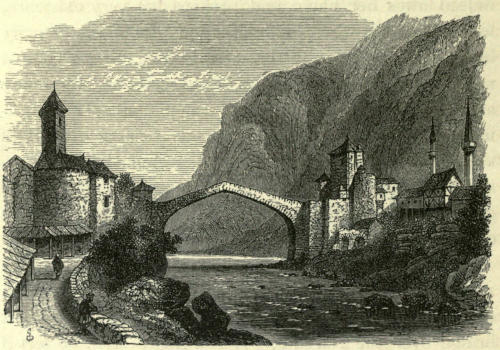
Mostar Bridge.
But the most interesting monument of her early civilization, and that to which Mostar, even at the present day, owes much of her importance, is the magnificent bridge over the Narenta. It is a single arch, 95 feet 3 inches in span,[300] and rising 70 feet above the river when the water is low. According to tradition, this was the work of the Emperor Trajan, whose engineering triumphs in Eastern Europe have taken a strong hold on the South-Sclavonic imagination. Others refer its erection to Hadrian, and the Turks, not wishing to leave the credit of such an architectural masterpiece to Infidel Emperors, claim the whole for their Sultan, Suleiman the Magnificent. He and other Turkish rulers have certainly greatly restored and altered the work, insomuch that Sir Gardner Wilkinson declares that none of the original Roman masonry has been left on the exterior, but he was none the less convinced of its Roman origin; and anyone who has seen it will agree with Sir Gardner that the grandeur of the work, and the form of the arch, as well as the tradition, attest its Roman origin. In the gateway-towers at each end we also detected something Roman, as besides in some ancient archways and masonry on the river-bank by the side of the bridge. This sketch was taken looking down the stream from the left side, and indeed the view from this point needs not the spell of classic associations to fascinate the beholder! The soaring arch beneath which the emerald Narenta hurries—fuming and fretting amongst the boulders that strew her course in many a foamy eddy—as though after eighteen centuries she were still impatient of the yoke[301] imposed upon her by the monarch of the world; the steep banks tiered with rocks, contorted, cavernous, festooned with creepers and wild vines; above, the arcades of Turkish stores, with brilliant Oriental wares; the peaks and towers and gables of quaint old fortifications; two slender minarets, and further still a fainter background of barren mountain, against which the mediæval outlines of the city were relieved in the chiaroscuro of a Southern sun. The whole scene presented such a picturesque combination, alike of colours and outlines, as I have not seen the like of in any other town.
The very name of Mostar signifies in the Sclavonic tongue ‘the old bridge,’[302] and would be enough to prove that the bridge was already looked on as an antiquity before the Turkish conquest. Mostar was already a place of importance under the dukes of St. Sava. The town appears to have been much augmented in 1440 by Radivoj Gost, Curopalata or ‘mayor of the palace’ to Stephen Cossaccia, the first duke of St. Sava.[303] It was originally peopled by Latin Christians, and was the residence of their bishop, who afterwards emigrated to Narona. On the Turkish conquest, Mostar became the seat of residence of the Viziers of Herzegovina; and just as before the dukes of St. Sava had exercised an authority almost independent of their suzerains, the kings of Bosnia, so now the Viziers of Herzegovina succeeded in defying their Bosnian superiors, the lieutenants of the Grand Signior at Travnik. One of the latest and most representative of these Turkish dukes of St. Sava was the renowned Ali Pashà, who, for the valuable assistance which he rendered Sultan Mahmoud in his struggle with the Mahometan magnates of Bosnia, was rewarded with the Vizierate of Herzegovina, which in 1833 was separated from Bosnia and erected into an independent government for the benefit of this faithful servant of the Sultan.
Ali Pashà, originally Ali Aga of Stolac, the seat of his hereditary castle and possessions, was a scion of the renegade nobility of Herzegovina, and had been enabled to aid the Grand Signior against his reactionary Mahometan vassals, by resorting to the bold expedient of arming his rayah retainers. He appears to have been a man endued above the average with the Turkish aptitude for dissimulation. While the Christians were useful to him, he was profuse in his promises of reward, and used to swear to them ‘by the golden cross’ that their taxes would be abolished with the exception of a hundred paras yearly of haratch. But, once in the Vizierial palace of Mostar, he increased the haratch, levied the tithes with greater rigour, doubled the other taxes, and, only anxious to conciliate the Moslems of his Pashalik, allowed his agents to treat the rayahs with greater cruelty than ever. On the pretence of seizing Christians who, after fleeing to Montenegro, might presume, with brigandish intent, to revisit the Herzegovina, he used to send detachments of fanatical officers, who made the circuit of the Christian villages, and ill-treated or murdered whom they pleased, under the pretence that they were Uskoks, as these refugees were called, or had sheltered such. A native historian, a monk of Mostar,[304] has related with a Herodotean simplicity the history of the civil war in the Herzegovina and the reign of the terrible Vizier; and the picture which he gives of the sufferings of the rayahs, of the sort of justice which was meted out to them in the country districts, and the sights with which the tyrant in the palace of Mostar was wont to feast his eyes, may serve to open people’s eyes to the character of the government in this part of the Sultan’s dominions during the years immediately preceding the Crimean War. We must remember that the writer is a monk, but there is a charming naïveté about the following narrations.
If the Pashà had a weakness, it was for impaled heads of rayahs, so that when these Uskok hunters were disappointed of legitimate game, they used to resort to a rough and ready way of securing the Pashà’s approbation. Thus in 1849 Ali Pashà sent Ibrahim, his Cavass-Basha, to collect Uskoks. ‘Ibrahim,’ says our native historian, ‘tarried in Drobniaki till October, but found no work there wherewith to keep his hands warm. Therefore he betook himself to the village Cerna Gora,[305] and after he had passed the night there, he gave orders to the villagers that one out of every house should come forth and accompany him to Piva. The poor villagers came forth as he bade them; but when they had gone with him one hour’s distance from their dwellings, their hands were bound, and here, on the plain near Lysina, the Cavass-Basha Ibrahim shot them dead one after the other. And thus were slain fifteen men, Christians all, miserable indeed in their life-time, but guiltless before the all-high God. And wherefore were they slain? For naught, but that there should be fewer Vlachs.’[306]...
‘The greatest delight of the Vizier was to look upon Christian heads impaled. From his palace in Mostar he could not see the fortress walls, and therefore had he them made higher that he might see them when he lay at meals; and round about the whole fortress he set up palisades of pointed oak-staves, which he topped with Christian heads. At these then looked he from his window, and his heart leapt thereat for joy. If he would oppress any man, he straightway spake and said, “Wilt thou never cease to trouble me, till such time as I hew thy head from thy body, and bid them stick it on the palisades?—then shalt thou give me peace at last!” Upon this fortress there were 150 staves, and upon each stave was always fixed a dead man’s head.[307] But when his murderous bands brought a fresh head, and there was room wanted for it, then Ali Pashà bade them take one or more of the dried heads down, and throw them into the street, where the children were wont to kick them about for sport, and no man durst take them away.’
But Ali Pashà himself fell at last into disfavour with the Porte, and his intrigues with the Mahometan magnates of Bosnia in their final revolt against the Sultan in 1850 brought on his head the vengeance of the second conqueror of Bosnia, Omer Pashà. The catastrophe of our satrap, like the episodes of his tyranny, was thoroughly Eastern, and as the closing scene of the drama is laid with poetic fitness on the bridge of Mostar, I may be allowed once more to have recourse to our Herzegovinian historian.
‘The old, lame Ali Pashà was forced to limp on foot, with a staff in his hand, to the bridge over the river Narenta—and there they set him for mockery on a lean and mangy mule, and in such a plight Omer Pashà led with him our Ali Pashà, even he who for so many years had ruled the Herzegovina according to his will, and had done there so many evil deeds; but Ali Pashà was sore vexed at his abasement, and straightway began to rail at Omer Pashà, and amongst other things he said: “Why dost thou torment me thus? Thou art a Vlach[308] and the son of a Vlach! From whom hast thou authority to drag me thus? Aye, and had I taken arms against the Sultan himself, it is not to thee belongs the right to treat me as one taken in battle, wert thou three times Seraskier. Therefore, O unclean Vlach! send me rather to my Padishah, that he may judge me, and vex me not in my old age.” But when Omer Pashà heard this, he feared lest peradventure he himself should suffer damage at Stamboul; for Ali Pashà had many friends there amongst those in high places, to whom he was wont to send much money from the Herzegovina. So Omer Pashà, turning these things over in his mind, in the end perceived that it were better if Ali Pashà were no longer of this world. And lo! at night, at two of the clock, was heard the sound as of a shot, and there came tidings to Omer Pashà that it had so chanced a gun had gone off, and behold the ball had passed through Ali Pashà’s head. Thus died Ali Pashà, Rizvanbegović, on the twentieth day of March, 1851.’
Mostar contains about 18,000 inhabitants,[309] and is therefore a considerable town for this part of the world. For trade, it has long been the chief staple of Herzegovina, and was renowned of old for its manufacture of Damascened swords. The wares, however, here are much the same as those of Serajevo, so that I have little to record of the streets of Mostar, except that one old Turk—whose principles I respect—swore by the beard of the Prophet that he would never sell the meanest knife on his shop-board to a dog of a Giaour; and that one Mostar damsel—about whose principles I will not enquire, but of whose amiability there can be no question—deftly dropped her veil as we passed her doorway, and favoured us with a private view of a not uncomely face.[310] Indeed we noticed that in the lower valley of the Narenta generally the use of the veil is not so rigorously enforced as usually in Bosnia, though the face-covering is absolutely discarded only at Jablanica and the adjoining district.
There was one very pleasant feature about the streets of Mostar, and that was the abundance of fruit. The peaches were poor; but melons, figs, and the grapes at about a halfpenny a pound, even when a Frank was a purchaser, were delicious. The grapes, of which the Mostar wine famed throughout all these lands is made, are of magnificent calibre, and are celebrated in Serbian song. When the bride of Mahmoud Pashà[311] speeds with the choicest delicacies of earth to comfort princely Mujo, these are not forgotten in the dainty menu. The lady hides beneath her richest garments:—
Rosy sweets wrapped up in golden vestments, Yellow honeycomb in silver dishes, And spring-cherries all preserved in honey; Peaches with the earliest dewdrops gathered, Figs of Ocean, and the grapes of Mostar.
We too, as a preparation for our weary pilgrimage across the Karst deserts of the lower Narenta to the Dalmatian frontier, took with us a generous basket of the fruits of Mostar.
The day was terribly hot, and a suffocating miasmatic vapour[312] (such as we had not met with since we left the valley of the Save) brooded over the city, which, according to our Consul, possesses a climate decidedly hotter than that of Constantinople, so that we were naturally desirous of lightening our day’s journey to the frontier by obtaining horses. These, however, it was extremely hard to obtain; but the Pashà, to whom we mentioned our difficulty, generously placed a couple of horses at our disposal, and told us that if we would start this afternoon we should have the advantage of a guard that was to accompany a caravan of Herzegovinians to Metcović, our Dalmatian destination. We being anxious to push on, as we were really afraid of this climate, took advantage of the proposal, and about five in the afternoon started with our cavalcade on the most terrible journey I ever remember.
Our caravan, consisting of sixty horses and men, slowly mustered together, and having defiled out of Mostar over the steep Narenta bridge, we jogged for hours along tedious dusty plains, leaving on our left the ruins of the feudal stronghold of Blagaj, once the treasury, as its name implies, and castle of the Duke of St. Sava. About sunset we heard many muttered prayers, and an ‘Ave Maria’ continually repeated by a rayah who was riding near; then it grew dark, so that my brother and myself, who both of us suffer from night-blindness, could not see an inch; but still the whole caravan jogged on, and though the stars, shining with a reddish, lurid light, looked more like ‘lamps of heaven’ than the pale stars of old acquaintance, they did not aid our purblind vision in the least, and we felt particularly helpless when we perceived by the noise of water running a good way immediately below us that we were riding along the brink of a precipitous steep. However, our beasts followed their leaders, till suddenly there was an universal stampede—my horse rushed down a steep bank, nearly throwing me off, and then plunged into a stream to drink, and after some more stumbling and climbing we found ourselves in a struggling crowd of men and horses, and were told to dismount. Then our steeds disappeared, and we found ourselves together wedged into a trampling throng in what to us was pitch darkness. Happily, a Zaptieh, who had been ordered by the Pashà to attend on us, rescued us from this plight, and we discovered that we had arrived at a Han called Buna, where we obtained coffee and a room to ourselves over a stable, and rested three hours.
This Han was erected here by our old friend Ali Pashà, who was something more than an impaler of rayahs, and did many things to improve the means of communication and the material well-being of his Pashalik. To him Herzegovina owes the introduction of rice culture, and also of silk-worms; and it was here, at Buna, that he planted, with this object, the first mulberry-trees in the country. The Vizier built a favourite summer residence here, of which and its grounds the Mostar historian gives a curious description. The little river Buna, which, issuing from a cavern in the rock below the castle of Blagai, here pours into the Narenta, is, like it, according to our monk, ‘rich in innumerable fish,’ while the Pashà’s grounds abounded in ‘all the fruits of the South.’ ‘Ali Pashà laid down pipes in which he conducted water from the Buna, and he brought hither a dragon’s head of lead which poured forth the water from its throat into a stone basin, wherein rare fishes played. Here the Satrap was wont to tarry for his pleasure; and when his bloodthirsty servants brought him the heads of Christian Serbs, he bade them to be stuck on the poles of a palisade that stood opposite, and in gazing on them had his chiefest delight.’
Aug. 30th.—During our midnight halt at Buna we were not in a position to examine the Vizier’s villa, nor had we long given us even for repose, for at 2.30 we were roused once more by our Zaptieh, and having been guided to our horses in the dark, were again jogging on our way, and ascending a range of high limestone hills by a rough winding road, without the slightest aid from vision. As morning gradually revealed to us our surroundings, we found that we were crossing a rock-strewn table-land almost bereft of trees, except a few olives, and some fine old oaks shading an ancient solitary graveyard The motion was most fatiguing, as our horses were anything but sure-footed; and the saddle was simply excruciating. The saddle of these countries is simply formed of two hurdle-like frames of wood joined together in the middle at an angle of over fifty degrees, and padded underneath, to protect the horse. We had to sit astride on the sharp upper keel, and had nothing but our sleeping-gear to mitigate its hardness. Add to this the perpetual jolting and stumbling, and the fact that the stirrups were simply loops of cord, which twisted our toes under our horses’ bellies, and our discomfort may be imagined. The dust kicked up by our caravan was terrible, so that to avoid it we wished to ride in front; but our horses, who knew their place in the ranks, could not be induced to stir from it till we dismounted and literally dragged them in front. The pace was provokingly slow, and the Herzegovinian drivers were perpetually reminding their beasts of the duty of sloth by shouts of Polacko! polacko![313] My beast didn’t need any reminder of this kind, and nothing on earth would induce him to put on a spurt so as to distance our dusty train, till by some happy inspiration I whistled to him ‘Little Polly Perkins of Paddington Green.’ Then, at last, the intelligent animal pricked up its ears and broke into a lively trot!
For many hours we had been riding through a wilderness, but as we approached the southern edge of our plateau a prospect of desolation broke upon us such as those who have not seen it can scarcely imagine. In every direction rose low mountains, mere heaps of disintegrated limestone rock, bare of vegetation as a shingly sea-beach—a cruel southern Karst, aptly compared to a petrified glacier or a moon-landscape, the creation—as the old Bogomiles of these parts would have supposed it—of some Evil Spirit. Yet, like most things in nature, this desert prospect is not without its redeeming specialities of beauty. Where the colours of earth are so faint there is nothing to interfere with the most perfect development of atmospheric effects. Nature has, as it were, provided a white sheet for the grandest of all illuminators, and I have seen these pale rock skeletons tinged by morning and evening suns with more delicate saffron and peach-blossom than the green hills of more fertile lands are susceptible of taking. Even as seen by the light of common day, this barren panorama was well worth an artist’s study. We were among mountain-tops without the climbing; and though the languor of the colours spoke too evidently of the universal waterlessness, their delicacy was novel and not without a subtle fascination. The sky above was of a pale hazy azure; the sterile hill-sides a thin ashy grey, stained here and there with a soupçon of sand colour or faint iron brown; the plain below was the palest and most languid of greens.
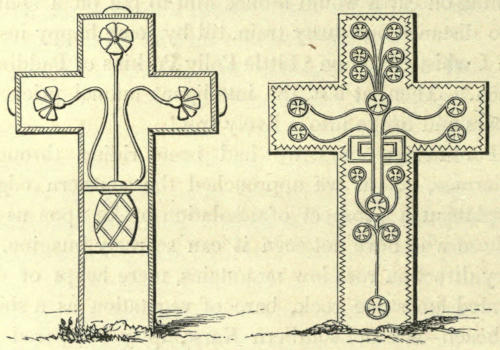
Christian Monuments, Tassorić.
About 9 in the morning we stopped at a hamlet called Tassorić, where the caravan made their next halt; but though we tried here and at other hovels on the road to obtain some food, we met with one universal response: ‘Nima chlébba! nima jaje!’—‘We have no bread! we have no eggs!’ And the only refreshment we could obtain in this terrible waste was the never-failing coffee; so that had it not been for the figs and grapes we had brought with us from Mostar, we might have fainted by the way. The Herzegovinian peasants who travelled with us had brought their food with them.
The seat on which we quaffed our mocha here was supported by two fragmentary bases of Roman columns; but in a graveyard hard by, which we had leisure to examine, were modern monuments of still greater interest. These were the gravestones of the Roman Catholic inhabitants of Tassorić, which were ornamented with incised crosses and floral devices of an elegance indeed surprising when it is remembered that these were the work of rude peasants, unable to write even the names of the departed kinsmen whom they wished to honour.
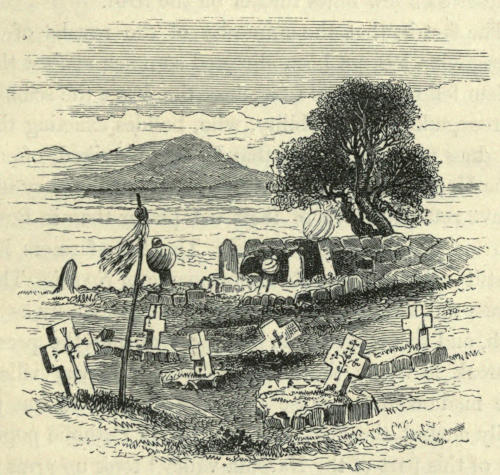
Graveyard at Tassorić.
The whole appearance of this graveyard was indeed one of the most curious sights that we observed in our Bosnian-Herzegovinian experiences. Here, in one God’s acre, alike the Infidel and Christian inhabitants of the hamlet had found their last resting-place, and the crosses of the departed rayahs were only separated by a narrow, and in places almost indistinguishable pathway from the turbaned columns of the Moslem. It was a striking proof that even in this land of bigotry and persecution both sectaries can live together in peace; and it afforded a melancholy contrast to the burnt villages whose ruins we descried a few miles further on the road.
The fact is, that the animosity of the rayahs of the Herzegovina has not been directed so much against their Moslem fellow-villagers as against the Begs, the scions of the renegade feudal nobility, who, besides exacting their own dues with the rigour that I have described, often—in the Herzegovina especially, where at present they seem to have retained more of their old power than in Bosnia—farm the government taxes. The tithe-farmers here are still called by the old ominous name of Spahi. These oppress the Moslem peasant almost as grievously as the rayah, and there have been instances during the present outbreak in which the Moslems of the country villages have made common cause with the rayah. It was primarily against the Begs that the Roman Catholic population of this part of the Narenta valley[314] took up arms last June.
A little further on we passed the Roman Catholic village of Draševo, whose inhabitants, with those of another village called Rasno, were the first to take up arms in this part of the Herzegovina. These assembled with arms in their hands at a bridge just beyond, where the high road crosses the little river Kruppa, and which, though the only means of transit for any stores and cannon that the Turks may land at their port of Klek on the other side of the hills, we found in a condition so dilapidated that we had to dismount from our horses and lead them carefully over the broken woodwork—the whole fabric being so cranky that it would only bear one man and beast at a time. At this bridge the assembled rayahs kept watch and ward, allowing travellers, and even Zaptiehs, to pass (for it was no part of the design of the insurgents at first to war against the Sultan), but declaring that they were keeping watch against the Begs alone.
But it was at a mill called Struge, which we left to the right on the further bank of the Narenta, that the first actual outbreak of hostilities took place. The miller here was a Mussulman, who, offended at the spirited attitude taken up by the neighbouring rayah villages, refused to grind the corn which the Christians, who depended on his grindstone for this part of their breadmaking, brought him for that purpose. Thereupon the Christians of the neighbouring village of Gorica resolved to take vengeance on the unbelieving miller. The miller, on his part, was aided by a division of Zaptiehs; and here the first shots were fired. The Turks were victorious, and the Zaptiehs signalized their victory by entering Gorica the following night, and burning, after first sacking, the houses of the rayahs, who had themselves escaped. They then defiled the church, and as a further insult dug up some dead bodies and left the naked corpses of a man and a child exposed in the churchyard. The insurgents of the Narenta valley and the country to the right of it were thus unfortunate from the beginning, so that when the Turks, by the murder of the prior of the Franciscan monastery at Livno, had terrified the Roman Catholic hierarchy of this part into submission, the Catholic Bishop Kraljević found no difficulty in persuading the Latin peasantry to follow the example of their spiritual governors.
A little way beyond the bridge where the rayahs first set their armed watch against the Begs, we came to the ruins of the village of Doliane, burnt, as we heard, by the Turks at a very early period of the insurrection. It was a miserable sight, the blackened shells of these little stone hovels—piteous at any time—clinging to the bare hill-side. The Turks were utilizing the ruins to build a guard-house, and were pulling down for that purpose the few homestead walls which had still been left standing. Yet this is but a single sample of the devastation which extends along the whole Dalmatian and Montenegrine borders of Herzegovina, over an area embracing many hundreds of square miles.
A mile more of jolting brought us to the Dalmatian frontier, and at Metcović we found ourselves once more within the limits of Christendom with whole skins, but quite worn out after (deducting rests) fifteen hours of excruciation on Bosnian saddles. Of this future emporium of Narentan trade there is little to record, except the filth of the inhabitants. The cleanliness of the Turks and Herzegovinians contrasts most strongly with the South-Italian squalor of the citizens of Metcović, which culminated in the family circle of the Bezirkshauptmann—an interview with whom was forced on us for the examination of passports. The Bezirkshauptmann’s table-cloth was so filthy that there was not a spot of anything approaching whiteness on its whole superficies!
Aug. 31st.—Next morning, after considerable bargaining, we engaged a flat beetle-like craft to convey ourselves and our fortunes to Stagno, viâ the left arm of the Narenta. The landscape now afforded most startling contrasts of fertility and barrenness. The heights that overhung the Narenta, or stretched away to environ its broad alluvial plains, were mere rock heaps, of that lunar desolation already described; so bare that the mountain goat can scarce glean a pittance on their bony terraces. But the broad delta below, formed by the double-armed Narenta, is the richest land in all Dalmatia; the maize by the river-side attains a gigantic stature; on other places the soil is covered by a luxuriant network of vines, which, without any training or apparent cultivation, yield grapes as fine as those of Mostar; and there are mulberry-trees at Fort Opus fifteen feet in circumference. But how little of this marvellous rich soil is even culturable now-a-days! To the right of us, what was once a blooming champaign, covered with tilled fields, and dowering a city wealthy and refined, is now a stretch of fever-breeding marshes which it would cost millions to drain. The wretched inhabitants of the few villages that now remain, are, during the summer months, never free from intermittent fever, and the stranger who values his life must not tarry at this season even to explore the interesting relics of antiquity that we are now passing on our right.
Among the swamps that lie two or three miles to the north of Metcović are still to be seen the foundations of many of the houses of the Illyrian Narbonne,[315] further remains of which, including many inscriptions, are scattered on the hill above, which takes its name from the modern village of Viddo. Here stood the old Narbona, or as it was called in the later days of Rome, Narona; a city so ancient that it was already of renown five centuries before our era, and which lost none of its eminence when, in B.C. 168, Lucius Annius added it to the possessions of Rome. At Narbona, now known as Narona, the Romans planted a colony, and among the many inscriptions that have been discovered, we find ample witness to its municipal liberties; while from others we learn that temples of Jove, Diana of the woods, and Father Liber, once graced this spot. Another inscription on the tomb of a Naronan lapidary, to which I shall have occasion to refer, may, perhaps, bear witness to an art which attained considerable perfection in the cities of Roman Illyria, and of which many traces, in the shape of beautifully engraved gems, are still discovered on this site.
Yet it was not under the Romans that Narona and the rich alluvial plains of the Narenta, amidst which our boat is meandering, attained that importance which makes the name of the Narentines familiar to the student of European history.
In the year 639 A.D. Narona, which till then had remained a flourishing Roman city, was reduced to ashes by a mingled horde of Avars and Sclaves, and a few years later the Serbian Sclaves called in by the Emperor Heraclius took possession of the vacant sites of the lower Narenta. Out of the ruins of the Roman Narona they built a new town, and here, on the site of classic temples, reared a fane to a Sclavonic god, whose name, Viddo,[316] is still perpetuated in that of the modern village. The site of this Illyrian Narbonne thus became a stronghold of heathendom in these parts, just as with the Sclavonians of the Baltic shores Paganism found its last defenders among those staunch Rügen islanders who guarded the precincts of the sacred city of Arkona. It was not till the year 873 that Nicetas, the Admiral of the Byzantine Emperor Basil, prevailed on the Narentines to accept baptism; the temple of their country’s god underwent a strange conversion, and Viddo lived again in a Christian guise as St. Vitus![317]
In the next century the country of the Narentines is still known as Pagania, the land of the Pagans, by which name Constantine Porphyrogenitus mentions it in his account of the Serbians; and it was during the ninth and tenth centuries that these barbarous Sclaves, yet untamed by a civilized religion, issued forth from the swamps and inlets of the Narenta, to ravage the coasts of the Adriatic, and to rival their heathen counterparts and contemporaries, the Sea-kings of the North. As early as 827 their ‘Archons,’ as the Byzantine Emperor calls the Starosts of their Republic, refused to pay the customary tribute to Eastern Rome; and soon after this date we find them in possession of Curzola, Lagosta, Meleda, Lesina, Brazza, and other islands of the Adriatic. But it is their rivalry with Venice which exalts the history of the Narentines into world importance. The rising city of the lagoons saw her commerce cut off by these hardy corsairs, and was at last actually forced to pay them an ignominious tribute. It was not till 997 that the Doge Pietro Orseolo II. succeeded in throwing off the yoke and attacking the pirates in their Narentan fastnesses. After three centuries of piratic domination, the Narentines saw all their island empire taken from them, and themselves not only forced to disgorge their plunder, but to swear allegiance to their rival. The power of the Pirate State was broken for ever; but the fate of Venice had trembled in the balance, and for a moment the whole current of European civilization seemed destined to be perverted from its channel by the inhabitants of the now obscure valley through which we are passing. It were perhaps as idle to speculate what might have been the history of Europe, had the Queen of the Adriatic been smothered in her cradle, as to discuss the fates of Lerna or Nemea, had infant Heracles perished in the coils of the serpent which he strangled; but the most casual student of Venetian annals must perceive that the final triumph of Venice over the Narentines is the great climacteric in the history of her rise.
We thought we detected something of the old piratic genius of the race in the way in which our boatmen plundered the maize and vine fields as we passed; but there was nothing of Pagan savagery in their demeanour and conversation, which on the contrary formed a marked contrast to the rudeness and asperity of the ordinary Bosniac or Herzegovinian. They spoke indeed a dialect closely akin to the Illyrian of the interior, but they spoke it with energy, vivacity, elegance; with a softness of cadence so thoroughly Italian, that when, as all of them did at times, they changed to that language to address the signori, we hardly detected the change. Their very form is lither, suppler; of lesser mould, but a striking contrast to the overgrown ungraceful Bosniac. The eyebrows of these Narentines are not so arched, the hair is darker; they seemed to be many of them Sclavonized Italians, descendants perhaps of the Roman colonists of Narbona. One of our boatmen was a very interesting type of man. He spoke Dalmatian like the rest, but his face—which, like that of many other Dalmatian faces that I recall, beamed with all the openness of a sea-faring people—was typically Scotch; and, oddly enough, he wore what looked like a Scotch cap, minus the tails. His hair was of a lighter and more reddish hue than that of the others. One almost fancied that we had here before us a waif of that early Celtic population of Illyria already invoked as nomenclators of the Illyrian Narbonne whose ruins we are passing to our right.
Meanwhile we have been making very slow progress, since a fierce scirocco has set dead in the teeth of our small craft; and as we arrive at Fort Opus, an old Venetian station at the apex of the Narentan delta, our boatmen inform us that our two-master is too lubberly for them to hope to take us to Stagno in it while the scirocco continues to blow, in which case the voyage might take two or three days. They professed their willingness to find a smaller vessel which should be able to cope with the elements, and to resign half the wages, for which we had agreed upon, to the new boatmen. ‘You see, Sirs, it is not for want of will—but we cannot struggle against God!’
At Fort Opus, accordingly, we shifted into another smaller craft, pointed at both stern and stem, and beetle-like as the other, and were soon on our way again along a part of the Narenta’s course which might well be the source of weirdest myth and legend. Just beyond Fort Opus, the hills on the left—bonier skeletons, if possible, than before—draw nearer to the river, till they frown over its depths. It is at this point that ever and anon mysterious boomings and bellowings are heard to proceed as from the inmost recesses of the mountain. It is, say those who have heard it, as the bellowing of a bull, sometimes here, sometimes there, and sometimes everywhere at once. At other times it seems to issue from the darkest pools of the Narenta itself. I cannot say that we ourselves heard the ‘hideous hum,’ but these noises cannot be set down as the creatures of superstitious imagination; for a competent observer, Signor Lanza, who was physician in this district, and to whom is due a scientific account of this part of the Narenta valley, has himself borne ample witness of the existence of this phenomenon; nor does it stand alone, for there are equally authentic accounts of similar subterranean murmurs and explosions having been heard in Meleda and other islands of the Dalmatian Littorale. The explanation given by some is that the detonations are due to the pressure of the tide on the air pent up in the subterranean caverns which honeycomb the limestone Karst-formation of these Illyrian coastlands; but Dr. Lanza—who notices that the phenomenon generally takes place either at sunrise or sundown—confesses that ‘a veil of mystery hangs over the whole.’ Meanwhile, nothing but the portent is certain; and fearful as I am of giving publicity to ill-omened words, I cannot refrain from breathing a suspicion that this unhallowed bellowing may proceed from some hideous Minotaur, caverned in his labyrinthine den.
This neighbourhood is also much subject to earthquakes, which generally occur during the winter months; and as our boat toiled heavily past a succession of rocky headlands, we ourselves experienced a natural phenomenon scarcely less awful than these subterranean bellowings and convulsions. The wind rose higher and higher, whistling among the limestone ‘ruins of the older world’ that frowned above us. Our two boatmen knit their brows and muttered ‘la Fortuna!’ Dame Fortune, the old goddess of the way by sea and land, still retains some of her old attributes of wheel and rudder among these Romanized Dalmatian Sclaves; her name[318] is still used on these coastlands as equivalent to a tempest; and even in the interior of Bosnia the Sclaves have so far adopted the idea, that a snow-storm—the kind of storm dreaded most in the Bosnian mountains—is known to the peasants as ‘Fortunja.’
At last, on steering between the two rocky hills, whose barren masses rise on either side at the mouth of this arm of the Narenta like twin pillars of Hercules, a tremendous scene burst upon us. Just opposite to where the river widened into the sea, towered before us—its limestone crags and boulders up-piled and jumbled in cataclysmic confusion—a small desolate island, a fit abode for nothing unless it were departed spirits of the evil. The rays of a pale ominous sunset fell upon these cadaverous rocks and flooded them with spectral light. On either side of the island the sea shone with abnormal emerald lustre; but what made the brilliance of the foreground so unearthly, was the unutterable darkness of all behind. The rocky island rose like a phantom against a sky as black as night.
The question for us was whether there would be time to round the nose of rock to the left of the Narenta mouth, and cross a narrow arm of green sea to a promontory where we might obtain shelter, before the impending hurricane came down on us.
The sailors thought it possible, and with set teeth laboured at the oars as for grim life. But the black pall of clouds that darkened the western hemisphere drew nearer and nearer; the white sea-mews swept wildly and more wildly hither and thither against the face of coming night, shrieking weirdly like the Banshees of coming doom. The wind and thunder roared louder in our ears, and a thin snowy line of surf stretching along the emerald horizon, swept like a charge of cavalry across the intervening fields of sea—but now, so treacherously smooth!—and dashed down upon our little craft.
The night was already upon us; the brilliant beams of sunset were suddenly transformed, first into darkness, and then into the lurid twilight of an eclipse which lit up our men’s faces with a pale ashy grey, ghastly to look upon. These hardy descendants of corsairs seemed really cowed, and shouted to us ‘Pray to God, signori! Pray to God! La Fortuna è rotta!’
The storm had burst with a vengeance. The wind rose to a hurricane. The surf and tempest struck our boat and beat her head round. It was in vain that the men struggled at the oars; we were borne back, and swept along helpless as a log in a torrent. We were driven towards the mouth of the Narenta which we had left, and I thought every moment we should have been dashed against the rocks; but Dame Fortune was merciful to us, and notwithstanding that the men lost all command of the vessel, we rounded the rocky headland, and found ourselves in comparatively sheltered waters where oars were again available, so that we were presently anchored near another small Narentan vessel in smoother waters—though even the river was one sheet of foam. It now began to rain in torrents beyond all our experience; so we covered ourselves with our macintoshes, and lay down in the bottom of our boat, resolved not to emerge till the hurricane should have abated somewhat of its fury. But hardly were we settled, when a tremendous clap of thunder rent the air, followed by a series of sharp blows which made us start to our feet, when we found that hailstones varying in size from a bullet to a walnut, and in shape like Tangerine oranges,[319] were rattling about our heads. With our helmet hats on, and under cover of our macintoshes, we avoided being actually bruised, but the thunder and lightning that accompanied the hail were still more terrific. The forked lightning literally played around our craft, and it seemed that it must be struck; the thunder was such as we had neither of us heard the like of before. For a quarter of an hour we endured the full brunt of this celestial cannonade, and then the storm passed away as suddenly as it had come, and rolled on among the more inland ranges of the Dinaric Alps, which the lightning kept throwing into vivid and unexpected reliefs behind us; while in front and overhead, sky and rocks and sea were illumined with the renewed splendour of sunset, and the surface of the troubled Narenta calmed down into its wonted serenity.
But it was a storm such as one does not meet with twice in a life-time; it was a fit initiation into this iron-bound coastland, with its earthquakes and subterranean thunders—the cavernous home of winds and tempests—the last refuge of piratic races.
We now renewed our voyage, and crossing a narrow arm of sea, landed in a sheltered cove, where we took refuge in a spacious stone house, the abode of a Dalmatian Family-community, hoping for the scirocco to subside, in order to be able to pursue our course up the Stagno. We were shown into the common eating and cooking room, a spacious chamber on the ground-floor, where the family gathered round us; and the men, when they heard that we were English, at once claimed us as brothers, and entered into a most friendly conversation. ‘We like the English,’ said one; ‘we know your greatness on the sea, and we too are a nation of seamen; England and Dalmatia!—there are no sailors but in your country and ours!’ Another of the men had been to London and Plymouth, and he and the others aired a string of English phrases with a decidedly nautical flavour, amongst which we detected ‘Or’ right,’ ‘cup o’ tea,’ ‘grog,’ ‘haul up,’ ‘ease her;’ and other expressions proving their entente cordiale with ‘Jack.’ About nine in the evening the woman-kind, the children, and some of the men, betook themselves to sleeping chambers above, and we were shown a bed in the spacious hall below, on whose floor slept our seamen and some of the inmates. But the stuffiness was so suffocating within, that I preferred the gnats and night air without; and finding a convenient rock on which to pillow my head, imitated the example of Jacob.
About midnight the adverse wind fell, and I being, by now, sufficiently disillusioned of patriarchal repose, hastened to rouse L⸺ and our men, and we were again on our way before 1 A.M., the wind shifting enough to enable us every now and then to use our sail. We steered along the Canale di Stagno piccolo, passing in the dark the inlet in which the Turkish harbour of Klek is situate. About 8 A.M. we landed at Luka, on the peninsula of Sabbioncello, and making our way on foot across the isthmus, entered the old town of Stagno by a gateway through its high machicolated Venetian walls. It was a small friendly place with clean narrow streets, and many old stone palaces of the citizen nobility with stone escutcheons over their doors, quaint rope mouldings and carved corbels under the windows, some of which were of Venetian-Gothic style. Other houses, whose owners probably could lay no claim to coats of arms, displayed over their doorways medallions on which I.H.S. was engraved in a variety of ornamental forms. In the Piazza just inside the gate by which we entered lay an old font with many noble shields upon it, and in the city wall opposite was a Renaissance fountain with a sixteenth-century date upon it. Stagno was once a port of the Bosnian kings, till sold by one of them to Ragusa at the end of the fourteenth century.
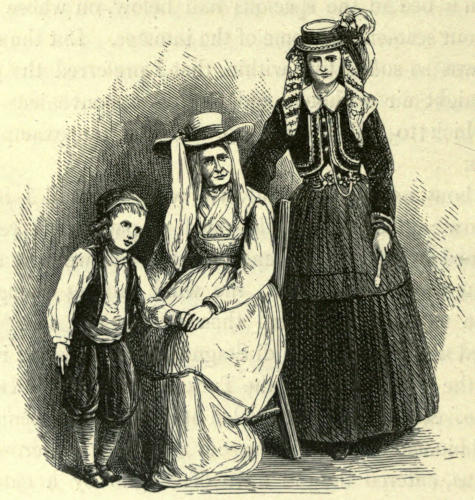
Women and Child, Stagno.
The peasants in the Piazza were highly picturesque; the men, like the inhabitants of the lower Narenta, strongly resembling the Turks in their attire, except for a yellow sash round their waist, a Dalmatian peaked fez on their head, and an ear-ring—a plain golden circle—in one ear. The women, with their kerchiefs crossed about their bosom, showed more Sclavonic characteristics in their dress, but their straw hats with long streamers gave them a certain Swiss air.
While sketching the little group above, in the Piazza, I was somewhat surprised to hear the inspiriting tune of ‘Men of Harlech’ proceeding from a neighbouring house; but the mystery was cleared up by our shortly receiving a message to the effect that ‘the daughter of the Judge of Stagno’ wished to secure an interview with the Englishmen; and then it was that we found that this amiable young lady, having lived some years in Wales, and looking back with a tender regret to her sojourn in our island, had resorted to the innocent device of playing the national melodies of the Principality in order to attract our attention.... But alas! the boat is starting for Ragusa—the parting has taken place,—we have left our romantic damsel to sigh once more for English society, and stagnate at Stagno.
Our boat—a Trabaccolo, I believe it is called—is equipped with an expansive lateen sail, and as a propitious breeze, the Maestro, has sprung up, we soon leave Stagno, its olives and oleanders and pretty flowering shrubs, its siren music and bright eyes, far in our wake, and scud along between rocky islands to our right, and the bare Karst mountains of the mainland to our left. The desolate, monotonous hills, perpetually repeating themselves, were hardly relieved by a stunted tree—it was the same scenery so well described by Ovid in his Pontic exile:
Rara, nec hæc felix, in apertis eminet arvis Arbor, et in terra est altera forma maris!
At one point, indeed, the village of Canosa, there was an oasis of green in the desert landscape; this was the gigantic group of plane trees, which are said to rank among the finest in the world. But we are nearing Ragusa, and after passing a line of jagged scoglie which start up from the deep like the teeth of a gigantic antediluvian, the sea, hitherto hardly recovered from its frenzy of yestereen, becomes tranquil once more, and we glide into the harbour of Gravosa, the port of modern Ragusa, for depth and capacity reckoned the finest in Dalmatia.