Chapter V · TRAVNIK AND FOINICA.
Reading edition
A Turkish Cemetery—Arrive at Travnik—Taken for Insurgent Emissaries—The ex-Capital of Bosnia—New Readings of the Koràn—Streets of Travnik—Veiling of Women in Bosnia—Survivals of old Sclavonic Family Life among Bosnian Mahometans—Their Views on the Picturesque—Their Dignity, oracular Condescension, and Laisser-Aller—Hostile Demonstrations—Bashi Bazouks—‘Alarums Excursions!’—Insulted by armed Turks—Rout of the Infidels—Departure of Mahometan Volunteers for Seat of War—Ordered to change our Route—A Turkish Road—Busovac—Romish Chapel and Bosnian Han—The Police defied—Our Mountain Route to Foinica—Ores and Mineral Springs—Dignity at a Disadvantage—Turkish Picnic—The Franciscan Monastery at Foinica—Refused Admittance—An ‘Open Sesamé!’—‘The Book of Arms of the old Bosnian Nobility’—Escutcheon of Czar Dūshan—Shield of Bosnia—Armorial Mythology of Sclaves—The Descendants of Bosnian Kings and Nobles—The Ancient Lords of Foinica—The ‘Marcian Family’ and their Royal Grants—A Lift in the Kadi’s Carriage—Traces of former Gold Mines—Mineral Wealth of Bosnia—A ‘Black Country’ of the future—Why Bosnian Mines are unworked—Influence of Ancient Rome and Ragusa on past and present History of Bosnia, and on the distribution of her Population—A Fashionable Spa—Kisseljak and—Beds!
But it is high time to take leave of this hospitable brotherhood, and continue our way to Travnik, which we proposed to reach that night. The monks kindly found us a Latin peasant from the neighbouring village to set us in the right path, and we began a winding ascent of a foot of Mt. Vlašić. From the crest of this a fine mountain prospect opened out to the south and west, range overtopping range till they culminated in the far distance towards the Dalmatian frontier. But below we caught sight of what was then a more welcome prospect, the high-road, namely, leading to Travnik—it being now four days since we had seen anything which by a stretch of courtesy could be called a road! Taking leave of our guide, who was vastly gratified by a couple of ‘grosch,’ as the Bosniacs call piastres, we made our way to the highway and followed the telegraph wires—for it was actually lined with telegraph wires—in the Travnik direction. On one side of us flowed the little river Lašva, driving a succession of turbine-mills such as have already been described; and on the other the limestone heights of Mt. Vlašić rose above us, bare as regards vegetation, but as we neared the town planted tier above tier with Turkish gravestones: for throughout Bosnia—as generally in Turkey—the old-world fashion prevails of burying the dead by the roadsides outside the walls of towns. It was an impressive sight, that forest of turbaned columns. Some loftier headpieces spoke of the old days of Janissary rule. In places great stone sarcophagi were overturned and rifled by the mountain torrent; here and there lay marble slabs fretted with vine-leaves and interlaced devices, which still betrayed their Byzantine ancestry. On the left we passed another landmark of the East—a capacious stone cistern; and at last a turn in the road revealed to us the ex-capital of Bosnia—mosques, minarets, and chalet-like houses harmonizing with the Alpine precipices above; and, in the midst of the town, a craggy acropolis crowned with another castle of old Bosnian kings.
We had scarcely entered the town when an observant Zaptieh pounced upon us to know our business; and on our demanding to see the Mutasarìf,[203] or Governor, conducted us to the Konak. The Mutasarìf was at the time absent from the town at his country house—at least so we were informed, though considering the critical state of the country the statement seemed almost incredible. We were therefore obliged to show our credentials to his lieutenant; but this functionary, for some reason, which the small smattering of Italian of which he was master failed to convey to us, at once ‘smelt a rat,’ and, as the best court of inquiry at hand, hurried us off to the telegraph office, where one of the officials spoke French, and then and there put us through a severe cross-questioning as to our route and our objects in travelling.
‘How was it possible,’ he asked, ‘for you to have arrived at Travnik without escort? You say that you come from Tešanj over the mountains, but you don’t expect us to believe that you came on foot! Besides, where is the pièce de conviction? Where is your Zaptieh? You say that you are now on the way to Serajevo, but’—and this was regarded as the most damning fact of all—‘we see this order in the Vali’s handwriting was given at Serajevo, and you must therefore be coming from it; at any rate you must have been there, which you deny.’
It was a little embarrassing to know how to convince people who put both postal transmission and pedestrianism beyond the range of human possibilities! However, a circumstantial account of our itinerary, coupled with the awkward fact that they could not deny that our bujuruldu was in the actual autograph of the Governor-General, and that, however we came by it, we had it in our possession, brought our officials to reason, or at any rate to a wholesome perception that we were masters of the situation. So the Mutasarìf’s locum tenens being reduced to express himself satisfied with our explanation, our French interrogator changed his tone to one of apology. He explained that our arrival had been so mysterious that we seemed to have dropped from the clouds, and our being on foot and unattended convinced the authorities that we must be Austrian emissaries sent to excite the Bosnian rayahs to revolt! ‘You see, monsieur,’ he wound up, ‘you come in very delicate times’—and certainly, to judge by the un-Turkish bustle of the telegraph office, the times were ‘delicate’ indeed!
A Zaptieh was now told off to escort us to the ‘best hotel in Travnik,’ and after a little more stumbling and slipping through streets so terribly cobbled that they made one sigh for the mountain-side again, we arrived at our destination, a miserable han, where we were ushered into an upper room, and our wants attended to with due dilatoriness by the squalid hanjia and a boy rejoicing in the name of ‘Smily,’ who between them made up the whole personnel of the establishment. Here, while waiting for the pilaf and indescribables which compose our evening meal, we have leisure to reflect on the augustness of the town in which this is considered ‘first class accommodation.’
For Travnik, in the eyes of your Bosniac, is decidedly no mean city. Although at present, with its 12,000 inhabitants, only a quarter the size of Serajevo, and indeed at no period comparable to it either in populousness or commercial activity, Travnik was yet for nearly two centuries the political capital of Bosnia, and the seat of her Viziers. Their original seat was indeed Serajevo, but when the Vizierate of Bosnia stretched itself over Slavonia to the Drave, Banjaluka was fixed on as the city of residence, owing, it would seem, to the remoteness of the older capital from the new frontier. But when Buda was recovered in 1686, Banjaluka might be regarded as too much at the mercy of a coup de main, and the Divan of the Vizier was again transferred beyond the watershed and pitched at Travnik, as if the Turks were still loth to give up hopes of once more ruling on the Hungarian bank of the Save. At any rate they kept up the pleasing fiction that they ruled it still, for down to quite recent times the Vizier-Pashà who resided here clung to the vain title ‘Vizier of Hungary.’ The importance of Travnik is seen in the interesting ‘Account of the War in Bosnia,’ written in the first half of the last century by a native Bosnian historian.[204] Travnik is the seat of government and jurisdiction. It is here that a kind of parliament is ‘summoned by the Vizier, consisting of the magnates, judges, muftis, priests, and other learned effendis,’ to grant supplies in view of the invasion of Bosnia by the Austrians. It is outside the walls, on the ‘plains of Travnik,’ that the army of true believers assembles from all parts of the province. Serajevo, the seat of the native aristocracy, became indeed more and more the real seat of government, but the Sultan’s Lieutenant was obliged to content himself with his shadowy dignity at Travnik, till Omer Pashà in 1850 finally crushed the Capetans and transferred the Vizierial residence once more to the Serai.
Aug. 18.—Next morning, while we are still enjoying hard-earned rest—and let it be recorded, injustice to our hanjia, that our room was tolerably free from vermin—a most honourable exception in Bosnia!—in comes the acting Governor, whose acquaintance we had made the day before, leading his little boy, decked out in raiment of purple velvet and crimson silk, with gold brocade and elaborate arabesques of embroidery—more gorgeously bedizened than any princeling of our poor civilized West!—and begs me to photograph, or, failing that, to sketch the little man. As a camera I had brought with me had unfortunately come to grief at an early period of our tour, I was reduced—for all my disavowals of artistic skill—to attempt what portraiture I could. The child, like his father, was a true Osmanlì, unlike the light-haired offspring of the native Sclavonic Mussulmans, dark in eye and locks, and withal precociously endowed with something of the gravity of his race. His self-possession, indeed, was amusing. He could not have been more than six years old, but he leant quite quietly against his father’s knees, hardly shifting his position the whole while, and laid his little hand on the big hilt of his paternal scimetar—instructed, doubtless, to look all the future hero! The pride of the fond papa in his hopeful was an amiable study, though purblind Frankish eyes might detect little that was remarkable about the prodigy. Alas! the artist was uninstructed as to those points the insistance on which was most acceptable to his patron; and though the Turkish parent was on the whole satisfied with a scrutiny of my humble performance, he looked up from the paper with an air of profound art-criticism, and requested me, as I loved truth, to make the eyebrows darker. It was too true; I had not done justice to the raven pigment!
And the Koràn? it may be asked, what about the prohibition of the Prophet against the portrayal of living things? Actually it is observed about as rigorously in Bosnia as the prohibition against drinking wine. Within the last year or two a Dalmatian photographer has set up in Serajevo; and to prove the laxity of morals in this respect, it may be mentioned that Mahometan priests have their likenesses taken by him, and that in one case he was summoned to reproduce a whole group of Turks engaged in the interment of a fellow-believer.
We found much to interest us in the streets of Travnik, and indeed the superior architecture of the town still witnesses its old importance as the seat of government. There are some larger buildings besides the castle already mentioned—palaces of bygone Viziers, barracks for Turkish troops. Even the ordinary rows of wooden houses—with their latticed dairy-like windows, the central bays of their upper story, the blue pillars and other ornaments painted outside—are not without variety in hue and outline; and amongst these rise more solid edifices of stone. Here, for instance, is one such—the best in the town—supported on arcades of solid masonry, adorned with rosettes carved in the spandrils of the arches: perhaps an old Bezestan or cloth-hall—very possibly the magazine of some merchant prince from Ragusa, for the arcading below is characteristic of the street architecture of the old republic. Beyond this—we are surveying one of the most picturesque street scenes in Travnik—rises an old mosque of wood, time-stained, dilapidated, with pinnacle awry. At its side an elegant cupola, supported on four columns and ogee arches, encanopies the turbaned tomb of a Mahometan saint; for every true believer who falls in battle against the infidel ‘drinks,’ as the Bosnian historian expresses it, ‘the sweet sherbet of martyrdom,’ and passes from this ‘vale of tears’ to enter with saintly honours into the joys of Paradise. Beyond these rose a background of gardens and spreading foliage, and above, the naked precipices of Mount Vlašić.
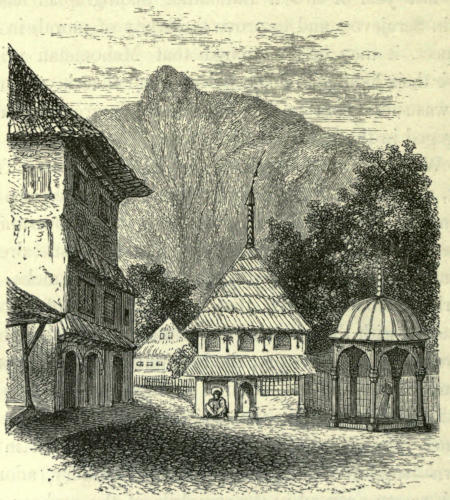
View in Travnik.
Climbing round by the hills to rejoin the town on the other side, we gained a more general view of the city, and counted no less than thirteen minarets, besides two clock-towers, and—what we had not seen in a Bosnian town before—the stone cupolas of the bath and the larger mosques or dzàmias. The porches of some of these Mahometan prayer-houses had altered little from those of the early Christian church, and were in truth as Byzantine as their domes. The walls are most brilliant, not to say tawdry, outside—painted with what were meant to be delectable fore-glimpses of Paradise—palm-trees loaded with dates, fruitful vines sprouting forth from vases, or here a luscious melon with a knife ready inserted for the carving. Like devices might be seen on the spandrils of the kiosques that rose over the saints’ graves, but all in the most gaudy and inharmonious colours. Against the walls of some of the mosques were built the wooden booths of Travnik tradesmen, so that the disfigurement of sacred edifices by secular accretions is not confined to Christian countries. The most gorgeous of all the dzàmias had been converted into a kind of gathering-ground for the fruit and vegetable market—as if the fruiterers considered that the celestial fruits painted on the sanctuary walls above might be useful in suggesting to customers the propriety of enjoying the humbler fruits of earth, and serve generally as a good trade advertisement. It is, however, to be hoped that the faithful will be supplied with better plums hereafter than are to be obtained for love or money in the Travnik market.
Narrow rows lined with the usual open stores—varied and fascinating as ever. Armourers’ shops, with handshars or Bosnian cutlasses, yataghans, quaint ornamental guns and pistols; another store containing nothing but melons; grindstones next door; two or three watchmakers—glazed windows to these, and a goodly exposure of turnips; as elsewhere, many Jacks-of-all trades. Among the primitive arts practised here that of a rope-maker struck me. He held the cord tight with his great toe, while he twisted it with his fingers. The inhabitants of Travnik are mostly Moslems, with a small infusion of Spanish Jews and Serbs, or members of the Greek Church, some of whom are the most well-to-do merchants in the place, and have organised a company—the Kombeni, as it is known here—for facilitating traffic with Serajevo. Their wives were dressed in the style which distinguishes the Christian women of Bosnian towns from those of most country districts, and which approaches the fashions of Belgrade.
In strange contrast to these were the Mahometan women, several of whom we noticed in the streets towards evening. Their whole face was concealed but for the tiniest eyeslits imaginable; but their insatiable bashfulness is not contented even with this, for in passing a stranger they must needs bow the head so that the fringe of the upper veil which curtains the head falls forward far enough to eclipse their last loophole of humanity! Their hands they modestly hide in two front pockets of their dress. Their exterior envelopes are sometimes green, sometimes white, sometimes of a darker hue; those whose under veil is black and outer white, looking at a little distance strikingly like nuns. Besides the two ordinary veils—that which drapes the head and that which swathes the nose, mouth, and bosom—their forehead is often covered with an additional piece not unlike the half mask worn at masquerade balls, usually of black horse-hair, with the two eyeslits above-mentioned fringed with gold. The whole form is mummied in such a way that an Englishman who had travelled through a great deal of the Ottoman dominions, but who had not visited Bosnia, could hardly be induced to believe that the figure below represented a woman of European Turkey. To find her like, one must transport oneself as far away as Egypt. Outside the limits of conservative old Bosnia, her disguise would be laughed at by the Turks themselves!
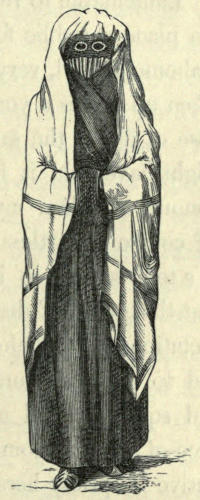
Bosniac Mahometan Woman.
But what is still stranger is that in Bosnia should coexist the two extremes of veiling and not veiling. If the married women here veil themselves more than anywhere else, en revanche unmarried girls are allowed to display their charms in a way which, to the well regulated Turk of another province when he first visits Bosnia, is quite scandalous. There is a Turkish proverb, ‘Go to Bosnia if you wish to see your betrothed!’ It is actually a fact that in this reactionary land there are such things as Mahometan love-matches; and even when the mother is allowed to select the spouse in the usual way, by inspecting, that is, the ‘stock’ in the baths, even then—so demoralized are the customs of these Mahometan Sclaves!—the young people are allowed to converse together before tying the conjugal knot. On Fridays and Mondays—days of greater liberty to all the Mahometan women—lovers may steal up to their sweethearts’ windows and whisper airy nothings to them through the lattice. This Bosnian custom is called aschyklik, and has been compared with the Fensterln of Styria and Upper Austria.[205]
Mondays and Fridays, and through a lattice—what restrictions can be more judicious?
Lamentable to record, the day was a Wednesday and the place a public fountain in the street of Travnik. A Mahometan girl, very slightly veiled, was drawing water, when up comes a young fellow with the ostensible purpose of doing the same. He was a gay deceiver!—she might have told it from his roguish look,—but for the honour of Islâm my pen refuses to chronicle the rest. Of course the artless maiden gave vent to a ‘Haiti!’ but in a tone so soft, so insinuating, as abundantly to prove that that word of dismissal is capable of as many interpretations as ‘get along, do!’ among certain she-Giaours, and to be the natural prelude to more mutual oglings, and squeezes, and gigglings, cut short by the appearance of an unwelcome third party in the distance—retributive Propriety herself, advancing like a walking sack.
Not many years ago a tragic love romance had Travnik for its scene. In the days of the last struggle of feudal Bosnia for her provincial liberties, a young Osmanlì sergeant of Omer Pashà’s army, who was stationed here, fell in love with the pretty daughter of a Bosniac Mussulman, and was betrothed to her. Before they could be married, however, the sergeant fell in battle, and the maiden, when she heard of the death of her beloved, rather than survive him and be forced to marry another, blew out her brains with a pistol. The moral drawn by Omer Pashà, in relating this tragic story, was admirable. ‘It all comes of not wearing the veil, and letting affianced couples see each other. If she had always kept her yashmak on her face she might have married another man, for there would have been no great love in the matter.’[206]
This approach towards natural relations between the two sexes is doubtless, as much else among the Bosniac Mussulmans, a survival of the old Sclavonic family life. The Mahometan house in Bosnia more nearly approaches our idea of home than in any other part of Turkey. We learnt that polygamy was almost non-existent throughout the province. It has been dying out, it is true, in other parts of Turkey, but here it appears never to have taken. What is still perhaps exceptional among the wealthier Turks, the richest Bosniacs have only one wife. Some of them are said to have concubines, but public opinion here denounces the Moslem who concludes more than one marriage. A few years ago a representative of the old feudal nobility, Ali-Beg Dzinić, one of the richest landholders in the country, set all Bosnia in an uproar by taking a second wife in the lifetime of the first.[207] Another peculiarity of these Mussulman Sclaves, illustrating the vitality of the family tie, is to be found in their names. Mahometans elsewhere, with the exception of Persians and Arabs, have no family name; but here, after the orthodox personal appellation, as in the instance above, to the Ali, or Méhchmet, or Selim, these descendants of the old Bosnian nobles add their ancestral patronymic. This, however, is confined to the grandees, and is rather an instance of the tenacity with which the Bosnian aristocracy has clung to its old feudal attributes.
After all, one ought rather perhaps to wonder that these Sclavonic renegades have received so much of the impress of Islâm. Considering the difference of race—how strange it is to see a bevy of blue-eyed light-haired Mahometans!—it is curious what thorough Turks these Travnik burghers make. Towards evening many of these grave merchants seated themselves in the gardens of a café just outside the town, and, while alternately purring their narghilés and sipping their coffee, contemplated, without uttering a syllable, the beautiful scene before them—the mountains, the green valley, the foaming mill-stream murmuring at their feet.
We were assured by ‘Europeans’ in Bosnia that the Turks do not care a rap for nature—that they are utterly callous as to scenery; that if anything charmed, it was the peace, the silence—not the beauties of the landscape. It is this, they say, which allures the Turk to seek as his greatest luxury the gardens of his country house. Yet old Edward Brown,[208] in his ‘Travels in the Levant,’ in the seventeenth century, records how the Grand Signior passed two months on Mount Olympus, not only for the coolness of the air in summer, but also for the sake of enjoying the prospect of the fair champaign of Thessaly on one side and the blue expanse of the Ægean on the other. For flowers at least, all Bosniacs, Mussulman as well as Christian, display an extraordinary love; not only do they adorn their persons with them on every possible occasion, but so great is their craving for them, that at Serajevo it is not unfrequent for mendicants to station themselves at the doors of our Consulate to beg not for bread, but for a single flower from the pretty little garden.
Meanwhile there sit our Turks, to all outward appearance rapt in the enjoyment of the picturesque. What sapient big-wigs, too, they look!—how profoundly versed in all the Law and the Prophets!—of what superfluity of braininess are those capacious turbans suggestive! It is hard to realise that these gentlemanly beings have been engaged all day in peddling trades. And indeed it is true that they forego with lordly disdain the petty chicaneries of their calling; it is notorious, among foreigners in Bosnia most hostile to the Mahometans, that wares are, as a rule, to be bought cheaper and of better quality with them, than at stores kept by Christians. The true believer will not wilfully cheat, and disdains to bargain. This is always put down to their fatalism; but I doubt if it be not more due to a certain personal dignity which the plastic Sclave of Bosnia has borrowed from the Osmanlì.
One would expect the brows of a pure fatalist to be smooth as marble. There could be, one would think, no trace of emotions to which he is superior. But the features of these Bosniac Mahometans are fretted with a positive network of wrinkles—far more than those of an average Englishman. The truth is that, superior as they are to many of the ‘changes and chances of this mortal world,’ they, too, have their weak points, and vanities of their own, about which they are touchy as other people. It is their wish on all occasions to seem oracular, to be lawgivers, to impress you with the profundity of their learning, to give the idea that they know a great deal more than they choose to say—to make up for the paucity of their observations by accentuating their value. Thus on the slightest occasion they will elevate or depress their brow, and otherwise contort the features with a kind of measured emphasis. The wrinkling process resembles that of the dogmatic and self-important type of German; it is the very opposite to that theatrical adaptiveness which leaves the footprints of every emotion on the Zingar’s face. Not indeed that the expression arrived at smacks by any means of Teutonic cantankerousness; it is rather a Spanish Grandezza—a stately condescending politeness—which converts every shopkeeper you converse with into a Grand Signior!
Of course in their manner of life and their way of conducting business there are traces enough of the numbing influences of fatalism. Though these Mahometan tradesmen are distinguished by their honesty, which, as everybody knows, is also the best policy, though they are favoured by belonging to the ruling caste, there is a want of enterprise among them which precludes them from favourably competing with the Christians. Almost all the larger businesses in the country are in Christian hands; the Mahometans are shopkeepers at most, not merchants—they are too stationary by temperament. Perhaps they indulge more than the rayahs in narcotics; it was woful to see the ghastly pallor of so many Turkish faces. Here and there in the course of our journey amusing features in Mahometan interiors bore witness of the laisser-aller spirit of the inmates. In the Konak at Tešanj was a writing-table made for no less a personage than the Kaïmakàm, and it was put together with bits of wood of uneven sizes, just as they came handy; and here, in the telegraph office at Travnik, was another—quite an elegant escritoir—but the whole spoilt and rendered ridiculous by a piece of wood of insufficient length being stuck in the middle, Providence having been pleased to place it in the way of the upholsterer. If a button comes off an official’s coat, he never thinks of replacing it; and if a beast dies before a Bosniac’s house, instead of removing it, or even burying it, he leaves it there to stink!
To-day we noticed a certain amount of positive manifestations, and those directed against ourselves. Many of the believers scowled as we passed, and one old fellow did me the distinguished honour of coming up and cursing me in the middle of the street. Once a Mahometan store-keeper positively refused to sell any of his wares to the Giaour—the Kaur, as the Bosniacs call him—and I should have been unable to procure the ‘lumps of delight’ which I affected, had not a Serb merchant, whose acquaintance I had made, come up and explained that I was neither a Russian, nor an Austrian, but an Englishman, on which the Turk relented at once. We were, however, more seriously annoyed by being followed wheresoever we went by a Zaptieh; and at last, unable to stand such persecution any longer, betook ourselves to the telegraph office to demand an explanation from our French-speaking friend.
‘You see,’ said he, ‘he has orders from the prefect of police to follow you.’
‘To follow us! So he still takes us for spies, then?’
‘Oh, that is not the reason! It is simply for your safety. You see we are in a very critical state: the Mahometans here are very fanatical—they may rise against the Christians at any moment.’ Had he said, as indeed was the case, that they were actually rising in the neighbouring town of Banjaluka—that the Christians of Bosnia had risen against the Turks—that the Turkish burghers had in places flown to arms in self-defence—that massacres were being perpetrated all along the Save—he would have put us more on our guard. As it was, by subsequently admitting that we were still suspected to be insurgent emissaries, he destroyed the effect of his previous warning, and left us as averse to having a Zaptieh clattering at our heels as we had been before. Perhaps, too, we were rather obtuse in not reading the signs of the times more clearly. During the whole day raw levies, not regulars, not redìf or reserve, but the old Bashi Bazouks, Mahometan volunteers dressed in the ordinary country costumes—the red turban and sash, loaded with antiquated pistols and handshars or short sword-knives—had been streaming into the town. Some of them were beating a diabolical tattoo on drums shaped like the bowls of spoons—quite in harmony with the savage aspect of the warriors. During the night we were frequently woke up by bugle-calls, and next morning the uproar had rather increased. We, however, knowing with what brotherly feelings the Bosniac Turks regarded Englishmen, felt no uneasiness on our own account. So that leaving L⸺ at the Han, I hesitated not to sally forth alone, unencumbered either with escort or a revolver, to sketch the old castle.
This, like the other old castles we have seen, belongs to the days of the Christian kingdom, and is in fact said to have been the work of Tvartko, the first King of Bosnia.[209] In form and general aspect it is very much the same as the Starigrads of Doboj and Tešanj. Like them it terminates at one angle in a polygonal tower; and, like them, is more remarkable for its situation than the beauty of its architecture. It rises on a peninsular rock with ravines on every side, except where a low narrow neck connects it with the mountains, which dominate it so completely that it would be quite untenable at present, though the Turks seem still to use it as a kind of arsenal.
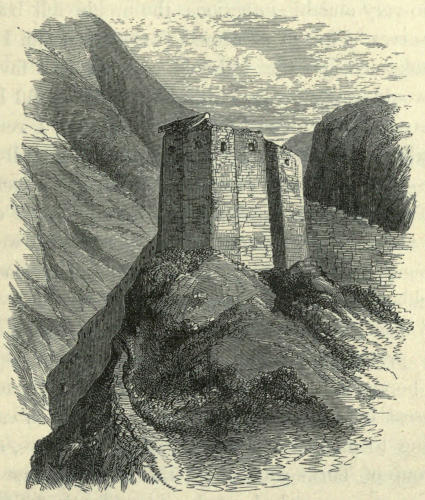
Old Castle of King Tvartko at Travnik.
While I was drawing this venerable ruin I became unpleasantly conscious that a battery of some kind or other was opening a lively fire on me from the rear, and presently, a larger stone than usual whizzing past my head, I thought it high time to make a reconnaissance, and looking round perceived that the enemy chiefly consisted of a lad of about fourteen. Seeing me get up with no very amiable intentions, the urchin fell back on his reserves, a group of armed Turks, to whom I made unmistakable signs that I should consider it a favour if they would restrain the enthusiasm of youthful Islâm; and having thus given vent to my feelings I returned tranquilly to my drawing. Then it was that a well-aimed missile—judging by the sensation it produced, larger than any of its predecessors—hit me on the middle of the back; and this time, being thoroughly roused, I went for our young artilleryman in such earnest that he made for a neighbouring house, and slamming the door, disappeared from my indignant view. Whereat, being still in a very pretty temper, I knocked at the door with my stick, hoping at least to wreak vicarious vengeance on the rascal by means of his parents. While in vain attempting to gain an interview with the inmates, one of the group of Turks with whom the boy had first taken refuge came up and shouted to me ‘Tursko! Tursko!’ meaning that the boy being a Turk might throw as many stones as he liked at the cursed Giaour.
Finally, as neither knocking nor thumping made any impression on the door, and myself beginning to recover from this ‘short madness,’ I went back to my original station, and was putting a few finishing touches to my sketch, when the door of refuge opened; the lad, accompanied by two armed Turks—one on either side—issued forth, and the three swaggered up to me to insult the dog of a Christian at their leisure.
This was more than mortal patience could stand. I got up, and, disregarding the menaces of the two self-constituted guardians, who, seeing that I meditated some act of personal chastisement on their protégé, shouted ‘Tursko! Tursko!’ ‘He’s a Turk! he’s a Turk!’ in tone as if they would bid me lick the dust off the urchin’s feet, I simply said, ‘Inglese!’[210] ‘I’m an Englishman!’ and gave the stripling a good hearty box on the ears. The rage of the Turks knew no bounds. For a moment they recoiled a few paces as if struck dumb with amazement; then, with a look of fury one of them drew his sword-knife and was making at me, but before he had time to disentangle it from its sash or its sheath, I was on him with my stick—happily a good heavy one—and the coward let go his handshar and took to his heels. The other Turk, who was beginning to draw his weapon, imitated the example of his mate; the boy ran off in another direction, and I was left in possession of the field. As, however, I was not prepared to withstand all Travnik in arms, and as it seemed possible that this spark might serve to kindle that conflagration of fanaticism which the official had warned us was imminent, I profited by the impression I had made to retreat in good order to our Han, where were my reserves and munitions; and with L⸺ once more by my side, and our revolvers in our hands, felt more at ease. Meanwhile there was an ominous hum in the town, and it was perhaps fortunate that a Zaptieh shortly arrived to escort us in the other direction to the Prefect of Police, as our French interpreter styled him, who demanded our immediate attendance.
On our way we passed through a kind of Champ de Mars, with a row of light field-pieces glittering in the sunshine, and swarming with a motley array of those organised brigands, the Bashi Bazouks. Drums were beating, trumpets were sounding, a Tartar messenger in his long coat was riding up post haste to the Konak, and large crowds of citizens were assembled to see a body of these Mahometan volunteers march out of the town for Banjaluka. It was becoming more and more unintelligible to us why troops against Herzegovinian insurgents should be wanted there, and the real truth that we were in for a Bosnian insurrection was beginning to dawn upon us.
These suspicions were confirmed by the official who had ‘wanted’ us. After re-inspecting our bujuruldu, he informed us, by means of an Italian interpreter, that we were on no account to go to Foinica (where was another Franciscan monastery), as we intended; that a Zaptieh was attached to us, and an Arabà provided to take us straight to Serajevo. So there was nothing for it but to start as if we acquiesced in the arrangement, without, however, in the least relinquishing our intentions. To the last we were taken (so it turned out) for Austrian emissaries, and it was thought desirable to prevent us from holding any communication with the Roman Catholic monks of Foinica.
So we started on our way, ostensibly bound for Serajevo, in a covered waggon, escorted by a Zaptieh, and left Travnik unmolested. The four hours’ jolt to Busovac, where we were to sleep, gave us sufficient experience of what a Turkish high-road can be. To cross a bridge was like driving over a row of fallen trunks, with the additional pleasing uncertainty as to whether or not the whole would give way and let us down into the stream below. As to the water-culverts over the lesser brooks, they were almost always broken in, but the horses were equal to the occasion, and always succeeded in jumping the cart over—which itself was springless. At one part we came to a newly-made piece of road, and this was like passing over a succession of heaps of unbroken stones. A precipice yawned at one side, and another cliff rose sheer above us on the other, so that when in the middle of this strait we came upon a monster waggon which had foundered in the vain attempt to make use of the new piece of road, and had taken root as it seemed among large blocks of rock, a serious stoppage occurred; and it was not until after considerable delay that all the levering and pushing and pulling, of our horses, ourselves, our driver, our Zaptieh, and the crew of the foundered waggon, could extricate our cart—which here performed the most extraordinary antics.
But here we are safe at our destination at last; nor are we sorry to have arrived, for our Zaptieh has shown unmistakable signs of insubordination. Once, to our great indignation, he swooped on some unfortunate rayahs, and, before we had time to prevent it, ‘requisitioned’ them of some bread, for which, to the great surprise of all parties, we paid, as the quickest way out of the difficulty: besides this, our escort and driver thought themselves privileged to drink raki at our expense at every Han they came to, till we took effectual means to disabuse them of the notion that we were going to pay for it!
The country we have been passing through is not so rich as the Possávina and the lower vale of Bosna; the crops generally were poor, the mountains were covered with less stately forest growth, and indeed out of the valleys the trees here became quite scrubby. Thus there is a comparative want of softness about the mountain scenery; the conical limestone hills, with their scrubby overgrowth, looking like frozen folds of green drapery, Düreresque in its stiffness and angularity.
Busovac, where we are stopping for the night, is a village of about 700 inhabitants, with a couple of mosques rising among low houses, each in its little enclosure with the shed for kukurutz, the small dwelling-house, the square hearth and fire-dogs, all as in Slavonia and Croatia, but on a smaller scale. Hearing that there was a Roman Catholic chapel here, we asked to be allowed to see it, and were conducted by the priest through some backyards and houses to a small shed, where a plain room was fitted up with an altar, a few crucifixes, and pictures. The priest conversed with us in Latin; he also knew a smattering of German. He was inclined to do full justice to the tolerance of the Turks, who, he said, did not molest the Latin Christians here in any way.
We entered our Han—which is a fair sample of the ordinary house of the better-off Mahometans in Bosnia—by an archway on either side of which are the stables and abodes of menials, and found ourselves in a court (a garden in private houses) from which we ascended by an out-door staircase to the Divanhané, a gallery running the whole length of the house, and overlooking the yard or garden, but secured from view by a lattice. From the middle of this a kind of transept runs out to the front of the house with a bay overlooking the street, and this recess is spread with mats and cushions for the usual mid-day siesta. On either side of this central hall are the rooms with doors opening on to the gallery. We found ours fairly clean, our Hanjia obliging, and altogether fared very well. Our repast consisted of a soup compounded of milk and rice, very fine trout, a chicken very well roasted, and succeeded by kaimak[211] with little bits of sugar floating in it—all excellent; so that it is possible to dine even in Bosnia.
Next morning we discovered to our sincere pleasure that our Zaptieh had levanted, so that we had less difficulty than we anticipated in adhering to our original itinerary and defying the Travnik authorities. We drove a few miles further on the Serajevo road in our waggon, and then, stopping at a roadside Han, informed our driver that we had no further need of his services. He seemed at first considerably taken aback at this coup, but as we gave him all that was his due had he carried us to the capital, we left him well satisfied. Our next care was to secure a guide over the mountains to Foinica, nor were we long in finding a peasant willing to conduct us. He only asked us to excuse him a few minutes, and presently returned with a serviceable cutlass—rather an ominous beginning to our mountain journey! Our way ran along a gradually ascending footpath winding over the undulations of the Zahorina Planina, and through beechy defiles—the trees not indeed so fine as those of Troghìr and Mazulia Planina, but very beautiful. The flowers and ferns were much the same as we had seen before, but the beech-fern now for the first time became plentiful, and so surpassing rich were the tufts of male fern that we seemed to be passing through a gigantic fernery. Now and then we emerged on glades and a few scattered fields, with huts surrounded by fruit-trees, and there were plenty of wild walnut-trees on the mountain itself.
As we ascended the main ridge we detected the first sign of the wealth stored up in the bowels of the mountain, from the mineral taste of the springs; and as we began to descend the southern slopes, the same cause seemed to blight the growth of beech and oak, and in some parts the mountain-side showed bare, while streaks of mica rock glittered like silver in the sunshine. The soil itself from a pale brown took rich ochreous hues, so that the range was not without its golden streaks as well. Here and there our path was strewn with bits of crystalline quartz, and we picked up pieces of iron, lead, and even—we believe—silver ore; and here and there fragments of noble crystals. At the summit our guide had left us, and a steep and rough descent brought us to the village of Foinica.
On our way down we passed some sooty-looking blacksmiths, and a mule laden with their stock-in-trade—theirs being the chief industry of the village. We crossed a bridge over a stream, and were threading our way along one of the narrow lanes of Foinica, when a hue and cry was raised behind us, of which at first we took no notice—on principle—till the sound of hurried footsteps close behind us told us that the demonstration, of whatever kind it was, could no longer be conveniently ignored; and, looking round, we discovered a Zaptieh making after us, and flourishing a pistol in a warlike manner. Then it was that we drew forth our magic pass, and there being someone by who could read it—an extraordinary occurrence—we were allowed to proceed on our way. As, however, we were attempting to ascend to the monastery, a barrack-like pile perched on a rocky platform above the town, another Zaptieh stopped us and bade us accompany him to the Konak, where we found a man who spoke Italian, and after a long preliminary ‘interviewing’ were told that the Kaïmakàm[212] desired to see us.
So we were conducted some way off to a garden by the stream, where we took his dignity at a disadvantage, for he was engaged, when we appeared on the scene, in the presumably unofficial act of dabbling in the shallow water, and was in a decided state of dishabille. However, he emerged on to terra firma, not the least disconcerted; and having, with due circumspection, arrayed himself in his dressing-gown and slippers, advanced towards us with undiminished grandeur, and went through the saluting process as if neither he nor ourselves had been conscious of each other’s presence till that moment. Then, bidding us take our seat upon mats spread upon the grass in the shade of a spreading pear-tree, he treated us to cigarettes and questioned us, by means of the Italian interpreter, as to the objects of our travelling and the places we had been to. While this was going on, several more Turks equally dignified made their appearance, arrayed in the long gowns of undress. These turned out to be the Mudìr, the Kadi, and the Imaum, each of whom went through the usual temena, or greeting, by touching in turn his head, mouth, and bosom, thereby intimating, in the majestic symbolism of the East, that in thoughts, words, and heart, he was equally loyal to us. From the subsequent arrival of a tepsia, several mysterious covers, and a roast lamb spitted in the usual way, we perceived that we were intruding on a pic-nic à la Turque, and accordingly expressed our desire of adjourning to the monastery, whither the Italian-speaking Effendi was dispatched to conduct us, the Kaïmakàm having first given orders that we should be provided with an arabà for our onward journey. The Kaïmakàm had previously asked us whether we were Romanists or Protestants, possibly not wishing us in the former case to have an opportunity of conversing with co-religionists.
Climbing up to the rocky height on which the monastery stood, we found ourselves in another cloistered court, not unlike what we had seen at Gučiagora. Outside was an old foliated cross, much the same as that which we had noticed at the other monastery, and dating, according to the monks, three hundred years back; but the buildings themselves were almost entirely of the present century. Inside the court we knocked at a door labelled in gold letters ‘Clausura;’ but no one opened it. Presently, however, a monk sauntered up from another direction, evidently to reconnoitre who the strangers might be before letting them into the sanctum—in troubled times a not unnecessary precaution. Seeing a Mahometan official with us he at once became, as the French say, boutonné; protested that there was nothing within worth our inspection; and when we told him our reason for visiting the monastery, which was to see the curious old Bosnian monuments contained there, went so far as to deny that any such existed.
We were beginning to despair of gaining admittance after this, and should probably have gone away without seeing the most interesting antiquity, perhaps, in the whole of Bosnia—the book, namely, of the Old Christian Nobility, as it existed before the conquest—had it not been for our old friend, the Major. In his official capacity Major Roskiević had obtained admission to this monastery. As an Austrian and a good Catholic, he had disarmed the suspicions of the monks, and had been admitted to a sight of their invaluable treasure. The Major, though as a rule he does not trouble himself about antiquities, had engraved one of the old designs illuminated in the book—the armorial bearings, namely, of the old kings of Bosnia; and as I happened to have copied and duly coloured this as an appropriate device for the outside of my note-book, and possible credentials to Bosniac Christians, I took it out of my pocket, and, as a last resource, held it up to the monk.
It proved an ‘open sesamé’ indeed! The monk, who thoroughly believed that no soul outside the monastic walls knew of the existence of the Book of Arms, much less that anyone possessed a facsimile of any of its illuminations, was visibly taken aback. The change that passed over his whole demeanour was most amusing. He no longer attempted to deny that the book we sought existed within, and was now as ready to welcome us inside as he had before been to keep us out. Another monk, who had come up during the conversation, which was held in Latin, went off to consult the Prior of the monastery, and there was something of the ‘Arabian Nights’ in the way in which the ‘Clausura’ door flew open, and a saintly vision of the Superior of the fraternity himself appeared above, beckoning us upstairs.
We were now ushered into a guest-room of much the same kind as at Gučiagora, and were treated with coffee and Bosnian wine in the same hospitable way, while the Prior and several of the brothers clustered round, and we conversed in German and Latin on our own travels, and the history and prospects of the country; the monks betraying that of the present state of affairs they knew more than they chose to tell. Presently, to our no small delight, the Prior went to an antique chest, and, unlocking it, brought out the old Book of Arms. It was enclosed in a worn vellum cover, and at the beginning was a Bosnian inscription, written in old Serbian characters, which, Englished, ran as follows:—
‘The Book of Arms of the Nobility of Bosnia or Illyria, and Serbia, together set forth by Stanislaus Rubčić, priest, to the glory of Stephen Némanja, Czar of the Serbs and Bosnians. In the year 1340.’[213]
Thus it was a monument of that most interesting moment in Bosnian history when, for a while, she formed part of that greater empire of the Némanjas, which seemed about to weld all the scattered Serbian populations between the Ægean, the Danube, and the Adriatic into one great State. It must not, however, be thought that this MS. itself dated back to the times of Czar Dūshan. The most cursory glance was sufficient to convince me that the book, in its present state, was a later copy. The designs were still mediæval, but the painting belonged to a period when the art of illuminating was almost dead. They were executed, not on parchment, as doubtless the original was, but on paper, which, however, was without any water-mark, and in places so polished by fingering as to look like vellum. The copyist, moreover, had left his mark in several mis-spelt and bungled words. That it was the original, as the monks asserted, cannot therefore for a moment be maintained, but I have no wish to deny that it was written previous to the Turkish conquest; and I warn any who may harbour such a wish that they have to reckon with Apostolic authority. At the beginning of the book is a short Latin note dated 1800, in which Gregorius, Episcopus Ruspensis, and Vicar Apostolic of Bosnia, certifies ‘that this codex has from time immemorial, namely, from the captivity of the kingdom of Bosnia, been zealously preserved by the reverend Franciscan brothers of the family of Foinica.’[214]
Upon the first page was blazoned the Queen of Heaven with the Child on her knees, seated on a golden half-moon. St. Mary was in the middle ages the tutelary goddess of Bosnia, and the crescent is the chosen emblem of Illyria. Next followed a picture of a saint attended by a lion, and intended, if the monks informed us rightly, to represent St. Martin.[215] This was succeeded by two saints beneath a cross, one of them holding a branch; these were Saints Cosmas and Damian, the doughty patrons of the Némanjas, whose effigies are still traceable among the rich frescoes of their chosen shrines.[216]
This, therefore, formed a fitting preface to the armorial bearings of the great Serbian Czar himself. Above the shield appeared a crowned helmet, whose crest was the double-headed eagle of empire, supporting another rayed crown. On either side were two other casques, each crested with two lions,—I take it, from a Macedonian den,—crowned and guardant. The shield itself was divided into eleven compartments; in the centre reappeared the double eagle of the Némanjas, argent on a field gules, and round this were quartered the arms of all the provinces of his empire. Here was the red, crowned lion of Macedonia (this alone appeared in two quarters); the Moorish trophies of Bosnia; the Slavonian leash of hounds; the three bearded kings of Dalmatia; the chequers, gules and argent of Croatia; the rampant lion of Bulgaria; the Serbian battle-axes; the three horse-shoes of Rascia; the armour-cased arm of Primorie, holding aloft her sable scimetar.
The original of this comprehensive escutcheon was devised fifteen years before Czar Dūshan marched with such sanguine hopes to seize Byzantium; and already we see him claiming sway over a territory which embraces the southern provinces of modern Austria, and the greater part of Turkey-in-Europe. The Eastern question was nearer a felicitous solution then than it ever has been since! Had Dūshan found a successor worthy to support his shield, or to wear the double-eagled casque, in all human probability the Turk would never have made good his footing in Europe, the dotard Greeklings of Byzantium would have given place to a youthful power capable of acting as the champion of Christendom and of competing successfully with the civilization of the West; and the different destiny of these Sclavonic lands might nowhere have been more conspicuous than in this very valley—so rich in the mineral wealth of nature, so deficient in human industry! Dîs aliter placitum; and were Czar Dūshan himself to return from the grave, he might well shrink from the attempt to form anew the Serbian empire; or if he attempted to cut the knot of complications by the sword, he would find himself opposed not only by Turkish scimetars, but more effectually by the ignoble jealousies of Christendom; and, in a last resort, by the arms of military monarchies, whose rulers prefer to have for neighbours decrepit infidels whom they can bully at their pleasure, to see a Christian State rise on their borders, which might some day form a healthy rival!
After the arms of Stephen Dūshan follow those of the various Illyrian provinces in detail, as being more immediately involved in this Armorial of Nobility. Illyria herself as a unity does not figure in the Czar’s shield, but her crescent beneath a star of eight points follows, argent on a field gules. This design appears in the centre of the Bosnian arms; to betoken—so the monks assured us—that Bosnia is the heart of Illyria. One is at once struck with its general resemblance to the star and crescent of the Turks, though their star is at one side of the moon instead of above it. Indeed the presence of these emblems on the Bosnian arms has given rise to the erroneous idea that they were imposed by the Turks as a badge of suzerainty on their conquest of the country.[217] The monks, however, were undoubtedly right in referring the star and crescent on the Bosnian shield to her Illyrian connexions; and in fact, in the title at the beginning of the book, Bosnia and Illyria are made synonymous.

Bosnian Armorial Bearings.
Besides the star and crescent, the Bosnian arms consisted of two crossed stakes, sable on ground or, each surmounted by the head of a Moorish king. These trophies appeared in the arms of several of the nobles contained in the volume, and recalled the long struggles of the Sea Serbs with the African corsairs. The early annals of Ragusa—or, as the Serbs call her, Dubrovnik, who often stood in peculiarly close relations with Bosnia, being practically her seaport and emporium—are much occupied with these Saracenic infestations, which extended along the whole Serbian coastland to Albania, and at one time desolated the Bocche di Cattaro. These trophies bear interesting witness to the deep impression left by those struggles on the national mind; and point to those early days when Trajekto on the Bocche di Cattaro was the residence of a Bosnian Ban.[218]
The scimetar on the arms of Primorie, or Serbia-on-the-Sea, seems to refer to these same struggles, and I cannot help suspecting that here is also to be found the true clue towards solving the mystery of the appearance of the star and crescent on the Illyrian escutcheon. The Moslems had early appropriated the old Byzantine half-moon,[219] and Richard Cœur de Lion, on returning from his wars in Palestine, added it as a Saracenic trophy to his royal seal. The moon and stars appear on the Irish coins of John. Nothing could have been more natural than for the Illyrian Serbs engaged in the long contests with the Saracen corsairs to have added this device to their shields for the same reason.
Following the escutcheons of the various Illyrian kingdoms come those of the nobility—there being no less than 126 families whose armorial bearings are blazoned in this book. How much is here to throw a light on the extension of Western ideas over the old Serbian area! How much to illustrate the national history, the national customs—aye, even the old Sclavonic mythology; how much to recall the origin of illustrious dynasties! I have spoken of the Némanjić ensigns; here, too, were the Castriotić, belonging to the family of Scanderbeg—again, a double-eagle, sable on or, and eagle crest to the helm—the arms of the royal house of Bosnia that was to be—the Tvartkoević shield semé of golden fleurs de lys. In many of the arms might be detected a curious play on words. The Kopiević arms, for example, had four lances, in allusion to the Bosnian word for a lance, Kopje. Brzo is the native word for ‘quick,’ and the device of the Barzoevic family is a fish in water. More interesting still is the occasional cropping up of the heathen Sclavonic mythology—chiefly seen in the frequent appearance of zmaje or dragons, who play so important a part in Serbian folk-lore; and—more fascinating than these fire-drakes—the Vila herself appears on the shield of the Mergnjavić—long-haired and devoid of raiment as in Serbian poetry: the guardian nymph of the race, holding aloft the eagle banner of empire.
The book appropriately concluded with a shield charged with the armorial bearings of the united Bosnian Nobility; and the monks, with an enthusiasm worthy of record, pointed out the motto—read by the light of after events, not without its pathos—Semper Spero.
As this heraldic pageant passes before us—these knightly shields and helms, with their crests, supporters, and accoutrements—the imagination is kindled to realize how these isolated regions fitted once into the polity of mediæval Europe. Here, too, in these barbarous neglected lands, the romantic brilliance of chivalry has once held sway. For a moment the Paynim surroundings are forgotten—we wake, and find ourselves still within the limits of Christendom militant. We hear the herald’s trump. The barriers that to-day wall off Bosnia from the West sink at the potent blast like the towers of some Eastern magician. The names, the armorial bearings, recall the European cousin-hood of that hierarchy of birth. In due order among the escutcheons of Bosnian nobles appears the shield of the Frangepani; that of the Rusciević family reproduces the oriflamme of France: next in order, by a curious coincidence, follows that of the Sestrićić, strewn with Tudor roses.[220] Perhaps it would be impossible for any other monument to recall more vividly than this Book of Arms, at once the futile dreams of Serbian empire, the wreck of Bosnian kingship, and that dastardly abjuration by her nobles of country and belief.
Or what fitter repository for such a monument than this Minorite monastery? Here, perhaps, better than anywhere else, one perceives how it is among these Franciscan brotherhoods that the traditions of the old Bosnian kingdom most live on. The genealogic lore evinced by the monks with regard to the old nobility was quite surprising to us; they seemed to have the pedigrees by heart; they betrayed sources of information not open to the outside world. To understand how this happens one need only call to mind that for the most part the royal race and magnates were in fact but a Roman Catholic minority, holding sway over heretics and Greeks, and that next after the Magyar battle-axe, their mainstay lay in the influence and organisation of these very monks. Thus it befell that, when the crash came, these Franciscan brotherhoods emerged, the only stable remnant from the wreck of the old régime. It was in their cloisters that the surviving supporters of Bosnian loyalty rallied; and those who in that supreme moment of national prostration would neither fly nor play the renegade, found safety in the bosom of the Church. The monks confided to us that two of the noble families of Bosnia were still represented in the fraternity—the Aloupović and Radieljević.
Others, without actually taking the cowl, seem to have found retirement from generation to generation, under shadow, as it were, of the monastery. In the village of Foinica below, a poor rayah family perpetuates the noble race of Kristić; and—more interesting still—the Christian inmates of another Foinican hovel still exult in the royal name of Tvrdkoiević, and preserve the lineage of those Bosnian kings whose mighty castles we have seen at Doboj, Tešanj, and Travnik.
The Franciscans were, in fact, put forward to make terms for Catholic Bosnia with the conqueror; and it was the head of the Foinica brotherhood, Angelo Zvizdović, who took the lead; and advancing like a new Leo to the camp of the terrible Sultan, gained from Mahomet II., on the field of Milodraz in 1463, the great charter of the Franciscans. This was the Atname.[221] The Sultan, in this firman, orders that no one shall in any way molest the Bosnian brothers, either in their person, or their property, or their churches; that those who have fled the realm may return, and that the brothers may bring any person they choose from foreign parts into the country. ‘And I swear by the great God, the creator of heaven and earth, by the seven books, by the great prophets, by the 124,000 prophets, and by the sabre which I wear, that no one shall act counter to these commands so long as these monks do my bidding and are obedient to my service.’
Nor need it surprise us that it was to Foinica that Roman and aristocratic Bosnia turned in the hour of need. The local history of the district is bound up with that of the old kings and nobles. Foinica was originally a royal domain, and this monastery of the ‘Holy Spirit’ (Svéta Duša) in all probability owes its origin to the piety of the kings, whose usual residence, Sutiska, was not far off. From the royal race of the Tvartkos it passed to one of the noblest of the noble families whose shields we have been surveying; to that, namely, of Mergnjavić, they of the Vila crest. The hereditary possessions of this house lay at Naissus (Nissa) in Serbia; and coming from the birthplace of Constantine they modestly traced their descent from the fourth king of Rome! After the Turkish conquest of Bosnia, some members of the family fled, or, as they doubtless put it to themselves, returned, to the Eternal City. Here one of its scions, a certain John Tomko, published in 1632 the family archives—‘The Proofs of the Antiquity and Nobility of the Marcian Family, vulgarly known as Marnavić.’[222] Thus we possess, in Latin translations, some of the original deeds by which Foinica was given and confirmed to this Marcia gens; and as they are, I suppose, the only documents of the kind relating to Bosnia which have been preserved, I may be permitted to allude to them.
The first grant is by King Stephen Dabiscia, otherwise known as Tvartko II., to Goiko Mergnjavić. ‘Seeing that when Bajazet with the Turks came and stood in Naglasinci,’[223] and destroyed Bosnia, then came Goiko Mergnjavić and helped us to slay the Turks. And I, King Dabiscia, was with all the province of Bosnia, and with the Bosnians; and I acted in full council with all the province of the Bosnian realm, and gave and presented and confirmed to Goiko Mergnjavić, Foinica, and the plain of Godalie in the territory of Imoteschi, both to him and his heirs, and his latest posterity for ever. Amen.’[224] The original of this was in the old Cyrillian or Illyrian characters and in the Bosnian tongue.[225]
This grant appears to have been renewed or confirmed to another Mergnjavić, in consideration of services equally distinguished, by King Tvartko III. The second grant, like the other, originally written in the native language, runs as follows:—
‘We, Stephen Tvartko Tvartkoević, King of Serbia, Bosnia, Primorie, Dalmatia, of the Western part of Lower Croatia, of Ussora, Sala, Podrinia, &c., with the consent of the realm, and according to the custom of the magnates of every grade, to the Prince John Mergnjavić, of Nissa, for the faithful services he rendered us in our need, when Murat (Amurath), the Turkish Czar, was wroth with us and wasted our dominions; for that then the said John Mergnjavić of Nissa went to the Porte, not sparing his own head for our sake, and found grace for us before the Czar, and rid our realm from his host: we, therefore, grant to him his own portion at Nissa, and Zvornik, and Nissava, and in the realm of Bosnia the country of Foinica,[226] and the land under Thum. And it is our will that this be not taken away from him for any breach of fealty which shall not first have been examined by the Bosnians and the Bosnian Church.’ As witnesses appear the Starosts (elders) of the kingdom, the Palatine with his brothers, the Župan Drina Driničić, the other palatines and Princes, and the Aulic marshal of the court. The whole is ‘written by the scribe Radoslav, Aulic of the great and glorious lord King Tvartko, in his residential seat of Sutiska, in the year 1426.’
To this was appended the great seal of King Tvartko, attached by red silk: on one side appeared the king seated on the throne of majesty crowned and sceptred; on the other as a knight on horseback, holding shield and lance.
When in 1448 the great Hungarian general, John Hunyadi, defeated by Sultan Amurath on the ill-omened field of Kóssovo, was seized in his flight by George, Despot of Serbia, and imprisoned in the fortress of Semendria, he owed his deliverance to another scion of the race, George Mergnjavić, perpetual Count of Zvornik and lord of Foinica, who hurried to his relief with a strong body of troops collected from his territories; and a deed in which Hunyadi confirms this George in his possession bears witness to his gratitude. George Mergnjavić is succeeded by his nephew Tomko, who, besides being lord of Foinica, appears in the deed in which Hunyadi and Ladislaus, king of Hungary, confirm his titles, to be ‘Chief Voivode of the Kingdom of Bosnia.’ The last donation to the ‘Marcian’ family is from Mathias Corvinus, who in 1460, six years after the overthrow of the Bosnian kingdom by the Turks, confirms to Tomko Mergnjavić, Magnificent Count of Zvornik, lord of Foinica, and Starost of the kingdom of Rascia, his ‘mills, mines, vineyards, fishpools, and weirs’ (aquarum decursus), of which the Ban of Slavonia was attempting to deprive him.
But we must attend to the lords of modern Foinica! A Zaptieh brings a message from the Kaïmakàm to say that he and the Kadi are about to drive to Kisseljak, our own destination, and to offer us a lift in one of their carriages; so, being for many reasons anxious to push on, we declined the pressing invitation of the monks to dine and pass the night with them, and descending once more to the village found an arabà waiting for us outside a Han, where we had ordered some eatables. The arabà—an ordinary country waggon, only provided with a better harness—belonged to the Kadi, but the Kaïmakàm had taken him into his carriage—a more sumptuous equipage—in order to provide room for us. We started therefore under good auspices, these two functionaries acting as our vanguard. Nor did the courtesy of the Turks stop here, for they had given our driver a supply of rosy apples and a sweet red-fleshed melon wherewith to serve us at intervals during the drive. About half-way down the Foinica valley our cortége stopped at a little roadside Han, where the Kaïmakàm motioned us to sit down by him on an open-air divan, canopied by shady branches and overhanging the stream; and while he treated us to coffee and water-melon both he and our Kadi reaped a quiet enjoyment by extending their hospitality to some fishes below.
The pebbles in the bed of the stream are stained of a rich brown and orange with the iron ore in which the valley abounds. On the flanks of the mountains, on either side, might here and there be detected huge scars and traces of old excavations. These are the mines of gold and silver worked of old by the Romans, and later on by the Ragusans, but now untouched. We are in the very midst of the mineral treasury of Bosnia. This vale of Foinica contains, besides these precious metals, lead ore, arsenic, quarries (unworked) of slate; and in a tributary gorge which we had seen running south-east, cinnabar, rich in quicksilver.[227] A little lower down, just where the Foinica stream runs into the Lepenica, the valley opened out considerably and formed an alluvial plain. Here and there among the stunted vegetation a column of blue smoke marked out a rude forge, where a little iron, the only metal exploited, is smelted to be converted into shovels, horse-shoes, and sundry tools and weapons for Bosnian home consumption. A few miles further down the Lepenica debouches into the valley of the Bosna, which is described as one vast coal-field.
Were we, one kept asking oneself, passing through what some day may become one of the Black Countries of Europe? Would, as the world grew older, something of the tremendous energy of our Midlands burst forth upon this stagnant valley—blasting, boring, blackening, metamorphosing its every feature? Mountains rose around us overgrown with primeval forest—habitations were few and far between. What there were, were miserable hovels—each in its mangy patch of maize—more ruinous than any we remembered having seen in Bosnia. It was hard to transform such into the busy streets of a great city—the silence of the woods seemed too inveterate to be ever broken by the crash of a steam-hammer. The hornpipe performed by our waggon, over what the Turks were pleased to call a road, was a positive relief to such desolation; and yet what stretch of imagination could convert it into an iron-way, or our ambling Bosnian pony into a locomotive? We seemed, however, to detect one little omen of the future, and accepted the augury: at one spot the foliage of some neighbouring beech-trees had been browned away prematurely by the fumes of a primitive forge.
And why, it will reasonably be asked, is all this mineral wealth allowed to rust in the bosom of mother earth? Are there not miners in plenty who go further afield than Bosnia in search for precious metals? Yes. But in Australia, even in California, there is something like civilized government. There are railways—there are roads; those in authority do not look upon the successful digger as their natural prey. They are, at any rate, too canny to kill the goose with the golden egg.
But here, not only are there natural obstacles serious in any country, but before any mining can be set on foot a long stretch of road must first be made, to be kept up at the expense of the projectors; add to this, that even when an avenue to one of the highways of the country is thus opened out, it will probably be found impossible to conduct traffic of any magnitude along them; and that there is scarcely a bridge in the country which would support the weight of a heavy load of ores.
But even were these obstacles overcome, there are others of a political nature fatal at the very outset to such enterprises. To take a single instance. Over the hills to the south-east of Foinica, near the Franciscan monastery of Kreševo, are veins of cinnabar and quicksilver, which have been estimated to be as rich as any in Europe. So rich in fact are they, that a German company were tempted to believe that, despite the expenses of preliminary road-making and outlay of another kind, it might pay to work them. But a concession must first be obtained at Stamboul, and nothing can be obtained at that sink of all human corruption without copious bribery. The company began in good spirits; they made first one ‘present’ and then another; but months passed, the demands of the Sultan’s ‘advisers’ grew more and more exorbitant, and the prospect of obtaining the required permission more remote, till, seeing themselves in a fair way to be ruined before they could begin, they gave up their enterprise as hopeless. Precisely the same causes have prevented the working of the vast coal measures of the Bosna!
There is one remarkable phenomenon in connection with these ore-bearing districts, which must strike anyone who examines the distribution of population in Bosnia; and that is, that these former centres of mining activity are at the present day the strongholds of the Roman Catholic population of the country.
Can it be merely accidental that three of the chief Roman Catholic monasteries in the country—Foinica, Kreševo, and Sutiska—are each placed in the very focus of the richest mineral areas in the province?[228]
No, surely, it is not fortuitous. It is rather the result of a chain of causes, reaching far back into the past, and which, if I read them rightly, are explanatory of much that is most characteristic and least intelligible in Bosnian history. Stated baldly, I cannot doubt that the presence of the Catholic population and their monastic seats in the mining districts of Bosnia is ultimately due to the Roman conquest, or—if we may single out a man—to Q. Asinius Pollio.
Cui laurus æternos honores Dalmatico peperit triumpho.
There seems no good reason for doubting that many of these deserted mines, such as those that scar the mountain sides about Foinica, were the work of Roman miners. A Roman road, for example, has been traced almost to the western foot of this range, connecting it with Dalmatia. In the time of the Romans no less than 50 lbs. of gold was turned out daily by these Illyrian miners, and despatched to Rome by the Provost of the Dalmatian treasury[229] at Salona.
When the Nations possessed themselves of the Western Empire, Epidaurus and the Dalmatian cities still continued to be islands of pure Romanity; and besides their Roman municipal institutions and their ecclesiastical connection with Rome, these cities may also have preserved some record of these inland deposits of precious metals, and some knowledge of where to look for them. This, at least, is certain, that when the Epidauran republic lived again at Ragusa, her sons sought out the vestiges of the older Roman mines of Illyria, and opened them out anew, so that the former scenes of Roman industry became the chief commercial centres in these barbarous lands. Nor would Ragusa fail to play her allotted part of interpreter between Rome and the southern Sclaves. It is not to be wondered at that in these neighbourhoods Christianity of a purely Roman character should have taken root: and in the days of heresy this connection with Catholic Ragusa would perpetually keep alive influences favourable to the Church.
We can well understand that the superior civilization and wealth of these mining districts would react on the indigenous nobility. Doubtless many noble families actually owed their position to wealth acquired from a mine opened on their lands by these enterprising traders. Many would naturally draw round these small civilised centres. To this Ragusan influence I would therefore refer, not only the peculiarly Roman Catholic character of the population of these mining districts, but also much of the Roman sympathies of the ruling caste. Thus it is not only the Roman Catholic monasteries that are found in connection with the scenes of old Ragusan activity, but also the favourite residences of the Bosnian kings; so that in the neighbourhood of the chief Ragusan castle and trading settlement—called Dubrovnik, after the Sclavonic name of the mother city—rose both the monastery of Sutiska, and the old town of Bobovac, where the Tvartkos once sate in majesty. They are over the hills, to the north-east of Foinica.
Nor is this far-reaching concatenation of causes and effects without its bearings on the future as well.
If in the course of time Bosnia should enter once more into the civilised system of Europe—if these now unused mines were to be opened out anew, it must be evident that such an industrial development would once more place the chief wealth, and therefore the chief influence, in the country in the hands of the Roman Catholic minority; in other words, in the hands of the only portion of the inhabitants who at the present day still treasure the memories[230] of the old Bosnian kingdom.
But we are entering Kisseljak, and stop at what is unquestionably the best hotel in Bosnia, and where, for the first time since our arrival in the country, we obtain—beds! Kisseljak is in fact the fashionable Bosnian Spa. Just outside our hostelry, under a kiosque, bubble up the waters celebrated throughout the length and breadth of the land. ‘In taste,’ as L⸺ remarked, ‘it is like flat seltzer-water with a soupçon of flat-irons.’ Mixed, however, with red coinica wine, it becomes a livelier, and, as we thought, a very agreeable beverage. It is said to be very good for complaints of stomach and liver; and quite a colony had collected in the neighbourhood of the sources, not only to drink the waters, but to bathe in them—certain sheds containing wooden baths being built for the latter purpose. The wealthier people, who were chiefly Spanish-speaking Jews from Serajevo, were lodged at the almost European hotels; the other ranks of society sheltering themselves, according to their means, in humbler abodes, and the poorest, of all camping about the valley like gipsies.
It was while drinking the waters that we first became the recipients of tidings which, in our then position, might be considered somewhat sensational, which were calculated to cast a new light on some of our recent experiences, and which may fitly open a new chapter of our pilgrimage.