IN HONDURAS
Reading edition
I

TEGUCIGALPA is the odd name of the capital of the republic of Honduras, the least advanced of the republics of Central or South America.
Somerset had learned that there were no means of getting to this capital from either the Pacific Ocean on one side or from the Caribbean Sea on the other except on muleback, and we argued that while there were many mining-camps and military outposts and ranches situated a nine days’ ride from civilization, capitals at such a distance were rare, and for that reason might prove entertaining. Capitals at the mouths of great rivers and at the junction of many railway systems we knew, but a capital hidden away behind almost inaccessible mountains, like a monastery of the Greek Church, we had never seen. A door-mat in the front hall of a house is useful, and may even be ornamental, though it is never interesting; but if the door-mat be hidden away in the third-story back room it instantly assumes an importance and a value which it never could have attained in its proper sphere of usefulness.
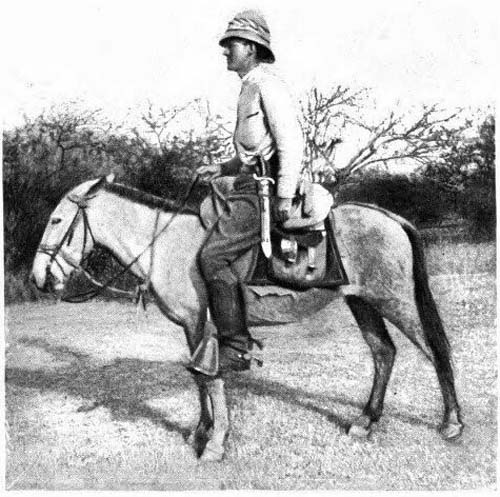
OUR NAVAL ATTACHÉ
Our ideas as to the characteristics of Honduras were very vague, and it is possible that we might never have seen Tegucigalpa had it not been for Colonel Charles Jeffs, whom we found apparently waiting for us at Puerto Cortez, and who, we still believe, had been stationed there by some guardian spirit to guide us in safety across the continent. Colonel Jeffs is a young American mining engineer from Minneapolis, and has lived in Honduras for the past eleven years. Some time ago he assisted Bogran, when that general was president, in one of the revolutions against him, and was made a colonel in consequence. So we called him our military attaché, and Griscom our naval attaché, because he was an officer of the Naval Brigade of Pennsylvania. Jeffs we found at Puerto Cortez. It was there that he first made himself known to us by telling our porters they had no right to rob us merely because we were gringos, and so saved us some dollars. He made us understand at the same time that it was as gringos, or foreigners, we were thereafter to be designated and disliked. We had no agreement with Jeffs, nor even what might be called an understanding. He had, as I have said, been intended by Providence to convey us across Honduras, and every one concerned in the outfit seemed to accept that act of kindly fate without question. We told him we were going to the capital, and were on pleasure bent, and he said he had business at the capital himself, and would like a few days’ shooting on the way, so we asked him to come with us and act as guide, philosopher, and friend, and he said, “The train starts at eight to-morrow morning for San Pedro Sula, where I will hire the mules.” And so it was settled, and we went off to get our things out of the custom-house with a sense of perfect confidence in our new acquaintance and of delightful freedom from all responsibility. And though, perhaps, it is not always best to put the entire charge of an excursion through an unknown country into the hands of the first kindly stranger whom you see sitting on a hotel porch on landing, we found that it worked admirably, and we depended on our military attaché so completely that we never pulled a cinch-strap or interviewed an ex-president without first asking his permission. I wish every traveller as kindly a guide and as good a friend.
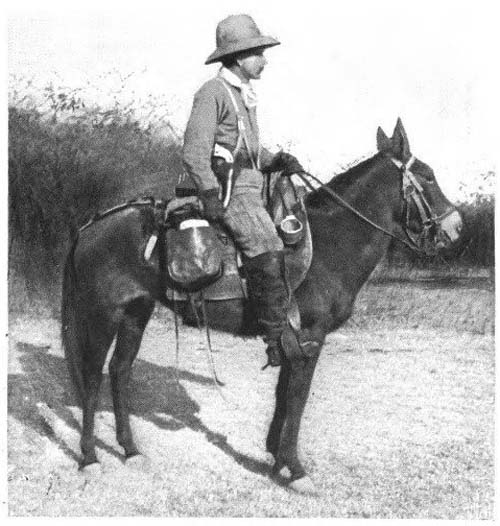
OUR MILITARY ATTACHÉ
The train to San Pedro Sula was made up of a rusty engine and three little cars, with no glass in the windows, and with seats too wide for one person, and not at all large enough for two. The natives made a great expedition of this journey, and piled the cramped seats with bananas and tortillas and old bottles filled with drinking-water. We carried no luncheons ourselves, but we had the greater advantage of them in that we were enjoying for the first time the most beautiful stretch of tropical swamp-land and jungle that we came across during our entire trip through Honduras. Sometimes the train moved through tunnels of palms as straight and as regular as the elms leading to an English country-house, and again through jungles where they grew in the most wonderful riot and disorder, so that their branches swept in through the car-windows and brushed the cinders from the roof. The jungle spread out within a few feet of the track on either side, and we peered into an impenetrable net-work of vines and creepers and mammoth ferns and cacti and giant trees covered with orchids, and so tall that one could only see their tops by looking up at them from the rear platform.
The railroad journey from Puerto Cortez to San Pedro Sula lasts four hours, but the distance is only thirty-seven miles. This was, until a short time ago, when the line was extended by a New York company, the only thirty-seven miles of railroad track in Honduras, and as it has given to the country a foreign debt of $27,992,850, the interest on which has not been paid since 1872, it would seem to be quite enough. About thirty years ago an interoceanic railroad was projected from Puerto Cortez to the Pacific coast, a distance of one hundred and forty-eight miles, but the railroad turned out to be a colossal swindle, and the government was left with this debt on its hands, an army of despoiled stockholders to satisfy, and only thirty-seven miles of bad road for itself. The road was to have been paid for at a certain rate per mile, and the men who mapped it out made it in consequence twice as long as it need to have been, and its curves and grades and turns would cause an honest engineer to weep with disapproval.
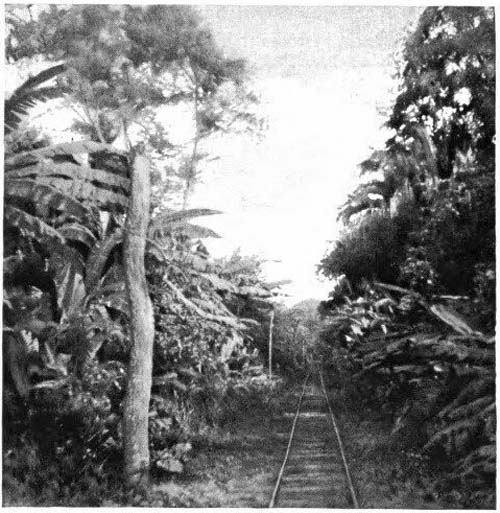
A STRETCH OF CENTRAL-AMERICAN RAILWAY
The grades are in some places very steep, and as the engine was not as young as it had been, two negro boys and a box of sand were placed on the cow-catcher, and whenever the necessity of stopping the train was immediate, or when it was going downhill too quickly, they would lean forward and pour this sand on the rails. As soon as Griscom and Somerset discovered these assistant engineers they bribed them to give up their places to them, and after the first station we all sat for the remainder of the journey on the cow-catcher. It was a beautiful and exhilarating ride, and suggested tobogganing, or those thrilling little railroads on trestles at Coney Island and at the fêtes around Paris. It was even more interesting, because we could see each rusty rail rise as the wheel touched its nearer end as though it meant to fly up in our faces, and when the wheel was too quick for it and forced it down again, it contented itself by spreading out half a foot or so to one side, which was most alarming. And the interest rose even higher at times when a stray steer would appear on the rails at the end of the tunnel of palms, as at the end of a telescope, and we saw it growing rapidly larger and larger as the train swept down upon it. It always lurched off to one side before any one was killed, but not until there had been much ringing of bells and blowing of whistles, and, on our part, some inward debate as to whether we had better jump and abandon the train to its fate, or die at our post with our hands full of sand.
We lay idly at San Pedro Sula for four days, while Jeffs hurried about collecting mules and provisions. When we arrived we insisted on setting forth that same evening, but the place put its spell upon us gently but firmly, and when we awoke on the third day and found we were no nearer to starting than at the moment of our arrival, Jeffs’s perplexities began to be something of a bore, and we told him to put things off to the morrow, as did every one else.
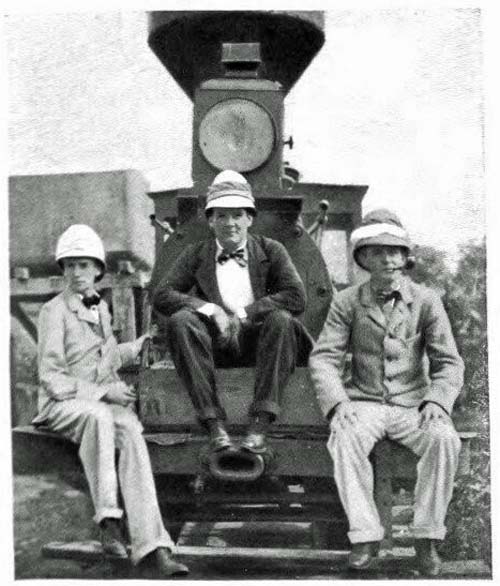
THE THREE GRINGOS
San Pedro Sula lay in peaceful isolation in a sunny valley at the base of great mountains, and from the upper porch of our hotel, that had been built when the railroad was expected to continue on across the continent, we could see above the palms in the garden the clouds moving from one mountain-top to another, or lying packed like drifts of snow in the hollows between. We used to sit for hours on this porch in absolute idleness, watching Jeffs hurrying in and out below with infinite pity, while we listened to the palms rustling and whispering as they bent and courtesied before us, and saw the sunshine turn the mountains a light green, like dry moss, or leave half of them dark and sombre when a cloud passed in between. It was a clean, lazy little place of many clay huts, with gardens back of them filled with banana-palms and wide-reaching trees, which were one mass of brilliant crimson flowers. In the centre of the town was a grass-grown plaza where the barefooted and ragged boy-soldiers went through leisurely evolutions, and the mules and cows gazed at them from the other end.
Our hotel was leased by an American woman, who was making an unappreciated fight against dirt and insects, and the height of whose ambition was to get back to Brooklyn and take in light sewing and educate her two very young daughters. Her husband had died in the interior, and his portrait hung in the dining-room of the hotel. She used to talk about him while she was waiting at dinner, and of what a well-read and able man he had been. She would grow so interested in her stories that the dinner would turn cold while she stood gazing at the picture and shaking her head at it. We became very much interested in the husband, and used to look up over our shoulders at his portrait with respectful attention, as though he were present. His widow did not like Honduranians; and though she might have made enough money to take her home, had she consented to accept them as boarders, she would only receive gringos at her hotel, which she herself swept and scrubbed when she was not cooking the dinner and making the beds. She had saved eight dollars of the sum necessary to convey her and her children home, and to educate them when they got there; and as American travellers in Honduras are few, and as most of them ask you for money to help them to God’s country, I am afraid her chance of seeing the Brooklyn Bridge is very doubtful.
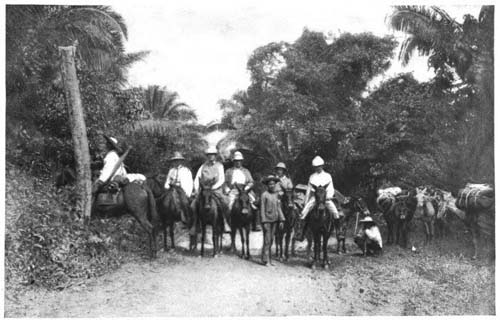
SETTING OUT FROM SAN PEDRO SULA
We contributed to her fund, and bought her a bundle of lottery tickets, which we told her were the means of making money easily; and I should like to add that she won the grand prize, and lived happily on Brooklyn Heights ever after; but when we saw the list at Panama, her numbers were not on it, and so, I fear, she is still keeping the only clean hotel in Honduras, which is something more difficult to accomplish and a much more public-spirited thing to do than to win a grand prize in a lottery.
We left San Pedro Sula on a Sunday morning, with a train of eleven mules; five to carry our luggage and the other six for ourselves, Jeffs, Charlwood, Somerset’s servant, and Emilio, our chief moso, or muleteer. There were two other mosos, who walked the entire distance, and in bull-hide sandals at that, guarding and driving the pack-mules, and who were generally able to catch up with us an hour or so after we had halted for the night. I do not know which was the worst of the mosos, although Emilio seems to have been first choice with all of us. We agreed, after it was all over, that we did not so much regret not having killed them as that they could not know how frequently they had been near to sudden and awful death.
The people of Honduras, where all the travelling is done on mule or horseback, have a pretty custom of riding out to meet a friend when he is known to be coming to town, and of accompanying him when he departs. This latter ceremony always made me feel as though I were an undesirable citizen who was being conveyed outside of the city limits by a Vigilance Committee; but it is very well meant, and a man in Honduras measures his popularity by the number of friends who come forth to greet him on his arrival, or who speed him on his way when he sets forth again. We were accompanied out of San Pedro Sula by the consular agent, the able American manager of the thirty-seven miles of railroad, and his youthful baggage-master, a young gentleman whom I had formerly known in the States.
Our escort left us at the end of a few miles, at the foot of the mountains, and we began the ascent alone. From that time on until we reached the Pacific Ocean we moved at the rate of three miles an hour, or some nine leagues a day, as distances are measured in Honduras, ten hours being a day’s journey. Our mules were not at all the animals that we know as mules in the States, but rather overgrown donkeys or burros, and not much stouter than those in the streets of Cairo, whether it be the Street in Cairo of Chicago, or the one that runs in front of Shepheard’s Hotel. They were patient, plucky, and wonderfully sure-footed little creatures, and so careful of their own legs and necks that, after the first few hours, we ceased to feel any anxiety about our own, and left the entire charge of the matter to them.
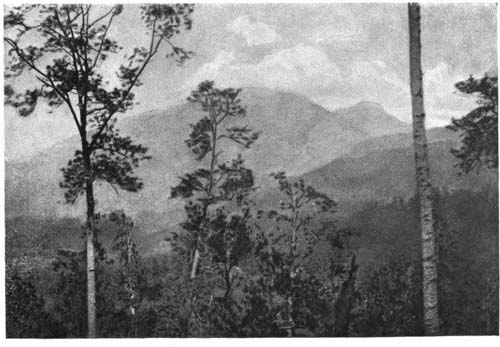
THE HIGHLANDS OF HONDURAS
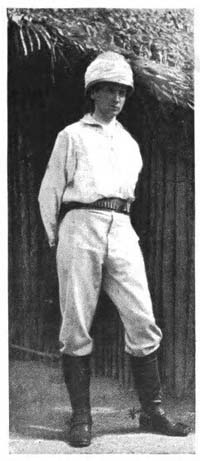
SOMERSET
I think we were all a little startled at sight of the trail we were expected to follow, but if we were we did not say so—at least, not before Jeffs. It led almost directly up the face of the mountain, along little ledges and pathways cut in the solid rock, and at times was so slightly marked that we could not see it five yards ahead of us. On that first day, during which the trail was always leading upward, the mules did not once put down any one of their four little feet without first testing the spot upon which it was to rest. This made our progress slow, but it gave one a sense of security, which the angle and attitude of the body of the man in front did much to dissipate. I do not know the name of the mountains over which we passed, nor do I know the name of any mountain in Honduras, except those which we named ourselves, for the reason that there is not much in Honduras except mountains, and it would be as difficult to give a name to each of her many peaks as to christen every town site on a Western prairie. When the greater part of all the earth of a country stands on edge in the air, it would be invidious to designate any one particular hill or chain of hills. A Honduranian deputy once crumpled up a page of letter-paper in his hand and dropped it on the desk before him. “That,” he said, “is an outline map of Honduras.”
We rode in single file, with Jeffs in front, followed by Somerset, with Griscom and myself next, and Charlwood, the best and most faithful of servants, bringing up the rear. The pack-mules, as I have said, were two hours farther back, and we could sometimes see them over the edge of a precipice crawling along a thousand feet below and behind us. It seemed an unsociable way for friends to travel through a strange country, and I supposed that in an hour or so we would come to a broader trail and pull up abreast and exchange tobacco pouches and grow better acquainted. But we never came to that broad trail until we had travelled sixteen days, and had left Tegucigalpa behind us, and in the foreground of all the pictures I have in my mind of Honduras there is always a row of men’s backs and shoulders and bobbing helmets disappearing down a slippery path of rock, or rising above the edge of a mountain and outlined against a blazing blue sky. We were generally near enough to one another to talk if we spoke in a loud voice or turned in the saddle, though sometimes we rode silently, and merely raised an arm to point at a beautiful valley below or at a strange bird on a tree, and kept it rigid until the man behind said, “Yes, I see,” when it dropped, like a semaphore signal after the train has passed.
Early in the afternoon of the day of our setting forth we saw for the last time the thatched roofs of San Pedro Sula, like a bare spot in the great green plain hundreds of feet below us, and then we passed through the clouds we had watched from the town itself, and bade the eastern coast of Honduras a final farewell.
The trail we followed was so rough and uncertain that at first I conceived a very poor opinion of the Honduranians for not having improved it, but as we continued scrambling upward I admired them for moving about at all under such conditions. After all, we who had chosen to take this road through curiosity had certainly no right to complain of what was to the natives their only means of communication with the Atlantic seaboard. It is interesting to think of a country absolutely and entirely dependent on such thoroughfares for every necessity of life. For whether it be a postal card or a piano, or a bale of cotton, or a box of matches, it must be brought to Tegucigalpa on the back of a mule or on the shoulders of a man, who must slip and slide and scramble either over this trail or the one on the western coast.
Sometimes this high-road of commerce was cut through the living rock in steps as even and sharp as those in front of a brownstone house on Fifth Avenue, and so narrow that we had to draw up our knees to keep them from being scratched and cut on the rough walls of the passageway, and again it led through jungle so dense that if one wandered three yards from the trail he could not have found his way back again; but this danger was not imminent, as no one could go that far from the trail without having first hacked and cut his way there.
It was not always so difficult; at times we came out into bare open spaces, and rode up the dry bed of a mountain stream, and felt the full force of the sun, or again it led along a ledge of rock two feet wide at the edge of a precipice, and we were fanned with cool, damp breaths from the pit a thousand feet below, where the sun had never penetrated, and where the moss and fern of centuries grew in a thick, dark tangle.
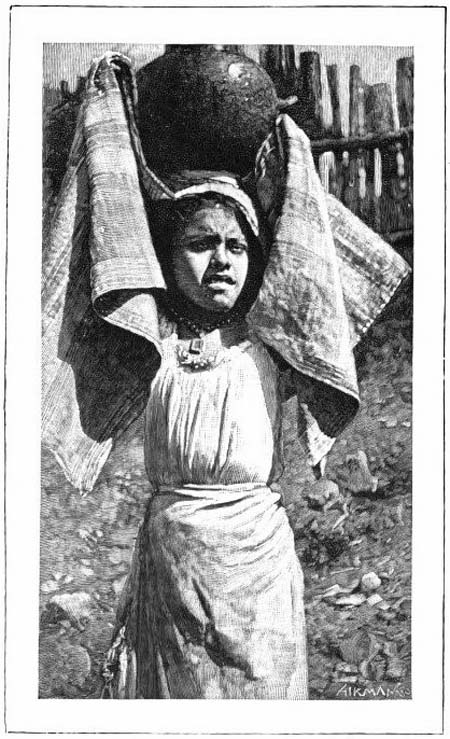
A DRAWER OF WATER
We stopped for our first meal at a bare place on the top of a mountain, where there were a half-dozen mud huts. Jeffs went from one to another of these and collected a few eggs, and hired a woman to cook them and to make us some coffee. We added tinned things and bread to this luncheon, which, as there were no benches, we ate seated on the ground, kicking at the dogs and pigs and chickens, that snatched in a most familiar manner at the food in our hands. In Honduras there are so few hotels that travellers are entirely dependent for food and for a place in which to sleep upon the people who live along the trail, who are apparently quite hardened to having their homes invaded by strangers, and their larders levied upon at any hour of the day or night.
Even in the larger towns and so-called cities we slept in private houses, and on the solitary occasion when we were directed to a hotel we found a bare room with a pile of canvas cots heaped in one corner, to which we were told to help ourselves. There was a real hotel, and a very bad one, at the capital, where we fared much worse than we had often done in the interior; but with these two exceptions we were dependent for shelter during our entire trip across Honduras upon the people of the country. Sometimes they sent us to sleep in the town-hall, which was a large hut with a mud floor, and furnished with a blackboard and a row of-benches, and sometimes with stocks for prisoners; for it served as a school or prison or hotel, according to the needs of the occasion.
We were equally dependent upon the natives for our food. We carried breakfast bacon and condensed milk and sardines and bread with us, and to these we were generally able to add, at least once a day, coffee and eggs and beans. The national bread is the tortilla. It is made of cornmeal, patted into the shape of a buckwheat cake between the palms of the hands, and then baked. They were generally given to us cold, in a huge pile, and were burned on both sides, but untouched by heat in the centre. The coffee was always excellent, as it should have been, for the Honduranian coffee is as fine as any grown in Central America, and we never had too much of it; but of eggs and black beans there was no end. The black-bean habit in Honduras is very general; they gave them to us three times a day, sometimes cold and sometimes hot, sometimes with bacon and sometimes alone. They were frequently served to us in the shape of sandwiches between tortillas, and again in the form of pudding with chopped-up goat’s meat. At first, and when they were served hot, I used to think them delicious. That seems very long ago now. When I was at Johnstown at the time of the flood, there was a soda cracker, with jam inside, which was served out to the correspondents in place of bread; and even now, if it became a question of my having to subsist on those crackers, and the black beans of Central America, or starve, I am sure I should starve, and by preference.
We were naturally embarrassed at first when we walked into strange huts; but the owners seemed to take such invasions with apathy and as a matter of course, and were neither glad to see us when we came, nor relieved when we departed. They asked various prices for what they gave us—about twice as much as they would have asked a native for the same service; at least, so Jeffs told us; but as our bill never amounted to more than fifty cents apiece for supper, lodging, and a breakfast the next morning, they cannot be said to have robbed us. While the woman at the first place at which we stopped boiled the eggs, her husband industriously whittled a lot of sharp little sticks, which he distributed among us, and the use of which we could not imagine, until we were told we were expected to spike holes in the eggs with them, and then suck out the meat. We did not make a success of this, and our prejudice against eating eggs after that fashion was such that we were particular to ask to have them fried during the rest of our trip. This was the only occasion when I saw a Honduranian husband help his wife to work.
After our breakfast on the top of the mountain, we began its descent on the other side. This was much harder on the mules than the climbing had been, and they stepped even more slowly, and so gave us many opportunities to look out over the tops of trees and observe with some misgivings the efforts of the man in front to balance the mule by lying flat on its hind-quarters. The temptation at such times to sit upright and see into what depths you were going next was very great. We struck a level trail about six in the evening, and the mules were so delighted at this that they started off of their own accord at a gallop, and were further encouraged by our calling them by the names of different Spanish generals. This inspired them to such a degree that we had to change their names to Bob Ingersoll or Senator Hill, or others to the same effect, at which they grew discouraged and drooped perceptibly.
We slept that night at a ranch called La Pieta, belonging to Dr. Miguel Pazo, where we experimented for the first time with our hammocks, and tried to grow accustomed to going to bed under the eyes of a large household of Indian maidens, mosos, and cowboys. There are men who will tell you that they like to sleep in a hammock, just as there are men who will tell you that they like the sea best when it is rough, and that they are happiest when the ship is throwing them against the sides and superstructure, and when they cannot sit still without bracing their legs against tables and stanchions. I always want to ask such men if they would prefer land in a state of perpetual earthquake, or in its normal condition of steadiness, and I have always been delighted to hear sea-captains declare themselves best pleased with a level keel, and the chance it gives them to go about their work without having to hang on to hand-rails. And I had a feeling of equal satisfaction when I saw as many sailors as could find room sleeping on the hard deck of a man-of-war at Colon, in preference to suspending themselves in hammocks, which were swinging empty over their heads. The hammock keeps a man at an angle of forty-five degrees, with the weight of both his legs and his body on the base of the spinal column, which gets no rest in consequence.
The hammock is, however, almost universally used in Honduras, and is a necessity there on account of the insects and ants and other beasts that climb up the legs of cots and inhabit the land. But the cots of bull-hide stretched on ropes are, in spite of the insects, greatly to be preferred; they are at least flat, and one can lie on them without having his legs three feet higher than his head. Their manufacture is very simple. When a steer is killed its hide is pegged out on the ground, and left where the dogs can eat what flesh still adheres to it; and when it has been cleaned after this fashion and the sun has dried it, ropes of rawhide are run through its edges, and it is bound to a wooden frame with the hairy side up. It makes a cool, hard bed. In the poorer huts the hides are given to the children at night, and spread directly on the earth floor. During the day the same hides are used to hold the coffee, which is piled high upon them and placed in the sun to dry.
We left La Pieta early the next morning, in the bright sunlight, but instead of climbing laboriously into the sombre mountains of the day before, we trotted briskly along a level path between sunny fields and delicate plants, and trees with a pale-green foliage, and covered with the most beautiful white-and-purple flowers. There were hundreds of doves in the air, and in the bushes many birds of brilliant blue-and-black or orange-and-scarlet plumage, and one of more sober colors with two long white tail-feathers and a white crest, like a macaw that had turned Quaker. None of these showed the least inclination to disturb himself as we approached. An hour after our setting forth we plunged into a forest of manacca-palms, through which we rode the rest of the morning. This was the most beautiful and wonderful experience of our journey. The manacca-palm differs from the cocoanut or royal palm in that its branches seem to rise directly from the earth, and not to sprout, as do the others, from the top of a tall trunk. Each branch has a single stem, and the leaf spreads and falls from either side of this, cut into even blades, like a giant fern.
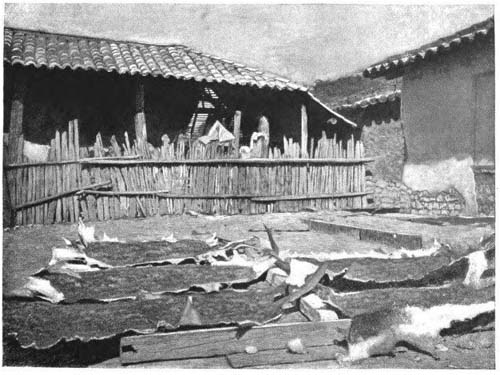
NATIVE METHOD OF DRYING COFFEE
There is a plant that looks like the manacca-palm at home which you see in flower-pots in the corners of drawing-rooms at weddings, and consequently when we saw the real manacca-palm the effect was curious. It did not seem as though they were monster specimens of these little plants in the States, but as though we had grown smaller. We felt dwarfed, as though we had come across a rose-bush as large as a tree. The branches of these palms were sixty feet high, and occasionally six feet broad, and bent and swayed and interlaced in the most graceful and exquisite confusion. Every blade trembled in the air, and for hours we heard no other sound save their perpetual murmur and rustle. Not even the hoofs of our mules gave a sound, for they trod on the dead leaves of centuries. The palms made a natural archway for us, and the leaves hung like a portière across the path, and you would see the man riding in front raise his arm and push the long blades to either side, and disappear as they fell again into place behind him. It was like a scene on the tropical island of a pantomime, where everything is exaggerated both in size and in beauty. It made you think of a giant aquarium or conservatory which had been long neglected.
At every hundred yards or so there were giant trees with smooth gray trunks, as even and regular as marble, and with roots like flying-buttresses, a foot in thickness, and reaching from ten to fifteen feet up from the ground. If these flanges had been covered over, a man on muleback could have taken refuge between them. Some of the trunks of these trees were covered with intricate lace-work of a parasite which twisted in and out, and which looked as though thousands of snakes were crawling over the white surface of the tree; they were so much like snakes that one passed beneath them with an uneasy shrug. Hundreds of orchids clung to the branches of the trees, and from these stouter limbs to the more pliable branches of the palms below white-faced monkeys sprang and swung from tree to tree, running along the branches until they bent with the weight like a trout-rod, and sprang upright again with a sweep and rush as the monkeys leaped off chattering into the depths of the forest. We rode through this enchanted wilderness of wavering sunlight and damp, green shadows for the greater part of the day, and came out finally into a broad, open plain, cut up by little bubbling streams, flashing brilliantly in the sun. It was like an awakening from a strange and beautiful nightmare.
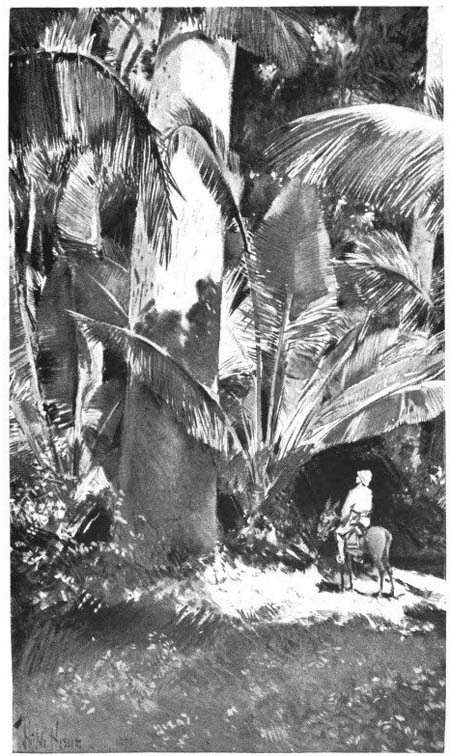
IN A CENTRAL-AMERICAN FOREST
In the early part of the afternoon we arrived at another one of the farm-houses belonging to young Dr. Pazo, and at which he and his brother happened to be stopping. We had ridden out of our way there in the hopes of obtaining a few days’ shooting, and the place seemed to promise much sport. The Chamelicon River, filled with fish and alligators, ran within fifty yards of the house; and great forests, in which there were bear and deer and wild-pig, stretched around it and beyond it on every side. The house itself was like almost every other native hut in Honduras. They are all built very much alike, with no attempt at ornamentation within, or landscape-gardening without, although nature has furnished the most beautiful of plants and trees close on every side for just such a purpose. The walls of a Honduranian hut are made of mud packed round a skeleton of interwoven rods; the floor is of the naked earth, and the roof is thatched with the branches of palms. After the house is finished, all of the green stuff growing around and about it is cleared away for fifty yards or so, leaving an open place of bare and barren mud. This is not decorative, but it helps in some measure to keep the insects which cling to every green thing away from the house. A kitchen of similarly interlaced rods and twigs, but without the clay, and covered with just such layers of palm leaves, stands on the bare place near the house, or leans against one side of it. This is where the tortillas are patted and baked, and the rice and beans are boiled, and the raw meat of an occasional goat or pig is hung to dry and smoke over the fire. The oven in the kitchen is made of baked clay, and you seldom see any cooking utensils or dishes that have not been manufactured from the trees near the house or the earth beneath it. The water for drinking and cooking is kept in round jars of red clay, which stand in rings of twisted twigs to keep them upright, and the drinking-vessels are the halves of gourds, and the ladles are whole gourds, with the branch on which they grew still adhering to them, to serve as a handle.
The furnishing of the house shows the same dependence upon nature; the beds are either grass hammocks or the rawhide that I have described, and there are no chairs and few benches, the people preferring apparently to eat sitting on their haunches to taking the trouble necessary to make a chair. Everything they eat, of which there is very little variety, grows just beyond the cleared place around the hut, and can be had at the cost of the little energy necessary to bring it in-doors. When a kid or a pig or a steer is killed, the owner goes out to the nearest peak and blows a blast on a cow’s horn, and those within hearing who wish fresh meat hurry across the mountain to purchase it. As there is no ice from one end of Honduras to the other, meat has to be eaten the day it is killed.
This is not the life of the Honduranians who live in the large towns or so-called cities, where there are varying approaches to the comfort of civilized countries, but of the country people with whom we had chiefly to do. It is as near an approach to the condition of primitive man as one can find on this continent.
But bare and poor as are the houses, which are bare not because the people are poor, but because they are indolent, there is almost invariably some corner of the hut set aside and ornamented as an altar, or some part of the wall covered with pictures of a religious meaning. When they have no table, the people use a shelf or the stump of a tree upon which to place emblematic figures, which are almost always china dolls, with no original religious significance, but which they have dressed in little scraps of tinsel and silk, and which they have surrounded with sardine-tins and empty bottles and pictures from the lids of cigar-boxes. Everything that has color is cherished, and every traveller who passes adds unconsciously to their stock of ornaments in the wrappings of the boxes which he casts away behind him. Sometimes the pictures they use for ornamentation are not half so odd as the fact that they ever should have reached such a wilderness. We were frequently startled by the sight of colored lithographs of theatrical stars, advertising the fact that they were playing under the direction of such and such a manager, and patent-medicine advertisements and wood-cuts from illustrated papers, some of them twenty and thirty years old, which were pinned to the mud walls and reverenced as gravely as though they had been pictures of the Holy Family by a Raphael or a Murillo.
In one hut we found a life-size colored lithograph of a woman whom, it so happened, we all knew, which was being used to advertise a sewing-machine. We were so pleased at meeting a familiar face so far from home that we bowed to it very politely, and took off our hats, at which the woman of the house, mistaking our deference, placed it over the altar, fearing that she had been entertaining an angel unawares.
The house of Dr. Pazo, where we were most hospitably entertained, was similar to those that I have described. It was not his home, but what we would call a hunting-box or a ranch. While we were at luncheon he told a boy to see if there were any alligators in sight, in exactly the same tone with which he might have told a servant to find out if the lawn-tennis net were in place. The boy returned to say that there were five within a hundred yards of the house. So, after we had as usual patiently waited for Griscom to finish his coffee, we went out on the bank and fired at the unhappy alligators for the remainder of the afternoon. It did not seem to hurt them very much, and certainly did us a great deal of good. To kill an alligator it is necessary to hit it back of the fore-leg, or to break its spine where it joins the tail; and as it floats with only its eyes and a half-inch of its nose exposed, it is difficult to reach either of these vital spots. When the alligator is on a bank, and you attempt to crawl up on it along the opposite bank, the birds make such a noise, either on its account or on their own, that it takes alarm, and rolls over into the water with an abruptness you would hardly expect from so large a body.
On our second day at Dr. Pazo’s ranch we divided into two parties, and scoured the wilderness for ten miles around after game. One party was armed with shot-guns, and brought back macaws of wonderful plumage, wild turkeys, and quail in abundance; the others, scorning anything but big game, carried rifles, and, as a result, returned as they set forth, only with fewer cartridges. It was most unfortunate that the only thing worth shooting came to me. It was a wild-cat with a long tail, who patiently waited for us in an open place with a calm and curious expression of countenance. I think I was more surprised than he was, and even after I had thrown up the ground under his white belly he stopped and turned again to look at me in a hurt and reproachful manner before he bounded gracefully out of sight into the underbrush. We also saw a small bear, but he escaped in the same manner, without waiting to be fired upon, and as we had no dogs to send after him, we gave up looking for more, and went back to pot at alligators. There were some excellent hunting-dogs on the ranch, but the Pazo brothers had killed a steer the night we arrived, and had given most of it to the dogs, so that in the morning they were naturally in no mood for hunting.
There was an old grandfather of an alligator whom Somerset and I had repeatedly disturbed in his slumbers. He liked to take his siestas on a little island entirely surrounded by rapids, and we used to shoot at him from the opposite bank of the river. He was about thirteen feet long, and the agility with which he would flop over into the calm little bay, which stretched out from the point on which he slept, was as remarkable as it was disappointing. He was still asleep at his old stand when we returned from our unsuccessful shooting tour, so we decided to swim the rapids and crawl up on him across his little island and attack him from the flank and rear. It reminded me somewhat of the taking of Lungtenpen on a small scale. On that occasion, if I remember correctly, the raw recruits were uniformed only in Martinis and cartridge-belts; but we decided to carry our boots as well, because the alligator’s island was covered with sharp stones and briers, and the sand was very hot, and, moreover, we had but vague ideas about the customs of alligators, and were not sure as to whether he might not chase us. We thought we would look very silly running around a little island pursued by a long crocodile and treading on sharp hot stones in our bare feet.
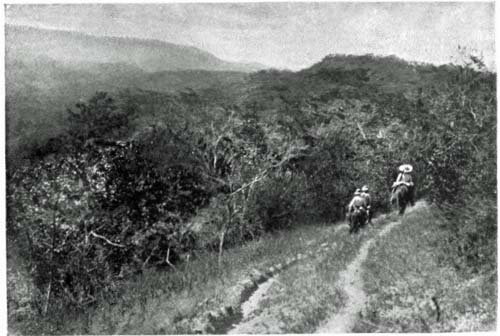
ON THE TRAIL TO SANTA BARBARA
So each of us took his boots in one hand and a repeating-rifle in the other, and with his money-belt firmly wrapped around his neck, plunged into the rapids and started to ford the river. They were exceedingly swift rapids, and made you feel as though you were swinging round a sharp corner on a cable-car with no strap by which to take hold. The only times I could stop at all was when I jammed my feet in between two stones at the bed of the river, and was so held in a vise, while the rest of my body swayed about in the current and my boots scooped up the water. When I wanted to go farther I would stick my toes between two more rocks, and so gradually worked my way across, but I could see nothing of Somerset, and decided that he had been drowned, and went off to avenge him on the alligator. It took me some time to get my bruised and bleeding toes into the wet boots, during which time I kept continually looking over my shoulder to see if the alligator were going to make a land attack, and surprise me instead of my surprising him. I knew he was very near me, for the island smelled as strongly of musk as a cigar-shop smells of tobacco; but when I crawled up on him he was still on his point of sand, and sound asleep. I had a very good chance at seventy yards, but I was greedy, and wanted to come closer, and as I was crawling along, gathering thorns and briers by the way, I startled about fifty birds, and the alligator flopped over again, and left nothing behind him but a few tracks on the land and a muddy streak in the water. It was a great deal of trouble for a very little of alligator; but I was more or less consoled on my return to find that Somerset was still alive, and seated on the same bank from which we had both started, though at a point fifty yards farther down-stream. He was engaged in counting out damp Bank-of-England notes on his bare knee, and blowing occasional blasts down the barrel of his rifle, which had dragged him and itself to the bottom of the river before the current tossed them both back on the shore.
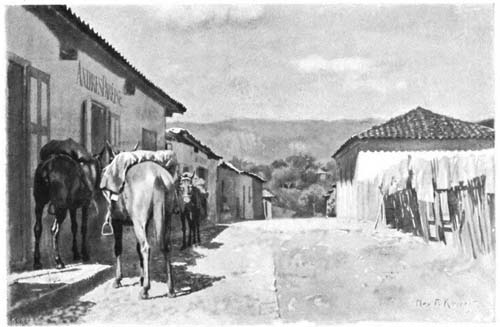
A HALT AT TRINIDAD
The two days of rest at the ranch of Dr. Pazo had an enervating effect upon our mules, and they moved along so slowly on the day following that we had to feel our way through the night for several hours before we came to the hut where we were to sleep. Griscom and I had lost ourselves on the mountain-side, and did not overtake the others until long after they had settled themselves in the compound. They had been too tired when they reached it to do anything more after falling off their mules, and we found them stretched on the ground in the light of a couple of fluttering pine torches, with cameras and saddle-bags and carbines scattered recklessly about, and the mules walking over them in the darkness. A fire in the oven shone through the chinks in the kitchen wall, and showed the woman of the house stirring something in a caldron with one hand and holding her sleeping child on her hip with the other, while the daughters moved in and out of the shadow, carrying jars on their heads and bundles of fodder for the animals. It looked like a gypsy encampment. We sent Emilio back with a bunch of pine torches to find the pack-mules, and we could see his lighted torch blazing far up the trail that we had just descended, and lighting the rocks and trees on either side of him.
There was only room for one of us to sleep inside the hut that night, and as Griscom had a cold, that privilege was given to him; but it availed him little, for when he seated himself on the edge of the bull-hide cot and began to pull off his boots, five ghostly feminine figures sat upright in their hammocks and studied his preparations with the most innocent but embarrassing curiosity. So, after waiting some little time for them to go to sleep again, he gave up any thought of making himself more comfortable, and slept in his boots and spurs.
We passed through the pretty village of Trinidad early the next morning, and arrived at nightfall at the larger town of Santa Barbara, where the sound of our mules’ hoofs pattering over the paved streets and the smell of smoking street lamps came to us with as much of a shock as does the sight of land after a week at sea. Santa Barbara, in spite of its pavements, was not a great metropolis, and, owing to its isolation, the advent of five strangers was so much of an event that the children of the town followed us, cheering and jeering as though we were a circus procession; they blocked the house in which we took refuge, on every side, so that the native policemen had to be stationed at our windows to wave them away. On the following morning we called to pay our respects on General Louis Bogran, who has been President of Honduras for eight years and an exile for two. He died a few months after our visit. He was a very handsome man, with a fine presence, and with great dignity of manner, and he gave us an audience exactly as though he were a dethroned monarch and we loyal subjects come to pay him homage in his loneliness. I asked him what he regarded as the best work of his administration, and after thinking awhile he answered, “Peace for eight years,” which was rather happy, when you consider that in the three years since he had left office there have been four presidents and two long and serious revolutions, and when we were in the capital the people seemed to think it was about time to begin on another.
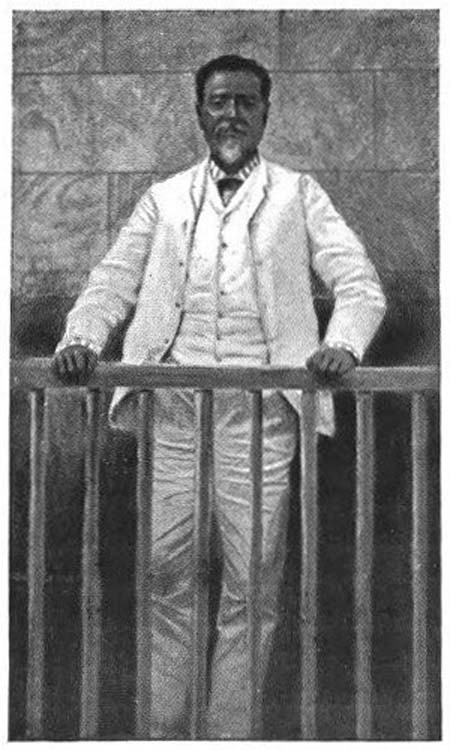
GENERAL LOUIS BOGRAN
We left Santa Barbara early the next morning, and rode over a few more mountains to the town of Seguaca, where the village priest was holding a festival, and where the natives for many miles around had gathered in consequence. There did not seem to be much of interest going on when we arrived, for the people of the town and the visitors within her gates deserted the booths and followed us in a long procession down the single street, and invaded the house where we lunched.
Our host on this occasion set a table for us in the centre of his largest room, and the population moved in through the doors and windows, and seated themselves cross-legged in rows ten and fifteen deep on the earth floor at our feet, and regarded us gravely and in absolute silence. Those who could not find standing-room inside stood on the window-sills and blocked the doorways, and the women were given places of honor on tables and beds. It was somewhat embarrassing, and we felt as though we ought to offer something more unusual than the mere exercise of eating in order to justify such interest; so we attempted various parlor tricks, without appearing to notice the presence of an audience, and pretended to swallow the eggs whole, and made knives and forks disappear in the air, and drew silver dollars from the legs of the table, continuing our luncheon in the meantime in a self-possessed and polite manner, as though such eccentricities were our hourly habit. We could see the audience, out of the corner of our eyes, leaning forward with their eyes and mouths wide open, and were so encouraged that we called up some of the boys and drew watches and dollars out of their heads, after which they retired into corners and ransacked their scantily clad persons for more. It was rather an expensive exhibition, for when we set forth again they all laid claim to the dollars of which they considered they had been robbed.
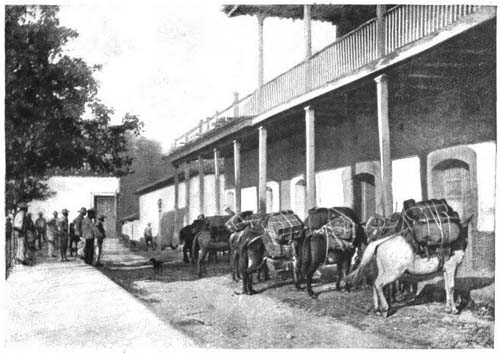
OUR PACK-TRAIN AT SANTA BARBARA
The men of the place, according to their courteous custom, followed us out of the town for a few miles, and then we all shook hands and exchanged cigars and cigarettes, and separated with many compliments and expressions of high esteem.
The trail from Seguaca to our next resting-place led through pine forests and over layers of pine-needles that had been accumulating for years. It was a very warm, dry afternoon, and the air was filled with the odor of the pines, and when we came to one of the many mountain streams we disobeyed Jeffs and stopped to bathe in it, and let it carry us down the side of the mountain with the speed of a toboggan. We had been told that bathing at any time was extremely dangerous in Honduras, and especially so in the afternoon; but we always bathed in the afternoon, and looked forward to the half-hour spent in one of these roaring rapids as the best part of the day. Of all our recollections of Honduras, they are certainly the pleasantest. The water was almost icily cold, and fell with a rush and a heavy downpour in little water-falls, or between great crevices in the solid rocks, leaping and bubbling and flashing in the sun, or else sweeping in swift eddies in the compass of deep, shadowy pools. We used to imprison ourselves between two rocks and let a fall of water strike us from the distance of several feet on our head and shoulders, or tear past and around us, so that in five minutes the soreness and stiffness of the day’s ride were rubbed out of us as completely as though we had been massaged at a Turkish bath, and the fact that we were always bruised and black and blue when we came out could not break us of this habit. It was probably because we were new to the country that we suffered no great harm; for Jeffs, who was an old inhabitant, and who had joined us in this particular stream for the first time, came out looking twenty years older, and in an hour his teeth were chattering with chills or clinched with fever, and his pulse was jumping at one hundred and three. We were then exactly six days’ hard riding from any civilized place, and though we gave him quinine and whiskey and put him into his hammock as soon as we reached a hut, the evening is not a cheerful one to remember. It would not have been a cheerful evening under any circumstances, for we shared the hut with the largest and most varied collection of human beings, animals, and insects that I have ever seen gathered into so small a place.
I took an account of stock before I turned in, and found that there were three dogs, eleven cats, seven children, five men, not including five of us, three women, and a dozen chickens, all sleeping, or trying to sleep, in the same room, under the one roof. And when I gave up attempting to sleep and wandered out into the night, I stepped on the pigs, and startled three or four calves that had been sleeping under the porch and that lunged up out of the darkness. We were always asking Jeffs why we slept in such places, instead of swinging our hammocks under the trees and camping out decently and in order, and his answer was that while there were insects enough in-doors, they were virtually an extinct species when compared to the number one would meet in the open air.
I have camped in our West, where all you need is a blanket to lie upon and another to wrap around you, and a saddle for a pillow, and where, with a smouldering fire at your feet, you can sleep without thought of insects. But there is nothing green that grows in Honduras that is not saturated and alive with bugs, and all manner of things that creep and crawl and sting and bite. It transcends mere discomfort; it is an absolute curse to the country, and to every one in it, and it would be as absurd to write of Honduras without dwelling on the insects, as of the west coast of Africa without speaking of the fever. You cannot sit on the grass or on a fallen tree, or walk under an upright one or through the bushes, without hundreds of some sort of animal or other attaching themselves to your clothing or to your person. And if you get down from your mule to take a shot at something in the bushes and walk but twenty feet into them, you have to be beaten with brushes and rods when you come out again as vigorously as though you were a dusty carpet. There will be sometimes as many as a hundred insects under one leaf; and after they have once laid their claws upon you, your life is a mockery, and you feel at night as though you were sleeping in a bed with red pepper. The mules have even a harder time of it; for, as if they did not suffer enough in the day, they are in constant danger at night from vampires, which fasten themselves to the neck and suck out the blood, leaving them so weak that often when we came to saddle them in the morning they would stagger and almost fall. Sometimes the side of their head and shoulders would be wet with their own blood. I never heard of a vampire attacking a man in that country, but the fact that they are in the air does not make one sleep any the sounder.
In the morning after our night with the varied collection of men and animals we put back again to the direct trail to Tegucigalpa, from which place we were still distant a seven days’ ride.
II
We swung our hammocks on the sixth night out in the municipal building of Tabla Ve; but there was little sleep. Towards morning the night turned bitterly cold, and the dampness rose from the earthen floor of the hut like a breath from the open door of a refrigerator, and kept us shivering in spite of sweaters and rubber blankets. Above, the moon and stars shone brilliantly in a clear sky, but down in the valley in which the village lay, a mist as thick as the white smoke of a locomotive rose out of the ground to the level of the house-tops, and hid Tabla Ve as completely as though it were at the bottom of a lake. The dogs of the village moved through the mist, howling dismally, and meeting to fight with a sudden sharp tumult of yells that made us start up in our hammocks and stare at each other sleepily, while Jeffs rambled on, muttering and moaning in his fever. It was not a pleasant night, and we rode up the mountain-side out of the mist the next morning unrefreshed, but satisfied to be once more in the sunlight. They had told us at Tabla Ve that there was to be a bull-baiting that same afternoon at the village of Seguatepec, fifteen miles over the mountain, where a priest was holding a church festival. So we left Jeffs to push along with the mozos, and by riding as fast as the mules could go, we reached Seguatepec by four in the afternoon.
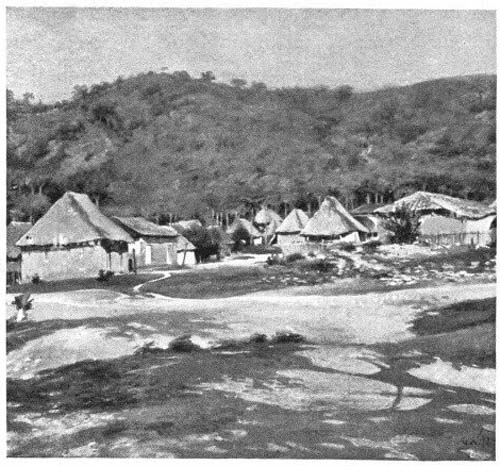
A VILLAGE IN THE INTERIOR
It was a bright, clean town, sitting pertly on the flat top of a hill that fell away from it evenly on every side. It had a little church and a little plaza, and the church was so vastly superior to every other house in the place—as was the case in every village through which we passed—as to make one suppose that it had been built by one race of people and the houses by another. The plaza was shut in on two of its sides by a barrier seven rails high, held together by ox-hide ropes. This barrier, with the houses fronting the plaza on its two other sides, formed the arena in which the bull was to be set at liberty. All of the windows and a few of the doors of the houses were barred, and the open places between were filled up by ramparts of logs. There was no grand-stand, but every one contributed a bench or a table from his own house, and the women seated themselves on these, while the men and boys perched on the upper rail of the barricade. The occasion was a memorable one, and all the houses were hung with strips of colored linen, and the women wore their brilliant silk shawls, and a band of fifteen boys, none of whom could have been over sixteen years of age, played a weird overture to the desperate business of the afternoon.
It was a somewhat primitive and informal bull-fight, and it began with their lassoing the bull by his horns and hoofs, and dragging him head first against the barricade. With a dozen men pulling on the lariat around the horns from the outside of the ring, and two more twisting his tail on the inside, he was at such an uncomfortable disadvantage that it was easy for them to harness him in a net-work of lariats, and for a bold rider to seat himself on his back. The bold rider wore spurs on his bare feet, and, with his toes stuck in the ropes around the bull’s body, he grasped the same ropes with one hand, and with the other hand behind him held on to the bull’s tail as a man holds the tiller of a boat. When the man felt himself firmly fixed, and the bull had been poked into a very bad temper with spears and sharp sticks, the lariat around his horns was cut, and he started up and off on a frantic gallop, bucking as vigorously as a Texas pony, and trying to gore the man clinging to his back with backward tosses of his horns.
There was no regular toreador, and any one who desired to sacrifice himself to make a Saguatepecan holiday was at liberty to do so; and as a half-dozen men so sought distinction, and as the bull charged at anything on two legs, the excitement was intense. He moved very quickly for so huge an animal in spite of his heavy handicap, and, with the exception of one man with a red flag and a spirit of daring not entirely due to natural causes, no one cared to go very near him. So he pawed up and down the ring, tossing and bucking and making himself as disagreeable to the man on his back as he possibly could. It struck me that it would be a distinctly sporting act to photograph a bull while he was charging head on at the photographer, and it occurred to Somerset and Griscom at about the same time that it would be pleasant to confront a very mad bull while he was careering about with a man twisting his tail. So we all dropped into the arena at about the same moment, from different sides, and as we were gringos, our appearance was hailed with laughter and yells of encouragement. The gentleman on the bull seemed to be able to control him more or less by twisting his tail to one side or the other, and as soon as he heard the shouts that welcomed us he endeavored to direct the bull’s entire attention to my two young friends. Griscom and Somerset are six feet high, even without riding-boots and pith helmets, and with them they were so conspicuous that the bull was properly incensed, and made them hurl themselves over the barricade in such haste that they struck the ground on the other side at about the same instant that he butted the rails, and with about the same amount of force.
Shrieks and yells of delight rose from the natives at this delightful spectacle, and it was generally understood that we had been engaged to perform in our odd costumes for their special amusement, and the village priest attained genuine popularity for this novel feature. The bull-baiting continued for some time, and as I kept the camera in my own hands, there is no documentary evidence to show that any one ran away but Griscom and Somerset. Friendly doors were opened to us by those natives whose houses formed part of the arena, and it was amusing to see the toreadors popping in and out of them, like the little man and woman on the barometer who come out when it rains and go in when the sun shines, and vice versa.
On those frequent occasions when the bull charged the barricade, the entire line of men and boys on its topmost rail would go over backward, and disappear completely until the disappointed bull had charged madly off in another direction. Once he knocked half of a mud-house away in his efforts to follow a man through a doorway, and again a window-sill, over which a toreador had dived head first like a harlequin in a pantomime, caved in under the force of his attack. Fresh bulls followed the first, and the boy musicians maddened them still further by the most hideous noises, which only ceased when the bulls charged the fence upon which the musicians sat, and which they vacated precipitately, each taking up the tune where he had left off when his feet struck the ground. There was a grand ball that night, to which we did not go, but we lay awake listening to the fifteen boy musicians until two in the morning. It was an odd, eyrie sort of music, in which the pipings of the reed instruments predominated. But it was very beautiful, and very much like the music of the Hungarian gypsies in making little thrills chase up and down over one’s nervous system.
The next morning Jeffs had shaken off his fever, and, once more reunited, we trotted on over heavily wooded hills, where we found no water until late in the afternoon, when we came upon a broad stream, and surprised a number of young girls in bathing, who retreated leisurely as we came clattering down to the ford. Bathing in mid-stream is a popular amusement in Honduras, and is conducted without any false sense of modesty; and judging from the number of times we came upon women so engaged, it seems to be the chief occupation of their day.
That night we slept in Comyagua, the second largest city in the republic. It was originally selected as the site for a capital, and situated accordingly at exactly even distances from the Pacific Ocean and the Caribbean Sea. We found it a dull and desolate place of many one-story houses, with iron-barred windows, and a great, bare, dusty plaza, faced by a huge cathedral. Commerce seemed to have passed it by, and the sixty thousand inhabitants who occupied it in the days of the Spaniards have dwindled down to ten. The place is as completely cut off from civilization as an island in the Pacific Ocean. The plain upon which Comyagua stands stretches for many miles, and the nature of the stones and pebbles on its surface would seem to show that it was once the bottom of a great lake. Now its round pebbles and sandy soil make it a valley of burning heat, into which the sun beats without the intervening shadows of trees or mountains to save the traveller from the fierceness of its rays.
We rode over thirty miles of it, and found that part of the plain which we traversed after our night’s rest at the capital the most trying ten miles of our trip. We rode out into it in the rear of a long funeral procession, in which the men and boys walked bareheaded and barefooted in the burning sand. They were marching to a burial-ground out in the plain, and they were carrying the coffin on their shoulders, and bearing before it a life-sized figure of the Virgin and many flaring candles that burned yellow in the glaring sunlight.
From Comyagua the trail led for many miles through heavy sand, in which nothing seemed to grow but gigantic cacti of a sickly light green that twisted themselves in jointed angles fifteen to twenty feet in the air above us, and century-plants with flowers of a vivid yellow, and tall, leafless bushes bristling with thorns. The mountains lay on either side, and formed the valley through which we rode, two dark-green barriers against a blazing sky, but for miles before and behind us there was nothing to rest the eye from the glare of the sand. The atmosphere was without a particle of moisture, and the trail quivered and swam in the heat; if you placed your hand on the leather pommel of your saddle it burned the flesh like a plate of hot brass, and ten minutes after we had dipped our helmets in water they were baked as dry as when they had first come from the shop. The rays of the sun seemed to beat up at you from below as well as from above, and we gasped and panted as we rode, dodging and ducking our heads as though the sun was something alive and active that struck at us as we passed by. If you dared to look up at the sky its brilliancy blinded you as though some one had flashed a mirror in your eyes.
We lunched at a village of ten huts planted defiantly in the open plain, and as little protected from the sun as a row of bricks in a brick-yard, but by lying between two of them we found a draught of hot air and shade, and so rested for an hour. Our trail after that led over a mile or two of red hematite ore, which suggested a ride in a rolling-mill with the roof taken away, and with the sun beating into the four walls, and the air filled with iron-dust. Two hours later we came to a cañon of white chalk, in which the government had cut stepping-places for the hoofs of the mules. The white glare in this valley was absolutely blinding, and the atmosphere was that of a lime-kiln. We showed several colors after this ride, with layers of sand and clay, and particles of red ore and powdering of white chalk over all; but by five o’clock we reached the mountains once more, and found a cool stream dashing into little water-falls and shaded by great trees, where the air was scented by the odor of pine-needles and the damp, spongy breath of moss and fern.
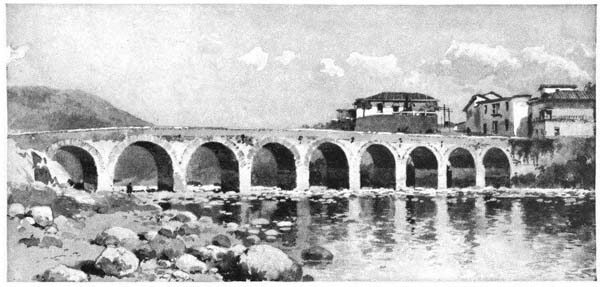
BRIDGE CONNECTING TEGUCIGALPA WITH ITS SUBURB
We were now within two days of Tegucigalpa, and the sense of nearness to civilization and the knowledge that the greater part of our journey was at an end made us forget the discomforts and hardships which we had endured without the consolation of excitement that comes with danger, or the comforting thought that we were accomplishing anything in the meantime. We had been complaining of this during the day to Jeffs, and saying that had we gone to the coast of East Africa we could not have been more uncomfortable nor run greater risks from fever, but that there we would have met with big game, and we would have visited the most picturesque instead of the least interesting of all countries.
These complaints inspired Jeffs to play a trick upon us, which was meant in a kindly spirit, and by which he intended to furnish us with a moment’s excitement, and to make us believe that we had been in touch with danger. There are occasional brigands in Central America, and their favorite hunting-ground in Honduras is within a few miles of Tegucigalpa, along the trail from the eastern coast over which we were then passing. We had been warned of these men, and it occurred to Jeffs that as we complained of lack of excitement in our trip, it would be a thoughtful kindness to turn brigand and hold us up upon our march. So he left us still bathing at the water-fall, and telling us that he would push on to engage quarters for the night, rode some distance ahead and secreted himself behind a huge rock on one side of a narrow cañon. He first placed his coat on a bush beside him, and his hat on another bush, so as to make it appear that there were several men with him. His idea was that when he challenged us we would see the dim figures in the moonlight and remember the brigands, and that we were in their stalking-ground, and get out of their clutches as quickly as possible, well satisfied that we had at last met with a real adventure.
We reached his ambuscade about seven. Somerset was riding in advance, reciting “The Walrus and the Carpenter,” while we were correcting him when he went wrong, and gazing unconcernedly and happily at the cool moonlight as it came through the trees, when we were suddenly startled by a yell and an order to halt, in Spanish, and a rapid fusillade of pistol-shots. We could distinguish nothing but what was apparently the figures of three men crouching on the hill-side and the flashes of their revolvers, so we all fell off our mules and began banging away at them with our rifles, while the mules scampered off down the mountain. This was not as Jeffs had planned it, and he had to rearrange matters very rapidly. Bullets were cutting away twigs all over the hill-side and splashing on the rock behind which he was now lying, and though he might have known we could not hit him, he was afraid of a stray bullet. So he yelled at us in English, and called us by name, until we finally discovered we had been grossly deceived and imposed upon, and that our adventure was a very unsatisfactory practical joke for all concerned. It took us a long time to round up the mules, and we reached our sleeping-place in grim silence, and with our desire for danger still unsatisfied.
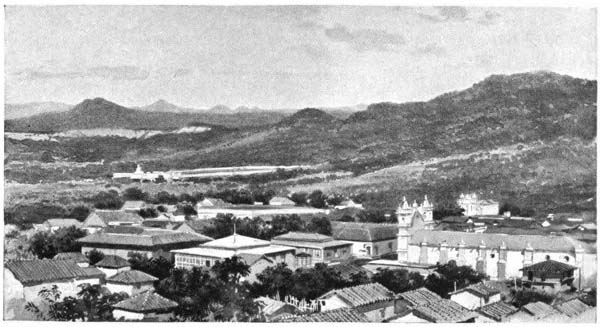
BIRD’S-EYE VIEW OF TEGUCIGALPA
The last leagues that separated us the next morning from Tegucigalpa seemed, of course, the longest in the entire journey. And so great was our desire to reach the capital before nightfall that we left the broader trail and scrambled down the side of the last mountain, dragging our mules after us, and slipping and sliding in dust and rolling stones to the tops of our boots. The city did not look inviting as we viewed it from above. It lay in a bare, dreary plain, surrounded by five hills that rose straight into the air, and that seemed to have been placed there for the special purpose of revolutionists, in order that they might the more exactly drop shot into the town at their feet. The hills were bare of verdure, and the landscape about the capital made each of us think of the country about Jerusalem. As none of us had ever seen Jerusalem, we foregathered and argued why this should be so, and decided that it was on account of the round rocks lying apart from one another, and low, bushy trees, and the red soil, and the flat roofs of the houses.
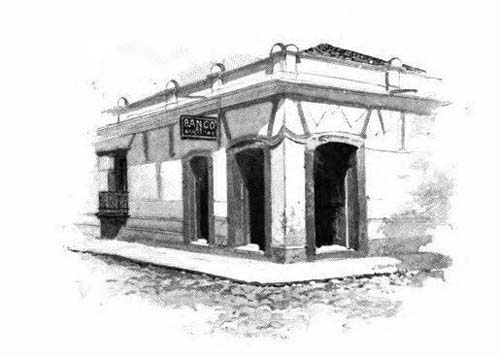
THE BANK OF HONDURAS
The telegraph wire which extends across Honduras, swinging from trees and piercing long stretches of palm and jungle, had warned the foreign residents of the coming of Jeffs, and some of them rode out to make us welcome. Their greeting, and the sight of paved streets, and the passing of a band of music and a guard of soldiers in shoes and real uniform, seemed to promise much entertainment and possible comfort. But the hotel was a rude shock. We had sent word that we were coming, and we had looked forward eagerly to our first night in a level bed under clean linen; but when we arrived we were offered the choice of a room just vacated by a very ill man, who had left all of his medicines behind him, so that the place was unpleasantly suggestive of a hospital, or a very small room, in which there were three cots, and a layer of dirt over all so thick that I wrote my name with the finger of my riding-glove on the centre-table. The son of the proprietor saw this, and, being a kindly person and well disposed, dipped his arm in water and proceeded to rub it over the top of the table, using his sleeve as a wash-rag. So after that we gave up expecting anything pleasant, and were in consequence delightfully surprised when we came upon anything that savored of civilization.
Tegucigalpa has an annex which lies on the opposite side of the river, and which is to the capital what Brooklyn is to New York. The river is not very wide nor very deep, and its course is impeded by broad, flat rocks. The washer-women of the two towns stand beside these all day knee-deep in the eddies and beat the stones with their twisted clubs of linen, so that their echo sounds above the roar of the river like the banging of shutters in the wind or the reports of pistols. This is the only suggestion of energy that the town furnishes. The other inhabitants seem surfeited with leisure and irritable with boredom. There are long, dark, cool shops of general merchandise, and a great cathedral and a pretty plaza, where the band plays at night and people circle in two rings, one going to the right and one going to the left, and there is the government palace and a big penitentiary, a university and a cemetery. But there is no color nor ornamentation nor light nor life nor bustle nor laughter. You do not hear people talking and calling to one another across the narrow streets of the place by day or serenading by night. Every one seems to go to bed at nine o’clock, and after that hour the city is as silent as its great graveyard, except when the boy policemen mark the hour with their whistles or the street dogs meet to fight.
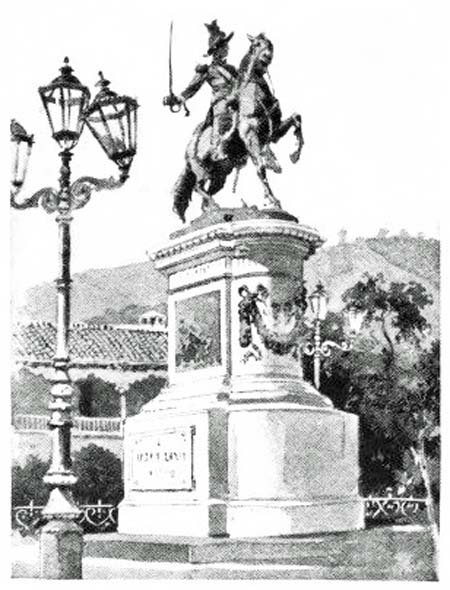
STATUE OF MORAZAN
The most interesting thing about the capital is the fact to which I have already alluded, that everything in it and pertaining to it that was not dug from the ground or fashioned from trees was carried to it on the backs of mules. The letter-boxes on the street corners had once been United States letter-boxes, and had later swung across the backs of donkeys. The gas-lamps and the iron railings of the parks, the few statues and busts in the public places, reached Tegucigalpa by the same means, and the great equestrian statue of Morazan the Liberator, in the plaza, was cast in Italy, and had been brought to Tegucigalpa in pieces before it was put together like a puzzle and placed in its present position to mark a glorious and victorious immortality. These things were not interesting in themselves, but it was interesting that they were there at all.
On the second day after our arrival the vice-president, Luis Bonilla, who bears the same last name but is no near relation to President Bonilla, took the oath of office, and we saw the ceremony with the barefooted public in the reception-room of the palace. The hall was hung with lace curtains and papered with imitation marble, and the walls were decorated with crayon portraits of Honduranian presidents. Bogran was not among them, nor was Morazan. The former was missing because it was due to him that young Bonilla had been counted out when he first ran for the presidency three years ago, when he was thirty-three years old, and the portrait of the Liberator was being reframed, because Bonilla’s followers six months before had unintentionally shot holes through it when they were besieging the capital. The ceremony of swearing in the vice-president did not last long, and what impressed us most about it was the youth of the members of the cabinet and of the Supreme Court who delivered the oath of office. They belonged distinctly to the politician class as one sees it at home, and were young men of eloquent speech and elegant manners, in frock-coats and white ties. We came to know most of the president’s followers later, and found them hospitable to a degree, although they seemed hardly old enough or serious enough to hold place in the government of a republic, even so small a one as Honduras. What was most admirable about each of them was that he had fought and bled to obtain the office he held. That is hardly a better reason for giving out clerkships and cabinet portfolios than the reasons which obtain with us for distributing the spoils of office, but you cannot help feeling more respect for the man who has marched by the side of his leader through swamps and through jungle, who has starved on rice, who has slept in the bushes, and fought with a musket in his hand in open places, than for the fat and sleek gentlemen who keep open bar at the headquarters of their party organization, who organize marching clubs, and who by promises or by cash secure a certain amount of influence and a certain number of votes.
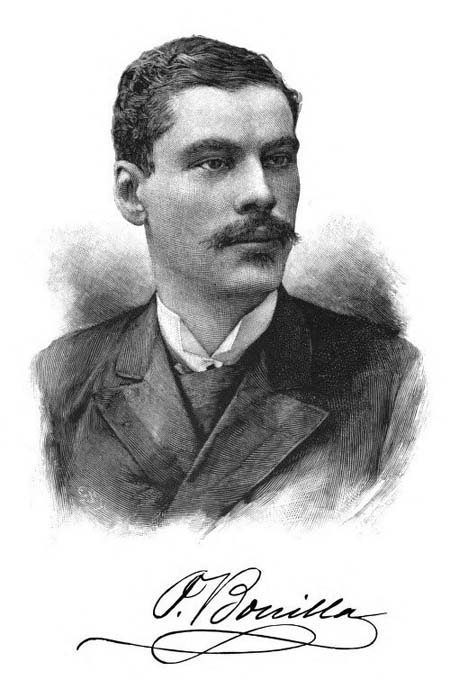
P. Bonilla
They risk nothing but their money, and if their man fails to get in, their money is all they lose; but the Central-American politician has to show the faith that is in him by going out on the mountain-side and hacking his way to office with a naked machete in his hand, and if his leader fails, he loses his life, with his back to a church wall, and looking into the eyes of a firing squad, or he digs his own grave by the side of the road, and stands at one end of it, covered with clay and sweat, and with the fear of death upon him, and takes his last look at the hot sun and the palms and the blue mountains, with the buzzards wheeling about him, and then shuts his eyes, and is toppled over into the grave, with a half-dozen bullets in his chest and stomach. That is what I should like to see happen to about half of our professional politicians at home. Then the other half might understand that holding a public office is a very serious business, and is not merely meant to furnish them with a livelihood and with places for their wives’ relations.
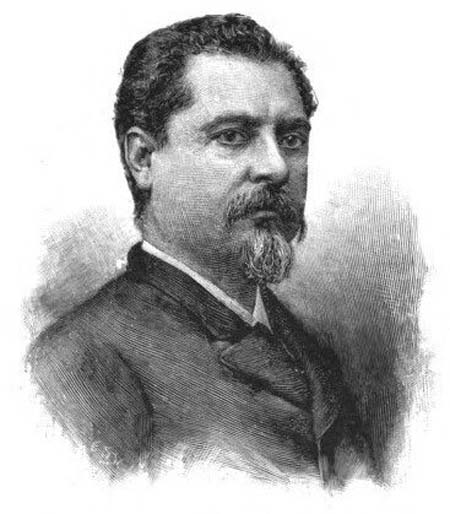
GENERAL LUIS BOGRAN, EX-PRESIDENT
I saw several churches and cathedrals in Honduras with a row of bullet-holes in the front wall, about as high from the ground as a man’s chest, and an open grave by the road-side, which had been dug by the man who was to have occupied it. The sight gave us a vivid impression of the uncertainties of government in Central America. The man who dug this particular grave had been captured, with two companions, while they were hastening to rejoin their friends of the government party. His companions in misery were faint-hearted creatures, and thought it mattered but little, so long as they had to die, in what fashion they were buried. So they scooped out a few feet of earth with the tools their captors gave them, and stood up in the hollows they had made, and were shot back into them, dead; but the third man declared that he was not going to let his body lie so near the surface of the earth that the mules could kick his bones and the next heavy freshet wash them away. He accordingly dug leisurely and carefully to the depth of six feet, smoothing the sides and sharpening the corners, and while he was thus engaged at the bottom of the hole he heard yells and shots above him, and when he poked his head up over the edge of the grave he saw his own troops running down the mountain-side, and his enemies disappearing before them. He is still alive, and frequently rides by the hole in the road-side on his way to the capital. The story illustrates the advisability of doing what every one has to do in this world, even up to the very last minute, in a thorough and painstaking manner.
There do not seem to be very many men killed in these revolutions, but the ruin they bring to the country while they last, and which continues after they are over, while the “outs” are getting up another revolution, is so serious that any sort of continued prosperity or progress is impossible. Native merchants will not order goods that may never reach them, and neither do the gringos care to make contracts with men who in six months may not only be out of office, but out of the country as well. Sometimes a revolution takes place, and half of the people of the country will not know of it until it has been put down or has succeeded; and again the revolution may spread to every boundary, and all the men at work on the high-roads and in the mines or on the plantations must stop work and turn to soldiering, and pack-mules are seized, the mail-carriers stopped, plantations are devastated, and forced loans are imposed upon those who live in cities, so that every one suffers more or less through every change of executive. During the last revolution Tegucigalpa was besieged for six months, and was not captured until most of the public buildings had been torn open by cannon from the hills around the town, and the dwelling-houses still show where bullets marked the mud and plaster of the walls or buried themselves in the wood-work. The dining-room of our hotel was ventilated by such openings, and we used to amuse ourselves by tracing the course of the bullets from the hole they had made at one side of the room to their resting-place in the other. The native Honduranian is not energetic, and, except in the palace, there has been but little effort made by the victors to cover up the traces of their bombardment. Every one we met had a different experience to relate, and pointed out where he was sitting when a particular hole appeared in the plaster before him, or at which street corner a shell fell and burst at his feet.
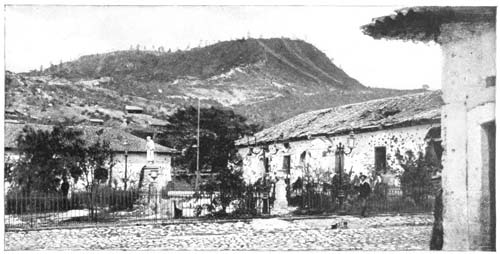
BARRACKS AT TEGUCIGALPA AFTER THE ATTACK OF THE REVOLUTIONISTS
It follows, of course, that a government which is created by force of arms, and which holds itself in place by the same power of authority, cannot be a very just or a very liberal one, even if its members are honest, and the choice of a majority of the people, and properly in office in spite of the fact that they fought to get there, and not on account of it. Bonilla was undoubtedly at one time elected President of Honduras, although he did not gain the presidential chair until after he had thrown his country into war and had invaded it at the head of troops from the rival republic of Nicaragua.
The Central-American cannot understand that when a bad man is elected to office legally it is better in the long-run that he should serve out his full term than that a better man should drive him out and defy the constitution. If he could be brought to comprehend that when the constitution says the president must serve four years that means four years, and not merely until some one is strong enough to overthrow him, it might make him more careful as to whom he elected to office in the first place. But the value of stability in government is something they cannot be made to understand. It is not in their power to see it, and the desire for change and revolution is born in the blood. They speak of a man as a “good revolutionist” just as we would speak of some one being a good pianist, or a good shot, or a good executive officer. It is a recognized calling, and the children grow up into fighters; and even those who have lived abroad, and who should have learned better, begin to plot and scheme as soon as they return to their old environment.
In each company of soldiers in Honduras there are two or three little boys in uniform who act as couriers and messengers, and who are able, on account of their slight figure, to penetrate where a man would be seen and shot. One of the officers in the revolution of 1894 told me he had sent six of these boys, one after another, with despatches across an open plain which was being raked by the rifles of the enemy. And as each boy was killed as he crawled through the sage-brush the other boys begged of their colonel to let them be the next to go, jumping up and down around him and snapping their fingers like school-boys who want to attract the attention of their teacher.
In the same revolution a young man of great promise and many acquirements, who had just returned from the States with two degrees from Columbia College, and who should have lived to turn his education to account in his own country, was killed with a rifle in his hand the third day after his arrival from New York. In that city he would probably have submitted cheerfully to any imposition of the law, and would have taken it quite as a matter of course had he been arrested for playing golf on Sunday, or for riding a bicycle at night without a lamp; but as soon as this graduate of Columbia smelled the powder floating on his native air he loaded a rifle, and sat out all day on the porch of his house taking chance shots at the revolutionists on the hill-side, until a chance shot ended him and his brilliant career forever. The pity of it is that so much good energy should be wasted in obtaining such poor results, for nothing better ever seems to follow these revolutions. There is only a new form of dictatorship, which varies only in the extent of its revenge and in the punishments it metes out to its late opponents, but which must be, if it hopes to remain in power, a dictatorship and an autocracy.
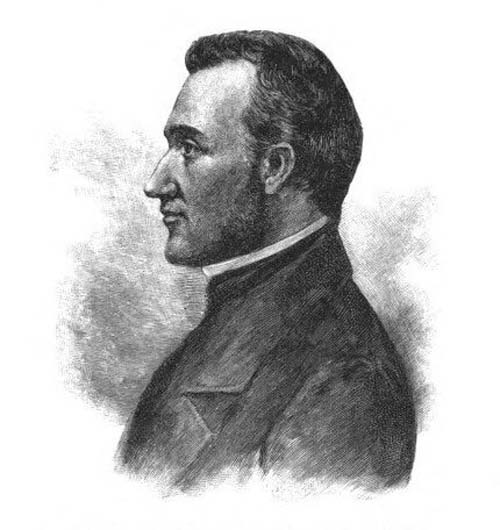
MORAZAN, THE LIBERATOR OF HONDURAS
The republics of Central America are republics in name only, and the movements of a stranger within the boundaries of Honduras are as closely watched as though he were a newspaper correspondent in Siberia. I often had to sign the names of our party twice in one day for the benefit of police and customs officers, and we never entered a hotel or boarded a steamer or disembarked from one that we were not carefully checked and receipted for exactly as though we were boxes of merchandise or registered letters. Even the natives cannot walk the street after nightfall without being challenged by sentries, and the collection of letters we received from alcaldes and comandantes and governors and presidents certifying to our being reputable citizens is large enough to paper the side of a wall. The only time in Central America when our privacy was absolutely unmolested, and when we felt as free to walk abroad as though we were on the streets of New York, was when we were under the protection of the hated monarchical institution of Great Britain at Belize, but never when we were in any of these disorganized military camps called free republics.
The Central-American citizen is no more fit for a republican form of government than he is for an arctic expedition, and what he needs is to have a protectorate established over him, either by the United States or by another power; it does not matter which, so long as it leaves the Nicaragua Canal in our hands. In the capital of Costa Rica there is a statue of the Republic in the form of a young woman standing with her foot on the neck of General Walker, the American filibuster. We had planned to go to the capital for the express purpose of tearing that statue down some night, or blowing it up; so it is perhaps just as well for us that we could not get there; but it would have been a very good thing for Costa Rica if Walker, or any other man of force, had put his foot on the neck of every republic in Central America and turned it to some account.
Away from the coasts, where there is fever, Central America is a wonderful country, rich and beautiful, and burdened with plenty, but its people make it a nuisance and an affront to other nations, and its parcel of independent little states, with the pomp of power and none of its dignity, are and will continue to be a constant danger to the peace which should exist between two great powers.
There is no more interesting question of the present day than that of what is to be done with the world’s land which is lying unimproved; whether it shall go to the great power that is willing to turn it to account, or remain with its original owner, who fails to understand its value. The Central-Americans are like a gang of semi-barbarians in a beautifully furnished house, of which they can understand neither its possibilities of comfort nor its use. They are the dogs in the manger among nations. Nature has given to their country great pasture-lands, wonderful forests of rare woods and fruits, treasures of silver and gold and iron, and soil rich enough to supply the world with coffee, and it only waits for an honest effort to make it the natural highway of traffic from every portion of the globe. The lakes of Nicaragua are ready to furnish a passageway which should save two months of sailing around the Horn, and only forty-eight miles of swamp-land at Panama separate the two greatest bodies of water on the earth’s surface. Nature has done so much that there is little left for man to do, but it will have to be some other man than a native-born Central-American who is to do it.
We had our private audience with President Bonilla in time, and found him a most courteous and interesting young man. He is only thirty-six years of age, which probably makes him the youngest president in the world, and he carries on his watch-chain a bullet which was cut out of his arm during the last revolution. He showed us over the palace, and pointed out where he had shot holes in it, and entertained us most hospitably. The other members of the cabinet were equally kind, making us many presents, and offering Griscom a consul-generalship abroad, and consulates to Somerset and myself, but we said we would be ambassadors or nothing; so they offered to make us generals in the next revolution, and we accepted that responsible position with alacrity, knowing that not even the regiments to which we were accredited could force us again into Honduras.
Before we departed the president paid us a very doubtful compliment in asking us to ride with him. We supposed it was well meant, but we still have secret misgivings that it was a plot to rid himself of us and of the vice-president at the same time. When his secretary came to tell us that Dr. Bonilla would be glad to have us ride with him at five that afternoon, I recalled the fact that all the horses I had seen in Honduras were but little larger than an ordinary donkey, and quite as depressed and spiritless. So I accepted with alacrity. The other two men, being cross-country riders, and entitled to wear the gold buttons of various hunt clubs on their waistcoats, accepted as a matter of course. But when we reached the palace we saw seven or eight horses in the patio, none under sixteen hands high, and each engaged in dragging two or three grooms about the yard, and swinging them clear of the brick tiles as easily as a sailor swings a lead. The president explained to us that these were a choice lot of six stallions which he had just imported from Chili, and that three of them had never worn a saddle before that morning.
He gave one of these to Griscom and another one to the vice-president, for reasons best known to himself, and the third to Somerset. Griscom’s animal had an idea that it was better to go backward like a crab than to advance, so he backed in circles around the courtyard, while Somerset’s horse seemed best to enjoy rearing himself on his hind-legs, with the idea of rubbing Somerset off against the wall; and the vice-president’s horse did everything that a horse can do, and a great many things that I should not have supposed a horse could do, had I not seen it. I put my beast’s nose into a corner of the wall where he could not witness the circus performance going on behind him, and I watched the president’s brute turning round and round and round until it made me dizzy. We strangers confessed later that we were all thinking of exactly the same thing, which was that, no matter how many of our bones were shattered, we must not let these natives think they could ride any better than any chance American or Englishman, and it was only a matter of national pride that kept us in our saddles. The vice-president’s horse finally threw him into the doorway and rolled on him, and it required five of his officers to pull the horse away and set him on his feet again. The vice-president had not left his saddle for an instant, and if he handles his men in the field as he handled that horse, it is not surprising that he wins many battles.