IN HONDURAS (continued 2)
Reading edition
Not wishing to have us all killed, and seeing that it was useless to attempt to kill the vice-president in that way, Dr. Bonilla sent word to the band to omit their customary salute, and so we passed out in grateful silence between breathless rows of soldiers and musicians and several hundreds of people who had never seen a life-sized horse before. We rode at a slow pace, on account of the vice-president’s bruises, while the president pointed out the different points from which he had attacked the capital. He was not accompanied by any guard on this ride, and informed us that he was the first president who had dared go abroad without one. He seemed to trust rather to the good-will of the pueblo, to whom he plays, and to whom he bowed much more frequently than to the people of the richer class. It was amusing to see the more prominent men of the place raise their hats to the president, and the young girls in the suburbs nodding casually and without embarrassment to the man. Before he set out on his ride he stuck a gold-plated revolver in his hip-pocket, which was to take the place of the guard of honor of former presidents, and to protect him in case of an attempt at assassination. It suggested that there are other heads besides those that wear a crown which rest uneasy.
It was a nervous ride, and Griscom’s horse added to the excitement by trying to back him over a precipice, and he was only saved from going down one thousand yards to the roofs of the city below by several of the others dragging at the horse’s bridle. When, after an hour, we found ourselves once more within sight of the palace, we covertly smiled at one another, and are now content never to associate with presidents again unless we walk.
We left Tegucigalpa a few days later with a generous escort, including all the consuls, and José Guiteris, the assistant secretary of state, and nearly all of the foreign residents. We made such a formidable showing as we raced through the streets that it suggested an uprising, and we cried, “Viva Guiteris!” to make the people think there was a new revolution in his favor. We shouted with the most loyal enthusiasm, but it only served to make Guiteris extremely unhappy, and he occupied himself in considering how he could best explain to Bonilla that the demonstration was merely an expression of our idea of humor. Twelve miles out we all stopped and backed the mules up side by side, and everybody shook hands with everybody else, and there were many promises to write, and to forward all manner of things, and assurances of eternal remembrance and friendship, and then the Guiteris revolutionists galloped back, firing parting salutes with their revolvers, and we fell into line again with a nod of satisfaction at being once more on the road.[B]
We never expected any conveniences or comforts on the road, and so we were never disappointed, and were much happier and more contented in consequence than at the capital, where the name promised so much and the place furnished so little. We found that it was not the luxuries of life that we sighed after, but the mere conveniences—those things to which we had become so much accustomed that we never supposed there were places where they did not exist. A chair with a back, for example, was one of the things we most wanted. We had never imagined, until we went to Honduras, that chairs grew without backs; but after we had ridden ten hours, and were so tired that each man found himself easing his spinal column by leaning forward with his hands on the pommel of his saddle, we wanted something more than a three-legged stool when we alighted for the night.
Our ride to the Pacific coast was a repetition of the ride to the capital, except that, as there was a full moon, we slept in the middle of the day and rode later in the night. During this nocturnal journey we met many pilgrims going to the festivals. They were all mounted on mules, and seemed a very merry and jovial company. Sometimes there were as many as fifty in one party, and we came across them picnicking in the shade by day, or jogging along in the moonlight in a cloud of white dust, or a cloud of white foam as they forded the broad river and their donkeys splashed and slipped in the rapids. The nights were very beautiful and cool, and the silence under the clear blue sky and white stars was like the silence of the plains. The moon turned the trail a pale white, and made the trees on either side of it alive with shadows that seemed to play hide-and-seek with us, and the stumps and rocks moved and gesticulated with life, until we drew up even with them, when they were transformed once more into wood and stone.
ON THE WAY TO CORINTO
It was on the third day out from the capital, while we were picking our way down the side of a mountain, that Jeffs pointed to what looked like a lake of silver lying between two great hills, and we knew that we had crossed the continent, and so raised our hats and saluted the Pacific Ocean. A day later, after a long, rapid ride over a level plain where the trail was so broad that we could ride four abreast, we came to San Lorenzo, a little cluster of huts at the edge of the ocean. The settlement was still awake, for a mule train of silver had just arrived from the San Rosario mines, and the ruddy glare of pine knots was flashing through the chinks in the bamboo walls of the huts, and making yellow splashes of color in the soft white light of the moon. We swung ourselves out of the saddles for the last time, and gave the little mules a farewell pat and many thanks, to which they made no response whatsoever.
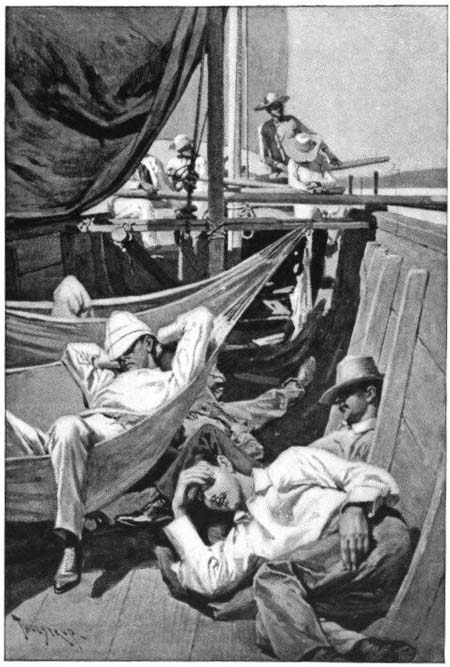
Five hours later we left the continent for the island of Amapala, the chief seaport of the Pacific side of Honduras, and our ride was at an end. We left San Lorenzo at two in the morning, but we did not reach Amapala, although it was but fifteen miles out to sea, until four the next afternoon. We were passengers in a long, open boat, and slept stretched on our blankets at the bottom, while four natives pulled at long sweeps. There were eight cross-seats, and a man sat on every other one. A log of wood in which steps had been cut was bound to each empty seat, and it was up this that the rower walked, as though he meant to stand up on the seat to which it was tied, but he would always change his mind and sink back again, bracing his left leg on the seat and his right leg on the log, and dragging the oar through the water with the weight of his body as he sank backwards. I lay on the ribs of the boat below them and watched them through the night, rising and falling with a slight toss of the head as they sank back, and with their brown naked bodies outlined against the sky-line. They were so silent and their movements so regular that they seemed like statues cut in bronze. By ten the next morning they became so far animated as to say that they were tired and hungry, and would we allow them to rest on a little island that lay half a mile off our bow? We were very glad to rest ourselves, and to get out of the sun and the glare of the sea, and to stretch our cramped limbs: so we beached the boat in a little bay, and frightened off thousands of gulls, which rose screaming in the air, and which were apparently the only inhabitants.
The galley-slaves took sticks of driftwood and scattered over the rocks, turning back the seaweed with their hands, and hacking at the base of the rocks with their improvised hammers. We found that they were foraging for oysters; and as we had nothing but a tin of sardines and two biscuits among five of us, and had had nothing to eat for twenty-four hours, we followed their example, and chipped the oysters off with the butts of our revolvers, and found them cool and coppery, like English oysters, and most refreshing. It was such a lonely little island that we could quite imagine we were cast away upon it, and began to play we were Robinson Crusoe, and took off our boots and went in wading, paddling around in the water after mussels and crabs until we were chased to shore by a huge shark. Then every one went to sleep in the sand until late in the afternoon, when a breeze sprang up, and a boatman carried us out on his shoulders, and we dashed off gayly under full sail to the isle of Amapala, where we bade good-bye to Colonel Jeffs and to the Republic of Honduras.
We had crossed the continent at a point where it was but little broader than the distance from Boston to New York, a trip of five hours by train, but which had taken us twenty-two days.