Chapter VII · CHEMICAL EFFECTS OF THE ELECTRIC CURRENT.
Reading edition
79. Electrolysis. It has been seen that in the voltaic cell electricity is generated by chemical action. Sulphuric acid acts upon zinc and dissolves it in the cell, hydrogen is produced, etc. When this process is reversed, that is, when the electric current is passed through some solutions, they are decomposed, or broken up into their constituents. This process is called electrolysis, and the compound decomposed is the electrolyte. (See "Study," § 369, etc., with experiments.)
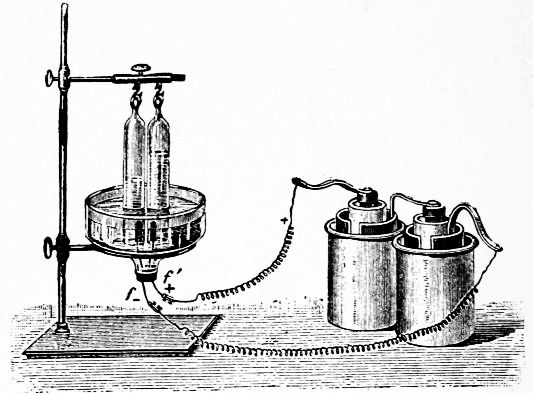
Fig. 77.
Fig. 77 shows how water can be decomposed into its two constituents, hydrogen and oxygen, there being twice as much hydrogen formed as oxygen.
Fig. 78 shows a glass jar in which are placed two metal strips, A and C, these being connected with two cells. In this jar may be placed various conducting solutions to be tested. If, for example, we use a solution of copper sulphate, its chemical formula being CuSO4, the current will break it up into Cu (copper) and SO4. The Cu will be deposited upon C as the current passes from A to C through the solution. A is called the anode, and C the cathode.
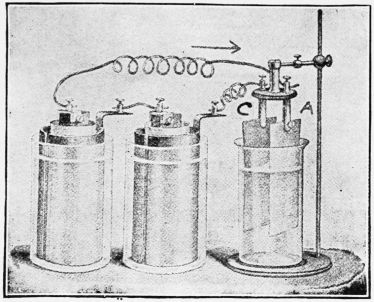
Fig. 78.
Fig. 79 shows another form of jar used to study the decomposition of solutions by the electric current.
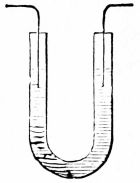
Fig 79.
80. Ions. When a solution is decomposed into parts by a current, the parts are called the Ions. When copper sulphate (Cu SO4) is used, the ions are Cu, which is a metal, and SO4, called an acid radical. When silver nitrate (Ag NO3) is used, Ag and NO3 are the ions. The metal part of the compound goes to the cathode.