Theodosia Ernest. Volume II.: or, Ten Days’ Travel in Search of the Church. (continued 10)
Reading edition
“God grant us all obedient hearts, and a true knowledge of his way, for Christ’s sake! Amen.”
When the preacher had finished his discourse, he remarked that there was some business requiring the action of the Church. While the congregation sang a hymn he came down from the pulpit, and took his place as president or chairman of the Church-meeting, and announced that at the last meeting a certain brother had been found guilty of unchristian conduct, and he had been instructed to see and converse with him, and ascertain whether he showed any symptoms of repentance, and induce him, if possible, to appear before the Church, and make such confession as would remove the scandal of his offences from the Church. He had seen and conversed with him, but he pertinaciously refused to make any acknowledgment of wrong, or to appear before the Church.
“I move, then,” said an aged brother, “that we, as a Church, formally withdraw from him our fellowship, and count him as no longer one of us.”
The motion being duly seconded, and briefly discussed, was unanimously carried, and the clerk so entered it upon his record.
“If there are any persons present,” said the pastor, “who desire to unite with us by letter from other Churches, or by profession of their faith and baptism, let them come forward while we sing.”
One young man came up and took a seat near the chairman. He was much affected by the responsibility which attended the act he was about to perform, and could not restrain his tears.
When the singing had ceased, the pastor remarked, probably for the information of the strangers who were present, and who might be presumed to be ignorant of Baptist usage, That the word of God required but one prerequisite for admission into the visible kingdom and Church of Christ, and that was personal and saving faith in Jesus Christ the Saviour. But as—according to Romans xiv. 1, “Him that is weak in faith receive ye”—it is the duty of the Church to decide whether they have this faith, and not to reject any, even though their faith be weak, so it is the duty of the Church to refuse those whom she may judge to have no faith. We are, therefore, accustomed to require of those who ask admission among us such an explanation of their views and feelings, and such an account of their religious experience, as will enable the Church to judge whether they truly have any portion of that real and saving faith which works by love, and purifies the heart and brings forth good fruit in the life. This is the more needful, since persons are often self-deceived, mistaking a temporary concern about their soul’s salvation for genuine conversion to God, and the regeneration of the Spirit. We do not receive people into the Church or baptize them in order that they may be born again, and made the children of God; but because they give us satisfactory evidence that they have already been born of God, already belong to Christ, and are already qualified, by their love to him and to his people and his cause, to take part in the privileges and responsibilities of his visible kingdom. Baptism is with us a mere formal, official, and public recognition of a previously existing fact, which is symbolized in the ordinance, namely, that the person baptized has died unto sin, as Christ died for him, and has arisen to a new life of righteousness, as Christ came forth from death.
He then proceeded to ask the young man such questions as would elicit the evidence of his conversion to God. And when his answers were not loud enough to be heard by all the Church, he repeated the substance of them, so that all might be capable of judging.
When he was satisfied for himself, he inquired if any member wished to ask any thing more; and, as no one spoke, a motion was made and seconded, to the effect that the pastor be authorized to baptize him, and that after his baptism he be received as a member of the Church. The votes being taken, and found unanimous, the congregation adjourned to the neighboring stream, and there he was baptized in the name of the Father, Son, and Holy Ghost; and on coming up from the water, the members gave him at once the right hand of fellowship, in token that henceforth they counted him as one of themselves.
Scarcely a word was spoken by our little party as they returned home. The solemn scene which they had witnessed called up to the minds of Mr. Percy and Theodosia a crowding host of sad yet tender and pleasing recollections and emotions, which could find no utterance in words. Dr. Thinkwell was debating in his own mind whether he had not done wrong by refusing at once to go up and unite with this little company, as the true Church of Christ; but while he could see at a glance that it had most of the marks which in the Scriptures they had found to characterize a true Church, yet there were one or two which he could not at the moment, and with the information he then possessed, feel certain that it could certainly claim; but when he came to reflect, he found that these were such as did not depend entirely upon the Scripture, though they were scriptural marks, and it had been distinctly understood and expressed, when they were making up the tablet, that a true Church, though it must possess these marks, could be easily known without them. These were the last three tests, each of which requires some knowledge of history to make its application certain. He comforted himself, however, with the reflection that one month’s delay would not probably be of very great consequence, and would give him the opportunity to make his investigation complete in every particular, and his decision, as a consequence, final, and subject to no annoying doubts; and doubts had thus far been the bane of his religious life—not doubts about his own acceptance in Christ, but uncertainty about what was his duty to believe and to perform.
Tenth Day’s Travel.
In which the Church is found and identified.
The Presiding Elder owed his high standing and influence as much to his never-failing suavity of manner, his imperturbable good-humor, and the possession of a comfortable estate, as to his intellectual vigor or his extensive information. He had a ready mind, and could usually give a plausible reply to any argument that seemed to bear against the opinions he espoused; and it was not to him a matter of much moment whether others were satisfied with his reasoning or not. He cared very little, in fact, what opinions other people held: he had no conception that it was of any great consequence whether they or he were right or wrong. Indeed, he thought it doubtful whether all were not wrong. He was sure that there were inconsistencies and contradictions in his system, but yet he had never thought of abandoning the system; and as the more he examined it, the more its inconsistencies appeared, he would not earnestly and carefully look into it, but contented himself by defending those points which others assailed; and this he usually did by a resort to raillery and ridicule, rather than to sober reason and earnest logical argument.
As he had no hope of making a Methodist of any of the company with whom he met at Dr. Thinkwell’s, he was not very each concerned about the result of their investigations, and was prepared to hear, with equal indifference, that they had decided that any one or another of the branches of the Church was, in their estimation, the true ekklesia of Christ.
It was, therefore, a source of no annoyance to him, when they met at his house on Monday, to hear the Doctor say that he was almost convinced that he had at last discovered the object of his search, in the simple, unpretending body of Christian people with whom he met upon the Sabbath.
“I grant you,” said the elder, “that if your marks or tests are reliable, the Baptist Church has more of them than any other; and I suppose, as the majority of your company are Baptists, you purposely framed them so that they might admit that organization, and exclude all others. I will not contend with you, or these friends, upon the applicability of your tests; but if I had been with you from the beginning, I would have objected to the tests themselves.”
“There were those with us, sir, who did object to them. Nay, we ourselves at first objected to some of them, and we received and entered on our tablet not one until we had carefully examined the word of God in regard to it, and were compelled to admit that it was in strict accordance with the requirements of the Scriptures; and so, I think, you would have done had you been present.
“In the first place, we could not avoid conceding that the apostles must have known what Christ desired and intended concerning the institution which he called the Church; and that in every thing essential to its existence and its order, its constitution and its membership, they would conform the Churches which they founded to the model they had received from him.”
“Certainly, sir, that is all self-evident.”
“Then, sir, we could not help seeing that the Church of Christ is, and must be now, in its organization and membership, in its constituent materials, and in its constitutional order, its permanent offices and ordinances—in short, in all that necessarily belongs to it as a Church, just such an institution as those which the apostles founded, and of which we have the accounts in the New Testament Scriptures.”
“I grant all that,” said the Rev. Mr. Stiptain. “I see that, so far, you stood upon solid ground. It is not worth while to question that which is self-evident. But, then, there are still two sources of error into which you may have fallen, and by which your conclusions may have been vitiated. You may, in the first place, have mistaken what was merely accidental and temporary, and, consequently, unessential, for what was designed to be perpetual, and always and everywhere the same. Then, in the second place, you may have misapprehended what were the real characteristics of the apostolic Churches.”
“We were conscious, sir, of both these dangers, and endeavored to guard against them with most scrupulous care. First, in regard to what was really essential, we determined that there could be no Church without members. Members were, therefore, essential. And as these members must have a certain character, there must be something that distinguishes them from other people who are not members. Therefore, we concluded that the character of the membership was another essential, at least in those particulars in which the first Church members invariably differed from those who were not Church members. Thus far, surely we were safe. Then it seemed to us self-evident, as it must have done to you, and every other man of common sense, that there could be no Church without some sort of organization. The members must be united upon some formal basis. The Church was a body—a community, a society. It was not only an assembly, but an official assembly, with certain duties to perform, certain privileges to enjoy, certain objects to accomplish; and this, of necessity, required some basis of organization, or, in other words, some written or unwritten constitution. This constitution must determine the conditions of membership, the relations of the members to each other, and of each of the local societies to each of the other local societies and to all of them, and of each and all of them to Christ their head. Whatever the Master determined in regard to such matters as these must evidently be regarded as perpetually essential; for it is inconceivable that human wisdom should ever be able to mend that system by which the apostle says the wisdom of God was made manifest to the principalities and powers in heavenly places. You may take our tests now, one by one, and see if any one has reference to a matter that was not essential to the being, the constitution, or the continuance of the Church.
“Then, to guard against all danger from the other source which you indicate, namely, that we might have mistaken what were the real scriptural characteristics of the apostolic Churches in regard to these essential points, we took care first to exclude all the testimony of mere tradition, or even of history, and then all the assertions of even the most learned doctors, as to what these characteristics were, and regarded no one as established until we had found it for ourselves plainly and unmistakably recorded in the word of inspiration. What better could we possibly have done?”
“But, my dear sir, do you not admit that you are fallible, and that your friends are so; and, consequently, you and they may have thought you found in the Word things which really are not there?”
“Suppose that were the case. We must still trust to our own conclusions, and act upon our determinations; since God has made each one of us responsible for himself. Religion is a personal and individual thing. Every man must believe for himself, and decide for himself, and carry out in his religious obedience what he himself has found to be the will of God, as revealed in his holy Word. The Word is addressed to me, and I must study it: I must endeavor to understand it for myself, and for myself I must obey; and if I fail, God will hold me individually and personally responsible. So that, unless I have so much more confidence in my pastor’s judgment, or in the judgment of some other person, than I have in my own, that I am willing, unenquiringly, to risk my soul’s eternal interest in his hands, I must be governed by my own determination.
“But, so far from deciding carelessly or inconsiderately, we have explored, with all the helps at our command, every inch of the ground, and are ready now, if it would not take up too much time, to point you to the chapter and verse in which each mark is designated in the Word.”
“If you should do so,” said the Presiding Elder, “we would be no nearer an agreement than we are now; for I should doubtless differ with you about the meaning of the passages, or should be disposed to point you to others teaching a very different doctrine.”
“One would think, to hear you talk,” replied the Doctor, “that it is impossible to know any thing certainly about what the Scriptures mean; but we have found them very plain, and all the time consistent with themselves, and feel that we may be as certain that they do contain these essential characteristics of a true Church of Christ, as we can be that they contain any system of doctrine or of duty. If they are ambiguous and double-tongued on this subject, it seems to me that men may as well at once despair of finding what they mean to teach on any subject; and as we have examined carefully and earnestly, and found the teaching plain and unmistakable, we must be governed by them, and consequently must abide by the result of the application of our tablet.”
“I see, then, there is no room for argument against the Baptist Church, except on some two or three points.”
“It is probably on those same points that I still have some lingering doubts. I saw at a glance, yesterday, that the Baptist Church with which I met consisted only of professed believers. There are none born into it, as Dr. Miller says they are into the Presbyterian Church. There are none baptized into it without their knowledge or consent, and without any previous confession of their faith, as infants are into the Roman Catholic, Episcopalian, Methodist, Presbyterian, Lutheran, and Independent or Congregational Churches. It therefore has the first mark of our tablet. Its members are all professed believers upon Christ.
“It also has the second. Its members have all been baptized upon a profession of their faith; and as all denominations agree that immersion is baptism, there can be no doubt about this, arising from the nature of the act performed.
“So, also, it has the third. It is an independent, local organization, a complete Church in itself, and independent of all others.”
“I do not know so well about that,” said the Presiding Elder. “I was at a Baptist Association last summer, and for the life of me I could not see much difference between the relation which it sustained to the Churches, and that sustained by a presbytery or a conference. It is merely another name for a great ecclesiastical court. The Methodists have their quarterly conferences, their annual conferences, and their General Conference. The Presbyterians have their presbyteries, and their synods, and their General Assembly; and so the Baptists have their local associations and their general associations, and their great Convention, which, like our General Conference, only meets once in several years. The local Churches are no more independent in the one denomination than in the other. In all they are under the control of the assembled delegates, which represent the combined wisdom of all the Churches.”
This was a new phase of the subject to the Doctor, and he knew not what to say, but turned inquiringly to Mr. Courtney.
“A Baptist Church,” said the schoolmaster, “is, in all that concerns it own members, as independent of the associations as it is of the Methodist conference, or of the grand lodge of Odd-Fellows. When a candidate applies for admission, it alone decides to receive or reject him. When a member has been guilty of some offence, it tries, condemns, and excludes him, and from its decision there is no appeal to any association, local or general, or to any convention or other body outside itself. What it decides is the decision of the Church, and ends the matter, unless it can be persuaded to revoke its decision, as Paul besought the Church at Corinth to restore one whom it had cast out.
“The Church is under no necessity to belong to any association, and is neither more nor less a Church when she does belong to one. Every association and convention in the land may be dissolved to-morrow, and no single Baptist Church will have either more or less authority than she has to-day. But if you dissolve the Conference, that great ecclesiastical establishment called the Methodist Church is dissolved. Dissolve the General Assembly, and you have dissolved that great confederation known as the Presbyterian Church, and of which each local society is but an integral part. A Methodist society cannot be a Methodist society except as a part of the great body that is subordinate to the Conference. A Presbyterian society cannot be a real Presbyterian society except as it makes a part of that great body which is subject to the General Assembly. Let either withdraw all connection with or deny all obedience to the powers thus set over them, and they become Independents. But a Baptist Church is not of necessity a part of any association or convention. It gives up no part of its authority when it sends a messenger, and retains no mire when it refuses or neglects to send.”
“What then, let me ask, is the Association, and what relation does it sustain to the Churches and their members?”
“Some Baptist associations and conventions,” replied Mr Courtney, “are organized for one purpose, and some for an other. They are simply voluntary organizations outside the Churches, formed, like a Bible society, or a missionary society for the accomplishment of some specific object, in which the Churches may or may not take a part, as they see fit. Sometimes this object is to sustain a system of missionary operations so extensive that some concert of action is required to secure its success; sometimes it is to build up and sustain an institution of learning; sometimes to provide young ministers with the means of acquiring a better theological education; sometimes it is for the arrangement and support of some plan for the distribution of the Scriptures or of other religious books; sometimes merely for mutual counsel, and to learn, by messengers or letters, what progress each Church is making, what is the number and condition of her membership, and what she is doing to promote the cause of Christ; and sometime it combines several or all of these objects. But whatever objects it may have, it never can have the right to interfere with the domestic economy or discipline of the Churches, whether of those who send messengers to it or of others.”
“But let me ask you,” said the Presiding Elder, “whether these associations are not often called on to decide cases of difficulty in the discipline of the Churches, which are sent up to them for adjustment?”
“No, sir; the Churches often send up some notice of cases of difficulty and ask for advice, and sometimes they send questions of difficulty and ask for information concerning matters either of faith or practice, and the advice is given and the information granted; but neither the one nor the other is binding as a law to the Churches. Each Church may receive or reject the advice, as it sees best.”
“But may not the association punish the Church by exclusion, if it should fail to heed the advice so kindly given?”
“That would depend upon the relation of the matter to the constitution of that particular association. You will observe that each association is a voluntary organization. It makes no part of the Churches, and has no control over the Churches, except in regard to such matters as are provided for in the constitution adopted by itself, and voluntarily agreed to by the parties coming in. And no Church has the right to give up to the association any of those prerogatives with which Christ has invested her. She dare not give up to the association, or to the minister, or to anybody else, the power of discipline, which is by the authority of Christ vested in the ekklesia alone. The constitution of the association determines the conditions of membership in its own body: they are as various, almost, as the associations themselves. In some, for instance, no Church can be represented that does not send a certain sum of money; and if she fails to make the contribution, she cannot be a member of the association, but she is no less a Church, and a Baptist Church, than she would have been if she had sent it. In most of the associations, it is made a condition of membership that the Church must be an orderly Baptist Church, and must hold certain doctrines which are common to the denomination. This is essential for the harmonious mutual cooperation of them all in the educational or missionary enterprises for the conducting of which the association was formed. And when they have such a constitutional basis, and any Church has ceased to be an orderly Baptist Church, or to hold the doctrines specified, they may refuse to recognize her any longer as a member. But this is no ecclesiastical, no Church action. It is not an excommunication on the assumed authority of Christ, and exercised by the association as his Church. or as a part or a branch of his Church; it is the mere dissolution of a voluntary compact, when one of the parties has violated the terms of the compact. The authority of the association can never go behind its own constitution.
“It may be possible that associations sometimes forget this, and act as though they were not merely advisory, but legislative or judicial bodies; but if they ever do, they violate all regular Baptist usage, and thoughtful and intelligent Baptists will at once disown them.
“The truth is, the associations and conventions are the mere creatures of the Churches, formed for the more effectual execution of the plans which the Churches entertain for the furtherance of the great objects of Christian benevolence; objects so vast that individual Churches cannot alone accomplish them. What one cannot do, some twenty, or fifty, or a hundred can, and they agree to work together; and that they may work harmoniously together, each sends a delegate or more, as may be agreed upon, to carry funds, assist by his counsel, and bring back word to the Church as to how the work goes on. The association is not, therefore, like the Conference or the Presbytery, the lord and master of the Church, but is its creature and its servant, and so responsible to it for its proceedings, that if it does not conduct in all things in such a way as to give satisfaction, it withdraws from it and gives it no more countenance or support. But whatever the association may be, or whatever power it may have, it is sufficient for our present argument to know that every Baptist Church is so far independent of it, that it is entirely free to unite with it or to stand apart from it. It is no more bound to belong to an association or convention, than it is to represent itself in the Grand Division of the Sons of Temperance, or to belong to the American Bible Society, or the American Sunday School Union.”
“Then I can understand,” resumed the Doctor, “that it has also the fourth mark upon our tablet. It has Christ alone for its King and Lawgiver, and recognizes no authority but his above its own. If the associations and conventions cannot make laws for it, or exercise discipline for it or in it, I suppose no others will attempt to do so, unless it be their pastors: and I observed yesterday that the pastor took no other share in the exercise of discipline, than simply as the president of the assembly, to put the question and gather the voice of the members. And, moreover, as the pastor is not sent to them by bishops, conferences, or presbyters, but chosen by the Church, and holds his office at their pleasure, he must of necessity be the servant and not the master of the Church. He may rule, but his government must be founded in love, and his control such as the faithful performance of his duties as a good minister of Jesus could not fail to give him in any assembly of earnest-hearted, Christ-trusting, and Christ-loving people.
“And so, also, I can testify that its members come voluntarily and ask for membership, and are not brought by their parents and compelled to be initiated, even though they cry out against it as loudly as a little babe can cry.
“Nor do I see any reason to doubt that it holds to the fundamental doctrines of the gospel as its articles of faith. And have never heard of any Baptist Churches being engaged in persecution, though all the histories of them that I have read are almost continuous records of the distress which they have endured from other so-called Christian Churches.
“I yield them, therefore, the possession of our fifth and sixth, and also our eighth mark; but now when I come to ask about the seventh and the ninth, I must wait for further information.”
“And if you wait,” said the Reverend Mr. Stiptain, “until you have traced its continued existence down from the time of Christ, or ascertained its regular succession in a line of Churches that never in any age became even temporarily apostate, you will wait till you have joined the Church above. I have not studied particularly the history of the Baptist Church: but I will venture to promise that if you will make out this regular succession for them, I will at least never laugh at them again as the modern progeny of the Munster men in Europe, and Roger Williams in America.”
“It was our understanding, I believe, when we entered these historical marks upon our tablet,” replied the Doctor, “that each of the bodies claiming to be Churches should be considered as having descended regularly from the apostles, unless the contrary should appear from their own records. We have seen for each of the others a historical origin in comparatively modern times. We know when the Lutheran, the English and American Episcopalian, the Presbyterian, and the Methodist Churches were first organized. We can trace them back to a certain point, and beyond that they had no separate existence. They were all merged in Rome, and only existed as component parts of the great Roman Catholic antichristian Hierarchy. We have traced this mother of them all back still farther, and found a time long after Christ or the apostles when there was not only no Roman Catholic Church, but no such organization as that afterwards became.
“Now, if we can do the same by the Baptist Church—if we can go back and find a time since Christ when it had no existence—we must concede that it has not this test. But unless this can be done, we must take it for granted, as we were ready to do in regard to the other claimants, that it has existed from the days of Christ and the apostles. We need not put it upon the Baptists to show the record of every age, and trace upon it the history of their Church.”
“In the sense in which you employ the term,” said Mr. Courtney, “there is not and never has been such a thing as ‘the Baptist Church.’ There cannot be. Each Baptist Church stands alone and independent of all other Baptist Churches. As the Church at Jerusalem, and the Church at Antioch, and the Churches of Judea, and Galilee, and Samaria, were not combined together in any great confederation called the Church, but each one was the Church, in and of itself, and neither more nor less the Church for the existence of the others, so every particular Baptist Church that is organized upon the same model, having the same sort of members, the same organization, the same ordinances, and the same doctrines, is itself the Church. It is not a confederation of Baptist Churches nor a continued succession of Baptist Churches that is the Baptist Church; but every local, independent body of baptized believers, holding the doctrines of the gospel, and having the ordinances of the gospel, that now exists, or has at any time or in any place existed, is and was the Baptist Church in the only sense that there can be any such thing as the Baptist Church, or that there was any such thing as the Church in the days of the apostles. And now, with this understanding of the term, I am ready to take either plan to show our continuity from the time of Christ. I will prove, by the most unexceptional historical authority, by the concessions of our bitterest opponents and persecutors, that our Churches have existed in every age. Or I will undertake, as a shorter method of reaching the same conclusion, to show that there is no other history of their first beginning but that which we have in the New Testament itself. And if I can do either one or the other, it will be more than enough. Now, to settle the question at once, I will take it upon me to trace the Baptist Churches on the chart of history, either backwards or forwards. We may begin here to-day and trace them back to John in Jordan; or I will begin in Jordan and trace them downward till to-day. I anticipated this difficulty. I knew that a true Church could be known without this test, ere would not have introduced it but at the suggestion of the Episcopal bishop; but since we have it, I will not shrink from its most rigid application. Try us as you will, and you will not find us wanting in any scriptural feature. I have here a brief sketch of dates and authorities, which I have arranged merely to assist my memory, and by its aid I will give you such testimony as cannot fail to satisfy any reasonable man that Churches have all the time existed, having every essential characteristic of the little assembly with which we met on yesterday. I do not say they were called Baptists, or even Anabaptists, which is an older name, as applied to the Churches; but names are nothing. It is the thing, and not the name, that we are looking for; and the thing is an official assembly of Christian people, having each of the marks which we have recognized as the characteristics of the Churches of Christ in the apostles’ days. Their names have usually been given by their enemies, and do not designate their character Their names have been changed for them in almost every century, but their peculiar character has been the same, and by this, not the name, we must discover and point them out upon the page of history.”
“I think,” said the Doctor, “I would a little prefer to begin at the present, and trace them backwards. Thus we did with the other claimants, and found them all to end in Rome, at the time of Luther’s Reformation.”
“Very good: this is a little past the middle of the nineteenth century. I suppose no one will question the existence A.D. 1700 to 1800. of the Baptist Churches now, and since the year eighteen hundred. Both in this country and in Europe, there are hundreds, nay, thousands of Churches, and hundreds of thousands of members.
“Nor will it be doubted that they existed in the eighteenth century. A letter, dated Philadelphia, August 12th, 1714, written by a Baptist minister, Mr. Able Morgan, to a friend in England, will show their existence in this country at that time: ‘We are now,’ he says, ‘nine Churches;’ alluding to those in the vicinity of Philadelphia. ‘In these Churches there are alone five hundred members, but greatly scattered,’ etc. (Crosby, vol. i., p. 122.) And we will presently see that there were many of them long before this in the New England States. I suppose it will hardly be necessary to do more than to say that hundreds of our Churches existed from A.D. 1700 to 1800, in the British Empire, and on the Continent. Their history in that country is too recent and too well known to admit of cavil or denial. But when we enter the next age in our travels up this stream of tie, there may possibly be need of reference to authorities. It was during this century that the first Baptists came to America. They were members of a Church of English Baptists in Holland, A.D. 1600 to 1700. having by persecution been driven out of England, and who came over here in 1620. Cotton Mather, the historian of the early colonists, says of them, ‘Having done with the Quakers, let it not be misinterpreted if into the same chapter we put the inconveniences which the New England Churches have suffered from the Anabaptists, albeit they have infinitely more of Christianity among them than the Quakers.… Infant baptism hath been scrupled by multitudes in our days, who have been in other points most worthy Christians, and as holy, watchful, fruitful, and heavenly people as, perhaps, any in the world. Some few of these people have been among the planters in New England from the beginning, and have been welcome to the communion, which they have enjoyed, reserving their particular opinion to themselves.’
“‘But at length it came to pass that while some of our Churches used, it may be, a little too much cogency toward the brethren which would weakly turn their backs when infants were brought forth to be baptized in the congregation, there were some of these brethren, who in a day of temptation, broke forth into schismatical practices that were justly offensive to all the Churches in this wilderness.’
“‘Our Anabaptists, when somewhat of exasperation was begun, formed a Church at Boston, on May 28th, 1665, besides one which they had before at Swanzey. Now they declared our infant baptism to be a mere nullity, and they arrogate unto themselves the title of Baptists, as if none were baptized but themselves.’
“In another place, Mr. Mather says that more than a score of ministers had come to the country who were so obnoxious to the body of the colonists that they could not be tolerated, but that some of them were deserving of a place in his book for their piety. ‘Of these there were some godly Anabaptists,’ whom he mentions by name. (Crosby, vol. i., pp 112–116.)
“The existence of our Churches in England, during this century, is attested by several books which were published by their ministers. One in 1615, to prove that every man has a right to judge for himself in matters of religion, and show the invalidity of the commonly received baptism; and for their opinions on several points of doctrine they refer to their Confession of Faith, published in 1611. They published another book defending Baptist sentiments, in 1618, and many from that time on. But they have not only given this testimony concerning themselves, but we can trace them in the laws enacted for their destruction, in their petitions and complaints, in the records of the courts and the prisons in which they were condemned and confined; and one of them, at least, was burned at the stake. It was about the middle of this century, moreover, that Cromwell made religion free, and thousands of Baptists came forth into the light, who before had been obliged to hide from the sword of persecution. ‘Persons of this persuasion,’ says Russell, ‘filled the army with preaching, and praying, and valiant men.’ When Cromwell afterward, under the influence of Presbyterians, determined to repress the Baptists, they sent him a memorial or remonstrance, in which they ask ‘if Baptists have not filled his towns, cities, provinces, islands, castles, navies, tents, armies, and court.’ But under Charles the Second, they were again subject to persecution, but still continued to protest against the Hierarchy, and the other corruptions of Christianity. A.D. 1500 to 1600. “Now let us go back another century. We have found Baptists in great numbers from 1600 to 1700. How is it from 1500 to 1600?
“The Baptists in the early part of this century were for the most part called Lollards in England, and Anabaptists and Mennonites upon the Continent. But they were Baptists in fact, though known by other names. They were in England many of them foreigners who had been led to expect, from the rupture between King Henry the Eighth and the Pope, that they might there be free to enjoy their religion; a mistake of which King Henry hastened to cure them, as soon as he became the Head of the Church.
“Styrpe, the historian of those times, says, ‘The Baptists pestered the Church, and would openly dispute their principles in public places.’ In 1539, a general pardon was granted to all religious offenders, but the Baptists were specially exempted. So numerous were they, and so rigorously persecuted, that the records show that over seventy thousand of them were, in King Henry’s time, punished by fines, by imprisonment, by banishment, or by burning.
“On the Continent, their existence is shown by the persecutions which they suffered from the Lutherans, as we have already seen.
“Then let us go back another hundred years. A.D. 1400 to 1500. How was it from 1400 to 1500? We have now, you see, gone back of the times of the Reformation, which occupied the early part of the century we have just past. We are now where we can find no Church of England, no Lutheran, no Presbyterian Churches. The Protestants had at this time not yet protested, and were quietly resting in the polluted arms of their mother of Rome.
“Now if we still find the Baptists outside of Rome, refusing to recognize her as a Christian Church, denouncing her as the very Antichrist foretold in the Word, and by her denounced and persecuted, we will have proved, at least, this much, that the Baptist Churches are older than Protestantism in any of its sects or creeds, and that they did not, as charged by Dr. Featly, and reiterated by almost every Pedobaptist writer since his day, begin with the madmen of Munster.”
“Why do you not go back at once to Peter Bruis and his co-laborer Henry?” asked the Rev. Mr. Stiptain. “Dr. Wall, you know, admits that they were Baptists, and expressly says, ‘they were the first preachers that ever set up a Church or society holding that infant baptism was a nullity, and rebaptizing such as had been baptized in infancy.’”
“I thank you for your suggestion, sir, though this will take us back at one step for over two hundred and fifty years. But in all those two hundred and fifty years the followers of Peter and Henry can be traced as Baptists, and their societies as Baptist Churches. It was some years before 1150 that they appeared. We learn their doctrines from their A.D. 1150 to 1500. enemies. One who wrote against them, the Catholic Abbot of Clugny, says that they taught that ‘infants are not baptized or saved by the faith of another, but ought to be baptized and saved by their own faith; or that baptism without their own faith does not save, and that those that are baptized in infancy, when grown up should be baptized again, nor are they then rebaptized, but rather rightly baptized.’ (Magdeburg Centuriators, Cent. xii. c. 5, p. 332. Ivimey, vol. i., p. 22.) The Lateran Council, under Pope Innocent the Second, in 1139, according to Dr. Wall, did condemn Peter Bruis and his follower Arnold of Bresica, for rejecting infant baptism. The followers of these men were called Petrobrussians, Henricans, and Arnoldists, and a portion of them, at a later day, Lollards, from one Lollardo, who brought their doctrine into England. They and those who held the same doctrines, namely, the Paternines and Puritans, or Cathari, from the Province of Bulgaria, spread over the south of Europe, and, notwithstanding all the terrific persecutions to which they were subjected, maintained their separate societies even in parts of Italy. They owned the Scriptures for their only rule of faith and practice, administered baptism only to professed believers, and that by one immersion. See Orchard’s History of Foreign Baptists, p. 160.
“It is stated by the learned Magdeburg Centuriators, and by Wall, that the followers of Peter Bruis, and of Henry, were about eight hundred thousand strong when Waldo, of Lyons, appeared and joined them, a few years after their condemnation by the Roman Catholic Council. He became a great leader among them, and thence, some say, they were called Waldenses, or Lyonists. Before the close of this century they had become a mighty host, and embraced among them persons of rank and power. In France, where they were strongest, they were called Albigenses. The ordinary means for the extirpation of the heresy not availing for their destruction, Pope Innocent the Third determined to bring to bear upon them all the military power of his dominions. He raised an army of from three to five hundred thousand men, and sent for their destruction. Two hundred thousand fell in one short campaign in the year 1209. An other army was sent the coming year: cities and towns were burned, the country desolated, and every man, woman, and child that could be found, destroyed or banished. This was repeated year by year until the death of Innocent in 1216, and the same sanguinary course was followed up by his successor until about 1229, when the heretics had been so completely crushed that scarcely any could be found to glut the Roman thirst for blood. A great multitude had, however, escaped to other lands and carried the true gospel with them. They gathered in Switzerland and Germany, and among the valleys of the Pyrenees; and after all the wicked waste of life for the quarter of a century, it is conceded that there still remained at least eight hundred thousand of these persecuted people, concealed in various countries of Europe. (Perin.)”
“But is it certain,” asked Theodosia, “that these Albigenses were Baptists?”
“It was for denying infant baptism and the sacraments of the Roman Catholic hierarchy,” replied Mr. Courtney, “that they were condemned. Their own confessions of faith, the accusations of their enemies, and the concurrent testimony of historians, all unite in showing that they were Baptist Churches. See Orchard’s History of the Foreign Baptists pp. 226–229.
“The same people in England were called Lollards, from the eminent Walter Lollardo, who left his native land to preach this gospel to the British; but the doctrines had gone there before him Archbishop Lanfranc wrote a book against them shortly after the doctrine was condemned by the Lateran Council in 1139. About this time Lingard says a colony of people came into England belonging to the fanatics who invested the north of Italy, Gaul, and Germany, and who were called Puritans. Usher calls them Waldenses. They said they were Christians, and followed the doctrines of the apostles; they denied purgatory, prayers for the dead, and invocations to the saints. It was from these people that Wyckliffe first, and Tyndale afterwards, were indoctrinated in the truth. History records the death of thousands of them up to the very time of the Reformation, as it is called, under Henry the Eighth, though by that time their name had been changed to Anabaptists.
“We might trace the same people in Bohemia, in Poland, in Moravia, and elsewhere; but it is not needful for our purpose. We have seen that, according to the testimony of Dr. Wall, there were Baptist Churches from 1139 or before, when Peter Bruis and Henry set them up. Wall says they were the first, but I will show you now that Wall was mistaken. These men laid no claim to the originating of a system. They but embraced and preached doctrines already known, and united with a people who were already in being, and had long been persecuted for the maintaining of the very same doctrines and practices. If we will go back to the A.D. 750 to 1150. time of Pope Stephen the Second, about 750, we will find in history numerous accounts of a people called Paternines, who denounced infant baptism, and maintained that a Church should consist only of Christian people, and must not persecute, and who baptized by immersion, as indeed all parties did at that time. (See Robinson’s History of Baptists, pp. 428–430.) They were called Paternines from the patience with which they suffered for the cause of Christ. In 1040 they had become very numerous. Their principal city was Milan. They had no connection with the Church of Rome. They rejected the authority of the Fathers. They said the sign of the cross was the mark of the Beast. Their Churches were numerous all over Europe, their meetings being held during times of persecution in the residences of the brethren, and it was to these people that Peter Bruis, and Henry, and Arnold of Bresica joined themselves, and gave their learning and their eloquence to advance their cause. They, indeed, became so conspicuous among them that portions of their communities were called by their names; but though they were the means of giving them new names, they did not give them new doctrines. They left the Church of Rome, and joined these people who were never in the Church.
“But the Paternines were no new sect. They had simply been new named, for they belonged to the people who were A.D. 650 to 750. before called Paulicians, or Publicans, and who began about the year 650, and who are well known to the history of those times. Robinson says they rebaptized those who came to them by immersion. Mosheim says they rejected the baptism of infants, and Dr. Allix calls them Anabaptists. Because they had no rulers and condemned the hierarchy, they were sometimes called the Acephali, from a Greek word signifying the Headless. So numerous were these people, that even after portions of them had come to be called Paternines and by other names, one hundred thousand martyrs of them died in nine years by the most horrid tortures, during the reign of that female devil incarnate, the Empress Theodora.”
“I am glad,” said Mrs. Percy, “that her name was not Theodosia.”
“From Italy,” continued Mr. Courtney, “the Paulicians sent colonies, according to the testimony of Mosheim, and Gibbon, and others, into almost every nation of Europe, and formed a number of religious assemblies, who adhered to their doctrine, and who suffered every conceivable indignity from the Church of Rome. In Italy they were called Paternines, or Puritans; (‘Paterni,’ or ‘Cathari,’ from a Greek word signifying the pure;) in France Bulgarians, because they came from Bulgaria, and sometimes Publicans and Boni-Homines, or the Good Men; but they were mainly known as the Albigenses, from Alby, the name of a chief town in the region where they dwelt.
“But though the Paulicians were called a new sect, and did have in one sense an independent origin, from one Constantine, who was afterwards called Sylvanus, and who was converted to Christ by reading the Gospels and the Epistles of Paul, which were brought to him out of Syria by a deacon of a Christian Church, and after his conversion became a noted preacher of the truth, until he was, at the instigation of the Greek Church, stoned to death; yet his doctrine was not new, and before his day and after it, there were thousands who, like him, rejected infant baptism and the authority of the hierarchy, and were in all essential particulars Baptist Churches of Christ.
“For if we now go back to the year 300, we A.D. 300 to 650. will find all the Churches to be Baptist Churches in regard to baptism, except a few in Africa, though many of them had become apostate in regard to the episcopacy.
“The accession of Constantine to the imperial throne in 306 has commonly been regarded as a blessing to Christianity. It was, in fact, so far as human wisdom can discover, its greatest curse. It degraded and polluted the Church by combining it with the state, and it made that thing which people have ever since called the Church, the murderer and persecutor of the followers of Christ. It was a matter of policy in Constantine to profess the Christian faith. He did it to cement his worldly power. He was no friend to Jesus. He had never learned of him how to be meek and lowly. He knew nothing of the humble and forgiving and long-suffering spirit of the true disciples of Jesus. Like Henry the Eighth of England, his ambition was to become the head of the Church; and as its head, so soon as his ecclesiastical power was firmly established, he adjusted his creed and issued his edicts of conformity. His clergy were notoriously corrupt, and the people who would not submit to their rule were most grievously oppressed; yet they continued to ask, ‘What has the Emperor to do with our religion?’ The councils of prelates by imperial authority strove in vain to bring into subjection the Cathari, the Novatianists, and the Ærians, (not Arians,) who opposed their doctrines and rejected their authority, and continued to baptize anew all who came from their apostate communion. For they regarded the so- called Catholic Church, now claiming all the power of Christ’s kingdom, but as a worldly community, while Christ’s Church must, they said, consist only of the converted. There was not at the beginning of this period in the Eastern Churches any question concerning baptism, for all parties immersed, and we have no record of the baptism of a child until 370, when the son of the Emperor Valens was thought to be dying, and was baptized by command of the emperor. Nor is there any official requisition for the baptism of children until the decree of the Council of Carthage in 401. But we have nothing to do with this establishment, world-wide as it was, which recognized the emperor for its head. By that one act, if in no other way, it had apostatized from Christ. We must look for the Baptist Churches among those who would not even on pain of death yield to its usurped authority, who would not obey its decrees, and who held on to the liberty with which Christ had made them free. We have nothing to do with the so called Arian heresy, or its Trinitarian opponents. The apostate Church of the emperor may fight its own battles—they do not concern the Churches of Christ. These never came into the ecclesiastical establishment called the Church by those who write Church history. That establishment was mostly made up of those who had apostatized before Constantine entered it and was elevated to its headship. They had already recognized the authority of bishops and councils to make laws for them. They had already become worldly and corrupt, and there were those who had long refused communion with them on this account. They said to any who came to join them, ‘If you be a virtuous believer, and will concede to our confederacy against sin, you may be admitted among us by baptism, or, if any Catholic has baptized you before, by rebaptism.’ It was on this account that they were at a later day called Ana-Baptists, or rebaptizers. They soon obtained the name of Cathari, or Puritans, because they thus insisted on maintaining the purity of their communion. There is mention made of these people in France fifty years before the time of Constantine. Their Churches were scattered all over the Roman empire when Constantine came to the throne. Constantine sought to unite them with the Catholics, but they obstinately refused to pollute their communion even at the command of the emperor, who then professed to be their friend. He therefore turned against them, destroyed their books, drove them out of their Churches and, by his oppressive measures, scattered them as precious seed among those countries in the west of Europe where they afterwards produced those trees of righteousness, the Paternines, Albigenses, Waldenses, and others of the same faith and order, though called by various names. Claudius Seysell, the popish archbishop, traces the rise of the Waldensian heresy to a pastor named Leo leaving Rome at this early period, and taking up his abode in the valleys.
“The succeeding emperors continued the persecution which Constantine began. In 375, the Puritan ministers were banished by Valens; but Theodosius, a few years after, restored their liberties, and showed them so much favor, that at the close of this century they had several Churches in Constantinople itself, under the very eye of his imperial majesty.
“In 412, however, their Churches were closed again, and by a decree of the Lateran council, in 413, they were banished as heretics, and the emperor doomed all who should rebaptize or be rebaptized, to death. Under this law, so like to that of the Lutheran senate, in 1522, many were slain, and others driven into the valleys of Piedmont, where they were after wards called Waldenses. Another council, at Mela, in 416, held them accursed, as denying that infant baptism conferred forgiveness and salvation, and two years after, the curse was repeated by a council at Carthage. These persecutions drove them into retirement, and from the patience with which they endured it, caused them to be called Paternines, and under this name we have already traced them. The accounts given of them by Eusebius and by Socrates, the historians of the early Churches, enables us easily to identify them, even after their name was changed. A.D. 30 to 300. “Now, to complete our chain, we have only to go back to the time when Jesus began to be about thirty years old, and bring down our history to the year 300. John at that time had prepared or was preparing a people made ready for the Lord. He rejected all who did not give evidence of true repentance, and profess their faith in him who was to come. After Jesus had been baptized by him, he, by his disciples, continued to baptize. Out of these a Church was formed, as the model for others. The apostles formed many like it in various places. We have already examined them, and found that they were Baptist Churches, with every single mark included in our tablet. Such Churches as these would, of course, succeed them for a time. We have already ascertained that neither infant baptism nor the rule of prelatical bishops was recognized among them for many years; and that when they were sought to be introduced, there were some at least, whose history we have traced, who would accept of neither. All the so-called Christian Churches, for the most part, were separate and independent organizations for the first three hundred years; the exceptions being, as we have seen in our examination of episcopacy, in the cities where the hierarchy first began by the recognized supremacy of the pastor of the first or principal Church. Infant baptism, we have seen, was not so much as mentioned till the time of Tertullian, and then promptly rejected; nor have we any record of the baptism of any infant till after Church and State were joined. In those early days all baptized by immersion, as all historians concede; so that we have no possible room to doubt that from Christ to the separation of the Puritans or Novatianists, the great multitude of the Churches were independent local societies, consisting of professed believers who had been baptized by immersion upon a profession of their faith, and of course had voluntarily united with them; and that almost all these societies rejected the authority, in matters of religion, of all lawgivers but Christ, and were, in fact, just such communities as the Baptist Churches are now.”
“Your succession is very ingeniously made out,” said the Reverend Mr. Stiptain, “and it seems a pity to sever such a beautiful chain, and let all fall that hangs upon it; but the truth of history requires it; and much as I regret the ruin in which it must involve your whole scheme, I must call your attention to one very important fact, which you, undesignedly no doubt, forgot to mention.”
“And what is that, pray?”
“It is, simply, that the Waldenses were not Baptists, but, like the Methodists and Presbyterians, baptized their infant children.”
“That would not, even if it were true,” said Mr. Courtney, “sever the chain of our succession; for I have shown that the first Churches, for two hundred and fifty years, did not baptize infants, and were in other things like Baptist Churches. Then I have shown that similar Churches, disowning the hierarchies and denying all baptisms but that administered by themselves to professed believers, called Novatianists and Cathari at first, and Paternines afterwards, continued to exist down to the time of Peter, and Henry, and Arnold, and that they afterwards became so numerous under the name of Albigenses as to require immense armies, year after year, for near a quarter of a century, to extirpate them in France alone. These Albigenses, I have shown, were Baptists; and it was by one of these that their doctrines were brought into England. The Lollards were descendants of these people, and the Lollards continued to be drowned and burnt in England for denying infant baptism and the hierarchy, up to the time of the Reformation, and were in all respects similar to these ancient Baptist Churches. If those upon the continent ever apostatized, and fell into the baptism of infants, it was not till after they had sent believers’ baptism into England, and any defection afterwards would not affect our cause.
“Let it be true that some of the people called Waldenses by others, or even by themselves, did baptize infants; it is enough for us that there were others of them who, as Dr. Wall says of the Petrobrussians, whom he counts as a sect of the Waldenses, ‘did reckon infant baptism as one of the corruptions of the Church of Rome, and accordingly renounced it, and preached only adult baptism.’ (Hist. Inf. Bap., part ii., chap. 7, §§ 5, 6, 7.) Mosheim says of Peter Bruis, that ‘it is certain that one of his tenets was, that no persons whatever were to be baptized before they were come to the full use of reason.’
“Brandt, in his History of the Reformation, says that ‘some of the Waldenses rejected infant baptism;’ and this is certain from the testimony of those who killed them because they did deny infant baptism. Now if there were some of them who were Baptists, and Lollardo was of these, as he must have been, since those whom he instructed in England were afterwards killed for entertaining Baptist sentiments, it does not matter if many others of them were degenerate.
“But besides this, we have traced the Baptists of England only through this one channel: we could trace them with equal ease through the Mennonites, and these we can trace back to this times of the apostles by a channel which has no suspicion of infant baptism. Then we have not yet examined the history of the original baptism which is said to have been brought into England by Paul himself, and which certainly was introduced at a very early day, and before the corruptions which made the Eastern Churches apostate.
“But merely for your satisfaction, I will show you that you have been imposed upon when you were taught to believe that the main body of the so-called Waldensian Christians baptized their infants, or were in any thing other than true Baptist Churches according to our tablet.”
“I do not know,” replied the Presiding Elder, “how that can be, when we have their own express declaration in their official Confession of Faith.”
“In a body of people so numerous as the Waldenses,” said Mr. Courtney, “comprising not only many separate communities, but extending over different countries, and speaking various different languages, we may well suppose some diversity of faith and practice; and if some one of these communities should for themselves have stated that they believed and practiced infant baptism, it would not follow that all the Waldenses did so. But I doubt if you can show any such concession.”
“Most certainly I can, sir. It is in the confession entitled ‘A Confession of Faith of the Waldensian Brethren,’ and is addressed to King Uladislaus, in Hungary, presented in 1508; and which has been so often quoted and referred to, that I wonder how a gentleman of your intelligence upon these subjects could be ignorant of it.”
“I am not ignorant of the existence of the document you refer to; but I do not believe that it was ever made by Waldenses. It was made, probably, by some of the followers of Huss, commonly called Calixtines.”
“But why do you not believe they were Waldenses?”
“Simply because, in the first place, the document itself declares that they were not. It begins by informing the king that ‘they were not Waldenses, though by their enemies they were called Waldenses, and persecuted as such.’ Now, the real Waldenses were not very likely to be ashamed of their name, nor to deny it, even to shun persecution and death. In the second place, there is a real Waldensian confession, of a later date, which is in direct opposition to this. In this which you refer to, and which is called theirs, they are made to say that ‘children, by an apostolic canon, as Dionysius writes, ought to be baptized;’ but in the later, and real one, say, ‘By this ordinance we are received into the holy congregation of God’s people, previously professing our faith and change of life;’ and not a word is there about the infants. (Jones’s Ch. Hist. vol. ii., pp. 59, 60. Orchard’s Hist. F. B., p. 278.) But even allowing it to have been made by true Waldenses, it is evident they must have changed their sentiments and practice; as nothing can be more certain than that at one time they were destroyed as pestilent Anabaptists.”
“But did they not readily unite with Luther and Calvin, and become incorporated into their Churches?”
“It is certain,” replied the schoolmaster, “that many of them did. They were not all prepared to suffer death for their religion, either at the hands of Luther or the pope; and large bodies of them came over to Luther, and more still to Calvin; yet so many remained faithful, that Mosheim says ‘prodigious numbers of them were devoted to death in its most dreadful forms.’ ‘In almost all the countries of Europe an unspeakable number of Baptists preferred death in its worst forms to a retraction of their sentiments.’ ‘They suffered death,’ says the same author, ‘not on account of their being considered rebellious subjects, but merely because they were judged to be incurable heretics; for, in this century, [the sixteenth,] the error or limiting the administration of baptism to adult persons only, and the practice of rebaptizing such as had received the sacrament in infancy, were looked upon as the most flagitious and intolerable of heresies. Those who had no other marks of peculiarity than their administering baptism to the adult, and their excluding the unrighteous from the external communion of the Church, ought to have met with milder treatment.’
“But now let us suppose, for a moment, that all the Waldenses had from the first been Pedobaptists; then it would follow of necessity that there were some other people who had existed and been persecuted all the time as Anabaptists; for Cardinal Hosius, the Roman Catholic president of the Council of Trent, expressly recognizes the existence of some such people, and his authority in the matter is unquestionable: ‘If the truth of religion were to be judged of by the readiness and cheerfulness which a man of any sect shows in suffering, then the opinions and persuasions of no sect can be truer or surer than those of the Anabaptists; since there have been none, for these twelve hundred years past, that have been more grievously punished.’ This was in 1570, and twelve hundred years back carries us to the very year in which the first infant baptism is recorded. And Mosheim: says, ‘that when the Mennonites for Dutch Baptists assert that they are the descendants of the Waldenses, Petrobrussians, and other ancient sects, who are usually considered the witnesses of the truth in the times of universal darkness, they are not entirely mistaken; for, before Luther and Calvin, there lay concealed in almost all the countries of Europe many persons who adhered tenaciously to the doctrines of the Dutch Baptists.’ Some of the followers of Menno, who had collected and reorganized the ancient Waldensian Baptists, settled in Holland. After the Reformation in England, some who embraced Baptist sentiments, but had among them no one whom they considered as authorized to baptize, sent to Holland one of their number to be baptized and qualified; and thus true baptism came into England again from these Mennonite Churches. And it was from these Churches, and not directly from England, that the first Baptists came to this country and formed the Churches at Swanzey and Boston, as we have seen.
Diagram of Church History.
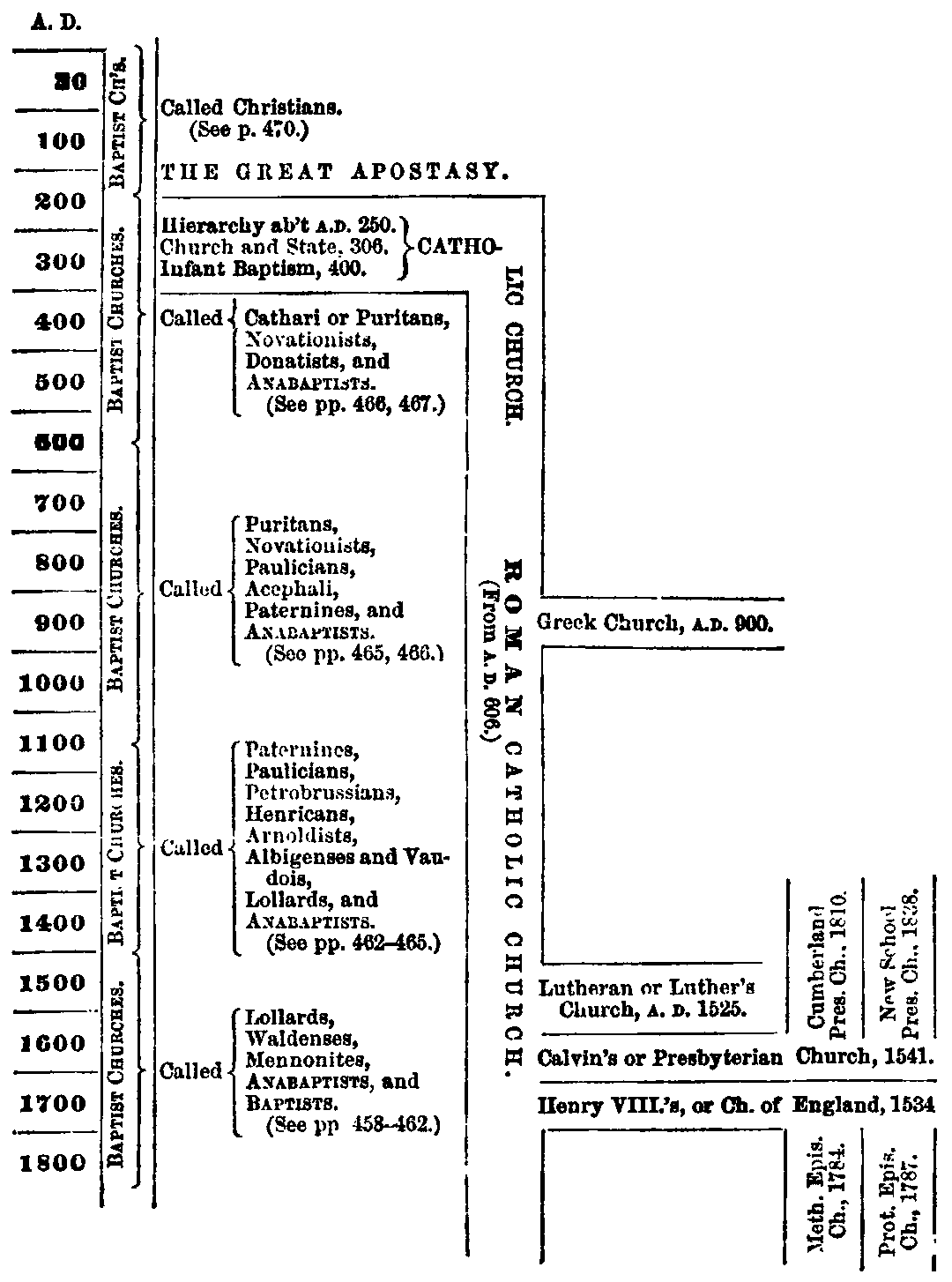
Explanation of the Diagram.
The period which has elapsed since his Church was organized by the Lord Jesus shortly after A. D. 30 down to the present time, we have divided into five great historical periods, as indicated by the braces (⏞) in the left-hand column, which represent the succession of the Baptist Churches.
The 1st of these periods, it will be seen, extends from the year 30 to 250, during which time almost all the Churches had the marks required by our tablet. The figures after pp. refer to the pages of this work in which their history is briefly recorded.
The 2d period extends from 250 to 650. P. 466.
The 3d from 650 to 1150. P. 465.
The 4th from 1150 to 1500. P. 462.
The 5th from 1500 to the present time. P. 458.
In each of these periods we have distinctly, though very briefly, shown the existence of the genuine and true Christian Church, conforming in all things to the Scripture pattern, and called by the names indicated in the Diagram. If our space would permit, we could make their history much more complete. Our object is merely to prove their existence.
The great apostasy, foretold in the Scripture as the Mystery of Iniquity, the Man of Sin and the Son of Perdition, and Antichrist, is represented by the lines that go off at right-angles from the year 250 to 400. This Apostasy was of gradual growth, and was mainly characterized by the substitution of the Hierarchy, or the rule of the bishops and councils, for the independence of the Churches, by the union of Church and State under Constantine, and the introduction of unauthorized members by the baptism of infants, or rather of minors. It claimed to be the Holy Catholic or Universal Church, and from the first became a bloody persecutor of those in the left-hand column.
A little after 1500 it gave off, during what was called the Reformation, the bodies which were organized respectively by Luther, Calvin, and King Henry VIII., since known as the Lutheran Church, the Presbyterian Church, and the Church of England. These have each given off several others, only a few of which are indicated on the Diagram, with the dates of their organization.
“It does not follow that because some in England sent to these ancient Churches for their baptism, they might not have found it nearer home. There is, to say the least, a very strong probability that the original, pure Christianity brought into England in the apostles’ days was never quite extinguished, but that true Churches have existed, at least in Wales, from the very first; and it is certain the Lollards found a lodging there. In this country we have had ministers from England and Wales, and from Germany and Holland, all bringing with them the baptism which came down from the ancient Churches.”
“I think,” said Mr. Percy, “I could make this matter plainer by means of a diagram, or chart, which will bring the prominent facts before the eye at one view. Thus, let the straight lines upon the left of the page show the succession of true Churches, and those on the right the several departures from them, while on the margin we may put the dates of each important change.”
(See Diagram of Church History, on page 476.)
“Now, if you, or any one else, should feel dissatisfied with this brief but comprehensive history of the Baptist Churches, let me commend to your reading, Jones’s Church History, Robinson’s History of Baptism, De Anvers’ History of the Baptists, Ivimey’s History of English Baptists, Crosby’s History of the English Baptists, and last, and best of all, because they contain the essence of their statements in a smaller compass, those monuments of historical industry, Orchard’s History of the Foreign Baptists, and Orchard’s History of the English Baptists. These works are the result of thirty years of careful and earnest study by one who had opportunities which very few possess of learning all that can now be known concerning these so long despised and persecuted people; and it is hard to say whether he deserves more credit for what he has written than for what he has left out. For if he had recorded all, his work would have been too large for many to read, or any to remember; but, with most admirable judgment, he has selected what was of most importance, and has arranged it with so much skill, and authenticated every statement by such abundant references to the most unexceptionable authorities, that it will be difficult for any candid mind, after reading these two works, to doubt that there have been Baptists all the time, from the day that Jesus was baptized (eis) into the river of Jordan, as recorded by Mark, in the beginning of the gospel of Jesus Christ, down to the present time.
“Now, as the present Baptists hold the same doctrines, have the same organization, the same officers, and the same ordinances with the first Churches, and as we have traced such all the way, independent of the great apostasy, we may give them the last mark also. And therefore Mr. Percy may now finish his diagram of the Baptist Churches.”
“I do not know so well about that,” said Theodosia, smiling. “I well remember when my husband, for a little time at least, had very serious doubts as to whether these were the Churches of Christ, upon a ground very different from any you have mentioned. He will recollect that one of his friends almost persuaded him that those could not be the Churches of Jesus Christ which starved his ministers, or, what is the same thing to the Churches, compelled them to forsake their sacred calling and engage in other labors for their subsistence.”
“Yes, indeed,” said Mr. Percy, “I do remember it; and though, for my own part, I have found nothing to complain of, yet, to this day, I cannot help feeling a sort of doubt as to any Church which I find pursuing this suicidal and ignoble policy. They way be right in doctrine, but they are surely very wrong in practice.”
Diagram of the Baptist Churches.
Signs or Marks of a True Church. Marks of a Baptist Church.
1st. It consists only of professed believers in Christ. [Yes] It consists of those only who have publicly professed their faith in Christ.
2d. Its members have been baptized upon a profession of their faith. [Yes] After public profession of their faith they are immersed, and so baptized.
3d. It is a local organization, and independent of all others. [Yes] Each Church is like those formed by the apostles, independent of all others.
4th. It has Christ alone for its King and Lawgiver, and recognizes no other authority above its own. [Yes] No priests, bishops, or confederacy can give laws to it, or control its discipline. It calls none on earth its master.
5th. Its members have become such by their own voluntary act. [Yes] Its members were not brought in by others in their infancy, but came in of their own desire.
6th. It holds as articles of faith the fundamental doctrines of the gospel. [Yes] It holds as articles of faith the fundamental doctrines of the gospel.
7th. It began with Christ, and has continued to the present time. [Yes] The apostolic Churches were Baptist Churches, and just such have been continued, even until now. See Historic Chart, p. 477.
8th. It never persecutes for conscience’ sake. [Yes] It has in every age been the advocate of religious freedom; has asked it for others as well as itself; and though always persecuted, never persecutes.
9th. No apostate Church can be a Church of Christ. [Yes] It has not apostatized, nor has it ever been connected with the great apostasy.
“If you will take the trouble to observe a little more carefully,” replied Mr. Courtney, “you will find that whenever and wherever a minister has had the faith and courage to risk all and give himself entirely to his proper work, he has been provided for. The Lord does not intend that his ministers shall get rich; and when they leave their work to engage in money-making, he often blasts all their hopes, in various ways of his providence. But he does intend and has plainly and repeatedly promised that they shall have enough for the supply of their necessities; and this they will have in the ministry, if they will devote themselves entirely to it. I am ready to assure to any young man whom the Lord has qualified and called to preach, a comfortable support, provided he will give up all his powers of body and mind to the one work of his calling. I can do so because the Master has promised, and I can do so because I have been watching for years, and have not found his promise fail to any one who kept himself within the order of God’s providence—that is, who was ready to go and labor wherever God by his providence seemed to call him. I could, for the encouragement of such, relate the personal history of several, the beginnings of whose ministerial life were most unpromising, but who had determined to know nothing but Christ, and do nothing but preach; and are now enjoying in a green old age as many comforts as their neighbors, who have made it the business of their lives to get rich. But while I say this, I know very well that our Churches are most shamefully negligent of their duty. They give nothing near what they should give for the support of the ministry; but for this there are two reasons besides the parsimony of the brethren. I grant that this is one; and if it is not repented of, God will shortly take our candlestick away and leave our Churches to die out, as some Baptist Churches are already doing, and many others have done in the last thirty years. But I do not believe this is the principal reason. That is to be found in the early history of our Churches, when we were taxed to pay other preachers than our own, to preach another gospel which we did not believe. The people felt the injustice of such taxation; our ministers declaimed against it; and, to show that they were of a different class, that they did not care for the pay, so that they had their love and saved their souls, they took a pride in preaching without compensation, and Providence, as it then might have been their duty, enabled them to do it, and yet not to suffer. The people came gradually to think that what was thus done for a particular purpose, under peculiar circumstances, was something required by the gospel, and that ministers were bound to preach without any regular provision for their support. The ministers had only done as Paul did—waived their rights for the time being, that their gospel might not be reproached. Paul labored for his own support and that of those who were with him. Sometimes he would not be chargeable to the Churches for his support, but he was careful to maintain all the time that he had a right to it. He was careful to show that it was the express command of the Lord Jesus that ‘those who preached the gospel should live by the gospel;’ and that he and others might forbear working if they would. It is not unlikely our preachers might have been less careful in this particular, and so the people came to feel at length that preachers should have no regular support, and if any one claimed it they were disposed to class him with their oppressors, whom they counted but as wolves, seeking to devour their substance, or, at least, mere hirelings who labored only for the pay.
“Such opinions and feelings, deeply infused into a great mass of minds, would be eradicated but slowly, even by the most sedulous efforts of succeeding ministers. But here is the third reason: These efforts have been wanting. I blame our preachers more than our people for this state of things. They have pandered to this corruption in the Churches, instead of boldly reproving it as they should.”
“But, my dear sir, to have boldly reproved it would have lost them the confidence and the affections of the flock, and prevented them from doing good in any other way.”
“So perhaps it might if they had begun by complaints concerning themselves. I would not have a minister always grumbling about his own support. To do so will leave the impression that it is for the gratification of his selfishness that he seeks to cure others of being selfish. A wise man who understands human nature will adopt another and more successful plan. He will show the people that the Lord requires them to give, not to him, the preacher, but to the cause of Christ. He will present frequent opportunities to them for giving to others than himself. He will plead the cause of the destitute, and of the heathen. He will present the claims of missions, and of Bible societies, of Sunday schools, and other objects of Christian benevolence, until they have acquired a habit of giving. He will explain the teachings of the Word concerning ministerial support, and thus preach the whole gospel, but without making any application of it to his own case. Let him do this, and his people will spontaneously begin to feel that they have done too little for their own pastor. Let all our ministers begin at once to preach thus prudently and kindly the whole gospel, and the Churches will soon show that the fault was less in them than in the preachers themselves that they have been apparently so parsimonious.”
“I have already seen enough in my own experience,” said Mr. Percy, “to convince me of the truth of what you say.”
“I wish,” said Dr. Thinkwell, “we could have finished this conversation last Saturday, so that I might have gone into the water with that young man who was yesterday baptized. My last lingering doubt is gone. I thank you all for the patience with which you have borne with my slowness of faith, and the readiness with which you have assisted my inquiries.”
“We are more than repaid,” said Mr. Percy, “by the happy result.”
“And I,” said the Reverend Mr. Stiptain, “am heartily glad that you have come to some conclusion. Of course I had rather you had determined to be a Methodist; but any branch of the Church is better than none. Let every man be fully persuaded in his own mind, and be able to give a reason for the faith that is in him. I trust, sir, you will now enjoy that peace which arises only from a consciousness of doing your duty.”
“I wish, my dear friend, I could persuade you to unite with me, and do your duty also.”
“O, as to that, I have always enjoyed myself very well among the Methodists. You know I glory in the name, and among them I expect to live and die; but I acknowledge, after what I have learned of the Baptist Churches, I shall hereafter feel a little more respect for them than I have.”
On their way back to the Doctor’s residence, Theodosia reminded him that as they had now finished the investigation of the question, What is the Church? he was under promise to relate to her the means, or rather the arguments by which he was recovered from his infidelity and atheism, and led to receive the Scriptures as the word of God.
But as this conversation has no connection with the subject treated of in the present volume, we must postpone it for the present,[12] and only inform the reader that Doctor Thinkwell was baptized into the little Church at their next regular meeting, much to the joy of all God’s people there; and that our travelling party pursued their way to the mountains, where Mr. Percy’s strength was soon so far restored that he felt that he must hasten back to his flock in the South, where he is still residing, preaching Jesus, beloved by his people, and admired by the world. Theodosia is indeed his helper in the Lord. Her influence is felt in every department of his work; nor does he preach less touchingly, or labor less hopefully, since the dear little boy came to amuse his hours of relaxation with its childish prattle. Mrs. Ernest and old Aunt Chloe are the assistants of Theodosia in her domestic labors, and all of them delight to show how much they love their Saviour and his Church.