Theodosia Ernest; or The Heroine of Faith. (continued 8)
Reading edition
“But we do not ask you to do what we think wrong.”
“No, you only ask us to do what you know we think wrong, and then abuse us because we dare not do it. But let it pass. I should think, Doctor, you would find some serious, if not insuperable difficulties in your plan of inter-communion with other denominations, over whose discipline you have no control.”
“How so?”
“Let me explain. The peculiar and distinctive privilege of a church member in good standing in your church, is the liberty of approach to the Lord’s table. When you exclude the unworthy, they can no longer be permitted to sit down with you at this sacred feast. Now suppose you exclude a member to-day for heresy in doctrine, or irregularity in practice, and he goes to-morrow and unites with some other denomination, can he not, according to your principles, come right back, and claim a seat at your table as the member of another denomination, although you have just driven him away as a member of your own?”
“That might possibly happen; but I do not think we have ever been much troubled with cases of that sort.”
“That is because your open communion is held in theory, but seldom reduced to practice. If there were, in fact, that inter-communion between you and Baptists, which many of you profess so much to desire, I can conceive that it might happen very often, to the utter destruction of any effective discipline in both bodies. Let us see. You require of all your communicants who have children, that they bring them to the church for baptism, do you not?”
“Certainly; it is the solemn duty of every Christian parent to dedicate his offspring to God in this holy ordinance at his earliest convenience.”
“Very good. Now suppose some one of them should take a fancy to ask you for the text on which this requirement is based. You might, as you very well know, search all the New Testament, from Matthew to Revelation, and you could not produce a solitary precept or example. You would try to satisfy him with a wordy jargon about the covenant of circumcision, etc. But he might reply, Jewish children were circumcised at eight days old, because God commanded it to be done. If Christian children are to be baptized, you can show where he commanded that.”
“You will say—No, but a command was not necessary; they were to be baptized as a matter of course.
“Very well, then. Of course it was done, and you can show me at least one case among the thousands of ‘both men and women,’ in which there was one little child. But you can’t find it. And he begins to doubt the propriety of performing as an ordinance of Christ, what Christ did not command. He cannot be persuaded to bring up the little ones into the church. You exhort him and reason with him in vain; and you are obliged at last to exclude him. I have read of such a case. You exclude him, and he comes to us, and we receive him. Now he holds the same opinions, and is guilty of the same practices. But though you could not commune with him as a member of your own church, because he was guilty of the heinous sin of denying infant baptism, you will welcome him back the very next Sabbath as a Baptist. You urge him to sit down to the same table from which you have just now formally expelled him. And I suppose, if he should decline to accept, you would henceforth abuse him as narrow- minded, selfish, bigoted, and intolerant Baptist, who thought himself too good to commune with other Christians.
“The same thing might happen to us, and this furnishes an additional reason why we cannot commune with other denominations. I have said we could not, because you were in our view unbaptized; and that is of itself an unanswerable and all-sufficient reason, if there were no other. But there is another growing out of this matter of church discipline. Let us suppose a case for illustration. A minister in our church has imbibed the idea that the sprinkling ceremony, which you borrowed from the Roman Catholics, is valid baptism, and insists upon introducing it into our churches. We would regard it as a great wrong. We would, for the peace and purity of our communion, at once expel him, and deny him the privileges of the church. He goes to you, and you receive him gladly, and the very next day he comes back and claims, as a member of your church, privileges which we had just now formally denied him as a member of our own. Do you not see that this rule, carried out in actual practice, must necessarily destroy the force of all attempts at church discipline?”
“But how do Baptists now avoid that difficulty among themselves?”
“Very easily and simply. The right to our communion never extends beyond the reach of our discipline.”
“Then how can members of one Baptist Church claim a seat at the table of another; for, if I understand your church polity, every one of your churches is an independent body.”
“They cannot claim it as a right, and our invitation to commune is extended by courtesy only to those whose faith and practice is so like our own, that no person could be a member in good standing with them who would not stand equally well with us.
“The rule adopted by Mr. Wesley (Discipline, see. 5th), and which is founded alike in Scriptural principles and common sense, is the same in substance as that which regulates our practice. That is, ‘no person shall be admitted to the Lord’s Supper among us, who is guilty of any practice for which we would exclude a member of our church.’ This rule you see at once compels us to deny all who teach and practice sprinkling for baptism, and all who engage in what we regard as the sinful though solemn mockery of baptizing unconscious infants, or any others who have not made a personal and credible profession of repentance and faith, according to the plain requirements of the Word of God, which always and everywhere puts repentance and faith before baptism, as it puts baptism before communion. We are bound to this course by that solemn and most impressive injunction of the Apostles, 2 Thess. iii. 6—‘Now we command you, brethren, in the name of our Lord Jesus Christ, that you withdraw yourselves from every brother that walketh disorderly, and not after the tradition which ye received from us.’”
“Y declare, Mr. Courtney,” said Mrs. Jones, “I had no idea that you Baptists had so good and satisfactory reasons for your singular exclusiveness; and I promise you now that I will never complain of you again. In fact, if I ever become a Baptist, I shall be a close communion Baptist.”
“I do not see,” said Mrs. Ernest, “how any one can take the Scripture for his guide, and be any thing else; and I have been thinking all the time that there must be some good Bible reason for it, or else Theodosia and her uncle would not have agreed to it—but now, when I come to think of it, I have not heard either of them say a word on the subject.”
The reader will recollect, that at the beginning of this conversation Professor Jones had gone out of the room, for some cause at that time unexplained. He returned after a few minutes, but took no part in the conversation, in with indeed he seemed to feel but very little interest. Mrs. Jones had quickly noticed his abstracted manner, so different from his ordinary behaviour; and had several times cast an uneasy glance into his face, hoping to read there the cause. But she could only learn that it was in some way connected with Theodosia, whom he loved with the affection of a father. Each time she looked, his eye was resting with an expression of the deepest pity upon his lovely niece, who took no more part in the conversation than himself. In truth she had spoken very little to any one since the appearance of Mr. Percy at the courthouse on the preceding night. His relation of his experience of grace, and his declaration of his desire to be baptized, had placed him in a new relation to her. She did not know that he had then never seen her letter—and once (but only for a moment) the thought intruded into her heart that all this change had been made for her sake, and not for Christ’s. She repelled it, however, in the instant that it came, and all day long had held herself ready to welcome him back to his place in her heart as her betrothed, and felt that she could love him now with an affection even deeper and more intense, higher and purer and holier than that which with such agony of effort she had been trying to strangle in her heart. She thought he would have come and spoken to her before she left the meeting, but he did not seem to notice her presence there. She was sure he would call in the morning—but dinner was on the table, and he had not come. That letter of hers must have prevented; but surely there was not in it any harsh expression, any single word of unkindness. Did not her heart ache with the very intensity of her love, while she was writing it? And now she tried to recall it, sentence by sentence, and word by word, to see if there was any thing there which she should not have said.
The afternoon wore slowly away. She sat at the window where she could see the door of his office, but it was never opened. She listened to every foot fall on the pavement, but she heard not his familiar step. Once the latch of the front door was moved, and she sprang from her seat, and felt the blood crimson all her face and neck; but she sat down in a moment, for she knew it was her brother Edwin. Mr. Courtney called after supper. Mr. Percy had not come yet; but she hoped to meet him at her uncle’s. He was not there—and her spirit retired within itself; and she sat as mute, and almost as unconscious of what was passing around her, as a marble statue.
When Uncle Jones went out, it was to see Dr. Woodruff, a cousin of Mr. Percy, who was also his most devoted friend and confidant. He was to have officiated as the bridegroom’s friend on the expected wedding-day, and had just returned from Mr. Percy’s mother’s, where he had spent the day with one whose earthly career seemed likely soon to close. He had come in to break the melancholy tidings as best he could to Theodosia.
The facts, as he related them to Professor Jones, were briefly these: The servant who waited on Mr. Percy’s office had gone there in the morning, and had found the young man lying upon his face on the floor, with Theodosia’s letter in his hand. When the servant entered he seemed to be asleep. He aroused him, and raised him up; but his looks were so wild, and his face was so pale and his words (rather muttered than spoken) so strange and unnatural, that he placed him on the bed and ran for his cousin, the doctor.
When Doctor Woodruff came, and read the letter, he understood how it had been. Mr. Percy, from the time he wrote and sent that distressing letter to Theodosia, in the previous week, had been in a state of most intense mental excitement. Much of the time he had been suffering extreme agony of mind. His physical powers had become greatly exhausted, and his nervous system debilitated and excitable. He had gone from the meeting in the courthouse (where he had so unexpectedly had an opportunity to ask for Christian baptism) to his office. There he found Theodosia’s letter. He had never till then conceived that his letter would have occasioned such distress to her, or that it would have led her to such a determination. Yet if he had been entirely self-collected, and his mind had not been already exhausted by long continued over-excitement, the shock which the reading of her reply now gave him, would have been speedily followed by calmer thoughts, and an instant determination to see her at once, confess his fault, ask her forgiveness, and set himself right in her heart. But exhausted in body and excited in mind as he was, the revulsion of feeling was too great to be endured. He read on till he came to where she said, “When you return, I pray you to consider me but as one dead. It will be better for us both.” The paper seemed to grow black before his eyes. The room was suddenly darkened. He felt a strange, dreamy calmness creep over his brain. He sunk down out of his chair in a deep swoon, or fainting fit, upon the floor. He became conscious after a time, but had not strength to rise; and subsided again into a strange, unquiet sleep, mixed with half-waking dreams, in which he saw a beauteous form, more like an angel than a being of the earth, who came and raised him up, and looked into his eyes so sadly, so reproachfully, and yet so tenderly, that he struggled to tell her how his heart bled at the remembrance of the act which caused her so much sorrow—but he could not speak. He strove to raise his hand and make some sign to assure her that he loved her better for her firm adherence to the truth, but the muscles would not obey the will. He could not move—he could not speak—and she was gone. Oh, how deep and how long was the darkness of that night! She was gone! He felt that she was lost to him forever. The very light of his life was darkness now—and yet he waited and watched for her return. Could she leave him thus? Would she not love him still? Hark! he hears her footstep. The door opens. Some one touches him. He starts from his slumber to greet her with some word of love, but he sees only his servant, who is trying to remove him from the floor to the bed. He stares at him with the strange gaze of incipient madness, and bids him leave him to rest in peace. The doctor saw at once that a long and fearful brain fever was the best that he could hope for; and while his strength was yet comparatively undiminished, resolved to remove him to his mother’s house, some two miles in the country. This done, he prepared such remedies as his medical skill suggested, sat down, and watched beside his bed till he was satisfied that there was no immediate danger; and then, at his mother’s request, came in to explain to Theodosia the reason why he had not called on her. He had thought best to explain, as we have seen, to Uncle Jones, and leave him to make it known to his niece.
The Professor had been so much occupied with this matter, that he scarcely heard the discussion which was going on in his presence. He was glad when a pause in the conversation showed that the parties engaged had, for the present, at least, exhausted their ammunition, and were prepared for a temporary truce, if not for a permanent peace. He turned their attention to some other subject, and in a few minutes the Reverend Doctor took his leave.
Uncle Jones walked home with Theodosia. They walked slowly; and when Mrs. Ernest and Mr. Courtney had gotten some way before them, he broke the silence by reminding her that she had not spoken a word all through the evening; “and,” said he, “I will tell you why. You were distressed that Mr. Percy had not called to see you since his return, and wondering what could be the cause. Will it relieve your mind to tell you that he is sick?”
“I will not deny to you, uncle, that such was the subject of my thoughts. I hope he is not seriously unwell.”
“The doctor does not think him in any immediate danger, but fears it will be long before he can resume his business.”
“Why, uncle, what can be the matter? I am sure I never saw him look better than he did last night. Did you not notice the brightness of his eye, and the freshness of his cheek, and how rich and mellow was his voice while he was telling what God so wonderfully had done for his soul?”
“I was myself too much engaged to observe him closely, but I can well imagine that the unnatural flushing of his check, and the unusual brilliancy of his eye, were but the tokens of that intense mental excitement which preceded, if it did not produce, the fever from which he is suffering now.”
They had reached the cottage door. Uncle Jones thought best not to go into any further particulars, and returned to his home.
That night, if one had passed by the window of Theodosia’s room, he might have heard many a sob, mingled with half-uttered prayers. Had she known all the truth, her sobs might have been louder; but her prayers could hardly have been more earnest.
The messenger who went next day to inquire, returned to say that Mr. Percy was no better; and so it was the next day—and the next. Doctor Woodruff had called in a brother practitioner, but did not reveal to him, nor even to Mr. Percy’s mother, the whole secret of his attack. The letter which he found in his hand, he had considerately laid aside, to be returned to him should he recover. Its existence was a professional secret. He attributed his illness to the long and tiresome journey on horseback through the sun, and to such excitement of mind as he had himself publicly described before his strange attack.
On Saturday evening Mrs. Ernest received a line from Mrs. Percy, saying that her son was growing daily worse and worse; and, strange to tell, he had in his delirium conceived a singular fancy that Theodosia had ceased to love him, and had even formally discarded him. This idea, she said, was uppermost in all the wanderings of his mind, and evidently was exerting a great influence upon the progress of his disease; and Doctor Woodruff had suggested that if Theodosia could herself assure him of her continued affection, it might have a soothing, and perhaps a healing influence.
Mrs. Ernest handed the note to her daughter, with the remark, that in consideration of their well-known betrothal, there could be no impropriety in granting Mrs. Percy’s request.
“We will go to him at once, dear mother,” said Theodosia, when she had read the note, with eyes full of tears “Even a brief delay may be of fatal consequence.”
When they reached Mrs. Percy’s house, he had fallen into an unquiet slumber, from which they did not seek to awaken him. They sat down in the room, and conversed in a low tone about the nature of his disease, and other matters which the circumstances suggested. Theodosia took but little part in this conversation, except as a most eager listener. She sat down near the head of the low couch on which he lay, but presently arose, and, under pretence of shading the patient’s eyes, adjusted the candle so that it should not shine upon her own. Oh, who can tell the thoughts that then were thronging in her maiden heart! How changed he was! How pale—how corpse-like was his cheek! How wasted was the thin, emaciated hand, which lay outside the cover! How parched and feverish the lips! How sunken the eyes! How would they look when he should open them? Would he know her? Would he speak to her? What if he now should open his eyes and see me here?—and she almost unconsciously moved her chair back out of his range of vision as she thought of it. His lips moved: she reached the spoon in the tumbler of water upon the little table, and moistened them. He opened his eyes wide; he looked her steadily in the face; he glanced at her white dress; he looked in her face again. She fancied that the expression of wonder on his face gave place to a scarcely perceptible smile. But he did not speak; he did not make any sign of recognition. She sat down again and wept.
“You must need rest, Mrs. Percy. You may go and sleep, and leave the care of him to us to-night,” said Mrs. Ernest. “We will watch him as tenderly as you could do yourself.”
Mrs. Percy laid down, and Theodosia withdrew to some distance from the couch, and sat where she could see every change that passed upon his face. The love which she had for a time endeavored to eradicate from out her mind, had only, like the lofty oak when torn and wrenched by the mighty storm, extended its roots more widely and deeply, and clasped them more firmly round her heart; and now, when the cause which led her to cast it off had been removed, she clung more ardently and devotedly than ever to the hope that he would yet be hers. Again and again during that long night, when she hastened to do some little act of kindness, did he open his eyes and look at her with a kind of wondering tenderness in his gaze; but yet he did not speak, nor was she sure that he recognized her at all.
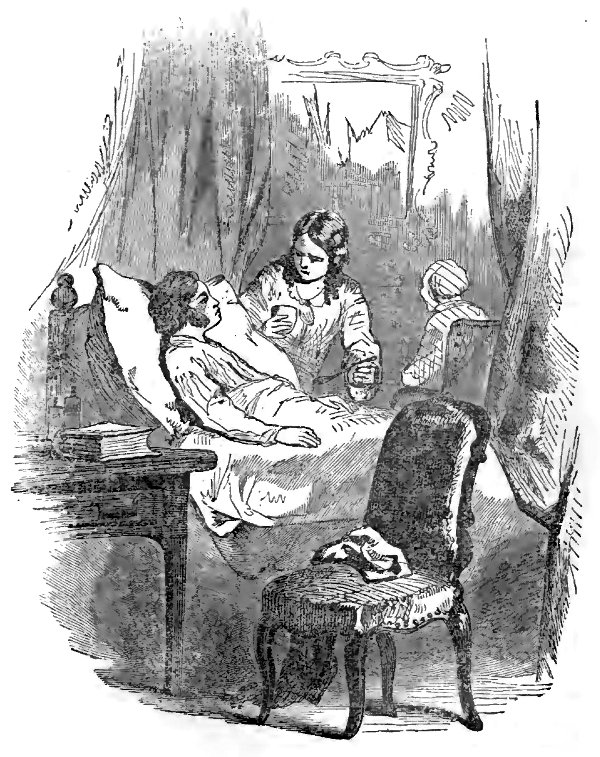
He slept more quietly that night than he had yet done, and when the doctor came next day, he whispered in his ear that a beautiful vision had come to him in his dreams and looked at him so lovingly, that he was ready to speak, and ask it whence it came, but feared his voice might break the charm, and it would vanish from his sight.
“You must stay with us, my child,” said Mrs. Percy, “till my son gets better. He talked of you continually until you came, but now it seems as though your very presence in the house exerts a sort of magic influence over him, for he is quiet, and does not so much as lisp your name. The doctor says if you could but become his nurse, he may yet recover. Will you not, my daughter?”
“If my mother thinks there would be no impropriety in my doing so.”
“Certainly, Theodosia, I think you ought to return and assist Mrs. Percy in every way you can. But your uncle and I are going to be baptized to- day, and you will not be willing to be absent from the meeting.”
This conversation took place in the hall, from which there was an open door leading to the patient’s room. He heard Theodosia’s voice; he thought he heard her name. He made some sound, which recalled his mother to his side, and looking in her face with a more natural expression than he had since his attack, he said:
“Mother, I thought I saw her spirit here last night, and just now I am sure I heard her voice, and thought that some one called her name. Tell me if she is here.”
“Would you like to see her, my son?”
“Oh, yes; I want to ask her to forgive me before I die.”
“You do not think you are going to die, my child!”
“I have strange feelings, mother. I do not know what death is, or how he comes; but I am sure I have been very near the world of spirits.”
“Do you feel any alarm at the prospect of death?”
“My mind is very weak, mother. I scarcely feel or think at all. I have a blessed Saviour: I remember that; and I will trust him, even though I die. But tell me—did I hear her voice, or was it but a dream?”
“Try to compose yourself, my child. The doctor says that you must sleep awhile this morning. If you wish to see Miss Ernest, I will send for her.”
“Do you think she would come?”
“I know she would. So make yourself easy, and you shall see her when you wake.”
On returning to her visitors, Mrs. Percy related this conversation, and insisted that Theodosia must remain to be there when he awoke; and as the young lady did not object, Mrs. Ernest went home without her. She laid down on her arrival, and took a short nap, and then taking Edwin by the hand, joined Uncle and Aunt Jones on their way to the Baptist meeting.
When the usual invitation was given to those who desired membership with the church to come forward and make their profession, Uncle Jones was surprised and delighted to see both his wife and his sister go up and ask admittance into the church of God. Neither of them had said a word to him upon the subject, for though both had yielded to their convictions of the truth, that immersion is the only baptism, some days before, and both had been convinced that believers are the only Scriptural subjects of baptism, they could neither of them overcome their repulsion to the practice of close communion, or consent to sever their connections with these to whom they had such strong attachments, until the explanations of Mr. Courtney in their last conversation put it beyond the shadow of a doubt that the Lord Jesus not only commanded believers, and them only, to be immersed, but that he had also forbidden all who had not believed and been immersed to approach his table, and required of those who had in this way become, according to his order, the members of his church, that they should carefully guard the purity and the perpetuity of his ordinances, by permitting no one to partake with them in the peculiar privileges of church members who had not, like themselves, been made members according to the same Gospel order. This difficulty removed, they were now ready to be baptized.
We need not detain you any longer, gentle reader, by describing to you the baptism of these three, who, with several others, followed the example of their Saviour, by going down into the water, and were buried with him in the liquid grave. Nor can we now continue the history in which you have come, we trust, to feel so great an interest that you would gladly see the end. We have finished our ten nights’ study of Scripture baptism. We have examined it in regard to its mode, its subjects, and its results. We have endeavored to do it plainly and candidly, but if we know our own hearts, we have tried to do it kindly—and in the spirit of that “charity” which “rejoices in the truth.”
We are grieved to leave our darling Theodosia in such distress. But she must remain a little while in the valley of tears, until, by her own sorrows, she has been taught how to sympathize with the sorrowful. He was the wisest man of earth who said, “By the sadness of the countenance the heart is made better.” She needs the discipline of grief to fit her for the life of eminent usefulness which lies before her—and the history of which will soon be given in another volume.
A Dream,
Review Of N. L. Rice’s Notice of the Theodosia Ernest First Series.
By the Author of Theodosia.
Preface.
The only attempted review or extended unfavorable notice of the first volume of Theodosia Ernest, appeared in the St. Louis Presbyterian, from the pen of its Editor, N. L. Rice, D.D. That notice is here given, and a review of Mr. R’s singular statements reviewed in a dream—and also the natural effect of such a treatment of the best arguments ever produced by Presbyterians or Pedobaptists—the conversion of Pastor Johnson. We regard this review, in connection with Mr. Rice’s notice, as the most powerful argument in favor of Baptist positions.
J. R. Graves.
Nashville, 1857.
Notice Of Theodosia.
By N. L. Rice.
as it appeared in the St. Louis Presbyterian.

If perseverance and ingenuity were evidences of religious truth, there could no longer be a doubt that immersion is the only valid baptism. Long and earnestly have the advocates of this doctrine labored to sustain its claims. The pulpit, the newspaper, the tract, the book, learned argument, and assertion, and ridicule, have all been laid under requisition. Then the whole Bible must be translated anew to make it sustain the Baptist sense. And now we have before us, by the kindness of a friend, a Baptist novel, the title of which is “Theodosia Ernest, or the Heroine of Faith.” The author has modestly concealed his name, but the work is published by Graves, Marks & Ruthland, Nashville, Tennessee. The book is really instructive and amusing. We purpose briefly to notice a few of its peculiarities.
It displays throughout a consciousness of the weakness of the doctrine it is intended to advocate. 1st. The title betrays this consciousness—“The Heroine of Faith.” There is in every Christian’s heart a strong sympathy with the struggles and conflicts of a genuine faith, rising above the allurements and persecutions of a wicked world. The author has thought it necessary to take advantage of this noble sympathy. If he had adopted the more truthful title—“The Heroine of Immersion” —the book would have fallen still-born from the press. There is little that is either noble or romantic in the zeal of a professing Christian, young or old, for a narrow sectarian dogma. The author judged, merely, that the cause of immersion needs the advantage of a title far nobler than itself.
The same conscious weakness shows itself in the choice of a heroine instead of a hero, and of a heroine who is a highly cultivated, sensitive young lady of eighteen. Who can help strongly sympathizing with such a young lady, devotedly pious, evidently conscientious, willing to sacrifice every thing for the truth, conducting an argument against two or three men much older than herself? We forget the cause and sympathize with the girl. We put double weight to her arguments, and feel gratified at the perplexities into which her antagonists are thrown. The author of the novel judged rightly that the cause of immersion and anti-pedobaptism claims all this sympathy and more. If he had been a hero, instead of a youthful heroine, his hearers would have weighed his arguments, instead of being carried away with sympathy.
The cause needed even stronger sympathy; and, therefore, Miss Theodosia Ernest is brought in conflict with the man to whom she was engaged to be married— a cold-hearted, formal Presbyterian lover—whom she loves most devotedly. He opposes her joining “the contemptible sect of Baptists”—(we naturally sympathize with a person opposed). She, poor girl, is thrown into a paroxysm of grief, sighs, weeps, and prays, and resolves to break off the engagement, just for the pure love of immersion! The reader feels his eyes filling with tears of sympathy for the dear distressed creature who had also her mother in opposition, and is almost ready to be immersed himself just to comfort her. Who would have thought that a Baptist knew so well how much it was necessary to excite the sympathies of his readers to prevent them seeing the flimsiness of his arguments?
The necessities of immersion were even greater. Although Miss Theodosia is singularly furnished with Baptist arguments, for one who has just reason to doubt the validity of her baptism, Professor Courtney, an accomplished scholar, is called to aid her. He, having been a Presbyterian, and having examined the whole subject, is perfectly at home in the discussion. He understands Greek, and he can read all the learned authors on the subject. On the other side we have, first, Mr. Percy, the gentleman engaged to Miss Theodosia, who is represented as wholly ignorant of the subject; Rev. Mr. Johnson, the young lady’s pastor, who is made to talk like an ignoramus and a simpleton; and Professor Jones, the heroine’s uncle, who had confessedly never examined the subject, and scarcely had sense enough to keep him out of the fire. With such combatants on each side, immersion may lift its head in bold defiance. We cannot help admiring the author’s clear perception of the necessities of his cause. It was exceedingly proper that he should select, as the advocates of Pedobaptism, such persons as Mr. Percy, who “had never had a serious thought upon the question” (p. 13); Mr. Johnson, who said, “I have never studied these controversies much”; and “Uncle Jones,” who, though Professor of Languages, had considered it the duty of his parents and their pastor to attend to his baptism, and “had never inquired whether they did it illy or well” (p. 121). It is precisely over such persons, as the author rightly judged, that Baptist controvertists gain the victory. And yet we cannot but wonder that he would so publicly disgrace his cause by selecting such ignoramuses as the opponents of the learned Mr. Courtney!
The respective characters being thus selected, the advocates of immersion are, of course, allowed to make bold assertions which are utterly untrue, and to keep out of view the merits of the case, whilst their ignorant and soft-headed opponents gape and wonder. Thus “the heroine of faith” decides, as by intuition, that baptism is an act, and that if immersion is baptism, sprinkling and pouring cannot be. Her intellect is too lofty, and her perception too clear, to hesitate for a moment to decide against forty-nine fiftieths of the wisest and best men that have lived both in ancient and modern times. The author rightly judged that this heroine ought to be very self-conceited. Mr. Percy is made to admit, what every tolerable scholar knows to be untrue, that all the lexicons sustain the immersionists. It suited the purpose of the writer to keep out of view the declaration of the learned Baptist, Carson, that “all the lexicons” were against them. “Professor Jones,” poor simpleton, is made to express the opinion that immersion was first introduced “by the Mad Men of Munster during the Reformation of Luther.” He cannot tell, poor fellow, where he got the idea; but “perhaps he got something of it from reading D’Aubigne’s History of the Reformation—perhaps he received it by hearing something of the kind from the pulpit.” And the accomplished Baptist, Mr. Courtney, has “seen and heard such statements many times from various sources. They are often recorded in Presbyterian and Methodist newspapers” (p. 160). And the learned gentleman gravely goes to work to disprove this statement, which was never made by any tolerably informed Presbyterian, or recorded in any respectable Pedobaptist paper. The book abounds with such vile misrepresentations.
The book is written with ingenuity—it was necessary that it should be. It keeps out of view the facts and arguments on which Pedobaptists rely, or caricatures them to make them appear ridiculous. It puts into their mouths arguments they never use. It manufactures history to suit the occasion. In a novel, all this can be done in such a way that the uninformed reader will not readily detect it. We are gratified at observing how distinctly the writer shows, first and last, that the cause of immersion needs very peculiar advantage in order to sustain its claims.
After all, since he was advocating a fiction, he is probably right in adopting fiction as the means of its defence. The only way to find so ignorant and stupid Presbyterians as Percy, Johnson, and Jones, is to manufacture them for the occasion; and nowhere, but in the imagination of a zealous immersionist, can such Presbyterian young ladies as “Theodosia Ernest, the Heroine of Faith,” he found. The author could not successfully assail real, living Presbyterians; and, therefore, being resolved on battle and a victory, he manufactures a few to suit him, and then chooses their weapons for them, and directs them how to use them, so they will be sure not to hurt them. Brave man! Don Quixote was scarcely his equal.
Verily, the cause of anti-Pedobaptism seems to be “on its last legs.” If it cannot induce the Christian world to receive an immersionist Bible, and if novels will not sustain it, what is it to do?