MALACOPTERYGII.
Reading edition
Family. SILURIDÆ.
1. Pimelodus gracilis. Val.
Pimelodus gracilis, Val. in D’Orb. Voy. dans l’Amer. Mérid. Atl. Ichth. Pl. 2. fig. 5.
———— Cuv. et Val. Hist. des Poiss. tom. xv. p. 134.
Form.—Of a slender elongated form, the body compressed behind the dorsal. Greatest depth contained about seven and a half times in the entire length: thickness at the commencement of the dorsal a little less than the depth. Head, measured to the gill-opening, rather more than one-sixth of the entire length: its breadth two-thirds of its own length. Helmet smooth, and not very conspicuous, though with its whole surface finely wrinkled: its breadth behind the eyes rather more than one-third of its length, measuring this last from the end of the snout to the further extremity of the interparietal process. The solution of continuity extends back nearly to the base of the process just mentioned, which last is narrow and lanceolate, three times as long as broad at its base, but not reaching to the buckler, or triangular plate in front of the dorsal, by one-third of its own length. The buckler itself is not very large, but sufficiently obvious.
Profile sloping gradually downwards in nearly a straight line from the beginning of the dorsal to the end of the snout: this last depressed and rounded horizontally in the form of a semicircle. Mouth wide, but very little cleft, the commissure not reaching half-way to the eye. Upper jaw projecting a very little beyond the lower. In each a band of very fine velutine teeth; but none on the vomer or palatines. Tongue smooth, and fastened down all round. Six barbules; the maxillary pair very long, reaching to the commencement of the anal fin; of the submandibular pairs, the exterior reach one-third beyond the insertion of the pectorals; the interior are only half the length of the exterior. Eyes round, of moderate size, their diameter four and a half times in the length of the head, situate in about the middle of the length: distance from one to the other one diameter and a quarter. Lateral line nearly straight throughout its course, dividing the body longitudinally into two nearly equal portions.
Pectorals not quite equalling the length of the head, and a little less than one-sixth of the entire length: the spine very little shorter than the soft rays, very strong, with sharp teeth on its inner edge, but the outer edge only granulated, or with a few slight serratures towards the extremity. The humeral bone seen above the pectoral projects backwards in the form of a spinous lamina, but does not appear through the skin; it equals half the length of the pectoral itself. The dorsal commences at one-fourth of the entire length, and is of a somewhat rectangular form, the soft rays not decreasing much backwards: its length equals four-fifths of the depth of the body, and two-thirds of its own height. The spine is not so strong as that of the pectoral, and with only a few small serratures on the outer edge near the tip. The space between the dorsal and the adipose a little exceeds the length of the former. The adipose 111itself is twice the length of that fin; very low at first, but gradually rising, until, before its termination, it becomes equal to between one-half and one-third of the depth. The vent is in the middle of the entire length, caudal excluded. Anal short, and just beneath the middle of the adipose, there being about one-fourth of this last fin in advance of it as well as behind it: the first four rays simple, but apparently all articulated, the first two or three very minute and not easily observed. Caudal forked for two-thirds of its length: the upper lobe a little longer than the lower, and contained five and a half times in the entire length. Ventrals immediately beneath the last ray of the dorsal; a little shorter than the pectorals, and not reaching to the anal by half their own length.
D. 1/6; A. 14 or 15; C. 17, &c.; P. 1/9; V. 6.
Length 5 inches 2 lines.
Colour.—(In spirits.) Brownish, inclining to silvery in some places: a dusky fascia formed of dots along the lateral line. Dorsal rather dusky at the base, and with the upper portion also dusky between the rays: a dusky spot on the anterior part of the adipose.
Habitat, Rio de Janeiro.
This species was taken by Mr. Darwin in a running brook at Rio de Janiero. It approaches on the whole so nearly the P. gracilis of D’Orbigny, that I can hardly suppose it to be distinct. Yet there are some slight differences observable in this specimen. It has more anal rays; the adipose appears shorter; and the upper lobe of the caudal is not so prolonged, though possibly it may be worn down. Also D’Orbigny’s figure appears to want the dusky stains on the dorsal and adipose fins. If it be not that species it must be new, as there is none other described by Cuvier and Valenciennes with which it will assimilate better.
2. Pimelodus exsudans. Jen.
P. corpore parum elongato, altitudine quintam partem longitudinis æquante: galeâ lævi, inconspicuâ, processu interparietali haud clypeum parvum prædorsalem attingente: poris paucis buccalibus amplis, serie obliquâ dispositis: maxillis æqualibus: cirris sex; maxillaribus haud analem attingentibus: lineâ laterali primum deflexâ, deinde rectâ: pinnis dorsali et anali brevibus; adiposâ dorsali haud duplo longiore: caudali profundè bifurcâ, lobis æqualibus: spinâ pectorali margine interno fortiter dentato.
D. 1/7; A. 13 vel 14; C. 17, &c.; P. 1/8; V. 6.
Long. unc. 3. lin. 6.
Form.—In some respects resembling the last species, but the body much less elongated, the depth and thickness remaining the same. The depth is about one-fifth of the entire length; the head rather more than one-fifth. The helmet is scarcely so much wrinkled, and the interparietal process not so long, reaching only half-way to the buckler, which last is smaller and less obvious. The solution of continuity of the bones of the cranium appears to extend back 112in the form of a narrow fissure nearly to the base of the interparietal process, but is not very obvious, except between the eyes, where it opens into a sort of elongated ellipse. There are eight or nine pores on the top of the head, rather behind the eyes, so arranged as to form nearly a complete circle. There is also a very conspicuous row of three or four large oval pores on the cheek, at the anterior part of the opercle, descending obliquely forwards: other smaller ones may be seen scattered about different parts of the head. The jaws are equal: the teeth as in the last species, excepting that a roughness can be distinctly felt upon the vomer beneath the skin, though there are no teeth on that part which appear through it. The maxillary pair of barbules reach to a point midway between the insertion of the ventrals and the commencement of the anal: of the submandibular pairs, the exterior do not reach beyond the insertion of the pectorals; the interior are two-thirds the length of these. Eyes elliptical, the longitudinal diameter about one-fifth the length of the head; situate nearer the end of the snout than the posterior part of the opercle; the interval between them nearly two diameters. The lateral line slopes downward till opposite the fourth soft ray of the dorsal, then passes off straight along the middle to the caudal.
The pectorals are contained about five and a half times in the entire length. The spine is similar to that of the last species; but the humeral bone is shorter, and scarcely one-third of the pectoral itself. The dorsal is similar; and the space between it and the adipose is the same; but the adipose itself, though of the same form, is not so long, from the body being less elongated; it is not more than half as long again as the dorsal. Anal similar, but the adipose not advancing so much beyond it. Caudal and ventrals similar; but the former with the lobes equal.
Colour.—(In spirits.) On the whole similar to, but darker than that of the last species. There is some appearance of a fascia along the lateral line. The upper part of the dorsal, and also of the anal, is dusky, but there is no spot on the adipose. Pectorals and ventrals dusky.
A second specimen differs from the above in no respect, except in being smaller, measuring two inches and a quarter in length, and in having one ray more in the anal.
Habitat, Rio de Janeiro?
The number annexed to this species has been lost, but there is reason for believing that Mr. Darwin took it with the last at Rio de Janeiro. I cannot identify it with any of those described by Cuvier and Valenciennes in the “Histoire des Poissons.”—It affords another instance of the indefiniteness of the character derived from the presence or absence of vomerine teeth; since a band of such teeth, which are considered by Valenciennes as absent in this genus, can be distinctly felt and made obvious by removing the skin of the palate, though they do not appear externally. This is not the case with the species last described, to which nevertheless, the present one approaches so closely in general character, that they never could be widely separated. Except for the greater elongation of the body in the P. gracilis, I should have been almost inclined to consider them as sexes of the same species.
113
Callichthys paleatus. Jen.
C. capite compresso lævi: ore parvo, cirris maxillaribus ad utrumque angulum duobus, haud ultrà oculos pertingentibus; labro inferiore reflexo, et in duos cirros breves membranaceos producto: spinâ pectorali compressâ, forti, margine interno leviter dentato, externo lævi, quintam partem totius longitudinis æquanti: caudali bifurcá, lobis æqualibus acuminatis.
D. 1/7—1; A. 6; C. 14, &c.; P. 1/7; V. 6.
Long. unc. 1. lin. 10.
Form.—General form resembling that of the C. punctatus. Depth, at the commencement of the dorsal, one-third of the length, excluding caudal: thickness at the pectorals three-fourths of the depth. Head slightly compressed, its height very little less than its length, this last, measured to the gills, being rather less than one-fourth of the entire length. Profile falling from the dorsal in one regular slope, and nearly rectilineal till it arrives before the eyes, where it curves downwards, making the extremity of the snout obtuse. Mouth small, the upper jaw a little projecting; two maxillary cirri at each angle; these nearly equal; the lower one a little the longest, reaching to beneath the middle of the eye: also two short cirri, only half the length of the maxillary ones, pendent from the reflexed lower lip, a little separate from each other, one on each side the middle. Teeth so minute as hardly to be distinguished; a row can just be felt on each jaw, and on the vomer. Head smooth. The number of dorsal laminæ twenty-one; that of the ventral twenty.
Pectorals a little exceeding the length of the head; the spine nearly as long as the fin itself, but not exceeding one-fifth of the entire length; very strong, compressed, and sharp-pointed, with a few fine teeth or serratures on the inner margin, but smooth on the outer. Height of the dorsal more than half the depth, and a little more than its own length, this last equalling the space between it and the adipose: the spine strong, and similar to that of the pectoral. Anal directly underneath the adipose, and hardly occupying more space. Ventrals shorter than the pectorals, attached beneath the last third of those fins, or under the second soft ray in the dorsal, and scarcely reaching more than half-way to the anal: the first ray, as well as that of the anal, somewhat hispid. Caudal forked for half its length, which about equals that of the head: the lobes equal and pointed.
Colour.—(In spirits.) General colour yellowish brown, with dusky spots and mottlings: breast and edge of the abdomen whitish. Pectorals, ventrals, and anal, almost wholly dusky: dorsal and caudal spotted.
This species, in its general character, approaches so extremely near the C. punctatus of Valenciennes, that perhaps I am in error in considering it distinct. But it is remarkable for possessing, in addition to the four usual maxillary cirri, two labial, which are neither represented in D’Orbigny’s figure,[33] nor noticed in the description given in the “Histoire des Poissons,” and which therefore I infer are not present in that species, as they could hardly have been overlooked, or been deemed unimportant to be noticed. The maxillary cirri also, which in the C. punctatus, 114reach, according to Valenciennes, to the gill-opening, if not beyond it, here only attain to beneath the middle of the eye; and this character is invariable in five specimens which Mr. Darwin has brought home. Judging from the description, there would seem to be one or two further differences: the profile appears to be more rectilineal, the pectoral spine shorter, and smoother on its external margin. The colours are on the whole similar, but the pectorals and ventrals darker: the latter, which are said to be yellow in the C. punctatus, are here quite dusky in every one of the specimens.
The exact locality in South America in which Mr. Darwin obtained this species is uncertain, as the specimens have lost their attached labels.
Family.—CYPRINIDÆ.
1. Pœcilia unimaculata. Val.
Pœcilia unimaculata, Val. in Humb. Zool. et Anat. Comp. vol. ii. p. 158. pl. 51. fig. 2.
Form.—Body oval, slightly elongated, thick anteriorly, compressed behind. The dorsal and ventral lines meeting at the month at an acute angle; but the head, when viewed from above, broad, and very much flattened between the eyes, and the snout obtuse. Greatest depth about one-fourth of the entire length: thickness two-thirds of the depth. Length of the head nearly equalling, or a little less than, the depth of the body. Mouth small: jaws very protractile; each with a single row of very fine, close-set, pointed teeth; the lower one a trifle the longest. Eyes large, their diameter three and a half times in the length of the head, high in the cheeks, reaching to the line of the profile. Nostrils consisting of one small orifice a little above and rather in advance of the eyes.
Scales large, investing the head and all the pieces of the gill-cover, though very thin and transparent on the opercle and not very obvious there. On the body there are about eight in the depth, and twenty-seven or twenty-eight in a longitudinal row from the gill-opening to the caudal. One taken from the middle of the side found to be of a semi-elliptic form, the exposed portion marked with numerous very fine curved concentric lines, the basal with sixteen or seventeen deeper-cut nearly parallel striæ gradually lengthening from the sides towards the middle, but not converging to a fan. Lateral line very faintly marked out by a dotted line, scarcely obvious in some places.
Dorsal small, commencing exactly at the middle point of the entire length, measuring this last quite to the extremity of the caudal. Anal similar and opposite; in strictness, however, terminating a very little in advance. The last ray in both these fins double: the first two in the anal short. Caudal rounded. Pectorals and ventrals small and narrow, the former three-fourths the length of the head; the latter not above half the same. The pectorals, when laid back, reach to the insertion of the ventrals, but the ventrals hardly reach to the commencement of the anal.
B. 5; D. 7; A. 9; C. about 24, including short ones; P. 14 or 15; V. 6.
Length 2 inches.
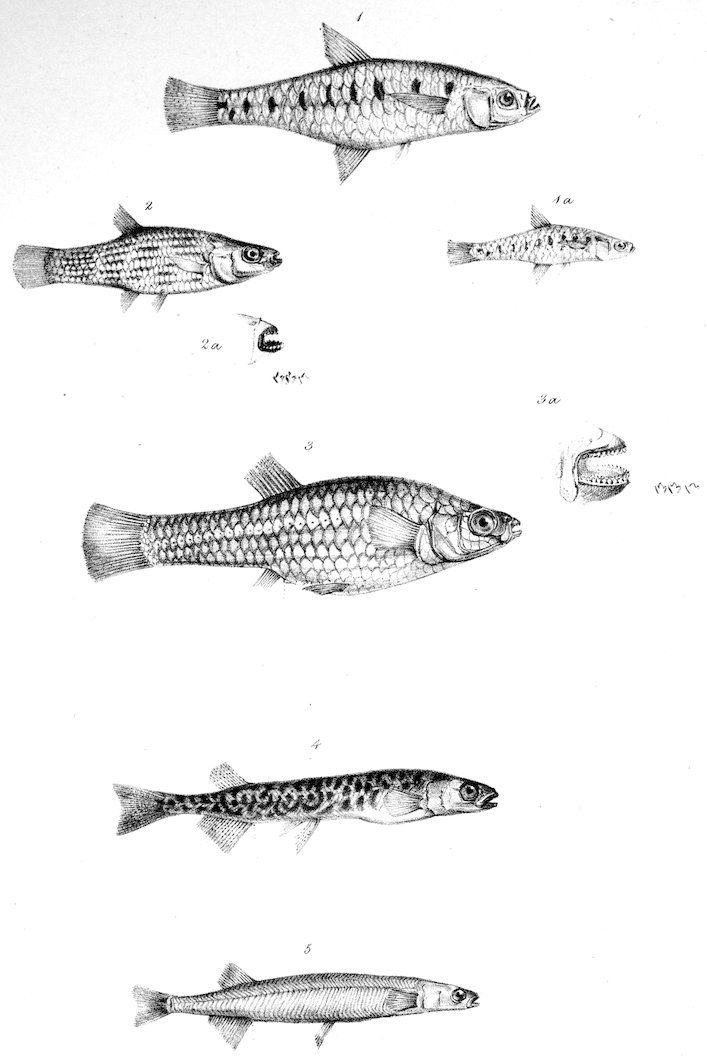
Fish. Pl. 22. From Nature on Stone by W. Hawkins.
No. 1. Pœcilia decem-maculata. Magnified View twice Natural Size.
1a. Natural Size.
2. Lebias lineata. Nat. Size.
2a. Magnified View of Teeth.
3. Lebias multidentata Nat. Size.
3a. Magnified View of Teeth.
4. Mesites maculatus. Nat. Size.
5. attenuates.
115Colour.—Greenish-brown, with a conspicuous black spot on the middle of each side, a little in advance of the commencement of the dorsal. Dorsal a little dotted and mottled with dusky, especially towards the tips of the rays. The other fins plain.
Habitat, Rio de Janeiro.
This species, which was discovered by Humboldt, was observed by Mr. Darwin in great numbers in fresh-water ditches at Rio de Janeiro: others were taken in equal plenty in a salt lagoon. The bellies of the females are very turgid when big with young, which are said to be excluded alive, and yellowish.—Valenciennes, in his description, speaks of the opercle as being smooth, or without scales, though he says the preopercle is covered with scales; and he would lead one to suppose that they are absent on this part in the whole genus, as it enters into his generic character; I find them, however, present, though very thin and transparent, both in this species and the next.
The general resemblance which Pœcilia bears to Mugil, as regards the form of the head and mouth, is very striking, and calls up irresistibly the idea of some relation of analogy between these two genera.
2. Pæcilis decem-maculata. Jen. Plate XXII. Fig. 1.
P. corpore subelongato, viridescenti-fusco; lateribus maculis nigris circiter decem serie longitudinali dispositis; pinnis immaculatis: dentibus subincisivis: caudali subtruncatà.
D. 8; A. 10; C. 22, brevibus inclusis; P. 9; V. 5.
Long. unc. 1. lin. 4.
Form.—More elongated than the last species; the snout not so acute when viewed laterally. Depth not more than one-fifth of the entire length, the length of the head being equal to it. Mouth and jaws similar; the teeth also in one row in each jaw, and forming a compact series, but more incisor-like than pointed, with oblique cutting edges. Scales of a different form and sculpture; more oblong than semi-elliptical, broader than long; the deep striæ behind more numerous, amounting to twenty or more, and all drawn nearly of the same length. They cover all the pieces of the opercle as in the P. unimaculata.
Dorsal and anal exactly opposite, commencing at a point a little anterior to the middle of the entire length, reckoning this to the extremity of the caudal. Caudal rather more approaching to square than rounded; the number of rays fewer than in the last species. Pectorals narrower, having also fewer rays. Ventrals very small, scarcely more than half the length of the pectorals. When laid back, the pectorals reach to beyond the insertion of the ventrals: the ventrals do not attain to the anal.
Colour.—Greenish-brown, with about ten conspicuous somewhat oval-shaped dusky spots, arranged in a longitudinal line along the middle of each side. All the fins plain.
Habitat, Maldonado.
This, which is evidently a new species of Pœcilia, was taken by Mr. Darwin 116at Maldonado, in a lake that had been suddenly drained. There are three specimens in the collection, none of them exceeding the length above given. Mr. Darwin, however, states in his notes, that he believes them to be full grown, having taken them so repeatedly, in brooks, of the same size. The number of spots varies from nine to twelve, and is sometimes different on the two sides of the same specimen.
Independently of the spots, which at once characterize this species, it is readily distinguished from the last by its teeth, which are more cutting than pointed, and in this respect rather departing from the character of the genus as established by Valenciennes.
1. Lebias lineata. Jen. Plate XXII. Fig. 2.
L. corpore subelongato, subcompresso, viridescenti-fusco; lateribus lineis circiter septem longitudinalibus nigris, e maculis parvis subconfluentibus formatis: dentibus uniseriatis: caudali rotundatâ.
D. 9; A. 9; C. 26, brevibus inclusis; P. 13; V. 6.
Long. unc. 1. lin. 10.
Form.—General form very similar to that of the Pæcilia decem-maculata. Slightly compressed; the depth one-fifth of the length; the length of the head about four and a half times in the same. Head depressed: snout obtuse: mouth small; the commissure horizontal. Upper jaw very protractile; the lower one rather the longest, when the mouth is shut. Teeth forming a single closely set series, somewhat compressed at bottom, the cutting edges tricuspid. Diameter of the eye nearly one-fourth the length of the head. Some large conspicuous pores on the lower jaw, passing upwards in a series along the margin of the preopercle, not very near together, about eight or nine in all.
Scales large, covering the head and all the pieces of the gill-cover, as well as the body. About eight in the depth, and thirty in a longitudinal line from the gill to the caudal. One taken from the middle of the side of a semi-elliptic somewhat oblong form; the free portion very finely striated, the basal with ten or twelve deeper-cut striæ, these last nearly parallel, and of equal lengths. Lateral line faintly marked out by a dotted line; the first half in the third row of scales from the top, the last half in the fourth row.
Dorsal commencing at exactly the middle point of the entire length. Anal opposite and similar. Caudal rounded. Pectorals small, about two-thirds the length of the head. Ventrals smaller, barely one-half of the same. The pectorals, when laid back, reach to the insertion of the ventrals; but the latter hardly attain to the anal.
Colour.—Greenish-brown, with six or seven longitudinal dark lines on the sides, the lines apparently made up of spots for the most part confluent, but here and there not so, interrupting the continuity of the lines. All the fins pale dusky, without any spots or markings.
Habitat, Maldonado.
This new species of Lebias was taken by Mr. Darwin in the same lake at 117Maldonado with the Pœcilia decem-maculata. There are several specimens in the collection, none of them exceeding the size above mentioned, and they have all the appearance of being full grown. Some have the lines of spots much more interrupted than others.
2. Lebias multidentata. Jen.
Plate XXII. Fig. 3.
L. corpore subelongato, subcompresso, viridescenti-fusco; lateribus fasciis angustis paucis longitudinalibus albidis obscurioribus: dentibus seriebus plurimis dispositis, omnibus tricuspidatis: caudali rotundatâ.
D. 9; A. 9; C. 26, brevibus inclusis; P. 13; V. 6.
Long. unc. 3. lin. 2.
Form.—The general form and proportions of this species are extremely similar to those of the last; but it differs very remarkably in having behind the anterior row of tricuspid teeth, a band of minuter teeth above and below, all of which are also tricuspid, and similarly formed to those in front. Head one-fifth of the entire length; flattened on the crown. Jaws nearly equal; upper one very protractile. Scales large; about thirty-two in a longitudinal line, and eight in the depth; covering all the pieces of the opercle; similar in form to those of the last species, but with the striæ on the free portion finer and more numerous, the deep-cut basal striæ also rather more numerous, amounting to about fourteen, and of unequal lengths, gradually increasing from the outermost to the middle ones. Lateral line similar; also the same pores on the lower jaw. Fins and finray-formula similar: in both species the first and last rays of the dorsal and anal are simple, and shorter than the others. The anal perhaps terminates a little nearer the caudal than the dorsal does.
Colour.—(In spirits.) Greenish-brown, with very little appearance of markings in its present state. There is, however, some indication of an irregular scattered row of small black spots on each side, a little below the ridge of the back; also of two or three pale longitudinal narrow bands along the middle of the sides, which were probably more conspicuous in the living fish. The belly is yellow, and very tumid; but these are evidently characters merely indicative of the female sex.
Habitat, Monte Video.
This is another new species of Lebias taken by Mr. Darwin in fresh-water at Monte Video, if indeed it strictly belong to the genus; but the circumstance of the teeth being in several rows, and in fact forming a complete band, is at variance with the generic characters as given by Cuvier. The teeth however being exactly of the same form as in the other species, and the general characters on the whole similar, I have not thought it expedient to erect it into a new genus. There is but one specimen in the collection, which appears to be a large female big with young.
118
Genus—MESITES. Jen.
Corpus elongatum, gracile, antice subcylindricum, postice compressum, nudum, squamis nullis. Caput depressum. Rostrum breve, obtusum: os terminale, rictu modico. Maxillæ debiles; superior margine ex ossibus intermaxillaribus omnino formato, maxillaribus retroductis et a labio partim celatis. Dentes minuti, acuti, in maxillâ utrâque uniseriati; in linguâ et vomere biseriati; in ossibus palatinis et pharyngalibus nulli. Apertura branchialis amplissima, membranâ sex-racliatâ, subter gulam profundè emarginatâ, haud isthmo annexâ. Pinnæ dorsalis et analis valde retropositæ, oppositæ. Pinnæ pectorales et ventrales parvæ. Pinna caudalis leviter emarginata.
There can be no doubt, I imagine, as to this being an entirely new form, and a very interesting one, from the circumstance of its being at the extreme end of the family to which it belongs, and its very much departing from the usual characters of that family. I have referred it to the Cyprinidæ, taking that group in the enlarged view in which Cuvier accepts it; though by those who divide it into subfamilies it would probably be associated with the Cobitidæ, or made to constitute a distinct one by itself. It agrees with the Cyprinidæ in general in the form of its mouth, in the upper jaw having its margin entirely formed by the intermaxillary, the maxillary being present, but placed behind and partly concealed in the thickness of the lip, and in the want of an adipose; but it altogether departs from that family in the entire want of scales, of which there is not even a vestige in the dried skin, and in which respect it would seem to shew an affinity to the Siluridæ. Yet it has none of the other characters of the family just mentioned. On the other hand, in the backward position of the dorsal and anal fins, which are opposite to each other, it agrees with the Esocidæ. The pharyngeal bones are unarmed, but this deficiency is made up for by the strong curved teeth on the tongue, independently of the minuter ones in the jaws.
The intestine is extremely short and quite straight, measuring only fourteen lines in length from the pylorus to the anus, in a specimen two inches and a half long. The stomach is of an oval form, of considerable capacity, very membranaceous, with the cardiac and pyloric openings near together at the upper extremity, from the latter of which the intestine is immediately reflexed to pass off to the anus. In the specimen dissected, the stomach was much distended by a nearly perfect individual of the genus Colymbetes, which appeared to have been recently swallowed, and was scarcely at all altered. There are no cœcal appendages. The air-bladder is of an elongated oval form, and of considerable development.
119Mr. Darwin’s collection contains no less than three species of this new genus, differing but slightly from each other. Two are from the most southern parts of South America, the third from New Zealand.
1. Mesites maculatus. Jen.
Plate XXII. Fig. 4.
M. viridescenti-fuscus; dorso et lateribus maculis crebris, hic et illic confluentibus, nigris; ventre niveo; pinnarum radiis nigro-punctatis.
B. 6; D. 10; A. 16; C. 16, &c.; P. 12; V. 7.
Long. unc. 2. lin. 8.
Form.—Slender and very much elongated. Body anteriorly subcylindrical, compressed behind. Greatest depth not more than one-eighth of the entire length: thickness about three-fourths of the depth. Head rather depressed, about one-sixth of the entire length. Snout short and rounded; mouth at the extremity; the gape moderate, not quite reaching to beneath the anterior angle of the eye. Lower jaw ascending a little to meet the upper, and, when the mouth is open, appearing rather the longest. Intermaxillary fixed, forming the entire margin of the upper jaw, the maxillary being behind it, and, though of nearly equal development, not very distinct: both bones slender. Teeth small, but sharp-pointed, rather widely apart, arranged in a single row along the edge of the intermaxillary, and in the lower jaw; the series above consists of about eighteen, that below of about twenty-one: also a double longitudinal row on the tongue, each row containing five or six teeth, the anterior ones curved, and larger than any of those in the jaws: a similar double row, but of minuter ones, down the middle of the vomer; none, however, on the palatines or pharyngeans. Eyes rather large, their diameter contained about three and a half times in the length of the head, distant scarcely one diameter from the end of the snout. The nostrils appear to consist of only a single aperture in front of the eye, in the neighbourhood of which, and also above the eye, are several large pores. The opercle and subopercle taken together approach to an oblong form, the posterior margin being straight and nearly vertical: the subopercle is not much developed, nor very distinct. Gill-opening very large, the membrane thick, with six rays, deeply notched beneath, and not fastened down. The whole skin is perfectly smooth and naked, invested with mucosity. No appearance of any lateral line, unless a fine dark streak be so called, passing along the middle of the sides, and dividing them into two equal parts.
The dorsal and anal are opposite to each other, and both placed very far back, almost at the extremity of the body. They commence in nearly the same vertical line, a very little anterior to the commencement of the last third of the entire length; but the anal being longer than the dorsal, it extends nearer the caudal. The form of these fins is much as in the genus Cobitis. The dorsal has the first three rays simple, the rest branched: the anal also has the first three simple, the first very short. Caudal about one-eighth of the entire length, with a shallow notch, the principal rays branched. The vent is just before the anal. The ventrals arise from about the middle of the entire length, the distance from their insertion to the commencement of the anal being twice their own length. The pectorals are small, and rather narrow, equalling about two-thirds the length of the head or hardly so much: they are attached low down, but not quite so low as in the genus Cobitis.
120Colour.—(In spirits.) Greenish-brown, with numerous conspicuous spots and small irregular transverse bars of black. Under a lens the spots appear to be made up of thickly crowded black specks upon a dark brown ground: the bars result from some of the spots being confluent. The belly appears to have been white. The rays of all the fins are dotted with dusky, but the membranes transparent and colourless.
The individual described above was taken by Mr. Darwin in a fresh-water brook, in Hardy Peninsula, Tierra del Fuego. His collection, however, contains four other specimens found in streamlets and creeks high up the river of Santa Cruz in Patagonia, where they are said to have been numerous. Though these last are slightly different, they are evidently referable to the same species: they also vary a little from each other. Their peculiarities are as under:
The largest measures 2 inches 8 lines in length, and has the following fin-ray formula:
D. 12; A. 16; C. 16, &c.; P. 14; V. 7.
The next in size is 2 inches 6 lines, with the fin-ray formula thus:
D. 11; A. 16; C. 16, &c.; P. 13; V. 7.
These specimens agree in being both slenderer than the one from Tierra del Fuego. The depth is eight and a half, if not nine times in the entire length: the head rather more than one-sixth of the same. The colours are similar, except that the spots are not quite so numerous, and of a more regular form, seldom running together to form bars.
It is to these specimens that Mr. Darwin’s notes refer, respecting the colours of this species in the recent state. As follows: “Pale greenish brown, with small irregular transverse bars of black; belly snow white.”—D.
The third of the Patagonian specimens is 2 in. 2 lin. long. Fin-ray formula—
D. 10; A. 15; C. 16, &c.; P. 14; V. 7.
The fourth is of the same length.
D. 11; A. 15; C. 16, &c.; P. 13; V. 7.
These last two specimens are exactly similar to each other in colours, but differ from the former two in being almost immaculate, having only a few spots on the upper part of the back. This brings them very close to the following species, from which they are scarcely to be distinguished, except by their smaller eyes. It should be observed further, that the fleshy part of the tail in these specimens has the upper and under edges fringed with the short accessory rays of the caudal, a character which is not so obvious in any of the others.
121
2. Mesites alpinus. Jen.
M. viridescenti-fuscus, dorso saturatiore; hoc, et lateribus, et pinnis, nigro levissimè irroratis, immaculatis; ventre niveo; oculis majusculis.
D. 10; A. 16; C. 16, &c.; P. 13; V. 7.
Long. unc. 2. lin. 5.
Form.—Very little difference in form between this and the last species. The eyes, however, are decidedly larger, measuring in diameter one-third the length of the head. The head itself also appears somewhat longer, being nearly one-fifth of the entire length. The anterior teeth on the tongue do not seem much larger than the others. Fins similar.
Colour.—(In spirits). Greenish-brown, deepening in tint at the top of the back. Back, sides, and fins, immaculate, but thickly powdered with minute dark specks, scarcely visible except under a lens. These specks give the fins a more dusky appearance than they possess in the last species. The belly appears to have been white.
A second specimen does not differ from the above in any respect, except in being rather smaller, and scarcely more than two inches in length.
Habitat, Tierra del Fuego.
This species was taken by Mr. Darwin in alpine fresh-water lakes in Hardy Peninsula, Tierra del Fuego. I have no hesitation in considering it distinct from the last, as there are two specimens exactly similar, both shewing a larger eye, and an entire absence of all approach to spots; while the whole surface of the back and sides is thickly irrorated with dark specks, a character which does not appear in the plain varieties of the M. maculatus.
3. Mesites attenuatus. Jen. Plate XXII. fig. 5.
M. viridescenti-fuscus, ventre vix pallidiore; dorso, et lateribus, pinnarumque radiis, sparsim nigro levissimè irroratis, immaculatis: corpore prægracili, anticè attenuato; capite et oculis minoribus.
D. 11; A. 17; C. 16, &c.; P. 12; V. 7.
Long. unc. 2. lin. 6.
Form.—Rather more slender than either of the last two species, the body more attenuated anteriorly; the head also smaller, though scarcely shorter. Mouth and eyes both smaller; the diameter of the latter not more than one-fourth of the length of the head. Teeth also rather more minute as well as more numerous. The fins are similar, except that the ventrals appear to stand rather more forward, being attached exactly in the middle of the entire length, excluding caudal: the distance from their insertion to the commencement of the anal is more than twice their own length. The outer rays of the caudal are worn, but there was probably a shallow notch when entire: the short accessory rays are very numerous, and form a very distinct fringe along the upper and lower edges of the fleshy part of the tail.
122Colour.—(In spirits.) Greenish-brown, much more uniform than in either of the last two species, not deepening on the back, and scarcely becoming paler underneath. The back sides, and rays of the fins, are finely irrorated with dusky specks, as in the M. alpinus, but not to the same extent, the specks being more thinly scattered, and here and there scarcely visible. From the same cause the fins appear paler.
Habitat, Bay of Islands, New Zealand.
This, which is a very distinct species of this new genus, was taken by Mr. Darwin in fresh-water in the Bay of Islands, New Zealand. It is well characterized by its more attenuated head and smaller eye, than those of either of the two others.
Family.—ESOCIDÆ.
Exocœtus exsiliens. Bl.?
Exocœtus exsiliens, Bl. Ichth. pl. 397.
Form.—Head about one-sixth of the entire length, and approaching to the form of a parallelopiped; very much flattened on the crown and between the eyes quite to the end of the snout, broader above than beneath, so that the cheeks are beyond the vertical inclining inwards at bottom. Snout short: mouth not much cleft; when shut, the jaws are equal, and the commissure of the lips appears to extend to beneath the anterior margin of the eye, but the maxillary, which retires completely beneath the suborbital, does not reach so far: when the mouth is open, the maxillary becomes vertical, and the intermaxillary being scarcely at all protractile, the lower jaw is a little the longest. Teeth very minute: a row, scarcely visible, along the forepart of the intermaxillary, but not extending to the sides of the jaw: none that can even be felt in the lower jaw, or in any other part of the mouth. Tongue rounded, and free at the tip. A loose veil of skin hangs down in front of the palate, from immediately behind the teeth in the upper jaw. Eyes round, and very large; the upper part of the orbit reaching to the line of the profile, and forming a slightly salient ridge: their diameter very nearly one-third the length of the head; between them and the end of the snout is two-thirds of a diameter; the distance from one to the other across the crown is one diameter and a quarter. The nostrils consist of one large round orifice a little in advance of the eyes. The membrane of the opercle forms a slightly salient angle backwards, near the upper part of the gill-opening. Scales large, of a somewhat irregular form, approaching to oblong, nearly twice as broad as long, the posterior margin with three or four incisions near the middle, and a few rather indistinct nearly parallel striæ on the surface of the basal portion; in others these striæ converge to form a small but very regular fan; and the scales appear to vary a good deal on different parts of the body.
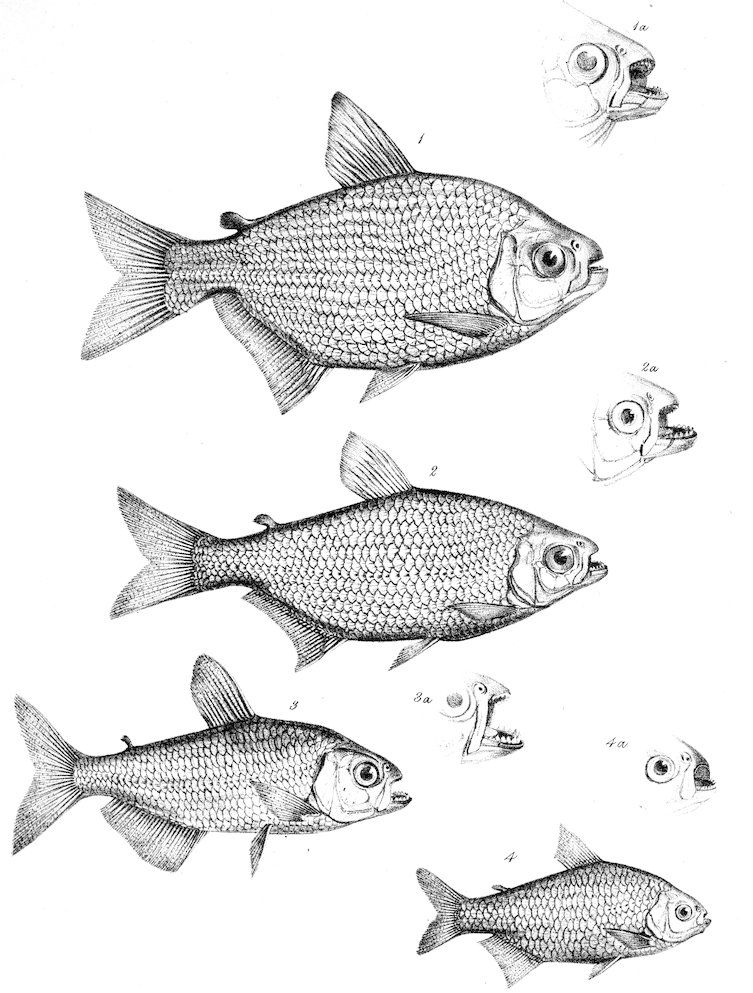
Fish. Pl. 23. B. Waterhouse Hawkins del.
No. 1. Tetragonopterus Abramis. All Nat. Size.
2. rutilus.
3. scabripinnis.
4. interruptus.
1a. 2a. 3a. 4a. Magnified View of Teeth.
123The pectorals reach exactly to the base of the lateral caudal rays; the first two rays are simple, and all the others branched; first ray of all not half the length of the fin. Dorsal so situate as to leave a space between it and the end of the fleshy part of the tail about equal to its own length; the first ray simple, the others branched; the last prolonged beyond those which immediately precede it so as to form rather a point backwards. Anal similar to the dorsal, and answering to it exactly. The ventrals are attached at a point, in this specimen, about half an inch posterior to the middle of the entire length, reckoning this to the end of the fleshy part of the tail; but are not much out of the middle, if the length be reckoned to the end of the upper lobe of the caudal: their length is contained not quite three and a half times in the entire length, excluding caudal; and they reach exactly to the end of the dorsal and anal: first ray very much branched, and only one-third the length of the fin; second ray appearing like two or even three rays at its upper extremity, from the circumstance of the several branches of it being of unequal length; all the other rays branched likewise. Vent a very little in advance of the anal. Upper lobe of the caudal one-third shorter than the lower; this last being exactly the same length as the ventrals.
D. 11; A. 12; C. 16, &c.; P. 18; V. 6.
Length 12 inches 8 lines.
Colour.—The colours were not noticed in the recent state; and the specimen is in such bad condition, and so much altered by the spirit, that they are now no longer distinguishable.
The flying-fish above described was taken by Mr. Darwin in the Pacific Ocean, off the coast of Peru, in Lat. 18° S. It appears to be the E. exsiliens of Bloch, but as I am not aware that the species of Exocœtus have been ever rigourously worked out, and closely compared from different parts of the globe, I have thought it expedient to annex a description, by which it may be identified, if it prove hereafter distinct.[34]
Family.—SALMONIDÆ.
1. Tetragonopterus Abramis. Jen.
Plate XXIII. fig. 1.
T. corpore subrhomboideo, compressissimo, altitudine fere dimidium longitudinis, pinnâ caudali exclusâ, æquante: osse maxillari angusto, retrorsum arcuato: pinnâ dorsali triangulari, suprâ ventrales accuratè exorienti; anali lævi, longâ, altitudine retrò cito decrescente; utrâque plicis membranaceis, radiis longitudinaliter adhærentibus, instructâ: squamis in lineâ laterali 46, in lineâ inter pinnas ventrales et dorsalem transversâ 17.
B. 4; D. 1/10; A. 2/30; C. 19, &c.; P. 13; V. 8.
Long. unc. 4. lin. 7.
Form.—Of a subrhomboidal form, the nape and back being much elevated, whence the profile falls very obliquely and in nearly a straight line. Greatest depth nearly half the entire length, excluding caudal. Body very much compressed, the thickness being nearly three and a half times in the depth. Head approaching to a laterally flattened cone, with the length and height nearly equal. Snout very short; mouth but little cleft; when open, the lower jaw projecting 124considerably. Maxillary narrow, and of nearly equal breadth throughout, curving backwards. Teeth with their cutting edges dentated, the middle point much the most developed, with one or two smaller ones on each side: two rows of such teeth on the intermaxillary, and one in the lower jaw, this last row with scarcely more than eight or ten teeth in it. No teeth on the maxillary, vomer, palatines, or tongue. Eyes round, rather large, their diameter three and a half times in the length of the head, distant not so much as one diameter from the end of the snout. Nostrils with two orifices, the posterior one a narrow curved slit, the anterior one a round hole. The suborbital forms a somewhat triangular naked disk beneath the eyes, with radiating veins. Posterior margin of the opercle very little curved: subopercle narrow, and small, forming but a small portion of the gill-flap.
About seventeen scales in the depth, and forty-six in the lateral line, which last bends downwards rather below the middle, and is continued quite to the caudal. A scale taken from the middle of the side below the lateral line is somewhat rounded anteriorly, the basal margin being straight; the surface marked with very fine numerous concentric striæ, and with two coloured deeper striæ on the free portion diverging from the centre in a V-like form: some scales have three or four of these coloured striæ, drawn more or less regularly.
The dorsal commences in about the middle of the entire length, excluding the caudal and narrow part of the tail; of a triangular form, its greatest height equalling the depth to the lateral line. Pectorals narrow, shorter than the head, attached below the bottom of the gill-opening, and reaching rather beyond the insertion of the ventrals, which last are in a vertical line with the commencement of the dorsal and shorter than the pectorals. Anal long, commencing a very little beyond the tips of the reclined ventrals; the anterior portion rather more than half the height of the dorsal, but the posterior much lower, sloping rapidly off; two spines, the first very minute, the second about one-third the length of the first soft ray; the last soft ray double. The anal terminates nearly in a line with the adipose, which is small. Caudal forked for half its length: the lobes equal. Many of the rays in the vertical fins, more especially the dorsal and anal, are accompanied through nearly half their length from the bottom by membranous folds of skin. There are also some small scales along the base of the anal, but none apparent on the dorsal. In the axillæ of the ventrals is an elongated scale, not half their length.
Colour.—“Back bluish silvery, with a silver band on the side: a bluish black spot behind the gills. Fins pale orange; tail with a black central band.”—D.—There is now not much trace of the silver band, or the black band on the tail. The humeral spot is, however, still very distinct.
Habitat, the Rio Parana, South America.
This species was taken by Mr. Darwin in October in the Rio Parana, as high up as Rozario. I cannot ascertain that it is described, though there is much resemblance between it and the species figured in Seba.[35] It differs from the T. chalceus of Spix, in its much smaller scales, not to mention other points of dissimilarity.
125
2. Tetragonopterus rutilus. Jen. Plate XXIII. fig. 2.
T. corpore ovali, compressissimo, altitudine tertiam partem longitudinis, hâc ad basin furcæ caudalis mensâ, æquante: osse maxillari angusto, retrorsum arcuato: pinnâ dorsali subtriangulari, paululum pone ventrales exorienti; anali lævi, longâ, altitudine retrò cito decrescente; utrâque plicis membranaceis, radiis longitudinaliter adhærentibus, instructâ: squamis in lineâ laterali 40, in lineâ inter pinnas ventrales et dorsalem transversâ 14.
D. 1/9; A. 2/27; C. 19, &c.; P. 14; V. 8.
Long. unc. 4. lin. 3.
Form.—More oval than rhomboidal: the back and nape not so much elevated as in the last species; the profile falling less obliquely. Depth one-third of the entire length, measured to the base of the caudal fork: head one-fifth of the same. Not above fourteen scales in the depth, and forty in the lateral line, which occupies the eighth row from the top. The scales on the whole similar, but with the basal margin not so straight and regular, and somewhat projecting in the middle in the form of a blunt salient angle. The dorsal commences a trifle nearer the caudal, and at the middle of the entire length, the caudal alone excluded. The pectorals reach just to the insertion of the ventrals, which last are a trifle in advance of the dorsal. The second anal spine is longer, and nearly half the length of the soft rays which follow.
Colour.—“Back iridescent greenish brown: a silver band on the side. Fins dirty orange: tail with a central black band; above and below the band bright red and orange.”—D.—The colours appear very similar to those of the last species. The humeral spot, however, is less obvious, while, on the other hand, the silver band on the side can still be distinguished.
Habitat, Rio Parana, South America.
Taken with the last species, to which it is very closely allied. Mr. Darwin observes in his notes, that both are among the commonest of the river fry in the Rio Parana.
Both this and the T. Abramis are distinguished by having narrow longitudinal folds of skin attached to the basal half of the rays of the dorsal and anal fins, a character which does not shew itself in any of the three species next to be described.
3. Tetragonopterus scabripinnis. Jen.
Plate XXIII. fig. 3.
T. corpore ovali, subelongato, valde compresso; altitudine tertiam partem longitudinis, caudali exclusâ, æquante: osse maxillari paulo dilatato, recto: pinnâ dorsali suboblongâ, altâ, pone ventrales exorienti; anali scabrâ, altitudine retrò gradatim decrescente; radiis plicis membranaceis nullis: squamis in lineâ laterali circiter 38, in lineâ inter pinnas ventrales et dorsalem transversâ 12.
D. 1/9; A. 3/22; C. 19, &c.; P. 13; V. 8.
Long. unc. c. 3. lin. 7.
126Form.—Still more oval and elongated than the last species, the profile falling in a gentle curve from the dorsal to the end of the snout. Depth exactly one-third of the length, excluding caudal: head one-fifth of the entire length, caudal included. Maxillary rather dilated towards the bottom, and quite straight, not curving backwards as in both the last species. Teeth rather larger, and more conspicuous. Nostrils larger. Only twelve scales in the depth, the lateral line occupying the seventh row from the top: thirty-seven or thirty-eight in the lateral line. Scales of a rather different form; the basal margin more sinuous, the free margin not so regularly curved, the coloured striæ hardly obvious. Dorsal more oblong than triangular, higher in relation to the depth, of which it equals two-thirds, commencing at a point anterior to the middle of the length, excluding caudal. The pectorals reach a little beyond the ventrals, which are attached a little in advance of the dorsal. The anal has all the rays longer, and more nearly equal, the posterior part of the fin not being so much sloped off: there are three spines at the commencement, the first two minute, the third not quite half the length of the soft rays: this fin is furthermore distinguished from that of the two former species by the rays being set with asperities, which communicate a scabrous harsh feel to the touch, when the finger is passed along them from the base upwards.
Colour.—Not noticed in the recent state. In spirits it appears more silvery than either of the two last species: the back and upper part of the sides being brownish. A humeral dusky spot, and the remains of what was probably a bright silver band along the middle of the side from the gill to the caudal. At the base of the caudal is a dusky spot, which is prolonged in a line along the central rays to the commencement of the fork. The other fins faintly edged with dusky, but otherwise pale.
Habitat, Rio de Janeiro.
The more oval and elongated form, straight maxillary, and scabrous anal fin, at once distinguish this species from either of the two last. It was taken by Mr. Darwin in fresh water, at Rio de Janeiro, in June.
4. Tetragonopterus tæniatus. Jen.
T. corpore ovali, valde compresso, altitudine tertiam partem, longitudinis, hâc ad basin furcæ caudalis mensá, æquante: osse maxillari margine posteriore recto: pinnâ dorsali suprà, ventrales accuratè exorienti; anali lævi, altitudine retrò cito decrescente; radiis plicis membranaceis nullis: squamis in lineâ laterali 40, in lineâ inter pinnas ventrales et dorsalem transversâ 14.
D. 1/10; A. 3/22, &c.
Long. unc. 2. lin. 2.
Form.—Depth and general form similar to those of the T. rutilus; also the same number of rows of scales, the lateral line occupying the eighth from the top. Anal smooth, and similar to that of the T. rutilus in form, but in the number of the spines and soft rays agreeing with the T. scabripinnis. The maxillary straight, but hardly so much dilated as in the last-named species, being of nearly equal breadth throughout. The teeth are more numerous than in either, amounting in the lower jaw to fourteen or more. The ventrals are in an exact line with the commencement of the dorsal.
127Colour.—Much as in the T. scabripinnis. The same silver band, only more brilliant; also the same humeral spot, and the spot at the base of the caudal extending along the middle rays.
Habitat, Rio de Janeiro.
The above description is that of two small specimens, similar to each other, obtained by Mr. Darwin in a running brook at Socego, in the province of Rio de Janeiro. They are probably not full grown; but so evidently distinct from either of the last two species, the characters of which are in some measure combined in them, that I have not hesitated to give them a separate place. The silver band is more or less obvious in all the species of this genus brought home by Mr. Darwin, but it is much brighter in this than in any of the others.
5. Tetragonopterus interruptus. Jen. Plate XXIII. fig. 4.
T. corpore ovali, valde compresso: altitudine tertiam partem longitudinis totius æquante: ore parvo; osse maxillari brevissimo, dilatato, margine posteriore recto: dentibus minutis, multicuspidatis: dorsali subtriangulari, pone ventrales exorienti; anali (in uno sexu?) scabrâ, altitudine retrò subito decrescente; his pinnis plicis membranaceis nullis: squamis in lineâ longitudinali 35, in lineâ inter pinnas ventrales et dorsalem transversâ 10: lineâ laterali interruptâ, haud finem pinnæ pectoralis attingente.
D. 1/10; A. 2/18; C. 18, &c.; P. 11; V. 7.
Long. unc. 2. lin. 8.
Form.—Oval, and not very dissimilar in general form to the T. rutilus, but rather more elevated above the shoulder. Depth exactly one-third of the entire length: head one-fourth of the same, caudal excluded. Profile not exactly straight, but very slightly hollowed out at the crown, then as slightly protuberant above the eyes, whence it falls more rapidly in front, giving the snout a short and blunt appearance. Mouth much smaller than in any of the preceding species, owing to the extreme shortness of the maxillary, which is broad, with the anterior margin curving outwards, but the posterior one straight. Teeth very small; the points on the cutting edges numerous (five or six on each tooth) and nearly equal; apparently only one row on the intermaxillary, and the same in the lower jaw; none on the maxillary. Eyes and nostrils as in the other species, but the anterior orifice of the latter larger. Subopercle much larger, forming a greater portion of the gill-flap. Scales relatively larger; only ten in the depth, and thirty-five in the length. They have no deep striæ on the basal portion, and consequently no fan; but they are very regularly marked with the usual finer striæ concentrically arranged, except on the free portion where they become indistinct.
The lateral line occupies the sixth row of scales from the top, but is very soon interrupted, coming to an end before it has reached the length of the pectoral, and not carried over more than eight or nine scales in the length. Dorsal subtriangular, commencing exactly at the middle of the length, caudal excluded. Anal shorter than in the other species, and not reaching so near the caudal; two spines, but the first extremely minute. Caudal forked for half its 128length, the lobes equal. Ventrals more forward than in the other species, decidedly in advance of the dorsal, and attached at one-third of the entire length; their axillary scale very small. Pectorals narrow, reaching beyond them. No long folds of skin accompanying the rays of the vertical fins.
Colour.—Not noticed in the recent state, in which, judging from its appearance in spirit, it was probably silvery, or perhaps golden, with somewhat of an olivaceous hue becoming deeper on the back. There are evident remains of a bright longitudinal lateral band: also of a black spot at the base of the caudal. The dorsal and the anterior portion of the anal incline to dusky: the pectorals and ventrals are slightly dusky at their extremities; there is also a large irregular dusky stain on the back and shoulders anterior to the dorsal fin.
A second specimen differs from the above in being a trifle smaller, and not quite so deep in the body. The anal is also decidedly scabrous, as in the T. scabripinnis, and has one ray less in it. The colours are similar, excepting that the fins are rather less dusky, and the large dusky stain on the back and shoulders is wanting.
Habitat, Maldonado.
This species is one of several that were taken by Mr. Darwin at Maldonado, in the lake that had been suddenly drained, before alluded to. It is immediately distinguished from all the others in this genus above described, by its small mouth and abbreviated lateral line. The circumstance of the anal fin being scabrous in only one of the specimens leads to the suspicion that this may be a sexual character, perhaps common to this and several species; and, judging from its somewhat less depth, I conceive the specimen so distinguished in this instance to be a male.
Hydrocyon hepsetus. Cuv.
Hydrocyon hepsetus, Cuv. Reg. An. (ed. 2) tom. ii. p. 312.
———— falcatus, Freycinet, (Voyage) Zoologie, p. 221, pl. 48. fig. 2.
Form.—Back rising slightly from the nape, whence the profile in front falls obliquely in nearly a straight line to the mouth. Depth contained about three and a half times in the length, caudal excluded. Both head and body much compressed, the greatest thickness being only two-fifths of the depth. The length of the head equals the depth of the body. Snout appears rather pointed when the jaws are shut; when open, the lower jaw is a little the longest. Gape considerable. Maxillary long, commencing before the eyes, and reaching to a vertical from the posterior part of the orbit; inclining downwards, lapping obliquely in part over the lower jaw, gradually widening towards the posterior extremity, which is rather obliquely rounded. Intermaxillary with two sharp canines in front, then on each side four or five very small hooked teeth, then another large canine, though not so large as those in front; behind this commences the maxillary, which is armed all along its margin with a regular row of small equal hooked teeth, resembling sharp serratures; a similar row on each palatine, but none on the vomer or tongue; this last pointed, and free at the tip. Lower jaw with two strong canines in front, larger than those in the upper, and fitting into two holes above, when the mouth is shut; on each side of these are three only half their size, but increasing backwards, placed at rather wide 129intervals; then follow a row of close, minute, sharp teeth, similar to those on the edge of the maxillary. Eyes rather large, their diameter not quite one-fourth the length of the head, distant one diameter and a quarter from the end of the snout. Suborbital large, consisting of three pieces. Preopercle rectangular. A row of pores, not very distinct, along the under part of the lower jaw, thence continued along the limb of the preopercle. Opercle and subopercle taken together with the posterior margin forming a slight but regular curve, with scarcely any salient angle.
Head naked; scales on the body of moderate size, arranged in somewhat oblique rows, especially below the lateral line; one from the middle of the side below the lateral line of an irregularly rounded form, the posterior margin rather sinuous, the disk with numerous fine concentric striæ, but no deeper-cut striæ on the basal portion. About sixteen scales in a vertical row, and fifty-seven or fifty-eight in the lateral line: this last bending downwards in a curve which falls below the middle of the depth. Scales on the lateral line not larger than the others.
The dorsal answers to the space between the ventrals and anal; its height equals the depth to the lateral line. Anal long, commencing exactly under the last ray of the dorsal; the first part of this fin as high as the dorsal, but the rays, beyond the fifth, gradually decreasing; three spines, the first two very minute; the last soft ray double. Caudal in this specimen injured. Adipose and last ray of the anal in the same vertical line. Pectorals two-thirds the length of the head, attached very low down beneath the terminating portion of the gill-flap, narrow and slightly falcate, reaching to the ventrals, which last are one-fourth shorter. A long narrow scale in the axilla of each ventral one-third the length of the fin itself.
B. 4; D. 11; A. 3/26; C. 22, &c.; P. 12; V. 8.
Length 4 inches 3 lines.
Colour.—“Bluish silvery.”—D.—Some appearance of a dusky spot at the base of the caudal prolonged in a line along the middle rays, but scarcely any trace of a humeral one. The dorsal and anal incline a little to dusky.
Taken at Maldonado, in a fresh-water lake, in June. I have scarcely any doubt of its being the H. falcatus of the Zoology of Freycinet’s voyage, the figure of which it exactly resembles, excepting that the humeral dark spot, if it ever existed, and which is not mentioned in Mr. Darwin’s notes, is now almost entirely effaced. It is probable, however, that there are two or three species nearly allied, for which reason I have been the more particular in my description. The H. Hepsetus of D’Orbigny[36] appears to differ from the H. falcatus of Freycinet (with which last Cuvier associates his name of Hepsetus,) in having the lateral line curving upwards rather than downwards, and the caudal fascia as well as the humeral spot more marked. The Salmo falcatus of Bloch is probably distinct from both.
130
Genus.—APLOCHITON. Jen.
Corpus elongatum, compressum, subfusiforme, undique nudum alepidotum. Caput parvum. Rostrum breviusculum, subacutum. Os terminale, rictu modico. Maxilla superior margine ex ossibus intermaxillaribus omnino formato, maxillaribus, hæc subæquantibus, retroductis. Dentes minuti, acuti, in maxillâ utrâque uniseriati, in linguâ et vomere longitudinaliter biseriati, in ossibus palatinis nulli. Apertura branchialis amplissima, membranâ triradiatâ, subtus profundè emarginatâ. Pinnæ, dorsalis paululum pone ventrales, analis paululum pone dorsalem reclinatam, exorientes. Ventrales appendicibus axillaribus nullis. Pinna caudalis bifurca.
I have already noticed a remarkable new form among the Cyprinidæ brought home by Mr. Darwin, and differing from all the known genera in that family by the entire absence of scales. The one now to be described is not less remarkable among the Salmonidæ, and, what is particularly interesting, would seem to occupy an exactly analogous place in this family, departing from it in the same important character of having the skin perfectly naked and free from scales. There are, however, many other points of similarity between Mesites and the genus which I have here termed Aplochiton.[37] In both there is the same form of mouth, the margin of the upper jaw being entirely formed by the intermaxillary, behind which is the maxillary of nearly equal development. The teeth in the jaws are similar, both in regard to form and arrangement; there is also the same double longitudinal row on the tongue, and along the vomer. The pieces of the opercle are similar, and the gill-opening equally large in both genera, though the branchial membrane has twice the number of rays in Mesites that it has in Aplochiton. Furthermore, the fins are on the whole very similar, with the exception of the dorsal not being so far back in Aplochiton, and there being also an adipose in this genus. It is also deserving of notice that both these new forms, so resembling each other in many of their characters, come from the same quarter of the globe, being found either in the most southern parts of S. America, or in the neighbouring islands.
From the circumstance of the naked skin, Aplochiton might by some be referred to the Siluridæ, but what was said of the genus Mesites may be repeated here, that it has none of the other external characters of that family. The maxillary, instead of being reduced to a mere vestige, or lengthened into a barbule, is as much developed as in any of the Cyprinidæ, and of the usual form; the subopercle also is very distinct;[38] while there is no strong spine at the commencement of either the dorsal or pectoral fins. At the same time it must be mentioned that Aplochiton agrees with the Siluridæ in having no cœcal appendages, though the air-bladder is similar to that of the ordinary Salmonidæ. There are some peculiarities connected with the anal and sexual orifices which I shall notice presently, along with other points in the internal structure, in the species to be described first.
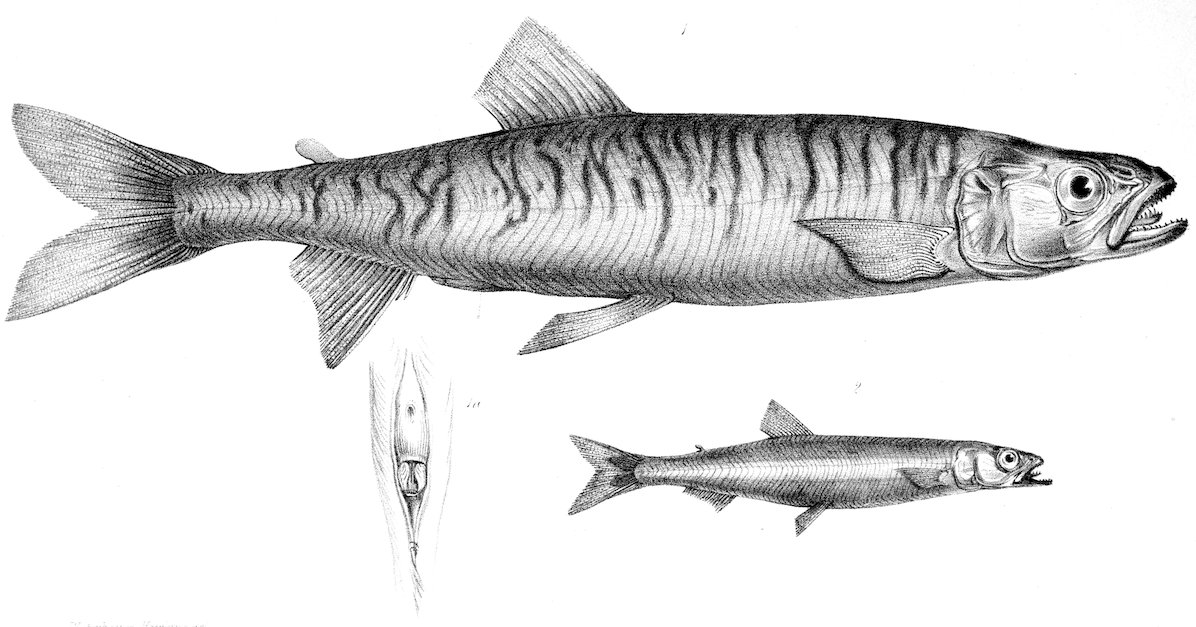
Fish. Pl. 24. Waterhouse Hawkins. del.
1. Aplochiton Zebra. Nat. Size.
1a. Magnified show of anal and generative orifices.
2. Aplochiton tæniatus. Nat. Size.
131Mr. Darwin has brought home two species of this new genus, agreeing precisely in form, but very distinct in respect to size and colouring.
1. Aplochiton Zebra. Jen.
Plate XXIV. Fig. 1.
A. obscurè plumbeus; fasciis nigris transversis: maxillis æqualibus.
B. 3; D. 11; A. 2/14; C. 16, &c.; P. 18; V. 7.
Long. unc. 9. lin. 6.
Form.—General form somewhat resembling that of the Mackarel, elongated, and approaching to fusiform. Greatest depth about the middle, equalling one-sixth of the entire length. Line of the back and profile nearly straight, the latter falling very little. Greatest thickness rather more than half the depth. Head small, contained about five and a half times in the entire length. Snout short, but rather acute. Mouth with a moderate gape reaching to beneath the anterior angle of the eye: when shut, both jaws equal, the lower one ascending at an angle of 45° to meet the upper; when open, the lower one a little the longest. Margin of the upper jaw formed by the intermaxillary, the maxillary appearing behind it. A single row of small but sharp teeth extending along the entire margins of both jaws: a double row of similar teeth, but stronger and more curved, down the middle of the tongue; also a double row along the middle of the vomer. Eyes moderate; their diameter four and a half times in the length of the head; distant about one diameter and a quarter from the end of the snout, and with an interval between them of about one and a half. Nostrils with two orifices, both roundish, one before the other, with a little interval between, the posterior one rather the largest. Two distinct pores on each side of the crown, one behind the other with an interval between, above and rather behind the eyes. Gill-opening very large, the membrane with only three flattened rays, deeply notched beneath, the notch reaching to beneath the middle of the eyes. All the pieces of the opercle present, but the interopercle only just appearing behind the angle of the preopercle, and the subopercle forming but a narrow lanceolate lamina beneath the true opercle, which last constitutes the greater portion of the gill-flap, and is of an oblong form, the posterior margin being cut straight and vertical.
The whole skin perfectly naked everywhere, without the least vestige of scales. No lateral line, except a faint streak, passing along the middle of the sides, be so called. Dorsal commencing at the middle of the length, this last being measured to the base of the caudal fork; of the same form as in the ordinary species of the genus Salmo; its greatest height a little exceeding its length, which last is rather more than half the depth of the body; first ray simple, the rest branched. Adipose small, and just half-way between the end of the dorsal and the base of the caudal. Anal of a somewhat triangular form, the margin sloping very much off backwards, commencing a little beyond the tip of the reclined dorsal, and terminating opposite 132the adipose, or perhaps a trifle beyond it; two small spines at its commencement; the first two soft rays simple, the others branched. Caudal forked for half its length, the lobes equal; the whole fin contained about six and a half times in the entire length; the accessory rays very numerous, and partially fringing the upper and lower edges of the tail. Pectorals attached behind the gill-opening, rather below the middle, about two-thirds the length of the head, of a somewhat triangular form, the rays gradually shortening from the first, which is the only one unbranched. Ventrals attached a very little in advance of the dorsal, rounded, or almost cut square at the ends, the rays being all nearly equal. They are scarcely shorter than the pectorals: the space between their insertion and the commencement of the anal is nearly double their own length. There is no long scale or appendage of any kind in their axillæ.
Colour.—“Dull leaden colour.”—D.—In spirits it appears brown. The sides are banded with some irregular transverse zebra-like marks, not noticed by Mr. Darwin, reaching from the back down two-thirds or three-fourths of the depth, some terminating sooner than others. All the fins brownish.
Habitat, Falkland Islands.
Mr. Darwin obtained three specimens of this remarkable fish all precisely similar, from a fresh-water lake in the Falkland Islands, in March. The lake was not far from the sea, and connected with it by a brook. He adds in his notes that the species is common there; that it is good eating, and grows to be about half as large again as the individuals procured.
One of these specimens was dissected by Mr. Yarrell and myself, and presented the following internal characters, which are of importance to be noted. The coats of the stomach were thick and muscular; the œsophageal portion with prominent longitudinal plicæ. Its contents, so far as they could be ascertained, consisted of the remains of caddis-worms. The intestine was large, without any cœcal appendages, but with one spiral convolution at the end of the first third of its length from the pyloric orifice: the entire length of the canal was four inches. The air-bladder was large, undivided, and of the same general form as in many of the Salmonidæ. There were two elongated flattened lobes of roe nearly ready for exclusion. The anal and sexual orifices were separated, but enclosed in a tubular sheath, common to both, directed backwards; the sheath itself lying in a groove in the abdomen, and five-eighths of an inch in length: the opening to the cavity of the abdomen and sexual organs was at the extreme end of this sheath, and partly closed by two lateral valves; the opening to the intestine, three-eighths of an inch short of the extremity.
2. Aplochiton tæniatus. Jen.
Plate XXIV. Fig. 2.
A. olivaceus, punctis fuscis minutissimis irroratus; lateribus vittâ longitudinali argenteâ: maxillâ inferiore longiore.
133B. 3; D. 12; A. 2/13; C. 16, &c.; P. 18; V. 7.
Long. unc. 3. lin. 10.
Form.—A much smaller species than the last, but the general form similar. Rather more elongated, the depth being contained seven and a half times in the length. Head one-fifth of the length measured to the base of the caudal fork. Snout a little longer, and more pointed. Lower jaw at all times a little the longest. Teeth similar, and similarly disposed. Nostrils similar; but no pores on the crown, or only one on each side, and that not very distinct. All the fins similar.
Colour.—Not noticed in the recent state. In spirits it appears of a uniform greenish or olivaceous brown, the back and sides very minutely dotted with darker brown. There is a pale silver band along the middle of the side, not bounded, however, by any definable line, but shading off insensibly into the brown above and below. The irides are still bright, and appear to have been golden.
Habitat, Goree Sound, Tierra del Fuego.
There are three specimens of this second species in the collection, all of the same size, and not differing in any respect from each other, except that one of them has thirteen rays in the dorsal fin, and fourteen soft rays in the anal. Mr. Darwin’s notes state that they were taken at Goree Sound, Tierra del Fuego, in the mouth of a fresh-water stream, where the water was quite fresh; and that when put into salt water they immediately died.
The silver band at once distinguishes this elegant species from the last, independently of its smaller size. The specimens appear full grown.
There is the same peculiarity with respect to the anal and sexual orifices in this species, as in the one previously described.
Family.—CLUPEIDÆ.
1. Clupea Fuegensis. Jen.
Mr. Darwin’s collection contains a single individual of a species of Clupea from Tierra del Fuego so extremely similar to the young of the common Herring, that it might almost be mistaken for it. As it is small, and in not very good preservation, I shall merely point out some of its leading characters.
Depth of the body the same as in a young Herring of the same size. Belly carinated, but with the serratures not more developed than in that species. Teeth the same, and very minute. The maxillary does not slope inwards quite so much at its upper extremity, before uniting with the intermaxillary; but the mouth and its several parts are in all other respects similar. The same may be said of the pieces of the opercle, excepting that there is a more sensible notch near the upper part of the posterior margin of the gill-flap, much as in the common Sprat. It 134differs also from the Herring in having the ventrals exactly in a line with the commencement of the dorsal, this last being placed a little further back than in that species.
D. 18; A. 19; C. 19, &c.; P. 18; V. 8.
Length 3 inches.
“Caught at night, off Cape Ines, Tierra del Fuego, two miles from the shore, in thirteen fathoms.”—D.—The specimen is probably not full-sized,
2. Clupea arcuata. Jen.
The present species is from Bahia Blanca. The specimens, of which there are two, are also in bad condition like the last, and probably not full-sized.
Form.—Body deep, with the ventral line swelling rather more outwards than the dorsal. Greatest depth a little exceeding one-fourth of the entire length. Very much compressed: abdomen carinated, and very sharply serrated, the serratures sharper than in the common sprat. A few minute teeth at the extremity of the lower jaw, and also on each side of the intermaxillary, near its junction with the maxillary; the lower half of this last finely serrated. Pieces of the gill-cover much as in the Sprat; the subopercle rounded at bottom, the opercle with a shallow notch near the upper angle.
The dorsal commences exactly in the middle of the entire length, excluding caudal. The ventrals are as nearly as possible directly beneath its first ray: these fins are very small, and shorter than in the sprat.
D. 18; A. 23; C. 19, &c.; P. 16; V. 7.
Length 4 inches 2 lines.
Colours.—“Back blue; belly silvery.”—D.
The second specimen is similar, only smaller. Both were taken in the month of September.
3. Clupea Sagax. Jen.
A third species of Clupea, in Mr. Darwin’s collection, likewise in bad condition, much resembles in general form the common Pilchard.
Depth the same as in the Pilchard, but the head larger and longer than in that species, being one-fourth[39] of the entire length. Abdomen smoother; no appearance of any serratures in front of the ventrals. Lower jaw but little advanced beyond the upper. No perceptible teeth, more than a few very minute serratures near the lower extremity of the maxillary. Diameter of the eye about one-fifth the length of the head. The form and veinings of the pieces of the opercle very much as in the Pilchard, but the interopercle more developed. The posterior margin of the opercle and subopercle taken together is almost quite straight, without any emargination anywhere, and not far out of a vertical; the subopercle is cut nearly square at bottom. The preopercle is much veined: there are also some veins on the upper part of the opercle, and lower down on this last piece some very deep striæ, running parallel to its junction with the preopercle, as in the Pilchard, but still more strongly marked.
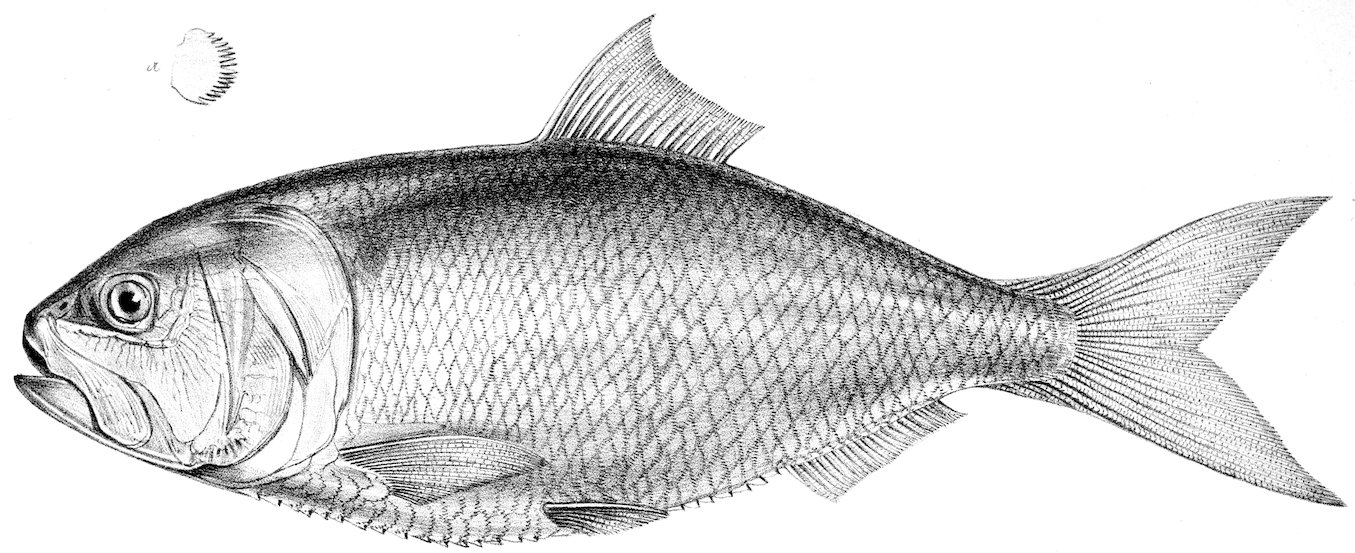
Fish. Pl. 25. From Nature on Stone by W. Hawkins. Alosa pectinata. ¾ Nat. Size. a Magnified Scale from nape.
135The commencement of the dorsal is very little anterior to a middle point between the end of the snout and the base of the middle caudal rays. The ventrals are beneath the posterior half of the dorsal as in the Pilchard. There are the same two elongated scales on each side of the caudal as in that species. The scales on the body, however, are much smaller than in the Pilchard, with their free portions striated, the basal portions marked with some irregular curved lines running in a transverse direction towards the median line of the scale.
D. 11; A. 18 or 19; C. 19, &c.; P. 18; V. 8.
Length 10 inches 6 lines.
Habitat, Lima, San Lorenzo Island.
Alosa pectinata. Jen.
Plate. XXV.
A. corpore ovali, altitudine prope tertiam partem longitudinis æquante: ventre carinato, serraturis, præsertim inter pinnas ventrales et analem, acutis: maxillis subæqualibus, edentulis: preoperculo venoso; operculo striato: squamis pectinatis: pinnis ventralibus paulo ante dorsalem exorientibus.
D. 16; A. 21; C. 19, &c.; P. 17; V. 7.
Long. unc. 12.
Form.—Of an oval compressed form, the depth very considerable, equalling very nearly one-third of the entire length. Head contained about three times and three quarters in the same. Abdomen sharply carinated, with strong serratures, especially between the ventrals and anal. Jaws nearly equal, perhaps the lower one a little the longest; intermaxillary deeply notched; no apparent teeth anywhere. Eyes rather high, partly covered both anteriorly and posteriorly by a membranaceous veil; their diameter about one-fifth the length of the head; more than one diameter between them and the end of the snout. Subopercle obliquely rounded off at bottom, but the curvature of the posterior margin of the opercle and subopercle taken together not very considerable. Preopercle marked with vein-like ramifications; opercle similarly veined, and also striated below, as in the species last described, though more finely. Scarce any trace of a lateral line.
Scales moderately large, thin and membranaceous. One from the middle of the side of a sub-oblong form, the hinder angles rounded, its length only two-thirds of its breadth; the greater portion of the surface marked with exceedingly delicate striæ, scarcely visible without a strong lens, the anterior margin pectinated, and with a slightly projecting lobe in the middle. The scales as they approach the tail, become longer in proportion to their breadth, the basal margin more rounded, and sometimes with a strongly projecting lobe in the middle. The pectinations are longest on the scales covering the nape.
The dorsal commences a little behind the middle point of the oval of the body, and the ventrals are attached a little in advance of that fin. The anal commences a little behind the termination of the dorsal, and reaches to the commencement of the fleshy part of the tail: the last ray in both dorsal and anal is slightly lengthened beyond the preceding ones. The pectorals 136reach to the ventrals, and are contained about once and two-thirds in the length of the head. Caudal deeply forked; the lower lobe a little longer than the upper one: the base appears to have been covered with minute scales. Above the pectorals is a thin membranaceous lanceolate scale, more than half the length of the fin: a somewhat similar scale in the axillæ of the ventrals, but shorter in proportion; another below those fins.
Colour.—“Body silvery: dorsal scales iridescent with green and copper: head greenish: tail yellow.”—D.
A second specimen agrees with the above in form, but is smaller, measuring only 7½ inches. The colours, when recent, according to Mr. Darwin’s notes, were as follows:—“Scales silvery iridescent; back especially greenish; caudal fin yellow: remarkable for a circular dark green patch behind the gill-cover.”—D.
Habitat, Bahia Blanca.
This species was caught by Mr. Darwin in the net, on a sandbank, at Bahia Blanca. It is well characterized by its strongly-pectinated scales, and does not appear to have been noticed by authors; though it would seem in that respect to have some affinity with the Clupea fimbriata of Bowdich.[40]
Engraulis ringens. Jen.
E. capite compresso, grandiusculo, quartam partem longitudinis totius æquante: rostro acuto, ultra maxillam superiorem mediocriter prominulo; mandibulâ angustâ, dentibus lateralibus (ut etiam in maxillâ) minimis: corpore compresso: pinnis ventralibus infra, vix ante, initium pinnæ dorsalis exorientibus: squamâ longissimâ membranaceâ super pinnam pectoralem retrorsum productâ.
D. 15; A. 19; C. 19, &c.; P. 16; V. 7.
Long. unc. 5.
Form.—Closely resembling the common Anchovy, but the head decidedly larger and longer, being one-fourth of the entire length.[41] Eye larger, but bearing an equal proportion to the size of the head; also rather nearer to the tip of the snout in consequence of this last not being so acute and much produced. Lower jaw rather narrower, from the greater compression of the head and body. Maxillary, and its fine serratures on the edges for teeth, similar.
The depth of the body is about one-sixth of the entire length. The dorsal commences at the middle point of the length, reckoning this last to the base of the caudal fork, and terminates a little before the commencement of the anal: the first ray is not half the length of the second and third, which equal three-fourths of the depth: the fifth and succeeding rays become gradually shorter than those which precede. The first ray in the anal is likewise very short, and scarcely one-third of the next following. The ventrals arise almost directly under the first ray of the dorsal, being scarcely at all in advance; when laid back, they do not reach half-way to the anal. Above the pectoral is a long membranaceous scale equalling, or very nearly, the fin itself.
137Colour.—Not noticed in the recent state. In spirits, it appears silvery, with the back and upper part of the sides deep dusky blue, the two colours separated by a well-defined line.
Habitat, Iquique, Peru.
This is probably an undescribed species of Engraulis; nor am I aware that authors have hitherto noticed any from the west coast of America. Mr. Darwin obtained two specimens which are precisely similar to each other. The species closely resembles the common European Anchovy,[42] differing principally in its larger head, and more backward ventrals in respect to the dorsal.
Family.—PLEURONECTIDÆ.
Mr. Darwin’s collection contains individuals of five species belonging to this family, besides the drawing of a sixth; but the specimens brought home are dry, and badly preserved. Two appear to have been previously noticed; but it is difficult to pronounce upon the other three with certainty, neither do they admit of being very accurately described. These last, therefore, I shall not venture to name, but merely point out a few of their principal characters, adding the localities whence they were obtained.
The species, of which there is a drawing, I conceive to be certainly new; and as its characters are very distinguishable, I shall name it in honour of the gentleman, one of the officers of the Beagle, by whom the drawing was made.
1. Platessa Orbignyana. Val.?
Platessa Orbignyana, Val. in D’Orb. Voy. dans l’Amer. Mérid. Atl. Ichth. Pl. 16. fig. 1.
Form.—Oval; greatest breadth two and a half times in the length. Eyes on the left side, near together, and equally in advance. Teeth in a single row, sharp-pointed, moderately strong, rather widely separate: posterior extremity of the maxillary cut nearly square. Dorsal commencing in a line with the eyes, and leaving a space between it and the caudal. The lateral line takes a sweep over the pectoral. Upper or eye side of the body slightly rough, with the scales finely ciliated; under side smooth, the scales on this side not ciliated.
Colour.—“Above dirty reddish brown; beneath faint blue: iris yellow.”—D.
Length 8 inches 9 lines.
Habitat, Bahia Blanca, where it is said to be plentiful.
This species agrees so well with the figure of the P. Orbignyana in D’Orbigny’s Voyage, that I have little hesitation in considering it the same,—but as 138no description of this last has been yet published, it is still possible I may be mistaken.
2. Platessa ——?
Form.—Very similar to the last species, from which it scarcely seems to differ, except in having the teeth smaller, and somewhat more numerous and closer together; also in the maxillary, which is more dilated at its posterior extremity, and more obliquely truncated. The scales are extremely similar.
Length 6 inches 6 lines.
Colour.—Not noticed.
Habitat, King George’s Sound, New Holland.
Hippoglossus Kingii. Jen. Plate XXVI.
H. fuscus: corpore ovato, lato: oculis sinistris, haud valde approximatis: dentibus acutis, fortioribus: lineâ laterali anticè arcuatâ: pinnâ dorsali supra oculos initium capienti, dimidio anteriore humillimo, posteriore modicè elevato: ventralibus distinctis, haud anali continuis: caudali subquadratâ, radiis mediis cæteris paululum longioribus.
D. 18 et 48; A. 51; C. 14; P. 11; V. 6.
Form.—Breadth, not including the dorsal and anal fins, half the length of the oval of the body. Eyes on the left side, apparently distant from each other about two diameters; the upper one a little behind the lower. Teeth sharp and strong, forming a very regular series. The lateral line takes a sweep over the pectoral fin. The dorsal commences above the upper eye; the first half, or until it gets above the extremity of the reclined pectoral, is very little elevated, and much lower than the rest of the fin, with the membrane apparently notched between the rays; the remainder of the fin attains a moderate elevation, and there is an abrupt transition from the former to the latter portion. The anal answers to the elevated portion of the dorsal: both these fins fall short of the caudal by a small space. Pectorals short, and of a somewhat triangular form. Ventrals very distinct, free, placed right and left, with the rays a little projecting beyond the membrane; which last character appears also in the dorsal and anal. Tail somewhat square, but the middle rays slightly projecting beyond the lateral ones in the form of an obtuse lobe.
Colour.—Represented in the drawing of a uniform light brown.
Habitat, Valparaiso.
This is the species of which, as before stated, no specimen was brought home, but only a coloured drawing made by Mr. Phillip King, an officer of the Beagle, for Capt. FitzRoy. The drawing appears to have been done with accuracy, and from it the above description has been taken. The fin-ray formula, however, was computed from the recent fish, the above numbers being marked upon the drawing.
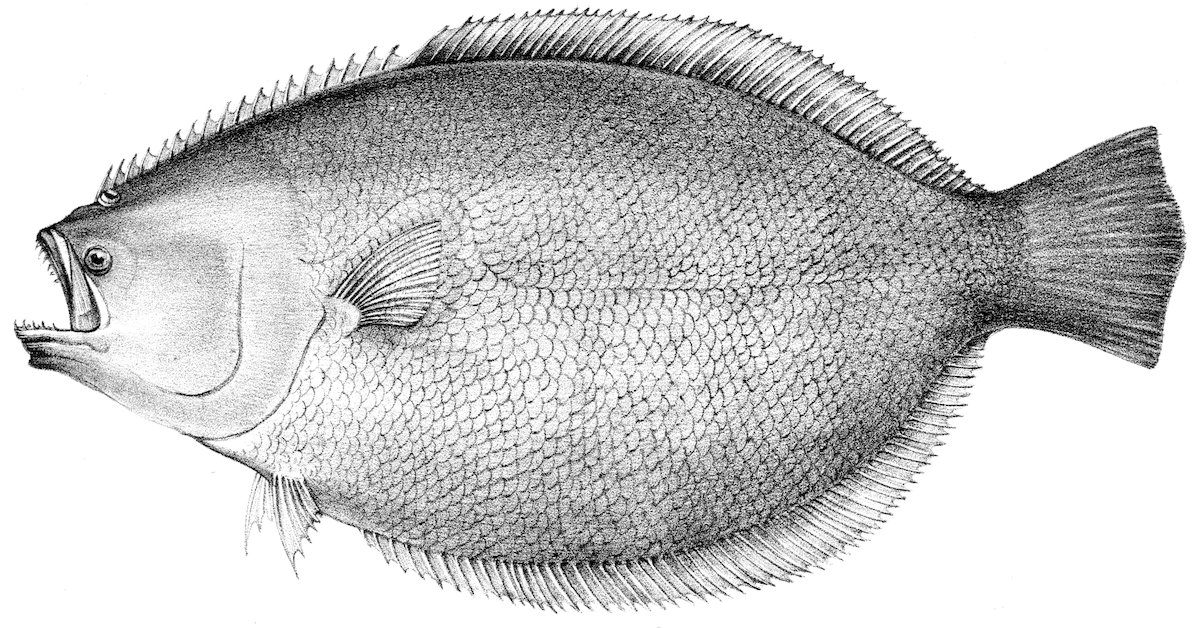
Fish. Pl. 26. from Nature by W. Hawkins Hippoglossus Kingii.
139The teeth appear to indicate this species as belonging to Hippoglossus rather than to Rhombus, though possibly it may be found hereafter to serve as the type of a distinct subgenus in this family. The form of the dorsal fin, if correctly delineated, is remarkable. The size of the fish is not stated.
Rhombus ——?
Form.—Oval, approaching to rhomboidal. Breadth a little exceeding half the length. Eyes on the right side, near together, equally in advance, or the lower one perhaps rather more forward than the upper; between them a double osseous ridge. On the under side of the head, and nearly answering in position to the upper eye, is a deepish cavity, from whence proceeds a tentaculiform appendage four or five lines in length. Teeth very small, sharp, in scarcely more than two rows, and apparently confined to the under side. Lateral line sweeping over the pectoral. Dorsal commencing above the upper lip, and reaching nearly to the caudal, but leaving a minute space. Both sides of the body are smooth, but the upper one appears to have lost its scales. Pectoral on the eye side about three-fourths the length of the head.
Length 5 inches.
Colour.—“Above pale purplish brown, with rounded darker markings.”—D.
Habitat, Bahia Blanca, Coast of Patagonia.
Achirus lineatus. D’Orbig.
Achirus lineatus, D’Orb. Voy. dans L’Amer. Mérid. Atl. Ichth. Pl. 16. fig. 2.
Form.—Body oval, but with the dorsal and anal fins included, approaching orbicular; the greatest breadth rather more than half the length. Eyes on the right side, moderately near together, the upper one a very little in advance. Lower jaw longest, projecting beyond the snout. Teeth forming a velutine band, very minute, and scarcely sensible except to the touch, confined to the side opposed to the eyes. Preopercle distinct from the opercle. A few short thread-like cirri on the under side of the head; two at the extremity of the snout being rather longer and more conspicuous than the others. Lateral line nearly straight throughout its course, somewhat higher at its commencement than afterwards, but taking no sweep. Both sides of the body rough, with ciliated scales, but the upper one most so. The dorsal commences above the upper lip, and reaches, as also the anal, almost quite to the caudal: this last rounded. Pectorals entirely wanting.
Length 9 inches.
Colour.—Not noticed.
Habitat, Rio Plata.
This species was obtained by Mr. Darwin in the market at Buenos Ayres, where it is said to be eaten. It so exactly accords in form with the figure of the A. lineatus in D’Orbigny’s Voyage, that I have little hesitation in considering it the same, though, from the specimen being dried, there are no vestiges left of the transverse lines. Whether it be the A. lineatus of any other author I am uncertain. 140It approaches, however, very closely the Passer lineis transversis notatus of Sloane.[43]
Plagusia ——?
Form.—Oval, but narrow, and much elongated for a Sole, the breadth in the middle being three and a half times in the length. Eyes on the left side, very small, and closely approximating, equally in advance, or if any difference, the lower one a little first. Mouth small, with velutine teeth on the supine side, but apparently none on the upper: snout a little produced in a point beyond it. The dorsal and anal unite with the caudal, which terminates in rather a fine point. No trace of any pectorals above or below. Scales strongly ciliated, especially above, and both sides of the body rough.
Length 7 inches.
Colour.—Not noticed.
Habitat, San Blas, Coast of Patagonia.
This species is very nearly allied to the Plagusia Braziliensis of Spix’s work,[44] but it appears to differ in having the eyes one over the other, or the lower one perhaps a little in advance, instead of the upper one a little before the lower.
Family.—CYCLOPTERIDÆ.
1. Gobiesox marmoratus. Jen.
Plate XXVII. Fig. 1.
G. dorso et lateribus pallidè fuscis, nigro reticulatis et fasciatis: dentibus anterioribus majoribus, in maxillâ superiore subconicis, in inferiore incisivis: operculo posticè mucrone obtuso armato: membranâ branchiali spinâ gracili, subduplici, (præter radios solitos,) instructâ, magnâ ex parte celatâ, apice exserto: pinnâ dorsali tredecim-radiatâ.
B. 6; D. 13; A. 11; C. 14 vel 15; P. 20 vel 21.
Long. unc. 2. lin. 7.
Form.—Head very large, broad and much depressed, with the snout rounded nearly in an exact semicircle. Body compressed behind, and suddenly tapering behind the pectorals. The length and breadth of the head are equal, each being one-third of the entire length, excluding caudal. Gape wide, reaching nearly to beneath the anterior angle of the eye. Teeth strong, and somewhat crowded in front; in the upper jaw bluntly conical, or slightly curved, but of irregular size, with minuter ones behind; very small at the sides of the jaw, and apparently here but in a single row: below, the six middle teeth are incisor-like, and project forwards; on each side of these are two or three similar to those in front above, then follow some minuter ones at the sides. Eyes rather more than a diameter apart. Gill-opening wide, the membrane free all round, with six rays. Opercle terminating behind in a blunt point: there is also a kind of double spine concealed in the thickness of the branchial membrane, in front of the ordinary branchial rays, the extreme end of one portion of which projects a little beyond the margin.
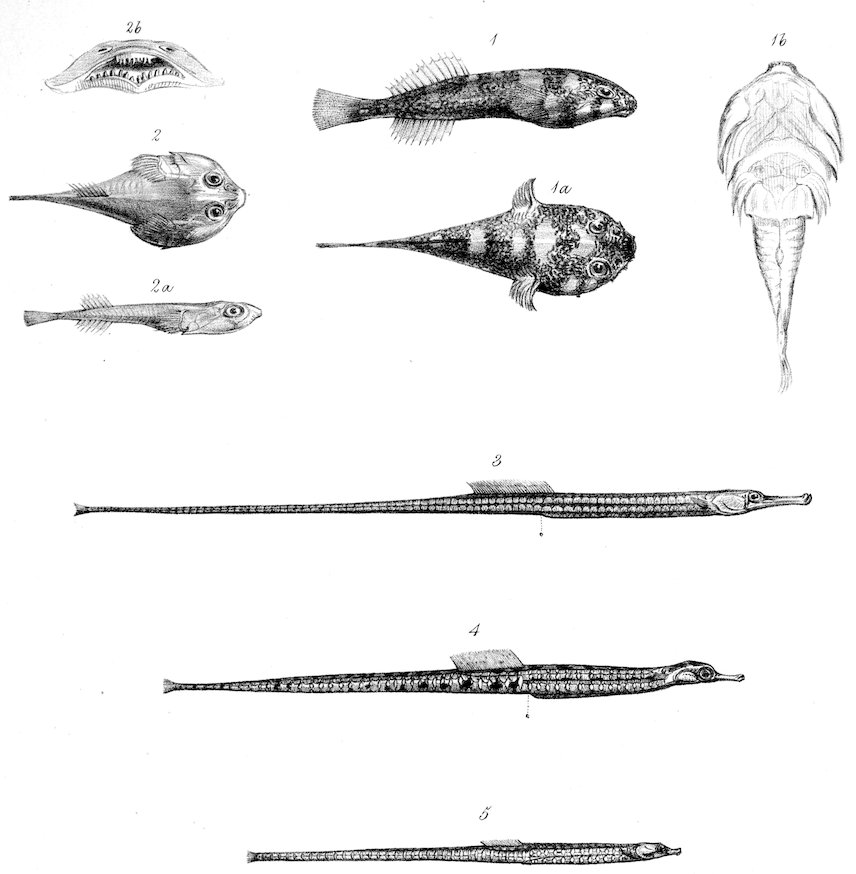
Fish. Pl. 27. From Nature on Stone by W. Hawkins.
1. Gobiesox marmoratus.
1a. „ „ Dorsal View.
1b. „ „ Under Side.
2. Gobiesox pœcilophthalmos.
2a. „ „ Lateral View.
2b. „ „ Magnified View of Teeth.
3. Syngnathus acicularis.
4. „ conspicillatus
5. „ crinitus.
All Nat. Size
141The dorsal commences a little beyond the middle of the entire length, and leaves a space between it and the caudal; the rays nearly equal, except the first, which is short. The anal begins under the fourth or fifth dorsal ray, and extends a trifle further than that fin. Caudal slightly rounded.
Colour.—(In spirits.) Back and sides light brown, reticulated with black: the reticulations have a tendency to form three or four broad fasciæ across the back. Under parts yellowish.
Habitat, Archipelago of Chiloe.
This and the following species appear to belong to the genus Gobiesox of Cuvier’s “Regne Animal,” and are probably new. Two specimens of the one above described were found by Mr. Darwin under stones off the island of Lemuy, in the Archipelago of Chiloe.
2. Gobiesox pœcilophthalmos. Jen. Plate XXVII. Fig. 2.
G. fuscescenti-albidas, immaculatus: dentibus anterioribus majoribus, supra et subtus incisivis: operculo posticè spinâ acutâ armato; membranâ, operculari margine, supra spinam, cirris paucis filamentosis fimbriato; membranâ branchiali spinâ nullâ,: pinnis dorsali et anali septem-radiatis.
B. 6; D. 7; A. 7; C. 12; P. 23;
Long. unc. 1. lin. 10.
Form.—General form the same as that of the last species, including the proportion of head to body. Snout equally rounded. Teeth on the whole similar, but the upper ones in front, as well as the lower, incisor-like. Eyes rather larger, closer together, less than a diameter apart. Differs essentially from the G. marmoratus in the form of the opercular spine, which is much sharper, as well as somewhat longer and slenderer; also in having no spine concealed in the branchial membrane: the lower part of the opercular membrane, just above the spine, is fringed with a few thread-like filaments. The number of branchial rays is the same.
The dorsal and anal are both shorter, and appear to have only seven rays each: the anal reaches a little nearer the caudal. The pectorals on the contrary have rather more rays.
Colour.—(In spirits.) Every where of a uniform very pale brown, or brownish white, without any markings whatever. The eyes were probably very brilliant in the living fish, the irides still showing traces of what seems to have been blue and golden pink.
Habitat, Galapagos Archipelago.
A single individual of this species was obtained by Mr. Darwin in tidal pools at Chatham Island, in the Galapagos Archipelago.
142
Family.—ECHENEIDIDÆ.
Echeneis Remora. Linn.
Mr. Darwin took a small specimen of this fish from off a shark in the Atlantic Ocean, near St. Paul’s Rocks. It is not four inches long. It has eighteen pairs of laminæ on the head; and a rough disk on the middle of the tongue:[45] caudal lunate.
Family.—ANGUILLIDÆ.
Anguilla australis. Richards.
Anguilla australis, Richardson, Proceed. of Zool. Soc. 1841, p. 22.
Form.—Very similar to the A. latirostris, Yarr., but the upper jaw rather shorter and broader, making the gape, which reaches to a vertical line from the posterior part of the orbit, wider. Teeth rather stronger. Dorsal commencing considerably beyond the first third, and not much in advance of the middle point, of the entire length; much less elevated than in the A. latirostris, its height scarcely exceeding one-fifth of the depth, which last is about one-seventeenth of the entire length. Vent a little posterior to the commencement of the dorsal.
The distance from the end of the snout to the insertion of the pectorals is rather less than one-eighth of the entire length: the form of the pectorals is lanceolate. The tail is rounded, much as in the A. latirostris.
in. lin.
Length (entire) 17 3
From end of snout to commencement of dorsal 7 6
From the same to insertion of pectoral 2 2
From the same to vent 7 9
Colour—(In spirits.) Appears similar to that of the common eel.
Habitat, New Zealand.
The above eel was procured by Mr. Darwin in fresh water in the month of December, in the Bay of Islands, New Zealand. It so nearly accords with the A. australis of Dr. Richardson from Van Dieman’s Land, that I can hardly suppose it to be a distinct species. The vent, however, would seem to be a trifle backwarder, and the body deeper in proportion to its length. Without seeing more specimens, it is impossible to say what importance is to be attached to these points of discrepancy.