APPENDIX.
Reading edition
The following Appendix contains descriptions of a few species, which were omitted to be noticed in their proper places; and further remarks with respect to some, which will be found in the body of the work.
Family.—PERCIDÆ.
1. Aphritis undulatus. Jen.
Plate XXIX. fig. 1.
A. elongatus: lateribus supra pallide olivaceis, fasciis transversis abbreviatis, lineisque longitudinaliter undantibus, nigris; lateribus infra argenteis: pinnis dorsalibus et caudali punctatis; pinnis, reliquis, et lineâ laterali, albidis.
B. 6; D. 8—25; A. 1/22; C. 14, et 6 brevioribus; P. 22; V. 1/5.
Long. unc. 3. lin. 1.
Form.—Elongated; the depth about one-sixth of the entire length; the thickness two-thirds of the depth. depth. Head four and a half times in the length. Profile falling very gradually at first, but more rapidly in advance of the eyes, causing the snout to appear rather obtuse. Mouth small: maxillary slender, hardly reaching to a vertical line from the anterior margin of the orbit: upper jaw slightly longer than the lower, and very protractile. Teeth very minute, forming a narrow velutine band: a patch on the chevron of the vomer scarcely visible, but capable of being very distinctly felt; none apparent on the palatines. Eye one-fourth the length of the head, and distant one diameter from the end of the snout; the interocular space rather less than the diameter. Snout slightly indented, or furrowed out in front of the eyes. A series of impressions on the lower jaw, and along the limb of the preopercle, but much less obvious than in the next species, and not distinctly porous. Preopercle with the ascending margin vertical, the angle at bottom rounded; the limb broad and distinctly marked, with the boundary line between it and the cheek slightly elevated into a ridge. The opercle, with its membrane, produced backwards in an angle, the subopercle being visible beneath. The branchial membrane six-rayed, and fastened to the isthmus underneath, the aperture commencing beneath the ascending margin of the preopercle.
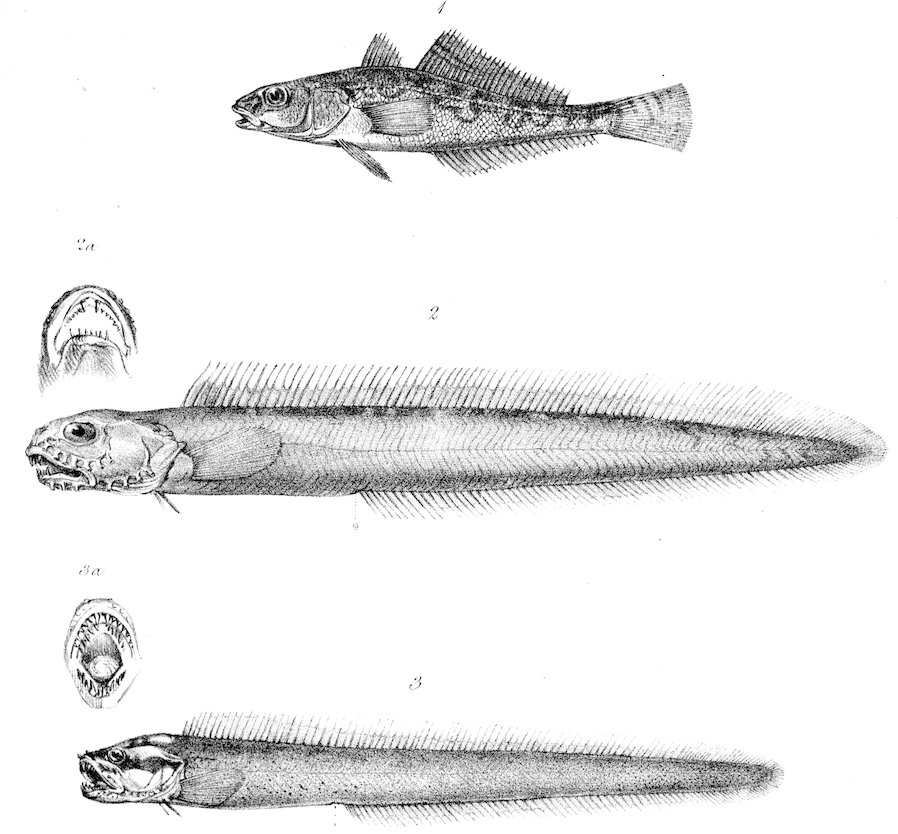
Fish Pl. 29 Appendix. Waterhouse Hawkins del.
1. Aphritis undulatus. Nat. Size.
2. Iluocœtes fimbriatus.
2a. „ Magnified View of Teeth.
3. Phucocœtes latitans.
3a. „ „ Teeth.
161Lateral line commencing at the upper angle of the gill-opening, and following the curvature of the back at one-fourth of the depth, and preserving this direction throughout its course, not falling to the middle before losing itself in the caudal. Scales small, covering the whole head and body, except the snout in front of the eyes, the jaws, and the limb of the preopercle. The free portion of each scale marked with several small concentric circles, the free edge finely ciliated: the basal portion with a fan of seven striæ, and the spaces between these deeper striæ with minuter striæ running transversely: the basal margin cut square.
Pectorals attached rather low down, and a little posterior to the terminating angle of the opercle; their length about three-fourths that of the head: the fourth to the eighth rays longest; the first ray only half the length of the second; the first two, and the last three or four, simple; the rest branched. Ventrals about four-fifths the length of the pectorals, and in advance of those fins by nearly half their own length; their spine very distinct. First dorsal short, commencing immediately above the insertion of the pectoral: all the spines very slender, with the intervening membrane delicate; the second longest, equalling about half the depth; the third and following ones gradually decreasing. Second dorsal long, separated from the first by a very small interval, and occupying a space just equal to the distance between its commencement and the end of the snout: the rays gradually decreasing in length from the anterior ones, which equal three-fourths of the depth; all simple, or if branched, only so at their extreme tips. The interval between the second dorsal and the caudal contained eight and a half times in the entire length. Anal commencing under the sixth ray of the second dorsal, or exactly at the middle point of the entire length, caudal excluded; extending a trifle beyond the second dorsal, but in other respects answering to that fin. Caudal square when spread, but very slightly notched when the rays are close; contained six and a half times in the entire length; the principal rays branched.
Colour.—(In spirits.) Back and upper half of the sides pale olivaceous, with about seven or eight abbreviated, transverse, dusky fasciæ; beneath these are two irregular lines undulating longitudinally in a zig-zag manner, and having rather a tendency to meet at the angles, so as to form a connected longitudinal chain of diamond-shaped links. Lower portion of the sides and abdomen silvery. Tubal pores of the lateral line white, making this line very evident. Dorsal and caudal fins speckled with small dusky spots and points. Pectorals, ventrals, and anal, quite plain, and whitish.
A second specimen in the collection exactly resembles the above, except in being not quite so large, and in having a ray less in each of the two dorsal fins.
Habitat, Chonos Archipelago, W. coast of S. America.
The genus Aphritis was first established by M. Valenciennes, in the appendix to the eighth volume of the “Histoire des Poissons,” for the reception of a small Percoid fish obtained by MM. Quoy and Gaimard in Van Dieman’s Land, inhabiting fresh-water. The species above described, which was taken by Mr. Darwin in Lowe’s Harbour, South of Chiloe, appears to be referable to the same genus. It differs, however, in many respects from the A. Urvillii, the only one which Valenciennes has noticed. The relative situation of the first dorsal with respect to the pectorals, and of the anal with respect to the second dorsal, is different: there are fewer rays in the anal, and more in the second dorsal: the upper, instead of the lower jaw, as represented in Valenciennes’s figure, is 162rather the longest; neither can I discern any teeth on the palatines, though there is a patch of very minute ones in front of the vomer.
That this species really belongs to Aphritis, would seem indicated not merely by the aggregate of its external characters, but by the internal structure also, which was examined in one of the two specimens brought home by Mr. Darwin, and found conformable to what is stated by Valenciennes, in this respect, of the A. Urvillii. The stomach is large, with four very distinct cœcal appendages, and there is no air-bladder.
The A. undulatus, which I have so named in reference to the undulating longitudinal lines on the sides, is very Cypriniform in general appearance, and not altogether unlike the common minnow, Cyprinus Phoxinus.
2. Aphritis porosus. Jen.
A. brevior: pallide olivaceus, lateribus fasciis transversis obsoletis nigricantibus; pinnis omnibus brunneis: maxillâ inferiore, et limbo preoperculi, poris conspicuis circiter novem, suborbitalibus circiter quinque, seriatim dispositis.
D. 8—25; A. 1/22; C. 14, &c.; P. 23; V. 1/5.
Long. unc. 2. lin. 5.
Form.—Not so much elongated as the last species: the depth rather more than one-sixth of the entire length, and the head only four times in the same. Also distinguished by a row of large mucous pores on the lower jaw, passing upwards posteriorly, and continued along the limb of the preopercle: the number of these pores on each side is nine or ten: a row of similar pores, amounting to about five, passes backwards from a little above the end of the maxillary beneath each eye. In other respects, the form is similar to that of the last species, excepting that the interval between the second dorsal and the caudal is only one-eighth of the entire length, in consequence of the body being less elongated.
Colour.—(In spirits.) Back and upper half of the sides, olivaceous brown; beneath silvery. No very obvious markings; but traces may be seen of six or seven transverse dusky fasciæ, reaching from the back to a little beneath the lateral line, which were probably more distinct in the recent state. All the fins brownish; the dorsal a little powdered with dusky specks. The fourth and fifth rays of the ventrals are white, and appear to have been always of a different colour from the rest of the fin.
Habitat, Coast of Patagonia.
This appears to be another new species of Aphritis, taken by Mr. Darwin on mud-banks, in Port Desire, central Patagonia. It is very closely allied to the A. undulatus, but, I conceive, certainly distinct. There is but one specimen in the collection.
163
Family.—SCORPÆNIDÆ.
Apistus ——?
Mr. Darwin’s collection contains a species of this genus procured in King George’s Sound, New Holland, which, from the bad state of preservation of the specimen, it is scarcely possible to identify with certainty. Possibly it may be new, as it does not seem to accord very exactly with any of those described in the “Histoire des Poissons;” but I shall not consider it such, nor do more than point out a few of its more obvious characters.
It is not determinable, whether it was originally one of the naked species of this genus, or whether the scales have been rubbed off, but probably the former. The suborbital and preopercular spines are strong, and considerably developed: the former reaches back further than the maxillary, and nearly to the posterior part of the orbit, and has another very small spine at its base. The lower jaw advances beyond the upper. The head is about one-third of the entire length. The eyes are large, their diameter being contained about three and a half times in the length of the head. The dorsal commences in a line with the ascending margin of the preopercle. The first spine is half the length of the second; the second is a little shorter than the third, which is longest, and equals two-thirds of the depth of the body; the fourth and succeeding ones decrease very gradually; the soft portion of this fin is a little higher than the hinder part of the spinous. The first anal spine is rather more than half the length of the second, which is the strongest of the three, though not much longer than the third. The pectorals are rather pointed, and a little shorter than the head. The ventrals are attached a little behind the pectorals, and are not very much shorter than those fins.
The following is the fin-ray formula:
D. 13/9; A. 3/6; C. 11, &c.; P. 11; V. 1/5.
Length 4 inches 6 lines.
The species to which this approaches nearest would seem to be the A. niger of Cuvier and Valenciennes; but there is no appearance of the small elevations on the skin resembling hairs, which those authors mention in their description of this last, and, on the whole, I am inclined to consider it as distinct.
Agriopus hispidus. p. 38.
Notwithstanding what I have advanced in regard to this species, further consideration has inclined me to suspect, that it may prove ultimately only the young of the A. Peruvianus. In that case, however, it would appear that the absence of vomerine teeth can only be assigned as a character of this genus in the adult state.
164
Family.—SCIÆNIDÆ.
Otolithus analis. Jen.
This new species of Otolithus is from Callao: it was omitted to be noticed in the body of the work. There is but one specimen in the collection, in bad condition, and not admitting of a very detailed description: but it is evidently distinct from all the species described by Cuvier and Valenciennes.
It is rather more elongated than the O. Guatucupa, the depth being not much more than one-fifth of the entire length. The head is long, and contained three and a half times in the same. The lower jaw is considerably the longest. The teeth above are small, and sharp-pointed, apparently in two rows, the outer row being a little stronger than the inner: there are two very strong canines in front, springing from between the rows. Below, the teeth are in two rows in front, and one at the sides; those in front small, but those at the sides unequally sized, three or four, standing at intervals, being much stronger than the others, and very sharp. Diameter of the eye about one-sixth the length of the head; its distance from the end of the snout one diameter and a half.
The lateral line is continued to the extremity of the caudal, between the ninth and tenth rays. There is a small interval between the two dorsal fins. The second dorsal, as well as the anal, are longer than in the O. Guatucupa, with more soft rays, especially the anal. The pectorals are narrow and pointed, and between one-half and two-thirds the length of the head. The ventrals are attached almost exactly beneath the pectorals. The caudal appears to have been square.
D. 9—1/24; A. 1/16; P. 17; V. 1/5.
Length 12 inches.
Colour.—The colours were not noticed when recent, and can hardly be judged of now. The general tint appears to have been silvery. If there were any markings, no traces of them remain.
Habitat, Callao, Peru.
This species has a longer anal than any of the American species described by Cuvier and Valenciennes. I have in consequence named it analis.
Prionodes fasciatus. p. 47.
It has been suggested that this may be nothing more than a monstrosity. Whether this be really the fact or not, can only be determined by the examination of more specimens. But in either case, I am so satisfied now of its being a Serranus in all its essential characters, that I conceive it never can be placed in a different family from that genus. If the fact be established of its never possessing vomerine and palatine teeth, such a character can, at the very utmost, serve only to distinguish it as a subgenus in that group. But every day is bringing more and more to light the small value of that character.
165
Stegastes imbricatus. p. 63.
I am informed by Mr. Lowe, of Madeira, that this is the same as the Glyphisodon luridus of Cuvier and Valenciennes.[50] Their description is so short, that I failed to recognize it; and I was induced to consider it as a new genus from the circumstance of its possessing vomerine teeth. Whether these teeth exist in any other species, or have only been presumed absent in all, because not found in some, I am not aware. But here again we see how little such a character is to be depended upon.
Family.—BLENNIDÆ.
Mr. Darwin’s collection contains two new forms from South America, closely allied to each other, yet forming distinct genera, and which will not enter into any of those described by authors. At first it was conceived that they were Malacopterygian fishes, more especially from their having all the rays in the dorsal and anal fins articulated; and to belong to the Apodal division of that group, from their being supposed to be without ventrals; but, on a closer inspection, the ventrals, which are very small, were found to have been overlooked, and it was evident altogether that the true place of these fishes in the system was amongst the Blennidæ. The mention of this circumstance will explain why they were omitted to be noticed in their proper place.
These two genera, so far as can be judged from the situations in which Mr. Darwin obtained them, have the same habits as the Blennies, lurking under stones and weeds; and I propose to give them respectively the names of Iluocœtes and Phucocœtes.
Genus.—ILUOCŒTES.[51] Jen.
Corpus elongatum, antice subcylindricum, postice compressum, ensiforme, læve, nudum, alepidotum. Rostrum breve, obtusum, rotundatum, ultrà maxillam inferiorem productum. Dentes acuti, subconici, in utrâque maxillâ uniseriati: supra canini duo fortes, curvati, antici, et præ serie exstantes: in vomere dentes pauci acuti aggregati; in utroque palatino uniseriati. Lingua lævis. Oculi grandes, prominuli. Apertura branchialis mediocriter fissa, membranâ quinque-radiatâ. Maxillæ, os suborbitale, et præoperculum, tubiporis cutaneis brevibus ad margines fimbriatæ. Pinnæ ventrales jugulares, minutæ, gracilissimæ, triradiatæ. Pinnæ dorsalis et analis prælongæ, caudali coalescentes, radiis omnibus articulatis.
If I am right in placing this new genus amongst the Blennidæ, it will evidently take its place next to Zoarces, to which it is more nearly allied than to any other 166group in that family. It agrees especially with Zoarces, not only in general form, but in having all the dorsal and anal rays articulated, (excepting one in the dorsal, which possibly may be an accident in the only specimen examined,) and in having the ventral fins extremely small. On the other hand, it departs from that genus, in having the body entirely naked, and free from scales; in the two remarkable canines in front of the upper jaw, and in having teeth on the palate; also in having no notch at the posterior part of the dorsal. It is further remarkable for its large prominent eyes, and the rows of tubipores on the cheeks. Amongst the true Malacopterygians, it approaches nearest to Ophidium, and, but for the circumstance of its possessing ventrals, it might perhaps be ranged under that genus. It is, however, evidently a connecting link between the Apodal Malacopterygians and the Blennidæ.
Like the Blennies, this genus has neither cæcal appendages nor air-bladder. The intestinal canal is rather ample, with a few coils, but of tolerably equal dimensions throughout.
There is but one species of this new genus in the collection, which is from the Archipelago of Chiloe. The detailed description of it is as follows:—
Iluocœtes fimbriatus. Jen.
Plate XXIX. Fig. 2.
Form.—Very much elongated, subcylindric anteriorly, compressed and ensiform behind. Greatest depth in the region of the pectorals, and about one-tenth of the entire length. Head, measured to the extreme point of the gill-cover, five and a half times in the same. The head is rather larger than any part of the body, its depth and thickness being equal, and each a trifle less than the depth of the body. Crown and forehead a little flattened, whence the profile descends in a curve before the eyes. Snout blunt and rounded, projecting, both in front and at the sides, beyond the lower jaw. Gape wide, and reaching to beneath the middle of the eye. Intermaxillary somewhat protractile at the sides, but not in front; shorter than the maxillary, with a considerable intervention of membrane between the extremities of the two bones, which are not united posteriorly, excepting by the membrane just mentioned. Maxillary long, rather slender, of nearly uniform breadth and thickness throughout, retiring in part beneath the suborbital, and reaching backwards to a vertical from the posterior part of the orbit. Intermaxillary with a single row of small, pointed, subconical, slightly curved teeth; in front of these, and quite at the anterior extremity of the jaw, two strong, hooked, regular canines:[52] the teeth in the row rather wide asunder, and set a little irregularly, about thirty in number. In the lower jaw, teeth few in number, scarcely more than eight or ten in front, rather stronger than the intermaxillary series, followed by a moderate canine on each side, these last smaller than the ones above: at the sides of the lower jaw, beyond the canines, scarcely more than one or two small teeth (possibly others are fallen). A small cluster of three or four teeth on the fore part of the vomer, like those in front of the lower jaw, and a 167row on each palatine. Pharynx also armed with strong teeth; but the tongue, which is free at the tip, and rounded, smooth. Eyes large and prominent, and elevated rather above the line of the profile: their diameter one-fourth the length of the head; their distance from the end of the snout one diameter; the interocular space reduced to a narrow channel, and scarcely equalling half a diameter.
Opercle of a triangular form; subopercle lanceolate, projecting further than the opercle, and passing upwards and backwards to form the terminating angle of the gill-cover. Gill-opening of very moderate extent; the branchial membrane fastened down underneath, with five rays. Skin smooth and naked, loose, and probably very mucous in the living fish. Apparently no lateral line. The edges of both jaws curiously fringed each with a row of tubipores, or cutaneous appendages in the form of tubes, having pores at their terminal extremities for the exudation of mucus. The row on the upper jaw is continued along the margin of the suborbital on to the cheek; that on the lower is carried upwards to form an edging to the preopercle. There is also one of these tubipores at each nostril, another behind each eye, and a third on each side of the nape.
The dorsal commences above the terminating angle of the gill-cover, and extends the whole length of the body: its height nearly uniform throughout, equalling half the depth: the rays slender; all articulated, except the third, which is spinous, and shorter than those which precede and follow it; mostly simple, but some of the posterior ones slightly divided at their tips. Vent situate beneath the termination of the first quarter of the dorsal. The anal begins immediately behind it, and, like the dorsal, is carried on to the end of the body, to unite with it in forming a pointed caudal; all the rays soft and delicate. Pectorals rather pointed, with the middle rays longest, and about two-thirds the length of the head. Ventrals very minute and narrow, of only three rays, and appearing like one filament, about one-third the length of the pectorals; attached in front of the pectorals, and nearly in a line with the gill-opening.
B. 5; D. about 80; A. about 60; C. about 15; P. 16; V. 3.
Length 5 inc. 9 lin.
Colour.—Not noticed in the recent state. In spirits it is nearly colourless, with the exception of a dark bluish line along the base of the dorsal; upper part of the head, and nape, also stained with the same dark tint.
Habitat, Archipelago of Chiloe.
This species was taken by Mr. Darwin under stones. There is but one specimen in the collection, and it would be very desirable to see others, in order to ascertain whether the circumstance of the third dorsal ray alone being spinous, (those that precede as well as follow being articulated), is merely accidental in the one above described, or really characteristic of the species. If the latter, it is an anomaly,—a single spine thus occurring in the middle of a soft fin,—of which I know no other example.
168
Genus.—PHUCOCŒTES.[53] Jen.
Corpus elongatum, compressum, nudum, alepidotum, porosissimum. Rostrum breve, obtusum. Dentes acuti, subconici, in maxillâ superiore uniseriati, in inferiore bi-vel tri-seriati; supra canini duo fortiores, antici, et præ serie exstantes: in vomere dentes duo vel tres acuti, quorum unus fortis; in utroque palatino uniseriati. Lingua lævis. Oculi parvi. Apertura branchialis arctissima, membranâ sex-radiatâ. Maxillarum margines poris conspicuis longitudinaliter dispositis, simplicibus, haud in tubos productis. Pinnæ ventrales, dorsalis et analis, ut in genere præcedenti.
This genus differs from Iluocœtes, in having the head and eyes smaller, the snout scarcely at all produced, the teeth in front of the lower jaw in two or three rows, and especially in the contracted gill-opening, which is reduced to a small hole, relatively not much larger than in the Eels, and in the branchial membrane having six rays. It wants also the tubal cutaneous appendages on the jaws and cheeks, in the place of which are rows of simple pores. It may be added that the whole skin is every where studded with pores; smaller, however, than those which form the maxillary series. The fins are similar, including the minute ventrals; but the tail and caudal are more rounded, and the membrane investing the rays of the dorsal and anal is more fleshy, so as hardly to allow of the rays being counted.
This genus is yet more eel-like, and more malacopterygian in general appearance than the last, serving to make the passage from the Blennidæ to the apodal division of the soft-finned fishes, still more gradual and evident. Mr. Darwin obtained it at the Falkland Islands. There is but one species in the collection referable to it.
Phucocœtes latitans. Jen.
Plate XXIX. Fig. 3.
Form.—Still more elongated than the Iluocœtes fimbriatus, but not tapering so much to a point posteriorly, the tail being blunter and more rounded. Greatest depth about one-eleventh of the entire length: head one-seventh. Head more compressed, its thickness being only three-fourths of its depth. Nape rather more elevated, and the profile more sloping, its descent commencing at a more backward point. Snout equally short and rounded, but much less projecting over the lower jaw. Gape, intermaxillary, and maxillary, similar: also the teeth; only the pair of canines above, standing in front of the series, are smaller; and below, the teeth in front are in two or more rows. On the fore part of the vomer is one strong tooth, and apparently one or two other smaller teeth with it; on each palatine a row, one or two of the anterior ones being stronger than the others. Eyes very much smaller; their diameter scarcely more than one-seventh the length of the head; not sufficiently high in the cheeks to cut the line of the profile: interocular space slightly convex.
169Pieces of the gill-cover on the whole similar, but the branchial aperture much smaller, the fissure not descending below the level of the upper part of the pectoral: branchial membrane with six rays. Skin quite naked, and thickly studded all over with mucous pores. Also some very large and conspicuous pores in rows on the jaws and cheeks, but not elevated into cutaneous tubes, excepting the nostrils, which are tubular.
Dorsal and anal with all the rays articulated, and the greater part of them simple, but some toward the tail a little branched at their tips. Caudal not so pointed as in Iluocœtes. Pectorals and ventrals similar, but the latter a trifle longer and broader in proportion.
Length 4 inc. 7 lines.
Colour.—(In spirits.)—Brown, with the jaws, under part of the head, and lower half of the cheeks, whitish; also a whitish fascia extending longitudinally from behind each eye to the upper angle of the opercle.
A second specimen in the collection is smaller than the above, measuring only two inches and a half in length. It is in bad condition, but does not appear to differ, except in having the anterior canines above but very little developed.
Habitat, Falkland Islands.
Both individuals of this species were taken by Mr. Darwin in the Falkland Islands. “Caught amongst kelp.”—D.
170