Family.—FRINGILLIDÆ.
Reading edition
Sub-Fam.—ALAUDINÆ.
Melanocorypha cinctura. Gould.
M. Fæm. fuscescenti rufa; gulâ abdomineque medio pallidioribus; remigibus ad apicem nigrescenti fuscis; rectricibus singulis maculâ albâ ovatâ nigrescenti fuscâ ad apicem notatis.
Long. tot. 5¾ unc.; alæ, 3¼; caudæ, 2¼; tarsi, ¾; rost. ½.
The whole of the plumage, bill, and feet, sandy rufous brown, which is lightest on the throat and centre of the abdomen; primaries near their extremities passing into blackish brown; and each of the tail feathers with a large oval spot of blackish brown near the tip.
Habitat, St. Jago, Cape Verde Islands. (September.)
This bird inhabits the most arid plains of lava; it runs, and in its habits resembles, in many respects, a lark.
Pyrrhalauda nigriceps. Gould.
P. supra fuscescenti albâ, plumis medio obscurioribus; fronte, genis lineâque pectoris utrinque albis; corpore infra lineâque à basi rostri supra oculos ad occiput transiente nigris; caudæ plumis mediis nigrescentibus fuscescenti albo marginatis, plumis externis atris.
Long. tot. 4⅝ unc.; alæ, 2⅞; caudæ, 1⅝; tarsi, ⁶⁄₁₀; rost. ⁴⁄₁₀.
Upper surface brownish white, with the middle of the feathers darker; the front, cheeks, and a line on each side of the breast white; beneath the body, and a line from the bill passing over the eyes to the hind head, black; the tail with the middle feathers blackish, margined with brownish white, the outer feathers deep black; the bill and feet pale.
88Habitat, St. Jago, Cape Verde Islands. (September and January.)
Like the last species, this bird inhabits sterile lava plains; it runs like a lark, and generally goes in small flocks.
Sub-Fam.—PYRRHULINÆ.
Spermophila nigrogularis. Gould.
S. capite corporeque supra, alis caudâque fusco cinereis; loris gulâque nigris; lineis à rostri angulis per collum utrinque descendentibus, pectore abdomineque mediis, tegminibusque caudalibus inferioribus cinereo albis.
Fem.? supra olivaceo fusca, subtus pallidior.
Long. tot. 3 unc.; alæ, 2¼; caudæ, 2; tarsi, ⅝; rostri, ⁵⁄₁₆.
Male.—Head, all the upper surface, wings and tail, brownish grey; lores and throat black; lines from the angle of the bill down each side of the neck, centre of the chest and abdomen, and the under tail coverts greyish white; bill light horn colour; feet dark brown.
Female?—The whole of the plumage olive brown above, and lighter beneath; bill and feet brown.
Habitat, Monte Video. (November.)
1. Crithagra? brasiliensis.
Fringilla Brasiliensis, Spix, Av. Sp. Nov. ii. t. lxi. f. 1. m. 2. fem. p. 47.
My specimens were obtained from the northern bank of the Plata, in the months of June and November.
2. Crithagra? brevirostris. Gould.
C. vertice dorsoque pallidè olivaceo fuscis, plumis singulis striâ angustâ mediâ nigro-fuscâ, pennis scapularibus alis caudâque nigro-fuscis cinereo olivaceo latè marginatis; uropygio virescenti flavo; loris, gulâ, pectore humero infra, abdomine, tegminibusque caudæ inferioribus latè flavis.
Long. tot. 5 unc.; rostri, ⁷⁄₁₆; alæ, 2⅞; caudæ, 2¼; tarsi, ⅝.
Crown of the head and back, light olive brown, with a narrow stripe of blackish brown in the centre of each feather; scapularies, wings and tail, blackish brown, broadly margined with greyish olive; rump greenish yellow; lores, 89throat, chest, under surface of the shoulders, abdomen, and under tail-coverts bright yellow: bill and feet brown.
Habitat, Maldonado (May), and Valparaiso (September).
Near Maldonado, I saw very large flocks of this species feeding on the open grassy plains. When the whole flock rises, these birds utter a low but shrill chirp. In Chile I obtained only one specimen.
Sub-Fam.—EMBERIZINÆ.
1. Emberiza gubernatrix. Temm.
Emberiza gubernatrix, Temm., Pl. Col. 63 & 64.
—— cristata, Swains, Zool. Ill. pl. 148.
—— cristatella, Vieill. Gal. des Ois. pl. 67.
Yellow crested grosbeak, Lath. Hist.
La huppe jaune, Azara, No. 129.
My specimen was procured on the banks of the Parana, near Santa Fe, in latitude 31° S.
2. Emberiza luteoventris. G. R. Gray.
Fringilla luteoventris, Meyen, Nov. Act. 1880, pl. 12. f. 3.
This bird was procured at Santa Cruz, in Southern Patagonia; it was rare there.
Chrysometris campestris. Gould.
Fringilla campestris, Spix, Avium Nov. Sp. ii. p. 47, pl. 59. f. 3. ♀
C. Mas: olivaceous; dorsi plumis singulis flavo marginatis, uropygii præsertim; vertice, gulâ, alis caudâque nigris, alis caudâque plus minusve flavo-marginatis; capitis lateribus corporeque infra latè flavis.
Long. tot. 4 unc.; 11 lin.; rost. 5 lin.; alæ, 2¾; caudæ, 2¼; tarsi, 7 lin.
Male; olivaceous, with each feather of the back margined with yellow, especially on the rump; the top of the head, throat, wings and tail, black, the two latter margined more or less with yellow; the sides of the head and beneath the body bright yellow.
Habitat, forests of Tierra del Fuego (February), Valparaiso (September).
90
Sub-Fam.—FRINGILLINÆ.
1. Ammodramus longicaudatus. Gould.
Plate XXIX.
A. vertice humeroque cinereo-fuscis, dorso pallescenti fusco, uropygio rufescenti-fusco tincto, plumis singulis strigâ mediâ fuscâ; tectricibus alarum majoribus, remigibus primariis secundariisque et caudâ nigrescentibus, cinereo albo externe marginatis; fronte, strigâ superciliari corporeque infra flavescentibus.
Long. tot. 5¾ unc.; alæ, 2⅜; caudæ, 3; tarsi, ¾; rostri, ⁹⁄₁₆.
Crown of the head and shoulder, greyish brown; back, light brown, tinged with reddish brown on the rump, and with a stripe of dark brown down the centre of each feather; greater wing-coverts, primaries, secondaries, and tail blackish, margined externally with greyish white; forehead, stripe over the eye, and all the under surface, buff; bill black; feet brown. Young, or a bird after gaining its new plumage, differs in having the whole of the upper surface rich brown, with a tinge of olive and with a stripe of dark brown down each feather, and in having the wing coverts margined with reddish instead of greyish brown.
Habitat, Monte Video (November), Maldonado (June).
At Maldonado this bird frequented, in small flocks, reeds and other aquatic plants bordering lakes. In general habits, as well as in place of resort, it resembles those species of Synallaxis and Limnornis, with which it is often associated. It appears to live entirely on insects, and I found in the stomach of one which I opened various minute Coleoptera. Mr. Gould remarks, that the structure of this Ammodramus is very remarkable, for that it has a great general resemblance both in form and colouring to Synallaxis, although the thickness of its bill shows its relation to the Fringillinæ. In its habits it certainly is more allied to the former genus, than to its own family.
2. Ammodramus Manimbe. G. R. Gray.
Plate XXX.
Ammodramus xanthornus, in Plate, and in Gould’s MS.
Fringilla Manimbè, Licht., Cat. No. 253.
Emberiza Manimbè, D’Orb. & Lafr., Syn. p. 77.
Manimbè, Azara, No. 141.
My specimen was obtained from Maldonado.
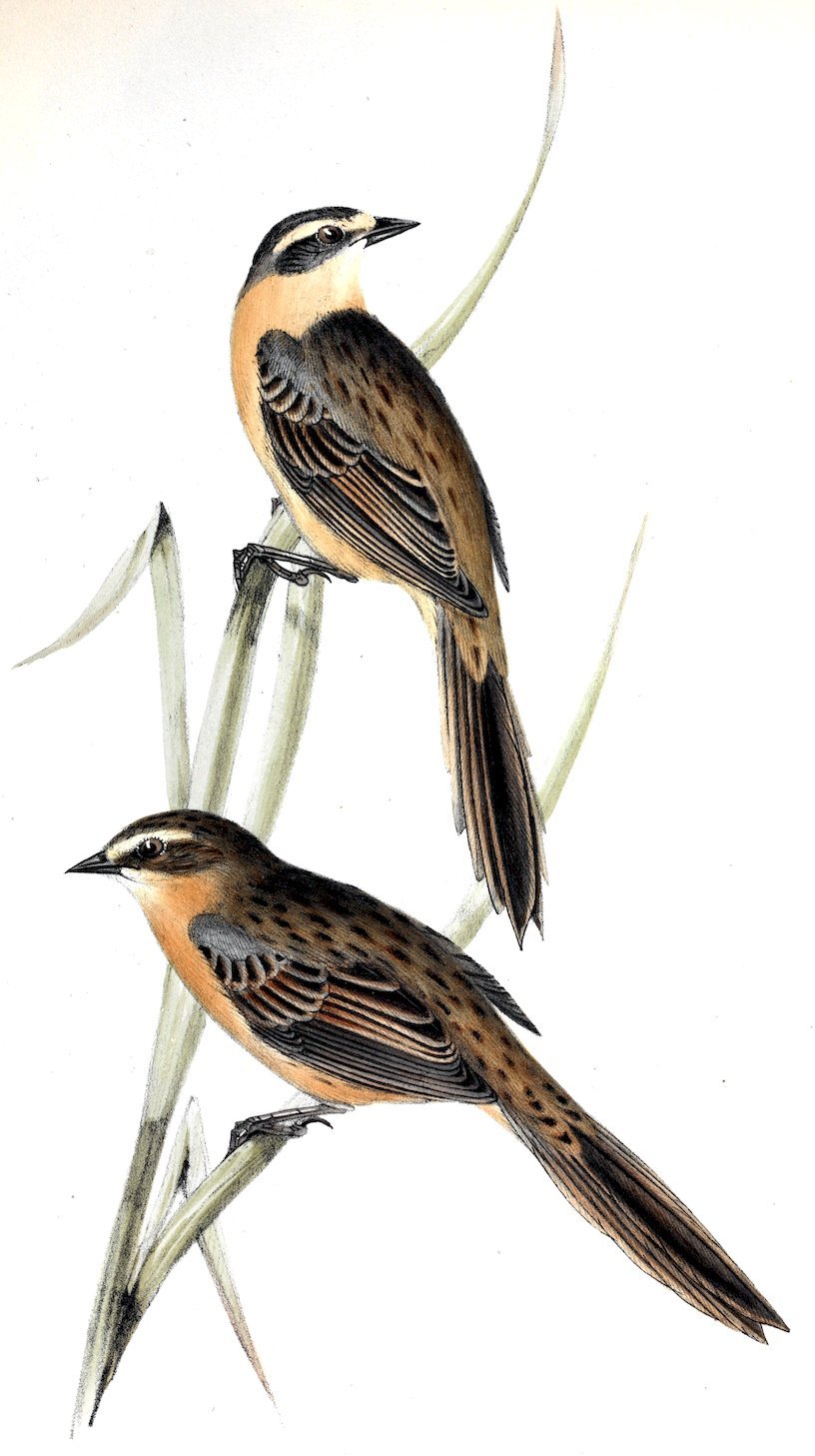
Birds. Pl. 29. Ammodramus longicaudatus.
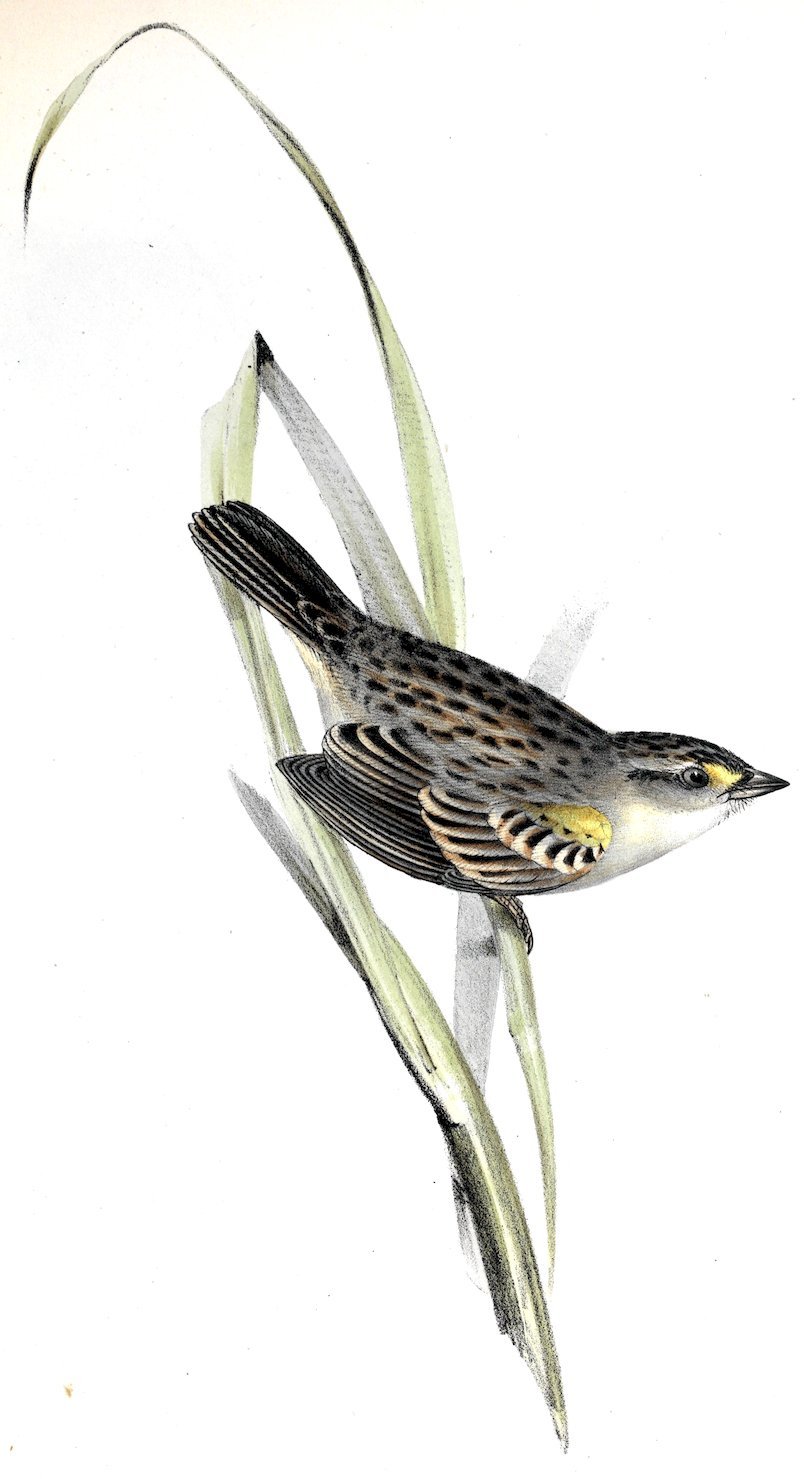
Birds. Pl. 30. Ammodramus xanthornus.
91
1. Zonotrichia matutina. G. R. Gray.
Fringilla matutina, Licht., Cat. 25.
—— Kittl. Kupfertafeln der Vögel, pl. 23. f. 3.
Tanagra ruficollis, Spix, Av. Sp. Nov. ii. t. liii. f. 3. p. 39.
Chingolo, Azara, No. 135. Chingolo Bunting, Lath. Hist.
I procured specimens of this species from the banks of the Plata, Bahia Blanca in Northern Patagonia, and from Valparaiso in Chile: in these countries it is perhaps the commonest bird. In the Cordillera, I have seen it at an elevation of at least 8000 feet. It generally prefers inhabited places, but it has not attained the air of domestication of the English sparrow, which bird in habits and general appearance it represents. It does not go in flocks, although several may be frequently seen feeding together. At Monte Video I found on the ground the nest of this species. It contained three eggs; these were .75 of an inch in length; form, rather rounded; colour, dirty white, with numerous small spots of chesnut and blackish brown, almost confluent towards the broadest end. It was in this nest that I found the parasitic egg, supposed to belong to a species of Molothrus, described in my journal.[12]
2. Zonotrichia canicapilla. Gould.
Z. vertice cinereo; loris regioneque paroticâ obscure fuscis: dorso collique lateribus rufis, dorso superiori et uropygio fuscis; dorso medio nigrescenti fusco, plumis singulis pallido fusco marginatis; tectricibus alarum nigrescenti fuscis, rufescente fusco marginatis, apice albis, duas fascias obliquas trans alarum formantibus.
Long. tot. 5½ unc.; alæ, 2⅞; caudæ, 2½; tarsi, ⅞; rostri, ½.
Crown of the head grey; lores and ear-coverts dark brown; back and sides of the neck rufous; upper part of the back and rump brown; centre of the back blackish brown, each feather margined with light brown; wing-coverts blackish brown, margined with reddish brown, and tipped with white, forming two oblique bands across the wing; primaries, secondaries, and tail, dark brown, margined with greyish brown; throat and all the under surface brownish grey; and feet brown.
Habitat, Port Desire in Patagonia, and Tierra del Fuego.
This species is not uncommon in Tierra del Fuego, wherever there is any open 92space. Of the few birds inhabiting the desert plains of Patagonia, this is the most abundant. At Port Desire I found its nest: egg, about .83 in length; form somewhat more elongated than in that of the last species; colour, pale green, almost obscured by minute freckles and clouds of pale dull red.
3. Zonotrichia Strigiceps. Gould.
Z. capite castaneo, lineâ mediâ obscure diviso, plumis singulis striâ mediâ nigro-fuscâ, humeri flexurâ rufâ; corpore supra fuscescente, plumis singulis striâ latâ mediâ obscure fuscâ; remigibus, primariis caudâque nigro-fuscis pallidè fusco marginatis; strigâ superciliari, faciei collique lateribus, gulâ pectore abdomineque medio cinereis; hypochondriis tegminibusque caudæ inferioribus flavescentibus.
Long. tot. 5¾ unc.; rostri, ½; alæ, 2½; caudæ, 2⅞; tarsi, ⅝.
Head chestnut, divided down the middle by a line of deep grey, each feather with a stripe of blackish brown down the centre; point of the shoulder rufous; the remainder of the upper surface light brown, with a broad stripe of dark brown down the centre of each feather; primaries and tail brown; secondaries blackish brown, margined all round with pale brown; stripe over each eye, sides of the face and neck, throat, breast, and centre of the abdomen, grey; flanks and under tail-coverts buff; upper mandible black; under mandible light horn colour; feet brown.
Habitat, Santa Fe. Lat. 31° S. (October.)
This species appears to replace in this latitude the Z. matutina, which is so abundant on the banks of the Plata and in Chile, as that species does the Z. canicapilla of Patagonia and Tierra del Fuego.
Passerina jacarina. Vieill.
Tanagra jacarina, Linn.
Passerina jacarina, Vieill. Ency. Meth. p. 933.
Emberiza jacarina, D’Orb. & Lafr., Syn.
Le Sauteur, Azara, No. 138.
Euphone jacarina, Licht. Cat. p. 30.
Fringilla splendens, Vieill. Ency. p. 981?
I procured a specimen of this bird at Rio de Janeiro.
93
1. Fringilla Diuca. Mol.
Fringilla Diuca, Kittl. Mem. de St. Petersb. t. i. pl. 11.
—— Mag. de Zool. 1837, pl. 69.
Emberiza Diuca, D’Orb. & Lafr. Syn. Mag. of Zool. 1838, f. 77.
This bird is very common on the coast of Chile, from the humid forests of Chiloe to the desert mountains of Copiapó. In Chiloe it is perhaps the most abundant of the land birds; south of Chiloe I never saw it, although the nature of the country does not change them. On the eastern side of the continent, I met with this bird only at the Rio Negro, in northern Patagonia. I do not believe it inhabits the shores of the Plata, although so common in the open country, under corresponding latitudes west of the Cordillera. The Diuca, as this Fringilla is called in Chile, generally moves in small flocks, and frequents, although not exclusively, cultivated ground in the neighbourhood of houses: habits very similar to those of the Zonotrichia matutina. During incubation, the male utters two or three pleasing notes, which Molina has in an exaggerated description called a fine song. In October, at Valparaiso, I found the nest of this bird in the trellis-work of a vineyard, close by a much frequented path. The nest is shallow, and about six inches across; the outer part is very coarse, and composed of the thin stalks of twining plants, strengthened by the husky calices of a composite flower; this outside part is lined by many pieces of rag, thread, string, tow, and a few feathers. Eggs rather pointed, oval, ·94 of an inch in length; colour, pale dirty green, thickly blotched by rather pale dull brown, which small blotches and spots become confluent, and entirely colour the broad end.
2. Fringilla Gayi. Eyd. & Gerv.
Fringilla Gayi, Eyd. & Gerv. Mag. de Zool. 1834. pl. 23.
Emberiza Gayi, var. D’Orb. & Lafr. Syn. p. 76.
This Fringilla, which was first brought from Chile, is abundant in the southern parts of Patagonia.
3. Fringilla formosa. Gould.
F. fronte lorisque nigris; vertice, genis, gulâ, alarum tegminibus cæruleo griseis, tegminibus primariis, secundariis rectricibusque griseo-nigris, cærulescenti-griseo marginatis, dorso flavescenti castaneo; tegminibus caudalibus inferioribus pallidè griseis; uropygio pectore abdomine hypochondriisque saturatè flavis.
Long. tot. 5½ unc.; alæ, 3¼; caudæ, 2⅝; tarsi, ¾; rostri, ½.
Forehead and lores black; crown of the head, sides of the face, throat, wing 94coverts, and the margins of the primaries, secondaries, and tail feathers, blue grey; the remainder of the primaries, secondaries, and tail feathers, greyish black; back yellowish chestnut; under tail coverts light-grey; rump, breast, abdomen and flanks, deep wax yellow; bill bluish horn colour; feet light brown.
Habitat, Tierra del Fuego (December and February).
This finch is common on the outskirts of the forests in Tierra del Fuego. Mr. Gould remarks, that it is nearly allied to F. Gayi, but it is much smaller, and is richer in its colouring.
4. Fringilla fruticeti. Kittl.
Fringilla fruticeti, Kittl. Kupf. der Vögel, pl. 23. f. 1.
Emberiza luctuosa, Eyd. et Gerv. Mag. de Zool. 1834. Cl. 11. pl. 71.
——— D’Orb. & Lafr. Syn. p. 80.
I obtained specimens of this bird from Northern Chile, and Southern Patagonia. I saw it also in the Cordillera of Central Chile, at an elevation of at least eight thousand feet, near the upper limit of vegetation. In Patagonia it is not common, it frequents bushy valleys in small flocks, from six to ten in number. These birds sometimes move from thicket to thicket with a peculiar soaring flight: they occasionally utter very singular and pleasing notes.
5. Fringilla carbonaria. G. R. Gray.
Emberiza carbonaria, D’Orb. & Lafr. Synop. p. 79.
I never saw this bird but once, and then it was in small flocks, on the most desert parts of the plains between the rivers Negro and Colorado, in Northern Patagonia.
6. Fringilla alaudina. Kittl.
Fringilla alaudina, Kupf. der Vögel, pl. 23. f. 2.
Emberiza guttata, Meyen, Nov. Act. Cur. xvii. pl. 12.
——— D’Orb. & Lafr. Syn. p. 78: Adult.
Passerina guttata, Eyd. & Gerv. Mag. de Zool. 1834. pl. 70. p. 22.
My specimens were obtained from the neighbourhood of Valparaiso.
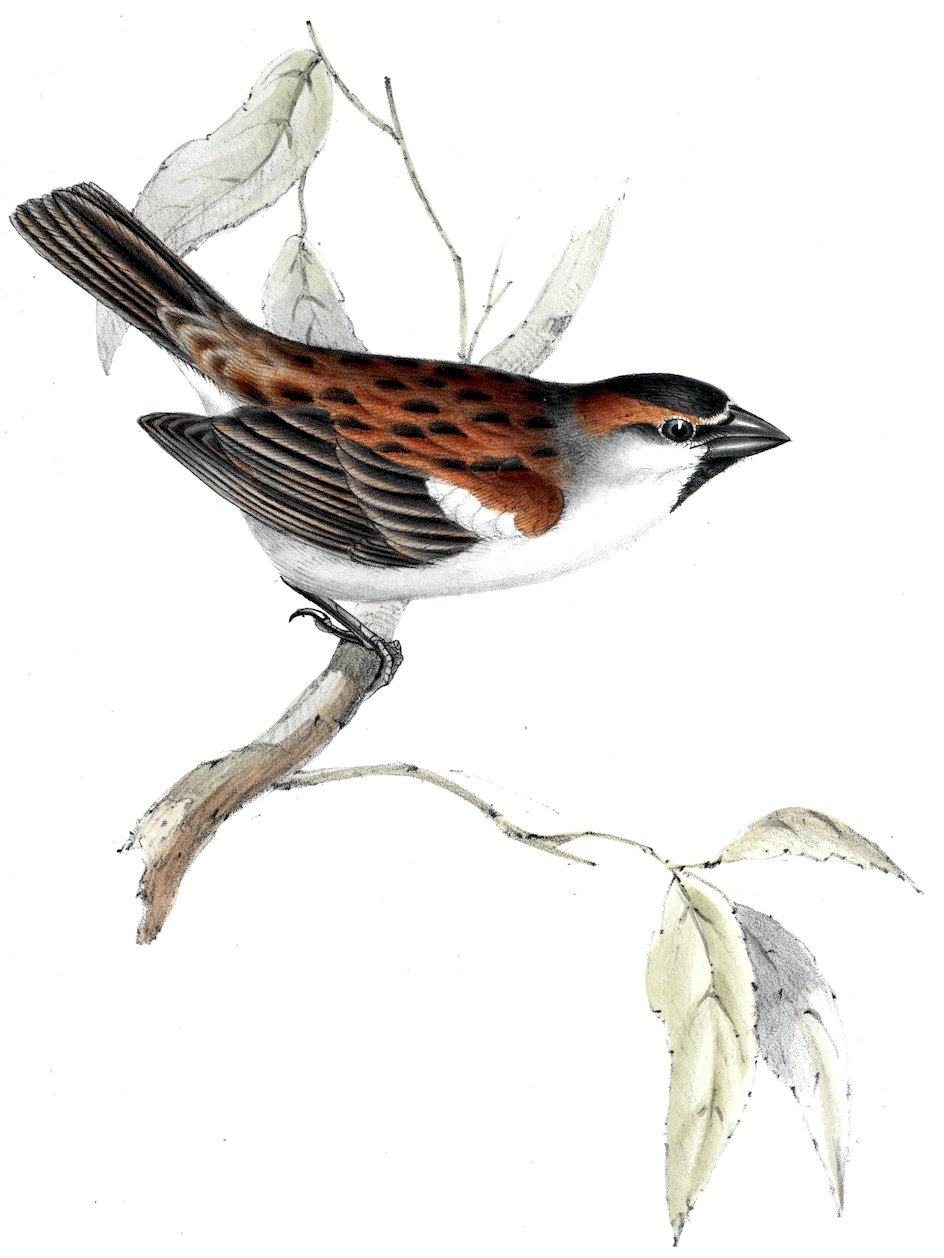
Birds. Pl. 31. Passer Jagoensis.
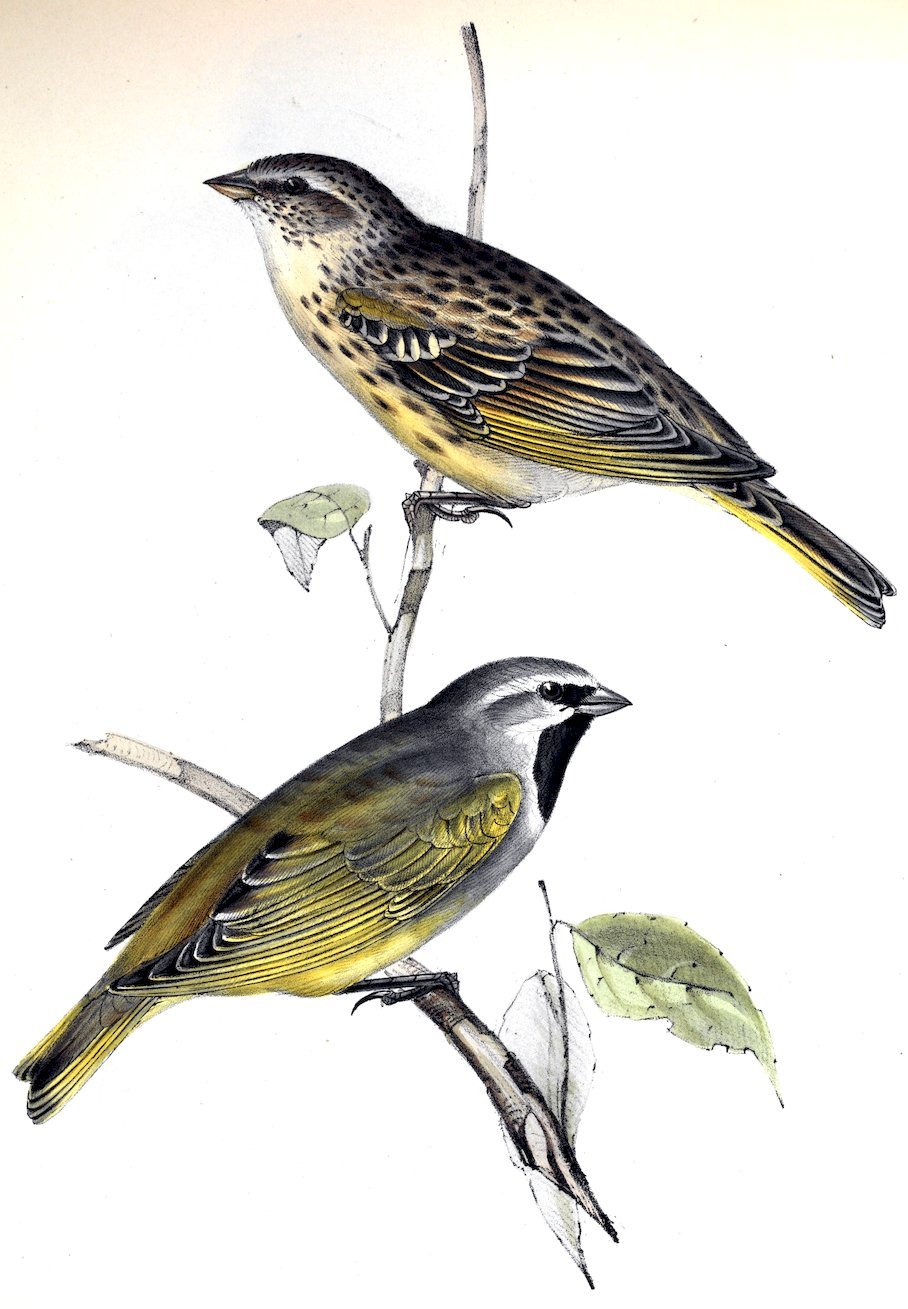
Birds. Pl. 32. Chlorospiza melanodera.
95
1. Passer Jagoensis. Gould.
Plate XXXI.
Pyrgita Jagoensis, Gould, Proc. of Zool. Soc. 1837. p. 77.
P. summo capite, et maculâ parvâ gulari intensè nigrescenti-fuscis; strigâ superciliari, collo, humeris dorsoque intensè castaneis, hujus plumis strigâ fuscâ centrali notatis; alis caudâque brunneis, tectricibus alarum minoribus albis, qui color fasciam transversam efficit: lineâ angustâ albâ à nare ad oculum; genis corporeque subtùs albis, hoc colore in cinereum ad latera transeunte: rostro, pedibusque fuscis.
Long. tot. 5 unc.; caudæ, 2¼; alæ, 2½; rost. ½; tarsi, ⁵⁄₄.
Crown of the head and a small mark on the throat intense blackish brown, with a stripe on the eyebrows, the neck, shoulders and back bright chestnut, the feathers of the latter marked with a central dusky streak; wings and tail brown, with the smaller wing coverts white, forming a transverse bar; a narrow white line from the nostrils to the eye; cheeks and under side of body white, this colour passing into grey on the sides; beak and feet dusky.
Habitat, St. Jago, Cape Verde Islands (January).
This is the commonest bird in the island; it frequents, generally in small flocks, both the neighbourhood of houses and wild uninhabited spots. It was building its nest towards the end of August.
2. Passer Hispaniolensis. G. R. Gray.
Fringilla Hispaniolensis, Temm. Man. i, 353.
In the month of January I obtained a specimen of this bird from St. Jago, one of the Cape Verde Islands, where it was not common.
1. Chlorospiza? melanodera. G. R. Gray.
Plate XXXII.
Emberiza melanodera, Quoy & Gaim. Voy. de L’Uranie, Zool. i. p. 109.
C. flavescenti olivacea; dorso superiori cinereo rufoque mixto; vertice, auribus, colli lateribus pectoreque cinereis rufomixtis; lineâ à naribus pone oculos transiente genisque albis; plumis inter rostrum et oculos gulâque atris; remigibus primariis et secundariis nigrescentibus flavo marginatis: caudâ rectricibus mediis olivaceo fuscis, tribus externis ferè toto pallidè flavis; abdomine medio flavescenti albo, lateribus obscurioribus.
Long. tot. 6½ unc.; alæ, 3½; caudæ, 2¾; tarsi, 10 lines; rostri, 5 lin.
Adult. Yellowish olive, mixed with grey and rufous on the upper part of the back; 96top of the head, ears, sides of the neck and breast, grey mixed with rufous; the lines from the nostrils reaching behind the eyes and cheeks, white; the space between the bill and eye, and the throat, deep black; the primaries and secondaries blackish, margined with yellow; the tail, with the middle feathers, olivaceous black, with the three external nearly wholly pale yellow; the middle of the abdomen yellowish white, with the flanks darker.
Young: Upper surface brownish white, with the middle of each feather black; the throat lighter; the wing coverts and secondaries margined with white and brown; the primaries with yellow; the tail blackish, with their outer margins yellow, and the external feather wholly pale yellow white; beneath the body pale yellowish white, streaked on the breast and flanks with a darker tint.
Habitat, East Falkland Island {March), and Santa Cruz, Patagonia (April).
This bird is extremely abundant in large scattered flocks in the Falkland Islands.
2. Chlorospiza? xanthogramma. G. R. Gray.
Plate XXXIII.
C. cinerascenti olivacea, rufo paulo tincta; lineâ à naribus pone oculos transiente genisque flavis; plumis inter rostrum et oculos gulâque atris; remigibus secundariis nigrescentibus, cinereo et olivaceo latè marginatis; primariis nigrescentibus, flavo angustè marginatis; caudâ cinerascenti nigrâ, plumis externis albis; corpore infra flavescenti albo, hypochondriis obscurioribus.
Long. tot. 7²⁄₈ unc.; alæ, 3⅞; caudæ, 3; tarsi, 1; rostri, 7 lin.
Adult: Greyish olive, very slightly mixed with rufous, a line from the nostrils reaching behind the eyes and cheeks, yellow; the space between the bill and eye, and the entire throat, deep black; the secondaries blackish, broadly margined with grey and olive; the primaries blackish, slightly margined with yellow; the tail greyish black, with the outer feathers white; beneath the body yellowish white, darker on the flanks.
Female: Upper surface brownish white, with each feather blackish brown in the middle, the head and throat paler; the wing-coverts and secondaries blackish, margined with brownish white; the primaries blackish, slightly margined with yellow; the tail blackish white-margined, with the outer feathers nearly wholly white; beneath the body yellowish white, streaked with brown on the breast and flanks: and the space from the nostrils reaching to behind the eyes and cheeks, yellowish.
Habitat, East Falkland Island (March), and Tierra del Fuego (February).
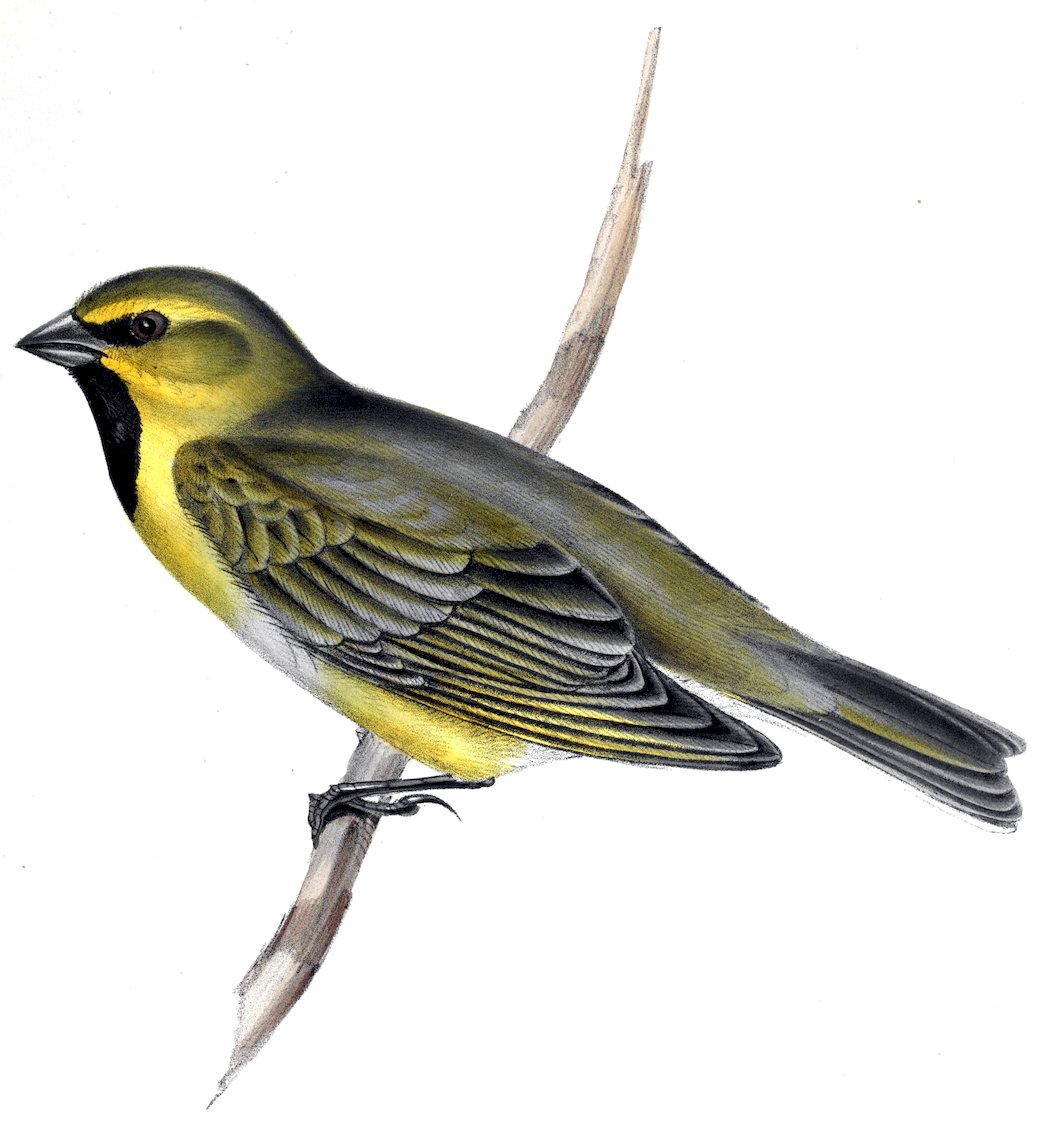
Birds. Pl. 33. Chlorospiza Xanthogramma.
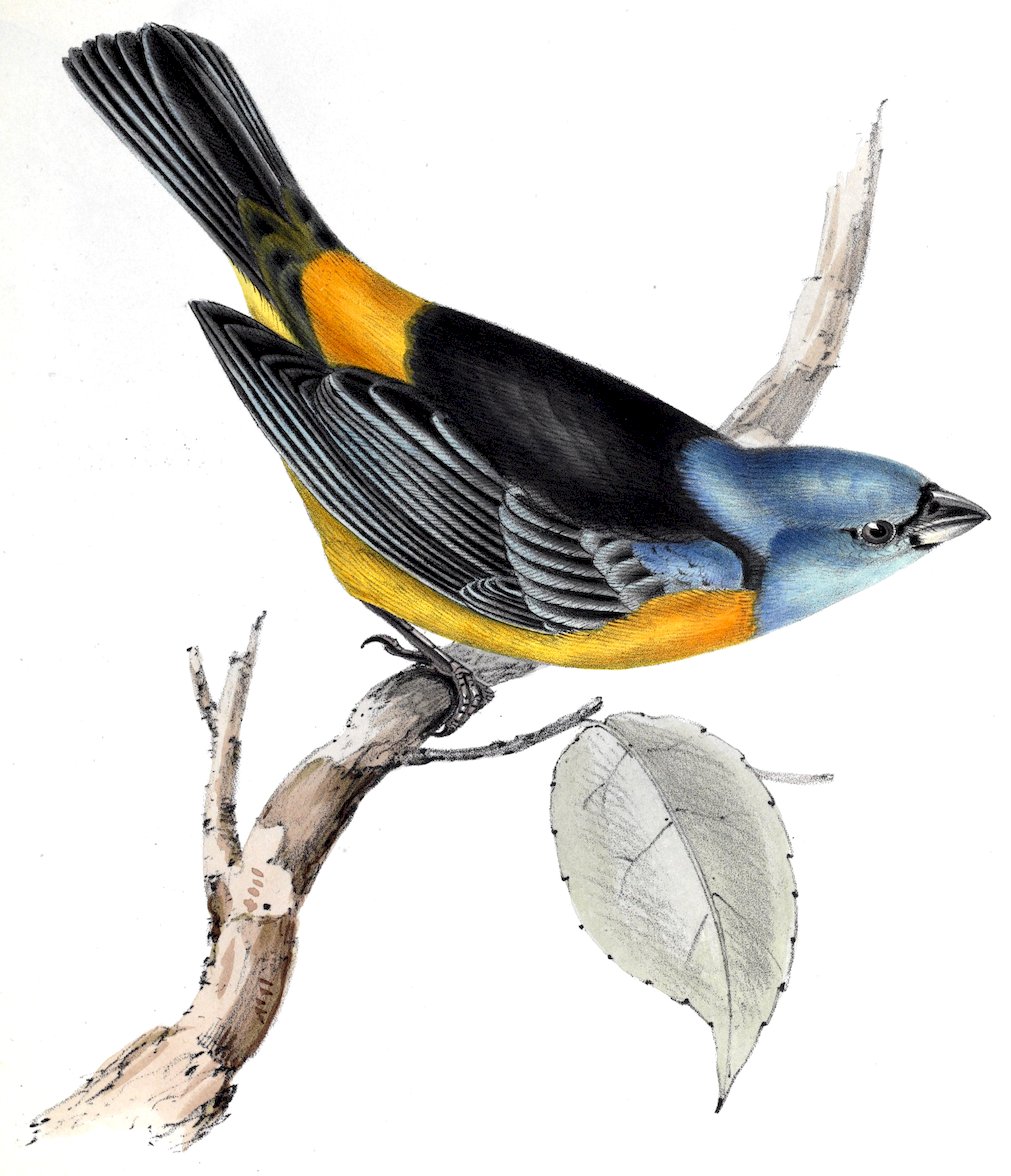
Birds. Pl. 34. Tanagra Darwinii.
97This species is common at the Falkland Islands, and it often occurs mingled in the same flock with the last one. I suspect, however, it more commonly frequents higher parts of the hills. These species have a very close general resemblance; but the marks about the head, which are white in the C. melanodera, are yellow in the C. xanthogramma, while the parts of the tail-feathers which are white in the latter, are yellow in the C. melanodera: this difference of colours does not hold in the females, but they may be at once distinguished by the greater length of wing, when folded, of the C. xanthogramma.
Chrysomitris Magellanica. Bonap.
Fringilla Magellanica, Vieill. Ency. Meth. 983; Ois. Chant. de la Zône Torride, pl. 30; Audubon, Birds of Am. pl. 394, f. 2.
Gafarron, Azara, No. 134.
Fringilla icterica, Licht. Cat. p. 26.
This bird was very abundant in large flocks during May, at Maldonado; I found it also at the Rio Negro.
Sub-Family.—TANAGRINÆ.
Pitylus superciliaris.
Tanagra superciliaris, Spix. Av. Sp. Nov. 2. t. lvii. fig. 1. p. 44.
My specimen was procured from Santa Fé, in Lat. 31° S.
1. Aglaia striata. D’Orb. & Lafr.
Plate XXXIV.
♂ Tanagra striata, Gmel. Syst. 1. 899; Ency. Meth. 776; Licht. Cat. p. 31. Sp. 347; Proc. Zool. Soc. 1837, p. 121, pl. 34 of this work.
L’Onglet, Buff. iv. p. 256.
Le Lindobleu, dore et noir, Azara, No. 94.
♀ Tanagra Darwinii, Bonap.; Proc. Zool. Soc. 1837, p. 121.
I saw the only specimen, which I procured, feeding on the fruit of an opuntia at Maldonado.
Mr. G. R. Gray is induced to consider the species figured under the name of T. Darwinii, as the T. striata, Gm. and the T. Darwinii of the Zoological Society’s Proceedings, as the female of the same species, while the young birds may be described as following:
Brown, with the margins of the dorsal feathers greenish brown, those of the wings and tail margined brownish white; head and neck greyish green; 98beneath the body pale dusky green, somewhat darker on the breast and sides; uropygium yellowish green.
Three specimens of this species are contained in the British Museum, exhibiting male, female, and young.
2. Aglaia Vittata.
Tanagra vittata, Temm. Pl. col.
Maldonado; not common.
Pipillo personata. Swains.
Plate XXXV.
P. personata, Swains. Two cent. and a quart. p. 311.
Maldonado; not common. The stomach of one, which I shot, contained seeds.
Emberizoides poliocephalus. G. R. Gray.
E. olivaceus, dorsi plumis medio nigro striatis; capite gulâque cinereis, priore plumis singulis, medio nigrostriatis; corpore infra rufescenti albo; hypochondriis tectricibus caudæ inferioribus obscurioribus; alarum margine latè flava, remigibus primariis secundariisque nigris; prioribus pallidè olivaceo, posterioribus olivascente flavo latè marginatis.
Long. tot. 7¾ unc.; alæ, 3½; caudæ, 4; tarsi, 1¼; rostri, 8 lin.
Olivaceous, with the feathers of the back marked down the middle with black; the head and throat cinereous, with each feather of the former streaked down the middle with black; beneath the body rufous white, darker on the flanks and under tail coverts: the border of the wings bright yellow; the secondaries and primaries black, the former broadly margined with pale olive, the latter with bright olivaceous yellow; base of bill dusky orange.
Habitat, northern shore of the Plata. (May and August.)
This bird is common both near Monte Video and Maldonado, in swamps. Stomach full of seeds: it makes a shrill loud cry: its flight is clumsy, as if its tail were disjointed.
Fam.—COCCOTHRAUSTINÆ.
Genus, Geospiza, Gould.
Corporis figura brevissima et robusta.
Rostrum magnum, robustum, validum, altitudine longitudinem præstante; culmine arcuato et capitis verticem superante, apice sine denticulo, lateribus tumidis.
Naribus basalibus et semitectis plumis frontalibus.
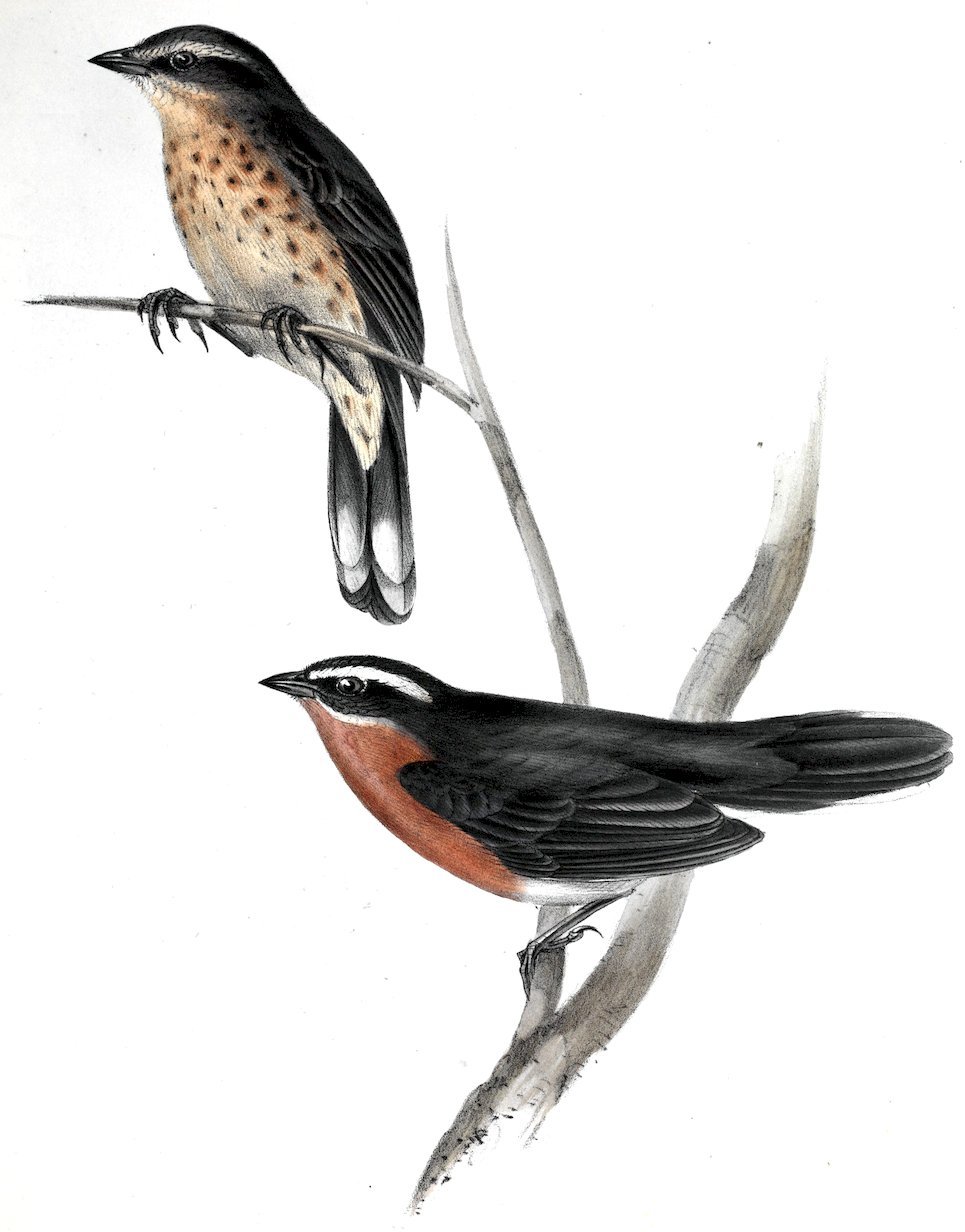
Birds. Pl. 35. Pipilo personata
99Mandibulâ superiori tomiis medium versus sinum exhibentibus, ad mandibulæ inferioris processum recipiendum. Mandibula inferior ad basin lata, hoc infra oculos tendente. Alæ mediocres remige primo paulo breviore secundo, hoc longissimo.
Cauda brevissima et æqualis.
Tarsi magni et validi, digito postico, cum ungue robusto et digito intermedio breviore; digitis externis inter se æqualibus at digito postico brevioribus. Color in maribus niger, in fœm. fuscus.
This singular genus[13] appears to be confined to the islands of the Galapagos Archipelago. It is very numerous, both in individuals and in species, so that it forms the most striking feature in their ornithology. The characters of the species of Geospiza, as well as of the following allied sub-genera, run closely into each other in a most remarkable manner.
In my Journal of Researches, p. 475, I have given my reasons for believing that in some cases the separate islands possess their own representatives of the different species, and this almost necessarily would cause a fine gradation in their characters. Unfortunately I did not suspect this fact until it was too late to distinguish the specimens from the different islands of the group; but from the collection made for Captain FitzRoy, I have been able in some small measure to rectify this omission.
In each species of these genera a perfect gradation in colouring might, I think, be formed from one jet black to another pale brown. My observations showed that the former were invariably the males; but Mr. Bynoe, the surgeon of the Beagle, who opened many specimens, assured me that he found two quite black specimens of one of the smaller species of Geospiza, which certainly were females: this, however, undoubtedly is an exception to the general fact; and is analogous to those cases, which Mr. Blyth[14] has recorded of female linnets and some other birds, in a state of high constitutional vigour, assuming the brighter plumage of the male. The jet black birds, in cases where there could be no doubt in regard to the species, were in singularly few proportional numbers to the brown ones: I can only account for this by the supposition that the intense black colour is attained only by three-year-old birds. I may here mention, that the time of year (beginning of October) in which my collection was made, probably corresponds, as far as the purposes of incubation are concerned, with our autumn. The several species of Geospiza are undistinguishable from each other in habits; they often form, together with the species of the following sub-genera, and likewise with doves, large irregular flocks. They frequent the rocky and extremely arid parts of the land sparingly covered with almost naked bushes, near the coasts; 100for here they find, by scratching in the cindery soil with their powerful beaks and claws, the seeds of grasses and other plants, which rapidly spring up during the short rainy season, and as rapidly disappear. They often eat small portions of the succulent leaves of the Opuntia Galapageia, probably for the sake of the moisture contained in them: in this dry climate the birds suffer much from the want of water, and these finches, as well as others, daily crowd round the small and scanty wells, which are found on some of the islands. I seldom, however, saw these birds in the upper and damp region, which supports a thriving vegetation; excepting on the cleared and cultivated fields near the houses in Charles Island, where, as I was informed by the colonists, they do much injury by digging up roots and seeds from a depth of even six inches.
1. Geospiza magnirostris. Gould.
Plate XXXVI.
G. fuliginosa, crisso cinerascenti-albo; rostro nigro-brunnescente lavato; pedibus nigris.
Long. tot. 6 unc.; alæ, 3½; caudæ, 2; tarsi, 1; rostri, ⅞; alt. rost. 1.
Fœm. vel Mas jun.; corpore intensè fusco singulis plumis olivaceo cinctis; abdomine pallidiore; crisso cinerascenti-albo; pedibus el rostro, ut in mare adulto.
Sooty black; with the vent cinereous white, the bill black, washed with brownish, and the feet black.
Female, or young male: Deep fuscous, with each feather margined with olive, the abdomen much paler, with the under tail-coverts cinereous white, the feet and bill like those of the male.
Habitat, Galapagos Archipelago. (Charles and Chatham Islands.)
I have strong reasons for believing this species is not found in James’s Island. Mr. Gould considers the G. magnirostris as the type of the genus.
2. Geospiza strenua. Gould.
Plate XXXVII.
G. fuliginosa, crisso albo, rostro fusco et nigro tincto; pedibus nigris.
Long. tot. 5½ unc.; alæ, 3; caudæ, 1⅜; tarsi, ¾; rostri, ⅝; alt. rost. ⅜.
Fœm. Summo corpore fusco singulis plumis alarum caudæque plumis exceptis, pallidè cinerascenti-olivaceo cinctis; gulâ et pectore fuscis; abdomine lateribus et crisso pallidè cinerascenti-fuscis; rostro brunnescente.
Sooty black, with the under tail coverts white; the bill brown, tinged with black, and the feet black.
Female: Upper part of the body fuscous, with the margins of each feather, except those of the wings and tail, pale cinereous olive; the throat and breast fuscous: the abdomen, sides, and under tail-coverts pale cinereous-fuscous; the bill brownish.
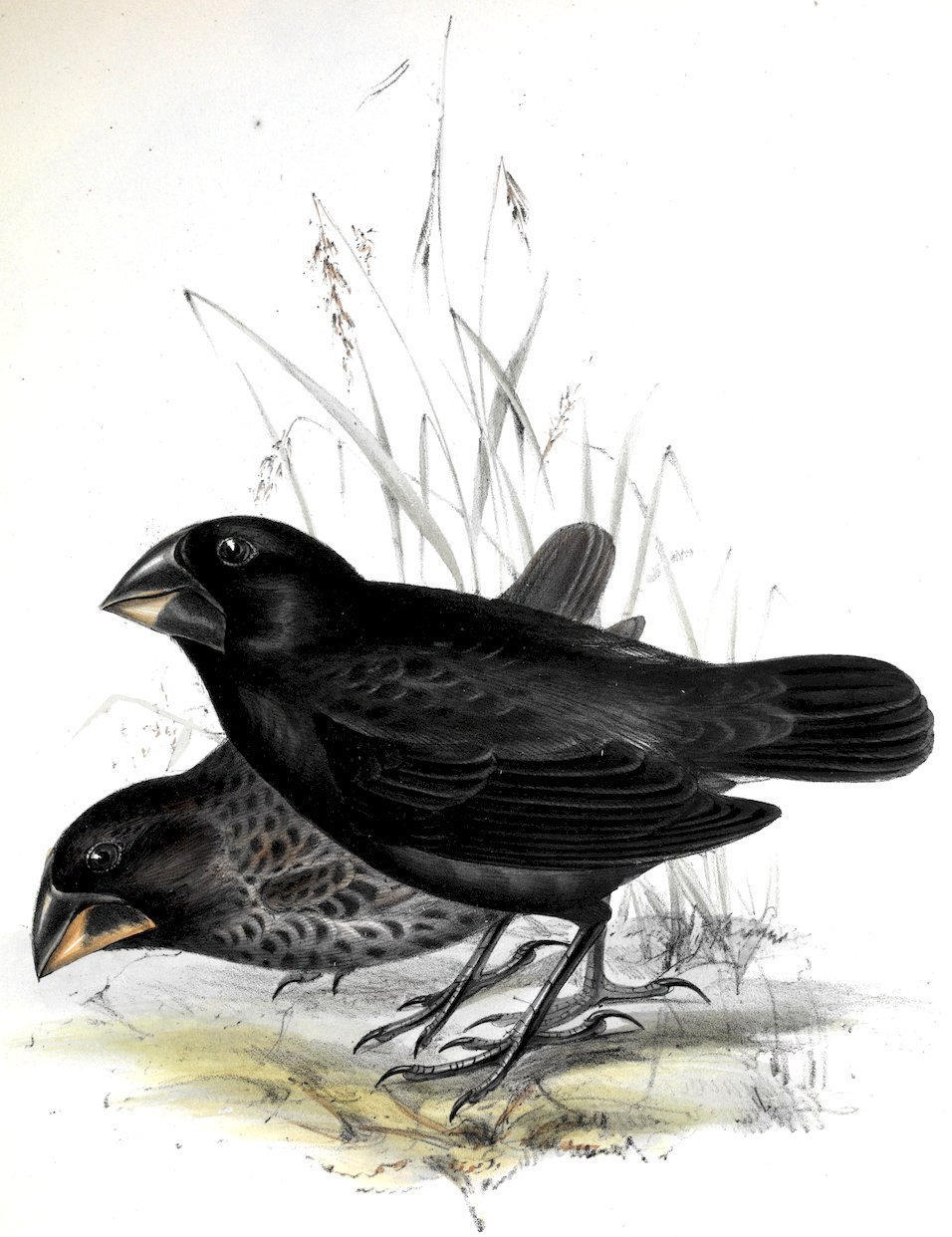
Birds. Pl. 36. Geospiza magnirostris
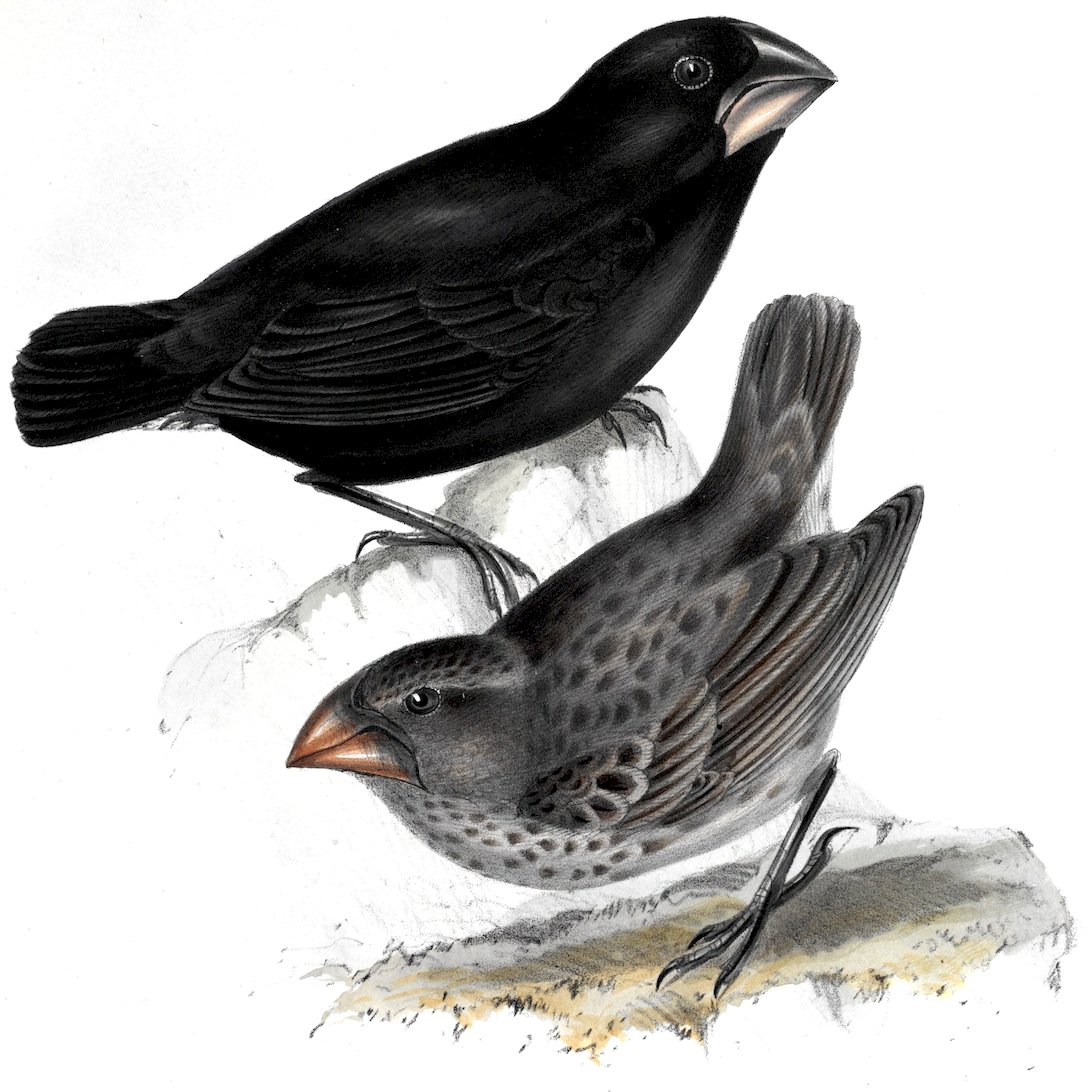
Birds. Pl. 37. Geospiza strenua
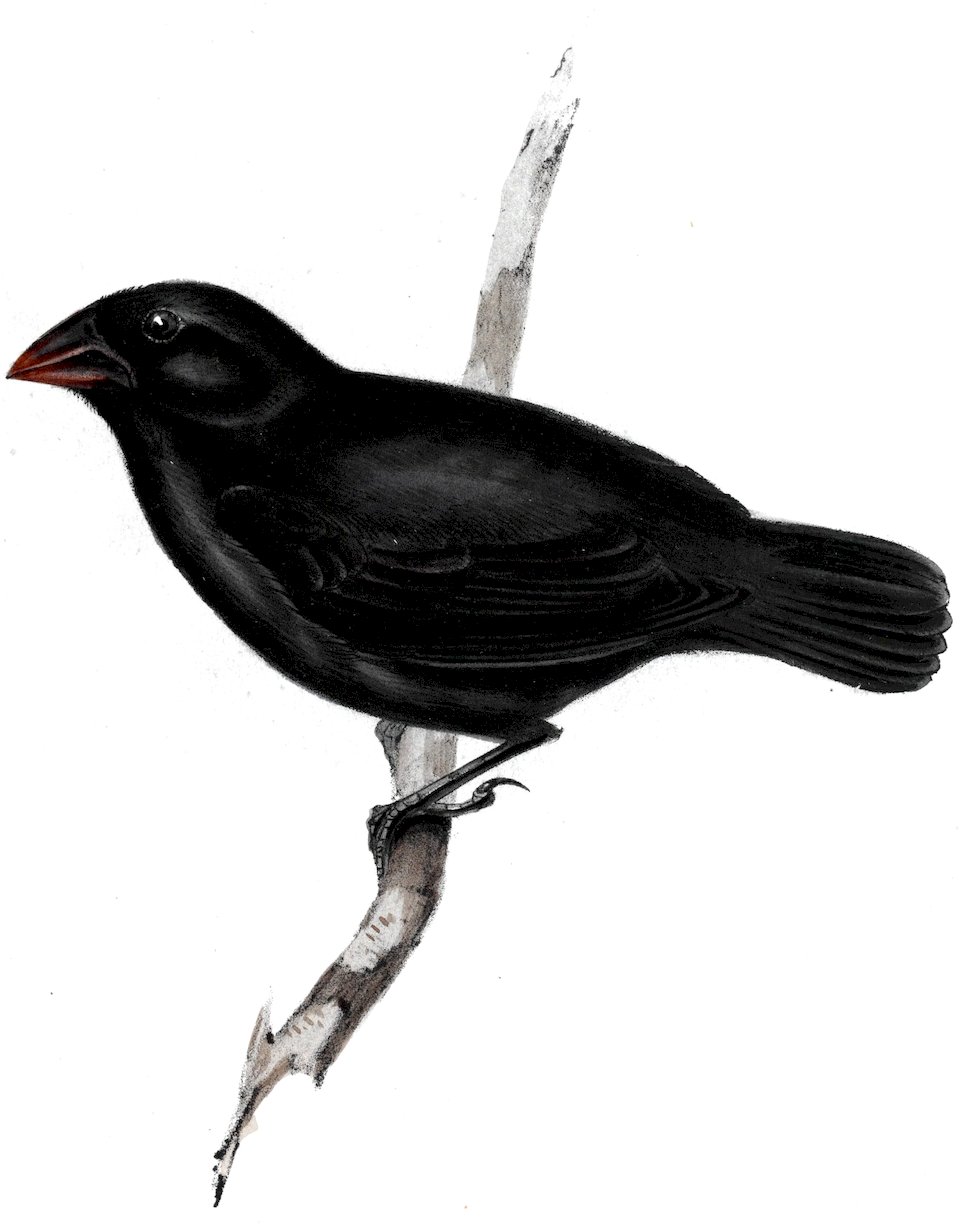
Birds. Pl. 38. Geospiza fortis
101Habitat, Galapagos Archipelago (James and Chatham Islands.)
Geospiza fortis. Gould.
Plate XXVIII.
G. intense fuliginosa, crisso albo; rostro rufescenti-brunneo, tincto nigro; pedibus nigris.
Fœm. (vel Mas jun.) Corpore suprà pectore et gutture intensè fuscis, singulis plumis cinerascenti-olivaceo marginatis; abdomine crissoque pallidè cinerascenti-brunneis; rostro rufescenti-fusco ad apicem flavescente; pedibus ut in mare.
Long. tot. 4¾ unc.; alæ, 3; caudæ, 1½; tarsi, ¹⁰⁄₁₂; rostri, ⁷⁄₁₂.
Deep sooty black; with the under tail-coverts and the bill reddish brown tinged with black; the feet black.
Female (or young male): The body above, breast and throat, deep fuscous, with each feather margined with cinereous olive: the abdomen, and under tail-coverts pale cinereous brown; the bill reddish fuscous, with the apex yellowish, and the feet like those in the male.
Habitat, Galapagos Archipelago, (Charles and Chatham Islands.)
4. Geospiza nebulosa. Gould.
G. summo capite et corpore nigrescenti-fuscis; singulis plumis cinerascenti-olivaceo marginatis; corpore subtus pallidiore, abdomine imo crissoque cinerascentibus; rostro et pedibus intensè fuscis.
Long. tot. 5 unc.; alæ, 2¾; caudæ, 1¾; tarsi, ¾; rostri, ⅝; alt. rost. ½.
Male.—Upper part of the head and body blackish fuscous, with each feather margined with cinereous olive; the body beneath paler, with the lowest part of the abdomen and under tail-coverts ashy; the bill and feet deep fuscous.
Habitat, Galapagos Archipelago, (Charles Island.)
5. Geospiza fuliginosa. Gould.
G. intensè fuliginosa, crisso albo, rostro fusco; pedibus nigrescenti-fuscis.
Long. tot. 4½ unc.; alæ, 2½; caudæ, 1⅝; tarsi, ¾; rostri, 1½; alt. rostri, ⅜.
Fœm. Summo corpore, alis, caudâque intensè fuscis; singulis plumis cinerascenti-ferrugineo marginatis; corpore infra cinereo, singulis plumis medium versus obscurioribus; rostro brunneo; pedibus nigrescenti-brunneis.
Deep sooty black, with the under tail coverts white; the bill fuscous, and the feet blackish fuscous.
102Female: Upper part of the body; the wings and tail deep fuscous, with each feather margined with ashy ferrugineous; beneath the body cinereous, with each feather towards the middle darker; the bill brown, and the feet blackish brown.
Habitat, Galapagos Archipelago. (Chatham and James’ Island.)
6. Geospiza dentirostris. Gould.
G. (Fœm. vel Mas jun.) mandibulæ superioris margine in dentem producto, vertice corporeque supra fuscis; singulis plumis medium versus obscurioribus; secundariis tectricibusque alarum ad marginem stramineis; gutture et pectore pallidè brunneis, singulis plumis medium versus obscurioribus, imo abdomine crissoque cinerascenti-albis; rostro rufo-fusco; pedibus obscurè plumbeis.
Long. tot. 4¾ unc.; alæ, 2⅜; caudæ, 1¾; rostri, ½; alt. rost. ⅜.
The margin of the upper mandible produced into a tooth; the vertex and above the body fuscous, with each feather towards the middle darker; the margins of the secondaries and wing coverts straw colour; the throat and breast pale brown, darker towards the middle of each feather; the sides and under tail-coverts cinereous white; the bill rufous fuscous, and the feet obscure lead colour.
Habitat, Galapagos Archipelago.
Mr. Gould considered this specimen a female, from the appearance of its plumage; but from dissection, I thought it was a male.
7. Geospiza parvula. Gould.
Plate XXXIX.
G. (Mas) capite, gutture, et dorso fuliginosis; uropygio cinerascenti-olivaceo; caudâ et alis nigrescenti brunneis; singulis plumis caudæ et alarum, cinereo-marginatis; lateribus olivaceis, fusco guttatis; abdomine et crisso albis, rostro et pedibus nigrescenti-brunneis.
Long. tot. 4 unc.; alæ, 2⅜; caudæ, 1½; tarsi, ¾; rostri, ⅜; alt. rost. ⁵⁄₁₆.
Fœm. Summo capite et dorso cinerascenti-brunneis, gutture, pectore, abdomine crissoque pallidè cinereis, stramineo tinctis.
The head, throat, and back, sooty black; the lower part of the back cinereous olive; the tail and wings blackish brown, margined with cinereous; the sides olive with fuscous spots; the abdomen and under tail-coverts white; the bill and feet blackish brown.
Female: The upper surface cinereous brown; the throat, breast, abdomen, and the under tail coverts, pale cinereous tinged with straw colour.
Habitat, Galapagos Archipelago. (James’ Island.)
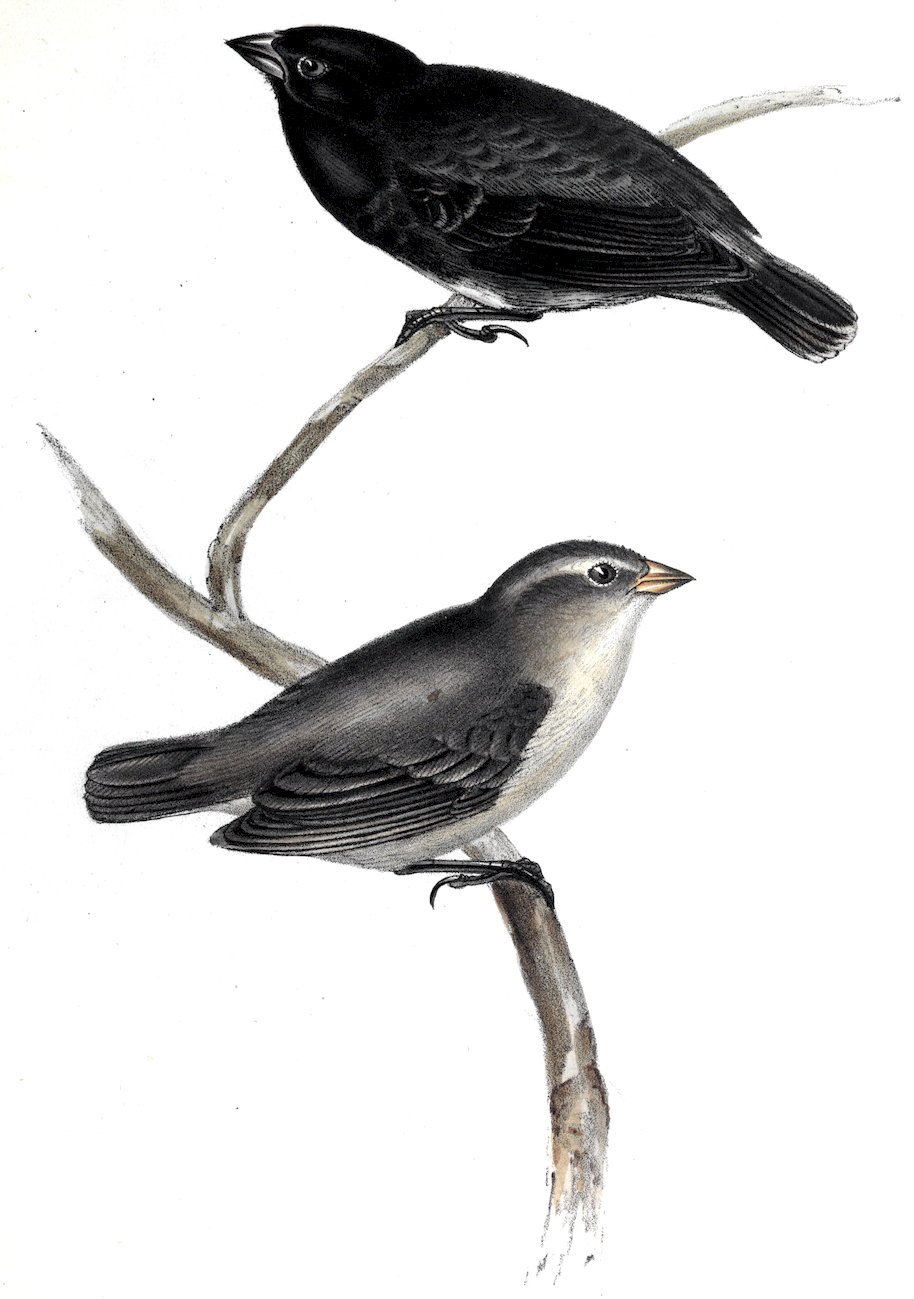
Birds. Pl. 39. Geospiza parvula.
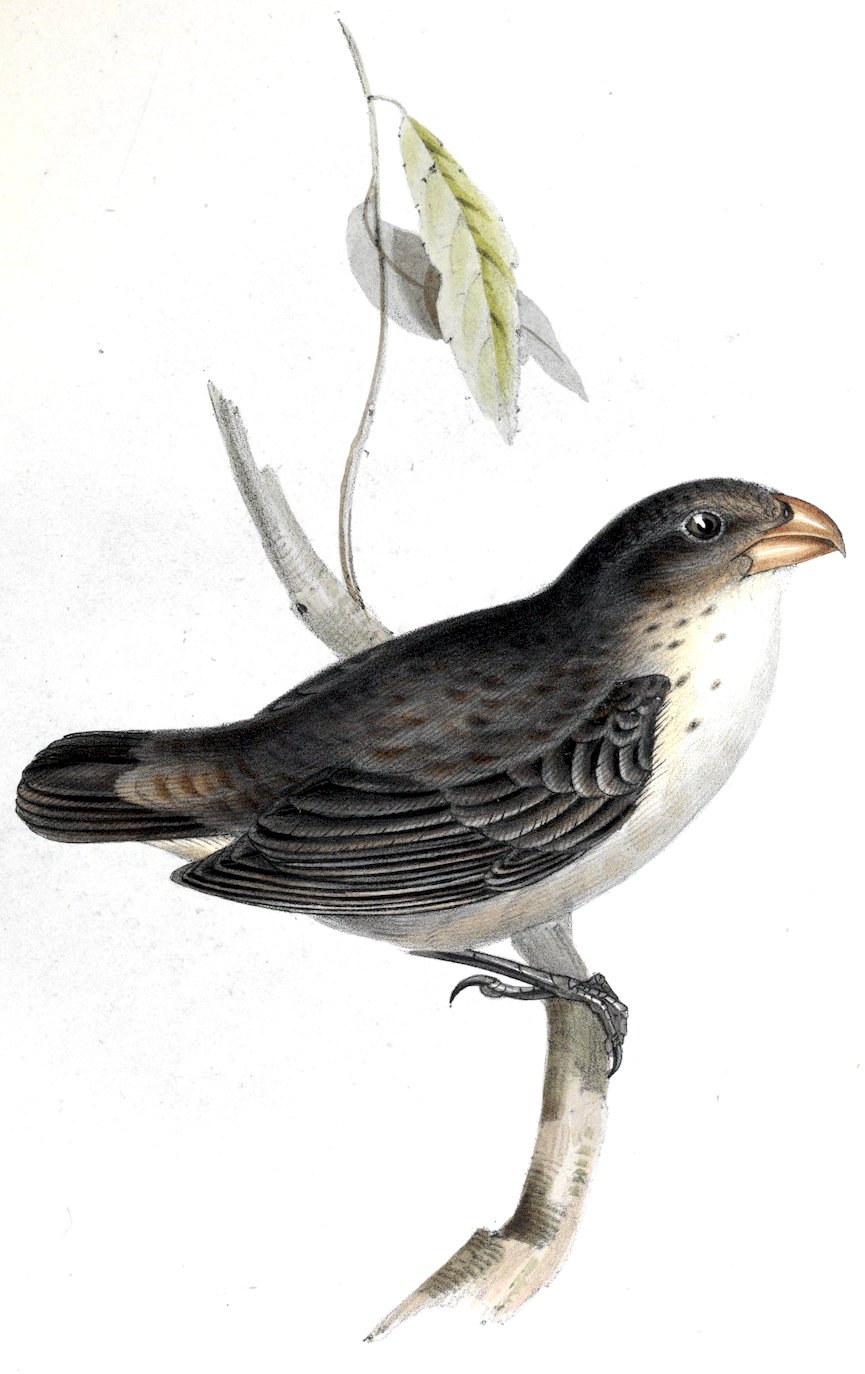
Birds. Pl. 40. Camarhynchus psittaculus.
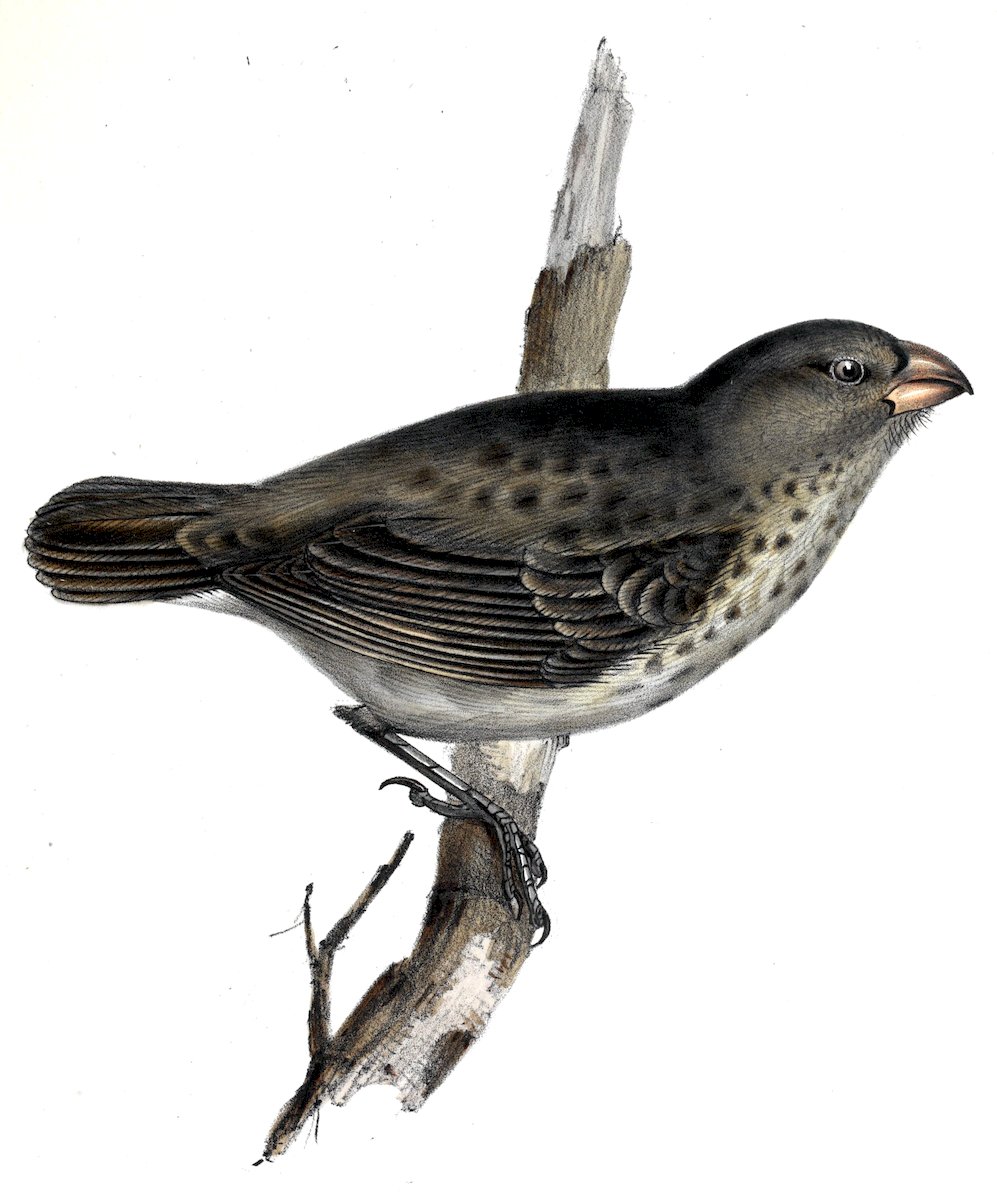
Birds. Pl. 41. Camarhynchus crassirostris.
103
8. Geospiza dubia. Gould.
G. (Fœm. Mas ignot.) summo capite et corpore suprà fuscis, singulis plumis cinerascenti-olivaceo marginatis; strigâ superciliari, genis, gutture, corpore infrà cinerascenti-olivaceis, singulis plumis notâ centrali fuscâ; alis caudâque brunneis singulis plumis olivaceo-cinereo marginatis; rostro sordidè albo, pedibus obscurè fuscis.
Long. tot. 3⅜ unc.; alæ, 2¾; caudæ, 1⅝; tarsi, ⅞; rostri, ⅝; alt. rostri, ⅜.
Upper surface fuscous, with each feather margined with cinereous olive; the streak above the eye, cheeks, throat, and beneath the body, cinereous olive, with the middle of each feather fuscous; the wings and tail brown, with each feather margined with cinereous ash; the bill white, and the feet obscure fuscous.
Habitat, Galapagos Archipelago, (Chatham Island.)
Sub-Genus.—CAMARHYNCHUS. Gould.
Camarhynchus differt a genere Geospiza, rostro debiliore, margine mandibulæ superioris minùs indentato; culmine minùs elevato in frontem et plus arcuato; lateribus tumidioribus; mandibulâ inferiore minus in genas tendente.
Camarhynchus psittaculus is the typical species.
1. Camarhynchus psittaculus. Gould.
Plate XL.
C. (Fœm.) summo capite corporeque superiore fuscis; alis caudâque obscurioribus; gutture corporeque inferiore, cinerascenti-albis, stramineo tinctis; rostro pallidè flavescenti-fusco; pedibus fuscis.
Long. tot. 4¾ unc.; alæ, 2¾: caudæ, 1¾; tarsi, ⅞; rostri ½; alt. rostri, ½.
The upper part of the head and body fuscous; the wing and tail darker; the throat, and beneath the body cinereous white, tinged with straw colour; the bill pale yellowish fuscous, and the feet fuscous.
Habitat, Galapagos Archipelago, (James’ Island.)
The species of Camarhynchus do not differ in habits from those of Geospiza; and the C. psittaculus might often be seen mingled in considerable numbers in the same flock with the latter. Mr. Bynoe procured a blackish specimen, which, doubtless, was an old male; I saw several somewhat dusky, especially about the head.
2. Camarhynchus crassirostris. Gould.
Plate XLI.
C. (Mas jun. et Fœm.) corpore superiore intensè brunneo, singulis plumis cinerascenti-olivaceo 104marginatis; gutture pectoreque cinerascenti-olivaceis, singulis in medio plumis obscurioribus; abdomine, lateribus crissoque cinereis stramineo tinctis.
Long. tot. 5½ unc.; alæ, 3¾; caudæ, 2; tarsi, 1⅛; rostri, ½; alt. rostri, ½.
Upper part of the body deep brown, with each feather margined with cinereous olive; the throat and breast cinereous olive, with the middle of each feather darker; the abdomen, sides, and under tail coverts cinereous tinged with straw colour.
Habitat, Galapagos Archipelago, (Charles Island?)
I am nearly certain that this species is not found in James Island. I believe it came from Charles Island, and probably there replaces the C. psittaculus of James Island. I obtained three specimens, one male, and two females; from the analogy of so many species in this group, I do not doubt the old male would be black.
Sub-Genus.—CACTORNIS. Gould.
Cactornis differt a genere Geospiza rostro elongato, acuto, compresso, longitudine altitudinem excellente; mandibulæ superioris margine vix indentato; naribus basalibus et vix tectis; tarsis brevioribus, unguibus majoribus et plus curvatis.
Cactornis scandens is the typical species.
1. Cactornis scandens. Gould.
Plate XLII.
C. intensè fuliginosa, crisso albo; rostro et pedibus nigrescenti-brunneis.
Long. tot. 5 unc.; rostri, ¾; alæ, 2⅝; caudæ, 1¾; tarsi, ¾.
Fœm. Corpore superiore, gutture pectoreque intensè brunneis, singulis plumis pallidiorè marginatis; abdomine crissoque cinereis, stramineo tinctis; rostro pallidè fusco; pedibus nigrescenti-fuscis.
Deep sooty black, with the under tail-coverts white; the bill and feet blackish brown.
Female: Upper surface of the body, throat and breast intensely brown, with the margins of each feather paler; the abdomen and the under tail coverts cinereous, tinged with straw colour; the bill pale fuscous, and the feet blackish fuscous.
Habitat, Galapagos Archipelago, (James’ Island.)
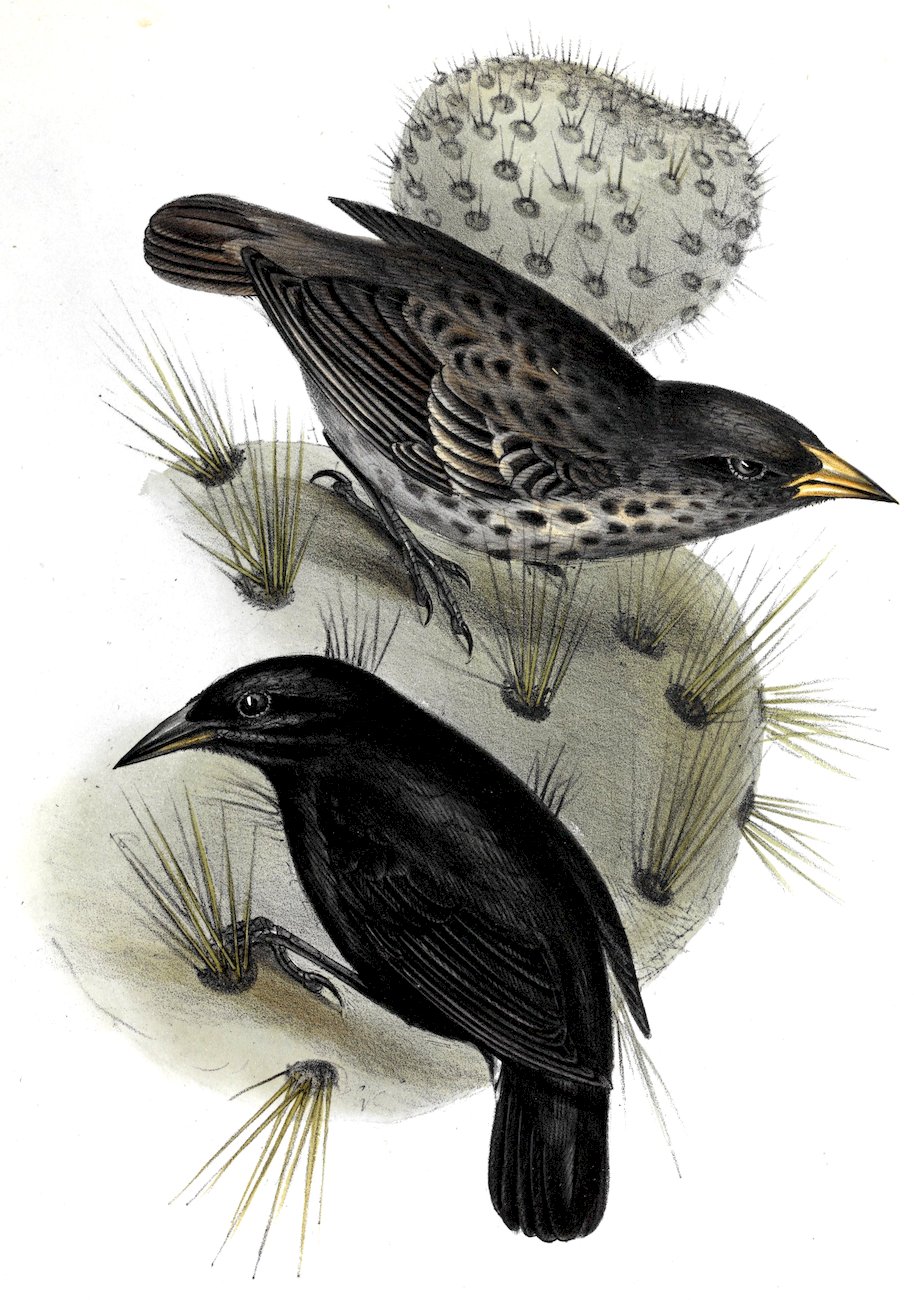
Birds. Pl. 42. Cactornis scandens.
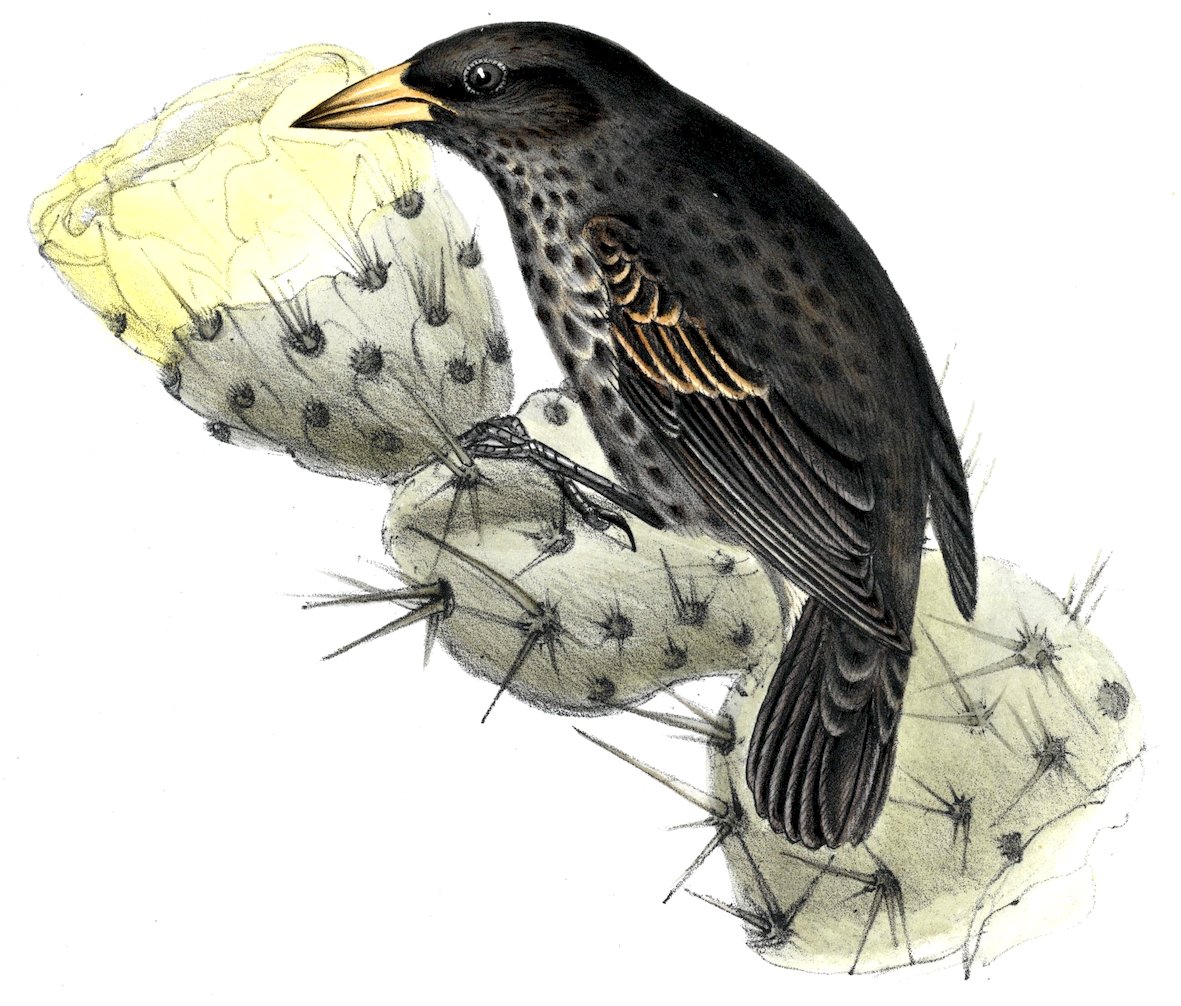
Birds. Pl. 43. Cactornis assimilis.
105The species of this sub-genus alone can be distinguished in habits from the several foregoing ones belonging to Geospiza and Camarhynchus. Their most frequent resort is the Opuntia Galapageia, about the fleshy leaves of which they hop and climb, even with their back downwards, whilst feeding with their sharp beaks, both on the fruit and flowers. Often, however, they alight on the ground, and mingled with the flock of the above mentioned species, they search for seeds in the parched volcanic soil. The extreme scarceness of the jet black specimens, which I mentioned under the head of the genus Geospiza, is well exemplified in the case of the C. scandens, for although I daily saw many brown coloured ones, (and two collectors were looking out for them), only one, besides that which is figured, was procured, and I did not see a second.
2. Cactornis assimilis. Gould.
Plate XLIII.
Tisserin des Gallapagos, (île St. Charles,) Neboux, Revue Zoologique, 1840, p. 291.
C. Mas (jun?) corpore suprà fuliginoso, (gutture abdomineque exceptis,) cinereo marginatis; rostro pallidè rufescenti-brunneo; pedibus nigrescenti-brunneis.
Long. tot. 5½ unc.; rostri, ¾; alæ, 2¾; caudæ, 1¾; tarsi, ¾.
Upper surface of the body sooty black, margined with cinereous, as well as the throat and abdomen; the bill pale rufous brown; the feet blackish brown.
Habitat, Galapagos Archipelago.
I do not know from which island of the group this species was procured; almost certainly not from James Island. Analogy would in this case, as in that of Camarhynchus crassirostris, lead to the belief that the old male would be jet black. By a mistake this bird has been figured standing on the Opuntia Darwinii, a plant from Patagonia, instead of the O. Galapageia. I may here mention that a third and well characterized species of Cactornis has lately been sent by Captain Belcher, R.N. to the Zoological Society; as Capt. Belcher visited Cocos Island, which is the nearest land to the Galapagos Archipelago, being less than 400 miles distant, it is very probable that the species came thence.
Sub-Genus.—CERTHIDEA. Gould.
Certhidea differt a genere Geospiza rostro graciliore et acutiore; naribus basalibus et non tectis; mandibulæ superioris margine recto; tarsis longioribus et gracilioribus.
Of the foregoing sub-genera, Geospiza, Camarhynchus and Cactornis belong to one type, but with regard to Certhidea, although Mr. Gould confidently believes it should also be referred to the same division, yet as in its slighter form and weaker bill, it has so much the appearance of a member of the Sylviadæ, he would by no means insist upon the above view being adopted, until the matter shall have been more fully investigated.
106
Certhidea olivacea. Gould.
PLATE XLIV.
C. summo capite, corpore superiore, alis caudâque olivaceo-brunneis; gutture et corpore infra cinereis; rostro pedibusque pallidè brunneis.
Long. tot. 4 unc.; rostri, ½; alæ, 2; caudæ, 1½; tarsi, ¾.
Upper part of the head, body, wings and tail, olivaceous brown; the throat, and beneath the body, cinereous; the bill and feet pale brown.
Habitat, Galapagos Archipelago. (Chatham and James Island).
I believe my specimens, which include both sexes, were procured from Chatham and James Islands; it is certainly found at the latter.
Phytotoma rara. Mol.
P. Bloxami, Children, Jard. and Selby’s Ill.
P. rutila, Vieill. Mag. de Zool. 1832, ii. pl. 5.
P. silens, Kittl. Mem. de l’Acad. des Sci. de St. Petersb.
This is not a very uncommon bird in Central Chile: the farmers complain that it is very destructive to the buds of fruit trees. It is quiet and solitary, and haunts hedge-rows or bushes; its manners are similar to those of our bullfinch, (Loxia Pyrrhula). Iris bright scarlet. Mr. Eyton has given an anatomical description of this bird in the Appendix.
Dolichonyx oryzivorus. Swains.
Dolichonyx oryzivorus, Swains. Faun. Bor. Am. 2. 278.
Emberiza oryzivorus, Linn.
This one specimen only was seen at James Island, in the Galapagos Archipelago, during the beginning of October. It is remarkable that a bird migrating, according to Richardson, as far as 54° N. in North America, and generally inhabiting marshy grounds, should be found on these dry rocky islands under the equator. Mr. Gray and myself carefully compared this specimen with one from North America, and we could not perceive the slightest difference.
1. Xanthornus chrysopterus. G. R. Gray.
Oriolus cayennensis, Linn. Syst. 1. 168 ?
Agelaius chrysopterus, Vieill.
Psarocolius chrysopterus, Wagl. Syst. Av. p.
This bird generally frequents marshy grounds. I procured specimens from La Plata and from Chile; in the latter country it extends at least as far north as the valley of Copiapo, in 27° 20′: on the eastern plains it does not range, according to Azara, north of 28°. It builds in reeds. Molina says it is called by the Indians Thili, or Chile—hence he derives the name of the country.
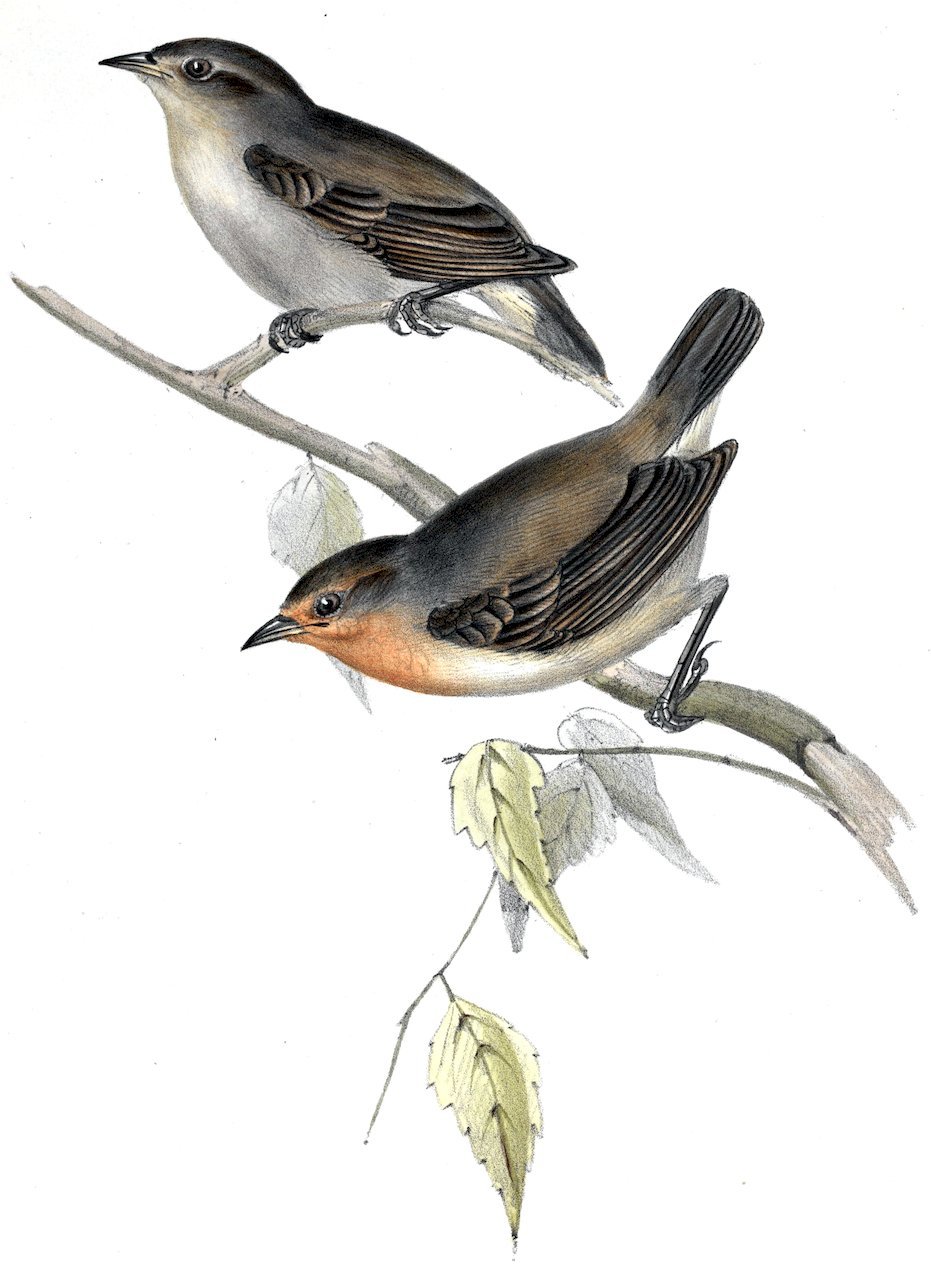
Birds. Pl. 44. Certhidea olivacea.
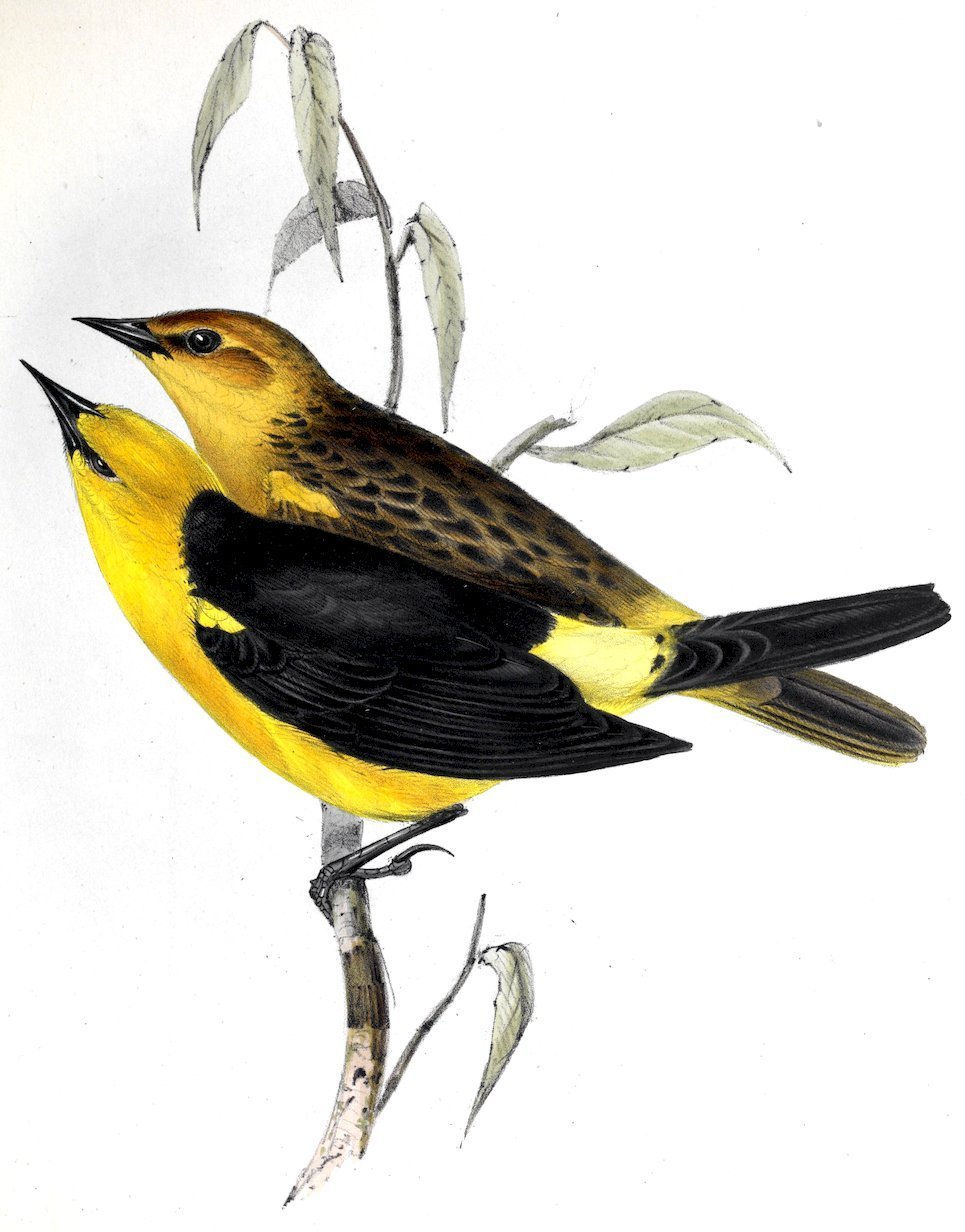
Birds. Pl. 45. Xanthornus flaviceps.
107
2. Xanthornus flavus. G. R. Gray.
Plate XLV.
Oriolus flavus, Gmel.
Psarocolius flaviceps, Wagl. Syst. Avium.
Troupiale à tête jaune, Azara, No. 66.
This species is common at Maldonado in large flocks.
Leistes anticus. G. R. Gray.
Icterus anticus, Licht. Cat. p. 19.
Agelaius virescens, Vieill. Ency. Meth. 543.
Psarocolius anticus, Wagl.
Le Dragon, Azara, No. 65.
This bird is exceedingly abundant in large flocks on the grassy plains of La Plata. It is noisy, and in its habits resembles our starling.
1. Agelaius fringillarius. G. R. Gray.
Icterus fringillarius, Spix, Av. Sp. No. 1. t. lxv. fig. 1 & 2. p. 68.
Psarocolius sericeus, juv., Wagl.
This species is rare at Maldonado, but appears more common on the banks of Parana in Lat. 31°. S. Spix says (vol. i. p. 68, Birds of Brazil), it is found in Minas Geraes.
2. Agelaius chopi. Vieill.
Turdus curæus, Gmel.
Le Chopi, Azara, No. 62.
Icterus unicolor, Licht.
Icterus sulcirostris, Spix, Av. Br. pl. 64. f. 2.
This species is common in flocks on the pasture grounds of Chile, and along the whole western shore of the southern part of the continent. In Chile it is called, according to Molina, “cureu.” It is a noisy, chattering bird, and runs in the manner of our starlings. It can be taught to speak, and is sometimes kept in cages. It builds in bushes.
Molothrus niger. Gould.
Tanagra bonariensis, Gmel.
Icterus niger, Dand.
Passerina discolor, Vieill.
Icterus maxillaris, D’Orb. & Lafr.
Icterus sericeus, Licht.
Psarocolius sericeus, Wagl.
This Molothrus is common in large flocks on the grassy plains of La Plata, and is often mingled with the Leistes anticus, and other birds. In the same flock 108with the usual black kind, there were generally a few dull brown coloured ones, (Icterus sericeus of Licht.) which I presume are the young. Azara states that the brown coloured birds are smaller than the black glossy ones, and that they sometimes form one-tenth of the whole number in a flock. In the single specimen which I brought home, the size, with the exception of the length of the wing, is only a very little less. Sonnini, in his notes to Azara, considers the brown birds as the females; I can, however, scarcely believe that so obvious a solution of the difficulty could have escaped so accurate an observer as Azara. These birds in La Plata often may be seen standing on the back of a cow or horse. While perched on a hedge, and pluming themselves in the sun, they sometimes attempt to sing or rather to hiss: the noise is very peculiar; it resembles that of bubbles of air passing rapidly from a small orifice under water, so as to produce an acute sound. Azara states that this bird, like the cuckoo, deposits its eggs in other birds’ nests. I was several times told by the country people, that there was some bird which had this habit; and my assistant in collecting, who is a very accurate person, found in the nest of the Zonotrichia ruficollis (a bird which occupies in the ornithology of S. America the place of the common sparrow of Europe), one egg larger than the others, and of a different colour and shape. This egg is rather less than that of the missel-thrush, being ·93 of an inch in length, and ·78 in breadth; it is of a bulky form, thick in the middle. The ground colour is a pale pinkish white, with irregular spots and blotches of a bright reddish brown, and others less distinct of a greyish hue. This species is evidently a very close analogue of the M. pecoris of North America, from which, however it may at once be distinguished by the absence of the glossy brown on the head, neck, and upper breast,—by the metallic blueness of its plumage in the place of a green tinge, and by its somewhat greater size in all its proportions. The young or brown coloured specimens of these Molothri resemble each other more closely; that of the M. pecoris is of a lighter brown, especially under the throat, and the small feathers on its breast and abdomen have each an obscure dark central streak. The eggs of the Molothri, although having the same general character, differ considerably; that of the M. pecoris being smaller and less swollen in the middle; it is ·85 of an inch in length, and ·78 in breadth. Its colour cannot be better described than in the words of Dr. Richardson[15]—it is “of a greenish white, with rather small crowded and confluent irregular spots of pale liver brown, intermixed with others of subdued purplish grey.” From this 109description it is obvious that the egg of M. niger is larger and of a much redder tint; the more prominent spots also are larger, the subdued grey being quite similar in both.
If we were to judge from habits alone, the specific difference between these two species of Molothrus might well be doubted; they seem closely to resemble each other in general habits,—in manner of feeding,—in associating in the same flock with other birds, and even in such peculiarities as often alighting on the backs of cattle. The M. pecoris, like the M. niger, utters strange noises, which Wilson[16] describes “as a low spluttering note as if proceeding from the belly.” It appears to me very interesting thus to find so close an agreement in structure, and in habits, between allied species coming from opposite parts of a great continent. Mr. Swainson[17] has remarked that with the exception of the Molothrus, the cuckoos are the only birds which can be called truly parasitical; namely, such as “fasten themselves, as it were, on another living animal, whose animal heat brings their young into life, whose food they alone live upon, and whose death would cause theirs during the period of infancy.” It is very remarkable, that the cuckoos and the molothri, although opposed to each other in almost every habit, should agree in this strange one of their parasitical propagation: the habit moreover is not universal in the species of either tribe. The Molothrus, like our starling, is eminently sociable, and lives on the open plains without art or disguise:[18] the cuckoo, as every one knows, is a singularly shy bird; it frequents the most retired thickets, and feeds on fruit and caterpillars.[19]
Amblyramphus ruber. G. R. Gray.
Oriolus ruber, Gmel.
Amblyramphus bicolor, Leach.
Sturnus pyrrhocephalus, Licht.
Sturnella rubra, Vieill.
Leistes erythrocephala, Swains. Class. Birds.
This bird frequented marshy places in the neighbourhood of Maldonado, but it was not common there. It is more solitary than the following allied species; I have, however, seen it in a flock. Seated on a twig, with its beak widely open, it often makes a shrill, but plaintive and agreeable cry, which is sometimes single 110and sometimes reiterated. Its flight is heavy. The young have their heads and thighs merely mottled with scarlet.
Sturnella militaris. Vieill.
Sturnus militaris, Gmel.
Etourneau des terres Magellanique, Pl. enl. 113.
I met with specimens of this bird on the east coast of the continent from the Falkland Islands to 31° S., and on the western coast from the Strait of Magellan to Lima, a space of forty degrees of latitude.