THE YEAR AFTER THE ARMADA (continued 6)
Reading edition
After a good deal more of mutual recrimination the vicar gave way, and on September 9, 1698, he wrote that he had sworn the Devil on the holy sacrament, and he had declared that the charm had been administered to the King in a cup of chocolate on April 3, 1673. "I asked," he writes, "what the charm was made of, and he said three parts of a dead man." "What parts?" "Brain to take away his will, intestines to spoil his health, and kidney to ruin his virility." "Can we burn any sign to restore him?" "No, by the God that made you and me." "Was it a man or a woman who administered the charm?" "A woman; and she has already been judged." "Why did she do it?" "In order to reign." "When?" "In the day of Don Juan of Austria, whom she killed with a similar charm, only stronger."
This of course was directed against the late Queen-mother—a dangerous line to take, considering that the Cardinal Archbishop Portocarrero, whose creature Froilan was, had been her friend and minister. Lucifer continued, that the remedies were those that the Church prescribed. First, drinking of blessed oil fasting; secondly, anointing the whole body with the oil; next, strong purges and absolute isolation of the King even from the sight of the Queen. Then the Devil got sulky, said he was tired and knew no more, and refused to say another word. The adoption of such a course as that prescribed, with a man who was dying already of exhaustion would have been murder; and of course the associates again hesitated, writing to the vicar directing him to inquire of the Devil if any witchery has been practised since the first, and why the King cannot do right when he wishes to, instead of being, as he complains, impelled to act wrongly against his will. It seems impossible that this can be the result of the original charm, particularly as the person who gave it is dead. Has anything been given since? "Yes," says the Devil, "in 1694, only four years ago, on September 24th, a similar charm was given in food and left no outward sign," and this the Devil swears by God and the Holy Trinity. Then Lucifer, tired of answering questions, apparently gives a bit of advice. He says they are thwarting Providence by their delay, and if they do not hurry up the King will be past help.
But again the friend and the master want more information, and on October 22nd write to say that it is of the highest importance that they should know the name and residence of the witch; who ordered her to act, and why. This the Devil absolutely refuses to answer; but as his past proceedings proved him to be a demon somewhat infirm of purpose, they do not seem to have been at all discouraged, but a week or so afterwards return to the charge with a perfect catechism, which they order the vicar to put to his diabolical interlocutor. "Who was the witch? What was her name, condition, and residence? Who ordered the charm, and why? Who got the corpse and prepared the conjuration? Who handed the chocolate to the King? Had the witch any children?" And so on at great length. The answer came from the vicar on October 7th, in which the Devil seems to have made quite a clean breast of it. The Queen-mother, he said, had ordered the first charm; the first witch was a woman named Casilda, married, with two sons, who lived away from her. The go-between was Valenzuela (the Queen-mother's favourite), and the witch had no accomplice but the Devil. She sought the corpse and prepared the charm, and handed it to Valenzuela. The second charm, in 1694, was administered by one who wishes for the fleur-de-lis in Spain; one who is a great adulator of the King, but hates him bitterly. The Devil could not mention names, he said, but they knew the person well. This witch was a famous one named Maria, living in the Calle Mayor; but he could not give the number of the house or her surname.
The Grand Inquisitor's secretary wrote in answer to this, thanking him, but regretting that his information was so limited. The street mentioned as the residence of the first witch, namely, the Calle de Herreros, did not exist in Madrid, and the friend and the master beg the vicar to ask his friend the Devil for more information as to the houses and husbands of both witches, "as to seek a Maria in the High Street of Madrid was like looking for a needle in a haystack." They want also the name of the person who ordered the second charm, and the secretary ends his letter with an astounding invocation of the Devil's aid. He is conjured in the names of God, of His holy Mother, and of St. Simeon of Jerusalem, the King's patron saint, to intercede with God, "who, the lessons tell us, is a relative," to aid in the King's recovery. No reply appears to have been received to this letter, but it was soon followed by another, saying that the friend and the master have administered the charm recommended by the Devil, and the King is better; but they urgently beg for further aid from the same quarter, and more charms if possible. This letter was written on November 5, 1698, and produced two replies from the vicar, who said that he had been conjuring all the afternoon fruitlessly, and at last the Devil burst out in a rage, "Go away! don't bother me." In fact, it is quite clear at this point that the vicar, having got himself into a perfect net of confusion and contradiction, was getting very frightened indeed; and his next letter said the Devil was sulky, and would only reply to all his conjurations that he, the Devil, had been telling him a lot of lies and would say no more. All would be known by and by, but not yet. The vicar added to this a remark to the effect that all the King's doctors were false and disloyal, and should be dismissed; the doctor to be appointed in their place was to be chosen more for his attachment to the old Church than for his medical science, and, in the meanwhile, the King's abode and garments were to be changed and the exorcisms continued.
The vicar was thereupon again gravely rebuked for daring to say that the King's physicians are disloyal, but they, the friend and the master, will refrain from employing them. A further letter of November 26th urges the vicar not to stand any more of the Devil's nonsense. Tell him he must give the names and addresses, as the friend and the master are put to great trouble seeking them, and he is exhorted to be diligent in completing the good work he has begun, as the King is much better for the exorcisms administered to him. The doctors were, of course, nominees of the new dominant French party, and the friend and master did not like their loyalty to be called into question; but the vicar was firm, so they were changed, and the poor King was taken on his journey to Toledo and Alcalá. He certainly had got much better, and Stanhope ascribes his improvement to the plasters of his new Aragonese doctor, or "rather," he says, "what I believe has done more is that he has of late drunk two or three glasses of pure wine at every meal, whereas he has never taken anything before in all his life but water boiled with a little cinnamon."
As soon as the King was well enough, the intrigue that had been brewing since the new confessor had got a footing was completed, and the third claimant to the succession, the young Prince of Bavaria, was solemnly adopted as heir to the crown. This, of course, offended most of the great Powers of Europe, but it had the effect of reconciling with each other the Spanish courtiers who had espoused either the French or the Austrian cause, and for a few months, until the new heir died, the Court quarrels were patched up. Still the inquiries of the Devil went on, and the vicar stumbled and blundered deeper into the mire. He tried to correct his mistake about the street where the first witch lived by saying that the street called Herreros was now the Cerrajeros, and the surname of the witch was Perez, the commonest name in Spain. The secretary wrote to say that the friend and the master could not make head or tail of it all, and begged the Devil to be more explicit—first he said the witch was alive, and then dead. The King was much better.
By this time, the beginning of the year 1699, the vicar evidently thought that, as he had so far come out of the affair with flying colours, he ought to be brought to the capital and placed on the main road of promotion, instead of being kept in a remote village: and he wrote that the Devil had declared that the whole truth could only be divulged in the church of the Virgin of Atocha in Madrid, and that as he, vicar, had begun it, so he must conduct the affair to the end. A week or two later he wrote, again pressing to be allowed to carry on the rest of the conjuration at the Atocha, in order, as he says, to reanimate the devotion to the image, which he thought was cooling. He gives the name of the second witch as Maria Diez, another extremely common name, and then falls ill, sulks, and refuses to invoke the Devil again except at the Atocha. Still his correspondents continue to press him for fresh signs and information, without result except to produce fresh demands that he should be brought to Madrid. The confederates, however, deemed this too dangerous, and the correspondence with Argüelles closes in the month of May, 1699.
About this time the Queen's suspicions were aroused by a hint dropped by the King, and she at once set spies around those who had access to the monarch's room, particularly Froilan Diaz. She soon learnt something of what was going on, and, as the chronicler says, "roared from very rage." She called her friends together, and in a tearing passion told them what she had discovered, demanding immediate vengeance on the King's confessor. Some of her friends, particularly Folch de Cardona, were cooler-headed than she was, and pointed out that as the Grand Inquisitor was mixed up in the business, it would be imprudent to take any steps until it was seen how far the holy tribunal itself was implicated, and that in any case the Queen's vengeance should be wreaked on Froilan by the action of the Inquisition if possible, so that she might avoid the unpopularity of appearing in the matter herself.
The next day Folch de Cardona sounded his inquisitor brother, and found that the Council of the Holy Office knew nothing of what was going on, and when the Inquisitor was informed and asked whether the tribunal would consider Froilan guilty if the facts were proved, he cautiously answered his brother that he would not venture of himself to decide, but personally he considered so much hobnobbing with the Devil both delicate and dangerous. In June the Grand Inquisitor Rocaberti died suddenly, probably of poison, and left Froilan to face the matter alone; and a few days afterwards a report was sent from Germany, having been transmitted to the Emperor by the Bishop of Vienna, containing a declaration, said to have been made by the Devil to an exorciser in the church of St. Sophia, to the effect that Charles II. was bewitched by a certain woman called Isabel living in the Calle de Silva, in Madrid, and that if search were made the instruments of her incantations would be found beneath the threshold of her house. The Queen thought to prove that this was another of Froilan's tricks, and had the whole matter discussed by the Inquisition, who, however, could find nothing to connect him with it, but proceeded to excavate the spot indicated in the Calle de Silva, and there found sundry dolls and figures dressed in uniforms, which dolls were borne in solemn procession and burnt with all the ceremonies of the Church at the end of July. All this was of course conveyed to the King by Froilan, and it, together with the positive assurance that he was bewitched given to him by a German exorciser named Mauro Tenda, who had been secretly summoned to Spain, threw the poor creature into such an agony of terror that his state became more and more pitiable.
In September a mad woman in a state of frenzy presented herself at the palace and demanded audience. She was refused admittance, and thereupon began to scream and struggle in a way that attracted the attention of the King, who told his attendants to admit her. She burst in foaming and shrieking with a crucifix in her hand, cursing and blaspheming at the poor trembling King, and she had to be borne out again on the shoulders of the guards, the King nearly dying of fright on the spot. The maniac was followed, and it was found that she lived with two other demoniacs, one of whom was under the impression that they were keeping the King subject in their room. This nonsense was also conveyed to the monarch, who was now thoroughly persuaded that he was under the influence of sorcery, and he ordered that all three of the women should be exorcised by the German monk. This was done, Froilan standing by and dictating the questions that were to be asked of the Devil by the exorciser. Unfortunately for the confessor, the questions he asked were rather leading ones, in which his desire to injure the Queen was evident. "Who was it," he asked, "that had caused the King's malady?" The answer given was that it was a beautiful woman. "Was it the Queen?" was next demanded, to which the reply was somewhat confusing, as it was merely the name of an unknown man, "Don Juan Palia." "Is he a relative of the Queen? What countryman is he?" received no reply; but when the Devil was asked in what form the charm had been administered he said, "In snuff." "Any of it left?" "Yes, in the desk." "What queen was it that caused the malady?" was again asked. "The dead one," said the Devil. "Is there any other charm?" "Yes." "Who gave it?" "Maria de la Presentacion." "Who ordered it?" "Don Antonio de la Paz." "When was it given?" No answer. "Of what was it made?" "Of a dog's bone." "Why did you send the woman to frighten the King?" No answer. Other questions and answers were given of the same sort, the latter mentioning at random the names of unknown people, and in some cases libelling the Queen and the ministers—all of it obviously the babble of a mad woman. Secret though the exorcism was, the Queen had a full report of it, and was of course furious with rage at the open attempt to cast upon her the blame of the witchcraft.
The first step towards her revenge was to get a new Grand Inquisitor in her interest, and she pressed the King to appoint her friend Folch de Cardona. He refused, no doubt prompted by his confessor Froilan, and, notwithstanding the Queen's passionate protests, appointed a second son of one of the noblest houses in Spain, Cardinal Cordoba, to whom the King unburdened himself completely, and Froilan told the whole story of the exorcism from beginning to end. From these confabulations a most extraordinary resolution was arrived at. Probably the Queen herself was too high game to fly at, so the new Grand Inquisitor and his friends decided that the Devil and the Admiral of Castile, the late Prime Minister, were at the bottom of all the King's trouble, and they ordered the Admiral with his papers to be secretly seized and imprisoned by the Inquisition of Granada, whilst all his household were incarcerated in another prison. They had no doubt, they said, that he would confess all, even if his papers did not incriminate him. No action, however, could be taken until the new Grand Inquisitor's appointment was ratified by the Pope; but on the very day the bull of ratification arrived the Cardinal Grand Inquisitor died of poison, and the Queen once again urged her nominee for the place, but without success as before. She then cast about for an ambitious man who was unobjectionable to her opponents, but who might nevertheless be bought over by her. She found him in the person of Mendoza, Bishop of Segovia, to whom she promised her support and a cardinal's hat if he would serve her. He was appointed Grand Inquisitor, and the Queen had now the whip-hand of her enemy, the confessor. First the German monk was netted, and under torture by the Inquisition made a clean breast of his exorcism in the Calle del Olmo, when Froilan was present. Then a monk of the Atocha, who had been sent by the Provincial to investigate the strange doings of Friar Argüelles at Cangas, produced the letters from the "friend and the master," and told the story of the conjurations. This was quite enough evidence to ruin Froilan, and he was apprehended. He refused to answer any questions, as all he had done had been by the King's own orders, and as the confessor of his Majesty his mouth was closed. He was at once dismissed from his offices, and the Grand Inquisitor appealed to the King to allow all privileges to be waived, and his confessor punished. Poor Charles the Bewitched was dying in good earnest now, and could only mumble out that they might do justice. But Froilan had powerful friends both at Court and in the Council of the Inquisition, and before the blow fell he retired, ostensibly to his monastery, but thence fled to the coast, and so to Rome. But he was not safe even there, for the Grand Inquisitor had him seized for heresy by the Papal officers and brought back to Spain. Then came the long struggle between the Inquisition and its head. First, Froilan's case was submitted to the theological committee of the Holy Office, who unanimously absolved him. On June 23, 1700, he was fully acquitted by the General Council of the Inquisition, the Grand Inquisitor alone voting for his secret imprisonment without further trial.
At the next meeting of the full Council, to the intense surprise of the members, a decree for the secret imprisonment of Froilan was placed before them for signature. They unanimously refused to sign it, and came to high words—almost blows—with their chief, who threatened them all with dire consequences for their obstinacy, and, to show that he was in earnest, there and then sent five of them down to their dungeons on his own responsibility. This was too high-handed even for the meekest of the Inquisitors, and the Council broke up in confusion. The Council of Castile, the supreme advisers of the Crown, appealed at once to the King against the imprisonment of the Inquisitors; but the King was helpless now, for the Queen and a new confessor were at his bedside, bound to stand by the Grand Inquisitor through thick and thin. They got the dying King to sign a decree appointing new Inquisitors enough to swamp the votes of those left, but lo and behold! they turned against their own creator at the very first meeting, and refused to endorse the Grand Inquisitor's action, either as to the imprisonment of Froilan or that of the Inquisitors. The strong man who led the revolt was Lorenzo Folch de Cardona, the brother of the Queen's old friend, now Bishop of Valencia, and it was decided that he must be silenced somehow. They offered him a bishopric, which he refused. They threatened him with prison and banishment, and he told them that they dared not touch him; and he was right, for all Madrid was looking on. Then the Inquisitor-General sent the case to be judged by a provincial council of the Inquisition at Murcia, which was subservient to him, but the General Council at Madrid told them they would be acting illegally if they decided against the verdict already given by the Committee of Theologians and the General Council, and even they did not dare to find Froilan guilty. In the meanwhile, guilty or not guilty, the poor man was kept a close prisoner in a dark cell of a monastery of the Dominican Order, to which he belonged.
In November, 1700, the King died, and the Grand Inquisitor was one of the regents, making himself remarkable for his splendour and ostentation during the short period of uncertainty after the King's death. But the arrival of the French King, Philip V., put an end to the Queen's hopes, and the Grand Inquisitor was sent off in disgrace to his diocese. As soon as his back was turned the General Council of the Inquisition, with Folch de Cardona in the chair, demanded of Prior of the Atocha by what right he still kept Froilan in prison. His answer was that he did so on the warrant of the Grand Inquisitor. An appeal was made to the King, but the fortune of war kept Philip for ever on the move, and for years no decision was given. In the meanwhile the Pope espoused the cause of the Inquisitor-General, and protested against his deprivation. The King appointed a new Inquisitor-General, and the Pope vetoed the appointment. Then the Pope sent special power to the old Grand Inquisitor to sentence Froilan to whatever punishment he liked without more ado, and the Council of the Inquisition and Folch de Cardona protested to the King against the attempt of the Pope to override the law of Spain; and at last Philip V. put his foot down once for all—dismissed the Inquisitor-General, reappointed the old Council, and authorised them to release Froilan in the King's name. They found him, after five years' close confinement, nearly blind in the dungeons of the monastery of the Atochu, and brought him out in triumph to be appointed Bishop of Avila. In vain the Pope protested and the dismissed Grand Inquisitor fumed. Philip the Magnanimous was a very different monarch from Charles the Bewitched. The black bigotry of the House of Austria was gone, and thenceforward, though the Holy Office existed in the land for a century longer, the arbitrary power of the Inquisition to override the law of the land was gone with it.
Tailpiece
A SPRIG OF THE HOUSE OF AUSTRIA.
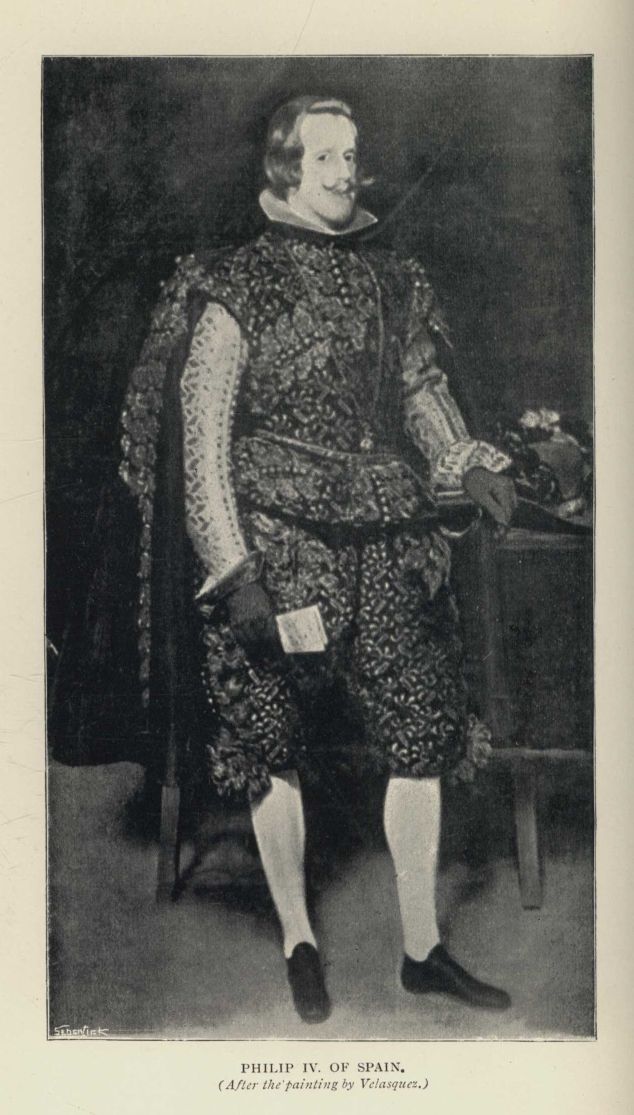
PHILIP IV. OF SPAIN. (After the painting by Velasquez.
Headpiece

A SPRIG OF THE HOUSE OF AUSTRIA.[1]
No dead and gone human visage looms so clearly through the mist of ages as that strange lymphatic face of Philip IV., which the genius of Velazquez delighted to portray from youth to age. The smooth-faced stripling in hunting dress, with his fair pink and white complexion, his lank yellow hair, and his great mumbling Austrian mouth, shows more plainly on canvas than he could have done whilst alive how weak of will and how potent of passion he was, how easily he would be led by the overbearing Count-Duke of Olivares to sacrifice all else for splendid shows and sensuous indulgence; how his vanity would be flattered by poets, painters, and players, whilst the world-wide empire of his fathers was crumbling to nothingness beneath his sway, and his vassals were being robbed of their last maravedi to pay for the frenzy of waste and prodigality with which Charles Stuart was entertained or a royal wedding celebrated. Thenceforward, through his fastuous prime, stately and splendid in his black satin and gold, to the time when, old and disappointed, with forty years of disastrous domination, the rheumy eyes drawn and haggard, but the head still erect, haughty and unapproachable in its reserve, the great painter tells the King's story better than any pen could write it. There is something not unlovable in the shy, weak, poetic face, and one can pity the lad with such a countenance who found himself the greatest king on earth at the age of sixteen, surrounded by fawning flatterers and greedy bloodsuckers who plunged him into a vortex of dissipation before his father's body was cold in the marble sarcophagus at the Escurial. The old man's face, too, cold and repellent as it is, shocking as are the ravages that time and self-indulgence have stamped upon it, has yet in it an almost plaintive despair that explains those terrible broken-hearted letters in which the King, icy and undemonstrative as he was, poured out his agony and sorrow undisguised for years to the only person in the wide world he trusted, the nun Maria de Agreda.
His long reign, which saw the ruin of the Spanish power, witnessed also the most splendid epoch of Spanish art and literature, the golden age of the Spanish stage, and a wasteful prodigality of magnificence in the Court such as, with the exception of that displayed by Philip's son-in-law, the Roi-soleil, the world has never seen equalled. The Elizabethan age in England may have approached it in literary strength, although even that cannot show such a galaxy as Lope de Vega, Calderon, Velazquez, Murillo, Tirso de Molina, Moreto, Quevedo, Guevara, Montalvan, and their host of imitators. The history of the reign has never yet been adequately or even fairly written. Isolated portions and detached incidents or personalities have been dealt with, and stray fragments now and again bring vivid pictures of the sumptuous Court before us. Spanish writers, of late years particularly, are fond of dwelling with microscopic minuteness on the incidents and adventures of the time that happened at particular spots in the capital; but the topographical-historical style, first introduced by Mesonero Romanes, and now so popular, pleasant reading as it is, does not attempt to do more than amuse by presenting romantic and detached pictures of a bygone age, and all that can be claimed by the writers is that materials are gradually being collected and brought to light by them from contemporary sources which will be invaluable to the future serious historian of the reign.
The British Museum contains many hundreds of unpublished manuscripts bearing upon the subject—copies of official documents, letters, and "relations" from Philip's Court, petitions and statements of grievance addressed to the King, and vast collections of miscellaneous papers in Spanish, Portuguese, and French, most of which have not yet been consulted for historical purposes. Amongst a great mass of rather dry official documents of the period, most of them copies, I recently came across a small, compact group of papers, all originals, telling a curious, plaintive little story, nakedly enough, it is true, but not without a pathos of its own. There is nothing historically important in it, or in the fact that it discloses probably for the first time since it happened, but a quaint side-light is thrown by some of the documents on the way in which Court intrigue was conducted, and also, curiously enough, on the opinion of the highest authorities of those times as to the best way of bringing up a child, by which it will be seen that, allowing for difference of climate and national habits, no great change has taken place in this respect in the two centuries and a half that have passed since the papers were penned.
Philip had succeeded to the throne on the death of his father in March, 1621. He was only sixteen, and Olivares at once plunged him into such distractions as the then most dissolute capital in Europe could afford. By a strange coincidence the paper in the Museum (Egerton MSS., 329) which precedes the group of which I wish to speak is a lengthy and solemn letter, dated only a few weeks after the young King's accession, addressed to the Count-Duke by the Archbishop of Granada, remonstrating with the all-powerful favourite for taking the boy-king out in the street at night. "People," he says, "are gossiping about it all over Madrid, and things are being said which add little to the sovereign's credit or dignity." Madrid even now is fond of scandal, but in the beginning of the seventeenth century, isolated from the world as was the capital of the Spains, its one absorbing pursuit from morn till night was tittle-tattle, and the long raised walk by the side wall of the church of St. Philip, fronting the Onate palace in the Calle Mayor, was a recognised exchange for the scandal-mongers. The Archbishop says, in his bold and outspoken letter, that not only have these people begun to whisper things that were better unsaid, but the example shown by the King and his minister in scouring the streets in search of adventure is a bad one for the people at large, and he reminds Olivares of the anxiety of the late King on this very account, and his dread that his heir was already before his death being inducted into dissipation. The answer to the bold prelate's remonstrance is just such as might be expected from the insolent favourite. He tells him in effect that he is an impertinent meddler, and ought to be ashamed, with his rank, and at his age, to trouble him with the vulgar gossip of the street. The King, he tells him, is sixteen and he (Olivares) is thirty-four, and it is not to be expected that they are to be kept in darkness as to what is done in the world. It is good that the King should see all phases of life, bad as well as good. He (Olivares) never trusts the King with any one else; and the favourite finishes his answer by a scarcely veiled threat that if the Archbishop does not mind his own business worse may befall him. No doubt the prelate took the warning, for Olivares was not scrupulous, and had a short and secret way with those who incurred his displeasure.
The small group of original papers coming after this begins with a memorandum unsigned, but evidently written by Olivares to the King some nine years subsequently, namely, early in the summer of 1630. It says that it is high time that measures should be taken at once to put a boy, whose name is not given, out of the way, as he is now four years old, and it is of great importance that he should be concealed, and all communication broken off between him and the people with whom he has been. The writer goes on to say that he has considered deeply how this is to be done, and that there are objections to be found in every solution that presents itself, but he thinks on the whole the best way will be to entrust him secretly to the care of a gentleman of his acquaintance named Don Juan Isassi Ydiaquez, who lives at Salamanca. He is a person of education, has travelled all over Europe, and could bring the lad up as his own. It will be necessary to see this gentleman first, and the writer proposes to summon him to Court without telling him the reason, so that "Your Majesty" may see him and then decide for the best. Across this document is written in Philip's uncertain, poetic hand: "It appears very necessary that something should be done in this matter and I approve of what you suggest.—P."
Presumably Ydiaquez was sent for and approved of, as the next document in the series is of a much more formal character, being a notarial deed drawn up by the Secretary of State, Geronimo de Villanueva as prothonotary of the kingdom, who was, with the exception of Olivares, the principal confidant of Philip's intrigues.[2] This deed, dated June 1, 1631, recites that his Excellency Don Caspar de Guzman, Count of Olivares, Duke of San Lucar, Grand Councillor of the Indies, Councillor of State, and Master of the Horse, delivers a boy named Francisco Fernando, aged over four years to Don Juan Isassi Ydiaquez, this boy being the person referred to but not named in his Majesty's warrant, under his sign manual, addressed to Don Juan Isassi, and countersigned and delivered to him by the Secretary of State. The deed directs that Don Juan is to bring up the boy and educate him in conformity with the instructions to be given to him by the Count-Duke, by his Majesty's orders, and Don Juan himself undertakes in the deed to deliver up the person of the said Don Francisco Fernando when required, and to obey implicitly in all things the directions of the Count-Duke with regard to him. He promises to bring him up and rear him as he is ordered to do in the royal warrant. The deed is signed by the Count-Duke, Isassi, the King's secretary Carnero, and two servants, and is attested in notarial form by Villanueva, as prothonotary of the kingdom.
Then comes the King's warrant, under Philip's own sign manual, in the fine old Spanish form:—
"The King—Don Juan Isassi Ydiaquez. The Count-Duke will deliver to you a boy in whose education and virtuous bringing up you will serve me well and with absolute secrecy, following therein all the orders given to you by the Count-Duke. I, the King."
It is clear that this Don Francisco Fernando was no ordinary babe of four to require the personal attention of all these high and mighty gentlemen in sending him to school. Philip had one child by his wife at this time, the chubby youngster Don Baltasar, who for all time will prance on his stout bay cob on the canvas of Velazquez, and only the year previous, in 1629, there had been born to the King, by the beautiful actress, Maria Calderon, the idol of the Spanish stage, a boy who in the fulness of time was to become that second great Don John of Austria, the last virile man of his race; but Don Francisco Fernando was the first-born, and apparently his mother was of far superior social rank to the jaunty "Calderona," so that he was no doubt, baby as he was, destined for great things. The instructions given by the Count-Duke to Don Juan Isassi with regard to the care of his charge are minute to the last degree, and reflect in every line the great importance that is attached to the identification of the child. The long document begins by saying that the boy delivered to Don Juan is the illegitimate son of the King by the daughter of a gentleman, and was born in the house of his grandparents, between eleven and twelve at night, on May 15, 1626. Don Francisco Eraso, Count of Humanes, took the midwife, and was present at the birth; conveying the infant as soon as it was born to the house of Don Baltasar de Alamos y Barrientos, Councillor of the Treasury, where a nurse was awaiting him, and the child had there remained until its delivery to Don Juan. After impressing upon Don Juan the need for the most exquisite care to be taken of the child's life and health, and arranging for the nurses and doctor who have had the care of him to accompany him to Salamanca for the first few months of the change, the Count-Duke instructs Don Juan to seek a good doctor to be kept at hand permanently, who is not to be told who the boy is unless his services are required, and in the meanwhile is to receive a good salary. "His Majesty," says Olivares, "has confided this care to me, and I depend upon you to carry out the task."
First of all the child was to be well taught in religion and morality; secondly, on no account was he to learn who he was, and if his attendants have already told him incautiously he is to be allowed to forget it, and "neither by word nor behaviour is he to be made to think that he is not an ordinary person;" thirdly, he is to be taught polite learning and languages, particularly Italian and French, to dance, fence, and play tennis, and, when he is a little older, to ride. He is to be treated familiarly and without ceremony, and, "in short, to be educated and brought up with the virtues and nobleness of royalty, and the study, modesty, knowledge, and temperance of a private person." Don Juan is to send a weekly report to the Count-Duke through his secretary Carreras, but to take care that this is done with the utmost secrecy, and on no account is the child to be shown to any one without a written order. As secrecy is of the first importance 500 (ducats) a month only are ordered to be paid, besides the doctor's fees, and Don Juan is to devise some means for the secret payment of this sum. A coach is to be secretly got ready to meet the Count-Duke and the child on the night and at the place which may be appointed for the delivery; and then, after another urgent injunction of secrecy and care of the child's religious instruction, and a fervent prayer that God will give to the little one "all the happiness, spiritual and temporal, which He will see is necessary and good for the realm," the proud favourite signs himself simply Caspar de Guzman.
The hidalgo of Salamanca appears to have been quite overwhelmed at the honour done him by the charge of so important a person, and his ceremonious and verbose letter of thanks to the Count-Duke needed hardly to be prefaced by the prayer that his patron will not attribute his laconic speech to the proverbial taciturnity of his countrymen, but rather to his confusion at the greatness of the honour done him by his Majesty, for which words are inadequate to express his gratitude. His only thanks can be his faithful fulfilment of orders. He begs that the doctor who has had the care of the little one may be sent to Salamanca with him in order to consult with Don Juan's doctor, and ascertain whether he is fit to undertake so important a charge, and if not he will approach cautiously a doctor in Vitoria, named Trevino, of whom he hears good accounts. The woman who accompanies the child shall stay with him some short time, although the good hidalgo is evidently rather doubtful of this arrangement, as he adds that if she should find the horizon of their dull country life too confined for her after Madrid, or begins to kick against the discipline, other arrangements will have to be made. All care shall be taken to prevent the boy from learning who he is, and if it should get wind efforts shall be made to silence it, but the task will be a difficult one. The child shall be so reared, please God, that he shall not become abject or servile (which is most important to a royal personage), or licentious and headstrong; and the good hidalgo thereupon breaks out into a mild pedantic little joke by quoting a Latin proverb, to the effect that, to attain so great an object as this, one must be prepared to eat salt and acrid food, which, he says, will be easy for him to do, "as we all live on salt bacon and hung beef in my province." This does not sound very promising, nor does his description of the water they have to drink, which he says is bad to drink raw, particularly in the summer, and needs cinnamon or other spice to correct it. The doctor, he says, will advise whether they had better boil it with mastic or some other drug. The correspondence shall be sent weekly through "my nephew, Don Alonso Ibarra Isassi, the eldest of the lads I took to Madrid with me. He is a good, prudent, and modest lad, and a correspondence between us as uncle and nephew will arouse no suspicion." As for the 500 ducats a month payment, the good hidalgo says his cheeks burn with shame as he writes or even thinks about them; "but if your Excellency should deign to order them to be paid to me they might be sent without attracting notice through the treasury at Vitoria or Burgos."
So the little child is sent to Salamanca, and with him goes the ponderously learned Dr. Cristobal Nuñez, who wraps up the simplest facts in the most complicated and pedantic technical phraseology, and, what is far more troublesome for the present purpose, writes a shockingly bad hand. His first document is a microscopic report of the constitution and temperament of the child, and the simple history of his baby ailments. The description is most curious; and, if any doubt existed as to his paternity, every trait indicates the character and appearance of a son of the sovereign race of Austria. "He is," says the learned doctor, "of melancholic, choleric temperament, wilful and passionate, but playful when he is pleased, and respectful to those he thinks his superiors. He is of sound constitution, being the offspring of young and healthy parents; possesses superior intelligence for his age; a wonderful memory, which gives great hope if he be well trained. He is slow of speech, and expresses himself with great difficulty, stuttering and lisping; and is so backward on his feet that he has only just learnt to walk. His person is so perfect and beautiful, that the mind of a sculptor never imagined anything better; he has a lovely, fair, red and white complexion, and full grey eyes. He is grave and thoughtful—not dull or sad, but full of childish humour; quick to laugh and quick to cry. He is," says the doctor, "high of spirit, courageous, and pugnacious, impatient of contradiction; and, if his speech be not at once understood, he flies into such ungovernable rage as to make it dangerous to thwart him, and he should rather be coaxed to obedience than forced."
Like all his forbears, he is described as a great eater, and very fond of sweets; and it is not surprising to learn that he has all his short life suffered from over-eating and indigestion, and for long past has had quartan ague. The drastic remedies of the times were endured by the child, the doctor says, "without weeping, as if he knew they were for his good"; but the learned medico confesses that all his own prescriptions had done the babe less good than what he describes as an old wife's remedy of anointing the stomach and spine with ointment and saffron.
The child's usual mode of life is carefully described. Between eight and nine in the morning he had a fowl's liver and a little loaf, or else some bread or cake sopped in broth, or bread and jam and a cup of water. At twelve o'clock broth with sippets of bread or half of the breast of a fowl, or sometimes some forcemeat balls, as he likes a change, and demands it. When he gets tired of this he may have a little loin of mutton or the leg of a fowl. He is also very fond of a piece of bacon between two slices of bread, and of quince marmalade, jams, and sweets. At five o'clock he "packs his wallet," as the doctor calls it, by a meal of bread and jam, and a cup of water. He is put to bed at nine o'clock, and sleeps with his nurse. The learned Don Cristobal then enters into a most verbose disquisition as to the fitness of the locality chosen for the temperament of the child, and arrives at the conclusion that the choice has been a wise one, although the roundabout method of argument founded on wise talk about blood and humours and vapours and the like seems rather beside the mark to a modern reader. The sum of it all is, however, that Don Juan de Isassi's house stands healthily, if somewhat bleakly, on high ground about three bow-shots from the town, and joining the great convent of the Suceso, the house itself being a good one, surrounded by its own grounds.
Thus far the doctor has only spoken of the constitution and past management of his late charge; but the next document, which bears the same date as the preceding one (June 18, 1630), lays down an elaborate plan for the future rearing of the child. He recommends that he should be allowed to play after his early supper, and not be sent to sleep before nine at night, unless he feels sleepy. He is to be woke at eight, if he is not already awake, and is to be given his light breakfast of a fowl's liver and cake, a rasher of bacon and bread and broth, or a roasted egg. At eleven or twelve he is to dine on forcemeat balls, made of two parts chicken, one part mutton, and one part bacon, with a little pie or broth with sippets. Sometimes, instead of force-meat balls, he may have the leg of a fowl, which, if he likes it, will be enough for him, with a little bread soaked in broth, or he may have a mouthful of mutton with chicken broth. It will be well, says the courtly doctor, that the gentleman himself should be consulted occasionally as to whether he preferred the fowl or the sausages, or roast or boiled food. He is to sleep about an hour and a half after dinner, and play in the afternoon; but great care must be taken to keep him out of the sun, and his early supper may be as heretofore, only somewhat later; a biscuit or two with jam, a small egg, such as the fowls of the province lay, or sippets in broth. A curious and somewhat elaborate little dish is recommended for occasional breakfast or supper. "Take," says the doctor, "a half-dozen almonds or melon seeds, and press the juice from them, which mix with a little barley-cream and some good broth. This must be boiled, and sugar and sponge-cake worked into it until it is a smooth paste, which may be served with half a beaten egg over it, and will make a nice light supper." It will be good to excite the appetite by variety, and as the child gets older he may sometimes be given coarser food, and trout or other fresh fish. He must drink fresh spring water boiled with viper-grass, or mixed with cinnamon, according to the weather. He is always to have some fruit for dessert, unless it disagrees with him; but much care must be taken to guard him from excess; and he is to be specially sparing in drinking. Full common-sense directions are given with regard to his dress, and if he needs medicine his food must be reduced by one half, and a decoction of mallow and camomile, honey and oil administered. Red Alexandria honey is also recommended, quinces, oil of wormwood, and a variety of other remedies for simple ailments.
There is yet another document from the doctor giving some further rules, apparently in answer to special questions. In it he again learnedly describes the child's constitution, his weak stomach and aptness to catch cold, inherited from his parents, his tendency to hydrocephalus, and his almost continuous series of ailments since he was born, which, says the medico, would have killed him but for his strong constitution. From seven years old he was to eat fish and other Lenten fare, and at twelve years must be taught to fast. Above all, he is not to be brought up delicately or coddled, but encouraged to run and romp. Great care must be taken that he is not exposed to the cold, but he must be well wrapped up even in summer. Drugs are to be given sparingly, if at all: mallow, camomile, sweet almonds, black sugar or honey if wanted; but he is not to be constantly dosed with red honey and other things as children usually are, and if he is really ill he is not to be lowered or bled much; by which it will be seen that Dr. Cristobal Nuñez, pedantic as he was, differed somewhat from the usual type of sangrados of the time. All this was between the 1st and 18th of June, 1630, and it is to be supposed that the poor babe of the house of Austria lived his little life in and around the "Casa Solariega" of the Salamancan hidalgo for the next few years, although no record remains of it here.
The next document of the series is a letter, elated nearly four years afterwards, March 17, 1634, from the Secretary of State, Geronimo Villanueva, to Don Juan Isassi Ydiaquez, saying that his Majesty had received with the deepest grief the news of the death of Don Francisco Fernando, who showed such bright promise for his tender years, and his Majesty highly appreciates all the care that has been taken of his education. The body is to be brought with the utmost secrecy in a coach to the royal monastery of St. Lorenzo (the Escurial), where it is to be buried, and advice is to be sent by confidential special messenger to Madrid when the corpse should arrive, in order that one of the King's stewards may be there to receive it. All the other arrangements for the burial are made. The four years had apparently not been unprofitable ones to the hidalgo, as the next time his name appears he is a knight of Santiago and lord of the town of Ameyo, as well as of the castles of Isassi and Orbea. The date of the document is April 15, 1634, and again it is a notarial deed attested by the prothonotary of the kingdom, Don Geronimo Villanueva, setting forth that Don Juan Isassi Ydiaquez delivered the body of Don Francisco Fernando, son of his Catholic Majesty Philip IV., whom God had taken to himself, to the Marquis of Torres, the Bishop of Avila, and other nobles appointed by the King to receive it. The delivery was made in the porch of the cathedral, and we are told that the corpse was dressed in a red gown, bordered with gold, and lay in a coffin of black velvet. The coffin, which had been borne by Don Juan Isassi and his servant to the porch, was thence carried to the great hall of the monastery by certain of the King's gentlemen-in-waiting, and after the religious ceremonies had been performed, was taken to the vault by the monks of the Order and laid to rest. And so ended a little life which, like that of his half-brother Baltasar, if it had been spared, might have stayed the decay of the Spanish branch of the House of Austria. It is true that Don John of Austria survived, and for a short time snatched his poor brother, Charles the Bewitched, from the clutches of his foolish mother and her low-born favourite, Valenzuela, but who knows whether the strong, masterful spirit of the baby of four whom it was dangerous to thwart might not, if he had grown to manhood, have done more than his younger brother to keep the reins of power when once he grasped them. Poor trembling, white-faced Charles the Bewitched, with his leaden eyes and monstrous projecting jaw, a senile dodderer at thirty, wanted a strong, masterful spirit like this to hold him up and shield him from the vultures that fought over the carcase before the poor creature was dead.
But it was not to be, and the forgotten babe of the sovereign house was put with so many other princely corpses in that horrible "rotting place of princes," off the black marble stair of the regal pantheon of the Escurial, where, not so very many years ago, I saw a ghastly heap of princely and semi-princely skulls and leg-bones gathered up as they had fallen from the rotting coffins to the floor. There, all undistinguished from the others, probably enough rests still, his very name never published, and his short existence hardly known till now, Don Francis Ferdinand of Austria, one of the last male members of the Spanish branch of the sovereign house, which in four generations descended from the highest pinnacle of human greatness to contempt, disgrace, decrepitude and decay.
THE JOURNAL OF RICHARD BERE.
Headpiece
THE JOURNAL OF RICHARD BERE.[1]
In the course of a recent search amongst the Sloane MSS. at the British Museum for a document of an entirely different character I chanced upon a manuscript which, so far as I have been able to discover, has never yet been described in print or received the attention it appears to deserve. It is a long, narrow book like an account book, in the Sloane binding, containing 244 pages of cramped and crowded little writing in faded ink on rough paper, recording the daily—almost hourly—movements of a man for eleven years, from the 1st of January, 1692-3, to the middle of April, 1704. It is written in Spanish—Englishman's Spanish, full of solecisms and English idioms, but fair and fluent Castilian for all that, and the diarist, thinking no doubt his secrets were safe in a language comparatively little known at the time, has set down for his own satisfaction alone, and often in words that no amount of editing would render fit for publication, the daily life of one of the dissolute men about town, who roistered and ruffled in the coffee-houses and taverns of London at the end of the seventeenth century. Few men could hope to possess the keen observation and diverting style of Samuel Pepys, or the sober judgment and foresight of stately John Evelyn, and this last contemporary diarist of theirs certainly cannot lay claim to any such qualities. He rarely records an impression or an opinion, and as a rule confines himself to a bald statement of his own movements and the people he meets day by day; but still, even such as it is, the diary is full of quaint and curious suggestions of the intimate life of a London widely different from ours. The familiar names of the streets, nay, the very signs of the taverns, are the same now as then, but in every line of the fading brown ink may be gathered hints of the vast chasm that separates the busy crowded life of to-day from the loitering deliberation with which these beaux in swords and high-piled periwigs sauntered through their tavern-haunting existence. It strikes the imagination, too, to think that the man who thus sets down so coarsely and frankly the acts of his life must have listened, with however little appreciation, to the luminous talk of wondrous John Dryden at Will's coffee-house, most certainly knew the rising Mr. Addison, and probably met Matthew Prior at his old home at the "Rummer" tavern, which the diarist frequented.
There is nothing in the manuscript directly to identify the writer, and probably the indirect clues furnished by references to his relatives have never before been followed up to prove exactly who the author was. The task has not been an easy one, and has started me on more than one false scent ending in a check, but at last I stumbled on evidence that not only absolutely identified the diarist, but also explained many obscure passages in the manuscript.
From the first page to the last the writer refers to Danes Court, near Deal, as the home of his brother, and he himself passes the intervals of his dissolute life in London in visits to his Kentish kinsman. Now Danes Court had been for centuries in the possession of the ancient family of Fogge, and I at once concluded that the writer of my diary was a younger member of the house. Indeed, encouraged therein by Hasted, the great authority on Kentish history, I went so far as to establish to my own entire satisfaction that the diarist was a certain Captain Christopher Fogge, R.N., who died in 1708, and was buried in Rochester Cathedral, and I was confirmed in this belief by the fact that the wind and weather of each day is carefully recorded as in a sailor's log-book. But somehow it did not fit in. Constant reference is made to a brother Francis, and no amount of patient investigation in county genealogies and baptismal certificates could unearth any one named Francis Fogge. So I had to hark back and try another clue. Brother Francis was evidently a clergyman and a graduate of King's College, Cambridge, and towards the end of the diary the author visits him at the village of Prescot, near Liverpool.
Sure enough the rich living of Prescot was in the gift of King's College, Cambridge, and further inquiry soon showed that a certain Francis Bere, M.A., was rector from 1700 until his death in 1722. This of itself was not much, but it led to further clues which proved the monumental Hasted ("History of Kent") to be hopelessly wrong about the Fogge pedigree and the ownership of Danes Court at the time, and the whole question was settled more completely than I could have hoped by the discovery, in the "Transactions of the Kent Archæological Society for 1863," of a copy of the copious memoranda in the old family Bible, written by the stout cavalier, Richard Fogge, and his son John, with the notes attached thereto by Warren, the Kentish antiquary in 1711, in which the family history is made clear. This was good as far as it went, and proved the surname and parentage of the author of the diary, but did not identify him personally. Certain references in the manuscript, however, sent me searching amongst the Treasury Papers in the Record Office, and there I found a set of papers written in the same cramped, finnicking hand as the diary, which set my mind at rest, and proved beyond doubt or question who was the methodical rake that indiscreetly confided the secret of his "goings on" to the incomplete oblivion of the Spanish tongue.
The writer of the diary was one Richard Bere, whose father was rector of Ickenham, near Uxbridge, and who was born at Cowley, near there, on the 28th of August, 1653. His sister Elizabeth had married in 1679 John Fogge, who subsequently succeeded to the Danes Court Estate, and, on the fly-leaf of the Fogge family Bible referred to, John Fogge, who was evidently proud of the connection, sets forth that his wife's grandfather had been "Receiver General of ye Low Countries; her uncles, one of them was in a noble imploy in ye C Clarke's office, ye other being one of ye clarkes of ye signet to King Charles II., a man acquainted with all Xtian languages. Ye other now alive is rector of Bendropp in Gloucestershire, who has an Estate. Her mother was one of ye family of Bland, of London, eminent merchants at Home and Abroad." Richard Bere was born only a year after his sister, so that the statement as to her relatives will hold good for him also. He had been Collector of Customs at Carlisle, but apparently had allowed his Jacobite leanings to be too evident, and had been dismissed from his office a short time before he began the diary, leaving his accounts at Carlisle still unbalanced and in arrear. How he learnt Spanish I do not know, but he had evidently been in Spain before his appointment to Carlisle, probably in the navy, or in some way connected with shipping, as, in addition to the careful noting of the wind and weather all through the diary, he shows great interest in the naval events of his time. His uncle's remarkable proficiency in "all Xtian tongues" may also perhaps partly explain his own knowledge of the Spanish language. His family in old times had been a wealthy and powerful one, seated at Gravesend, Dartford, and Greenhithe in Kent, but had lost its county importance long before the date of the diary. The widow of one of his uncles, however, still lived at Gravesend at the time he wrote, and one of his father's sisters, who had married a man named Childs, also lived in the neighbourhood, and on her husband's death went to live with her niece at Danes Court.
The diary commences on the 1st of January, 1692-3, when Bere was living at Mr. Downe's in London, but the detailed entries begin on the 9th of the month, when he went by tilboat from Billingsgate to Gravesend. Here, after visiting his aunt Bere and his kinsman Childs at Northfleet, he slept at the inn, and started the next morning in a coach to Canterbury. The next day he continued his journey to Danes Court on a hired mare, and then after a few days rest, "without seeing anybody," begins a round of visits and carouses with the neighbouring gentry. All the squires and their families for miles round march through the pages of the diary. Mr. Paramour, of Stratenborough; Mr. Boys, of Betshanger, "my uncle Boys," who was probably Christopher Boys, of Updowne, uncle by marriage to John Fogge; "my uncle Pewry," who was rector of Knowlton, but whose relationship with the diarist is not clearly discoverable; Mr. Burville, rector of the Fogge Church of Tilmanston, and a host of other neighbours come and go, dine and drink, often staying the night, and in a day or two entertain John Fogge and his brother-in-law in return. The latter records the fact, but unfortunately does no more, and little is gathered of the manner of their lives at this period of the diary, except that they did a prodigious deal of visiting and dining at each others' houses. One of the most constant visitors to Danes Court is the aged Lady Monins, of Waldershare Park, the widow of the last baronet of the name, and Richard Bere appears to be as often her guest at Waldershare. The round of dining and visiting is broken in upon by a visit on horseback with brother John Fogge to the assizes at Maidstone, where the latter has a lawsuit which he loses, and Richard returns to Danes Court alone, leaving his defeated brother at Canterbury. On the 12th of April the diarist records that he first saw the swallows, and on the 20th, as instancing the uneventful life in this remote part of the country, it is considered worth while to register the fact that "whilst I was digging in the garden with Carlton a man passed on horseback." A few days afterwards neighbour Carlton's daughter is married, and then "my nephew Richard was first sent to school at Sandwich, Timothy Thomas being master." Richard, the heir of Danes Court, was about twelve years old at the time, and, as we shall see later on, turned out badly and completed the ruin of the fine old family, of which he was the last male representative in the direct line. Timothy Thomas, who was a distinguished scholar and M.A. of Sidney-Sussex College, Cambridge, was headmaster of the Sandwich Free School and brother to the rector of St. Paul and St. Mary, Sandwich. He seems to have been always ready for a carouse at the hostelry of the "Three Kings" at Sandwich or elsewhere with the father or uncle of his pupil.
On the 28th of April "the fleet entered the Downs, the wind blowing a gale at the time. A ship called the Windsor was lost. I went to Deal to see the ships, and saw five ensigns." Small details of ablutions—rare enough they seem nowadays—bed-warming, and quaint remedies for trifling ailments sound queerly enough to us coming faintly across the gloom of two centuries, but in the midst of the chronicles of this small beer of visits paid and received, of the stomach-ache, and so on, brother John receives a writ, and we feel that we are witnesses of the process by which all this feasting and revelry is completing the ruin of the ancient family that once owned broad lands and far manors all over Kent, which founded hospitals and colleges, and was closely allied to the regal Plantagenets, but whose possessions had even now shrunken to one poor mansion house of Danes Court and the few farms around it. John Fogge's father, Richard, whose pompous Latin epitaph is still in Tilmanston Church, written by his eldest son, Edward, and scoffed at in the family Bible by the degenerate John, had been true to the King's side during the civil war. His near neighbour, Sir John Boys of Betshanger, had hunted and harried the cavalier and sacked his house after the mad Kentish rising in 1648, and had frightened his favourite child to death, and for the whole of the Commonwealth period poor Richard had been plundered and well-nigh ruined. His sons Edward and John had been captured at sea by the Dutch, and Christopher had been taken prisoner by the Turks, and all three had had to be bought off with ransom. Stout old Richard Fogge therefore had left Danes Court sadly embarrassed at his death in 1680. His eldest son, Edward, died soon after, and John Fogge, the brother-in-law of our diarist, was rapidly continuing the ruin at the date of the diary. By the 30th of May Richard Bere had had enough of Danes Court, and started to Canterbury "with my brother's horse and servant, and so to Northfleet, where I visited my kinsman Childs." He mounted his horse at five o'clock in the morning and arrived at Northfleet at five in the evening, staying on the way only a short time at Canterbury to rest and drink with friend Best, at whose house he always alights when he passes through the ancient city. The distance by road is a good fifty-five miles, so Richard no doubt thought he had earned his night's rest at Uncle Childs' before starting, as he did next day, by tilboat to London. The first thing he did when he arrived was to "drink with Higgs" and send for Benson to meet him at Phillips' mug-house. Benson appears to have been a humble friend or foster-brother, as Bere calls Benson's father "my father Benson," who went on all his errands, pawned his valuables, and faced his creditors. When Benson came they started out together and took a room, where they both slept, "at the sign of the 'Crown,' an inn in Holborne," and the record thereafter for some time consists mainly of such entries as "Dined with Sindry at the 'Crown,' and drank with him all the afternoon and evening at Phillips'. Slept at Mrs. Ward's;" "Dined with Dr. Stockton, Haddock, and Simpson at the 'Pindar of Wakefield';" "Dined at the sign of the 'Castle,' a tavern in Wood Street, with many friends from the North; drank there all the afternoon, and all night drinking with usual friends at Phillips'," only that these daily entries usually wind up with the record of a debauch which need not be described, but which Richard does not hesitate to set down in such cold blood as his orgy has left him.
He appears to have had as a friend one Westmacott, who was a prison official, and a standing amusement was apparently to go and see the prisoners, who sometimes fall foul of Westmacott and his friend and abuse them. Richard also has a quaint way of drawing a miniature gallows in the margin of his manuscript on the days that he records the execution of malefactors. On the 15th of June, for instance, after giving his usual list of friends and taverns, he writes: "Seven men hanged to-day; fine and warm. Drinking at Phillips' at night; Westmacott there again." A day or two afterwards the bailiffs walk in during his dinner at the tavern and hale his boon companion, Pearce, off to jail; but Richard thinks little of it, for he goes off to drink straightway with Colonel Legge, and then passes a merry evening with Dr. Stockton and Mr. Rolfe at the sign of the "Ship," near Charing Cross.
On the 29th of June "a new sword-belt, some woollen hose, and a rosette for my hat," were bought; and soon after he leaves his lodgings at Mrs. Ward's, and thenceforward seems to sleep in taverns or inns for some time, very often winding up the entries in the diary by confessing that he was "drunk" or "very drunk."
On the 18th of July, 1693, he visits "the house of the Princess of Denmark with Mr. Wooton," and thence goes to see a fashionable friend of his called Captain Orfeur, who had a fine house at Spring Gardens, where he meets his brother, and they all make a night of it at the "Ship." By the beginning of August it is not surprising that he is ill, and decides to visit his brother Francis in the country. On the 3rd he takes horse to Biggleswade and thence to Oundle, "where I met my brother and Mr. Rosewell" (he was a fellow of "King's," and apparently a great friend of Francis Bere's). "Dined at Caldwell's, and slept at the sign of the 'Dog.'"
He stays at the "Dog" at Oundle for some days, still ill, and visits Northampton, where he is struck with the curious church, town-hall, prison, and courts of justice, and slept at the "George." From there he rides to the "Angel" at Wellingboro', and so home to London by Dunstable, where he stays at the "Saracen's Head," Watford, Rickmansworth, and Uxbridge, where he puts up at the "Swan." Being now well again, he recommences the old round of the "Horns," the "Red Cow," the "Mermaid," the "Crown," and so on, usually winding up with a roaring carouse at Phillips', and occasionally relieved by trips to Islington-wells to walk in the fields with friend Stourton, who lives near there, and who later on becomes his inseparable companion. To illustrate the methodical character of this roistering blade, it is curious to note that, as he could not well carry his cumbrous diary with him on his journey to Oundle, he has made his daily entries on a small loose leaf and has afterwards carefully transcribed them in the book, the loose leaf, however, being also bound up with the rest. On the reverse side, in English, Richard has copied the following couplet of Lord Thomond's, which seems to have struck him:—
"Whatever Traveller doth wicked ways intend, The Devill entertains him at his journey's end,"
and to this he adds several little remedies which some travelling companion seems to have told him on the road. He scrupulously records the fact that the day is his birthday on each succeeding 28th of August, and the occasion appears to be an excuse for a burst of deeper drinking than ever, but on this first birthday mentioned in the diary, 1693, he is evidently getting hard up. He lodges with a man named Nelson, who ceaselessly duns him for his rent, and we soon learn that the faithful Benson has pawned his two rings for eighteen shillings. On the 27th of September his friend Dr. Stockton tells him "that Mr. Addison told him that I lost my place because I was against the Government, and was foolish enough to talk about it, which," says indignant Richard, "is a lie."
It sounds curious nowadays to read that he and his friends, Westmacott and others, sometimes walk out in the fields to shoot with bows and arrows, and usually return thence to the "Hole-in-the-Wall" to pass the evening.
As a specimen of the entries at this period, I transcribe that for the 30th of September, 1693, at least so much of it as can well be published. "With Metham and Stourton to the City, and dined at the 'Ship' in Birchin Lane. Vickers there, and we went together to the Exchange and met Mr. Howard; with him to the 'Fountain,' Mr. Coxum there. At five o'clock went to Sir James Edwards', and drank there two flasks of wine. Then to the 'King's Head,' where I left them and went to Mr. Pearce's house and received ten pounds. Found Stourton very drunk. Went and paid Jackson and Squires. Slept at Pearce's—drunk myself." With the ten pounds received from Mr. Pearce Richard seems to have set about renewing his wardrobe, and duly records the days upon which his various new garments are worn. On the 26th of October "Aspin, the tailor, brought my new white breeches in the morning, and we went out to drink at the 'Bull's Head' in Mart Lane." On the second of November he recites the names of six taverns at which he drank during the day, namely, the "Bull's Head," the "Red Cow," the "Ship," the "Horns," the "Cheshire Cheese," and the "Crown," and on the 7th of the same month a dreadful thing happens to him. The constables walk off his dulcinea, Miss Nichols, to jail, and Richard is left to seek such consolation as he can find at the "Chequers," the "Three Cranes," and the "Sugar Loaf." The next day he seeks out his friend Westmacott at the "King's Head," and is taken to the prison to see the incarcerated fair one. Whilst there he "meets the man who has done the mischief." But he winds up at the "Sugar Loaf" in Whitefriars, and Phillips' mug-house, and is carried home thence in a coach too much overcome by his grief and potations to walk. On the 14th, after several more visits to the prison, he bewails that he can do nothing for Nichols, and on visiting a Mrs. Hill, that kind matron tells him that his great friend, Dr. Stockton, had told her that "I had squandered all I had over a worthless wench, and thought now to live at the expense of my friends," but the entry, unfortunately, winds up with the words: "Borrowed two pounds of Simons on my watch."
After this Richard thinks that quiet Danes Court might suit him for a time, and starts the next day, the 15th of November, as before to Gravesend by the tilboat, and, after a duty visit to his relatives, stays two nights at the sign of the "Flushing," and dines there merrily with "a clergyman named Sell and another good fellow from the North." The same companions and others go with him in the coach to Canterbury, where he stays at the "Fleece," gets gloriously drunk, and is cheated out of half-a-crown, and lies in bed until mid-day next morning, his niece, Jane Fogge, who lived with the Bests at Canterbury, coming to visit him before he was up. In the afternoon he continues his road more soberly to Danes Court on a hired horse, and the old round of visiting and feasting begins afresh. On the first of December he meets Parson Burville, of Tilmanston, and drinks Canary wine till he is drunk. On the 12th Captain Christopher Fogge meets his brother John at a friend's house and they quarrel; Uncle Childs dies, the cat is drowned in the well, three East Indiamen captains dine at Danes Court, Ruggles' wife is confined, and the daily small events of a remote village happen and are recorded much as they might happen to-day. Uncle Boys had a kinsman, presumably a brother, Captain Boys, R.N., who was Constable of Walmer Castle, where he lived. and Richard and his friends often go there to dine and visit the ships in the Downs. On the 26th of February, 1694, they all go to dinner on board the Cornwall, and "they gave us a salute of seven guns." They all went back to the castle to sleep, and John Fogge made a bargain with his weak-witted younger brother William about Danes Court, presumably with regard to his reversionary interest or charge upon the property. But whatever it was it did not matter much, for William Fogge died soon after. On the 25th of March, after going to Betsanger church and to the rectory to see Thomas Boys, "Ruggles threw a poor boy out of the cart and seriously injured him," and on the next day a curt entry says: "The poor lad died at nine o'clock this morning, and was buried in the evening," but not a word about any enquiry or the punishment of the offending Ruggles.
But after five months Richard sighs again for the taverns of Fleet Street, and on the 4th of April, 1694, returns to London by the usual road by Canterbury and Gravesend, and again haunts the taverns and night-houses of the metropolis. He tries hard to borrow money from his friends, and is evidently getting anxious about his Customs accounts left in arrear at Carlisle. He is a pretty constant visitor to Whitehall about a certain petition of his, which petition, although he often mentions it in his diary, he of course does not describe or explain in a document written for his own eye alone. I have, however, been fortunate enough to find the actual document itself in the Treasury Papers at the Record Office, with all the voluminous reports and consultations founded upon it during the seven years it lingered in the Government offices. It appears that in August, 1689, the Earl of Shrewsbury, Secretary of State, had addressed a letter (the original of which is attached to Richard Bere's petition) to the Mayor or Collector of Customs of Carlisle, directing them to provide for the maintenance of certain "papist Irish soldier prisoners" who were to be kept in the castle there. The mayor refused to find the money, and Richard Bere, as Collector of Customs, had to do so, expecting to be reimbursed out of the Secret Service Fund, as provided by the Secretary of State. The prisoners were kept at Carlisle until December, 1690, and Richard spent £74 4s. on their maintenance. He was soon after suddenly dismissed from his post, and was unable to balance his accounts for want of this money, and shortly before beginning the diary had presented his petition to the Lords of the Treasury for the reimbursement of the sum, or at least that it should be handed to the Receiver-General of Customs on his account. But whilst the petition was lying in the pigeon-holes in one office, another office was only conscious that Richard was behindhand in his accounts, and on the 11th of May, 1694, there is an entry as follows in the diary: "Alone to dine at the 'Spotted Bull.' Then to Phillips', where one Petitt told me about the tolls of Carlisle, and said that the bailiffs from Appleby had a warrant to arrest me." Richard did not wait long for the bailiffs, and in less than a week had signed and sealed a bond, apparently for borrowed money to settle his toll accounts, bought a horse and a Bible, had gone to Westminster Hall "about his brother's affairs," and started off for Carlisle. He rode through Oundle, where the Rev. Francis Bere appeared still to be living, and so by Stamford, Grantham, Newark, Doncaster, Ferrybridge, and Appleby to Carlisle. Two days before he arrived at the city some choice spirits came out to meet him, and a host of friends received him with open arms after his ten days' ride. He dines fourteen times with Dick Jackson, drinks often and deeply with the Mayor of Carlisle, collects money owing to him, buys a fine new periwig of Ned Haines, and a new sword, settles up his accounts of tolls, and begs a holiday for the schoolboys, whom he treats all round, and winds up in a burst of jubilation by receiving a present of two kegs of brandy from his friend Bell, which had not paid much to the King probably, and of which, no doubt, the late Collector and his jovial companions gave a very good account. And then, after a six weeks' stay at Carlisle, he wends his way back to London again by the same road, his horse falling lame at Stamford, and the rider having to post from Grantham to Ware, and thence to London by coach. He alights at the "Bell," in Bishopsgate Street, where Benson soon seeks him with fresh clothes and a sedan chair, and takes him to his old quarter of London again.
But poor Richard's prosperity is of short duration. The borrowed money soon comes to an end, with the able and constant assistance of a certain Catherine Wilson, who has now supplanted the vanished Nichols, and by the beginning of September, 1694, Benson is taking one article after the other to the pawnshop, and bringing back sums which Richard regards as very unsatisfactory in amount. On the 6th of that month he attends what must have been rather a curious marriage at the church of St. George's, Bloomsbury, where one of Catherine Wilson's companions, named Early, was married "to a young man named James Carlile, between nine and ten in the morning." The whole of the party adjourn to the fields, and at one o'clock return to drink at the "Feathers" in Holborn, "but the knavish constables disturbed us and we went to Whitefriars; at two I went to seek Benson, but he could only bring me 5s. on my pistols." With this sum Richard finds his way back to Whitefriars, where he remained drinking till evening with the "newly married pair, Catherine Wilson, a gentleman and his wife, and a marine." He then attends a coffee-house, and winds up with a carouse at the "Rising Sun." The unfortunate bridegroom soon disappears from the diary, but the "bride" takes part in the drinking bouts for some time to come. By the middle of October Richard has apparently come to the end of his tether, and, after borrowing a halfcrown on his knives, quarrels with and separates for a time from Catherine Wilson; but brother Francis and sister Fogge are appealed to for money, and when it arrives Catherine is to the fore again. A great scheme is hatched about this time with a Captain Sales and Mr. Butler, apparently relating to the tobacco duties, and the Commissioners of Customs and other officials are being constantly petitioned and visited. Sometimes the tobacco business is considered hopeful, and sometimes the contrary, but on the 7th of January, 1695, it looks very bright when the Lords of the Treasury and the Commissioners of Customs sitting together at Whitehall receive Richard and his two friends, who lay the case before them, but "Mr. Culliford spoke against us," and nothing was decided, so the trio and others who joined them go to the "Rummer" tavern at Charing Cross, and drink confusion to Mr. Culliford. A day or two days after this "a knave came to betray me to the bailiffs," and poor Richard and his friend Sales seek the shady retreat of a tavern in Fulwood's Rents. For the next few days he dodges the bailiffs from tavern to tavern, and sleeps at Bell Court, Whitefriars, and elsewhere. The "knavish" bailiffs even follow friend Sales in the hope of tracking Richard. On the 14th of January the faithful Benson brings his clothes to the new lodging in Whitefriars, and Richard ventures out "to the 'Anchor' in Coleman Street, about the business of Andrew Lloyd and the widow. Then the 'St. John the Baptist's Head' in Milk Street, where I found Butler meeting the citizens about the tobacco business." A few days after, the business of "Andrew Lloyd and the widow" is settled somehow at the "Mermaid" in Ram Alley, and on the 26th Benson pawns all Richard's silver for £5 7s., and Richard slips out of Whitefriars at night, sleeps at the "Star," and escapes to the quiet of Danes Court, where the bailiffs cease from troubling and the spendthrift is at rest.
On the 2nd of February, 1695, scapegrace little nephew Dick Fogge comes home with a story that the small-pox had appeared at the school at Sandwich, "but it is all a lie," and the youngster is led back ignominiously the next day by his father and Tim Thomas the schoolmaster, and when John Fogge returns to Danes Court he brings news that the French are capturing English boats in the Channel. Richard is still uneasy in his mind, for on the 15th of February he dreams that the bailiffs have caught him at last, and soon afterwards begins seriously to put his Customs accounts in order. Then early in April he starts for London again, but as soon as he was on board the tilboat at Gravesend he caught sight of a bailiff ashore seeking him. It takes four hours to reach London, and the city is in a turmoil, for during the night "the mob knocked down a house in Holborn." He takes a room at the "Green Dragon" for a day or two, and the next night the mob burn down two houses in the Coal Yard, Drury Lane. A false friend named Fowler accompanies him in his search for lodgings, which he eventually takes at the house of a cheese-monger named Tilley in Fetter Lane, and also goes with him to the Custom House "about my accounts," and then on the 13th of April, after carousing with him half the day, "the hound betrayed me to the bailiffs," and poor Richard is caught at last. He is at once haled off to a spunging-house, called the "King's Head," in Wood Street, and the first thing the prisoner does is, of course, to send for Benson, who comes with Sales and other friends, and they have a jovial dinner of veal with the keeper. The next day Benson brings some money, and Richard holds a perfect levee of friends. Some of them go off to soften the creditors, in which they fail, and other to apply for a writ of habeas corpus. A good deal of dining goes on at the spunging-house, but on the 16th the carouse is cut short by the removal of Richard to the Fleet. He has a good deal of liberty, however, for he still occasionally haunts the taverns in Fleet Street, probably within the "rules" of the prison or under the ward of a keeper. Brother Francis is appealed to daily by letter, and pending his reply all the old boon companions come in and out of the prison, dine there, drink there, and get drunk in the vaults, Benson and Catherine Wilson coming every day with clothes, books, and comfort. At the end of the month of May the parson brother, Francis, arrives, and after a month of negotiation at the Custom House and the law courts, and much drinking and dining as usual, a bond is signed and sealed at the "Three Tuns" tavern, "Sales standing my friend," and Richard Bere is free again.
But imprudent Richard, after a sharp fit of the gout, soon falls into his old habits again, and on the 6th of September confesses that he got into a row at the "Dog" Tavern in Drury Lane "about drinking the Prince of Wales' health," an indiscreet thing enough considering that his Custom House accounts were still unsettled, and his own petition to the Treasury unanswered. On the 1st of July, whilst he and his friend Sales are dining at the "Crown," the constables walk Sales off to prison, "and then go to the 'Globe' Tavern and arrest his landlady, and Andrew Lloyd the author." And so the diary goes on; his accounts still unpaid, but Richard full of the tobacco business, with petitions to the King and interviews with Treasury officials. Then there is some great Irish wool scheme, which necessitates much dancing attendance on the Duke of Ormond, but does not seem to result in much. His boon companions evidently do not think much of his chance of recovering anything from the Treasury, for "they made me promise B. Skynner a new wig if ever I received my £74 4s. on the King's order."
However much Richard may drink, he is frugal enough in his eating, for from this period to the end of the diary he constantly records that for days together he has eaten nothing but a little bread and cheese, and the "one poor halfpennyworth of bread to all this intolerable amount of sack" is as applicable to Richard Bere as it was to the fat knight. And he needs to be sparing in his expenditure, for he is poor enough just now, notwithstanding his drinkings with the Duke of Richmond's steward, with Stourton at the "Rose" in Pall Mall, and his visits to Lord James Howard in Oxenden Street, for he is reduced to pawning his new lace ruffles for six shillings, and Benson could borrow nothing on his new wig, for which he had just paid (or not paid) thirty-five shillings to Rolfe, the barber. But Benson pawns his linen for ten shillings and brother Francis sends funds, so after borrowing nine shillings and sixpence on "my Bezoar stone," and going to the Temple to receive "my pension" Richard starts on the 1st of September, 1696, by hoy for Sandwich. The voyage is long and tedious, the weather being bad, but after a day and a night at sea they drop anchor, and Richard solaces himself with punch and good fellowship at the "Three Kings" at Sandwich.
On his arrival at Danes Court "John gives me a bad account of my nephew Richard, who went back to school to-day." But John certainly does not set his son a good example, for he soon breaks out himself, and on the 21st of October, "after dining with my aunt," threatens to cut his wife's throat. For months after this the diary constantly records that "John came home raving drunk"; "John from Sandwich to-day, very violent"; "John mad drunk all day"; "to Tilmaston Church twice, John there reiving drunk," and so on. On Christmas Day, 1696, Richard, who as befits a parson's son, is all through an indefatigable church-goer, takes the Sacrament at Tilmanston Church, as he generally does on special days, John through all the Christmastide remaining drunk as usual. On the 18th of January, 1697, he gives his wife a black eye, and the next day it is Richard's turn, and he goes on a great drinking bout with Captain Whiston, and "got drunk and lost my white mare," whereupon the immaculate "John is very angry with me." On the 10th of February nephew Richard runs away from school again, and gets soundly whipped by his father, who remains drunk all the month. On the 15th of March tidings comes to Danes Court that the master has been lodged in Dover jail, and his wife and her brother start off next morning to find him. He has escaped somehow, and gets back to Danes Court mad drunk just as his household are returning from afternoon service at Tilmanston Church. This goes on all March, and on the 26th John borrows money from an attorney named Lynch, and seals a bond at Danes Court conveying all his goods to the lender as security, "being rabid drunk at the time." A few days afterwards "the bailiffs nearly took John, but he escaped by the quickness of his mare." Echoes of more important events occasionally reach Danes Court. On the 6th of April, 1697, news comes that the French have taken Jamaica, and that they have captured a merchant fleet and convoys off Bilbao. Soon after we hear of "French pirates infesting the Downs, and they had taken two of our ships," but the domestic troubles of the old Kentish manor house occupy most of the diary at this period; incorrigible young Richard runs away from school again and cannot be found for days; with some difficulty drunken John's accounts with Hill and Dilnot, of Sandwich, are arranged, but on the 24th of April he is lodged in jail at Canterbury on another suit, and is only released by more borrowing from Lynch, and at once goes back to his drunken career again. An entry on the 29th of April, 1697, gives another inkling of Richard's Jacobite leanings. "Walking to Eythorne I met Petitt the parson and Captain March. We drank together and went to Walker's, where a Mr. Kelly defended the bad opinion that it was lawful for people to rise against the King if he violated his coronation oath."
All through May John Fogge continued drunk, and one day falling foul of his brother-in-law, calls him a scurvy knave, and threatens to kick him out of his house. So Richard, having worn out his welcome at Danes Court, starts for town again, taking with him nephew Dick, who has just run away from school once more for the last time.
He lodges henceforward at Stokes' in Short's Gardens, and pays ten shillings a month for his room. Every morning two or three taverns are visited with Stourton, Churchill, and others, where unfortunately they are sometimes imprudent enough to drink deep to the health of King James. Metheglin and mum are occasional drinks, but brandy the most usual, and black puddings seem a favourite dish for dinner. On the 19th of October, 1697, peace is proclaimed with France, and on the 16th of the following month the King enters the City in state, and on the 2nd of December the peace rejoicings were crowned by a great display of fire-works, and a banquet given by the Earl of Romney to the King. Richard's petition after five years' waiting is favourably reported upon by the Commissioners of Customs, and during all the winter he haunts Whitehall and the ante-room of Lord Coningsby to get the recommendation carried out by the Treasury. But one obstacle after the other is raised, the papers are sent backwards and forwards, and it is fully two years longer before Richard at last receives his money. On the 2nd of December, 1697, he records the consecration of St. Paul's, and on the 15th of February, 1698, he attends his first service in the Cathedral, "from thence to the Temple Church, and so to the 'Trumpet,' where I supped on black puddings and cheese. Home at eight, when my landlady besought me to pay the rent." On the 18th of April he sees Prince George, and on the 16th of May visits the ship Providence from New England, and thence to the "Dolphin" tavern until three in the morning. On the 9th of June, apparently fired by the example of some of the wits he meets in the coffee-houses of Covent Garden, or in his favourite promenade at Gray's Inn Gardens, he records the fact that he wrote some satirical verses. The next day a fine new suit of clothes comes home, and he dons them with great pride. But alas! a sad thing happens. Drinking at the "Sun" with his friends, some of the latter "threw some beer over my fine garments," much to Richard's disgust. The quaint little gallowses on the margin are pretty frequent now, and the names of the wretches who are hanged are often given. On the 29th of June, 1698, Richard visits the Duke of Norfolk at St. James's House with his friends Stourton and Orfeur. "Thence to St. James's Park, to see a race between youths, where I met Churchill."