THE YEAR AFTER THE ARMADA (continued 5)
Reading edition
In March, 1621, Philip III. died, leaving luxury and extravagance in his capital more rampant than ever, and Philip IV., a mere boy, at once set to work to grapple the evil with as much confidence as if he were the first to attempt it. If economy had ever been needed it was so now, for the public treasury was empty, the people ruined with oppressive taxation, ecclesiastical extortion and official peculation, and the country was rapidly becoming depopulated. A curious pamphlet is still in existence which contains a series of exhortations addressed to the King in the year of his accession by a noble member of the Cortes of Castile, setting forth the various evils from which the country was suffering, and proposing remedies for them.[3] There is much plain speaking and boldness on many matters therein, and, amongst others, on the eternal question of sumptuary extravagance. The representation on this subject has so direct a bearing upon what has already been said as to the inoperativeness of the pragmatics, that some of it is worth transcribing.
"Your subjects spend and waste great sums in their abuse of costly garb with so many varieties of trimmings that the making costs more than the garments themselves, and as soon as they are made there is a change of fashion and the money has to be spent over again. When they marry, the vast wealth they squander on dress alone ruins them, and they are in debt for the rest of their lives; and although this expenditure may be voluntary, it has become, so to speak, obligatory, and such is the excess that the wife of an artisan nowadays needs as much finery as a lady, even though she and her husband have to get the money for it by dishonest means, to the offence of God. Many weddings, indeed, are prevented by the excessive cost and the vassals are therefore unable to serve your Majesty as they ought. They are unable to pay their debts, the costs incurred in the recovery of which still further reduce their fortunes.... As for collars also, the disorder in their use is very great, for a single one of linen, with its making and ravelling, will cost over 200 reals, and six reals every time it is goffered, which at the end of the year doubles the cost of them and much money is thus wasted. Besides this, many strong young men are employed in goffering them, who might be better employed in work necessary for the commonwealth or in tilling the soil. The servants, too, have to be paid higher wages in respect of the money they have to spend in collars, which consumes most of what they earn, and a great quantity of wheat is wasted in starch, which is wanted for food. In addition to this, the fine linens to make these collars are brought from abroad, and money has to be sent out of the country to pay for them. With respect to coaches, great evil is caused and offence given to God, seeing the disquiet they bring to the women who own them, as they never stay at home but leave their children and servants to run riot with the bad example of the mistress being always abroad. The praiseworthy and necessary art of horsemanship too is dying out, and those who ought to be mounted crowd, six or eight of them together in a carriage, talking to wenches rather than learning how to ride. It must be evident how different gentlemen must grow up who have all their lives been rolling about in coaches instead of riding, besides which the breed of horses is deteriorating and money is being squandered by the keeping of coaches often by people of moderate means who can ill afford it but who are over-persuaded by their wives, who say that because So-and-so, who is no better off than they, have a coach they must have one as well, and so the bad example spreads."
Don Mateo proposed some very drastic remedies, and, whether in consequence of this or not, the King and his favourite, the masterful Count-Duke of Olivares, put their heads together during the first few weeks of the reign, and came out with tremendous series of pragmatics repeating the most stringent provisions of the decree of 1611 with regard to the use of gold or silver, either in dress, furniture, saddlery, or upholstery. No trimmings were to be allowed of any sort, and no silk capes, cloaks, or overalls were to be worn, cloth, frieze, and duffel being substituted in those garments. Above all Don Mateo's suggestion about the ruffs was adopted. No person was permitted, on pain of the pillory and exile, to pleat or goffer linen in any shape. Starch was placed in the index expurgatoris again, and ruffs were to be for ever suppressed in favour of the large, square, flat Walloon collar, which fell over the shoulders and breast like a bib.
The expenses of the palace were cut down to a minimum, and Philip himself, the most prodigal and lavish of men in after years, went on short commons. Amongst other efforts at economy made by him one originated a fashion which became deeply rooted in the Spanish character, and which the Italian minister of another Philip—the Frenchman—a hundred years afterwards, said had a large share in making Spaniards the leisurely and dignified people they were. The wide, falling Walloon collar, with little or no stiffening,—as will be seen in portraits of the time—was apt to wrinkle round the neck and very soon became dirty; so an ingenious tailor in the Calle Mayor submitted to the young King and his brother Carlos a new device, consisting of a high square collar of cardboard covered with light-coloured silk inside and with the same stuff as the doublet outside. By means of heated rollers and shellac the cardboard was permanently moulded into a graceful curve which bent outwards at the height of the chin.[4] Philip was pleased with the novelty and ordered some of the new "golillas," as they were called, for himself and his brother. The tailor, in high glee, went to his shop to make them, but alas! heated rollers turned with handles and smoking pots of shellac were suspicious things in those days, and the spies of the Council promptly haled the tailor and his uncanny instruments before the President, who sagely decided that there was some devilish witchcraft behind it all; and if not—well, the accursed things he was making were lined with light blue silk in violation of the pragmatic, so he must be punished anyhow. A bonfire was made of the poor man's stock before his door and he was put under lock and key; but when Olivares heard of it he was furious. He and the Duke of Infantado sent for the President and rated him soundly as a meddling old fool for burning the King's new collars. The President declared his ignorance that they were for the King, but pointed out how outrageous they were in shape, and how they sinned against the pragmatic; but he was soon silenced by the Count-Duke, who told him they were the best and most economical things ever invented, as they did away with the need for constant washing of collars, and would last ten years without further expense or trouble.
The golilla "caught on" with high and low. It is true that heads had to be carried stiffly and turned slowly, but Spanish heads were intended so to be used and no complaint was made. No more pragmatics against ruffs, moreover, were ever needed again, and the costly, cumbrous fashion went out for good. This was in 1623, the same year as Charles Stuart went on his hairbrained trip to Madrid, and during his stay all the pragmatics were suspended, in order that he might see how splendid the Madrileños could be if left to themselves. They did their best to sustain their reputation and the poverty-stricken country was again plunged into the maddest vortex of prodigality that even dissolute Madrid had ever seen, and flaunting Buckingham himself was outshone in brilliancy and lavishness by the nobles of Philip's Court. The strict law of Charles V. limiting the wearing of jewellery and precious stones had been re-imposed, but the list of gems displayed, given, and received as presents during Charles' visit, and the sumptuous dresses worn, has been left on record, down to the smallest detail, by one of the King's attendants;[5] and shows an inconceivable lavishness which naturally would, and did, make it difficult to revert in Madrid to the severe orders of the pragmatics again.
The tendency of the time, however, was against barbaric splendour, and gradually the taste for gold and silver tissues and embroideries in civil costume was modifying itself, but new extravagancies sprang up as old ones languished. Philip's sister Anna had married Louis XIII. of France in 1615 with great pomp, and all the Spanish Court had assembled on the historic ford of the Bidasoa which marked the French frontier. They brought back some new fashions with them, caught from the Parisians. Since Charles V., for good reasons, was obliged to have his curls cropped at Barcelona, Spaniards of all classes had worn the hair short, and parted as it is in England at present. The French wore it longer and the Spaniards now followed their lead. But not all at once. They first adopted the mode of having two ugly locks like long, limp Newgate-knockers, called "guedejas," hanging before the ears, the back of the head being cropped and the top surmounted by a twist or curl called a "copete." In the early portraits of Philip IV. this style of headdress may be seen.
Another fashion brought from France was much more objectionable, but took a stronger hold in Spain than elsewhere. Round hoop-skirts or farthingales had been common in most parts of Europe for over fifty years before, but the new refinement, called a "guarda-infante," was a very large, farthingale flattened back and front so as to stick out inordinately at the sides, particularly at the hips. The jaunty Madrileñas added to it a new feature, which made it worse than ever, namely, a metal section or facing to the bottom hoop which resounded against a similar plate on the heels of their clogs, or clanked upon the ground, so that a musical clickety-click accompanied them wherever they went; even as it did that aged equestrienne of Banbury famed in English nursery lore. As the bold wenches minced along they prided themselves upon the eccentric or rhythmical effects they produced. They would be neither shamed, coerced, nor persuaded to abandon the foolish caprice until they tired of it themselves, but Don Philip did his best by pragmatics to suppress it. In 1639 the famous fulmination against female extravagance in dress was issued, part of which ran as follows:
"His Majesty orders that no woman, whatever her quality, shall wear a guarda-infante; which is a costly, superfluous, painful, ugly, disproportionate, lascivious, indecent article of dress, giving rise to sin on the part of the wearers and on that of men for their sakes. The only exception to this rule shall be public prostitutes.
"No skirts shall consist of more than eight yards of silk or a proportionate quantity of other stuff, nor shall they measure more than four yards round; the same rule shall apply to polonaises, over-skirts, hen-coop skirts and petticoats.
"No woman wearing shoes shall have a bottom hoop, farthingale, or anything else in the skirt for the purpose of making a noise, and bottom hoops or farthingales shall not be worn except with pattens at least five inches high.
"No woman shall wear low-cut bodices except women of known evil life. Any person guilty of infraction of this pragmatic shall lose the offending article of dress and pay a fine of 20,000 maravedis for the first offence, and for the second double that amount, with exile from the Court."
The unfortunate dressmakers who made the garments were to be much more severely punished than the fair wearers, and four years' penal servitude was their sentence for a second offence.
The offended Madrileñas did not put up tamely with such tyranny, and, led by three frisky damsels, the daughters of a famous judge, they came out the day after the pragmatic was proclaimed, swaggering and jingling up and down the Prado in the widest guarda-infantes, the most outrageous farthingales, and the noisiest of hoops; and dared the scandalised alguaciles to touch them, since they could hardly arrest all the rank and beauty of the Court; and the fair ones practically had their own way, for Philip only issued a grave and sorrowful remonstrance against the indelicacy and expense of their constantly changing caprices, and begging them to conform to their duty. But they pleased themselves as usual, although it is said that their three fair ringleaders did no go quite scot-free, as their father the judge, scandalised that his own daughters should be the first to break the law, condemned them to dress in nun's garb of the coarsest frieze. Nothing daunted, the recalcitrant "Gilimonas,"[6] as they were called, managed, with nods and winks and frisking skirts, to look more deliciously provocative than ever in their penitential garb, and their pastors and masters were glad enough to get them back again into their clicking farthingales to avoid the scandal.
Nor were the gallants of the other sex more submissive about their lovelocks. An order was proclaimed at the same time, saying, "His Majesty orders that no man shall wear a topknot, or lovelock before the ears, or any curls upon his head—and barbers who dress the hair in this fashion shall be fined 200 maravedis and be imprisoned for 10 days." Men who wore the offending curls were to be excluded from Court and all public offices. "Liars' Parade" was as much upset about this as about titles, and made a desperate attempt to resist. It was in the very heyday of poetry in Spain—Calderon, Lope de Vega, Quevedo, and a host of others were for ever firing off poetical squibs and satires at the foibles of the age, the "Liars' Parade" being the central exchange for the "good things" of poets, big and little, from the monarch downwards. A cloud of barbed poetical arrows from scores of poetical bows were consequently shot at the royal decree against topknots and guedejas; and ridicule and satire were poured out unsparingly upon those who were responsible for it. But to be shut out from the presence of king and ministers, to have the public service closed against them, was too hard to be borne by the noble swaggerers and kept poets of the Calle Mayor, so they gave way and took to the long, lank, straight hair all round, which Philip himself wore for the rest of his life, though others, particularly away from the Court, still clung to the guedejas and short backhair.
When Philip IV. had been gathered to his fathers in the jasper vault of the Escorial, and his sickly son had married a French princess, Spain began to conform its fashions to those which ruled in the Court of the Roi-soleil, but somehow the three-cornered plumed hat, so general in France and England, never became popular in Spain. The large flap-brimmed hat with feathers still lingered when the Queen Regent Mariana, during her rivalry with her bold step-son, Don Juan José of Austria, raised a regiment of Swiss and German mercenaries. These soldiers wore a very broad-brimmed hat, flat all round, and slightly turned up at the edge, much like the wideawakes of to-day. This hat caught the fancy of the Spaniards, who dubbed it "Chambergo," a Spanish variant of "Schomberg," after whom the regiment was called, and this hat has to this day never lost its hold upon the Spanish populace, although they had to raise a revolution to keep it, as will be related presently.
A very absurd craze at the end of the seventeenth century, which official remonstrance was powerless to put down, was the universal wearing of great horn-rimmed spectacles, such as may be seen in the portrait of Quevedo, facing page 256; men and women of fashion insisted upon wearing these ugly appendages, whether they needed them or not, and literary fashion though it was in a literary age, much sport was given to the poetasters in attacking it.
By the time Charles the Bewitched had grown up, French fashion ruled in Madrid, with the sole exceptions of the golilla (somewhat changed in shape to suit the long backhair) and the round-brimmed hat, which resisted all attempts to displace them; but the old vice of extravagance still continued in spite of changed fashions, and in 1674 a pragmatic was issued deploring again the costly excess in dress, the abuse of adornment of equipages, and the idle luxury of the time. The severe decrees of Philip IV. are re-enacted, and a code of permissible dress laid down, in which velvets, silks, satins, taffeties, of all colours, stamped and plain, are allowed, but foreign textures are to be equal in weight and fineness to Spanish goods.
The pragmatics now, however, had altered their tone. They were exhortatory rather than comminatory during the last years of the House of Austria. A change came with the advent of the first Bourbon Philip V. The Spaniards were sensitive, and resented the inferiority implied by the adoption by the Court and society of the French fashions, high heels, wide-skirted coats, full-bottomed wigs, and the rest; so the mass of the people clung to their cropped back-hair, their broad-brimmed hats, long cloaks, and above all their stately stiffened "golillas." Philip was too wise to run atilt against the golilla at first, and indeed adopted it himself, as may be seen in his portrait as a youth in the Louvre. But he wrote an anonymous pamphlet against it, and lost no opportunity of pointing out its unfitness for working people and soldiers. Alberoni, with his caustic Italian wit, was for ever sneering at it, so that when Philip abandoned it and took to a collar and white lace cravat public opinion was prepared for the change and the golilla fell, after a reign of a hundred years.
When Philip was firm upon his throne after his long struggle, he issued a pragmatic, in 1723, once more trying to stem the tide of extravagance, precisely as if it had never been tried and failed before. No gold or silver either in texture or trimming was to be worn. No gold, glass, pearl, or steel buttons were to be allowed. No precious stones, real or false, might be used in trimming or fastenings, there were to be no foreign ornaments, and sham gems and jewellery were strictly prohibited. No silk might be worn but such as was of Spanish manufacture. Servants were to be clothed in plain cloth and woollen stockings, and no person but a grandee was allowed to keep more than two lackeys; and no silk was to be used on harness or the outside of coaches. No person might drive more than four horses in the capital, and no lawyer, notary, or tradesman was permitted to keep a coach. Doctors and priests alone might ride a pacing mule, all other men were bidden to mount horses only. Artisans and workmen were to dress exclusively in baize, serge, or frieze; their cuffs alone might be of silk. The pains and penalties in this great pragmatic were many and severe, but the decree aimed at doing too much. So many fine and delicate doubtful points arose with regard to its provisions, that for years after fresh proclamations were constantly being made to elucidate this pragmatic of 1723; and through the many loopholes offenders escaped, and the act became a dead letter.
FRANCISCO DE QUEVEDO VILLEGAS from the collection of his Grace the Duke of Wellington.
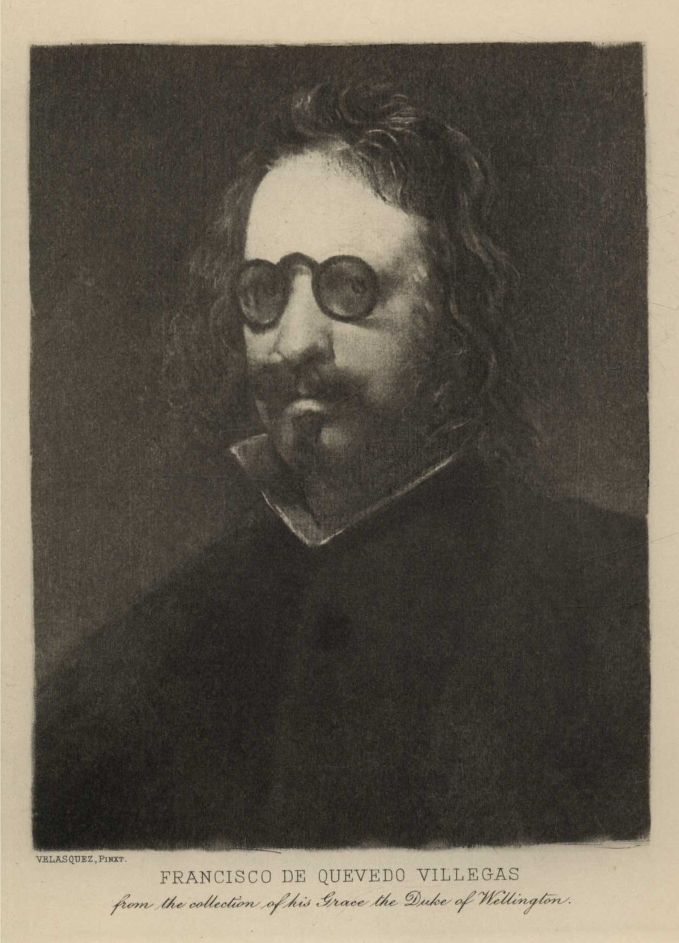
Indeed, sumptuary laws were already growing out of date, even in Spain; the courtiers copied the latest fashions from Paris, and the common people, more out of patriotism and mute resentment than anything else, made their cloaks longer and longer and their hats wider and wider. The long ends of the cloaks had to be put out of the way somehow, so they were thrown across the face to the opposite shoulder, and, what with the broadbrim over the brow and the cloak over the mouth, none of the face was seen but the eyes.
Spain during the greater part of the eighteenth century had the ill-fortune to be governed by foreign ministers, mostly Italians, and one after the other they tried to cut stubborn Spain to the same pattern as the rest of the world. The more they tried the more sulky and determined became the people, and it resolved itself into a national article of faith to resist all change; things Spanish being better than things elsewhere. When Philip's younger son, Charles III., came from Naples to rule them he brought with him his Neapolitan ministers. Grimaldi said that the Spaniards all looked like conspirators slinking about in the darkness with their covered faces. An attempt was made to light the streets with oil-lamps, but the people resented such a foolish foreign fad, and smashed the lamps as fast as they were put up. The offenders could not be identified with their covered faces and slouch hats, so the King was persuaded by the Marquis of Squillaci (Esquilache, as the Spaniards called him) to issue a new pragmatic. Its tone was more one of sorrow than of anger. The King was shocked for foreigners to see such a boorish fashion in his capital, and had determined that in future no long cloaks or round-brimmed hats were to be worn. Either a short cape or a skirted coat was allowed, and men might wear either their own hair or a wig, but they must cover it with a three-cornered hat and not a Chambergo, and the face must not be hidden in any way.
This order was proclaimed on the 4th of March, 1766, and police were posted in the principal places with shears to curtail cloaks and lop hat-brims. It happened that a man pursued by alguaciles for wearing the forbidden garments took refuge in the precincts of the church of the Trinity, where he was followed by the officers and beaten, in defiance of sanctuary. An infuriated crowd collected and overpowered the authorities, who were dismayed at the feeling evinced, and withdrew their men. For the next few days men all over Madrid ostentatiously flaunted their cloaks and broad-brims before the barracks and police posts, and there is no doubt that the feeling was taken advantage by politicians for their own ends to goad the people to fury against the Italian ministers. Matters came to a head on the 23rd of March, when a soldier attempted to seize a man with his face covered. A crowd, ready for mischief, collected immediately, and the authorities were overpowered. The mob swept up the Calle de Leon across the Calle de Alcalá to Squillaci's house (the famous "house with the seven chimneys") which they wrecked, although the minister had fled. With broad-brimmed hats on the top of poles they scoured the streets, making all men they met uncock their hats. Overpowering all resistance, they assembled before the palace. The guards used force in vain, and that night the capital was in the hands of the mob. The gaols were opened, houses wrecked, foreigners assailed and killed, the King's Walloon Guard especially being singled out for vengeance. Squillaci and Grimaldi had fled, and the Spanish ministers, either out of timidity or sympathy, practically sided with the rioters. The rising spread rapidly to the provinces, old grievances were raked up again, and a dangerous revolution was in progress, when the King surrendered unconditionally. People were to wear what they pleased, food and oil were to be reduced in price, and the Italian ministers were smuggled away, never to return.
That practically ended the fight for sumptuary control. Finery was triumphant in the long struggle, and the strong arm of authority was obliged to confess itself powerless to dictate on the question of personal adornment. Half-hearted attempts were made after this to interfere in sumptuary matters by Spanish sovereigns, but the effects of their decrees were hardly felt outside their own households. In 1780, for instance, a pragmatic as severe in form as ever was issued, minutely regulating the wearing of mourning and prohibiting mourning coaches, but little notice was taken of it after the first few weeks; and later still a curious mild little decree was issued by Charles IV. limiting the number of dishes which, according to custom, many officials were entitled to receive daily from the royal kitchens. It is a long drop from Alfonso the Wise to the silly dodderer who handed over his kingdom to Napoleon because his son had offended him; but the same feeling, almost the same phraseology, pervades the first pragmatic we have quoted and the last. Both deplore the lavishness and luxury of the people, and exhort them to correct the excess and superfluity which characterises their tables; and in both of them the King promises that he himself will rigidly conform to his own decree and reform the extravagance of his private repasts.
Custom, taste, and perhaps necessity, have done what five hundred years of "pragmatics" failed to do. The Spaniards are the most sober and frugal-feeding nation in Europe, and certainly do not exceed in the matter of gaudy or ostentatious raiment. The only traits left to them perhaps by the extravagant old fashions we have described, are their consuming love for driving about the streets in a fine carriage, however much they may stint in all else; and the grave stiff-necked dignity which a century of the golilla left behind it.
Tailpiece
A PALACE IN THE STRAND.
Headpiece
A PALACE IN THE STRAND.[1]
Probably not one person out of a thousand of those who hurry along the busiest part of the Strand notices even the existence of a closed iron gate by the side of a public-house opposite the Vaudeville Theatre. If you peer through the grating you will only see a dark, narrow court, now blocked up by the building operations connected with the Hotel Cecil, and you will have no difficulty in coming to the conclusion that this avenue, which has been gradually going down in the world for the last two centuries, is destined before very long to be blotted out altogether. For this was an important thoroughfare once, called Ivy Lane, one of the three public roadways by which access was obtained from the Strand to the river and the boats, the other two being Milford Lane and Strand Lane, the entrance to which latter still exists, a mere passage between two shops opposite Catherine Street. Down the centre of Ivy Lane ran a brook, over which the roadway of the Strand was carried by a bridge called Ivy Bridge. This lane, which separates the liberty of the Duchy of Lancaster from the city of Westminster, ran sloping down to the river between the garden walls of two of the great Strand palaces which, erected, as they all were at first, by bishops, were subsequently grabbed by kings and courtiers for their own use. To the east stood, on the Savoy demesne, the house of the Bishop of Carlisle, which was granted to the Elizabethan Earl of Bedford, and subsequently came into the possession, by exchange, of Robert Cecil, afterwards the first Earl of Salisbury, second son of the great Burleigh, whose own house stood nearly opposite, on the site of Exeter Hall; and on the west, covering all the space now occupied by the Adelphi as far as Coutts' bank, there rose the ancient mansion which for centuries was the town palace of the prince-bishops of Durham, known to history as Durham Place.
In the lawless times, when these mansions were first founded, it would have been dangerous for any but ecclesiastics to have resided outside of the protection afforded by the City boundaries, and so it came about that all the way from the Temple to Whitehall, along the banks of the silent highway, which then was the principal thoroughfare of London, there ran a string of bishops' palaces and religious foundations. Their outhouses and stable gates opened on to the rough country road we still call the Strand—a road which even in the time of Mary, we are told, was filthy and unseemly, and remained so, indeed, until the great nobles made these palaces their homes. Many books have been written about the Aldelphi and its site, and Durham Place, which was by far the most important of the Strand palaces until the Protector built Somerset House, has come in for its own full share of notice, but the writers upon the subject have copied each other with slavish fidelity, errors and all. The same set of facts and assumptions has invariably done duty in all descriptions of Durham Place. I wish in the present article to break new ground, and relate some hitherto unnoticed episodes in its history.
Stow has not much to tell of Durham Place, except of the great festival of 1540, when the future rivals, Dudley and Seymour, with Poynings, Carew, Kingston, and Richard Cromwell, challenged all Europe to a tourney, and held open house with regal lavishness for a week at Durham Place, lent to them for the purpose by the King, who rewarded each of them, moreover, with an income for ever of a hundred marks a year and a house out of the plunder of the Hospital of St. John of Jerusalem. The State Papers now and again give us a ray of side-light on the history of Durham Place. We know how Somerset granted it to Elizabeth for her life after he had beheaded his brother, who there had coined the doubloons with which he thought to bribe his way to the throne. We know on Somerset's fall how jealous Northumberland gave to the Princess the great unfinished palace of the dead Protector, and took for his own town house Durham Place, in which, although it was nominally hers, she had never lived. We know something, but not much, of the fastuous splendour of Dudley's life during the three years he lived here, of Jane Grey's ill-starred wedding in the house, of the plotting of her father-in-law, verily a lath painted like a sword, and the weaker time-servers around him, to perpetuate their rule and confirm them in their ill-gotten gains, of the pitiably crumbling down of the house of cards when the supreme moment came; and how Northumberland went forth from the Tower to the scaffold, never to see Durham Place again, hoping in his craven soul, till the axe fell, that his abject recantation would purchase his worthless life.
The Egerton Papers (Camden Society) tell us somewhat in detail of the arbitrary expulsion of Raleigh from Durham Place, where, by the grace of his mistress, he had lived happily and splendidly for nearly twenty years. These facts and some others in the subsequent history of the house are recited by every writer who has touched upon the subject, and I have no desire to repeat at length incidents which are already well known. One error into which most writers have fallen has been to jump at the conclusion that whenever recorded history is silent on the subject of Durham Place, the house reverted to the possession of the See of Durham. Such does not appear to me to have been the case. It is usually asserted that Henry VIII. first took possession of the house by forcing the Bishop, Cuthbert Tunstal, to exchange his palace for some other property. This is founded on Stow's statement that Cold Harbour, in Thames Street, was granted to the Bishop because of "his house near Charing Cross being taken into the King's hands, Cuthbert Tunstal was lodged in this Cold Harbour." It is certain, however, that Katherine of Aragon lived here during her widowhood, before Henry VIII. came to the throne, as many of her letters to her father in Spain are in existence dated from this house, ranging over several years prior to her marriage with Henry in 1509. On the very year of Mary's death Cuthbert Tunstal wrote a letter[2] to Cardinal Pole thanking him for obtaining for him the reversion of the house;[2] and it is usually assumed from this that he actually entered into possession of it. But he did not; and it is the story of Durham Place during this time, namely, the last years of Mary and the first few years of Elizabeth, that I wish to tell.
The historians of the house generally make short work of the matter by saying, "When Elizabeth came to the throne Tunstal was again driven from this house, and about 1583 Elizabeth granted it to its greatest tenant, the glorious Raleigh."[3] In all probability Tunstal only lived in the house a short time if at all. He was appointed to the See in 1530, and in 1540, as we know by Stow's description of the already-mentioned festival, Durham Place was a royal house, and so it remained until 1603, when Lord Salisbury used Toby Matthew, Bishop of Durham, as his catspaw to claim it, in order that he might filch the best part of it—the Strand frontage—for himself, which he did to his own great profit. In any case, it is certain that Tunstal never got the house back again from Mary or Cardinal Pole, whatever promises may have been made to him.
Of the few Spanish nobles of high rank who stayed with Philip II. during the whole of his residence in England after his marriage with Queen Mary, one was Gomez Suarez de Figueroa, Count de Feria, a prime favourite and close friend of Philip. This nobleman had fallen deeply in love with Miss Jane Dormer, one of Mary's maids of honour, and married her, and although the secret of the union had been well kept, circumstances made it necessary to openly avow it before the King and his suite left London for Flanders in September, 1555. Feria was again in London with the King in March, 1557, for a few months, but in January, 1558, he came back in another capacity. The war was going badly for Philip and England. The French had taken Calais, and Guines was on the point of falling; if the contest was to be carried on at all more money and more men must be squeezed out of unwilling England, or otherwise peace must be made, with England for a scapegoat. Philip could not come himself, so he sent his haughty, overbearing favourite Feria as his ambassador to bully and bribe the English courtiers and coerce the sorely beset Queen. He came with a large train of servants and with great magnificence; his English wife, a country knight's daughter only as she was, as proud as himself; and he was granted the use of Durham Place, furnished from the Queen's own house, as other great ambassadors had been granted it before him. Egmont had been lodged there with his splendid train in January, 1554, when he had come to offer Philip's hand to Mary. Chatillon, the French ambassador, too, had been given the use of the house during his short embassy in 1550, so that there was nothing extraordinary in the granting of the house to Feria. Only that former ambassadors had stayed for a few weeks, whereas Feria and his successor remained in possession for five years and a half, and made of Durham Place a trysting-place for treason during the most of that time.
Whilst Elizabeth was striving against terrible odds with all her subtle statecraft to lay the foundation of a united nation on the broken elements of civil and religious discord, her task was hourly rendered more difficult by the plots hatched in her own house at Durham Place. All the disaffected and discontented found a welcome there; emissaries from Shan O'Neil flitted backwards and forwards at night by the river gate. Stukeley whispered here his willingness to desert with the Queen's ships to the King of Spain, and here Hawkins himself humbly begged to be bought. Lady Sidney, Robert Dudley's sister, Dudley himself, Arundel, Lumley, Montague, and Winchester found in the secret rooms at Durham Place open but discreet ears to listen to their plans for preventing the establishment of Protestantism in England, and for bringing the country again under the sway of the Pope. Madcap Arthur Pole appealed first to Durham Place when he wanted aid for his silly plot in favour of Mary Stuart, and long-headed Lethington came at dead of night by the silent river on a similar but far more serious errand. The publication of the correspondence of the Spanish ambassadors in England during the reign of Elizabeth (Rolls Series) adds many interesting pages to the history of Durham Place, and renders the memories of the house more important than ever to the students of the Reformation period in England.
Feria arrived in London and took up his residence at Durham Place on the 26th of January, 1558, having, as he says, lingered on the way in order not to bring the unwelcome news of the surrender of Guines by the English, which news had crossed the Channel with him. In addition to Durham Place, where he and his household were lodged, he had the same privileges as to an apartment in the Queen's palace as those which appertained to an English Privy Councillor—privileges which he tried hard to have confirmed to him by the new Queen when Mary died, in order, as he says, that he might keep his foot in the place and spy out what was going on. But Elizabeth and Cecil knew full well what his object was, and were quite shocked at the idea of the representative of a possible suitor for her hand sleeping under the same roof as the maiden Queen, so Feria had to depend upon his paid agents in the palace, and even in the Council itself, to bring him news to Durham Place of what was going on.
With the evidence now before us we can form an approximate idea of the appearance of Durham Place at the time. The Strand was a rough, unpaved road, with a fringe of shops and taverns on the northern side, whilst on the south side were the back walls and outer courts of the riverine mansions. The principal land gateway of Durham Place stood exactly opposite the spot now occupied by the Adelphi Theatre. The English custodian or porter, who was in the pay of the Queen, had his dwelling just inside the gate, where he could spy those who went in and out on the land side. On each side of the gate in the outer courtyard were stables and outhouses, and in and around the gateway in the street were benches where idlers and hangers-on sat and lounged through the day gossiping, in various tongues, and boasting of the prowess of their respective countrymen. On the other side of the street, nearly opposite, was a tavern called the "Chequers,"[4] which drove a roaring trade with the men-at-arms, Court-danglers, and serving-men who were constantly passing to and from Whitehall and St. James'. Opposite the gateway, across the large outer courtyard, was the door of the great hall, generally standing open for the neighbours to pass through[5] it to the inner or smaller courtyard, in which stood a water conduit fed by a "spring of fairwater in Covent Garden."[6] Beyond this inner courtyard stood the house itself at the bottom of the slope on the bank of the river at the spot now occupied by the arches that support Adelphi Terrace. It was a castellated structure, with its water-gate placed in the middle of the curtain between two turrets, and leading not, as usually was the case, through a garden, but straight from the steps into the house itself by an enclosed pent-house doorway. The domestic offices, and probably the chapel, were on the ground floor, but the principal dwelling-rooms were all upstairs and in the turrets. Aubrey, in his letters (vol. iii. 573), thus speaks of Raleigh's occupancy of one of these turrets: "Durham House was a noble palace. After he came to his greatness, he lived there or in some apartment of it. I well remember his study, which was on a little turret that looked into and over the Thames, and had a prospect which is as pleasant as any in the world."
The water-gate of the house was not the only approach to the river, as there was a space with trees on each side of the house, with a dwarf wall fronting the water, and a descent on one side by which the neighbours were allowed to get water from the stream for washing and similar purposes. It will thus be seen that the only really private part was the house itself between the inner courtyard and the river; the great hall and both courtyards being practically open to the public under the supervision of the custodian at the outer gate, who was responsible only to the Queen, and was a constant source of friction with the foreign occupants of the house.
Feria stayed at Durham Place until August, 1558, taking an active part in the distracted Councils of the Queen; and then, having found that Mary's hopes of an heir were again fallacious, and having bullied and frightened the Queen and Council into raising all the money they could beg or borrow for Philip's service, he went back to Flanders, leaving his English wife in London, with a Flemish and a Spanish ambassador of lower rank than himself to represent his master. But when Mary was known to be dying, he posted back again to be on the spot when the great change took place, and Durham Place was avoided like a plague-spot thenceforward for many days by the courtiers and time-servers who wished to stand well with the new Queen.
The proud Spaniard repaid distrust by bitter resentment, and soon found that his arrogance made him unfit instrument for cajolery. So he sent for a softer spoken diplomatist to act as his "tender," and the wily, silken Bishop of Aquila became his guest at Durham Place. Feria could not for long brook the need of paying supple court to the people over whom he had ridden roughshod, and an excuse was soon found by which he might be withdrawn without an open confession of his unfitness, and in May, 1559, he left Durham Place for good, leaving his English Countess and the Bishop of Aquila in possession.
At Dover he met Baron Ravenstein, who was coming from the Emperor to offer the hand of the Archduke Charles to Elizabeth, and as such a match would only have subserved Spanish interests if it had been effected by the aid of Spanish diplomacy, Feria asked the German to become his guest at Durham Place, which he did, and was made much of by the Countess and the Bishop. But he wore out his welcome very soon, particularly with the latter, a portion of whose apartments he occupied, and the Bishop sneers at him for his constant attendance at Mass. "He is quite a good fellow," he says, "but surely this must be the first negotiation he ever conducted in his life." The Countess soon came to high words with the new Queen, and in a month or so left Durham Place in a dudgeon to join her husband in Flanders, thenceforward to see England no more. With her went, in addition to her escort, Don Juan de Ayala, her grandmother, Lady Dormer, and that Mistress Susan Clarencis who was Queen Mary's most devoted attendant. From that time, namely, July, 1559, the Bishop was temporary master of Durham Place by favour of the Queen, against whom he never ceased to intrigue as far as he dared.
We have already glanced at the structure of the house itself; it may be now interesting to give some account of the household of the Bishop, which may probably be considered a typical one. First there was a chaplain at three crowns a month and his board, a chief secretary at twelve crowns a month, a chamberlain, two or three gentlemen-in-waiting, a groom-of-the-chambers, and six pages—all without any fixed wage, but who lived on promises, perquisites, and what they could pick up, eating, however, at the Bishop's expense, and mostly clothed by him. Then there were two couriers at three shillings a month, which they rarely got; a cook, a buyer, a butler, and a pantryman, at a crown a month each; two cantineers, two "lacqueys," two Irish grooms, and two washerwomen at nominal wages of from three to five shillings a month when they could get them, which was very uncertain. Small as the wages seem to us, the expense of the establishment was very great, as these people and a host of friends and hangers-on were fed roughly but abundantly at the Bishop's cost, the humbler sort eating in the great hall and the gentlemen of the household in the upper chambers.
The Bishop had hardly been in possession of the house for a year when Challoner, the English Ambassador in Spain, warned Cecil that the "crafty old fox" was getting to know too much about what went on at Court, and that some decent excuse should be sought for turning him out from so advantageous a coign of vantage as Durham Place, with its water-gate and its close proximity to the palace, whence spies and courtiers might come and go secretly, as we now know they did, at all hours for the information of the King of Spain's Ambassador. We may be sure that the hint was not lost on Cecil, but the Bishop was cunning, and to turn him out without good ostensible cause would have been too risky at a time when Philip's future action was still uncertain. So the Queen's porter in charge of the house was told to take careful note of those who went in and out by the Strand gate, and particularly those who attended Mass in the Ambassador's chapel. But still the weak point in the position was the water-gate, the key of which always remained in the possession of the Bishop or his major-domo. Various stratagems were resorted to by the English porter to obtain possession of it, but in vain, and more decided measures had at last to be taken. The Bishop's confidential secretary, an Italian named Borghese, was bribed by Cecil to tell all he knew of his master's practices, and great promises of high position and a rich marriage in England were held out to him as a further reward for his treachery. This made him arrogant and boastful, and led to a slashing match with the Bishop's Italian gentleman-in-waiting, whom Borghese nearly killed. He boasted that he had friends at Court, snapped his fingers at the officers of the law and at the Bishop's cajolery and threats, made a clean breast of it to Cecil, and things began to look bad for his late master. Dr. Wotton, a member of the Privy Council, went to Durham Place, and gravely formulated a series of complaints founded on the secretary's information. Most of these complaints were trivial, being to the effect that the Bishop had said and written various depreciatory things against the Queen: but one accusation was serious, namely, than Shan O'Neil had taken the Sacrament at Durham Place, which was true, although the ecclesiastical diplomatist solemnly denied it.
The Bishop was nearly beside himself with rage and chagrin, and begged plaintively to be relieved from his irksome post among heretics such as these. But all in vain. It did not suit the Queen and Cecil for the moment to perpetrate the last indignity of turning him out of the house, but after this they kept a closer watch upon him than ever and bode their time. They had not to wait long. There were four French hostages in London, held in pledge for the due fulfilment of the Treaty of Château Cambresis, and very troublesome guests they were.
The most turbulent of them was a certain Nantouillet, Provost of Paris, a fanatical Catholic and partisan of the Guises. He had for some reason or another conceived a grudge against a mercenary captain called Masino, who was in the pay of the Vidame de Chartres, a Huguenot nobleman. So, in the manner of the times, he sought to have him killed, and, seeking for an instrument, he came across a young lad of bad character called Andrea, who was a servant of a lute player at Court, Alfonso the Bolognese. To this lad the Provost gave a dagger and a coat of mail, and promised a reward of a hundred crowns if he killed Masino. Andrea left his musical master and hung about the Strand door of Durham Place for several days at the beginning of January, 1563. At meal times he went into the great hall as others did and ate his fill, and then lounged outside on the benches again.
At last, in the dusk of the afternoon of the 3rd of January, 1563, Captain Masino came swaggering up the Strand on his way to Whitehall, and Andrea fired at him point blank, at a foot distance, with a harquebuss. But the captain's swagger saved his life, for the bullet passed between his left arm and his body, making a hole through his swinging cape and burning his doublet, and then glanced off into a shop on the other side of the way, "and came near killing an honest Englishman therein." Out came the swashbuckler's long rapier, and off ran the assassin into the outer courtyard of Durham Place, shrieking for mercy, followed by the captain and the English neighbours. The Bishop's household in the great courtyard seized their arms, and slammed the doors in the faces of the pursuers, whilst the terrified assassin fled through the great hall, through the inner courtyard and pell-mell up the stair leading to the Bishop's apartment.
Quite by chance, of course, the Provost of Paris happened to be playing at cards with the Bishop and the French Ambassador, whilst Luis de Paz and other friends looked on. The banging of the crowd at the closed door of the great hall, the terror-stricken cries of the criminal, and the tramping of the servants on the stair, brought out the Bishop and his friends to ask indignantly the cause of the uproar. Andrea on his knees at the door begged for protection and mercy. Captain Masino had beaten him, he said, some days ago, and he had fired a shot at him and missed him, so no harm was done, but still the captain wanted to kill him. Calming the clamour, the Bishop asked whether the shot had been fired inside or outside of Durham Place. "At the gate!" they said, and the boy had only entered when pursued, to save his life. "Then," said the Bishop to Bernabe Mata, his majordomo, "turn him out by the water-gate." By mere chance again a boat was in waiting, hired by the Provost of Paris, who slipped outside himself to see the assassin safely off, gave him ten crowns, and whilst the crowd still battered and stormed at the door of the great hall, Andrea was carried to Gravesend as fast as strong oars could propel him. But he was captured next day, and under torture told the whole story. The Provost himself was closely imprisoned in Alderman Chester's house, whence he carried on for weeks an interesting correspondence with his friends outside, written with onion juice on the inside lining of the breeches of a servant.
This attempted murder was the opportunity for which Cecil had long been waiting. Strong hints about treachery founded on the secretary's information, galling interference with attendance at Mass, flouts and insults, had been more or less patiently borne by the Bishop at his master's behest, but harbouring a criminal was an infraction of the ordinary law of the land, and if it could be brought home to the Ambassador the Queen would have a good excuse for taking her house away from a tenant who put it to so bad a use. The news was not long travelling from the Strand to Whitehall; Cobham and a posse of the Queen's guard came straight to Durham Place, and in the name of the law demanded the surrender of the criminal. They were told he was not there, but had left by the water-gate, and, this reply being unsatisfactory, they came back again directly with the Queen's command that the keys of the water-gate, as well as those of the Strand entrance, should be given up to the English custodian, in order that he might render an account of all those who went in and out. The Bishop writes to Philip:—
"This custodian is a very great heretic, who for three years past has been in this house with no other duty than to spy out those who come to see me, for the purpose of accusing me. I have put up with it for all this time, although at great inconvenience to myself, so as to avoid having disputes with them on a matter of this description. When the Marshal made this demand, however, I answered him that for twenty years the Ambassadors here had been allowed to reside in the royal houses, nearly all those sent by your Majesty and the Emperor having done so, and they had invariably been accustomed to hold the keys of the houses wherein they lived. I said that it was not right that an innovation should be made in my case after my four years' residence here, especially on so slight a pretext as this matter, in which I was not at all to blame, and considering that this is the first case of the sort that has happened since I have been here, it cannot be said that my house is an habitual refuge for criminals. I would, however, go and give the Queen an account of the matter, which I endeavoured to do."
But the Queen would not see him either that day or the next. She was too busy she said; and on the following day, which was Twelfth Day, just as people were coming to Mass, some locksmiths came in a boat to the water-gate and put a new lock on, notwithstanding the protest of the Bishop's household, and the keys of all the gates were now held by the Queen's officers. The Bishop was in a towering rage, and said, that as the Queen imprisoned him in his own house, and made a goal of it, he demanded the keys back, or else that she should find him another residence where he might be free. A long account of the solemn conference between the Bishop and the Council is given in the Calendar of State Papers (Foreign), the 7th of January, 1563, and the Bishop's version is now published in the Spanish State Papers of Elizabeth, vol. i. According to both accounts, the Bishop got decidedly the worst of it. Cecil was the spokesman, and, instead of taking up a defensive position about the keys, he turned the tables by piling up all the complaints which his spies had accumulated for the last two years, and the poor Bishop found himself the accused rather than the injured party. The escape of the criminal by the water-gate was made the most of—such a thing in law-abiding England had never been heard of before—but after all this was a bagatelle to the other charges.
The neighbours had complained over and over again, Cecil said, of the quarrels and fights of the Bishop's dependants, and had asked for his removal from the house. There had been a squabble, one of many, between the English porter and the Bishop's scullions about the water, which, after serving the conduit in the inner courtyard, ran down to the basement kitchen of the house itself. The Bishop's servants kept their tap running in the kitchen out of malice, in order to deprive the upper conduit of water, and when the English porter complained, they shut the door of the great hall, so that neither he nor the neighbours could get to the conduit at all. Then the porter said he would cut the pipe and stop their supply, and at this threat they went to his house with weapons in their hands and said they would kill him if he did so; and he was the Queen's servant! But, worst of all, Cecil accused the Bishop of plotting with Shan O'Neil and Arthur Pole, and said that since the house had been in the Bishop's occupation it had become sadly dilapidated and damaged as regarded the lead, glass doors, and so on, and that the Queen had decided to put it into proper repair and find another fitting residence for him. The Bishop retorted by denying all the charges, and saying that as the house was low-lying and damp and he was old and ailing, he would be glad to leave it. But soft spoken as he was to the Council, he was burning with rage, and wrote to Granvelle in a very different tone.
It was some months yet, however, before he moved from Durham Place, and during that time the Queen's Marshal again descended upon the house one morning of a Catholic feast-day, and haled all those who were attending Mass to the Marshalsea. The guard had, it appears, concealed themselves betimes in the porter's house, and Cecil had given them orders that if any resistance whatever was offered they were to attack the house in force and capture all the inmates at any cost. But at last the poor old Bishop, heart-broken at having to suffer so much indignity, was got rid of and lodged elsewhere. Deeply in debt and penniless, he went in the summer of 1563 to Langley, Bucks, where he died in August, some say of poison, some of plague, and some of grief. Then Durham Place, refurbished and repaired, again became a royal guest-house.
On the 16th of July, 1565, the Queen lent Durham Place to Sir Ambrose Cave, one of her Privy Council, for the celebration of his daughter's wedding with the son of Sir Francis Knollys, the Vice-Chamberlain, and the new Spanish Ambassador, Canon Guzman de Silva, was invited to the supper in the evening, at which the Queen had promised to be present. By mutual consent it had been arranged that the French and Spanish Ambassadors should never meet at Court, or where the vexed question of precedence might arise; but the two diplomatists, wily Churchmen both, were for ever on the look out for a chance of scoring off each other. No doubt Ambrose Cave thought he had cleverly evaded the difficulty by asking the French Ambassador to the more important meal, namely, the eleven o'clock dinner, and the Spanish Ambassador to the supper in the evening, at which the Queen was to be present. But when De Foix learnt at the hospitable feast at Durham Place that the Queen was coming later, he announced his intention of staying to supper as well. If Guzman did not like it, he said, he might stay away, and poor Cave, foreseeing an unseemly squabble in the Queen's presence, rushed off in despair to the Spanish Ambassador to beg of him not to come. But this was too much for the Toledan pride of the Canon, and he told Cave that he had not sought an invitation to the feast, but since it had been given and accepted he was not going to stay away for the French Ambassador or any one else. As for precedence, his master was the greatest King on earth, and if the worst came to the worst he would fight out the question. In vain Cave protested that the Queen would not come if there was to be any quarrelling, and he would be ruined at Court. He could not, he said, get rid of the Frenchman, who flatly refused to go, and he could hardly throw him out of the window. Guzman said if there was much ado about it he would throw him out of window himself, and sent off Cave in a huff. Then Guzman hurried to Whitehall in order to catch the Queen before she started for Durham Place. He waited for some time, he says, in the privy garden by which she would have to pass to her barge; and after she had vainly attempted to smooth matters over, and said she herself must refrain from going if there was to be any disturbance, she pretended to fly into a rage at Cave's management of the affair, and sent Cecil and Throgmorton off to Durham Place to get rid of the French Ambassador somehow. What arguments they used Guzman neither knew nor cared, but when he arrived with the Queen the rival Ambassador was gone, and he was the principal guest next to the sovereign. "The Queen stayed through the entertainment, and the Emperor's Ambassador and I supped with her in company with the bride and some of the principal ladies and the gentlemen who came with the Emperor's Ambassador. After supper there was a ball, a tourney, and two masques, and the feast ended at half-past one in the morning."
In September, 1565, Durham Place received a royal guest in the person of Cecilia, Princess of Sweden, Margravine of Baden, who came principally to spy how the land lay with regard to the oft-repeated suit for Elizabeth's hand made by her brother Eric XIV. The English queen, as was her wont, made much of her at first; but she, too, wore out her welcome during the months she stayed, for, as we have seen, the housekeeping of great folk in those days was far from economical, and when the Swedish princess ran short of money and wanted pecuniary help, as she soon did, frugal Elizabeth's friendship began to cool, and it ended in the poor Princess having to pledge even her clothes to satisfy her more pressing creditors before they would let her go; and her husband, a ruling prince, was put into gaol at Rochester by the irate tradesmen who had trusted his wife. But all this was at the end of her visit; the beginning was certainly brilliant and auspicious.
The Princess arrived at Dover in the Queen's ships, and was there received by Lord Cobham and his wife, the Mistress of the Robes, and a knot of courtiers sent by the Queen from Windsor. They rode as usual through Kent to Gravesend, where the Queen's barges awaited them, and the Queen's cousin, Lord Hunsdon, and six pages in royal livery received the Princess, who was thus carried up the river with all pomp and circumstance to the water-gate of Durham Place. Her dress on the occasion attracted attention in London by its strangeness. She was attired, we are told, in a long black velvet robe, with a mantle of cloth of silver and black, and on her fair hair she wore a golden crown. At the top of the water-stairs at Durham Place she was received by the Countess of Sussex, Lady Bacon, and Cecil, and installed in the house with all honour. A day or two afterwards the Queen came from Windsor to visit her. "She received her Majesty at the door, where she embraced her warmly, and both went up to her apartments. After the Queen had passed some time with her in great enjoyment she returned home, and the next night, the 15th, the Princess was delivered of a son." In due time the young Prince of Baden was christened with great pomp, and Durham Place was a scene of festivity on that and many other occasions whilst the Swedish Princess resided there. We have rather a full account of one of Queen Elizabeth's visits to the Princess at Durham Place, as Guzman, the Spanish Ambassador, happened to be at Whitehall when her Majesty was starting, and, at her invitation, accompanied her thither in her barge. He says he was with her alone for some time in the cabin of the barge, until, probably, her Majesty becoming tired of a tête-à-tête with an elderly clergyman, called her new pet Heneage to her, and began to whisper and flirt with him. The Princess awaited the Queen at the water-gate as usual, and led her to the principal apartments upstairs, although neither royal lady would consent to be seated until a stool was brought for Guzman, who relates the incident. The Queen came by water, and returned in a coach by way of the Strand. When she was seated in the carriage with Lady Cobham, her maiden Majesty could not resist the opportunity afforded by the condition of her companion to make rather a risky joke to the Ambassador, who, ecclesiastic though he was, retorted fully in the same vein, and carefully repeated the conversation in a letter to his royal master the next day.
For the next few years Durham Place gave shelter to many courtiers, ambassadors, and honoured guests of the Queen, and was occasionally lent, as we have seen, for parties and merrymakings, its large size and easy access by land and water making it peculiarly appropriate for such uses. But the elder Earl of Essex, Walter Devereux, made a somewhat longer stay in some of its apartments. It was here, probably enough in the turret-rooms which were Raleigh's favourite abiding-place, that Essex planned that expedition to Ireland with which his name was destined for all time to be linked. From here he started in August, 1573, and, with the exception of one flying visit in 1575, never saw Durham Place again.
In 1583 the Queen granted the house to Raleigh. It was in a dilapidated condition, and he spent, as he says, £2,000 in repairing it; certain it is that during twenty years that Raleigh lived there Durham Place reached its apogee of splendour. The Strand had greatly altered for the better since the time when Feria lived at Durham Place. The Bishop of Carlisle's house, on the other side of Ivy Lane, had disappeared, and Robert Cecil had built a splendid house for himself on its site. His father and elder brother, too, across the Strand had another palace, and between them they had paved and made up the roadway for a considerable distance before their properties. But slowly, too, the Strand was becoming a great fashionable thoroughfare, and long-headed Robert Cecil knew well that as shops grew up along its line the street frontage would increase in value. So he cast covetous eyes across his own boundary at Ivy Lane on to the great ramshackle congeries of stables and outhouses which fronted the Strand at Durham Place. As long as his mistress lived he dared not disturb Raleigh, but no sooner had the great Queen passed away than Raleigh was turned out with every circumstance of harshness and insult, and Lord Salisbury got his street frontage, upon which he built Britain's Burse, which was to be a rival to the Royal Exchange.
Thenceforward Durham Place went down in the world. A sort of square, with entrance by what is now called Durham Street, was built on a portion of the garden and great courtyard, but the hall and mansion themselves were left intact, and the latter was still used for the lodging of ambassadors and others, and the Bishops of Durham appear to have had lodgings in what formerly was their own palace. Lord Keeper Coventry lived, or at all events wrote, his letters here, and Lord Keeper Finch died at Durham Place in 1640. Lord Pembroke bought the whole site soon after, intending to build himself a house there, but although the plans were made the project fell through. The Commonwealth soldiers were quartered in the house for nearly two years, and Lord Pembroke had to find himself a house elsewhere, for which the Parliament voted him £200.
The Strand front became more and more valuable, and by and by another exchange was built on the rest of the frontage, whilst the property in the rear continued to get more squalid as the time went on. In the middle of the last century the exchanges were pulled down and a fine row of shops built on the site, whilst projects for dealing with the space still occupied by the old palace were busying many men's minds. At last came the brothers Adam and made a clean sweep of it all, back and front, and built the Adelphi as we see it to-day. The wide expanse of mud which at low tide formerly spread from the walls of the old palace is now replaced by the waving trees of a public garden. Great railway stations, gigantic hotels, towering masses of "flats" and "mansion" rear their high heads all round the site of old Durham Place. The wealth and power have passed from the hands of the few to the hands of the many, and instead of one man living in squalid splendour in the comfortless palace surrounded by hosts of unproductive hinds, hundreds live in comfort, usefulness, and self-respect upon the spot. There is probably more money spent in a week by working people in the garish music-hall that occupies the Strand front than would have sufficed to keep Durham Place in full swing for a year during the time of its greatest grandeur.
Tailpiece

THE EXORCISM OF CHARLES THE BEWITCHED.
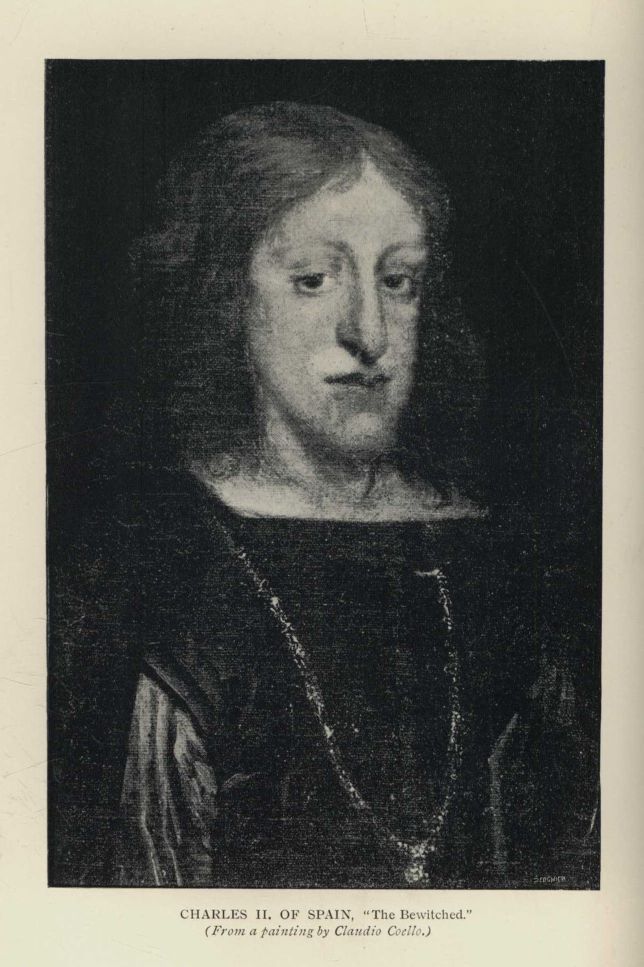
CHARLES II. OF SPAIN, "The Bewitched." (From a painting by Claudio Coelle.)
Headpiece

THE EXORCISM OF CHARLES THE BEWITCHED.[1]
The pallid little milksop in black velvet, with his lank, tow-coloured hair and his great underhung chin, who will simper for ever on the canvas of Carreño, had grown to be a man—a poor feeble anæmic old man of thirty-seven,[2] the last of his race, to whom fastings and feastings, the ceremonies of the Church, and the nostrums of the empirics had been equally powerless in providing a successor for the crumbling empire of his fathers. The strong spirits upon whom he had leant in his youth and early manhood had passed away. His imperious mother, who reigned so long and unworthily in his name, had died of cancer only a year or two ago. His virile brother, Don Juan José of Austria, in whom the worn-out blood of the imperial race had been quickened by the brighter but baser blood of his actress mother, had been poisoned. His beloved first wife, the beautiful Marie Louise of Orleans, had faded away in the sepulchral gloom of that dreary Court, and his new German wife, Marie Anne of Neuberg, with her imperious violence, frightened him out of what little wit he had left by her advocacy of new ideas. For new ideas to that poor brain were the inventions of the very Devil himself. He had been drilled for years into the knowledge that the claims of his French kinsmen to his inheritance were just; and, though for years past all the diplomatists of Europe had been plotting and planning for one or the other claimant with varying success, all that poor Charles the Bewitched himself wanted was to be left alone in peace whilst he lived, and that one of his French cousins should succeed him when he died. There was not much chance of either wish being fulfilled from the time that England and the Austrian faction juggled Marie Anne of Neuberg into the palace as Charles' second wife. She made short work of all the courtiers and ministers who favoured the French succession—they had one after the other either to come round to her side or go. Most of the best of them—not that any of them were very good—sulked in their own provinces awaiting events, whilst others still plotted in the capital.
In the meantime the Queen and her camarilla were all-powerful. After various weak and futile explosions, the smashing of crockery and breaking of furniture and the like, the poor King, for the sake of peace, let her have her own way, and ostensibly favoured the claims of the Austrian Archduke to his inheritance. But like most semi-idiots he could not relax his grasp on an idea of which he had once become possessed, and though he was surrounded day and night by the Queen's creatures, and was content that they should have their way whilst he was well, he no sooner fell into one of his periodical fits of deadly sickness than, with all the terror and dread of death, and constant fear of poison and witchcraft upon him, he yearned for the presence of those who had been with him in earlier and happier days, before the German Queen and her base blood-suckers had come to disturb his tranquillity.
The story of the strange and obscure Court intrigue which resulted in the gaining by the French faction of the upper hand in the palace during the critical time preceding Charles's death, has often and variously been told, mostly with an ignorant or wilful distortion of events. M. Morel-Fatio has shown how Victor Hugo has deliberately falsified the character of the Queen Marie Anne of Neuberg, in order that he might make use of the local colour furnished by the Countess d'Aulnoy's letters written from Spain fifteen years before the period represented by the dramatist;[3] and many other writers, French and English, who have been attracted by the romantic elements of the witchcraft story, have surrounded it with a cloud of fictitious persons and incidents which makes it difficult now to distinguish between history and romance. Every writer on the subject, so far as I know, moreover, has stopped short at the story of the exorcism itself, whereas it really developed into a great struggle of many years' duration between the Grand Inquisitor on the one hand and the Council of Inquisitors on the other, in which, curiously enough, the latter body championed the cause of legal process as against the arbitrary power assumed by its own chief.
There is in the British Museum[4] a full manuscript account from day to day of the whole transaction from beginning to end, written at the time by one of the clerks or secretaries in the Inquisition, who, although he avows himself a partisan of the French faction and of the King's confessor, Froilan Diaz, around whom all the storm raged, declares that he has set down the unvarnished truth of the whole complicated business, in order that people may know after his death what really happened, and how much they "owe to his Sacred Majesty Philip V. for preserving the privileges of the holy tribunal of the Inquisition, or, what is the same, our holy faith." By the aid of this set of documents, and another set in the Museum (part of which has been published in Spanish), the story, which is well worth preserving, may be reconstructed, and the hitherto unrelated particulars of the actual exorcism rescued from oblivion.
The most powerful person at Court next to the Queen was Father Matilla, the King's confessor, whose hand was everywhere, and who said on one occasion that he would much rather make bishops than be one. Then came the other members of the Queen's camarilla, an obscure country lawyer who had been created Count Adanero, and Minister of Finance and the Indies, who provided the crew with money to their hearts' content, and squandered and muddled away the national resources, whilst all Spain was groaning under impossible imposts; Madame Berlips, a German woman who had an extraordinary influence over the Queen, and an insatiable greed; two Italian monks, and a mutilated musician of the Royal Chapel. There were two great nobles also who, after several periods of disgrace and hesitation, had at last thrown themselves on to the Queen's side—the Admiral of Castile and Count Oropesa, the ostensibly responsible ministers; but these practically only carried out the designs of the Queen's camarilla, and were content with the appearance and profits of power without its exercise. The populace, as may be imagined, were in deadly opposition to the Queen and her foreign surroundings, and were strongly in favour of one of the younger French princes whom they might adopt and make a Spaniard of, as they never could hope to do with a German archduke, and thus, as they thought, avoid the threatened partition of their country.[5] This was the position of things in March, 1698, when the King, who had partly recovered from his previous attack eighteen months before, was again taken ill.[6] He was dragged out by the Queen to totter and stagger in religious processions, was made to go through the ceremonial forms of his position, nodding and babbling incoherently to ministers and ambassadors whom he was obliged to receive, and at last, weary and sick to death, haunted by an unquiet conscience and with the appalling fear of hourly poison, he sent word by a trusty messenger to the wise, crafty old minister of his mother, Cardinal Portocarrero, who had been banished from the Court by the Queen, that he wished to see him.
The Cardinal needed no two invitations, but posted off to the palace. He had still plenty of friends of various ranks, notwithstanding the Queen, and amongst them was Count de Benavente, the Gentleman of the Bedchamber. By him he was conducted at night to the King's bed-side, after the Queen had retired, and heard the heart-broken recital of the monarch's troubles. The King told him he was ill and unhappy and in trouble about his soul's health. He was conscious of a struggle going on within him between his knowledge of the right thing to do and his incapacity to do it, and this left him no peace or happiness. The people who surrounded him were distasteful to him, his confessor, Matilla, gave him no real consolation, and he ascribed much of his own illness and misery to the bad management and ceaseless worry he had to endure from those who had the direction of affairs. The King unburdened himself to the Cardinal in his lisping, mumbling fashion, his utterance broken with sobs and tears, but sufficiently plainly for Portocarrero to see that if he and his friends acted boldly, swiftly, and secretly they might again become predominant and dispose of the splendid inheritance of Spain and the Indies. He said some consoling, soothing words to the King, and promised him that steps should be taken to insure him tranquillity, and then he took his leave. The interview took place in the ancient Alcazar, which stood on the site of the present royal palace in Madrid, for poor Carlos had no spirits for the new Buen Retiro Palace, where his father had been so gay and splendid. It was nearly eleven o'clock at night, but as soon as the Cardinal got back to his own house he summoned his friends to a private conference. They were all of them courtiers in disgrace with the Queen, and most of them extremely popular with the mob in Madrid. There was Count Monterey, mild and temporising, with his hesitating speech and his irritating "hems and hahs"; there was the Marquis of Leganes, a hot-headed soldier, rash and pugnacious; Don Francisco Ronquillo, ambitious, intriguing, and bold, who, with his brother, was the idol of the "chulos" of the capital; Don Juan Antonio Urraca, honest, uncouth, and boorish; and, above all, quiet, wise, and prudent Don Sebastian de Cotes, a close friend of the Cardinal's. First, Monterey was invited to give his opinion as to what should be done, but he dwelt mainly upon the danger to them all presented from the King's infirmity of purpose; and how one minister after the other who had for a moment succeeded in persuading him to make a stand, had been disgraced and banished the moment the Queen got access to her husband and twisted him round her finger, as she could. He had no desire to take risks, apparently, and could recommend nothing but that the Cardinal Archbishop should keep his footing in the palace, and gradually work upon the King's mind. Leganes scoffed at such timid counsels; where the disease was so violent as this a strong remedy must be adopted. This should be the immediate banishment, and, if necessary, the imprisonment of the Admiral of Castile, the principal minister. He (Leganes) had plenty of arms at home, and had hundreds of men in Madrid who would serve him, with experienced officers to command them, and could soon make short work of the Admiral and his train of poets and buffoons. Ronquillo went further still. He said that was all very well, but at the same time they must seize the Queen and shut her up at the Huelgas de Burgos. Monterey called him a fool, and said such an act would be the death of the King and would ruin them all before he could alter his will; and the two nobles rushed at each other to fight out the question on the spot before the Archbishop himself. When they were separated the Cardinal no doubt thought it was time to do something practical, and asked his friend Cotes his opinion. Cotes was prosy enough, but practical. He said of course Portocarrero could easily get the King to sign any decree he liked, but the Queen could more easily still get him to revoke it; and, although it would be well to strike at the Queen herself, he did not know who would dare to do it. But after all she could only influence him by mundane means; the confessor, Matilla, whom the King hated and feared, and flouted only yesterday, must be got rid of, and the Queen would lose her principal instrument. This was approved of, but no one could suggest a fitting successor except Ronquillo—who, of course, had a nominee of his own!—who was promptly vetoed. Each of the others doubtless had one too, but thought best to press his claims privately. So it was left to the Archbishop to choose a new successor and gain the King's consent to his appointment. The choice fell upon a certain Froilan Diaz, professor of theology at the University of Alcalá. One of his recommendations was that he was near enough to the capital to be brought thither quickly, before the affair got wind, and no sooner did the Ronquillos learn that Cotes had recommended him to the Archbishop than they sent a mounted messenger post-haste to Alcalá to inform Father Froilan of his coming greatness, and claim for themselves the credit of his appointment.
A few days afterwards, in the afternoon, the King lay in bed languidly listening to the music which was being played in the outer chamber, with which his own room communicated by an open door. The outer room, as usual, was crowded with courtiers, and in the deep recess of a window stood the confessor, Matilla, chatting with a friend, alert and watchful of all that passed. Suddenly Count de Benavente entered with a stout, fresh-coloured ecclesiastic, quiet and modest of mien and unknown to all. They walked across the presence chamber without announcement, and entered the King's chamber, shutting the door behind them. Matilla's face grew longer and his eyes wider as he saw this, and he knew instinctively that his day was over. Turning to his friend, he said, "Good-bye; this is beginning where it ought to have left off," and with that he left the palace, and went with the conviction of disaster to his monastery of the Rosario. They had all known for some days that something had been brewing. Spies had dogged every footstep of the Archbishop and those who attended the midnight meeting at his house, but they had left out of account the King's own Gentleman of the Bedchamber, Count de Benavente, who had arranged the whole affair. It is true that when the Queen had, as usual, entered the King's bedroom that day, at eleven o'clock, to see him dine, he had told her in a whisper, unable to retain his secret, that he had changed his confessor. She, astounded and disconcerted at the news, pretended to approve of the change—anything, she said, to give tranquillity to her dear Carlos. But when she could leave, she flew with all speed to her room, summoned the Admiral and the camarilla, and told them they were undone. Panic reigned supreme, the general idea being that Matilla himself had betrayed them. In any case they saw that he was past praying for, so they threw him overboard, and decided to try to save themselves, and see if, in time, they could not buy over the new confessor.
The only man of them who kept his head was a great ecclesiastic, a brother of the Admiral of Aragon, and of a member of the Council of the Inquisition, one Folch de Cardona, Commissary-General of the Order of San Francisco, who was subsequently to play an important part in the tragi-comedy. When Matilla learnt that the Queen and her friends had known of the change an hour or two before it happened he broke down. "Oh, for that hour!" he exclaimed; "in it I would have set it all right." Divested of all his offices, dismissed from his inquisitorship, with a pension of 2,000 ducats, he died within a week of poison or a broken heart, and he disappears from the scene.
In his place stands Froilan Diaz, a simple-minded tool of the courtiers who had appointed him. He did not look very terrible, even to the panic-stricken Queen and her friends, and they decided to make the best of him, and try to confine the changes to the confessorship. Henceforward Froilan Diaz was a man to be courted and flattered. Honours and wealth were lavished on him, and for a year no great change was made in the palace or outside; but under the surface intrigue was busy, both at the King's bedside and in the haunts of the Madrid mob. At the end of a year the latter element made short work of the ministers and the Queen's gang and drove the lot of them out, to be replaced by Arias, the Ronquillos, and the French party; but with this revolt the present study has nothing to do.
The King's extreme decrepitude for a young man had several years before given rise to rumours amongst the vulgar that he was bewitched, and the assertion had been made the subject of grave consideration by the Grand Inquisitor of the time, who reported that he could find no evidence to act upon. At the time of the first serious illness of the King, in 1697, he had of his own action sent to the new Grand Inquisitor a terrible and austere Dominican monk called Rocaberti, and had confessed to him his conviction that his illness was not natural but the result of some maleficent charm, and besought him earnestly to have an exhaustive inquiry made. The Inquisitor told him that he would, if he pleased, have inquiry made, but saw no possible result could come of it, unless the King could point out some person whom he suspected or some plausible evidence to go upon. And so the matter remained until some weeks after Father Froilan had become confessor. As may be supposed, Froilan Diaz's elevation had reminded all his old friends of his existence, and, amongst others, an old fellow-student visited him, with whom he fell into talk about past days and former acquaintances. "And how is Father Argüelles getting on?" said the confessor. "Ah, poor fellow!" was the reply; "he is confessor at a convent at Cangas, terribly ill, but in no-wise cast down, for the Devil himself has assured him in person that God is preserving him for a great work yet that shall resound through the world." The King's confessor pricked up his ears at this, and wanted further particulars. It appeared, according to the friend, that Argüelles had had much trouble with two nuns of his convent, who were possessed, and in the course of his exorcisms had become quite on intimate terms with his Satanic Majesty. Froilan thought this was too important to be neglected, so he consulted the Grand Inquisitor, the Dominican Rocaberti. The grim monk did not, apparently, much like the business, but consented to a letter being written to the Bishop of Oviedo, the superior of Argüelles, asking him to question his subordinate as to the truth of the assertion that the King was suffering from diabolical charms. The Bishop, determined that he would not be made the channel for such nonsense, wrote a sensible answer back, saying that he did not believe in the witchcraft story. All that ailed the King was a weakness of the heart and a too ready acquiescence in the Queen's wishes, so he would have nothing to do with it.
Then Froilan sent direct to Argüelles, who himself was afraid of the business unless he was secured from harm, and refused to put any questions to the Devil unless he had the warrant of the Grand Inquisitor. A letter was therefore written by the latter on June 18, 1698, ordering him to write the names of the King and Queen on a sheet of paper, and, without uttering them, to place the paper on his breast, summon the Devil, and ask him whether the persons whose names were so written were suffering from witchcraft. Froilan sent the letter in a long one of his own to his old friend Argüelles with an elaborate cipher and other devices for secrecy in subsequent communications. No names henceforward were to be written. The vicar, Argüelles, replied, expressing no surprise at so strange a request, but said the Devil had previously told him that he was reserved for great things, but had not given particulars, only that he should receive an order from a superior. Then he tells the result obtained by his first effort. He says he placed the hands of the possessed nun upon the altar, and by the power of his incantations commanded the Devil to answer the question put to him. The Devil was not at all shy, but "swore by God Almighty that it was the truth that the King was bewitched," "et hoc ad destruendam materiam generationis in Rege et eum incapacem ponendum ad regnum administrandum." He said the charm had been administered by moonlight when the King was fourteen years of age.
So far the Devil. Then the vicar, as an expert, gives some advice of his own. He says the King should be given half a pint of oil to drink, fasting, with the benediction, and the ceremony of exorcism which the Church prescribes.[7] He must not eat anything for some time afterwards, and everything he eats and drinks must be blessed. The case is a very bad one, he says, and a miracle will be performed. If the King can bear it he should be given, in addition, the charm prescribed by the Church, but not otherwise.
He gives the not improbable opinion that as the King will vomit dreadfully he must be held in the arms of the "master," by which name it was agreed that the Grand Inquisitor should be referred to in the correspondence. But he says not an hour is to be lost, and the master himself must administer the draught.
But this remedy was too strong, and Froilan and the Inquisitor, or the friend and the master, as they are called henceforward, write to say that, although they are much obliged to the Devil and the vicar, such a draught as that recommended would certainly kill the King, and they beg the exorciser to ask the Devil again for a more practical and a safer remedy. "How much and in what form is the Church charm to be given; at what hour; on what parts of the body?" And so on—queer questions indeed to be addressed by two pillars of the Church to the Devil. But this is not all. They draw up a series of questions that would do honour to a cross-examining barrister. "What is the proof of witchcraft? In what way does it act so as to make the King do things contrary to his own will? How are the organs affected cleansed by the charm? What compact was made with the Devil when the witchery was effected? Was it administered internally, or externally? Who administered it? Has it been repeated? Is the Queen included in its operation?" And other questions of a similar sort. The vicar is rather shocked at their inquisitiveness, and refuses to put such questions. How can he ask the Devil anything that the Church does not deal with in its exorcising ceremonies?
Another letter is sent asking him to consult the Devil as to whether it will be well to take the King to Toledo, to which the vicar replies somewhat evasively, reproaching his associates. What is the good, he says, of all their professed desire to heal the King whilst they refuse to carry out the directions sent them? A change of place is useless if he takes the malady with him, and until they follow out the instructions already given it is no good for him to consult the Devil again. "Besides," he says, getting into dangerously deep water for a country vicar, "how can you expect the King to be well? Justice is not done, the churches are starved, hospitals are despoiled and closed, and souls are allowed to suffer in purgatory because money is begrudged for Masses, and above all, the King does not administer justice after swearing on the cross that he would do so. The Divine message has already been delivered to you. I have told you all it is fitting for you to know and how to cure the patient, and you do nothing but ask a lot more questions. I tell ye, then, that you will find no excuse for this at the supreme judgment, and the death of the King will be laid at your door, since you could cure him and will not." This was almost too bold to be borne, and the Inquisitor's secretary writes back in grave condemnation. He again insists upon the questions being put to the Devil. "You are presumptuous to dare to suppose that you know better than the friend and the master, and that you can command in this way whilst refusing to obey. You want to get out of it now by attributing the King's illness to other causes. The 'friend and the master' are deeply offended, and if you do not do as you are commanded all will be frustrated, and we distressed to feel that, just as God had begun to open the door of knowledge to us, all is spoilt by your presumption and obstinacy."