Volume 9 / Part 6 — PART VI. MISCELLANEOUS PAPERS. (continued 5)
Reading edition
April 4th. Cologne. Bonne. Andernach. Coblentz. I saw many walnut trees to-day in the open fields. It would seem as if this tree and wine required the same climate. The soil begins now to be reddish, both on the hills and in the plains. Those from Cologne to Bonne extend about three miles from the river on each side; but a little above Bonne they become contracted, and continue from thence to be from one mile to nothing, comprehending both sides of the river. They are in corn, some clover and rape, and many vines. These are planted in rows three feet apart both ways. The vine is left about six or eight feet high, and stuck with poles ten or twelve feet high. To these poles they are tied in two places, at the height of about two and four feet. They are now performing this operation. The hills are generally excessively steep, a great proportion of them barren; the rest in vines principally, sometimes small patches of corn. In the plains, though rich, I observed they dung their vines plentifully; and it is observed here, as elsewhere, that the plains yield much wine, but bad. The good is furnished from the hills. The walnut, willow, and apple tree beginning to leaf.
Andernach is the port on the Rhine to which the famous mill-stones of Cologne are brought; the quarry, as some say, being at Mendich, three or four leagues from thence. I suppose they have been called Cologne mill-stones, because the merchants of that place having the most extensive correspondence, have usually sent them to all parts of the world. I observed great collections of them at Cologne. This is one account.
April 5. Coblentz. Nassau. Another account is, that these stones are cut at Triers and brought down the Moselle. I could not learn the price of them at the quarry; but I was shown a grind-stone of the same stone, five feet diameter, which cost at Triers six florins. It was of but half the thickness of a mill-stone. I supposed, therefore, that two mill-stones would cost about as much as three of these grind-stones, i. e. about a guinea and a half. This country abounds with slate.
The best Moselle wines are made about fifteen leagues from hence, in an excessively mountainous country. The first quality (without any comparison) is that made on the mountain of Brownberg, adjoining to the village of Dusmond; and the best crops is that of the Baron Breidbach Burrhesheim, grand chambellan et grand Baillif de Coblentz. His Receveur, of the name of Mayer, lives at Dusmond. The last fine year was 1783, which sells now at fifty louis the foudre, which contains six aumes of one hundred and seventy bottles each, equal about one thousand one hundred and ten bottles. This is about twenty-two sous Tournois the bottle. In general, the Baron Burrhesheim's crops will sell as soon as made, say at the vintage, for one hundred and thirty, one hundred and forty, and one hundred and fifty ecus the foudre (the ecu is one and a half florin of Holland), say two hundred. 2. Vialen is the second quality, and sells new at one hundred and twenty ecus the foudre. 3. Crach-Bispost is the third, and sells for about one hundred and five ecus. I compared Crach of 1783 with Baron Burrhesheim's of the same year. The latter is quite clear of acid, stronger, and very sensibly the best. 4. Selting, which sells at one hundred ecus. 5. Kous-Berncastle, the fifth quality, sells at eighty or ninety. After this there is a gradation of qualities down to thirty ecus. These wines must be five or six years old before they are quite ripe for drinking. One thousand plants yield a foudre of wine a year in the most plentiful vineyards. In other vineyards, it will take two thousand or two thousand and five hundred plants to yield a foudre. The culture of one thousand plants costs about one louis a year. A day's labor of a man is paid in winter twenty kreitzers (i. e. one-third of a florin), in summer twenty-six; a woman's is half that. The red wines of this country are very indifferent, and will not keep. The Moselle is here from one hundred to two hundred yards wide; the Rhine three hundred to four hundred. A jessamine in the Count de Moustier's garden in leaf.
In the Elector of Treves' palace at Coblentz, are large rooms very well warmed by warm air conveyed from an oven below, through tubes which open into the rooms. An oil and vinegar cruet in this form: At Coblentz we pass the river on a pendulum boat, and the road to Nassau is over tremendous hills, on which is here and there a little corn, more vines, but mostly barren. In some of these barrens are forests of beach and oak, tolerably large, but crooked and knotty; the undergrowth beach brush, broom, and moss. The soil of the plains, and of the hills where they are cultivable, is reddish. Nassau is a village the whole rents of which should not amount to more than a hundred or two guineas. Yet it gives the title of Prince to the house of Orange to which it belongs.

April 6th. Nassau. Schwelbach. Wisbaden. Hocheim. Frankfort. The road from Nassau to Schwelbach is over hills, or rather mountains, both high and steep; always poor, and above half of them barren in beach and oak. At Schwelbach there is some chesnut. The other parts are either in winter grain, or preparing for that of the spring. Between Schwelbach and Wisbaden we come in sight of the plains of the Rhine, which are very extensive. From hence the lands, both high and low, are very fine, in corn, vines, and fruit trees. The country has the appearance of wealth, especially in the approach to Frankfort.
April 7th. Frankfort. Among the poultry, I have seen no turkies in Germany till I arrive at this place. The Stork, or Crane, is very commonly tame here. It is a miserable, dirty, ill-looking bird. The Lutheran is the reigning religion here, and is equally intolerant to the Catholic and Calvinist, excluding them from the free corps.
April 8th. Frankfort. Hanau. The road goes through the plains of the Maine, which are mulatto, and very fine. They are well cultivated till you pass the line between the republic and the landgraviate of Hesse, when you immediately see the effect of the difference of government, notwithstanding the tendency which the neighborhood of such a commercial town as Frankfort has to counteract the effects of tyranny in its vicinities, and to animate them in spite of oppression. In Frankfort all is life, bustle, and motion; in Hanau the silence and quiet of the mansions of the dead. Nobody is seen moving in the streets; every door is shut; no sound of the saw, the hammer, or other utensil of industry. The drum and fife is all that is heard. The streets are cleaner than a German floor, because nobody passes them. At Williamsbath, near Hanau, is a country seat of the Landgrave. There is a ruin which is clever. It presents the remains of an old castle. The ground plan is in this form: The upper story in this: A circular room of thirty-one and a half feet diameter within. The four little square towers at the corners finish at the floor of the upper story, so as to be only platforms to walk out on. Over the circular room is a platform also, which is covered by the broken parapet which once crowned the top, but is now fallen off some parts, whilst the other parts remain. I like better, however, the form of the ruin at Hagley, in England, which was thus a centry box here, covered over with bark, so as to look exactly like the trunk of an old tree. This is a good idea; and may be of much avail in a garden. There is a hermitage in which is a good figure of a hermit in plaster, colored to the life, with a table and book before him, in the attitude of reading and contemplation. In a little cell is his bed; in another his books, some tools, &c.; in another his little provision of firewood, &c. There is a monument erected to the son of the present landgrave, in the form of a pyramid, the base of which is eighteen and a half feet. The side declines from the perpendicular about twenty-one and a half degrees. An arch is carried through it both ways so as present a door in each side. In the middle of this, at the crossing of the two arches, is a marble monument with this inscription: "ante tempus." He died at twelve years of age. Between Hanau and Frankfort, in sight of the road, is the village of Bergen, where was fought the battle of Bergen in the war before last. Things worth noting here are: 1. A folding ladder. 2. Manner of packing china cups and saucers, the former in a circle within the latter. 3. The marks of different manufactures of china, to wit: Dresden with two swords. Hecks with a wheel with , Frankendaal with (for Charles Theodore), and a over it. Berlin with 4. The top rail of a wagon supported by the washers on the ends of the axle-trees.


April 10th. Frankfort. Hocheim. Mayence. The little tyrants round about having disarmed their people, and made it very criminal to kill game, one knows when they quit the territory of Frankfort by the quantity of game which is seen. In the Republic, everybody being allowed to be armed, and to hunt on their own lands, there is very little game left in its territory. The hog hereabouts resembles extremely the little hog of Virginia. Round like that, a small head, and short upright ears. This makes the ham of Mayence so much esteemed at Paris.
We cross the Rhine at Mayence on a bridge one thousand eight hundred and forty feet long, supported by forty-seven boats. It is not in a direct line, but curved up against the stream; which may strengthen it if the difference between the upper and lower curve be sensible, if the planks of the floor be thick, well jointed together, and forming sectors of circles, so as to act on the whole as the stones of an arch. But it has by no means this appearance. Near one end, one of the boats has an axis in peritrochio, and a chain, by which it may be let drop down stream some distance, with the portion of the floor belonging to it, so as to let a vessel through. Then it is wound up again into place, and to consolidate it the more with the adjoining parts, the loose section is a little higher, and has at each end a folding stage, which folds back on it when it moves down, and when brought up again into place, these stages are folded over on the bridge. This whole operation takes but four or five minutes. In the winter the bridge is taken away entirely, on account of the ice. And then everything passes on the ice through the whole winter.
April 11th. Mayence. Rudesheim. Johansberg. Markebronn. The women do everything here. They dig the earth, plough, saw, cut and split wood, row, tow the batteaux, &c. In a small but dull kind of batteau, with two hands rowing with a kind of large paddle, and a square sail, but scarcely a breath of wind, we went down the river at the rate of five miles an hour, making it three and a half hours to Rudesheim. The floats of wood which go with the current only, go one mile and a half an hour. They go night and day. There are five boat-mills abreast here. Their floats seem to be about eight feet broad. The Rhine yields salmon, carp, pike, and perch, and the little rivers running into it yield speckled trout. The plains from Maintz to Rudesheim are good and in corn; the hills mostly in vines. The banks of the river are so low that, standing up in the batteau, I could generally see what was in the plains. Yet they are seldom overflowed.
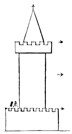
A TOWER AT RUDESHEIM.
Though they begin to make wine, as has been said, at Cologne, and continue it up the river indefinitely, yet it is only from Rudesheim to Hocheim that wines of the very first quality are made. The river happens there to run due east and west, so as to give its hills on that side a southern aspect. And even in this canton, it is only Hocheim, Johansberg, and Rudesheim, that are considered as of the very first quality. Johansberg is a little mountain (berg signifies mountain), whereon is a religious house, about fifteen miles below Mayence, and near the village of Vingel. It has a southern aspect, the soil a barren mulatto clay, mixed with a good deal of stone, and some slate. This wine used to be but on a par with Hocheim and Rudesheim; but the place having come to the Bishop of Fulda, he improved its culture so as to render it stronger; and since the year 1775, it sells at double the price of the other two. It has none of the acid of the Hocheim and other Rhenish wines. There are about sixty tons made in a good year, which sell, as soon as of a drinkable age, at one thousand franks each. The tun here contains seven and a-half aumes of one hundred and seventy bottles each. Rudesheim is a village of about eighteen or twenty miles below Mayence. Its fine wines are made on the hills about a mile below the village, which look to the south, and on the middle and lower parts of them. They are terraced. The soil is gray, about one-half of slate and rotten stone, the other half of barren clay, excessively steep. Just behind the village also is a little spot, called Hinder House, belonging to the Counts of Sicken and Oschstein, whereon each makes about a ton of wine of the very first quality. This spot extends from the bottom to the top of the hill. The vignerons of Rudesheim dung their wines about once in five or six years, putting a one-horse tumbrel load of dung on every twelve feet square. One thousand plants yield about four aumes in a good year. The best crops are,
The Chanoines of Mayence, who make 15 pieces of 7½ aumes.
Le Comte de Sicken 6 " "
Le Comte d'Oschstein 9 " "
L'Electeur de Mayence 6 " "
Le Comte de Meternisch 6 " "
Monsieur de Boze 5 " "
M. Ackerman, baliff et aubergiste des 3 couronnes 8 " "
M. Ackerman le fils, aubergiste à la couronne 5 " "
M. Lynn, aubergiste de l'ange 5 " "
Baron de Wetzel 7 " "
Convent de Mariahousen, des religieuses Benedictines 7 " "
M. Johan Yung 8 " "
M. de Rieden 5 " "
92
These wines begin to be drinkable at about five years old. The proprietors sell them old or young, according to the prices offered, and according to their own want of money. There is always a little difference between different casks, and therefore when you choose and buy a single cask, you pay three, four, five or six hundred florins for it. They are not at all acid, and to my taste much preferable to Hocheim, though but of the same price. Hocheim is a village about three miles above Mayence, on the Maine, where it empties into the Rhine. The spot whereon the good wine is made is the hill side from the church down to the plain, a gentle slope of about a quarter of a mile wide, and extending half a mile towards Mayence. It is of south-western aspect, very poor, sometimes gray, sometimes mulatto, with a moderate mixture of small broken stone. The wines are planted three feet apart, and stuck with sticks about six feet high. The wine, too, is cut at that height. They are dunged once in three or four years. One thousand plants yield from one to two aumes a year: they begin to yield a little at three years old, and continue to one hundred years, unless sooner killed by a cold winter. Dick, keeper of the Rothen-house tavern at Frankfort, a great wine merchant, who has between three and four hundred tons of wine in his cellars, tells me that Hocheim of the year 1783, sold, as soon as it was made, at ninety florins the aume, Rudesheim of the same year, as soon as made, at one hundred and fifteen florins, and Markebronn seventy florins. But a peasant of Hocheim tells me that the best crops of Hocheim in the good years, when sold new, sell but for about thirty-two or thirty-three florins the aume; but that it is only the poorer proprietors who sell new. The fine crops are,
Count Ingleheim about 10 tuns. } All of these keep till about fifteen years old, before they sell, unless they are offered a very good price sooner.
Baron d'Alberg 8 tuns }
Count Schimbon 14 tuns }
The Chanoines of Mayence 18 tuns }
Counsellor Schik de Vetsler 15 tuns }
Convent of Jacobsberg 8 tuns }
The Chanoine of Fechbach 10 tuns }
The Carmelites of Frankfort 8 tuns Who only sell by the bottle in their own tavern in Frankfort.
The Bailiff of Hocheim 11 tuns Who sells at three or four years old.
Zimmerman, a bourgeois 4 tuns } These being poor, sell new.
Feldman, a carpenter 2 tuns }
Markebronn (bronn signifies a spring, and is probably of affinity with the Scotch word, burn) is a little canton in the same range of hills, adjoining to the village of Hagenheim, about three miles above Johansberg, subject to the elector of Mayence. It is a sloping hill side of southern aspect, mulatto, poor, and mixed with some stone. This yields wine of the second quality.
April 12th. Mayence. Oppenheim. Dorms. Manheim. On the road between Mayence and Oppenheim are three cantons, which are also esteemed as yielding wines of the second quality. These are Laudenheim, Bodenheim, and Nierstein. Laudenheim is a village about four or five miles from Mayence. Its wines are made on a steep hill side, the soil of which is gray, poor and mixed with some stone. The river there happens to make a short turn to the south-west, so as to present its hills to the south-east. Bodenheim is a village nine miles, and Nierstein another about ten or eleven miles from Mayence. Here, too, the river is north-east and south-west, so as to give the hills between these villages a south-east aspect; and at Thierstein, a valley making off, brings the face of the hill round to the south. The hills between these villages are almost perpendicular, of a vermilion red, very poor, and having as much rotten stone as earth. It is to be observed that these are the only cantons on the south side of the river which yield good wine, the hills on this side being generally exposed to the cold winds, and turned from the sun. The annexed bill of prices current, will give an idea of the estimation of these wines respectively.
With respect to the grapes in this country, there are three kinds in use for making white wine, (for I take no notice of the red wines, as being absolutely worthless.) 1. The Klemperien, of which the inferior qualities of Rhenish wines are made, and is cultivated because of its hardness. The wines of this grape descend as low as one hundred florins the tun of eight aumes. 2. The Rhysslin grape, which grows only from Hocheim down to Rudesheim. This is small and delicate, and therefore succeeds only in this chosen spot. Even at Rudesheim it yields a fine wine only in the little spot called Hinder House, before mentioned; the mass of good wines made at Rudesheim, below the village, being of the third kind of grape, which is called the Orleans grape.
To Oppenheim the plains of the Rhine and Maine are united. From that place we see the commencement of the Bergstrasse, or mountains which separate at first the plains of the Rhine and Maine, then cross the Neckar at Heidelberg, and from thence forms the separation between the plains of the Neckar and Rhine, leaving those of the Rhine about ten or twelve miles wide. These plains are sometimes black, sometimes mulatto, always rich. They are in corn, potatoes, and some willow. On the other side again, that is, on the west side, the hills keep at first close to the river. They are about one hundred and fifty, or two hundred feet high, sloping, red, good, and mostly in vines. Above Oppenheim, they begin to go off till they join the mountains of Lorraine and Alsace, which separate the waters of the Moselle and Rhine, leaving to the whole valley of the Rhine about twenty or twenty-five miles breadth. About Worms these plains are sandy, poor, and often covered only with small pine.
April 13th. Manheim. There is a bridge over the Rhine here, supported on thirty-nine boats, and one over the Neckar on eleven boats. The bridge over the Rhine is twenty-one and a half feet wide from rail to rail. The boats are four feet deep, fifty-two feet long, and nine feet eight inches broad. The space between boat and boat is eighteen feet ten inches. From these data the length of the bridge should be 9ft. 8in. + 18ft. 10in. × 40 = 1140 feet. In order to let vessels pass through, two boats well framed together, with their flooring, are made to fall down stream together. Here, too, they make good ham. It is fattened on round potatoes and Indian corn. The farmers smoke what is for their own use in their chimneys. When it is made for sale, and in greater quantities than the chimney will hold, they make the smoke of the chimney pass into an adjoining loft, or apartment, from which it has no issue; and here they hang their hams.

An economical curtain bedstead. The bedstead is seven feet by four feet two inches. From each leg there goes up an iron rod three-eighths of an inch in diameter. Those from the legs at the foot of the bed meeting at top as in the margin, and those from the head meeting in like manner, so that the two at the foot form one point, and the two at the head another. On these points lays an oval iron rod, whose long diameter is five feet, and short one three feet one inch. There is a hole through this rod at each end, by which it goes on firm on the point of the upright rods. Then a nut screws it down firmly. Ten breadths of stuff two feet ten inches wide, and eight feet six inches long, form the curtains. There is no top nor vallons. The rings are fastened within two and a half or three inches of the top on the inside, which two and a half or three inches stand up, and are an ornament somewhat like a ruffle.
I have observed all along the Rhine that they make the oxen draw by the horns. A pair of very handsome chariot horses, large, bay, and seven years old, sell for fifty louis. One pound of beef sells for eight kreitzers, (i. e. eight sixtieths of a florin;) one pound of mutton or veal, six kreitzers; one pound of pork, seven and a half kreitzers; one pound of ham, twelve kreitzers; one pound of fine wheat bread, two kreitzers; one pound of butter, twenty kreitzers; one hundred and sixty pounds of wheat, six francs; one hundred and sixty pounds of maize, five francs; one hundred and sixty pounds of potatoes, one franc; one hundred pounds of hay, one franc; a cord of wood (which is 4 4 and 6 feet), seven francs; a laborer by the day receives twenty-four kreitzers, and feeds himself. A journee or arpent of land (which is eight by two hundred steps), such as the middling plains of the Rhine, will sell for two hundred francs. There are more soldiers here than other inhabitants, to wit: six thousand soldiers and four thousand males of full age of the citizens, the whole number of whom is reckoned at twenty thousand.
April 14th. Manheim. Dossenheim. Heidelberg. Schwetzingen Manheim. The elector placed, in 1768, two males and five females of the Angora goat at Dossenheim, which is at the foot of the Bergstrasse mountains. He sold twenty-five last year, and has now seventy. They are removed into the mountains four leagues beyond Dossenheim. Heidelberg is on the Neckar just where it issues from the Bergstrasse mountains, occupying the first skirt of plain which it forms. The château is up the hill a considerable height. The gardens lie above the château, climbing up the mountain in terraces. This château is the most noble ruin I have ever seen, having been reduced to that state by the French in the time of Louis XIV., 1693. Nothing remains under cover but the chapel. The situation is romantic and pleasing beyond expression. It is on a great scale much like the situation of Petrarch's château, at Vaucluse, on a small one. The climate, too, is like that of Italy. The apple, the pear, cherry, peach, apricot, and almond, are all in bloom. There is a station in the garden to which the château re-echoes distinctly four syllables. The famous ton of Heidelberg was new built in 1751, and made to contain thirty foudres more than the ancient one. It is said to contain two hundred and thirty-six foudres of one thousand two hundred bottles each. I measured it, and found its length external to be twenty-eight feet ten inches; its diameter at the end twenty feet three inches; the thickness of the staves seven and a half inches; thickness of the hoops seven and a half inches; besides a great deal of external framing. There is no wine in it now. The gardens at Schwetzingen show how much money may be laid out to make an ugly thing. What is called the English quarter, however, relieves the eye from the straight rows of trees, round and square basins, which constitute the great mass of the garden. There are some tolerable morsels of Grecian architecture, and a good ruin. The Aviary, too, is clever. It consists of cells of about eight feet wide, arranged round, and looking into a circular area of about forty or fifty feet diameter. The cells have doors both of wire and glass, and have small shrubs in them. The plains of the Rhine on this side are twelve miles wide, bounded by the Bergstrasse mountains. These appear to be eight hundred or a thousand feet high; the lower part in vines, from which is made what is called the vin de Nichar; the upper in chesnut. There are some cultivated spots however, quite to the top. The plains are generally mulatto, in corn principally; they are planting potatoes in some parts, and leaving others open for maize and tobacco. Many peach and other fruit trees on the lower part of the mountain. The paths on some parts of these mountains are somewhat in the style represented in the margin.

Manheim. Kaeferthal. Manheim. Just beyond Kaeferthal is an extensive, sandy waste, planted in pine, in which the elector has about two hundred sangliers, tamed. I saw about fifty; the heavies I am told, would weigh about three hundred pounds. They are fed on round potatoes, and range in the forest of pines. At the village of Kaeferthal is a plantation of rhubarb, begun in 1769 by a private company. It contains twenty arpens or jourries, and its culture costs about four or five hundred francs a year; it sometimes employs forty or fifty laborers at a time. The best age to sell the rhubarb at is the fifth or sixth year, but the sale being dull, they keep it sometimes to the tenth year; they find it best to let it remain in the ground. They sell about two hundred kentals a year at two or three francs a pound, and could sell double that quantity from the ground if they could find a market. The apothecaries of Francfort and of England are the principal buyers. It is in beds, resembling lettice-beds; the plants four, five or six feet apart. When dug, a thread is passed through every piece of root, and it is hung separate in a kind of rack; when dry it is rasped; what comes off is given to the cattle.
April 15. Manheim. Spire. Carlsruhe. The valley preserves its width, extending on each side of the river about ten or twelve miles, but the soil loses much in its quality, becoming sandy and lean, often barren and overgrown with pine thicket. At Spire is nothing remarkable. Between that and Carlsruhe we pass the Rhine in a common skow with oars, where it is between three and four hundred yards wide. Carlsruhe is the residence of the Margrave of Baden, a sovereign prince. His château is built in the midst of a natural forest of several leagues diameter, and of the best trees I have seen in these countries: they are mostly oak, and would be deemed but indifferent in America. A great deal of money has been spent to do more harm than good to the ground—cutting a number of straight allies through the forest. He has a pheasantry of the gold and silver kind, the latter very tame, but the former excessively shy. A little inclosure of stone, two and a half feet high and thirty feet diameter, in which are two tamed beavers. There is a pond of fifteen feet diameter in the centre, and at each end a little cell for them to retire into, which is stowed with boughs and twigs with leaves on them, which is their principal food. They eat bread also;—twice a week the water is changed. They cannot get over this wall Some cerfs of a peculiar kind, spotted like fawns, the horns remarkably long, small and sharp, with few points. I am not sure there were more than two to each main beam, and if I saw distinctly, there came out a separate and subordinate beam from the root of each. Eight angora goats—beautiful animals—all white. This town is only an appendage of the château, and but a moderate one. It is a league from Durlach, half way between that and the river. I observe they twist the flues of their stoves in any form for ornament merely, without smoking, as thus, e. g.

April 16. Carlsruhe. Rastadt. Scholhoven. Bischofheim. Kehl. Strasburg. The valley of the Rhine still preserves its breadth, but varies in quality; sometimes a rich mulatto loam, sometimes a poor sand, covered with small pine. The culture is generally corn. It is to be noted, that through the whole of my route through the Netherlands and the valley of the Rhine, there is a little red clover every here and there, and a great deal of grape cultivated. The seed of this is sold to be made into oil. The grape is now in blossom. No inclosures. The fruit trees are generally blossoming through the whole valley. The high mountains of the Bergstrasse, as also of Alsace, are covered with snow. Within this day or two, the every-day dress of the country women here is black. Rastadt is a seat also of the Margrave of Baden. Scholhoven and Kehl are in his territory, but not Bischofheim. I see no beggars since I entered his government, nor is the traveller obliged to ransom himself every moment by a chausiee gold. The roads are excellent, and made so, I presume, out of the coffers of the prince. From Cleves till I enter the Margravate of Baden, the roads have been strung with beggars—in Hesse the most, and the road tax very heavy. We pay it cheerfully, however, through the territory of Francfort and thence up the Rhine, because fine gravelled roads are kept up; but through the Prussian, and other parts of the road below Francfort, the roads are only as made by the carriages, there not appearing to have been ever a day's work employed on them. At Strasburgh we pass the Rhine on a wooden bridge.
At Brussels and Antwerp, the fuel is pit-coal, dug in Brabant. Through all Holland it is turf. From Cleves to Cologne it is pit-coal brought from England. They burn it in open stoves. From thence it is wood, burnt in close stoves, till you get to Strasburg, where the open chimney comes again into use.
April 16th, 17th, 18th. Strasburg. The vin de paille is made in the neighborhood of Colmar, in Alsace, about —— from this place. It takes its name from the circumstance of spreading the grapes on straw, where they are preserved till spring, and then made into wine. The little juice then remaining in them makes a rich sweet wine, but the dearest in the world, without being the best by any means. They charge nine florins the bottle for it in the taverns of Strasburg. It is the caprice of wealth alone which continues so losing an operation. This wine is sought because dear; while the better wine of Frontignan is rarely seen at a good table because it is cheap.
Strasburg. Saverne. Phalsbourg. As far as Saverne the country is in waiving hills and hollows; red, rich enough; mostly in small grain, but some vines; a little stone. From Saverne to Phalsbourg we cross a considerable mountain, which takes an hour to rise it.

Fig.1

Fig.2
April 19th. Phalsbourg. Fenestrange. Moyenvic. Nancy. Asparagus to-day at Moyenvic. The country is always either mountainous or hilly; red, tolerably good, and in small grain. On the hills about Fenestrange, Moyenvic, and Nancy, are some small vineyards where a bad wine is made. No inclosures. Some good sheep, indifferent cattle, and small horses. The most forest I have seen in France, principally of beech, pretty large. The houses, as in Germany, are of scantling, filled in with wicker and mortar, and covered either with thatch or tiles. The people, too, here as there, are gathered in villages. Oxen plough here with collars and hames. The awkward figure of their mould-board leads one to consider what should be its form. The offices of the mould-board are to receive the sod after the share has cut under it, to raise it gradually, and to reverse it. The fore-end of it then, should be horizontal to enter under the sod, and the hind end perpendicular to throw it over; the intermediate surface changing gradually from the horizontal to the perpendicular It should be as wide as the furrow, and of a length suited to the construction of the plough. The following would seem a good method of making it: Take a block, whose length, breadth and thickness, is that of your intended mould-board, suppose two and a half feet long and eight inches broad and thick. Draw the lines a d and c d, figure 1, with a saw, the toothed edge of which is straight, enter at a and cut on, guiding the hind part of the saw on the line a b, and the fore part on the line a d, till the saw reaches the points c and d, then enter it at c and cut on, guiding it by the lines c b and c d till it reaches the points b and d. The quarter, a b c d, will then be completely cut out, and the diagonal from d to b laid bare. The piece may now be represented as in figure 2. Then saw in transversely at every two inches till the saw reaches the line c e, and the diagonal b d, and cut out the pieces with an adze. The upper surface will thus be formed. With a gauge opened to eight inches, and guided by the lines c e, scribe the upper edge of the board from d b, cut that edge perpendicular to the face of the board, and scribe it of the proper thickness. Then form the underside by the upper, by cutting transversely with the saw and taking out the piece with an adze. As the upper edge of the wing of the share rises a little, the fore end of the board, b c, will rise as much from a strict horizontal position, and will throw the hind end, e d, exactly as much beyond the perpendicular, so as to promote the reversing of the sod. The women here, as in Germany, do all sorts of work. While one considers them as useful and rational companions, one cannot forget that they are also objects of our pleasures; nor can they ever forget it. While employed in dirt and drudgery, some tag of a ribbon, some ring, or bit of bracelet, earbob or necklace, or something of that kind, will show that the desire of pleasing is never suspended in them. It is an honorable circumstance for man, that the first moment he is at his ease, he allots the internal employments to his female partner, and takes the external on himself. And this circumstance, or its reverse, is a pretty good indication that a people are, or are not at their ease. Among the Indians, this indication fails from a particular cause: every Indian man is a soldier or warrior, and the whole body of warriors constitute a standing army, always employed in war or hunting. To support that army, there remain no laborers but the women. Here, then, is so heavy a military establishment, that the civil part of the nation is reduced to women only. But this is a barbarous perversion of the natural destination of the two sexes. Women are formed by nature for attentions, not for hard labor. A woman never forgets one of the numerous train of little offices which belong to her. A man forgets often.
April 20th. Nancy. Toule. Void. Ligny en Barrois. Bar le Duc. St. Dizier. Nancy itself is a neat little town, and its environs very agreeable. The valley of the little branch of the Moselle, on which it is, is about a mile wide: the road then crossing the head-waters of the Moselle, the Maes, and the Marne, the country is very hilly, and perhaps a third of it poor and in forests of beech: the other two-thirds from poor up to middling, red, and stony. Almost entirely in corn, now and then only some vines on the hills. The Moselle at Toule is thirty or forty yards wide: the Maese near Void about half that: the Marne at St. Dizier about forty yards. They all make good plains of from a quarter of a mile to a mile wide. The hills of the Maese abound with chalk. The rocks coming down from the tops of the hills, on all the road of this day, at regular intervals like the ribs of an animal, have a very irregular appearance. Considerable flocks of sheep and asses, and, in the approach to St. Dizier, great plantations of apple and cherry trees; here and there a peach tree, all in general bloom. The roads through Lorraine are strung with beggars.
April 21st. St. Dizier. Vitry le Français. Chalons sur Marne. Epernay. The plains of the Marne and Sault uniting, appear boundless to the eye till we approach their confluence at Vitry, where the hills come in on the right; after that the plains are generally about a mile, mulatto, of middling quality, sometimes stony. Sometimes the ground goes off from the river so sloping, that one does not know whether to call it high or low land. The hills are mulatto also, but whitish, occasioned by the quantity of chalk which seems to constitute their universal base. They are poor, and principally in vines. The streams of water are of the color of milk, occasioned by the chalk also. No inclosures, some flocks of sheep; children gathering dung in the roads. Here and there a château; but none considerable.
April 22d. Epernay. The hills abound with chalk. Of this they make lime, not so strong as stone lime, and therefore to be used in greater proportion. They cut the blocks into regular forms also, like stone, and build houses of it. The common earth too, well impregnated with this, is made into mortar, moulded in the form of brick, dried in the sun, and houses built of them which last one hundred or two hundred years. The plains here are a mile wide, red, good, in corn, clover, Luzerne, St. Foin. The hills are in vines, and this being precisely the canton where the most celebrated wines of Champagne are made, details must be entered into. Remember, however, that they will always relate to the white wines, unless where the red are expressly mentioned. The reason is that their red wines, though much esteemed on the spot, are by no means esteemed elsewhere equally with their white; nor do they merit equal esteem.
A Topographical sketch of the position of the wine villages, the course of the hills, and consequently the aspect of the vine-yards.
Soil, meagre, mulatto clay, mixed with small broken stone, and a little hue of chalk. Very dry.
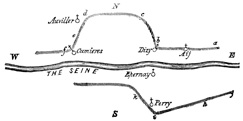
Aspect, may be better seen by the annexed diagram. The wine of Aij is made from a to b, those of Dizij from b to c, Auvillij d to e, Cumieres e to f, Epernay g to h, Perij i to k. The hills are generally about two hundred and fifty feet high. The good wine is made only in the middle region. The lower region, however, is better than the upper; because this last is exposed to cold winds, and a colder atmosphere.
Culture. The vines are planted two feet apart. Afterwards they are multiplied (provignés). When a stock puts out two shoots they lay them down, spread them open and cover them with earth, so as to have in the end about a plant for every square foot. For performing this operation they have a hook, of this shape, and nine inches long, which, being stuck in the ground, holds down the main stock, while the laborer separates and covers the new shoot. They leave two buds above the ground. When the vine has shot up high enough, they stick it with split sticks of oak, from an inch to an inch and a half square, and four feet long, and tie the vine to its stick with straw. These sticks cost two florins the hundred, and will last forty years. An arpent, one year with another, in the fine vineyards, gives twelve pieces, and in the inferior vineyards twenty-five pieces, of two hundred bottles each. An arpent of the first quality sells for three thousand florins, and there have been instances of seven thousand two hundred florins. The arpent contains one hundred verges, of twenty-two pieds square. The arpent of inferior quality sells at one thousand florins. They plant the vines in a hole about a foot deep, and fill that hole with good mould, to make the plant take. Otherwise it would perish. Afterwards, if ever they put dung, it is very little. During wheat harvest there is a month or six weeks that nothing is done in the vine-yard, that is to say, from the 1st of August to the beginning of vintage. The vintage commences early in September, and lasts a month. A day's work of a laborer in the busiest season is twenty sous, and he feeds himself: in the least busy season it is fifteen sous. Corn lands are rented from four florins to twenty-four; but vine lands are never rented. The three façons (or workings) of an arpent cost fifteen florins. The whole year's expense of an arpent is worth one hundred florins.

Grapes.—The bulk of their grapes are purple, which they prefer for making even white wine. They press them very lightly, without treading or permitting them to ferment at all, for about an hour; so that it is the beginning of the running only which makes the bright wine. What follows the beginning is of a straw color, and therefore not placed on a level with the first. The last part of the juice, produced by strong pressure, is red and ordinary. They choose the bunches with as much care, to make wine of the very first quality, as if to eat. Not above one-eighth of the whole grapes will do for this purpose. The white grape, though not so fine for wine as the red, when the red can be produced, and more liable to rot in a moist season, yet grows better if the soil be excessively poor, and therefore in such a soil is preferred, or rather, is used of necessity, because there the red would not grow at all.
Wine.—The white wines are either mousseux, sparkling, or non-mousseux, still. The sparkling are little drunk in France, but are almost alone known and drunk in foreign countries. This makes so great a demand, and so certain a one, that it is the dearest by about an eighth, and therefore they endeavor to make all sparkling if they can. This is done by bottling in the spring, from the beginning of March till June. If it succeeds, they lose abundance of bottles, from one-tenth to one-third. This is another cause increasing the price. To make the still wine, they bottle in September. This is only done when they know from some circumstance that the wine will not be sparkling. So if the spring bottling fails to make a sparkling wine, they decant it into other bottles in the fall, and it then makes the very best still wine. In this operation, it loses from one-tenth to one-twentieth by sediment. They let it stand in the bottles in this case forty-eight hours, with only a napkin spread over their mouths, but no cork. The best sparkling wine, decanted in this manner, makes the best still wine, and which will keep much longer than that originally made still by being bottled in September. The sparkling wines lose their briskness the older they are, but they gain in quality with age to a certain length. These wines are in perfection from two to ten years old, and will even be very good to fifteen. 1766 was the best year ever known. 1775 and 1776 next to that. 1783 is the last good year, and that not to be compared with those. These wines stand icing very well.
Aij. M. Dorsay makes one thousand and one hundred pieces, which sell, as soon as made, at three hundred florins, and in good years four hundred florins, in the cask. I paid in his cellar, to M. Louis, his homme d'affaires, for the remains of the year 1783, three florins ten sous the bottle. Sparkling Champagne, of the same degree of excellence, would have cost four florins, (the piece and demiqueue are the same; the feuillette is one hundred bottles.) M. le Duc makes four hundred to five hundred pieces. M. de Villermont, three hundred pieces. M. Janson, two hundred and fifty pieces. All of the first quality, red and white in equal quantities.
Auvillaij. The Benedictine monks make one thousand pieces, red and white, but three-fourths red, both of the first quality. The king's table is supplied by them. This enables them to sell at five hundred and fifty florins the piece. Though their white is hardly as good as Dorsay's, their red is the best. L'Abbatiale, belonging to the bishop of the place, makes one thousand to twelve hundred pieces, red and white, three-fourths red, at four hundred to five hundred and fifty florins, because neighbors to the monks.
Cumieres is all of the second quality, both red and white, at one hundred and fifty to two hundred florins the piece.
Epernay. Madame Jermont makes two hundred pieces at three hundred florins. M. Patelaine, one hundred and fifty pieces. M. Mare, two hundred pieces. M. Chertems, sixty pieces. M. Lauchay, fifty pieces. M. Cousin (Aubergiste de l'hôtel de Róhan à Epernay), one hundred pieces. M. Pierrot, one hundred pieces. Les Chanoines regulieres d'Epernay, two hundred pieces. Mesdames les Ursulines religieuses, one hundred pieces. M. Gilette, two hundred pieces. All of the first quality; red and white in equal quantities.
Pierrij. M. Casotte makes five hundred pieces. M. de la Motte, three hundred pieces. M. de Failli, three hundred pieces. I tasted his wine of 1779, one of the good years. It was fine, though not equal to that of M. Dorsay, of 1783. He sells it at two florins ten sous to merchants, and three florins to individuals. Les Seminaristes, one hundred and fifty pieces. M. Hoquart, two hundred pieces. All of the first quality; white and red in equal quantities.
At Cramont, also, there are some wines of the first quality made. At Avisi also, and Aucy, Le Meni, Mareuil, Verzis-Verzenni. This last place belongs to the Marquis de Sillery. The wines are carried to Sillery, and there stored, whence they are called Vins de Sillery, though not made at Sillery.
All these wines of Epernay and Pierrij sell almost as dear as M. Dorsay's, their quality being nearly the same. There are many small proprietors who might make wine of the first quality, if they would cull their grapes, but they are too poor for this. Therefore, the proprietors before named, whose names are established, buy of the poorer ones the right to cull their vineyards, by which means they increase their quantity, as they find about one-third of the grapes will make wines of the first quality.
The lowest-priced wines of all are thirty florins the piece, red or white. They make brandy of the pumice. In very bad years, when their wines become vinegar, they are sold for six florins the piece, and made into brandy. They yield one-tenth brandy.
White Champagne is deemed good in proportion as it is silky and still. Many circumstances derange the scale of wines. The proprietor of the best vineyard, in the best year, having bad weather come upon him while he is gathering his grapes, makes a bad wine, while his neighbor, holding a more indifferent vineyard, which happens to be ingathering while the weather is good, makes a better. The M. de Casotte at Pierrij formerly was the first house. His successors, by some imperceptible change of culture, have degraded the quality of their wines. Their cellars are admirably made, being about six, eight or ten feet wide, vaulted, and extending into the ground, in a kind of labyrinth, to a prodigious distance, with an air-hole of two feet diameter every fifty feet. From the top of the vault to the surface of the earth, is from fifteen to thirty feet. I have nowhere seen cellars comparable to these. In packing their bottles, they lay on their side; then cross them at each end, they lay laths, and on these another row of bottles, heads and points; and so on. By this means, they can take out a bottle from the top, or where they will.
April 23d. Epernay. Château Thieray. St. Jean. Meaux. Vergalant. Paris. From Epernay to St. Jean the road leads over hills, which in the beginning are indifferent, but get better towards the last. The plains, wherever seen, are inconsiderable. After passing St. Jean, the hills become good, and the plains increase. The country about Vergalant is pretty. A skirt of a low ridge which runs in on the extensive plains of the Marne and Seine, is very picturesque. The general bloom of fruit trees proves there are more of them than I had imagined from travelling in other seasons, when they are less distinguishable at a distance from the forest trees.
XIV. Travelling notes for Mr. Rutledge and Mr. Shippen, June 3, 1788.
General Observations.—On arriving at a town, the first thing is to buy the plan of the town, and the book noting its curiosities. Walk round the ramparts when there are any, go the top of a steeple to have a view of the town and its environs.
When you are doubting whether a thing is worth the trouble of going to see, recollect that you will never again be so near it, that you may repent the not having seen it, but can never repent having seen it. But there is an opposite extreme too, that is, the seeing too much. A judicious selection is to be aimed at, taking care that the indolence of the moment have no influence in the decision. Take care particularly not to let the porters of churches, cabinets, &c., lead you through all the little details of their profession, which will load the memory with trifles, fatigue the attention, and waste that and your time. It is difficult to confine these people to the few objects worth seeing and remembering. They wish for your money, and suppose you give it the more willingly the more they detail to you.
When one calls in the taverns for the vin du pays, they give what is natural and unadulterated and cheap: when vin etrangere is called for, it only gives a pretext for charging an extravagant price for an unwholesome stuff, very often of their own brewery. The people you will naturally see the most of will be tavern keepers, valets de place, and postilions. These are the hackneyed rascals of every country. Of course they must never be considered when we calculate the national character.
Objects of attention for an American.—1. Agriculture. Everything belonging to this art, and whatever has a near relation to it. Useful or agreeable animals which might be transported to America. Species of plants for the farmer's garden, according to the climate of the different States.
2. Mechanical arts, so far as they respect things necessary in America, and inconvenient to be transported thither ready-made, such as forges, stone quarries, boats, bridges, (very especially,) &c., &c.
3. Lighter mechanical arts, and manufactures. Some of these will be worth a superficial view; but circumstances rendering it impossible that America should become a manufacturing country during the time of any man now living, it would be a waste of attention to examine these minutely.
4. Gardens, peculiarly worth the attention of an American, because it is the country of all others where the noblest gardens may be made without expense. We have only to cut out the superabundant plants.
5. Architecture worth great attention. As we double our numbers every twenty years, we must double our houses. Besides, we build of such perishable materials, that one half of our houses must be rebuilt in every space of twenty years, so that in that time, houses are to be built for three-fourths of our inhabitants. It is, then, among the most important arts; and it is desirable to introduce taste into an art which shows so much.
6. Painting. Statuary. Too expensive for the state of wealth among us. It would be useless, therefore, and preposterous, for us to make ourselves connoisseurs in those arts. They are worth seeing, but not studying.
7. Politics of each country, well worth studying so far as respects internal affairs. Examine their influence on the happiness of the people. Take every possible occasion for entering into the houses of the laborers, and especially at the moments of their repast; see what they eat, how they are clothed, whether they are obliged to work too hard; whether the government or their landlord takes from them an unjust proportion of their labor; on what footing stands the property they call their own, their personal liberty, &c., &c.
8. Courts. To be seen as you would see the tower of London or menagerie of Versailles, with their lions, tigers, hyenas, and other beast of prey, standing in the same relation to their fellows. A slight acquaintance with them will suffice to show you that, under the most imposing exterior, they are the weakest and worst part of mankind. Their manners, could you ape them, would not make you beloved in your own country, nor would they improve it could you introduce them there to the exclusion of that honest simplicity now prevailing in America, and worthy of being cherished.
XV. Queries as to the rights and duties of the United States under her treaties with France, and the laws of neutrality.
1st. Do the treaties between the United States and France give to France or her citizens a right, when at war with a power with whom the United States are at peace, to fit out originally and from the ports of the United States, vessels armed for war with or without commission?
2d. If they give such a right, does it extend to all manner of armed vessels, or to particular kinds only? If the latter, to what kinds does it extend?
3d. Do they give to France or her citizens, in the case supposed, a right to refit, or arm anew vessels, which, before their coming within any port of the United States, were armed for war with or without commission?
4th. If they give such a right, does it extend to all manner of armed vessels, or to particular kinds only? If the latter, to what kinds does it extend? Does it include an augmentation of force, or does it only extend to placing the vessel in status quo?
5th. Does the twenty-second article of the treaty of commerce, in the case supposed, extend to vessels armed for war on account of the Government of a power at war with France, or to merchant-armed vessels belonging to the subjects or citizens of that power, (viz.) of the description of those which, by the English, are called letters of Marque ships; by the French, "batiments armes en marchandize et en guerre"?
6th. Do the treaties aforesaid prohibit the United States from permitting in the case supposed, the armed vessels belonging to a power at war with France, or to the citizens or subjects of such power to come within the ports of the United States, there to remain as long as they may think fit, except in the case of their coming in with prizes made of the subjects or property of France?
7th. Do they prohibit the United States from permitting in the case supposed, vessels armed on account of the government of a power at war with France, or vessels armed for merchandise and war, with or without commission, on account of the subjects or citizens of such power, or any vessels, other than those commonly called privateers, to sell freely whatever they may bring into the ports of the United States, and freely to purchase in and carry from the ports of the United States, goods, merchandise, and commodities, except as excepted in the last question?
8th. Do they oblige the United States to permit France in the case supposed, to sell in their ports the prizes which she or her citizens may have made, of any power at war with her, the citizens or subjects of such powers, or exempt from the payment of the usual duties on ships and merchandise, the prizes so made, in the case of their being to be sold within the ports of the United States?
9th. Do those treaties, particularly the Consular Convention, authorize France, as of right, to erect courts within the jurisdiction of the United States, for the trial and condemnation of prizes made by armed vessels in her service?
10th. Do the laws and usages of nations authorize her, as of right, to erect such courts for such purposes?
11th. Do the laws of neutrality, considered relatively to the treaties of the United States with foreign powers, or independently of those treaties, permit the United States in the case supposed, to allow to France or her citizens, the privilege of fitting out originally in and from the ports of the United States, vessels armed and commissioned for war, either on account of the government, or of private persons, or both?
12th. Do those laws permit the United States to extend the like privilege to a power at war with France?
13th. Do the laws of neutrality, considered as aforesaid, permit the United States, in the case supposed, to allow to France or her citizens the privilege of refitting, or arming anew, vessels which, before their coming within the United States, were armed and commissioned for war? May such privilege include an augmentation of the force of such vessels?
14th. Do those laws permit the United States to extend the like privilege to a power at war with France?
15th. Do those laws in the case supposed, permit merchant vessels of either of the powers at war to arm in the ports of the United States without being commissioned? May this privilege be rightfully refused?
16th. Does it make any difference in point of principle, whether a vessel be armed for war, or the force of an armed vessel be augmented in the ports of the United States with means procured in the United States, or with means brought into them by the party who shall so arm or augment the force of such vessels? If the first be unlawful, is the last lawful?
17th. Do the laws of neutrality, considered as aforesaid, authorize the United States to permit France, her subjects, or citizens, the sale within their ports of prizes made of the subjects or property of a power at war with France, before they have been carried into some port of France and there condemned, refusing the privilege to her enemy?
18th. Do those laws authorize the United States to permit to France the erection of courts within their territory and jurisdiction, for the trial and condemnations of prizes refusing that privilege to a power at war with France?
19th. If any armed vessel of foreign power at war with another, with whom the United States are at peace, shall make prize of the subjects or property of its enemy within the territory or jurisdiction of the United States, have not the United States a right to cause restitution of such prize? Are they bound or not by the principles of neutrality so to do, if such prize shall be within their power?
20th. To what distance, by the laws and usages of nations, may the United States exercise the right of prohibiting the hostilities of foreign powers at war with each other, within rivers, bays, and arms of the sea, and upon the sea along the coast of the United States?
21st. Have vessels armed for war, under commission from a foreign power, a right without the consent of the United States, to engage within their jurisdiction seamen or soldiers, for the service of such vessels, being citizens of that power or of another foreign power, or citizens of the United States?
22d. What are the articles by name to be prohibited to both or either party?
23d. To what extent does the reparation permitted in the nineteenth article of the treaty with France, go?
24th. What may be done as to vessels armed in our ports before the President's proclamation? And what as to the prizes they made before and after?
25th. May we within our own ports sell ships to both parties prepared merely for merchandise? May they be pierced for guns?
26th. May we carry either or both kinds to the ports of the belligerent powers for sale?
27th. Is the principle that free bottoms make free goods, and enemies bottoms make enemies goods, to be considered as now an established part of the law of nations?
28th. If it is not, are nations with whom we have no treaties, authorized by the law of nations to take out of our vessels enemy passengers, not being soldiers, and their baggage?
29th. May an armed vessel belonging to any of the belligerent powers, follow immediately merchant vessels, enemies departing from our ports, for the purpose of making prizes of them? If not, how long ought the former to remain after the latter has sailed? And what shall be considered as the place of departure, from which the time is to be counted? And how are the facts to be ascertained?
The first twenty-one questions by Alexander Hamilton.
Twenty-two to twenty-eight, by Thomas Jefferson.
Twenty-ninth, by the President.
XVI. Heads of consideration on the conduct we are to observe in the war between Spain and Great Britain, and particularly should the latter attempt the conquest of Louisiana and the Floridas.
The dangers to us, should Great Britain possess herself of those countries:—
She will possess a territory equal to half ours beyond the Mississippi.
She will reduce that half of ours which is on this side of the Mississippi;—by her language, laws, religion, manners, government, commerce, capital;—by the possession of New Orleans, which draws to it the dependence of all the waters of the Mississippi;—by the markets she can offer them in the Gulf of Mexico and elsewhere.
She will take from the remaining part of our States the markets they now have for their produce;—by furnishing those markets cheaper with the same articles, tobacco, rice, indigo, bread, lumber, arms, naval stores, furs.
She will have then possessions double the size of ours, as good in soil and climate.
She will encircle us completely, by these possessions on our land-board, and her fleets on our sea-board. Instead of two neighbors balancing each other, we shall have one with more than the strength of both.
Would the prevention of this be worth a war?
Consider our abilities to take part in a war. Our operations would be by land only. How many men should we need to employ?—their cost? Our resources of taxation and credit equal to this.
Weigh the evil of this new accumulation of debt against the loss of markets, and eternal expense and danger from so overgrown a neighbor.
But this is on supposition that France, as well as Spain, shall be engaged in the war; for, with Spain alone, the war would be unsuccessful, and our situation rendered worse.
No need to take a part in the war as yet. We may choose our own time. Delay gives us many chances to avoid it altogether.
In such a choice of objects, Great Britain may not single out Louisiana and the Floridas. She may fail in her attempt on them. France and Spain may recover them.
If all these chances fail, we should have to re-take them. The difference between re-taking and preventing, overbalanced by the benefits of delay. Delay enables us to be better prepared to obtain from the allies a price for our assistance.
Suppose these our ultimate views, what is to be done at this time?
1. As to Spain:— If she be as sensible as we are, that she cannot save Louisiana and the Floridas, might she not prefer their independence to their subjection to Great Britain? Does not the proposition of the Count d'Estaing furnish us an opening to communicate our ideas on this subject to the court of France, and through them to that of Madrid? and our readiness to join them in guaranteeing the independence of those countries? This might save us from a war, if Great Britain respected our weight in a war; and if she does not, the object would place the war on popular ground with us.
2. As to England?—say to Beckwith,— That as to a treaty of commerce, we would prefer amicable to adversary arrangements, though the latter would be infallible, and in our own power: that our ideas are, that such a treaty should be founded in perfect reciprocity, and would, therefore, be its own price: that as to an alliance, we can say nothing till its object be shown, and that it is not to be inconsistent with existing engagements: that in the event of a war between Great Britain and Spain, we are disposed to be strictly neutral: that, however, we should view with extreme uneasiness any attempts of either power to seize the possessions of the other on our frontier, as we consider our own safety interested in a due balance between our neighbors. [It might be deemed advantageous to express this latter sentiment, because, if there be any difference of opinion in their councils, whether to bend their force against North or South America, or the islands (and certainly there is room for difference), and if these opinions be nearly balanced, that balance ought to be determined by the prospect of having an enemy the more or less, according to the object they should select.]
July 12th, 1790.
XVII. Heads of consideration on the Navigation of the Mississippi, for Mr. Carmichael, Aug. 22d, 1790.
We have a right to the navigation of the Mississippi—1, by Nature; 2, by Treaty.
It is necessary to us. More than half the territory of the United States is on the waters of that river. Two hundred thousand of our citizens are settled on them, of whom forty thousand bear arms. These have no other outlet for their tobacco, rice, corn, hemp, lumber, house timber, ship timber.
We have hitherto respected the indecision of Spain, because we wish peace;—because our western citizens have had vent at home for their productions.
A surplus of production begins now to demand foreign markets. Whenever they shall say, "We cannot, we will not, be longer shut up," the United States will be reduced to the following dilemma: 1. To force them to acquiescence. 2. To separate from them, rather than take part in a war against Spain. 3. Or to preserve them in our Union, by joining them in the war.
The 1st is neither in our principles, nor in our power. 2d. A multitude of reasons decide against the second. It may suffice to speak out one: were we to give up half our territory rather than engage in a just war to preserve it, we should not keep the other half long. 3d. The third is the alternative we must adopt.
How are we to obtain that navigation?
(A.) By Force. I. Acting separately. That we can effect this with certainty and promptitude, circumstances decide. Objection. We cannot retain New Orleans, for instance, were we to take it. Answer. A moderate force may be so secured, as to hold out till succored. Our succors can be prompt and effectual. Suppose, after taking it, we withdraw our force. If Spain retakes it by an expedition, we can recover it by a counter-expedition, and so as often as the case shall happen. Their expedition will be slow, expensive, and lead to catastrophes. Ours sudden, economical, and a check can have no consequences. We should associate the country to our Union. The inhabitants wish this. They are not disposed to be of the Spanish government. It is idle in Spain to suppose our Western inhabitants will unite with them. They could be quiet but a short time under a government so repugnant to their feelings. Were they to come under it for present purposes, it would be with a view to throw it off soon. Should they remain, they would communicate a spirit of independence to those with whom they should be mixed. II. Acting in conjunction with Great Britain, and with a view to partition. The Floridas (including New Orleans) would be assigned to us. Louisiana (or all the Western waters of the Mississippi) to them. We confess that such an alliance is not what we would wish. Because it may eventually lead us into embarrassing situations with our best friend, and put the power of two neighbors into the hands of one. L. Lansdowne has declared he gave the Floridas to Spain rather than the United States as a bone of discord with the House of Bourbon, and of re-union with Great Britain. Connolly's attempt (as well as other facts) proves they keep it in view.
(B.) By Negotiation. I. What must Spain do of necessity? The conduct of Spain has proved that the occlusion of the Mississippi is system with her. If she opens it now, it will be because forced by imperious circumstances. She will consequently shut it again when these circumstances cease. Treaty will be no obstacle. Irregularities, real or pretended, in our navigators, will furnish color enough. Perpetual broils, and finally war will ensue. Prudence, and even necessity, imposes on us the law of settling the matter now, finally, and not by halves. With experience of the past and prospect of the future, it would be imbecility in us to accept the naked navigation. With that, we must have what is necessary to its use, and without which it would be useless to secure its continuance; that is, a port near the mouth to receive our vessels and protect the navigation. But even this will not secure the Floridas and Louisiana against Great Britain. If we are neutral, she will wrest those possessions from Spain. The inhabitants (French, English, Scotch, American) would prefer England to Spain. II. What then had Spain better do of choice? Cede to us all territory on our side of the Mississippi: on condition that we guarantee all her possessions on the Western waters of that river, she agreeing further, to subsidize us if the guarantee brings us into the war. Should Great Britain possess herself of the Floridas and Louisiana, her governing principles are conquest, colonization, commerce, monopoly. She will establish powerful colonies in them. These can be poured into the Gulf of Mexico for any sudden enterprise there, or invade Mexico, their next neighbor, by land. Whilst a fleet co-operates along shore, and cuts off relief. And proceed successively from colony to colony. With respect to us, if Great Britain establishes herself on our whole land-board our lot will be bloody and eternal war, or indissoluble confederacy. Which ought we to choose? What will be the lot of the Spanish colonies in the jaws of such a confederacy? What will secure the ocean against the monopoly? Safer for Spain that we should be her neighbor, than England. Conquest not in our principles: inconsistent with our government. Not our interest to cross the Mississippi for ages. And will never be our interest to remain united with these who do. Intermediate chances save the trouble of calculating so far forward. Consequences of this cession, and guarantee: 1. Every subject of difference will be removed from between Spain and the United States. 2. Our interest will be strongly engaged in her retaining her American possessions. 3. Spain will be quieted as to Louisiana, and her territories west of that. 4. She may employ her whole force in defence of her islands and Southern possessions. 5. If we preserve our neutrality, it will be a very partial one to her. 6. If we are forced into the war, it will be, as we wish, on the side of the House of Bourbon. 7. Her privateers will commit formidable depredation on the British trade, and occupy much of their force. 8. By withholding supplies of provision, as well as by concurring in expeditions, the British islands will be in imminent danger. 9. Their expenses of precaution, both for their continental and insular possessions, will be so augmented as to give a hope of running their credit down. In fine, for a narrow slip of barren, detached, and expensive country, Spain secures the rest of her territory, and makes an ally where she might have a dangerous enemy.
XVIII. Questions to be considered of.
I. As to France.
Shall it be proposed to M. de Ternant to form a treaty ad referendum to this effect: The citizens of the United States and of France, their vessels, productions, and manufactures, shall be received and considered each in all the dominions of the other as if they were the native citizens, or the ships, productions, or manufactures of the other; and the productions of the sea shall be received in all the dominions of each, as if they were the productions of the country by the industry of whose citizens they have been taken or produced from the sea. Saving only as to the persons of their citizens, that they shall continue under those in capacities for office, each with the other, which the constitution of France, or of the United States, or any of them, have or shall establish against foreigners of all nations, without exception?
If not, shall a treaty be proposed to him ad referendum, in which the conditions shall be detailed on which the persons, ships, productions, and manufactures of each shall be received with the other, and the imports to which they shall be liable be formed into a tariff?
Shall the Senate be consulted in the beginning, in the middle, or only at the close of this transaction?
II. As to England.
Shall Mr. Hammond be now asked whether he is instructed to give us any explanations of the intentions of his court, as to the detention of our Western posts, and other infringements of our treaty with them?
Shall he be now asked whether he is authorized to conclude, or to negotiate any commercial arrangements with us?
November 26, 1791.
XIX. Plan of a Bill concerning Consuls.
The matter of the bill will naturally divide as follows:
I. Foreign Consuls residing within the United States under a convention.
II. Consuls of the United States residing in foreign countries under a convention.
III. Provision for future conventions, and cases where there is no convention.
Preliminary observations.—Nothing should be inserted in the bill which is fully and adequately provided for by the convention with France, because weak magistrates may infer from thence, that the parts omitted were not meant by the Legislature to be enforced.
Are not the first, second and third sections of the printed bill objectionable in this view? The instructions of the Executive to their consuls will of course provide for the notification directed in the second clause.
I. For carrying into full effect the convention between his most Christian Majesty and the United States of America, entered into for the purpose of defining and establishing the functions and privileges of their respective Consuls and Vice-Consuls, Be it enacted by the Senate and House of Representatives of the United States of America, that where, in the seventh article of the said convention, it is agreed when there shall be no Consul or Vice-Consul of his most Christian King to attend to the saving of the wreck of any French vessel stranded on the coast of the United States, or that the residence of the said Consul or Vice-Consul (he not being at the place of the wreck) shall be more distant from the same place than that of the competent judge of the country, the latter shall immediately proceed to perform the office therein prescribed, the nearest (here name the officer) shall be the competent judge designated in the said article, and it shall be incumbent on him to perform the office prescribed in the said article, and according to the tenor thereof. Go on to direct who, in conjunction with the Consul or Vice-Consul, (if there be one,) shall ascertain the abatement of duties on the damaged goods stipulated in this article.
Article 9th allows the Consuls of the most Christian King to arrest and imprison deserted captains, officers, mariners, seamen, and all others being part of a ship's crew. For which purpose they are to address themselves to the courts, judges, and officers competent, who are to aid in arresting the deserter, and to confine him in the prisons of the country. Say who are the competent courts, judges, and officers to whom he is to apply, and what prisons they shall use.
This clause confines the terms of imprisonment to three months. The French Consuls represent that in many ports of the United States, no opportunity of re-conveying by a French ship occurs within that term, and they ask a longer. Suppose it be referred to the Federal district judge on application by the French Consul, and on his showing good cause, to prolong the term from time to time, not exceeding three months additional in the whole.
Article 12th. It is necessary to authorize some officer to execute the sentences of the Consul, not extending to life, limb or liberty. Will it be best to require the Marshal residing at the port to do it, (and make it the duty, where none resides, to appoint a deputy residing there,) or to allow the Consul to constitute some person of his nation an officer for the purpose? If it should be thought indifferent to us, it might be well to pay the French the compliment of asking their minister here which he would prefer, and it would shield us from complaints of delinquencies in the executing officer.
II. Article 12th. Say by what law the Consul of the United States, residing in the French dominion, shall decide the cases whereof he has jurisdiction, viz.: by the same law by which the proper federal court would decide the same case.
Direct appeals from Consular sentences to the proper Federal court, and save defects of formality in proceedings, where the matter is substantially stated.
Article 4th. Declare what validity the authentication under the Consular seal, of any instrument executed in foreign countries, shall have in the courts of the United States.
[Duties not prescribed in the Convention.]
To subsist ship-wrecked or wandering seamen till an opportunity offers of sending them back to some port of the United States, and to oblige every master of an American vessel homeward bound, to receive and bring them back in a certain proportion; they working, if able.
Where a ship is sold in a foreign port, oblige the master to send back the crew, or furnish wherewithal to do it, on pain of an arrest by the Consul on his ship, his goods, and his person, (if the laws of the land permit it,) until he does it.
Oblige all American masters (on pain of arrest, till compliance, of their vessel, cargo, or person, or such other pain as shall be thought effectual) on their arrival in any foreign port within the jurisdiction of a Consul or Vice-Consul of the United States, to report to him or his agent in the port, their ship's name, and owners, burthen, crew, cargo, and its owners, from what port of the United States they cleared, and at what ports they have touched. Also to report to the Consul the cargo they take in, and the port or ports of destination, and to take his certificate that such report has been made, on like pain.
Allow certain fees to Consuls where none are already allowed, for the same services, by the laws of the countries in which they reside.
Allow salaries not exceeding three thousand dollars to one Consul in each of the Barbary States.
III. Where there are Consuls of the United States residing in foreign countries, with which we have no convention, but whose governments indulge our Consuls in the exercise of functions, extend the provisions of this bill, or such of them as such government permits, to such Consuls of the United States residing with them.
Also where any Consular Convention shall hereafter be removed with the same, or entered into with any other nation, with stipulations corresponding to those provided for in this bill, extend the provisions of the bill respectively to the Consuls on both sides.
XX. Matters to be arranged between the Governments of England and United States. December 12th, 1791.
The discussions which are opening between Mr. Hammond and our government, have as yet looked towards no objects but those which depend on the treaty of peace. There are, however, other matters to be arranged between the two governments, some of which do not rest on that treaty. The following is a statement of the whole of them:
1st. The Western ports.
2d. The negroes carried away.
3d. The debt of their bank to Maryland, and perhaps Rhode Island.
4th. Goods taken from the inhabitants of Boston, while the town was in their possession, and compensation promised.
5th. Prizes taken after the dates at which hostilities were to cease.
6th. Subsistence of prisoners.
7th. The Eastern boundary.
Which of these shall be taken into the present discussion?
Which of them shall be left to arrangement through the ordinary channels of our ministers, in order to avoid embarrassing the more important points with matters of less consequence?
On the subject of commerce shall Mr. Hammond be desired to produce his powers to treat, as is usual, before conferences are held on that subject?
XXI. Memorandum of communications made to a committee of the Senate on the subject of the diplomatic nominations to Paris, London, and the Hague. January 4th, 1792.
The Secretary of State having yesterday received a note from Mr. Strong, as chairman of a committee of the Senate, asking a conference with him on the subject of the late diplomatic nominations to Paris, London, and the Hague, he met them in the Senate-chamber in the evening of the same day, and stated to them in substance what follows:—
That he should on all occasions be ready to give to the Senate, or to any other branch of the government, whatever information might properly be communicated, and might be necessary to enable them to proceed in the line of their respective offices: that on the present occasion, particularly, as the Senate had to decide on the fitness of certain persons to act for the United States at certain courts, they would be the better enabled to decide, if they were informed of the state of our affairs at those courts, and what we had to do there: that when the bill for providing the means of intercourse with foreign nations was before the legislature, he had met the committees of each House, and had given them the ideas of the executive as to the courts with which we should keep diplomatic characters, and the grades we should employ: that there were two principles, which decided on the courts, viz., 1, vicinage; and 2, commerce: that the first operated in the cases of London and Madrid, and the second in the same cases, and also in those of France and Portugal; perhaps, too, of Holland: that as to all other countries, our commerce and connections were too unimportant to call for the exchange of diplomatic residents: that he thought we should adopt the lowest grades admissible, to wit, at Paris that of minister plenipotentiary, because that grade was already established there; the same at London, because of the pride of that court, and perhaps the sense of our country and its interests, would require a sort of equality of treatment to be observed towards them; and for Spain and Lisbon, that of chargé des affaires only; the Hague uncertain: that at the moment of this bill, there was a complete vacancy of appointments between us and France and England, by the accidental translations of the ministers of France and the United States to other offices, and none as yet appointed to, or from England: that in this state of things, the legislature had provided for the grade of minister plenipotentiary, as one that was to be continued, and showed they had their eye on that grade only, and that of chargé des affaires; and that by the sum allowed, they approved of the views then communicated: that circumstances had obliged us to change the grade at Lisbon to minister resident, and this of course would force a change at Madrid and the Hague, as had been communicated at the time to the Senate; but that no change was made in the salary, that of resident being made the same as had been established for a chargé des affaires.——He then added, the new circumstances which had supervened on those general ones in favor of these establishments, to wit, with Paris, the proposal on their part to make a liberal treaty, the present situation of their colonies which might lead to a freer commerce with them, and the arrival of a minister plenipotentiary here; with London, their sending a minister here in consequence of notorious and repeated applications from us, the powers given him to arrange the differences which had arisen about the execution of the treaty, to wit, the posts, negroes, &c., which was now in train, and perhaps some authority to talk on the subject of arrangements of commerce, and also the circumstances which had induced that minister to produce his commission; with Madrid, the communication from the king, that he was ready to resume the negociations on the navigation of the Mississippi, and to arrange that, and a port of deposit on the most friendly footing, if we would send a proper person to Madrid for that purpose: he explained the idea of joining one of the ministers in Europe to Mr. Carmichael for that purpose; with Lisbon, that we had to try to obtain a right of sending flour there, and mentioned Del Pinta's former favorable opinion on that subject: he stated, also, the interesting situation of Brazil, and the dispositions of the court of Portugal with respect to our warfare with the Algerines; with Holland, the negotiating loans for the transfer of the whole French debt there, an operation which must be of some years, because there is but a given sum of new money to be lent to any one nation. He then particularly recapitulated the circumstances which justified the President's having continued the grade of minister plenipotentiary; but added, that whenever the biennial bill should come on, each House would have a constitutional right to review the establishment again, and whenever it should appear that either House thought any part of it might be reduced, on giving to the executive time to avail themselves of the first convenient occasion to reduce it, the executive could not but do it; but that it would be extremely injurious now, or at any other time, to do it so abruptly as to occasion the recall of ministers, or unfriendly sensations in any of those countries with which our commerce is interesting.
That a circumstance, recalled to the recollection of the Secretary of State this morning, induced him immediately to add to the preceding verbal communication a letter addressed to Mr. Strong in the following words:—
Philadelphia, January 4th, 1792.
"Sir,—I am just now made to recollect a mistake in one of the answers I gave last night in the committee of the Senate, and which, therefore, I beg leave to correct. After calling to their minds the footing on which Mr. Morris had left matters at the court of London, and informing them of what had passed between the British minister here and myself, I was asked whether this was all that had taken place? Whether there had been no other or further engagement? I paused, you may remember, to recollect. I knew nothing more had passed on the other side the water, because Mr. Morris' powers there had been determined, and I endeavored to recollect whether anything else had passed with Mr. Hammond and myself. I answered that this was all, and added in proof, that I was sure nothing had passed between the President and Mr. Hammond, personally, and so I might safely say this was all. It escaped me that there had been an informal agent here, (Colonel Beckwith,) and so informal that it was thought proper that I should never speak on business with him, and that on a particular occasion, the question having been asked whether if a British minister should be sent here, we would send one in exchange? It was said, through another channel, that one would doubtless be sent. Having only been present when it was concluded to give the answer, and not having been myself the person who communicated it, nor having otherwise had any conversation with Colonel Beckwith on the subject, it absolutely escaped my recollection at the moment the committee put the question, and I now correct the error I committed in my answer, with the same good faith with which I committed the error in the first moment. Permit me to ask the favor of you, sir, to communicate this to the other members of the committee, and to consider this as a part of the information I have had the honor of giving the committee on the subject.
I am with the most perfect esteem, sir, Your most obedient and most humble servant."
Which letter, with the preceding statement, contains the substance of what the Secretary of State has communicated to the committee, as far as his memory enables him to recollect.
XXII. Considerations on the subjects of Ransom, and Peace with the Algerines. April 1st, 1792.
I. The Ransom of our captive citizens, being fourteen in number.
For facts on this subject refer to the Reports of December 28th, 1790, on the same ransom, and on the Mediterranean trade, and to Mr. Short's letter of August 21st, 1791, sent to the Senate.
The probable cost will be one thousand five hundred dollars for the common men, and half as much more for officers: adding presents, duties, and other expenses, it will be little short of forty thousand dollars. This must be ready money, and consequently requires a joint, but secret vote of both houses. An agent must be sent for the purpose.
II. Peace, how best to be obtained?
1st. By war; that is to say, by constant cruises in the Mediterranean. This proved practicable by the experiment of M. de Massiac, by the Portuguese cruise. The co-operation of Portugal, Naples, Genoa, and Malta, could possibly be obtained, but the expense would be considerable. Vessels mounting one hundred guns in the whole, would probably be wanting on our part. These would cost in the outset four hundred thousand dollars, and annually afterwards one hundred and twenty-five thousand dollars. It may be doubted if this expense could be met during the present Indian war. If it could, it is the most honorable and efficacious way of having peace.
2d. By paying a gross sum for a peace of fifty years. Respectable opinions vary from three hundred thousand to one million dollars, as to the first cost. Then are to follow frequent occasional presents; and with all this, the peace will not be respected unless we appear able to enforce it; and if able to enforce it, why not rely on that solely? The same question arises here, to wit: are we able to meet this expense at present?
3d. By tribute annually.
The Dutch, Danes, Swedes, and Venetians, pay about twenty-four thousand dollars a year. We might, perhaps, obtain it for something less. If for ten or fifteen thousand dollars, it might be eligible. And by a tariff for the ransom of the captives they shall take from us. If low, this might do for the present. The agent to be sent for the purpose of ransom might be authorized to treat; but should also make himself acquainted with their coast, harbor, vessels, manner of fighting, &c. On either of these plans a vote of the Senate will be requisite.