Volume 9 / Part 6 — PART VI. MISCELLANEOUS PAPERS. (continued 4)
Reading edition
April 21st, 22d. Milan. Figs and pomegranates grow here unsheltered, as I am told. I saw none, and therefore suppose them rare. They had formerly olives; but a great cold in 1709 killed them, and they have not been replanted. Among a great many houses painted al fresco, the Casa Roma and Casa Candiani, by Appiani, and Casa Belgioiosa, by Martin, are superior. In the second is a small cabinet, the ceiling of which is in small hexagons, within which are Cameos and heads painted alternately, no two the same. The salon of the Casa Belgioiosa is superior to anything I have ever seen. The mixture called Scaiola, of which they make their walls and floors, is so like the finest marble as to be scarcely distinguishable from it. The nights of the 20th and 21st instant the rice ponds froze half an inch thick. Drouths of two or three months are not uncommon here in summer. About five years ago, there was such a hail as to kill cats. The Count del Verme tells me of a pendulum odometer for the wheel of a carriage. Leases here are mostly for nine years. Wheat costs a louis d'or the one hundred and forty pounds. A laboring man receives sixty livres, and is fed and lodged. The trade of this country is principally rice, raw silk, and cheese.
April 23d. Casino, five miles from Milan. I examined another rice-beater of six pestles. They are eight feet nine inches long. Their ends, instead of being a truncated cone, have nine teeth of iron, bound closely together. Each tooth is a double pyramid, joined at the base. When put together, they stand with the upper ends placed in contact, so as to form them into one great cone, and the lower ends diverging. The upper are socketed into the end of the pestle, and the lower, when a little blunted by use, are not unlike the jaw teeth of the mammoth, with their studs. They say here, that pestles armed with these teeth, clean the rice faster, and break it less. The mortar, too, is of stone, which is supposed as good as wood, and more durable. One half of these pestles are always up. They rise about twenty-one inches, and each makes thirty-eight strokes in a minute; one hundred pounds of rough rice is put into the six mortars, and beaten somewhat less than a quarter of an hour. It is then taken out, put into a sifter of four feet diameter, suspended horizontally; sifted there; shifted into another of the same size; sifted there; returned to the mortars; beaten little more than a quarter of an hour; sifted again; and it is finished. The six pestles will clear four thousand pounds in twenty-four hours. The pound here is twenty-eight ounces; the ounce equal to that of Paris. The best rice requires half an hour's boiling; a more indifferent kind, somewhat less. To sow the rice, they first plough the ground, then level it with a drag harrow, and let on the water; when the earth has become soft, they smooth it with a shovel under the water, and then sow the rice in the water.
Rozzano. Parmesan cheese. It is supposed this was formerly made at Parma, and took its name thence, but none is made there now. It is made through all the country extending from Milan for one hundred and fifty miles. The most is made about Lodi. The making of butter being connected with that of making cheese, both must be described together. There are, in the stables I saw, eighty-five cows, fed on hay and grass, not on grain. They are milked twice in twenty-four hours, ten cows yielding at the two milkings a brenta of milk, which is twenty-four of our gallons. The night's milk is scummed in the morning at daybreak, when the cows are milked again, and the new milk mixed with the old. In three hours, the whole mass is scummed a second time, the milk remaining in a kettle for cheese, and the cream being put into a cylindrical churn, shaped like a grind-stone, eighteen inches radius, and fourteen inches thick. In this churn, there are three staves pointing inwardly, endwise, to break the current of the milk. Through its centre passes an iron axis, with a handle at each end. It is turned about an hour and a half by two men till the butter is produced. Then they pour off the buttermilk, and put in some water which they agitate backwards and forwards about a minute, and pour it off. They take out the butter, press it with their hands into loaves, and stamp it. It has no other washing. Sixteen American gallons of milk yield fifteen pounds of butter, which sell at twenty-four sous the pound.
The milk, which, after being scummed as before, had been put into a copper kettle, receives its due quantity of rennet, and is gently warmed, if the season requires it. In about four hours it becomes a slip. Then the whey begins to separate. A little of it is taken out. The curd is then thoroughly broken by a machine like a chocolate mill. A quarter of an ounce of saffron is put to seven brenta of milk, to give color to the cheese. The kettle is then moved over the hearth, and heated by a quick fire till the curd is hard enough, being broken into small lumps by continued stirring. It is moved off the fire, most of the whey taken out, the curd compressed into a globe by the hand, a linen cloth slipped under it, and it is drawn out in that. A loose hoop is then laid on a bench, and the curd, as wrapped in the linen, is put into the hoop; it is a little pressed by the hand, the hoop drawn tight and made fast. A board two inches thick is laid on it, and a stone on that of about twenty pounds weight. In an hour, the whey is run off, and the cheese finished. They sprinkle a little salt on it every other day in summer, and every day in winter, for six weeks. Seven brentas of milk make a cheese of fifty pounds, which requires six months to ripen, and is then dried to forty-five pounds. It sells on the spot for eighty-eight livres the one hundred pounds. There are now one hundred and fifty cheeses in this dairy. They are nineteen inches diameter, and six inches thick. They make a cheese a day in summer, and two in three days, or one in two days, in winter.
The whey is put back into the kettle, the butter-milk poured into it, and of this, they make a poor cheese for the country people. The whey of this is given to the hogs. Eight men suffice to keep the cows and to do all the business of this dairy. Mascarponi, a kind of curd, is made by pouring some butter-milk into cream, which is thereby curdled, and is then pressed into a linen cloth.
The ice-houses at Rozzano are dug about fifteen feet deep, and twenty feet diameter, and poles are driven down all round. A conical thatched roof is then put over them, fifteen feet high, and pieces of wood are laid at the bottom, to keep the ice out of the water which drips from it, and goes off by a sink. Straw is laid on this wood, and then the house filled with ice, always putting straw between the ice and the walls, and covering ultimately with straw. About a third is lost by melting. Snow gives the most delicate flavor to creams; but ice is the most powerful congealer, and lasts longest. A tuft of trees surrounds these ice-houses.
Round Milan, to the distance of five miles, are corn, pasture, gardens, mulberries, willows, and vines. For in this State, rice ponds are not permitted within five miles of the cities.
Binasco. Pavia. Near Cassino the rice ponds begin, and continue to within five miles of Pavia, the whole ground being in rice, pasture, and willows. The pasture is in the rice grounds which are resting. In the neighborhood of Pavia, again, are corn, pasture, &c., as round Milan. They gave me green peas at Pavia.
April 24th. Voghera. Tortona. Novi. From Pavia to Novi, corn, pasture, vines, mulberries, willows; but no rice. The country continues plain, except that the Appenines are approaching on the left. The soil, always good, is dark till we approach Novi, and then red. We cross the Po where it is three hundred yards wide, in a pendulum boat. The rope is fastened on one side of the river, three hundred yards above, and supported by eight intermediate canoes, with little masts in them to give a greater elevation to the rope. We pass in eleven minutes. Women, girls, and boys are working with the hoe, and breaking the clods with mauls.
April 25th. Voltaggio. Campo-Marone. Genoa. At Novi, the Appenines begin to rise. Their growth of timber is oak, tall, small and knotty, and chesnut. We soon lose the walnut, ascending, and find it again, about one-fourth of the way down, on the south side. About half way down, we find figs and vines, which continue fine and in great abundance. The Appenines are mostly covered with soil, and are in corn, pasture, mulberries, and figs, in the parts before indicated. About half way from their foot to Genoa, at Campo-Marone, we find again the olive tree. Hence the produce becomes mixed, of all the kinds before mentioned. The method of sowing the Indian corn at Campo-Marone, is as follows: With a hoe shaped like the blade of a trowel, two feet long, and six inches broad at its upper end; pointed below, and a little curved, they make a trench. In that, they drop the grains six inches apart. Then two feet from that, they make another trench, throwing the earth they take out of that on the grain of the last one, with a singular slight and quickness; and so through the whole piece. The last trench is filled with the earth adjoining.
April 26th. Genoa. Strawberries at Genoa. Scaffold poles for the upper parts of a wall, as for the third story, rest on the window sills of the story below. Slate is used here for paving, for steps, for stairs, (the rise as well as tread) and for fixed Venetian blinds. At the Palazzo Marcello Durazzo, benches with straight legs, and bottoms of cane. At the Palazzo del principe Lomellino, at Sestri, a phaeton with a canopy. At the former, tables folding into one plane. At Nervi they have peas, strawberries, &c., all the year round. The gardens of the Count Durazzo at Nervi, exhibit as rich a mixture of the utile dulci, as I ever saw. All the environs in Genoa, are in olives, figs, oranges, mulberries, corn, and garden stuff. Aloes in many places, but they never flower.
April 28th. Noli. The Apennine and Alps appear to me, to be one and the same continued ridge of mountains, separating everywhere the waters of the Adriatic Gulf from those of the Mediterranean. Where it forms an elbow, touching the Mediterranean, as a smaller circle touches a larger, within which it is inscribed, in the manner of a tangent, the name changes from Alps to Apennine. It is the beginning of the Apennine which constitutes the State of Genoa, the mountains there generally falling down in barren naked precipices into the sea. Wherever there is soil on the lower parts, it is principally in olives and figs, in vines also, mulberries, and corn. Where there are hollows well protected, there are oranges. This is the case at Golfo de Laspeze, Sestri, Bugiasco, Nervi, Genoa, Pegli, Savona, Finale, Oneglia, (where there are abundance,) St. Remo, Ventimiglia, Mantone, and Monaco. Noli, into which I was obliged to put, by a change of wind, is forty miles from Genoa. There are twelve hundred inhabitants in the village, and many separate houses round about. One of the precipices hanging over the sea is covered with aloes. But neither here, nor anywhere else I have been, could I procure satisfactory information that they ever flower. The current of testimony is to the contrary. Noli furnishes many fishermen. Paths penetrate up into the mountains in several directions, about three-fourths of a mile; but these are practicable only for asses and mules. I saw no cattle nor sheep in the settlement. The wine they make, is white and indifferent. A curious cruet for oil and vinegar in one piece, I saw here. A bishop resides here, whose revenue is two thousand livres, equal to sixty-six guineas. I heard a nightingale here.
April 29th. Albenga. In walking along the shore from Louano to this place, I saw no appearance of shells. The tops of the mountains are covered with snow, while there are olive trees, &c. on the lower parts. I do not remember to have seen assigned anywhere, the cause of the apparent color of the sea. Its water is generally clear and colorless, if taken up and viewed in a glass. That of the Mediterranean is remarkably so. Yet in the mass, it assumes, by reflection, the color of the sky or atmosphere, black, green, blue, according to the state of the weather. If any person wished to retire from his acquaintance, to live absolutely unknown, and yet in the midst of physical enjoyments, it should be in some of the little villages of this coast, where air, water and earth concur to offer what each has, most precious. Here are nightingales, beccaficas, ortolans, pheasants, partridges, quails, a superb climate, and the power of changing it from summer to winter at any moment, by ascending the mountains. The earth furnishes wine, oil, figs, oranges, and every production of the garden, in every season. The sea yields lobsters, crabs, oysters, thunny, sardines, anchovies, &c. Ortolans sell at this time, at thirty sous, equal to one shilling sterling, the dozen. At this season, they must be fattened. Through the whole of my route from Marseilles, I observe they plant a great deal of cane or reed, which is convenient while growing, as a cover from the cold and boisterous winds, and when cut, it serves for espaliers to vines, peas, &c. Through Piedmont, Lombardy, the Milanese, and Genoese, the garden bean is a great article of culture; almost as much so as corn. At Albenga, is a rich plain opening from between two ridges of mountains, triangularly, to the sea, and of several miles extent. Its growth is olives, figs, mulberries, vines, corn, and beans. There is some pasture. A bishop resides here, whose revenue is forty thousand livres. This place is said to be rendered unhealthy in summer, by the river which passes through the valley.
April 30th. Oneglia. The wind continuing contrary, I took mules at Albenga for Oneglia. Along this tract are many of the tree called carroubier, being a species of locust. It is the ceratonia siliqua of Linnæus. Its pods furnish food for horses, and also for the poor, in time of scarcity. It abounds in Naples and Spain. Oneglia and Port Maurice, which are within a mile of each other, are considerable places, and in a rich country. At St. Remo, are abundance of oranges and lemons, and some palm trees.
May 1st. Ventimiglia. Menton. Monaco. Nice. At Bordighera, between Ventimiglia and Menton, are extensive plantations of palms, on the hill as well as in the plain. They bring fruit, but it does not ripen. Something is made of the midrib, which is in great demand at Rome, on the Palm Sunday, and which renders this tree profitable here. From Menton to Monaco, there is more good land, and extensive groves of oranges and lemons. Orange water sells here at forty sous, equal to sixteen pence sterling, the American quart. The distances on this coast, are, from Laspeze, at the eastern end of the territories of Genoa to Genoa, fifty-five miles, geometrical; to Savona, thirty; Albenga, thirty; Oneglia, twenty; Ventimiglia, twenty-five; Monaco, ten; Nice, ten; in the whole, one hundred and eighty miles. A superb road might be made along the margin of the sea from Laspeze, where the champaign country of Italy opens, to Nice, where the Alps go off northwardly, and the post roads of France begin; and it might even follow the margin of the sea quite to Cette. By this road, travellers would enter Italy without crossing the Alps, and all the little insulated villages of the Genoese would communicate together, and in time form one continued village along that road.
May 3d. Luc. Brignolles. Tourves. Pourcieux. La Galiniere. Long, small mountains, very rocky, the soil reddish from bad to middling; in olives, grapes, mulberries, vines and corn. Brignolles is in an extensive plain, between two ridges of mountains, and along a water course which continues to Tourves. Thence to Pourcieux we cross a mountain, low and easy. The country is rocky and poor. To la Galiniere are waving grounds, bounded by mountains of rock at a little distance. There are some inclosures of dry wall from Luc to la Galiniere; also, sheep and hogs. There is snow on the high mountains. I see no plums in the vicinities of Brignolles; which makes me conjecture that the celebrated plum of that name, is not derived from this place.
May 8. Orgon. Avignon. Vaucluse. Orgon is on the Durance. From thence, its plain opens till it becomes common with that of the Rhone; so that from Orgon to Avignon is entirely a plain of rich dark loam, which is in willows, mulberries, vines, corn and pasture. A very few figs. I see no olives in this plain. Probably the cold winds have too much power here. From the Bac de Nova (where we cross the Durance) to Avignon, is about nine American miles; and from the same Bac to Vaucluse, eleven miles. In the valley of Vaucluse, and on the hills impending over it, are olive trees. The stream issuing from the fountain of Vaucluse is about twenty yards wide, four or five feet deep, and of such rapidity that it could not be stemmed by a canoe. They are now mowing hay, and gathering mulberry leaves. The high mountains just back of Vaucluse are covered with snow. Fine trout in the stream of Vaucluse, and the valley abounds peculiarly with nightingales. The vin blanc de M. de Rochequde of Avignon, resembles dry Lisbon. He sells it at six years old for twenty-two sous the bottle, the price of the bottle, &c., included.
Avignon. Remoulins. Some good plains, but generally hills, stony and poor. In olives, mulberries, vines and corn. Where it is waste the growth is, chene-vert, box, furze, thyme and rosemary.
May 10. Nismes. Lunel. Hills on the right, plains on the left. The soil reddish, a little stony, and of middling quality. The produce, olives, mulberries, vines, corn, St. foin. No wood and few inclosures. Lunel is famous for its vin de muscat blanc, thence called Lunel, or vin muscat de Lunel. It is made from the raisin muscat, without fermenting the grain in the hopper. When fermented it makes a red muscat, taking the tinge from the dissolution of the skin of the grape, which injures the quality. When a red muscat is required, they prefer coloring it with a little Alicant wine. But the white is best. The piece of two hundred and forty bottles, after being properly drawn off from its lees, and ready for bottling, costs from one hundred and twenty to two hundred livres, the first quality and last vintage. It cannot be bought old, the demand being sufficient to take it all the first year. They are not more than from fifty to one hundred pieces a year, made of this first quality. A setterie yields about one piece, and my informer supposes there are about two setteries in an arpent. Portage to Paris by land is fifteen livres the quintal. The best recoltes are these of M. Bouquet and M. Tremoulet. The vines are in rows four feet apart, every way.
May 11. Montpelier. Snow on the Cevennes, still visible from here. With respect to the muscat grape, of which the wine is made, there are two kinds, the red and the white. The first has a red skin, but a white juice. If it be fermented in the cuve, the coloring matter which resides in the skin is imparted to the wine. If not fermented in the cuve, the wine is white. Of the white grape, only a white wine can be made. The species of St. foin cultivated here by the name of sparsette, is the hedysarum onobryches. They cultivate a great deal of madder (garance) rubia tinctorum here, which is said to be immensely profitable. Monsieur de Gouan tells me that the pine, of which they use the burs for fuel, is the pinus sativus, being two leaved. They use for an edging to the borders of their gardens, the santolina, which they call garderobe. I find the yellow clover here, in a garden; and the large pigeon succeeding well, confined in a house.
May 12. Frontignan. Some tolerably good plains in olives, vines, corn, St. foin, and lucerne. A great proportion of the hills are waste. There are some inclosures of stone, and some sheep. The first four years of madder are unproductive; the fifth and sixth yield the whole value of the land. Then it must be renewed. The sparsette is the common or true St. foin. It lasts about five years; in the best land it is cut twice, in May and September, and yields three thousand pounds of dry hay to the setterie, the first cutting, and five hundred pounds the second. The setterie is of seventy-five dextres en tout sens, supposed about two arpents. Lucerne is the best of all forage; it is sowed here in the broadcast, and lasts about twelve or fourteen years. It is cut four times a year, and yields six thousand pounds of dry hay at the four cuttings, to the setterie. The territory in which the vin muscat de Frontignan is made, is about a league of three thousand toises long, and one-fourth of a league broad. The soil is reddish and stony, often as much stone as soil. On the left, it is a plain, on the right, hills. There are made about one thousand pieces (of two hundred and fifty bottles each) annually, of which six hundred are of the first quality, made on the coteaux. Of these, Madame Soubeinan makes two hundred, Monsieur Reboulle, ninety. Monsieur Lambert, médicin de la faculté de Montpelier, sixty, Monsieur Thomas, notaire, fifty, Monsieur Argilliers, fifty, Monsieur Audibert, forty; equal to four hundred and ninety; and there are some small proprietors who make small quantities. The first quality is sold, brut, for one hundred and twenty livres the piece; but it is then thick, and must have a winter and the fouet to render it potable and brilliant. The fouet is like a chocolate mill, the handle of iron, the brush of stiff hair. In bottles, this wine costs twenty-four sous, the bottles, &c., included. It is potable the April after it is made, is best that year, and after ten years begins to have a pitchy taste, resembling it to Malaga. It is not permitted to ferment more than half a day, because it would not be so liquorish. The best color, and its natural one, is the amber. By force of whipping, it is made white, but loses favor. There are but two or three pieces a year of red muscat made; there being but one vineyard of the red grape, which belongs to a baker called Pascal. This sells in bottles at thirty sous, the bottle included. Rondelle, negociant en vin, Porte St. Bernard, fauxbourg St. Germains, Paris, buys three hundred pieces of the first quality every year. The coteaux yield about half a piece to the setterie, the plains a whole piece. The inferior quality is not at all esteemed. It is bought by the merchants of Cette, as is also the wine of Bezieres, and sold by them for Frontignan of the first quality. They sell thirty thousand pieces a year under that name. The town of Frontignan marks its casks with a hot iron: an individual of that place having two casks emptied, was offered forty livres for the empty cask by a merchant of Cette. The town of Frontignan contains about two thousand inhabitants; it is almost on the level of the ocean. Transportation to Paris is fifteen livres the quintal, and takes fifteen days. The price of packages is about eight livres eight sous the one hundred bottles. A setterie of good vineyard sells for from three hundred and fifty to five hundred livres, and rents for fifty livres. A laboring man hires at one hundred and fifty livres the year, and is fed and lodged; a woman at half as much. Wheat sells at ten livres the settier, which weighs one hundred pounds, poids de table. They make some Indian corn here, which is eaten by the poor. The olives do not extend northward of this into the country, above twelve or fifteen leagues. In general, the olive country in Languedoc is about fifteen leagues broad. More of the waste lands between Frontignan and Mirval are capable of culture; but it is a marshy country, very subject to fever and ague, and generally unhealthy. Thence arises, as is said, a want of hands.
Cette. There are in this town about ten thousand inhabitants. Its principal commerce is wine; it furnishes great quantities of grape pomice for making verdigrise. They have a very growing commerce; but it is kept under by the privileges of Marseilles.
May 13. Agde. On the right of the Etang de Tau, are plains of some width, then hills, in olives, vines, mulberry, corn and pasture. On the left, a narrow sand bar separating the Etang from the sea, along which it is proposed to make a road from Cette to Agde. In this case, the post would lead from Montpelier, by Cette and Agde, to Bezieres, being leveller, and an hour, or an hour and a half nearer. Agde contains six or eight thousand inhabitants.
May 14. Bezieres. Rich plains in corn, St. foin and pasture; hills at a little distance to the right, in olives; the soil both of hill and plain is red, going from Agde to Bezieres. But at Bezieres the country becomes hilly, and is in olives, St. foin, pasture, some vines and mulberries.
May 15. Bezieres. Argilies. Le Saumal. From Argilies to Saumal are considerable plantations of vines. Those on the red hills to the right, are said to produce good wine. No wood, no inclosures. There are sheep and good cattle. The Pyrenees are covered with snow. I am told they are so in certain parts all the year. The canal of Languedoc, along which I now travel, is six toises wide at bottom, and ten toises at the surface of the water, which is one toise deep. The barks which navigate it are seventy and eighty feet long, and seventeen or eighteen feet wide. They are drawn by one horse, and worked by two hands, one of which is generally a woman. The locks are mostly kept by women, but the necessary operations are much too laborious for them. The encroachments by the men, on the offices proper for the women, is a great derangement in the order of things. Men are shoemakers, tailors, upholsterers, stay-makers, mantua-makers, cooks, housekeepers, house-cleaners, bed-makers, they coeffe the ladies, and bring them to bed: the women, therefore, to live, are obliged to undertake the offices which they abandon. They become porters, carters, reapers, sailors, lock-keepers, smiters on the anvil, cultivators of the earth, &c. Can we wonder, if such of them as have a little beauty, prefer easier courses to get their livelihood, as long as that beauty lasts? Ladies who employ men in the offices which should be reserved for their sex, are they not bawds in effect? For every man whom they thus employ, some girl, whose place he has thus taken, is driven to whoredom. The passage of the eight locks at Bezieres, that is, from the opening of the first to the last gate, took one hour and thirty-three minutes. The bark in which I go, is about thirty-five feet long, drawn by one horse, and goes from two to three geographical miles an hour. The canal yields abundance of carp and eel. I see also small fish resembling our perch and chub. Some plants of white clover and some of yellow, on the banks of the canal near Capestan; santolina also, and a great deal of yellow iris. Met a raft of about three hundred and fifty beams, forty feet long, and twelve or thirteen inches in diameter, formed into fourteen rafts, tacked together. The extensive and numerous fields of St. foin in general bloom, are beautiful.
May 16th. Le Saumal. Marseillette. May 17th. Marseillette. Carcassonne. From Saumal to Carcassonne, we have always the river Aube close on our left. This river runs in the valley between the Cevennes and Pyrenees, serving as the common receptacle for both their waters. It is from fifty to one hundred and fifty yards wide, always rapid, rocky, and insusceptible of navigation. The canal passes in the side of hills made by that river, overlooks the river itself, and its plains, and has its prospect ultimately terminated, on one side, by mountains of rock overtopped by the Pyrenees, on the other, by small mountains, sometimes of rock, sometimes of soil, overtopped by the Cevennes. Marseillette is on a ridge, which separates the river Aube from the Etang de Marseillette. The canal, in its approach to this village, passes the ridge, and rides along the front, overlooking the Etang, and the plains on its border; and having passed the village, re-crosses the ridge, and resumes its general ground in front of the Aube. The land is in corn, St. foin, pasture, vines, mulberries, willows, and olives.
May 18th. Carcassonne. Castelnaudari. Opposite to Carcassonne, the canal receives the river Fresquel, about thirty yards wide, which is its substantial supply of water from hence to Bezieres. From Bezieres to Agde, the river Orb furnishes it, and the Eraut, from Agde to the Etang de Thau. By means of ecluse ronde at Agde, the waters of the Eraut can be thrown towards Bezieres, to aid those of the Orb, as far as the ecluse de Porcaraigne, nine geometrical miles. Where the Fresquel enters the canal, there is, on the opposite side, a waste, to let off the superfluous waters. The horseway is continued over this waste, by a bridge of stone of eighteen arches. I observe them fishing in the canal, with a skimming net of about fifteen feet diameter, with which they tell me they catch carp. Flax in blossom. Neither strawberries nor peas yet at Carcassonne. The Windsor bean just come to table. From the ecluse de la Lande we see the last olive trees near a metairée, or farm house, called la Lande. On a review of what I have seen and heard of this tree, the following seem to be its northern limits. Beginning on the Atlantic, at the Pyrenees, and along them to the meridian of la Lande, or of Carcassonne; up that meridian to the Cevennes, as they begin just there to raise themselves high enough to afford it shelter. Along the Cevennes, to the parallel of forty-five degrees of latitude, and along that parallel (crossing the Rhone near the mouth of the Isere) to the Alps; thence along the Alps and Apennines, to what parallel of latitude I know not. Yet here the tracing of the line becomes the most interesting. For from the Atlantic, so far, we see this production the effect of shelter and latitude combined. But where does it venture to launch forth unprotected by shelter, and by the mere force of latitude alone? Where for instance does its northern limits cross the Adriatic? I learn that the olive tree resists cold to eight degrees of Reaumur below the freezing point, which corresponds to fourteen above zero of Farenheit; and that the orange resists to four degrees below freezing of Reaumur, which is twenty-three degrees above zero of Farenheit.
May 19th. Castelnaudari. St. Feriol. Escamaze. Lampy. Some sheep and cattle; no inclosures. St. Feriol, Escamaze, and Lampy are in the montagnes noires. The country almost entirely waste. Some of it in shrubbery. The voute d'Escamaze is of one hundred and thirty-five yards. Round about Castelnaudari, the country is hilly, as it has been constantly from Bezieres; it is very rich. Where it is plain, or nearly plain, the soil is black; in general, however, it is hilly and reddish, and in corn. They cultivate a great deal of Indian corn here, which they call millet; it is planted but not yet up.
May 20th. Castelnaudari. Naurouze. Villefranche. Baziege. At Naurouze, is the highest ground which the canal had to pass, between the two seas. It became necessary then to find water still higher to bring it here. The river Fresquel heading by its two principal branches in the montagnes noires, a considerable distance off to the eastward, the springs of the most western one were brought together, and conducted to Naurouze, where its waters are divided, part furnishing the canal towards the ocean, the rest towards the Mediterranean, as far as the ecluse de Fresquel, where, as has been before noted, the Lampy branch, and the Alzau, under the name of the Fresquel, enter.
May 20th. They have found that a lock of six pieds is best; however, eight pieds is well enough. Beyond this, it is bad. Monsieur Pin tells me of a lock of thirty pieds, made in Sweden, of which it is impossible to open the gates. They therefore divided it into four locks. The small gates of the locks of this canal, have six square pieds of surface. They tried the machinery of the jack for opening them. They were more easily opened, but very subject to be deranged, however strongly made. They returned therefore to the original wooden screw, which is excessively slow and laborious. I calculate that five minutes are lost at every basin by this screw, which, on the whole number of basis, is one eighth of the time necessary to navigate the canal; and of course, if a method of lifting the gate at one stroke could be found, it would reduce the passage from eight to seven days, and the freight equally. I suggested to Monsieur Pin and others, a quadrantal gate, turning on a pivot, and lifted by a lever like a pump handle, aided by a windlass and cord, if necessary. He will try it, and inform me of the success. The price of transportation from Cette to Bourdeaux, through the canal and Garonne is —— the quintal; round by the straits of Gibraltar is ——. Two hundred and forty barks, the largest of twenty-two hundred quintals (or say, in general, of one hundred tons) suffice to perform the business of this canal, which is stationary, having neither increased nor diminished for many years. When pressed, they can pass and repass between Toulouse and Bezieres in fourteen days; but sixteen is the common period. The canal is navigated ten and a half months of the year; the other month and a half being necessary to lay it dry, cleanse it and repair the works. This is done in July and August, when there would, perhaps, be a want of water.
May 21st. Baziege. Toulouse. The country continues hilly, but very rich. It is in mulberries, willows, some vines, corn, maize, pasture, beans, flax. A great number of chateaux and good houses, in the neighborhood of the canal. The people partly in farm houses, partly in villages. I suspect the farm houses are occupied by the farmers, while the laborers (who are mostly by the day) reside in the villages. Neither strawberries nor peas yet at Baziege or Toulouse. Near the latter, are some fields of yellow clover.
At Toulouse the canal ends. It has four communications with the Mediterranean. 1. Through the ponds of Thau, Frontignan, Palavas, Maguelone, and Manjo, the canal de la Radela Aiguesmortes, le canal des Salines de Pecair, and the arm of the Rhone called Bras de fer, which ends at Fourgues, opposite to Arles, and thence down the Rhone. 2. At Cette, by a canal of a few hundred toises, leading out of the Etang de Thau into the sea. The vessels pass the Etang, through a length of nine thousand toises, with sails. 3. At Agde, by the river Eraut, twenty-five hundred toises. It has but five or six pieds of water at its mouth. It is joined to the canal at the upper part of this communication, by a branch of a canal two hundred and seventy toises long. 4. At Narbonne, by a canal they are now opening, which leads from the great canal near the aqueduct of the river Cesse, twenty-six hundred toises, into the Aude. This new canal will have five lock-basins of about twelve pieds fall, each. Then you are to cross the Aude very obliquely, and descend a branch of it six thousand toises, through four lock-basins to Narbonne, and from Narbonne down the same branch, twelve hundred toises into the Etang de Sigen, across that Etang four thousand toises, issuing at an inlet, called Grau de la nouvelle, into the Gulph of Lyons. But only vessels of thirty or forty tons can enter this inlet. Of these four communications, that of Cette only, leads to a deep sea-port, because the exit is there by a canal, and not a river. Those by the Rhone, Eraut, and Aude, are blocked up by bars at the mouths of those rivers. It is remarkable, that all the rivers running into the Mediterranean, are obstructed at their entrance by bars and shallows, which often change their position. This is the case with the Nile, Tyber, the Po, the Lez, le Lyoron, the Orbe, the Gly, the Tech, the Tet, &c. Indeed, the formation of these bars seems not confined to the mouths of the rivers, though it takes place at them, more certainly. Along almost the whole of the coast, from Marseilles towards the Pyrenees, banks of sand are thrown up, parallel with the coast, which have insulated portions of the sea, that is, formed them into etangs, ponds, or sounds, through which here and there, narrow and shallow inlets only, are preserved by the currents of the rivers. These sounds fill up in time, with the mud and sand deposited in them by the rivers. Thus the Etang de Vendres, navigated formerly by vessels of sixty tons, is now nearly filled up by the mud and sand of the Aude. The Vistre and Vidourle which formerly emptied themselves into the Gulf of Lyons, are now received by the Etangs de Manjo and Aiguesmortes, that is to say, the part of the Gulf of Lyons which formerly received, and still receives those rivers, is now cut off from the sea by a bar of sand, which has been thrown up in it, and has formed it into sounds. Other proofs that the land gains there on the sea, are, that the towns of St. Gilles and Notre dame d'asposts, formerly sea ports, are now far from the sea, and that Aiguesmortes, where are still to be seen the iron rings to which vessels were formerly moored, and where St. Louis embarked for Palestine, has now in its vicinities, only ponds which cannot be navigated, and communicates with the sea by an inlet, called Grau du roy, through which only fishing barks can pass. It is pretty well established, that all the Delta of Egypt has been formed by the depositions of the Nile, and the alluvions of the sea, and it is probable that that operation is still going on. Has this peculiarity of the Mediterranean any connection with the scantiness of its tides, which even at the equinoxes, are of two or three feet only?
The communication from the western end of the canal to the ocean is by the river Garonne. This is navigated by flat boats of eight hundred quintals, when the water is well; but when it is scanty, these boats carry only two hundred quintals till they get to the mouth of the Tarn. It has been proposed to open a canal that far, from Toulouse, along the right side of the river.
May 22d. Toulouse. 23d. Agen. 24th. Castres. Bourdeaux. The Garonne and rivers emptying into it, make extensive and rich plains, which are in mulberries, willows, corn, maize, pasture, beans and flax. The hills are in corn, maize, beans, and a considerable proportion of vines. There seems to be as much maize as corn in this country. Of the latter, there is more rye than wheat. The maize is now up, and about three inches high. It is sowed in rows two feet, or two and a half feet apart, and is pretty thick in the row. Doubtless they mean to thin it. There is a great deal of forage they call farouche. It is a species of red trefoil, with few leaves, a very coarse stalk, and a cylindrical blossom of two inches in length, and three quarters of an inch in diameter, consisting of floscules, exactly as does that of the red clover. It seems to be a coarse food, but very plentiful. They say it is for their oxen. These are very fine, large, and cream-colored. The services of the farm, and of transportation, are performed chiefly by them. There are a few horses and asses, but no mules. Even in the city of Bourdeaux, we see scarcely any beasts of draught but oxen. When we cross the Garonne at Langon, we find the plains entirely of sand and gravel, and they continue so to Bourdeaux. Where they are capable of anything, they are in vines, which are in rows, four, five, or six feet apart, and sometimes more. Near Langon is Sauterne, where the best white wines of Bourdeaux are made. The waste lands are in fern, furze, shrubbery, and dwarf trees. The farmers live on their farms. At Agen, Castres, Bourdeaux, strawberries and peas are now brought to table, so that the country on the canal of Languedoc seems to have later seasons than that east and west of it. What can be the cause? To the eastward, the protection of the Cevennes makes the warm season advance sooner. Does the neighborhood of the Mediterranean co-operate? And does that of the ocean mollify and advance the season to the westward? There are ortolans at Agen, but none at Bourdeaux. The buildings on the canal and the Garonne are mostly of brick, the size of the bricks the same with that of the ancient Roman brick, as seen in the remains of their buildings in this country. In those of a circus at Bourdeaux, considerable portions of which are standing, I measured the bricks, and found them nineteen or twenty inches long, eleven or twelve inches wide, and from one and a half to two inches thick; their texture as fine, compact, and solid as that of porcelain. The bricks now made, though of the same dimensions, are not so fine. They are burnt in a kind of furnace, and make excellent work. The elm tree shows itself at Bourdeaux, peculiarly proper for being spread flat for arbors. Many are done in, this way on the quay des Charterons. Strawberries, peas, and cherries at Bourdeaux.
May 24th, 25th, 26th, 27th, 28th. Bourdeaux. The cantons in which the most celebrated wines of Bourdeaux are made, are Medoc down the river, Grave adjoining the city, and the parishes next above; all on the same side of the river. In the first is made red wine principally, in the two last, white. In Medoc, they plant the vines in cross rows of three and a half pieds. They keep them so low, that poles extended along the rows one way, horizontally, about fifteen or eighteen inches above the ground, serve to tie the vines to, and leave the cross row open to the plough. In Grave, they set the plants in quincunx, i. e. in equilateral triangles of three and a half pieds every side; and they stick a pole of six or eight feet high to every vine, separately. The vine stock is sometimes three or four feet high. They find these two methods equal in culture, duration, quantity and quality. The former, however, admits the alternative of tending by hand or with the plough. The grafting of the vine, though a critical operation, is practised with success. When the graft has taken, they bend it into the earth, and let it take root above the scar. They begin to yield an indifferent wine at three years old, but not a good one till twenty-five years, nor after eighty, when they begin to yield less, and worse, and must be renewed. They give three or four workings in the year, each worth seventy, or seventy-five livres the journal, which is of eight hundred and forty square toises, and contains about three thousand plants. They dung a little in Medoc and Grave, because of the poverty of the soil; but very little, as more would effect the wine. The journal yields, communibus annis, about three pieces (of two hundred and forty or two hundred and fifty bottles each). The vineyards of first quality are all worked by their proprietors. Those of the second rent for three hundred livres the journal, those of the third at two hundred livres. They employ a kind of overseer at four or five hundred livres the year, finding him lodging and drink; but he feeds himself. He superintends and directs, though he is expected to work but little. If the proprietor has a garden, the overseer tends that. They never hire laborers by the year. The day wages for a man are thirty sous, a woman's fifteen sous, feeding themselves. The women make the bundles of sarment, weed, pull off the snails, tie the vines, and gather the grapes. During the vintage, they are paid high and fed well.
Of red wines, there are four vineyards of the first quality, viz., 1. Château Margau, belonging to the Marquis d'Agincourt, who makes about one hundred and fifty tons, of one thousand bottles each. He has engaged to Jernon, a merchant. 2. La Tour de Segur, en Saint Lambert, belonging to Monsieur Miresmenil, who makes one hundred and twenty-five tons. 3. Hautbrion, belonging two thirds to M. le Comte de Femelle, who has engaged to Barton, a merchant; the other third to the Comte de Toulouse, at Toulouse. The whole is seventy-five tons. 4. Château de la Fite, belonging to the President Pichard, at Bourdeaux, who makes one hundred and seventy-five tons. The wines of the three first are not in perfection till four years old; those of De la Fite, being somewhat lighter, are good at three years, that is, the crop of 1786 is good in the spring of 1789. These growths of the year 1783 sell now at two thousand livres the ton; those of 1784, on account of the superior quality of that vintage, sell at twenty-four hundred livres; those of 1785, at eighteen hundred livres; those of 1786, at eighteen hundred livres, though they had sold at first for only fifteen hundred livres. Red wines of the second quality, are Rozan, Dabbadie or Lionville, la Rose, Quirouen, Durfort; in all eight hundred tons, which sell at one thousand livres, new. The third class are, Calons, Mouton, Gassie, Arboete, Pontette, de Ferme, Candale; in all two thousand tons, at eight or nine hundred livres. After these, they are reckoned common wines, and sell from five hundred livres down to one hundred and twenty livres the ton. All red wines decline after a certain age, losing color, flavor and body. Those of Bourdeaux begin to decline at about seven years old.
Of white wines, those made in the canton of Grave are most esteemed at Bourdeaux. The best crops are, 1. Pontac, which formerly belonged to M. de Pontac, but now to M. de Lamont. He makes forty tons, which sell at four hundred livres, new. 2. St. Brise, belonging to M. de Pontac; thirty tons, at three hundred and fifty livres. 3. De Carbonius, belonging to the Benedictine monks, who make fifty tons, and never selling till three or four years old, get eight hundred livres the ton. Those made in the three parishes next above Grave, and more esteemed at Paris, are, 1. Sauterne. The best crop belonging to M. Diquem at Bourdeaux, or to M. de Salus, his son-in-law; one hundred and fifty tons, at three hundred livres, new, and six hundred livres, old. The next best crop is M. de Filotte's; one hundred tons, sold at the same price. 2. Prignac. The best is the President du Roy's, at Bourdeaux. He makes one hundred and seventy-five tons, which sell at three hundred livres, new, and six hundred livres, old. Those of 1784, for their extraordinary quality, sell at eight hundred livres. 3. Barsac. The best belongs to the President Pichard, who makes one hundred and fifty tons, at two hundred and eighty livres, new, and six hundred livres, old. Sauterne is the pleasantest; next Prignac, and lastly Barsac; but Barsac is the strongest; next Prignac, and lastly Sauterne; and all stronger than Grave. There are other good crops made in the same parishes of Sauterne, Prignac, and Barsac; but none as good as these. There is a virgin wine, which, though made of a red grape, is of a light rose color, because, being made without pressure, the coloring matter of the skin does not mix with the juice. There are other white wines, from the preceding prices down to seventy-five livres. In general, the white wines keep longest. They will be in perfection till fifteen or twenty years of age. The best vintage now to be bought, is of 1784; both of red and white. There has been no other good year since 1779.
The celebrated vineyards before mentioned are plains, as is generally the canton of Medoc, and that of the Grave. The soil of Hautbrion, particularly, which I examined, is a sand, in which is near as much round gravel or small stone, and very little loam; and this is the general soil of Medoc. That of Pontac, which I examined also, is a little different. It is clayey, with a fourth or fifth of fine rotten stone; and at two feet depth it becomes all a rotten stone. M. de Lamont tells me he has a kind of grape without seeds, which I did not formerly suppose to exist; but I saw at Marseilles dried raisins from Smyrna without seeds. I saw in his farm at Pontac some plants of white clover, and a good deal of yellow; also some small peach trees in the open ground. The principal English wine merchants at Bourdeaux are, Jemon, Barton, Johnston, Foster, Skinner, Copinger and M'Cartey; the chief French wine merchants are, Feger, Nerac, Bruneau, Jauge, and du Verget. Desgrands, a wine broker, tells me they never mix the wines of first quality; but that they mix the inferior ones to improve them. The smallest wines make the best brandy. They yield about a fifth or sixth.
May 28th, 29th. From Bordeaux to Blaye, the country near the river is hilly, chiefly in vines, some corn, some pasture; further out, are plains, boggy and waste. The soil, in both cases, clay and grit. Some sheep on the waste. To Etauliere, we have sometimes boggy plains, sometimes waving grounds and sandy, always poor, generally waste, in fern and furze, with some corn however, interspersed. To Mirambeau and St. Genis, it is hilly, poor, and mostly waste. There are some corn and maize however, and better trees than usual. Towards Pons, it becomes a little red, mostly rotten stone. There are vines, corn, and maize, which is up. At Pons we approach the Clarenton; the country becomes better, a blackish mould mixed with a rotten chalky stone; a great many vines, corn, maize, and farouche. From Lajart to Saintes and Rochefort, the soil is reddish, its foundation a chalky rock, at about a foot depth; in vines, corn, maize, clover, lucerne, and pasture. There are more and better trees than I have seen in all my journey; a great many apple and cherry trees; fine cattle and many sheep. May 30th. From Rochefort to le Rochex, it is sometimes hilly and red, with a chalky foundation, middling good; in corn, pasture, and some waste; sometimes it is reclaimed marsh, in clover and corn, except the parts accessible to the tide, which are in wild grass. About Rochelle, it is a low plain. Towards Usseau, and half way to Marans, level highlands, red, mixed with an equal quantity of broken chalk; mostly in vines, some corn and pasture; then to Marans and half way to St. Hermines, it is reclaimed marsh, dark, tolerably good, and all in pasture; there we rise to plains a little higher, red, with a chalky foundation, boundless to the eye, and altogether in corn and maize. May 31st. At St. Hermines, the country becomes very hilly, a red clay mixed with chalky stone, generally waste, in furze and broom, with some patches of corn and maize; and so it continues to Chantenay, and St. Fulgent. Through the whole of this road from Bourdeaux, are frequent hedge rows, and small patches of forest wood, not good, yet better than I had seen in the preceding part of my journey. Towards Montaigu, the soil mends a little; the cultivated parts in corn and pasture, the uncultivated in broom. It is in very small inclosures of ditch and quickset. On approaching the Loire to Nantes, the country is leveller; the soil from Rochelle to this place, may be said to have been sometimes red, but oftener grey, and always on a chalky foundation. The last census, of about 1770, made one hundred and twenty thousand inhabitants at Nantes. They conjecture there are now one hundred and fifty thousand, which equals it to Bourdeaux. June 1st, 2d. The country from Nantes to L'Orient is very hilly and poor, the soil grey; nearly half is waste, in furze and broom, among which is some poor grass. The cultivated parts are in corn, some maize, a good many apple trees; no vines. All is in small inclosures of quick hedge and ditch. There are patches and hedge-rows of forest wood, not quite deserving the name of timber. The people are mostly in villages; they eat rye bread, and are ragged. The villages announce a general poverty, as does every other appearance. Women smite on the anvil, and work with the hoe, and cows are yoked to labor. There are great numbers of cattle, insomuch that butter is their staple. Neither asses nor mules; yet it is said that the fine mules I have met with on my journey, are raised in Poictou. There are but few chateaux here. I observe mill ponds, and hoes with long handles. Have they not, in common with us, derived these from England, of which Bretagne is probably a colony? L'Orient is supposed to contain twenty-five thousand inhabitants. They tell me here, that to make a reasonable profit on potash and pearl ash, as bought in America, the former should sell at thirty livres, the latter thirty-six livres the quintal. Of turpentine they make no use in their vessels. Bayonne furnishes pitch enough; but tar is in demand, and ours sells well. The tower of L'Orient is sixty-five pieds above the level of the sea, one hundred and twenty pieds high, twenty-five pieds in diameter; the stairs four feet radius, and cost thirty-thousand livres, besides the materials of the old tower.
June 3d, 4th, 5th. The country and productions from L'Orient to Rennes, and from Rennes to Nantes, are precisely similar to those from Nantes to L'Orient. About Rennes, it is somewhat leveller, perhaps less poor, and almost entirely in pasture. The soil always grey. Some small separate houses which seem to be the residence of laborers, or very small farmers; the walls frequently of mud, and the roofs generally covered with slate. Great plantations of walnut, and frequently of pine. Some apple trees and sweet briar still in bloom, and broom generally so. I have heard no nightingale since the last day of May. There are gates in this country made in such a manner, that the top rail of the gate overshoots backwards the hind post, so as to counterpoise the gate, and prevent its swagging.
Nantes. Vessels of eight feet draught only, can come to Nantes. Those which are larger, lie at Point Boeuf, ten leagues below Nantes, and five leagues above the mouth of the river. There is a continued navigation from Nantes to Paris, through the Loire, the canal de Briare and the Seine. Carolina rice is preferred to that of Lombardy for the Guinea trade, because it requires less water to boil it.
June 6th, 7th, 8th. Nantes. Ancenis. Angers. Tours. Ascending the Loire from Nantes, the road, as far as Angers, leads over the hills, which are grey, oftener below than above mediocrity, and in corn, pasture, vines, some maize, flax, and hemp. There are no waste lands. About the limits of Bretagne and Anjou, which are between Loriottiere and St. George, the lands change for the better. Here and there, we get views of the plains on the Loire, of some extent, and good appearance, in corn and pasture. After passing Angers, the road is raised out of the reach of inundations, so as at the same time, to ward them off from the interior plains. It passes generally along the river side; but sometimes leads through the plains, which, after we pass Angers, become extensive and good, in corn, pasture, some maize, hemp, flax, peas, and beans; many willows, also poplars and walnuts. The flax is near ripe. Sweet briar in general bloom. Some broom here still, on which the cattle and sheep browse in winter and spring, when they have no other green food; and the hogs eat the blossoms and pods, in spring and summer. This blossom, though disagreeable when smelt in a small quantity, is of delicious fragrance when there is a whole field of it. There are some considerable vineyards in the river plains, just before we reach Les trois volées, (which is at the one hundred and thirty-sixth mile stone) and after that, where the hills on the left come into view, they are mostly in vines. Their soil is clayey and stony, a little reddish, and of southern aspect. The hills on the other side of the river, looking to the north, are not in vines. There is very good wine made on these hills; not equal indeed to the Bourdeaux of best quality, but to that of good quality, and like it. It is a great article of exportation from Anjou and Touraine, and probably is sold abroad, under the name of Bourdeaux. They are now mowing the first crop of hay. All along both hills of the Loire, is a mass of white stone, not durable, growing black with time, and so soft, that the people cut their houses out of the solid, with all the partitions, chimnies, doors, &c. The hill sides resemble cony burrows, full of inhabitants. The borders of the Loire, are almost a continued village. There are many chateaux; many cattle, sheep, and horses; some asses.
Tours is at the one hundred and nineteenth mile stone. Being desirous of inquiring here into a fact stated by Voltaire, in his Questions Encyclopediques, article Coquilles, relative to the growth of shells unconnected with animal bodies, at the Château of Monsieur de la Sauvagiere, near Tours, I called on Monsieur Gentil, premier secretaire de l'Intendance, to whom the Intendant had written on my behalf, at the request of the Marquis de Chastellux. I stated to him the fact as advanced by Voltaire, and found he was, of all men, the best to whom I could have addressed myself. He told me he had been in correspondence with Voltaire on that very subject, and was perfectly acquainted with Monsieur de la Sauvagiere, and the Faluniere where the fact is said to have taken place. It is at the Château de Grillemont, six leagues from Tours, on the road to Bourdeaux, belonging now to Monsieur d'Orcai. He says, that de la Sauvagiere was a man of truth, and might be relied on for whatever facts he stated as of his own observations; but that he was overcharged with imagination, which, in matters of opinion and theory, often led him beyond his facts; that this feature in his character had appeared principally in what he wrote on the antiquities of Touraine; but that, as to the fact in question, he believed him. That he himself, indeed, had not watched the same identical shells, as Sauvagiere had done, growing from small to great; but that he had often seen such masses of those shells of all sizes, from a point to a full size, as to carry conviction to his mind that they were in the act of growing; that he had once made a collection of shells for the Emperor's cabinet, reserving duplicates of them for himself; and that these afforded proofs of the same fact; that he afterwards gave those duplicates to a Monsieur du Verget, a physician of Tours, of great science and candor, who was collecting on a larger scale, and who was perfectly in sentiment with Monsieur de la Sauvagiere, that not only the Faluniere, but many other places about Tours, would convince any unbiassed observer, that shells are a fruit of the earth, spontaneously produced; and he gave me a copy of de la Sauvagiere's Recueil de Dissertations, presented by the author wherein is one Sur la vegetation spontanée des coquilles du Château des Places. So far, I repeat from him. What are we to conclude? That we have not materials enough yet, to form any conclusion. The fact stated by Sauvagiere is not against any law of nature, and is therefore possible; but it is so little analogous to her habitual processes, that, if true, it would be extraordinary; that to command our belief, therefore, there should be such a suite of observations, as that their untruth would be more extraordinary than the existence of the fact they affirm. The bark of trees, the skin of fruits and animals, the feathers of birds, receive their growth and nutriment from the internal circulation of a juice through the vessels of the individual they cover. We conclude from analogy, then, that the shells of the testaceous tribe, receive also their growth from a like internal circulation. If it be urged, that this does not exclude the possibility of a like shell being produced by the passage of a fluid through the pores of the circumjacent body, whether of earth, stone, or water; I answer, that it is not within the usual economy of nature, to use two processes for one species of production. While I withhold my assent, however, from this hypothesis, I must deny it to every other I have ever seen, by which their authors pretend to account for the origin of shells in high places. Some of these are against the laws of nature, and therefore impossible; and others are built on positions more difficult to assent to, than that of de la Sauvagiere. They all suppose the shells to have covered submarine animals, and have then to answer the question, How came they fifteen thousand feet above the level of the sea? And they answer it, by demanding what cannot be conceded. One, therefore, who had rather have no opinion than a false one, will suppose this question one of those beyond the investigation of human sagacity; or wait till further and fuller observations enable him to decide it.
Chanteloup. I heard a nightingale to-day at Chanteloup. The gardener says, it is the male who alone sings, while the female sits; and that when the young are hatched, he also ceases. In the border at Chanteloup, is an ingenious contrivance to hide the projecting steps of a stair-case. Three steps were of necessity to project into the boudoir: they are therefore made triangular steps; and instead of being rested on the floor, as usual, they are made fast at their broad end to the stair door, swinging out and in, with that. When it shuts, it runs them under the other steps; when open, it brings them out to their proper place. In the kitchen garden, are three pumps, worked by one horse. The pumps are placed in an equilateral triangle, each side of which is of about thirty-five feet. In the centre is a post, ten or twelve feet high, and one foot in diameter. In the top of this, enters the bent end of a lever, of about twelve or fifteen feet long, with a swingle tree at the other end. About three feet from the bent end, it receives on a pin, three horizontal bars of iron, which at their other end lay hold of one corner of a quadrantal crank (like a bell crank) moving in a vertical plane, to the other corner of which is hooked the vertical handle of the pump. The crank turns on its point as a centre, by a pin or pivot passing through it. The horse moving the lever horizontally in a circle, every point of the lever describes a horizontal circle. That which receives the three bars, describes a circle of six feet in diameter. It gives a stroke then of six feet to the handle of each pump, at each revolution.
Blois. Orleans. June 9, 10. At Blois, the road leaves the river, and traverses the hills, which are mostly reddish, sometimes gray, good enough, in vines, corn, St. foin. From Orleans to the river Juines, at Estampes, it is a continued plain of corn, and St. foin, tolerably good, sometimes gray, sometimes red. From Estampes to Estrechy, the country is mountainous and rocky, resembling that of Fontainebleau. Quære. If it may not be the same vein?
XII. A Tour to some of the Gardens of England.
[Memoranda made on a tour to some of the gardens in England, described by Whateley in his book on gardening.] While his descriptions, in point of style, are models of perfect elegance and classical correctness, they are as remarkable for their exactness. I always walked over the gardens with his book in my hand, examined with attention the particular spots he described, found them so justly characterized by him as to be easily recognized, and saw with wonder, that his fine imagination had never been able to seduce him from the truth. My inquiries were directed chiefly to such practical things as might enable me to estimate the expense of making and maintaining a garden in that style. My journey was in the months of March and April, 1786.
Chiswick.—Belongs to Duke of Devonshire. A garden about six acres;—the octagonal dome has an ill effect, both within and without: the garden shows still too much of art. An obelisk of very ill effect; another in the middle of a pond useless.
Hampton-Court.—Old fashioned. Clipt yews grown wild.
Twickenham.—Pope's original garden, three and a half acres. Sir Wm. Stanhope added one and a half acre. This is a long narrow slip, grass and trees in the middle, walk all round. Now Sir Wellbore Ellis's. Obelisk at bottom of Pope's garden, as monument to his mother. Inscription, "Ah! Editha, matrum optima, mulierum amantissima, Vale." The house about thirty yards from the Thames: the ground shelves gently to the water side; on the back of the house passes the street, and beyond that the garden. The grotto is under the street, and goes out level to the water. In the centre of the garden a mound with a spiral walk round it. A rookery.
Esher-Place.—The house in a bottom near the river; on the other side the ground rises pretty much. The road by which we come to the house forms a dividing line in the middle of the front; on the right are heights, rising one beyond and above another, with clumps of trees; on the farthest a temple. A hollow filled up with a clump of trees, the tallest in the bottom, so that the top is quite flat. On the left the ground descends. Clumps of trees, the clumps on each hand balance finely—a most lovely mixture of concave and convex. The garden is of about forty-five acres, besides the park which joins. Belongs to Lady Frances Pelham.
Claremont.—Lord Clive's. Nothing remarkable.
Paynshill.—Mr. Hopkins. Three hundred and twenty-three acres, garden and park all in one. Well described by Whateley. Grotto said to have cost £7,000. Whateley says one of the bridges is of stone, but both now are of wood, the lower sixty feet high: there is too much evergreen. The dwelling-house built by Hopkins, ill-situated: he has not been there in five years. He lived there four years while building the present house. It is not finished; its architecture is incorrect. A Doric temple, beautiful.
Woburn.—Belongs to Lord Peters. Lord Loughborough is the present tenant for two lives. Four people to the farm, four to the pleasure garden, four to the kitchen garden. All are intermixed, the pleasure garden being merely a highly-ornamented walk through and round the divisions of the farm and kitchen garden.
Caversham.—Sold by Lord Cadogan to Major Marsac. Twenty-five acres of garden, four hundred acres of park, six acres of kitchen garden. A large lawn, separated by a sunk fence from the garden, appears to be part of it. A straight, broad gravel walk passes before the front and parallel to it, terminated on the right by a Doric temple, and opening at the other end on a fine prospect. This straight walk has an ill effect. The lawn in front, which is pasture, well disposed with clumps of trees.
Wotton.—Now belongs to the Marquis of Buckingham, son of George Grenville. The lake covers fifty acres, the river five acres, the basin fifteen acres, the little river two acres—equal to seventy-two acres of water. The lake and great river are on a level, they fall into the basin five feet below, and that again into the little river five feet lower. These waters lie in form of an : the house is in middle of open side, fronting the angle. A walk goes round the whole, three miles in circumference, and containing within it about three hundred acres: sometimes it passes close to the water, sometimes so far off as to leave large pasture grounds between it and the water. But two hands to keep the pleasure grounds in order; much neglected. The water affords two thousand brace of carp a year. There is a Palladian bridge, of which, I think, Whateley does not speak.

Stowe.—Belongs to the Marquis of Buckingham, son of George Grenville, and who takes it from Lord Temple. Fifteen men and eighteen boys employed in keeping pleasure grounds. Within the walk are considerable portions separated by inclosures and used for pasture. The Egyptian pyramid is almost entirely taken down by the late Lord Temple, to erect a building there, in commemoration of Mr. Pitt, but he died before beginning it, and nothing is done to it yet. The grotto and two rotundas are taken away. There are four levels of water, receiving it one from the other. The basin contains seven acres, the lake below that ten acres. Kent's building is called the temple of Venus. The inclosure is entirely by ha-ha. At each end of the front line there is a recess like the bastion of a fort. In one of these is the temple of Friendship, in the other the temple of Venus. They are seen the one from the other, the line of sight passing, not through the garden, but through the country parallel to the line of the garden. This has a good effect. In the approach to Stowe, you are brought a mile through a straight avenue, pointing to the Corinthian arch and to the house, till you get to the arch, then you turn short to the right. The straight approach is very ill. The Corinthian arch has a very useless appearance, inasmuch as it has no pretension to any destination. Instead of being an object from the house, it is an obstacle to a very pleasing distant prospect. The Grecian valley being clear of trees, while the hill on each side is covered with them, is much deepened to appearance.
Leasowes, in Shropshire.—Now the property of Mr. Horne by purchase. One hundred and fifty acres within the walk. The waters small. This is not even an ornamented farm—it is only a grazing farm with a path round it, here and there a seat of board, rarely anything better. Architecture has contributed nothing. The obelisk is of brick. Shenstone had but three hundred pounds a year, and ruined himself by what he did to this farm. It is said that he died of the heart-aches which his debts occasioned him. The part next the road is of red earth, that on the further part gray. The first and second cascades are beautiful. The landscape at number eighteen, and prospect at thirty-two, are fine. The walk through the wood is umbrageous and pleasing. The whole arch of prospect may be of ninety degrees. Many of the inscriptions are lost.
Hagley, now Lord Wescot's.—One thousand acres: no distinction between park and garden—both blended, but more of the character of garden. Eight or nine laborers keep it in order. Between two and three hundred deer in it, some few of them red deer. They breed sometimes with the fallow. This garden occupying a descending hollow between the Clent and Witchbury hills, with the spurs from those hills, there is no level in it for a spacious water. There are, therefore, only some small ponds. From one of these there is a fine cascade; but it can only be occasionally, by opening the sluice. This is in a small, dark, deep hollow, with recesses of stone in the banks on every side. In one of these is a Venus predique, turned half round as if inviting you with her into the recess. There is another cascade seen from the portico on the bridge. The castle is triangular, with a round tower at each angle, one only entire; it seems to be between forty and fifty feet high. The ponds yield a great deal of trout. The walks are scarcely gravelled.
Blenheim.—Twenty-five hundred acres, of which two hundred is garden, one hundred and fifty water, twelve kitchen garden, and the rest park. Two hundred people employed to keep it in order, and to make alterations and additions. About fifty of these employed in pleasure grounds. The turf is mowed once in ten days. In summer, about two thousand fallow deer in the park, and two or three thousand sheep. The palace of Henry II. was remaining till taken down by Sarah, widow of the first Duke of Marlborough. It was on a round spot levelled by art, near what is now water, and but a little above it. The island was a part of the high road leading to the palace. Rosamond's bower was near where is now a little grove, about two hundred yards from the palace. The well is near where the bower was. The water here is very beautiful, and very grand. The cascade from the lake, a fine one; except this the garden has no great beauties. It is not laid out in fine lawns and woods, but the trees are scattered thinly over the ground, and every here and there small thickets of shrubs, in oval raised beds, cultivated, and flowers among the shrubs. The gravelled walks are broad—art appears too much. There are but a few seats in it, and nothing of architecture more dignified. There is no one striking position in it. There has been a great addition to the length of the river since Whateley wrote.
Enfield Chase.—One of the four lodges. Garden about sixty acres. Originally by Lord Chatham, now in the tenure of Dr. Beaver, who married the daughter of Mr. Sharpe. The lease lately renewed—not in good repair. The water very fine; would admit of great improvement by extending walks, &c., to the principal water at the bottom of the lawn.
Moor Park.—The lawn about thirty acres. A piece of ground up the hill of six acres. A small lake. Clumps of spruce firs. Surrounded by walk—separately inclosed—destroys unity. The property of Mr. Rous, who bought of Sir Thomas Dundas. The building superb; the principal front a Corinthian portico of four columns; in front of the wings a colonnade, Ionic, subordinate. Back front a terrace, four Corinthian pilasters. Pulling down wings of building; removing deer; wants water.
Kew.—Archimedes' screw for raising water. A horizontal shaft made to turn the oblique one of the screw by a patent machinery of this form:
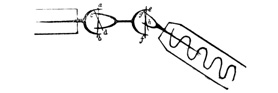

The pieces separate.
A is driven by its shank into the horizontal axis of the wheel which turns the machine.
B is an intermediate iron to connect the motion of A and C.
C is driven by its shank into the axis of the screw.
D is a cross axis, the ends, a and b, going into the corresponding holes a and b of the iron A, and the ends, c and d, going into the corresponding holes c and d of the iron B.
E is another cross axis, the ends, e and f, going into the corresponding holes e and f of the iron B, and the ends, g and h, going into the corresponding holes g and h of the iron C.
XIII. Memorandums on a Tour from Paris to Amsterdam, Strasburg, and back to Paris.—March 3d, 1788.
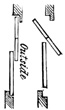
Windows.
Amsterdam.—Joists of houses placed, not with their sides horizontally and perpendicularly, but diamond wise, thus: first, for greater strength; second, to arch between with brick, thus: Windows opening so that they admit air and not rain. The upper sash opens on a horizontal axis, or pins in the centre of the sides, the lower sash slides up.



Manner of fixing a flag staff on the mast of a vessel: a is the bolt on which it turns; b a bolt which is taken in and out to fasten it or to let it down. When taken out, the lower end of the staff is shoved out of its case, and the upper end being heaviest brings itself down: a rope must have been previously fastened to the butt end, to pull it down again when you want to raise the flag end. Dining tables letting down with single or double leaves, so as to take the room of their thickness only with a single leaf when open, thus: or thus: double-leaves open: shut, thus: or thus: shut:


Peat costs about one doit each, or twelve and a half stivers the hundred. One hundred make seven cubic feet, and to keep a tolerably comfortable fire for a study or chamber, takes about six every hour and a half.
A machine for drawing light empty boats over a dam at Amsterdam. It is an axis in peritrochio fixed on the dam. From the dam each way is a sloping stage, the boat is presented to this, the rope of the axis made fast to it, and it is drawn up. The water on one side of the dam is about four feet higher than on the other.
The camels used for lightening ships over the Pampus will raise the ships eight feet. There are beams passing through the ship's sides, projecting to the off side of the camel and resting on it; of course that alone would keep the camel close to the ship. Besides this, there are a great number of windlasses on the camels, the ropes of which are made fast to the gunwale of the ship. The camel is shaped to the ship on the near side, and straight on the off one. When placed along side, water is let into it so as nearly to sink it; in this state it receives the beams, &c., of the ship, and then the water is pumped out.
Wind saw mills. See the plans detailed in the moolen book which I bought. A circular foundation of brick is raised about three or four feet high, and covered with a curb or sill of wood, and has little rollers under its sill which make it turn easily on the curb. A hanging bridge projects at each end about fifteen or twenty feet beyond the circular area, thus: horizontally, and thus: in the profile to increase the play of the timbers on the frame. The wings are at one side, as at a; there is a shelter over the hanging bridges, but of plank with scarce any frame, very light.


A bridge across a canal formed by two scows, which open each to the opposite shore and let boats pass.
A lanthern over the street door, which gives light equally into the antechamber and the street. It is a hexagon, and occupies the place of the middle pane of glass in the circular top of the street door.
A bridge on a canal, turning on a swivel, by which means it is arranged along the side of the canal so as not to be in the way of boats when not in use. When used, it is turned across the canal. It is, of course, a little more than double the width of the canal.
Hedges of beach, which, not losing the old leaf till the new bud pushes it off, has the effect of an evergreen as to cover.
Mr. Ameshoff, merchant at Amsterdam. The distribution of his aviary is worthy of notice. Each kind of the large birds has its coop eight feet wide and four feet deep; the middle of the front is occupied by a broad glass window, on one side of which is a door for the keeper to enter at, and on the other a little trap-door for the birds to pass in and out. The floor strewed with clean hay. Before each coop is a court of eight by sixteen feet, with wire in front and netting above, if the fowls be able to fly. For such as require it, there are bushes of evergreen growing in their court for them to lay their eggs under. The coops are frequently divided into two stories: the upper for those birds which perch, such as pigeons, &c., the lower for those which feed on the ground, as pheasants, partridges, &c. The court is in common for both stories, because the birds do no injury to each other. For the water-fowl there is a pond of water passing through the courts, with a movable separation. While they are breeding they must be separate, afterwards they may come together. The small birds are some of them in a common aviary, and some in cages.
The Dutch wheel-barrow is in this form: which is very convenient for loading and unloading.

Mr. Hermen Hend Damen, merchant-broker of Amsterdam, tells me that the emigrants to America come from the Palatinate down the Rhine, and take shipping from Amsterdam. Their passage is ten guineas if paid here, and eleven if paid in America. He says they might be had in any number to go to America, and settle lands as tenants on half stocks or metairies. Perhaps they would serve their employer one year as an indemnification for the passage, and then be bound to remain on his lands seven years. They would come to Amsterdam at their own expense. He thinks they would employ more than fifty acres each; but quære, especially if they have fifty acres for their wife also?
Hodson.—The best house. Stadhonderian, his son, in the government. Friendly, but old and very infirm.
Hope.—The first house in Amsterdam. His first object England; but it is supposed he would like to have the American business also, yet he would probably make our affairs subordinate to those of England.
Vollenhoven.—An excellent old house; connected with no party.
Sapportus.—A brother, very honest and ingenuous, well-disposed; acts for Hope, but will say with truth what he can do for us. The best person to consult with as to the best house to undertake a piece of business. He has brothers in London in business. Jacob Van Staphorst tells me there are about fourteen millions of florins, new money, placed in loans in Holland every year, being the savings of individuals out of their annual revenue, &c. Besides this, there are every year reimbursements of old loans from some quarter or other to be replaced at interest in some new loan.
1788. March 16th. Baron Steuben has been generally suspected of having suggested the first idea of the self-styled Order of Cincinnati. But Mr. Adams tells me, that in the year 1776 he had called at a tavern in the State of New York to dine, just at the moment when the British army was landing at Frog's Neck. Generals Washington, Lee, Knox and Parsons, came to the same tavern. He got into conversation with Knox. They talked of ancient history—of Fabius, who used to raise the Romans from the dust; of the present contest, &c.; and General Knox, in the course of the conversation, said he should wish for some ribbon to wear in his hat, or in his button hole, to be transmitted to his descendants as a badge and a proof that he had fought in defence of their liberties. He spoke of it in such precise terms, as showed he had revolved it in his mind before. Mr. Adams says he and Knox were standing together in the door of the tavern, and does not recollect whether General Washington and the others were near enough to hear the conversation, or were even in the room at that moment. Baron Steuben did not arrive in America till above a year after that. Mr. Adams is now fifty-three years old, i. e. nine years more than I am.
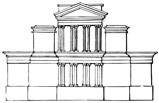
HOPE'S HOUSE, NEAR HARLAEM.
It is said this house will cost four tons of silver, or forty thousand pounds sterling. The separation between the middle building and wings in the upper story has a capricious appearance, yet a pleasing one. The right wing of the house (which is the left in the plan) extends back to a great length, so as to make the ground plan in the form of an L. The parapet has a pannel of wall, and a pannel of ballusters alternately, which lighten it. There is no portico, the columns being backed against the wall of the front.
March 30th, 31st. Amsterdam. Utrecht. Nimeguen. The lower parts of the low countries seem partly to have been gained from the sea, and partly to be made up of the plains of the Yssel, the Rhine, the Maese and the Schelde united. To Utrecht nothing but plains are seen, a rich black mould, wet, lower than the level of the waters which intersect it; almost entirely in grass; few or no farm-houses, as the business of grazing requires few laborers. The canal is lined with country houses, which bespeak the wealth and cleanliness of the country; but generally in an uncouth state, and exhibiting no regular architecture. After passing Utrecht, the hills north-east of the Rhine come into view, and gather in towards the river, till at Wyck Dursted they are within three or four miles, and at Amelengen they join the river. The plains, after passing Utrecht, become more sandy; the hills are very poor and sandy, generally waste in broom, sometimes a little corn. The plains are in corn, grass, and willow. The plantations of the latter are immense, and give it the air of an uncultivated country. There are now few châteaux; farm-houses abound, built generally of brick, and covered with tile or thatch. There are some apple-trees, but no forest; a few inclosures of willow wattling. In the gardens are hedges of beach, one foot apart, which, not losing its old leaves till they are pushed off in the spring by the young ones, gives the shelter of evergreens. The Rhine is here about three hundred yards wide, and the road to Nimeguen passing it a little below Wattelingen, leaves Hetern in sight on the left. On this side, the plains of the Rhine, the Ling, and the Waal unite. The Rhine and Waal are crossed on vibrating boats, the rope supported by a line of seven little barks. The platform by which you go on to the ferry-boat is supported by boats. The view from the hill at Cress is sublime. It commands the Waal, and extends far up the Rhine. That also up and down the Waal from the Bellevue of Nimeguen, is very fine. The château here is pretended to have lodged Julius Cæsar. This is giving it an antiquity of at least eighteen centuries, which must be apocryphal. Some few sheep to-day, which were feeding in turnip patches.
April 1st. Cranenburg. Cleves. Santen. Reynberg. Hoogstraat. The transition from ease and opulence to extreme poverty is remarkable on crossing the line between the Dutch and Prussian territories. The soil and climate are the same; the governments alone differ. With the poverty, the fear also of slaves is visible in the faces of the Prussian subjects. There is an improvement, however, in the physiognomy, especially could it be a little brightened up. The road leads generally over the hills, but sometimes through skirts of the plains of the Rhine. These are always extensive and good. They want manure, being visibly worn down. The hills are almost always sandy, barren, uncultivated, and insusceptible of culture, covered with broom and moss; here and there a little indifferent forest, which is sometimes of beach. The plains are principally in corn; some grass and willow. There are no châteaux, nor houses that bespeak the existence even of a middle class. Universal and equal poverty overspreads the whole. In the villages, too, which seem to be falling down, the over-proportion of women is evident. The cultivators seem to live on their farms. The farm-houses are of mud, the better sort of brick; all covered over with thatch. Cleves is little more than a village. If there are shops or magazines of merchandise in it, they show little. Here and there at a window some small articles are hung up within the glass. The goose-berry beginning to leaf.
April 2d. Passed the Rhine at Essenberg. It is there about a quarter of a mile wide, or five hundred yards. It is crossed in a scow with sails. The wind being on the quarter, we were eight or ten minutes only in the passage. Duysberg is but a village in fact, walled in; the buildings mostly of brick. No new ones, which indicate a thriving state. I had understood that near that were remains of the encampment of Varus, in which he and his legions fell by the arms of Arminius (in the time of Tiberius I think it was), but there was not a person to be found in Duysberg who could understand either English, French, Italian, or Latin. So I could make no inquiry.
From Duysberg to Dusseldorf the road leads sometimes over the hills, sometimes through the plains of the Rhine, the quality of which are as before described. On the hills, however, are considerable groves of oak, of spontaneous growth, which seem to be of more than a century; but the soil being barren, the trees, though high, are crooked and knotty. The undergrowth is broom and moss. In the plains is corn entirely. As they are become rather sandy for grass, there are no inclosures on the Rhine at all. The houses are poor and ruinous, mostly of brick, and scantling mixed. A good deal of grape cultivated.
Dusseldorf. The gallery of paintings is sublime, particularly the room of Vanderwerff. The plains from Dusseldorf to Cologne are much more extensive, and go off in barren downs at some distance from the river. These downs extend far, according to appearance. They are manuring the plains with lime. A gate at the Elector's château on this road in this form. We cross at Cologne on a pendulum boat. I observe the hog of this country (Westphalia), of which the celebrated ham is made, is tall, gaunt, and with heavy lop ears. Fatted at a year old, would weigh one hundred or one hundred and twenty pounds. At two years old, two hundred pounds. Their principal food is acorns. The pork, fresh, sells at two and a half pence sterling the pound. The hams, ready made, at eight and a half pence sterling the pound. One hundred and six pounds of this country is equal to one hundred pounds of Holland. About four pounds of fine Holland salt is put on one hundred pounds of pork. It is smoked in a room which has no chimney. Well-informed people here tell me there is no other part of the world where the bacon is smoked. They do not know that we do it. Cologne is the principal market of exportation. They find that the small hog makes the sweetest meat.

Cologne is a sovereign city, having no territory out of its walls. It contains about sixty thousand inhabitants; appears to have much commerce, and to abound with poor. Its commerce is principally in the hands of Protestants, of whom there are about sixty houses in the city. They are extremely restricted in their operations, and otherwise oppressed in every form by the government, which is Catholic, and excessively intolerant. Their Senate, some time ago, by a majority of twenty-two to eighteen, allowed them to have a church; but it is believed this privilege will be revoked. There are about two hundred and fifty Catholic churches in the city. The Rhine is here about four hundred yards wide. This city is in 51° latitude, wanting about 6´. Here the vines begin, and it is the most northern spot on the earth on which wine is made. Their first grapes came from Orleans, since that from Alsace, Champagne, &c. It is thirty-two years only since the first vines were sent from Cassel, near Mayence, to the Cape of Good Hope, of which the Cape wine is now made. Afterwards new supplies were sent from the same quarter. That I suppose is the most southern spot on the globe where wine is made, and it is singular that the same vine should have furnished two wines as much opposed to each other in quality as in situation. I was addressed here by Mr. Damen, of Amsterdam, to Mr. Jean Jaques Peuchen, of this place, Merchant.