Volume 7 / Part 1 — PART I. REPORTS AND OPINIONS WHILE SECRETARY OF STATE. (continued 3)
Reading edition
Of the disadvantages which depend on others, are—
1. The loss of the Mediterranean markets.
2. Exclusions from the markets of some of our neighbors.
3. High duties in those of others; and,
4. Bounties to the individuals in competition with us.
The consideration of these will find its place more aptly, after a review of the condition of our whale fishery shall have led us to the same point. To this branch of the subject, therefore, we will now proceed.
The whale fishery was first brought into notice of the southern nations of Europe, in the fifteenth century, by the same Biscayans and Basques who led the way to the fishery of Newfoundland. They began it on their own coasts, but soon found that the principal residence of the whale was in the Northern seas, into which, therefore, they pursued him. In 1578 they employed twenty-five ships in that business. The Dutch and Hamburghers took it up after this, and about the middle of the seventeenth century the former employed about two hundred ships, and the latter about three hundred and fifty.
The English endeavored also to participate of it. In 1672, they offered to their own fishermen a bounty of six shillings a ton, on the oil they should bring home, and instituted, at different times, different exclusive companies, all of which failed of success. They raised their bounty, in 1733, to twenty shillings a ton, on the admeasurement of the vessel. In 1740, to thirty shillings, with a privilege to the fishermen against being impressed. The Basque fishery, supported by poverty alone, had maintained but a feeble existence, before competitors aided by the bounties of their nation, and was, in fine, annihilated by the war of 1745, at the close of which the English bounty was raised to forty shillings. From this epoch, their whale fishery went on between the limits of twenty-eight and sixty-seven vessels, till the commencement of the last war.
The Dutch, in the meantime, had declined gradually to about one hundred and thirty ships, and have, since that, fallen down to less than half that number. So that their fishery, notwithstanding a bounty of thirty florins a man, as well as that of Hamburg, is now nearly out of competition.
In 1715, the Americans began their whale fishery. They were led to it at first by the whales which presented themselves on their coasts. They attacked them there in small vessels of forty tons. As the whale, being infested, retired from the coast, they followed him farther and farther into the ocean, still enlarging their vessels with their adventures, to sixty, one hundred, and two hundred tons. Having extended their pursuit to the Western Islands, they fell in, accidentally, with the spermaceti whale, of a different species from that of Greenland, which alone had hitherto been known in commerce: more fierce and active, and whose oil and head matter was found to be more valuable, as it might be used in the interior of houses without offending the smell. The distinction now first arose between the Northern and Southern fisheries: the object of the former being the Greenland whale, which frequents the Northern coasts and seas of Europe and America; that of the latter being the spermaceti whale, which was found in the Southern seas, from the Western Islands and coast of Africa, to that of Brazil, and still on to the Falkland Islands. Here, again, within soundings, on the coast of Brazil, they found a third species of whale, which they called the black or Brazil whale, smaller than the Greenland, yielding a still less valuable oil, fit only for summer use, as it becomes opaque at 50 degrees of Fahrenheit's termometer, while that of the spermaceti whale is limpid to 41, and of the Greenland whale to 36, of the same thermometer. It is only worth taking, therefore, when it falls in the way of the fishermen, but not worth seeking, except when they have failed of success against the spermaceti whale, in which case, this kind, easily found and taken, serves to moderate their loss.
In 1771 the Americans had one hundred and eighty-three vessels, of thirteen thousand eight hundred and twenty tons, in the Northern fishery, and one hundred and twenty-one vessels, of fourteen thousand and twenty tons, in the Southern, navigated by four thousand and fifty-nine men. At the beginning of the late war, they had one hundred and seventy-seven vessels in the Northern, and one hundred and thirty-two in the Southern fishery. At that period, our fishery being suspended, the English seized the opportunity of pushing theirs. They gave additional bounties of £500, £400, £300, £200, £100 sterling, annually, to the five ships which should take the greatest quantities of oil. The effect of which was such, as, by the year 1786, to double the quantity of common oil necessary for their own consumption. Finding, on a review of the subject, at that time, that their bounties had cost the Government £13 10s. sterling a man, annually, or sixty per cent. on the cargoes, a part of which went consequently to ease the purchases of this article made by foreign nations, they reduced the northern bounty from forty to thirty shillings the ton of admeasurement.
They had, some little time before, turned their attention to the Southern fishery, and given very great bounties in it, and had invited the fishermen of the United States to conduct their enterprises. Under their guidance, and with such encouragement, this fishery, which had only begun with them in 1784 or 1785, was rising into value. In 1788 they increased their bounties, and the temptations to our fishermen, under the general description of foreigners who had been employed in the whale fishery, to pass over with their families and vessels to the British dominions, either in America or Europe, but preferably to the latter. The effect of these measures had been prepared, by our whale oils becoming subject, in their market, to the foreign duty of £18 5s. sterling the ton, which, being more than equal to the price of the common oil, operated as a prohibition on that, and gave to their spermaceti oil a preference over ours to that amount.
* * * * * * * *
The fishermen of the United States, left without resource, by the loss of their market, began to think of accepting the British invitation, and of removing, some to Nova Scotia, preferring smaller advantages in the neighborhood of their ancient country and friends, others to Great Britain, postponing country and friends to high premiums.
The Government of France could not be inattentive to these proceedings. They saw the danger of letting four or five thousand seamen, of the best in the world, be transferred to the marine strength of another nation, and carry over with them an art, which they possessed almost exclusively. To give time for a counterplan, the Marquis de Lafayette, the valuable friend and citizen of this, as well as that country, wrote to a gentleman in Boston, to dissuade the fishermen from accepting the British proposals, and to assure them that their friends in France would endeavor to do something for them. A vessel was then arrived from Halifax at Nantucket, to take off those who had proposed to remove. Two families had gone abroad, and others were going. In this moment, the letter arriving, suspended their designs. Not another went abroad, and the vessel returned to Halifax with only the two families.
The plan adopted by the French ministry, very different from that of the first mover, was to give a counter invitation to the Nantucket men to remove and settle in Dunkirk, offering them a bounty of fifty livres (between nine and ten dollars) a ton on the admeasurement of the vessels they should equip for the whale fishery, with some other advantages. Nine families only, of thirty-three persons, accepted the invitation. This was in 1785. In 1786, the ministry were led to see that their invitation would produce but little effect, and that the true means of preventing the emigration of our fishermen to the British dominions would be to enable them still to follow their calling from their native country, by giving them a new market for their oils, instead of the old one they had lost. The duties were, therefore, abated on American whale oil immediately, and a further abatement promised by the letter No. 8, and, in December, 1787, the arrêt No. 9 was passed.
The rival fishermen immediately endeavored to turn this measure to their own advantage, by pouring their whale oils into the markets of France, where they were enabled, by the great premiums received from their Government, perhaps, too, by extraordinary indemnifications, to undersell both the French and American fishermen. To repel this measure, France shut her ports to all foreign fish oils whatever, by the arrêt No. 10. The British whale fishery fell, in consequence, the ensuing year from two hundred and twenty-two to one hundred and seventy-eight ships. But this general exclusion has palsied our fishery also. On the 7th of December, 1788, therefore, by the arrêt No. 11, the ports of France still remaining shut to all other nations, were again opened to the produce of the whale fisheries of the United States, continuing, however, their endeavors to recover a share in this fishery themselves, by the aid of our fishermen. In 1784, 1785, 1786, they had had four ships. In 1787, three. In 1788, seventeen in the two fisheries of four thousand five hundred tons. These cost them in bounty 225,000 livres, which divided on one thousand five hundred and fifty tons of oil, the quantity they took, amounted to 145 livres (near twenty-seven dollars) the ton, and, on about one hundred natives on board the seventeen ships, (for there were one hundred and fifty Americans engaged by the voyage) came to 2,225 livres, or about 416⅔ dollars a man.
We have had, during the years 1787, 1788 and 1789, on an average, ninety-one vessels, of five thousand eight hundred and twenty tons, in the northern, and thirty-one of four thousand three hundred and ninety tons in the southern fishery. * * * * *
These details will enable Congress to see with what a competition we have to struggle for the continuance of this fishery, not to say its increase. Against prohibitory duties in one country, and bounties to the adventurers in both of those which are contending with each other for the same object, ours have no auxiliaries, but poverty and rigorous economy. The business, unaided, is a wretched one. The Dutch have peculiar advantages for the northern fishery, as being within six or eight days' sail of the grounds, as navigating with more economy than any other nation in Europe, their seamen content with lower wages, and their merchants with lower profit. Yet the memorial No. 13, from a committee of the whale merchants to the States General of Holland, in the year 1775, states that fourteen millions of guilders, equal to five million six hundred thousand dollars, has been lost in that fishery in forty-seven years, being about one hundred and twenty thousand dollars a year. The States General, thereupon, gave a bounty of thirty guilders a man to the fishermen. A person immediately acquainted with the British whale fishery, and whose information merits confidence, has given assurance that the ships employed in their northern fishery, in 1788, sunk £800 each, on an average, more than the amount of the produce and bounties. An English ship of three hundred tons and forty-two seamen, in this fishery, generally brings home, after a four months' voyage, twenty-five tons of oil, worth £437 10s. sterling; but the wages of the officers and seamen will be £400; there remain but £37 10s., not worth taking into account, towards the outfit and merchants' profit. These, then, must be paid by the Government; and it is on this idea that the British bounty is calculated.
Our vessels for the northern fishery average sixty-four tons, and cost, when built, fitted out, and victualled for the first voyage, about three thousand dollars. They have taken, on an average, the three last years, according to the statement No. 12, eighteen tons of oil, worth, at our market, nine hundred dollars, which are to pay all expenses, and subsist the fishermen and merchant. Our vessels for the southern fishery average one hundred and forty tons, and cost, when built, fitted out, and victualled, for their first voyage, about six thousand five hundred dollars. They have taken on an average, the three last years, according to the same statement, thirty-two tons of oil each, worth at our market three thousand two hundred dollars, which are, in like manner, to pay all expenses, and subsist the owners and navigators. These expenses are great, as the voyages are generally of twelve months' duration. No hope can arise of their condition being bettered by an augmentation of the price of oil. This is kept down by the competition of the vegetable oils, which answer the same purposes, not quite so well, but well enough to become preferable, were the price to be raised, and so well, indeed, as to be more generally used than the fish oils for lighting houses and cities.
The American whale fishery is principally followed by the inhabitants of the island of Nantucket—a sand bar of about fifteen miles long, and three broad, capable of maintaining, by its agriculture, about twenty families; but it employed in these fisheries, before the war, between five or six thousand men and boys; and, in the only harbor it possesses, it had one hundred and forty vessels, one hundred and thirty-two of which were of the larger kind, as being employed in the southern fishery. In agriculture, then, they have no resource; and, if that of their fishery cannot be pursued from their own habitations, it is natural they should seek others from which it can be followed, and preferably those where they will find a sameness of language, religion, laws, habits, and kindred. A foreign emissary has lately been among them, for the purpose of renewing the invitations to a change of situation. But, attached to their native country, they prefer continuing in it, if their continuance there can be made supportable.
This brings us to the question, what relief does the condition of this fishery require?
1. A remission of duties on the articles used for their calling.
2. A retaliating duty on foreign oils, coming to seek a competition with them in or from our ports.
3. Free markets abroad.
1. The remission of duties will stand on nearly the same ground with that to the cod fishermen.
2. The only nation whose oil is brought hither for competition with our own, makes ours pay a duty of about eighty-two dollars the ton, in their ports. Theirs is brought here, too, to be reshipped fraudulently, under our flag, into ports where it could not be received under theirs, and ought not to be covered by ours, if we mean to preserve our own admission into them.
The 3d and principal object is to find markets for the vent of oil.
Portugal, England, Holland, Sweden, Denmark, Prussia, Russia, the Hanse towns, supply themselves and something more. Spain and Italy receive supplies from England, and need the less, as their skies are clearer. France is the only country which can take our surplus, and they take principally of the common oil; as the habit is but commencing with them of ascribing a just value to spermaceti whale. Some of this, however, finds its vent there. There was, indeed, a particular interest perpetually soliciting the exclusion of our oils from their markets. The late government there saw well that what we should lose thereby would be gained by others, not by themselves. And we are to hope that the present government, as wise and friendly, will also view us, not as rivals, but as co-operators against a common rival. Friendly arrangements with them, and accommodation to mutual interest, rendered easier by friendly dispositions existing on both sides, may long secure to us this important resource for our seamen. Nor is it the interest of the fisherman alone, which calls for the cultivation of friendly arrangements with that nation; besides five-eights of our whale oil, and two-thirds of our salted fish, they take from us one-fourth of our tobacco, three-fourths of our live stock * * * * * a considerable and growing portion of our rice, great supplies, occasionally, of other grain; in 1789, which, indeed, was extraordinary, four millions of bushels of wheat, and upwards of a million of bushels of rye and barley * * * * * and nearly the whole carried in our own vessels. * * * * * They are a free market now, and will, in time, be a valuable one for ships and ship timber, potash, and peltry.
England is the market for the greatest part of our spermaceti oil. They impose on all our oils a duty of eighteen pounds five shillings sterling the ton, which, as to the common kind, is a prohibition, as has been before observed, and, as to the spermaceti, gives a preference of theirs over ours to that amount, so as to leave, in the end, but a scanty benefit to the fishermen; and, not long since, by a change of construction, without any change of law, it was made to exclude our oils from their ports, when carried in our vessels. On some change of circumstance, it was construed back again to the reception of our oils, on paying always, however, the same duty of eighteen pounds five shillings. This serves to show that the tenure by which we hold the admission of this commodity in their markets, is as precarious as it is hard. Nor can it be announced that there is any disposition on their part to arrange this or any other commercial matter, to mutual convenience. The ex parte regulations which they have begun for mounting their navigation on the ruins of ours, can only be opposed by counter regulations on our part. And the loss of seamen, the natural consequence of lost and obstructed markets for our fish and oil, calls, in the first place, for serious and timely attention. It will be too late when the seaman shall have changed his vocation, or gone over to another interest. If we cannot recover and secure for him these important branches of employment, it behooves us to replace them by others equivalent. We have three nurseries for forming seamen:
1. Our coasting trade, already on a safe footing.
2. Our fisheries, which, in spite of natural advantages, give just cause of anxiety.
3. Our carrying trade, our only resource of indemnification for what we lose in the other. The produce of the United States, which is carried to foreign markets, is extremely bulky. That part of it which is now in the hands of foreigners, and which we may resume into our own, without touching the rights of those nations who have met us in fair arrangements by treaty, or the interests of those who, by their voluntary regulations, have paid so just and liberal a respect to our interests, as being measured back to them again, places both parties on as good ground, perhaps, as treaties could place them—the proportion, I say, of our carrying trade, which may be resumed without affecting either of these descriptions of nations, will find constant employment for ten thousand seamen, be worth two millions of dollars, annually, will go on augmenting with the population of the United States, secure to us a full indemnification for the seamen we lose, and be taken wholly from those who force us to this act of self protection in navigation.
Hence, too, would follow, that their Newfoundland ships, not receiving provisions from us in their bottoms, nor permitted (by a law of their own) to receive in ours, must draw their subsistence from Europe, which would increase that part of their expenses in the proportion of four to seven, and so far operate as a duty towards restoring the level between them and us. The tables No. 2 and 12, will show the quantity of tonnage, and, consequently, the mass of seamen whose interests are in distress; and No. 17, the materials for indemnification.
If regulations exactly the counterpart of those established against us, would be ineffectual, from a difference of circumstances, other regulations equivalent can give no reasonable ground of complaint to any nation. Admitting their right of keeping their markets to themselves, ours cannot be denied of keeping our carrying trade to ourselves. And if there be anything unfriendly in this, it was in the first example.
The loss of seamen, unnoticed, would be followed by other losses in a long train. If we have no seamen, our ships will be useless, consequently our ship timber, iron, and hemp; our ship building will be at an end, ship carpenters go over to other nations, our young men have no call to the sea, our produce, carried in foreign bottoms, be saddled with war-freight and insurance in times of war; and the history of the last hundred years shows, that the nation which is our carrier has three years of war for every four years of peace. (No. 18.) We lose, during the same periods, the carriage for belligerent powers, which the neutrality of our flag would render an incalculable source of profit; we lose at this moment the carriage of our own produce to the annual amount of two millions of dollars, which, in the possible progress of the encroachment, may extend to five or six millions, the worth of the whole, with an increase in the proportion of the increase of our numbers. It is easier, as well as better, to stop this train at its entrance, than when it shall have ruined or banished whole classes of useful and industrious citizens.
It will doubtless be thought expedient that the resumption suggested should take effect so gradually, as not to endanger the loss of produce for the want of transportation; but that, in order to create transportation, the whole plan should be developed, and made known at once, that the individuals who may be disposed to lay themselves out for the carrying business, may make their calculations on a full view of all circumstances.
On the whole, the historical view we have taken of these fisheries, proves they are so poor in themselves, as to come to nothing with distant nations, who do not support them from their treasury. We have seen that the advantages of our position place our fisheries on a ground somewhat higher, such as to relieve our treasury from giving them support; but not to permit it to draw support from them, nor to dispense the government from the obligation of effectuating free markets for them; that, for the great proportion of our salted fish, for our common oil, and a part of our spermaceti oil, markets may perhaps be preserved, by friendly arrangements towards those nations whose arrangements are friendly to us, and the residue be compensated by giving to the seamen thrown out of business the certainty of employment in another branch, of which we have the sole disposal.
XXI.—Opinion against the constitutionality of a National Bank.
February 15, 1791.
The bill for establishing a National Bank undertakes among other things:—
1. To form the subscribers into a corporation.
2. To enable them in their corporate capacities to receive grants of land; and so far is against the laws of Mortmain.[26]
3. To make alien subscribers capable of holding lands; and so far is against the laws of alienage.
4. To transmit these lands, on the death of a proprietor, to a certain line of successors; and so far changes the course of Descents.
5. To put the lands out of the reach of forfeiture or escheat; and so far is against the laws of Forfeiture and Escheat.
6. To transmit personal chattels to successors in a certain line; and so far is against the laws of Distribution.
7. To give them the sole and exclusive right of banking under the national authority; and so far is against the laws of Monopoly.
8. To communicate to them a power to make laws paramount to the laws of the States; for so they must be construed, to protect the institution from the control of the State legislatures; and so, probably, they will be construed.
I consider the foundation of the Constitution as laid on this ground: That "all powers not delegated to the United States, by the Constitution, nor prohibited by it to the States, are reserved to the States or to the people." [XIIth amendment.] To take a single step beyond the boundaries thus specially drawn around the powers of Congress, is to take possession of a boundless field of power, no longer susceptible of any definition.
The incorporation of a bank, and the powers assumed by this bill, have not, in my opinion, been delegated to the United States, by the Constitution.
1. They are not among the powers specially enumerated: for these are: 1st. A power to lay taxes for the purpose of paying the debts of the United States; but no debt is paid by this bill, nor any tax laid. Were it a bill to raise money, its origination in the Senate would condemn it by the Constitution.
2d. "To borrow money." But this bill neither borrows money nor ensures the borrowing it. The proprietors of the bank will be just as free as any other money holders, to lend or not to lend their money to the public. The operation proposed in the bill, first, to lend them two millions, and then to borrow them back again, cannot change the nature of the latter act, which will still be a payment, and not a loan, call it by what name you please.
3. To "regulate commerce with foreign nations, and among the States, and with the Indian tribes." To erect a bank, and to regulate commerce, are very different acts. He who erects a bank, creates a subject of commerce in its bills; so does he who makes a bushel of wheat, or digs a dollar out of the mines; yet neither of these persons regulates commerce thereby. To make a thing which may be bought and sold, is not to prescribe regulations for buying and selling. Besides, if this was an exercise of the power of regulating commerce, it would be void, as extending as much to the internal commerce of every State, as to its external. For the power given to Congress by the Constitution does not extend to the internal regulation of the commerce of a State, (that is to say of the commerce between citizen and citizen,) which remain exclusively with its own legislature; but to its external commerce only, that is to say, its commerce with another State, or with foreign nations, or with the Indian tribes. Accordingly the bill does not propose the measure as a regulation of trade, but as "productive of considerable advantages to trade." Still less are these powers covered by any other of the special enumerations.
II. Nor are they within either of the general phrases, which are the two following:—
1. To lay taxes to provide for the general welfare of the United States, that is to say, "to lay taxes for the purpose of providing for the general welfare." For the laying of taxes is the power, and the general welfare the purpose for which the power is to be exercised. They are not to lay taxes ad libitum for any purpose they please; but only to pay the debts or provide for the welfare of the Union. In like manner, they are not to do anything they please to provide for the general welfare, but only to lay taxes for that purpose. To consider the latter phrase, not as describing the purpose of the first, but as giving a distinct and independent power to do any act they please, which might be for the good of the Union, would render all the preceding and subsequent enumerations of power completely useless.
It would reduce the whole instrument to a single phrase, that of instituting a Congress with power to do whatever would be for the good of the United States; and, as they would be the sole judges of the good or evil, it would be also a power to do whatever evil they please.
It is an established rule of construction where a phrase will bear either of two meanings, to give it that which will allow some meaning to the other parts of the instrument, and not that which would render all the others useless. Certainly no such universal power was meant to be given them. It was intended to lace them up straitly within the enumerated powers, and those without which, as means, these powers could not be carried into effect. It is known that the very power now proposed as a means was rejected as an end by the Convention which formed the Constitution. A proposition was made to them to authorize Congress to open canals, and an amendatory one to empower them to incorporate. But the whole was rejected, and one of the reasons for rejection urged in debate was, that then they would have a power to erect a bank, which would render the great cities, where there were prejudices and jealousies on the subject, adverse to the reception of the Constitution.
2. The second general phrase is, "to make all laws necessary and proper for carrying into execution the enumerated powers." But they can all be carried into execution without a bank. A bank therefore is not necessary, and consequently not authorized by this phrase.
It has been urged that a bank will give great facility or convenience in the collection of taxes. Suppose this were true: yet the Constitution allows only the means which are "necessary," not those which are merely "convenient" for effecting the enumerated powers. If such a latitude of construction be allowed to this phrase as to give any non-enumerated power, it will go to every one, for there is not one which ingenuity may not torture into a convenience in some instance or other, to some one of so long a list of enumerated powers. It would swallow up all the delegated powers, and reduce the whole to one power, as before observed. Therefore it was that the Constitution restrained them to the necessary means, that is to say, to those means without which the grant of power would be nugatory.
But let us examine this convenience and see what it is. The report on this subject, page 3, states the only general convenience to be, the preventing the transportation and re-transportation of money between the States and the treasury, (for I pass over the increase of circulating medium, ascribed to it as a want, and which, according to my ideas of paper money, is clearly a demerit.) Every State will have to pay a sum of tax money into the treasury; and the treasury will have to pay, in every State, a part of the interest on the public debt, and salaries to the officers of government resident in that State. In most of the States there will still be a surplus of tax money to come up to the seat of government for the officers residing there. The payments of interest and salary in each State may be made by treasury orders on the State collector. This will take up the great export of the money he has collected in his State, and consequently prevent the great mass of it from being drawn out of the State. If there be a balance of commerce in favor of that State against the one in which the government resides, the surplus of taxes will be remitted by the bills of exchange drawn for that commercial balance. And so it must be if there was a bank. But if there be no balance of commerce, either direct or circuitous, all the banks in the world could not bring up the surplus of taxes, but in the form of money. Treasury orders then, and bills of exchange may prevent the displacement of the main mass of the money collected, without the aid of any bank; and where these fail, it cannot be prevented even with that aid.
Perhaps, indeed, bank bills may be a more convenient vehicle than treasury orders. But a little difference in the degree of convenience, cannot constitute the necessity which the constitution makes the ground for assuming any non-enumerated power.
Besides; the existing banks will, without a doubt, enter into arrangements for lending their agency, and the more favorable, as there will be a competition among them for it; whereas the bill delivers us up bound to the national bank, who are free to refuse all arrangement, but on their own terms, and the public not free, on such refusal, to employ any other bank. That of Philadelphia, I believe, now does this business, by their post-notes, which, by an arrangement with the treasury, are paid by any State collector to whom they are presented. This expedient alone suffices to prevent the existence of that necessity which may justify the assumption of a non-enumerated power as a means for carrying into effect an enumerated one. The thing may be done, and has been done, and well done, without this assumption; therefore, it does not stand on that degree of necessity which can honestly justify it.
It may be said that a bank whose bills would have a currency all over the States, would be more convenient than one whose currency is limited to a single State. So it would be still more convenient that there should be a bank, whose bills should have a currency all over the world. But it does not follow from this superior conveniency, that there exists anywhere a power to establish such a bank; or that the world may not go on very well without it.
Can it be thought that the Constitution intended that for a shade or two of convenience, more or less, Congress should be authorized to break down the most ancient and fundamental laws of the several States; such as those against Mortmain, the laws of Alienage, the rules of descent, the acts of distribution, the laws of escheat and forfeiture, the laws of monopoly? Nothing but a necessity invincible by any other means, can justify such a prostitution of laws, which constitute the pillars of our whole system of jurisprudence. Will Congress be too straight-laced to carry the constitution into honest effect, unless they may pass over the foundation-laws of the State government for the slightest convenience of theirs?
The negative of the President is the shield provided by the constitution to protect against the invasions of the legislature: 1. The right of the Executive. 2. Of the Judiciary. 3. Of the States and State legislatures. The present is the case of a right remaining exclusively with the States, and consequently one of those intended by the Constitution to be placed under its protection.
It must be added, however, that unless the President's mind on a view of everything which is urged for and against this bill, is tolerably clear that it is unauthorised by the Constitution; if the pro and the con hang so even as to balance his judgment, a just respect for the wisdom of the legislature would naturally decide the balance in favor of their opinion. It is chiefly for cases where they are clearly misled by error, ambition, or interest, that the Constitution has placed a check in the negative of the President.
XXII.—Opinion relative to locating the Ten Mile Square for the Federal Government, and building the Federal city.
March 11, 1791.
Objects which may merit the attention of the President, at Georgetown.
The commissioners to be called into action.
Deeds of cession to be taken from the land-holders.
Site of the capitol and President's house to be determined on.
Proclamation completing the location of the territory, and fixing the site of the capitol.
Town to be laid off. Squares of reserve are to be decided on for the capitol, President's house, offices of government, townhouse, prison, market, and public walks.
Other squares for present sale designated.
Terms of sale to be settled. As there is not as yet a town legislature, and things may be done before there is one to prevent them, which yet it would be desirable to prevent, it would seem justifiable and expedient that the President should form a capitulary of such regulations as he may think necessary to be observed, until there shall be a town legislature to undertake this office; such capitulary to be indented, signed, sealed, and recorded, according to the laws of conveyance in Maryland. And to be referred to in every deed for conveyance of the lots to purchasers, so as to make a part thereof. The same thing might be effected, by inserting special covenants for every regulation in every deed; but the former method is the shortest. I cannot help again suggesting here one regulation formerly suggested, to wit: To provide for the extinguishment of fires, and the openness and convenience of the town, by prohibiting houses of excessive height. And making it unlawful to build on any one's purchase any house with more than two floors between the common level of the earth and the eaves, nor with any other floor in the roof than one at the eaves. To consider in what way the contracts for the public buildings shall be made, and whether as many bricks should not be made this summer as may employ brick-layers in the beginning of the season of 1792, till more can be made in that season.
With respect to the amendment of the location so as to include Bladensburgh. I am of opinion it may be done with the consent of the legislature of Maryland, and that that consent may be so far counted on, as to render it expedient to declare the location at once.
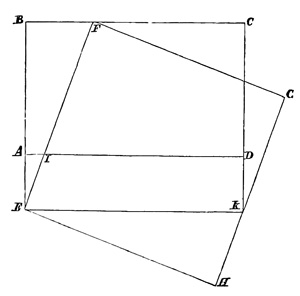
The location A B C D A having been once made, I consider as obligatory and unalterable, but by consent of parties, except so far as was necessary to render it practicable by a correction of the beginning. That correction might be lawfully made either by stopping at the river, or at the spring of Hunting creek, or by lengthening the course from the court-house so that the second course should strike the mouth of Hunting creek. I am of opinion, therefore, that the beginning at the mouth of Hunting creek, is legally justifiable. But I would advise the location E F G H E to be hazarded so as to include Bladensburgh, because it is a better location, and I think will certainly be confirmed by Maryland. That State will necessarily have to pass another act confirming whatever location shall be made, because her former act authorized the delegates then in office, to convey the lands. But as they were not located, no conveyance has been made, and those persons are now out of office, and dispersed. Suppose the non-concurrence of Maryland should defeat the location E F G H E, it can only be done on this principle, that the first location A B C D A was valid, and unalterable, but by mutual consent. Then their non-concurrence will re-establish the first location A B C D A, and the second location will be good for the part E I D K E without their concurrence, and this will place us where we should be were we now to complete the location E B C K E. Consequently, the experiment of an amendment proposed can lose nothing, and may gain, and probably will gain, the better location.
When I say it can lose nothing, I count as nothing, the triangle A I E, which would be in neither of the locations. Perhaps this might be taken in afterwards, either with or without the consent of Virginia.
XXIII.—Report on the policy of securing particular marks to Manufacturers, by law.
December 9, 1791.
The Secretary of State, to whom was referred by the House of Representatives the petition of Samuel Breck and others, proprietors of a sail-cloth manufactory in Boston, praying that they may have the exclusive privilege of using particular marks for designating the sail-cloth of their manufactory, has had the same under consideration, and thereupon
Reports, That it would, in his opinion, contribute to fidelity in the execution of manufacturers, to secure to every manufactory an exclusive right to some mark on its wares, proper to itself.
That this should be done by general laws, extending equal right to every case to which the authority of the Legislature should be competent.
That these cases are of divided jurisdiction: Manufactures made and consumed within a State being subject to State legislation, while those which are exported to foreign nations, or to another State, or into the Indian Territory, are alone within the legislation of the General Government.
That it will, therefore, be reasonable for the General Government to provide in this behalf by law for those cases of manufacture generally, and those only which relate to commerce with foreign nations, and among the several States, and with the Indian Tribes.
And that this may be done by permitting the owner of every manufactory, to enter in the records of the court of the district wherein his manufactory is, the name with which he chooses to mark or designate his wares, and rendering it penal in others to put the same mark to any other wares.
XXIV.—Opinion relative to the demolition of Mr. Carroll's house by Major L'Enfant, in laying out the Federal City.
December 11, 1791.
Observations on Major L'Enfant's letter of December 7th, 1791, to the President, justifying his demolition of the house of Mr. Carroll, of Duddington.
He says that "Mr. Carroll erected his house partly on a main street, and altogether on ground to which the public had a more immediate title than himself could claim." When blaming Mr. Carroll, then, he considers this as a street; but when justifying himself, he considers it not yet as a street, for to account for his not having pointed out to Carroll a situation where he might build, he says, "The President had not yet sanctioned the plan for the distribution of the city, nor determined if he would approve the situation of the several areas proposed to him in that plan for public use, and that I would have been highly to be blamed to have anticipated his opinion thereon." This latter exculpation is solid; the first is without foundation. The plan of the city has not yet been definitely determined by the President. Sale to individuals, or partition decide the plan as far as these sales or partitions go. A deed with the whole plan annexed, executed by the President, and recorded, will ultimately fix it. But till a sale, or partition, or deed, it is open to alteration. Consequently, there is as yet no such thing as a street, except adjacent to the lots actually sold or divided; the erection of a house in any part of the ground cannot as yet be a nuisance in law. Mr. Carroll is tenant in common of the soil with the public, and the erection of a house by a tenant in common on the common property, is no nuisance. Mr. Carroll has acted imprudently, intemperately, foolishly; but he has not acted illegally. There must be an establishment of the streets, before his house can become a nuisance in the eye of the law. Therefore, till that establishment, neither Major L'Enfant, nor the commissioners, would have had a right to demolish his house, without his consent.
The Major says he had as much right to pull down a house, as to cut down a tree.
This is true, if he has received no authority to do either, but still there will be this difference: To cut down a tree or to demolish a house in the soil of another, is a trespass; but the cutting a tree, in this country, is so slight a trespass, that a man would be thought litigious who should prosecute it; if he prosecuted civilly, a jury would give small damages; if criminally, the judge would not inflict imprisonment, nor impose but a small fine. But the demolition of a house is so gross a trespass, that any man would prosecute it; if civilly, a jury would give great damages; if criminally, the judge would punish heavily by fine and imprisonment. In the present case, if Carroll was to bring a civil action, the jury would probably punish his folly by small damages; but if he were to prosecute criminally, the judge would as probably vindicate the insult on the laws, and the breach of the peace, by heavy fines and imprisonment. So that if Major L'Enfant is right in saying he had as much authority to pull down a house as to cut down a tree, still he would feel a difference in the punishment of the law.
But is he right in saying he had as much authority to pull down a house as to cut down a tree? I do not know what have been the authorities given him expressly or by implication, but I can very readily conceive that the authorities which he has received, whether from the President or from the commissioners, whether verbal or written, may have gone to the demolition of trees, and not houses. I am sure he has received no authority, either from the President or commissioners, either expressly or by implication, to pull down houses. An order to him to mark on the ground the lines of the streets and lots, might imply an order to remove trees or small obstructions, where they insuperably prevented his operations; but a person must know little of geometry who could not, in an open field, designate streets and lots, even where a line passed through a house, without pulling the house down.
In truth, the blame on Major L'Enfant, is for having pulled down the house, of his own authority, and when he had reason to believe he was in opposition, to the sentiments of the President; and his fault is aggravated by its having been done to gratify private resentment against Mr. Carroll, and most probably not because it was necessary; and the style in which he writes the justification of his act, shows that a continuation of the same resentment renders him still unable to acquiesce under the authority from which he has been reproved.
He desires a line of demarcation between his office, and that of the commissioners.
What should be this line? and who is to draw it? If we consider the matter under the act of Congress only, the President has authority only to name the commissioners, and to approve or disapprove certain proceedings of theirs. They have the whole executive power, and stand between the President and the subordinate agents. In this view, they may employ or dismiss, order and countermand, take on themselves such parts of the execution as they please, and assign other parts to subordinate agents. Consequently, under the act of Congress, their will is the line of demarcation between subordinate agents, while no such line can exist between themselves and their agents. Under the deed from the proprietors to the President, his powers are much more ample. I do not accurately recollect the tenor of the deed; but I am pretty sure it was such as to put much more ample power into the hands of the President, and to commit to him the whole execution of whatever is to be done under the deed; and this goes particularly to the laying out the town: so that as to this, the President is certainly authorized to draw the line of demarcation between L'Enfant and the commissioners. But I believe there is no necessity for it, as far as I have been able to judge, from conversations and consultations with the commissioners. I think they are disposed to follow implicitly the will of the President, whenever they can find it out; but L'Enfant's letters do not breathe the same moderation or acquiescence; and I think it would be much safer to say to him, "the orders of the commissioners are your line of demarcation," than by attempting to define his powers, to give him a line where he may meet with the commissioners foot to foot, and chicane and raise opposition to their orders whenever he thinks they pass his line. I confess, that on a view of L'Enfant's proceedings and letters latterly, I am thoroughly persuaded that, to render him useful, his temper must be subdued; and that the only means of preventing his giving constant trouble to the President, is to submit him to the unlimited control of the commissioners; we know the discretion and forbearance with which they will exercise it.
XXV.—Opinion relative to certain lands on Lake Erie, sold by the United States to Pennsylvania.
December 19, 1791.
The Secretary of State, to whom was referred, by the President of the United States, a letter from the Governor of Pennsylvania, with the documents therein mentioned, on the subject of certain lands on Lake Erie, having had the same under consideration, thereupon Reports:—
That Congress, by their resolution of June 6th, 1788, directed the Geographer General of the United States to ascertain the quantity of land belonging to the United States between Pennsylvania and Lake Erie, and authorized a sale thereof.
That a sale was accordingly made to the commonwealth of Pennsylvania.
That Congress, by their resolution of September 4th, 1788, relinquished to the said commonwealth all their right to the government and jurisdiction of the said tract of land; but the right of soil was not transferred by the resolution.
That a survey of the said tract has been since made, and the amount of the purchase money been settled between the comptrollers of the United States and of the said commonwealth, and that the Governor of Pennsylvania declares in the said letter, to the President of the United States, that he is ready to close the transaction on behalf of the said commonwealth. That there is no person at present authorized, by law, to convey to the said commonwealth the right of soil, in the said tract of land.
And the Secretary of State is therefore of opinion that the said letter and documents should be laid before the legislature of the United States to make such provision by law for conveying the said right of soil, as they in their wisdom shall think fit.
XXVI.—Report relative to negotiations with Spain to secure the free navigation of the Mississippi, and a port on the same.
December 22, 1791.
The Secretary of State reports to the President of the United States, that one of the commissioners of Spain, in the name of both, has lately communicated to him verbally, by order of his court, that his Catholic Majesty, apprized of our solicitude to have some arrangement made respecting our free navigation of the river Mississippi, and the use of a port thereon, is ready to enter into treaty thereon at Madrid.
The Secretary of State is of opinion that this overture should be attended to without delay, and that the proposal of treating at Madrid, though not what might have been desired, should yet be accepted, and a commission plenipotentiary made out for the purpose.
That Mr. Carmichael, the present chargé de affaires of the United States at Madrid, from the local acquaintance which he must have acquired with persons and circumstances, would be an useful and proper member of the commission; but that it would be useful also to join with him some person more particularly acquainted with the circumstances of the navigation to be treated of.
That the fund appropriated by the act providing the means of intercourse between the United States and foreign nations, will insufficiently furnish the ordinary and regular demands on it, and is consequently inadequate to the mission of an additional commissioner express from hence.
That, therefore, it will be advisable, on this account, as well as for the sake of despatch, to constitute some one of the ministers of the United States in Europe, jointly with Mr. Carmichael, commissioners plenipotentiary for the special purpose of negotiating and concluding, with any person or persons duly authorized by his Catholic Majesty, a convention or treaty for the free navigation of the river Mississippi by the citizens of the United States, under such accommodations with respect to a port, and other circumstances, as may render the said navigation practicable, useful, and free from dispute; saving to the President and Senate their respective rights as to their ratification of the same; and that the said negotiation be at Madrid, or such other place in Spain, as shall be desired by his Catholic Majesty.
March 18, 1792.
The appointment of Mr. Carmichael and Mr. Short, as commissioners to negotiate, with the court of Spain, a treaty or convention relative to the navigation of the Mississippi, and which perhaps may be extended to other interests, rendering it necessary that the subjects to be treated of should be developed, and the conditions of arrangement explained:
The Secretary of State reports to the President of the United States the following observations on the subjects of negotiation between the United States of America and the court of Spain, to be communicated by way of instruction to the commissioners of the United States, appointed as before mentioned, to manage that negotiation.
These subjects are,
I. Boundary.
II. The navigation of the Mississippi.
III. Commerce.
I. As to boundary, that between Georgia and Florida is the only one which will need any explanation. Spain sets up a claim to possessions within the State of Georgia, founded on her having rescued them by force from the British during the late war. The following view of the subject seems to admit no reply:
The several States now comprising the United States of America, were, from their first establishment, separate and distinct societies, dependent on no other society of men whatever. They continued at the head of their respective governments the executive magistrate who presided over the one they had left, and thereby secured, in effect, a constant amity with the nation. In this stage of their government their several boundaries were fixed; and particularly the southern boundary of Georgia, the only one now in question, was established at the 31st degree of latitude from the Apalachicola westwardly; and the western boundary, originally the Pacific ocean, was, by the treaty of Paris, reduced to the middle of the Mississippi. The part which our chief magistrate took in a war, waged against us by the nation among whom he resided, obliged us to discontinue him, and to name one within every State. In the course of this war we were joined by France as an ally, and by Spain and Holland as associates; having a common enemy, each sought that common enemy wherever they could find him. France, on our invitation, landed a large army within our territories, continued it with us two years, and aided us in recovering sundry places from the possession of the enemy. But she did not pretend to keep possession of the places rescued. Spain entered into the remote western part of our territory, dislodged the common enemy from several of the posts they held therein, to the annoyance of Spain; and perhaps thought it necessary to remain in some of them, as the only means of preventing their return. We, in like manner, dislodged them from several posts in the same western territory, to wit: Vincennes, Cahokia, Kaskaskia, &c., rescued the inhabitants, and retained constantly afterwards both them and the territory under our possession and government. At the conclusion of the war, Great Britain, on the 30th of November, 1782, by treaty acknowledged our independence, and our boundary, to wit: the Mississippi to the west, and the completion of the 31st degree, &c. to the south. In her treaty with Spain, concluded seven weeks afterwards, to wit, January 20th, 1783, she ceded to her the two Floridas, which had been defined in the proclamation of 1763, and Minorca; and by the eighth article of the treaty, Spain agreed to restore, without compensation, all the territories conquered by her, and not included in the treaty, either under the head of cessions or restitutions, that is to say, all except Minorca and the Floridas. According to this stipulation, Spain was expressly bound to have delivered up the possessions she had taken within the limits of Georgia, to Great Britain, if they were conquests on Great Britain, who was to deliver them over to the United States; or rather, she should have delivered them to the United States themselves, as standing quoad hoc in the place of Great Britain. And she was bound by natural rights to deliver them to the same United States on a much stronger ground, as the real and only proprietors of those places which she had taken possession of in a moment of danger, without having had any cause of war with the United States, to whom they belonged, and without having declared any; but, on the contrary, conducting herself in other respects as a friend and associate. Vattel, 1. 3, 122.
It is an established principle, that conquest gives only an inchoate treaty of peace, which does not become perfect till confirmed by the treaty of peace, and by a renunciation or abandonment by the former proprietor. Had Great Britain been that former proprietor, she was so far from confirming to Spain the right to the territory of Georgia, invaded by Spain, that she expressly relinquished to the United States any right that might remain in her; and afterwards completed that relinquishment, by procuring and consolidating with it the agreement of Spain herself to restore such territory without compensation. It is still more palpable, that a war existing between two nations, as Spain and Great Britain, could give to neither the right to seize and appropriate the territory of a third, which is even neutral, much less which is an associate in the war, as the United States were with Spain. See, on this subject, Grotius, 1. 3, c. 6, § 26. Puffendorf, 1. 8, c. 17, § 23. Vattel, 1. 3, § 197, 198.
On the conclusion of the general peace, the United States lost no time in requiring from Spain an evacuation of their territory This has been hitherto delayed by means which we need not explain to that court, but which have been equally contrary to our right and to our consent.
Should Spain pretend, as has been intimated, that there was a secret article of treaty between the United States and Great Britain, agreeing, if at the close of the war the latter should retain the Floridas, that then the southern boundary of Georgia should be the completion of the 32d degree of latitude, the commissioners may safely deny all knowledge of the fact, and refuse conference on any such postulatum. Or, should they find it necessary to enter into any argument on the subject, they will of course do it hypothetically; and in that way may justly say, on the part of the United States; suppose that the United States, exhausted by a bloody and expensive war with Great Britain, might have been willing to have purchased peace by relinquishing, under a particular contingency, a small part of their territory, it does not follow that the same United States, recruited and better organized, must relinquish the same territory to Spain without striking a blow. The United States, too, have irrevocably put it out of their power to do it, by a new constitution, which guarantees every State against the invasion of its territory. A disastrous war, indeed, might, by necessity, supersede this stipulation, (as necessity is above all law,) and oblige them to abandon a part of a State; but nothing short of this can justify or obtain such an abandonment.
The southern limits of Georgia depend chiefly on,
1. The charter of Carolina to the lords proprietors, in 1663, extending southwardly to the river Matheo, now called St. John, supposed in the charter to be in latitude 31, and so west in a direct line as far as the South Sea. See the charter in 4th[27] Memoires de l'Amerique, 554.
2. On the proclamation of the British King, in 1763, establishing the boundary between Georgia and the two Floridas to begin on the Mississippi, in thirty-one degrees of latitude north of the equator, and running eastwardly to the Appalachicola; thence, along the said river to the mouth of the Flint; thence, in a direct line, to the source of St. Mary's river, and down the same to the ocean. This proclamation will be found in Postlethwayte voce "British America."
3. On the treaties between the United States and Great Britain, of November 30, 1782, and September 3, 1783, repeating and confirming these ancient boundaries,—
There was an intermediate transaction, to wit: a convention concluded at the Pardo, in 1739, whereby it was agreed that Ministers Plenipotentiary should be immediately appointed by Spain and Great Britain for settling the limits of Florida and Carolina. The convention is to be found in the collections of treaties. But the proceedings of the Plenipotentiaries are unknown here. Qu. If it was on that occasion that the southern boundary of Carolina was transferred from the latitude of Matheo or St. John's river further north to the St. Mary's? Or was it the proclamation of 1763, which first removed this boundary? [If the commissioners can procure in Spain a copy of whatever was agreed on in consequence of the convention of the Pardo, it is a desirable State paper here.]
To this demonstration of our rights may be added the explicit declaration of the court of Spain, that she would accede to them. This took place in conversations and correspondence thereon between Mr. Jay, Minister Plenipotentiary for the United States at the court at Madrid, the Marquis de La Fayette, and the Count de Florida Blanca. Monsieur de La Fayette, in his letter of February 19, 1783, to the Count de Florida Blanca, states the result of their conversations on limits in these words: "With respect to limits, his Catholic Majesty has adopted those that are determined by the preliminaries of the 30th of November, between the United States and the court of London." The Count de Florida Blanca, in his answer of February 22d, to M. de La Fayette, says, "although it is his Majesty's intention to abide for the present by the limits established by the treaty of the 30th of November, 1782, between the English and the Americans, the King intends to inform himself particularly whether it can be in any ways inconvenient or prejudicial to settle that affair amicably with the United States;" and M. de La Fayette, in his letter of the same day to Mr. Jay, wherein he had inserted the preceding, says, "on receiving the answer of the Count de Florida Blanca, (to wit: his answer, before mentioned, to M. de La Fayette,) I desired an explanation respecting the addition that relates to the limits. I was answered, that it was a fixed principle to abide by the limits established by the treaty between the English and the Americans; that his remark related only to mere unimportant details, which he wished to receive from the Spanish commandants, which would be amicably regulated, and would by no means oppose the general principle. I asked him, before the Ambassador of France, [M. de Montmorin,] whether he would give me his word of honor for it; he assured me he would, and that I might engage it to the United States." See the report sent herewith.
II.—The navigation of the Mississippi.
Our right to navigate that river, from its source to where our southern boundary strikes it, is not questioned. It is from that point downwards, only, that the exclusive navigation is claimed by Spain; that is to say, where she holds the country on both sides, to wit: Louisiana on the west, and Florida on the east.
Our right to participate in the navigation of that part of the river, also, is to be considered, under
1. The Treaty of Paris of 1763,
2. The Revolution Treaty of 1782-3.
3. The law of nature and nations.
1. The war of 1755-1763, was carried on jointly by Great Britain and the thirteen colonies, now the United States of America, against France and Spain. At the peace which was negotiated by our common magistrate, a right was secured to the subjects of Great Britain (the common designation of all those under his government) to navigate the Mississippi in its whole breadth and length, from its source to the sea, and expressly that part which is between the island of New Orleans and the right bank of the river, as well as the passage both in and out of its mouth; and that the vessels should not be stopped, visited, or subjected to the payment of any duty whatsoever. These are the words of the treaty, article VII. Florida was at the same time ceded by Spain, and its extent westwardly was fixed to the lakes Pontchartrain and Maurepas, and the river Mississippi; and Spain received soon after from France a cession of the island of New Orleans, and all the country she held westward of the Mississippi, subject of course to our right of navigating between that country and the island previously granted to us by France. This right was not parcelled out to us in severalty, that is to say, to each the exclusive navigation of so much of the river as was adjacent to our several shores—in which way it would have been useless to all—but it was placed on that footing on which alone it could be worth anything, to wit: as a right to all to navigate the whole length of the river in common. The import of the terms and the reason of the thing prove it was a right of common in the whole, and not a several right to each of a particular part. To which may be added the evidence of the stipulation itself, that we should navigate between New Orleans and the western bank, which, being adjacent to none of our States, could be held by us only as a right of common. Such was the nature of our right to navigate the Mississippi, as far as established by the treaty of Paris.
2. In the course of the Revolutionary war, in which the thirteen colonies, Spain, and France, were opposed to Great Britain, Spain took possession of several posts held by the British in Florida. It is unnecessary to inquire whether the possession of half a dozen posts scattered through a country of seven or eight hundred miles extent, could be considered as the possession and conquest of that country. If it was, it gave still but an inchoate right, as was before explained, which could not be perfected but by the relinquishment of the former possession at the close of the war; but certainly it could not be considered as a conquest of the river, even against Great Britain, since the possession of the shores, to wit, of the island of New Orleans on the one side, and Louisiana on the other, having undergone no change, the right in the water would remain the same, if considered only in its relation to them; and if considered as a distinct right, independent of the shores, then no naval victories obtained by Spain over Great Britain, in the course of the war, gave her the color of conquest over any water which the British fleet could enter. Still less can she be considered as having conquered the river, as against the United States, with whom she was not at war. We had a common right of navigation in the part of the river between Florida, the island of New Orleans, and the western bank, and nothing which passed between Spain and Great Britain, either during the war, or at its conclusion, could lessen that right. Accordingly, at the treaty of November, 1782, Great Britain confirmed the rights of the United States to the navigation of the river, from its source to its mouth, and in January, 1783, completed the right of Spain to the territory of Florida, by an absolute relinquishment of all her rights in it. This relinquishment could not include the navigation held by the United States in their own right, because this right existed in themselves only, and was not in Great Britain. If it added anything to the rights of Spain respecting the river between the eastern and western banks, it could only be that portion of right which Great Britain had retained to herself in the treaty with the United States, held seven weeks before, to wit, a right of using it in common with the United States.
So that as by the treaty of 1763, the United States had obtained a common right of navigating the whole river from its source to its mouth, so by the treaty of 1782, that common right was confirmed to them by the only power who could pretend claims against them, founded on the state of war; nor has that common right been transferred to Spain by either conquest or cession.
But our right is built on ground still broader and more unquestionable, to wit:
3. On the law of nature and nations.
If we appeal to this, as we feel it written on the heart of man, what sentiment is written in deeper characters than that the ocean is free to all men, and their rivers to all their inhabitants? Is there a man, savage or civilized, unbiased by habit, who does not feel and attest this truth? Accordingly, in all tracts of country united under the same political society, we find this natural right universally acknowledged and protected by laying the navigable rivers open to all their inhabitants. When their rivers enter the limits of another society, if the right of the upper inhabitants to descend the stream is in any case obstructed, it is an act of force by a stronger society against a weaker, condemned by the judgment of mankind. The late case of Antwerp and the Scheldt was a striking proof a general union of sentiment on this point; as it is believed that Amsterdam had scarcely an advocate out of Holland, and even there its pretensions were advocated on the ground of treaties, and not of natural right. (The commissioners would do well to examine thoroughly what was written on this occasion.) The commissioners will be able perhaps to find, either in the practice or the pretensions of Spain, as to the Dauro, Tagus, and Guadiana, some acknowledgments of this principle on the part of that nation. This sentiment of right in favor of the upper inhabitants must become stronger in the proportion which their extent of country bears to the lower. The United States hold 600,000 square miles of habitable territory on the Mississippi and its branches, and this river and its branches afford many thousands of miles of navigable waters penetrating this territory in all its parts. The inhabitable grounds of Spain below our boundary and bordering on the river, which alone can pretend any fear of being incommoded by our use of the river, are not the thousandth part of that extent. This vast portion of the territory of the United States has no other outlet for its productions, and these productions are of the bulkiest kind. And in truth, their passage down the river may not only be innocent, as to the Spanish subjects on the river, but cannot fail to enrich them far beyond their present condition. The real interests then of all the inhabitants, upper and lower, concur in fact with their rights.
If we appeal to the law of nature and nations, as expressed by writers on the subject, it is agreed by them, that, were the river, where it passes between Florida and Louisiana, the exclusive right of Spain, still an innocent passage along it is a natural right in those inhabiting its borders above. It would indeed be what those writers call an imperfect right, because the modification of its exercise depends in a considerable degree on the conveniency of the nation through which they are to pass. But it is still a right as real as any other right, however well-defined; and were it to be refused, or to be so shackled by regulations, not necessary for the peace or safety of its inhabitants, as to render its use impracticable to us, it would then be an injury, of which we should bee entitled to demand redress. The right of the upper inhabitants to use this navigation is the counterpart to that of those possessing the shore below, and founded in the same natural relations with the soil and water. And the line at which their rights meet is to be advanced or withdrawn, so as to equalize the inconveniences resulting to each party from the exercise of the right by the other. This estimate is to be fairly made with a mutual disposition to make equal sacrifices, and the numbers on each side are to have their due weight in the estimate. Spain holds so very small a tract of habitable land on either side below our boundary, that it may in fact be considered as a strait of the sea; for though it is eighty leagues from our boundary to the mouth of the river, yet it is only here and there in spots and slips that the land rises above the level of the water in times of inundation. There are, then, and ever must be, so few inhabitants on her part of the river, that the freest use of its navigation may be admitted to us without their annoyance. For authorities on this subject, see Grot. 1. 2. c. 2 § 11, 12, 13, c. 3. § 7, 8, 12. Puffendorf, 1. 3. c. 3. § 3, 4, 5, 6. Wolff's Inst. § 310, 311, 312. Vattel, 1. 1. § 292. 1. 2. § 123 to 139.
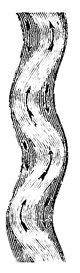
It is essential to the interests of both parties that the navigation of the river be free to both, on the footing on which it was defined by the treaty of Paris, viz.: through its whole breadth. The channel of the Mississippi is remarkably winding, crossing and recrossing perpetually from one side to the other of the general bed of the river. Within the elbows thus made by the channel, there is generally an eddy setting upwards, and it is by taking advantage of these eddies, and constantly crossing from one to another of them, that boats are enabled to ascend the river. Without this right the whole river would be impracticable both to the Americans and Spaniards.
It is a principle that the right to a thing gives a right to the means, without which it could not be used, that is to say, that the means follow their end. Thus, a right to navigate a river, draws to it a right to moor vessels to its shores, to land on them in cases of distress, or for other necessary purposes, &c. This principle is founded in natural reason, is evidenced by the common sense of mankind, and declared by the writers before quoted. See Grot. 1. 2. c. 2. § 15. Puffend. 1. 3. c. 3. § 8. Vattel, 1. 2. § 129.
The Roman law, which, like other municipal laws, placed the navigation of their rivers on the footing of nature, as to their own citizens, by declaring them public,[28] (flumina publica sunt, hoc est populi Romani, Inst. 2. t. 1. § 2,) declared also that the right to the use of the shores was incident to that of the water. Ibid, § 1, 3, 4, 5. The laws of every country probably do the same. This must have been so understood between France and Great Britain, at the treaty of Paris, when a right was ceded to British subjects to navigate the whole river, and expressly that part between the island of New Orleans and the western bank, without stipulating a word about the use of the shores, though both of them belonged then to France, and were to belong immediately to Spain. Had not the use of the shores been considered as incident to that of the water, it would have been expressly stipulated; since its necessity was too obvious to have escaped either party. Accordingly, all British subjects used the shores habitually for the purposes necessary to the navigation of the river; and when a Spanish Governor undertook at one time to forbid this, and even cut loose the vessels fastening to their shores, a British frigate went immediately, moored itself to the shore opposite to the town of New Orleans, and set out guards with orders to fire on such as might attempt to disturb her moorings. The Governor acquiesced, the right was constantly exercised afterwards, and no interruption ever offered.
This incidental right extends even beyond the shores, where circumstances render it necessary to the exercise of the principal right; as, in the case of a vessel damaged, where the mere shore could not be a safe deposit for her cargo till she could be repaired, she may remove it into safe ground off the river. The Roman law shall be quoted here too, because it gives a good idea both of the extent and the limitations of this right. Ins. 1. 2. t. 1. § 4. [29]Riparum quoque usus publicus est, ut volunt jura gentium, sicut et ipsius fluminis usus publicus est. Itaque et navigium ad ripes appellere, et funes de arboribus ibi natis religare, et navis onera in his locis reponere, liberum quique est sicuti nec per flumen ipsum navigare quisquam prohibetur. And again, §5, [30]littorum quoque usus publicus, sive juri gentium est, ut et ipsius maris et ob id data est facultas volentibus, casas ibi sibi componere, in quas se recipere possint, &c. Again, § 1. [31]Nemo igitur ad littora maris accedere prohibitur; veluti deambulare aut navem appellere, sic tamen ut a villis, id est domiciliis monumentisque ibi positis, et ab edificiis abstineat, nec iis damnum inferat.
Among incidental rights are those of having pilots, buoys, beacons, landmarks, light-houses, &c., to guide the navigators. The establishment of these at joint expense, and under joint regulations, may be the subject of a future convention. In the meantime, both should be free to have their own, and refuse those of the other, both as to use and expense.
Very peculiar circumstances attending the river Mississippi, require that the incidental right of accommodation on the shore, which needs only occasional exercise on other rivers, should be habitual and constant on this. Sea vessels cannot navigate that river, nor the river vessels go to sea. The navigation would be useless then without an entrepôt where these vessels might safely deposit their own cargoes, and take those left by the others; and where warehouses and keepers might be constantly established for the safeguard of the cargoes. It is admitted, indeed, that the incidental right thus extended into the territory of the bordering inhabitants, is liable to stricter modifications in proportion as it interferes with their territorial right. But the inconveniences of both parties are still to have their weight, and reason and moderation on both sides are to draw the line between them. As to this, we count much on the liberality of Spain, on her concurrence in opinion with us, that it is for the interest of both parties to remove completely this germ of discord from between us, and draw our friendship as close as circumstances proclaim that it should be, and on the considerations which make it palpable that a convenient spot placed under our exclusive occupation, and exempted from the jurisdiction and police of their government, is far more likely to preserve peace than a mere free port, where eternal altercations would keep us in eternal ill humor with each other. The policy of this measure, and indeed of a much larger concession, having been formerly sketched in a paper of July 12th, 1790, sent to the commissioners severally, they are now referred to that.
If this be agreed to, the manner of fixing on that extra territorial spot becomes highly interesting. The most desirable to us, would be a permission to send commissioners to choose such spot, below the town of New Orleans, as they should find most convenient.
If this be refused, it would be better now to fix on the spot. Our information is, that the whole country below the town, and for sixty miles above it, on the western shore, is low, marshy, and subject to such deep inundation for many miles from the river, that if capable of being reclaimed at all by banking, it would still never afford an entrepôt sufficiently safe; that on the eastern side the only lands below the town, not subject to inundation, are at the Detour aux Anglais, or English Turn, the highest part of which, is that whereon the fort St. Marie formerly stood. Even this is said to have been raised by art, and to be very little above the level of the inundations. This spot then is what we would fix on, if obliged now to decide, with from one to as many square miles of the circumjacent lands as can be obtained, and comprehending expressly the shores above and below the site of the fort as far as possible. But as to the spot itself, the limits, and even whether it shall be extra territorial, or only a free port, and what regulations it shall be laid under, the convenience of that Government is entitled to so much respect and attention on our part, that the arrangement must be left to the management of the commissioners, who will doubtless use their best efforts to obtain all they can for us.
The worst footing on which the determination of the ground could be placed, would be a reference to joint commissioners; because their disagreement, a very probable, nay, a certain event, would undo the whole convention, and leave us exactly where we now are. Unless indeed they will engage to us, in case of such disagreement, the highest ground at the Detour aux Anglais, of convenient extent, including the landings and harbor thereto adjacent. This would ensure us that ground, unless better could be found and mutually preferred, and close the delay of right under which we have so long labored for peace-sake.
It will probably be urged, because it was urged on a former occasion, that, if Spain grants to us the right of navigating the Mississippi, other nations will become entitled to it by virtue of treaties giving them the rights of the most favored nation.
Two answers may be given to this:
1. When those treaties were made, no nations could be under contemplation but those then existing, or those at most who might exist under similar circumstances. America did not then exist as a nation; and the circumstances of her position and commerce, are so totally dissimilar to everything then known, that the treaties of that day were not adapted to any such being. They would better fit even China than America; because, as a manufacturing nation, China resembles Europe more. When we solicited France to admit our whale oils into her ports, though she had excluded all foreign whale oils, her minister made the objection now under consideration, and the foregoing answer was given. It was found to be solid; and the whale oils of the United States are in consequence admitted, though those of Portugal and the Hanse towns, and of all other nations, are excluded. Again, when France and England were negotiating their late treaty of commerce, the great dissimilitude of our commerce (which furnishes raw materials to employ the industry of others, in exchange for articles whereon industry has been exhausted) from the commerce of the European nations (which furnishes things ready wrought only) was suggested to the attention of both negotiators, and that they should keep their nations free to make particular arrangements with ours, by communicating to each other only the rights of the most favored European nation. Each was separately sensible of the importance of the distinction; and as soon as it was proposed by the one, it was acceded to by the other, and the word European was inserted in their treaty. It may fairly be considered then as the rational and received interpretation of the diplomatic term, "gentis amicissimæ"[32] that it has not in view a nation unknown in many cases at the time of using the term, and so dissimilar in all cases as to furnish no ground of just reclamation to any nation.
But the decisive answer is, that Spain does not grant us the navigation of the river. We have an inherent right to it; and she may repel the demand of any other nation by candidly stating her act to have been, what in truth it is, a recognition only, and not a grant.
If Spain apprehends that other nations may claim access to our ports in the Mississippi, under their treaties with us, giving them a right to come and trade in all our ports, though we would not choose to insert an express stipulation against them, yet we shall think ourselves justified to acquiesce in fact, under any regulations Spain may from time to time establish against their admission.
Should Spain renew another objection, which she relied much on before that the English at the Revolution treaty could not cede to us what Spain had taken from them by conquest, and what of course they did not possess themselves, the preceding observations furnish sufficient matter for refutation.
To conclude the subjects of boundary and navigation, each of the following conditions is to be considered by the commissioners as a sine quâ non.
1. That our southern boundary remain established at the completion of thirty-one degrees of latitude on the Mississippi, and so on to the ocean, as has been before described, and our western one along the middle of the channel of the Mississippi, however that channel may vary, as it is constantly varying, and that Spain cease to occupy or to exercise jurisdiction in any part northward or eastward of these boundaries.
2. That our right be acknowledged of navigating the Mississippi, in its whole breadth and length, from its source to the sea, as established by the treaty of 1763.
3. That neither the vessels, cargoes, or the persons on board, be stopped, visited, or subjected to the payment of any duty whatsoever; or, if a visit must be permitted, that it be under such restrictions as to produce the least possible inconvenience. But it should be altogether avoided, if possible, as the parent of perpetual broils.
4. That such conveniences be allowed us ashore, as may render our right of navigation practicable and under such regulations as may bonâ fide respect the preservation of peace and order alone, and may not have in object to embarrass our navigation, or raise a revenue on it. While the substance of this article is made a sine quâ non, the modifications of it are left altogether to the discretion and management of the commissioners.
We might add, as a fifth sine quâ non, that no phrase should be admitted in the treaty which could express or imply that we take the navigation of the Mississippi as a grant from Spain. But, however disagreeable it would be to subscribe to such a sentiment, yet, were the conclusion of a treaty to hang on that single objection, it would be expedient to waive it, and to meet, at a future day, the consequences of any resumption they may pretend to make, rather than at present, those of a separation without coming to any agreement.
We know not whether Spain has it in idea to ask a compensation for the ascertainment of our right.
1. In the first place, she cannot in reason ask a compensation for yielding what we have a right to, that is to say, the navigation of the river, and the conveniences incident to it of natural right.
2. In the second place, we have a claim on Spain for indemnification for nine years' exclusion from that navigation, and a reimbursement of the heavy duties (not less for the most part than 15 per cent. on extravagant valuations) levied on the commodities she has permitted to pass to New Orleans. The relinquishment of this will be no unworthy equivalent for any accommodations she may indulge us with, beyond the line of our strict right. And this claim is to be brought into view in proper time and manner, merely to be abandoned in consideration of such accommodations. We have nothing else to give in exchange. For as to territory, we have neither the right nor the disposition to alienate an inch of what belongs to any member of our Union. Such a proposition, therefore, is totally inadmissible, and not to be treated of for a moment.
3. On the former conferences on the navigation of the Mississippi, Spain chose to blend with it the subject of commerce; and, accordingly, specific propositions thereon passed between the negotiators. Her object, then, was to obtain our renunciation of the navigation, and to hold out commercial arrangements, perhaps as a lure to us; perhaps, however, she might then, and may now, really set a value on commercial arrangements with us, and may receive them as a consideration for accommodating us in the navigation; or, may wish for them, to have the appearance of receiving a consideration. Commercial arrangements, if acceptable in themselves, will not be the less so if coupled with those relating to navigation and boundary. We have only to take care that they be acceptable in themselves.
There are two principles which may be proposed as the basis of a commercial treaty: 1. That of exchanging the privileges of native citizens; or,
2. Those of the most favored nation.
1. With the nations holding important possessions in America, we are ready to exchange the rights of native citizens, provided they be extended through the whole possessions of both parties, but the propositions of Spain, made on the former occasion, (a copy of which accompanies this,) were, that we should give their merchants, vessels, and productions, the privilege of native merchants, vessels, and productions, through the whole of our possessions, and they give the same to ours only in Spain and the Canaries. This is inadmissible, because unequal; and, as we believe that Spain is not ripe for an equal exchange on this basis, we avoid proposing it.
2. Though treaties, which merely exchange the rights of the most favored nations, are not without all inconvenience, yet they have their conveniences also. It is an important one, that they leave each party free to make what internal regulations they please, and to give what preferences they find expedient to native merchants, vessels, and productions. And as we already have treaties on this basis, with France, Holland, Sweden, and Prussia, the two former of which are perpetual, it will be but small additional embarrassment to extend it to Spain. On the contrary, we are sensible it is right to place that nation on the most favored footing, whether we have a treaty with them or not, and it can do us no harm to secure by treaty a reciprocation of the right.
Of the four treaties before mentioned, either the French or the Prussian might be taken as a model. But it would be useless to propose the Prussian; because we have already supposed that Spain would never consent to those articles which give to each party access to all the dominions of the other; and, without this equivalent, we would not agree to tie our own hands so materially in war, as would be done by the 23d article, which renounces the right of fitting out privateers, or of capturing merchant vessels. The French treaty, therefore, is proposed as the model. In this, however, the following changes are to be made.
We should be admitted to all the dominions of Spain, to which any other foreign nation is, or may be admitted.
Article 5 being an exemption from a particular duty in France, will of course be omitted, as inapplicable to Spain.
Article 8 to be omitted, as unnecessary with Morocco, and inefficacious, and little honorable with any of the Barbary powers. But it may furnish occasion to sound Spain on the project of a convention of the powers at war with the Barbary States, to keep up, by rotation, a constant cruise of a given force on their coasts, till they shall be compelled to renounce forever, and against all nations, their predatory practices. Perhaps the infidelities of the Algerines to their treaty of peace with Spain, though the latter does not choose to break openly, may induce her to subsidize us to cruise against them with a given force.
Article 9 and 10, concerning fisheries, to be omitted, as inapplicable.
Article 11. The first paragraph of this article, respecting the droit d'aubaine, to be omitted; that law being supposed peculiar to France.
Article 17, giving asylum in the ports of either to the armed vessels of the other, with the prizes taken from the enemies of that other, must be qualified as it is in the 19th article of the Prussian treaty; as the stipulation in the latter part of the article, "that no shelter or refuge shall be given in the ports of the one to such as shall have made prize on the subjects of the other of the parties," would forbid us in case of a war between France and Spain, to give shelter in our ports to prizes made by the latter on the former, while the first part of the article would oblige us to shelter those made by the former on the latter—a very dangerous covenant, and which ought never to be repeated in any other instance.
Article 29. Consuls should be received in all the ports at which the vessels of either party may be received.
Article 30, concerning free ports in Europe and America. Free ports in the Spanish possessions in America, and particularly at the Havana, San Domingo, in the island of that name, and St. John of Porto Rico, are more to be desired than expected. It can, therefore, only be recommended to the best endeavors of the commissioners to obtain them. It will be something to obtain for our vessels, flour, &c., admission to those ports during their pleasure. In like manner, if they could be prevailed on to re-establish our right of cutting log-wood in the bay of Campeachy, on the footing on which it stood before the treaty of 1763, it would be desirable, and not endanger, to us, any contest with the English, who, by the Revolution treaty, are restrained to the south-eastern parts of Yucatan.