Volume 6 / Part 3 — PART III.—Continued. LETTERS WRITTEN AFTER HIS RETURN TO THE U. S. DOWN TO THE TIME OF HIS DEATH. 1790-1826. (continued 8)
Reading edition
Thus we find this string of authorities, when examined to the beginning, all hanging on the same hook, a perverted expression of Prisot's, or on one another, or nobody. Thus Finch quotes Prisot; Wingate also; Sheppard quotes Prisot, Finch and Wingate; Hale cites nobody; the court in Woolston's case cite Hale; Wood cites Woolston's case; Blackstone that and Hale; and Lord Mansfield, like Hale, ventures it on his own authority. In the earlier ages of the law, as in the year-books, for instance, we do not expect much recurrence to authorities by the judges, because in those days there were few or none such made public. But in latter times we take no judge's word for what the law is, further than he is warranted by the authorities he appeals to. His decision may bind the unfortunate individual who happens to be the particular subject of it; but it cannot alter the law. Though the common law may be termed "Lex non Scripta," yet the same Hale tells us "when I call those parts of our laws Leges non Scriptæ, I do not mean as if those laws were only oral, or communicated from the former ages to the latter merely by word. For all those laws have their several monuments in writing, whereby they are transferred from one age to another, and without which they would soon lose all kind of certainty. They are for the most part extant in records of pleas, proceedings, and judgments, in books of reports and judicial decisions, in tractates of learned men's arguments and opinions, preserved from ancient times and still extant in writing." Hale's H. c. d. 22. Authorities for what is common law may therefore be as well cited, as for any part of the Lex Scripta, and there is no better instance of the necessity of holding the judges and writers to a declaration of their authorities than the present; where we detect them endeavoring to make law where they found none, and to submit us at one stroke to a whole system, no particle of which has its foundation in the common law. For we know that the common law is that system of law which was introduced by the Saxons on their settlement in England, and altered from time to time by proper legislative authority from that time to the date of Magna Charta, which terminates the period of the common law, or lex non scripta, and commences that of the statute law, or Lex Scripta. This settlement took place about the middle of the fifth century. But Christianity was not introduced till the seventh century; the conversion of the first Christian king of the Heptarchy having taken place about the year 598, and that of the last about 686. Here, then, was a space of two hundred years, during which the common law was in existence, and Christianity no part of it. If it ever was adopted, therefore, into the common law, it must have been between the introduction of Christianity and the date of the Magna Charta. But of the laws of this period we have a tolerable collection by Lambard and Wilkins, probably not perfect, but neither very defective; and if any one chooses to build a doctrine on any law of that period, supposed to have been lost, it is incumbent on him to prove it to have existed, and what were its contents. These were so far alterations of the common law, and became themselves a part of it. But none of these adopt Christianity as a part of the common law. If, therefore, from the settlement of the Saxons to the introduction of Christianity among them, that system of religion could not be a part of the common law, because they were not yet Christians, and if, having their laws from that period to the close of the common law, we are all able to find among them no such act of adoption, we may safely affirm (though contradicted by all the judges and writers on earth) that Christianity neither is, nor ever was a part of the common law. Another cogent proof of this truth is drawn from the silence of certain writers on the common law. Bracton gives us a very complete and scientific treatise of the whole body of the common law. He wrote this about the close of the reign of Henry III., a very few years after the date of the Magna Charta. We consider this book as the more valuable, as it was written about the time which divides the common and statute law, and therefore gives us the former in its ultimate state. Bracton, too, was an ecclesiastic, and would certainly not have failed to inform us of the adoption of Christianity as a part of the common law, had any such adoption ever taken place. But no word of his, which intimates anything like it, has ever been cited. Fleta and Britton, who wrote in the succeeding reign (of Edward I.), are equally silent. So also is Glanvil, an earlier writer than any of them, (viz.: temp. H. 2,) but his subject perhaps might not have led him to mention it. Justice Fortescue Aland, who possessed more Saxon learning than all the judges and writers before mentioned put together, places this subject on more limited ground. Speaking of the laws of the Saxon kings, he says, "the ten commandments were made part of their laws, and consequently were once part of the law of England; so that to break any of the ten commandments was then esteemed a breach of the common law, of England; and why it is not so now, perhaps it may be difficult to give a good reason." Preface to Fortescue Aland's reports, xvii. Had he proposed to state with more minuteness how much of the scriptures had been made a part of the common law, he might have added that in the laws of Alfred, where he found the ten commandments, two or three other chapters of Exodus are copied almost verbatim. But the adoption of a part proves rather a rejection of the rest, as municipal law. We might as well say that the Newtonian system of philosophy is a part of the common law, as that the Christian religion is. The truth is that Christianity and Newtonianism being reason and verity itself, in the opinion of all but infidels and Cartesians, they are protected under the wings of the common law from the dominion of other sects, but not erected into dominion over them. An eminent Spanish physician affirmed that the lancet had slain more men than the sword. Doctor Sangrado, on the contrary, affirmed that with plentiful bleedings, and draughts of warm water, every disease was to be cured. The common law protects both opinions, but enacts neither into law. See post. 879.
879. Howard, in his Contumes Anglo-Normandes, 1. 87, notices the falsification of the laws of Alfred, by prefixing to them four chapters of the Jewish law, to wit: the 20th, 21st, 22d and 23d chapters of Exodus, to which he might have added the 15th chapter of the Acts of the Apostles, v. 23, and precepts from other parts of the scripture. These he calls a hors d'œuvre of some pious copyist. This awkward monkish fabrication makes the preface to Alfred's genuine laws stand in the body of the work, and the very words of Alfred himself prove the fraud; for he declares, in that preface, that he has collected these laws from those of Ina, of Offa, Aethelbert and his ancestors, saying nothing of any of them being taken from the Scriptures. It is still more certainly proved by the inconsistencies it occasions. For example, the Jewish legislator Exodus xxi. 12, 13, 14, (copied by the Pseudo Alfred § 13,) makes murder, with the Jews, death. But Alfred himself, Le. xxvi., punishes it by a fine only, called a Weregild, proportioned to the condition of the person killed. It is remarkable that Hume (append. 1 to his History) examining this article of the laws of Alfred, without perceiving the fraud, puzzles himself with accounting for the inconsistency it had introduced. To strike a pregnant woman so that she die is death by Exodus, xxi. 22, 23, and Pseud. Alfr. § 18; but by the laws of Alfred ix., pays a Weregild for both woman and child. To smite out an eye, or a tooth, Exod. xxi. 24-27. Pseud. Alfr. § 19, 20, if of a servant by his master, is freedom to the servant; in every other case retaliation. But by Alfr. Le. xl. a fixed indemnification is paid. Theft of an ox, or a sheep, by the Jewish law, Exod. xxii. 1, was repaid five-fold for the ox and four-fold for the sheep; by the Pseudograph § 24, the ox double, the sheep four-fold; but by Alfred Le. xvi., he who stole a cow and a calf was to repay the worth of the cow and 401 for the calf. Goring by an ox was the death of the ox, and the flesh not to be eaten. Exod. xxi. 28. Pseud. Alfr. § 21 by Alfred Le. xxiv., the wounded person had the ox. The Pseudograph makes municipal laws of the ten commandments, § 1—10, regulates concubinage, § 12, makes it death to strike or to curse father or mother, § 14, 15, gives an eye for an eye, tooth for a tooth, hand for hand, foot for foot, burning for burning, wound for wound, strife for strife, § 19; sells the thief to repay his theft, § 24; obliges the fornicator to marry the woman he has lain with, § 29; forbids interest on money, § 35; makes the laws of bailment, § 28, very different from what Lord Holt delivers in Coggs v. Bernard, ante 92, and what Sir William Jones tells us they were; and punishes witchcraft with death, § 30, which Sir Matthew Hale, 1 H. P. C. B. 1, ch. 33, declares was not a felony before the Stat. 1, Jac. 12. It was under that statute, and not this forgery, that he hung Rose Cullender and Amy Duny, 16 Car. 2, (1662,) on whose trial he declared "that there were such creatures as witches he made no doubt at all; for first the Scripture had affirmed so much, secondly the wisdom of all nations had provided laws against such persons, and such hath been the judgment of this kingdom, as appears by that act of Parliament which hath provided punishment proportionable to the quality of the offence." And we must certainly allow greater weight to this position that "it was no felony till James' Statute," laid down deliberately in his H. P. C., a work which he wrote to be printed, finished, and transcribed for the press in his life time, than to the hasty scripture that "at common law witchcraft was punished with death as heresy, by writ de Heretico Comburendo" in his Methodical Summary of the P. C. p. 6, a work "not intended for the press, not fitted for it, and which he declared himself he had never read over since it was written;" Pref. Unless we understand his meaning in that to be that witchcraft could not be punished at common law as witchcraft, but as heresy. In either sense, however, it is a denial of this pretended law of Alfred. Now, all men of reading know that these pretended laws of homicide, concubinage, theft, retaliation, compulsory marriage, usury, bailment, and others which might have been cited, from the Pseudograph, were never the laws of England, not even in Alfred's time; and of course that it is a forgery. Yet palpable as it must be to every lawyer, the English judges have piously avoided lifting the veil under which it was shrouded. In truth, the alliance between Church and State in England has ever made their judges accomplices in the frauds of the clergy; and even bolder than they are. For instead of being contented with these four surreptitious chapters of Exodus, they have taken the whole leap, and declared at once that the whole Bible and Testament in a lump, make a part of the common law; ante 873: the first judicial declaration of which was by this same Sir Matthew Hale. And thus they incorporate into the English code laws made for the Jews alone, and the precepts of the gospel, intended by their benevolent author as obligatory only in foro concientiæ; and they arm the whole with the coercions of municipal law. In doing this, too, they have not even used the Connecticut caution of declaring, as is done in their blue laws, that the laws of God shall be the laws of their land, except where their own contradict them; but they swallow the yea and nay together. Finally, in answer to Fortescue Aland's question why the ten commandments should not now be a part of the common law of England? we may say they are not because they never were made so by legislative authority, the document which has imposed that doubt on him being a manifest forgery.
TO DR. JOHN MANNERS.
Monticello, February 22, 1814.
Sir,—The opinion which, in your letter of January 24, you are pleased to ask of me, on the comparative merits of the different methods of classification adopted by different writers on Natural History, is one which I could not have given satisfactorily, even at the earlier period at which the subject was more familiar; still less, after a life of continued occupation in civil concerns has so much withdrawn me from studies of that kind. I can, therefore, answer but in a very general way. And the text of this answer will be found in an observation in your letter, where, speaking of nosological systems, you say that disease has been found to be an unit. Nature has, in truth, produced units only through all her works. Classes, orders, genera, species, are not of her work. Her creation is of individuals. No two animals are exactly alike; no two plants, nor even two leaves or blades of grass; no two crystallizations. And if we may venture from what is within the cognizance of such organs as ours, to conclude on that beyond their powers, we must believe that no two particles of matter are of exact resemblance. This infinitude of units or individuals being far beyond the capacity of our memory, we are obliged, in aid of that, to distribute them into masses, throwing into each of these all the individuals which have a certain degree of resemblance; to subdivide these again into smaller groups, according to certain points of dissimilitude observable in them, and so on until we have formed what we call a system of classes, orders, genera and species. In doing this, we fix arbitrarily on such characteristic resemblances and differences as seem to us most prominent and invariable in the several subjects, and most likely to take a strong hold in our memories. Thus Ray formed one classification on such lines of division as struck him most favorably; Klein adopted another; Brisson a third, and other naturalists other designations, till Linnæus appeared. Fortunately for science, he conceived in the three kingdoms of nature, modes of classification which obtained the approbation of the learned of all nations. His system was accordingly adopted by all, and united all in a general language. It offered the three great desiderata: First, of aiding the memory to retain a knowledge of the productions of nature. Secondly, of rallying all to the same names for the same objects, so that they could communicate understandingly on them. And Thirdly, of enabling them, when a subject was first presented, to trace it by its character up to the conventional name by which it was agreed to be called. This classification was indeed liable to the imperfection of bringing into the same group individuals which, though resembling in the characteristics adopted by the author for his classification, yet have strong marks of dissimilitude in other respects. But to this objection every mode of classification must be liable, because the plan of creation is inscrutable to our limited faculties. Nature has not arranged her productions on a single and direct line. They branch at every step, and in every direction, and he who attempts to reduce them into departments, is left to do it by the lines of his own fancy. The objection of bringing together what are disparata in nature, lies against the classifications of Blumenbach and of Cuvier, as well as that of Linnæus, and must forever lie against all. Perhaps not in equal degree; on this I do not pronounce. But neither is this so important a consideration as that of uniting all nations under one language in Natural History. This had been happily effected by Linnæus, and can scarcely be hoped for a second time. Nothing indeed is so desperate as to make all mankind agree in giving up a language they possess, for one which they have to learn. The attempt leads directly to the confusion of the tongues of Babel. Disciples of Linnæus, of Blumenbach, and of Cuvier, exclusively possessing their own nomenclatures, can no longer communicate intelligibly with one another. However much, therefore, we are indebted to both these naturalists, and to Cuvier especially, for the valuable additions they have made to the sciences of nature, I cannot say they have rendered her a service in this attempt to innovate in the settled nomenclature of her productions; on the contrary, I think it will be a check on the progress of science, greater or less, in proportion as their schemes shall more or less prevail. They would have rendered greater service by holding fast to the system on which we had once all agreed, and by inserting into that such new genera, orders, or even classes, as new discoveries should call for. Their systems, too, and especially that of Blumenbach, are liable to the objection of giving too much into the province of anatomy. It may be said, indeed, that anatomy is a part of natural history. In the broad sense of the word, it certainly is. In that sense, however, it would comprehend all the natural sciences, every created thing being a subject of natural history in extenso. But in the subdivisions of general science, as has been observed in the particular one of natural history, it has been necessary to draw arbitrary lines, in order to accommodate our limited views. According to these, as soon as the structure of any natural production is destroyed by art, it ceases to be a subject of natural history, and enters into the domain ascribed to chemistry, to pharmacy, to anatomy, &c. Linnæus' method was liable to this objection so far as it required the aid of anatomical dissection, as of the heart, for instance, to ascertain the place of any animal, or of a chemical process for that of a mineral substance. It would certainly be better to adopt as much as possible such exterior and visible characteristics as every traveller is competent to observe, to ascertain and to relate. But with this objection, lying but in a small degree, Linnæus' method was received, understood, and conventionally settled among the learned, and was even getting into common use. To disturb it then was unfortunate. The new system attempted in botany, by Jussieu, in mineralogy, by Haüy, are subjects of the same regret, and so also the no-system of Buffon, the great advocate of individualism in opposition to classification. He would carry us back to the days and to the confusion of Aristotle and Pliny, give up the improvements of twenty centuries, and co-operate with the neologists in rendering the science of one generation useless to the next by perpetual changes of its language. In botany, Wildenow and Persoon have incorporated into Linnæus the new discovered plants. I do not know whether any one has rendered us the same service as to his natural history. It would be a very acceptable one. The materials furnished by Humboldt, and those from New Holland particularly, require to be digested into the Catholic system. Among these, the Ornithorhyncus mentioned by you, is an amusing example of the anomalies by which nature sports with our schemes of classification. Although without mammæ, naturalists are obliged to place it in the class of mammiferæ; and Blumenbach, particularly, arranges it in his order of Palmipeds and toothless genus, with the walrus and manatie. In Linnæus' system it might be inserted as a new genus between the anteater and manis, in the order of Bruta. It seems, in truth, to have stronger relations with that class than any other in the construction of the heart, its red and warm blood, hairy integuments, in being quadruped and viviparous, and may we not say, in its tout ensemble, which Buffon makes his sole principle of arrangement? The mandible, as you observe, would draw it towards the birds, were not this characteristic overbalanced by the weightier ones before mentioned. That of the Cloaca is equivocal, because although a character of birds, yet some mammalia, as the beaver and sloth, have the rectum and urinary passage terminating at a common opening. Its ribs also, by their number and structure, are nearer those of the bird than of the mammalia. It is possible that further opportunities of examination may discover the mammæ. Those of the Opossum are asserted, by the Chevalier d'Aboville, from his own observations on that animal, made while here with the French army, to be not discoverable until pregnancy, and to disappear as soon as the young are weaned. The Duckbill has many additional particularities which liken it to other genera, and some entirely peculiar. Its description and history needs yet further information.
In what I have said on the method of classing, I have not at all meant to insinuate that that of Linnæus is intrinsically preferable to those of Blumenbach and Cuvier. I adhere to the Linnean because it is sufficient as a ground-work, admits of supplementary insertions as new productions are discovered, and mainly because it has got into so general use that it will not be easy to displace it, and still less to find another which shall have the same singular fortune of obtaining the general consent. During the attempt we shall become unintelligible to one another, and science will be really retarded by efforts to advance it made by its most favorite sons. I am not myself apt to be alarmed at innovations recommended by reason. That dread belongs to those whose interests or prejudices shrink from the advance of truth and science. My reluctance is to give up an universal language of which we are in possession, without an assurance of general consent to receive another. And the higher the character of the authors recommending it, and the more excellent what they offer, the greater the danger of producing schism.
I should seem to need apology for these long remarks to you who are so much more recent in these studies, but I find it in your particular request and my own respect for it, and with that be pleased to accept the assurance of my esteem and consideration.
JOHN ADAMS TO THOMAS JEFFERSON.
Quincy, February, 1814.
Dear Sir,—I was nibbing my pen and brushing my faculties, to write a polite letter of thanks to Mr. Counsellor Barton, for his valuable memoirs of Dr. Rittenhouse, (though I could not account for his sending it to me), when I received your favor of January 25th. I now most cordially endorse my thanks over to you. The book is in the modern American style, an able imitation of Marshall's Washington, though far more entertaining and instructive; a Washington Mausoleum; an Egyptian pyramid. I shall never read it any more than Taylor's aristocracy. Mrs. Adams reads it with great delight, and reads to me what she finds interesting, and that is indeed the whole book. I have not time to hear it all.
Rittenhouse was a virtuous and amiable man, an exquisite mechanician, master of the astronomy known in his time; an expert mathematician, a patient calculator of numbers. But we have had a Winthrop, an Andrew Oliver, a Willard, a Webber, his equals, and we have a Bowditch his superior in all these particulars, except the mechanism. But you know Philadelphia is the heart, the censorium, the pineal gland of the United States.
In politics, Rittenhouse was a good, simple, ignorant, well-meaning, Franklinian democrat, totally ignorant of the world. As an anchorite, an honest dupe of the French Revolution; a mere instrument of Jonathan Dickinson Sargent, Dr. Hutchinson, Genet, and Mifflin, I give him all the credit of his Planetarium. The improvement of the Orrery to the Planetarium was an easy, natural thought, and nothing was wanting but calculations of orbits Distranus, and periods of revolutions; all of which were made to his hands long before he existed. Patience, perseverance, and sleight of hand, is his undoubted merit and praise. I had read Taylor in the Senate, till his style was so familiar to me that I had not read three pages, before I suspected the author. I wrote a letter to him, and he candidly acknowledged that the six hundred and fifty pages were sent me with his consent. I wait with impatience for the publication, and annunciation of the work. Arator ought not to have been adulterated with politics, but his precept "Gather up the fragments that nothing be lost," is of inestimable value in agriculture and horticulture. Every weed, cob, husk, stalk, ought to be saved for manure.
Your researches in the laws of England establishing Christianity as the law of the land, and part of the common law, are curious and very important. Questions without number will arise in this country. Religious controversies, and ecclesiastical contests, are as common, and will be as sharp as any in civil politics, foreign and domestic. In what sense, and to what extent the Bible is law, may give rise to as many doubts and quarrels as any of our civil, political, military, or maritime laws, and will intermix with them all, to irritate factions of every sort. I dare not look beyond my nose into futurity. Our money, our commerce, our religion, our National and State Constitutions, even our arts and sciences, are so many seed plots, of division, faction, sedition and rebellion. Everything is transmuted into an instrument of electioneering. Election is the grand Brahma, the immortal Lama, I had almost said, the Juggernaut; for wives are almost ready to burn upon the pile, and children to be thrown under the wheel. You will perceive, by these figures, that I have been looking into oriental history, and Hindoo religion. I have read voyages, and travels, and everything I could collect, and the last is Priestley's "Comparison of the Institutions of Moses with those of the Hindoos, and other Ancient Nations," a work of great labor, and not less haste. I thank him for the labor, and forgive, though I lament the hurry. You would be fatigued to read, and I, just recruiting from a little longer confinement and indisposition than I have had for thirty years, have not strength to write many observations. But I have been disappointed in the principal points of my curiosity:
1st. I am disappointed by finding that no just comparison can be made, because the original Shasta, and the original Vedams are not obtained, or if obtained, not yet translated into any European language.
2d. In not finding such morsels of the sacred books as have been translated and published, which are more honorable to the original Hindoo religion than anything he has quoted.
3d. In not finding a full development of the history of the doctrine of the Metempsichosis which originated—
4th. In the history of the rebellion of innumerable hosts of angels in Heaven against the Supreme Being, who after some thousands of years of war, conquered them, and hurled them down to the regions of total darkness, where they have suffered a part of the punishment of their crime, and then were mercifully released from prison, permitted to ascend to earth, and migrate into all sorts of animals, reptiles, birds, beasts, and men, according to their rank and character, and even into vegetables, and minerals, there to serve on probation. If they passed without reproach their several gradations, they were permitted to become cows and men. If as men they behaved well, i. e. to the satisfaction of the priests, they were restored to their original rank and bliss in Heaven.
5th. In not finding the Trinity of Pythagoras and Plato, their contempt of matter, flesh, and blood, their almost adoration of fire and water, their metempsichosis, and even the prohibition of beans, so evidently derived from India.
6th. In not finding the prophecy of Enoch deduced from India, in which the fallen angels make such a figure. But you are weary. Priestley has proved the superiority of the Hebrews to the Hindoos, as they appear in the Gentoo laws, and institutes of Menu; but the comparison remains to be made with the Shasta.
In his remarks on Mr. Dupuis, page 342, Priestley says: "The History of the fallen angels is another circumstance, on which Mr. Dupuis lays much stress. According to the Christians, he says, Vol. I, page 336, there was from the beginning a division among the angels; some remaining faithful to the light, and others taking the part of darkness, &c.; but this supposed history is not found in the Scriptures. It has only been inferred, from a wrong interpretation of one passage in the 2d epistle of Peter, and a corresponding one in that of Jude, as has been shown by judicious writers. That there is such a person as the Devil, is not a part of my faith, nor that of many other Christians, nor am I sure that it was the belief of any of the Christian writers. Neither do I believe the doctrine of demoniacal possessions, whether it was believed by the sacred writers or not; and yet my unbelief in these articles does not affect my faith in the great facts of which the Evangelists were eye and ear witnesses. They might not be competent judges in the one case, though perfectly so with respect to the other."
I will ask Priestley, when I see him, do you believe those passages in Peter and Jude to be interpolations? If so, by whom made? And when? And where? And for what end? Was it to support, or found, the doctrine of the fall of man, original sin, the universal corruption, depravation and guilt of human nature and mankind; and the subsequent incarnation of God to make atonement and redemption? Or do you think that Peter and Jude believed the book of Enoch to have been written by the seventh from Adam, and one of the sacred canonical books of the Hebrew Prophets? Peter, 2d epistle, c. 2d, v. 4th, says "For if God spared not the angels that sinned, but cast them down to hell, and delivered them into chains of darkness to be reserved unto Judgment." Jude, v. 6th says, "and the angels which kept their first estate, but left their own habitations, he hath reserved in everlasting chains under darkness, unto the judgment of the great day." Verse 14th, "And Enoch, also, the seventh from Adam, prophesied of these sayings, behold the Lord cometh with ten thousands of his saints, to execute judgment upon all," &c. Priestley says, "a wrong interpretation" has been given to these texts. I wish he had favored us with his right interpretation of them. In another place, page 326, Priestley says, "There is no circumstance of which Mr. Dupuis avails himself so much, or repeats so often, both with respect to the Jewish and Christian religions, as the history of the Fall of Man, in the book of Genesis." I believe with him, and have maintained in my writings, that this history is either an allegory, or founded on uncertain tradition, that it is an hypothesis to account for the origin of evil, adopted by Moses, which by no means accounts for the facts.
March 3d. So far was written almost a month ago; but sickness has prevented progress. I had much more to say about this work. I shall never be a disciple of Priestley. He is as absurd, inconsistent, credulous and incomprehensible, as Athanasius. Read his letter to the Jews in this volume. Could a rational creature write it? Aye! such rational creatures as Rochefoucauld, and Condorcet, and John Taylor, in politics, and Towers' Jurieus, and French Prophets in Theology. Priestley's account of the philosophy and religion of India, appears to me to be such a work as a man of busy research would produce—who should undertake to describe Christianity from the sixth to the twelfth century, when a deluge of wonders overflowed the world; when miracles were performed and proclaimed from every convent, and monastery, hospital, churchyard, mountain, valley, cave and cupola.
There is a book which I wish I possessed. It has never crossed the Atlantic. It is entitled Acta Sanctorum, in forty-seven volumes in folio. It contains the lives of the Saints. It was compiled in the beginning of the sixteenth century by Bollandus, Henschenius and Papebrock. What would I give to possess in one immense mass, one stupendous draught, all the legends, true, doubtful and false.
These Bollandists dared to discuss some of the facts, and hint that some of them were doubtful. E. G. Papebrock doubted the antiquity of the Carmellites from Elias; and whether the face of Jesus Christ was painted on the handkerchief of St. Véronique; and whether the prepuce of the Saviour of the world, which was shown in the church of Antwerp, could be proved to be genuine? For these bold scepticisms he was libelled in pamphlets, and denounced by the Pope, and the Inquisition in Spain. The Inquisition condemned him; but the Pope not daring to acquit or condemn him, prohibited all writings pro. and con. But as the physicians cure one disease by exciting another, as a fever by a salivation, this Bull was produced by a new claim. The brothers of the Order of Charity asserted a descent from Abraham, nine hundred years anterior to the Carmellites.
A philosopher who should write a description of Christianism from the Bollandistic Saints of the sixth and tenth century would probably produce a work tolerably parallel to Priestley's upon the Hindoos.
TO GIDEON GRANGER, ESQ.
Monticello, March 9, 1814.
Dear Sir,—Your letter of February 22d came to hand on the 4th instant. Nothing is so painful to me as appeals to my memory on the subject of past transactions. From 1775 to 1809, my life was an unremitting course of public transactions, so numerous, so multifarious, and so diversified by places and persons, that, like the figures of a magic lanthern, their succession was with a rapidity that scarcely gave time for fixed impressions. Add to this the decay of memory consequent on advancing years, and it will not be deemed wonderful that I should be a stranger as it were even to my own transactions. Of some indeed I retain recollections of the particular, as well as general circumstances; of others a strong impression of the general fact, with an oblivion of particulars; but of a great mass, not a trace either of general or particular remains in my mind. I have duly pondered the facts stated in your letter, and for the refreshment of my memory have gone over the letters which passed between us while I was in the administration of the government, have examined my private notes, and such other papers as could assist me in the recovery of the facts, and shall now state them seriatim from your letter, and give the best account of them I am able to derive from the joint sources of memory and papers.
"I have been denounced as a Burrite; but you know that in 1800 I sent Erving from Boston to inform Virginia of the danger resulting from his intrigues." I well remember Mr. Erving's visit to this State about that time, and his suggestions of the designs meditated in the quarter you mention; but as my duties on the occasion were to be merely passive, he of course, as I presume, addressed his communications more particularly to those who were free to use them. I do not recollect his mentioning you; but I find that in your letter to me of April 26, 1804, you state your agency on that occasion, so that I have no reason to doubt the fact.
"That in 1803-4, on my advice, you procured Erastus Granger to inform De Witt Clinton of the plan to elevate Burr in New York." Here I do not recollect the particulars; but I have a general recollection that Colonel Burr's conduct had already, at that date rendered his designs suspicious; that being for that reason laid aside by his constituents as Vice President, and aiming to become the Governor of New York, it was thought advisable that the persons of influence in that State should be put on their guard; and Mr. Clinton being eminent, no one was more likely to receive intimations from us, nor any one more likely to be confided in for their communication than yourself. I have no doubt therefore of the fact, and the less because in your letter to me of October 9, 1806, you remind me of it.
About the same period, that is, in the winter of 1803-4, another train of facts took place which, although not specifically stated in your letter, I think it but justice to yourself that I should state. I mean the intrigues which were in agitation, and at the bottom of which we believed Colonel Burr to be; to form a coalition of the five eastern States, with New York and New Jersey, under the new appellation of the seven eastern States; either to overawe the Union by the combination of their power and their will, or by threats of separating themselves from it. Your intimacy with some of those in the secret gave you opportunities of searching into their proceedings, of which you made me daily and confidential reports. This intimacy to which I had such useful recourse, at the time, rendered you an object of suspicion with many as being yourself a partisan of Colonel Burr, and engaged in the very combination which you were faithfully employed in defeating. I never failed to justify you to all those who brought their suspicions to me, and to assure them of my knowledge of your fidelity. Many were the individuals, then members of the legislature, who received these assurances from me, and whose apprehensions were thereby quieted. This first project of Colonel Burr having vanished in smoke, he directed to the western country those views which are the subject of your next article.
"That in 1806, I communicated by the first mail after I had got knowledge of the fact, the supposed plans of Burr in his western expedition; upon which communication your council was first called together to take measures in relation to that subject." Not exactly on that single communication; on the 15th and 18th of September, I had received letters from Colonel George Morgan, and from a Mr. Nicholson of New York, suggesting in a general way the manœuvres of Colonel Burr. Similar information came to the Secretary of State from a Mr. Williams of New York. The indications, however, were so vague that I only desired their increased attention to the subject, and further communications of what they should discover. Your letter of October 16, conveying the communications of General Eaton to yourself and to Mr. Ely gave a specific view of the objects of this new conspiracy, and corroborating our previous information, I called the Cabinet together, on the 22d of October, when specific measures were adopted for meeting the dangers threatened in the various points in which they might occur. I say your letter of October 16 gave this information, because its date, with the circumstance of its being no longer on my files, induce me to infer it was that particular letter, which having been transferred to the bundle of the documents of that conspiracy, delivered to the Attorney General, is no longer in my possession.
Your mission of Mr. Pease on the route to New Orleans, at the time of that conspiracy, with powers to see that the mails were expected, and to dismiss at once every agent of the Post Office whose fidelity could be justly doubted, and to substitute others on the spot was a necessary measure, taken with my approbation; and he executed the trusts to my satisfaction. I do not know however that my subsequent appointment of him to the office of Surveyor General was influenced, as you suppose, by those services. My motives in that appointment were my personal knowledge of his mathematical qualifications and satisfactory informations of the other parts of his character.
With respect to the dismission of the prosecutions for sedition in Connecticut, it is well known to have been a tenet of the republican portion of our fellow citizens, that the sedition law was contrary to the constitution and therefore void. On this ground I considered it as a nullity wherever I met it in the course of my duties; and on this ground I directed nolle prosequis in all the prosecutions which had been instituted under it, and as far as the public sentiment can be inferred from the occurrences of the day, we may say that this opinion had the sanction of the nation. The prosecutions, therefore, which were afterwards instituted in Connecticut, of which two were against printers, two against preachers, and one against a judge, were too inconsistent with this principle to be permitted to go on. We were bound to administer to others the same measure of law, not which they had meted to us, but we to ourselves, and to extend to all equally the protection of the same constitutional principles. These prosecutions, too, were chiefly for charges against myself, and I had from the beginning laid it down as a rule to notice nothing of the kind. I believed that the long course of services in which I had acted on the public stage, and under the eye of my fellow citizens, furnished better evidence to them of my character and principles, than the angry invectives of adverse partisans in whose eyes the very acts most approved by the majority were subjects of the greatest demerit and censure. These prosecutions against them, therefore, were to be dismissed as a matter of duty. But I wished it to be done with all possible respect to the worthy citizens who had advised them, and in such way as to spare their feelings which had been justly irritated by the intemperance of their adversaries. As you were of that State and intimate with these characters, the business was confided to you, and you executed it to my perfect satisfaction.
These I think are all the particular facts on which you have asked my testimony, and I add with pleasure, and under a sense of duty, the declaration that the increase of rapidity in the movement of the mails which had been vainly attempted before, were readily undertaken by you on your entrance into office, and zealously and effectually carried into execution, and that the affairs of the office were conducted by you with ability and diligence, so long as I had opportunities of observing them.
With respect to the first article mentioned in your letter, in which I am neither concerned nor consulted, I will yet, as a friend, volunteer my advice. I never knew anything of it, nor would ever listen to such gossiping trash. Be assured, my dear Sir, that the dragging such a subject before the public will excite universal reprobation, and they will drown in their indignation all the solid justifications which they would otherwise have received and weighed with candor. Consult your own experience, reflect on the similar cases which have happened within your own knowledge, and see if ever there was a single one in which such a mode of recrimination procured favor to him who used it. You may give pain where perhaps you wish it, but be assured it will re-act on yourself with double though delayed effect, and that it will be one of those incidents of your life on which you will never reflect with satisfaction. Be advised, then; erase it even from your memory, and stand erect before the world on the high ground of your own merits, without stooping to what is unworthy either of your or their notice. Remember that we often repent of what we have said, but never, never of that which we have not. You may have time enough hereafter to mend your hold, if ever it can be mended by such matter as that. Take time then, and do not commit your happiness and public estimation by too much precipitancy. I am entirely uninformed of the state of things which you say exists, and which will oblige you to make a solemn appeal to the nation, in vindication of your character. But whatever that be, I feel it a duty to bear testimony to the truth, and I have suggested with frankness other considerations occurring to myself, because I wish you well, and I add sincere assurances of my great respect and esteem.
TO HORATIO G. SPAFFORD.
Monticello, March 17, 1814.
Dear Sir,—I am an unpunctual correspondent at best. While my affairs permit me to be within doors, I am too apt to take up a book and to forget the calls of the writing-table. Besides this, I pass a considerable portion of my time at a possession so distant, and uncertain as to its mails, that my letters always await my return here. This must apologise for my being so late in acknowledging your two favors of December 17th and January 28th, as also that of the Gazetteer, which came safely to hand. I have read it with pleasure, and derived from it much information which I did not possess before. I wish we had as full a statement as to all our States. We should know ourselves better, our circumstances and resources, and the advantageous ground we stand on as a whole. We are certainly much indebted to you for this fund of valuable information. I join in your reprobation of our merchants, priests, and lawyers, for their adherence to England and monarchy, in preference to their own country and its constitution. But merchants have no country. The mere spot they stand on does not constitute so strong an attachment as that from which they draw their gains. In every country and in every age, the priest has been hostile to liberty. He is always in alliance with the despot, abetting his abuses in return for protection to his own. It is easier to acquire wealth and power by this combination than by deserving them, and to effect this, they have perverted the purest religion ever preached to man into mystery and jargon, unintelligible to all mankind, and therefore the safer engine for their purposes. With the lawyers it is a new thing. They have, in the mother country, been generally the firmest supporters of the free principles of their constitution. But there too they have changed. I ascribe much of this to the substitution of Blackstone for my Lord Coke, as an elementary work. In truth, Blackstone and Hume have made tories of all England, and are making tories of those young Americans whose native feelings of independence do not place them above the wily sophistries of a Hume or a Blackstone. These two books, but especially the former, have done more towards the suppression of the liberties of man, than all the million of men in arms of Bonaparte and the millions of human lives with the sacrifice of which he will stand loaded before the judgment seat of his Maker. I fear nothing for our liberty from the assaults of force; but I have seen and felt much, and fear more from English books, English prejudices, English manners, and the apes, the dupes, and designs among our professional crafts. When I look around me for security against these seductions, I find it in the wide-spread of our agricultural citizens, in their unsophisticated minds, their independence and their power, if called on, to crush the Humists of our cities, and to maintain the principles which severed us from England. I see our safety in the extent of our confederacy, and in the probability that in the proportion of that the sound parts will always be sufficient to crush local poisons. In this hope I rest, and tender you the assurance of my esteem and respect.
TO MR. GIRARDIN.
Monticello, March 18, 1814.
Dear Sir,—According to your request of the other day, I send you my formula and explanation of Lord Napier's theorem, for the solution of right-angled spherical triangles. With you I think it strange that the French mathematicians have not used or noticed this method more than they have done. Montucla, in his account of Lord Napier's inventions, expresses a like surprise at this fact, and does justice to the ingenuity, the elegance, and convenience of the theorem, which, by a single rule easily preserved in the memory, supplies the whole table of cases given in the books of spherical trigonometry. Yet he does not state the rule, but refers for it to Wolf, Cours de Mathematiques. I have not the larger work of Wolf; and in the French translation of his abridgement, (by some member of the congregation of St. Maur,) the branch of spherical trigonometry is entirely omitted. Potter, one of the English authors of Courses of Mathematics, has given the Catholic proposition, as it is called, but in terms unintelligible, and leading to error, until, by repeated trials, we have ascertained the meaning of some of his equivocal expressions. In Robert Simson's Euclid we have the theorem with its demonstrations, but less aptly for the memory, divided into two rules, and these are extended as the original was, only to the cases of right-angled triangles. Hutton, in his Course of Mathematics, declines giving the rules, as "too artificial to be applied by young computists." But I do not think this. It is true that when we use them, their demonstration is not always present to the mind; but neither is this the case generally in using mathematical theorems, or in the various steps of an algebraical process. We act on them, however, mechanically, and with confidence, as truths of which we have heretofore been satisfied by demonstration, although we do not at the moment retrace the processes which establish them. Hutton, however, in his Mathematical Dictionary, under the terms "circular parts," and "extremes," has given us the rules, and in all their extensions to oblique spherical, and to plane triangles. I have endeavored to reduce them to a form best adapted to my own frail memory, by couching them in the fewest words possible, and such as cannot, I think, mislead, or be misunderstood. My formula, with the explanation which may be necessary for your pupils, is as follows:
Lord Napier noted first the parts, or elements of a triangle, to wit, the sides and angles; and expunging from these the right-angle, as if it were a non-existence, he considered the other five parts, to wit, the three sides, and two oblique angles, as arranged in a circle, and therefore called them the circular parts; but chose, (for simplifying the result,) instead of the hypothenuse and two oblique angles, themselves, to substitute their complements. So that his five circular parts are the two legs themselves, and the complements of the hypothenuse and of the two oblique angles. If the three of these, given and required, were all adjacent, he called it the case of conjunct parts, the middle element the MIDDLE PART, and the two others the EXTREMES disjunct from the middle or EXTREMES DISJUNCT. He then laid down his catholic rule, to wit:
"The rectangle of the radius, and sine of the middle part, is equal to the rectangle of the tangents of the two EXTREMES CONJUNCT, and to that of the cosines of the two EXTREMES DISJUNCT."
And to aid our recollection in which case the tangents, and in which the cosines are to be used, preserving the original designations of the inventor, we may observe that the tangent belongs to the conjunct case, terms of sufficient affinity to be associated in the memory; and the sine complement remains of course for the disjunct case; and further, if you please, that the initials of radius and sine, which are to be used together, are alphabetical consecutives.
Lord Napier's rule may also be used for the solution of oblique spherical triangles. For this purpose a perpendicular must be let fall from an angle of the given triangle internally on the base, forming it into two right-angled triangles, one of which may contain two of the data. Or, if this cannot be done, then letting it fall externally on the prolongation of the base, so as to form a right-angled triangle comprehending the oblique one, wherein two of the data will be common to both. To secure two of the data from mutilation, this perpendicular must always be let fall from the end of a given side, and opposite to a given angle.
But there will remain yet two cases wherein Lord Napier's rule cannot be used, to wit, where all the sides, or all the angles alone are given. To meet these two cases, Lord Buchan and Dr. Minto devised an analogous rule. They considered the sides themselves, and the supplements of the angles as circular parts in these cases; and, dropping a perpendicular from any angle from which it would fall internally on the opposite side, they assumed that angle, or that side, as the MIDDLE part, and the other angles, or other sides, as the OPPOSITE or EXTREME parts, disjunct in both cases. Then "the rectangle under the tangents of half the sum, and half the difference of the segments of the MIDDLE part, is equal to the rectangle under the tangents of half the sums, and half the difference of the OPPOSITE PARTS."
And, since every plane triangle may be considered as described on the surface of a sphere of an infinite radius, these two rules may be applied to plane right-angled triangles, and through them to the oblique. But as Lord Napier's rule gives a direct solution only in the case of two sides, and an uncomprised angle, one, two, or three operations, with this combination of parts, may be necessary to get at that required.
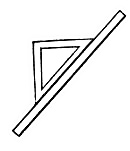

You likewise requested for the use of your school, an explanation of a method of platting the courses of a survey, which I mentioned to you as of my own practice. This is so obvious and simple, that as it occurred to myself, so I presume it has to others, although I have not seen it stated in any of the books. For drawing parallel lines, I use the triangular rule, the hypothenusal side of which being applied to the side of a common straight rule, the triangle slides on that, as thus, always parallel to itself. Instead of drawing meridians on his paper, let the pupil draw a parallel of latitude, or east and west line, and note in that a point for his first station, then applying to it his protractor, lay off the first course and distance in the usual way to ascertain his second station. For the second course, lay the triangular rule to the east and west line, or first parallel, holding the straight or guide rule firmly against its hypothenusal side. Then slide up the triangle (for a northerly course) to the point of his second station, and pressing it firmly there, lay the protractor to that, and mark off the second course, and distance as before, for the third station. Then lay the triangle to the first parallel again, and sliding it as before to the point of the third station, there apply to it the protractor for the third course and distance, which gives the fourth station; and so on. Where a course is southwardly, lay the protractor, as before, to the northern edge of the triangle, but prick its reversed course, which reversed again in drawing, gives the true course. When the station has got so far from the first parallel, as to be out of the reach of the parallel rule sliding on its hypothenuse, another parallel must be drawn by laying the edge, or longer leg of the triangle to the first parallel as before, applying the guide-rule to the end, or short leg, (instead of the hypothenuse,) as in the margin, and sliding the triangle up to the point for the new parallel. I have found this, in practice, the quickest and most correct method of platting which I have ever tried, and the neatest also, because it disfigures the paper with the fewest unnecessary lines.
If these mathematical trifles can give any facilities to your pupils, they may in their hands become matters of use, as in mine they have been of amusement only.
Ever and respectfully yours.
TO M. DUFIEF.
Monticello, April 19, 1814.
Dear Sir,—Your favor of the 6th instant is just received, and I shall with equal willingness and truth, state the degree of agency you had, respecting the copy of M. de Becourt's book, which came to my hands. That gentleman informed me, by letter, that he was about to publish a volume in French, "Sur la Création du Monde, un Systême d'Organisation Primitive," which, its title promised to be, either a geological or astronomical work. I subscribed; and, when published, he sent me a copy; and as you were my correspondent in the book line in Philadelphia, I took the liberty of desiring him to call on you for the price, which, he afterwards informed me, you were so kind as to pay him for me, being, I believe, two dollars. But the sole copy which came to me was from himself directly, and, as far as I know, was never seen by you.
I am really mortified to be told that, in the United States of America, a fact like this can become a subject of inquiry, and of criminal inquiry too, as an offence against religion; that a question about the sale of a book can be carried before the civil magistrate. Is this then our freedom of religion? and are we to have a censor whose imprimatur shall say what books may be sold, and what we may buy? And who is thus to dogmatize religious opinions for our citizens? Whose foot is to be the measure to which ours are all to be cut or stretched? Is a priest to be our inquisitor, or shall a layman, simple as ourselves, set up his reason as the rule for what we are to read, and what we must believe? It is an insult to our citizens to question whether they are rational beings or not, and blasphemy against religion to suppose it cannot stand the test of truth and reason. If M. de Becourt's book be false in its facts, disprove them; if false in its reasoning, refute it. But, for God's sake, let us freely hear both sides, if we choose. I know little of its contents, having barely glanced over here and there a passage, and over the table of contents. From this, the Newtonian philosophy seemed the chief object of attack, the issue of which might be trusted to the strength of the two combatants; Newton certainly not needing the auxiliary arm of the government, and still less the holy author of our religion, as to what in it concerns him. I thought the work would be very innocent, and one which might be confided to the reason of any man; not likely to be much read if let alone, but, if persecuted, it will be generally read. Every man in the United States will think it a duty to buy a copy, in vindication of his right to buy, and to read what he pleases. I have been just reading the new constitution of Spain. One of its fundamental basis is expressed in these words: "The Roman Catholic religion, the only true one, is, and always shall be, that of the Spanish nation. The government protects it by wise and just laws, and prohibits the exercise of any other whatever." Now I wish this presented to those who question what you may sell, or we may buy, with a request to strike out the words, "Roman Catholic," and to insert the denomination of their own religion. This would ascertain the code of dogmas which each wishes should domineer over the opinions of all others, and be taken, like the Spanish religion, under the "protection of wise and just laws." It would shew to what they wish to reduce the liberty for which one generation has sacrificed life and happiness. It would present our boasted freedom of religion as a thing of theory only, and not of practice, as what would be a poor exchange for the theoretic thraldom, but practical freedom of Europe. But it is impossible that the laws of Pennsylvania, which set us the first example of the wholesome and happy effects of religious freedom, can permit the inquisitorial functions to be proposed to their courts. Under them you are surely safe.
At the date of yours of the 6th, you had not received mine of the 3d inst., asking a copy of an edition of Newton's Principia, which I had seen advertised. When the cost of that shall be known, it shall be added to the balance of $4.93, and incorporated with a larger remittance I have to make to Philadelphia. Accept the assurance of my great esteem and respect.
TO LE CHEVALIER DE ONIS.
Monticello, April 28, 1814.
I thank you, Sir, for the copy of the new constitution of Spain which you have been so kind as to send me; and I sincerely congratulate yourself and the Spanish nation on this great stride towards political happiness. The invasion of Spain has been the most unprecedented and unprincipled of the transactions of modern times. The crimes of its enemies, the licentiousness of its associates in defence, the exertions and sufferings of its inhabitants under slaughter and famine, and its consequent depopulation, will mark indelibly the baneful ascendancy of the tyrants of the sea and continent, and characterize with blood and wretchedness the age in which they have lived. Yet these sufferings of Spain will be remunerated, her population restored and increased, under the auspices and protection of this new constitution; and the miseries of the present generation will be the price, and even the cheap price of the prosperity of endless generations to come.
There are parts of this constitution, however, in which you would expect of course that we should not concur. One of these is the intolerance of all but the Catholic religion; and no security provided against the re-establishment of an Inquisition, the exclusive judge of Catholic opinions, and authorized to proscribe and punish those it shall deem anti-Catholic. Secondly, the aristocracy, quater sublimata, of her legislators; for the ultimate electors of these will themselves have been three times sifted from the mass of the people, and may choose from the nation at large persons never named by any of the electoral bodies. But there is one provision which will immortalize its inventors. It is that which, after a certain epoch, disfranchises every citizen who cannot read and write. This is new, and is the fruitful germ of the improvement of everything good, and the correction of everything imperfect in the present constitution. This will give you an enlightened people, and an energetic public opinion which will control and enchain the aristocratic spirit of the government. On the whole I hail your country as now likely to resume and surpass its ancient splendor among nations. This might perhaps have been better secured by a just confidence in the self-sufficient strength of the peninsula itself; everything without its limits being its weakness not its force. If the mother country has not the magnanimity to part with the colonies in friendship, thereby making them, what they would certainly be, her natural and firmest allies, these will emancipate themselves, after exhausting her strength and resources in ineffectual efforts to hold them in subjection. They will be rendered enemies of the mother country, as England has rendered us by an unremitting course of insulting injuries and silly provocations. I do not say this from the impulse of national interest, for I do not know that the United States would find an interest in the independence of neighbor nations, whose produce and commerce would rivalize ours. It could only be that kind of interest which every human being has in the happiness and prosperity of every other. But putting right and reason out of the question, I have no doubt that on calculations of interest alone, it is that of Spain to anticipate voluntarily, and as a matter of grace, the independence of her colonies, which otherwise necessity will enforce.
* * * * * * * *
TO MR. DELAPLAINE.
Monticello, May 3, 1814.
Sir,—Your favors of April 16 and 19, on the subject of the portraits of Columbus and Americus Vespucius were received on the 30th. While I resided at Paris, knowing that these portraits and those of some other of the early American worthies were in the gallery of Medicis at Florence, I took measures for engaging a good artist to take and send me copies of them. I considered it as even of some public concern that our country should not be without the portraits of its first discoverers. These copies have already run the risks of transportations from Florence to Paris, to Philadelphia, to Washington, and lastly to this place, where they are at length safely deposited. You request me "to forward them to you at Philadelphia for the purpose of having engravings taken from them for a work you propose to publish, and you pledge your honor that they shall be restored to me in perfect safety." I have no doubt of the sincerity of your intentions in this pledge; and that it would be complied with as far as it would be in your power. But the injuries and accidents of their transportation to Philadelphia and back again are not within your control. Besides the rubbing through a land carriage of six hundred miles, a carriage may overset in a river or creek, or be crashed with everything in it. The frequency of such accidents to the stages renders all insurance against them impossible. And were they to escape the perils of this journey I should be liable to the same calls, and they to the same or greater hazards from all those in other parts of the continent who should propose to publish any work in which they might wish to employ engravings of the same characters. From public, therefore, as well as private considerations, I think that these portraits ought not to be hazarded from their present deposit. Like public records, I make them free to be copied, but, being as originals in this country, they should not be exposed to the accidents or injuries of travelling post. While I regret, therefore, the necessity of declining to comply with your request, I freely and with pleasure offer to receive as a guest any artist whom you shall think proper to engage, and will make them welcome to take copies at their leisure for your use. I wish them to be multiplied for safe preservation, and consider them as worthy a place in every collection. Indeed I do not know how it happened that Mr. Peale did not think of copying them while they were in Philadelphia; and I think it not impossible that either the father or the son might now undertake the journey for the use of their museum. On the ground of our personal esteem for them, they would be at home in my family.
When I received these portraits at Paris, Mr. Daniel Parker of Massachusetts happened to be there, and determined to procure for himself copies from the same originals at Florence; and I think he did obtain them, and that I have heard of their being in the hands of some one in Boston. If so, it might perhaps be easier to get some artist there to take and send you copies. But be this as it may, you are perfectly welcome to the benefit of mine in the way I have mentioned.
The two original portraits of myself taken by Mr. Stewart, after which you enquire, are both in his possession at Boston. One of them only is my property. The President has a copy from that which Stewart considered as the best of the two; but I believe it is at his seat in his State.
I thank you for the print of Dr. Rush. He was one of my early and intimate friends, and among the best of men. The engraving is excellent as is everything from the hand of Mr. Edwin. Accept the assurance of my respect, and good wishes for the success of your work.
TO MR. JOHN F. WATSON.
Monticello, May 17, 1814.
Sir,—I have long been a subscriber to the edition of the Edinburgh Review first published by Mr. Sargeant, and latterly by Eastburn, Kirk & Co., and already possess from No. 30 to 42 inclusive; except that Nos. 31 and 37 never came to hand. These two and No. 29, I should be glad to receive, with all subsequently published, through the channel of Messrs. Fitzwhylson & Potter of Richmond, with whom I originally subscribed, and to whom it is more convenient to make payment by a standing order on my correspondent at Richmond. I willingly also subscribe for the republication of the first twenty-eight numbers to be furnished me through the same channel, for the convenience of payment. This work is certainly unrivalled in merit, and if continued by the same talents, information and principles which distinguish it in every department of science which it reviews, it will become a real Encyclopedia, justly taking its station in our libraries with the most valuable depositories of human knowledge. Of the Quarterly Review I have not seen many numbers. As the antagonist of the other it appears to me a pigmy against a giant. The precept "audi alteram partem," on which it is republished here, should be sacred with the judge who is to decide between the contending claims of individual and individual. It is well enough for the young who have yet opinions to make up in questions of principle in ethics or politics. But to those who have gone through this process with industry, reflection, and singleness of heart, who have formed their conclusions and acted on them through life, to be reading over and over again what they have already read, considered and condemned, is an idle waste of time. It is not in the history of modern England or among the advocates of the principles or practices of her government, that the friend of freedom, or of political morality, is to seek instruction. There has indeed been a period, during which both were to be found, not in her government, but in the band of worthies who so boldly and ably reclaimed the rights of the people, and wrested from their government theoretic acknowledgments of them. This period began with the Stuarts, and continued but one reign after them. Since that, the vital principle of the English constitution is corruption, its practices the natural results of that principle, and their consequences a pampered aristocracy, annihilation of the substantial middle class, a degraded populace, oppressive taxes, general pauperism, and national bankruptcy. Those who long for these blessings here will find their generating principles well developed and advocated by the antagonist of the Edinburgh Review. Still those who doubt should read them; every man's reason being his own rightful umpire. This principle, with that of acquiescence in the will of the majority will preserve us free and prosperous as long as they are sacredly observed. Accept the assurances of my respect.
TO MR. ABRAHAM SMALL.
Monticello, May 20, 1814.
Sir,—I thank you for the copy of the American Speaker which you have been so kind as to send me. It is a judicious selection of what has been excellently spoken on both sides of the Atlantic; and according to your request, I willingly add some suggestions, should another edition be called for. To the speeches of Lord Chatham might be added his reply to Horace Walpole, on the Seamen's bill, in the House of Commons, in 1740, one of the severest which history has recorded. Indeed, the subsequent speeches in order, to which that reply gave rise being few, short and pithy, well merit insertion in such a collection as this. They are in the twelfth volume of Chandler's Debates of the House of Commons. But the finest thing, in my opinion, which the English language has produced, is the defence of Eugene Aram, spoken by himself at the bar of the York assizes, in 1759, on a charge of murder, and to be found in the Annual Register of that date, or a little after. It had been upwards of fifty years since I had read it, when the receipt of your letter induced me to look up a MS. copy I had preserved, and on re-perusal at this age and distance of time, it loses nothing of its high station in my mind for classical style, close logic, and strong representation. I send you this copy which was taken for me by a school-boy, replete with errors of punctuation, of orthography, and sometimes substitutions of one word for another. It would be better to recur to the Annual Register itself for correctness, where also I think are stated the circumstances and issue of the case. To these I would add the short, the nervous, the unanswerable speech of Carnot, in 1803, on the proposition to declare Bonaparte consul for life. This creed of republicanism should be well translated, and placed in the hands and heart of every friend to the rights of self-government. I consider these speeches of Aram and Carnot, and that of Logan, inserted in your collection, as worthily standing in a line with those of Scipio and Hannibal in Livy, and of Cato and Cæsar in Sallust. On examining the Indian speeches in my possession, I find none which are not already in your collection, except that my copy of the corn-planter's has much in it which yours has not. But observing that the omissions relate to special subjects only, I presume they are made purposely and indeed properly.
I must add more particular thanks for the kind expressions of your letter towards myself. These testimonies of approbation from my fellow-citizens, offered too when the lapse of time may have cooled and matured their opinions, are an ample reward for such services as I have been able to render them, and are peculiarly gratifying in a state of retirement and reflection. I pray you to accept the assurance of my respect.
TO THOMAS LAW, ESQ.
Poplar Forest, June 13, 1814.
Dear Sir,—The copy of your Second Thoughts on Instinctive Impulses, with the letter accompanying it, was received just as I was setting out on a journey to this place, two or three days' distant from Monticello. I brought it with me and read it with great satisfaction, and with the more as it contained exactly my own creed on the foundation of morality in man. It is really curious that on a question so fundamental, such a variety of opinions should have prevailed among men, and those, too, of the most exemplary virtue and first order of understanding. It shows how necessary was the care of the Creator in making the moral principle so much a part of our constitution as that no errors of reasoning or of speculation might lead us astray from its observance in practice. Of all the theories on this question, the most whimsical seems to have been that of Wollaston, who considers truth as the foundation of morality. The thief who steals your guinea does wrong only inasmuch as he acts a lie in using your guinea as if it were his own. Truth is certainly a branch of morality, and a very important one to society. But presented as its foundation, it is as if a tree taken up by the roots, had its stem reversed in the air, and one of its branches planted in the ground. Some have made the love of God the foundation of morality. This, too, is but a branch of our moral duties, which are generally divided into duties to God and duties to man. If we did a good act merely from the love of God and a belief that it is pleasing to Him, whence arises the morality of the Atheist? It is idle to say, as some do, that no such being exists. We have the same evidence of the fact as of most of those we act on, to-wit: their own affirmations, and their reasonings in support of them. I have observed, indeed, generally, that while in protestant countries the defections from the Platonic Christianity of the priests is to Deism, in catholic countries they are to Atheism. Diderot, D'Alembert, D'Holbach, Condorcet, are known to have been among the most virtuous of men. Their virtue, then, must have had some other foundation than the love of God.
The Το καλον of others is founded in a different faculty, that of taste, which is not even a branch of morality. We have indeed an innate sense of what we call beautiful, but that is exercised chiefly on subjects addressed to the fancy, whether through the eye in visible forms, as landscape, animal figure, dress, drapery, architecture, the composition of colors, &c., or to the imagination directly, as imagery, style, or measure in prose or poetry, or whatever else constitutes the domain of criticism or taste, a faculty entirely distinct from the moral one. Self-interest, or rather self-love, or egoism, has been more plausibly substituted as the basis of morality. But I consider our relations with others as constituting the boundaries of morality. With ourselves we stand on the ground of identity, not of relation, which last, requiring two subjects, excludes self-love confined to a single one. To ourselves, in strict language, we can owe no duties, obligation requiring also two parties. Self-love, therefore, is no part of morality. Indeed it is exactly its counterpart. It is the sole antagonist of virtue, leading us constantly by our propensities to self-gratification in violation of our moral duties to others. Accordingly, it is against this enemy that are erected the batteries of moralists and religionists, as the only obstacle to the practice of morality. Take from man his selfish propensities, and he can have nothing to seduce him from the practice of virtue. Or subdue those propensities by education, instruction or restraint, and virtue remains without a competitor. Egoism, in a broader sense, has been thus presented as the source of moral action. It has been said that we feed the hungry, clothe the naked, bind up the wounds of the man beaten by thieves, pour oil and wine into them, set him on our own beast and bring him to the inn, because we receive ourselves pleasure from these acts. So Helvetius, one of the best men on earth, and the most ingenious advocate of this principle, after defining "interest" to mean not merely that which is pecuniary, but whatever may procure us pleasure or withdraw us from pain, [de l'esprit 2, 1,] says, [ib. 2, 2,] "the humane man is he to whom the sight of misfortune is insupportable, and who to rescue himself from this spectacle, is forced to succor the unfortunate object." This indeed is true. But it is one step short of the ultimate question. These good acts give us pleasure, but how happens it that they give us pleasure? Because nature hath implanted in our breasts a love of others, a sense of duty to them, a moral instinct, in short, which prompts us irresistibly to feel and to succor their distresses, and protests against the language of Helvetius, [ib. 2, 5,] "what other motive than self-interest could determine a man to generous actions? It is as impossible for him to love what is good for the sake of good, as to love evil for the sake of evil." The Creator would indeed have been a bungling artist, had he intended man for a social animal, without planting in him social dispositions. It is true they are not planted in every man, because there is no rule without exceptions; but it is false reasoning which converts exceptions into the general rule. Some men are born without the organs of sight, or of hearing, or without hands. Yet it would be wrong to say that man is born without these faculties, and sight, hearing, and hands may with truth enter into the general definition of man. The want or imperfection of the moral sense in some men, like the want or imperfection of the senses of sight and hearing in others, is no proof that it is a general characteristic of the species. When it is wanting, we endeavor to supply the defect by education, by appeals to reason and calculation, by presenting to the being so unhappily conformed, other motives to do good and to eschew evil, such as the love, or the hatred, or rejection of those among whom he lives, and whose society is necessary to his happiness and even existence; demonstrations by sound calculation that honesty promotes interest in the long run; the rewards and penalties established by the laws; and ultimately the prospects of a future state of retribution for the evil as well as the good done while here. These are the correctives which are supplied by education, and which exercise the functions of the moralist, the preacher, and legislator; and they lead into a course of correct action all those whose disparity is not too profound to be eradicated. Some have argued against the existence of a moral sense, by saying that if nature had given us such a sense, impelling us to virtuous actions, and warning us against those which are vicious, then nature would also have designated, by some particular ear-marks, the two sets of actions which are, in themselves, the one virtuous and the other vicious. Whereas, we find, in fact, that the same actions are deemed virtuous in one country and vicious in another. The answer is that nature has constituted utility to man the standard and best of virtue. Men living in different countries, under different circumstances, different habits and regimens, may have different utilities; the same act, therefore, may be useful, and consequently virtuous in one country which is injurious and vicious in another differently circumstanced. I sincerely, then, believe with you in the general existence of a moral instinct. I think it the brightest gem with which the human character is studded, and the want of it as more degrading than the most hideous of the bodily deformities. I am happy in reviewing the roll of associates in this principle which you present in your second letter, some of which I had not before met with. To these might be added Lord Kaims, one of the ablest of our advocates, who goes so far as to say, in his Principles of Natural Religion, that a man owes no duty to which he is not urged by some impulsive feeling. This is correct, if referred to the standard of general feeling in the given case, and not to the feeling of a single individual. Perhaps I may misquote him, it being fifty years since I read his book.
The leisure and solitude of my situation here has led me to the indiscretion of taxing you with a long letter on a subject whereon nothing new can be offered you. I will indulge myself no farther than to repeat the assurances of my continued esteem and respect.
TO JOHN ADAMS.
Monticello, July 5, 1814.
Dear Sir,—Since mine of January the 24th, yours of March the 14th has been received. It was not acknowledged in the short one of May the 18th, by Mr. Rives, the only object of that having been to enable one of our most promising young men to have the advantage of making his bow to you. I learned with great regret the serious illness mentioned in your letter; and I hope Mr. Rives will be able to tell me you are entirely restored. But our machines have now been running seventy or eighty years, and we must expect that, worn as they are, here a pivot, there a wheel, now a pinion, next a spring, will be giving way; and however we may tinker them up for awhile, all will at length surcease motion. Our watches, with works of brass and steel, wear out within that period. Shall you and I last to see the course the seven-fold wonders of the times will take? The Attila of the age dethroned, the ruthless destroyer of ten millions of the human race, whose thirst for blood appeared unquenchable, the great oppressor of the rights and liberties of the world, shut up within the circle of a little island of the Mediterranean, and dwindled to the condition of an humble and degraded pensioner on the bounty of those he had most injured. How miserably, how meanly, has he closed his inflated career! What a sample of the bathos will his history present! He should have perished on the swords of his enemies, under the walls of Paris.
"Leon piagato a morte Sente mancar la vita, Guarda la sua ferita, Ne s'avilisce ancor. Cosi fra l'ire estrema Rugge, minaccia, e freme, Che fa tremar morendo Tal volta il cacciator."—Metast. Adriano.
But Bonaparte was a lion in the field only. In civil life, a cold-blooded, calculating, unprincipled usurper, without a virtue; no statesman, knowing nothing of commerce, political economy, or civil government, and supplying ignorance by bold presumption. I had supposed him a great man until his entrance into the Assembly des cinq cens, eighteen Brumaire (an. 8.) From that date, however, I set him down as a great scoundrel only. To the wonders of his rise and fall, we may add that of a Czar of Muscovy, dictating, in Paris, laws and limits to all the successors of the Cæsars, and holding even the balance in which the fortunes of this new world are suspended. I own, that while I rejoice, for the good of mankind, in the deliverance of Europe from the havoc which would never have ceased while Bonaparte should have lived in power, I see with anxiety the tyrant of the ocean remaining in vigor, and even participating in the merit of crushing his brother tyrant. While the world is thus turned up side down, on which of its sides are we? All the strong reasons, indeed, place us on the side of peace; the interests of the continent, their friendly dispositions, and even the interests of England. Her passions alone are opposed to it. Peace would seem now to be an easy work, the causes of the war being removed. Her orders of council will no doubt be taken care of by the allied powers, and, war ceasing, her impressment of our seamen ceases of course. But I fear there is foundation for the design intimated in the public papers, of demanding a cession of our right in the fisheries. What will Massachusetts say to this? I mean her majority, which must be considered as speaking through the organs it has appointed itself, as the index of its will. She chooses to sacrifice the liberties of our seafaring citizens, in which we were all interested, and with them her obligations to the co-States, rather than war with England. Will she now sacrifice the fisheries to the same partialities? This question is interesting to her alone; for to the middle, the southern and western States, they are of no direct concern; of no more than the culture of tobacco, rice and cotton, to Massachusetts. I am really at a loss to conjecture what our refractory sister will say on this occasion. I know what, as a citizen of the Union, I would say to her. "Take this question ad referendum. It concerns you alone. If you would rather give up the fisheries than war with England, we give them up. If you had rather fight for them, we will defend your interests to the last drop of our blood, choosing rather to set a good example than follow a bad one." And I hope she will determine to fight for them. With this, however, you and I shall have nothing to do; ours being truly the case wherein "non tali auxilio, nec defensoribus istis tempus eget." Quitting this subject, therefore I will turn over another leaf.
I am just returned from one of my long absences, having been at my other home for five weeks past. Having more leisure there than here for reading, I amused myself with reading seriously Plato's Republic. I am wrong, however, in calling it amusement, for it was the heaviest task-work I ever went through. I had occasionally before taken up some of his other works, but scarcely ever had patience to go through a whole dialogue. While wading through the whimsies, the puerilities, and unintelligible jargon of this work, I laid it down often to ask myself how it could have been, that the world should have so long consented to give reputation to such nonsense as this? How the soi-disant Christian world, indeed, should have done it, is a piece of historical curiosity. But how could the Roman good sense do it? And particularly, how could Cicero bestow such eulogies on Plato? Although Cicero did not wield the dense logic of Demosthenes, yet he was able, learned, laborious, practised in the business of the world, and honest. He could not be the dupe of mere style, of which he was himself the first master in the world. With the moderns, I think, it is rather a matter of fashion and authority. Education is chiefly in the hands of persons who, from their profession, have an interest in the reputation and the dreams of Plato. They give the tone while at school, and few in their after years have occasion to revise their college opinions. But fashion and authority apart, and bringing Plato to the test of reason, take from him his sophisms, futilities and incomprehensibilities, and what remains? In truth, he is one of the race of genuine sophists, who has escaped the oblivion of his brethren, first, by the elegance of his diction, but chiefly, by the adoption and incorporation of his whimsies into the body of artificial Christianity. His foggy mind is forever presenting the semblances of objects which, half seen through a mist, can be defined neither in form nor dimensions. Yet this, which should have consigned him to early oblivion, really procured him immortality of fame and reverence. The Christian priesthood, finding the doctrines of Christ levelled to every understanding, and too plain to need explanation, saw in the mysticism of Plato materials with which they might build up an artificial system, which might, from its indistinctness, admit everlasting controversy, give employment for their order, and introduce it to profit, power and pre-eminence. The doctrines which flowed from the lips of Jesus himself are within the comprehension of a child; but thousands of volumes have not yet explained the Platonisms engrafted on them; and for this obvious reason, that nonsense can never be explained. Their purposes, however, are answered. Plato is canonized; and it is now deemed as impious to question his merits as those of an Apostle of Jesus. He is peculiarly appealed to as an advocate of the immortality of the soul; and yet I will venture to say, that were there no better arguments than his in proof of it, not a man in the world would believe it. It is fortunate for us, that Platonic republicanism has not obtained the same favor as Platonic Christianity; or we should now have been all living, men, women and children, pell mell together, like beasts of the field or forest. Yet "Plato is a great philosopher," said La Fontaine. But, says Fontenelle, "do you find his ideas very clear?" "Oh no! he is of an obscurity impenetrable." "Do you not find him full of contradictions?" "Certainly," replied La Fontaine, "he is but a sophist." Yet immediately after, he exclaims again, "Oh, Plato was a great philosopher." Socrates had reason, indeed, to complain of the misrepresentations of Plato; for in truth, his dialogues are libels on Socrates.
But why am I dosing you with these antediluvian topics? Because I am glad to have some one to whom they are familiar, and who will not receive them as if dropped from the moon. Our post-revolutionary youth are born under happier stars than you and I were. They acquire all learning in their mother's womb, and bring it into the world ready made. The information of books is no longer necessary; and all knowledge which is not innate, is in contempt, or neglect at least. Every folly must run its round; and so, I suppose, must that of self-learning and self-sufficiency; of rejecting the knowledge acquired in past ages, and starting on the new ground of intuition. When sobered by experience, I hope our successors will turn their attention to the advantages of education. I mean of education on the broad scale, and not that of the petty academies, as they call themselves, which are starting up in every neighborhood, and where one or two men, possessing Latin and sometimes Greek, a knowledge of the globes, and the first six books of Euclid, imagine and communicate this as the sum of science. They commit their pupils to the theatre of the world, with just taste enough of learning to be alienated from industrious pursuits, and not enough to do service in the ranks of science. We have some exceptions, indeed. I presented one to you lately, and we have some others. But the terms I use are general truths. I hope the necessity will, at length, be seen of establishing institutions here, as in Europe, where every branch of science, useful at this day, may be taught in its highest degree. Have you ever turned your thoughts to the plan of such an institution? I mean to a specification of the particular sciences of real use in human affairs, and how they might be so grouped as to require so many professors only as might bring them within the views of a just but enlightened economy? I should be happy in a communication of your ideas on this problem, either loose or digested. But to avoid my being run away with by another subject, and adding to the length and ennui of the present letter, I will here present to Mrs. Adams and yourself, the assurance of my constant and sincere friendship and respect.