Volume 6 / Part 3 — PART III.—Continued. LETTERS WRITTEN AFTER HIS RETURN TO THE U. S. DOWN TO THE TIME OF HIS DEATH. 1790-1826. (continued 12)
Reading edition
JOHN ADAMS TO THOMAS JEFFERSON.
Quincy, August 24, 1815.
Dear Sir,—If I am neither deceived by the little information I have, or by my wishes for its truth, I should say that France is the most Protestant country of Europe at this time, though I cannot think it the most reformed. In consequence of these reveries, I have imagined that Camus and the Institute, meant, by the revival and continuance of the Acta Sanctorum, to destroy the Pope, and the Catholic church and Hierarchies, de fonde en comble, or in the language of Frederick Pollair, D'Alembert, &c., "ecraser le miserable"—"Crush the wretch." This great work must contain the most complete history of the corruptions of Christianity that has ever appeared, Priestley's not excepted and his history of ancient opinions not excepted.
As to the History of the Revolution, my ideas may be peculiar, perhaps singular. What do we mean by the Revolution? The war? That was no part of the Revolution. It was only an effect, and consequence of it. The revolution was in the minds of the people, and this was effected, from 1760 to 1775, in the course of fifteen years, before a drop of blood was drawn at Lexington. The records of thirteen Legislatures, the pamphlets, newspapers, in all the colonies ought to be consulted, during that period, to ascertain the steps by which the public opinion was enlightened and informed, concerning the authority of Parliament over the colonies. The Congress of 1774 resembled in some respects, though I hope not in many, the council of Nice in ecclesiastical history. It assembled the Priests from the east and the west, the north and the south, who compared notes, engaged in discussions and debates, and formed results by one vote, and by two votes, which went out to the world as unanimous.
Mr. Madison's Notes of the Convention of 1787 or 1788 are consistent with his indefatigable character. I shall never see them, but I hope posterity will.
That our correspondence has been observed is no wonder; for your hand is more universally known than your face. No printer has asked me for copies; but it is no surprise that you have been requested. These gentry will print whatever will sell; and our correspondence is thought such an oddity by both parties, that the printers imagine an edition would soon go off, and yield them a profit. There has, however, been no tampering with your letters to me. They have all arrived in good order.
Poor Bonaparte! Poor Devil! What has, and what will become of him? Going the way of King Theodore, Alexander, Cæsar, Charles XIIth, Cromwell, Wat Tyler, and Jack Cade, i.e., to a bad end. And what will become of Wellington? Envied, hated, despised, by all the barons, earls, viscounts, marquises, as an upstart, a parvenue elevated over their heads. For these people have no idea of any merit, but birth. Wellington must pass the rest of his days buffeted, ridiculed, scorned and insulted by factions, as Marlborough and his Duchess did. Military glory dazzles the eyes of mankind, and for a time eclipses all wisdom and virtue, all laws, human and divine; and after this it would be bathos to descend to services merely civil or political.
Napoleon has imposed kings upon Spain, Holland, Sweden, Westphalia, Saxony, Naples, &c. The combined emperors and kings are about to retaliate upon France, by imposing a king upon her. These are all abominable examples, detestable precedents. When will the rights of mankind, the liberties and independence of nations, be respected? When the perfectibility of the human mind shall arrive at perfection. When the progress of Manillius' Ratio shall have not only eripuit cœlo fulmen, Jouvisque fulgores, but made mankind rational creatures.
It remains to be seen whether the allies were honest in their declaration that they were at war only with Napoleon.
Can the French ever be cordially reconciled to the Bourbons again? If not, who can they find for a head? the infant, or one of the generals? Innumerable difficulties will embarrass either project. I am, as ever
TO JUDGE ROANE.
Monticello, October 12, 1815.
Dear Sir,—I received in a letter from Colonel Monroe the enclosed paper communicated, as he said, with your permission, and even with a wish to know my sentiments on the important question it discusses. It is now more than forty years since I have ceased to be habitually conversant with legal questions; and my pursuits through that period have seldom required or permitted a renewal of my former familiarity with them. My ideas at present, therefore, on such questions, have no claim to respect but such as might be yielded to the common auditors of a law argument.
I well knew that in certain federal cases the laws of the United States had given to a foreign party, whether plaintiff or defendant, a right to carry his cause into the federal court; but I did not know that where he had himself elected the State judicature, he could, after an unfavorable decision there, remove his case to the federal court, and thus take the benefit of two chances where others have but one; nor that the right of entertaining the question in this case had been exercised, or claimed by the federal judiciary after it had been postponed on the party's first election. His failure, too, to place on the record the particular ground which might give jurisdiction to the federal court, appears to me an additional objection of great weight. The question is of the first importance. The removal of it seems to be out of the analogies which guide the two governments on their separate tracts, and claims the solemn attention of both judicatures, and of the nation itself. I should fear to make up a final opinion on it, until I could see as able a development of the grounds of the federal claim as that which I have now read against it. I confess myself unable to foresee what those grounds would be. The paper enclosed must call them forth, and silence them too, unless they are beyond my ken. I am glad, therefore, that the claim is arrested, and made the subject of special and mature deliberation. I hope our courts will never countenance the sweeping pretensions which have been set up under the words "general defence and public welfare." These words only express the motives which induced the Convention to give to the ordinary legislature certain specified powers which they enumerate, and which they thought might be trusted to the ordinary legislature, and not to give them the unspecified also; or why any specification? They could not be so awkward in language as to mean, as we say, "all and some." And should this construction prevail, all limits to the federal government are done away. This opinion, formed on the first rise of the question, I have never seen reason to change, whether in or out of power; but, on the contrary, find it strengthened and confirmed by five and twenty years of additional reflection and experience: and any countenance given to it by any regular organ of the government, I should consider more ominous than anything which has yet occurred.
I am sensible how much these slight observations, on a question which you have so profoundly considered, need apology. They must find this in my zeal for the administration of our government according to its true spirit, federal as well as republican, and in my respect for any wish which you might be supposed to entertain for opinions of so little value. I salute you with sincere and high respect and esteem.
TO CAPT. A. PARTRIDGE OF THE CORPS OF ENGINEERS, WEST POINT, NEW YORK.
Monticello, October 12, 1815.
Sir,—I thank you for the statement of altitudes, which you have been so kind as to send me of our northern mountains. It came opportunely, as I was about making inquiries for the height of the White Mountains of New Hampshire, which have the reputation of being the highest in our maritime States, and purpose shortly to measure geometrically the height of the Peaks of Otter, which I suppose the highest from their base, of any on the east side of the Mississippi, except the White Mountains, and not far short of their height, if they are but of 4,885 feet. The method of estimating heights by the barometer, is convenient and useful, as being ready, and furnishing an approximation to truth. Of what degree of accuracy it is susceptible we know not as yet; no certain theory being established for ascertaining the density and weight of that portion of the column of atmosphere contiguous to the mountain; from the weight of which, nevertheless, we are to infer the height of the mountain. The most plausible seems to be that which supposes the mercury of barometer divided into horizontal lamina of equal thickness; and a similar column of the atmosphere into lamina of equal weights. The former divisions give a set of arithmetical, the latter of geometrical progressionals, which being the character of Logarithms and their numbers, the tables of these furnish ready computations, needing, however, the corrections which the state of the thermometer calls for. It is probable that in taking heights in the vicinity of each other in this way, there may be no considerable error, because the passage between them may be quick and repeated. The height of a mountain from its base, thus taken, merits, therefore, a very different degree of credit from that of its height above the level of the sea, where that is distant. According, for example, to the theory above mentioned, the height of Monticello from its base is 580 feet, and its base 610 feet 8 inches, above the level of the ocean; the former, from other facts, I judge to be near the truth; but a knowledge of the different falls of water from hence to the tide-water at Richmond, a distance of seventy-five miles, enables us to say that the whole descent to that place is but 170 or 180 feet. From thence to the ocean may be a distance of one hundred miles; it is all tide-water, and through a level country. I know not what to conjecture as the amount of descent, but certainly not 435 feet, as that theory would suppose, nor the quarter part of it. I do not know by what rule General Williams made his computations; he reckons the foot of the Blue Ridge, twenty miles from here, but 100 feet above the tide-water at Richmond. We know the descent, as before observed, to be at least 170 feet from hence, to which is to be added that from the Blue Ridge to this place, a very hilly country, with constant and great waterfalls. His estimate, therefore, must be much below truth. Results so different prove that for distant comparisons of height, the barometer is not to be relied on according to any theory yet known. While, therefore, we give a good degree of credit to the results of operations between the summit of a mountain and its base, we must give less to those between its summit and the level of the ocean.
I will do myself the pleasure of sending you my estimate of the Peaks of Otter, which I count on undertaking in the course of the next month. In the meantime accept the assurance of my great respect.
TO DOCTOR LOGAN.
Monticello, October 15,1815.
Dear Sir,—I thank you for the extract in yours of August 16th respecting the Emperor Alexander. It arrived here a day or two after I had left this place, from which I have been absent seven or eight weeks. I had from other information formed the most favorable opinion of the virtues of Alexander, and considered his partiality to this country as a prominent proof of them. The magnanimity of his conduct on the first capture of Paris still magnified everything we had believed of him; but how he will come out of his present trial remains to be seen. That the sufferings which France had inflicted on other countries justified severe reprisals, cannot be questioned; but I have not yet learned what crimes of Poland, Saxony, Belgium, Venice, Lombardy and Genoa, had merited for them, not merely a temporary punishment, but that of permanent subjugation and a destitution of independence and self-government. The fable of Æsop of the lion dividing the spoils, is, I fear, becoming true history, and the moral code of Napoleon and the English government a substitute for that of Grotius, of Puffendorf, and even of the pure doctrine of the great author of our own religion. We were safe ourselves from Bonaparte, because he had not the British fleets at his command. We were safe from the British fleets, because they had Bonaparte at their back; but the British fleets and the conquerors of Bonaparte being now combined, and the Hartford nation drawn off to them, we have uncommon reason to look to our own affairs. This, however, I leave to others, offering prayers to heaven, the only contribution of old age, for the safety of our country. Be so good as to present me affectionately to Mrs. Logan, and to accept yourself the assurance of my esteem and respect.
TO MR. GALLATIN.
Monticello, October 16, 1815.
Dear Sir,—A long absence from home must apologize for my so late acknowledgment of your welcome favor of September 6th. Our storm of the 4th of that month gave me great uneasiness for you; for I was certain you must be on the coast, and your actual arrival was unknown to me. It was such a wind as I have not witnessed since the year 1769. It did, however, little damage with us, only prostrating our corn, and tearing tobacco, without essential injury to either. It could have been nothing compared with that of the 23d, off the coast of New England, of which we had not a breath, but on the contrary, fine, fair weather. Is this the judgment of God between us? I congratulate you sincerely on your safe return to your own country, and without knowing your own wishes, mine are that you would never leave it again. I know you would be useful to us at Paris, and so you would anywhere; but nowhere so useful as here. We are undone, my dear Sir, if this banking mania be not suppressed. Aut Carthago, aut Roma delenda est. The war, had it proceeded, would have upset our government; and a new one, whenever tried, will do it. And so it must be while our money, the nerve of war, is much or little, real or imaginary, as our bitterest enemies choose to make it. Put down the banks, and if this country could not be carried through the longest war against her most powerful enemy, without ever knowing the want of a dollar, without dependence on the traitorous classes of her citizens, without bearing hard on the resources of the people, or loading the public with an indefinite burthen of debt, I know nothing of my countrymen. Not by any novel project, not by any charlatanerie, but by ordinary and well-experienced means; by the total prohibition of all private paper at all times, by reasonable taxes in war aided by the necessary emissions of public paper of circulating size, this bottomed on special taxes, redeemable annually as this special tax comes in, and finally within a moderate period,—even with the flood of private paper by which we were deluged, would the treasury have ventured its credit in bills of circulating size, as of five or ten dollars, &c., they would have been greedily received by the people in preference to bank paper. But unhappily the towns of America were considered as the nation of America, the dispositions of the inhabitants of the former as those of the latter, and the treasury, for want of confidence in the country, delivered itself bound hand and foot to bold and bankrupt adventurers and pretenders to be money-holders, whom it could have crushed at any moment. Even the last half-bold half-timid threat of the treasury, showed at once that these jugglers were at the feet of government. For it never was, and is not, any confidence in their frothy bubbles, but the want of all other medium, which induced, or now induces, the country people to take their paper; and at this moment, when nothing else is to be had, no man will receive it but to pass it away instantly, none for distant purposes. We are now without any common measure of the value of property, and private fortunes are up or down at the will of the worst of our citizens. Yet there is no hope of relief from the legislatures who have immediate control over this subject. As little seems to be known of the principles of political economy as if nothing had ever been written or practised on the subject, or as was known in old times, when the Jews had their rulers under the hammer. It is an evil, therefore, which we must make up our minds to meet and to endure as those of hurricanes, earthquakes and other casualties: let us turn over therefore another leaf.
I grieve for France; although it cannot be denied that by the afflictions with which she wantonly and wickedly overwhelmed other nations, she has merited severe reprisals. For it is no excuse to lay the enormities to the wretch who led to them, and who has been the author of more misery and suffering to the world, than any being who ever lived before him. After destroying the liberties of his country, he has exhausted all its resources, physical and moral, to indulge his own maniac ambition, his own tyrannical and overbearing spirit. His sufferings cannot be too great. But theirs I sincerely deplore, and what is to be their term? The will of the allies? There is no more moderation, forbearance, or even honesty in theirs, than in that of Bonaparte. They have proved that their object, like his, is plunder. They, like him, are shuffling nations together, or into their own hands, as if all were right which they feel a power to do. In the exhausted state in which Bonaparte has left France, I see no period to her sufferings, until this combination of robbers fall together by the ears. The French may then rise up and choose their side. And I trust they will finally establish for themselves a government of rational and well-tempered liberty. So much science cannot be lost; so much light shed over them can never fail to produce to them some good, in the end. Till then we may ourselves fervently pray, with the liturgy a little parodied, "Give peace till that time, oh Lord, because there is none other that will fight for us but only thee, oh God." It is rare that I indulge in these poetical effusions; but your former and latter relations with both subjects have associated you with them in my mind, and led me beyond the limits of attention I ordinarily give to them. Whether you go or stay with us, you have always the prayers of yours affectionately.
P. S. The two letters you enclosed me were from Warden and De Lormerie, and neither from La Fayette, as you supposed.
JOHN ADAMS TO THOMAS JEFFERSON.
Quincy, November 13, 1815.
Dear Sir,—The fundamental article of my political creed is, that despotism, or unlimited sovereignty, or absolute power, is the same in a majority of a popular assembly, an aristocratical council, an oligarchical junto, and a single emperor; equally arbitrary, cruel, bloody, and in every respect diabolical.
Accordingly, arbitrary power, wherever it has resided, ha never failed to destroy all the records, memorials, and histories of former times which it did not like, and to corrupt and interpolate such as it was cunning enough to preserve or tolerate. We cannot therefore say with much confidence, what knowledge or what virtues may have prevailed in some former ages in some quarters of the world.
Nevertheless, according to the few lights that remain to us, we may say that the eighteenth century, notwithstanding all its errors and vices, has been, of all that are past, the most honorable to human nature. Knowledge and virtues were increased and diffused. Arts, sciences useful to men, ameliorating their condition, were improved more than in any former equal period.
But what are we to say now? Is the nineteenth century to be a contrast to the eighteenth? Is it to extinguish all the lights of its predecessors? Are the Sorbonne, the Inquisition, the Index Expurgatorius, and the knights-errant of St. Ignatius Loyola to be revived and restored to all their salutary powers of supporting and propagating the mild spirit of Christianity? The proceedings of the allies and their Congress at Vienna, the accounts from Spain, France, &c., the Chateaubriands and the Genti's, indicate which way the wind blows. The priests are at their old work again. The Protestants are denounced, and another St. Bartholomew's day threatened.
This, however, will probably, twenty-five years hence, be honored with the character of "The effusions of a splenetic mind, rather than as the sober reflections of an unbiased understanding." I have received Memoirs of the Life of Dr. Price, by William Morgan, F.R.S. In pages 151 and 155 Mr. Morgan says: "So well assured was Dr. Price of the establishment of a free constitution in France, and of the subsequent overthrow of despotism throughout Europe, as the consequence of it, that he never failed to express his gratitude to heaven for having extended his life to the present happy period, in which after sharing the benefits of one revolution, he has been spared to be a witness to two other revolutions, both glorious." But some of his correspondents were not quite so sanguine in their expectations from the last of the revolutions; and among these, the late American Ambassador, Mr. John Adams. In a long letter which he wrote to Dr. Price at this time, so far from congratulating him on the occasion, he expresses himself in terms of contempt, in regard to the French revolution; and after asking rather too severely what good was to be expected from a nation of Atheists, he concluded with foretelling the destruction of a million of human beings as the probable consequence of it. These harsh censures and gloomy predictions were particularly ungrateful to Dr. Price, nor can it be denied that they must have then appeared as the effusions of a splenetic mind, rather than as the sober reflections of an unbiased understanding.
I know not what a candid public will think of this practice of Mr. Morgan, after the example of Mr. Belsham, who, finding private letters in the Cabinet of a great and good man, after his decease, written in the utmost freedom and confidence of intimate friendship, by persons still living, though after the lapse of a quarter of a century, produces them before the world.
Dr. Disney had different feelings and a different judgment. Finding some cursory letters among the papers of Mr. Hollis, he would not publish them without my consent. In answer to his request, I submitted them to his discretion, and might have done the same to Mr. Morgan; indeed, had Mr. Morgan published my letter entire, I should not have given him nor myself any concern about it. But as in his summary he has not done the latter justice, I shall give it with all its faults.
Mr. Morgan has been more discreet and complaisant to you than to me. He has mentioned respectfully your letters from Paris to Dr. Price, but has given us none of them. As I would give more for these letters than for all the rest of the book, I am more angry with him for disappointing me, than for all he says of me and my letter, which, scambling as it is, contains nothing but the sure words of prophecy. I am, as usual, yours
TO MR. WM. BENTLEY.
Monticello, December 28, 1815.
Dear Sir,—At the date of your letter of October 30th, I had just left home on a journey from which I am recently returned. I had many years ago understood that Professor Ebeling was engaged in a geographical work which would comprehend the United States, and indeed I expected it was finished and published. I am glad to learn that his candor and discrimination have been sufficient to guard him against trusting the libel of Dr. Morse on this State. I wish it were in my power to give him the aid you ask, but it is not. The whole forenoon with me is engrossed by correspondence too extensive and laborious for my age. Health, habit, and necessary attention to my farms, require me then to be on horseback until a late dinner, and the society of my family and friends, with some reading, furnish the necessary relaxations of the rest of the day. Add to this that the cession of my library to Congress has left me without materials for such an undertaking. I wish the part of his work which gives the geography of this country may be translated and published, that ourselves and the world may at length have something like a dispassionate account of these States. Poor human nature! when we are obliged to appeal for the truth of mere facts from an eye-witness to one whose faculties for discovering it are only an honest candor and caution in sifting the grain from its chaff!
The Professor's history of Hamburg is doubtless interesting and instructive, and valuable as a corrective of the false information we derive from newspapers. I should read it with pleasure, but I fear its transportation and return would expose it to too much risk. Notwithstanding all the French and British atrocities, which will forever disgrace the present era of history, their shameless prostration of all the laws of morality which constitute the security, the peace and comfort of man—notwithstanding the waste of human life, and measure of human suffering which they have inflicted on the world—nations hitherto in slavery have descried through all this bloody mist a glimmering of their own rights, have dared to open their eyes, and to see that their own power and their own will suffice for their emancipation. Their tyrants must now give them more moderate forms of government, and they seem now to be sensible of this themselves. Instead of the parricide treason of Bonaparte in employing the means confided to him as a republican magistrate to the overthrow of that republic, and establishment of a military despotism in himself and his descendants, to the subversion of the neighboring governments, and erection of thrones for his brothers, his sisters and sycophants, had he honestly employed that power in the establishment and support of the freedom of his own country, there is not a nation in Europe which would not at this day have had a more rational government, one in which the will of the people should have had a moderating and salutary influence. The work will now be longer, will swell more rivers with blood, produce more sufferings and more crimes. But it will be consummated; and that it may be will be the theme of my constant prayers while I shall remain on the earth beneath, or in the heavens above. To these I add sincere wishes for your health and happiness.
TO MR. GEORGE FLEMING.
Monticello, December 29, 1815.
Sir,—At the date of your favor of October 30th, I had just left home on a journey to a distant possession of mine, from which I am but recently returned, and I wish that the matter of my answer could compensate for its delay. But, Sir, it happens that of all the machines which have been employed to aid human labor, I have made myself the least acquainted with (that which is certainly the most powerful of all) the steam engine. In its original and simple form indeed, as first constructed by Newcomen and Savary, it had been a subject of my early studies; but once possessed of the principle, I ceased to follow up the numerous modifications of the machinery for employing it, of which I do not know whether England or our own country has produced the greatest number. Hence, I am entirely incompetent to form a judgment of the comparative merit of yours with those preceding it; and the cession of my library to Congress has left me without any examples to turn to. I see, indeed, in yours, the valuable properties of simplicity, cheapness and accommodation to the small and more numerous calls of life, and the calculations of its power appear sound and correct. Yet experience and frequent disappointment have taught me not to be over-confident in theories or calculations, until actual trial of the whole combination has stamped it with approbation. Should this sanction be added, the importance of your construction will be enhanced by the consideration that a smaller agent, applicable to our daily concerns, is infinitely more valuable than the greatest which can be used only for great objects. For these interest the few alone, the former the many. I once had an idea that it might perhaps be possible to economize the steam of a common pot, kept boiling on the kitchen fire until its accumulation should be sufficient to give a stroke, and although the strokes might not be rapid, there would be enough of them in the day to raise from an adjacent well the water necessary for daily use; to wash the linen, knead the bread, beat the homony, churn the butter, turn the spit, and do all other household offices which require only a regular mechanical motion. The unproductive hands now necessarily employed in these, might then increase the produce of our fields. I proposed it to Mr. Rumsey, one of our greatest mechanics, who believed in its possibility, and promised to turn his mind to it. But his death soon after disappointed this hope. Of how much more value would this be to ordinary life than Watts & Bolton's thirty pair of mill-stones to be turned by one engine, of which I saw seven pair in actual operation. It is an interesting part of your question, how much fuel would be requisite for your machine?
Your letter being evidence of your attention to mechanical things, and to their application to matters of daily interest, I will mention a trifle in this way, which yet is not without value. I presume, like the rest of us in the country, you are in the habit of household manufacture, and that you will not, like too many, abandon it on the return of peace, to enrich our late enemy, and to nourish foreign agents in our bosom, whose baneful influence and intrigues cost us so much embarrassment and dissension. The shirting for our laborers has been an object of some difficulty. Flax is injurious to our lands, and of so scanty produce that I have never attempted it. Hemp, on the other hand, is abundantly productive, and will grow forever on the same spot. But the breaking and beating it, which has been always done by hand, is so slow, so laborious, and so much complained of by our laborers, that I had given it up and purchased and manufactured cotton for their shirting. The advanced price of this, however, now makes it a serious item of expense; and in the meantime, a method of removing the difficulty of preparing hemp occurred to me, so simple and so cheap, that I return to its culture and manufacture. To a person having a threshing machine, the addition of a hemp-break will not cost more than twelve or fifteen dollars. You know that the first mover in that machine is a horizontal horse-wheel with cogs on its upper face. On these is placed a wallower and shaft, which give motion to the threshing apparatus. On the opposite side of this same wheel I place another wallower and shaft, through which, and near its outer end, I pass a cross-arm of sufficient strength, projecting on each side fifteen inches in this form: nearly under the cross-arm is placed a very strong hemp-break, much stronger and heavier than those for the hand. Its head block particularly is massive, and four feet high, and near its upper end in front, is fixed a strong pin (which we may call its horn), by this the cross-arm lifts and lets fall the break twice in every revolution of the wallower. A man feeds the break with hemp stalks, and a little person holds under the head block a large twist of the hemp which has been broken, resembling a twist of tobacco but larger, where it is more perfectly beaten than I have ever seen done by hand. If the horse-wheel has one hundred and forty-four cogs, the wallower eleven rounds, and the horse goes three times round in a minute, it will give about eighty strokes in a minute. I had fixed a break to be moved by the gate of my saw-mill, which broke and beat at the rate of two hundred pounds a day. But the inconveniences of interrupting that, induced me to try the power of a horse, and I have found it to answer perfectly. The power being less, so also probably will be the effect, of which I cannot make a fair trial until I commence on my new crop. I expect that a single horse will do the breaking and beating of ten men. Something of this kind has been so long wanted by the cultivators of hemp, that as soon as I can speak of its effect with certainty, I shall probably describe it anonymously in the public papers, in order to forestall the prevention of its use by some interloping patentee. I shall be happy to learn that an actual experiment of your steam engine fulfils the expectations we form of it, and I pray you to accept the assurances of my esteem and respect.
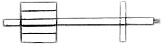
TO M. DUPONT DE NEMOURS.
Monticello, December 31, 1815.
Nothing, my very dear and ancient friend, could have equalled the mortification I felt on my arrival at home, and receipt of the information that I had lost the happiness of your visit. The season had so far advanced, and the weather become so severe, that together with the information given me by Mr. Correa, so early as September, that your friends even then were dissuading the journey, I had set it down as certain it would be postponed to a milder season of the ensuing year. I had yielded, therefore, with the less reluctance to a detention in Bedford by a slower progress of my workmen than had been counted on. I have never more desired anything than a full and free conversation with you. I have not understood the transactions in France during the years '14 and '15. From the newspapers we cannot even conjecture the secret and real history; and I had looked for it to your visit. A pamphlet (Le Conciliateur) received from M. Jullien, had given me some idea of the obliquities and imbecilities of the Bourbons, during their first restoration. Some manœuvres of both parties I had learnt from Lafayette, and more recently from Gallatin. But the note you referred me to at page 360 of your letter to Say, has possessed me more intimately of the views, the conduct and consequences of the last apparition of Napoleon. Still much is wanting. I wish to know what were the intrigues which brought him back, and what those which finally crushed him? What parts were acted by A, B, C, D., &c, some of whom I know, and some I do not? How did the body of the nation stand affectioned, comparatively, between the fool and the tyrant? &c., &c., &c. From the account my family gives me of your sound health, and of the vivacity and vigor of your mind, I will still hope we shall meet again, and that the fine temperature of our early summer, to wit, of May and June, may suggest to you the salutary effects of exercise, and change of air and scene. En attendant, we will turn to other subjects.
That your opinion of the hostile intentions of Great Britain towards us is sound, I am satisfied, from her movements north and south of us, as well as from her temper. She feels the gloriole of her late golden achievements tarnished by our successes against her by sea and land; and will not be contented until she has wiped it off by triumphs over us also. I rely, however, on the volcanic state of Europe to present other objects for her arms and her apprehensions; and am not without hope we shall be permitted to proceed peaceably in making children, and maturing and moulding our strength and resources. It is impossible that France should rest under her present oppressions and humiliations. She will rise in that gigantic strength which cannot be annihilated, and will fatten her fields with the blood of her enemies. I only wish she may exercise patience and forbearance until divisions among them may give her a choice of sides. To the overwhelming power of England I see but two chances of limit. The first is her bankruptcy, which will deprive her of the golden instrument of all her successes. The other in that ascendency which nature destines for us by immutable laws. But to hasten this last consummation, we too must exercise patience and forbearance. For twenty years to come we should consider peace as the summum bonum of our country. At the end of that period we shall be twenty millions in number, and forty in energy, when encountering the starved and rickety paupers and dwarfs of English workshops. By that time I hope your grandson will have become one of our High-admirals, and bear distinguished part in retorting the wrongs of both his countries on the most implacable and cruel of their enemies. In this hope, and because I love you, and all who are dear to you, I wrote to the President in the instant of reading your letter of the 7th, on the subject of his adoption into our navy. I did it because I was gratified in doing it, while I knew it was unnecessary. The sincere respect and high estimation in which the President holds you, is such that there is no gratification, within the regular exercise of his functions, which he would withhold from you. Be assured then that, if within that compass, this business is safe.
Were you any other than whom you are, I should shrink from the task you have proposed to me, of undertaking to judge of the merit of your own translation of the excellent letter on education. After having done all which good sense and eloquence could do on the original, you must not ambition the double need of English eloquence also. Did you ever know an instance of one who could write in a foreign language with the elegance of a native? Cicero wrote Commentaries of his own Consulship in Greek; they perished unknown, while his native compositions have immortalized him with themselves. No, my dear friend; you must not risk the success of your letter on foreignisms of style which may weaken its effect. Some native pen must give it to our countrymen in a native dress, faithful to its original. You will find such with the aid of our friend Correa, who knows everybody, and will readily think of some one who has time and talent for this work. I have neither. Till noon I am daily engaged in a correspondence much too extensive and laborious for my age. From noon to dinner health, habit, and business, require me to be on horseback; and render the society of my family and friends a necessary relaxation for the rest of the day. These occupations scarcely leave time for the papers of the day; and to renounce entirely the sciences and belles-lettres is impossible. Had not Mr. Gilmer just taken his place in the ranks of the bar, I think we could have engaged him in this work. But I am persuaded that Mr. Correa's intimacy with the persons of promise in our country, will leave you without difficulty in laying this work of instruction open to our citizens at large.
I have not yet had time to read your Equinoctial republics, nor the letter of Say; because I am still engrossed by the letters which had accumulated during my absence. The latter I accept with thankfulness, and will speedily read and return the former. God bless you, and maintain you in strength of body, and mind, until your own wishes shall be to resign both.
TO CAPT. A. PARTRIDGE.
Monticello, January 2d, 1816.
Sir,—I am but recently returned from my journey to the neighborhood of the Peaks of Otter, and find here your favors of November 23d and December 9th. I have therefore to thank you for your meteorological table and the corrections of Colonel Williams' altitudes of the mountains of Virginia, which I had not before seen; but especially for the very able extract on Barometrical measures. The precision of the calculations, and soundness of the principles on which they are founded, furnish, I am satisfied, a great approximation towards truth, and raise that method of estimating heights to a considerable degree of rivalship with the trigonometrical. The last is not without some sources of inaccuracy, as you have truly stated. The admeasurement of the base is liable to errors which can be rendered insensible only by such degrees of care as have been exhibited by the mathematicians who have been employed in measuring degrees on the surface of the earth. The measure of the angles by the wonderful perfection to which the graduation of instruments has been brought by a Bird, a Ramsden, a Troughton, removes nearly all distrust from that operation; and we may add that the effect of refraction, rarely worth notice in short distances, admits of correction by well-established laws; these sources of error once reduced to be insensible, their geometrical employment is certainty itself. No two men can differ on a principle of trigonometry. Not so as to the theories of Barometrical mensuration. On these have been great differences of opinion, and among characters of just celebrity.
Dr. Halley reckoned one-tenth inch of Mercury equal to 90 feet altitude of the atmosphere. Derham thought it equal to something less than 90 feet. Cassini's tables to 24° of the Barometer allowed 676 toises of altitudes.
Mariole's, to the same 544 toises.
Schruchzer's " 559 "
Nettleton's tables applied to a difference of .5975 of mercury, in a particular instance gave 512.17 feet of altitude, and Bonguor's and De Luc's rules, to the same difference gave 579.5 feet. Sir Isaac Newton had established that at heights in arithmetrical progression the ratio of rarity in the air would be geometrical, and this being the character of the natural numbers and their Logarithms, Bonguor adopted the ratio in his mensuration of the mountains of South America, and stating in French lignes the height of the mercury of different stations, took their Logarithms to five places only, including the index, and considered the resulting difference as expressing that of the altitudes in French toises. He then applied corrections required by the effect of the temperature of the moment on the air and mercury. His process, on the whole, agrees very exactly with that established in your excellent extract. In 1776 I observed the height of the mercury at the base and summit of the mountain I live on, and by Nettleton's tables, estimated the height at 512.17 feet, and called it about 500 feet in the Notes on Virginia. But calculating it since on the same observations, according to Bonguor's method with De Luc's improvements, the result was 579.5 feet; and lately I measured the same height trigonometrically, with the aid of a base of 1,175 feet in a vertical plane with the summit, and at the distance of about 1,500 yards from the axis of the mountain, and made it 599.35 feet. I consider this as testing the advance of the barometrical process towards truth by the adoption of the Logarithmic ratio of heights and densities; and continued observations and experiments will continue to advance it still more. But the first character of a common measure of things being that of invariability, I can never suppose that a substance so heterogeneous and variable as the atmospheric fluid, changing daily and hourly its weight and dimensions to the amount, sometimes, of one-tenth of the whole, can be applied as a standard of measure to anything, with as much mathematical exactness, as a trigonometrical process. It is still, however, a resource of great value for these purposes, because its use is so easy, in comparison with the other, and especially where the grounds are unfavorable for a base; and its results are so near the truth as to answer all the common purposes of information. Indeed, I should in all cases prefer the use of both, to warn us against gross error, and to put us, when that is suspected, on a repetition of our process. When lately measuring trigonometrically the height of the Peaks of Otter (as my letter of October 12th informed you I was about to do), I very much wished for a barometer, to try the height of that also. But it was too far and hazardous to carry my own, and there was not one in that neighborhood. On the subject of that admeasurement, I must premise that my object was only to gratify a common curiosity as to the height of those mountains, which we deem our highest, and to furnish an à peu près, sufficient to satisfy us in a comparison of them with the other mountains of our own, or of other countries. I therefore neither provided such instruments, nor aimed at such extraordinary accuracy in the measures of my base, as abler operators would have employed in the more important object of measuring a degree, or of ascertaining the relative position of different places for astronomical or geographical purposes. My instrument was a theodolite by Ramsden, whose horizontal and vertical circles were of 3½ inches radius, its graduation subdivided by noniuses to one-third, admitting however by its intervals, a further subdivision by the eye to a single minute, with two telescopes, the one fixed, the other movable, and a Gunter's chain of four poles, accurately adjusted in its length, and carefully attended on its application to the base line. The Sharp, or southern peak, was first measured by a base of 2806.32 feet in the vertical plane of the axis of the mountain. A base then nearly parallel with the two mountains of 6,589 feet was measured, and observations taken at each end, of the altitudes and horizontal angles of each apex, and such other auxiliary observations made as to the stations, inclination of the base, &c., as a good degree of correctness in the result would require. The ground of our bases was favorable, being an open plain of close grazed meadow on both sides of the Otter river, declining so uniformly with the descent of the river as to give no other trouble than an observation of its angle of inclination, in order to reduce the base to the plane of the horizon. From the summit of the Sharp peak I took also the angle of altitude of the flat or northern one above it, my other observations sufficing to give their distance from one another. The result was,
The mean height of the Sharp peak above the surface of Otter river 2946.5 inches.
Mean height of the flat peak above the surface of Otter river 3103.5 inches.
The distance between the two summits 9507.73 inches.
Their rhumb N. 33° 50´ E. the distance of the stations of observation from the points in the bases of the mountains vertically under their summits was, the shortest 19002.2 feet, the longest 24523.3 feet. These mountains are computed to be visible to fifteen counties of the State, without the advantage of counter-elevations, and to several more with that advantage. I must add that I have gone over my calculations but once, and nothing is more possible than the mistake of a figure, now and then, in calculating so many triangles, which may occasion some variation in the result. I mean, therefore, when I have leisure, to go again over the whole. The ridge of mountains of which Monticello is one, is generally low; there is one in it, however, called Peter's mountain, considerably higher than the general ridge. This being within a dozen miles of me, north-eastwardly, I think in the spring of the year to measure it by both processes, which may serve as another trial of the Logarithmic theory. Should I do this you shall know the result. In the meantime accept assurances of my great respect and esteem.
TO COLONEL YANCEY.
Monticello, January 6, 1816.
Dear Sir,—I am favored with yours of December 24th, and perceive you have many matters before you of great moment. I have no fear but that the legislature will do on all of them what is wise and just. On the particular subject of our river, in the navigation of which our county has so great an interest, I think the power of permitting dams to be erected across it, ought to be taken from the courts, so far as the stream has water enough for navigation. The value of our property is sensibly lessened by the dam which the court of Fluvana authorized not long since to be erected, but a little above its mouth. This power over the value and convenience of our lands is of much too high a character to be placed at the will of a county court, and that of a county, too, which has not a common interest in the preservation of the navigation for those above them. As to the existing dams, if any conditions are proposed more than those to which they were subjected on their original erection, I think they would be allowed the alternative of opening a sluice for the passage of navigation, so as to put the river into as good a condition for navigation as it was before the erection of their dam, or as it would be if their dam were away. Those interested in the navigation might then use the sluices or make locks as should be thought best. Nature and reason, as well as all our constitutions, condemn retrospective conditions as mere acts of power against right.
I recommend to your patronage our Central College. I look to it as a germ from which a great tree may spread itself.
There is before the assembly a petition of a Captain Miller which I have at heart, because I have great esteem for the petitioner as an honest and useful man. He is about to settle in our county, and to establish a brewery, in which art I think him as skilful a man as has ever come to America. I wish to see this beverage become common instead of the whiskey which kills one-third of our citizens and ruins their families. He is staying with me until he can fix himself, and I should be thankful for information from time to time of the progress of his petition.
Like a dropsical man calling out for water, water, our deluded citizens are clamoring for more banks, more banks. The American mind is now in that state of fever which the world has so often seen in the history of other nations. We are under the bank bubble, as England was under the South Sea bubble, France under the Mississippi bubble, and as every nation is liable to be, under whatever bubble, design, or delusion may puff up in moments when off their guard. We are now taught to believe that legerdemain tricks upon paper can produce as solid wealth as hard labor in the earth. It is vain for common sense to urge that nothing can produce but nothing; that it is an idle dream to believe in a philosopher's stone which is to turn everything into gold, and to redeem man from the original sentence of his Maker, "in the sweat of his brow shall he eat his bread." Not Quixot enough, however, to attempt to reason Bedlam to rights, my anxieties are turned to the most practicable means of withdrawing us from the ruin into which we have run. Two hundred millions of paper in the hands of the people, (and less cannot be from the employment of a banking capital known to exceed one hundred millions,) is a fearful tax to fall at hap-hazard on their heads. The debt which purchased our independence was but of eighty millions, of which twenty years of taxation had in 1809 paid but the one half. And what have we purchased with this tax of two hundred millions which we are to pay by wholesale but usury, swindling, and new forms of demoralization. Revolutionary history has warned us of the probable moment when this baseless trash is to receive its fiat. Whenever so much of the precious metals shall have returned into the circulation as that every one can get some in exchange for his produce, paper, as in the revolutionary war, will experience at once an universal rejection. When public opinion changes, it is with the rapidity of thought. Confidence is already on the totter, and every one now handles this paper as if playing at Robin's alive. That in the present state of the circulation the banks should resume payments in specie, would require their vaults to be like the widow's cruise. The thing to be aimed at is, that the excesses of their emissions should be withdrawn as gradually, but as speedily, too, as is practicable, without so much alarm as to bring on the crisis dreaded. Some banks are said to be calling in their paper. But ought we to let this depend on their discretion? Is it not the duty of the legislature to endeavor to avert from their constituents such a catastrophe as the extinguishment of two hundred millions of paper in their hands? The difficulty is indeed great; and the greater, because the patient revolts against all medicine. I am far from presuming to say that any plan can be relied on with certainty, because the bubble may burst from one moment to another; but if it fails, we shall be but where we should have been without any effort to save ourselves. Different persons, doubtless, will devise different schemes of relief. One would be to suppress instantly the currency of all paper not issued under the authority of our own State or of the General Government; to interdict after a few months the circulation of all bills of five dollars and under; after a few months more, all of ten dollars and under; after other terms, those of twenty, fifty, and so on to one hundred dollars, which last, if any must be left in circulation, should be the lowest denomination. These might be a convenience in mercantile transactions and transmissions, and would be excluded by their size from ordinary circulation. But the disease may be too pressing to await such a remedy. With the legislature I cheerfully leave it to apply this medicine, or no medicine at all. I am sure their intentions are faithful; and embarked in the same bottom, I am willing to swim or sink with my fellow citizens. If the latter is their choice, I will go down with them without a murmur. But my exhortation would rather be "not to give up the ship."
I am a great friend to the improvements of roads, canals, and schools. But I wish I could see some provision for the former as solid as that of the latter,—something better than fog. The literary fund is a solid provision, unless lost in the impending bankruptcy. If the legislature would add to that a perpetual tax of a cent a head on the population of the State, it would set agoing at once, and forever maintain, a system of primary or ward schools, and an university where might be taught, in its highest degree, every branch of science useful in our time and country; and it would rescue us from the tax of toryism, fanaticism, and indifferentism to their own State, which we now send our youth to bring from those of New England. If a nation expects to be ignorant and free, in a state of civilization, it expects what never was and never will be. The functionaries of every government have propensities to command at will the liberty and property of their constituents. There is no safe deposit for these but with the people themselves; nor can they be safe with them without information. Where the press is free, and every man able to read, all is safe. The frankness of this communication will, I am sure, suggest to you a discreet use of it. I wish to avoid all collisions of opinion with all mankind. Show it to Mr. Maury, with expressions of my great esteem. It pretends to convey no more than the opinions of one of your thousand constituents, and to claim no more attention than every other of that thousand.
I will ask you once more to take care of Miller and our College, and to accept assurances of my esteem and respect.
TO CHARLES THOMPSON.
Monticello, January 9, 1816.
My Dear and Ancient Friend,—An acquaintance of fifty-two years, for I think ours dates from 1764, calls for an interchange of notice now and then, that we remain in existence, the monuments of another age, and examples of a friendship unaffected by the jarring elements by which we have been surrounded, of revolutions of government, of party and of opinion. I am reminded of this duty by the receipt, through our friend Dr. Patterson, of your synopsis of the four Evangelists. I had procured it as soon as I saw it advertised, and had become familiar with its use; but this copy is the more valued as it comes from your hand. This work bears the stamp of that accuracy which marks everything from you, and will be useful to those who, not taking things on trust, recur for themselves to the fountain of pure morals. I, too, have made a wee-little book from the same materials, which I call the Philosophy of Jesus; it is a paradigma of his doctrines, made by cutting the texts out of the book, and arranging them on the pages of a blank book, in a certain order of time or subject. A more beautiful or precious morsel of ethics I have never seen; it is a document in proof that I am a real Christian, that is to say, a disciple of the doctrines of Jesus, very different from the Platonists, who call me infidel and themselves Christians and preachers of the gospel, while they draw all their characteristic dogmas from what its author never said nor saw. They have compounded from the heathen mysteries a system beyond the comprehension of man, of which the great reformer of the vicious ethics and deism of the Jews, were he to return on earth, would not recognize one feature. If I had time I would add to my little book the Greek, Latin and French texts, in columns side by side. And I wish I could subjoin a translation of Gosindi's Syntagma of the doctrines of Epicurus, which, notwithstanding the calumnies of the Stoics and caricatures of Cicero, is the most rational system remaining of the philosophy of the ancients, as frugal of vicious indulgence, and fruitful of virtue as the hyperbolical extravagances of his rival sects.
I retain good health, am rather feeble to walk much, but ride with ease, passing two or three hours a day on horseback, and every three or four months taking in a carriage a journey of ninety miles to a distant possession, where I pass a good deal of my time. My eyes need the aid of glasses by night, and with small print in the day also; my hearing is not quite so sensible as it used to be; no tooth shaking yet, but shivering and shrinking in body from the cold we now experience, my thermometer having been as low as 12° this morning. My greatest oppression is a correspondence afflictingly laborious, the extent of which I have been long endeavoring to curtail. This keeps me at the drudgery of the writing-table all the prime hours of the day, leaving for the gratification of my appetite for reading, only what I can steal from the hours of sleep. Could I reduce this epistolary corvée within the limits of my friends and affairs, and give the time redeemed from it to reading and reflection, to history, ethics, mathematics, my life would be as happy as the infirmities of age would admit, and I should look on its consummation with the composure of one "qui summum nec me tuit diem nec optat."
So much as to myself, and I have given you this string of egotisms in the hope of drawing a similar one from yourself. I have heard from others that you retain your health, a good degree of activity, and all the vivacity and cheerfulness of your mind, but I wish to learn it more minutely from yourself. How has time affected your health and spirits? What are your amusements, literary and social? Tell me everything about yourself, because all will be interesting to me who retains for you ever the same constant and affectionate friendship and respect.
TO BENJAMIN AUSTIN, ESQ.
Monticello, January 9, 1816.
Dear Sir,—Your favor of December 21st has been received, and I am first to thank you for the pamphlet it covered. The same description of persons which is the subject of that is so much multiplied here too, as to be almost a grievance, and by their numbers in the public councils, have wrested from the public hand the direction of the pruning knife. But with us as a body, they are republican, and mostly moderate in their views; so far, therefore, less objects of jealousy than with you. Your opinions on the events which have taken place in France, are entirely just, so far as these events are yet developed. But they have not reached their ultimate termination. There is still an awful void between the present and what is to be the last chapter of that history; and I fear it is to be filled with abominations as frightful as those which have already disgraced it. That nation is too high-minded, has too much innate force, intelligence and elasticity, to remain under its present compression. Samson will arise in his strength, as of old, and as of old will burst asunder the withes and the cords, and the webs of the Philistines. But what are to be the scenes of havoc and horror, and how widely they may spread between brethren of the same house, our ignorance of the interior feuds and antipathies of the country places beyond our ken. It will end, nevertheless, in a representative government, in a government in which the will of the people will be an effective ingredient. This important element has taken root in the European mind, and will have its growth; their despots, sensible of this, are already offering this modification of their governments, as if of their own accord. Instead of the parricide treason of Bonaparte, in perverting the means confided to him as a republican magistrate, to the subversion of that republic and erection of a military despotism for himself and his family, had he used it honestly for the establishment and support of a free government in his own country, France would now have been in freedom and rest; and her example operating in a contrary direction, every nation in Europe would have had a government over which the will of the people would have had some control. His atrocious egotism has checked the salutary progress of principle, and deluged it with rivers of blood which are not yet run out. To the vast sum of devastation and of human misery, of which he has been the guilty cause, much is still to be added. But the object is fixed in the eye of nations, and they will press on to its accomplishment and to the general amelioration of the condition of man. What a germ have we planted, and how faithfully should we cherish the parent tree at home!
You tell me I am quoted by those who wish to continue our dependence on England for manufactures. There was a time when I might have been so quoted with more candor, but within the thirty years which have since elapsed, how are circumstances changed! We were then in peace. Our independent place among nations was acknowledged. A commerce which offered the raw material in exchange for the same material after receiving the last touch of industry, was worthy of welcome to all nations. It was expected that those especially to whom manufacturing industry was important, would cherish the friendship of such customers by every favor, by every inducement, and particularly cultivate their peace by every act of justice and friendship. Under this prospect the question seemed legitimate, whether, with such an immensity of unimproved land, courting the hand of husbandry, the industry of agriculture, or that of manufactures, would add most to the national wealth? And the doubt was entertained on this consideration chiefly, that to the labor of the husbandman a vast addition is made by the spontaneous energies of the earth on which it is employed: for one grain of wheat committed to the earth, she renders twenty, thirty, and even fifty fold, whereas to the labor of the manufacturer nothing is added. Pounds of flax, in his hands, yield, on the contrary, but pennyweights of lace. This exchange, too, laborious as it might seem, what a field did it promise for the occupations of the ocean; what a nursery for that class of citizens who were to exercise and maintain our equal rights on that element? This was the state of things in 1785, when the "Notes on Virginia" were first printed; when, the ocean being open to all nations, and their common right in it acknowledged and exercised under regulations sanctioned by the assent and usage of all, it was thought that the doubt might claim some consideration. But who in 1785 could foresee the rapid depravity which was to render the close of that century the disgrace of the history of man? Who could have imagined that the two most distinguished in the rank of nations, for science and civilization, would have suddenly descended from that honorable eminence, and setting at defiance all those moral laws established by the Author of nature between nation and nation, as between man and man, would cover earth and sea with robberies and piracies, merely because strong enough to do it with temporal impunity; and that under this disbandment of nations from social order, we should have been despoiled of a thousand ships, and have thousands of our citizens reduced to Algerine slavery. Yet all this has taken place. One of these nations interdicted to our vessels all harbors of the globe without having first proceeded to some one of hers, there paid a tribute proportioned to the cargo, and obtained her license to proceed to the port of destination. The other declared them to be lawful prize if they had touched at the port, or been visited by a ship of the enemy nation. Thus were we completely excluded from the ocean. Compare this state of things with that of '85, and say whether an opinion founded in the circumstances of that day can be fairly applied to those of the present. We have experienced what we did not then believe, that there exists both profligacy and power enough to exclude us from the field of interchange with other nations: that to be independent for the comforts of life we must fabricate them ourselves. We must now place the manufacturer by the side of the agriculturist. The former question is suppressed, or rather assumes a new form. Shall we make our own comforts, or go without them, at the will of a foreign nation? He, therefore, who is now against domestic manufacture, must be for reducing us either to dependence on that foreign nation, or to be clothed in skins, and to live like wild beasts in dens and caverns. I am not one of these; experience has taught me that manufactures are now as necessary to our independence as to our comfort; and if those who quote me as of a different opinion, will keep pace with me in purchasing nothing foreign where an equivalent of domestic fabric can be obtained, without regard to difference of price, it will not be our fault if we do not soon have a supply at home equal to our demand, and wrest that weapon of distress from the hand which has wielded it. If it shall be proposed to go beyond our own supply, the question of '85 will then recur, will our surplus labor be then most beneficially employed in the culture of the earth, or in the fabrications of art? We have time yet for consideration, before that question will press upon us; and the maxim to be applied will depend on the circumstances which shall then exist; for in so complicated a science as political economy, no one axiom can be laid down as wise and expedient for all times and circumstances, and for their contraries. Inattention to this is what has called for this explanation, which reflection would have rendered unnecessary with the candid, while nothing will do it with those who use the former opinion only as a stalking horse, to cover their disloyal propensities to keep us in eternal vassalage to a foreign and unfriendly people.
I salute you with assurances of great respect and esteem.
TO JOHN ADAMS.
Monticello, January 11, 1816.
Dear Sir,—Of the last five months I have passed four at my other domicil, for such it is in a considerable degree. No letters are forwarded to me there, because the cross post to that place is circuitous and uncertain; during my absence, therefore, they are accumulating here, and awaiting acknowledgments. This has been the fate of your favor of November 13th.
I agree with you in all its eulogies on the eighteenth century. It certainly witnessed the sciences and arts, manners and morals, advanced to a higher degree than the world had ever before seen. And might we not go back to the æra of the Borgias, by which time the barbarous ages had reduced national morality to its lowest point of depravity, and observe that the arts and sciences, rising from that point, advanced gradually through all the sixteenth, seventeenth and eighteenth centuries, softening and correcting the manners and morals of man? I think, too, we may add to the great honor of science and the arts, that their natural effect is, by illuminating public opinion, to erect it into a censor, before which the most exalted tremble for their future, as well as present fame. With some exceptions only, through the seventeenth and eighteenth centuries, morality occupied an honorable chapter in the political code of nations. You must have observed while in Europe, as I thought I did, that those who administered the governments of the greater powers at least, had a respect to faith, and considered the dignity of their government as involved in its integrity. A wound indeed was inflicted on this character of honor in the eighteenth century by the partition of Poland. But this was the atrocity of a barbarous government chiefly, in conjunction with a smaller one still scrambling to become great, while one only of those already great, and having character to lose, descended to the baseness of an accomplice in the crime. France, England, Spain, shared in it only inasmuch as they stood aloof and permitted its perpetration.
How then has it happened that these nations, France especially and England, so great, so dignified, so distinguished by science and the arts, plunged all at once into all the depths of human enormity, threw off suddenly and openly all the restraints of morality, all sensation to character, and unblushingly avowed and acted on the principle that power was right? Can this sudden apostasy from national rectitude be accounted for? The treaty of Pilnitz seems to have begun it, suggested perhaps by the baneful precedent of Poland. Was it from the terror of monarchs, alarmed at the light returning on them from the west, and kindling a volcano under their thrones? Was it a combination to extinguish that light, and to bring back, as their best auxiliaries, those enumerated by you, the Sorbonne, the Inquisition, the Index Expurgatorius, and the knights of Loyola? Whatever it was, the close of the century saw the moral world thrown back again to the age of the Borgias, to the point from which it had departed three hundred years before. France, after crushing and punishing the conspiracy of Pilnitz, went herself deeper and deeper into the crimes she had been chastising. I say France and not Bonaparte; for, although he was the head and mouth, the nation furnished the hands which executed his enormities. England, although in opposition, kept full pace with France, not indeed by the manly force of her own arms, but by oppressing the weak and bribing the strong. At length the whole choir joined and divided the weaker nations among them. Your prophecies to Dr. Price proved truer than mine; and yet fell short of the fact, for instead of a million, the destruction of eight or ten millions of human beings has probably been the effect of these convulsions. I did not, in '89, believe they would have lasted so long, nor have cost so much blood. But although your prophecy has proved true so far, I hope it does not preclude a better final result. That same light from our west seems to have spread and illuminated the very engines employed to extinguish it. It has given them a glimmering of their rights and their power. The idea of representative government has taken root and growth among them. Their masters feel it, and are saving themselves by timely offers of this modification of their powers. Belgium, Prussia, Poland, Lombardy, &c., are now offered a representative organization; illusive probably at first, but it will grow into power in the end. Opinion is power, and that opinion will come. Even France will yet attain representative government. You observe it makes the basis of every constitution which has been demanded or offered,—of that demanded by their Senate; of that offered by Bonaparte; and of that granted by Louis XVIII. The idea then is rooted, and will be established, although rivers of blood may yet flow between them and their object. The allied armies now couching upon them are first to be destroyed, and destroyed they will surely be. A nation united can never be conquered. We have seen what the ignorant, bigoted and unarmed Spaniards could do against the disciplined veterans of their invaders. What then may we not expect from the power and character of the French nation? The oppressors may cut off heads after heads, but like those of the Hydra they multiply at every stroke. The recruits within a nation's own limits are prompt and without number; while those of their invaders from a distance are slow, limited, and must come to an end. I think, too, we perceive that all these allies do not see the same interest in the annihilation of the power of France. There are certainly some symptoms of foresight in Alexander that France might produce a salutary diversion of force were Austria and Prussia to become her enemies. France, too, is the neutral ally of the Turk, as having no interfering interests, and might be useful in neutralizing and perhaps turning that power on Austria. That a re-acting jealousy, too, exists with Austria and Prussia, I think their late strict alliance indicates; and I should not wonder if Spain should discover a sympathy with them. Italy is so divided as to be nothing. Here then we see new coalitions in embryo, which, after France shall in turn have suffered a just punishment for her crimes, will not only raise her from the earth on which she is prostrate, but give her an opportunity to establish a government of as much liberty as she can bear—enough to ensure her happiness and prosperity. When insurrection begins, be it where it will, all the partitioned countries will rush to arms, and Europe again become an arena of gladiators. And what is the definite object they will propose? A restoration certainly of the status quo prius, of the state of possession of '89. I see no other principle on which Europe can ever again settle down in lasting peace. I hope your prophecies will go thus far, as my wishes do, and that they, like the former, will prove to have been the sober dictates of a superior understanding, and a sound calculation of effects from causes well understood. Some future Morgan will then have an opportunity of doing you justice, and of counterbalancing the breach of confidence of which you so justly complain, and in which no one has had more frequent occasion of fellow-feeling than myself. Permit me to place here my affectionate respects to Mrs. Adams, and to add for yourself the assurances of cordial friendship and esteem.
TO DABNEY CARR.
Monticello, January 19, 1816.
Dear Sir,—At the date of your letter of December the 1st, I was in Bedford, and since my return, so many letters, accumulated during my absence, have been pressing for answers, that this is the first moment I have been able to attend to the subject of yours. While Mr. Girardin was in this neighborhood writing his continuation of Burke's history, I had suggested to him a proper notice of the establishment of the committee of correspondence here in 1773, and of Mr. Carr, your father, who introduced it. He has doubtless done this, and his work is now in the press. My books, journals of the times, &c., being all gone, I have nothing now but an impaired memory to resort to for the more particular statement you wish. But I give it with the more confidence, as I find that I remember old things better than new. The transaction took place in the session of Assembly of March 1773. Patrick Henry, Richard Henry Lee, Frank Lee, your father and myself, met by agreement, one evening, about the close of the session, at the Raleigh Tavern, to consult on the measures which the circumstances of the times seemed to call for. We agreed, in result, that concert in the operations of the several colonies was indispensable; and that to produce this, some channel of correspondence between them must be opened; that therefore, we would propose to our House the appointment of a committee of correspondence, which should be authorized and instructed to write to the Speakers of the House of Representatives of the several Colonies, recommending the appointment of similar committees on their part, who, by a communication of sentiment on the transactions threatening us all, might promote a harmony of action salutary to all. This was the substance, not pretending to remember the words. We proposed the resolution, and your father was agreed on to make the motion. He did it the next day, March the 12th, with great ability, reconciling all to it, not only by the reasonings, but by the temper and moderation with which it was developed. It was adopted by a very general vote. Peyton Randolph, some of us who proposed it, and who else I do not remember, were appointed of the committee. We immediately despatched letters by expresses to the Speakers of all the other Assemblies. I remember that Mr. Carr and myself, returning home together, and conversing on the subject by the way, concurred in the conclusion that that measure must inevitably beget the meeting of a Congress of Deputies from all the colonies, for the purpose of uniting all in the same principles and measures for the maintenance of our rights. My memory cannot deceive me, when I affirm that we did it in consequence of no such proposition from any other colony. No doubt the resolution itself and the journals of the day will show that ours was original, and not merely responsive to one from any other quarter. Yet, I am certain I remember also, that a similar proposition, and nearly cotemporary, was made by Massachusetts, and that our northern messenger passed theirs on the road. This, too, may be settled by recurrence to the records of Massachusetts. The proposition was generally acceded to by the other colonies, and the first effect, as expected, was the meeting of a Congress at New York the ensuing year. The committee of correspondence appointed by Massachusetts, as quoted by you from Marshall, under the date of 1770, must have been for a special purpose, and functus officio before the date of 1773, or Massachusetts herself would not then have proposed another. Records should be examined to settle this accurately. I well remember the pleasure expressed in the countenance and conversation of the members generally, on this debut of Mr. Carr, and the hopes they conceived as well from the talents as the patriotism it manifested. But he died within two months after, and in him we lost a powerful fellow-laborer. His character was of a high order. A spotless integrity, sound judgment, handsome imagination, enriched by education and reading, quick and clear in his conceptions, of correct and ready elocution, impressing every hearer with the sincerity of the heart from which it flowed. His firmness was inflexible in whatever he thought was right; but when no moral principle stood in the way, never had man more of the milk of human kindness, of indulgence, of softness, of pleasantry of conversation and conduct. The number of his friends, and the warmth of their affection, were proofs of his worth, and of their estimate of it. To give to those now living, an idea of the affliction produced by his death in the minds of all who knew him, I liken it to that lately felt by themselves on the death of his eldest son, Peter Carr, so like him in all his endowments and moral qualities, and whose recollection can never recur without a deep-drawn sigh from the bosom of any one who knew him. You mention that I showed you an inscription I had proposed for the tomb stone of your father. Did I leave it in your hands to be copied? I ask the question, not that I have any such recollection, but that I find it no longer in the place of its deposit, and think I never took it out but on that occasion. Ever and affectionately yours.
TO DR. PETER WILSON, PROFESSOR OF LANGUAGES, COLUMBIA COLLEGE, NEW YORK.
Monticello, January 20, 1816.
Sir,—Of the last five months, I have been absent four from home, which must apologize for so very late an acknowledgment of your favor of November 22d, and I wish the delay could be compensated by the matter of the answer. But an unfortunate accident puts that out of my power. During the course of my public life, and from a very early period of it, I omitted no opportunity of procuring vocabularies of the Indian languages, and for that purpose formed a model expressing such objects in nature as must be familiar to every people, savage or civilized. This being made the standard to which all were brought, would exhibit readily whatever affinities of language there be between the several tribes. It was my intention, on retiring from public business, to have digested these into some order, so as to show not only what relations of language existed among our own aborigines, but by a collation with the great Russian vocabulary of the languages of Europe and Asia, whether there were any between them and the other nations of the continent. On my removal from Washington, the package in which this collection was coming by water, was stolen and destroyed. It consisted of between thirty and forty vocabularies, of which I can, from memory, say nothing particular; but that I am certain more than half of them differed as radically, each from every other, as the Greek, the Latin, and Islandic. And even of those which seemed to be derived from the same radix, the departure was such that the tribes speaking them could not probably understand one another. Single words, or two or three together, might perhaps be understood, but not a whole sentence of any extent or construction. I think, therefore, the pious missionaries who shall go to the several tribes to instruct them in the Christian religion, will have to learn a language for every tribe they go to; nay, more, that they will have to create a new language for every one, that is to say, to add to theirs new words for the new ideas they will have to communicate. Law, medicine, chemistry, mathematics, every science has a language of its own, and divinity not less than others. Their barren vocabularies cannot be vehicles for ideas of the fall of man, his redemption, the triune composition of the Godhead, and other mystical doctrines considered by most Christians of the present date as essential elements of faith. The enterprise is therefore arduous, but the more inviting perhaps to missionary zeal, in proportion as the merit of surmounting it will be greater. Again repeating my regrets that I am able to give so little satisfaction on the subject of your inquiry, I pray you to accept the assurance of my great consideration and esteem.
TO MR. AMOS J. COOK, PRECEPTOR OF FRYEBURG ACADEMY IN THE DISTRICT OF MAINE.
Monticello, January 21, 1816.
Sir,—Your favor of December 18th was exactly a month on its way to this place; and I have to thank you for the elegant and philosophical lines communicated by the Nestor of our Revolution. Whether the style or sentiment be considered, they were well worthy the trouble of being copied and communicated by his pen. Nor am I less thankful for the happy translation of them. It adds another to the rare instances of a rival to its original: superior indeed in one respect, as the same outline of sentiment is brought within a compass of better proportion. For if the original be liable to any criticism, it is that of giving too great extension to the same general idea. Yet it has a great authority to support it, that of a wiser man than all of us. "I sought in my heart to give myself unto wine; I made me great works; I builded me houses; I planted me vineyards; I made me gardens, and orchards, and pools to water them; I got me servants and maidens, and great possessions of cattle; I gathered me also silver and gold, and men singers and women singers, and the delights of the sons of men, and musical instruments of all sorts; and whatsoever mine eyes desired I kept not from them; I withheld not my heart from any joy. Then I looked on all the works that my hands had wrought, and behold! all was vanity and vexation of spirit! I saw that wisdom excelleth folly, as far as light excelleth darkness." The Preacher, whom I abridge, has indulged in a much larger amplification of his subject. I am not so happy as my friend and ancient colleague, Mr. Adams, in possessing anything original, inedited, and worthy of comparison with the epigraph of the Spanish monk. I can offer but humble prose, from the hand indeed of the father of eloquence and philosophy; a moral morsel, which our young friends under your tuition should keep ever in their eye, as the ultimate term of your instructions, and of their labors. "Hic, quisquis est, qui moderatione et constantia quietus animo est, sibique ipse placatus; ut nec tabescat molestiis, nec frangatur timore, nec sitienter quid expectens ardeat desiderio, nec alacritate futili gestiens deliquescat; is est sapiens, quem quaerimus; is est beatus; cui nihil humanarum rerum aut intolerabile ad dimittendum animum, aut nimis lactabile ad efferendum, videri potest." Or if a poetical dress will be more acceptable to the fancy of the juvenile student:
"Quisnam igitur liber? Sapiens, sibique imperiosus: Quem neque pauperies, neque mors, neque vincula terrent: Responsare cupidinibus, contemnere honores Fortis, et in scipso totus teres, atque rotundus; Externi ne quid valeat per laeve morari: In quem manea ruit semper Fortuna."
And if the Wise be the happy man, as these sages say, he must be virtuous too; for, without virtue, happiness cannot be. This then is the true scope of all academical emulation.
You request something in the handwriting of General Washington. I enclose you a letter which I received from him while in Paris, covering a copy of the new Constitution; it is offered merely as what you ask, a specimen of his handwriting.
On the subject of your Museum, I fear I cannot flatter myself with being useful to it. Were the obstacle of distance out of the way, age and retirement have withdrawn me from the opportunities of procuring objects in that line. With every wish for the prosperity of your institution, accept the assurances of my great esteem and respect.
TO MR. THOMAS RITCHIE.
Monticello, January 21, 1816.
Dear Sir,—In answering the letter of a northern correspondent lately, I indulged in a tirade against a pamphlet recently published in this quarter. On revising my letter, however, I thought it unsafe to commit myself so far to a stranger. I struck out the passage therefore, yet I think the pamphlet of such a character as not to be unknown, or unnoticed by the people of the United States. It is the most bold and impudent stride New England has ever made in arrogating an ascendency over the rest of the Union. The first form of the pamphlet was an address from the Reverend Lyman Beecher, chairman of the Connecticut Society for the education of pious young men for the ministry. Its matter was then adopted and published in a sermon by Reverend Mr. Pearson of Andover in Massachusetts, where they have a theological college; and where the address "with circumstantial variations to adopt it to more general use" is reprinted on a sheet and a half of paper, in so cheap a form as to be distributed, I imagine, gratis, for it has a final note indicating six thousand copies of the first edition printed. So far as it respects Virginia, the extract of my letter gives the outline. I therefore send it to you to publish or burn, abridge or alter, as you think best. You understand the public palate better than I do. Only give it such a title as may lead to no suspicion from whom you receive it. I am the more induced to offer it to you because it is possible mine may be the only copy in the State, and because, too, it may be à propos for the petition for the establishment of a theological society now before the legislature, and to which they have shown the unusual respect of hearing an advocate for it at their bar. From what quarter this theological society comes forward I know not; perhaps from our own tramontaine clergy, of New England religion and politics; perhaps it is the entering wedge from its theological sister in Andover, for the body of "qualified religious instructors" proposed by their pious brethren of the East "to evangelize and catechize," to edify our daughters by weekly lectures, and our wives by "family visits" from these pious young monks from Harvard and Yale. However, do with this what you please, and be assured of my friendship and respect.
TO NATHANIEL MACON.
Monticello, January 22, 1816.
Dear Sir,—Your favor of the 7th, after being a fortnight on the road, reached this the last night. On the subject of the statue of General Washington, which the legislature of North Carolina has ordered to be procured, and set up in their capitol, I shall willingly give you my best information and opinions.
1. Your first inquiry is whether one worthy the character it is to represent, and the State which erects it, can be made in the United States? Certainly it cannot. I do not know that there is a single marble statuary in the United States, but I am sure there cannot be one who would offer himself as qualified to undertake this monument of gratitude and taste. Besides, no quarry of statuary marble has yet, I believe, been opened in the United States, that is to say, of a marble pure white, and in blocks of sufficient size, without vein or flaw. The quarry of Carara, in Italy, is the only one in the accessible parts of Europe which furnishes such blocks. It was from thence we brought to Paris that for the statue of General Washington, made there on account of this State; and it is from there that all the southern and maritime parts of Europe are supplied with that character of marble.
2. Who should make it? There can be but one answer to this. Old Canova, of Rome. No artist in Europe would place himself in a line with him; and for thirty years, within my own knowledge, he has been considered by all Europe as without a rival. He draws his blocks from Carara, and delivers the statue complete, and packed for transportation, at Rome; from thence it descends the Tiber, but whether it must go to Leghorn, or some other shipping port, I do not know.
3. Price, time, size, and style? It will probably take a couple of years to be ready. I am not able to be exact as to the price. We gave Houdon, at Paris, one thousand guineas for the one he made for this State; but he solemnly and feelingly protested against the inadequacy of the price, and evidently undertook it on motives of reputation alone. He was the first artist in France, and being willing to come over to take the model of the General, which we could not have got Canova to have done, that circumstance decided on his employment. We paid him additionally for coming over about five hundred guineas; and when the statue was done, we paid the expenses of one of his under workmen to come over and set it up, which might, perhaps, be one hundred guineas more. I suppose, therefore, it cost us, in the whole, eight thousand dollars. But this was only of the size of life. Yours should be something larger. The difference it makes in the impression can scarcely be conceived. As to the style or costume, I am sure the artist, and every person of taste in Europe, would be for the Roman, the effect of which is undoubtedly of a different order. Our boots and regimentals have a very puny effect. Works of this kind are about one-third cheaper at Rome than Paris; but Canova's eminence will be a sensible ingredient in price. I think that for such a statue, with a plain pedestal, you would have a good bargain from Canova at seven or eight thousand dollars, and should not be surprised were he to require ten thousand dollars, to which you would have to add the charges of bringing over and setting up. The one-half of the price would probably have to be advanced, and the other half paid on delivery.